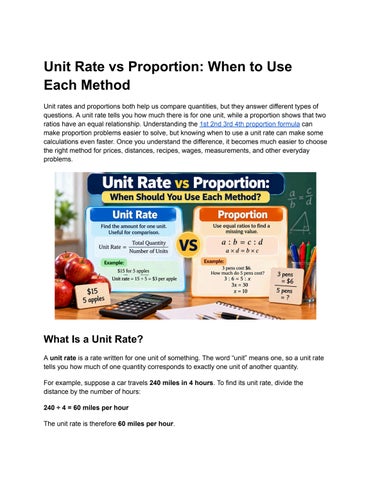
Unit Rate vs Proportion: When to Use Each Method Unit rates and proportions both help us compare quantities, but they answer different types of questions. A unit rate tells you how much there is for one unit, while a proportion shows that two ratios have an equal relationship. Understanding the 1st 2nd 3rd 4th proportion formula can make proportion problems easier to solve, but knowing when to use a unit rate can make some calculations even faster. Once you understand the difference, it becomes much easier to choose the right method for prices, distances, recipes, wages, measurements, and other everyday problems.
What Is a Unit Rate? A unit rate is a rate written for one unit of something. The word “unit” means one, so a unit rate tells you how much of one quantity corresponds to exactly one unit of another quantity. For example, suppose a car travels 240 miles in 4 hours. To find its unit rate, divide the distance by the number of hours: 240 ÷ 4 = 60 miles per hour The unit rate is therefore 60 miles per hour.
Another common example involves shopping. If a package of 12 bottles costs $18, the cost per bottle is: $18 ÷ 12 = $1.50 per bottle The unit rate makes it easier to compare this product with another package that has a different size or price. Unit rates are especially useful when the question asks for a value per one item, one hour, one mile, one kilogram, or another single unit.
What Is a Proportion? A proportion is an equation stating that two ratios are equivalent. It can be written in the form: a:b=c:d or: a/b = c/d For example: 2 : 5 = 6 : 15 Both ratios have the same value, so they form a proportion. A proportion is useful when you know that two relationships remain consistent and you need to find a missing quantity. You can solve it by using cross multiplication: a×d=b×c For example: 3 : 7 = 12 : x Cross multiply: 3x = 84 Therefore: x = 28 So: 3 : 7 = 12 : 28
Proportions are commonly used in scale drawings, recipe adjustments, conversions, percentages, similar figures, and other situations where one relationship needs to remain constant.
Unit Rate vs Proportion: The Main Difference The biggest difference is the purpose of the calculation. A unit rate converts a comparison into a value for one unit, while a proportion compares two equivalent ratios and is often used to find an unknown value. Imagine a recipe requires 4 cups of flour for 10 cookies. If you simply want to know the flour needed for one cookie, calculate the unit rate: 4 ÷ 10 = 0.4 cups per cookie But suppose you want to make 25 cookies while keeping the recipe unchanged. A proportion is useful: 4 : 10 = x : 25 Cross multiply: 10x = 100 x = 10 So you need 10 cups of flour. Both approaches involve ratios, but they serve different purposes. The unit rate reduces the relationship to one unit, while the proportion extends the relationship to another quantity.
When Should You Use a Unit Rate? A unit rate is generally the simpler option when you need to compare prices, speed, productivity, or quantities on a one-unit basis. ● ● ● ● ● ● ●
Price comparisons: Find the cost per item, ounce, kilogram, or other unit. Speed: Find miles per hour or kilometers per hour. Pay: Find earnings per hour. Production: Find items made per hour or day. Fuel efficiency: Compare miles per gallon or kilometers per liter. Measurements: Convert a quantity to a per-unit value. Shopping: Compare different package sizes using price per item or price per weight.
For example, one store sells 8 notebooks for $12, while another sells 15 notebooks for $19.50. The first store's unit price is: $12 ÷ 8 = $1.50 per notebook The second store's unit price is: $19.50 ÷ 15 = $1.30 per notebook Finding the unit rate makes the comparison straightforward because both prices are expressed on the same basis.
When Should You Use a Proportion? A proportion is more useful when you need to scale a known relationship to a different quantity. The key idea is that the relationship between the values stays the same. ● ● ● ● ● ● ●
Recipes: Adjust ingredient quantities for more or fewer servings. Maps: Convert map distances into real-world distances. Scale models: Determine the real size of an object from its model. Similar figures: Find an unknown side length. Conversions: Solve relationships between equivalent quantities. Percent problems: Find an unknown amount when the ratio is known. Work and production: Estimate output when the rate remains constant.
For example, a map uses a scale of 1 inch = 20 miles. If two locations are 4.5 inches apart on the map, you can use: 1 : 20 = 4.5 : x Cross multiply: x = 90 The actual distance is 90 miles. You could also use a unit rate because the scale already tells you the value per inch. In fact, this shows that unit rates and proportions are closely related. A unit rate can sometimes provide the information needed to set up a proportion.
How Unit Rates and Proportions Are Connected A unit rate can often be viewed as the first step toward solving a proportion problem. Suppose a cyclist travels 150 miles in 5 hours.
The unit rate is: 150 ÷ 5 = 30 miles per hour Now suppose you want to know how far the cyclist would travel in 8 hours. You can use the unit rate: 30 × 8 = 240 miles Or you can use a proportion: 150 : 5 = x : 8 Cross multiply: 5x = 1200 x = 240 Both methods produce the same answer because they represent the same constant relationship. This connection is important because it shows that neither method is always separate from the other. The better choice depends on how the problem is presented and what information you need.
Unit Rate Example: Comparing Products Suppose a 6-pound bag of rice costs $9.60, while a 10-pound bag costs $14.50. The first unit rate is: $9.60 ÷ 6 = $1.60 per pound The second unit rate is: $14.50 ÷ 10 = $1.45 per pound Expressing both products as a price per pound gives you a fair comparison. A proportion could also be used if you wanted to find the expected price of one package based on the price per pound. However, the unit rate is the more direct method when the goal is simply to compare cost per unit.
Proportion Example: Adjusting a Recipe
Suppose a recipe uses 3 cups of rice for 5 servings, but you need enough for 12 servings. Set up the proportion: 3 : 5 = x : 12 Cross multiply: 5x = 36 x = 7.2 You need 7.2 cups of rice to maintain the same ratio. You could first find the unit rate: 3 ÷ 5 = 0.6 cups per serving Then multiply: 0.6 × 12 = 7.2 cups Again, both methods work. The proportion simply keeps the original relationship visible throughout the calculation.
Common Mistakes When Choosing a Method One common mistake is using a unit rate when the problem actually asks you to maintain a relationship between two sets of quantities. Another is setting up a proportion when a simple division would answer the question immediately. For example, if a question asks, “What is the cost per notebook?” you usually do not need a full proportion. Divide the total price by the number of notebooks. But if the question asks, “How much would 25 notebooks cost at the same rate?” you can use either a unit rate or a proportion. Always pay attention to the wording. Phrases such as “per one,” “each,” “per hour,” and “per pound” often point toward a unit rate. Phrases such as “at the same rate,” “in the same ratio,” “how many,” and “what is the missing amount” may indicate that a proportion is useful.
Can a Proportion Calculator Help? A proportion calculator is useful when you already know that a problem involves equivalent ratios and want to find a missing term. You can enter the three known values in their correct positions and solve for the fourth.
This can be especially helpful with fractions, decimals, large values, or multi-step calculations where arithmetic mistakes are easy to make. However, identifying whether a problem should be solved with a unit rate or a proportion still requires understanding the question first. For learning purposes, it is often helpful to solve the problem manually and then use the calculator to verify the result. This reinforces the relationship between the numbers rather than turning the calculator into a substitute for understanding.
Unit Rate and Proportion in Real Life Both methods appear frequently outside mathematics classrooms. A shopper uses unit rates to compare grocery prices, a driver uses rates to think about distance and time, and a contractor may use proportional relationships when adjusting measurements. Teachers may introduce unit rates through shopping and speed examples because the idea of “per one” is easy to visualize. Proportions often become more useful when students move into scale drawings, percentages, geometry, and algebra. Learning both methods gives you more than one way to approach a problem. It also helps you recognize that many everyday comparisons are based on the same underlying mathematical ideas.
Final Takeaway The easiest way to distinguish the two methods is to ask what the problem is trying to find. A unit rate tells you the amount for one unit, such as dollars per item or miles per hour. A proportion shows that two ratios are equal and is especially useful when you need to extend or preserve a relationship. When a problem asks for a “per one” value, start by considering a unit rate. When it asks you to maintain the same ratio and find an unknown quantity, a proportion may be the better approach. Understanding both methods—and knowing how they connect—makes ratio and proportion problems much easier to solve accurately.