The Meaning Behind Popular Spanish Nicknames
Spanish nicknames can reveal a lot about affection, friendship, family, and culture. Some are simple shortened versions of a person’s name, while others have surprising histories that are difficult to guess from the original name. If you want to read more about meaningful names and creative nickname ideas, NamesNicknames is a useful place to explore different types of nicknames for names, relationships, friends, and family.
What Are Spanish Nicknames Called? In Spanish, a nickname can be called an apodo, while a familiar or affectionate form of a given name is often called a hipocorístico. These forms are common in Spanish-speaking communities and can make a person's name sound more casual, friendly, or affectionate. A nickname does not always have a direct English-style equivalent because Spanish naming traditions have developed their own patterns over many generations. For example, someone named Alejandro may commonly be called Ale, while Nicolás can become Nico and Rafael can become Rafa. These forms are easy to recognize because they usually keep part of the original name while making it shorter and easier to say. Spanish
nicknames can also vary by country, family, age, and personal preference, so one person may have several forms of the same name.
Why Are Nicknames So Important in Spanish Culture? A nickname is often more than a shorter name. It can communicate familiarity, affection, friendship, humor, or a sense of belonging. Calling someone by a nickname can make a conversation feel warmer, particularly when the nickname has been used by family members or close friends for years. This is especially noticeable with Spanish diminutives. Endings such as -ito and -ita can make a word or name sound smaller, softer, cuter, or more affectionate. For example, Carlos can become Carlitos, Luis can become Luisito, and Ana can become Anita. These forms are not simply about physical size; depending on context, diminutives can express affection and familiarity.
Common Ways Spanish Nicknames Are Created Spanish nicknames are formed in several interesting ways. The simplest method is shortening the original name, but speakers can also add sounds, use diminutive endings, combine two names, or create a completely different familiar form. This variety is one reason Spanish nicknames can be so interesting for people learning the language.
Shortened Spanish Names Shortening is one of the easiest ways to create a Spanish nickname. The speaker removes part of the original name while keeping enough of it to remain recognizable. This creates familiar forms that are often quick to say in everyday conversation. Some popular examples include: ● ● ● ● ● ● ● ● ● ● ● ● ●
Alejandro → Ale Adrián → Adri Carolina → Caro Cristina → Cris Eduardo → Edu Federico → Fede Fernando → Fer Francisco → Fran Guillermo → Guille Isabel → Isa Manuel → Manu Nicolás → Nico Rafael → Rafa
● Santiago → Santi ● Sofía → Sofi These popular Spanish nicknames are useful examples of how a long formal name can become a short and friendly everyday name. The result often sounds natural among friends, classmates, coworkers, and family members.
Spanish Nicknames With -Ito and -Ita One of the most recognizable features of Spanish nickname culture is the use of diminutive endings. -ito is commonly used with masculine forms, while -ita is commonly used with feminine forms, although actual usage depends on the word and context. For example, Pablo can become Pablito, Pedro can become Pedrito, and Amparo can become Amparito. These forms can give a name a more affectionate or tender feeling, which is why they are especially common when speaking to children or someone close to you. Diminutives are also much broader than personal names. Spanish speakers can use them with ordinary nouns and adjectives to express affection, familiarity, softness, humor, or other shades of meaning. Their exact feeling can change according to the situation and the speaker's relationship with the person.
Popular Spanish Nicknames With Surprising Origins Some of the most interesting Spanish nicknames are not obvious shortened versions of their original names. Pepe and Paco are famous examples. Their connection to José and Francisco is not immediately clear, which makes their histories particularly interesting. Traditional explanations connect these nicknames with religious Latin expressions. Pepe is associated with Pater Putativus, referring to Saint Joseph, while Paco is linked to Pater Comunitas, associated with Saint Francis of Assisi. These explanations help show why some Spanish apodos cannot be understood simply by looking at the spelling of the original name. Other examples are easier to recognize but still show how creative Spanish naming can be. Lola is associated with Dolores, Nacho with Ignacio, Quique with Enrique, and Pancho with Francisco. Some of these forms have changed so much over time that their connection to the original name may not be obvious to someone unfamiliar with Spanish naming traditions.
Romantic Spanish Nicknames and Terms of Endearment Spanish is also well known for affectionate expressions used between romantic partners, close friends, and family members. These are not always traditional nicknames based on a person's
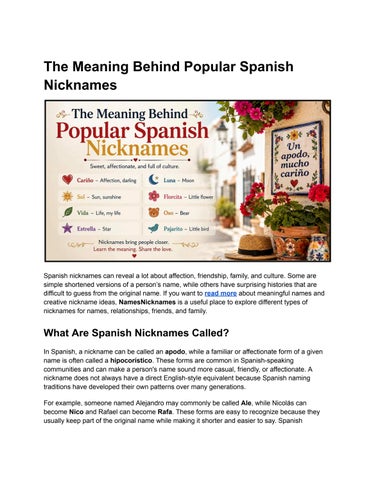
given name. Instead, they can describe affection, closeness, personality, or the importance of the relationship. Some popular Spanish terms of endearment include cariño meaning “darling” or “dear,” amor meaning “love,” mi vida meaning “my life,” corazón meaning “heart,” and tesoro meaning “treasure.” The appropriate expression depends heavily on the relationship and setting, so a phrase that sounds romantic between partners may simply sound warm or friendly in another situation. For couples looking for romantic Spanish nicknames, expressions such as amor, cariño, and corazón can feel warm and personal. Diminutive forms such as amorcito can add an even softer tone. However, regional differences matter, so it is always useful to understand how a nickname is normally used before adopting it.
Spanish Nicknames for Friends and Family Spanish nicknames are not limited to romantic relationships. Friends and relatives often develop informal names based on someone's personality, appearance, habits, childhood memories, or a funny event. This makes Spanish apodos particularly personal because the meaning may be understood mainly by the people who know the individual. A friend might receive a playful nickname because they are always making jokes, while a family member might keep a childhood nickname long after becoming an adult. Some nicknames may also come from animals, physical characteristics, or personality traits. Their meaning can be affectionate in one relationship but inappropriate in another, so context is important.
Regional Differences in Spanish Nicknames Spanish is spoken across Spain and much of Latin America, so nickname traditions are not exactly the same everywhere. Even diminutive endings can vary between regions. While -ito and -ita are widely recognized, other forms such as -ico, -iño, -ino, and -uco can appear in particular areas. For example, -ico has regional use in parts of Spain and several Latin American countries, while -iño has connections with Galicia and -uco is associated with Cantabria. These differences show how Spanish nicknames can carry regional identity as well as affection.
Popular Spanish Nicknames to Know If you are looking for a quick collection of familiar Spanish nicknames, these examples are a useful starting point: ● Ale — Alejandro ● Caro — Carolina
● ● ● ● ● ● ● ● ● ● ● ● ● ● ● ●
Cris — Cristina Dani — Daniel Fede — Federico Fran — Francisco Gabi — Gabriel Isa — Isabel Juli — Julieta Lola — Dolores Manu — Manuel Nacho — Ignacio Nico — Nicolás Paco — Francisco Pepe — José Rafa — Rafael Santi — Santiago Sofi — Sofía
These examples demonstrate that there is no single formula for creating a Spanish nickname. Some are shortened naturally, some use affectionate endings, and others have developed through historical or cultural traditions.
How to Choose the Right Spanish Nickname Choosing a Spanish nickname should depend on the person's name, personality, relationship, and the situation in which you plan to use it. A shortened name such as Nico or Sofi is generally easy and casual, while a diminutive such as Carlitos or Anita may feel more affectionate. For romantic relationships, consider names that communicate warmth without sounding forced. For friends, playful or personality-based apodos can feel more natural. If you are choosing a nickname for a child, soft diminutives can be a good option, while family nicknames often work best when they have a personal story behind them. It is also important to remember that some Spanish nicknames or descriptive apodos can have different meanings depending on the country and relationship. A word that sounds friendly in one Spanish-speaking community may not carry exactly the same feeling elsewhere. When in doubt, choose a simple nickname based on the person's name or use a familiar term of affection that fits the relationship.
Final Thoughts The meaning behind popular Spanish nicknames goes far beyond simply making a name shorter. From Ale, Nico, and Rafa to affectionate forms such as Carlitos and Anita, Spanish naming traditions show how language can express closeness and personality. More unusual
examples such as Pepe and Paco also reveal the historical and cultural stories hidden inside everyday names. Whether you are learning Spanish, choosing a nickname for a loved one, or simply interested in Spanish nicknames and their meanings, understanding the background can help you choose a name that feels natural rather than random. For more ideas covering Spanish names, romantic nicknames, cute names, funny nicknames, and nicknames for different relationships, NamesNicknames offers a growing collection to explore.