Have yourself a very
S A M T S I R H C E G VINTA Christmas Grotto,* family activities and so much more! *Booking essential
FOR BLETCHLEY PARK TRUST Chief Executive Officer: Iain Standen Director of Public Engagement: Rebecca Foy Press & PR Manager: Lauren Theodosi Supporter Engagement Manager: Sue Litchfield Marketing and Communications Officer: Christina Farley Magazine design by: Owen Bevan Bletchley Park Trust Ltd The Mansion Bletchley Park Milton Keynes MK3 6EB Tel: +44 (0) 1908 640404 Friends and Veterans’ Office: Tel: +44 (0) 1908 272652 Email: friends@bletchleypark.org.uk bletchleypark.org.uk Front cover images and right-side image courtesy of Will Amlot. Available digitally and in print. Printed in England. © Bletchley Park Trust 2026 All images © Bletchley Park Trust unless otherwise stated. While every effort has been made to seek clearance, some omissions may occur.
3
CONTENTS
WELCOME LETTER
WELCOME LETTER
4
BRIEFING
5
IAIN’S UPDATE
9
COLLECTIONS UNCOVERED: ALLON BACON
TELFORD TAYLOR
10
14
GORDON WELCHMAN: ARCHITECT OF ULTRA 16 INTELLIGENCE?
4
T
hank you for joining us for the Autumn/Winter edition of ULTRA. You’ll notice a UK-USA thread throughout, following the launch of the American Friends of Bletchley Park – an opportunity for USA followers to support Bletchley Park in telling the story of the WW2 Allied Codebreakers. Highlights in this edition include Research Officer Dr Thomas Cheetham on the life of American lawyer turned Codebreaker Telford Taylor (p14-15), and a look into whether Gordon Welchman really was the architect of Ultra, as part of the ongoing myth-busting series (p16-17). You’ll be able to catch up on what happened this summer at Bletchley Park, including an award win, a festival, an important annual lecture and ongoing restoration work to ensure Bletchley Park’s future. Vicki Pipe, Head of Audience and Programmes, takes you on a musical journey across wartime Bletchley Park (p18-19). We also take a look forward and share plans for two new major exhibitions which will transform Block B over the next three years (p20-21).
THE SOUNDTRACK OF BLETCHLEY PARK
18
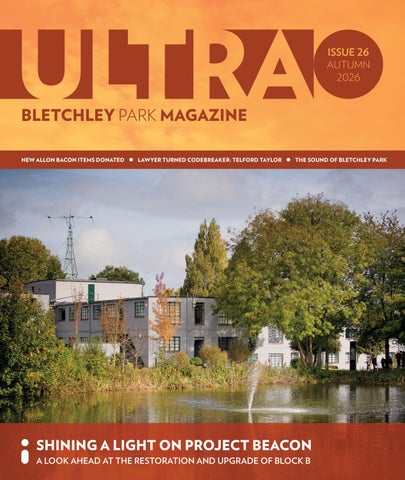
A LOOK AHEAD: PROJECT BEACON
If you’ve been enjoying ULTRA for a while, don’t forget your membership benefits which include a discount in the shop and onsite cafés plus savings on tickets to public programme events.
20
MY BLETCHLEY: CLARE MULLEY
22
You can also gift a membership to someone who’d love to feel part of the Bletchley Park story too. Every membership, new or gifted, helps Bletchley Park Trust continue to preserve this remarkable site and tell its stories for years to come.
INTEL
23
Grab yourself a drink, pop your feet up, sit back and enjoy the issue. - Lauren Theodosi, Editor
BRIEFING BLETCHLEY PARK HOSTS FIRST-EVER GCHQ ANNUAL LECTURE
NEW RESEARCH IDENTIFIES DOZENS MORE NAMES INVOLVED IN WW2 CODEBREAKING
Hundreds of people from the world of intelligence attended the first-ever GCHQ Annual Lecture, held at Bletchley Park.
New research from Bletchley Park Trust has identified dozens of Polish Codebreakers who contributed to the work at Bletchley Park during WW2. Around 100 UK-based Polish personnel were carrying out work on behalf of Bletchley Park between 1940 – 1945 as part of the Polish Armed Forces in the West.
EVENTS
Delivered by Director of GCHQ Anne KeastButler, the lecture in May highlighted the role of the intelligence organisation, formerly at Bletchley Park and now based in Cheltenham, in helping the UK in “seeing around corners” to inform its defences. Bletchley Park Trust CEO Iain Standen commented on the significance of holding the event at Bletchley Park. In his speech at the event, he said: “During World War Two, Bletchley Park was the location of the Government Code & Cypher School, and, as a memo dated 21st February 1940 stated: “The official designation of the establishment will, in future, be ‘Government Communications Headquarters’; this should be sufficient explanation for the curious…” It therefore feels entirely fitting that this inaugural GCHQ Annual Lecture is taking place here, where collaboration, ingenuity, and partnership were crucial in the face of adversity. These are values that remain as relevant today as they were then.”
Anne Keast-Butler speaking at the first annual GCHQ Lecture in May
EVENTS
So far, the names of 27 Polish Codebreakers and signals intelligence (sigint) workers have come to light and added to the Roll of Honour, with dozens more expected to follow. The research was prompted by the story of Ferdynand Vanke, known as Fred, a 103-year-old former Polish Codebreaker who served at Boxmoor, a Polish sigint station near Hemel Hempstead which supported Bletchley Park. Vanke joined hundreds of visitors in July to attend the first Polish Codebreaking Festival at Bletchley Park. The event coincided with the 87th anniversary of the Pyry Conference, where Polish cryptologists invited French and British counterparts, including Alastair Denniston and Dilly Knox, to share their pioneering success in breaking the German Enigma machine cipher.
Polish Codebreaking Festival 2026
5
BRIEFING AMERICAN FRIENDS LAUNCHES IN NEW YORK NEWS
Bletchley Park’s story has always been a shared one. British and American Codebreakers worked side by side when the site was under extraordinary secrecy during WW2, forging an intelligence partnership - the “Special Relationship” - that began with a meeting at the Bletchley Park Mansion in February 1941. That legacy was celebrated at SPYSCAPE, the interactive and immersive spy museum, in New York with the launch of American Friends of Bletchley Park, a new USA non-profit giving American supporters a direct way to help preserve the site. Thomas L Kempner Jr, President of American Friends of Bletchley Park, was joined by distinguished national security figures, including board member Admiral Michael S Rogers, USN (Ret.), for an evening marking the occasion. Bletchley Park Trust Director of Development Laura Stoker said: “The launch of American Friends of Bletchley Park marks an exciting new chapter for Bletchley Park. Time and again, we’ve seen just how
6
strong American interest in Bletchley Park’s story is, so creating a direct channel for that support in the US felt like a natural next step. We are especially grateful to Tom Kempner, whose leadership was instrumental in making the launch such a success. The strength of the response confirms the appetite for our mission on both sides of the Atlantic and marks the beginning of a more sustained approach to fundraising for the Trust going forward.” Find out more by visiting: https://americanfriends.bletchleypark.org.uk/
Left to right: Thomas L Kempner Jr, Sir John Scarlett KCMG OBE, Iain Standen, Jacqueline De Rojas CBE, Admiral Michael S Rogers, Avril Haines, Wendy Noble
4
BRIEFING BLETCHLEY PARK SCOOPS SILVER IN PRESTIGIOUS VISIT ENGLAND AWARD WIN NEWS
Bletchley Park has been named as one of England’s outstanding visitor destinations after winning Silver in the Large Visitor Attraction of The Year category in 2026’s VisitEngland Awards for Excellence. The win recognises the truly memorable visitor experience Bletchley Park, which has been open to the public since 1994, delivers across every aspect of its operation, including its innovative and thoughtprovoking exhibitions which help tell the story of the Allied Codebreakers of WW2. Rebecca Foy, Director of Public Engagement at Bletchley Park Trust, said: “We are beyond proud to have been awarded Silver and to be recognised as one of the best visitor attractions across England. As an independent museum and charity, for Bletchley Park to place in the Large Visitor Attraction category is recognition of the work of the staff and volunteers of Bletchley Park Trust, front of house or behind the scenes, to provide the best visitor experience possible.” Book your visit here: https://www.bletchleypark.org.uk/plan-a-visit/ NEWS
Duty Manager Chloe West and Learning Officer Andrew Fryer posing with the Silver Award for Large Visitor Attraction of The Year 2026
INVESTING IN THE FUTURE OF BLETCHLEY PARK
A grant from the Department for Culture, Media and Sport (DCMS) Museum Estate and Development (MEND) fund, administered by Arts Council England, is helping secure the Mansion’s future as part of Bletchley Park’s wider commitment to sustainability and long-term site viability. Work already completed includes the removal of asbestos from the roof voids, opening up access for essential maintenance that had long been restricted. A new access system and urgent stonework and roof repairs - both nearing completion - will further protect the building from water damage for years to come. Looking ahead, Air Source Heat Pumps are being installed in the Mansion and Block E, replacing outdated oil boilers with a low-carbon alternative sensitively designed to preserve the listed building’s character. Read about more changes planned at Bletchley Park on pages 20-21. 7
Stay insured. Help make roads safer. There are 335,000 uninsured vehicles on UK roads on any given day. MIB is a not-for-profit organisation based in Milton Keynes. For 80 years, we have been compensating victims of uninsured and untraced collisions and making our roads safer by reducing uninsured driving. Read our top tips to stay safe and legal on the road.
Your car insurance checklist 1
Are your details correct?
Always double-check everything on your policy documents and notify your insurer of any changes in personal details or circumstances straight away.
2
What are you using your car for?
Make sure your policy matches how you’ll use your vehicle. Commuting is not always included as standard and if you are driving for work, you’ll need business or even maybe hire-and-reward cover.
3
Are your payments up to date?
A single missed payment can cancel your insurance. Keep an eye on bank alerts and emails from your insurer. If you’d prefer to auto-renew, make sure this is enabled.
4
Can you drive someone else’s vehicle?
‘Drive other vehicle’ cover is often not included as standard and may come with restrictions. If you need to borrow a car, consider a short-term policy.
5
Are you really the main driver?
It’s a misconception that you can list a more experienced driver as the main policyholder to save money, but this is a type of fraud, known as fronting.
Scan or head to mib.org.uk to understand the cover you need and check you are insured.
IAIN’S UPDATE
A
s we move into autumn, it feels a good moment reflect on what has been happening this year at Bletchley Park.
The summer brought some real highlights. In June, our first 1940s Weekend of the year welcomed thousands of visitors, and the atmosphere created by our staff and volunteers was heightened by a very special flypast by the Red Arrows. In July, we hosted our inaugural Polish Codebreaking Festival, developed with the Polish Cultural Institute in London, the Polish Embassy and the Enigma Cipher Centre in Poznań, celebrating a vital chapter in the story of breaking into the German Enigma cipher.
It would be remiss of me not to acknowledge that this has been a challenging period for Bletchley Park Trust. The current economic situation has meant that visitor numbers have been lower than we would have wished, and this is a situation experienced by many museums and heritage organisations across the sector. This has made life difficult and has forced some difficult decisions. However, against this backdrop, I remain immensely proud and very grateful for the fantastic staff and volunteers whose professionalism, expertise and goodwill continues to make a trip to Bletchley Park a very high-quality experience for our visitors. Despite the current situation there is much to be optimistic about. Work is well underway on two new exhibitions that will replace the current displays in Block B. These will see a major upgraded and refreshed presentation of two key parts of the Bletchley Park story (p20 and 21). For a heritage attraction, investment of this kind matters; caring for historic buildings protects the place where so much history was made, while fresh experiences give people a reason to visit and return. I would like to thank the various donors who have supported this project, and which will allow us to bring the vision into reality. Boo-letchley (a nod to Halloween) made its debut this October, and it has been wonderful to see so many families enjoying it. For a second time, the National Intelligence History Conference (NIHC) was delivered in the onsite Fellowship Auditorium in collaboration with GCHQ. It featured keynote speakers including Gordon Corera, Sir Richard Moore KCMG and Katja Hoyer, and was a fitting reminder that the history made at Bletchley Park continues to shape the world today. Looking ahead, I am delighted that our Christmas programme returns, this year bringing festive entertainment, costumed characters and seasonal activities across the site. It is a fantastic way to experience Bletchley Park, and I hope many of you will join us. Finally, I would like to thank you for your continued support of Bletchley Park Trust and our mission to attract, engage and educate people from all over the world, and to inspire them with Bletchley Park’s crucial role in World War Two. - Iain Standen, CEO, Bletchley Park Trust
9
COLLECTIONS UNCOVERED
BRINGING
HOME THE BACON Each of the more than 420,000 items in Bletchley Park Trust’s collection tells a story of World War Two history and when Bletchley Park was a secret hub of intelligence. Bletchley Park Trust’s Archivist Dean Annison and Research Historian, Dr David Kenyon talk through the latest donations relating to one of the most prominent Codebreakers.
Norman “Allon” Bacon was a pre-war yachtsman who joined the Government Code & Cypher School in 1939. Later commissioned into the Royal Naval Volunteer Reserve (RNVR), he became responsible for collecting documents of interest to Bletchley Park captured by the Royal Navy. He became personally involved in these captures or ‘pinches’, most notably joining the boarding party of the weather ship Lauenburg in June 1941, and later in October that year boarding the German patrol vessel Föhn as part of the wider commando raid on Vågsøy in Norway. These raids produced codebooks and other material vital to the eventual breaking of German Naval Enigma at Bletchley Park. In later years during World War Two, Bacon travelled to North Africa to supervise commando pinching operations in the Mediterranean, before returning to the UK to oversee the collection of signals intelligence materials in Europe from the retreating German forces after D-Day (an operation known as TICOM). His work throughout the war as Bletchley Park’s “Traveller” made a vital contribution to GC&CS’s ability to break enemy naval codes. More of his story was told in a previous article in the Winter 2023 edition of ULTRA. 10
Top Left: Section 5, Report on Various Liaison Visits and on Duties Outside Naval Section, 1941 to 1945 Bottom Left: Typewritten testimonial for Allon Bacon from Edmund Gerard Noel Rushbrooke, Director of Naval Intelligence. Dated 15 Sep 1946 Top Right: From left to right: Sir Alan Munro, who is Allon Bacon’s son. James Munro, Allon Bacon’s grandson. Bottom Right: Relatives of Allon Bacon
11
COLLECTIONS UNCOVERED Bletchley Park Trust is extremely lucky to have a number of items formerly belonging to Allon Bacon in its museum collection which have been donated by his family - including photographs, memoirs, documents and objects. The Trust first heard from James Munro, Allon Bacon’s grandson, last year. James got in touch with the Collections team saying he “would love to pay a visit to Bletchley Park and bring Allon’s trunk of documents, medals and photos”. During conversations that took place in the months that followed, it was revealed that there were a number of items which would make a significant contribution to help shape our understanding of what life could have been like for those working at Bletchley Park during the war. In October last year, James, his brother and their father – Allon Bacon’s son -, brought the items, some of which are pictured here, to be accessioned (formally accepted into the Bletchley Park Trust’s collections). The more personal items that were donated, including testimonials, a Christmas card and photograph, are fantastic in giving an insight into Bacon’s character. They also confirm his proficiency during his time at Bletchley Park. One particularly significant item from the donation is a document entitled ‘Report on Various Liaison Visits and on Duties Outside Naval Section, 19411945’ written and sent by Allon Bacon to Frank Birch, Deputy Director of Naval Section, and dated 11 July 1945. Donated items are occasionally incomplete. For example, the featured report pictured overleaf is missing sections one and six. Despite this, it offers a fascinating look into ‘pinchery’ and the details of particular operations which were beneficial to 12
GC&CS during the War. Interestingly, the top of the cover page has been cut off which has led to the theory that this previously was marked as either “SECRET” or “MOST/TOP SECRET” and Bacon wanted to hide the fact that he had held on to such an important report, which he really shouldn’t have kept. During this initial visit the Trust was also shown a number of other items not previously seen but clearly of interest for our collection. These were left with the Collections team so a final decision could be made on whether to accept them. Such decisions aren’t made by one person; they rest with a group that meets fortnightly to discuss potential donations. In July 2026, Bletchley Park welcomed a large contingent of Allon Bacon’s family, who brought in the remaining accepted items, formally signed the paperwork to complete the donation, and shared stories about Allon with Bletchley Park staff. Among the items were more photographs and documents, along with handwritten notes by Allon relating to his work here — a fantastic resource for future research, not least because he was involved in several dramatic and important events in WW2 codebreaking, and we now have an account of them in his own words - Museum Archivist, Dean Annison and Research Historian, Dr David Kenyon
TOP SECRET
Top Left: Cover page, Report on Various Liaison Visits and on Duties Outside Naval Section, 1941 to 1945 Bottom Right: Typewritten letter to Allon Bacon from the Admiralty informing him of the award of an OBE for Distinguished Service during the War in Europe, 1 Jan 1946
13
TELFORD TAYLOR THE LAWYER WHO HELPED ESTABLISH ANGLOAMERICAN INTELLIGENCE LIAISON AND LATER PROSECUTED NAZI WAR CRIMINALS Telford Taylor was an American lawyer and intelligence officer who played a key role in establishing effective intelligence cooperation between Bletchley Park and the US Army. Born in 1908, Taylor received his degree from Harvard Law School in 1932, and spent the 1930s acting as legal counsel for several US Government agencies; entering intelligence in 1942. He first came to the UK in early 1943 alongside Colonel Alfred McCormack, the head of US Army Intelligence ‘Special Branch’, and leading American cryptographer William F Friedman, to establish a formal framework for how the US Army would cooperate with Bletchley Park (following a separate naval agreement reached the previous year). The BRUSA (‘Britain-USA’) agreement, which was signed on 17 May, owed much to Taylor’s levelheaded approach to negotiations, he recognised that a workable compromise now could lead to closer partnership later, which would ultimately benefit the Americans. The most important result of the agreement was that the British took the lead on German codebreaking and the Americans on Japanese; but this did not mean the War Department (the government department responsible for the US Army) lacked interest in operations in the United Kingdom and Europe. 14
McCormack and Friedman returned to the US, but after a stint in London, Taylor went to Bletchley Park at the end of July 1943. There he was concerned not with codebreaking – which was tackled by a US Signal Corps unit, 6813 Signals Security Detachment, which arrived in September – but with ensuring that the Americans got their fair share of Ultra intelligence. There were always figures in Washington who suspected that they would be sidelined and deprived of the intelligence they needed and deserved by dint of their burgeoning contribution – in personnel and technology – to the signals intelligence effort against Germany. For their part, some on the British side doubted whether it was safe to share intelligence with the Americans given their reputation for lax security. Handsome, urbane and self-assured without being brash, Taylor proved the right man to smooth over disagreements during the following months, ensuring that the BRUSA agreement worked in practice and undercurrents of distrust were not allowed to disrupt the productive working relationships established at Bletchley Park. One of the most important ways Taylor did this was by ensuring that US commands were fully equipped to handle and exploit the Ultra intelligence they received. To complement the Special Liaison Units which delivered intelligence from Hut 3, manned and managed by the British, the Americans also
HEROES OF BLETCHLEY PARK
“The human rights movement owes much of its legal foundation to the work of Gen. Telford Taylor” -The Nation Magazine, 1995
perceived a need for what they called Signals Security Officers (SSOs) or ‘Ultra Representatives’. It was thought necessary for material from this new and obscure source to be presented to the rest of the intelligence staff and the commander by an American expert who could “advise and act as liaison officer to overcome difficulties that may arise in regard to differences in language”. Twenty-four SSOs, most also lawyers by trade, were hand-picked by Jim Rose, an experienced Hut 3 intelligence officer whom Taylor arranged to visit the United States, and then trained by Taylor at Bletchley Park. To handle the selection of decrypts for the War Department, in late 1943 Taylor set up a cell within Bletchley Park’s Hut 3, known as ‘3-US’. Because of their appreciation for the needs of American commands, they also participated in the normal activities of the Hut, like indexing, drafting signals
and deciding on routing, and so provided valuable reinforcement to the British analysts. Eventually 3-US numbered sixty-eight (including the SSOs), and Taylor was kept busy coordinating the work of his unit across Bletchley Park, as well as outside it. He therefore laid much of the groundwork for the special intelligence relationship which still exists between the UK and USA to this day. During the closing stages of the war, however, Taylor turned his attentions towards the planned prosecution of Nazi war criminals. He would serve as an assistant to the Chief Prosecutor in the main Nuremburg Trial, and Chief Prosecutor in the Subsequent Trials, which lasted until 1948. After returning to the United States Taylor practiced law and later became a university professor. He died in 1998. - Dr Thomas Cheetham, Research Officer 15
GORDON WELCHMAN: ARCHITECT OF ULTRA INTELLIGENCE? THE FOUNDING HEAD OF BLETCHLEY PARK’S HUT 6 WAS A PIVOTAL FIGURE, BUT HAS AN INFLATED REPUTATION OVERSHADOWED HIS TRUE ACHIEVEMENTS?
Gordon Welchman remains a giant of Bletchley Park. Recruited when war broke out, from Sidney Sussex College, Cambridge, the mathematician set up and directed the effort against German army and air force Enigma ciphers in Hut 6. Later in the war he moved into senior management as Assistant Director (Mechanisation), overseeing machine operations in support of codebreaking across Bletchley Park and its Outstations. Along the way he made crucial personal contributions, not least inventing the ‘Diagonal Board’ which transformed the Bombe machines, originally conceived by Alan Turing, into effective cryptanalytic devices which could support the large-scale breaking of Enigma ciphers. Significantly, Welchman was junior enough that he survived to write about Bletchley Park once it became public knowledge in the 1970s, yet senior enough to have important things to say about it. When published in 1982, The Hut Six Story was the first detailed account of how Enigma was broken and inevitably became one of the foundational texts for the historical understanding of Bletchley Park. The details of cryptanalysis – even if distorted by memory – earned Welchman official censure, the cancellation of his security clearances and the loss of his consultancy on communications security at Mitre Corporation, which he found personally devastating. Nevertheless, he had cemented his name in the annals of wartime codebreaking’s greatest achievement. 16
Welchman’s prominence, however, means his contribution has been conflated with other aspects of the popular perception of the Bletchley Park story. There is a natural tendency to assume that the breaking of German machine ciphers was the result of a concerted plan, even though luck and happenstance also played their parts. It is also increasingly understood that Bletchley Park owed much of its success to good organisation and the factory-style system which came about; and to imagine that this was planned out from the beginning is more narratively satisfying than the reality that the agency grew piecemeal and organically, with nobody in full control. This means the claims made for Welchman’s contribution extend far beyond his codebreaking work: frequently he alone is credited with conceiving the production line of interception, cipher-breaking, message translation and intelligence dissemination. As one biography describes him, with reference to the later codename for information derived from the breaking of Axis high-grade ciphers, he was the “architect of Ultra intelligence”. The roots of the Welchman legend stem from the earliest period of his war – which naturally stuck in the memory and formed the most important section of The Hut Six Story. On arriving at Bletchley Park, the day after Britain declared war on Germany – 4 September 1939 – he reported to Chief Cryptographer Alfred “Dilly” Knox, whose
MYTHBUSTING Enigma Research Section was working in the prewar Cottages. Knox soon sent Welchman to the newly-requisitioned Elmers School, which lay not far outside the Park’s main gate, to make sense of the available collection of intercepted Enigma messages. Welchman perceived this as a ‘banishment’, but, in reality, Knox well understood that the first step in breaking traffic was to get it organised, which is why he assigned one of his brightest new recruits to the task. Thanks to this early work, Welchman is often credited with developing methods of deriving information from the outside characteristics of messages without breaking them: what later became known as ‘Traffic Analysis’ (TA). However, there are problems with this interpretation. Firstly, Welchman received substantial guidance from others, so it is clear that techniques for categorising traffic were well understood among pre-war Codebreakers. Secondly, what Welchman did was little more than sorting messages into different cipher keys so they could be broken, the procedure Hut 6 later called ‘Registration’. This was essential work but no comparison, in method or outcome, with the complex specialism of TA, which was not a prelude to codebreaking but a source of producing intelligence in its own right. Welchman himself explains in the Hut Six Story that he initially resisted cooperation with Army traffic analysts, seeing their work as a distraction from codebreaking; it was not until TA began to bear fruit in 1941 that, to his credit, he changed tack, lobbying for them to move to Bletchley, where they eventually formed the section called Sixta. Soon after his stint in Elmers School, Welchman seems to have been one of the first to put detailed thought into what would need to be done to exploit the anticipated break of Enigma. He now understood Registration and also appreciated that, to ensure the right messages were intercepted, good coordination with the interceptors at the Y Stations
would be crucial. An Enigma-breaking section, which Welchman naturally hoped to lead, would also need teams to promptly break the cipher keys and decode messages as quickly as possible. Welchman outlined this production line to Edward Travis, the deputy head of the agency who was overseeing the attack on Enigma, in November 1939, and received his approval. Hut 6 assembled even before their namesake wooden hut was completed and were ready to get down to work when the Research Section broke Enigma in January 1940. It is important to stress, however, that Welchman’s plan only dealt with breaking messages; he had nothing to say about translation, intelligence analysis and dissemination. Hut 3, the translation and interpretation section which was paired with Hut 6 (while Huts 8 and 4 handled naval Enigma), was set up at very short notice when the first decrypts appeared, and almost entirely improvised in terms of staffing, internal organisation, security procedures and even its basic terms of reference (the cause of innumerable disputes during the first years of its existence). Nor did anyone at this point have a firm idea about how intelligence would get from Bletchley Park to the end customers, whether in the United Kingdom or at overseas headquarters. Welchman certainly contributed to conversations on these issues later on, becoming notorious for pontificating on policy matters in wordy ‘screeds’ to management, but his chief concern was always with cipher-breaking first and foremost, where he made indispensable contributions. As for the Signals Intelligence system which grew up around Bletchley Park, that was ultimately the combined work of dozens of visionaries, of which Welchman was only one. - Dr Thomas Cheetham, Research Officer
17
The Soundtrack of Bletchley Park Vicki Pipe, Head of Audiences and Programmes, looks at how music was a constant presence at Bletchley Park during World War Two. When you think of Bletchley Park you may envisage the famous wooden huts, containing dozens of sparsely decorated rooms sprawling off long central, dimly lit corridors where Codebreakers are hunched over desks, poring over piles of paper. Perhaps this image is accompanied by the clack of metal typewriter keys, the occasional shrill ringing of a telephone, muffled voices in hushed tones and the dull thud of heeled shoes on wooden floorboards. What you may not imagine is the sound of music produced by the weekly gatherings of the gramophone club, or rehearsals of the Bletchley Park Orchestra. Whilst surprising, music played a huge role in the lives of those who worked at Bletchley Park during World War Two. It was prioritised alongside many other recreational activities as a vital way to maintain morale, boost wellbeing but also enhance many of the skills staff needed to be effective in the varied roles required to intercept, decode and interpret intelligence information. Modern films depicting the wartime era may lead you to believe that big bands, playing Glenn Miller style swing and jazz, would be the most prolific of these musical offerings, and yet Bletchley Park Trust archives tell a slightly different story - with classical music appearing to have taken centre stage. In-house concerts (that is to say those performed by Bletchley Park staff themselves) included opera, orchestral 18
music, chamber music, and string ensembles as well as choral performances. Rehearsals took place within the perimeter of secret operations; we know the Bletchley Park Orchestra, for example, were in the habit of using Hut 12 as there was a piano in permanent situ for that very reason. Concerts themselves, however, were held outside the Bletchley Park boundary just a few yards down the road from the Park’s main wartime entrance at the purposebuilt Assembly Hall. As such, local residents were also able to attend - what they must have thought of this influx of cultural activity by visiting personnel is unfortunately not documented. The number of these performances were significant. Researcher, author and Bletchley Park volunteer Harold Liberty has found evidence of 34 different concerts performed by the Bletchley Park Music Society throughout the wartime years. External organisations supported Codebreakers’ creativity
Pamphlet of Bletchley Park Recreational Club
FEATURE with additional productions including the Council for the Encouragement of Music and the Arts (CEMA), now the Arts Council England, who enabled showcases by celebrity artists like the soprano Isobel Bailey, the pianist Dame Myra Hess, and the Jacques String Orchestra. So, why were Bletchley Park Codebreakers such a musical bunch? There are a few theories that help to shed some light on this question - the most intriguing of which looks at a comparison between the techniques required of an effective Codebreaker and that of the skills of a musician. The concept of musical notation is so familiar to us that we often forget it is itself a code. The ability to read that code, requires a mind that can, through practice, instantaneously translate symbols on a page into an auditory language; notes on a stave translate into the order that notes are played on a keyboard, or the finger positions on a fret board, or how much breath you apply through the reed of a wind instrument. Taking it a step further, the ability to compose music is to effectively encipher sounds into written codified symbols. It is essentially the same process as enciphering or deciphering written messages, and just like music notation, all you need to know are the
Flyer for Pianoforte Recital by Dame Myra Hess
rules on which that code is created. Once you know the rules you can translate the symbols and read the intelligence. The most notable example of someone with these kinds of transferrable skills is Herbert Murrill. As a Codebreaker, Murrill worked on Japanese ciphers in Block F between 1943 and 1945. As a musician, he was a talented and well-respected composer who worked with artists such as W.H. Auden and Benjamin Britten, to name but a few. He played a leading role in the musical life of Bletchley Park, as the conductor of the previously mentioned Bletchley Park Orchestra, but also using his contacts at the BBC to arrange recitals by touring artists. Such was his standing as a musician he later became Head of Music for the BBC post-war. Although not immediately obvious the role music and the arts played at Bletchley Park is one that should not be overlooked. Far from a site filled solely with serious, silent, mathematical types, Bletchley Park was a place of musical sounds and dramatic creativity which not only lifted the spirits of those who worked there but equally enhanced their codebreaking activities. - Vicki Pipe, Head of Audiences and Programming
Herbert Murrill and family, 6th July 1943
19
PROJECT Putting the spotlight on two key Bletchley Park stories in planned new exhibitions. Over the course of 1938-46, during World War Two, seemingly ordinary folk came together to solve outwardly impossible problems, developing new ways of thinking that helped the Allies to victory. Years later, when Bletchley Park Trust formed in 1991, it continued that spirit of creative excellence in its mission to preserve, share and bring once top-secret stories to life for new generations to discover. As part of this mission, an ambitious new capital project is underway at Bletchley Park that will create two major permanent exhibitions, transforming one of the site’s historic buildings. Known as Project Beacon, the initiative will see the restoration and upgrade of Block B, creating space for two landmark exhibitions that explore some of the most important stories connected with Bletchley Park. The ground floor exhibition will be dedicated to Codebreaker Alan Turing whilst the first floor will take a deep dive into encryption. WHY BLOCK B?
When Bletchley Park opened to visitors, Block B was one of the very first exhibitions to tell the story of the site’s history. Decades on, the public’s understanding of that story has grown enormously, not least thanks 20
to the Veterans who have continued to come forward to share their own accounts of the work they did at Bletchley Park. Project Beacon is a chance to bring that new knowledge into the light, drawing on research and material from the Trust’s collection that simply wasn’t available when Block B was first put together. The way visitors expect these stories to be told has moved on too. Within the two new exhibitions you’ll find storytelling that’s interactive, engaging and genuinely innovative, with accessibility in every sense: for those with access needs, as well as being able to follow and connect with the history itself. Plans include a new accessible entrance, upgraded infrastructure and, most significantly, step-free access to all areas in Block B for the first time. CELEBRATING ALAN TURING
Bletchley Park will be the first museum in the world to have a permanent exhibition on the life and work of Alan Turing. A pioneer of his day, Turing’s revolutionary contributions to wartime codebreaking, computing, mathematics and artificial intelligence continue to
BEACON influence society today.
LOOKING AHEAD
The new exhibition will offer visitors the opportunity to discover Turing’s achievements in greater depth, from his wartime role at Bletchley Park and development of the Bombe, through to his groundbreaking ideas about computing and machine intelligence.
Project Beacon represents one of the most substantial developments at Bletchley Park since the completion of the Blocks A and E refurbishment project, which led to the creation of The Intelligence Factory exhibition in Block A, Block E Learning Centre and The Fellowship Auditorium.
Alongside science and innovation, the exhibition will also explore the personal story of a complex and extraordinary individual whose legacy continues to resonate around the world. UNDERSTANDING ENCRYPTION
If codebreaking is at the heart of the Bletchley Park story, then encryption is where that story begins. In a world where data and cyber security is often a topic of conversation, the new encryption exhibition at Bletchley Park will encourage visitors to explore concepts such as codes, cryptography and security, helping to connect the historic story with the technologies that shape everyday life today. Alongside hands-on displays and experiences, visitors will be able to view the the country’s largest display of cipher machines to explain how messages were protected, who designed and operated these systems, and why secure communications were so vital during wartime. The exhibition will also provide new opportunities to support the Trust’s highly successful STEM Learning Programme, inspiring future generations to think creatively about science, technology and innovation.
The project is making good progress, with much planning and design work completed and fundraising for the project well underway. Work continues to bring together the expertise, collections, research and creativity that will shape these exciting new spaces. For visitors, Friends and supporters alike, Project Beacon will ensure that some of the most important stories associated with Bletchley Park are shared in new and engaging ways for decades to come. At the same time, work to improve the building’s utilities and environment will give this Grade II listed building a more efficient and sustainable future. As the project progresses, ULTRA will continue to bring you updates from behind the scenes, introducing the people, stories and activities that will help make these exhibitions a reality. - Erica Munro, Head of Content, and Laura Stoker, Director of Development
21
MY BLETCHLEY determination and true resilience in which thousands of highly skilled women played critical roles in winning and shortening the war - yet many of them are still overlooked and underestimated to this day. Why do you think it’s important to have Bletchley Park as a site people can visit and learn about WW2?
Clare Mulley
ward-winning author Clare Mulley has built her career telling the stories of A women in wartime. Here, she tells us what Bletchley Park means to her.
What fascinates you about Bletchley Park? When I was researching Krystyna Skarbek, the first woman to serve Britain as a special agent during the war, I was delighted to find her Morse and radio transmitting speeds buried in an archive. How incredible, I thought, that this woman not only flew through weapons and sabotage training and ‘excelled’ in the course on silent killing, but could also transmit almost 20 words a minute! Full of admiration, I visited a neighbour who had served at Bletchley Park, to get her take on Skarbek’s skills. “Not very fast,” she told me brusquely. The operators at Y Stations transmitting to Bletchley Park were expected to transcribe Morse at a minimum of 22 words a minute, and some could reach 32! Special agents, I realised, do not have a monopoly on skills and grit. Winning a war requires collective endeavour, and not of all of it comes with loud bangs. Bletchley Park is a story of quiet courage, lateral thinking, deep 22
I love a book, of course, but nothing brings Bletchley Park’s history home better than walking on the same lawns, smiling at the same griffins, and touching the same radiators to see if they are warm, as people once did when they served here. The wonderful displays at Bletchley Park have taught me a lot, but it is the history in the fabric of the buildings that inspires me in a personal sense. Is there a particular story or person that excites you, about Bletchley Park? There are many remarkable stories of the people of Bletchley Park, still deserving greater recognition. We should all know the names and stories of the brilliant Polish mathematician and cryptanalyst Marian Rejewski, for example, and of Tommy Flowers - the postal worker who created the Colossus. But I am most fascinated by the mathematicians such as Margaret Rock and Mavis Lever who helped decrypt German Enigma messages and Italian naval codes. You took part in Bletchley Park’s Polish Codebreaking Festival this year, how was that for you? What I really loved about this festival is how it told a story of joint endeavour; Brits, French and Poles, men and women, serving alongside each other for the cause of freedom. The Enigma story, and the story of Bletchley Park more widely, really embodies this collective effort, which is all too often forgotten.
INTEL
EXCLUSIVE EVENTS COMING UP FOR FRIENDS OF BLETCHLEY PARK
ENIGMA DEMONSTRATIONS Saturday 28 November 2026, 14.00 | Saturday 13 March 2027, 14.00 Learn all about the workings of a real wartime Enigma machine with an in-person demonstration from a Bletchley Park Trust expert. Debunk the myths and get to grips with the eccentricities of a machine that the German Army used to encrypt and decrypt messages during World War Two. The event includes a talk and demonstration of using an Enigma followed by a question and answer session.
1940S WEEKEND Saturday 19 June and Saturday 25 September 2027, 14.00-16.00 1940s Weekend will be back for 2027 with two chances to come along and experience the sights, sounds, and spirit of the decade. A weekend of opportunity where visitors can learn to swing dance to a live band, sing along to timeless melodies and find a vintage gem amongst specialist retailers.
From 14.00 to 16.00 on Saturday 19 June and Saturday 25 September, come along for tea, cake and chatter, and relax away from the crowds. Vintage dressing is optional. Simply show your membership card to a team member to access the exclusive Friend Area. Please note: These events are subject to change and extra events will be added during the year. Further details will be sent in the Friends’ monthly e-news. To register for these events please email friends@bletchleypark.org.uk or call 01908 272652
Friends of Bletchley Park are entitled to 10% discount in the onsite shop, catering outlets and public lectures in the Fellowship Auditorium. Keep a lookout on our website for upcoming events.
23 Credit: James Owen Photography
AFTERNOON TEA AT BLETCHLEY PARK Book online or contact us on 01908 640404
Please note: Some items may be substituted, depending on ingredient availability
Sit back, relax and enjoy delicious food and drink served in the Mansion at Bletchley Park. Friends enjoy 10% discount