FLEXX YOUR BUNKER
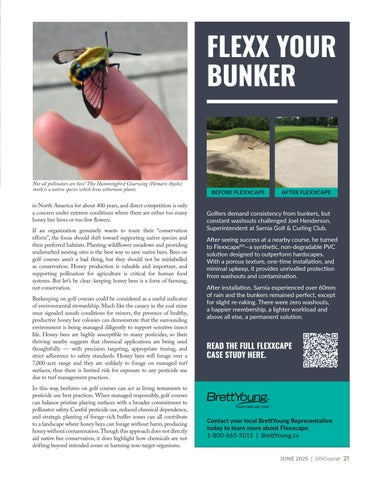
Not all pollinators are bees! This Hummingbird Clearwing (Hemaris thysbe) moth is a native species which loves viburnum plants.
in North America for about 400 years, and direct competition is only a concern under extreme conditions where there are either too many honey bee hives or too few flowers. If an organization genuinely wants to toute their “conservation efforts”, the focus should shift toward supporting native species and their preferred habitats. Planting wildflower meadows and providing undisturbed nesting sites is the best way to save native bees. Bees on golf courses aren’t a bad thing, but they should not be mislabelled as conservation. Honey production is valuable and important, and supporting pollination for agriculture is critical for human food systems. But let’s be clear: keeping honey bees is a form of farming, not conservation. Beekeeping on golf courses could be considered as a useful indicator of environmental stewardship. Much like the canary in the coal mine once signaled unsafe conditions for miners, the presence of healthy, productive honey bee colonies can demonstrate that the surrounding environment is being managed diligently to support sensitive insect life. Honey bees are highly susceptible to many pesticides, so their thriving nearby suggests that chemical applications are being used thoughtfully — with precision targeting, appropriate timing, and strict adherence to safety standards. Honey bees will forage over a 7,000-acre range and they are unlikely to forage on managed turf surfaces, thus there is limited risk for exposure to any pesticide use due to turf management practices. In this way, beehives on golf courses can act as living testaments to pesticide use best practices. When managed responsibly, golf courses can balance pristine playing surfaces with a broader commitment to pollinator safety. Careful pesticide use, reduced chemical dependence, and strategic planting of forage-rich buffer zones can all contribute to a landscape where honey bees can forage without harm, producing honey without contamination. Though this approach does not directly aid native bee conservation, it does highlight how chemicals are not drifting beyond intended zones or harming non-target organisms.
BEFORE FLEXXCAPE
AFTER FLEXXCAPE
Golfers demand consistency from bunkers, but constant washouts challenged Joel Henderson, Superintendent at Sarnia Golf & Curling Club. After seeing success at a nearby course, he turned to FlexxcapeTM—a synthetic, non-degradable PVC solution designed to outperform hardscapes. With a porous texture, one-time installation, and minimal upkeep, it provides unrivalled protection from washouts and contamination. After installation, Sarnia experienced over 60mm of rain and the bunkers remained perfect, except for slight re-raking. There were zero washouts, a happier membership, a lighter workload and above all else, a permanent solution.
READ THE FULL FLEXXCAPE CASE STUDY HERE.
Contact your local BrettYoung Representative today to learn more about Flexxcape. 1-800-665-5015 | BrettYoung.ca JUNE 2025 | ONCourse 21