AUGUST 2026
LOOKING BACK: CONVERSATIONS WITH ONTARIO’S VETERAN SUPERS
WHERE CULTURE TAKES ROOT
HIGH ROI IN-HOUSE GC IMPROVEMENT PROJECTS
CANADA GOOSE CONTROL
SUPERINTENDENT HIGHLIGHT: GREG COUTTS
CANADA POST PUBLICATIONS MAIL PUBLICATIONS AGREEMENT NO. 40027105 Postmaster: Please return undeliverable copies to The OGSA, Guelph Turfgrass Institute, G.M. Frost Building, University of Guelph, 364 College Ave E. Unit 3, Guelph ON, N1G 3B9
INSIDE THIS ISSUE Managing Editor Madeleine White projects@ogsa.ca
FROM THE OGSA OFFICE 5
The President’s Message
6
Editorial Committee
7
What’s New
9
OGSA Renews Committment to Turfgrass Research $20,000 Donation to NTRF
FEATURES 11
Advertising & Administrative Manager Courtney White manager@ogsa.ca
GC Highlight & Member Profile Greg Coutts, Fairways at Kirrie Glen
15
In-House GC Improvement Projects Delivering a High Return on Investment
19
Co-Existing With Wildlife Canada Goose Control
23
Where Culture Takes Root Team Building Strategies
26
Looking Back - The Ones Who Came Before Conversations With Ontario’s Veteran Supers
29
Turf or Consequences
INDEX OF ADVERTISERS Almack Agronomic Services Inc. Aquatrols
21 4, 20
aquatrolscompany.com
Belchim Canada
10, 31
belchimturf.ca
Braemar Building Systems
6
braemarbuildings.com
BrettYoung Seeds Ltd.
17
BrettYoung.ca
Flightline Golf Construction 24 flightlinegolf.com
John Deere johndeere.ca
14, 19
Publisher/Editor-in-Chief Courtney White Ontario Golf Superintendents’ Assoc. manager@ogsa.ca
Production & Design Ontario Golf Superintendents’ Assoc.
ONCourse is published four times a year. (November, April, June, August)
Green Jacket Turf Covers
27
Premier Equipment
19
P.D. Solutions
9
greenjacket.com
premierequipment.ca
Ontario Golf Superintendents’ Association 519-767-3341 admin@ogsa.ca
pdsolutions.ca
Professional Stump Grinders 13 professionalstumpgrinders.ca
Target Specialty Products
2
target-specialty.ca
The Personal
8
thepersonal.com/ogsa
Turf Care Products
18, 32
turfcare.ca
Zander Sod Co. Ltd
16
zandersod.com
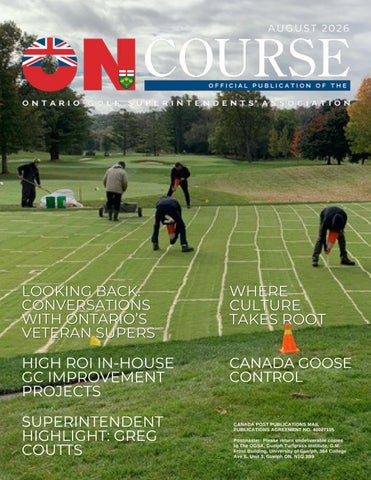
ON THE COVER Finishing touches on in-house tee expansion and leveling work at Deer Ridge GC. Photo provided by Marco China, Director of Turfgrass Operations, Deer Ridge GC.
ONCOURSE 2026 Although every effort is made to check material for publication, the association is not responsible for material published on behalf of its contributors. All rights are reserved by the publisher, and any reproduction in whole or in part without the written permission of the publisher is prohibited. Although some trade names may be mentioned in articles contained in this publication, no endorsement is intended or implied by the Ontario Golf Superintendents’ Association. OGSA is committed to serving its members, advancing their profession, and enriching the quality of the golf environment.
AUGUST 2026 | ONCOURSE 3
PRESIDENT’S MESSAGE
Strength through Engagement As we move into the heart of summer, another busy golf season is well underway across Ontario. Courses are in peak condition, clubs are fully operational, and maintenance teams are working tirelessly to deliver outstanding playing conditions for golfers each day. It is an exciting time of year, and it is always inspiring to see our members showcasing the professionalism, dedication, and passion that continue to elevate our industry. One of the most encouraging signs of the strength of our association has been the exceptional level of member engagement. The response to our 2026 events has been remarkable and speaks volumes about the value our members place on connecting, learning, and supporting one another. This level of participation reinforces the importance of what we do as an association and highlights the strong sense of community that defines the OGSA. The enthusiasm surrounding our annual Assistants’ Tournament has been especially encouraging. It is incredibly rewarding to see so many assistant superintendents eager to participate, build relationships, and invest in their professional development. These events play a critical role in cultivating the next generation of leaders within our profession. We are extremely grateful to the golf courses, assistants, and superintendents who go out of their way to champion these opportunities, working with their boards and memberships to open their facilities and accommodate
OGSA events during an already busy season. As we look ahead, we encourage assistants to build on the connections made at this event and continue those conversations with their peers. We also encourage superintendents to work with their assistants and leadership and boards to explore future hosting opportunities. Expanding access to high-quality facilities enhances the development of our future leaders by broadening their perspectives and benchmarking experiences. With continued support, we can ensure even more meaningful opportunities for assistants across Ontario. The excitement continues with the 5th annual OGSA Championship. As our membership grows and engagement reaches new heights, it has become clear that we must evolve our events alongside our members. This fall, we are excited to explore expanding the Championship with golf being played on both courses, both days. This approach will create additional opportunities for participation and networking, while creating more room for play on each course. Working toward a more sustainable event model that meets growing demand is an important goal and we’re excited to pilot this approach. We encourage those considering attending to register and experience the event firsthand, and we look forward to welcoming participants to Muskoka for what promises to be another memorable Championship.
Kevin Collier, OGSA President, 2026 Superintendent, RiverBend Golf Community.
I also want to remind everyone to continue making personal wellness a priority. The demands of our profession are significant, particularly during the summer months, and maintaining both physical and mental well-being is essential. Take time whenever possible to be with family and friends, step away from work, and recharge. Perhaps most importantly, continue to lean on the strong network that makes this profession so special. The relationships you have built throughout your career remain one of the greatest strengths of the OGSA. Never hesitate to reach out to a colleague for support or simply to connect with someone who understands the challenges we all face. On behalf of the Board of Directors and the Ontario Golf Superintendents’ Association, thank you for your continued commitment to our profession and to our association. I wish you a safe, successful, and enjoyable summer, and I look forward to seeing many of you at our upcoming events and in Muskoka this fall. AUGUST 2026 | ONCOURSE 5
EDITORIAL COMMITTEE MADELEINE WHITE Managing Editor, OGSA
KEVIN COLLIER Writer, Content Development, Superintendent, RiverBend Golf Community, President, OGSA
DAWSON RIML Writer, Content Development, Associate Superintendent, The Club at North Halton
ANDREW MARSAN Writer, Content Development, Turf Technical Sales, Plant Products
6
LORI SINUITA
Advertising & Administrative Manager, Associate Editor, OGSA
MARCO CHINA Writer, Content Development, Superintendent, Deer Ridge GC
CHRIS LECOUR Writer, Content Development, Sr. Turf Sales Representative, BASF
AMY BULTENA Writer, Content Development, 2nd Assistant Superintendent, Oakville GC
ERIK VAUGHAN
AL SCHWEMLER
Writer, Content Development, Superintendent, Rebel Creek GC
Writer, Content Development, Past President, OGSA, Retired Superintendent
WHAT’S NEW
Courtney White, Executive Director, Ontario Golf Superintendents’ Association manager@ogsa.ca
ROUNDS 4 RESEARCH
TODAY IN ONTARIO
Following up on our previous note, we’re pleased to report that this year’s Rounds 4 Research initiative generated approximately $2,100 USD from Ontario-based clubs—equating to roughly $3,000 CAD directed back to the OGSA.
Today in Ontario 2026 photo contest will come to a close on September 15th, 2026. To have your amazing photo considered for the 2026-2027 Calendar, tweet the photo and #TodayInOntario, and tag @OntarioGSA.
These funds will play a valuable role in developing programing to engage youth outreach efforts including school visits, job fairs, and other engagement opportunities where we can showcase turfgrass management as a rewarding and viable career path.
WELCOME
We sincerely appreciate the continued support of participating clubs and bidders who help make this program a success year after year. Your contributions will make a meaningful impact in building awareness and strengthening the future of our industry. As we look ahead, we encourage superintendents to begin the conversation early with their clubs about donating a round for the 2027 auction. Information and registration details will be shared in January 2027, and with advance planning, we hope to see even greater participation across Ontario next year. Early discussions help ensure your facility can be part of this impactful initiative while continuing to support both turfgrass research and the growth of our profession.
New Members
Cameron Hinan, CLASS F Peterborough G&CC Duncan Davis, CLASS EM Southbrook G&CC Joe Dyck, CLASS F Hidden Lake GC Jordan Bifolchi, CLASS F The Carrying Place G&CC Keith Johnston, CLASS C Muskoka Highlands GL Kieran Moloney, CLASS S University of Guelph Mark Gibson, CLASS C RiverBend Golf Community Mike McClelland, CLASS F Glen Eagle GC
MARK YOUR CALENDARS Sept 21-22, 2026 OGSA Championship The Rock & Rocky Crest Resort
Feb 2-4, 2027 OGSA Turfgrass Management Conference Fallsview Casino Conference Centre, Niagara Falls, ON.
SCHOLARSHIP DEADLINES Sept 2, 2026 OGSA Professional Development Bursaries OGSA Heritage Awards
June 30, 2027 William Sansom Distinguished Service Award
Palmer Spoorenberg, CLASS C Spring Lakes GC
April 1, 2027
Roel Calimlim, CLASS F Islington GC
OGSA Turfgrass Education Awards
Scott Wright, CLASS C Carlisle G&CC
Paul Brown Internship Award AUGUST 2026 | ONCOURSE 7
WHAT’S NEW
OGSA Renews Commitment to Turfgrass Research with $20,000 Donation August, 2026 - Guelph , Ontario The Ontario Golf Superintendents’ Association (OGSA) is proud to confirm its longstanding commitment to advancing turfgrass research with an annual $20,000 donation to the National Turfgrass Research Foundation (NTRF). For more than 40 years, the OGSA has played an active role in funding research initiatives, first through the Ontario Turfgrass Research Foundation (OTRF) and now through the NTRF. Over that time, the Association has contributed an estimated $340,000 toward projects that directly benefit golf course superintendents and the broader turfgrass community. “The OGSA is committed to serving our members, advancing the profession and enriching the quality of golf and its environment. Turfgrass research is essential to our mandate, and the long-term success and sustainability of the golf community,” said OGSA Executive Director, Courtney White. The OGSA’s contribution is particularly meaningful because it represents the collective support of its membership. This continuous investment has helped drive advancements in environmental stewardship, resource management, pest control, and playing surface quality—areas that remain critical as the industry continues to evolve. By supporting the NTRF, the OGSA and its members are helping to ensure that the next generation of superintendents has access to the knowledge, tools, and innovations required to succeed.
“Superintendents understand firsthand the importance of evidence-based decision-making and the role that research plays in delivering high-quality playing conditions while meeting environmental and regulatory expectations. By investing in research, members are not only supporting their own operations but also contributing to the advancement of the profession as a whole,” said OGSA President, Kevin Collier, Superintendent at RiverBend Golf Community.
The NTRF is dedicated to funding research that addresses real-world challenges faced by turfgrass professionals. From climate resilience and water management to integrated pest management and soil health, the work supported by the Foundation provides superintendents with the tools and knowledge needed to adapt to increasingly complex demands. In turn, this research supports not only the golf industry but also sports fields, municipal spaces, and other managed turf environments that contribute to healthy, vibrant communities.
“As the industry faces climate variability, resource constraints, and evolving golfer expectations, the demand for strong, well-supported research has never been greater. We are committed to working together with our valued OGSA partnership, whose ongoing support and commitment deliver the solution the industry needs,” said Executive Director, Kelly Scenna. The OGSA looks forward to continuing its partnership with the NTRF and to seeing the impact of this important work in the years ahead. The OGSA will present the NTRF with the donation cheque at the NTRF Annual Fundraising Golf Classic on August 17th, 2026, held at Credit Valley Golf & Country Club. About the NTRF: The transition from OTRF to the National Turfgrass Research Foundation represents an important step forward in aligning research efforts on a national level.
AUGUST 2026 | ONCOURSE 9
GC HIGHLIGHT | MEMBER PROFILE
FAIRWAYS AT KIRRIE GLEN 1838 Kirrie Glen Road Muskoka Lakes, ON 705-645-4520 kirrieglen.ca Fairways at Kirrie Glen
ABOUT THE COURSE The Fairways at Kirrie Glen is an affordable 9-hole golf course known for its challenging greens. At 2,830 yards, the golf course offers experienced players attractive scenery and the chance to play with family and friends, while offering beginner golfers the chance to improve their skills. It’s conveniently located between Port Carling and Bracebridge and is situated amongst the scenic Muskoka woodlands, with immaculate gardens and rolling fairways. Type of Club: Semi-private Architect: Alan Mills Holes: 9 Annual Rounds: 25,000 + Practice Facility: Driving net and practice green Maintenance Staff: 11 club house and course and 1 maintenance team member in a dual role as Assistant and Mechanic - Faron Mintz
MEMBER SINCE 2005
Greg Coutts Superintendent
Written by Chris Lecour, Senior Turf Sales Representative, BASF. Photos provided by Greg Coutts.
For Greg Coutts, the path to becoming a golf course superintendent was not mapped out in advance. It was built season by season, through hard work and curiosity in the science of turf management. Now in his third season as Superintendent at The Fairways at Kirrie Glen in Bracebridge, Coutts represents a generation of Ontario turf professionals whose careers are shaped by experience, mentorship, and attention to detail. With 40 years in the industry his journey reflects both the evolution of the profession and the enduring value of its fundamentals. Coutts got his start at South Muskoka Curling and Golf Club as a student labourer, performing the essential tasks that form the backbone of course maintenance:
hand-raking bunkers, weed eating, and moving tee blocks. He spent several years cutting fairways using gang mowers pulled by a tractor, a role that left an impression. “It’s something I absolutely loved,” he says, noting that even today, he would gladly return to cutting 18 holes with gangs if given the opportunity. That early connection to the work led him to pursue formal training at Sir Sandford Fleming College, followed by additional turf education at the University of Guelph. He also completed Ice AUGUST 2026 | ONCOURSE 11
IN THE HOT SEAT Q. FAVOURITE GOLF TOURNAMENT? Q. ULTIMATE FOURSOME? A. The Masters
A. My wife, son and daughter
Q. FAVOURITE PIECE OF EQUIPMENT?
Q. LOWEST ROUND & WHERE? A. 43 – 9 holes at Muskoka Highlands
A. Turfco Top Dresser 1430 Q. FAVOURITE GOLF COURSE?
Q. FAVOURITE MOVIE?
A. Fairways at Kirrie Glen
A. Top Gun
Q. FAVOURITE BAND? A. Kim Mitchell Q. FAVOURITE MEAL? A. Prime rib Q. FAVOURITE COURSE DESIGNER A. Robbie Robinson
Technician certifications, allowing him to take on a unique dual role managing both turf and curling ice operations. Coutts’ career at South Muskoka spanned 36 years, where he steadily progressed into assistant superintendent and head ice technician roles. More importantly, it was where he developed the technical foundation that continues to define his approach today. He immersed himself in the details of agronomy, refining cultural practices such as topdressing, verticutting, aeration, and rolling, while experimenting with fertilizer and plant growth regulator programs to optimize turf performance. “I spent many years trying to perfect those practices,” he explains, focusing on achieving consistent greens speeds and
WHAT YOU NEED TO KNOW Predominate grass type: bent, poa, blue grass, rye grass, fescue Predominant soil type: brown clay Course length: 2830 yards Size of greens: 70,000 sq ft Size of tees: 1 acre Size of fairways: 10 acres Major Challenges: Upgrading from a manual irrigation system to a Toro satellite system Spring of 2026, managing poa on collars of greens, keeping up with filling of divots and recuperating small tee boxes with increased play. 12
Hole #4
high-quality playing conditions. His work with soil management stands out as a defining professional accomplishment. Through detailed soil testing and a disciplined approach to nutrient management, Coutts was able to transform acidic, nutrient-deficient soils into a balanced growing medium that requires minimal inputs today. Beyond turf performance, he highlights the financial and environmental benefits of that approach: reducing unnecessary inputs, improving efficiency, and minimizing nutrient loss to surrounding ecosystems. Throughout his career, Coutts has also emphasized the importance of leveraging industry relationships, particularly with sales
representatives and technical advisors. “I always took the time to connect with my turf salespeople,” he says. “They’re a bundle of knowledge and always up to date on new products and what’s happening in the industry.” Those partnerships have played a meaningful role in his professional development, providing insights into recent technologies and helping him stay current in a constantly evolving field. It is a perspective that resonates strongly across the Ontario golf industry, where collaboration between superintendents, suppliers, and consultants remains essential to success. After more than three decades at one facility, Coutts made the move
to Fairways at Kirrie Glen, a course he had long admired and envisioned himself managing one day. Now in his third season as superintendent, he describes the role as both fulfilling and energizing. Becoming the superintendent of a course he respects deeply stands as one of his greatest career accomplishments. It is also a reminder that even after decades in the industry, new challenges and opportunities continue to emerge. Coutts leads a crew of five, supported by an engaged general manager, and approaches leadership with a straightforward philosophy: stay positive, communicate openly, and treat people with respect. He places strong emphasis on recognizing hard work and building personal connections with staff, taking the time to understand their lives outside of work and fostering a supportive team environment. That approach is rooted in the lessons he learned from mentors throughout his career, including superintendents who emphasized work ethic, professionalism, and accountability.
underscores the broader role superintendents play, not just as caretakers of golf courses, but as integral members of the communities they serve. For those entering the industry, Coutts offers advice grounded in real-world experience: Be a strong problem solver and quick thinker. Take the time to learn every aspect of the operation. Stay patient and respectful. Build relationships and network within the industry. He also stresses the importance of utilizing available resources and never hesitating to ask questions or seek guidance. Away from the course, Coutts remains connected to the outdoors. Whether fishing, hunting, or working
at his off-grid cabin producing maple syrup and milling lumber, he continues to embrace the same hands-on lifestyle that defines his work. Family is central to that balance. He and his wife Angela have been married for 27 years, and together they have raised two children. Time spent at the family cottage or camping in Algonquin Park provides a reset from the demands of the golf season. Even with decades of experience behind him, Coutts isn’t thinking about slowing down. His goal is to reach 50 years in the golf industry and it’s a milestone that speaks to both his dedication and his enjoyment of the work. And after that? He still sees himself on the course, in a scaled-back “mow and go” role but remaining connected to the game he’s spent a lifetime building.
What stands out about Greg is his commitment to doing things the right way. He takes pride in his course, supports his team, and communicates with clarity and respect. His positive attitude and steady approach help him through the everyday challenges at this position, while consistently representing the industry with professionalism and integrity. - Gib Piche, Regional Account Manager - Muskoka, BrettYoung
Despite his experience, Coutts maintains the same routine that has guided him throughout his career: start the day with a coffee and a tour of the course. It is a simple but essential practice, one that allows him to assess conditions, anticipate challenges, and set the tone for the day ahead. “Every day is a new adventure,” he says. While agronomic successes and career milestones are important, Coutts points to a moment far removed from turf management as one of the most meaningful in his life: saving someone’s life using a defibrillator during a medical emergency. That experience AUGUST 2026 | ONCOURSE 13
Collar dam being removed by team members.
In-House Golf Course Improvement Projects DELIVERING A HIGH RETURN ON INVESTMENT Written by and photos provided by Marco China, Director of Turfgrass Operations, Deer Ridge GC.
As many of us begin planning late-season projects and improvements, it seems fitting to highlight areas where meaningful gains can be achieved using the skills our teams already possess or are willing to learn. Expectations surrounding course conditioning continue to rise while budgets remain constrained, making the ability to complete improvement projects in-house more valuable than ever. While large-scale renovations often dominate long-term planning discussions, many of the most impactful improvements in playability, conditioning, and presentation come from targeted projects led by the maintenance team. By leveraging the talents within our crews and encouraging the development of new skills, we can deliver exceptional results while creating valuable learning opportunities for key staff members. The following projects offer a strong ROI by improving consistency, reducing long-term maintenance requirements, and enhancing the golfer experience without the need for significant capital expenditure.
LARGER SCALE PROJECTS Tee Surface Re-Grading and Expansion: Over time, tee decks often develop excessive wear, settling, or crowned surfaces that create uneven lies and concentrate divot patterns. Few projects are as noticeable to golfers as a properly regraded tee with a smooth, level playing surface. Depending on the size of the tee, the work can range from a simple correction of surface imperfections to a complete reconstruction and expansion. For teams new to this type of work, smaller tees provide an excellent opportunity to become comfortable using laser levels and grading equipment before tackling larger projects. Consider whether a tee requires expansion to increase usable space or simply needs surface corrections to restore functionality. Strategic Drainage Enhancements: Few projects have a greater impact on playability than improved drainage. Installing slit drains, catch basins, or improving existing drainage infrastructure in chronically wet areas can quickly restore firmness and reduce downtime following rainfall events. AUGUST 2026 | ONCOURSE 15
In-house construction on bunker edge & surround sodded ready to be grown-in.
Approaches, green surrounds, and fairway low points typically provide the greatest return on investment. A working knowledge of laser grading is particularly valuable, as proper slope is critical to long-term drainage performance. Numerous resources are available to help determine the most appropriate drainage solution for a specific site or problem area. Bunker Edge Restoration: Over time, bunker edges lose their original shape and definition due to sand splash, traffic, maintenance practices, and natural erosion. Reestablishing crisp bunker edges dramatically improves presentation while reducing contamination and ongoing maintenance requirements. Larger restoration projects can be completed by rebuilding edges using sod bricks or burlap bag construction methods before installing new sod. In many cases, replacing the perimeter sod around a bunker can create the visual impact of a complete bunker renovation at a fraction of the cost. Completing entire green complexes in-house is often achievable and delivers a significant visual improvement. Entrance and Landscape Renovation: The arrival experience helps shape golfers’ first impressions of a facility. Over time, landscape beds and entrance features can decline due to weed encroachment, winter damage, 16
Burlap bags filled with topsoil to re-establish bunker edges.
aging plant material, or changing design preferences. An entrance and landscape renovation can range from refreshing existing planting beds to a complete redesign incorporating new plant material, hardscape elements, signage features, or landscape improvements around the clubhouse and practice facilities. When selecting plant material, consider the long-term maintenance requirements. Annual displays provide outstanding seasonal colour but require yearly replacement, while perennial gardens generally reduce replacement costs but often demand more ongoing maintenance. Regardless of scope, improving the visual appeal of arrival and gathering areas creates an immediate impact on presentation and helps establish positive expectations before golfers even reach the first tee.
MANAGEABLE PROJECTS Not every impactful improvement requires extensive planning or construction expertise. Some of the most effective changes can be completed incrementally using existing equipment and labour resources. These projects offer an excellent opportunity to improve conditions while building confidence for larger undertakings in the future. Bunker Floor Re-Grading and Sand Redistribution: Inconsistent sand depths and poor internal drainage often result in unpredictable playing conditions. Many bunkers contain adequate quantities of sand, but years of top-up applications can create uneven depths and alter the original design. Re-establishing floor contours and redistributing existing sand can significantly improve bunker performance while restoring the intended appearance and playability. This type of work typically requires more labour than capital and can produce excellent results when completed methodically. Tree and Shade Management: Selective tree pruning or removal remains one of the most effective ways to improve turf health. Even modest increases in sunlight and air movement can significantly enhance growing conditions, reduce disease pressure, and improve playing surface consistency. Priority should be given to greens and tees, where turf performance is most critical. In many cases, thinning overgrown areas not only improves growing conditions but also enhances sightlines, aesthetics, and the overall character of the golf course. Collar Dam and Surround Re-Grading: Surface water movement around greens plays a critical role in firmness, consistency, and turf health. Over time, AUGUST 2026 | ONCOURSE 17
settlement and organic matter accumulation can create low areas around collars that trap water and contribute to soft conditions. Re-grading collars and surrounds to promote positive surface drainage can significantly improve green performance. For teams without access to laser equipment, a six- to eight-foot level can be an effective tool for identifying problem areas and establishing gentle grades that direct water away from the putting surface. Mowing Line Refinement and Playability Adjustments: Adjusting fairway widths, intermediate rough lines, and green surrounds can subtly reshape how a golf course plays without requiring any major capital investment. Many older golf courses have gradually lost the original shape and intent of their playing surfaces. Historical aerial imagery, course plans, and original design drawings can help guide restoration efforts. In other situations, widening landing areas or reducing maintenanceintensive pinch points may improve both playability and and pace of play. Small adjustments to mowing lines often create outsized improvements in strategy, aesthetics, and golfer enjoyment.
18
Start with Manageable Projects Take the time to honestly assess the resources, equipment, labour, and expertise required to complete projects successfully. Building confidence through smaller successes creates a foundation for larger improvements. At the same time, do not hesitate to take on work outside your team's previous experience. Some of the most rewarding projects come from stepping beyond your comfort zone and learning new skills. These projects not only improve the golf course but also develop staff and strengthen the maintenance team. Lean on friends, colleagues, and industry peers who have completed similar projects. Their insights can guide planning, avoid pitfalls, and improve execution. Whether through a phone call, site visit, or industry event, those relationships can be as valuable as equipment or budget. By approaching projects thoughtfully, setting achievable goals, and leveraging industry expertise, maintenance teams can deliver meaningful improvements that benefit the golf course, their staff, and the long-term success of the operation.
Co-Existing With Wildlife CANADA GOOSE CONTROL Written by Erik Vaughan, Superintendent, Rebel Creek GC. Photos provided by Ted Gates, Owner & Operator, Adventure K9.
Across Ontario, golf course superintendents face a growing challenge that has little to do with turf diseases, drought, or equipment maintenance. Instead, one of their most persistent concerns comes from a familiar feathered resident: the Canada Goose.
Large populations of resident geese come with significant management issues for golf course operators. By adapting to non-traditional, predator-free environments they can live over twenty years and will attempt to nest in the same areas where they were hatched, a trait known as imprinting. Adult Canada Geese molt their flight feathers in conjunction with goslings being hatched and reared, causing them to
be flightless for seven to ten weeks. The most visible problem associated with geese on golf courses is the sheer volume of droppings they leave behind. A single adult goose can produce more than a kilogram of waste each day. When large numbers of birds gather on a course, playing surfaces can quickly become littered with droppings. Geese can cause extensive turf damage while feeding
Many Ontario golf courses attract geese year-round. Golf courses provide ideal habitat for Canada Geese, which have a dietary preference for lush grasses and clovers. Ponds and water hazards provide safety and ideal nesting areas. The Great Lakes region is home to large non-migratory populations of geese that have taken up residence in urban and suburban environments. These birds no longer undertake a southern migration provided they can access open water through winter. AUGUST 2026 | ONCOURSE 19
Ted Gates using his ideal tool to assist his dogs in moving Canada Geese out of the water.
on short grasses, and they require sand in their gizzard to grind plant material for digestion. As a result, they often frequent bunkers, leaving behind droppings, feathers, and footprints. In some cases, they may even dig into greens, creating unacceptable damage. During the breeding season, nesting geese can become aggressive, occasionally confronting golfers and staff. Their droppings also contribute significant nutrient loads to ponds and waterways, which can elevate nutrient levels, promote algae growth, and reduce overall water quality. Ted Gates is the owner and operator of Adventure K9, a goose control company based in the Waterloo Region. For the last fifteen years, goose control has been his full-time occupation. Ted offers advice for Ontario superintendents who are seeking to manage geese and the problems they create on their properties. Firstly, due to the ideal habitat golf courses offer geese, there will always be continuous pressure. As a result, there is no permanent solution to the
problem - a diligent and dedicated management approach is the only viable option. His advice aligns closely with both Ontario Ministry of Agriculture guidance and Environment and Climate Change Canada's Best Practices for Canada Goose Management, which emphasize that successful programs rely on an integrated strategy rather than a single deterrent. Property managers are encouraged to assess why geese are using a site, identify attractants, and employ multiple management techniques before populations become established.
of effective goose population control. Canada Geese are protected under the Migratory Birds Convention Act and associated Migratory Birds Regulations, 2022. Property managers
Secondly, a successful management plan must be a two-pronged approach comprised of both reducing the presence of adult geese and nest management. Once a breeding pair hatches a brood and molts their flight feathers, they are bound to your property for a significant portion of the golf season and you're basically out of options. This recommendation mirrors federal best-management guidance, which identifies earlyseason intervention and nest management as critical components AUGUST 2026 | ONCOURSE 21
wishing to remove nests, oil or addle eggs, relocate birds, or undertake certain control activities must obtain a Damage or Danger Permit from the Canadian Wildlife Service. These permits are free of charge and provide legal, regulated tools for managing birds that are creating property damage or public safety concerns. Damage and Danger Permits are an essential component of a successful goose management strategy for golf courses. These permits provide course operators with legal options to protect golfers, staff, turf quality, and the overall playing experience while maintaining compliance with federal wildlife protection laws. Federal guidance also encourages large landowners, including golf courses, to develop formal goose management plans that establish population objectives, document management activities, and incorporate preventative measures whenever possible. Ted also offers a tip for superintendents who are working with their own dogs and not achieving ideal results. "Whenever you engage birds, it is imperative that you follow through fully and move the birds out every time. Otherwise, the birds will quickly become reverse conditioned, understanding that they can evade efforts. This reinforces a feeling of safety in them." When it comes to dogs, Ted prefers Border Collies due to their natural stalking behaviours, which closely mimic predators that geese recognize and fear. However, a goose's first line of defence is always the water, and once they are in, it can be extremely challenging to drive them out. Even a pack of hard-working, strong-swimming Collies have difficulty forcing geese into flight once they reach open water. The geese learn quickly that they can outswim the dogs. Ted finds a kayak to be the ideal tool to assist his canine coworkers in the water. Together, he and the dogs employ a team effort to achieve the end goal: moving the birds out every time. Geese also become quickly accustomed to deterrents that are used infrequently or predictably. Both Ontario and federal guidance caution that habitat modification and active management are generally most effective when deterrents are used as part of a broader, coordinated program. Ontario superintendents take great pride in being environmental stewards, and golf courses across the province provide outstanding habitat for a wide variety of wildlife. Unfortunately, the same characteristics that make golf courses attractive to golfers—closely maintained turf, open sight lines, and accessible water features—also make them ideal habitat for resident 22
Canada Geese, challenge.
creating
an
ongoing
management
Successful management requires a long-term, integrated approach that is humane, ethical, legal, and able to withstand public scrutiny. The most effective programs combine early intervention, nest management, habitat awareness, and consistent harassment techniques while remaining compliant with federal regulations and recognized best management practices.
GOOSE CONTROL QUICK TIPS & RESOURCES Apply for a Damage or Danger Permit Obtain a permit from the Canadian Wildlife Service before removing nests, destroying eggs, relocating birds, or conducting organized harassment activities that require authorization. Act Early in the Season Target adult geese and manage nests before goslings hatch and adults enter their annual molt. Once geese become flightless with their young, management options become much more limited. Use a Consistent Management Program Goose control is most effective when conducted regularly. Golf courses provide ideal habitat, so ongoing pressure should be expected. There is no permanent solution. Document Control Activities Keep records of nest management, egg treatment, hazing efforts, permit numbers, and dates of activity to demonstrate compliance and support future permit applications. Ensure All Actions Are Humane and Defensible Goose management should be humane, ethical, legal, and able to withstand public scrutiny.
Migratory Birds Convention Act, 1994
Damage or Danger Permits
The Turf Team at The Club at North Halton.
Where Culture Takes Root TEAM BUILDING STRATEGIES Written by and photos provided by Dawson Riml, Associate Superintendent, The Club at North Halton.
mornings, extreme weather, and seasonal peaks are part of the norm, culture can either serve as a significant strength or become a critical liability. Superintendents who prioritize team building often experience lower turnover rates, improved attention to detail, and a crew that takes genuine pride in the course conditions they produce. Establishing this culture starts with clarity. Every employee from assistant to seasonal staff must understand not only what their role entails, but how their contributions affect the overall success of the course. This goes far beyond simply reading a job description.
In today’s golf course maintenance environment, superintendents and assistant superintendents are responsible for delivering consistent, high-quality playing conditions while leading teams made up of multiple generations, backgrounds, and experience levels. Leadership has become just as critical as agronomy. While equipment, products, and technology continue to evolve, the most significant competitive advantage remains the same: a motivated and cohesive team. One of the most effective and often underutilized tools for achieving this is creative, flexible scheduling Daily communication is essential. strategies. Brief morning meetings provide an opportunity to reinforce daily goals Strong, resilient teams do not form and explain the rationale behind by chance. They are cultivated specific tasks. When team members deliberately, day after day, through understand the “why” behind their communication, trust, and a shared work, they are far more likely to take sense of purpose. On a golf course ownership, demonstrate initiative, maintenance crew where early and maintain high standards.
Including assistants in these discussions is equally important as it allows them to develop their leadership voice, build confidence, and gain experience in guiding a team, all preparing them for future superintendent roles. Trust is another cornerstone of effective leadership. Superintendents and assistants who empower their teams rather than micromanage them foster an environment where employees feel valued and capable. Empowerment can take many forms, allowing experienced crew members to make certain decisions, rotating leadership responsibilities on projects, or enabling staff to manage small teams during peak periods. Cross-training is another strategy that achieves multiple goals. By training crew members to perform multiple tasks, leaders not only improve operational flexibility, but also demonstrate confidence in their employees’ abilities. This sends a AUGUST 2026 | ONCOURSE 23
TEAM CULTURE & MORALE CHECKLIST Start every day with clear communication. Reinforce priorities, expectations, and the purpose behind the day's work.
Explain the “why” behind tasks. Employees are more engaged when they understand how their work contributes to overall success.
Empower team members. Trust employees with responsibility, decision-making opportunities, and project leadership roles.
Invest in cross-training & develop future leaders. Develop versatile staff while building confidence, career growth, and operational flexibility. Give assistants and experienced staff opportunities to mentor, coach, and lead others.
Recognize effort consistently. Celebrate accomplishments through shout-outs, thankyou notes, and other simple acknowledgements.
Offer scheduling flexibility when possible & reward demanding work periods with recovery time. Staggered start times and creative scheduling can improve work-life balance and reduce burnout.
Create opportunities for feedback & respond meaningfully to employee input. Regular conversations, one-on-one meetings, and surveys help identify challenges before they become problems. Listening and acting on feedback builds trust, respect, and long-term commitment.
Make culture a daily priority. Strong teams are built through consistent leadership, trust, communication, and recognition—not by chance. Bottom Line: Employees who feel trusted, valued, recognized, and supported are more engaged, more resilient, and more likely to take pride in delivering exceptional results.
clear message that growth, development, and personal initiative are encouraged. Recognition, both formal and informal, plays a pivotal role in reinforcing culture and strengthening cohesion. Simple acknowledgments at the end of a long tournament week, a shout-out in a morning huddle, or a handwritten note of thanks costs nothing and produces significant returns in morale and engagement. Assistants, who often spend the most time directly with the crew, are particularly effective in reinforcing 24
recognition consistently. When acknowledging effort becomes embedded in the daily routine, accountability and pride naturally follow. Employees begin to internalize standards of excellence because they feel appreciated and noticed. While culture lays the foundation for a high-performing team, scheduling is where superintendents can achieve immediate, tangible improvements in morale, engagement, and retention. Traditional golf course schedules entailing long weeks, alternating weekends, early mornings, and little flexibility, are increasingly incompatible with today’s workforce, particularly younger generations seeking work-life balance. Creative scheduling does not mean lowering standards; it simply means rethinking how work gets done while preserving quality and productivity. Flexible scheduling can take several forms. One widely successful approach is staggered start times. Allowing some crew members to begin earlier while others start later accommodates personal obligations, family responsibilities, and individual preferences without compromising the operation. Staggered starts also reduce burnout, particularly during high-intensity periods such as tournament preparation or spring
grow-in, by giving employees a sense of control over their day.
through team discussions, one-onone meetings, or anonymous surveys help gauge morale, workload balance, and communication effectiveness. When leadership responds to feedback meaningfully, trust strengthens, and employees feel respected, heard, and invested in the club’s long-term success.
Longer shifts with fewer days per week, combined with rotating long weekends, are another strategy that can significantly improve morale among full-time staff. While not feasible year-round or in every operation, even partial implementation during slower periods demonstrates a commitment to employee well-being. Seasonal flexibility is also critical. During high-demand periods, extended hours may be necessary, but offering additional time off afterward demonstrates appreciation and respect for the team’s effort. Planned recovery time can be just as valuable as overtime compensation in preventing fatigue and burnout. Creative scheduling also directly supports team development and mentorship. Pairing less experienced staff with seasoned employees on overlapping shifts creates opportunities for hands-on learning and skill transfer. It enables assistants to evaluate performance in real-world scenarios, identify emerging leaders, and coach effectively. Over time, this approach develops depth within the crew and reduces dependency on a few key individuals, increasing operational resilience and overall team confidence. Clear communication is the thread that ties team building and flexible scheduling together. Every adjustment in schedule or responsibility must be explained transparently. When crew members understand that flexibility is a twoway street benefiting both individuals and the operation, buy-in increases significantly. Assistants can serve as a vital bridge, relaying crew feedback and helping superintendents adjust plans proactively to maintain balance and fairness.
The Club at North Halton staff outting.
Intentional leadership is the underlying principle. Superintendents establish the vision and set expectations, while assistants bring that vision to life daily. When both roles align and consistently reinforce culture and scheduling practices, the operation becomes more adaptable, resilient, and attractive to both current and prospective staff. Leadership that invests time in these areas demonstrates that the team is not just a workforce, it is a competitive advantage. Measuring success extends beyond turf quality and operational efficiency. Actively listening to crew members provides immediate insight into the effectiveness of leadership strategies, team morale, and operational practices. Employees often observe challenges and opportunities long before they are reflected in performance metrics, making their input invaluable. Regular opportunities for feedback, whether
In an industry facing persistent labor challenges, the golf courses that stand out will not necessarily be those with the largest budgets, newest equipment, or most advanced technology. They will be the operations led by superintendents and assistants who understand that investing in people through strong culture, recognition, and flexible scheduling is not a concession, it is a strategic advantage. Teams thrive when they are trusted, valued, and developed. Scheduling that supports both personal well-being and operational excellence creates loyalty, reduces turnover, and ensures consistency in the product delivered. Ultimately, success in golf course maintenance requires a balance between technical expertise and people-centered leadership. Turf quality will always matter, but it is the team behind the turf that determines how effectively a course performs under pressure, adapts to challenges, and maintains its reputation over time. By committing to daily team building, thoughtful recognition, and creative scheduling strategies, superintendents and assistants can cultivate a culture where employees are motivated, resilient, and proud of the work they do. In such an environment, excellence becomes the standard and the course not only meets expectations, it sets them.
AUGUST 2026 | ONCOURSE 25
LOOKING BACK
Pioneers of the profession (L-R): Ken Wright, Gordon Witteveen, & Keith Nisbet.
The Ones Who Came Before CONVERSATIONS WITH ONTARIO’S VETERAN SUPERS Written by Andrew Marsan, Turf Technical Sales Rep, Plant Products. Photos provided by Ken Wright, Retired, OGSA Life Member
There is a steel mat in this story, a crowbar, and an agronomist who once told a young superintendent that what he was about to do would fail. There is also fifty-some years of golf course maintenance distilled into one plain rule, delivered the way only a man who has spent his life outdoors can deliver it: you can’t grow grass from your office. That man is Ken Wright, who turns 80 this summer and who, for the better part of three decades, was the only superintendent the Devil’s Pulpit Golf Association — now The Pulpit Club — had ever known. In 2011, he was named the CGSA Superintendent of the Year, an honour voted on by peers across the country and one he counts among the most meaningful of his career. 26
to cut greens, carrying a crowbar in the cart because the ground was full of rock and changing holes meant fighting it out of the soil by hand.
WHERE IT STARTED
Ken Wright.
Wright didn’t grow up around golf. He grew up in Elmsdale, Nova Scotia, a small community halfway between Halifax and Truro, and he found his way to a golf course the way a lot of teenagers find their way a things — almost by accident. “Eighteen years old, you don’t know what you want to do with your life, right?” he says. “So, I said, this is pretty good.” That was Oakfield Golf and Country Club, a brand-new course just down the road, and Wright was there the year it opened, working summers, learning
He drifted for a few years after that — a short stint at teachers’ college that didn’t take, then a move to Ontario, where his brother was living. There wasn’t much reason behind it beyond needing somewhere to go. He answered an ad for a golf course job, got hired on the spot, and went to work for Helmut Kopp at Uplands Golf & Country Club. Two weeks in, he asked for a raise — twenty-five cents — and was denied. He quit on the spot and took a job at a battery factory instead. It was Gordon Witteveen who pulled him back into the business, and it’s Witteveen’s name that comes up more than any other when Wright talks about how he mastered his craft.
The two met at a turf show around 1970, and Witteveen offered him work at Northwood Golf and Country Club, a private club off the north side of Sheppard Avenue, between Keele and Jane. When Witteveen left to take a position with the Board of Trade in 1972, Wright took over as superintendent — his first head job, with Witteveen’s voice still very much in his ear. He’d stay at Northwood until 1979, when the club was sold. Out of work, a call came from Gil Blechman, co-founder of The National Golf Club of Canada, and Wright took the superintendent’s job there — a position he’d hold for the next ten years. “Probably the best boss I ever had,” he says of Blechman, without hesitation. When Blechman offered Wright the job, his message was simple: give me the best-conditioned golf course in Canada. “It was the number one course in the country at the time,” Wright recalls, “so it didn’t take me long to decide.” Blechman’s support went beyond the course itself.
That hands-on education produced a habit of trusting his own observations over received wisdom, and it showed early at The National. The greens there sat on a base that was, in his telling, like rock, topdressed for years with a heavy soil mix that offered little relief. So, Wright started topdressing with sand instead — an unremarkable practice today, but in the early 1980s, novel enough that a well-known agronomist consulting at the club told him flatly that it wouldn’t be successful. There was no research behind it. Wright did it anyway, becoming one of the first superintendents in Canada to do so. He followed that by cutting fairways with lightweight GM3 mowers — again, a first in Canada — after noticing how much better his bentgrass looked on the approaches already being cut that way. He also fumigated and re-grassed greens at a time when few in this country had attempted it, and contributed to the development of the Accuform rake, a tool that became standard equipment across the industry.
successful careers within the golf industry, many of them as superintendents at their own clubs across the country — a number he mentions with quiet pride. I worked closely with Ken Wright from 1994 to 2002,” says Scott Clayworth, who served as assistant superintendent at Devil’s Pulpit and Devil’s Paintbrush during that time. “I was fortunate to be mentored by the best in the business. Ken had a simple approach — ‘the grass will tell you what it needs.’ At the time, I didn’t realize all the little things he was teaching me. The details… it’s all about the details.” It’s a philosophy that clearly rubbed off.
That willingness to trust his instincts When the Ontario Turfgrass Research before the industry caught up is a Foundation (OTRF) approached thread that ran through his entire Wright about hosting one of their career. earliest events, Wright brought it to Blechman without a second thought. The mentorship model that Witteveen The answer was immediate. Anything started with Wright didn’t stop there. for turf, he was all in. Over the course of his career, more than twenty of Wright’s former LEARNING WITHOUT A assistants and employees went on to
CLASSROOM Ask
Wright
how
superintendents
learned the ropes in his era, and the answer
is
straightforward:
they
learned it from each other, or they didn’t learn it at all. There wasn’t a four-year degree waiting for him. He took
the
short
course
at
the
University of Guelph and everything else came from watching, from trial and
error,
and
from
men
like
Witteveen who were, in Wright’s words, dragging the profession “from the barn to the clubhouse.”
AUGUST 2026 | ONCOURSE 27
Inside the maintenance shop, the standards of the era look almost foreign now. Mercury-based fungicides handled disease pressure that today requires an entire rotation of products to manage. Topdressing greens meant spreading sand by hand, walking a steel mat across the surface, and coming back through to pick up every stick and stone before anyone could putt on them. The only machines allowed on a green were the mower and the fertilizer spreader — everything else was done the hard way, because the hard way was the only way available.
WHAT STAYS WITH HIM Ken Wright & Assistant Superintendent Scott Clayworth survey the golf course at The Devil’s Pulpit.
THE PULPIT & THE PAINTBRUSH YEARS Wright’s connection to what would become The Pulpit Club came through Dana Fry, whom he’d gotten to know years earlier while spending time observing courses under construction in the American desert — absorbing how the big design-build operations actually moved dirt. By the time Fry and Mike Hurdzan were routing Devil’s Pulpit for owners Chris Haney and Scott Abbott — the co-inventors of Trivial Pursuit — the project needed a superintendent. Fry made the call. Wright remembers his answer being almost reflexive: tell Chris Haney to call me directly. Nobody advertised the job. It went exactly that way — Haney called, and Wright was on site by the fall of 1989. Devil’s Pulpit opened in July of 1990 and was named the Best New Canadian Course by Golf Digest. Devil’s Paintbrush followed two years later, earning a similar distinction and later being called a “hidden gem” by respected architect Rees Jones, who labelled the combination the best two-course golf club in the world. If there was pressure in growing in two championshipcalibre courses back-to-back, Wright doesn’t describe it that way. “No pressure, didn’t feel any,” he says. His approach was simpler than that — don’t leave fertilizer sitting in the bag, don’t dilly-dally, cut it short and keep moving. Haney and Abbott left him alone to do the job. So did Fry and Hurdzan. “Great relationship with Dana and Mike — they listened to you,” he says, and it’s clear from the way he says it that being listened to mattered as much as anything else about the job. The site itself gave him every reason to ask for help. Water was the first real fight — the property simply didn’t have enough of it in the early days, and wells had to be dug before anything could properly establish. 28
Wright was the only superintendent The Pulpit Club had for roughly twenty-five years, with his son Rob succeeding him in 2015. Architect Dana Fry has called him one of the best superintendents anywhere. Those who nominated Wright for the 2011 CGSA award noted that, in addition to his firsts in Canada for topdressing, mowing, and fumigation, colleagues regularly visited the club specifically to observe his practices — and that Ken was always generous with his time. Wright brushes off the accolades in the way that men of his generation tend to do. “I’ve been pretty lucky,” he’ll say. “Right place, right time. And I’ve worked with and for some great people.” But luck doesn’t produce that kind of legacy. Luck doesn’t topdress greens with sand when the leading agronomist in the room disagrees with the practice. What he’s proudest of now isn’t the awards or the reputation. It’s watching his son run the place. “Prouder of him now than I’ve ever been,” he says. Ask him what he misses, and the answer isn’t the long hours or the limited tools. It’s being outside. He loved spraying greens himself — being the one physically out there, watching the turf respond in real time. The job has changed in ways that keep superintendents closer to their desks and further from their turf, and he’s not entirely at peace with that shift. “You can’t grow grass from your office,” he says. After more than five decades in the business, it’s the one piece of advice that hasn’t aged a day.
Early driving range renovations at the Devil’s Pulpit.
TURF OR CONSEQUENCES
The Curse of the Breen Family Written by Doug Breen, Regional VP, Golf North Properties
Anyone who has known me for a while, has heard me refer to what my family (with typical gallows humour) refers to as "The Breen Curse". It is a fact, that as many Breen men have dropped dead at 59, as rock stars have expired at 27. My father was the first man in our clan to make it to his 60th birthday in about three generations. Every speech at his birthday party referred to the fact that he had bested the Grim Reaper. My brothers and I, have all lived like it was inevitable, and when the older one reached the same milestone, we called it his 60th Birthday and Celebration of Life. The women in our lives didn’t find that nearly as worker, and voice of reason) - was hilarious as we did. sitting beside me while I explained that my situation was completely Which brings me to August 2025. different, and that my sore chest Within a couple days of my 59th when exercising was just a pulled birthday, while playing a show with muscle. my band in extreme heat (and having played three rounds of golf in the If you love me, or ever did love me, previous 36 hours in the same heat) - you all owe her a debt of gratitude I felt "off". Chest pains, dizziness and because she would NOT let it go. In the like - seems obvious right? To the end, she ratted me out to others remain upright, I had to stand more in my circle (including my wife), and I or less still for the rest of the show, was goaded into seeing a doctor. concluded that I was just dehydrated, and flew to Cape Breton the next A few weeks and a barrage of tests morning. later, I was tentatively diagnosed with exercise induced angina. Exercise While in Cape Breton, one of the induced angina – like both of my performers at the Keltic Lodge grandmothers had, and the thing that described a very similar event, which killed my grandfather at 59 while led to him having emergency, life- milking cows – how odd. I was sent saving heart surgery. If I'm being to St. Mary's Hospital in Kitchener for 100% honest, I would have probably an angiogram, with the expectation dismissed the whole thing, except that I would need a stent or two (like that Lynne (my long-time friend, co- my older brother got when he turned
59). Simple day surgery. I had a tee time booked for three days after; however, once they got under the hood for a look, they wouldn’t let me leave. I got home fifteen days later, after emergency triple bypass surgery. I was 99% blocked in one artery, and 70% blocked in two more. I was nearly fully blocked with essentially zero symptoms apparently, they call that a 'widowmaker'. I tried negotiating with the surgeon. I tried to convince him to let me go to the Grey Cup, go to the NGCOA Conference, play a show that we were very excited about, and squeeze in a scheduled round of golf at Congressional – then I would come back for the operation. He looked at me like I was an idiot and said, “You can’t leave the country, you can’t fly, and you have a time bomb in your chest! AUGUST 2026 | ONCOURSE 29
Do you want to go to this Grey Cup, or the next twenty?” So, I missed my first Grey Cup in over two decades – thank goodness the Ticats didn’t win it like they did the last time I didn’t go. The actual surgery is devilishly simple, but it’s still shocking that they can even do it. They stole a vein from my leg (which I guess I wasn’t using) and used it to plumb around the plugged bits in two of the arteries – just like bypassing a water meter. For the worst blockage, they rerouted an artery that was feeding my left mammary gland (which I definitely wasn’t using) to my heart beyond the plug. Kind of like stealing power from the neighbours.Again – simple enough in theory, but we have all glued pipe together that didn’t hold. So I asked the surgeon, “What happens if the repair leaks?”Same ‘you are an idiot’ look as before – apparently, they use better glue. True to his word, everything held, and now I have oxygen going everywhere!The trick is recovering from having your sternum sawed in half, prying you open with carpentry clamps, shutting your heart and lungs down for a few hours, and ripping a vein out of your leg. I am now home - exhausted and working from here for the next little while, but I am fully aware that I have cheated death. The Breen Curse has been broken (at least for now). I was saved by a medical system that has its warts but gave me the care I needed as soon as we realized that I needed it. I was saved by an army of hard-working staff on three west (the Severance Floor that I didn't leave for 15 days), but also by a small group of tenacious friends and family who just wouldn't let me alone. I’m thankful to everyone who sent notes and flowers, or stopped in to see me, even when I was too stoned to talk. Many thanks to the Cardiac Ward who did things for me that nobody should ever have to do for anyone. Thanks to my family, GolfNorth, NGCOA, Safe as Milk, and the County of Wellington for their patience, understanding, and support. I let a lot of people down for the better part of a month, and I promise to make it up to every single one of you. Most of all, I’m thankful for my new lease on life – and by the way, don’t be a hero, go get checked out. 30