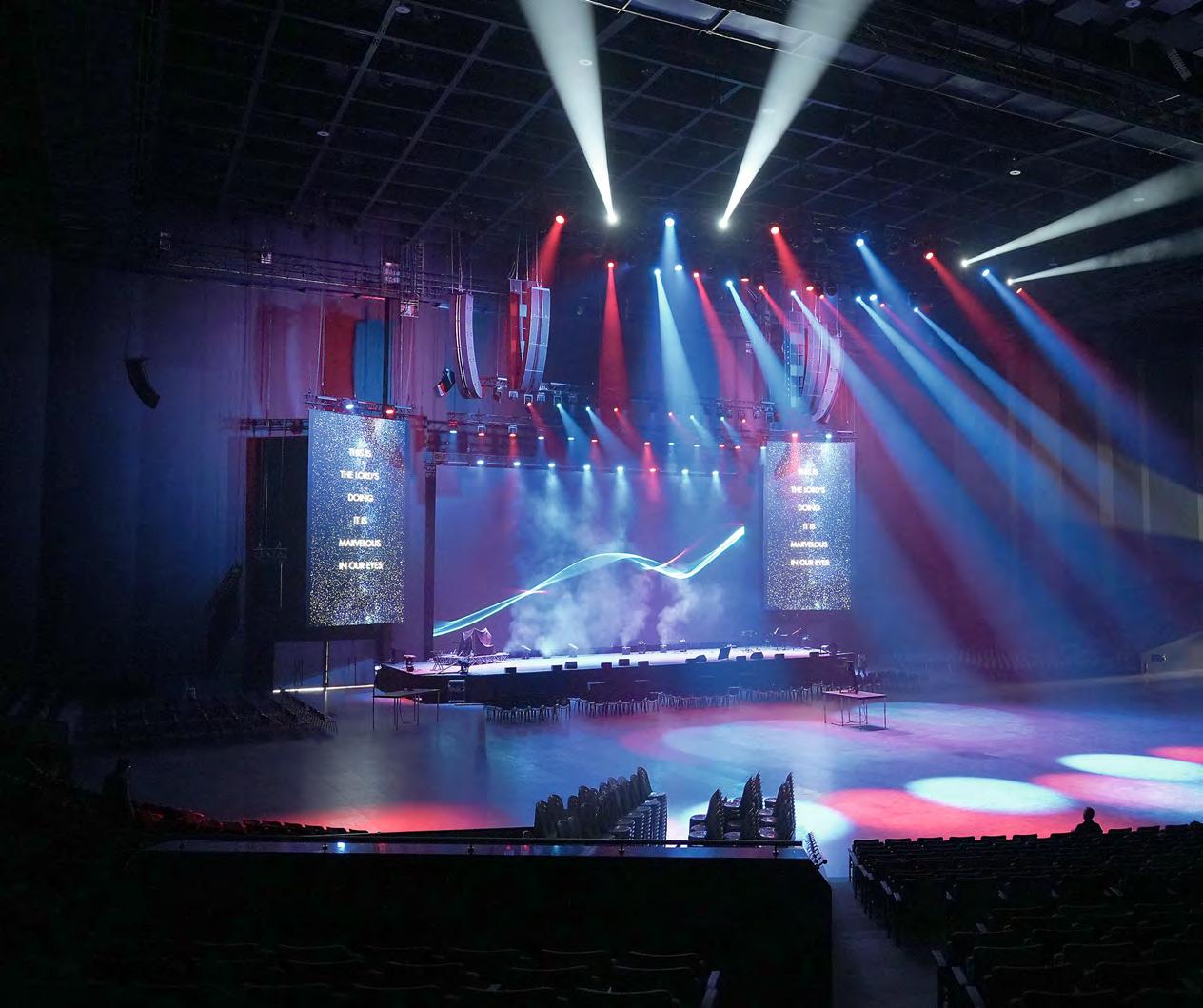
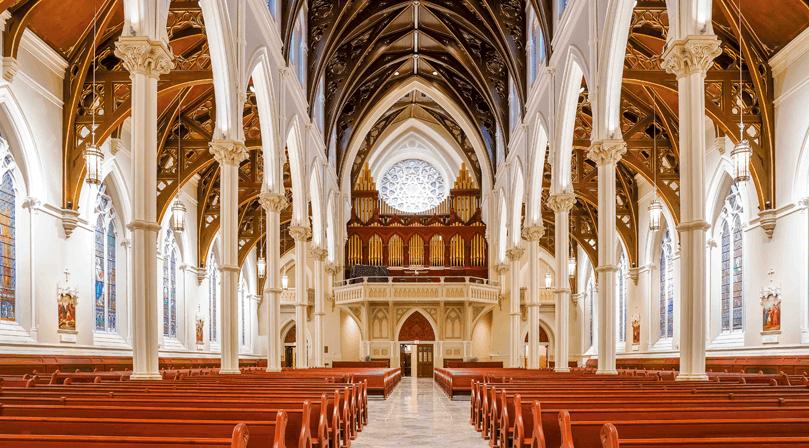
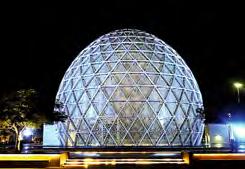
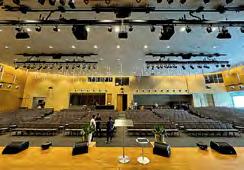
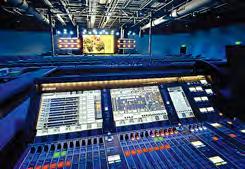
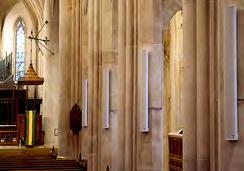
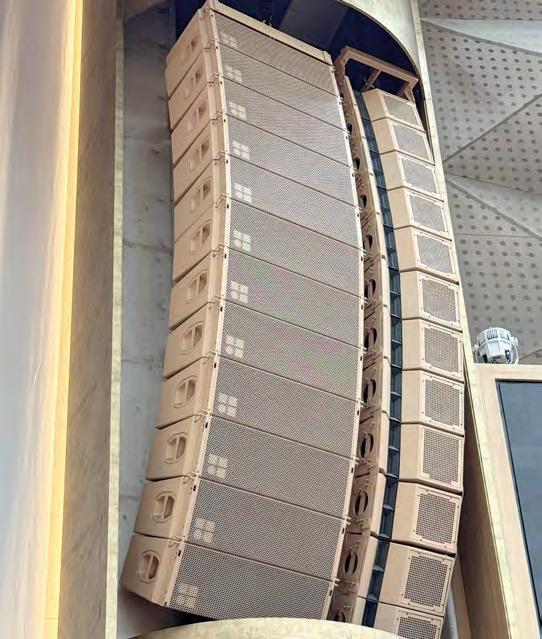
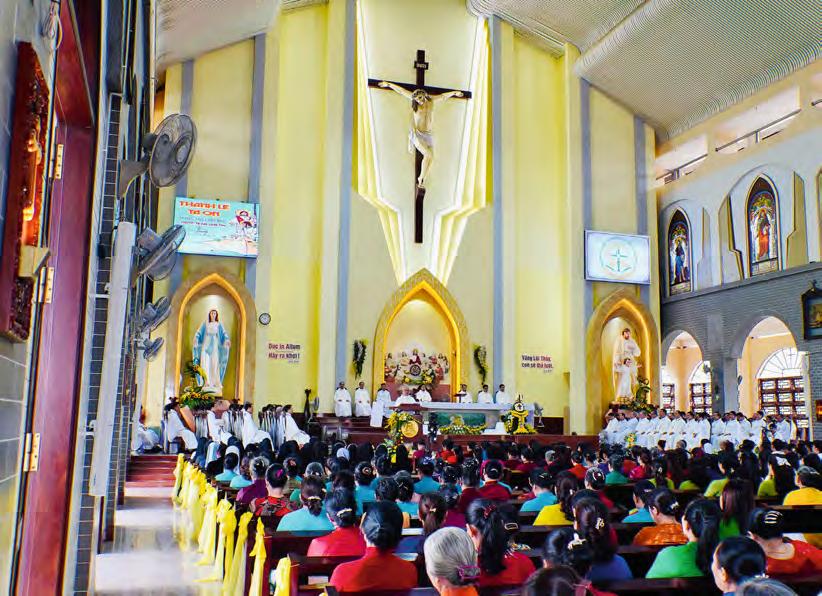
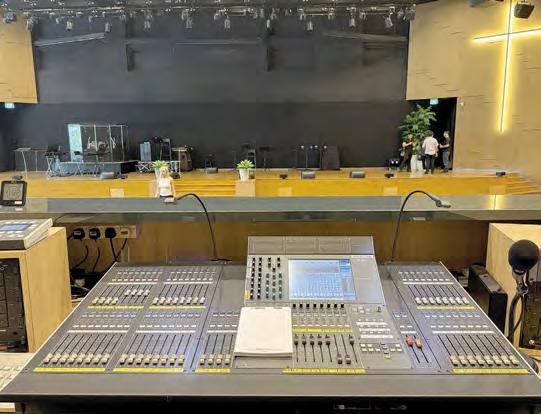
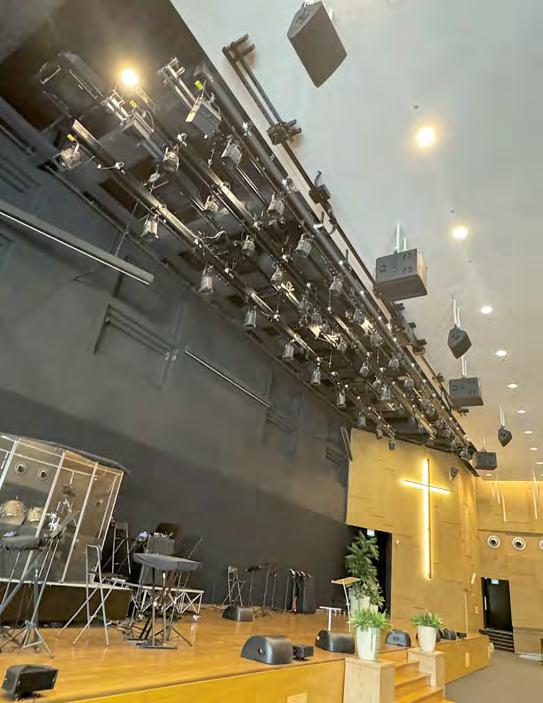
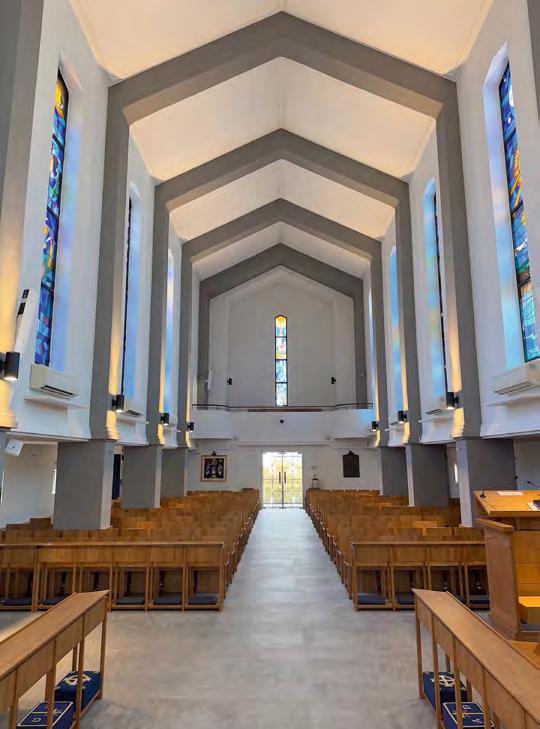
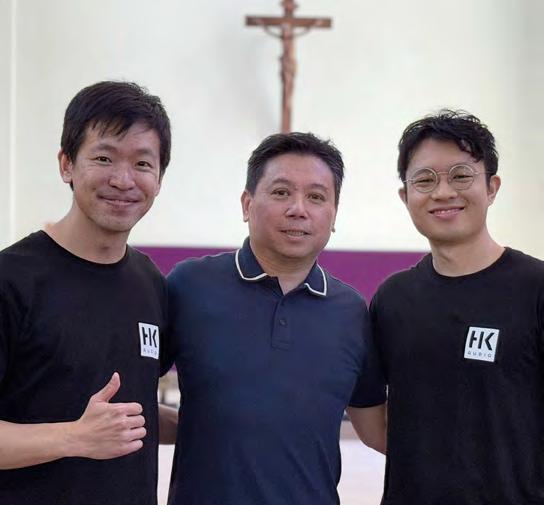
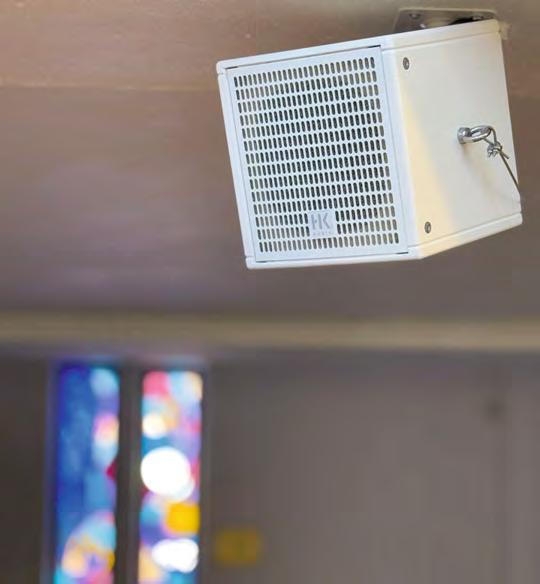
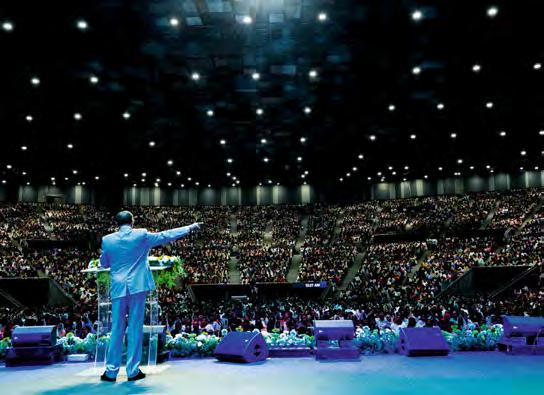
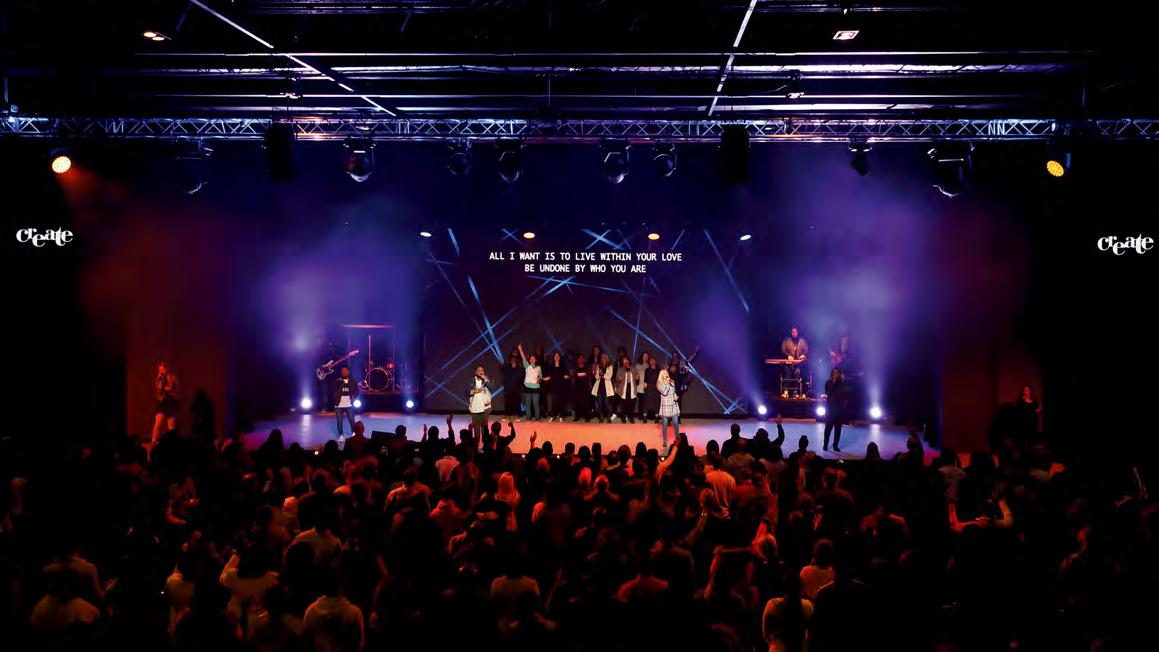
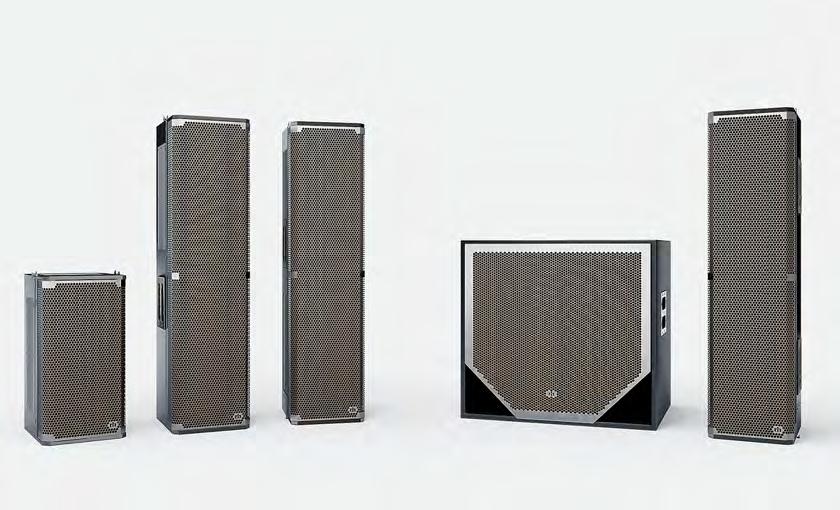
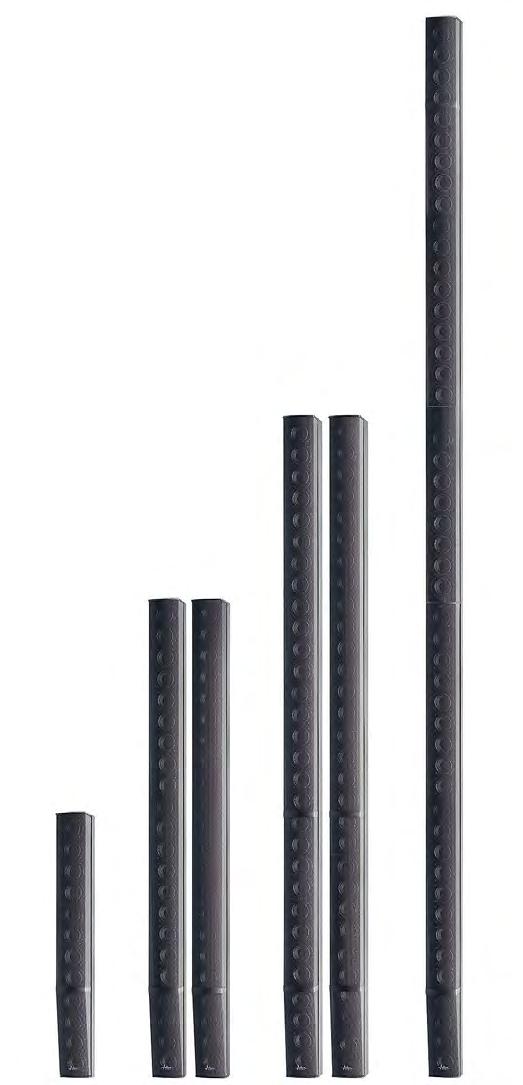
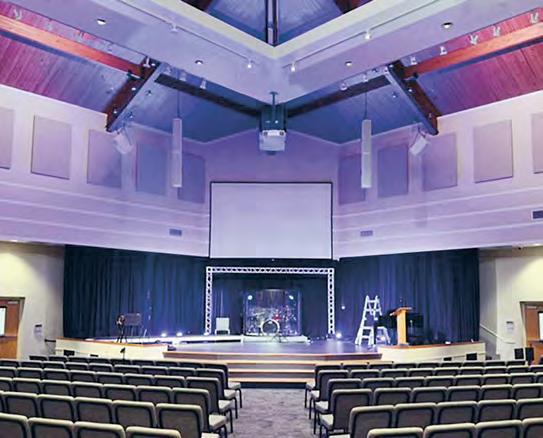
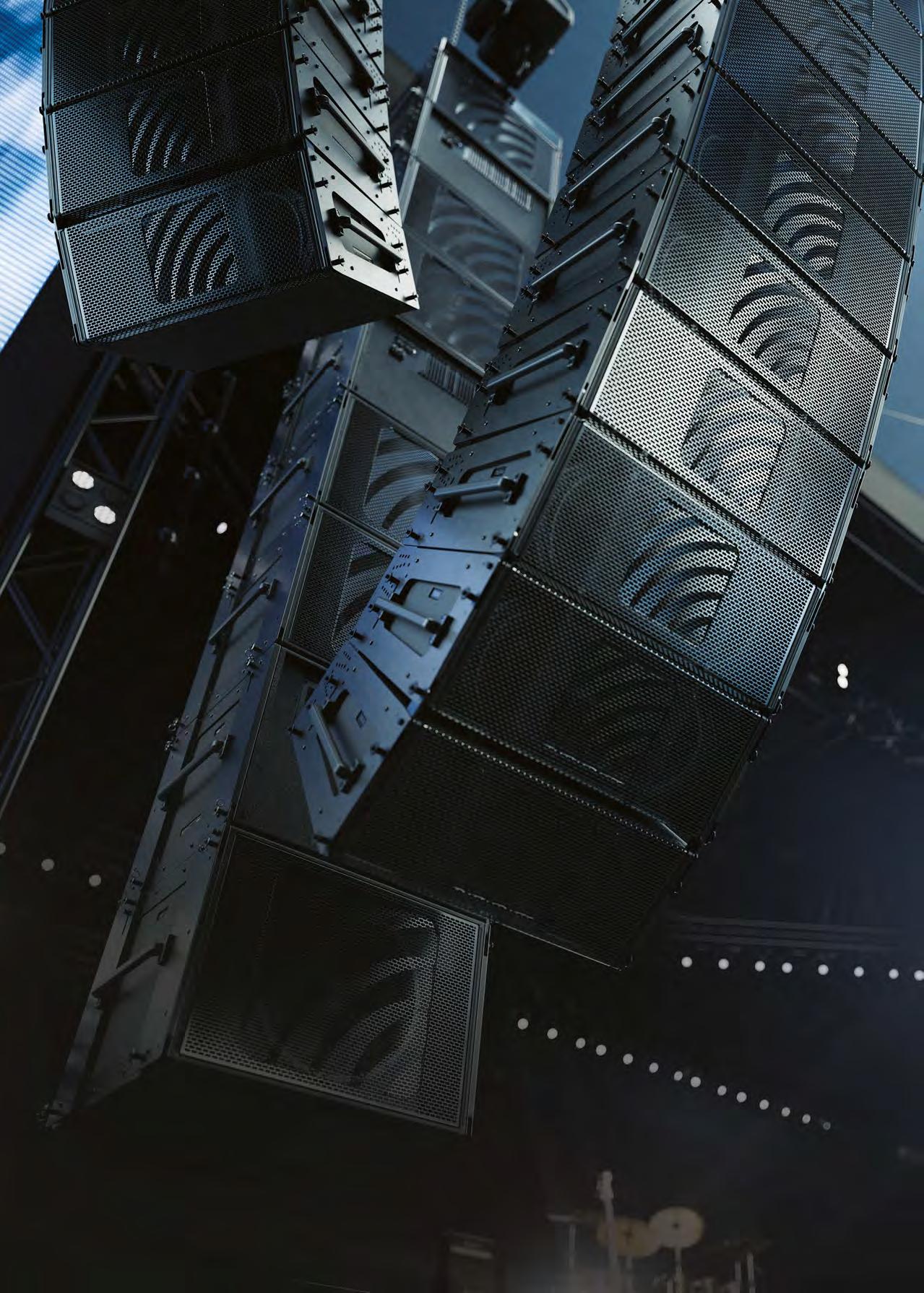
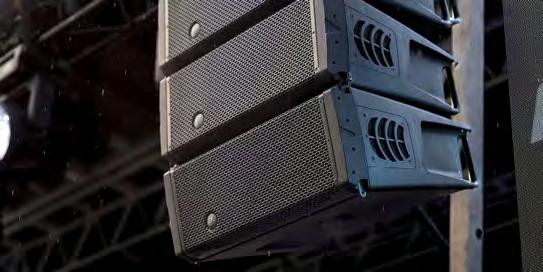
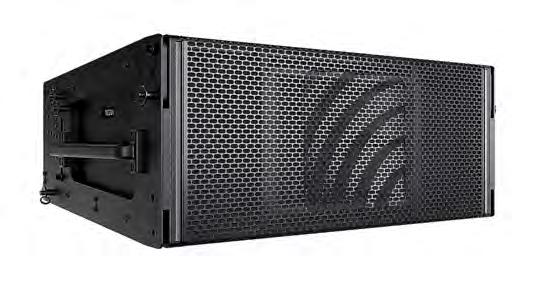
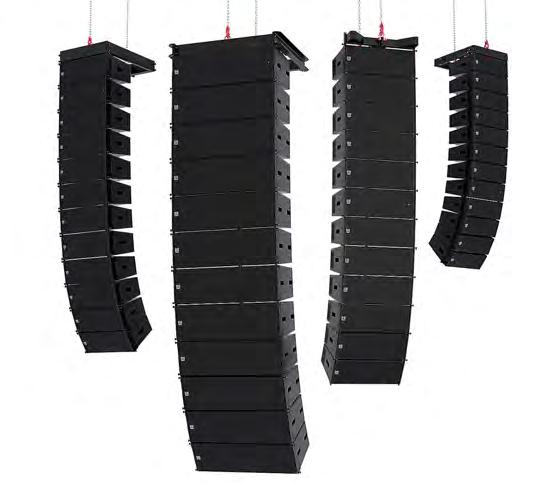
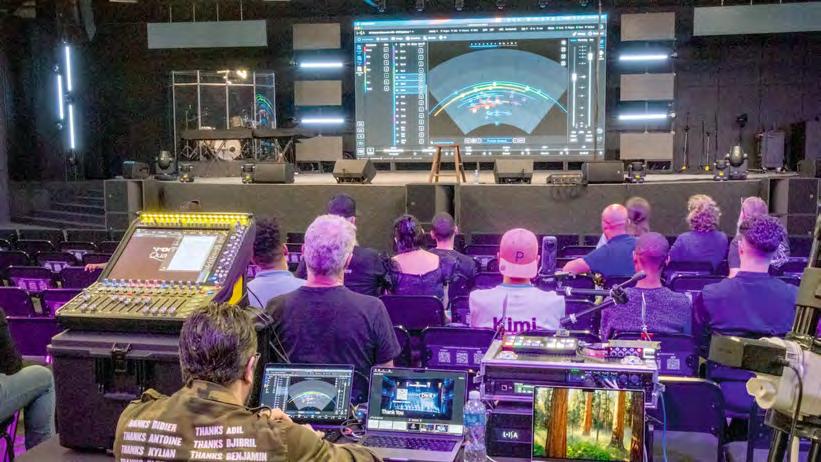
The house of worship market in India continues to evolve and it’s been a pleasure to work with L-Acoustics, Hi-Tech Audio & Image and Benjamin Mohan on the opening of New Life Assembly of God’s latest and largest sanctuary in Chennai. The 25,000seat auditorium has been built from the ground up as both a worship venue and an events space. It’s now home to an L-Acoustics L2 and L2D system that needed to provide both impact and consistency across the entire listening area –that’s quite a mean feat for such a large space. It is hoped the project country.
“A tool is only as effective as its operator and it needs to fit the job.” In his article on page 36, John Black has reflected on the concept that the tool needs to fit the job otherwise it’s not a good investment in either time or money. There’s no point in purchasing the best and most recent console if there’s no one around who will understand how to use it. With budgets increasingly being squeezed, equipment needs to be selected on the basis of how it best fits the skill level of the team and the goals of the service. I hope you enjoy the issue.
Richard Lawn General manager rlawn@worshipavl.com
Nick Smith Digital media manager nsmith@worshipavl.com
Sue Gould
director sgould@worshipavl.com
Chris Yardley Video editor cyardley@worshipavl.com
Carolyn Valliere
cvalliere@worshipavl.com
Jack Stennulat Digital content creator jstennulat@worshipavl.com
Simon Luckhurst Senior reporter sluckhurst@worshipavl.com
Adrian Baker Production editor abaker@worshipavl.com
Caroline
cmoss@worshipavl.com
Jo Pugh-Jones Production manager jpj@worshipavl.com
Allen & Heath’s commercial audio manager, Samantha Potter, highlights a few fundamental checks for our production systems
I WAS ON AN EXTENDED support call recently helping a gentleman and his tech team. Frequently in our production systems (like most HOWs these days), there can be a big emphasis on everything except audio. I was walking this gentleman through setting up basic audio processing and an app for the non-technical teams to change levels of the other areas and rooms in their building. A tale as old as time. He said something to me that’s been stuck in my head since. He was posturing that his team was used to very fancy tools of the trade, so didn’t need that much help. But would then proceed to ask the most basic, fundamental questions about audio that left me slightly concerned about their audio system. He said, through a litany of catchphrases and what I call “tech signalling” (think virtue signalling, except with tech-sounding words and ill-used), that “audio is just audio… [so we don’t even really need to discuss that]”. I stifled a scoff.
I don’t mind answering questions, truly. People seeking knowledge should be supported. What can get to me on occasion is this ego standing in the way. Audio is not “just” audio. And you don’t have to pretend to have all the answers. I won’t make it seem like it’s rocket science, but I think a lot of you, dear readers, since you’re here reading this, would say it’s not nothin’.
In this instance, fear is the opposite of ego – being too timid to try something or to find a possibly better option for fear of losing what we already know (even if it’s bad). Audio is not impossible. There are a few fundamental rules (which I will reiterate shortly) that should be followed, then beyond that it becomes a game of taste and subjectivity.
This particular person was sure that we could just cobble together whatever audio bits and it’d be fine – which isn’t totally wrong, if you know what you’re doing. However, his immediate questions regarding things like gain and EQ let me know where the conversation truly needed to go.
I’ve detailed in other articles throughout my career that sound and audio hold a really odd and special place to us humans. It’s intrinsic to humanity. We use it without even thinking about it –perhaps more than any other sense. When there’s something wrong with sound, a tiny red flag pops into our brain. When the sound is correct, it’s invisible. And when it’s not, we have a tough time sitting still.
I suppose I’m just asking for a little respect on “just audio”. So,
below are a few fundamental ideas that help all of us walk through our production systems (of whatever size) with more comfort and ease.
Point it where you want it
Funnily enough, microphones and speakers are nearly the exact same mechanisms but inverse to one another. Microphones take in changes in air pressure (sound) turning them into electrical signals. Speakers take electrical signals and turn them into changes in air pressure – neat! The thing about them, though, is that you have to point them where you want them. If it’s a microphone and you want to be picked up by it (for recording, streaming or local amplification), then you’ll need to speak into the
microphone. Being in the general vicinity is not quite enough, but sometimes you work with what you’ve got.
If you want people to hear the sound system, they generally need to be in the “splash zone” of the speakers. If you have a single speaker in the middle of the room trying to cover seating areas way off to the side, I could imagine they’d have a hard time hearing the system. In those instances, intelligibility really drops off as well. If any of your congregation is having trouble hearing anything at all, I’d start looking at these two things. Are we pointing ourselves into the microphones? And are we pointing the speakers at the people that should be hearing them? It almost seems silly when we phrase it like that; obvious, even. But it’s
Samantha Potter
Allen & Heath’s commercial audio manager
Speaking into the microphone is essential for capturing audio
so easy to forget about it because, again, sound is invisible.
Equalising
EQ has been around on stereos for many decades now. The concept is fundamentally the same now as it was then. I’ve covered different EQing techniques in other articles, so I won’t completely rehash those ideas. Instead, I want to emphasise how there is no one-size -fits-all setting. Sounds vary slightly from instance to instance, even when they are the same thing making the same sound. The only sounds that are mathematically the same are the ones copied/pasted by computers. Even the most talented singers on the planet cannot precisely duplicate one instance to the next. It’s also why on recorded vocals there are so many takes and so many layers happening. It’s because of the differences between them then summed together to make something bigger than each part individually. When you duplicate mathematical copies of sounds on top of one another, it just gets louder. The timbre or sound doesn’t change. Sound is super fun in that way. When you have two different copies of something, one set of rules apply.
Speakers need to cover every seat in the room
And when you have two exact copies of something, a different set of rules apply. But let me not stray off the path I’ve written.
Corey. They’re all different. When you read about EQ curves and starting points, you must remember that this is all they are: starting points. It’s nice to have some general direction, right? But you can’t just “let go and let God” on these sorts of things. Anything worth doing is worth doing right.
I cannot give you an EQ setting or curve that will be the answer to all things, or all vocalists, or all male vocalists, or all male vocalists named
When this tech lead was asking me about audio processes that he can just slap on the file, I had to keep telling him that like most things related to sound and audio, it depends. I can’t sit here and tell him (nor you) that if you’re using a handheld microphone that your entire processing chain should look like X or Y. I’d have to be standing there in the room, listening! Because (say it with me…) it depends! This is part of the art that is sound and audio. I can tell you to put a high-pass filter on your channels. That’s definitely a great rule of thumb. But the exact frequency, I can only give you a range or starting point. You must listen. Your team must listen. It’s not that “oh it’s just audio it’ll work itself out”. No, in fact, it’s because someone else has cared along the way that audio has felt like “just audio”.
www.allen-heath.com
Beyond tech mastery
Building systems that hold when everything shifts
Audio engineer Kevin Yague considers what happens when your service doesn’t go according to plan
SOME SUNDAYS GO EXACTLY
as planned. Most don’t. A last-minute song change, a missing volunteer, a microphone that doesn’t come up when it should, a pastor who lingers longer than expected. In moments like these, your AVL system reveals what it was really built for. Not perfection. Pressure.
In stable environments, almost any well-designed system can perform. But church production rarely operates in stability. It lives in constant adjustment. That’s why the goal isn’t to build systems that work when everything goes right. It’s to build systems that hold when everything shifts.
Many production systems are designed around ideal conditions. The most experienced operator is on the console, the band follows the arrangement, transitions happen on time. Under those conditions, complex routing and detailed automation can work beautifully. But what happens when those conditions disappear?
If your system depends on one person’s expertise or a perfectly executed plan, it’s not robust – it’s vulnerable. Resilient systems are built differently – they assume change, expect inconsistency and make room for the unexpected. Take console setup as an example. Modern desks offer deep flexibility, and it’s tempting to use every available feature. But when building
a show file, the question isn’t just what the console can do. It’s what your team can sustain week after week.
The same thinking applies when evaluating new equipment. More features don’t always translate to better outcomes. The right upgrade is the one that fits your team’s current capacity while leaving room to grow. Clarity creates confidence.
Scene management is another area where this matters. A flexible approach allows operators to respond quickly without fighting the console. RF systems highlight this further. Backup frequencies, clearly labelled transmitters and well-chosen systems all contribute to stability. Livestream workflows carry similar risks. Building a system that others can understand and run creates long-term stability. Consistent input lists, controlled stage volume and clean patching make systems predictable under pressure. The best AVL systems are not the most impressive – they are the most dependable. They create space for people to step in, adapt and serve with confidence.
Every piece of gear you choose and every system you build reflects what you value. Uncertainty doesn’t create weakness – it reveals it. Technical mastery still matters. But mastery reaches its full potential when it creates stability in unpredictable moments. Beyond tech mastery is not about doing less – it’s about building better. The systems that serve the church best are the ones that hold when everything shifts.
A GIGA…ntic performance
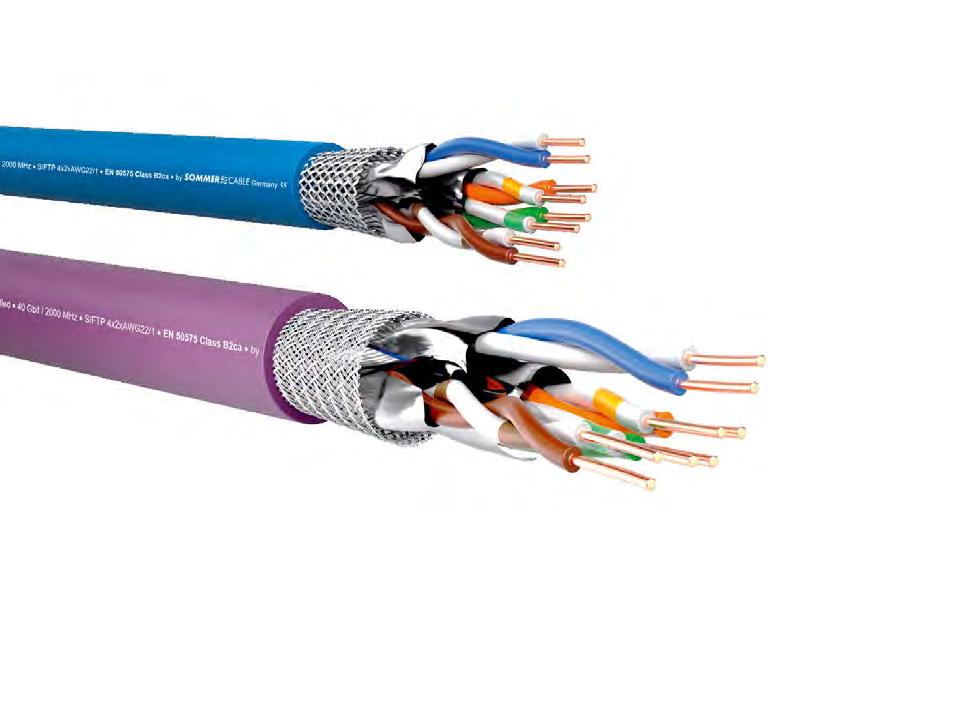
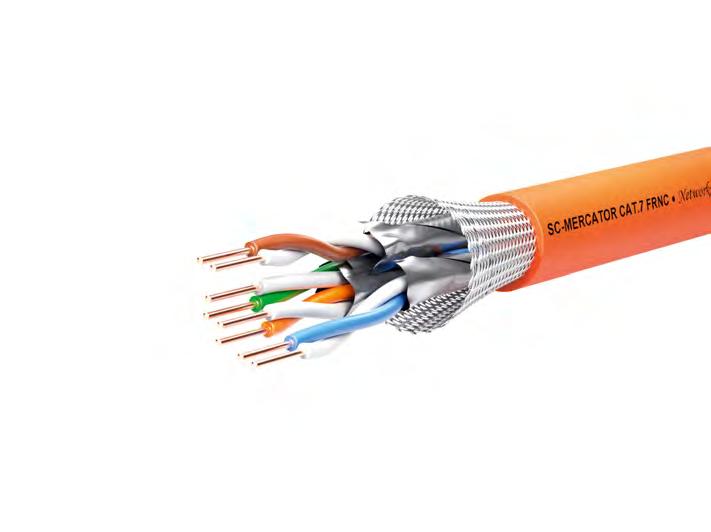
of up to 40 Gbit can be achieved with our CAT.8 connection world, or up to 10 Gbit with our CAT.7 or CAT.6a solutions.
Wide variety of cable and connection technology products for fully networked installation concepts
Classified cable bulkware in accordance with the EU Construction Products Regulation
Ready-to-connect media/network/fiber optic systems for robust mobile and installation applications
CPR-certified CAT.8 and CAT.7 installation and connection cables
SOMMER CABLE, headquartered in Straubenhardt (Germany) and founded in 1999, is an international supplier of professional connection technology for the audio, video, broadcast, studio/media technology, and installation business. In addition to its in-house brands HICON, CARDINAL DVM, and SYSBOXX, the company offers a range of over 25,000 products, including bulk cables, connectors, assembled cables, customizable distribution systems, and active components.
A B2B shop guarantees customers fast availability and a 24/7 service.
REQUEST YOUR FREE INSTALLATION CATALOG!
High-quality certified cables and connection components
Why your church’s Wi-Fi isn’t enough
LiveU has produced a guide to broadcast-grade livestreaming for houses of worship
“THE CONGREGATION HAS changed, and so has the service,” says Mike Mahoney, VP sales, growth markets at LiveU. “For most places of worship, reaching a congregation meant filling seats. That has changed permanently.”
A significant portion of every congregation is now watching on a screen, with some now attending church exclusively online. This is not a pandemic habit that faded – it is the new normal of worship. The question is no longer whether to stream – it is whether the stream is good enough to honour the moment.
What does “broadcast-quality” actually mean?
Many worship teams hear “broadcast quality” and assume it means expensive cameras or a professional crew. That is part of it. But the more important – and more frequently overlooked – piece is the connection that carries the video out of the building.
“Here is a simple way to think about it,” Mahoney adds. “A livestream has three things that can go wrong. First, the picture can look bad – grainy, dark or pixelated. This is usually a
camera or lighting issue. Second, the sound can be poor – echoing, muffled or out-of-sync. This is usually a microphone or mixing issue. Third, the stream can drop – the video freezes, buffers or goes dark entirely. This is almost always a connectivity issue.”
The first two problems are visible and easy to identify. The third one –connectivity – tends to be invisible until it fails, and it fails at the worst possible times: during a baptism, at the climax of a sermon or in the opening moments of an important service. Broadcast quality, at its core, means that the third problem never happens.
Why single-connection streaming fails at the worst moment
Most houses of worship stream over the building’s existing Wi-Fi or a single wired internet connection. On a quiet Tuesday morning, that works fine. On Sunday, it is a different story. When a service begins, every person in the room is also on their phone. They are looking up scripture, sharing the sermon on social media or just browsing. That shared use competes directly with the stream for the same Wi-Fi bandwidth. The more people
attending in-person, the worse the connection becomes – exactly when it matters most.
There is also a deeper problem: a single connection is a single point of failure. If your internet provider has an outage, your stream goes with it. If a volunteer unplugs the wrong cable, the stream drops. If the signal weakens just for a few seconds during an outdoor procession, your online congregation sees a frozen screen. For entertainment content, a brief dropout is annoying. For worship, it is something different. People watching a funeral service for a family member they could not travel to attend, a baptism of a grandchild or a Christmas morning service from a care facility –they are counting on that stream. A single connection is not a resilient foundation for that kind of trust.
What is bonded streaming – and why does it matter for worship?
Bonded streaming solves the reliability problem by combining multiple connections – cellular, Wi-Fi and wired Ethernet – into one unified stream. Think of it like a highway with multiple lanes. When
one lane slows down or closes, traffic shifts to the others and you keep moving. Your stream never notices. Your online congregation never sees a freeze frame.
Inside the sanctuary, churches can use a device that bond the venue’s wired LAN connection, the building’s Wi-Fi and a few cellular networks simultaneously. This means that even during a standard Sunday service – where a reliable internet connection exists – you are never dependent on a single pipe. If the venue’s internet hiccups for any reason, cellular takes over instantly and automatically.
Outside the walls, where there is no cable drop and no Wi-Fi, the system draws on multiple cellular carriers at once, distributing the stream across all of them. If one network is congested or loses signal, the others carry the load without any human intervention.
“This matters because meaningful worship happens everywhere,” explains Mahoney. “A river baptism, an outdoor service, a graveside memorial – bonded streaming goes where a single connection cannot, and holds where a single connection would fail.”
Mike Mahoney
More and more people are watching services remotely
The device that makes this possible is called a bonding encoder. It connects directly to your camera, compresses the video and sends it simultaneously over multiple connections – cellular, Wi-Fi and wired – to wherever your stream needs to go. It requires no engineering background to operate and, for most worship setups, it is up and running in minutes.
Real-world worship scenarios where this changes everything
Bonded streaming is not just for large productions. Here is what it looks like in practice across the situations worship teams encounter every week.
Sunday main service
A congregation of 800 fills the sanctuary. Another 1,200 are watching online. The in-venue Wi-Fi is under strain from hundreds of phones. A bonding encoder combines the building’s wired connection, Wi-Fi and cellular simultaneously – ensuring the online audience sees and hears every word clearly, regardless of what is happening on the local network.
If the signal weakens during an outdoor event, the congregation sees a frozen screen
Outdoor Easter sunrise service
No cable runs. No venue Wi-Fi. The encoder runs entirely on cellular, drawing from multiple carriers at once and streaming in high definition to congregation members who could not attend – including anyone overseas.
Baptism at an offsite location
A river baptism is one of the most meaningful moments in a congregation’s life. Streaming it over a single hotspot risks dropping at exactly the wrong second. Bonded streaming – across cellular, Wi-Fi or both – makes it as stable as a connection from inside the building.
Multi-campus and multi-site
church streaming
A lead pastor delivers a message
from the main campus while satellite locations receive the feed live. Any interruption breaks the experience for every location simultaneously. Bonding provides the redundancy that multi-site ministry requires.
Memorial services for remote family members
Family members who cannot travel still deserve to be present. A dropped stream at that moment is not a technical inconvenience – it is a missed moment they cannot get back.
What to look for in a church livestreaming solution
Not every streaming setup is built for the demands of live worship.
AIMLINE SERIES
Find out more at AtlasIED.com or engage with us on your favorite social platform.
Here are some points to consider. Reliability – does it eliminate single points of failure? What happens when one connection drops? Ease-of-use –can a trained volunteer operate it or does it require a broadcast engineer? Portability – can you take it from the sanctuary outside to a remote baptism site? Multi-platform – can it stream to YouTube, Facebook and your church website simultaneously? Support – is 24/7 support available? What happens when something goes wrong at 8:45am on a Sunday morning? Scalability – will it serve your congregation today and grow with you as your online audience grows?
When exploring bonding, not all bonding solutions are built for live video. Consumer routers and general-purpose bonding devices can combine connections, but they are not optimised for live video. If a solution was not designed specifically for live broadcast, it will likely show its limits at exactly the moment you need it most.
“The principle is the same,” concludes Mahoney. “Your online congregation deserves the same reliability as your in-person one. A service that is worth attending is worth streaming without compromise.”
www.liveu.tv
State of Church Technology report 2026
Kenny Wyatt, CEO of Pushpay, discusses how technology has become embedded into the way ministries communicate, organise and connect with their congregations
PUSHPAY HAS RELEASED ITS annual State of Church Technology report, a study that examines digital trends in houses of worship, including current adoption, considerations, barriers to embracing new technology and forecasts on what is strategically important as venues develop strategies for the future of ministry. The report outlines the role technology and digital solutions play in the faith sector today, and evaluates current priorities, concerns and near-term expectations from the people responsible for meeting their church’s needs with technology. The overall consensus from the 2026 research reveals a landscape of both optimism and discernment. Most leaders affirm that technology plays an important role in achieving their mission, yet many remain cautious, particularly as artificial intelligence expands rapidly. Leaders are leveraging AI to enhance communication and efficiency, yet they remain hesitant to outsource spiritual authority or pastoral leadership to machines.
“AI represents a distinct frontier because it moves beyond being a neutral delivery mechanism, like a camera or a soundboard, and begins to touch the actual substance of the message,” explains Pushpay CEO, Kenny Wyatt. “I think the questioning we are seeing around its spiritual validity is not only healthy but needed. While about one-third of churches (33%) are already using AI in some capacity, most are limiting its role to administrative and creative support rather than the core pastoral work.
The hesitations are very specific: about half of leaders are concerned about plagiarism (51%) or losing the authenticity of their preaching and teaching (49%). Those worries deserve to be taken seriously. For many leaders, the centrepiece of the service must remain a deeply human endeavour.”
A staggering 95% of church leaders now agree that digital tools open new opportunities for ministry, but the real driver is the desire for deeper connection. “We’ve moved past the era of adopting
technology out of necessity and into one defined by intentionality,” adds Wyatt. “A few years ago, the surge was about survival and basic access. Today, the acceleration is driven by a deeper conviction: that technology, when used with purpose, actually strengthens ministry rather than diluting it. We’re seeing that when these tools are integrated into the heart
of community life, it doesn’t just make things more efficient – it opens new doors. This is especially true for younger generations, like Gen Z, where digital fluency is an expectation for connection. It is no longer about just having the tools. It is about aligning them with the mission to reach people exactly where they are.”
In today’s digital age, relying solely on what happens inside the four walls can create a real gap in reach. Houses of worship need to be considering whether they are meeting people where they actually are. “Our research shows that 91% of church leaders feel technology helps them better care for their community,” continues Wyatt. “That’s because technology has become the connective tissue of our relationships. The
For Gen Z, digital fluency is an expectation
Kenny Wyatt
biggest pitfall isn’t just a lack of efficiency – it’s the risk of becoming invisible to the next generation. Younger people are looking for belonging, and they are often finding their first points of connection through digital channels. Technology is simply a way to extend the church’s presence so the pastor’s voice can reach people in their daily lives, not just on Sunday morning.”
Yet there remains a reluctance to embrace technology, even though that reluctance usually comes from a good place: a desire to protect the authenticity of worship. “We often assume hesitation is a generational gap, but it’s usually about the weight a person carries,” says Wyatt. “A senior pastor is naturally protective of a congregation’s spiritual health. In fact, 52% of them worry about the risks technology poses. Staff members, however, tend to see the possibilities first. Overcoming that gap is about showing that technology is a support system, not a substitute. When leaders see that their peers believe technology has supported the faith of their people, the conversation shifts from fear to possibility. These tools simply remove administrative barriers so
95% of church leaders now agree that digital tools open new opportunities for ministry
leaders can focus on the deeply human work of ministry.”
Staff and members are often the ones feeling the day-to -day logistical strain, so they tend to be the first to champion tools that can reduce that friction. Pastors and worship leaders, on the other hand, are responsible for the spiritual authenticity of the service, which naturally requires a more cautious and discerning position.
“We see this reflected clearly in the heart of our research: half of staff (50%) say technology is
extremely important for worship, compared to just over one-third of senior pastors (37%),” continues Wyatt. “To move forwards, both of these perspectives need to be in the room. The goal isn’t to convince every pastor to be a tech enthusiast, but rather to build a shared understanding that these tools exist to support the mission, not compete with it. When that alignment is clear, technology stops feeling like a threat to the worship experience and starts feeling like what it was always meant to be: a
support system that frees leaders to focus on the deeply human work of ministry that matters most.”
But can technology ever cross the line and distract from worship? Can it become the centre of attention rather than advancing the mission?
“It’s a tension every leader has to manage, and 39% say they worry that digital tools could distract from or distort authentic ministry,” concludes Wyatt. “The answer isn’t just about having access to the latest tools, it’s about alignment.
The question every place of worship needs to keep asking is whether a given tool is clearing the path for human connection or whether it is just adding noise.
We see a huge difference in churches that take what we call a highly missional approach –those that integrate technology intentionally into discipleship, worship and community life. 93% of those leaders report improved congregational connection as a result. That is not a coincidence. When technology is treated as a ministry partner rather than just an operational utility, it amplifies the mission without ever overshadowing the message.”
www.pushpay.com
The power of amplification
Powersoft’s T Series amplifiers have been selected for two Ho Chi Minh City churches
RELIGIOUS AUDIO
installations in Vietnam often present complex acoustic challenges, particularly in spaces where reverberation is high and speech intelligibility is critical. Local systems integrator Sao Mai Audio has once again teamed up with UPSV – the official distributor of Bose Professional and Powersoft solutions in Vietnam –to provide new sound systems at Sơn Bình Parish and Chánh Thiện Church in Ho Chi Minh City.
At Sơn Bình Parish, the solution needed to deliver clear and reliable audio performance for daily liturgical activities and consistent coverage throughout the worship space, while also ensuring long-term operational stability and allowing flexible system tuning and control. Amplification was key to the success of this project in terms of both power delivery and overall system optimisation.
At the core of the system is a multichannel amplification setup based on Powersoft’s T904A and T902A amplifiers. “The T Series has been designed for high-performance applications where power density, DSP capability and reliability are essential,” explains Pham Ngoc Dung, chief engineer at Sao Mai Audio.
“The Class-D topology enables high power delivery with reduced energy consumption and heat dissipation, key factors for systems operating continuously.”
The onboard processing has allowed the Sao Mai Audio engineers to implement frequency equalisation tailored to the room, delay alignment for coherent sound arrival and limiting for system protection. This ensures precise control over system behaviour in a challenging acoustic environment.
The amplifiers are paired with 18 Bose Professional MA12 column loudspeakers, selected for their ability to control vertical dispersion and reduce reflections from ceilings and walls. “This improves speech intelligibility in reverberant spaces,” explains Dung. “The integration between amplification and loudspeaker design enables us to provide the church with a coherent system approach, rather than treating components in isolation.”
The completed system has given Sơn Bình Parish clear and intelligible speech reproduction, even coverage across the entire space, stable performance for extended use and flexible tuning to adapt to the church’s
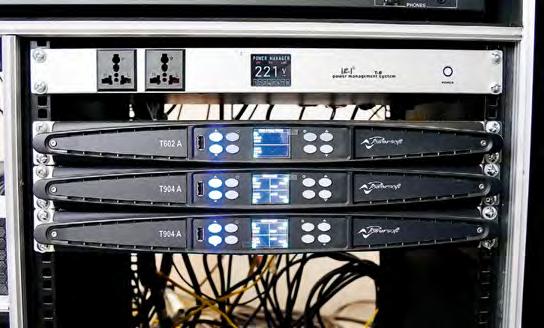
More than just an amplifier, it functions as a core system component, enabling engineers to design and maintain high-quality audio environments over the long term.” Meanwhile, Sao Mai Audio has also supplied a Powersoft T Series solution at Chánh Thiện Church, with the aim of delivering clear and intelligible sound across a highly reverberant space. The setup includes one T602A amplifier, two T904A amplifiers and 18 Bose Professional MA12 column loudspeakers. “The choice of MA12 speakers combined with Powersoft amplification enabled us to provide Chánh Thiện Church with precise coverage and improved speech clarity in challenging acoustic conditions,” says Dung. “The church now has access to uniform sound coverage across the entire space, high speech intelligibility for sermons and announcements, stable and reliable operation over long periods, and flexible zone management and delay alignment.
difficult acoustic conditions. Dung describes the result as an audio environment that supports both spoken word and musical content in a balanced and natural way.
“The Sơn Bình Parish project highlights the importance of selecting the right amplification platform in religious audio systems,” adds Dung. “With its combination of high power output, integrated DSP and operational reliability, the Powersoft T Series serves as a solid foundation for achieving consistent performance in acoustically challenging spaces.
“With Powersoft amplifiers, I am fully confident in the sound quality they deliver,” concludes Dung. “The integrated DSP and EQ presets allow me to quickly tune the system with EQ, delay and limiter. The availability of 2- and 4-channel configurations also helps me divide zones effectively and apply precise delay adjustments, especially important in highly reverberant spaces like churches.”
www.boseprofessional.com www.powersoft.com
Bose Professional MA12 column loudspeakers control vertical dispersion at Sơ n Bình Parish
One Powersoft T602A and two T904A amplifiers in the rack at Chánh Thiện Church
A moment of reflection
ADJ fixtures have been selected to illuminate two glass dome structures located on the site of the Sheikh Zayed Grand Mosque in Abu Dhabi
SHEIKH ZAYED GRAND MOSQUE
(SZGM) in Abu Dhabi is one of the world’s largest and most stunning places of worship. Built under the vision of Sheikh Zayed bin Sultan Al Nahyan, the mosque features 82 domes of various sizes, combining several forms of Islamic architecture predominantly inspired by the Moroccan and Mogul styles.
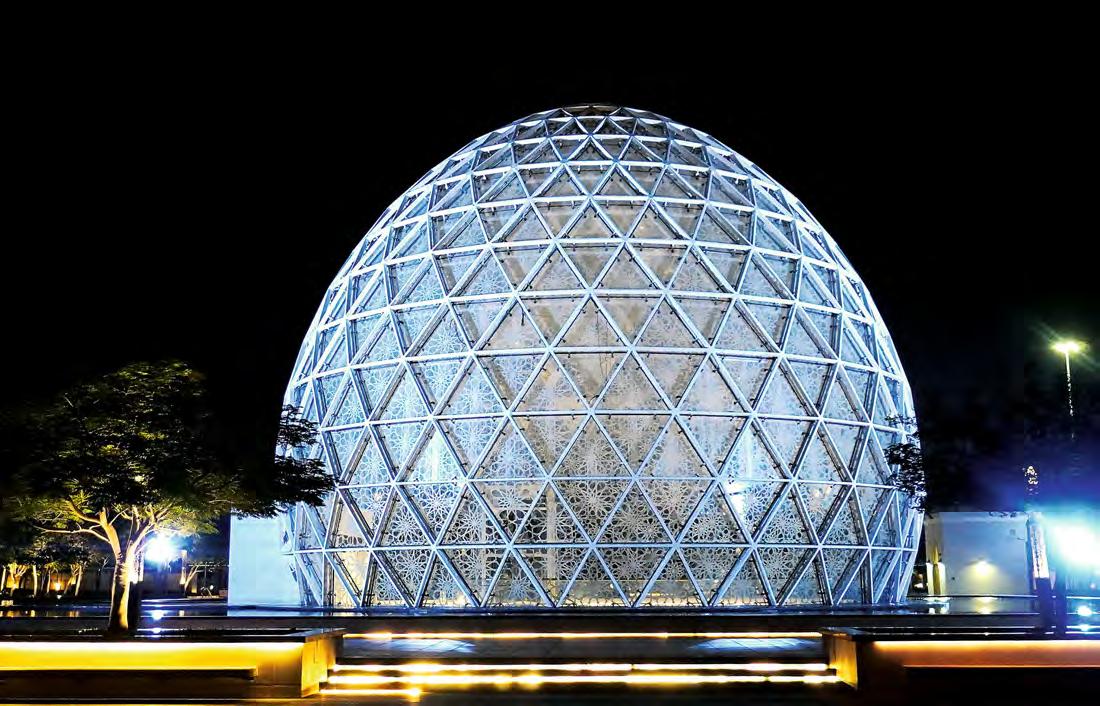
The pure white colour of the mosque is one of its most distinctive characteristics. A total of 10 rectangular pools surround the building and are tiled in different shades of blue. The layout also includes 14 glass domes, distributed above the female and male ablution areas, which form part of the traditional design elements of Islamic gardens in mosques. SZGM recently tasked ICONICA Design & Supply with installing a new exterior lighting setup for two of the glass dome structures, with support from ADJ’s UAE distributor, GSL Professional. When the mosque was first constructed in 2007, strip lighting was installed to illuminate the domes. “However, most of these lights have now failed, so the client was looking to replace them,” explains Jasper Bryan, sales executive at GSL Professional. “The mosque contacted
us to provide an IP-rated solution capable of functioning outside with the ability to light two of the domes in both white and blue, matching the colour scheme used across the site. While the fixtures we provided were initially intended as a temporary replacement so that the original system could be renovated, they quickly proved to be so effective that they have now become a permanent solution.”
The setup comprises 32 ADJ Encore LP32IP LED wash fixtures with barndoors, eight ELP32L20 20° frost filters, eight ELP32L60 60° frost filters, four Aria X2 Bridges which bridge the gap between the Aria X2 serial protocol and existing wireless DMX solutions, two D4
Branch RM 4-way distributor/booster with 3-pin and 5-pin XLR input and output jacks, and one myDMX5 control package.
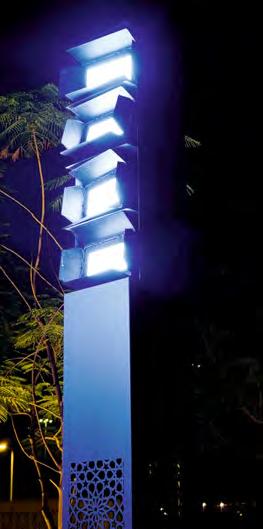
With the domes surrounded by water, ICONICA Design & Supply wasn’t able to run signal cables to the lighting fixtures, which were mounted to custom fabricated decorative towers. Four towers have been installed surrounding each dome, set back by 30m, with each tower fabricated to match the mosque’s exterior design. Multiple design iterations were submitted
before the client approved the final light tower design. It was also necessary to install control for the system inside the domes. “This was overcome by using the Encore LP32IP’s integrated wireless antenna,” adds Bryan. “Two
Aria X2 Bridge wireless transceivers have been installed in each dome –one at either side – which transmit DMX control signals to all 32 lighting fixtures. Control is provided via ADJ’s myDMX5 software/hardware, programmed with easy-to -use scenes covering the client’s requirements (white/blue/blackout), with two D4 Branch RM DMX signal distributors/ boosters splitting the signal from the myDMX5 interface out to the Aria X2 Bridges.”
According to Bryan, it was the saturation of the colour generated by the Encore LP32IP – especially its blue – as well its cost effectiveness, that sealed the deal. “At least two other brands’ products were considered; however, when a shootout was organised onsite, the Encore LP32IP was chosen by the client as the preferred solution,” he concludes. “The easy wireless control and user-friendliness of the myDMX control software have also made a good impression. As we haven’t heard from the client for a while now, we’re confident that they’re satisfied with the end result.”
www.adj.com
www.gslprofessional.com
www.iconica.ae
ADJ fixtures light up two of SZGM’s glass domes
Playing it short and wide over the long term
Yamaha
Music (Asia) has designed and supplied a fully digital audio networked speaker system for Bethel Assembly of God in Singapore
CELEBRATING ITS 70TH anniversary this year, Bethel Assembly of God church has resided at its current Geylang East site in Singapore since 1986. Newly constructed in 2012, the church leadership recently decided that the clarity of the spoken word through the loudspeakers in the main sanctuary had degraded sufficiently to warrant an upgrade. Over those 13 ensuing years, Yamaha Music (Asia)’s office had consistently offered excellent service, support and advice. This loyalty was repaid when it was awarded the contract to design and supply a fully digital audio networked loudspeaker system that completes phase one of the AV and lighting refresh.
“In terms of the church’s AVL requirements, the primary goal is to support the worship experience and ensure that the message is communicated clearly for speech and musicality,” explains Pastor Aaron. “The church gathers weekly for praise and for preaching the spoken word, but we also adopt drama and other creative elements to communicate the message.
Clear speech is important, but the music also needs to be well-balanced so that the congregation can engage fully in the service.”
With full-length reflective glass windows running down the left-hand side of the second-level sanctuary, the church had endured intelligibility problems within the
16.36m x 40.89m (DxW) room.
Upon discovering that the original L-C -R dual 10-inch line array with subwoofers could no longer be supported, the decision to invest in a new audio loudspeaker system was taken in 2024. This presented the church’s AVL team with an opportunity to troubleshoot the room’s acoustics.
Several leading suppliers, including Yamaha Music (Asia), were contacted to partake in a tender process. “We opted for a point source system, owing to the venue’s insufficient depth for line array deployment,” furthers Pastor Aaron. “A point source system is more beneficial as the venue has over double the width compared to the depth.”
Ultimately, a NEXO L-C -R point source solution was specified based on the P15’s controlled audio dispersion in combination with the L18 subwoofer’s tighter bass response and even distribution.
“The NEXO system was able to concentrate the sound on the targeted audience areas without exciting the walls in the venue,” adds Pastor Aaron. “Because NEXO is represented by Yamaha, we were further encouraged as Yamaha has consistently provided us with great service for our M7CL-48ES console.”
Full-time audio specialist Jasper Chia joined the church in late 2023. Possessing a deep interest in audio during high school, Chia had served his previous church for
L–R: Bethel Assembly of God’s Pastor Aaron with audio specialist Jasper Chia
The church opted for a point source system due to the room’s insufficient depth for a line array
The Yamaha M7CL-48ES console has served the church since 2012
many years. To date, he has built up a collection of older analogue and digital equipment, including ADAT machines and a 25-year-old Yamaha DM1000 console. Chia was vocal in his recommendation for a point source system as the NEXO NS-1 simulations suggested that the audio directivity would cover the wider seating area and avoid the back wall.
“When we auditioned the NEXO M10 and the P15 speakers, the M10’s coverage pattern was a little too narrow,” confirms Chia. “Supplemented in the lower frequencies by four ceiling-mounted L18 subwoofers, the simulations confirmed that an L-C -R ceiling-suspended configuration of P15 enclosures together with two additional fills in the corners would provide optimal coverage. The previous front fills were located under the stage, and as such could only effectively cover the first row of seats. By mounting six ID24 enclosures onstage, the coverage extends several rows behind. Their small, compact footprint does not obstruct the sightline of the stage for the congregants sitting towards the front and, crucially, they enhance the clarity in the front area. The lightweight enclosures can also be easily removed when required.”
Commissioned to install the audio upgrade by Yamaha Music (Asia), ATECH Integration Engineering director James Tan spent the first two days onsite tracing the 2012 cabling network from the ELV room to the various inputs and outputs. Embedded into the stage floor, the original cabling that was routed inside the staircase and through a false wall to the small, low ELV room has been replaced by Canare AWG12-gauge in new conduits.
Fitted with NEXO NXAEDT Dante cards, NXAMP4X2MK2 and NXAMP4X1MK2 amplifiers now supply power to the main and fill outputs, respectively. Occupying the same equipment rack, a Yamaha MRX7-D processor provides loudspeaker system management. Eight amplifiers previously powered the original loudspeakers installed by Electronics & Engineering, but now there are just four NEXO models.
“With the increased intelligibility, we could lower the SPL from the previous 95dB to 88dB,” furthers Pastor Aaron. “Most of the band are happier with this setup and the congregants appreciate the enhanced clarity.”
A further investment was made by the church in the form of a Shure SLX-D wireless microphone system.
Comprising SM58 handhelds, SLXD1 beltpacks and 14 channels of SLXD4D receivers, the system can be expanded in future. Providing an alternative to the original wedge monitors, four channels of Shure PSM 300 in-ear monitors are also available for the singers and worship leaders.
Additional Ethernet lines have been installed for the stage and video room for future Dante implementation when the mixer and stageboxes are upgraded. Providing control and simplifying operations, the addition of primary and secondary Dante networks adds redundancy and promotes expandability options for future upgrades. Allowing the church to position stageboxes closer to the musicians, Ethernet Cat6A cable has been routed onto the stage.
“The analogue network was characterised by individual lines for each signal, while the new system only requires a single network cable for one amplifier,” adds Tan. “Reducing a single point mode of failure, Dante also possesses a redundant switch and cabling. The integration of a new console and stageboxes will be greatly simplified
with less cabling and conversion between protocols required on this one network.”
In addition, acoustic panelling dictated that ATECH could not route new cabling through the false ceiling to the control room. “We located the signal path down to level one and came up from the bottom,” explains Tan. “As there is no cable trench or riser for the audio cables, I had to open a small panel in the false wall to route cables for the fill speakers on the stage. The cables to the console area also go through this path and cut across the car park on the ground floor.”
With the cabling routed before Christmas 2025, ATECH returned for one week in January between Sunday services to fix the NEXO
speakers. “Once the P15 and L18 cabinets had been raised into position and fixed, the equipment in the amplifier rack was terminated and then we simply configured and tuned,” recalls Tan. “There’s a basic stored preset for routing the entire venue including the breakout rooms, with all the volume control points.”
Looking forward to phase two of the AVL upgrade, Pastor Aaron is keen to reinforce the same ethos that characterised the first phase by insisting on flexible, labour-saving , future-proofed technology that remains easy to use. “For broadcasting our services, we are looking at ways to reduce manpower requirements, but without sacrificing quality,” Pastor Aaron declares. “For
example, by replacing our ageing broadcast cameras with the latest Canon CR-N700 PTZ wall-mounted 30x advanced zoom HD models, the broadcast quality will be similar, if not better. However, we will only need one operator rather than four and we will save much valued space where the three broadcast cameras used to be in the sanctuary.”
The overall phase one objective to improve the clarity and worship experience in the sanctuary has been achieved, but Pastor Aaron continues to be in admiration of Yamaha. “The installation process was very smooth with the ATECH and Yamaha representatives professionally overseeing the installation safely, on time and according to the plan. Digital pioneers for over 30 years, Yamaha continues to maintain the highest standards in the industry. Over that time span, Bethel Assembly of God has enjoyed operating its consoles, which come with great service and backup. What impressed me most was the after-sales support, when a Yamaha representative attended our first service.”
www.bethel.org.sg
www.nexo-sa.com
www.sg.yamaha.com/en/business
L–R: Yamaha Music (Asia)’s Joseph Edward with Jasper Chia, ATECH’s James Tan and Yamaha Music (Asia)’s Aloysius Tang
The sanctuary now relies on a NEXO P15 L-C-R point source solution
A lens into the community
Diversified has deepened its relationship with Cross Point Church by upgrading the main broadcast campus’s camera setup and providing a full AV fitout for the new Hendersonville site
EACH WEEK, CROSS POINT
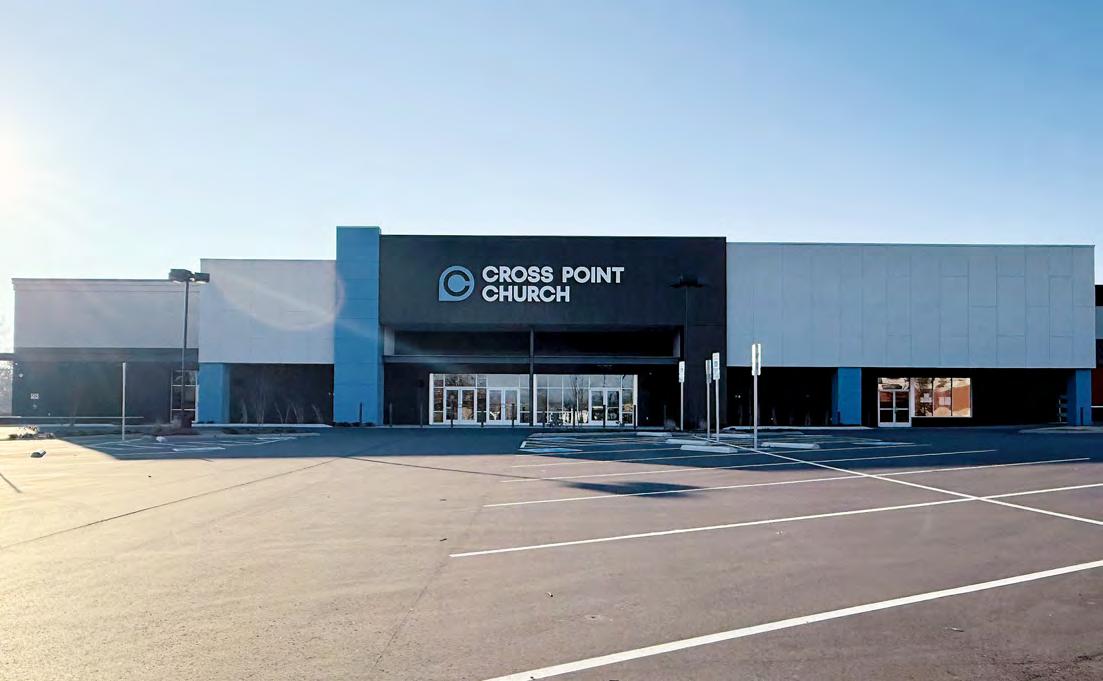
Church reaches between 12,000 and 15,000 people through its streamed and in-person services. It has six campuses across central Tennessee – the main broadcast site in downtown Nashville along with regional sites in Bellevue, Dickson, Franklin, Hendersonville and Mt Juliet. Recently, the central production team worked closely with installation partner Diversified to improve the image quality of the Nashville campus and create a more cinematic look across its content.
“A key part of this campus strategy is that the senior pastor preaches from the broadcast site in downtown Nashville,” explains Diversified’s vice president, Tim Corder. “Then that message is broadcast online and it’s also simulcast to the remote sites around the city with a low-latency buffer. The previous cameras were ageing and the image quality showed this in graphic detail each week. When engaged, we immediately facilitated demos with camera options from multiple manufacturers over the course of a few weeks, and it was Canon that rose to the top of the evaluation as the best choice for the future.”
The church selected Canon cinema EOS full-frame cameras including the new EOS C400 and C80, as well as onstage PTZ cameras that can achieve smooth, cinematic shots while offering efficiency through auto tracking and remote-control capabilities. The primary goal of this upgrade was better colour accuracy, improved colour depth and a more intentional, authored look to the content originating from the broadcast
site. Already invested in the Canon ecosystem for creative pieces produced outside of the auditorium, along with natural skin tones and overall image quality, the church felt that Canon was the best choice. Diversified replaced all of the manned static camera positions with the EOS C400 and the onstage handhelds with the portable EOS C80 cinema cameras. The church is also using an LUT (look-up table) to tie everything
together in the colour space, achieving a consistent image that translates to all audiences.
“You would never guess when you watch the content online how little they’ve actually had to spend to achieve such a significant improvement in the end result,” continues Corder. “Cross Point’s stream is now regularly mentioned as a source of inspiration for other churches around the country. What’s been most impressive about working with Canon is that, through intentional product development, they have made significant strides to specifically address the needs of the modern megachurch where expectations are always through the roof.”
By upgrading the camera imager at the main broadcast campus, every other site benefits as well, along with every viewer who’s watching the stream from anywhere in the world.
“Working in Nashville isn’t always easy – its Music City reputation means that the bar is set higher here,” explains Corder. “Beyond upgrading camera bodies, this upgrade also provided the opportunity to execute a shift from a 59.94 frame rate to 23.98. We’ve been on this journey now with a number of ministries from
Cross Point’s Hendersonville campus opened earlier this year
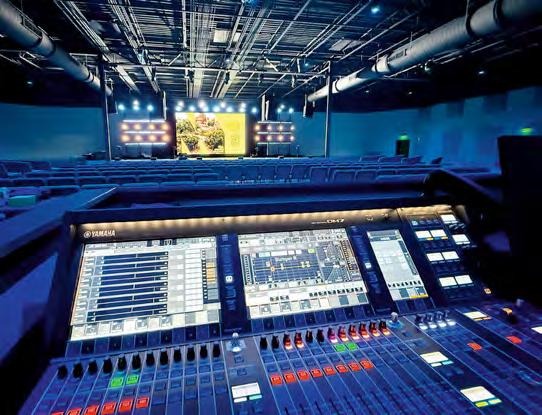
Hendersonville has upgraded to Yamaha’s DM7 platform
Back
together. More than ever.
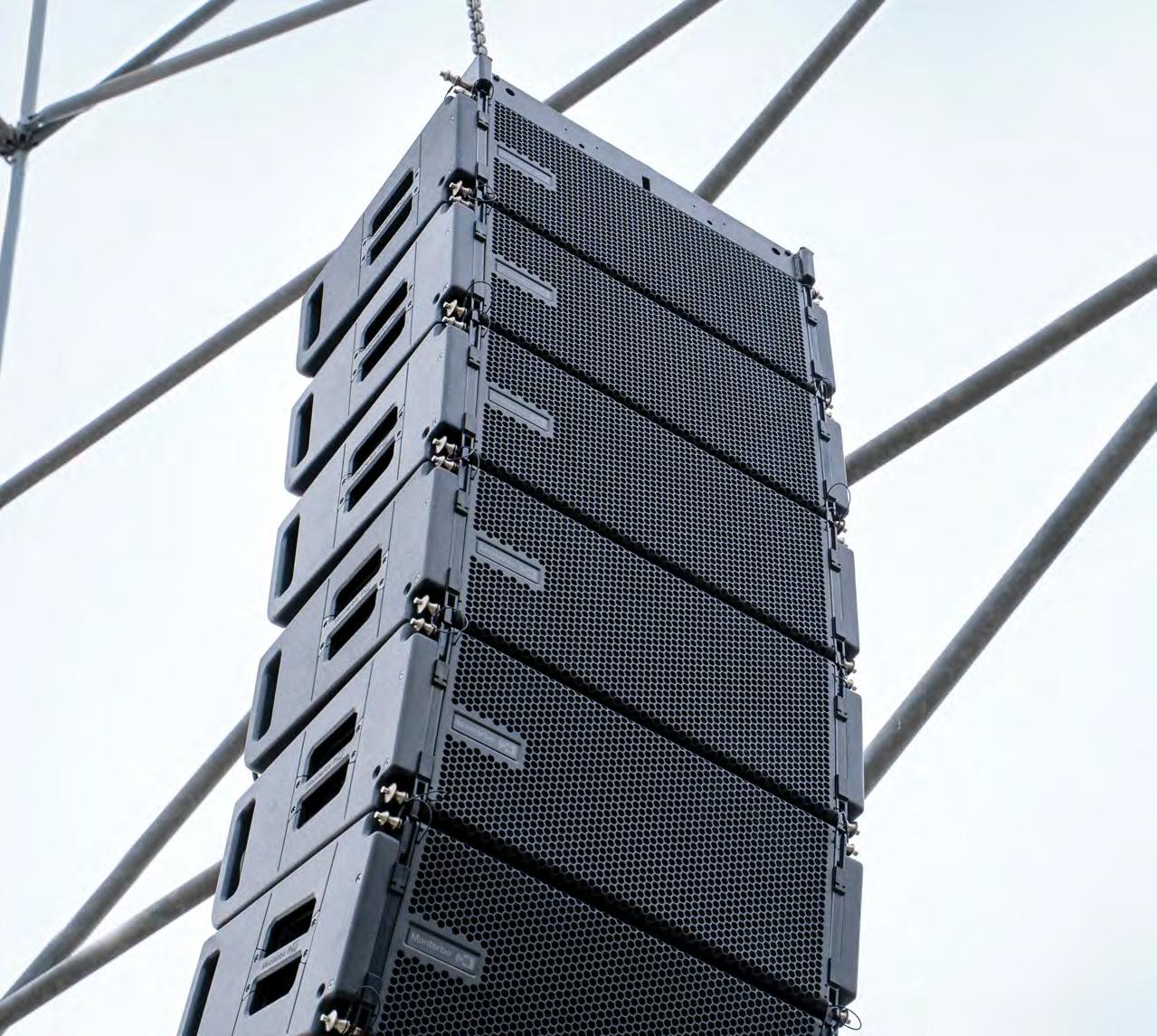
Nettuno L28 marks Montarbo’s comeback with a newly designed compact active line-array, engineered to deliver speech intelligibility, musical clarity and balanced coverage in Houses of Worship.
Modular and versatile , it adapts easily to both contemporary and traditional worship spaces, offering professional performance for permanent installations and live events alike. Through scalable design, 135.5 dB SPL and perfectly balanced coverage, Nettuno L28 integrates effortlessly into any space, delivering sound that embraces every listener.
Its adaptive headroom handles both speech and live music with ease, while onboard presets simplify system configuration by reducing the need for external processing.
PROJECTS
all denominations and worship styles and it’s always interesting to see how everyone navigates this topic. The difference is not for everyone but, when executed intentionally, this authored look can be a game-changer for the emotional connection between the communicator and the audience.” Alongside the upgrade at the main broadcast facility, Cross Point also embarked on building a new campus in Hendersonville, approximately 25 minutes north of the city, opening in January 2026. Starting out in a local elementary school just a few weeks before the pandemic, it’s taken the campus nearly six years to move into its new home. “All of Cross Point’s facilities are permanent spaces but often when they expand into a new part of town, they’ll start portable for a few years to build a base before they move into a building,” continues Corder. “The Hendersonville location is a renovated grocery store and we have a lot of experience with these kinds of installations. There are normally a lot of challenges with these buildings –low ceiling heights, columns that can’t be moved and weight restrictions on the ceiling. Cross Point had a great architect who was a strong partner on this project.
lighting and neutral room tones to create a space that feels warm and welcoming from the moment you step inside. I think everyone on this project certainly set a very high standard at Hendersonville, proving that regional sites can represent the same quality of experience as the main broadcast location.”
“With these big box stores, it’s really challenging as a worship environment designer because you aren’t dealing with a blank slate,” describes Corder. “The building often hands you cards that you wish you didn’t have, so the challenge in these spaces is changing what you can to make the most conducive environment possible and then making the most of those non-negotiables you’re stuck with. In this case, we did everything possible to make remaining structural columns disappear visually, as well as leaning on colour-changing house
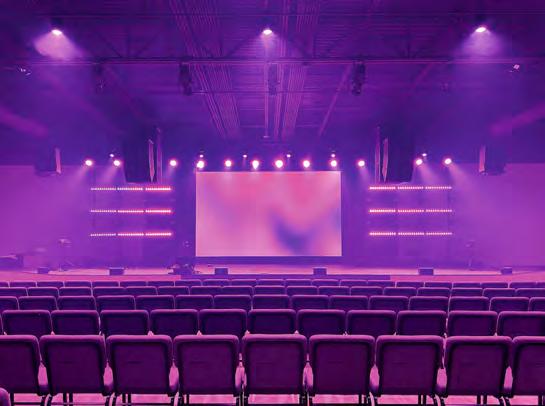
The Hendersonville campus is now home to an L-Acoustics A15 loudspeaker system, sought out by the church due to its value for money. The team opted to stay in the Yamaha family of audio consoles that is also part of the main broadcast campus, moving to the new DM7 platform. The video platform consists of a Unilumin centre-stage LED videowall with Barco side screen projection, driven by a Blackmagic Design video switcher with Renewed Vision ProPresenter.
“This project represents one of the largest financial investments Cross Point has made in a regional campus.
This prioritisation reflects the change in our world post-pandemic and the associated rise in expectations while also needing to maximise the church’s investment,” says Corder. “When you’re dealing with multiple regional sites, you’re always thinking about standardisation and replicating as much as possible to ease remote troubleshooting and volunteer training. Since it’s been nearly a decade since they’ve opened a new location, available tools have changed. So, this project was an important opportunity for Cross Point to reevaluate everything such as its speaker manufacturer of choice for these environments, as well as the overall tech stack that will be used moving forwards. The plan is to roll out many of these decisions in the coming years to the other sites.”
The Hendersonville campus uses a full Q-SYS backbone as the heart of the facility. “There’s generally a heavy Q-SYS component to every system we build nowadays,” adds Corder. “The facility is used 24/7 and there’s lots of smaller, simpler events that happen in the main auditorium beyond weekend services, so we build Q-SYS in such a way that it is the bridge to make the system easy to use for volunteers. Churches are in an arms race for talent, so one of the biggest trends that we’re helping ministries navigate comes back to this philosophy of creating systems that manage themselves as much as possible and minimise the amount of staff required. Q-SYS helps us do everything we can to set the team up for that consistency they need from week to week.”
At Hendersonville – and at every regional site – a Canon PTZ camera is used as a capture camera but it
also has the ability to be put on the screens and used as an IMAG camera for events such as weddings and baptisms. “What’s interesting as well is that shortly before the pandemic, a tornado ripped through the main broadcast campus in Nashville and exposed the lack of a redundancy plan for such a video-centric church,” describes Corder. “So, one of the design requests for Hendersonville was to build in infrastructure to support live message capture in the room. Cameras can be plugged into wall panels and in short order they are ready to broadcast from this site. And that’s exactly what they did – about six weeks after opening, senior pastor Kevin Queen came to Hendersonville to preach and that’s the first time in many years that they’ve originated somewhere other than the main broadcast site. It looked so good and I think few realised that he was in a different location. Mission accomplished.”
For Corder, it was a privilege to be able to work on his home church. “I have had a general rule throughout my career of not mixing business with my church community, but I broke that rule this time and it turned out fabulous,” he smiles. “For me personally, it was particularly humbling as I recognised some of my neighbours on that first Sunday that I didn’t realise had started coming to Cross Point. I’ve never experienced seeing people that I know and care about in a facility that I’ve been blessed to help construct, so that was pretty special.”
www.crosspoint.tv
www.l-acoustics.com
www.onediversified.com
A Q-SYS backbone ties the whole facility together
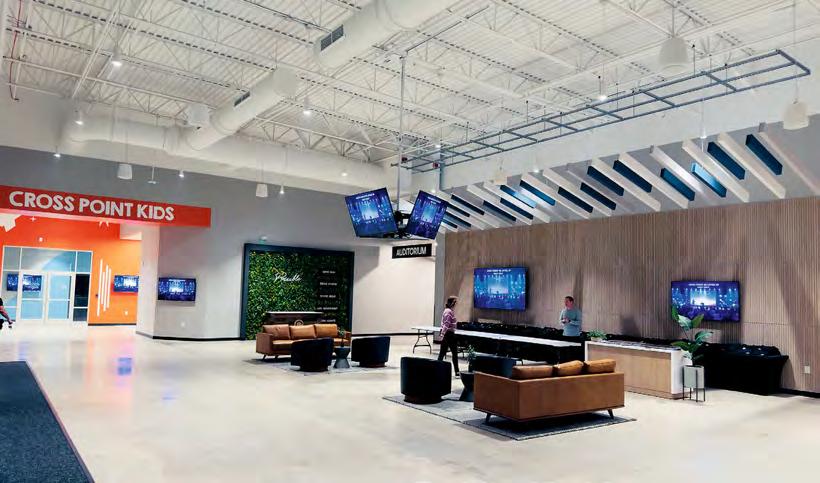
Colour-changing house lighting conveys a warm, welcoming feeling
Large worship spaces and historic halls often present complex acoustic challenges: long reverberation times, uneven sound dispersion, and reduced speech intelligibility.
The Kobra-KK52 I is designed to deliver clear, natural, and evenly distributed sound while blending seamlessly into the architecture. Featuring 8 × 2” neodymium woofers, selectable 16 Ω / 64 Ω impedance, and controlled vertical dispersion, the KK52 I ensures precise coverage and exceptional intelligibility for speech, music, and multimedia applications — all within an elegant stainless-steel design with minimal visual impact.
Kobra-KK52 I
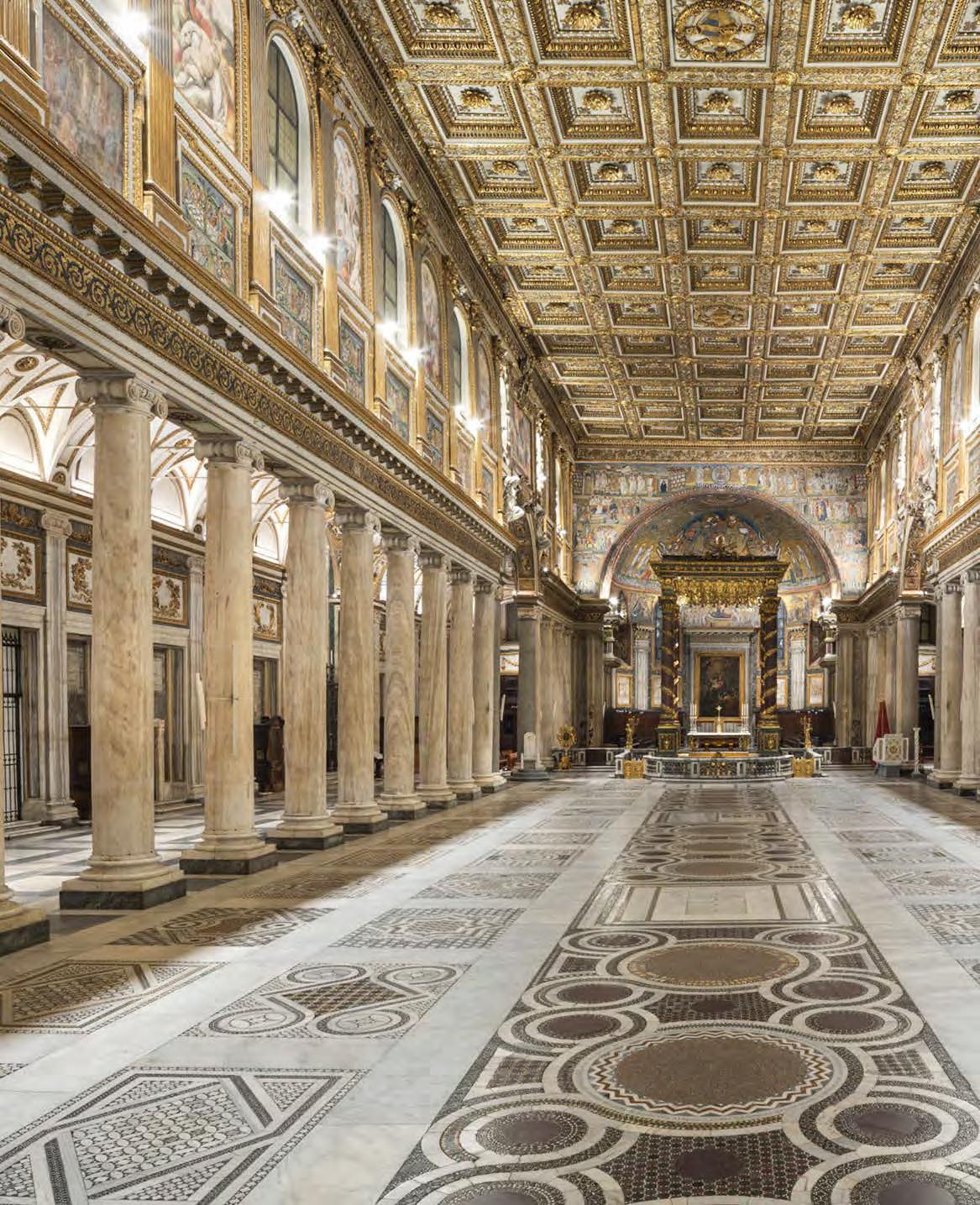
Basilica S.Maria MaggioreRoma (Italy)
A perfect fit
Tones Tailor has selected HK Audio’s P10i and P10j columns to solve Christ Church’s reverberation issues
BLESSED WITH NATURAL acoustic properties that can carry music and voices effectively, Anglican Gothic churches arguably do not require audio reinforcement. Their unique architectural features including stone surfaces, high vaulted ceilings and open spaces may suit choral music but, for spoken word and musical services, challenges abound. When Hong Kong-based AV distributor and turnkey solutions provider Tones Tailor was requested to provide an audio simulation for the Gothic-style Christ Church in Kowloon Tong, it placed its faith in its trusty HK Audio toolbox.
The high ceiling, angular pillars and high glass windows that allow sunlight to filter into Christ Church are characteristic modern Gothic features. Consecrated in 1938, architect John Porter was heroically killed defending the church from the Japanese as a member of the Hong Kong Volunteer
Defensive Corps (HKVDC). During the 1942–45 occupation, the church was used as a horse stable, and those turbulent early years continue to serve as a powerful legacy.
An ideal setting for weddings with its simple, peaceful architecture, the church presented significant acoustic challenges for achieving clear speech and uniform audio coverage. Designed to naturally amplify the word of the Lord in the 1930s, today’s requirements for speech intelligibility and musicality required a renewed solution. “Our church members had been increasingly complaining about the deteriorating analogue audio quality of our old speaker system in our church,” testifies church councillor Raymond W C Chan. “With a new vicar Darren Pollock coming in, an opportunity presented itself to initiate an upgrade.”
Provided with a green light and supporting a budget to proceed,
Chan nominated three vendors to tender, from which Tones Tailor would ultimately succeed. “The aesthetics of the technology including the speakers and antennae would all need to blend in naturally with the architecture,” comments Tones Tailor product manager Howard Chan. “Following long discussions with the church members to better understand their system requirements, we conducted an EASE simulation. When we modelled an HK Audio column system, the vertical dispersion qualities and reduction in reverberation from the ceiling and the walls vindicated our belief.”
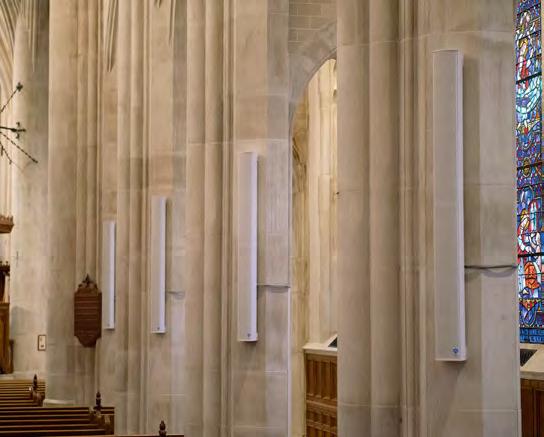
To address the specific acoustical and operational requirements, the bespoke audio solution relies on HK Audio P10i and P10j passive column speakers. Precisely controlling the sound with 100° horizontal dispersion, their narrow 5° and 15° vertical patterns achieve the desired Speech Transmission Index (STI) value. Comprising 10 3-inch full-range woofers, each 600W (programme power) column speaker operates within a 155Hz–18kHz (–6dB) range.
“The primary demand is very clear speech performance followed by musical performance for weddings and musical events,” explains Howard Chan. “A worship leader
can easily lose the attention of the congregation, so intelligibility is key to getting the message across loud and clear. When looking to achieve narrow directivity and long throw accuracy, the P10 column solution is perfect. Echo used to be a major issue with the sound bouncing around, especially when the vicar was preaching, but the P10 column speakers eliminated all those reverberation problems. With its slim, elegant appearance, the P10 is a very natural-sounding speaker, and the white finish ensures that it blends in with the church’s décor.” Fixed to the left and right columns at the front of the church, joined P10i and P10j columns serve as the main system. With versatile mounting options, single P10j columns are fixed as delays in the left and right corridors combined with a final P10j serving as a rear balcony fill to provide constant coverage across the audience area. With a GLL file available for each HK Audio speaker model, integration in EASE Focus was simplified. “The outcome was impressive because the actual loudspeaker performance is very close to the simulation with minimal tuning, ensuring a very quick and clean installation,” furthers Howard
L–R: Tones Tailor’s Howard Chan and Humphrey Lee reunite with Christ Church’s Raymond W C Chan
Acoustic challenges abound with a high ceiling, angular pillars and high glass windows
Chan. “Achieving a similar result in EASE Focus, the simulation data proved to be very accurate and was within the ±3dB SPL of our predictions.”
Providing a little boost in the low frequencies, Tones Tailor added
two floor-standing S210V dual 10-inch passive subwoofers for those occasions when the church stages music performances and live events. Dual wall-mounted HK Audio Fineo FO5 5-inch speakers cover the front seats and two larger
FO8 enclosures provide onstage monitoring for the choir and the priest at the altar. A further FO5 speaker extends the sermon audio to the exterior entrance porch. Providing highly detailed and powerful processing power for tuning and control, the entire loudspeaker system is supported by two Powersoft T604A 4-channel amplifiers, in addition to Q2404DSP+D 4-channel and Mezzo 322AD 2-channel amplifiers. The Italian manufacturer’s website provided detailed DSP presets for the HK Audio speakers. “The DSP preset file is separated into different installation positions, which allowed us to select the ideal preset for each individual speaker,” furthers Howard Chan. “By inputting the speaker preset files into the ArmoníaPlus software, little tuning was required.”
Housed in a rear rack with the amplifiers, an Allen & Heath SQ-5 can be connected to a 16-in/8-out portable stagebox. All the technological elements including the Shure SLX-D wireless microphone antenna are white. Following four months of negotiations and careful planning, the works were completed between Sunday services. “We ensured that
there would be no disruptions to services, which meant carefully planning the cabling and installation for the loudspeakers. Everything went according to plan and all the equipment suppliers sped up their deliveries,” adds Howard Chan. “Full credit to HK Audio because they delivered quickly and provided a customised solution for Christ Church’s bespoke requirements. Following the installation and the commissioning, our client is very happy with the speech intelligibility.”
Transitioning from an analogue to a digital mixing platform, and fulfilling speech intelligibility with a discreet, aesthetically integrated speaker placement appeared far-fetched at the onset of the project. To achieve these goals on a limited budget surpassed Raymond Chan’s expectation. “HK Audio proved to be excellent in terms of price–performance characteristics,” adds Howard Chan. “Their speakers sounded very good straight out of the box, but with just a little low-frequency adjustment, they sounded beautiful.”
Discreet HK Audio Fineo FO5 5-inch speakers serve the front seats
Statement of intent
NLAG has opened its latest and largest sanctuary in Chennai, enlisting an L-Acoustics L2 system to provide uniform coverage
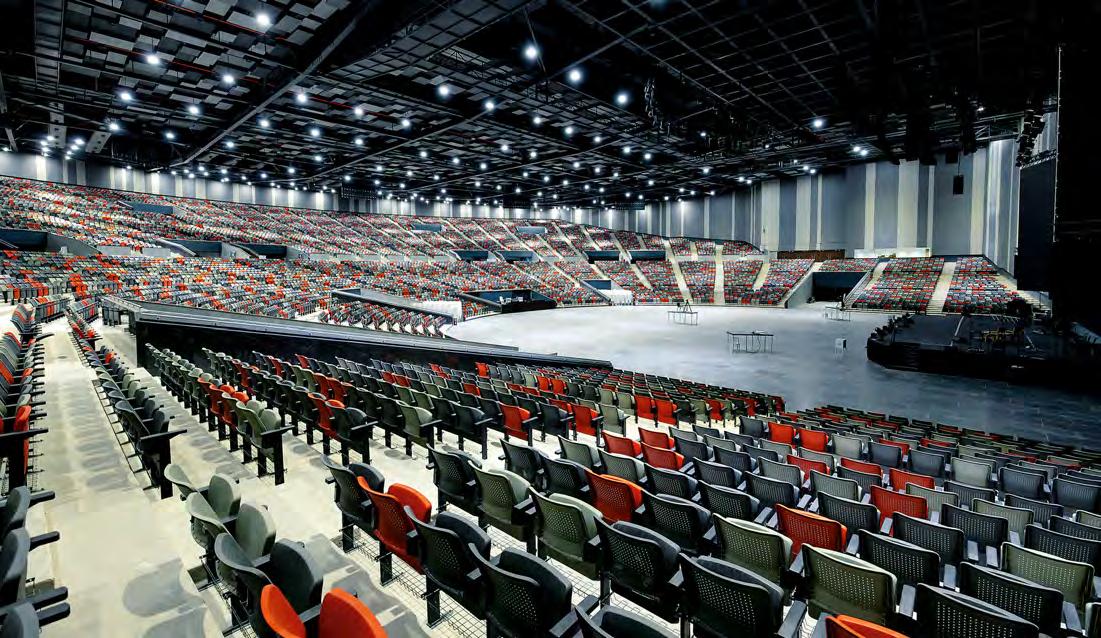
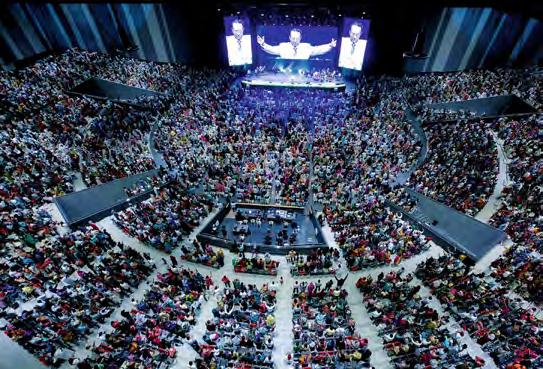
FOUNDED BY REV DR DAVID Mohan in 1973, New Life Assembly of God (NLAG) – part of the Assemblies of God worldwide network – has grown from its humble beginnings of seven members meeting in Rev Mohan’s apartment in Chennai. In 1986, the church moved into its first building at Little Mount, extending the property in 1994 to accommodate the growing congregation. However, demand was so great that in 2001, NLAG began the search for even larger premises. Opening at the end of 2025, the new sanctuary – located in Zamin Pallavaram in the south of Chennai –seats 25,000 worshippers.
Built from the ground up, the auditorium has been conceived both as a worship centre as well as a Christian events venue. Blueprints were drawn up by Populous Architects, a global architectural firm with an office in Delhi which has extensive experience of designing large auditoriums and stadiums. Working alongside the architect, the initial conceptual AV design, schematic and acoustic plans were carried out by Idibri (part of Salas O’Brien) from Dallas, Texas
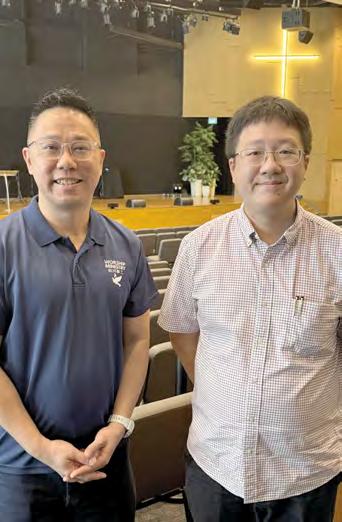
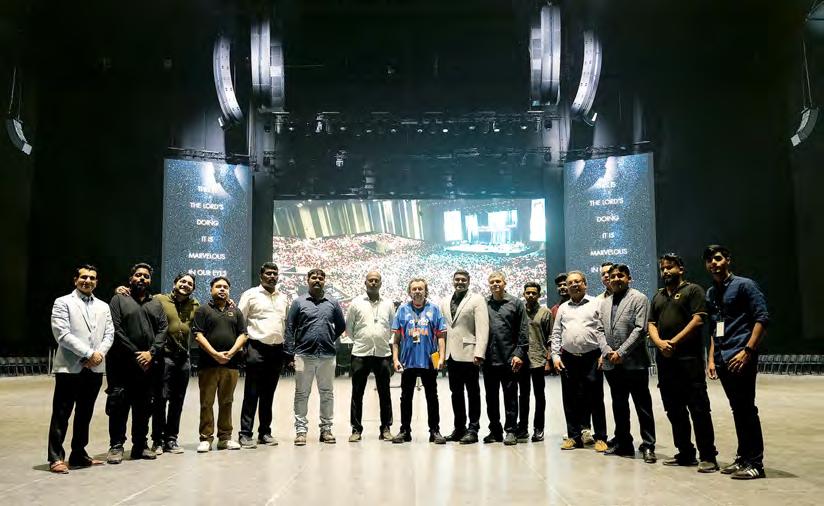
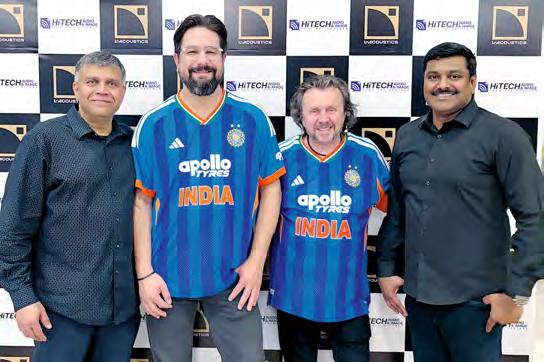
L-Acoustics’ Peter Owen (centre) with Benjamin Mohan and Christian Duraipandian on his right and Hi-Tech’s Rajan Gupta fifth from the right
and HouseRight from Lexington in Kentucky.
From an architectural perspective, the audio system needed to be seamlessly integrated and visually unobtrusive, with all primary
elements flown to preserve clean sightlines. To achieve this, NLAG’s AV team conducted a detailed evaluation process. On a trip to the US in 2023, HouseRight organised three live demonstrations in
comparable environments to help the church look for a partner that would deliver good, quality sound with both clarity and consistency. It was during this trip to the SALT 2023 Conference in Nashville that
members of the church first met with Joshua Maichele, L-Acoustics’ global application lead, house of worship.
“The building was still under construction when I met with Christian Duraipandian [audio project lead, NLAG] and Benjamin Mohan [project director and executive pastor at NLAG] in 2023,” explains Maichele. “They heard the L2 for the first time in October that year and we talked over the first conceptual design for the project. With the church’s desire to have the same audio experience for every seat in the house, we eventually ended up
with around 20 revisions before we finalised the plans and passed them onto Nirdosh Aggarwal, managing partner of our Indian distributor, Hi-Tech Audio & Image. We explored several system approaches during the design phase. Ultimately, the venue’s architectural constraints, including the large Absen videowall, called for a compact line array solution, leading us to the L2.”
“With a deep understanding of the space and its purpose, the L-Acoustics demonstration from Joshua and Peter Owen [regional sales lead, emerging markets
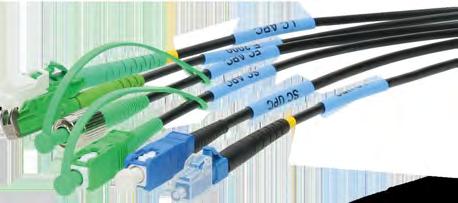
SmartBeam connection cables
• SmartBeam DUO, QUAD, OCTO or DODEKA
• unique hermaphrodite expanded beam connector
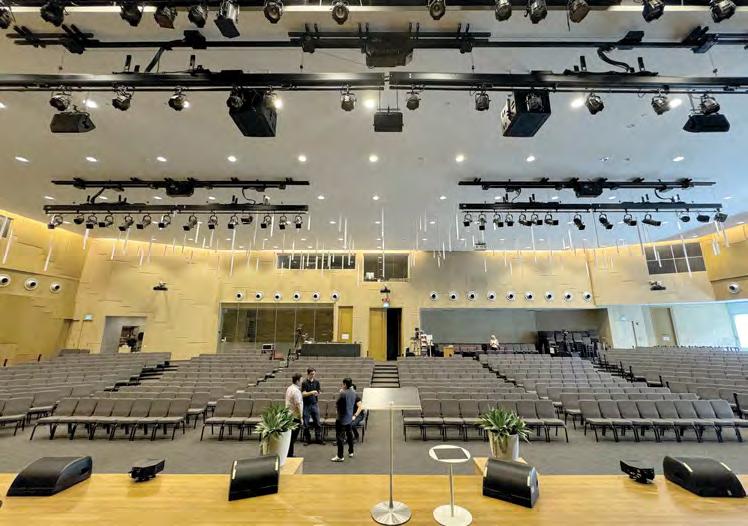
The Zamin Pallavaram sanctuary holds 25,000 worshippers
at L-Acoustics] showed the true essence of the system and how it could provide effortless coverage, pristine tonal balance and a mix that would translate beautifully across the venue,” explains Rajan Gupta, CEO and founder of Hi-Tech Audio & Image.
“We had considerable prior exposure to L-Acoustics’ systems in different environments,” continues Benjamin Mohan, “and I have personally experienced the K1 system in a large church venue in Indonesia and the L2 system at the SALT conference. In addition, in one
of our previous church campuses we had installed an A15 and KS21 system, which gave us confidence not only in the product performance but also in the reliability of their support ecosystem. The L2 system stood out as an ideal solution for our space.”
With such a strong focus on uniform coverage and tonal consistency, the target SPL levels were set at between 100dBA and 103+dBA throughout the venue to ensure both impact and consistency. “Equally important was maintaining sufficient headroom for dynamic
• FiberFlex ULTRA cable, rugged and flexible
• for mobile and studio use
• single mode (OS2) or multimode (OM4)
• ultra-low attenuation
• available with FC, L2000, SC or LC connectors
• premium APC or UPC polish
• FiberFlex ULTRA cable
• for mobile and studio use
• extremely rugged, highly flexible
• single mode (OS2) or multimode (OM4)
• ultra-low attenuation
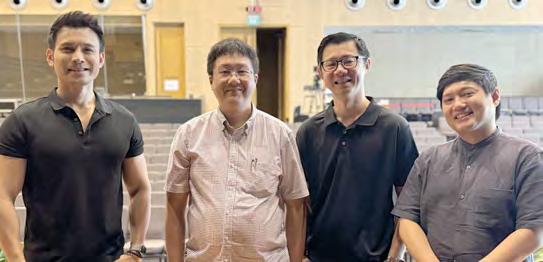
L–R: Christian Duraipandian, Joshua Maichele, Peter Owen and Benjamin Mohan
PROJECTS
worship moments while ensuring that the spoken word remained intelligible for the worshipper,” explains Benjamin Mohan.
“Ultimately, our philosophy was simple: there is no value in building such a large space if people cannot hear clearly.”
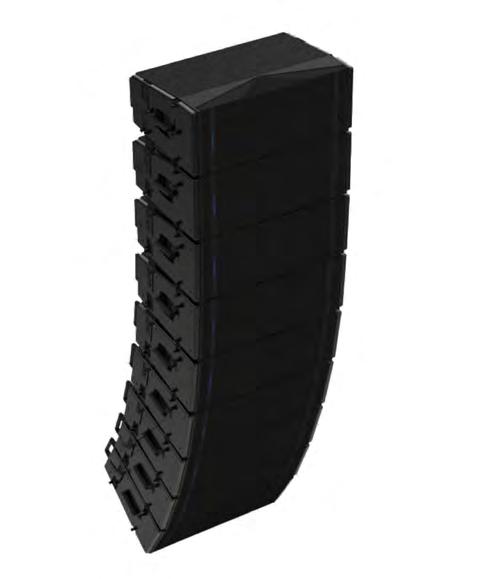
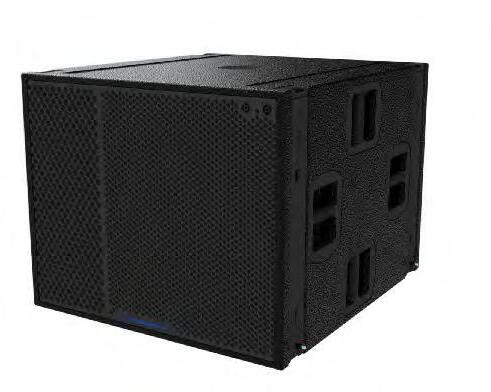
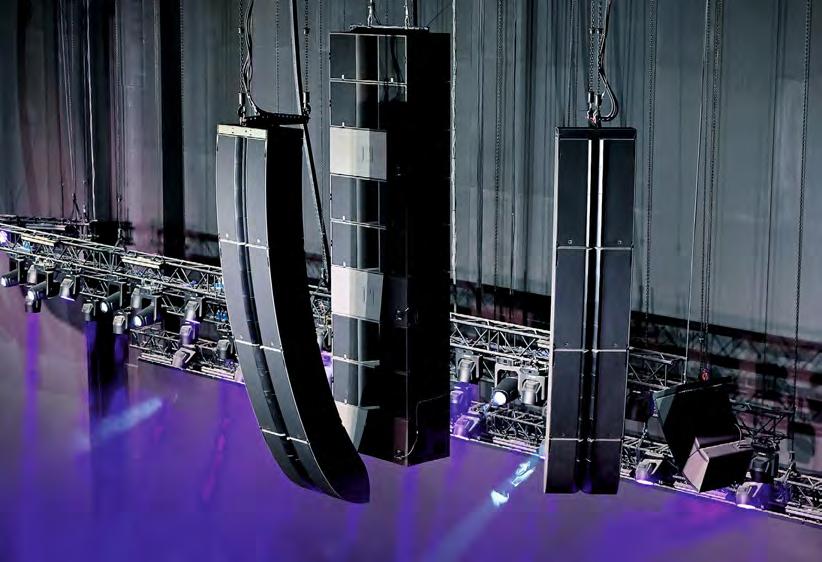
The main L-R setup consists of three L2 and an L2D per side, with the same combination repeated for out fill, along with 18 KS28 flown subwoofers. Eight KS21i subwoofers have been installed on the ground, 10 X8i passive speakers are being used for front fill, with two A10i Focus and two A10i Wide models for delay. Twelve A15i Focus and six A15i Wide provide coverage in the corners. The inventory also includes 25 LA7.16i and five LA12Xi amplified controllers, seven LS10 CE 10-port AVB switches, one LC16D CE AES/
with full bandwidth throughout the room. The delay ring of 10 L2Ds really helped us achieve full coverage in such a large space and tonally matched with the main PA.”
With various worship and youth events planned for up to 100,000 people across the week, the venue is shaped like a traditional arena with raked seating that rises gradually
the team to adapt easily to varying audience sizes and different stage configurations. This flexibility has been a key advantage for the tech team. From my point of view as a pastor, the ease of use comes when the system performs with consistent vocal presence and intelligibility, when the congregants are focused on worship and when the leadership
EBU+MADI network audio converter and four X12 stage monitors.
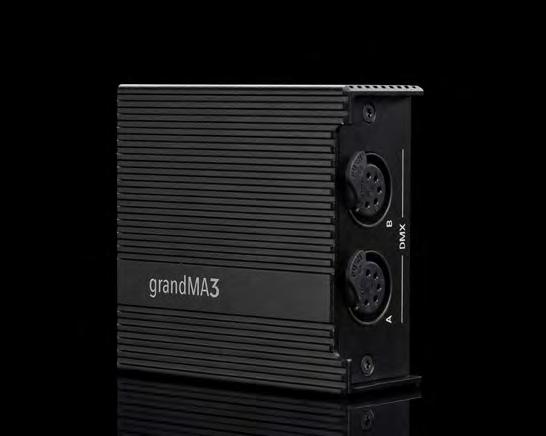
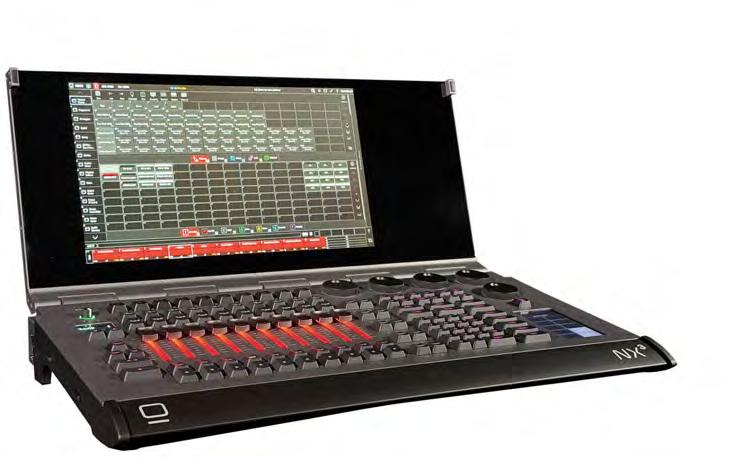
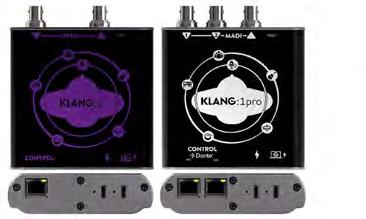
Hi-Tech Audio & Image also supplied a Fourier Audio transform.engine, one KLANG:konductor in-ear mixing processor, three Madrix Luna 8 lighting nodes and an MA Lighting console.
“Any space that holds upwards of 25,000 people is always going to be a challenge,” explains Maichele. “The room is very wide at certain points, so we had to be a little creative with some of the fills, using the A15is to cover some of the hard-to -reach areas. We ended up with a long hang of KS28s to try and control directivity and the L2 hangs allowed us to achieve the consistency we wanted
from the front. The space can also be divided into a 10,000-seat area for smaller events, reducing air conditioning costs. At the back underneath the raked seating are four different spaces available for children’s ministry, with each room accommodating up to 1,500 children of different ages.
“While the system is complex, it is operationally efficient and predictable,” adds Benjamin Mohan. “Our technical team is still growing and learning, yet they have been able to manage the system effectively due to its predictable behaviour and logical signal flow. It also supports multiple usage scenarios, allowing
“Our collaboration with Hi-Tech Audio & Image for the supply and installation was built on prior experience and trust,” he continues. “For an install such as ours in India, where equipment availability can be a challenge, the right partner such as Rajan and the entire Hi-Tech Audio & Image team with their strong local presence and the capacity to service equipment with a good turnaround time is essential. A focus on scalability, serviceability and operational simplicity is a must. All these factors play a key role in planning and execution.”
Benjamin Mohan confirms that the system is performing exactly as it has been designed to, describing it as the most satisfying outcome he could have hoped for. He adds that what stands out most is the uniformity of coverage and clarity, and seeing the congregation respond so positively each week. “From the front rows to the farthest seats, both speech and music translate with remarkable consistency,” he says. “The integration between the main arrays and delay systems is seamless and the tonal balance remains fairly stable across all zones. Since going live, the system has operated flawlessly, demonstrating the accuracy of both the modelling and the execution.”
“It’s a very impressive acoustical space for its size – it doesn’t feel too dead or too alive,” says Maichele.
“The L2 was very new in 2023, so we took particular care in the calibration phase. When that was accomplished, the church was blown away with what the L2 system could do in terms of consistency over the listening plane.
The acoustic panelling on the ceiling and walls designed by Salas O’Brien and the cardioid L2 speakers meant we could reduce the energy in the room.”
“There are projects that get completed and then there are projects that leave a mark,” concludes Gupta.
team is happy with the outcome. The L2 system was able to deliver that for us. This reliability allows me to focus entirely on the mission without being conscious of the technology supporting it.”
Benjamin Mohan is full of praise for the L-Acoustics team and their ability to understand the church’s needs, budget constraints and passion for good sound. “They have been accommodating and consistent in delivering what was required for a project of this scale. Their collaborative approach ensured that the required equipment and importantly the right expertise were brought in at suitable times.
“The unveiling of the L-Acoustics L2 system at NLAG was one such defining moment, not just for us at Hi-Tech Audio & Image, but for the evolving landscape of large-scale house of worship audio in India. From the very first note, the L2 system revealed its character – precision, depth and remarkable clarity. It was in those moments of silence between the notes, and the expressions across the audience, that we knew something special had been achieved. This is more than just an installation –it is a statement of intent.”
www.hitechavl.com
www.l-acoustics.com www.nlag.in
The inventory also includes four L-Acoustics X12 stage monitors
Each array consists of three L-Acoustics L2 and an L2D
Building connections
Barker Road Methodist Church in Singapore has selected a Ross Video Ultrix solution to improve its livestreaming setup
CELEBRATING ITS 70TH anniversary this year, Barker Road Methodist Church (BRMC) has more than 3,000 members. Alongside its in-person worship services, the church also streams two Sunday morning services to YouTube and other venues on campus, allowing the wider community and anyone who’s unable to attend onsite to take part.
There is a growing movement among churches to connect worship spaces and bring people together, wherever they are. As congregations expand and become more distributed, staying connected matters more than ever. With its growing congregation,
BRMC recognised an opportunity to upgrade its livestream system. The aim was to better support its live services and connect venues, without making production harder for staff and volunteers to manage.
As BRMC’s audience grew, the old setup, built up over time, could not keep up. The team handled livestreaming, internal feeds, complex routing, delayed telecasts and simultaneous
broadcasts, all with just a small group of volunteers. BRMC needed a reliable system that could run all the time and handle five English worship services at its Barker Road campuses every weekend. The team decided to replace it with infrastructure built for continuous use and fewer breakdowns.
“We wanted more than just better stream quality,” explains Palister Wang, technical lead, AV at BRMC.
“We wanted a system we could rely
on to manage multiple venues and accommodate changing schedules and production needs week-toweek. We knew Ross gear is built to run 24/7 with a low failure rate, which was really important to us. That’s why we switched.”
After talking in detail with the Ross Video team about their needs and future goals, the team chose a complete video production setup with Ultrix at the centre, which routes signals to and from the
sanctuary and external venues over fibre. Carbonite powers onsite livestream mixing, while a Tria handles programme recording and delayed multichannel playback for venues that aren’t in sync. The same setup also supports BRMC’s broadcasts to the local school, making it easy to send audio and video between spaces for the chapel.
“The way the system was put together was just as important as the technology,” adds Wang.
“The Ross Video team and their partners worked closely with us, looking at every option, considering the pros and cons, and designing a solution that fits our needs now and in the future.”
For the Barker Road crew, one of the biggest changes has been workflow simplification. Previously, tasks that required additional systems or manual operation could take hours to set up, creating extra work during and after broadcasts. Combining everything into an Ultrix-based system made it easier to run and update, with fewer things that could go wrong. Delayed telecasts that once needed a vMix computer and a dedicated operator can now be recorded and played back by anyone on the team after just a few minutes of training. With tools like Bitfocus Stream Deck, DashBoard panels and RossTalk integrated, daily tasks are now easier to manage, so volunteers can focus on creating a great worship experience for everyone.
“The result has been a better experience for the pastors, volunteers and the wider congregation,” concludes Wang.
“There’s less downtime, fewer eleventh-hour issues and more confidence that the team can adapt as production needs change.
The Ross system has proven itself with its reliability and we’ve received positive feedback from staff and volunteers about how easy it is to use and connect to other things. There’s nothing too complicated for us to solve.”
www.brmc.org.sg
www.rossvideo.com
Built over time, the previous livestreaming setup could not keep up
The Ross Video Ultrix setup routes signals to and from the sanctuary and external venues over fibre
Steering sound
Dynamic AV Systems has deployed a Renkus-Heinz ICONYX system to overcome acoustic challenges at the Episcopal Cathedral of St Philip
WITH STONE WALLS, HIGH ceilings and hard floors, the Episcopal Cathedral of St Philip is a highly reverberant space. When the ageing audio system was making speech intelligibility almost impossible, the cathedral turned to Renkus-Heinz for a modern solution.
Located in the northern suburbs of Atlanta, Georgia, the cathedral stands as a symbol of community and faith on Peachtree Road, otherwise known as “Jesus Junction”. It first opened in 1962 and has since become one of the largest Episcopal congregations in the United States. Its Gothic Revival architecture stands out against the modern city backdrop and creates an inspiring acoustic setting for the choir and pipe organ.
“The previous sound system had been in place for over 20 years, cobbled together over time with parts that didn’t match,” explains James Denmon of Dynamic AV Systems, who led the installation project. “We were approached by the consultant, Newcomb & Boyd, who had been tasked with delivering
an upgraded solution that would optimise clarity and minimise reverberation. The regional representative for Renkus-Heinz, Griffith Sales Associates, pointed them in our direction due to our experience with houses of worship and the ICONYX system.”
In order to design a system that would address these architectural and acoustic challenges, Newcomb & Boyd created an EASE model of the cathedral, allowing the team – in conjunction with Dynamic AV Systems – to determine which loudspeakers were best suited to the space. “We have worked with Renkus-Heinz plenty of times in the past. Knowing that speech intelligibility was the main goal, their ICONYX steerable system was the obvious solution for this venue,” Denmon states.
“At the front of the hall, we deployed two IC24-RD digital steerable line array loudspeaker systems as mains, supported by two IC8-RD arrays for the transepts at the sides,” he continues. “Through to the back of the room,
we installed 10 IC16-RD columns. The ability to steer sound directly to the audience is a real game-changer for acoustically complex venues such as this cathedral.”
Throughout the installation process, the cathedral continued to rely on the existing system
for regular services. Despite the added complexity, the Dynamic AV team carefully worked around the legacy equipment, ensuring that worship services proceeded without interruption. However, when it came to controlling the system, there were some initial network
IC16-RD columns carry sound to the back of the sanctuary
Whether deploying a redundant or primary-only network topology, the MS8.2 Milan network switch is perfectly suited to simplify mobile, installed systems and spatial audio applications.
The speakers were custom-painted to match the stonework
From behind the console
WHEN THE CONGREGATION looks towards the stage, the sound booth often seems distant, placed behind people, glass or equipment. But from where we stand, the worship experience is a wide-angle view. We see the whole platform at once: every singer, every musician, every engagement, every moment
This article is a sincere reflection from the sound booth, written not to criticise, but to encourage the people we serve alongside, to bridge the gap between stage and sound booth, and to remind us that we’re all after the same thing. Whether you’re a new volunteer, an experienced musician or a worship
The stage may feel distant from the back of the room but, from the sound booth, it’s an open book. We see the vocalist who steps back from the mic when nervous or the worship leader who leads the flow with sensitivity. But we also see the moments of struggle, the insecure glance, the tense exchange, the
details that the human ear onstage might miss. It can be brutally honest, depicting the softest details and imperfections that contribute to the overall worship experience. But here is the truth: we are not listening to judge. We are listening to shape, balance, support and help you succeed. When we gently ask for adjustments like mic technique, monitor levels or dynamics, it is not to control you – it is to bring out the best in what you already have. Typically, we provide feedback during rehearsals and sound checks, allowing us to address any issues together in an encouraging environment. We are committed to supporting open communication and encouraging an atmosphere of trust, where suggestions are seen as possibilities for improvement. One of the biggest technical truths from the booth is this: high stage volume works against the entire team. When instrument amps, wedges or acoustic drums are too loud, the congregation hears stage noise more than the mix, vocal clarity drops, feedback becomes likely and musicians ask for louder monitors, which only worsens the problem.
For beginners, think of sound like cups of water. When the stage “overflows”, we can’t pour the mix properly – everything spills. For musicians, soft playing is not weak playing. A controlled drummer, a
For worship leaders, your team’s monitoring habits shape the entire mix. Encouraging healthy volume and good in-ear monitor (IEM) use is one of the biggest leadership gifts you can give. Consider doing regular sound checks before services and rehearsals to guarantee everyone’s sound is balanced and clear. Investing in in-ear monitors can also greatly help reduce onstage volume, allowing each team member to hear precisely what they need without spillover. These actions don’t just affect the FOH mix; they impact everyone onstage and in the congregation.
From our vantage point, we can see how dynamics change everything. Not just vocally or instrumentally, but spiritually too. The best worship teams pull back when the vocal leads, build intentionally, don’t overcrowd the arrangement, use silence as a tool, communicate musically and allow moments to rise and fall. Technically speaking, dynamic control reduces compressor strain, prevents frequency masking and creates space in the mix. Spiritually speaking, it reflects sensitivity to the moment. For beginners, dynamics mean knowing when to be soft and when to go big. For musicians, even with modern worship’s big choruses, the verses matter. How you set them up determines how powerful the chorus feels. For worship leaders, your gestures, flow cues and arrangement choices guide the energy of the room.
From behind the console, preparation is especially visible. Teams that are prepared help create a more enjoyable and effective mixing experience, while teams that are not prepared can turn mixing into damage control. Trust is
built when the worship team feels comfortable being vulnerable with one another, which is essential to a great team. Well-prepared teams help close the “trust gap” and encourage this kind of openness. When team members come rehearsed and ready, it establishes
contributions. Acknowledging these small efforts reinforces a culture of encouragement and growth.
From the booth, we can immediately tell whether the team communicates well. Great teams use hand cues, listen to each other, acknowledge changes,
The stage may feel distant from the back of the room but, from the sound booth, it’s an open book
a framework of trust that goes beyond mere accuracy, creating an environment where each musician can be more vulnerable and open. For beginners, rehearsal serves as your ally. The more familiar you are, the more comfortable you’ll be onstage. For musicians, knowing your tone, patches and signal flow beforehand helps us dial you in quickly. For worship leaders, prepared direction brings stability to the whole team. When you’re clear, the room feels it. Even small steps in preparation can build confidence and improve the overall sound, motivating everyone to take pride in their
follow the worship leader’s body language and keep eye contact as needed. Teams that struggle talk into live mics, make facial expressions that unsettle others, signal late or inconsistently, adjust gear mid-song without warning and assume others can read their minds.
For beginners, your confidence grows as your communication improves. For musicians, tell us before you adjust your tone, volume or instruments with simple cues. For worship leaders, your clarity equals your team’s unity.
We’re not just techs, we’re worshippers too. This might
be the part most people miss. We’re not back here just “running sound” – we follow the flow just as intensely as anyone onstage. We observe communication among worship team members, between the worship team and the congregation, and how the congregation responds to the worship team. When the team is unified, humble and prepared, our job becomes more than mixing – it becomes ministry.
From the booth, we want you to know that we’re on your team, we want you to sound your best and we notice your growth, even when others don’t. If we all keep learning, listening and serving together, the worship experience becomes something beautiful. We’re cheering for you, from behind the console.
Anything and everything that is announced, preached or sung onstage passes through our ears, hearts, minds and skills before we deliver it to the congregation. The quality of every word is determined by the level of our skills. Our role is more than simply a technical task –it is a key part of the worship experience that conveys profound spiritual significance. We’re not just sound techs, we’re ministry partners. I always liken mixing to holding a bubble – one wrong move and the delicate bubble bursts. I hope we still have that excitement every time we go behind the console, pushing faders and tweaking knobs. I hope that, from behind the console, we still hear and listen to the message preached Sunday after Sunday. I hope that we treat our time behind the console as anything but just another Sunday. And so, from behind the console, these are what we see, hear and hope for.
Improving production quality
Why do some HOWs struggle to communicate effectively on camera and what can be done to change this?
MOST HOUSES OF WORSHIP
will have volunteers making up their AV teams, often with little experience of creating a high-end production. They also may not serve frequently enough to build the necessary experience, so each week a different group of volunteers works hard to deliver a good production. As a result, the outcome can be inconsistent. With an over-reliance
on volunteers, how can systems be designed to support non-professional operators?
“The Japanese principle of Kaizen –focused on continuous, incremental improvement – is especially relevant here,” explains Artie Shaw, head of digital broadcast at Epiphany Church Brooklyn in New York. “Without it, teams often become overwhelmed by trying to achieve too much too quickly. Start small: one solid camera and a technical director who understands the full signal chain. Gradually introduce proper lighting and other production elements. As quality improves, create and document standard operating procedures for each area or ministry. Training should be ongoing, not occasional. Weekly reinforcement is key, especially as even small workflow changes are introduced.”
“The key is organisation and ease of use,” adds Greg Boren, product
marketing engineer at Marshall Electronics. “Volunteers can be easily taught to recall camera moves by number without a lot of discussion about the best shot. Presets should be grouped logically. For example, dedicate a set for the main service and another set for music productions, so volunteers can quickly recall shots without making creative decisions in the moment. It’s also important to set aside a separate group for learning, essentially a ‘sandbox’ to experiment with transitions, speeds and camera movements from one preset to another without impacting the live production. Push the limits of what the cameras and controller can do then. As the volunteers grow more comfortable, those refinements can be folded into the main service workflow.”
With recent developments in video technology changing the way worship services are captured and produced, streaming is on the rise, expanding the audience beyond the physical room. “There is no limit to the size of the congregation or the reach of the message now,” continues Boren. “This shift means that production decisions can’t be based solely on what looks or sounds good in the control booth. Stream quality should be monitored during the service because streaming introduces compression, which can create visual artefacts that aren’t present in the original video. Decorative patterns and busy backgrounds might look great when seen live but can appear distracting or distorted in the stream. The same goes for graphics and text,
so it’s important to design visuals with the remote viewer in mind. Clean compositions, legible text and simplicity will translate best.”
In the past, achieving high-quality production required expensive, broadcast-level cameras and lenses, putting it out of reach for many houses of worship. “Today, with some research and the right combination of tools, you can achieve excellent results, even in low light,” says Shaw. “It’s now possible to build multiple PTZ setups, all operated by a single person over a well-configured network. The barrier to entry has dropped significantly, opening the door for teams with limited budgets but strong technical understanding to produce high-quality content.”
But consistency is critical, says Shaw. “For many churches, the goal of livestreaming is either to encourage viewers to attend in-person or provide a spiritually satisfying experience for those who cannot. Maintaining a consistent look across all cameras helps create a more immersive experience, especially since many viewers watch on mobile devices. Regardless of the screen size, the objective is the same: the more immersive the experience, the more likely viewers are to stay engaged.” However, consistency doesn’t mean rigidity, adds Boren – some variety can be introduced, but it should be done so thoughtfully. “New camera moves and different lenses on POV cameras can add life to the presentation, but these experiments should be done in off-hours. Presets
An Atomos Ninja 5-inch monitor-recorder at Epiphany Church Brooklyn
Epiphany Church Brooklyn’s Artie Shaw
Start small and gradually introduce other production elements
Image courtesy of Epiphany Church Brooklyn
should not be updated unless it’s clear that they have been properly tested. Transitions between presets should be checked. Moving from Preset 1 to Preset 4 might look brilliant, but the move from 1 to 3 might introduce focus issues or awkward speed changes. Transition speed sets a tone and a feel. Whether it’s a video dissolve or camera move, it shapes how the audience experiences the moment. Ultimately, the question isn’t whether camera moves should always be invisible, but rather when they should be noticeable.”
There are several key considerations churches can take to improve production quality. “Training is essential,” says Shaw. “No amount of high-end gear can replace the knowledge required to use it effectively. Training should focus specifically on the equipment and workflows your team uses. Learning generic concepts has value, but nothing compares to hands-on experience with your actual setup. A well-trained team paired with strong equipment will always deliver the best results.”
Then marry training with lighting and sound. “Lighting is one of the most critical elements because great lighting will elevate even
modest cameras, while poor lighting will limit the performance of the best ones,” continues Boren. “It’s important to regularly review your lighting setup – do your lights
cast unwanted shadows, uneven coverage or changes in colour temperature? And sound is equally important, but it’s best evaluated outside the control room. Go sit down and listen to the sound in each area. The goal is clarity and consistency. Can everyone hear? Is it crisp and clear? Are there echoes? Nothing beats hearing the audio in various locations to understand the acoustics of the room.”
Are there any practical steps a church can take to immediately improve how it communicates visually? “Understanding the flow of the service,” describes Boren. “Rather than capturing isolated
moments, take the viewer through the service. Move from wide shots to specific shots. When the pastor opens the Bible, set an establishing shot that shows the pages turning. Where will the pastor’s hands stop, what section? Build some anticipation. The same principle applies to transitions between speakers. If there is a guest presenter, don’t bring them out immediately. Suspense and surprise are all parts of storytelling. If a visiting musician or choral group is warming up backstage, get a quick shot of them while the pastor reveals today’s special guests. These approaches help connect the narrative and add depth to a moment.”
“Support your team,” concludes Shaw, “whether through stipends, meals or other forms of appreciation. Invest thoughtfully in storytelling tools such as lighting, cameras, audio and lenses.
Finally, if you have a subject matter expert on your team, listen to them. Their insight is critical to making informed decisions and improving overall quality.”
www.atomos.com www.epiphanybk.com
www.marshall-usa.com
Marshall Electronics’ Greg Boren
Software-based lighting control
John Black looks into the increase of software-based lighting control options that provide professional control capabilities in budget-friendly
packages
ONE OF THE MANY THINGS
that bring me joy throughout the year is being able to visit other campuses, see what equipment they have, how they are using it and to provide technical training and consulting services. I love being able to encourage and assist other teams towards technical excellence.
Recently I was at a campus with a small, tungsten-heavy conventional lighting rig of about 50 instruments being controlled by an MA Lighting grandMA3 Compact XT. The volunteer I was working with had expressed the difficulty they had with getting the funds to update their lighting console and, once received, the challenge of teaching student volunteers how to use it.
On the flight home, I couldn’t help but ponder why this particular team had selected this console. It’s a great console, don’t get me wrong. But a tool is only as effective as the operator using it and it needs to fit the job. To me, this was not a good example of financial or functional stewardship.
With many lighting control options available on the market, there has been an increasing supply of software-based lighting control options that provide professional control capabilities in budget-friendly packages. And not only that, but I find that having a software-based lighting control package available makes a great backup solution as well, rather than purchasing a backup console or having to rely on the availability of a rental. Let’s take a look at some of the options that are available.
Big hitters – ETC and MA (Mac and Windows)
ETC is one of the industry-leading theatrical lighting brands on the market. Their consoles can be found in performance venues, churches and schools around the world. The company standardised the EOS operating system and scaled it to different console
Eos v3.3 includes Expansion Processing, which allows productions to divide the workload of large rigs across multiple devices
hardware options to fit different budget points and applications.
ETC entered the software-based lighting control space many years ago with the EOS Nomad software, which takes the same EOS software and puts it on your personal computer (Mac or PC). The software itself is available from ETC’s website as a free download and I use it regularly as an offline editor for editing show files when off-campus. Its power can be further unlocked through the purchase of a USB dongle that enables online lighting control, providing you with the full EOS system software. Simply connect your computer Ethernet port to your lighting network and you will be able to send sACN data directly out and control your instruments. I have used this solution to programme shows from various places in the auditorium, as well as to run shows if I’ve not been able to use a console due to a maintenance issue.
If you prefer to have physical buttons and/or sliders (let’s face it, who doesn’t), ETC provides a programming wing and fader wing solution that allows you to have tactile control while operating the EOS software from your personal computer.
Another global leader in lighting control is MA Lighting, with its grandMA3 control platform. Like
The grandMA3 on PC DMX-key unlocks eight universes of DMX via a USB connection
ETC, you’ll find their products in industry-leading performance venues, churches and schools around the world, especially in venues that are “busk”-driven, such as music venues.
MA offers the grandMA3 onPC software, which, like Nomad, is the company’s console operating system offered in a format that runs on your personal computer (Mac and PC). This allows programmers to be able to edit show files when offsite or away from the console. Lighting control from your computer is also
possible through the purchase of an onPC node, which unlocks real-time output. MA has been expanding its options for onPC output, including the introduction of the grandMA3 onPC DMX-key this year, which unlocks eight universes of DMX via a USB connection.
Again, if you prefer to have physical buttons and/or sliders, MA provides a programming wing and fader wing solution that unlocks the software output while giving you tactile control of the software as if you were sitting in
front of a full console (at a fraction of the cost).
ETC and MA are two of the biggest names in lighting control consoles – both of which now provide budget-friendly options for smaller venues to use the power of their ecosystems in smaller packages. Programmers often prefer one platform over the other (like the Mac vs PC debate). But for those who may be intimidated by these big hitters, there are still other software-based lighting control options available that are powerful and budget-friendly
LightKey (Mac)
LightKey has emerged as a disruptive force by focusing entirely on a visual user experience. Although it is exclusive to macOS, LightKey abandons the traditional, intimidating look of a lighting desk – with its rows of virtual faders, tiles and/or complex spreadsheets – in favour of a visual canvas. Users see a 2D map of their stage and interact with lights as they would with objects in a drag-and -drop graphic design programme. For churches that rely heavily on non-technical volunteers, LightKey offers the shortest path from a creative idea to a finished look.
LightKey is available in a number
some of the more professional features, such as MIDI triggering from tools such as ProPresenter or Ableton Live.
LightKey does not produce any physical control options; however, it can be set up with third-party MIDI controllers and DMX interfaces for non-network connections.
Onyx (Windows)
While I haven’t experienced the Onyx platform personally, I have been hearing about its adoption more and more. Previously the Martin M-Series, Onyx offers a powerful set of features that can scale from small youth rooms to large auditoriums. The software can be unlocked to provide
Where LightKey is a macOS-specific product, Onyx is a Windows-specific product and may be a good solution for those who prefer that platform. Onyx still offers professional console features, such as MIDI and timecode triggering, a large fixture library and onboard visualiser to assist with offline programming.
Vista (Mac and Windows)
The last software-based system I’ll highlight is Vista by Chroma-Q, which uses a timeline-based approach to programming that feels similar to video editing software. For a generation of volunteers raised on iMovie or Adobe Premiere, the ability to see lighting changes as clips on a timeline makes the abstract concept of “cue timing” suddenly
Vista originally debuted in 2004 by Jands Lighting and its timeline approach was legendary at the time. Like the options above, it operates on a highly graphical user interface that makes lighting control very accessible to visual creatives. Operating on both macOS and Windows computers, the system is modular. Output is enabled by a USB dongle and is available in a number of different packages based on universes needed. For tactile control, several control surface options are available providing faders and buttons specially mapped to system controls.
output is enabled via a USB dongle or via a DMX interface makes no real difference so long as you understand how to get your software-based lighting control solution to speak to your lights. If your venue and rig is small and you are set up close to your instruments, your most budget-friendly option may be a simple USB-to -DMX interface. However, if your lights are distributed around your facility and distances are quite long, you may find it more practical to distribute lighting data via a network, in which case you may be able to simply connect your personal computer to the network and send that data directly via the Ethernet port.
As with any lighting control purchase decision, whether hardware- or software-based , be sure to think through and plan your data distribution system ahead of time to ensure the control platform you select will meet the physical requirements of your rig.
In conclusion
the number of outputs needed. Once connected to your lighting network, you can send sACN or Art-Net data directly out from your computer and control your rig in real time. And just because it isn’t a heavy-hitter doesn’t mean it lacks
Key, an Onyx DMX interface or one of the company’s dedicated hardware control options. And like the ETC and MA platforms, Onyx also provides tactile control wings to provide you with the physical control that everyone loves.
Speaking to your lights
Software choice ultimately comes down to your workflow preference and your needs – the software is just a tool. Whether
Those in the congregation will not care or know whether you have a US$1,000 solution or a $40,000 solution. A system that is too complex will lead to volunteer burnout and frustrated leaders, while a system that is too simple may stifle the creative expression of a talented production team. When evaluating these options, the most successful teams are the ones that look beyond the features list and ask which interface will empower their people to tell the story most effectively. By choosing a system that matches the skill level of the team and the goals of the service, the technology fades into the background, allowing the light to do what it does best: illuminate the message.
Obsidian’s NX3 is a full-size lighting console built on the Onyx platform
Chroma-Q’s Vista uses a timeline-based approach to programming
Controlling directivity
The second instalment in this three-part series focuses on the main tools available for controlling directivity and how it is managed
UNDERSTANDING HOW
different speaker types manage directivity is important. There are point source loudspeakers, line array-style loudspeakers, column loudspeakers, beam-steered loudspeakers and many more. All of these types have their own unique ways to manage directivity, and all have benefits and drawbacks.
Tools for controlling directivity
Controlling directivity in a worship environment draws on three interconnected layers: the loudspeakers themselves, the system design and the software used to model and manage it all. “At the loudspeaker level, the choice of technology matters enormously,” says Geoff McKinnon, senior director of engineering at EAW. “Point source cabinets offer precise, predictable coverage from a single enclosure, ideal for smaller sanctuaries or supplemental fills where a compact, high-output solution is needed. Line arrays extend that reach into larger rooms, with vertical stacking providing the narrow vertical pattern control that keeps energy off balcony faces and high ceilings. For the most complex spaces, software can electronically sculpt coverage in ways that no physical cabinet repositioning could achieve.”
d&b audiotechnik uses three methods to control the directivity of a sound source. The most standard and widely used approach is to incorporate well-designed constant directivity horns to stop the varying dispersion patterns most sound sources create. “Second, when the HF horn is no longer big enough to control the lower frequencies, we can use larger physical drivers and their arrangement to create specific interactions that lead to the
desired changes in directivity,” explains Steve Jones, d&b audiotechnik EAS team leader EMEA. “Third, where we cannot space drivers physically apart enough while keeping a loudspeaker design within sensible sizes for practical use, we can employ specific methods to actively cancel the sound energy in targeted directions.”
Steve Mathis, product development, installed loudspeakers for JBL Professional, believes that digital beam shaping is currently the gold standard for highly reflective traditional sanctuaries. Instead of physically tilting a speaker and using different waveguides, software is used to custom configure the shape of the speaker coverage specifically for the environment. “Each driver in a column has its own dedicated amplifier and DSP channel. Using advanced digital processing to create tiny variances in the sound produced by each individual driver, the array creates one or more ‘lobes’ of sound that are shaped and steered. You can mount the speakers perfectly flat against a pillar (preserving the aesthetics) while digitally aiming the sound only at the listeners, avoiding the rest of the space.”
“Controlling directivity happens at multiple levels,” adds Alan Johnson, business development manager, house of worship global lead at L-Acoustics. “First, it starts with the physics of the loudspeaker itself. Line arrays, by their nature, produce tight vertical control while maintaining wide horizontal coverage, which is exactly what most worship rooms need. Then you have mechanical adjustability: how you configure array geometry, inter-element angles and splay. On top of that, you have processing tools like DSP presets, EQ, filtering and delay alignment. And then at the system design level, you have prediction software, which lets you model coverage in three dimensions before a single cable is pulled. The best results come from all of these working together, not from any single one in isolation.”
When evaluating overall system designs, it is key for end users to be able to understand where the sound is directed and, importantly, where it is not. “The granularity of designs and predictions are not standardised across the industry, so it is important for professionals to ensure different
designs from different manufacturers are appropriate comparisons,” adds Andy Davies, senior director of product management at Meyer Sound. “For example, one manufacturer may choose to show a 6dB variation per colour on its plots while another might show a 3dB variation the same way. So, the two plots could look the same, but they represent very different scales of directivity control.”
“The most fundamental tool is selecting the appropriate loudspeaker for the application,” continues Christian Mayo Guedes, R&D engineer at Fohhn. “Many modern loudspeakers feature inherent, well-controlled directivity characteristics that can address most challenges when properly placed. For more advanced or adaptable control – particularly in multi-use venues – active systems with beam-steering capabilities are increasingly used.”
How is directivity managed?
The room is always one of, if not the most critical aspect of designing a loudspeaker system.
L–R: Mathieu Pobeda (Arbane Groupe), Steve Jones (d&b), Geoff McKinnon (EAW), Christian Mayo Guedes (Fohhn), Steve Mathis (JBL), Alan Johnson (L-Acoustics), Andy Davies (Meyer Sound) and Brandon Heinz (Renkus-Heinz)
The IC Live X family from Renkus-Heinz consists of three combinable, steerable array modules and a subwoofer
The room will always affect the way a designer, integrator or consultant will approach the final outcome and what loudspeakers are chosen.
Room shape, size, reverberation time, reverberation levels and type of content will affect the way loudspeakers are chosen. “Primarily, directivity control comes from the loudspeaker, and sometimes software if we’re designing a system based around beam-steering loudspeakers,” says Brandon Heinz, product manager at Renkus-Heinz. “In theory, you could build the room around the speakers to use the room as a directivity control device, but that is not what we see out in the projects we work in. To meet the requirements of the space, directivity characteristics need to be considered at the beginning of a sound system design. Larger or more reverberant rooms require bigger loudspeakers with better directivity characteristics, while smaller or less reverberant rooms tend to be able to get away with more compact loudspeakers.”
“The larger the sound source, the more directivity control we can achieve in the lower frequencies,” adds Jones. “One way we can increase the size of a sound source is by connecting multiple single sources into one bigger source, such as a line array or a distributed sub array. Both flexible arrangements of loudspeaker arrays can be tailored to control down to the required frequency through physical sizing, but then they can be finely tuned through physical shaping and DSP to further match the dispersion across the whole frequency range to the room’s geometry.”
Directivity management is always context-dependent Guedes. “The required radiation characteristics of a loudspeaker
system must be tailored to both the physical properties of the room and its intended use. In multipurpose venues, this often extends to scene-based system configurations, where different usage scenarios may demand different directivity characteristics. As such, effective directivity control is achieved through a combination of loudspeaker design, system configuration (often software-driven) and room acoustic considerations of the space itself.”
Mathieu Pobeda, technical director at Arbane Groupe, explains that the first consideration is speaker location, followed by a precise acoustical simulation of the venue. “This is when the choice of speaker and its intrinsic directivity or when the fine-tuning of the steering signal processing (for
the loudspeaker that offers this technology like column speakers or line array) must be made,” he says. “Once the energy is emitted into the environment, there is nothing you can do to control the directivity – it is inherent to the emitting device. When the energy spreads in the room, it is down to acoustic treatment to avoid unwanted resonance or reflections that can create a second source with a different time arrival to the brain, creating a blur in the message and understanding. So, the room (size or shape) will influence the place where you will put the loudspeaker so the position of the sound source either on a practical point of view (where the rigging points are or must be to minimise the architectural impact) or with the acoustic performance in mind.”
“Directivity isn’t something you dial in at one point in the signal chain; it’s a system-level discipline that spans hardware selection, physical placement and software-driven optimisation,” adds McKinnon. “The room is really where the conversation starts. A wide room might call for an L-C-R configuration to spread coverage evenly across the horizontal plane, while a deep room often benefits from a longer line array to ensure the back rows receive the same clarity as the front. Highly reverberant spaces demand particularly tight directivity to minimise energy on reflective surfaces.”
Directivity management is a software-driven process that happens inside the speaker’s processor, but it is entirely dictated by the physical room it lives in. “It is best to think of the speaker as the ‘engine’, the software as the ‘steering wheel’ and the room as the ‘road’,” says Mathis. “You cannot drive without all three.
Software allows designers to model how a system will interact with a specific room before it is installed. Room shape, ceiling height, materials and seating layout all influence how directivity is approached, which is why solutions vary widely between fan-shaped sanctuaries, long narrow naves and modern multi-use worship spaces.”
“But what’s changed is that we can now do so much more in the speaker and in the software than we used to,” explains Johnson. “The speaker gives you the fundamental radiation pattern. Software lets you model, optimise and configure the system to that specific room before and during installation. And, in some cases, acoustic treatment in the room still plays a role, though good directivity control can significantly reduce your dependence on treatment.”
“Maintaining directivity at different power levels is an important consideration in worship designs which can often mix spoken word with high-impact live music,” concludes Davies. “Loudspeaker systems must remain linear to guarantee to operators that their system is not going to change directivity during an event.”
In the final part of this series, we’ll look at the use of prediction and modelling tools when controlling directivity and future developments that may change the way directivity is handled.
www.arbane-groupe.com www.dbaudio.com
www.eaw.com
www.fohhn.com www.jblpro.com
www.l-acoustics.com
www.meyersound.com www.renkus-heinz.com
Christ Covenant Church is home to EAW AC6 ADAPTive column loudspeakers
How cloud production is reshaping live video
Charles Steinkuehler, director of technology at NDI, looks at how the use of cloud-based technologies is growing for houses of worship of all sizes
EARLIER THIS YEAR, NDI 6.3 WAS released as a major update to the global standard for plug-and-play IP video connectivity. With the trend for cloud-based and software-defined workflows accelerating, NDI’s director of technology, Charles Steinkuehler, looks at how cloud compute has become significantly more affordable and bandwidth has improved dramatically.
“You’re no longer locked into specific hardware sitting in a specific room,” he explains. “You can spin up resources when you need them and scale back when you don’t. For organisations that don’t have a dedicated broadcast engineering team, which describes the vast majority of houses of worship, that flexibility is a game-changer They’re not trying to build a television station – they’re trying to reach their congregation, and software-defined workflows let them do that without the capital expense and complexity that used to come with the territory.”
Regardless of each church’s journey into software tools, the barrier to entry is dropping. Churches no longer need dedicated hardware to put together a professional-looking production. A capable laptop, the right software stack and an IP-based network can go surprisingly far. “The practical benefit for church production teams is that most of their volunteers are already comfortable working in software environments,” Steinkuehler adds. “They’re not intimidated by a
DAW-style interface the way they might be by a traditional broadcast switcher with hundreds of physical buttons. Software tools also make it much easier to update and add capabilities over time because you update your existing software rather than buying new gear. That matters a lot when you’re working with limited budgets and a small team.”
Steinkuehler believes that it’s inevitable that all churches will embrace cloud technology, although the pace will vary. Larger congregations with multiple campuses or a significant online presence are already there in many ways, while smaller churches will get there as the tools become more accessible and workflows more intuitive. “The benefits are real and tangible,” he says. “Cloud production means you’re not geographically constrained. You could have a graphic designer working remotely, a producer pulling in camera feeds from across town and a tech director calling the show from the
sanctuary all in the same production. For multi-site churches especially, that’s incredibly powerful. You can centralise production resources and serve multiple locations without duplicating hardware at every site.”
NDI is software-defined and works on a standard CPU-based infrastructure. It bridges the local network environment and the cloud, giving users a consistent way to move video whether they’re working on-premises, in a hybrid setup or fully in the cloud. “I’ve been in this industry since 1986 and the technologies that have truly moved the needle are the ones that let people focus on the content rather than the technology itself,” continues Steinkuehler. “If someone has to spend 20 minutes troubleshooting a connection issue before a service starts, you’ve failed them, regardless of how impressive
democratises professional video production is exactly why it resonates in houses of worship,” explains Steinkuehler. “From a workflow standpoint, NDI makes it easy to connect cameras, computers, capture cards and software tools without needing a specialised router or a complex patching system. That kind of immediate, intuitive connectivity reduces the friction that often intimidates churches from upgrading their production capabilities.”
Steinkuehler believes that cloud technologies will become deeply integrated rather than a novelty.
“Multi-site services, guest speakers joining remotely, congregation members engaging from anywhere –these won’t be a special production challenge, it’ll just be how things work. And the tools they’re using to do all of that will still be interoperable
your spec sheet looks. When we’re developing NDI, ease-of-use is always part of the conversation. The person running cameras at a church is usually a volunteer with a full-time job and limited time to train. They need tools that are intuitive on day one and that don’t require an IT degree to maintain.”
NDI was designed to be accessible to anyone looking to improve their AV systems, to work without requiring deep broadcast engineering expertise and to operate efficiently on off-theshelf hardware. “The fact that NDI
with standard protocols because the industry has largely moved past proprietary lock-in as a viable long-term strategy. The underlying efficiency improvements in how NDI handles video transport on CPU-based infrastructure benefit everyone, but they’re especially meaningful for organisations running modest hardware budgets. Getting more out of the equipment you already have is always welcome.”
www.ndi.video
Charles Steinkuehler
Cloud production means you’re not tied to one location
Video operators need tools that are easy to use
Developments in architectural lighting
Experts from Anolis, ETC and GLP consider the recent advances in architectural lighting and how it can transform the worship experience
WHILE THE DESIRE TO ILLUMINATE houses of worship has not fundamentally changed, the approach to lighting design has become more refined. Lighting is no longer an afterthought – it has become a core part of how places of worship inspire and connect with their communities. There are now more controllable architectural lighting fixtures coming onto the market and developments in software and firmware platforms now enable a much higher level of control over RGBW and RGBA fixtures.
“In practical terms, this allows for precise and repeatable adjustment of colour temperature from 1,800–4,500K, as well as full access to a wide spectrum of pastel and saturated colours,” explains Eloise Reed, international specification manager at Anolis. “The result is a more versatile system that can support both subtle architectural lighting and more expressive environments for events and celebrations.”
“Houses of worship come in all shapes, sizes and architectural styles, and our job is to make sure we have the right solution for every one of them,” adds ETC’s architectural
market manager, Emily Lai. “LED technology continues to advance rapidly, with improvements in quality, efficiency and longevity. On the control side, developments in wireless and networked systems have been a real game-changer, particularly in historic or architecturally sensitive spaces where running cable infrastructure is challenging. Now, houses of worship have the ability to manage both architectural and theatrical lighting from a single, unified system, which is increasingly what they’re looking for.”
One of the most notable shifts in the last five years has been the growing expectation for houses of worship to function as multipurpose spaces.
Beyond traditional services, there is an increasing need for venues to remain active throughout the week and, in many cases, generate additional revenue. “As a result, they are often used more like stadiums or arenas, hosting events, meetings and particularly concerts,” continues Reed. “In these contexts, architectural lighting becomes an important tool for shaping atmosphere and creating a distinct visual identity that differs from the standard worship setting.”
Colour-changing houselights are on the rise, with congregations discovering that the ability to shift the mood of a space through light can be incredibly powerful. Warm, intimate tones for
a reflective moment, vibrant colour for celebration – it’s a simple but transformative capability that more and more houses of worship are prioritising. “Beyond houselights, we’re seeing strong demand for fixtures that do double duty – architectural in their appearance and placement, but with the functionality and control you’d expect from a theatrical system,” explains Lai. “Pew lighting, wall washers and accent fixtures with tuneable white or full colour capability are all growing in popularity as congregations look to get more out of every fixture in the room.”
“Also popular is a combination of downlights and cove lighting, primarily
Whether it’s a contemporary structure or a historic venue, lighting needs to respond to the architecture
Eloise Reed (Anolis)
Emily Lai (ETC)
Mark Ravenhill (GLP)
because of the abundance of choices now available in the market,” adds Mark Ravenhill, director of GLP. “Downlights are typically used as house lighting for the public areas either as built-in units or hung in a pendant style. Cove lighting is built into the architectural design of the building and used to highlight the architectural design itself, bringing it to life.”
manufacturer to develop products for all eventualities. “Our starting point is always the same, regardless of the building type: how should the space feel?” explains Reed. “That question guides everything that follows. Whether we’re working with a contemporary converted structure or a historic stone church with stained glass, the goal is to ensure the lighting responds to the architecture
lighting is the foundation everything else sits on
“There is a clear and positive shift towards prioritising the quality of light over purely technical output,” continues Reed. “Across both interior and exterior applications, we’re seeing strong demand for fixtures that offer precise beam control, reduced glare and minimal light spill. This reflects a more considered approach to lighting design, where performance is measured not just in output, but in how well the light supports and enhances the architecture.”
But is there a risk that architectural lighting can become just an afterthought? Sometimes video, audio and theatrical lighting can claim the lion’s share of investment. “But what we try to help clients understand is that architectural lighting is the foundation everything else sits on,” adds Lai. “It defines the space, sets the baseline atmosphere and, when it’s done well, elevates every other element in the room. A stunning videowall or a beautifully lit stage loses some of its impact in a poorly lit environment. The good news is that as LED and control technology have advanced, the conversation is shifting. The cost of doing architectural lighting well has come down, and the functionality like colour changing, wireless control and seamless integration has gone up. Increasingly, we’re seeing houses of worship recognise that a modest investment in architectural lighting pays dividends across the entire worship experience.”
With houses of worship coming in such a wide range of shapes and sizes, it’s down to each
and enhances its character, rather than competing with it.”
“These different building designs often have widely different requirements regarding the installation and the design of fixtures,” continues Ravenhill. “We work with the design of our fixtures to make them as practical as possible, so they can blend into a wide variety of environments. Size, silence and sleek integration are key determining factors.”
But how can integrators ensure that there’s the right balance between architectural and other essential lighting? “The integrators who add the most value are the ones who come in as partners rather than vendors,” says Lai. “A traditional church with beautiful architectural detail needs lighting that honours and enhances those features. A modern, production-heavy congregation needs a system built around energy, flexibility and performance. Forcing either of those into the wrong mould does a disservice to the community you’re serving.”
“The use of colour and intensity of any lighting fixture can help guide and tell a story,” concludes Ravenhill. “Bringing in a wider environment, such as the complete auditorium, can strengthen the overall effect and impact. But it’s important that architectural lighting is added as a supportive element that isn’t overdone to the point of distraction otherwise the opposite happens.”
www.anolislighting.com
www.etcconnect.com
www.glp.de
Precision
Architectural
NEWPRODUCTS
Blackmagic extends ATEM series
The ATEM 4 M/E Constellation IP has been designed for customers who are using SMPTE-2110 workflows but need a native 2110 IP switcher rather than SDI
RETAINING THE features of the existing ATEM Constellation SDI-based switchers, the ATEM 4 M/E Constellation IP integrates an LCD displaying ATEM Constellation status information and access to the settings menus. The standard 4 M/E model comes with 32 standards-converted
inputs and outputs across its multiple 100G Ethernet connections, with each 100G Ethernet connection having two separate connectors, supporting SMPTE-2110 redundancy. All ATEM 4 M/E Constellation switchers are equipped with integrated talkback for
the other. Available in 24TB and 48TB models, it also features RAID 5 support, dual redundant power supplies and Blackmagic Cloud sync. Specifically designed for HyperDeck recorders, the rack-mount network storage device supports DaVinci Resolve proxy files, allowing
SMPTE-2022-7 inputs using four sets of dual redundant 100G Ethernet connections. Also available are 24 SMPTE-2110 outputs, 16 ATEM Advanced Keys, four multiviews and two SuperSource for a total of 12 DVEs. The 4 M/E Plus model has 64 standardsconverted SMPTE-2022-7 inputs using eight sets of 100G Ethernet connections, with 48 SMPTE-2022-7 outputs.
Supporting eight input and eight output video channels on each connection, the ATEM 4 M/E Constellation IP is further equipped with multiple SMPTE-2110 connections using 100G Ethernet. The switcher maps
2-way communication with Blackmagic Design cameras, but this can be extended using the latest Fairlight Live offering multiple talkback busses and full audio channel routing. A headphone connection and built-in speaker for local programme monitoring also come as standard.
Offering up to 48TB capacity and two independent 100G Ethernet connections for high transfer speeds, the Blackmagic Cloud Store Ultra flash storage promotes simultaneous recording and editing without either workflow interfering with
Monitoring Rack Panel
RAID 5, every sixth M.2 card is used for parity, sacrificing some storage space for increased redundancy. The parity cards store error correction data to rebuild files. Combining a monitoring converter and a control panel for use with ATEM Constellation IP live production switchers, the ATEM Monitoring Rack Panel converts
with four M.2 cards, while the Max and Ultra models can use up to 12 M.2 cards in a parallel RAID 0 group. Ensuring data protection through redundant M.2 card operation, RAID 5 reformatting is also available. By reformatting to
has the same controls as regular ATEM Constellation SDI models but is an independent monitoring converter and control panel combination. It can also be a redundant 10G Ethernet SMPTE-2022 -7 to 12G-SDI and HDMI converter so customers can connect to local video monitoring.
ATEM 4 M/E Constellation IP
Cloud Store Ultra
ATEN expands KVMP with 8K switches
introduction of the CS1942DPA and CS1944DPA dual-display DisplayPort switches, designed to support highresolution multitasking workflows across pro AV environments.
Available in 2- and 4-port configurations, the devices enable users to control multiple computers from a single dual-monitor workstation while maintaining support for resolutions up to 8K60Hz and 4K120Hz. The switches are intended for applications where both visual fidelity and fluid motion are critical, while also supporting 21:9 and 32:9 ultra-wide display formats for expanded screen real estate. Peripheral sharing is handled via an integrated 2-port USB 3.0 hub, providing data transfer speeds of up to 5Gbps. This allows
as external storage, cameras and other peripherals to be shared across connected systems without the need for additional switching hardware, supporting streamlined desktop configurations in demanding professional environments. Both models support multiple system switching methods, including front-panel buttons, hotkeys, mouse switching, RS-232 control and an optional remote port selector. For larger workstation deployments, two units can be daisy-chained via dedicated ports to create a quad-display setup, enabling control of up to four systems from a single keyboard and mouse configuration. Joining the 36x20 VW3620, the compact VW1608 16x8 modular videowall processor has been
designed for a variety of applications. Created to address the complexity of modern visual data, the VW1608 features a high-performance FPGA-based hardware architecture combined with FrameSync technology. Supporting True 4K resolution, the processor reportedly delivers crystal-clear detail and accurate colour reproduction while upscaling and optimising content.
output for live previews to verify adjustments such as repositioning feeds or fine-tuning window overlays before pushing them live to the main LED wall.
The VW1608 features a modular 4U chassis supporting 16 sources and eight displays, with daisy-chaining capability to expand up to 24 display outputs. Built for 24/7 stability, it includes redundant
To meet the demands of bezel-free LED displays, the VW1608 is engineered to leverage the limitless potential of seamless videowalls. By removing the constraints of physical borders, it enables flexible overlapping and cross-screen windowing that allows content to flow freely across the entire display area to maximise screen real estate. Operators can use the local HDMI
RØDE debuts the RØDECaster Video Core
ALONGSIDE A new integration feature called RØDECaster Sync, RØDE has expanded its production ecosystem with the introduction of the RØDECaster Video Core. The device is a compact video production console designed for creators working across streaming, podcasting and studio environments. Combining video switching, recording and streaming functionality with an integrated audio mixer, the unit is positioned as a more compact alternative within the RØDECaster Video range for workflows built around software control or modular setups.
The console supports switching between multiple video sources and includes HDMI and USB connectivity for cameras and external devices, alongside network-based inputs. Recording can be handled locally via external storage or output to a connected computer, with support for isolated recording of individual sources for postproduction.
RØDECaster Video Core
Audio is handled via built-in inputs with integrated onboard APHEX processing – including an EQ, compressor, noise gate, high-pass filter, de-esser and the company’s Aural Exciter, Big Bottom and Compellor effects. There’s also support for network cameras (including PTZ operation) with up to four NDI inputs and one output via Ethernet,
plus dual-cam streaming with the free RØDE Capture app for iOS devices. Additional control and configuration is available through the manufacturer’s RØDECaster App, which provides access to scene building, media playback, audio processing and system setup.
RØDECaster Sync has been introduced alongside the new
power and hot-swappable modules. For high-stakes environments, the VW1608 supports high-availability clustering with real-time mirroring and automatic failover, while automatic configuration backup protects against system failures to provide uninterrupted mission-critical operations.
www.aten.com
console, a feature that links the Video Core with compatible RØDECaster audio consoles including the RØDECaster Pro II and Duo. The integration allows audio and video to be managed within a single system, expanding available inputs and enabling shared control across devices.
The Video Core can be integrated into a range of production environments, from single-operator setups through to more complex multi-camera workflows. Support for HDMI, USB and network sources allows the system to be adapted as requirements evolve, while streaming and recording functions are handled within the same platform.
Firmware updates across the RØDECaster range introduce additional workflow improvements, including timeline export for postproduction, expanded USB camera compatibility and broader media import support.
www.rode.com
Sommer goes the distance
SOMMER CABLE is tackling long transmission lines with the Fiber eXTreme eXTenders (XT2) from the manufacturer’s long-standing partner Belram. Reportedly able to overcome almost any distance, the XT2 series is now available with HICON’s HI-FIBER4 system, offering a solution for the uncompressed transmission of video and data signals over fibre optics. Designed for professional use in broadcast, live events and AV installations, the extenders enable a stable, latency-free signal transmission over long distances of up to 10km (singlemode) or 1km (multimode).
Depending on the model, the series transmits HDMI signals up to 4K60 4:4:4, 12G-SDI, Gigabit Ethernet and USB over a singlemode or multimode fibre. Thanks to true plug-and -play functionality, commissioning is said to take just seconds. All XT2 extenders are housed in robust, extruded aluminium enclosures designed for tough use in live events, rental applications or demanding installation environments.
The XT2 extender series uses the HI-FIBER4 socket from HICON for the fibre interface. Combined with the HI-FIBER4 -MC connector made from
Roland switches to 4K60p
THE V-1-4K from Roland Professional A/V is a compact 4K60p video switcher that provides an easy transition to 4K workflows in today’s production environments. In addition, Graphics Presenter Version 3.0 software now offers 4K
with effects and processing. It also comes with built-in control for a wide range of PTZ cameras, with remote operation supported through dedicated Roland control apps for macOS, Windows and iPadOS.
solid metal, the series features IP68 protection (when mated) and a mechanism. Thanks to the connector compatibility of the HI-FIBER4 www.sommercable.com
Marshall gets close up
size, cost and complexity of traditional broadcast systems, the V-1-4K delivers 4K performance in a portable and approachable design suitable for both emerging and experienced operators. Building on the workflow of Roland’s V-1 series, the V-1-4K offers 4K60p and HDR processing in a compact footprint. Features include five HDMI 2.0 inputs and six total outputs, including HDMI, USB and multiview; high-quality scalers on every input for seamless operation with mixed 4K and HD video sources; USB-C 4K streaming output for direct use with popular conferencing, streaming and capture platforms; and multichannel audio mixing
requiring a dedicated graphics workstation.
VenuSet version 1.2 (iPadOS, macOS and Windows) works with the V-1-4K and other supported Roland video products, allowing users and systems integrators to create customisable control interfaces tailored to specific events or operator skill levels. This approach is suitable for environments where non-technical staff may be asked to manage AV systems. By enabling operators to build minimal, purpose-driven layouts, VenuSet is said to reduce barriers to high-quality video switching and ensure consistent, reliable operation.
proav.roland.com
THE CV356-10X is Marshall Electronics’ latest compact 10x camera that offers Full HD with simultaneous SDI and HDMI outputs. Featuring a 10x optical (12x digital) zoom and flexible 3G-SDI/HDMI simultaneous outputs, the camera is suitable for various broadcast and AV applications that require unobtrusive positioning. It’s designed with a 2.13 Megapixel 1/2.8-inch Full HD sensor that delivers up to 1920x1080 at 60fps over both SDI and HDMI. The optical zoom is said to give flexibility without sacrificing image quality for framing, getting close-ups and switching between medium and tight shots for presenters/pastors, as well as for various livestreamed events. A
secure mounting in a variety of setups.
Meanwhile, the CV574-WP is the manufacturer’s first all-IP 4K POV camera. It supports NDI|HX, providing low-latency video transport over standard Ethernet networks. Adding the IP67-rated weatherproof design for outdoor operations reportedly makes the camera suited to any REMI workflow. The model features an interchangeable M12 lens mount that comes with a high-quality 4mm lens with a 77° horizontal angle of view. Featuring an 8.46 Megapixel 1/2.8-inch 4K UHD sensor at up to UHD 3840x2160p60 video output over IP with up to 1080p50/60 for NDI|HX, the camera supports multiple streaming protocols, including NDI|HX3, NDI|HX2, RTSP design provides H.264 and HEVC encoding support and secure SRT streaming over
ND filter. The CV356-10X supports VISCA control over RS-485 for remote operation and is powered by the included 12VDC power supply. Firmware can be upgraded in the field to keep the camera up to date. An industrial-standard ¼-inch-20 mount hole provides
An integrated audio input
embedding audio directly into the video output for streamlined production workflows. The camera supports remote adjustment and matching options via VISCA-over-IP, as well as through the web-based GUI. It can be powered using the included 12V DC power supply or via PoE over a single Cat cable.
www.marshall-usa.com
PRODUCTS
Yamaha directs content creators to URX audio interfaces
THE URX Series of USB-C audio interfaces is characterised by a streamlined design for efficient setup and workflow. The three models currently available include the 4-in/ 2-out URX22 and the 6-in/4-out URX44 and URX44V, which adds HDMI-USB video capture. All models feature 32-bit/192kHz support, ultralow distortion microphone preamps and high-end AD/DA converters. The rear panels also incorporate a 3.5mm stereo input and TRS outputs, as well as dual main USB ports allowing between 16 and 18 tracks of recording and playback. The Sub USB ports provide an extra two tracks of recording/playback. Adding visuals into the workflow, the URX44V’s HDMIUSB video interface incorporates the capture or transmission of HD video and audio from cameras and other HDMI output devices. The URX44 and URX44V also include a microSD card slot for up to 16 tracks of audio recording and two tracks of playback,
while all models feature headset in/out ports and twin headphone sockets with independent monitoring.
The manufacturer has also launched its enhanced Commercial Installation Solutions (CIS) ecosystem, with new digital signal processors, power amplifiers and control solutions said to offer “a new key to sound”. The CIS product portfolio has been designed to allow users to integrate, configure and manage complex audio systems in a straightforward way.
The lineup includes the DME5 and DME3 digital signal processors, which join the DME series processors. These 1U units offer high-quality, 96kHz audio processing, seamless connectivity with Yamaha digital mixers and feature Dante and analogue I/O. They also feature four channels of flexible I/O which are assignable as inputs or outputs. Dual USB ports support background music playback and PC connectivity for web conferencing.
Dynacord expands V Series
EXPANDING THE V Series 2and 4-channel power amplifiers, Dynacord has created what it describes as a fully featured zone audio solution with versatile DSP, mixing and control options. At its core is the VZX-8 8-zone audio processor, which is complemented by the VCS-8 8-zone call station and the VWP wall panel controller. The VZX-8 is equipped with extensive I/O capabilities, internal storage and signal processing designed for more complex audio setups. To ensure security, the VZX-8 is password protected for different user roles and credentials. It provides eight zone outputs and facilitates up to 20 processed input sources, including eight balanced mic/line inputs with phantom power.
A total of eight GPIO ports are freely assignable as analogue or digital inputs and outputs, with two ready/ fault contacts for supervision. For integration with PA/VA systems, an emergency override input for line level or 70V/100V signals is also available.
The VCS-8 features a high-quality condenser microphone. Designed for live paging, it can also act as a system controller, triggering stored messages, muting zones and performing additional user-defined functions via nine freely programmable buttons. Communication priority can be customised, while busy indication LEDs provide clarity during active sessions. The system supports expansion with up to eight
The XMS series is a range of 1U and 2U power amplifiers. The eight models provide power sharing across four output channels and include onboard DSP for speaker processing, delay and matrix routing, with a built-in speaker processor to optimise output settings. This is aimed at ensuring safe, reliable operation, giving users greater confidence and security.
The MCP2 wall mount controller and TCD10 touchscreen control device combine flexible configuration with intuitive operation. The MCP2 supports up to 64 devices, while the TCD10 provides secure control with power over Ethernet (PoE) and versatile mounting options. Through working seamlessly with Yamaha’s
ProVisionaire system design and control software, both controllers can also manage third-party devices, such as lighting and projectors, enabling straightforward AV control of the entire space.
Meanwhile, ProVisionaire Design and ProVisionaire Control PLUS software have been updated to version 3.0. Now supporting a broader range of products and system components, a new Conductor feature allows the DME5 or DME3 processors to coordinate multiple Yamaha devices. This is said to make system integration more intuitive, while simplifying daily operation.
www.yamaha.com/2/proaudio
daisy-chained call stations, each configurable with chimes. The VWP wall panel controller features a bright colour TFT display and a push encoder for quick and easy operation. It provides level, zone and source input level control
Ravenna card expands AoIP capabilities
NTP TECHNOLOGY has unveiled a 128-channel Ravenna Card with SRC. Ravenna AoIP connectivity with built-in AES67 and ST 2110-30 is now available for the manufacturer’s audio interfaces, including the Thunder | Core series, Penta series and the AX32 via the new card and free updates to the DADman control software and device firmware.
DADman version 5.8.2 provides support for the Ravenna card as well as updates to the current 128-channel Dante SRC card and the native Dante technology in the brand’s interfaces for support of ST 2110-30 in managed and unmanaged mode.
The Thunder | Core and Penta interfaces offer a range of digital and analogue I/O options, with all signals accessible via an internal 2,048 x 2,048 routing matrix. A
as well as source selection of BGM, Zone Mix and Virtual Mixer sources. Configuration and labelling are managed via the VZX Web App. Thanks to Unicode compatibility, the display supports more than 150
The multichannel V600:2 and V600:4 power amplifiers serve as a matching system drive, each offering 600W of total power. These amplifiers are quickly and easily connected via the two RJ45 line outputs of the VZX-8, reducing terminations and points of failure.
www.dynacord.com
configurations depending on system www.digitalaudio.dk
V Series
Auri platform expands
LISTEN TECHNOLOGIES and Ampetronic have expanded the Auri system with an earphone/neck loop lanyard and a 16-way dock carry case. The LA-470 Auri earphone/neck loop lanyard provides an optimised listening experience for end users with telecoil (t-coil)-equipped hearing aids or cochlear implants. The neck loop connects to the Auri receiver and transmits the broadcast audio directly to listeners’ telecoil devices. Users can seamlessly switch between telecoil mode and earphone mode based on their accessory choice. The Auri neck loop helps venues offer inclusive, high-quality audio and fully meet accessibility expectations.
The Auri 16-way dock carry case provides a simple storage solution for Auri receivers. Venues can store, charge and carry up to 16 receivers in the case, which features a hard foam insert with individual openings for system components.
Meanwhile, Listen Technologies has launched the LR-3200 -HL hearing loop receiver, which gives users clearer, more consistent loop audio, no matter how they hold the receiver. It features dual telecoils, smart bandwidth, hum filtering and full iDSP compatibility. Additional features include a dual-coil omni-axis pickup which eliminates “dead spots” and ensures consistent audio; IEC (International
Auri neck loop with receiver
even in venues with older wiring or challenging loop installations; and Field Strength Mode, which confirms the loop is working properly. ListenWIFI has also been updated to v3.5. Improvements include
WPA2-Enterprise, which enables dedicated ListenWIFI receivers to authenticate enterprise-grade wireless networks. This also expands deployment flexibility and aligns with IT security standards in secure or large-scale environments. Connection beacons broadcast server identification information so devices can discover the correct server without relying on DNS (Domain Name System). This is said to simplify network discovery and setup, reduce IT burden and support multi-venue configurations on shared networks.
www.ampetronic.com www.listentech.com
KLANG:TECHNOLOGIES HAS released its KLANG:1 and KLANG:1pro, combining immersive in-ear monitor mixing into an ultra-compact format. The pocket-sized processors provide a single immersive mix from 64 input channels and have been designed to bring immersive in-ear mixing down to a
The devices offer plug-and-play operation for comprehensive control and monitoring via phone, tablet or PC, as well as native worksurface integration with DiGiCo Quantum SD-Range consoles. Featuring the same 0.25ms latency as the company’s KLANG:konductor,
connections. The two models are nearly identical: the KLANG:1 features dual MADI I/O, while the KLANG:1pro adds a second MADI input to enable full 64-channel MADI I/O at 96kHz, plus redundant 64x64 Dante with single-channel routing.
Audio-Technica debuts on-camera shotguns
BUILT FOR professional videographers and content creators, the ATV-SG1 and ATV-SG1LE oncamera shotgun microphones from Audio-Technica are suitable for use with DSLR, mirrorless SLR and other cameras. The ATV-SG1 is said to provide a highly directional 100mm acoustic tube to keep pickup focused on the sound source while blocking unwanted background noise. The mic’s newly designed 14mm large-diameter diaphragm brings high-sensitivity and low-noise characteristics, while the integrated shock mount dissipates unwanted handling noise from camera movement and vibrations. A-T’s patented RF noise-immunity technology prevents the mic from picking up any annoying noise from nearby smartphones or other electronic devices.
Additional features include a low-cut filter switch to attenuate noise from wind, traffic, HVAC systems and other low-frequency sources, plus a gain knob on the rear of the unit for stepless, on-the -fly gain adjustment. The safety track feature records the main audio level to the left channel and a backup track at –6dB to the
right channel. This is said to help create a clean, usable recording, even if unexpected volume spikes occur during a shoot. With its external input jack and accessory shoe, the ATV-SG1 enables users to mount a wireless lavalier mic receiver to record simultaneously with the shotgun and lav mics and enable backup recording with a single camera on professional shoots. In addition, a headphone jack with volume adjustment knob lets users monitor the audio in real time. The plugin power circuitry of the compact ATV-SG1LE allows it to retain the professional characteristics equivalent to battery-powered mics, including an extended dynamic range and high max SPL. It also boasts a highly directional 100mm acoustic and a newly designed 14mm large-diameter diaphragm. The microphone comes with a wind muff to ensure clear pickup in windy conditions. The mic’s 12-sided shoe mounting plate also allows it to be attached to the camera at 30° increments to enable the capture of off-centre sound sources.
www.audio-technica.com
DPA expands 4097 series
DPA MICROPHONES has added to its CORE+ microphone selection with the 4097 CORE+ Micro Shotgun, designed for houses of worship, speech, choir, film and broadcast applications. The integration of CORE+ technology aims to eliminate the nonlinearities generated by microphone membranes and electronic components, producing a natural, distortion-free sound that is particularly critical for spoken word reinforcement.
The 4097 has been designed with a foam shape with a flock finish and an upgraded gooseneck. Its lightweight and compact form factor allows flexible placement and aiming without visual clutter. The updated construction includes an improved shockmount that reduces interference from external disturbances, both structural and cable-borne. It offers a supercardioid pickup pattern that provides off-axis rejection, helping to minimise ambient noise and feedback in acoustic environments. The CORE+ technology allows the microphone to handle a wide range of vocal levels, from subtle speech to vocal performances. When purchased as a part of the choir miking solution, the 4097 CORE+ comes with a pre-assembled stand that can be folded down into a storage compartment.
connectors for integration into existing infrastructure and runs on a range of phantom power voltages
The MicroLock connector on the 4097 is rotatable and non-reflective The mic is also backwards compatible to devices with MicroDot
DMA and LMA chart a course for AtlasIED
WITH THE advent of the DMA and LMA series, AtlasIED has created mixer amplifiers specifically for smaller venues requiring the incorporation of BGM or live music. Available in 100W, 200W and 400W models, the DMA digitalmixer amplifier combines onboard DSP with app-based configuration via the DMA Control iOS/Android App, which provides direct access to speaker tunings, routing and system performance on a mobile device. With front panel controls providing access to volume and source selection, the DMA units are compatible with optional wall plate accessories, including volume control (DMA-V),
The Gooseneck Mount (G-MOUNT) integrates a 2-step locking mechanism that allows for precise mic placement with just one hand and reportedly improves vibration isolation and overall stability. It is backwards compatible with many existing DPA clips, ensuring a smooth transition for current users. Select clips have also been refined to enhance usability, adaptability and acoustic performance.
www.dpamicrophones.com
volume and source selection (DMA-VS) and Bluetooth audio (DMA-BT). Mirroring the DMA’s power ratings and load flexibility (4/8Ω, 70V and 100V), the LMA amplifier series differentiates itself as a streamlined, DSP-free solution for small-scale audio applications. Used independently, the LMA serves as a single-zone amplifier that is compatible with the DMA-V volume controller. When paired with a DMA through a dedicated link port, the LMA becomes part of an intelligent 2-channel system for Zone 2 expansion or subwoofer support.
www.atlasied.com
4097 CORE+
Renkus-Heinz releases Symetrix control plugin
RENKUS-HEINZ HAS released a third-party control plugin that enables its loudspeaker systems to be integrated directly within the Symetrix control environment. The plugin allows integrators and system designers to manage key loudspeaker functions including DSP
parameters, input routing, preset recall and device telemetry from Symetrix platforms. By consolidating loudspeaker control within the Symetrix interface, the plugin is intended to simplify
both system setup and day-to-day operation. Centralised control can help reduce operational complexity, streamline configuration and support faster troubleshooting, particularly in larger AV installations.
DiGiCo announces V22 software update
DESIGNED FOR all Quantum and SD consoles, DiGiCo has released its latest software, Version 22. According to the manufacturer, it offers an abundance of new features and functional improvements that further streamline and enhance the experience of mixing live sound.
Additions include the Mustard Levelling Amp and the Silver One – a processor based on classic tube-design, electro-optical compressors that gives “warmth and thickness” to sources like vocals and bass while still maintaining their dynamic content. The Snapshots
Audinate launches Dante Director Professional
DANTE DIRECTOR Professional from Audinate is a web-based solution that enables remote management of AV installations while providing centralised monitoring and secure
panel has undergone a makeover and can easily be reordered using Touch and Move, and the Snapshots Overview panel now follows all view options of the main Snapshots panel, giving continuity from Master Screen to Overview Screen.
Setlists have also been added to the Snapshots panel. By default, the All Snapshots list includes all snapshots in a session. Further set lists can then be created and snapshots added and removed from these.
V22 has also overhauled the Recall Times panel of the Snapshot panel. Snapshots previously had the option to capture a recall time at the point of insertion, and now can update their recall time from timecode when the Update Recall Times button is pressed. Groups can now be included
authentication across distributed infrastructure. It enables IT and AV teams to monitor device health and
d&b adds 42S to xS-Series
UNVEILED AS the latest member of d&b audiotechnik’s xS-Series, the 42S comes with the same mounting options as its 44S sibling in a smaller form factor. Featuring a 4.5-inch neodymium LF driver with an asymmetric 0.75-inch HF dome tweeter and providing 120° x 90° (HxV) dispersion, the passive 2-way point source enclosure provides even coverage, directivity and
intelligibilty, according to the German manufacturer.
Featuring a wide selection of mounting options, including flush mount, and an extensive Custom Solution offering, the 42S can be integrated into almost any house of worship venue. Acoustically tuned for use with all d&b amplifiers in main, auxiliary and distributed audio configurations, the frequency
The integration enables a unified workflow across loudspeakers and DSP infrastructure, allowing users to monitor devices and recall presets from a single control platform. The plugin allows multiple loudspeakers to be managed centrally, helping maintain consistency across the system while reducing setup time between events. In houses of worship, preset recall can simplify system management for staff and volunteers while maintaining consistent audio performance.
www.renkus-heinz.com
ensure systems remain operational without requiring onsite presence.
The solution offers remote
when enabling Aux to Fader. By default, all but the Master group are included in the Aux to Fader selection, and the included groups can be changed at any time.
Version 22 also brings new features to the Macro panel. First, there is the ability to reorder Macros to create an easier to navigate list. Second, when searching for a Macro command, the command types column now filters to show categories where the search term exists. New Macro commands for V22 are Switch to Bank, bringing a specific fader bank to the surface; and Set Security Mode, putting the console directly into either Live or Unattended mode without navigating through the Security Panel.
www.digico.biz
management, providing real-time visibility into device status. The platform also enables IT teams to proactively identify and resolve issues before they impact users. The Enhanced Security feature ensures that only authorised personnel can make network changes and protect corporate AV signals from unauthorised routing.
www.audinate.com
response of the 42S extends down to 77Hz. For distributed systems, its nominal impedance of 24Ω allows for between six and eight loudspeakers
per amplifier channel, including the 5D or Milan-version 5DM amplifiers.
www.dbaudio.com
PRODUCTS
DAS Audio adds to EVENT Series
AS THE family-owned company celebrates 55 years in business, DAS Audio has expanded its EVENT Series with the addition of the EVENT-30A line array system, EVENT-M12A coaxial monitor and EVENT-S218A subwoofer.
for stage monitoring, fills and point source applications. Its compact form, controlled coverage and front-mounted connectors keep cabling out of sight for a cleaner stage aesthetic. Like other members of the family, the
The EVENT-30A has been built on a new smart DSP platform designed to evolve over time. Featuring onboard Wi-Fi for wireless firmware updates and Smart Self-Tuning, the EVENT-30A automatically identifies each cabinet’s position within an array using IR technology and applies the correct processing. It delivers 142dB of maximum SPL from a compact, lightweight enclosure. The speakers incorporate newly developed transducers and dual compression drivers, reportedly delivering increased dynamic range and controlled SPL.
The EVENT-M12A is a powered 12-inch coaxial monitor designed
monitor has been built on a scalable DSP architecture that supports future firmware updates.
The EVENT-S218A is a dual 18-inch powered subwoofer developed alongside the new EVENT systems. With cardioid presets for two- and three-sub configurations providing effective rear rejection, integrated threaded pole adapters for vertical or horizontal deployment and future-ready DSP, the S218A reportedly delivers controlled, efficient low-frequency performance for demanding live and outdoor environments.
www.dasaudio.com
JBL updates Intellivox column speakers
DANTE NETWORKED audio support has been added to JBL Professional’s Intellivox active digital beam-shaping column loudspeakers. The 13 newly introduced arrays serve as the next-generation replacements for all previous models in the Intellivox DSX, DS and HP - DS product families.
Combining multiple high - quality drivers with advanced DSP and integrated multichannel amplifiers, the models incorporate JBL’s Digital Directivity Synthesis (DDS) beam-shaping technology, which allows users to define exactly where sound should be projected, and where it should not. By tailoring coverage areas and minimising reflections, DDS maximises the direct- to - reverberant ratio. The slim, unobtrusive design makes the column loudspeaker arrays suitable for installations where architectural preservation is critical. Enclosures require no mechanical aiming, are available in custom colours and can even be recessed to blend seamlessly into buildings of all ages and styles. Intellivox supports Dante
Electro-Voice reworks EVF and EVH Series
FIRST LAUNCHED in 2008, the front-loaded EVF Series and the horn-loaded EVH Series have become two of Electro-Voice’s most widely installed point source solutions. Now, both series have been reworked to provide higher acoustic output, improved pattern control and a simpler model selection process. Each model features newly developed Electro-Voice transducers, including the ND2-EVO high-performance 2-inch compression driver, as well as model-specific DSCA low-frequency drivers. A new low-loss crossover forms the foundation for higher efficiency and more consistent performance across the entire frequency range. Incorporating the manufacturer’s Constant Directivity technology, all models benefit from slightly lower tuning and increased woofer excursion capability, resulting in more usable full-range output and increased low-frequency headroom.
All units are offered in black and white finishes and in indoor and outdoor versions. The EVF Series is available in five coverage patterns: 60° x 40°, 60° x 60°, 90° x 50°, 90° x 90° and 120° x 60°. The EVH Series
also comprises five different coverage patterns: 40° x 30°, 60° x 40°, 60° x 60°, 90° x 50° and 90° x 90°. Both series are ideally matched to the IX Series power amplifiers from Dynacord, making it easier to deploy the EVF or EVH models in
and analogue audio inputs alongside IP control connectivity. Each system includes an electronics module that provides network connectivity for control via free WinControl software, enabling easy setup and monitoring of Intellivox installations. For system designers, the DDA (Digital Directivity Analysis) software tool offers advanced simulation and optimisation of directional behaviour, as well as modelling of other loudspeakers within the system.
www.jblpro.com
fully bi-amplified configurations. For maximum flexibility, EVF and EVH G2 are also compatible with the full range of Dynacord DSP amplifiers and the new V Series Zone Audio Platform.
The EVF Series lineup comprises three models: the EVF-12 and EVF-15 2-way front-loaded loudspeakers, and the EVF-215S dual 15-inch subwoofer. The EVF-12 introduces an improved 120° x 60° horn pattern, while the EVF-215S subwoofer benefits from new DSCA-family woofers and processing presets that deliver up to 3dB more output at 40Hz compared to the existing generation.
The EVH consists of the EVH-15, a horn-loaded 2-way loudspeaker designed for applications requiring precise pattern control and high output over longer throw distances. Compared to the previous generation, the EVH-15 delivers increased maximum SPL on most models, improved low-frequency performance and enhanced directivity consistency. Updated mounting and installation options further simplify deployment.
www.electrovoice.com
The EVF and EVH family
Fohhn provides the power
FOHHN HAS expanded its Dante Power over Ethernet (PoE) platform with PoE, PoE+ and PoE++ models, including ceiling, pendant and fullrange speakers and a subwoofer. Power, audio, control and monitoring are transmitted via a single network cable, reducing installation effort while enabling scalable and flexible sound reinforcement systems.
The manufacturer has also expanded its MA series with the MA-4.200, a compact 4-channel DSP amplifier delivering 4x200W. For high-power applications, the DM-8000 offers 4x2,000W with Dante, AES and analogue inputs for larger systems and live sound.
Meanwhile, the AS subwoofer series has been redesigned, combining a new front design with enhanced low-frequency performance.
Finally, Fohhn has added the IG-104 ceiling speaker and IG-104 free pendant version for commercial and hospitality environments to its growing catalogue, along with the AT-206 EN 54-24 certified point source speaker for voice alarm and music playback, the OT-106 stainless steel loudspeaker for harsh environments and the CT-110 coaxial loudspeaker developed for immersive and 3D audio installations.
www.fohhn.com
Clear coverage from TOA
THE SR-D200-EB from TOA Electronics is an active line array speaker designed for highperformance audio applications. It combines vertical beam steering from –15° to +15°, integrated DSP and Dante network connectivity. With dedicated setting software and Dante, line and 100V inputs, the SR-D200-EB provides clear sound coverage and simple integration into modern digital media networks.
The vertical beam-steering technology allows the sound dispersion to be electronically adjusted to the listening area. This reportedly enables precise sound coverage without mechanical tilt, reduces unwanted reflections from ceilings and floors, and improves speech intelligibility, especially in acoustically challenging indoor environments.
The SR-D200 -EB is suitable for indoor projects that demand precise directivity, clear voice announcements and reliable networked audio distribution.
It has a maximum SPL of 123dB (at 1m) and dual Dante network ports with automatic device ID detection on the same subnet.
www.toa.eu
The Dante PoE range
Easy, TIGRA!
MEYER SOUND has expanded its self-powered loudspeakers with the introduction of the TIGRA line array loudspeaker and the 1800-LFC low-frequency control element. Both loudspeakers are suited for venues such as houses of worship.
Both products contain Meyer Sound’s GEN-1 technology that integrates signal processing, control, networking and a Galileo GALAXY output channel. They support Milan AVB networking as well as analogue
The TIGRA-L produces 146dB SPL (140.5dB AES75 maximum linear SPL) maintaining sound at close audience proximity. In addition, TIGRA arrays exhibit a similar cardioid low-frequency pattern as PANTHER modules. The 1800-LFC improves on the 2100-LFC’s low-frequency performance delivering comparable response and dynamic range. It delivers an operating range of 30–125Hz and a 134dB AES75 maximum linear SPL.
inputs, with the flexibility to combine both in hybrid signal paths. With processing integrated into the speaker, the systems remove the need for external processing, reducing the need for supporting racks. Crews can configure PAs for analogue deployments or add networking for control and audio with integrated failover options – all using the same hardware.
www.meyersound.com
Can there be ANNY
LD SYSTEMS has extended the ANNY series with the ANNY 12, a battery-powered, mobile, full-range PA system in a 12-inch format that “combines the lifestyle flexibility of a Bluetooth speaker with the audio quality, performance and connection options of a professional PA speaker”. Regardless of location, the ANNY 12 is said to be at home wherever high-quality sound is required quickly, easily and without a power socket.
Based on an active 2-way loudspeaker system with a 12-inch woofer and 1.4-inch tweeter, the fixture has a sound pressure level of up to 122dB (peak) and an output of 185W RMS. For self-sufficient operation, the ANNY 12 relies on a long battery life of up to 50 hours (in ECO mode) and the hot-swap concept to enable the four battery modules to be replaced and charged without interruption, even during operation.
Martin Audio updates Wavefront Precision
AN ENCLOSURE upgrade has been announced for Martin Audio’s Wavefront Precision line array series and SXH218 subwoofer. The entire enclosure of the Wavefront Precision units now achieves an IP54 rating for protection against dust and splashes. Improvements also include new corrosion-resistant coatings and improved resilience to high and low temperatures, humidity protection and UV stability. With the addition of an LED indicator within the grille that can be illuminated via VU-NET control software, each enclosure can be identified on the circuit.
An update to the engine of DISPLAY 3 will reportedly make it 27,000 times faster than its
more?
Like the other models in the series, the ANNY 12 is also designed as an all-in -one PA solution. The integrated 6-channel mixer has a and effects such as delay and reverb. Two microphone/line inputs, a stereo channel (3.5mm jack or RCA) and Bluetooth 5.0 are available for the flexible connection of microphones, instruments and external equipment. For wireless applications, it has two slots for wireless receiver modules (with 12dB more gain), which can be combined with handheld microphones or bodypacks.
The unit has a priority/ ducking mode for speech reinforcement, which automatically lowers the level of other signals as soon as speech is heard. At the same time, the DynX DSP (Generation 2) ensures transparent and low-distortion sound, even at
high levels. Thanks to True Wireless Stereo (TWS), two ANNY systems can also be paired wirelessly and
predecessor, accelerating the system design process. The upgrade also includes enhanced control of the low frequencies.
Meanwhile, the SXH218 hybrid horn/ reflex double 18-inch subwoofer now includes weatherisation protection, an LED circuit indicator and front and rear connector panels to support both cardioid and standard configuration. Two subwoofers have also been unveiled, the SX118+ single and SX218+ double 18-inch models, said to include significantly improved low-end extension performance, weatherisation and an LED indicator and front and rear connector panels.
www.martin-audio.com
positioning. A protective cover is available for use in the rain.
Wavefront Precision
TIGRA
Spectera in the palm of your hand
SENNHEISER HAS extended its Spectera bidirectional wideband wireless ecosystem with the Spectera SKM handheld transmitter, available in both a UHF and 1.4GHz version, as well as for the Command adapter, which equips the handheld with a programmable Command function. The Spectera handheld with the standard capsule interface for Sennheiser and Neumann microphone heads features an aluminium-anodised body
with OLED display. The bidirectional data stream enabled by Sennheiser’s WMAS implementation gives the operator full remote control of mic parameters such as low-cut or gain. The Command adapter allows users to change the audio routing at the push of a button, for example for convenient communication between the talent and the technical crew. Whether programmed for toggling, muting or push-to -talk, the Command
Full charge ahead
FOR MICROCOM XR users, Pliant Technologies has debuted a 10-Bay Battery-Only Charger, capable of charging up to 10 MicroCom XR All-In-One headset batteries simultaneously, ideal for larger teams requiring streamlined battery management. A MicroCom XR Multi-device Interface Cable has been designed to connect the system to USB or Lightning-based devices, allowing users to bridge UC platforms or bring external mobile conversations directly into their intercom workflow.
functionality is said to make communication control easy and immediate.
Meanwhile, the Spectera API (Application Programming Interface) enables advanced customisation and has been designed to help customise the ecosystem in multi-vendor live
audio workflows. Its bidirectional capabilities allow Spectera users to tailor their precise workflow requirements, supporting both DIY users and third-party solutions from a variety of industry partners.
www.sennheiser.com
desktop computers, expanding SmartBoom usability across Unified Communications (UC) and AV production environments.
MicroCom XR 10-Bay Battery-Only Charger
The manufacturer has also released a SmartBoom USB connectivity option, available both as new headset models (SmartBoom PRO and LITE) and
Novacore extends the wireless benchmark for Audix
WITH THE development of Audix has created a digital wireless platform that incorporates 24-bit analogue-to-digital converters.
Novacore currently comprises the NCR1, NCR2 and NCR4 single and multichannel receivers, NCHH handheld and NCBP bodypack transmitters, NCEC and NCTH vocal capsules and the Novacore Frequency Coordinator, together with a full suite of accessories. Operating within a 20Hz–20kHz frequency response and with an ultra-low latency of under 3ms, Novacore provides secure speech and performance security with AES256 digital transmission encryption. Ensuring spectrum agility within crowded RF environments, the digital receivers feature a wideband front end with a 48MHz tuning range. The Dante-enabled NCR2 dual- and NCR4 quad-channel models allow wireless channels to be routed directly onto existing AoIP infrastructures. The
operate for 16+ hours of battery life via rechargeable lithium-ion or standard AA batteries.
The specialised NCEC Extended Cardioid and NCTH Tight Hypercardioid vocal capsules utilise proprietary VLM (Very Low Mass) technology. Designed with internal vibration isolation to reduce handling noise, the capsules are compatible with common third-party S-thread wireless handles. The Novacore system seamlessly integrates with the recently launched Wireless MicroBoom line.
www.audixusa.com
as a standalone cable compatible with SmartBoom headsets featuring dynamic microphones. The addition enables direct USB-C connection to phones, tablets and
A CrewCom Three-RT Bracket has also been unveiled which enables mounting of up to three radio transceivers (RTs) together. The bracket supports one-, two- or three-RT configurations, and has been designed to offer increased deployment flexibility for applications requiring higher user density in a single location.
www.plianttechnologies.com
Astera extends QuikFamily
THE LATEST addition to the QuikFamily has been unveiled by Astera, joining the QuikSpot and QuikPunch. The QuikBeam Fresnel lens fixture comes with a 13–60° zoom, swappable batteries, plugand-play functionality and the manufacturer’s Titan LED engine. The QuikBrick replaceable/swappable battery system allows batteries to be replaced onsite or when a unit returns from rental or a demo. Spare batteries can be kept on charge and swapped in/out on-the-fly. The QuikBeam can also be hardwired without a battery, with the battery cover detaching and fitting neatly into the battery slot.
PoE connectivity over etherCON provides streamlined installations with combined power and data over a single cable, running up to 100m. An extra click beyond 13° enables the HotBeam effect, which is suitable for uplighting objects or for instances that need an extra narrow beam with additional brightness. A lightweight set of barn doors – with SafetyLink – provides additional beam-shaping options, while an EdgeSoftener filter for emulating classic Fresnel looks can be swiftly inserted to the front of the fixture. Multiple mounting options are available.
www.astera-led.com
Spectera SKM
Martin beams onto the stage
WITH THE launch of the MAC One Beam, Martin Professional has designed a compact beam moving head to deliver tight intensity beams and effects in a compact, lightweight form. An automotivegrade LILI (Laser Illuminated Lighting Instrument) engine lies at the core, while the light source produces a sharp beam with an intensity of approximately 7 million candela. Delivering dynamic, high-contrast effects, the sharp beam of the 5kg compact moving head comes with fast CMY colour mixing. A three-dimensional backlight effect featuring individually controllable light guides behind a 120mm lens adds visual depth and stage presence. Using common rigging accessories, including the MAC One Fourbar and VDO Grid Mount System, the MAC One Beam integrates with the MAC One wash fixture. This compatibility promotes the combination of beam and wash functionality within the same rig. In addition to DMX, Art-Net and sACN, the MAC One Beam supports Martin P3 control for mapping, addressing and video integration. The manufacturer has also introduced Martin Macula, a remote follow spot system designed to transform standard moving lights into precision-controlled tracking fixtures for performers and/or objects onstage. The system has been designed to address long-standing safety and ergonomic challenges associated with conventional follow spot workflows, particularly in live performance, touring and sporting environments.
ground-based control solution. From a single base station, operators can control one or multiple fixtures simultaneously with smooth, responsive movement, while maintaining a real-time visual reference that simulates being positioned directly at the fixture. This approach is said to reduce operator fatigue, improve consistency and eliminate the safety risks associated with elevated platforms.
At the core of the system is a high-resolution fluid head encoder, paired with ergonomic handles, and an integrated intuitive touchscreen interface. The base station allows operators to manage pan, tilt and zoom movement directly, while additional parameters can also be controlled locally when required. Macula integrates seamlessly with fixtures such as the MAC Ultra Performance, MAC Viper XIP and MAC Encore Two. At the same time, Macula remains fully brand-agnostic, enabling any suitable moving head fixture to function as a follow spot when equipped with a camera. The network setup is intentionally streamlined: camera feeds and control data run over a single network, eliminating the need for dedicated video cabling between fixtures and the base station.
www.martin.com
Martin Macula replaces height-based follow spot operation with a
New realms of lighting
ROBE HAS launched the GigaPointe, powered by a 350W white phosphor laser source and with an LSW-3 engine that produces more than 4,000,000 lux at 5m. The IP65-rated moving light comes with a 150mm front lens, along with 1.8–21° beam and 3–42° spot modes that automatically adjust based on the selected effects. Beam reducers and 1° and 5° frosts provide both tightly focused aerial beams and softer, subtler washes.
The GigaPointe has a CMY colour mixing system, a 540° pan indexing range and a 13-colour dichroic wheel as well as the DataSwatch virtual library with 66 pre-programmed colours, including essential whites, deep saturated colours and refined pastels. The fixture’s toolkit includes static and rotating gobo wheels and the patented SpektraBeam engine. MLP stackable multi-level prisms have independent speed and directional control for added depth. The fixture also includes Robe’s GLINT – GigaPointe Light Intensity Technology.
Meanwhile, the T10 PC and T10 Fresnel are the latest additions to the manufacturer’s T-Series of theatrical luminaires. Designed for smaller spaces while retaining all of
the features of the larger T11 PC/ Fresnel, the units incorporate the MSL (Multi-Spectral Light) additive colour mixing concept combined with Robe’s TE technology (Transferable Engine), while the MSL-TE 200W LED engine produces over 10,500 lumens. There is a virtually controlled CCT range of 2,700–8,000K (extended range 1,800–10,000K), as well as tungsten emulation for precision control.
www.robe.cz
Robert Juliat premieres Bizet 8-Colour Fresnel
AN LED fixture designed to provide high-output colour mixing as an alternative to traditional tungsten luminaires has been unveiled by Robert Juliat as the latest addition to the Bizet family. The Bizet 8-Colour Fresnel features a light engine built around eight LED colours: deep red, red, amber, green, cyan, sky blue, deep blue and yellow, with the inclusion of yellow described by the manufacturer as a first for a theatre fixture.
The manufacturer states that the unit’s output is equivalent to 2kW tungsten fixtures, with the Fresnel delivering in excess of 22,000 lumens, making it a viable LED replacement option for existing tungsten rigs. The Bizet 8-Colour will also be available later this year as a profile spot series and will be compatible with existing Robert Juliat 700 Series lamp houses. Together with Sully’s compatibility with RJ’s 600 Series, it will provide a complete and economical colour and/ or white replacement solution across both ranges.
Bizet and Sully both integrate RJ Color, which manages data in real
time to achieve a result as close as possible to a desired shade regardless of the console used. Bizet also uses the same DMX charts as the Sully 4-Colour range, allowing straightforward control for users familiar with RJ Color.
www.robertjuliat.com
MAC One Beam
Macula
GLP meets its Twyn
THE TWYN from GLP is a dualface moving head combining a zoomable washlight with a high-impact hybrid strobe in a single, compact fixture, designed to reduce fixture count while expanding creative possibilities. With its IP65-rated housing, continuous pan and tilt and a compact 16kg design, the Twyn has been designed for touring and multi-event venues.
The Wild Wash 12 expands the Wild Series and is a compact, performance-focused LED washlight designed to complement the Wild Bar 16. It
features 12 40W RGBL LEDs, delivering up to 5,790 lumens with a peak intensity of 1.08Mcd, combined with GLP’s iQ.Gamut technology for calibrated colour mixing and defined white points.
A motorised 1:19 zoom ranges from 3.5–54°, supporting both narrow, high-intensity beams and wide, homogeneous wash looks. With 540° pan and 270° tilt, a lightweight 16kg design, a maximum power consumption of 600W and an IP65-rated housing, the Wild Wash 12 has been created for touring, festival and outdoor environments.
Brute strength from beamZ
BEAMZ HAS expanded its professional laser offering with the introduction of the Brute series, comprising 12W and 20W models with both FB4-integrated and standard control variants. The range includes the Brute 20000FB4 and Brute 12000FB4, which feature integrated Pangolin FB4 control, alongside the Brute 20000 and Brute 12000, which are designed for operation via ILDA and DMX. Across the series, all models use analogue RGB modulation to deliver smoother colour transitions and a wider colour spectrum.
Output options are available at 20W and 12W, with diode
Finally, the X5 Dot Wash becomes the smallest member of the X5 Series, delivering high-quality RGBL light from a single 40W LED in a compact form factor.
It offers high CRI, full colour matching with the X5 Series and 16-bit colour control. The integrated mechanism allows manual zoom from 16–68° without altering the fixture’s body. With its IP65 rating, 24–48V DC operation and an optional adapter for classic accessories, the X5 Dot Wash is designed for both visible and discreet lighting applications in theatrical, broadcast and architectural environments.
www.glp.de
configurations providing up to 4,000mW red, 4,000mW green and 12,000mW blue on the higher-powered units. All fixtures incorporate 35K@8° optical scanners with a maximum scan angle of 50°, supporting detailed graphics projection and beam accuracy.
The FB4-equipped models support network-based control via and sACN, with etherCON connectivity, while the standard versions offer DMX and ILDA control
Elation turns up the haze
ELATION HAS introduced the Magma Prime Tour, a water-based hazer designed to produce consistent, ultra-fine haze for touring productions, live events and permanent installations. The unit delivers continuous atmospheric output to enhance beam visibility, aerial effects and gobo projection across a range of production environments.
The 1,500W system incorporates a 1,350W heater capable of reaching operational readiness in approximately 20s and can generate up to 566m³ of haze per minute. A 5.6l fluid reservoir supports extended operation with a fluid consumption rate of around 10ml/min. The unit also incorporates a DMX-activated sleep mode to reduce power consumption when haze output is not required. Designed for professional
environments, the system includes a thermally protected heat exchanger, onboard touch controls and DMX operation, with optional wireless control via the Aria X2 Wireless DMX module.
Alongside the new hazer, Elation has expanded its VOLT+ Series of
battery-powered lighting fixtures with the introduction of the VOLT+ BAR S LED batten. The fixture incorporates an integrated battery designed to deliver more than 12 hours of operation and supports wired and wireless control including DMX/RDM and standalone operation.
alongside standalone auto and sound-activated modes. Both configurations are designed to suit fixed installations as well as touring and event applications. Each unit is housed in an IP65-rated enclosure with a dust-resistant aluminium construction, allowing use in both indoor and outdoor environments. Additional features include scan fail safety systems, emergency stop connectivity, temperature-controlled cooling and front panel displays for system monitoring and setup.
www.beamzlighting.com
The fixture uses an RGBLA+UV colour engine designed to deliver a broad colour spectrum with consistent output. Variable white control from 2,400–8,500K, CMY emulation and a virtual gel library provide additional colour management options.
The 0.5m batten incorporates six 20W RGBLA+UV LEDs with 50mm lenses producing more than 5,020 lumens of output. End-to -end linking, adjustable trunnions and an L-track mounting system support flexible installation for wash and direct-view applications. The fixture features an IP65-rated housing with C4-M marine-grade coating and fanless convection cooling for silent operation in noise-sensitive environments.
www.elationlighting.com
Twyn
Brute 20000FB4
Magma Prime Tour
Taking immersive sound on tour
Alan Johnson, global business development lead, house of worship at L-Acoustics, has led a series of workshops for church technicians, volunteers and consultants
THE L-ACOUSTICS HOUSE of Worship Tour visits churches and worship spaces around the world. Johnson and fellow L-Acoustics colleague Joshua Maichele (global application lead, house of worship) guide attendees through audio infrastructure and the creation of immersive sound experiences. The workshops demonstrate L-Acoustics’ L-ISA immersive audio technology and its creative possibilities.
What is your background and current role at L-Acoustics?
I grew up in church as a “PK” – yes, one of those preacher’s kids! When I was fresh out of college, I be gan leading worship, which turned into a full-time career spanning 15 years and included leading creative, technical and leadership teams across several states and in Mexico. Coming out of full-time ministry, I began using my passion for high-quality audio in the pro audio segment, spending eight years at DPA Microphones overseeing houses of worship. I joined L-Acoustics in May 2025 and still lead worship at my local church from time to time.
Where did the idea of the house of worship tour originate?
When I joined the team, Josh and I spent a lot of time talking through what we wanted to accomplish with the vertical HOW team, what we felt had the most impact to the local church and in what areas did we see the biggest growth potential. We had a lot of ideas on what we wanted to do, and the first location we brought it all together was in August 2025 at Watermark Church in Dallas, Texas. We chose Watermark specifically because they had just installed an L-ISA system using L2 earlier that year,
and Dallas is a major airline hub, making it easy to get to. Since August, we’ve done this event in Phoenix, Arizona, Brisbane in Australia, Johannesburg and Cape Town in South Africa and Chennai in India. These locations were chosen in collaboration with some of our end users as well as distribution partners to use existing L-ISA locations, or adjacent L-ISA events.
What
is the aim of the tour?
The idea is to show as many people as possible the ease of L-ISA and Object-Based -Mixing, getting real-life tips from industry experts and hearing the difference in-person. The “proof is in the pudding” as they say, and we want people to walk away feeling excited about the future of church audio and have a better understanding of how to bring a shared experience to more people in their worship space. Technology has come so far, and we’re no longer shackled to mono or stereo systems, and often it takes experiencing something different in-person to realise its potential.
Who is the tour aimed at?
Most attendees come from various church backgrounds. Creative leaders wanting to see what’s possible, audio engineers wanting some tips and tricks for mixing in L-ISA, technical and production teams wanting to experience immersive audio within a house of worship or pastors interested in ways to bring their congregation closer together. The content of the events is aimed with these folks in mind but, to borrow a phrase often used in churches, “all are welcome, no exceptions”.
What have you learned from the events that you’ve already done?
One of the biggest benefits coming out of these events are the conversations we get to have with churches and seeing the “aha!” moments throughout the event. As one of the presenters, I get the benefit of seeing this happen from the stage. Nearly everyone, even the hardest sceptics, has a moment that makes them see how L-ISA could change the experience in their space to bring more people together. It’s also great to bring along
audio professionals to give their first-hand experience of mixing in L-ISA. I try and pay attention to the things others pay attention to, so we can expand on that in the future.
Will there be further events in 2026?
The events so far have led to an increase in houses of worship installing L-ISA so, from that standpoint, it’s been a success. More than that though, what I find to be the true success stories are the ones from people who come to an event with curious intent on putting L-ISA in their auditorium, and upon installation hearing how the room has never sounded so consistent before, how people in the congregation with no knowledge of what changed, comment on how it felt like everyone in the room was singing, how the pastor felt engaged and connected more than ever. These “aha!” moments are the true litmus test of success. We have some tricks up our sleeves for the next season, but I don’t want to spoil it yet. Stay tuned, because 2026 is going to be great.
www.l-acoustics.com
The tour has highlighted the growing interest in immersive sound solutions
From searchlight to skyower, beams to effects, it does it all!