TOGETHER
We
LEARN
www.sd23.bc.ca CAPITAL news
In this issue:
GRADE 8 SOCIAL ISSUES: STUDENT PROJECT · Pg. 6:
What does creative mean?
· Pg. 13: Incorporating Indigenous Perspective · Pg. 18: Deep Learning in Culture · On Every Page: Creativity from all grades across the district!
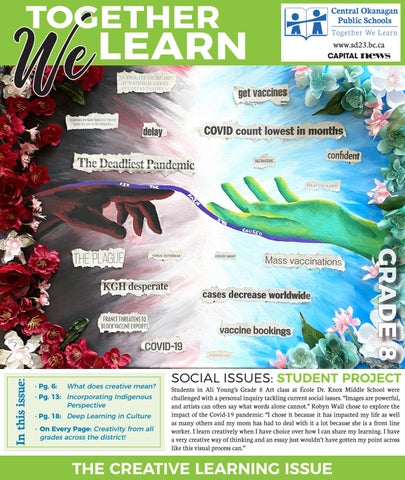
Students in Ali Young’s Grade 8 Art class at École Dr. Knox Middle School were challenged with a personal inquiry tackling current social issues. “Images are powerful, and artists can often say what words alone cannot.” Robyn Wall chose to explore the impact of the Covid-19 pandemic: “I chose it because it has impacted my life as well as many others and my mom has had to deal with it a lot because she is a front line worker. I learn creatively when I have choice over how I can share my learning. I have a very creative way of thinking and an essay just wouldn’t have gotten my point across like this visual process can.”
THE CREATIVE LEARNING ISSUE
BOARD CHAIRPERSON’S MESSAGE
Moyra Baxter Chairperson, Board of Education
The constant, though necessary, focus on COVID has made for an exhausting school year – many people are simply tired and more than ready for a break. Nonetheless, the people of our district are finishing strong, with creative approaches to the many transitions and milestones of our students. For me, some of the most uplifting moments of the school year are when I get to see the creativity of our staff and students. From the lovely artistic reflections of our young students to the leadership guiding collaborative projects like the Raven Canoe at Central
School, their creativity fills me with hope that we will not only recover but be stronger going forward. The issue you are about to read (or should I say view?) is filled with creativity from all levels of learners. Personally, I find it a welcome diversion from the overwhelming feelings that consume so many of our days. It is our hope that you will also be inspired by these displays. See their use of colour and light, hear their voices, and read their words; you will surely share my confidence that the future is in good hands and brighter days lie ahead.
earn Creatively when... I paint and draw. - Alice, Kindergarten, Helen Gorman Elementary
Kevin Kaardal Superintendent of Schools / CEO I am a strong proponent of the value of creativity in learning. Creativity is not only an inborn talent; we can learn creativity and practicing divergent thinking lets you see that for many projects or problems there are multiple paths to a
correct solution. Studies show that creative people are better able to live with uncertainty because they can adapt their thinking to allow for the flow of the unknown. Researchers found that only creativity—not intelligence or overall openness—decreased mortality risk. One possible reason creativity is protective of health is because it draws on a variety of neural networks within the brain, says study author Nicholas Turiano, now at the University of Rochester Medical Center. “Individuals high in creativity maintain the integrity of their neural networks even into old age,” says Turiano. One of the core competencies in the BC Curriculum is creative thinking. In schools, we foster the development of this competency in a variety of ways. In addition to teaching fine and performing arts, educators support assessment practices that allow students
to creatively demonstrate their learning in a variety of methods. Teachers also guide innovative projects that require critical and creative thinking to solve problems our world faces today, as you can see in the learning stories of our Instructional Leadership Team. In this issue, you will see students at all levels in our district who demonstrate creative thinking, as well as educators guiding creative learning opportunities. We also appreciate our community partners who validate student work, as with the display of student art at this year’s Kelowna Art Gallery exhibition Bright New World, which shows visual expressions of hope post pandemic. We need creative people to help us recover and renew our connections, so I am grateful our educators foster this competency in our learners.
“T here’s no such thing as creative people and non-creative people. T here are only people who use their creativity and people who don’t.”
— Brene Brown 2
COMMUNITYCONNECTION • JUNE 2021
KINDERGARTEN
SUPERINTENDENT’S MESSAGE
KINDERGARTEN
Creative Learning from Davidson Road Elementary
CREATIVE
STARS! By: Ms. Radley’s Kindergarten class, Chief Tomat Elementary We learned about Vincent Van Gogh and his famous painting “Starry Night”. In Science, we are learning about the properties of materials. We used a variety of materials like feathers, paper, tissue, plastic, string, sandpaper, and fabric to complete the piece. We had so much fun! TOGETHERWELEARN • SD23.BC.CA
3
GRADE 1
By: Grade 1, École George Pringle Elementary
Sənsisyustən House of Learning
We invite you to experience the beauty that is our place, culture and community. Sənsisyustən House of Learning is a Group 2 Independent Elementary School with the BC Ministry of Education. We teach current BC curriculum with an integration of Okanagan Syilx perspectives. The syilx/Okanagan translation of Sənsisyustən is “the place where you become anything you choose to be.” The school, designed after a traditional native pit-house, lends itself to interactive learning in a warm and nurturing environment.
The place where you become anything you choose to be.
Our school edifies the Seven Teachings: humility, honesty, bravery, respect, love, truth, and wisdom. Teachers, staff, Elders, and School Board Members strive to make that a reality for students. What we offer: A balance of academics with Okanagan Language and culture taught in every grade. Cultural field trips such as tea picking, gathering sage, and digging bitterroot. Small class sizes, allowing for more one on one teaching time. A Learning Assistance Program for children who may require additional support. A school-wide discipline program that promotes social responsibility. 1920 Quail Lane, Westbank First Nation Tel: 250 768 2802
4
Email: school@wfn.ca
Web: sensisyusten.ca
COMMUNITYCONNECTION • JUNE 2021
$
9 million renovation and expansion completed in 2019
GRADE 1 LEARNING CREATIVELY THROUGH PLAY Ms. Sawchuk’s Grade 1 class at Ellison Elementary learns social and emotional skills through the Play is the Way program of physically interactive games.
TOGETHERWELEARN • SD23.BC.CA
5
GRADE 1
STATEMENT ON CREATIVE LEARNING
What does creative mean?
“ You are a creative artist.” - Dimitri “ You’re the first one who created it.” – Leif “ When you make something and it’s nice and beautiful.” – Preslee “ You draw realistic stuff.” – Ryu “ You do something unique.” - Madisyn “ Working together on something that’s hard.” - Henry “ Creative means if you build something.” – Abby “ You create a plan by putting a seed in the ground.” – Mia “ When you do something that you want to do it actually looks real.” – Arya
What is happening in your brain when you are being creative? “ If you are being creative then your brain is thinking of lots of different
steps.” – Henry “ It grows. So like if you build a tiny thing and it doesn’t look good you can build on it and it gets gooder. If you just give up someone else can come and help. “ – Leif “ You feel happy.” – Simone “ You feel joyful.” – Madisyn “ It makes it funner when you work with someone else because it takes longer to work with someone else and you can finish sooner and play quicker and playing is funner than just working and you play sooner.”
6
COMMUNITYCONNECTION • JUNE 2021
By: Ms. Stewart’s Grade 1 Class, Oyama Traditional School “We learn creatively when we can work together to build something beautiful. We can use our imagination pockets to think of something unique. It brings us joy and happiness to be able to play and work together while we learn.”
Why do you like being creative? “ Because you feel joyful and happy and you can also help someone.” – Kenya “ Because I can ask my brother if we want we can build a castle together as a team.” – Owen “ You can make beautiful things and art is pretty.” – Arya
When do you get to be creative at school? “ Story making and writing” - Arya “ Writer’s workshop” – Owen “ When your teacher says we get to do art” - Simone “ When you figure out different strategies to make different numbers” – Henry “ Making our bear shelters” – Ryu “ Making our fox shelters” – Brie “ Pretending to be our animals” – Owen “ Using our imagination pocket” – Dimitri “ Making our shelter unique” – Leif “ Use triple scoop words” – Abby “ Paw prints and creating a story for how our animal acts” - Henry
GRADE 1
Creative Courage By Daniel R., Grade 1, École Peter Greer Elementary
This year our district theme was courage, and what a fitting theme it has been! PGE student, Daniel R, created this awesome display. Daniel says that courage means “standing up for what is right and being brave.” Bravo, Daniel. Nous savons que tu as le courage de prendre des bonnes décisions.
TOGETHERWELEARN • SD23.BC.CA
7
GRADE 2
STORY WORKSHOP! Mme. Paquin’s Grade 2 French Immersion Class, École Casorso Elementary Story workshop at Casorso allows learners to explore, create and connect to their thinking through play! Students see themselves as authors and there is no lack of imagination through this playful inquiry. Learners first share their stories orally and collect new vocabulary, then begin to write stories later. Story workshops also allow the acquisition of the French language in a holistic way.
WATERCOLOUR By: Kara Deen, Grade 2, Mar Jok Elementary
“This is a girl with an umbrella watercolour, showing light to dark colours.” - Kara
earn Creatively when... I make mistakes and keep trying new ways because when I make a mistake I don’t give up! When I do something I keep working, just like Chief Salmon of the Four Food Chiefs. Alicia Zerr, Grade 2, Bankhead Elementary School
8
COMMUNITYCONNECTION • JUNE 2021
GRADE 2/3
CREATIVE FORCES
earn Creatively when...
By Ms. Holland, Grade 2/3, Pearson Road Elementary The Grade 2/3s at Pearson Road Elementary have been exploring Forces and Motion during their Science and Inquiry unit. We started the unit with the question, “How do things move?” During an initial exploration, the students showed a particular interest in and fascination with magnets. They were also interested in exploring air. The Grade 2/3 team decided to do a cross-curricular lesson with science and art. We have documented the process of the lesson, where the students made art work with different forces.
“I learn creatively when I read books and my teacher gives me cool writing assignments.
Claire Palahniuk, Grade 3, North Glenmore Elementary
GRADE 3
AND MOTION!
TOGETHERWELEARN • SD23.BC.CA
9
GRADE 4
CREATIVELY SHOWING
SCIENCE LEARNING By: MJ Griesbeck, Grade 4, Raymer Elementary This young student finds projects that spark her curiosity, then shares her learning through Google Slides.
Creative Vision By: Elizabeth Chudecki, Grade 4, Rutland Elementary Elizabeth made a diorama of the rainforest, showing her creative understanding of the climate, plants, and animals that exist in this biome. 10 COMMUNITYCONNECTION • JUNE 2021
“You can’t use up creativity. The more you use, the more you have.” —Maya Angelou
GRADE 5
FINDING MATH IN THE
EVERYDAY WORLD By: Ms. Dhesi, Grade 5 class, Black Mountain At Black Mountain, Ms. Dhesi’s Grade 5 class has spent the entire year developing their skills as mathematicians. Through number talks, math investigations, math congresses, and a whole lot of communitybuilding, these students have truly excelled not only in their mathematical mindsets and skill sets but also in how they see themselves as mathematicians who can recognize where math lives in their everyday world. This has been a perfect example of transformational learning at Black Mountain!
earn Creatively when... I learn creatively when I am making something that is part of learning. For example building with clay or simple machines. I am creative when I work with groups or other people and when I get new ideas. Roy Kim, Grade 5, Watson Road Elementary
TOGETHERWELEARN • SD23.BC.CA
11
GRADE 6
earn Creatively when... I think creatively when my teacher gives us freedom to build and work independently. For example, my teacher let me and my partner choose a project and learn how to build it on our own during woodworking. We built a shoe rack for a class that needed one. He helped us when we needed help, but we still did most of the work ourselves.
Alandre Whyte, Grade 6, A.S. Matheson Elementary
Themed crafts and games Outdoor activities Fun and learning
JULY 13-15 JULY 27 - 29 AUG 10 - 12 AUG 24 - 26
$120 per child, 9:00 am 3:00pm all 3 days. AT THE LAKE COUNTRY MUSEUM & ARCHIVES COVID-19 PROTOCOLS
Geared towards kids aged 6 to 11. Curriculum based.
SOCIAL DISTANCING LIMITED NUMBERS MASKS WHEN NECESSARY HAND WASHING HAND SANITIZER
WWW.LAKECOUNTRY.BC.CA/REGISTER OR PHONE 250-766-5650
12
COMMUNITYCONNECTION • JUNE 2021
earn Creatively when... I think creatively when I take chances and learn from my mistakes. During ADST, the shelf we are building is tough and I am still working on it, because my partners left the school. I keep making a lot of mistakes with the tools because I have no one to correct me, but it is forcing me to experiment and find out the right ways to use them.
Ayano McClennan, Grade 6, A.S. Matheson Elementary
earn Creatively when... Averie: “I learn creatively when I work in different ways. No papers, no pens, just our minds.” Hailey: “I learn creatively when I am with my friends and working hard. I am positive and trying my best.” Averie and Hailey, Grade 6, École Belgo Elementary
Powerful, equitable learning incorporates Indigenous perspectives. This year, a team of teachers at Canyon Falls Middle School (CMS) developed a learning experience inspired by Jim Elwood’s Grade 6 Art Lesson N ̓x̌ax̌ aitkʷ. Together. CMS classroom teachers, art teacher, indigenous advocate, and teacher librarian built a series of activities that empowered learners to question the settler perspective surrounding Ogopogo. Syilx knowledge keeper Coralee Miller visited via Zoom and shared the true origin of the Spirit of the Lake from the Sylix perspective. Our learners learned of a lake protector that is revered and not feared; they learned the importance of reciprocity with the local environment. They built an understanding of water as life and explored the connectedness of the Syilx people to water. Learners created artwork based on their new perspective featured in the Kelowna Art Gallery. Student Lukas Miller said, “I portrayed how nature can survive together. You can see a deer drinking from the water. The water is polluted from modern activity but the Spirit of the Lake n ̓x̌ax̌ aitkʷ (n-haha-it-koo) can filter it for the deer. Living nature is our bright new future.”
Luke - Spirit of the Lake
Leena, Samantha and Ireland - Spirit of the Lake
GRADE 6
INCORPORATING INDIGENOUS PERSPECTIVES
Lukas - Spirit of the Lake
HEALTHY RESOURCES AND CARE FOR FAMILIES The YMCA of Okanagan has been a vital family resource for nearly 40 years, providing safe spaces for children and youth to get active and build their social skills. And also by providing affordable quality child care for families. As a charity, the Y works to promote healthy living, nurture young minds, and strengthen the foundations of our community, most of which start with our youngest generations. As the COVID-19 pandemic continues to affect the Okanagan, and with ample safety guidelines in place, the
Y is working to support families in any way they can. The following are some available programs and resources available for families: Preschool (3–5) spaces at the Kelowna Family Y and Glenrosa Elementary School Before and After School Care (5–12) at Glenrosa Elementary School Winter Child and Youth Programs (3–14) at Kelowna Family Y and H2O, December registration Youth Mindfulness Program (18–30) FREE early 2021 at the Kelowna Family Y
Thanks to generous donors, the YMCA offers financial assistance for all programs and services that are not free to the community. Learn more https://www.ymcaokanagan.ca/ at ymcaokanagan.ca.
TOGETHERWELEARN • SD23.BC.CA
13
GRADE 7
BE CREATIVE - BE YOU! By Springvalley Middle School
This music video was made by Springvalley Middle School (SMS). The song was written and composed by SMS Music Teacher, Karen Angle, the song is sung by the SMS choir, and they choreographed some sections of the video. Our theme this year at SMS is “Be You” so the video shows images and art work by SMS students expressing what it is to be true to you. They show creativity in so many ways throughout the three minute video from dancing, singing, art work, personal expression, and through creating a sense of community in a difficult year.
earn Creatively when... Malaya: I learned creatively when building our spaghetti bridges. I took ideas from other bridges to create our own unique bridge. I also had to expand on others’ ideas creating our bridge. Miya: I learn creatively when I’m in a group and when you can create whatever you want, because I can learn off of others’ ideas and build off them to help me. Malaya Martinuik and Miya Lees, Grade 7, Constable Neil Bruce Middle
14
COMMUNITYCONNECTION • JUNE 2021
THE GMS AND HARUHIGAOKA VIRTUAL CHOIR COLLABORATION
- “SISI NI MOJA” BY JACOB NARVERUD By: Kimberley Gorman, École Glenrosa Middle School (GMS) Band Teacher The idea for the project came about early 2021. It was originally meant as a way to keep the excitement for choir alive at GMS since choir classes were put on pause this year due to COVID. However, as it approached the time of year when our Japanese friends usually come to visit, I realized we would not be doing any joint performances this year either. Thus, the idea to do a choral collaboration was born. Twelve students and four staff members from GMS, plus ten Grade 9 students from Haruhigaoka Junior High School took the time to learn their parts and submit solo vocal recordings to be edited together. It was fun receiving videos from Japan periodically, showing students practicing and singing along to conducting videos, spread out across a large room in masked pairs. The process, as well as the end result, really helped to connect our schools again this year in a meaningful way. We all look forward to future opportunities where we can sing together again in person! The lyrics to the piece also drive home an important message. No matter where we live, or what happens in our lives, or what challenges come our way, it is important to remember that all people are the same in so many ways. We all laugh, we all cry. We all feel hunger, pain, sadness, love and joy. We are one.
CREATIVE COLLABORATORS
OFFER ADVENTURES!
Click here to see these PowerPoint presentations
GRADE 9
These projects were made in collaboration between Okanagan Mission Secondary (OKM) (Grade 9) & Canyon Falls Middle (CMS) (Grade 6/7/8) students via Zoom and GSuite Tools (Google Slides/Docs). The teachers that coordinated it were Mrs. Janine Collinson - OKM (original idea) & Mr. Nolan Chapman - CMS. These projects were intended to help build a relationship between the high school and its feeder school and hit the learning goals of exposition, figurative language, imagery, and writing conventions. Enjoy choosing your own adventure!
TOGETHERWELEARN • SD23.BC.CA
15
GRADE 10
Kʷu yʕayʕat kʷu cq̓əłiliʔs “WE ARE ALL CONNECTED” IN NSYILXCEN (OKANAGAN LANGUAGE) By Bailey Nerbus, Teacher, Mount Boucherie Secondary Indigenous Academy
Our Indigenous Leadership students (10-12) worked with our student teacher Ms. Ross to create Okanagan labels in our classroom and signage around our school. Ms. Ross works alongside a community Elder teaching the Okanagan language to adults. She helped the students with spelling and pronunciation, and then they worked together to create QR codes for each label/ sign. The QR codes are linked to audio, so students can stop, scan, and learn to pronounce the words. The Indigenous Leadership class had a lot of fun learning the words/ phrases and was excited to share them with our school community.
International students share their culture, hopes, and dreams with you as they embark on a study abroad journey.
Host families come in all shapes and sizes but they all benefit from their new family member! Host families receive $900 per month.
Together We Learn
Central Okanagan Public Schools International Education
16
COMMUNITYCONNECTION • JUNE 2021
earn Creatively when...
Homestay families are the heart of our program, providing caring, welcoming homes to students from 30 different countries. Apply online at: international.sd23.bc.ca/ homestay For more information, email: homestay@sd23.bc.ca International students must follow all Government of Canada travel requirements including pre-departure, arrival and post-arrival COVID testing.
Liam Sisson, Grade 10, Okanagan Mission Secondary
“I learn creatively when I am cooking and exploring different cuisines and spices. One of my favourite cuisines to work with is Mediterranean, as I love the diversity of the dishes. There are so many special flavour combinations that you can take apart and create a dish that’s uniquely your own.”
GRADE 11
CREATIVE DIGITAL ART from George Elliot Secondary Grade 11 Students
Photos By: Keegan Chatten By: Tyler Brown
By: Pauline Fink and Sacha Sabry
earn Creatively when... ● I look at other art styles for inspiration ● I have access to an assortment of supplies and time to try out new techniques and different types of media ● I have a bad day because I can usually find something to draw based on those personal experiences ● I use the colour red; I use it in most of my stuff ● I use important turning points in my life as a source of inspiration
Emma Cooper, Grade 11, Rutland Senior Secondary
Ommetaphobia Acrylic on canvas
TOGETHERWELEARN • SD23.BC.CA
17
GRADE 12 DEEP LEARNING IN CULTURE by Emma Doubt Keeler, Grade 12, Central Programs and Services This essay and the accompanying artwork were composed and created for a novel study reflection on the autobiography From the Ashes written by Jesse Thistle. “We owe the Aboriginal peoples a debt that is four centuries old. It is their turn to become full partners in developing an even greater Canada. And the reconciliation required may be less a matter of legal texts than of attitudes of the heart.” -Romeo LeBlanc Cultural Healing in Canada Identity, we all have it. It is composed of our moral values, our culture, and who our ancestors were and where they came from. Now, imagine having pieces of that identity taken from you before you were even born, or perhaps you don’t have to. Culture is a learned and collective behaviour of a group of many people surrounding the way they act, what they eat, how they communicate and express their religion, art, literature, forms of government and economic system. There are 630 First Nation communities in Canada that are so diverse from each other. Each have community events, usually in the summer or winter, which are personal to their individual beliefs and have come to build their unique culture. By understanding the importance of Aboriginal culture, the trauma Aboriginal people experienced due to systemic racism and cultural whitewashing practices, acknowledging our personal Aboriginal history and how we are showing awareness today, perhaps Canada can begin to heal, and move forward from our dark past of trying to erase what and who was here first. Some Aboriginal peoples hold Powwows which are a ceremony including dance,
18
singing, drums, and food. It is a way to celebrate life, spirituality, to honor traditions and for the community to connect and gather to share stories. The ceremony is a very important part of Aboriginal culture for many tribes. Matching is another significant ceremony used for medicinal, practical, and spiritual purposes. During a smudging ceremony dried plants such as sweetgrass, cedar, sage, and tobacco are burned. Using a sacred container, usually a shell, the smoke is fanned by an eagle feather whilst a prayer is said. Guardian spirit and vision quests are another ceremony in which young men, usually around the age of puberty, stay in remote areas. During this time they fast, bathe in springs and rivers, and pray. It is thought that the result of this purification will give the man a vision or encounter with a guardian spirit. The first fish ceremony, dip net fishing in the nearby canyon and basket weaving are cultural celebrations that have remained strong and are still being carried on today. There are many distinct varieties of celebrations and ceremonies of life in Canada, making it a very diverse place when it comes to Indigenous peoples. Visual art connects people and our way Aboriginal people communicate their way of life and can help us better understand their culture. Aboriginal art is connected to their religious ceremonies or rituals and is a visual way to preserve history and share their knowledge and beliefs. In Canada, Aboriginal art plays a significant role in their culture and is another form of language as each piece tells a story. Carving wood, rock art, bark paintings, quillwork (textile embellishment) and fibre art are just a few ways they express themselves through art. If I were to list them all I would probably
COMMUNITYCONNECTION • JUNE 2021
fill up an entire page because these arts are so broad within Canada. Carving wood and creating sculptures are used to tell stories and to broadcast the history of a nation; the most well-known carvings would be the many totem poles created by Indigenous peoples. The oldest rock paintings found date back to 5,000 years ago. I had the opportunity to view rock art from many years ago when I visited the Adams River in the Shuswap. I saw and learned they used animal and people drawings to possibly mark the site where a particular tribe lived and communicate the salmon run to other tribes. One of my favourite parts of Aboriginal culture is their ceremonial clothing which is called Regalia. The headdress worn by Chiefs with many feathers, ceremonial outfits such as dresses and accessories, secretly worn by tribes. These are all pieces of wearable art handcrafted typically by the women. Each tribe and community in Canada has its own traditions on what sacred clothing may look like so it varies from coast to coast, but it is all so vibrant and beautiful to the eye. My love of Aboriginal art is shared with my dad as he has collected many pieces in his travels and had personal artifacts and photos passed down from his ancestors. This ignited my curiosity to learn about my connection to Aboriginal peoples. In my Dad’s apartment, we have an entire wall filled with photographs of our past family dating as far back as the 1800s. On this wall, there is a lady who I was told went by the name Hannah Oppenheim. She was born in 1856 and was the daughter of a chief named Osomote. She was from the first nation of Spuzzum N’laka’ Pamux. I was told she was my great, great grandmother;
her granddaughter is my granny, Peggy Walters, who lives with me and my dad. My granny never really spoke of her Aboriginal family’s culture despite having many art pieces passed down from her family and displayed in our house. Naturally, I was curious to find out more information about Hannah and her culture. I began this journey by using some digital family tree tools. Family searches and Ancestry.com were my biggest helpers and by simply filling out the information I knew, I discovered many ancestors I hadn’t known existed. Then I found her, Hannah Oppenheim. I was hoping to learn more about Hannah, her parents, siblings, or where she came from, but sadly there was nothing and the family tree ended. I talked to my dad about how I felt discouraged and he mentioned I should give her name a Google search. The first two articles that came up were about her. Hannah’s real name was Nukwa Grace Andrew Martel. Hannah’s name appears to have been Anglicized due to European contact and influence. Nukwa Grace Andrew Martel was born in Spuzzum, BC and was married at age 14 to a man named Louis Oppenheim, with whom she had eight children! Her second marriage was to a man named Eli Martel with whom she had two children. I wasn’t able to find much information about her father and mother or if she had any siblings. This is probably because records were not kept, as well as due to residential schools separating her from her family and then changing her name. I found a few photos of her and in all of them she looks very emotionless, as most of the pictures were in those days, but I can see deep sadness and loss in her eyes. It breaks my heart as I will never know about her parents or have more photographs of her. I know in my heart that despite the erasing of Hannah’s native name and the hardships she went through, many that we may never know, she is a part of me and who I am. I hope to one day understand concepts of her language, participate in her culture, and understand why more Aboriginal traditions haven’t prevailed in our family. I’m glad that I can now write about Nukwa Grace Andrew Bartell, share her story, and pass what I know of her onto my children so that Nukwa Grace will not be forgotten again. Information was missing, though I was able to find some about one of her children. Rose Oppenheim is Nukwa Grace’s daughter. Rose shared a story of how her mother would weave many beautiful baskets. I was able to find photographs of several of these types of baskets, some possibly weaved by Nukwa. The same article mentions there are letters and more artwork housed in the historic Yale Museum. I look forward to one day visiting the museum to learn even more about these people’s lives and what they created. The Indian Act was put into place in 1876, a Canadian act of Parliament that controls most Indigenous freedoms, including Aboriginal status, land, resources, education, and even wills. I was surprised to find out this act is still in place. Indian reservations and residential schools were both the result of the 1876 Indian Act. My question is why we only allow the First Nations peoples, the original citizens of Canada, to own a small portion of land? Interfered with by
traumatic stress has caused generations of oppression and succumbing to substance abuse, depression, and both mental and physical disease. Sadly, generations of oppression have endangered the culture. Ignoring, conquering, and forcing change among people never ends well. Having stripped people of their dignity and culture for generations it will not be easy or quick for our country to make amends. Our government needs to work hard to ensure fair treatment and opportunities for quality of life for those on reservations, all the while continuing to acknowledge whose land we live on. We now have Aboriginal programs at most schools, and community programs where people can gather and participate in ceremonies and traditions of their Nations. The government of Canada has been working with archaeologists to preserve Aboriginal rock art so we can better understand who created them and preserve them for future generations. Many spiritual practices and celebrations were banned in Canada for a long time, however, arts and ceremonies which Aboriginal Elders thought they may never get to experience again are once again beginning to grow across Canada. Languages that were once forced to be forgotten are once again being taught. Thankfully opportunities are rising and some Aboriginal cultures are now beginning to flourish in Canada. Knowing your heritage and honouring it will always be an important part of the cultural melting pot of Canada. For many social justice warriors and passionate people, native culture is beginning to be less appropriated and much more appreciated. Learning about Aboriginal culture has become very important to me because now I know Aboriginal peoples are not just a people, they are my people. I have developed a better sense of understanding about my family and myself knowing about the culture and identity of my people. If we dig into our family history and try to understand our historical culture, we can appreciate, participate, and embrace being a part of it. We must remember the past and what we have evolved from, while continuing to strive for more healing. Canada will need to focus on reparations and healing, not just in Indigenous communities, but in all communities who share this land, because in some sense we all have been affected by this whether we realize it or not. We want a country where every nation and race can prosper on this beautiful land. If we work together our history will no longer feel erased as we will scream loud and clear for all the world to hear, celebrate the beautiful culture and history of our country. Real Canadians - Aboriginal, First Nation, and Indigenous Canadians - are the true, north, strong, and free. I’m glad to know the current Canadian government has finally begun to address the injustices to our lands’ first residents. Acknowledging a past of racism and cultural whitewashing, and opening our awareness to Aboriginal culture gives me hope. My Aboriginal ancestry will allow me to advocate for others and hold space for our first peoples. It is long overdue for Canada to take responsibility for the past and engage all of our citizens in Aboriginal cultural healing.
Congratulations to the Winners and Grand Champions of the 2021 Gord Downie & Chanie Wenjack National Indigenous Health Contest! By Tyler Ernst, Teacher, Okanagan Language 12 This new-to-KSS Okanagan Language 12 class won a National contest with their reflections on balancing studies and stresses while remaining healthy. Two of the students, Taylor and Julia, had their works place in the top three. The judges found Taylor's work to be incredibly creative. They loved how she tied in her obvious love of art with the colours of the medicine wheel as well as Okanagan words to share what helps her balance her holistic wellness. This poster really tied to the theme of the contest because it showed how Taylor uses art and other aspects of her life to balance mental health. The judges commented that Julia's art was incredibly beautiful and unique. Colours of the medicine wheel surrounding the girl with braided-hair in the centre of the poster caught their eyes, and the Okanagan words surrounding her tied to the overall theme of the contest, which is understanding how one can balance their holistic wellness. Further, we then won the grand prize with the entire class all receiving t-shirts and their teacher, Mr. Ernst, receiving a fresh hoodie. We may appear in further Indigenous curriculum within the Legacy School ReconciliACTION Guidebook, and the Okanagan Language students have won an amazing prize pack from the Gord Downie & Chanie Wenjack Fund including an autographed copy of Secret Path, signed by Jeff Lemire.
By: Taylor
By: Julia
GRADE 12
the government, their land is suffering from unclean water, something that was promised to be addressed for quite some time now. Not only this, but many Native women have also experienced violence in their homes, communities, and from outsiders. In the last 30 years, 4000 Indigenous women have gone missing, probably abused and possibly murdered, yet little being done to raise awareness and investigation by the federal and provincial governments. A report obtained by CBC News suggests that “actions and inactions are rooted in colonialism and Colonial ideologies”. These women are often dismissed because of the belief they are drug addicts, runaways or lost. I do not believe it is fair, or in any way acceptable, that our government sweeps these women’s death under the rug. The Indian Act of 1876 needs updating to make our government accountable for the injustice it has served against Aboriginal peoples. By looking at my own family history, I can see many Aboriginal ancestors have no records, have changed names, forgotten languages, lost talents and doomed cultural traditions. It is discouraging knowing that many of my ancestors’ names will likely never be known because of Christians preaching their own beliefs about right and wrong, heaven and hell, destroying many distinct beliefs, traditions, and families of Indigenous peoples in Canada. Why is it that a rich and benevolent country like ours still suffers from racism, injustice, and violence towards our native population, to a degree that even third world countries may not experience? It is not fair! Although time has gone by, and yes things have been done, not enough has been done to help Aboriginal people build their culture and identity and know they will live on for generations. Now that I knew where my family came from, a Salish tribe near the Thompson River, I was eager to look into Interior Salish traditions about language. I was sad to discover that few people still speak the n’laka’pamux language. I did gain some hope when I found a video of Youth talking about how they practice their traditions and speak the language. The Aboriginal language holds great importance as it keeps speakers connected to their culture, land, and most importantly future generations. More than 70 Aboriginal languages are spoken in Canada. Many of these languages are endangered and are spoken by less than 10,000 people. To put this in perspective, only 4% of Indigenous people speak their native tongue fluently, most of them being above 65 years of age. This happened mainly because up until the 1970s government policies discouraged the speaking of Indigenous languages. In some cases, young children were forbidden to use their mother tongue on school grounds. These policies destroyed many cultural aspects and basic rights. Prime Minister Stephen Harper was the first prime minister to apologize and admit that native Canadians were treated terribly through the residential school system. This was the first step that we needed to begin healing, but we need to continue to take more steps. Substantial and Lasting Trauma from placements in residential schools have been one of the heaviest trials the First Nations people have had to face. Post-
TOGETHERWELEARN • SD23.BC.CA
19
Start here
It’s not too late to apply for fall.
Explore your next steps at okanagan.bc.ca/starthere
OCRTP 32985
Complete university transfer courses, learn business, upgrade, level up your professional skills or learn a trade.