A12 Friday, January 17, 2020
Campbell River Mirror
www.campbellrivermirror.com
e e W k y c a er t i L y l i 2020 m Fa ALL EVENTS ARE FREE
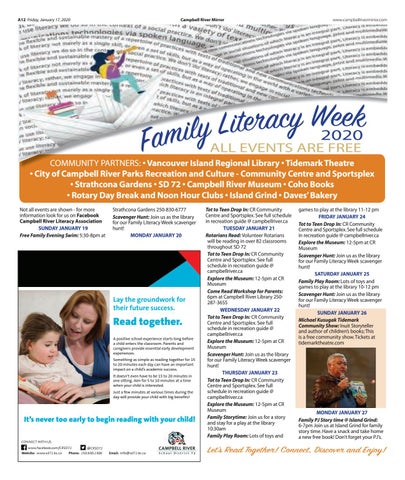
COMMUNITY PARTNERS: • Vancouver Island Regional Library • Tidemark Theatre Not Parks all eventsRecreation are shown for more 22 SATURDAY JANUARY 25 • City of Campbell River and WEDNESDAY CultureJANUARY - Community Centre and Sportsplex information look for us on Facebook Tot to Teen Drop In:Museum CR Community•CenFamily Play Room: Lots of toys and • Strathcona Gardens • SD 72 • Campbell River Coho Books Campbell River Literacy tre and Sportsplex. See full schedule in games to play at the library 10-12 pm • Rotary DayAssociation Break and Noon Hour Clubs • Island Grind • Daves’ Bakery recreation guide @ campbellriver.ca
Scavenger Hunt: Join us as the library for SUNDAY JANUARY 19 games to play at the library 11-12 pm hunt! Tot to Teen Drop In: CR Community 250-830-6777 NotNot all events are shown - forshown more all events are for Strathcona more Gardens at CR Mu- JANUARY our Family Literacy Week scavenger WEDNESDAY JANUARYExplore 22 the Museum: 12-5pm SATURDAY 25 Free Family Evening Swim: 5:30-8:00 Centre and Sportsplex. See full schedule information look for us on Facebook FRIDAY JANUARY 24 Scavenger Hunt: Join us as the library seum information look Association for us on Facebook in recreation guide @ campbellriver.ca Campbell River Literacy SUNDAY JANUARY 26 for our Family Tot Literacy Week scavenger pm at Strathcona Gardens 250-830Tot to Teen Dropof In:toys CR Community to Teen Drop In: CR Community CenFamily Play Room: Lots and Campbell Literacy TUESDAY JANUARY 21 hunt! SUNDAYRiver JANUARY 19 Centre and Sportsplex. See full schedule Scavenger Hunt: Join us as the library for 6777 Tidemark Community tre and Sportsplex. Seeour full schedule inWeek scavenger games hunt! to play at theKusugak library 10-12 pm inMichael recreation guide @ campbellriver.ca Rotarians Read: Volunteer Rotarians MONDAY JANUARY 20 Free Family Evening Swim: 5:30-8pm at Association Family Literacy Show: the Inuit Storyteller and author will be reading in over 82 classrooms Scavenger Hunt: Join us as the library Explore Museum: 12-5pm at CR of recreation guide @ campbellriver.ca throughout SD 72 Museum children’s is alibrary free community Scavenger Hunt: Joinbooks; us asThis the for for our Family Literacy Week scavenger THURSDAY JANUARY 23 SUNDAY JANUARY 19 Tot to Teen Drop In: CR Community Scavenger Hunt: Join us as the library show. Tickets at tidemarktheatre.com hunt! Explore the Museum: Tot 12-5pm CR In: Muour Week scavenger hunt! to Teen CR See Community Cen- Literacy Centre andatDrop Sportsplex. full Family for our Family Literacy Week scavenger Free Family Evening Swim: 5:30-8:00 schedule in recreation guide @ hunt! tre and Sportsplex. See full schedule in MONDAY JANUARY 27 MONDAY JANUARY seum20 campbellriver.ca SUNDAY JANUARY 26 SATURDAY JANUARY 25 pm at Strathcona Gardens 250-830recreation guide @ campbellriver.ca Explore the Museum: 12-5pm at CR Family PJ Story time @ Island Grind: 6-7 Tot to Teen Drop In: CR Community Family Play Room: Lots of toys and Scavenger Hunt: Join us as the library for Museum 6777 at CR MuPM Join us atatIsland Grind 10-12 for family games to play the library pm story Michael Kusugak Tidemark Community Centre and Sportsplex. See full schedule Explore the Museum: 12-5pm Come Read Workshop for Parents: our Family Literacy Week scavenger hunt! Scavenger Hunt: Joinand us as thehome librarya new time. Have a snack take recreation guide @ campbellriver.ca seum 6pm at Campbell River Library 250- Inuit Storyteller and author of Show: Scavenger Hunt: Join us as theinLay library for our Family Literacy Week scavenger the groundwork for free book! Don’t forget your PJ’s. 287-3655 Family Storytime: Join us forchildren’s a story andbooks; hunt! This is a free community TUESDAY JANUARY 21 THURSDAY JANUARY 23 their future success. for our Family Literacy Week scavenger WEDNESDAY JANUARY 22 SUNDAY JANUARY 26 2020 stay for a play at the library 10:30 am Family Literacy Week show. Tickets at tidemarktheatre.com Tot to Teen Drop In: CR Community Rotarians Read: Volunteer Rotarians hunt! Michael Kusugak Tidemark Tot to Teen Drop In: CR Community CenCentre andRoom: Sportsplex. full and Family Play Lots See of toys will be reading in over 82 classrooms Community Show: Inuit Storyteller schedule in recreation guide @ Let’s Read Together! Connect, full schedule in MONDAY JANUARY 27 and author of children’s books; This to play at the library 11-12 pm MONDAY JANUARY 20 throughout SDtre 72 and Sportsplex. Seegames campbellriver.ca is a free community show. Tickets at A positive school experience starts long before Discover and Enjoy! recreation guide @ campbellriver.ca ExploreJANUARY the Museum: 12-5pm at CR tidemarktheatre.com FRIDAY 24 a child enters the classroom. Parents and Tot to Teen Drop In: CR Community Family PJ Story time @ Island Grind: 6-7 Tot to Teen Drop In: CR Community Museum caregivers provide essential early development Centre and Sportsplex. See full schedule Tot experiences. to TeenatHunt: Drop CRusCommunity Scavenger Join as PM the library Explore the Museum: 12-5pm CR In: MuJoinCenus at Island Grind for family story Centre and Sportsplex. See full schedule Something as simple as reading together for 15 in recreation guide @ campbellriver.ca for our Family Literacy Week scavenger tre and Sportsplex. See full schedule in to 20 minutes each day can have an important seum time. Have a snack and take home a new hunt! in recreation guide @ campbellriver.ca impact on a child’s academic success. recreation guide @ campbellriver.ca Explore the Museum: 12-5pm at CR THURSDAY JANUARY 23 book! Don’t forget your PJ’s. free It doesn’t even have to be 15 to 20 minutes in Museum Family Storytime: Join us for a story and Tot to Teen Drop In: CR Community one sitting. Aim for 5 to 10 minutes at a time TUESDAY JANUARY 21 Explore the Museum: 12-5pm at CR Muwhen your child is interested. Centre and Sportsplex. See full seum 10:30 am stay forfor a play at the Come Read Workshop Parents: 6 library schedule in recreation guide @ Just a few minutes at various times during the Rotarians Read: Volunteer Rotarians day will provide yourRiver child with big benefits! campbellriver.ca pm at Campbell Library 250-287Scavenger Hunt: Join us as the library for Family Play Room: Lots of toys Explore theand Museum: 12-5pm at CR will be reading in over 82 classrooms 3655 our Family Literacy Week scavenger hunt! Museum MONDAY JANUARY 27 games to play at the library 11-12 pm throughout SD 72 Family Storytime: Join us for a story Family PJ Story time @ Island Grind: It’s never too early to begin reading with your child! and stay for a play at the library 6-7pm Join us at Island Grind for family FRIDAY JANUARY 24 10:30am Tot to Teen Drop In: CR Community story time. Have a snack and take home Family Play Room: Lots of toys and a new free book! Don’t forget your PJ’s. Centre and Sportsplex. See full schedule
Read together.
Family Literacy Week 2020
Let’s Read Together! Connect, Discover and Enjoy!
Tot to Teen Drop In: CR Community CenRead T tre and Sportsplex. See Let’s full schedule inogether! Website: www.sd72.bc.ca Phone: 250.830.2300 Email: info@sd72.bc.ca recreation guide @ campbellriver.ca Explore the Museum: 12-5pm at CR CONNECT WITH US
inwww.facebook.com/CRSD72 recreation guide @ @CRSD72 campbellriver.ca Museum
Explore the Museum: 12-5pm at CR Mu-
Connect, Discover and Enjoy!
Let’s Read Together! Let’s Read Together! Connect • Discover • Enjoy
Campbell River Mirror
www.campbellrivermirror.com
6 Ways Newspapers Benefit Children
Reading together with family is a child’s first together is a child’s first introduction toReading reading. Children like it whenwith their family Reading together with family is a child’s first their introduction to reading. Children like it when families read withintroduction them, even when to children can Children like reading. it when their families with them, even when children can read on their own. Reading read together connects families read with them, even when children can on their Reading together connects children to theread people andown. more. readthey onlove their own. Reading together connects literacy we ily e
f
am
f
children to the people they love and more.
k
iteracy w ee ily l am
children to the people they love and more. Let’s Read Together! Key messages:
skills. Key messages: • Reading together is a special What do children learn when you Connect • Discover • Enjoy What do children learn when you read together? • Reading together is a special time for families. Sharing a book is a 4. Newspapers bring ideas and current time for families. Sharing a book messages: What do children learn when you positive experience thatKey helps build close relationships and family Oral language events to life. Many children are aware read together? read together? a positive experience memories. •isReading together is a special families. Reading together with familytime isthat a for child’s firstSharing a book is a • Children hear the sound and rhythm positive experience that helps build close relationships andoffamily of major world events, even if they • Reading together helps introduction to reading. Children like it when their helps build close relationships Oral language children (and adults) discover new people, Oral • Children hear the sound and language, even before they know what alllanguage the memories. families read with even when children can don’t know or understand the details.places, things and ideas. It can help them find out howthem, to do things. words mean. and family memories. • Children hear the sound and rhythm of rhythm of language, even before they know what all on their own. helps Reading together connects • Reading together children (and adults) discover new people, language, even before they know what all the Newspaper articles about local events can read • Reading together is children fun! It helps children learn that reading isthey a helps Print awareness tothings the people love and more. • Reading together children places, and ideas. It can help them find out howthe to do things. mean. words mean. words pleasurable activity. be used as avenues to discussions about • Children see letters and how they make adults) discover new •(and Reading together is fun! It helps children learn that is awareness a Print awareness Print • Children see letters and how they words. They see how wordsreading make sentences. what’s going on in the world. pleasurable activity.things andThey people, places, ideas. connect sounds to lettersmake and words.do • see Children see words letters and how they make Key messages: What children learn whenhow you words. They make sentences. And, they see how on atogether? 5. Newspapers promote social words. They see how words make sentences. read • Reading together is a special timefi for families. a book is a print is organized It can help them nd outSharing how to to letters and words. positive experience that helps build close relationships andhow family page and a book works. They connect sounds They connect sounds to letters and words. Oral language consciousness. Without newspapers, memories. do things. And, they see how print is organized on a • Children hearsee the sound and rhythm of is organized on a page and And, they how print Vocabulary young people may never be exposed • Reading together helps children (and adults) discover new people, page and language, even before they know what all how the a book works. • places, Reading fun! It helps things andtogether ideas. It can help is them find out how to do things. words mean. • Books introduce words you might not useain book works. how to the social issues facing their own Vocabulary everyday The morePrint wordsawareness they children learn that reading is aconversations. • Reading together is fun! It helps children learn that reading is a pleasurable activity. communities or those issues that are Books introduce words hear, the more words childrenVocabulary know, and this see letters•and • they Books introduce words you you might might not use innot • Children how make pleasurable activity. sentences. helps them when they’re learning towords. read. They see how words make everyday conversations. The more words they affecting people across the country and useThey inconnect everyday conversations. The more words they sounds to letters and words. hear, the more words children know, and this And, they see how print is organized on a Background knowledge the world. Newspapers provide unbiased hear, more words and this helps helpschildren them whenknow, they’re learning to read. pagethe and how a book works. • Reading is a way to learn about the world. exposure to such issues, potentially them when they’re learning to read. Vocabulary Background knowledge Reading helps you do things. Building • Books introduce words you might not use in leading youngsters to further explore background knowledge from an earlyeveryday age • more Reading a• way to learn is about the world. conversations. The words is they Background knowledge Reading a way to hear, the more words childrenReading know, and helps this helps children understand what they’re you do things. Building topics that are shaping their world and helpsabout them when the they’reworld. learning to read. learn Reading helps you do reading when they are older. background knowledge from an early things. age even encouraging them to form their own Background knowledge helpsknowledge children understand what Building background from anthey’re early age Reading is fun! • Reading is a way to learn about the world. reading when they are older. opinions. “[Read-aloud] is a prescription for lifelong success for the child and helps understand what they’re reading Reading helps you do things. Building • Children who enjoy reading together are children a dose of deep well-being for the family.” background knowledge from an early age Reading is fun! more motivated to learn to read. They canchildren 6. Newspapers make learning fun. when they are older. helps understand what they’re “[Read-aloud] is a prescription for lifelong success for the child and — Pam Allyn in Scholastic’s Kids & Family Reading Report: The Rise of Read-Aloud (2019) reading identify as a reader, even before they are when they are older. • Children who enjoy reading together are a dose of deep well-being for the family.” Newspapers provide a welcome break reading. Reading whotoenjoy more motivated learn to reading read. They can Reading is fun!is fun! • Children a prescription lifelong success for the child and — Pam Allynis in Scholastic’s for Kids & Family Reading Report: The Rise of Read-Aloud (2019) identify even before they are from tablets, smartphones and computers, “[Read-aloud] • Children whoare enjoymore reading together are as a reader, together motivated to learn to read. a dose of deep well-being for the family.” more motivated to learn to read. They can reading. and kids may have fun flipping pages and identify as a identify reader, even before they are They can as a reader, even before they are reading. getting a little ink on their hands. For more playful family fun ideas, visit www.decoda.ca reading. Forplayful morefamily playful family ideas, visit www.decoda.ca For more fun ideas, visitfun www.decoda.ca f
iteracy w ee ily l am
k
FAMILY LITERACY EVENT:
Connect Discover • Enjoy Connect • •Discover • Enjoy k
Newspapers might not be as glamorous as tablets or other gadgets, but they are still an invaluable resource. 1. Newspapers build vocabulary. Numerous studies have found that reading can improve children’s vocabulary. Newspapers are filled with fresh stories that can introduce new words, helping strengthen their vocabulary and make them a more effective communicator. 2. Newspapers improve reading skills. Like the old adage says,“Practice makes perfect.” Reading newspapers frequently can help children develop reading and comprehension skills. 3. Newspapers promote critical thinking. Newspaper reporters are trained to objectively report the news, sharing facts without allowing their own opinions to influence their stories. Stories from the newspaper can serve as catalysts for discussions that focus not just on the facts listed in the story, but what might be behind them. Such discussions can help youngsters develop their critical thinking
Friday, January 17, 2020 A13
— Pam Allyn in Scholastic’s Kids & Family Reading Report: The Rise of Read-Aloud (2019)
MICHAEL KUSUGAK
604.681.4199 | www.decoda.ca | decodaliteracy | @decodaliteracy
604.681.4199 | www.decoda.ca decodaliteracy | |@decodaliteracy 604.681.4199 | |www.decoda.ca decodaliteracy |
@decodaliteracy
EXPLORE, LEARN, GROW
STORYTELLER
TIDEMARK THEATRE
1220 SHOPPERS ROW | CAMPBELL RIVER, BC | V9W 2C8 2:00pm | FREE FAMILY CONCERT (Limit 4 tickets per household) Presented by: Tidemark Theatre and Campbell River Literacy Association
TICKETS AT:
OUR GIFT TO THE COMMUNITY FOR FAMILY LITERACY DAY This event is made possible in part by donations to our Theatre Angels Program.
HTTP://WWW.TIDEMARKTHEATRE.COM
250.287.PINK
Take or upgrade a wide range of high school courses in math, English and sciences tuition free at NIC. Learn at your own pace in flexible courses that work around your schedule and learning style. www.nic.bc.ca
SUNDAY, JANUARY 26
Literacy opens a world of possibility. NIC educational advisors are here to help you, every step of the way. Book your advising appointment today:
www.nic.bc.ca | 1-800-715-0914
Campbell River Mirror
Folding Instructions: Cut along the dotted line. Begin folding with this side down.
Wonderwhat what to readnext? next? Make aafortune toto help youyou decide. Wonder fortuneteller teller help decide. Connectto• read DiscoverMake • Enjoy Folding Instructions: Cut along the dotted line. Begin folding with this side down. Folding Instructions: Cut along the dotted line. Begin folding with this side down. Wonder what to read next? Make a fortune teller to help you decide.
Fold and unfold the paper in half along the diagonals. Folding Instructions: Cut along the dotted line. Begin folding with this side down.
2. What is teller: your favourite number? Count it. Put Use fortune Putyour your fingers in yourUse your fortune teller: 3. What will we read next? Pick a number and lift the flap. the 4 open corners. fingers in in1.half Fold and unfold the paper alongisthe diagonals. What favourite colour? SpellSpell it. it. 1.your What is your favourite colour? the 4 open 2.your What is your favourite number? Count 2. What is favourite number? Count it.it. Put your fingers in | www.decoda.ca Use your fortune teller: corners. 604.681.4199 | read decodaliteracy @decodaliteracy 3. What will we next? Pick|a number and lift the flap. the 4 open corners. 3. What will1. we read next? Pick a number and lift the flap. What is your favourite colour? Spell it.
to make something A recipe to make something
5
5 5
9 9
3
Gr Gre Gre en en ee n
1 without any words A book without any words
3
7 7 7
EMAIL: admin@sunriselearningcentre.com
ey ey rey Gr Gr G
250-287-9090
A recipe to make Asomething recipe
2
Locally Owned Certified teachers Individualized Programs Autism/Spectrum Experience Enrichment Individual written reports No long term commitment
A book without anyAwords book
1
ge an Or e g an Or e g an Or
• • • • • • •
@decodaliteracy
A book A book A book Instructions Instructions a about aabout a aboutInstructions to play to a play ato play a famousfamous famous game game game person person person
8
decodaliteracy |
4
TUTORING
www.decoda.ca |
4
8
604.681.4199 |
2. What is your favourite number? Count it. www.decoda.ca | decodaliteracy | @decodaliteracy 3. What will we read next? Pick a number and lift the flap.
4
8
1
604.681.4199 |
“You can find magic wherever you look. Sit back and relax, all you need is a book.” - Dr Seuss Phone: 250-287-5100 or 866-387-5100 Email: Claire.trevena.mla@leg.bc.ca Community Office: 908 Island Hwy., Hon. Claire Trevena Campbell River V9W 2C3 MLA, North Island
Use your fortune teller:
Put your fingers in
the 4paper open corners. Fold andunfold unfold paper halfthe along the diagonals. Fold and thethe in halfin along diagonals. 1. What is your favourite colour? Spell it.
2
Proud to support Family Literacy Day
Wonder what to read next? Make a fortune teller to help you decide.
A book A book A story A story A story A book that is a that isthat a makes that makes that is a that makes song you laugh song you laugh song you laugh
Sikora, J. et al. (2019). Scholarly Culture: How books in Fox,S0049089X18300607 M. (2013). Ten read-aloud commandments. Retrieved adolescence and technology Trelease, J. (2019). Jim Trelease’s Read-Aloud Handbook. 8th edition. New York:enhance Penguin.adult literacy, numeracyLOGO from https://memfox.com/for-parents/for-parents-ten-readskills in 31 societies. Social Science Research, Vol. 77, p.1-15. aloudcommandments/ Willingham, D. (2015). Raising Kids Who Read: What Parents and Teachers Can Do. San In Francisco, CA: Jossey-Bass. Retrieved from https://www.sciencedirect.com/science/ Miller, E. & Sharp, C. (2018). Game Changer! Book Access for All article/pii/S0049089X18300607 Kids. New York: Scholastic. Trelease, J. (2019). Jim Trelease’s Read-Aloud Handbook. 8th For family Paul, P. & Russo, M. (2019). Howmore to Raise playful a Reader. New York: fun ideas, visit www.decoda.ca edition. New York: Penguin. Workman. Willingham, D. (2015). Raising Kids Who Read: What Parents and Scholastic. (2019). Kids & Family Reading Report: The Rise of 604.681.4199 | www.decoda.ca | decodaliteracy | @decodaliteracy Teachers Can Do. San Francisco, CA: Jossey-Bass. Read-Aloud. Retrieved from https://www.scholastic.com/
Let’s Read Together! Let’s Read Together! Connect • Discover • Enjoy Let’s Read Together!
A puzzle book
Read on your own. Apart from reading together, if your child sees you reading for enjoyment or learning, it underlines that
reading is an important activity. Your child will want to do what you are doing. Read on your own. Apart from reading choose from, so many books to explore. And, Have books in your home. Research shows that having books at home has an impact on children’s literacy skills. And, there together, if your child sees you reading for you can get help choosing books. is some evidence that this continues right through adulthood. enjoyment or learning, itchild’s underlines Visit the library. Increase your access to that books by making regular to the library. The library has sochildren many titles like to Makevisits your own books. Some choose from, so many books to explore. And, you can get help choosing books. reading is an important activity. Your child to draw, dictate or write their own stories, Make your own books. Some children like to draw, dictate or write their own stories, and then read them with you. Or you willcan want to do what youaare use family photos to make storydoing. about your family. and then read them with you. Or you can use Talk about what you’re reading andResearch doing. Activities at home and in the community to askabout and answer Have books in your home. shows family photosare to opportunities make a story your questions. The more background knowledge children have, the easier it will be for them to understand words in print. that having books at home has an impact family. onReferences children’s literacy skills. And, there is some Talk about what you’re reading and doing. evidence that this continues right through Activities at home and in the community are Fox, M. (2013). Ten read-aloud commandments. Retrieved from https://memfox.com/for-parents/for-parents-ten-read-aloudcommandments/ adulthood. opportunities to ask and answer questions. Miller, E. & Sharp, C. (2018). Game Changer! Book Access for All Kids. New York: Scholastic. Visit the library. Increase your child’s The more background knowledge children Paul, P. & Russo, M. (2019). How to Raise a Reader. New York: Workman. access to books by making regular visits to have, the easier it will be for them to Scholastic. (2019). Kids & Family Reading Report: The Rise of Read-Aloud. Retrieved from https://www.scholastic.com/ thereadingreport/rise-of-read-aloud.html library. The library has so many titles to understand words in print. Sikora, J. et al. (2019). Scholarly Culture: How books in adolescence enhance adult literacy, numeracy and technology skills in readingreport/rise-of-read-aloud.html References 31 societies. In Social Science Research, Vol. 77, p.1-15. Retrieved from https://www.sciencedirect.com/science/article/pii/
Even though poetry is largely associated with professing thoughts of love and affection, classical thinkers employed a three-pronged classification for classic poetry. These included epic, tragic and comic. Later, poetry was identified as epic, lyric and dramatic. Lyric poems were short and often personal. This gave rise to dramatic verse and the modernday evolution of performance poetry. Today, poetry is classified in various categories, from ballads to couplets to sonnets to limericks. Various nations are known for their styles of poetry, such as the Japanese haiku or the French rondeau. And while there are rules that govern particular types of poetry, there also are rule-breakers who create poetry as unique as their thoughts. Anyone who can take pen to paper — or cursor to screen — can create poetry. Poetry is one of the more lasting forms of selfexpression, and one that figures to continue withstanding the test of time.
A book about animals A book about
What else can families do to encourage reading?
What else can families do to encourage reading?
A puzzle book
Tips for Families Tips for Families • Set aside time to enjoy reading together. • Set to enjoy reading • Try toaside readtime together everytogether. day. • Try to read together every day. • Find a comfortable place to read. • Find a comfortable place to read. • Let your child choose what to read. • Let your child choose what to read. • Readwith with feeling. • Read feeling. • Talk about what you’re reading, before, during and after. • Talk about what you’re reading, before, during and after. • Read and talk in your home language. • Read and talk in your home language. • Focus on enjoyment. • Focus on enjoyment.
Historians believe that poetry is one of the earliest forms of communication, and one that may even predate literacy. Poetry was once a means of recording history and telling stories. Derived from the Greek “poieo,” meaning “I create,” poetry has long been a language prized for its aesthetic qualities and ability to convey emotions in a way that routine prose cannot. Poetry is also closely related to musical traditions, as it often features verses that are lyrical in nature. Repetitive verses and rhythm were assets in early oral traditions because they made lengthy or important stories easier to remember and retell. Many believe that the Tale of the Shipwrecked Sailor andConnect the Epic of Gilgamesh are some of the • Discover • Enjoy earliest forms of poetry.
A puzzle book
Connect Discover • Enjoy Connect • •Discover • Enjoy
Poetry is a lasting form of expression
animals A book about animals
Let’s Read Together!
www.campbellrivermirror.com
Pu r pl e P u rp l Pu e r pl e
A14 Friday, January 17, 2020
9
3