2019
HOMEGROWN
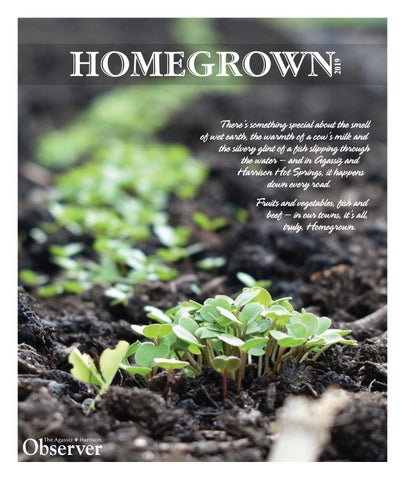
T here’s something special about the smell of wet earth, the warmth of a cow’s milk and the silvery glint of a fish slipping through the water — and in Agassiz and Harrison Hot Springs, it happens down every road. Fruits and vegetables, fish and beef — in our towns, it’s all, truly, Homegrown.
A10 Thursday, April 25, 2019
Agassiz-Harrison Observer
www.agassizharrisonobserver.com
Teaching from the earth Grace Kennedy
Earthwise farm has a five to eight acres of hazelnut trees on its property. Most have succumbed to blight, although Earthwise is hoping to bring them back. (GRACE KENNEDY/THE OBSERVER)
Of the 58 acres of land at the Earthwise Farm down Golf Road, only one is used for farming. But every inch is used for teaching, from the mountain face to the cedar grove to the moist wetlands to the rows of organic blueberry bushes. “We are kind of showing new ways of looking at land use … in relation to farms,” said Patricia Fleming, executive director of the non-profit farm. “We want to show by what we have here that it is possible to have this compatibility between the ecology and the agricultural productivity.” Earthwise, a non-profit based in Delta, has only been farming its land in Agassiz for the last four years. Originally donated from the John Westaway Society, a now-defunct organization that used the land as a religious retreat, Earthwise is now cultivating organic produce and rehabilitating natural habitats on the property. Surrounded by the mountainside, natural woodland and stream is the site’s one-acre farm, which includes a small plot of vegetables and fruits, a hoop house primarily used to grow heirloom tomatoes and a garden of blueberry and raspberry bushes. This organic farm is managed by Monique Olsen, the caretaker who lives on site. During the growing season, Earthwise also employs young workers to teach them about organic farming. “As a teaching farm, we do want to encourage young people to go into farming with an
organic model,” Fleming said. “But it’s also a teaching farm that’s focused on kids.” In the fall of 2018, Earthwise piloted its first “outdoor school,” an opportunity for kids between the ages of six and 10 to learn about the environment in a natural setting. This spring, Earthwise will be hosting a similar school, taking place over 10 weeks from April 22 to June 24. “People really understand these days how important it is for our young people to connect with nature and feel part of nature,” Fleming said. “The outdoor learning experiences allow kids to learn by discovery,” she added. “It’s not like they’re having to memorize something, but they’re understanding and discovering by being outside … and just getting curious about what’s going on out there.” Organized by Olsen, the school will give students a chance to explore the property each week: observing native plants along the Miami River, discovering the importance of ecosystem diversity, learning about the composition of healthy soil and figuring out how to harvest from nature. The first fall school saw eight kids come to the farm, and Fleming said she hoped more would come to the spring school. “We really think that education is a key to helping us have a more sustainable planet in the future,” she said. “We’re just trying to help kids, when they’re really young, understand the connections between themselves and the natural world.”
Circle Farm Tour
Agassiz + Harrison Mills • Celebrating the Past and Present A celebration of past and present, this tour is a rich mix of wonderful things to see, do, smell, and taste! See cows roaming the fields, watch artisan cheese and hand crafted pottery in the making. Take a self-guided tour of a 1920’s living history historic site, explore a garden and shop for antiques, home & garden décor. Smell fresh coffee being roasted and taste homemade dishes with locally sourced products, heirloom tomatoes, garlic, corn, cheese, raspberries, blueberries, and fresh veggies. Pick up artisan salmon products from locally caught Harrison River Salmon.
Proudly Sponsored by Tourism Harrison
Agassiz-Harrison Observer
www.agassizharrisonobserver.com
Thursday, April 25, 2019 A11
DAIRY
I
n the District of Kent, Harrison Hot Springs and the surrounding areas, no farms are more numerous than dairy farms. In 2016, there was a total of 30 dairy farms in the area, making up a quarter of all the kinds of farms for that year. Dairy farms are not all black and white. Although the monochromatic Holstein cows are among the most popular (93 per cent of all Canadian dairy cows are Holsteins), not every herd is the same. Some farmers prefer Gurnsey or Jersey cows, both coming from the Channel Islands between England and France. Still others choose Brown Swiss, Ayrshire, Milking Shorthorn or Canadienne cows.
Farming family traditions Grace Kennedy
Everywhere you look on Julaine and Johannes Treur’s property, you sense roots. Roots beneath the grass that carpets the pasture beyond the 100-cow dairy barns. Roots anchoring the neighbouring mountain to the earth. And family roots as well, keeping the Treurs’ Creekside Dairy attached to a heritage of dairy farming that goes back to the mid-1800s. “To say it easily, it’s in your blood,” Johannes said, sitting at the dining room table in his Agassiz farm home. For five generations, the men of the Treur family had been dairy farmers, from Johannes’ great-great-great grandfather milking 30 cows in Holland and selling the cheese he made by hand to Johannes and his brother, teaming up with a dairy farm in Rosedale. “It’s a good way to step into the industry,” Julaine explained. “Then when we were established we were able to go our separate ways.” In 2011, Johannes and his family moved to a property on Agassiz’s Maria Slough and set up their 55-cow organic dairy operation there. Originally, Julaine said, the farm wasn’t officially organic. Although they followed many organic practices, like making sure the cows spent about half a year on pasture, they weren’t certified. “Honestly, things were pretty tight financially,” she said about the transition to their own farm in Agassiz. “We were looking at different ways to increase our income … and (our organic feed salesman) told us to look into getting certified and getting paid extra for it.” According to the Treurs, going organic isn’t a get-rich-quick scheme. Although you earn some more money
for your milk, there is a cost to being certified and the cows don’t produce quite as much milk. But, because organic product was in such high demand, farmers getting certified also got an increase in quota, which is what really made the move attractive for the Treurs. “And once we started farming organically, then we realized the benefits of it for the cows and for the land,” Julaine added. “So I don’t think we would go back.” Now, the Treurs are not only certified organic, but also SPCA certified, which is another way of saying certified humane. Their herd has doubled since they started, and they are now looking for new ways to grow their business. The most recent venture is also a return to their roots. Julaine grew up in Chilliwack, her family owning a small beef farm with eight or nine animals on six acres. At Creekside Dairy, the Treurs would raise a steer or two for their own use. But this spring, they slaughtered and sold their first two commercial beef cows. The two cows had calved once, but weren’t great milkers, Julaine said. The Treurs didn’t want to re-breed them, but also knew they wouldn’t get the price they wanted for an organic cow at auction. “We decided to look into … getting the slaughtering and cutting and wrapping done custom, and then taking them back to the farm and selling them here,” Julaine said. “I put it on Facebook that we were interested in doing that and it just exploded. I couldn’t believe it actually.” In two weekends, three-quarters of the meat was sold. The plan is to keep the beef sales
going, although as Julaine noted “we can’t just decide we want to get rid of all our milk cows either.” But the success of the sales and the connection to the customer has made the Treurs want to continue. “We’ve really noticed since we sold the meat that it is really rewarding,” Johannes said. “It feels really rewarding to see the customer and they actually tell you that they liked the meat.” The family is also looking at other ways to bring the customer closer to the farm. “We have a long-term plan,” Johannes said. “We’d also like to eventually go into processing our milk.” “And if we do that then we’d like to open a real farm store,” Julaine added. “Sell beef and milk, maybe some yogurt, butter.” The idea is still a vague one, as the Treurs had their first experimental batch of cheeses sitting on the kitchen counter during the interview. But it’s one that would help bring the next generation of Treurs into the dairy farming business. “That’s kind of what we’re thinking too, that this is something good to have also for the kids,” Johannes said, adding that it would help bring “extra work” to the farm for their five kids to do in the future. For now, the farm store is still an idea. But the rest of Creekside Dairy — the cows, the pasture, the beef cuts sitting in the barn freezer — is a solid reminder of the Treurs roots. “You grow up in it and you know what it all entails,” Johannes said about his heritage of dairy farming. “You know all the ins and outs of it.” Julaine nodded. “It’s really just part of who you are as a person.”
For farmers like the Treurs, sometimes a mix is best. The Treurs started with Holstein cows, but then interbred them with Brown Swiss, one of the oldest breeds in the world and one of the best for producing cheese. On average, a Canadian dairy farm has 85 cows in a herd. B.C.’s average is significantly higher than that, at 135 cows a herd. But local herds are even bigger: with 174 cows a herd on average, according to Statistics Canada. If that doesn’t sound like very much to you, then think of it this way: in the Kent, Harrison Hot Springs and the surrounding areas, there is about one dairy cow for each person. (If you calculate all the cattle in the area, including bulls, steers, beef cows and calves, it goes up to just under two per person.) Each of these dairy cows produces an average of 33 litres of milk a day, the equivalent of eight four-litre milk jugs plus a couple glasses.
CORN
T
here’s a reason Agassiz calls itself the “Corn Capital of the World,” and it lies in the seeds that farmers have planted in the fertile soil year after year. But it wasn’t always that way. In the early years of European settlement in the Agassiz-Harrison Valley, hops were actually the dominant crop. It wasn’t until the 1948 flood that farmers began to focus on dairy farming, and growing fields of corn to feed their hungry cows. Since then, local farmers have traditionally grown one of two types of corn: sweet corn for eating, freezing and canning; or forage corn for biofuels, pharmaceuticals, syrup and livestock. (Forage corn is one of the main crops fed to local dairy cows, with the whole plant being stored in airtight bales.) Agassiz has a long history of celebrating its corn producers. In 1949, the town held the first Corn Festival and since then has annually crowned a local farmer as the Corn King or Queen for their corn’s uniformity and maturity, as well as their field cleanliness and nitrogen use.
A12 Thursday, April 25, 2019
Agassiz-Harrison Observer
www.agassizharrisonobserver.com
Finding the fish next door Grace Kennedy
Golden Eagle Aquaculture site manager Alex Brooks holding up one of the fish the farm has raised for sale. (GRACE KENNEDY/THE OBSERVER)
Continued on Page A13
Homemade Soup Fresh Baking • Lunch Antiques • Gifts
$220 for 5-FRAM E NUCS
CHECK OUT OUR GREAT SELECTION OF HONEY BEE SUPPLIES!
31852 Marshall Pl, Abbotsford, BC V2T 5Z9
Bring this coupon in and get a 12oz. house coffee and freshly baked muffin for
3
$
95
✃
HONEY BEE 5-FRAME NUCS WITH Q QUEEN!
COFFEE AND MUFFIN DEAL
✃
NOW TAKING ORDERS FOR
Honey Bees will be ready for pick up May 18th
Inside the dimly lit tent on Golden Eagle Aquaculture’s Wilson Road farm, Celine Cook tends to her fish. She has been raising the Coho salmon since they came to the farm in November as little five-gram fry. Her main duties are low-maintenance -- monitoring the oxygen in their freshwater tanks, removing the dead salmon to send to local mink farms -- and the fish pretty much raise themselves. “Everything’s pretty self-sufficient here,” Cook said, looking around at the tanks outfitted with timed feeders and recirculating water systems. “You don’t need that many manual workers.” At Golden Eagle Aquaculture, there are a total of three employees on site: Cook, fellow farm technician Patrick Smith and site manager Alex Brooks. All are relative newcomers to the aquaculture industry, but then again, so is land-based salmon farming. Currently, Golden Eagle is one of only 20 fresh water farms in B.C. that take salmon from tiny fry to two-kilogram adults. Of those farms, eight are located in the Lower Mainland. “The appetite to make land-based salmon farming work is not for the timid,” Don Read said. Read is the president of Willowfield
Enterprises, the company responsible for marketing and selling the salmon produced by Cook, Smith and Brooks at the farm. Golden Eagle, owned by Vancouver’s Aquilini Group, has been operating out of its Agassiz home since 2014 when they took over from Swift Aquaculture, which Read described as a “hobby farm.” “It was basically one guy who had some neat ideas trying to do his thing,” Read said about the company. “What (Golden Eagle) is trying to become … is a factor in the supply of commercial and industrial salmon.” That’s no easy task for the company, which is currently competing against the allure of wild-caught Coho and the productivity of marine-farmed Atlantic salmon. To make it all happen, Golden Eagle needs a shipment of 50,000 five-gram fry. Cook raises these fry under the cover of the tent, feeding them a commercial mixture of fish and insect meal until they reach 200 grams. Once they are large enough, the fish are moved into Golden Eagle’s outdoor tanks, dug seven feet deep into the ground. Outside in early April, Coho that are nearly a year old swim in the tanks,
Come see us at 1824 #9 Hwy., Agassiz, BC or call at (604) 491-5958
Save the date! 115th Agassiz Fall Fair and 71st Corn Festival September 13th & 14th, 2019
Year of the Dog
(Take Clearbrook Road Exit off Highway 1)
604-796-3246
Call 604-556-7477 to secure your bees
www.agassizfallfair.com
Agassiz-Harrison Observer
www.agassizharrisonobserver.com
Thursday, April 25, 2019 A13
STRAWBERRY
A
lthough local farms might be best known for their dairy and corn, Agassiz also has a special place in the history of the commercial stawberry industry.
In late ’60s and early ’70s, strawberries were succumbing to red stele, a disease that causes plant roots to rot from the root tip to the crown, and commercial strawberry farmers needed a solution. Hugh Daubeny, a plant breeder at the Agassiz Research and Development Centre, found it. He developed the Totem strawberry, a variety that was resistant to the virulant disease. From Page A12 agitating the water with their tails when the automated feeder spits out pellets of food. By September, these fish will be a hefty two-kilograms and ready for harvest. Throughout the process, the farm technicians are looking for issues with water quality, oxygen levels. But there are other things the technicians need to keep an eye on as well. Bald eagles hang around on trees just outside the farm, looking for an opportunity to snag a growing salmon. Herons are also popular visitors, and once Smith said he saw a baby black bear ambling along the edge of the property. “Every day it’s all interesting,”
Smith said. “We’re always learning something new.” Right now, the biggest challenge for Golden Eagle is the public’s opinion around farmed salmon. “One of the problems we have is that it’s still farmed fish,” Read explained, standing in front of the recirculating water system near the six outdoor salmon tanks. “When people hear the word farm, the f-word, they won’t buy it and they won’t support it.” Right now, Read said, about 80 per cent of Golden Eagle’s salmon is shipped to the prairies: Alberta, Saskatchewan and Manitoba. Getting the salmon into other markets requires convincing customers one
at a time. But, according to the farm technicians on site, there’s still hope that customers will come on board. “It’s the way of the future,” Smith said about the company. “We’re getting more and more people, and the oceans are slowing down. And when we can do this on a small little piece like this —” “It’s super sustainable,” Cook finished for him. Smith nodded. “As long as we open up and let people know it’s not a bad thing” the business may grow, he added. It’s “the same as raising chickens or pigs or something. “We’re just using water instead of dirt.”
Within five years, the Totem strawberry became the the dominant strawberry for commercial growers, and was produced by farmers around the world. Recently, the variety was all-but retired as it is no longer resistant to the new strains of red stele. (Some of Daubeny’s plants are still grown by farmers to this day, although not on the same scale.) Although Daubeny’s strawberry is perhaps the most popular Agassiz-developed strawberry, it’s not the only variety to come out of the Agassiz Research and Development Centre. Jack Freeman, another plant breeder at the Centre, also developed a commercial strawberry variety: the Agassiz strawberry. It never took off in the same way as the Daubeny’s berry. For a long time the strawberry was grown at Freeman’s home, but wasn’t maintained after he left the house. It’s not clear if any Agassiz strawberries still exist.
Here’s to
WEARING OUT YOUR WORK GLOVES We’re proud to finance the people, the dreams, and the future of Canadian agriculture. Here’s to Canadian agriculture. Here’s to you. fcc.ca
BIG BIG SALE $10 off all wine kits*
JOIN US FOR A GREAT WINE MAKING EXPERIENCE! CRAFT YOUR UNIQUE WINES WITH THE EXPERTS!
It's Fast, Fun & Affordable. Serving wine lovers in Agassiz, Harrison Hot Springs & Surrounding areas. Craft your favourite award winning wines at a fraction of Liquor Store Prices *Conditions Apply, Cannot Be Combined With Any Other Offer
Make wines for every occasion: Weddings, Parties, Events, BBQ & More
SATISFACTION GUARANTEED!
NOW OPEN: Tuesday, Wednesday, Friday 10am-3pm Thursday and Saturday by appointment only
Please note that bottling is available at other times with prior arrangements
Call now! 604-796-8496 Or visit 1-7384 Pioneer Avenue Agassiz
A14 Thursday, April 25, 2019
Agassiz-Harrison Observer
www.agassizharrisonobserver.com
An abundance of community Grace Kennedy
Amir Niroumand (left) and Melanie Buffel (right) at Abundance Farm in Agassiz. (GRACE KENNEDY/THE OBSERVER)
When Amir Niroumand bought his Agassiz farm three years ago, he was looking for a different life. The fuel cell scientist had grown up with memories of his grandparent’s hobby farm in Iran, and in 2013 had grown tired of the city’s endless bustle. He decided it was time to find a farm of his own, and after three years of searching ended up at a 40-acre dairy farm on Hamilton Road. “When I stopped here, I was like woah. This is so beautiful,� Niroumand said. “Once you turn in the valley, the energy shifts.� He bought the land, and set about creating Abundance Farm, a sanctuary where he, and others like him, could come to rest, rejuvenate and grow. “I trusted that if I started this, people would come,� he said. Although, he added, laughing, “I had no idea who would come.� The answer was many people, largely from Vancouver’s artist community, but also from Chilliwack and the surrounding area. Four people came to live on the property as caretakers, watching over the land Niroumand comes to visit on Fridays, Saturdays and Sundays. The rest are weekend workers, coming out to Agassiz to farm, laugh and play. “People want to know more about food,� Melanie Buffel, one of the four people who live full-time on the farm, said. “The first year we did it, none of us really were farmers.� But, she added, “that was a really good year, given that we didn’t know what we were doing.� That was the year the farm produced what Buffel called “dinosaur vegetables,� after using cow manure
from the old dairy barn to fertilize the field. “We had chard leaves that would cover your body,� she said. “It was incredible.� The following two years brought the yields down to more typical numbers, but the interest in the farm kept growing. This season, about 40 families have signed up to participate in the farm. Groups of workers are organized into cells, with each family coming to the Agassiz farm once a month and bringing back boxes of produce for those who stayed behind. “That’s kind of the idea, for city dwellers to grow our own food,� Niroumand said. But it’s also a chance to establish community in nature. “For me, that’s a higher priority than the garden,� he said. “It’s more of an excuse to get together.� In addition to the garden, the farm also has a sweat lodge, a stage, a barn loft draped in colourful fabric for impromptu concerts, a fire pit and a trampoline. “It’s got to be light,� Niroumand said. “They’ve got to come for the joy and for the kids.� “They want to come and bounce on the trampoline,� Buffel added, “and not spend the whole day weeding.� The farm does have plans to expand on its property. A “food forest� is growing off to the side of the garden, and a new on-site caretaker is working to make sure Abundance will have its own supply of seeds. But each change happens a bit at a time, keeping the relaxed atmosphere that makes Abundance so desirable to people from the city. “Whatever we add, we’ve got to be mindful about it,� Niroumand said. “We need to have that worklife balance, and at least practice it on the weekend. “Have a productive weekend, but it’s also joyful.�
Local McHale Dealer: Matsqui Ag-Repair Ltd. 34856 Harris Rd, Abbtosford BC 604-826-3281 www.matsquiagrepair.com
 �