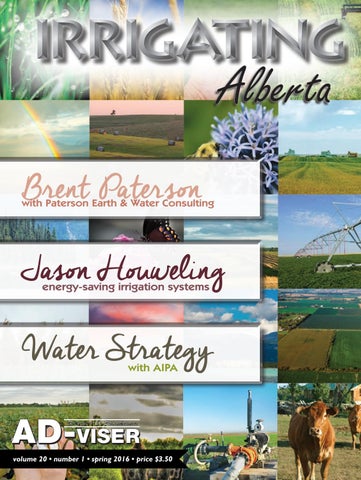
Alberta Brent Paterson
with Paterson Earth & Water Consulting
Jason Houweling energy-saving irrigation systems
Water Strategy with AIPA
volume 20 • number 1 • spring 2016 • price $3.50
IRRIGATING ALBERTA - SPRING 2016 • 1
IRRIGATING ALBERTA - SPRING 2016 • 2
volume 20 • number 1
SPRING 2016
03 ................................................. Table Of Contents 04 ..........................................................
Ric’s Corner
06 .......................................................... 08 ......................................................
10
A..I.P.A
Brent Paterson
7
10 ............................................................... Jay R. Lund 11 ..................................................................Dave Hill 12 ..........................................
13
Gosselin Rural Impact
13.................................................................... 16 - 17 ....................................
Dale Miller
Farm Safety Course
18 .................................................. Jason Houweling 19 .............................................................. Bob Riewe 20 ...........................................Roger Hohm Retires
11 22 ...................................................... Pulse Outlook 22 .................... Southern Irrigation Drip System 23 ........................................................... Lloyd Healy 24 - 27...................... Irrigation Water Managemnet
24-27 HEAD OFFICE 1320 - 36TH STREET NORTH LETHBRIDGE, AB T1H 5H8 TOLL FREE: 1-877-328-0048 PHONE: 403-328-5114 EMAIL: adsales@farmpressltd.com Reproduction or use of editorial content in any manner without written permission is strictly prohibited.
view online at www.farmpressltd.com
12 Thank you for supporting our advertisers. Without them, this publication would not be possible. Irrigating Alberta is proudly produced in Southern Alberta and distributed inside the Farmer/Stockman AD-Viser
PUBLISHER: Jeff Sarich DESIGN & PRODUCTION: Whitney Olitch EDITOR: Ric Swihart ADVERTISING CONSULTANTS: Al Such & Mel McDonald ADVERTISING CO-ORDINATOR: Kathy Overes IRRIGATING ALBERTA - SPRING 2016 • 3
L
RIC’S corner
ots of manure and lots of irrigation is part of farming in southern Alberta, especially in the livestock-feeding sector.
Figures don’t lie. Water quality monitoring done 1999 to 2006 showed the amount of phosphorus getting into the water system increased.
Nutrient budgets, on a single field or watershed scale, are a relatively new science. If imports of nutrients are more than crops use, producers run the risk of increased amounts of nutrients entering the water system.
Nutrient management becomes a vital producer responsibility. It sounds complex, but ultimately, producers simply must adopt a nutrient budget – match application of nutrients like manure to crop needs.
Eutrophication, the natural process of lake aging, can be accelerated by human activity. It is a growing global concern accelerated by the introduction of increased amounts of nutrients into the water system.
Balancing commercial fertilizers is also important. At the irrigation demonstration farm at the Lethbridge Research Center nitrogen, phosphorus and a combination of both has been studied. Three fresh cattle manure experiments have been done annually. For the phosphorus test, extra nitrogen was applied. Manure was collected from local feedlots, and then tested for nutrient levels before application. Triticale and barley were test crops. Some fertilizer recommendations evolved. For fertilizer urea, both pre-seed and spring seeded, the study showed that organic forms were used but they have to go through mineralization process for the plant to use it. The nutrients not mineralizated this year will be available in future years. That fact makes it difficult to recommend application rates. Manure applications showed 25 per cent of nitrogen was available first year, but only 13 per cent if composted manure was used. All test data showed the percentage of available nitrogen was lower with compost through the test. Soil tests showed problems were possible when more phosphorus was applied than the amount needed by the crops. The big problem is that most of the surplus phosphorus accumulates in the upper levels of the soil. That increases the risk of water contamination, perhaps even with the phosphorus in the top few centimeters of the soil. That is when runoff water can capture phosphorus and carry it into the water system. So manure management is a vital part of crop production and protection of the ground water system. Through carelessness or ignorance, or both, the valuable part of manure can be allowed to drain away, finding it easy to reach creeks or rivers. It can also endanger the health of the household or stock if it gets into the water well. Some feel manure management issues have been around for a long time. In fact, one industry spokesman suggests that a century later the industry is still grappling with these issues. Southern Alberta farmers are among the more advanced and educated in the world. Science knows how to protect the environment. There is no doubt farmers are on the same page.
IRRIGATING ALBERTA - SPRING 2016 • 4
“Our Service is Electrifying”
Van Rijn
Electric Ltd.
“We Specialize - Electrical for Irrigation”
commercial • industrial • farm • residential • Maintenance • Instrumentation • Power Factor Correction • Constant Pressure Control Systems
• ULC Certified Shop • Vegetable Storage Buildings • Ground Fault Detection In Underground Power Systems
coaldale Lethbridge (403) 345-5820 (403) 320-5093 Toll free: 1-888-345-5820 fax: 403-345-5821 1431 13th St., Coaldale • Mailing Address: PO Box 819, Coaldale, AB T1M 1M7 www.vanrijnelectric.com IRRIGATING ALBERTA - SPRING 2016 • 5
I
AIPA
On Water Strategy
ndustry and government are winning the march for the Water for Life Strategy, says the executive director of the Alberta Irrigation Projects Association.
Ron McMullin told the 2015 AIPA water conference all facets of industry are working to attain the strategy goals – safe, secure drinking water, healthy aquatic ecosystems and a reliable, quality water supply for a sustainable economy. McMullin said knowledge and research, partnerships and water conservation remain the tools used to meet the strategy goals. The strategy is faced with one challenge – the amount of water available and the demands for water. Water is needed for current and future economic growth, for growing populations and for healthy rivers and lakes. This uncertainty and variability in water supplies and more demand for water than is available. “The solution is water conservation.” Irrigation is the major water user in Alberta, and water losses can occur from evaporation as the water is applied to the land; wind can move water beyond the target area; evaporation can take place to free water on crop leaves and the ground; deep percolation beyond the plant root zone, and; surface runoff from the field. Water losses are also logged in the water distribution system McMullin said irrigation districts continue to work hard to improve water use efficiencies. All have worked to line earth canals to reduce seepage, many laterals and canals have been replaced with pipelines to avoid seepage, evaporation and water use by other plants, and; all are using automated flow monitoring and control systems. They also set water-use limits for farm deliveries and require notice for turning water on and off. He always gives credit to Alberta Agriculture and Forestry for working to improve water use efficiencies. Alberta provides 75 per cent of irrigation rehabilitation funding which had a budget of $19 million in 2015. It also supports the Growing Forward 2 program to encourage farm water efficiency. It does research into optimum crop water use and hosts water measurement workshops. The strategy is working, said McMullin.
IRRIGATING ALBERTA - SPRING 2016 • 6
Since 2005, more water efficient irrigation systems have been installed on 327,897 acres; 1,272 kilometres of pipelines were installed, bringing the total to 3,913 kilometres; canal lining was done on 93 kilometres for a total of 839 kilometres, and; there was a switch from 67,500 hectares of forages to primarily oilseeds and wheat; multiple automated monitoring and remote flow systems have been installed. All that work has costs attached. In that 10-year period, farmers have spent about $243 million on centre pivot sprinklers to become more efficient and reduce water diversions, and; government through its cost-sharing program has contributed $243 million while irrigation districts have contributed $78.3 million. The grant total has been $811,125,000.
The irrigation industry is a major partner in meeting strategy goals, said McMullin. Efficiencies allow the irrigation industry to lower water diversions, leaving more in the river systems; functional flow work has resulted in millions of seedlings establishing in riparian areas, and; watercraft inspections have intercepted boats with mussel to prevent infestation in Alberta lakes to avoid a dramatic ecological change. McMullin said the irrigation industry is contributing to strategy goals. “Members of AIPA have made a formal declaration committing to supply water to communities before supplying water for irrigating crops during a drought. And more water is available for communities through irrigation districts. About 30 communities, many rural water coops, and thousands of rural families get their water from the irrigation system.
IRRIGATING ALBERTA - SPRING 2016 • 7
Brent Paterson
E
with Paterson Earth and Water Consulting
very cubic metre of water delivered for irrigation creates $3 to the province's GDP and $2 in labour income.
This is one of the key conclusions in a study by former Lethbridgebased Alberta Agriculture irrigation branch executive Brent Paterson. The study was funded by the Canada-Alberta Growing Forward 2 program and commissioned by the Alberta Irrigation Projects Association. The study also shows that for every dollar of irrigation related crop, livestock and food processing sales, total GDP increased by $2.54 and labour income increased by $1.64. Overall irrigation contributes $3.6 billion each year to the province's GDP, averaging $2,550 per acre of land irrigated. The governments of Alberta and Canada are the beneficiaries of $1.3 billion in income annually from irrigation-based economic activity. "We have known that irrigation is the lifeblood of many communities in southern Alberta but we wanted to be able to quantify our overall economic impact in Alberta" explained AIPA Chair Erwin Braun. "A robust irrigation system plays an important role in the economic, environmental and social fabric of Alberta's agriculture industry. Our government will continue to support, build and maintain an efficient and sustainable irrigation system to ensure our producers are able to grow and diversify the industry while keeping thousands of Albertans employed," said Oneil Carlier, Alberta Minister of Agriculture and Forestry. Other key conclusions in the study undertaken by Paterson Earth and Water Consulting from Lethbridge include: •T he irrigation agri-food sector contributes about 20 per cent of the total provincial agri-food sector GDP on 4.7 per cent of the province's cultivated land base. •A lmost 90 per cent of the GDP generated by irrigation accrues to the region and the province and 10 per cent to irrigation producers. •U sing labour income as the criteria, 89 per cent of the irrigationrelated benefits accrue to the region and province, and 11 per cent to irrigation producers. •B ecause of the growth of irrigation in southern Alberta, irrigated crop and livestock production has resulted in 38,000 jobs and food processing has created in another 17,000 full time equivalent positions. •B enefits from irrigation water and infrastructure used for non-irrigation purposes, such as recreation, hydropower generation, and drought mitigation, generated an additional $85 million to the provincial GDP and $71 million in labour income. "We also wanted to know the industry's economic challenges for the future," said Braun. "And what the study shows is that there is a clear need for governments to work with industry to plan for potential impacts of climate change on agriculture, both positive and negative." The study calls for long term water and drought management strategies, including increasing Alberta's water storage capacity and better communication with international markets about the environmental and economic sustainability of Alberta's irrigation agri-food production, and new food production opportunities to meet growing world-wide demand.
IRRIGATING ALBERTA - SPRING 2016 • 8
Sizes: 15’, 20’, 28’ and 30’
• Increase organic matter in your soil • Proven ability to mulch and breakdown trash residue, increasing microbial activity • 560 mm discs are standard • Crumbler roller (as pictured) are supplied standard
• Sharks tooth, pipe & coil packer rollers are available • Models from 2.25m to 13m, 3PL Models (2.25 - 6m), trailing models (4.5 - 8.5m)
ONE-Till
• Pull at 8-10 MPH • 25’ or 32’ Length • Works at depth 1” - 4” Medicine Hat 3377 Gershaw Dr. SW
(403) 526-4426 • 1-855-535-2636
• 1 row of coil packers • 2 rows of concave discs with 5” spacing & independent torsion
www.flaman.com
lethbridge (County of Lethbridge) 16 Broxburn Blvd. - 5 km East of Lethbridge on Hwy. 3 (403) 317-7200 • 1-888-883-8081 IRRIGATING ALBERTA - SPRING 2016 • 9
JAY R. LUND W
ater woes are common in many regions, says a California specialist.
Jay R. Lund, director for watershed sciences at the University of California, Davis, said water problems continue to change, but there is reason for hope. He ponders if human water use has peaked, a question buffered by an economy he says depends less on water abundance. “Water markets a shift use and civilize change. But we agree we have a problem.” Lund says there is action on local levels. The work includes conservation and use efficiency, waste water reuse, desalinization, groundwater use and recharge, surface reservoir operations, and water markets and exchanges. On the statewide scene, inter-regional water conveyance and surface reservoir operations are discussed. It boils down to integrating a mix of actions, like portfolio planning. Still drought is a major issue in California. It is a chance to test water systems. Those water systems and the societies they serve are always changing and droughts point to the need for change. “This drought is helping California improve water management,” he said. “Every generation needs at least a threatening drought and a threatening flood.” The 2014 California drought has been measured. It reduced surface water supplies by 6.6 million acre feet (the Oldman River Dam stores 400,000 acre feet of water); groundwater pumping increased five
million acre feet. That left California with a net water shortage of 1.6 million acre feet. On the economic front , California crop revenue loss was $810 million, additional irrigation pumping cost $454 million, livestock and dairy producers lost $203 million, for a total loss of $1.5 billion. In that same time, California lost 17,700 jobs. Lund said the water crisis has pointed to change. The wish list includes more permanent and high-value crops, more environmental flows, tighter groundwater management, more wet-year water recharge and more reliable wells and drought supplies. Nitrate ground water contamination in inevitable and some land will be lost to salinization and delta flooding. It could mean longer fallowing rotations and some permanent fallowing. Lund said resistance to change is futile. “We cannot drought-proof, but we can manage better,” he said.
“water systems and the societies they serve are always changing and droughts point to the need for change.” Taber Irrigation District
TID is the centre of Specialty Crop specialty crop production and value added Country processing in Alberta including sugar beets, (Established in 1915) hay, potatoes, corn Taber is the centre of specialty crop production and value added andpotatoes, many other processing in Alberta including sugar beets, hay, corn vegetable crops. and many other vegetable crops.
TID
4420 - 44 Street, Taber, Alberta T1G 2J6 Telephone: (403) 223-2148 • Fax: (403) 223-2924 Email: tid@telusplanet.net Email: tid@taberirrigationdistrict.ca Visit Our Website: www.taberirrigationdistrict.ca TABER IRRIGATION DISTRICT Serving over83,000 82,000acres acresand and 750 750 water area Serving over waterusers usersininthe theTaber Taber area
IRRIGATING ALBERTA - SPPRING 2016• •10 10 SPRING 2016
DAVE HILL D
ave Hill of Lethbridge has roots deep in the giant agriculture and irrigation industry in Alberta, and now he has added the world of universities to his growing portfolio.
So when Hill argues for the value of agriculture and irrigation, it is a good learning experience. He told the recent Alberta Irrigation Projects Association annual water conference Alberta has all the elements of agriculture that are globally relevant – advanced irrigation systems and production with almost 70 per cent of Canadian irrigation in southern Alberta; a productive livestock sector; extensive grains and oilseeds sector; emerging fibers sector, abundant low-cost energy supplies, expanding value-added agribusiness sector, and; extensive transportation network. “Southern Alberta’s history is rooted in agriculture and a pioneering ethic remains,” he said. “(It) is successfully addressing issues such as global food and nutrition that requires a transformation in the approach to agriculture, agribusiness and sustainability. Southern Alberta is uniquely positioned to lead and have an impact in meeting this challenge by capitalizing on and building on its research, education and training strengths in collaboration with community, business and government.” Hill cautioned that work to meet global needs for food and nutrition will require a concerted and intentional effort in many areas. They include developing improved yields and quality; developing new crops and crop varieties; developing adaptive approaches to changes in disease and pest control and surveillance in field and horticulture crops, and; animal science that enables improved nutrition and promotes animal health and welfare with traceability that will ensure that Alberta’s production will be positioned as a preferred global supplier of meat protein.
“Food safety will be a key driver of consumer demand and supply chain success,” said Hill. He said demands for improved environmental performance in food and nutrition are being driven globally by consumer demand and increasing production requirements from food processors. “Performance (at all levels) is key to securing new markets.” Hill said an integrated-system approach to natural resource management, especially for land and water, would be needed to support sustainability. Hill said industry is already engaging to help meet goals. He pointed to Cor Van Raay of Picture Butte who donated $5 million to create a Centre for Agribusiness Innovation. The U of L and Lethbridge College shared that money. It provides $1 million for endowed students and $2 million for academic programming, shared equally by the two institutions. And the U of L got $1 million for entrepreneurship and innovation programming while LC got $1 million for its entrepreneur in residence program. “And funding has been matched.” He said there are other activities underway. The Potato Growers of Alberta, McCain Foods, Conagra, Lamb Weston and Cavendish Farms funded a research chair with $1 million. The work is to focus on immediate and long-term needs of the potato industry, designed to add capacity to research expertise in Alberta. A new chair in potato research has been created. And that contribution has also been matched.
IRRIGATING ALBERTA - SPRING 2016 • 11
GOSSELpIaNct
Rural Im
Rural Alberta contributes almost
$12 billion to the rest of Canada.
S
o you think rural southern Alberta isn’t important? Think again.
Colin Gosslin, of Edmonton, senior project cocoordinator for Alberta Agriculture and Forestry, says rural Alberta leaves a big gross domestic product footprint. “Rural Alberta’s total economic contribution is estimated at $77.4 billion in 2009 dollars,” Gosselin told the Alberta Irrigation Projects Association annual water conference at the Lethbridge Lodge Hotel. “This includes rural Alberta’s GDP as well as indirect and induced economic impacts on the rest of Alberta and Canada.” An indirect benefit would be rural firms sourcing additional supplies and services from urban suppliers. Induced benefit would be employees and owners spending salaries or earnings.
IRRIGATING ALBERTA - SPRING 2016 • 12
Rural Alberta contributes almost $12 billion to the rest of Canada. Gosselin said rural Alberta is a major job maker. It contributed to 272,000 jobs in urban Alberta and another 144,000 jobs in the rest of Canada. He pointed to Lethbridge County as a local example of rural economic impact. In 2011, the county had an estimated GDP of $312.5 million in 2002 dollars. The economic structure that led the way was 61 per cent goods-producing industries and 39 per cent services. Agriculture leads the way for the county, accounting for 37 per cent of activity. Manufacturing is second at 14 per cent and construction at 10 per cent. Services also contributed, led by public administration at 13 per cent, wholesale trade at nine per cent and warehousing at seven per cent.
DALE MILLER T
here is room for another river dam and reservoir in southern Alberta, says a Lethbridge engineering consultant. “Based on current legal arrangements and operational policies, and projected year 2030 demands, simply put, there is inadequate surplus water available in the Oldman River sub-basin, that when comparing the benefits to the cost would justify the development of additional storage,” said Dale Miller, with AMEC Earth and Environmental. Miller outlined the water runoff characteristics of the four sub-basins in the South Saskatchewan River Basin, which are markedly different. Those river basins include the Oldman and Bow Rivers in southern Alberta and Red Deer and South Saskatchewan rivers in central Alberta. The Red Deer and Oldman sub-basins have relatively low unit yields compared with the Bow and Oldman due to lower precipitation and poorly defined drainage patterns. The Oldman and Red Deer are more highly variable that the flow in the Bow, making them more susceptible to periodic droughts. There is need for more water, Those needs include water allocations and demands for irrigation districts, private irrigation, and urban and municipal users; a distinction was made between mainstream and tributary demands to determine the impact of need. Irrigation remains the major water user, and is expected to account for a large percentage of any new water sources. Total net use would increase from about 1.98 million dam in 2009 to 3.03 million dam by 2030, largely due to irrigation withdrawals. Miller said water allocations and users in the South Saskatchewan basin are “unequivocally” dominated by irrigation, and will become more dominant with irrigation district expansion potential. Private irrigation withdrawals could more than double in the Red Deer sub-basin if existing license applications are approved and if committed project are implemented. Water-use applications are not available in the Oldman, Bow and South Saskatchewan River sub-basins. Sharing the use of hydro power reservoirs to meet in-stream and consumptive uses in the Bow basin has shown some promise. The Oldman sub-basin has commitments for substantial additional use on the Piikani and Kainai First Nations, and in the Oldman River
Reservoir area. ”Some of these commitments, in addition to future increases in irrigation and non-irrigation water use in the Oldman River sub-basin, may be difficult to fulfill without a means to make additional water available.” Miller points to the Oldman basin as the hot-spot area for a new water storage facility. That is where the magnitude and frequency of water deficits are more severe. And additional storage in the Oldman sub-basin is needed to meet commitments to the two First Nations and the Summerview district, and to reduce deficits to existing water users. There is some surplus water in the Oldman sub-basin, but modeling is needed to determine the effectiveness of any new storage.
IRRIGATING ALBERTA - SPRING 2016 • 13
RELIABLE IRRIGATION PERFORMAN
LIKE NO OTH
T-L IRRIGATION SYSTEMS ARE EASIER ON YOU.
STOP COPPER THEFT.
Experience maximum uptime and eliminate
Copper wire is being stolen from
the hassles of electric drive machines with
electrically powered pivot systems
the simplicity and reliability of T-L’s exclusive
at an alarming rate, sometimes
hydraulic design. Safety, high maintenance costs,
on multiple occasions. T-L’s
and unexpected downtime will no longer be
hydrostatically powered pivot systems
major concerns.
can be designed with no wire to steal, eliminating the problem entirely.
Contact T-L, your T-L dealer, or visit www.tlirr.com to learn more.
T-L ... LIKE NO OTHER. www.tlirr.com
TL-329F.indd 1
IRRIGATING ALBERTA - SPRING 2016 • 14
NCE…
THER.
RECOVER YOUR LOST PRODUCTION WITH T-L. Eliminate the “spoking” effect caused by the start-stop operation of electrically-powered pivot irrigation systems and get the benefits of T-L systems can provide.
T-L Center Pivot
Electric Center Pivot
Phone: 1-800-330-4264
Phone: (402) 462-4128
Hastings, Nebraska 68902-1047 USA
Fax: 1-800-330-4268
Fax: (402) 462-4617 TIF ER IE
ISO 9001
D
sales@tlirr.com · www.tlirr.com
C
151 East Hwy 6 & AB Road · P.O. Box 1047
Q
U A LI T
Y
even water distribution only hydraulically driven
1/30/15 2:32 PM
IRRIGATING ALBERTA - SPRING 2016 • 15
FARM SAFET “I
t’s the time of year when some farmers take a step back from their hectic physical farm work and make assessments for the future,” Lauda Lubeck, farm safety coordinator, Alberta Agriculture and Forestry (AF), says in a news release. “Farming is a demanding and frequently hazardous occupation. Keeping safety top of mind is important for all farm owners and workers to make it home safely each evening. Be pro-active and use this winter to ensure next season’s farm work is injury- and incident-free.”
Some courses you might consider taking: First Aid this is a must for any farm. It is advisable for all workers to have some sort of first aid training, whether it be first aid on the farm, emergency first aid, standard first aid or higher. There are a few options to access training. St. John’s Ambulance has a great program and they are available toll free at 1-800-665-7114.
Now is the time to plan for training during the winter months, she says.
“Winter is a great time to pull out your farm safety plan – or develop one if you haven’t already – and decide what kind of training program your family members and employees should take,” says Lubeck “This can be formal training such as mentioned, or simply going over the plan you have in place along with any farm workplace protocols.”
Equipment Operator’s Training
this is particularly important for new and young farm workers. Equipment such as skid steers, loaders, and tractors are powerful and have the potential to severely injure workers. Check online or look for courses in your area.
Chemical-Related Courses
Personal Protective Equipment (PPE) Training
farmers working with pesticides, ammonia & in the presence of sour gas will benefit from courses such as pesticide applicators, Workplace Hazardous Materials Information System (WHMIS) or H2S Alive. Check with your chemical supply dealer for pesticide applicator training in your area. WHMIS training can be accessed online, while H2S courses are available through safety companies who specialize in oilfield safety courses.
for those handling chemicals, respirator training will be beneficial. For anyone working from heights, a fall protection course is recommended.
IRRIGATING ALBERTA - SPRING 2016 • 16
TY COURSE In addition to training, take into consideration protocols for hazard assessment and control, record keeping, communications, and emergency situations.
For more information on the guide, or how to set up a Farm Safe Alberta workshop in your area, contact the department’s farm safety coordinator Laurel Aitken at 780-980-4230.
AF has recently developed Farm Safe Alberta – A Safety Planning Guide for Farms and Ranches. This is a tool that producers can use to create and implement a health and safety management system specific to their farming operation.
“Planning now for a safe and prosperous year ahead is a sound investment for the future,” says Lubeck. For more information on farm safety visit the Alberta Farm Safety Program website.
Livestock Safety
Machinery Maintenance
virtually any course involving livestock includes aspects of safety. For those using horses to tend cattle, perhaps a horsemanship or ranch hand course will help. Others to consider are stock man courses and horse/livestock hauling. Check with local agricultural societies, livestock clubs and organizations for upcoming clinics.
well cared for machinery and equipment means increased safety during use. Take a quick course in how to care for and properly maintain your equipment to decrease the risk of down-time due to machinery failure.
Fire Extinguisher Training
Safety Systems Training
there are many types of fire extinguishers, and they can be intimidating to operate. It is a good idea to take this training before you need it.
at the basic level, this type of training course will teach participants the value of a safety program and how to get started setting one up. There are many courses aimed at different industries; farmers should look for a generic course provided by a private consultant or a reputable post-secondary institution.
IRRIGATING ALBERTA - SPRING 2016 • 17
Jason Houweling C
IRRIGATION
OALDALE – Variable frequency drive (VFD) irrigation has a confirmed convert in Jason Houweling.
Other irrigators have been able to attract some assistance through Growing Forward after Houweling won the first approvals about six years ago for his energy-saving irrigation pumping system. Funding though the Irrigation Efficiency Program has been in high demand. The heart of the system is a centralized pumping site that generates water flow to three quarter sections of land. Controlled by a key computer panel, the site features three pumps with water flowing into a distribution network. He has three sprinkler systems – two center pivots with corner arms and a linear drive unit, which moves across the field covering all the surface area. He also operates two small wheel-move sprinklers for smaller parcels outside the main fields. Houweling for years had powered his irrigation system with natural gas, but it posed too many management problems in the busy irrigation system. He also runs a family feedlot. While electrical pumping energy costs more, it provided improved management opportunities. VFD irrigation simply expanded his management options. A major advantage is his ability to apply more precise amounts of water to specific areas of a field, a major factor in his passionate agricultural stewardship goals. The key is the pumping system designed to meet changing demands for irrigation across his farm. He decided to invest extra on the pumping front by buying 3 premium efficiency pumps, units which feature a 95 per cent efficiency rating. That also allows him to alter the main variable drive pump, the workhorse of the operation, spreading the workload and extending pump replacement time. When irrigation starts, the main pump kicks in first. As it attains capacity, a second, and ultimately, the third pump kicks in. Usually, as the second and third pumps kick in, the main drive pump can relax. When his corner arm extends to irrigate a slight hill in one corner of one field, the computer calls for the main pump, or the other pumps, to boost power.
IRRIGATING ALBERTA - SPRING 2016 • 18
The big difference is pumping costs. With a normal pumping system, the pumps run at full speed all the time. The variable rate system allows pumps to run just enough to meet sprinkler water demand. “It is safe to say that if we irrigated without VFD, with larger pumps always running at maximum, our energy costs would be one quarter to one third higher,” he said. “Now we are irrigating three quarters for about the cost of t w o quarters, and that benefit will increase as energy costs increase. And we are getting the optimum water application rate. We are getting more uniform water distribution. We are also getting big savings on labor. It is a real management tool.”
BOB RIEWE B
orn and raised in Alberta, Bob Riewe completed his under-graduate studies at the University of Alberta, with a major in Soil Science. He joined Alberta Agriculture’s Irrigation Division – Farm Irrigation Services Branch in 1980, working in Calgary. He moved to Strathmore as Irrigation Specialist. In 1985 Riewe moved to Lethbridge as Irrigation Soil and Water Specialist, working on various applied research projects related to on-farm irrigation management. In 2001, he changed job function after a reorganization of the Irrigation Division, and since has worked as an Irrigation Modeling Specialist. Riewe has been an active member of the Alberta Institute of Agrologists since 1982. Married and with two grown kids, Reiwe enjoys curling and restoring older vehicles.
IRRIGATING ALBERTA - SPRING 2016 • 19
A
Roger Hohm Retires
senior Alberta Agriculture and Forestry irrigation specialist has retired after nearly 36 years of service to the industry.
Roger Hohm, Irrigation Secretariat and head of the department’s Water Basin Management section, has traded in his water industry hat in favor of many bucketlist activities. Lakes and streams, rolling deer country and a myriad of golf courses will be frequent stopping places. In an interview in his Provincial Building office following the Irrigated Crop Production Update 2016 conference, Holm reflected on an industry that has seen massive change in all facets. When he started, irrigation districts could buy concretewrapped pipe up to 21 inches in diameter. Plastic took over, and today an Edmonton firm makes plastic pipe up to five feet in diameter. “Today, that pipe can be used to bury little farm ditches to major district canals, and in some instances, some farmers can eliminate irrigation pumps because of gravity flow.” On the farm side, Hohm says the massive move at farmer expense to low-pressure center pivot or linear pivot sprinklers has been the major advance. It has allowed farmers to irrigate more land with less water and do it with less energy. Hohm said information had never been readily available. Not many years ago, much of the education exchange came at the local coffee shops. “Now, information is available world-wide. That knowledge is vital considering the exploding cost of irrigated land and the equipment needed to farm it. Some land in the Coaldale area is listed for up to $12,000 an acre. Since 1935, the EID has been supporting:
Hohm and his wife, who recently retired from Alberta Treasury Branch, have four children in a blended family. Supporting growing grandchildren was one of the factors the 58-year-old Hohm used to seek retirement early. Travel will become more important, including a visit to Alaska and the West Coast Trail. He also wants to revisit China following a work-assignment trip a few years ago.
Agriculture Municipalities Industry Recreation Wildlife through sustainable and integrated management of water and land resources.
“Where Water Works Wonders”
Eastern Irrigation District Phone: (403) 362-1400 | Fax: (403) 362-6206 | Email: eid@eid.ca | www.eid.ca P.O. Box 128 | 550 Industrial Road West | Brooks, Alberta | Canada T1R 1B2
IRRIGATING ALBERTA - SPRING 2016 • 20
QUALITY THAT ONLY THE LEADER CAN PROVIDE. At Valley® we demand more of our equipment and ourselves. Our pivots are precision engineered to last longer. Our advanced technology saves you time and money in the field. And our dealer support has never - and will never - be equaled. Find out what only #1 can do for you.
www.valleyirrigation.com
Oliver Irrigation
Taber • (403) 223-1170 Lethbridge • (403) 328-9999
Academy Services Brooks • (403) 362-5133
C & H Irrigation
Medicine Hat • (403) 526-3294
IRRIGATING ALBERTA - SPRING 2016 • 21
PULSE OUTLOOK P
ulses are set to hit the big stage this year.
The International Year of Pulses 2016, as declared by the UN General Assembly, is an opportunity to increase pulse consumption and inspire demand for foods containing pulse ingredients. Daria Lukie, brand development manager at Pulse Canada recently presented at the Farming Smarter Conference in Lethbridge where she outlined pulse benefits and listed activities that will be occurring throughout 2016 worldwide.
2016
Lukie says that this is the first time in Canada that the industry across the nation has coordinated efforts. “There are four thematic areas for the events including creating awareness, food security, market access and nutrition and health. Some of the messages will be creating awareness of the health benefits of pulse consumption, what they are, they’re positives attributes which in one example will be done through a museum exhibit. there’s also a program that has been developed for schools that will be going out early in the year. Each thematic area has it’s own set of planned activities,” she says.
Southern Irrigation DRIP SYSTEM
W
ater application efficiency was a theme at Irrigated Crop Production Update 2016 this winter.
Some speakers told the crowd of 375 at the Lethbridge Lodge Hotel that the irrigation industry has adopted new technologies and water management systems to reduce water consumption and improve water distribution on crops. Gains to 70 per cent efficiency are common as farmers adopt the low-pressure center pivot sprinklers. Some are claiming efficiencies approaching 90 per cent. One speaker suggested
95 per cent efficiency is possible now. Along the side wall of the convention room was a small display of Precision Mobile Drip Irrigation, manned by Jeff Brennan with Southern Irrigation of Lethbridge. The framework for PMDI is the standard pivot, but at strategic locations along the structure, long black plastic hoses reach to the ground, dragging emitters that apply water directly to the land. Brennan said the system could be installed on existing pivots or linear pivots, or to new machines. It can be used in tall or short crops. Brennan said it offers water savings of up to 50 per cent, partly because it eliminates evaporation and wind drift between the pivot and the crop; eliminates leaf burn and plant shock from sudden temperature change, and the potential for leaf disease and wheel track issues. Soil compaction is eliminated.
Southern Irrigation spokesman Jeff Brennan discusses Precision Mobile Drip Irrigation with John Garnes of Kalispell, Mont. during an irrigation conference in mid-January.
IRRIGATING ALBERTA - SPRING 2016 • 22
LLOYD HEALY P. Eng.
L
loyd is an Irrigation Engineer with the Irrigation and Farm Water Division of Alberta Agriculture and Forestry (AF), at the Lethbridge Research Centre. Lloyd has been with AF since 2000. Before coming to Lethbridge in 2000, he worked at Sask Power and Trans Alta. After graduating from university, Lloyd worked as the Irrigation Specialist in Vauxhall in the late 80’s. Lloyd grew up on a small mixed farm in Milo, Alberta with hand move irrigation. He launched his secondary education at the University of Alberta and earned a B.Sc. (Ag. Eng). He worked summers at the Lethbridge research station, and in the fall of 1984 he joined the Irrigation Branch as the Irrigation Specialist in Vauxhall. He stayed there until he joined Trans Alta as their Farm Energy Management Engineer in Calgary. He moved on to Sask Power before rejoining Alberta Agriculture in 2000. In 2007 he moved back into the irrigation field and has enjoyed working with the irrigation districts and irrigation farmers ever since.
Industry leaders run with the best.
• CONSTRUCTION/PRESSURE BOOSTING • TURF/IRRIGATION
BERKELEY provides innovative market solutions to meet your water handling needs.
• AGRICULTURE/DEWATERING • MUNICIPAL WATER SUPPLY
See Your Local Pentair Water 293 Wright Street Delavan, WI USA 53115 Ph. 1-888-BERKELEY www.berkeleypumps.com
Dealer
B2198BK
IRRIGATING ALBERTA - SPRING 2016 • 23
IRRIGATION WATER MANAGEMENT
To Optimize Crop Production BY: ROSS H. McKENZIE
O
ften the most limiting nutrient in irrigated crop production is WATER! Many irrigation farmers tend to under-irrigate their crops, which limits yield potential. Often the main reason for under-irrigation is simply not checking soil moisture resulting in starting up the irrigation system too late! To do a good job of managing irrigation, irrigators need to know: How much water does each irrigation system apply? 1. What is the water holding capacity of our soil in each field? 2. How much water does each crop use at various growth stages throughout the growing season? 3. How to check soil moisture levels in their fields? First - know the application rate of each irrigation system on your farm. The majority of irrigated fields in western Canada are irrigated with pivot systems. Table 1 shows the GROSS water application of a low pressure quarter section pivot, irrigating 133 acres, with various water outputs in US gallons/ minute (US gpm) at different applications times. The GROSS water application rates are in millimetres (mm). Table 2 shows the NET water application, assuming an 80% efficiency rate. NET water application is the amount of water that is actually stored in the soil. Typically, low pressure pivot systems with drop tubes and pressure regulated spray nozzles have an 80 to 85 per cent efficiency of water application, depending on environmental factors including air temperature and wind speed. High pressure pivot systems with impact nozzles typically have water application efficiency in the range of 75 per cent. Side roll - wheel move systems have water application efficiency in the range of 70 per cent. As an example of water application, a low pressure pivot with a 900 US gpm output that makes a full circle in 48 hours (two days) has a GROSS water application rate of 14.6 mm (from Table 1) but the NET application rate at 80 per cent efficiency is only 11.6 mm (from Table 2). A common mistake made by irrigators is not estimating NET water stored in soil. Further - if a pivot can only apply six mm of water per day, the irrigation system will not be able to keep up with water use during peak periods. Many crops will use eight mm of water per day at peak use! Second - it is important to know the water holding capacity of soils on your land. Soil should be viewed similar to the varying sizes of fuel tanks on vehicles. Sandy soils have a lower water holding capacity or a small fuel tank, while a clay loam soil has a relatively larger water holding capacity or large fuel
SPRING 2016 IRRIGATING ALBERTA - SPPRING 2016• •24 24
tank. Table 3 provides the approximate amounts of TOTAL AVAILABLE soil water for five major soil texture classes and the amount of READILY AVAILABLE soil water in the 0 to 50 cm and 0 to 100 cm depths. TOTAL AVAILABLE soil water is the total amount of water the soil can hold, which is also called FIELD CAPACITY. As crops are taking up water, the amount of available water is drawn down. As this occurs, remaining soil water is held more strongly within soil pores and plants must gradually work harder to take up the remaining soil water. READILY AVAILABLE water is the amount of water crops can easily take up, but after this water is used, crops begin to suffer, wilting during the day and yield losses will occur. Two soil terms irrigators need to know and understand are FIELD CAPACITY and SAFE DEPLETION POINT. FIELD CAPACITY is the total amount of water a soil will hold or TOTAL AVAILABLE soil water. SAFE DEPLETION POINT is the amount of water that can be safely used by crops without crop yield loss but when this point is reached it is time to irrigate soil back to field capacity. Ideally, for most irrigated crops, you should only use about 40 per cent of the total available water and then it is time to irrigate soil back to field capacity. Annual crops such as wheat and canola typically will root down to about 90 to 100 cm (36 to 40 inches) and can effectively take up moisture to 100 cm by the time of heading for cereals and flowering for canola. Under ideal conditions at heading of wheat or flowering of canola, crops will take up 70 per cent of water requirements in the 0 to 50 cm depth and take up 30% of water requirements in the 50 to 100 cm depth. To prevent yield loss for most crops, only 30 to 40 per cent of total available water should be used, and then irrigation is required to raise soil moisture back to field capacity. Irrigators must be very aware of the amount of crop water use of annual and perennial crops throughout the growing season. Moisture use starts off at relatively low rates in early May, but as vegetative growth rapidly increases, so does daily water use. Figures 1and 2 show typical examples of water use curves for wheat and canola in southern Alberta. Depending on the crop, peak water use can range from six and nine mm/day of water, depending on evapotranspiration conditions including maximum air temperature and wind speed. Southern Alberta farmers have access to the Irrigation Management Climatic Information Network (IMCIN) weather stations which provide daily crop water use information at sites across southern Alberta at: http://agriculture.alberta.ca/acis/alberta-weatherdata-viewer.jsp?stations=imcin . This is very useful for knowing how much water crops are using and to help to predict irrigation requirements. As crops are growing, irrigators must regularly monitor and determine soil moisture in fields to ensure moisture levels don’t
decline below the safe depletion point. There are various ways to monitor soil moisture. A simple and easy way to determine soil moisture is to use the “hand-feel method.” A hand auger is used to auger down to 100 cm and feel the soil moisture level at incremental depths. Table 4 provides information on the feel of soil at different moisture levels for different textured soils. A
good place to start is to check soil moisture in fields the day after irrigating so you know how your soils feel at Field Capacity. Then get to know how soils feel at 75 and 50 per cent of field capacity. This takes a bit of time and practice but can actually be quite effective to easily check soil moisture on a weekly basis.
To pull all knowledge together: 1. At least once per week or more, frequently check soil moisture in each field. 2. Know how much water each crop is using on a daily basis during the growing season. 3. Estimate how many days before readily available water is used up based on soil moisture levels and crop water use. 4. Estimate when the next irrigation will be required and how much water to apply. 5. Take into consideration the time needed to apply the water and estimate the NET water application. In summary, irrigation should be managed to maintain soil moisture between 60 and 100 per cent of field capacity throughout the growing season in the top 50 cm of soil. For most crops, it is best to ensure the root zone in the top 100 cm soil depth is irrigated to field capacity during vegetative grow stages to ensure enough water is available to the crop during peak water use.
Regularly checking soil moisture to ensure soil moisture is maintained between field capacity and safe depletion point will go a long way to achieve optimum production. For more detailed information, both Alberta Agriculture and Saskatchewan Agriculture web sites have excellent, detailed information on irrigation management information. Further, Alberta Agriculture has a free computer program model called Alberta Irrigation Management Model (AIMM) which is a very useful decision making tool.
Table 1. GROSS irrigation water application on a 133 acre pivot with varying output in US gpm and different times to complete a full circle.
Table 2. NET irrigation water application on a 133 acre pivot with varying output in US gpm and different times to complete a full circle assuming 80 per cent efficiency of application.
IRRIGATINGALBERTA ALBERTA- -SPPRING SPRING 2016 • 25 IRRIGATING
Table 3. Total plant available water for five different soil textures assuming effective rooting depths of 0 to 50 and 0 to 100 cm; and the amount of water needed to raise soil to field capacity when 40 per cent of water is used. (Adapted from: Alberta Agriculture Agdex 112/561-2)
Soil Texture
50-cm root zone
100-cm root zone
Total Available Water (Field Capacity) (mm)
Water needed to raise soil to field capacity at 40% depletion (Safe Depletion) (mm)
Total Available Water (Field Capacity) (mm)
Water needed to raise soil to field capacity at 40% depletion (Safe Depletion) (mm)
57 70 90 100 96
23 28 36 44 39
114 140 180 200 192
46 56 72 80 77
Loamy sand Sandy loam Loam Clay loam Clay
Table 4. Estimating soil moisture using the feel method. (Source: Alberta Agriculture and Rural Development Irrigation Manual, 2013)
SPRING 2016 IRRIGATING ALBERTA - SPPRING 2016• •26 26
Figure 1. Crop water use curve for wheat (Source: Alberta Agriculture Agdex 112/561-2)
Figure 2. Crop water use curve for canola (Sourcero)
IRRIGATINGALBERTA ALBERTA- -SPPRING SPRING 2016 • 27 IRRIGATING
POWERFUL SOLUTIONS POWERFUL BENEFITS POWERFUL DEALER NETWORK
© 2015 Lindsay. All rights reserved. Zimmatic, FieldNET, Watertronics and LAKOS are trademarks or registered trademarks of the Lindsay Corporation and its subsidiaries.
TABER LETHBRIDGE BROOKS STRATHMORE BOW ISLAND OUTLOOK, SK 403-223-3591 403-328-3777 403-362-4087 403-934-3570 403-545-2510 1-306-867-9606 IRRIGATING ALBERTA - SPRING 2016 • 28