Campbell River Mirror
www.campbellrivermirror.com
Friday, October 27, 2017 A39
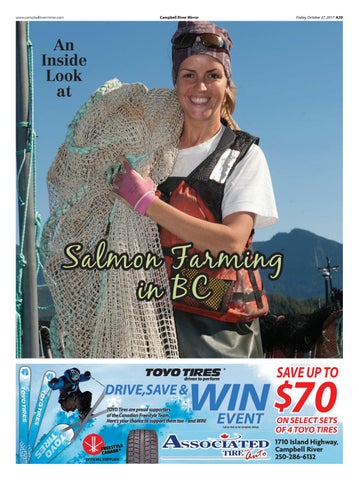
An Inside Look at
Salmon Farming in BC SAVE UP TO
WIN $70 ®
driven to perform
DRIVE,SAVE &
TOYO Tires are proud supporters of the Canadian Freestyle Team. Here’s your chance to support them too – and WIN!
EVENT Call or visit us for complete detials.
OFFICIAL SUPPLIER
ON SELECT SETS OF 4 TOYO TIRES
1710 Island Highway, Campbell River 250-286-6132
A40 Friday, October 27, 2017
Aquaculture 2017
Campbell River Mirror
www.campbellrivermirror.com
www.campbellrivermirror.com
Campbell River Mirror
Friday, October 27, 2017 A41
Top Ten
1 2 3 4 5
Aquaculture 2017
6 7 8 9 10
Reasons Salmon Farming is Good for British Columbia
Raises Atlantic salmon that are recommended as a “good alternative” by the Monterey Bay Aquarium Seafood Watch Program
Has a total economic impact of over $1.5-billion towards the province’s economy
Generates over 6,600 jobs (2,966 direct, 2,716 indirect, 928 induced), specifically in rural coastal communities where unemployment has traditionally been the high
Offers wages 30% higher than the provincial median employment income
Donates over $600,000 and more than 23,000 lbs of salmon to community organizations and causes
Congratulations from Grieg Seafood BC to our Skuna Bay brand on receiving the 2017 Marketer of the Year Award from the American Marketing Association, BC Chapter.
While 30% of B.C. farm-raised salmon is sold in Canada, 70% of the annual production is exported to 12 markets around the world – with the largest markets being United States, China, and Japan Currently has 20 social and economic agreements with Coastal First Nations
Raises 78% of its salmon in partnership with First Nations
Meets certification standards for several respected programs, and members of the BC Salmon Farmers Association have achieved at least one third-party certification for every farm Has developed collaborations with 15 organizations and 26 researchers on key projects, providing almost $600,000 in funding through the Marine Environmental Research Program
A42 Friday, October 27, 2017
Campbell River Mirror
www.campbellrivermirror.com
Aquaculture 2017 Salmon Farmers in B.C. Aim to be Industry Leaders Through Certifications
S
almon farming companies in British Columbia aim to be leaders in aquaculture by continuing to elevate their practices in raising a high-quality product that is in demand around the world. In doing so, they continue to achieve thirdparty certifications developed by independent bodies that let others know their products and services meet comprehensive food safety, environmental
and social standards. Every salmon farm B.C. holds at least one third party certification or recommendation, and most of the certifications held include stringent thirdparty audits and public disclosure of audit findings. In Canada, these independent verifications provide customers added assurance of responsible seafood farming practices in a country with some of the world’s toughest and well-enforced regulatory frameworks
for aquaculture. B.C. is the world’s only farming region to have all farm-raised Atlantic salmon recommended as a “good alternative” (yellow ranking) by the Monterey Bay Aquarium Seafood Watch Program. B.C. is also the first and only salmon farming region to have all its Atlantic salmon certified by Global Aquaculture Alliance Best Aquaculture Practices (BAP) program. In addition, 40% of active
Atlantic salmon farms B.C. have achieved the Aquaculture
Stewardship Council (ASC) certification, with farmers pledging
Atlantic Salmon CERMAQ CANADA
Big and small, we have industrial hose, tubing and fittings for all your needs
CRES
LTD.
1033 Ironwood St. 250-287-7121 cres1986@telus.net
Proud supporters of the aquaculture industry.
A-1 Radiators 1961 Island Highway Campbell River
www.guillevin.com
250-287-7344
• Global Aquaculture Alliance – Four-Star Best Aquaculture Practices • Aquaculture Stewardship Council (10 farms certified; 3 farms under assessment) • Aboriginal Principles for Sustainable Aquaculture • Occupational Safety Standard of Excellence (OSSE) • ISO 9001, ISO 22000, OHSAS 18001, ISO 14001 • Monterey Bay Aquarium Seafood Watch Program – Good Alternative (Yellow listing)
GRIEG SEAFOOD BC
• Global Aquaculture Alliance – Four-Star Best Aquaculture Practices • Aquarium of the Pacific’s ‘Seafood for the Future’ responsible sourcing programme • Occupational Safety Standard of Excellence (OSSE) (pursuing) • Monterey Bay Aquarium Seafood Watch Program – Good Alternative (Yellow listing)
MARINE HARVEST CANADA
• Global Aquaculture Alliance – Four-Star Best Aquaculture Practices • Aquaculture Stewardship Council (12 farms certified; 6 farms under assessment) • Aquarium of the Pacific’s ‘Seafood for the Future’ responsible sourcing programme • Occupational Safety Standard of Excellence • Monterey Bay Aquarium Seafood Watch Program – Good Alternative (Yellow listing)
Chinook Salmon CREATIVE SALMON
• Canadian Organic Aquaculture Standard CAN/CGSB – 32.312
to have 100% of active farms certified by 2020.
Coho Salmon GOLDEN EAGLE AQUACULTURE • Ocean Wise Recommendation
Steelhead Salmon LOIS LAKE STEELHEAD • Ocean Wise Recommendation
Sablefish GOLDEN EAGLE SABLEFISH • Ocean Wise Recommendation
Aquafeeds CARGILL AQUA NUTRITION CANADA/ EWOS FEEDS
• Global Aquaculture Alliance – Best Aquaculture Practices • GLOBALG.A.P. • ISO 9001 • Canadian Organic Aquaculture Standard CAN/CGSB – 32.312 • HACCP Feed Assure • Occupational Safety Standard of Excellence (OSSE)
SKRETTING
• Global Aquaculture Alliance – Best Aquaculture Practices • GLOBALG.A.P. • ISO 9001:2015, ISO 22000, ISO 14001, OHSAS 18001 • Canadian Organic Aquaculture Standard CAN/CGSB – 32.312 • Aquarium of the Pacific’s ‘Seafood for the Future’ responsible sourcing programme • Occupational Safety Standard of Excellence (OSSE)
TAPLOW FEEDS
• Canadian Organic Aquaculture Standard CAN/CGSB – 32.312
www.campbellrivermirror.com
Campbell River Mirror
Friday, October 27, 2017 A43
Aquaculture 2017
SERVING YOU FRESH BC SALMON EVERY DAY
A44 Friday, October 27, 2017
Campbell River Mirror
www.campbellrivermirror.com
Aquaculture 2017 NIC developing new Aquaculture Tech Diploma
N
IC’s new Aquaculture Technician diploma promises to provide hands-on, applied training in the latest aquaculture techniques. The program, now under development, builds on NIC’s existing aquaculture training and provides students with a real-world foundation of skills and experience. An independent economic analysis of the salmon aquaculture industry in BC shows an increase of 37% over the past three years in its value to the province, resulting in the creation of over 1,600 new jobs. Overall, farming and processing 92,800 metric tonnes of salmon in 2016 resulted in over $1.5-billion towards the BC economy. “It’s very exciting to be developing this program, incorporating comprehensive knowledge about the biology of salmonids and the different techniques in culturing,” said Dr. Jesse Ronquillo, NIC instructor and curriculum developer. “By working with industry we’re ensuring that students get the skills they need to transition smoothly from the program to working in the industry,
or furthering their training and careers.” Ronquillo, a multi-award winning aquaculture scientist, educator and researcher, is developing the curriculum in collaboration with industry. The training includes production techniques for a broad range of aquaculture species including finfish, bivalves, crustacean, seaweeds and kelps and upcoming species such as sea cucumbers, urchins and crayfish. “We’re very excited to have Dr. Ronquillo working with us,” said Cheryl O’Connell, Dean of NIC’s Trades and Technology Programs. “To have someone with his expertise and experience is a tremendous resource for students, NIC and the region.” Dr. Ronquillo has worked across Canada and internationally, including as a fellow with the Japan Society for the Promotion of Science (JSPS), the United Nations Educational, Scientific and Cultural Organization (UNESCO), and the Natural Sciences and Engineering Research Council of Canada (NSERC). The new diploma program will provide students
with training in marine, freshwater and land-based systems of aquatic food production. The hands-on program at NIC is also attracting the attention of other postsecondary institutions. “We have had several post-secondary institutions identify an interest in collaborating with NIC on exchange initiatives while expanding potential pathway opportunities for future graduates,” said O’Connell. “We anticipate that there will be several opportunities for rewarding partnerships as the program advances.” The aquaculture diploma will launch in 2018. NIC received $600,000 through the Canada-BC Labour Market Development Agreement to develop the curriculum in cooperation with the BC Salmon Farmers and BC Shellfish Growers Association. The organizations, which represent the majority of BC’s aquaculture producers, identified a need for more specialized skills training as the range of species grown across the sector expands.
REINVESTING IN R&D MAKES THE DIFFERENCE World leaders in aquaculture nutrition Ewos is a world leader in the research, development and manufacture of feed and nutrition to the international aquaculture community.
The progress that I’ve ❝ made with my career in
the past eight years with Marine Harvest has been extraordinary, I never imagined I would come this far.
❞
MAURICE “MOE” ISAAC
80’ Self-Propelled Landing Craft Tugs, Workboats, Crew boats & Research Vessels Crane & Ramp Barges Aquaculture support Marinas, Dockage & Anchor Installation & Inspections General Marine Construction & Salvage Scientific Research & ROV Services
EWOS Canada 7721–132nd Street, Surrey, BC Canada V3W 4M8 Customer Service-Orders-shipping Toll Free 1-800-663-0476 Toll Free Fax 1-866-287-4422 | customer.service@ewos.com 7721–132nd Street, Surrey, BC Canada
KNOWLEDGE MAKES THE DIFFERENCE.
EWOS.COM
EWOS.COM KNOWLEDGE MAKES THE DIFFERENCE
Phone: 250 871 8870 Fax: 250 871 8873 www.searoamermarine.com
Campbell River Mirror
www.campbellrivermirror.com
Friday, October 27, 2017 A45
Aquaculture 2017
Salmon farming suits Maurice Isaac
M
aurice “Moe” Isaac, 40, is a member of the Tlowitsis First Nation who lives in Alert Bay, British Columbia. He is the manager of Marine Harvest’s Midsummer Island salmon farm in the Broughton Archipelago. My first job was at the Gwa’ni Hatchery on the Nimpkish River. My manager’s exact words when I was laid off were “you should use what you have learned and go apply at one of those fish farms”. So I started farming in 2000. After three years farming, I left to try my hand at chum, sockeye and herring fishing. Commercial fishing wasn’t the right fit for me, it wasn’t steady enough work. So I returned to working around the salmon farms in the Broughton
Archipelago. In 2009 I started working for Marine Harvest at Wicklow Point, which gave me an opportunity to work beside my father. We went on to work together at Doctor Islets for a short period and that was a lot of fun. If this industry is still thriving when my five year old son is ready to work, I wouldn’t be opposed to him being a salmon farmer, not at all. The progress that I’ve made with my career in the past eight years with Marine Harvest has been extraordinary, I never imagined I would come this far. I came in with the idea that I would be nothing more than a technician. The harder I worked, the more opportunities became available to me and Marine Harvest helped me
with their continued focus on training. I fine-tuned my skills and was promoted from site technician to assistant manager to now managing my own farm. Obviously I believe in the value of aquaculture. I feel it is going to help save the wild stocks more than hurt them. I feel without aquaculture the demand for salmon is going to fall on the limited wild stocks. When I was young, I was told not to be a fisherman because the industry was dying due to overfishing, river damage and environmental changes. I don’t believe that salmon farming has the harsh impact on wild stocks that environmental activists claim.
is that they don’t care about the environment. This is the biggest lie out there. 100 percent of the people that I have had the pleasure to work with care more for the ocean than the average person. A lot of us are ex-fishermen, or have grown up on the water, why would we want to destroy it? It is frustrating to hear this lie being perpetuated.
I feel salmon farmers and Marine Harvest do our part and more, going above and beyond what is required of our business. The changes that I have witnessed over 17 years in the industry have been huge and beneficial. To name a few, we’ve improved net designs, feeding equipment, use of fish meal, workboats, pack boats and treatment plans. I can’t forget
the many rules and regulation changes that have made this industry sustainable. I take a lot of pride in what we do and would love to work in salmon farming for as long as I can. With constant innovation that improves our workplace, you can last for a long time in this industry, and I hope to continue down this path for as long as I am able to do so.
The District of Port Hardy proudly supports the British Columbia Aquaculture Industry.
The biggest misconception about salmon farmers
Thank you for your contribution to our community! T17051
The Campbell River Advantage: Love where you work and play.
From Our Team To Yours Thanks For All You Do For Our Community
THE ALL-NEW
2017 NISSAN TITAN XD WAS $60,955
SAVE 12,644 $
NOW $48,311*
+ TAX AND LICENSING
DL# 40069
CR advantage
Contact Rose Klukas rose.klukas@campbellriver.ca 250.286.5738 www.campbellriver.ca/ business-economy
1-855-291-4335 2700 North Island Hwy., Campbell River
www.northislandnissan.ca
A46 Friday, October 27, 2017
Campbell River Mirror
www.campbellrivermirror.com
Aquaculture 2017 Bringing Seafood to the Community and Your Home
T
his year’s BC Shellfish and Seafood Festival expanded into Campbell River for the first time with the inaugural Salmon Capital Seafood Taste event, raising over $1000 for the Campbell River Hospital Foundation. Centrally located in Spirit Square, members of the community – along with approximately 80 farm tour participants
(international buyers and media) – indulged in seafood tastings prepared by four Vancouver Island and Metro Vancouver chefs. International Chef and North Island College Culinary instructor, Xavier Bauby served up three innovative dishes that delighted the palate: Goat cheese and herb Stuffed Gravlax Steelhead Macaroon,
Pink Peppercorn and Herb Canned Chinook Salmon Rillettes Pate with Carrot Lemon Jam, and Coconut Mango Marinated Chinook Salmon Salad in a Filo Cup. Chef Bauby’s creative inspiration stems from his training in France, his culinary travels – to Morocco, the Canary Islands, the Cabo Verde Islands, the Ivory Coast, the Congo and Sierra Leone – and over 30 years of experience that includes catering to Bill Clinton and coaching students to win national championships.
Our Services Include:
New nets including design and manufacturing Net washing, disinfection, repair and alterations On-site net washing Tarp manufacturing and repair
Proud member of the BC Salmon Farmers Association and Global Aquaculture Community Campbell River 250-830-0100 Port Hardy 250- 949-7738 www.badinotti.com
Despite his accomplishments, he remains humble and serves as a great mentor to the next generation of chefs. In passing on his expertise to potential young chefs at North Island College, Chef
Bauby would like to see his students excel in their careers and surpass him. “My greatest pleasure in being able to follow in the footsteps of my mentors and share my knowledge with aspiring chefs that have the potential to become amazing at their craft,” said chef Bauby. “The program at North Island College provides students with hands-on experience – from learning how to
process whole salmon to creating full menus for NIC’s Third Course Bistro.”
Campbell River Mirror
www.campbellrivermirror.com
Friday, October 27, 2017 A47
Aquaculture 2017 For a taste of Chef Bauby’s creations, try making this at home: D��� S����� G������ Serving = 10 portions Dill marinated salmon, sweet mustard & dill sauce, croutons Gravlax (gravad lax) is a Nordic dish consisting of raw salmon, cured in salt, sugar, and dill, which is usually served as an appetizer – sliced thinly and accompanied by hovmästarsås (a dill and mustard sauce), either on bread, or with boiled potatoes. You can also use it on a toasted bagel, with cream cheese, red onion ring, capers and lemon juice as brunch item or great lunch. This side of salmon can be frozen. stard CE jon mu epper. U i A D S d L n L dp DI ea Yolks , lemon juic with salt an hopped g g E 2 son yolk dd c . Place ing bowl, sea h a whisk, a 1 ILET in mix fy the oil wit LMON F kin A S lsi D E T S A . 2. Emu MARIN on Filets with ones from fish ugar. s ing. dill. 3 kg Salm and remove b corn, salt and ottom pan. season k c e h r n 3. C ced) 1. Clea gether peppe brine in the b with on (Jui ustard o y r t r m e d ix v e e o L M h c t . 1 d f 2 Dijon Ml some o side down, an p e s c b la t P i . 2 3 filet skin e. Olive O d Dill e p – c u n la c e P ft . 1 o e 4 g brin opp e e to s tsp Ch pper to tast remainin em in the fridg per side. 2 e P th urs ently Salt & 5. Leave imately 12 ho , and g on. G e l N c I x r n i T o r c r A o p ap & PL lax in e salm epperc SHING lices of grav d around th n side. acked P I r C N I p F s t o s e 4 e thin ll sauce plac he or bread s Salt c p a u l c P ¼ c 1 brio he di s Sugar pour t ith toasted 1 ¼ cup w Serve ly pat RINADE orough h DILL MA ndles t d n a ell 4 Dill Bu dill bundles w on e s er salm in v o le 1. R k y. sprin them dr dill coarsely, hours at +2˚C. e h 8 t n 4 2. Chop marinate for er conservatio t tt and le ith oil for be w 3. Brush al). n o (opti eed. as you n live Oil e c li S . 4 O 3 TBSP ¼ cup +
Congratulations to our parent company Grieg Seafood ASA on the occasion of their 25th anniversary. From your senior team at Grieg Seafood BC.
Top Ten
Reasons To Eat More Salmon vitamins B and D, selenium, potassium and calcitonin – eating 2 x 75g of salmon each week can provide numerous health benefits. 1. Helps repair heart damage and strengthen your heart muscles – reducing the risk of heart disease 2. Reduces your risk of having a stroke 3. Lowers bad cholesterol, while raising your good cholesterol 4. Decreases your risk of developing Alzheimer’s Disease 5. Boosts your immune system, lowering your risk of developing certain autoimmune diseases, such as Crohn’s, colitis and lupus 6. Helps with the treatment of osteoarthritis and other inflammatory joint conditions by improving bone density and strength 7. Lowers triglycerides (a type of fat stored in the body) 8. Prevents blood clotting 9. Improves your energy 10. Functions as a great natural antidepressant, helping to combat depression
A48 Friday, October 27, 2017
Campbell River Mirror
www.campbellrivermirror.com
Aquaculture 2017
Launch your trades career at NIC
www.nic.bc.ca
Gain in-demand skills and credentials that employers are looking for.
Carpentry
Electrical
Gain apprenticeship credit toward your Red Seal and learn essential residential framing, footing, wall forming, site layout and work site safety skills to work in BC’s booming construction industry.
Learn electrical theory while developing applied skills while also earning apprenticeship technical training credit and work house toward Red Seal certification.
Landscape Horticulture
Plumbing and Piping
Gain highly sought after landscape maintenance and design skills with industry-recognized training as you work toward your Red Seal certification.
Gain skills and develop expertise in plumbing, steamfitting, sprinkler fitting and gasfitting while you earn apprenticeship credit toward your Red Seal.
For a full list of programs Visit www.nic.bc.ca/trades Call 250-923-9700
Heavy Mechanical Develop specialized skills in four heavy mechanical trades, including truck and transport mechanic, heavy duty equipment technician and diesel engine mechanic.
Welder Learn the core welding skills, processes, and techniques needed to enter the welding trade. Earn technical training credit towards levels 1 and 2 of welder apprenticeship training.
Campbell River Mirror
www.campbellrivermirror.com
Friday, October 27, 2017 A49
Aquaculture 2017 Interest in Kelp Growing Strong NIC-led study shows potential new industry for BC Coast
A
n historic kelp study on BC’s coast is showing the potential of the ocean plants as new aquaculture species in BC. The study, now in its fourth year, examines the commercial viability of kelp by installing test lines at salmon farm sites, in partnership with BC Salmon Farmers Association members Cermaq Canada, Grieg Seafood and Creative Salmon. It is being conducted by NIC’s Industrial Research Chair for Sustainable Aquaculture Dr. Stephen Cross and is funded by a five-year, $1 million Natural Sciences and Engineering Research Council of Canada (NSERC) grant. “We have 633 species of seaweed here in British Columbia,” said Cross. “The opportunity for research is inherent in the fact that we have so many different species and there’s such a diversity of uses for them.” Farming seaweeds, especially kelp, is seeing a surge of interest in the global market as it is looked for various uses such as an alternative fuel source (bioethanol), extractive
NIC Industrial Research Chair for Sustainable Aquaculture Dr. Stephen Cross holding sugar kelp grown on test lines as part of the multi-year kelp study.
compounds (alginates), cosmetics and for its environmental services like carbon sequestering. In 2015, the US-based Ocean Sciences National Center for Marine Algae and Microbiota estimated the global value of primary and intermediate seaweed products at $10 billion a year. The interest in kelp as a nutritional food for humans is also growing, something Cross believes is pushing the interest in the plants as an aquaculture species in BC. “It’s a common dish in Asia, but it’s only been in recent years that the interest has started to rise in the North American market,” noted Cross. “The beauty of seaweed is its versatility while also being extremely good
for you – the amount of vitamins it contains is amazing.” The study involved seed deployments at farm sites across the BC coast and then focusing in on the two best-performing sites. The data is now being compiled into papers to be published, but Cross notes there’s a lot more to be learned from seaweed, especially here in BC. Cross expects interest in seaweed aquaculture to continue to grow as public awareness of the plants grows. “You enter into a bit of a positive feedback loop as more people become aware of it and its potential, more people talk about it and the awareness grows, to the point where consumers start to seek out the product. The question becomes how to we meet that demand.”
GLOBAL SOLUTIONS FOR THE FUTURE OF AQUACULTURE In an industry with small margins for error, the importance of quality and reliability can’t be overstated. Pentair Aquatic Eco-Systems offers solutions and expertise to improve growing conditions in any environment from recirculating aquaculture systems to improving water conditions in sea pens. Pentair AES can help you improve results in any part of the growing cycle.
For more information visit PentairAES.com
~ CELEBRATING OUR 35th YEAR IN BUSINESS ~
Wire Rope & Fittings • Splicing Facilities Chains • Industrial Supplies • Hydro Testing Fire Extinguisher Recharging
Phone Orders and Tech Advice: +1 407 886 3939 Online Orders: PentairAES.com • Email: PAES.General@Pentair.com 2395 Apopka Blvd., Apopka, Florida 32703, USA
2860 North Island Hwy, Campbell River • Phone: 250-286-1027 • Fax: 250-286-1024
259 Puntledge Road, Courtenay • Phone: 250-334-3707 • Fax: 250-334-3721
© 2016 Pentair Aquatic Eco-Systems, Inc. All Rights Reserved.
A50 Friday, October 27, 2017
Campbell River Mirror
www.campbellrivermirror.com
Aquaculture 2017 B.C. Salmon Farmers Invest in Research and Collaborations
Sustainable Packaging Keep Your Product Colder | Fresher | Longer
Surrey & Campbell River | 604-590-2886
www.aquapak.com
Supporting the Aquaculture Industry for over 25 years
CAMPBELL RIVER NETLOFT LTD.
• Builders of quality nets for the local and international fish farming industry • Custom designed, cage nets, seines, predator and specialty nets • Shellfish farming equipment • Anchor ropes, chain and hardware • Net Washing, Disinfection, and Net Sealant Application
Tel: 250.286.3249 • Fax: 250.287.2475 Toll free in North America: 1.866.NET.LOFT (638.5638) 4225 Midport Rd. Campbell River, BC CANADA V9W 5A7 www.crnetloft.ca • crn@connected.bc.ca
T
he BC Salmon Farmers Association, through the support of its membership, is continually making developing collaborations and partnerships with researchers to answer questions on areas of shared interest, particularly those related to the health of wild fish stocks and environmental conservation. Now in its third year of funding, the Marine Environmental Research Program (MERP) committed $1.5 million in industry research dollars – over a fiveyear span – to help advance knowledge and gain a better understanding of the marine environment and B.C.’s wild marine species, particularly wild salmon stocks. The program funds research projects that fit within one of four priority areas: salmon health, salmon migration, environment, and reporting. An independent Science Advisory Council provides guidance to the program through funding decisions on
projects. Members of this Council represent Fisheries and Oceans Canada, the BC Ministry of Agriculture, University of British Columbia and Vancouver Island University, and the Pacific Salmon Foundation and industry. Project applicants are encouraged to leverage funds with other research funding programs to make the most of the funding received through MERP. To date $600,000 in research funding has been granted to 9 projects, working with more than 13 research organizations. Examples of funded research include: • Support to track wild juvenile sockeye salmon on their migration routes from Chilko Lake to the open ocean • Research to assess the ability of local perch species to clean sea lice from farm-raised salmon, a key development in creating an integrated approach to sea lice management on farms • Fish health studies on farm-raised and wild
Faster to harvest PRIME & EXPRESS are the next generation of feeds for post-transfer salmon. Skretting’s new grower salmon feed diets enable a shorter production time in the sea, without compromising fish health or final quality. PRIME prepares, or primes, the fish, building a solid foundation to support fast, high quality growth. EXPRESS builds on the framework created by Prime, maximizing the speed of growth by enabling the fish to fully utilize the potential in the feed. Learn more at www.skretting.ca
salmon Studies to help bring together large data sets, such as sea lice data, to analyze trends and improve reporting ability Beyond providing support for research projects, the BC Salmon Farmers Association hosts and partners on research workshops throughout the year, with topics spanning fish health, environment, and industry practices. In 2016-17 the Association held four workshops, reaching over 220 participants. The BCSFA’s signature workshop event, Collaborations on the Coast, is held annually in the winter, and is open to all active researchers studying the health of the oceans and wild and farm-raised fish stocks. This year’s event saw over 110 participants – representing conservation groups, industry, government, and universities. Plans are well underway for 2018’s event. For more information about BCSFA’s research initiatives, please visit bcsalmonfarmers.ca/ research-innovation.
Campbell River Mirror
www.campbellrivermirror.com
Friday, October 27, 2017 A51
Aquaculture 2017 Expanding the Role of First Nations in Aquaculture
A
n increasing number of Aboriginal communities across Canada are participating in aquaculture as an economic development opportunity. It is already an important economic driver for many rural and coastal Aboriginal communities in B.C. Over the last twelve years the Aboriginal Aquaculture Association (AAA) has seen the progress that is being made by First Nations that are participating in aquaculture development and taking greater control and management of their marine resources. Opportunities in aquaculture are mainly located in rural and coastal communities where First Nations can provide the labour, skills and traditional knowledge. Aquaculture provides jobs throughout the seafood supply chain, well paying, year round employment for men and women. In Canada, Aboriginals are the fastest growing and
youngest population. Jobs available close to home help curb the outmigration of our youth and with historic ties to the fishing industry Aboriginal people possess transferable skills. Through individual ownership and partnership development, First Nations are becoming increasingly involved in the aquaculture industry in B.C. B.C. Salmon farmers have entered into 20 economic and social partnerships with coastal First Nations. Currently 78% of the industry’s annual farmed salmon production is harvested from areas covered under agreements with First Nations. Although there are multiple successful partnerships between First Nations and the aquaculture industry challenges remain. While some First Nations have embraced aquaculture others remain skeptical. To overcome this both industry and government need to do more. Support is needed from
government to address policy constraints and the long-standing issue to First Nation access to capital. Industry needs to do more for their existing partners and to reach out to those that are unsure about aquaculture so that they too may be able to eventually share in the resource. Many businesses are seeking to build cooperative relationships based on the recognition of consent and mutually beneficial partnerships. To assist First Nations the AAA developed Aquaculture Partnerships: A Guide for Aboriginal Communities to provide guidance for those that are contemplating entering into partnerships with industry. “Industry and government are beginning to recognize the benefits of being more inclusive of First Nations. There are positive examples where First Nations and the aquaculture industry have worked cooperatively, resulting in mutually
beneficial relationships,” said Richard Harry President of the AAA. “For First Nations, this has meant increased employment; revenues and other social and economic development spin off benefits.” First Nations are in a unique position to take the lead with expansion of the industry and have much to offer to potential partnerships. First Nations not only have access to production sites but, in many cases, the necessary skills and infrastructure already exist in First Nation communities for aquaculture development. Harry goes on to say “There are tremendous opportunities for First Nations, however support and ongoing dialogue will be needed to address the challenges. We need to work together to build an Aboriginal aquaculture sector and to get past the political and polarizing positions on aquaculture and find some balance in this issue.”
Your Aquaculture Technology and Service Partner Your Aquaculture Technology and Service Partner Your Aquaculture Technology and Service Partner Your Aquaculture Technology and Service Partner Your Aquaculture Technology and Service Partner
Locally supplying and servicing the aquaculture industry since 1993.
1495 Baikie Road,www.akvagroup.com Campbell River, BC Phone: 250-286-8802 www.akvagroup.com www.akvagroup.com www.akvagroup.com www.akvagroup.com www.akvagroup.com
A52 Friday, October 27, 2017
Campbell River Mirror
www.campbellrivermirror.com
Aquaculture 2017 Growing Demand for B.C. FarmRaised Salmon
B
.C. is the fourth largest global producer of farm-raised salmon and accounts for about 60% of Canada’s annual harvest. Members of the BC Salmon Farmers Association harvested 78,000 mT of salmon in 2016 – about 3% of global production of over 2-million mT. Global demand
for seafood, and particularly farmraised salmon, has pushed the value of B.C. exports up by 45% over similar export volumes in 2012. Farm-raised salmon is B.C.’s second most valued agricultural product behind dairy and the province’s highest valued agricultural export.
While 30% continues to be consumed in Canada, the other 70% is exported to 12 countries around the world, with the top three export markets being the United States (51.6 mT), China (1,240,000 kg), Japan (846,000 kg). (Statistics Canada CATSNET Analytics, 2016).
Aquaculture Dive aining Specialists
NG PROFESSIONALS FOR THE WORKFORCE
ding
Become a Commercial DIVER!
rs.
*
GET Certified!
“The hurricane arrives in the New Year. Brunswick Jetters Ltd. has harnessed its power. VORTEX NET-WASHING.” brunswickjetters.com
For details call toll free: 1-888-325-3483 or email: info@divesafe.com
International certifi Become a cations in: • Commercial SCUBA Diver RTIFIED COMMERCIAL SCUBA Diver!
• Commercial NITROX Diver • Dive Supervisors Course nal certifi cations in: • Custom courses for groups UBA Diver (5• Surface weeks) Supply Diver 30m & 50m Nov. 18th, •2013 Dive Accident Management TROX Diver •(3Underwater day) WELDER October 15, 2013 • PLA courses for scientific divers
ace Supply Diver (7weeks) October 21, 2013
EST. 1900
Solutions for the Aquaculture Industry Commercial Dive Training 250-287-3837
1-888-325-3483 www.divesafe.com info@divesafe.com
www.divesafe.com
Campbell River Branch 1030 B - 9th Avenue Campbell River, B.C. V9W 4C2 Tel: 250-287-9265 Fax: 250-287-3313
Toll Free: 1-888-641-9414
NEWS
ebhorsman.com
Campbell River Mirror
www.campbellrivermirror.com
Friday, October 27, 2017 A53
Aquaculture 2017 B.C. Salmon Farmers Making Efforts in Continuous Improvements Through 2017 Sustainability Progress Report
T
he BC Salmon Farmers Association is continuing to strive for increased transparency through the release of its third annual Sustainability Progress Report. The report is organized into three pillars of sustainability – environmental, economic, and social. Building upon information shared in the 2015 and 2016 reports, the latest report demonstrates continued trends in areas of public interest, including industry antibiotic use, marine mammal interactions, sea lice numbers, escapes, salmon feed trends, and third party certifications. This year’s report also features research collaborations and technological innovations taking place to support efforts in environmental sustainability. With the vast majority of salmon farms no longer using copper-treated netting – and the remaining
farms transitioning to becoming copper-free – new innovations are being put in place to manage net cleaning. For example, Badinotti Net Services Canada Ltd. has purchased a $2.5 million vessel for this purpose. In addition, salmon farming companies are also investing in high-density polyethylene nets, which have been proving effective in reducing interactions with sea lions and seals. Salmon farming in B.C. plays an important role in province’s economy, particularly for coastal communities. The industry recognizes that efforts and success in environmental stewardship are important in driving economic and social sustainability. Investments in research and innovation are key to continually raising the bar for the industry’s environmental sustainability efforts in B.C.
A part of coastal communities griegseafoodcanada.com
A54 Friday, October 27, 2017
Campbell River Mirror
www.campbellrivermirror.com
Aquaculture 2017
Farming salmon responsibly on BC’s wild coast
cermaq.ca