Canadian
GRAPES to
WINE
Summer 2017
Canada
150
❚ John Schreiner on Wine ❚ Marketing Your Wine ❚ Drake Vine on South Africa ❚ Canadian Wine Tourism
PM # 41262017
Experience
BOTTLE SERVICE from Ardagh Direct
Superior service every day from the preferred glass packaging partner in North America When it comes to the packaging you choose to protect and enhance your quality wine, you deserve VIP service from a partner you can count on. Ardagh Direct provides wineries of all sizes, located West of Ontario, the option to purchase glass wine bottles directly from Ardagh Group.
971-413-1934 | www.ardaghgroup.com/wineAD
With a dedicated sales team and manufacturing facilities in the heart of the major North American wine regions, Ardagh Direct has the resources to meet your needs in a highly-flexible manner. Give us a call today to learn more about our wide range of premium bottles and experience bottle service in a whole new way.
ON THE COVER ROCHE WINES JENNIFER SCHELL
Canadian
GRAPES to
WINE
June 2017
The most read business to business wine industry publication in Canada
Publisher: Black Press Managing Editor: Jennifer Schell
Our last cover featured a very Canadian looking cork emblazoned with our national symbol, the maple leaf. What you didn’t see was the flip side of that cork. The French fleur-de-lis on one side and the Canadian maple leaf on the other represent the two nationalities of its winemakers Dylan and Penelope Roche of Roche Wines.
Penelope was born and raised in Bordeaux, France and Dylan is from North Vancouver, BC. The cork is a romantic symbol of the combined cultures and unified winemaking talents of this husband and wife team. Roche Wines will soon have a brick and mortar winery after operating as virtual for many years based in Penticton. You can read more about them at rterroir.ca
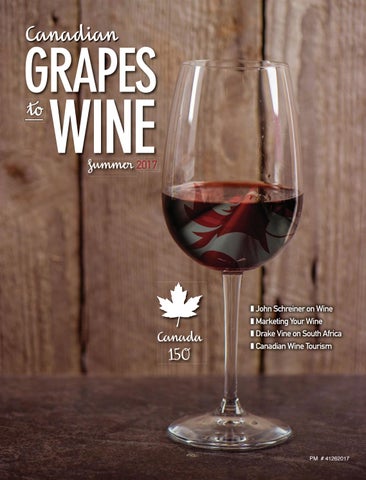
This summer issue cover design was created by Tiffany Larkan in celebration of Canada’s 150th birthday. Cheers Canada!
Advertising Director: Sommer O’Shaughnessy Ad & Publication Design: Tiffany Larkan Circulation Manager: Glenn Beaudry
Subscribe Today! Name Address dian Cana
Phone Canadian Grapes to Wine articles, columns, pictures and illustrations are copyrighted and may not be reproduced in any other publication without the expressed written consent of the Publisher. Although every effort has been made to verify the accuracy of information received and printed in Canadian Grapes to Wine, we cannot be held responsible for errors or omissions, E&OE.
S GRAPE
to
WINE
7 g 201 Sprin
PUBLISHED QUARTERLY March, June, September and December 2495 Enterprise Way, Kelowna, BC V1X 6X2 250-763-3212 editor@cdngrapes2wine.com
www.cdngrapes2wine.com
June 2017
Canadian Grapes to Wine
The d t rea ss msinoesss to buusstrinye
bu
Wine er on chrein r Wine S n ine h ❚ Jo g You ational W rketin rn ❚ Ma uver Inte s Canada o te c ❚ Van al Celebra urism v To 17 2620 Festi # 41 Wine PM adian ❚ Can
ind wine lication pub nada in Ca
BC Estate Winery Sales Update ..............Page 4 Cuvee Grand Tasting Awards..................Page 5 & 11 Social Media Tips ...................................Page 6 How to attract tourists ...........................Page 7 Q&A with Ann Sperling ..........................Page 8 & 13 Creating a great tasting room ................Page 9
The Roche family (l-r) Dylan, Eileen, Eugene, Penelope with winery dog Bacchus PHOTO BY DAVID MCILVRIDE History of Canadian Grapes to Wine ......Page 10 Sparkling Wine Seminar .........................Page 12 The Drake Vine on South Africa ..............Page 14 & 15 John Schreiner on wine ..........................Page 16 & 17 Cellar Tek Product Focus 2017................Page 18
www.cdngrapes2wine.com
3
IS THE TIDE FINALLY TURNING?
Geoff McIntyre, CPA, CA, is a Partner based in MNP’s Kelowna office. As the Food & Ag Processing Niche Leader for the Okanagan Region, Geoff specializes in serving the British Columbia wine industry; working with several winery and vineyard clients to help them achieve their goals. Geoff is also the Regional Leader for the delivery of MNP’s Farm Income Program services.
SALES OF BC ESTATE WINERIES FINALLY FLOWING Back in 2010, I was asked to look ahead at the trends I saw developing over the next decade in the BC wine industry. One of the trends I expected to see, based on sheer demographics alone, was a growing number of BC wineries changing hands as the founding owners looked towards retirement and an exit strategy. Here’s what I wrote on that subject seven years ago: “Demographics tell us that there will be a significant changeover in both land and winery ownership in the coming decade. There will be opportunities for both domestic and international purchasers to gain a foothold in the BC Industry. The wine business is capital intensive and raising funds to purchase or lease land will be a priority for those wineries intent on growth.
4
www.cdngrapes2wine.com
While we don’t necessarily see any wineries going public a la Robert Mondavi, we do see growing opportunities for private investors eager to own a piece of a BC winery or vineyard.” Well, it took a while, but I think we are finally there… Back in 2010, we were mired in a deep recession and many Canadians were forced to put their retirement plans on hold. Winery owners were no different. Most were in survival mode as debt increased, consumer demand slowed and land prices declined. Over the next couple of years, it became a buyers’ market and there was no shortage of rumors and speculation, but precious few actual deals. Coming out of the recession around 2012, the hot topic became the growing amount of Asian and Asian-Canadian interest in acquiring BC wine, wineries and vineyards. Every owner you talked to could tell stories of unsolicited visits and interest from abroad. Enthusiasm turned to skepticism as all the talk translated in to very little action. Eventually however, there were some real transactions. Bench 1775, Lang, and most recently Phantom Creek are all examples of BC wineries and vineyards acquired by new Asian Canadian owners that appear to be working out quite well for both buyers and sellers. Domestic interest seems to finally be catching up as well. North American consumer confidence is on the rise again. Land prices have reached and, in some cases, surpassed pre-recession levels and investor interest has returned. It can even be argued that the collapse of oil prices in Alberta has had some positive effects on the BC wine industry. The last two years
GEOFF MCINTYRE
has seen lots of wine tourist visits from Alberta, and even indications of investment dollars looking for a safe-haven outside the oil patch. Unlike public companies, when private businesses change hands, details are usually few and far between. There are often not a lot of announcements or fanfare. However, if I can extrapolate the level of transaction activity from MNP’s own BC wine industry business advisory practice, buying and selling activity definitely appears to be on the upswing. In the last 10 months alone, we have assisted on the purchase of four wineries and the sale of another. All of these purchasers come from Western Canada and are new to the wine industry. And all seem to be looking for a change and new direction from already successful business careers. The BC wine industry is quite young if you consider the 1989 mass pull out of older varieties and replacement with quality vinifera vines to be the real starting point for the modern era. In 1990 there were 17 licensed grape wineries in BC and today there are over 275. During the same timeframe, the number of planted vineyard acres in the province has grown from approximately 1,500 to over 10,500. Most experts agree that virtually all of land well suited to growing quality wine grapes has now been planted. It seems there has never been a shortage of people attracted to this unique industry. The difference that in now emerging now is that, for the first time, it has become easier to
enter the industry by purchasing an existing winery, vineyard and brand than by seeking to start from scratch. This is good news for current owners who are now facing what I call the “3 S’s decision” – succession, sell or shut down. It means “sell” is becoming an increasingly viable option. But bear in mind there are plenty of other winery owners thinking the same thing. It’s also good news for the new breed of buyers - there are lots of options out there. But more importantly, there is an opportunity to buy an already profitable business instead of starting from nothing and waiting upwards of 6 to 10 years for any real profits – the path that many current owners had taken. There’s no question that the days of lots of talk but no deals are over and the number of completed transactions is on the rise. When it comes to BC estate wineries changing hands, my sense is that it is still a buyer’s market. More than anything, that is because of the sheer number of wineries out there. But for a buyer looking to acquire a winery business with a solid brand, well developed sales channels, human talent and the right balance of land and production, I think the market is much narrower. This puts the seller back in the driver’s seat. If you are thinking it may be time to sell, you want to make sure winery is positioned well and effectively plan so you can capitalize on the opportunities that are finally flowing.
Canadian Grapes to Wine
June 2017
Scholarship winners were honoured at the Cuvée Grand Tasting on Friday, March 24. Pictured from left are Barb Tatarnic, manager of Continuing Education and Outreach at CCOVI with winners Jennifer Kelly (Cuvée Graduate Scholarship), Hannah Lee (Cuvée Award for Academic Excellence in OEVC), Stephanie Van Dyk (Cuvée Award for Academic Excellence in OEVI), Jacob Johnsson-Werner (Cuvée Hosting Award for Academic Excellence in OEVI) and Debbie Inglis, Director of CCOVI
Sarah Moore Communications & Media Relations Specialist Brock University | Cool Climate Oenology and Viticulture Institute (CCOVI) Niagara Region brocku.ca
SARAH MOORE
TOP HONOURS SHOWERED ON GRAPE AND WINE INDUSTRY AT CUVÉE
More than 750 wine and food lovers celebrated excellence in Ontario VQA winemaking on March 24 at the annual Cuvée Grand Tasting. The event, held at the Scotiabank Convention Centre, was organized by Brock University’s Cool Climate Oenology and Viticulture Institute (CCOVI). The proceeds help fund
academic scholarships and research focused on priorities of the grape and wine industry. Niagara-on-the-Lake’s Gerald Klose was honoured with the Cuvée Vineyard of Excellence Award that evening, which is presented by BASF Canada Inc. and recognizes a grape grower who promotes excellence in vineyard practices.
Patrick Forristal | Entire Marketing Canada, Ltd. 16-1182 Berlett’s Rd. | St. Agatha RR1 ON, Canada N0B 2L0 519.885.5375 | entire@sympatico.ca
Continued on Page 11 June 2017
Canadian Grapes to Wine
www.cdngrapes2wine.com
5
STEP UP YOUR SOCIAL This new column is exciting for me because I love using social media. I’ve been using various platforms since 2008, and have been instructing both in groups and coaching one-on-one since 2010. I embrace the opportunity to share some of what I’ve learned and to help you, readers, because that puts the ‘social’ in social media. You might’ve heard of the term “going down the rabbit hole”.
You know how it is: you go online and click on one thing and then click through to another, and then another, and then another... social media can be very much like that if you don’t really know where to start, and where to go. So for this first column I’d like to know from you what you need to learn. I did a quick poll of my Facebook friends and they commented with lots of advice about
INTRODUCING KUBOTA’S NEW M4 AND M5 NARROW TRACTORS.
In 2017 Leeann Froese was named in the Top 40 Wine Influencers on social media on a global list by Social Vignerons, ideally suiting her to bring you tips, tricks and best practices. Leeann co-owns Town Hall Brands, a marketing agency based in Vancouver BC, where they specialize in pr, social media, events and graphic design. See more of Leeann’s work at townhallbrands.com or find Leeann online at @leeannwine or @townhallbrands
LEEANN FROESE
TOWN HALL BRANDS
The Major Social Networks and Wine Instagram Here is a lovely photo of my wine, with all the hash tags Twitter I need to drink some wine Facebook I like wine YouTube Watch me tell you about me drinking wine! LinkedIn I’m good at drinking wine Pinterest Here is a gorgeous wine and food pairing and a craft Snapchat I’m too young to talk about wine, but here is me as a dog
Built with the power you expect from Kubota, the new M4 and M5 Narrow tractors are designed for work between vines and powerful enough to be part of the M Series line-up. Their final Tier IV Diesel engines deliver up to 91 PTO HP. Improved hydraulics and a redesigned cab make these tractors the perfect combination of size and strength.
Gerard’s Equipment Ltd. 5592 Hwy 97, Oliver, BC Phone: 250.498.2524 | Fax: 250.498.3288 6
www.cdngrapes2wine.com
kubota.ca | *See your dealer for details.
what they think wineries need to know, but I would like to know directly from you what’s going to help you be better or understand social media. Doug Sloan, a retailer and writer from Campbell River says “attention span on social media is limited, keep it light, keep it real, keep it funny or entertaining if you can manage that and still get your message across…” There is a LOT to what Doug said, so let’s start with the first barrier to social media that keeps you from getting online. You may think that you are not interesting or that no one is going to want to read or learn about what is going on with you or your winery, vineyard, or brand. Wrong. People love to know how a project comes together, what is happening behind the scenes, and to see snapshots of the lives of the people working in the world of grapes and wine.
So choose a network, and then we will go from there… You may feel pressure to be on all the networks. If you can do that, great; however if you can’t be on them all, then choose one, and do it well. You can decide among Facebook, Twitter, Instagram, LinkedIn, and more, and then work to find your way around that space. Each channel has a slightly different language and need for imagery, but one thing they have in common is that they each give you a way to speak to someone and share information online, and learn from customers in real time. In the issues of Canadian Grapes to Wine to come we will go through the varying networks and how to use them best, and cover other social media topics of the day. Let me know what you want to see. Let’s have a conversation – because that is what being social is, right?
Canadian Grapes to Wine
June 2017
HOW TO ATTRACT DISCERNING WINE TOURISTS
REFERENCES Canadian Tourism Commission/ Destination Canada (2015). Ambitious Together: 2015 Annual Report. Retrieved February 22, 2017 from https://www.destinationcanada.com/ en/about-us#publications Quadri-Felitti, D. & Fiore, A.M. (2012). “Experience economy constructs as a framework for understanding wine tourism.” Journal of Vacation Marketing, 18(1), 3-15. Sie, L., Patterson, I., & Pegg, S. (2016). Towards an understanding of older adult educational tourism through the development of a three-phase integrated framework. Current Issues in Tourism, 19(2), 100–136. https://doi.org/10.1080/1368350 0.2015.1021303
Sommelier Mike Lee at Quails’ Gate Estate WInery conducts tastings in the vineyard, special bookings include winemaker Nikki Callaway. (pictured right)
June 2017
Once the foundation of a great tasting room is established, what can wineries do to attract increasingly discerning wine tourists? Developing hands-on educational experiences for winery visitors is an excellent way to attract tourists interested in more in-depth learning experiences. Recent tourism trends emphasize tourism approaches that include creativity, experience and learning. The demand for learning oriented tourism is increasing because of cultural and demographic changes (Canadian Tourism Commission, 2015; Sie, 2016). In response, Canadian wineries are recognizing that local wine, food and farming knowledge are assets for developing sustainable, creative tourism experiences that appeal to a high-value market. Leading wineries are moving beyond the traditional ‘consume and purchase’ tasting room model to engage visitors in actively learning about local viticulture and wine making. There are also emerging partnerships between agri-food producers, wineries, and post-secondary institutions to develop and promote life-long learning experiences. Learning experiences range from activities like seated tastings, to food and wine pairing workshops, to multi-day hands-on learning experiences in the cellar and vineyard. Learning is a key motivator for wine tourists, so there are opportunities for wineries to develop more educational experiences to meet consumer demand (Quadri, 2012). Best of all, tourists who spend time learning at a winery develop a stronger connection to the place and brand, so are more inclined to re-visit, join wine club and share their positive winery experience with friends and family.
Canadian Grapes to Wine
Danielle Robinson lives in the Okanagan with her two children and winemaker husband. She holds WSET Level 3, Sonoma State Fundamental Wine Business Certificate and a Masters in Education. She is currently in the early stages of PhD research through the School of Environmental Design and Rural Development at the University of Guelph focused on how learning-oriented wine and food tourism enables cultural sustainability in rural communities. You can contact her at drobin11@uoguelph.ca
DANIELLE ROBINSON
www.cellartek.com Supplier to the Commercial Beverage Industry
WINEMAKING
BREWING
CIDER MAKING
Satisfied!
“CellarTek once again comes through with great equipment and uncompromising service on all levels. The Barida counter pressure filler is a breeze to use with simple setup and cleaning. Our Charmat wines love it! Cheers!” Matt Dumayne, Chief Winemaker Okanagan CrushPad
For quotes and more information: Justin Skladan
E: jskladan@cellartek.com Ph: (778) 215.8324
West: 1• 250•
cellartek• com
868• 3186
East: 1• 905• 246•
8316
Toll Free: 1• 877• 460•
www.cdngrapes2wine.com
9463
7
Q WITH &A CANADA’S
Born and raised on a vineyard in the Okanagan Valley, Canada’s Ann Sperling has been in the winemaking industry for 29 years now, crafting high quality, award winning wines from the west coast to the east coast of Canada. She and winemaking husband Peter Gamble have extended their winemaking projects internationally, with Versado, their beloved Malbec vineyard and winery in Mendoza, Argentina. (www.versadowine.com)
GLOBETROTTING WINEMAKER:
ANN SPERLING 2. HOW DID YOU END UP MAKING
1. DESCRIBE YOUR ENTRANCE INTO THE WORLD OF WINEMAKING.
While growing up in the Canadian wine industry in the 70s, there were many changes on our farm, and vines and wine were major topics of conversation at the dinner table. Many winemakers and viticulturists, often European, came to our home providing advice and telling their stories. Somewhere along the line in my teenage life, it dawned on me that I could do this too.
WINE IN MENDOZA?
ANN SPERLING / PHOTO BY TARYNN LIV PARKER
In the early 2000s, after 25+ year long careers in the Canadian wine industry, my husband, Peter Gamble and I felt that the time for a new adventure was right. When buying fine wine on a winemaker’s budget, we always look for regions that are great, or have great vineyards, but are perhaps under-rated or not quite in fashion at that moment. Mendoza fit the Versado description in 2006 when we startover 200 vineyard properties, and ed our search. After researching learning a heck of a lot along the way, we finally found our tiny (3 HA) ancient vines Malbec property on Cobos Road in Lujan de Cuyo. This registered planting that dates to 1920, is a massal block of Malbec, and is 100% vinifera ie no rootstock. When we found it, the vines had been ravaged by hail two years in a row, so an experienced eye and lots of patience and TLC was needed to restore the vineyard to its past glory. This was the perfect challenge for a couple of geeky vine-loving winemakers. We’ve now made eight vintages of our Versado Malbec and distribute it in BC, AB, ON & PQ as well as Paris, France. 3. DESCRIBE THE DIFFERENCES IN THE GROWING REGION YOU ARE IN. CAN YOU COMPARE THE MAJOR DIFFERENCES FROM A WINEMAKER’S POINT OF VIEW IN MAKING WINE IN CANADA AND THERE?
All of the wine regions of Canada are very different from each other for vine growing and winemaking. Since I prefer to make terroir wines, I’ve always focused on each vineyard, and work with the characteristics of a specific
sight to reveal a wine’s attributes and strengths. Working in different parts of the world provides a range of experiences that builds a deep reservoir of resources to draw on and recognize potential, or solve problems. 4. YOU ARE ONE OF FEW WINEMAKERS THAT HAVE MADE WINE IN THE EAST AND WEST OF CANADA. WHY DO YOU THINK THE INDUSTRIES ARE STILL OPERATE SO SEPARATELY? DO YOU SEE PROGRESS OR THE POSSIBILITY OF MORE COLLABORATION? WINE LAWS CHANGING TO BIND US?
The development of each Canadian wine region has evolved somewhat independently to suit the needs of the climate and people who’ve invested in “their” region, and each of the four provincial industries has achieved some notoriety of its own for which wineries can be proud. At this point in time, there is a natural synergy bringing the regions together to celebrate and share in the successes, and with this -- national collaboration. 5. WHERE IN CANADA DO YOU SEE THE MOST GROWTH? WHAT EXCITES YOU ABOUT...
Continued on Page 15 8
www.cdngrapes2wine.com
Canadian Grapes to Wine
June 2017
CREATING A GREAT
TASTING ROOM, FROM ATMOSPHERE TO STAFF
Allison Markin, Principal, has more than twenty years of experience in marketing, crisis communications, government relations, writing and editing, and is also an engaging facilitator and speaker. In her spare time, she is pursuing professional sommelier training. That’s All She Wrote.
ALLISON MARKIN
Every tasting room, or cellar door, if you prefer, is different. From rustic Quonset huts, to small barrel and wood-themed rooms with a “belly up to the bar” aura, to large, ultra-modern bright spaces that evoke an air of modern architectural sophistication. Of course, no one can possibly – without a lot of travel time and cash – visit every winery across the country, but surely there are tasting experiences, here and abroad, that have stuck with you for one reason or another. The décor? The wines? The people? Perhaps a combination of all three. And as Canada becomes better known on the world wine stage, visitors will expect more from their wine experience. Let’s start with décor. It begins in the parking lot…are signs clear and easy to read? That includes directions to the cellar door, not to mention washrooms, picnic tables, a pet-friendly area (include a water dish and leash lock-up), or any points of interest (or off-limits areas). How many times has a guest walked into a production areas, thinking it was the tasting room? It’s good practice, as well, to consider access points for those with mobility issues. Inside, is everything clean and tidy? Having displays of value-added merchandise is great, but be sure they don’t draw the eye away from the tasting bar and the main purpose a guest is there, to taste wine. A laminated wine list with clearly explained tasting policies – tasting fees, options for longer/seated June 2017
tastings, food pairings – is critical. A chalkboard behind the counter is convenient, but make sure it’s easy to read. A clever way to present a tasting list: a clipboard with tearoff sheets. Have the guest select a tasting flight and check off wines. Include a spot for contact info and brief privacy statement so you can collect data for your mailing list. But the crux of the whole experience is the staff. We all don’t need to be master sommeliers to work in a wine shop, but the basics are critical. How horrifying would it be for an employee to say, “I haven’t tried this wine, but people say it’s good.” Take the time to run frontline staff through your products, with trial pairings. Better yet, hire people with some WSET (Wine & Spirit Education Trust) or basic formal training, or hire good salespeople and invest in them by sending them to a wine class. And remember, it may be the end of the day in the tasting room, and you’ve said the same thing dozens of times, but that person walking through the door? They are looking for a good first impression.
Canadian Grapes to Wine
Ingredients • Supplies • Equipment Large & Small Wineries • Distilleries • Cideries • We’ve got it all!
The Cool Climate Series by T.W. Boswell is the embodiment of elegance. To emphasize fruit and terroir, Cool Climate Series barrels are exclusively crafted with 36 month, extra fine grain French oak as part of T.W. Boswell’s Special Reserve premium wood selection. Our team nurtures this exceptional wood source, and then each barrel is specially crafted using new, low-impact proprietary toasts that focus on finesse, thereby complementing delicate fruit and accentuating elegance.
800.797.2688 | info@scottlabsltd.com
www.cdngrapes2wine.com
9
THE HISTORY OF
Canadian
GRAPES WINE
Luke Whittall is a wine writer, educator, and sales professional. As the founder of WineCountryBC.ca, he has been writing about wine since 2009 and studying it for eight years hence. He is currently completing a book on the history of wine in BC as well as the WSET Diploma. Since 2005, his career has so far led him to experience the wine industry working in cellars, vineyards, wine shops, stores, classrooms, and board rooms.
to
Recognizing that the average wine consumer may not necessarily be interested in technical wine articles, editor David Gamble created a dedicated industry section within B.C. Wine Trails. By the year 2000 that industry section was given a name of its own called “B.C. Wine and Grapes”. It contained articles on technology, business, and winemaking aspects of the wine industry. There were articles on the latest grape growing and wine making research, winery technology, financial issues, and marketing advice. As Gamble explained, “Areas such as grape growing, wine production
10
www.cdngrapes2wine.com
and wine equipment did not really resonate with the readers of a wine consumer oriented publication, so the transition to a separate publication which was dedicated to the wine industry seemed the way to go.” That new publication was called Canadian Grapes to Wine and the first issue was released in the spring of 2001. Just like Wine Trails, Gamble and his daughter Dawn Wiens handled the writing and production of the publication. However, the extra workload in addition to Wine Trails and the national scope of Grapes to Wine necessitated that
LUKE WHITTALL
they seek help from across the country for articles. Dr. Andy Reynolds, from Brock University, contributed updates on the latest wine industry research for the Research Update column. There were other columns on vineyard and winery management, winemaking, and vintage updates from across the country. The ‘Vintage Update’ features Dav� Gamb�e in each issue were particularly important for industry in each bec. New contacts were soon added region to learn how other regions with the emergence of the wine were dealing with their own growing industries in Nova Scotia and the conditions and problems that arose fruit wineries in Newfoundland and from the weather. The Spring issue on the Prairies. Advertising support was a recap of how the winter was also came in from across the coungoing. The Summer issue focused try from businesses that supplied on any winter-related problems the wine industry with specialty with the vines. The fall issue offered products or services. “Often firms in vintage predictions and there was a Ontario, Quebec and B.C. were able vintage report in the final Vintage to build their businesses by adding Issue of the year. It was an importclients in other parts of the country.” ant resource for sharing information Even after selling Wine Trails in across the country and covered “full 2005, by 2009 Gamble and Wiens spectrum of the Canadian wine were “ready to step back” and sold industry.” “It was fascinating passing Canadian Grapes to Wine to Black along the different techniques that Press. Canadian Grapes to Wine were used in the different regions,” remains a publication of which Gamrecalled Gamble. “Burying vines in ble is clearly very proud. “It was a winter in Quebec; propagating new thrilling experience to bring this new vines directly from cuttings in Nova publication into the world and to Scotia, etc.” watch it develop and fill the needs Compared to the regional scope of of its industry readers,” he recalled. B.C. Wine Trails, Canadian Grapes He noted that the readers of Grapes to Wine allowed Gamble to branch to Wine were more “appreciative out much further. Grapes to Wine and enthusiastic” about it than any was always meant to be a nationalother publication that he had ever ly-focused industry magazine. “It been involved with. “[It] was one of also seemed natural to make it a the most interesting and rewarding national publication,” recalled Gam- experiences of my life.” Gamble conble. As the former publisher of Wine tinues to be involved with growing Regions of Ontario, he already had grapes and making wine in his own contacts in that province and Quehome vineyard in Summerland, BC.
Canadian Grapes to Wine
June 2017
TOP HONORS continued from Page 5 Klose was selected by an expert panel for maintaining a high level of quality in his Chardonnay vineyard. The Tony Aspler Cuvée Award of Excellence, honouring those who further the aims and aspirations of Ontario’s wine industry, was presented to award-winning wine journalist Ian D’Agata. He was recognized as a “great ambassador for Ontario wines on the world stage.” The VQA Promoters Awards, which recognize individuals who support VQA wines through promotion or education, were also announced at Cuvée and given out April 19 at CCOVI’s Experts Tasting. THE 2017 WINNERS ARE: Lifetime Achievement: Roberto Martella, owner of Toronto’s Grano Italian restaurant, for routinely promoting VQA wines in his establishment. EDUCATION: Barb Tatarnic, manager of Continuing Education
and Outreach at CCOVI, for her commitment to advancing wine education over the past two decades. LCBO: Melissa McFadden, customer service representative in Owen Sound, for her comprehensive product knowledge and eagerness to promote VQA wines. MEDIA: Angela Aiello, founder and editor of Toronto’s iYellowWineclub.com and editor at Chloe magazine, for vibrantly promoting VQA Ontario in countless print, television and radio appearances. HOSPITALITY: Mike Fish, sommelier and owner of London restaurant Glassroots, for 10 years of promoting VQA wines and for hosting London’s only all-Canadian wine list. RETAIL: Brian Hanna, sommelier at Prince Edward County’s Huff Estates Winery, for sharing his deep knowledge about Ontario wines in a way that educates, promotes sales and enriches the lives of those
around him. To further student engagement, long-time Cuvée Education Advocate sponsor BASF Canada Inc. also sent the 20 top oenology and viticulture students from Brock University and Niagara College to the event. “It is an incredible honour to represent Brock as a top Oenology and Viticulture student within the program — an opportunity I wouldn’t have been able to experience without the generous support of BASF,” said Alexandra Gunn, a third year OEVI student at Brock University. Second-year Niagara College Wine and Viticulture student Amelia Keating-Isaksen said she was “pleased to go to Cuvée because of the known prestige of the event, as well as the connections and people attending.” Brock University’s second year student Catherine Cahill summed it up by saying: “Being acknowledged affirms my hard work, dedication
The Cuvée Vineyard of Excellence Award was presented to Gerald Klose by Oleta Larush, of BASF Inc., at the 2017 Cuvée Grand Tasting on Friday, Mar. 24 at the Scotiabank Convention Centre in Niagara Falls
and passion for Oenology and Viticulture. Receiving such an incredible opportunity encourages me to continue to work hard towards my dreams.” Visit cuvee.ca for emerging details and dates for 2018. Sarah Moore Communications & Media Relations Specialist Brock University Cool Climate Oenology and Viticulture Institute (CCOVI)
The only electronic pruning tool in the world with an interchangeable cutting head.
NEW 2017 Model Available! Compact & Light: 790g Exceptional Power and Ef Efficiency Ergonomic Design Soft and Comfortable Grip Very Accurate Pro Progressiveness ULTRA-COMPACT LITHIUM ION BATTERY ULTRA-COMPAC
HIGH CUTTING CAPACITY:
• 40MM STANDARD KIT • 45MM MEDIUM KIT • 55MM MAXI KIT
storage cells of the battery have been The storag choosen for their reliability and capacity to ch deliver delive intense current. 120Wh LITHIUM Battery • 12 • Weight: 810g • Battery with storage cells protection and management electronic system (BMS) LITHIUM cells • High storage capacity L « igh Power Long Life Intelligent Ba ttery H Technology Tec
OKANAGAN
PO Box 25026 Mission Park PO Kelowna, BC P: (250) 762-9845 F: (250) 762-9846 C: (250) 878-3656 British Columbia fwhitehead@shaw.ca
VITICULTURE SERVICES INC. June 2017
Canadian Grapes to Wine
LAKEVIEW VINEYARD EQUIPMENT INC.
40 Lakeshore Rd. RR#5 Niagra-on-the-Lake, ON
P: (905) 646-8085 TF: (866) 677-4717 C: (905) 651-7505 sales@lvequipment.ca
www.cdngrapes2wine.com
11
BOTTLING EXCELLENCE LECTURE SERIES: A BUBBLING OPPORTUNITY IN
SPARKLING WINES There is a bubbling opportunity for wineries in BC to continue to grow and expand their sparkling wine production. In a recent lecture, nearly 100 winemakers from around BC gathered at Okanagan College in Penticton to discuss and taste sparkling wines while learning from international experts about the range of sparkling wine styles from around the world. During the lecture, titled Shaping Bubbles, international experts
shared about the range of production methods, considerations for different styles and the growth in the sparkling wines category. Recognizing that there is a huge range of different sparkling wine styles in the world, it is crucial to choose a style compatible with BC’s grape production conditions while also choosing a style that reflects the individual winery’s winemaking philosophy. Thierry Lemaire, owner of
MORI VINES INC. - Cabernet Franc - Cabernet Sauvignon - Chardonnay - Gamay - Gewürztraminer - Malbec - Merlot
- Muscat Ottonel - Orange Muscat - Pinot Blanc - Pinot Noir - Riesling - Sauvignon Blanc - Sovereign Coronation
- Seyval Blanc - Shiraz- Syrah - Vidal - Viognier - Zinfandel - Zweigelt
NOTE: Many different clones are available. Rootstocks available are Riparia, 101-14, SO4 and 3309 Contact: MORI VINES INC. R.R. #3, 1912 Concession 4, Niagara-on-the-Lake, Ontario LOS 1JO Phone: (905) 468-0822 Fax: (905) 468-0344 e-mail: morivines@sympatico.ca www.morivines.com
12
www.cdngrapes2wine.com
Kim Lawton is the owner of DogLeg Marketing. She is a long-time supporter of the BC Wine Industry and BC’s craft beer movement. Kim can be reached via Twitter @ DogLegMarketing
KIM LAWTON
Nuance Winery Supplies and one of the organizers of the lecture discussed the compositional differences and quality factors of sparkling wine made by Charmat and Traditional method. He also presented the Méthode Ancestrale, a style used by local winemaker Jay Drysdale from Naramata’s Bella Wines. Marcello Galetti, a wine consultant from Italy, shared about different Italian sparkling wine types including Prosecco and Lambrusco, plus he provided a technical presentation on Charmat method. Denis Bunner, assistant chef de cave at Champagne Bollinger in France, presented the main different styles found in Champagne and how they are achieved. Alison Moyes, winemaker at Liquidity Wines, participated in the lecture. “I think that these types of workshops are crucial to our local industry, pushing the quality standards forward and allowing us to compete on an international stage,” she explained. “In preparation for my first vintage of Traditional Method Sparkling wine, many of the specific secondary fermentation and aging techniques discussed at the Shaping Bubbles lecture will prove to be invaluable. The opportunity to hear the perspective of a winemaker from such a reputable Champagne house, with so much history, will certainly be reflected in the development of our new (traditional method) sparkling program and our own unique style.” Considering the growth of sparkling wines in Italy and France, and also the volume of sparkling wine imported into Canada, there is significant opportunity for BC wineries to further expand into the sparkling wines category. Norman Cole, owner of Artus Bottling and an organizer of the lecture series stated, “Worldwide consumption and demand for sparkling wines is increasing. BC wineries are seeing this trend with
consumers seeking out this style of wine. In other wine regions around the world, sparkling wines represent a higher percentage of a winery’s business than we see here in BC.” Italy and France have developed their own methods and styles for sparkling wines. Whether looking at Prosecco or Champagne, both styles are unique and meet different consumer needs. What is consistent though, is the way the wineries in each country have worked together to build the value and identity for their chosen style. This may be something to ponder for our BC wineries. By working together as a region, can we create our own sparkling wine style that identifies BC sparkling wines the way Prosecco defines Italy’s sparkling wine style and Champagne defines France’s sparkling wine style? It’s a thought to consider over your next glass of bubbly. Shaping Bubbles was part of the Bottling Excellence Lecture Series provided by Artus Bottling and Nuance Winery Supplies, with the support of Okanagan College. Thierry explained, “The goal of this lecture and our ongoing Bottling Excellence Lecture Series is to help wineries continue to improve the quality of their wines by bringing them leading edge presenters, technology and worldwide best practices.” To be included on the invitation list for future lectures, email Norman at norman@artusbottling. com or Thierry at thierry@nuancetrade.com.
Canadian Grapes to Wine
June 2017
Q &A
Continued from Page 8
...THE CANADIAN WINE INDUSTRY?
Canada is hot... I mean cool! The hot and leading edge wine fashion in restaurants all over the world is cool climate wines... those with finesse, elegance and purity. We have this and can express these traits in all of our Canadian wine regions. There’s a ton of interest by international writers and somms in our wines so its exciting to communicate our unique regions and wines with them. 6. DO YOU SEE ANY PATTERNS IN NEW VARIETAL PLANTINGS?
Q &A
WITH ANN SPERLING
sperlingvineyards.com
June 2017
Keeping with the cool theme, the wines to watch for are varieties like Gamay, and styles, especially in whites that are more linear and mineral driven, including sparkling wines. The other hot trend that you’ll be tasting more of is “skin fermented whites” also known as orange wines.
You love
champagne and wine?
We love you!
7. DO YOU FORESEE MORE VINEYARDS CONVERTING TO ORGANIC?
Consumers have a growing demand for all kinds of organic products, including wine, so there’s an opportunity for Canadian grape growers and wineries to step up. Sadly, if we do not, there are foreign producers who will. In Canada, we need to develop the confidence and skills in our viticulturists to take on this challenge. We have good examples of excellent vineyards and fine wines in every region, including Summerhill, Sperling, Clos du Soleil, and Haywire in BC, Southbrook, Hidden Bench and Tawse in Niagara and Lightfoot & Wolfville and Benjamin Bridge in Nova Scotia to show what is possible. To leave a clean and lasting legacy and to achieve greatness in our wine regions, we all need to push the envelop. If you look around the world, farming organically and biodynamically is a proven way to achieve all of these goals.
Canadian Grapes to Wine
www.unitedbottles.com 016_UnitedBottle_pub_verticale_PRINT.indd 1
2017-03-30 15:07
THE DRAKE VINE ON SOUTH AFRICA
Canada is currently South Africa’s fourth largest export market for wine, and with sales on the rise, Canadian consumers may soon be enjoying an even greater range of South African wines than before.
Having firmly established the popularity of South African wine among international consumers, South African wine producers have started to shift their attention away from bulk wine exports and towards the promotion of premium, higher-quality wines. This is good news for both wine producers and consumers who continue to develop more sophisticated tastes. Currently most international wine consumers have access to only a tiny fraction of South Africa’s impressive range of wines. Most of South Africa’s vineyards are located in the Western Cape, in
Originally from Aberdeen in Scotland, Chris currently lives and works in London where he recently completed the Level 3 course at the Wine & Spirit Education Trust (WSET). The course covered both wine-tasting and a broad range of theoretical topics related to the wine industry.
thedrakevine.weebly.com CHRIS DRAKE
areas stretching to the north and east of Cape Town. Key wine producing regions include leafy Constantia, whose first vineyards were planted by Dutch settlers in the mid-1600s, and picturesque Stellenbosch, whose vineyards date back to 1679. Another major wine producing region, Paarl,
includes the stunning and verdant Franschhoek Valley, which was settled by French Huguenots in the late 1600s. Back then Franschhoek (“the French Corner”) was populated by a rich variety of African wildlife including elephants, lions and Cape buffalo. Continued on Page 15
A w�nery v�ew o��r the Frans��ho�k Valley
8 Mobile Filtration Systems
When & Where You Need Us
Because SAFE workers make for HEALTHY business
TRAINING
• 3 Pall Oenoflow Crossflow Systems • Rotary Vacuum Drum Filter (RVDF) • 3 Reverse Osmosis Systems • STARS (Selective Tartrate Removal System)
SAFETY TOOLS PROFESSIONAL ADVICE COR CERTIFICATION
WE NOW OFFER SMALL HAUL FLAT DECK TRUCKING
ON-SITE & ONLINE SUPPORT
Cellar Dweller Mobile Filter Services Ltd. Lesia Wood & Robert Kwakernaak Office: 250-497-2009 C: 250-460-1313(Robert) C: 250-487-2995(Lesia)
153 Eastside Rd., OK Falls, BC
lesia@cellardweller.ca robert@cellardweller.ca 14
www.cdngrapes2wine.com
Contact us today! 1.877.533.1789 Contact@AgSafeBC.ca
www.AgSafeBC.ca
Canadian Grapes to Wine
June 2017
DRAKE VINE continued from Page 14 Much of the viticultural region around Cape Town has a Mediterranean climate, with hot dry summers and relatively cool wet winters. Some regions, including Constantia, the Overberg and Walker Bay benefit from cooling oceanic conditions such as the northward flowing Benguela Current and the “Cape Doctor”, a strong, persistent trade wind that comes from the southeast between September and March. The resulting microclimates influence the sort of grapes that are successful. For example, Constantia, whose surrounding mountains cool the climate, has a reputation for quality white wines made from Sauvignon Blanc and Semillon. Walker Bay and Elgin in the Overberg, with their maritime air, also have a reputation for good Sauvignon Blanc, as well as high quality Burgundian-style Pinot Noir. Warmer, drier inland regions such as Stellenbosch, Paarl and Swartland have a reputation for rich and complex red wines made from varieties such as Cabernet Sauvignon, Merlot, Shiraz and Pinotage, as well as white grapes such as Chenin Blanc. In the even more extreme semi-dessert region of the Klein Karoo, Portuguese grape varieties such as Touriga Nacional and Tinta Barocca are used to make highly successful port-style wines. Today 55% of plantings in South Africa consist of white grape varieties. Chenin Blanc, often described as South Africa’s signature white varietal, accounts for 18% of total plantings, with Cabernet Sauvignon being the most widely planted red grape. Other varieties with a long history in South Africa include Colombard and two members of the Muscat family, Muscat of Alexandria (known locally as Hanepoot) and Muscat Blanc à Petits Grains (known in South Africa as Muscat de Frontignan or simply Muscadel). Recent years have seen a growing experimentation with an array of French grape varieties, including Riesling (known locally as Weisser Riesling), Viognier, Marsanne, Roussanne, Gewürztraminer and Cabernet Franc. South African producers are also experimenting with grape varieties from Portugal (noted above), Spain (Tempranillo, Palomino and Albariño) and Italy (Sangiovese, Barbera, Pinot Grigio and Nebbiolo). June 2017
South African wines span a broad range of styles that encompass both single varietals and blends. In Stellenbosch, Franschhoek and other regions, winemakers have established a reputation for high-quality Bordeaux-style red blends from Cabernet Sauvignon, Merlot and Cabernet Franc. Some winemakers have developed a specialization in so-called “Cape Blends”, a red wine blend that typically includes 30% to 70% of Pinotage within the blend. Adding to the range of wine styles is the growing use of oak barrels for wine maturation and increased complexity, with a mixture of American, French and, in some cases, Hungarian oak used. Sparkling wines are produced using different methods, including the traditional “Champagne method”. Although made in the same way as Champagne, South African producers can’t use the Champagne label and instead label their wines as Method Cap Classique (MCC). The grapes used in MCC production include Chenin Blanc and Sauvignon Blanc, as well as the traditional Champagne grapes Chardonnay, Pinot Noir and Pinor Meunier. Continued innovation, together with a new focus on exporting higher quality wines, has potential to further elevate South African wines among international consumers. Canada is currently South Africa’s fourth largest export market for wine, and with sales on the rise, Canadian consumers may soon be enjoying an even greater range of South African wines than before.
Canadian Grapes to Wine
At Gusmer, we know the wine you create is just as as you are.
unique
For over 90 years, Gusmer has offered a full range of innovative enological tools that enable your creative expression
through
unique
and
interesting
wines.
Equipment, analytical instruments and processing aids brought to you from leading suppliers in the wine industry, all backed by strong Gusmer technical support. The options for expression have never been greater and the tools have never been better – so go ahead, be unique, express yourself. For more information, contact Gusmer today.
Fermentation Nutrients
Filter Sheets, Lenticular Cartridges, Cellulose Pre-Coat Fibers
Liquid and Granular Enological Enzymes
Malolactic Bacteria, Non-Saccharomyces Yeasts
Membrane Cartridge Filters, Laboratory Consumables
Oak-Mor®/Oak Avantage® Chips and Granular Oak
H2S Preventing Saccharomyces Yeasts
OenoFoss FTIR Analytical Instrumentation
Divergan F – PVPP
Portable Ozone Systems
Cross Flow Filters, RO Systems
French Oak
Lysozyme
www.gusmerwine.com sales@gusmerenterprises.com
West Coast : 81 M Street Fresno, CA 93721 Tel: 559.485.2692
The Wine LabTM : 640-D Airpark Road Napa, CA 94558 Tel: 707.224.7903
NOW OPEN YEAR-ROUND
Gusmer Sonoma Store : 9025 Old Redwood Hwy, Ste E Windor, CA 95492 Tel: 707.836.1056
East Coast : 1165 Globe Avenue Mountainside, NJ 07092 Tel: 908.301.1811
Midwest : 1401 Ware Street Waupaca, WI 54981 Tel: 715.258.5525
The Revolutionaries Behind Wine’s Visionaries
JOHN SCHREINER ON WINE
Several years ago, I had a hilarious confrontation with an Italian vintner at a tasting in Vancouver. I think of it every time that Hester Creek Estate Winery sends the latest release of its Trebbiano. The vintner, whose name I have forgotten, was from Tuscany. A friend had recommended I taste his wines because of their high quality. Indeed, the wines he was pouring were excellent, including a crisp and complex Trebbiano. I complimented him on the wines and then added that a producer in the Okanagan also made an excellent Trebbiano. “You can’t grow wines here,” he replied. “It rains too much.” Indeed, it was raining outside the Vancouver venue that day. But I told him that our major wine region was
400 miles east of Vancouver, with two intervening mountain ranges blocking most of the rain from the vineyards, which must be irrigated. “The average rainfall in the Okanagan is the same as the average rainfall in Sicily,” I told me. (I have been in Sicily recently.) The vintner snorted again in derision. “You don’t have the soils,” he said. I rebutted that with a description of the Okanagan’s complex geology. The Hester Creek vineyard is on a peninsula of soils deposited by the glaciers. There is everything in the soils from gravel and clay to traces of ancient volcanoes. The vintner’s third objection was that the Okanagan lacked Italy’s long tradition
John Schreiner is Canada’s most prolific writer of books on wine. Since his first book in 1984, The World of Canadian Wine, he has written 15, including multiple editions of The Wineries of British Columba, British Columbia Wine Country and John Schreiner’s Okanagan Wine Tour Guide. His newest book ICON: Flagship Wines from British Columbia’s Best Wineries is now available.
johnschreiner.blogspot.ca
JOHN SCHREINER
Continued on Page 17 of wine and viticulture. Of course, I could not quite match that. But I pointed out that the man who planted the Trebbiano vines (and other varieties) in 1968 was an Italian immigrant named Joe Busnardo. So we have a link to that historic tradition. Here is a biographical sketch from my 1996 book, British Columbia Wine Companion. When he was growing up on a farm at Treviso, north of Venice, and when he studied at a nearby agriculture school, [Joe Busnardo] “never liked any plant but grapes.” He came to Canada in 1954, a twenty-yearold bachelor, and by 1967 scraped together enough to buy sixty-eight acres on an eastward-facing sloping bench just south of Oliver. He imported twenty-six varieties of vinifera grapes from Italy and a further fifty-six
hestercreek.com
The vineyard once had as many as 128 different grape varieties, a testimony to Busnardo’s undisciplined curiosity about the vine.
A Perfect Blend of Services and Expertise Helping You Buy or Sell A Winery in Today’s Complex Business Environment Contact, Geoff McIntyre, Regional Leader Okanagan, Food and Beverage Processing, 1.877.766.9735 or geoff.mcintyre@mnp.ca
16 SPRINGwww.cdngrapes2wine.com ISSUE on stands early March 2011
Canadian Grapes to Wine
June 2017
JOHN SCHREINER continued from Page 16 varieties from the University of California in Davis. Busnardo’s planting of pinot bianco (Italian for pinot blanc) was one of the earliest and largest plantings of what now is recognized as a vinifera superbly suited to the Okanagan. He ignored the established wineries and professionals in the Okanagan who urged more hardy hybrid varieties [such] as bath, a labrusca grape totally unsuited for table wines. With the wineries not prepared to pay a premium for his low-yielding vinifera, the struggling Busnardo took a job as a heavy-duty mechanic for the city of Penticton and simply neglected his vineyard. “I closed the farm down,” he recalled. “I didn’t even prune the grapes.” His father visited him, shook his head and advised Joe to rip out the vineyard. The bitter winter of 1978’79 killed the next season’s growth on many vines in the Okanagan and destroyed some vines entirely. But Busnardo found that his casually-tended vineyard had come through the winter, proving that his faith in vinifera was not ill-founded. By coincidence, the first estate winery regulations had been issued by the provincial government in 1978. Busnardo now decided to get a winery license. Untrained as a winemaker, Busnardo launched Divino [Estate Winery] on a wing and a prayer, making wines in the traditional method that he remembered from his father’s farm. “I just throw in the grapes and hope for the best,” he said at the time. The occasional winemaking mistake slipped by: once, 5,000 bottles of pinot blanc had to be taken off the market after the harmless but unJune 2017
sightly residue of the fining agent began settling out in the bottles. Busnardo survived and learned from such experiences; subsequently, a brother, Guido, began coming from Italy to help with the winemaking which became more sure-handed with each passing vintage. The vineyard once had as many as 128 different grape varieties, a testimony to Busnardo’s undisciplined curiosity about the vine. It also has made for a wide range of releases from the winery, among them several that no one else has. Divino has been the only winery to release varietals made from garganega, trebbiano and malvasia, all important to vintners in Italy. Garganega, for example, is the principal grape for the production of Soave, a well-known delicate white made in the northern Italian winegrowing district of Veneto. But Divino has been at a disadvantage with these varietals because, in the British Columbia market it targets, these whites are scarcely known and, as much as Busnardo argues -- and rightly so -- that consumers should explore wines beyond the mainstream varietals, not many leave the beaten track. The winery was sold in 1996, to become Hester Creek. Joe moved Divino to the Cowichan Valley where he sometimes still presides in the tasting room Friday and Saturday afternoons. Hester Creek has been totally transformed by the team that has owned and run it since 2005, including Rob Summers, the veteran winemaker. The vineyard has been rationalized but some of Joe’s original plantings have been retained, including the Trebbiano. I regret that I never had a bottle to share with the
Canadian Grapes to Wine
Doubting Thomas from Tuscany. Hester Creek 2016 Old Vines Trebbiano Block 16 ($23.95). The wine begins with alluring aromas of apple, melon and grapefruit. Intense flavours of apple, pear and
citrus dance across the palate. With good acidity, the wine has a finish as fresh as a morning in spring, with a remarkable persistence. This surely is one of the best Trebbiano wines in the world. 93
FarmSolutions.net
Unbeatable Bird Protection!
250-488-2374
Neal Carter & Assoc.
info@farmsolutions.net Agricultural Netting & Fabrics • Strong HDPE knit, open-mesh nets • 10 year UV warranty, easy to apply and remove
• Hail, shade, rain & other fabrics • Nets for grapes, cherries & berry crops • Custom nets and structures
BC WINE GRAPE COUNCIL 18TH ANNUAL ENOLOGY & VITICULTURE CONFERENCE & TRADE SHOW MONDAY, JULY 17 & TUESDAY, JULY 18, 2017 PENTICTON TRADE SHOW & CONVENTION CENTRE
CO NFER
E N C E H IG H L IG H T S
Vineyard Floor Management for Sustainable Viticulture, Dr. Kerri Steenwerth, USDA at UC Davis, and Dr. Tom Lowery, Summerland RDC
Sustainability and Economics in Wine Production, Dr. Bruce Zoecklein, Virginia Tech, and Dr. Karl Storchmann, New York University Water Stress Monitoring and Detection Using IR Sensors, Remote Imaging, and Drones, Dr. Krista Shellie, USDA in Idaho, Dr. Pat Bowen, Summerland RDC Grape Pest and Disease Identification and Management Strategies, Dr. Susanna Acheampong, BCMAF, Dr. José Urbes Torres, Dr. Tom Lowery, Dan O’Gorman, and Dr. Sudarsana Poojari, Summerland RDC Evaluating Grape and Wine Quality, Dr. Wendy V. Parr, Lincoln University, Christchurch, New Zealand, and Dr. Matthias Schmitt, Hochschule GEISENHEIM University, Germany Molecular Approaches to Studying Water Stress and Yeast Strains, Dr. Dan Durall, UBC, Dr. Vivien Measday, UBC and Dr. Simone Castellarian, UBC The Elusive Nature of Minerality in White Wine, Dr. Wendy V. Parr, Lincoln University, Christchurch, New Zealand There will also be a Special Session on Sustainability, Climate Change and Wine Production, Research Updates, Workshops, an All Speakers Panel, Research Posters, Tradeshow Presentations, a Sensory Workshop featuring Alternative Varieties, and much more. VISIT THE TRADESHOW - OVER 100 EXHIBITOR FLOOR DISPLAYS SPONSORED BY
For information contact Carolyn MacLaren, Conference Coordinator,
778.878.6145
conference@bcwgc.org or www.bcwgc.org www.cdngrapes2wine.com
17
PRODUCT FOCUS 2017 istics in textural white wine fermentations. Glutaferm 1 has been isolated through an adaptive evolution strategy that has conditioned the colonies to react to stress and generate higher levels of reduced glutathione (GHS). This yeast is intended for aromatic white wine fermentations to preserve aromatics through oxidation protection and stabilize SO2 additions post fermentation. This is achieved by the residual glutathione in the wine acting as an antioxidant and reacting with SO2 binding compounds. Laffort was created in 1895 and has played a leading role in the main evolutionary phases of oenology. It played an active role in the major transformation witnessed in the past century: the shift from curative oenology, essentially based on pure chemistry, to preventative oenology using biochemistry and biotechnologies. One new product developed out of a growing need for mouthfeel enhancements is MANNOFEEL®. MANNOFEEL® provides complex mouthfeel and roundness on
There are a few great new products available this season for your winemaking toolkit! New this year from AEB is Fermoplus Tropical. Fermoplus Tropical is a white fermentation nutrient particularly rich in specific amino acids that are essential for the characterization of wines with a “tropical” profile. Composed of yeast autolysate and cell walls, Fermoplus Tropical is intended for use in musts after 3-5 0Brix consumption at a rate of 2050g/HL. This complex nutrient does not contain DAP and is a great tool to introduce into your aromatic white wine nutrition program to drive high tropical aromatic expression. Suited for all white wine varieties to ensure healthy ferments and maximum aroma! There are also two new AEB yeasts on the market that were trialled in Canada last year. Fermol Elegance and Fermol Glutaferm 1. Fermol Elegance is designed for low H2S production, low nutrient demand and elevated varietal character-
LUX
“
Our biggest concern when we switched all our wines to STELVIN® closures in 2007 was the public perception of screwcap versus cork, but we have been thrilled since. STELVIN®LUX closure is a perfect fit for us to enhance the design of our bottle/closure. We are eventually planning to switch all our wines to STELVIN®LUX.
“
David Johnson FEATHERSTONE ESTATE WINERY
WINEMAKING
the palate and respects the freshness and the aromatics of the wine. The product is in liquid form, ready to use, with an immediate action on the wine allowing mouthfeel enhancements in wine as late as 48hrs prior to bottling. MANNOFEEL® can be used as the last treatment before bottling (after blending, fining and X-Flow/Pad/DE filtration, etc.). This purified product TAV (%vol) pH
CIDER MAKING
gives the winemaker the freedom to make quality improvements at the final stages before bottling without negatively impacting stability or filterability. The mannoproteins in MANNOFEEL® are extracted from yeast cell walls by a specific process that allows us to obtain a highly-purified product with the highest content of mannoproteins on the market.
Up to 16 From 3,2
C8 and C10
SO2 Total (mg/L)
Up to 60
* Lactoenos B7
Temperature
Up to 16ºC
Bacteria changes have come down the line from Laffort with a new bacteria strain now available and the discontinuation of 350PreAc and B28 LACTOENOS® B7 DIRECT is a direct add formulation with low pH and high alcohol tolerance. It allows a quick start of the MLF, produces low amounts of diacetyl and volatile acidity which preserves the fruity character of wines and reduces their SO2 combination rate resulting in more stable total SO2. This strain does not produce biogenic amines and comes in 2.5, 25, and 250HL doses. Made available for the first time this year, Innerstave has released a premium 36-month air seasoned French oak adjunct to the Canadian market. Innerstave’s success comes from adhering to the rules established by traditional coopers – oak origin, air drying, aging and careful toasting. Maintaining long-term relationships in excess of 20 years with their oak suppliers allows Innerstave to source the highest quality tight-grain wood available in France and the USA. Revere 3yr air seasoned French oak available in oak cubes and fans for a more refined oak alternative
BREWING
≥ 50 mg/L of C8 ≥ 10 mg/L of C10 Direct usage parameters
impact. The Innerstave secret is the air seasoning at their Sonoma county yard for 3 years followed by consistent and expressive toasting of the oak sourced from central France. It is barrel quality oak at an approachable price point. Tasting Notes: Revere French Medium – vanilla, caramel, brown sugar, baker’s spice, cinnamon, maple syrup. Palate is elegant, silky tannins with structure Revere French Medium Plus – robust vanilla, butterscotch, dark chocolate, mocha, cinnamon, amber honey w/ oatmeal, roasted hazelnuts. Palate is full, creamy, velvety and mouth filling Revere French Plus Plus – dark chocolate, dark roast coffee, spice (clove, nutmeg, cinnamon), candied syrup, dark brown sugar, molasses, slight smoky bacon. Palate has depth and smooth lingering tannins The revere French oak is available in 6.8kg mini cube mesh bags and 28” fans for multiple application options. Note: Bench trials are always recommended when assessing dosage rates and product impacts on juice and wine
Contact your local representative for product information and availability Western Canada - Chelsey Peterson [ cpeterson@cellartek.com 1-250-878-5957 ] Ontario and Eastern Canada - Natalie Reynolds [ nreynolds@cellartek.com 1-289-696-8574 ]
ELEGANT AND CUSTOMIZABLE DESIGN
Process & Product Development \ Equipment Sales Alcoholic & Non Alcoholic Beverage Industry
Ivan D. Lessner
CONTROLLED OXYGEN TRANSMISSION RATE
GUARANTEED TCA-FREE
Contact your STELVIN® expert at +1-450-469-0777
The original taste keeper since 1964 www.stelvin.com
18
www.cdngrapes2wine.com
STELVIN® is a trademark of the AMCOR Group
NEW! EMD Lab Tests F.MERKEL: FLOTTWEG: ERBSLÖH:
1164 Lee Street, White Rock, B.C. V4B 4P4 Canada Phone: 604-538-2713 Fax: 604.538.4517 Warehouse Direct: 604-214-6437
EMD: TRUST INT.: E-CAVIS:
- Rapid S02 & T/A, Bentotest - Belt Presses - Enzymes, Acidex, Exacid, Fining, - Oenoferm Yeasts, Treatment Agents - CelluFluxx: Biodegradable Filtermedia - Pro Vino Malolactic Cultures - Analytical Kits & Equipment - Quality Hungarian Oak Barriques, Hungarian Oak Chips - Cremanti Multiencapsulated Champagne Yeasts - Bottling & Packaging Equipment
www.idlconsulting.com
Canadian Grapes to Wine
June 2017
Superior Quality. Start to Finish. Attention to detail, hard work and dedication is what true quality requires. The same effort you put in to making your renowned wines, is matched by us in pursuit of providing the best possible solutions at every step of the packaging process. TricorBraun WinePak: - Supplies all bottle sizes - Sources the highest quality domestic and imported glass - Has a dedicated in-house Quality Assurance Staff - Offers custom design, decorating, and repacking - Is a worldwide supplier with unmatched relationships
What can we do for you?
Heidi Cook | Business Development Manager | 604-649-5623 Michelle Thornburn | Account Coordinator | 877-495-7924
© 2017 TricorBraun WinePak
1-800-DRINKWINE | tricorbraunwinepak.com | � �
Your industry experts for: Domestic & Imported Glass, Decorating, Custom Design and Repacking
TBWP-4153_Canada-Grapes2Wine-Ftm.indd 1
2/28/17 10:47 AM