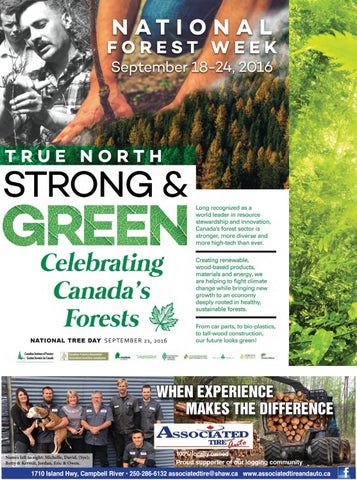
national tree day september 21, 2016
WHEN EXPERIENCE MAKES THE DIFFERENCE Names left to right: Michelle, David, (Sye); Betty & Kermit, Jordan, Eric & Owen.
100% locally owned Proud supporter of our logging community
1710 Island Hwy, Campbell River • 250-286-6132 associatedtire@shaw.ca www.associatedtireandauto.ca
What is National Forest Week? National Forest Week is sponsored across Canada by many individuals and diverse governmental and non-governmental organizations across Canada.
Established circa 1920 as Forest Fire Prevention Week, the intention was to encourage greater public awareness towards Canada’s forests. At the time, there was no apparent shortage of trees for industrial expansion – the greatest threat came from forest fires, due mainly to human causes. Since then National Forest Week, as it was renamed in 1967, has evolved to encompass the many and varied human and environmental aspects of Canada’s forest resources – past, present and future. Although special activities are promoted across Canada, National Forest Week remains first and foremost a challenge to individual Canadians to learn more about their forest heritage and support greater recognition of this valuable resource. www.cif-ifc.org
During National Forest Week, Canadians are invited to learn more about Canada’s forest heritage and to raise awareness about this valuable and renewable resource. Forests are fundamental to our economy, culture, traditions and history – and to our future. Communities, families and individuals depend on forests for their livelihood and way of life. This years theme is “True North, Strong and Green: Celebrating Canada’s Forests”.
We pride ourselves on our Service, and building trusting service relationships.
OIL, LUBE AND FILTER • ROTATE TIRES TEST STARTING AND CHARGING SYSTEM COMPREHENSIVE MULTIPOINT VISUAL INSPECTION.
SEYMOUR SERVICES
1860 Antonelli Road, Campbell River, BC V9W 4R6
www.seymourservices.ca
until Feb., 28th, 2017
Tel: (250) 287- 3505 Fax: (250) 287-3501
Proudly supporting the Forest Proudly supporting theIndustry Forest for over 30 years. industry for over 30 years
BAILEY WESTERN STAR, STERLING & FREIGHTLINER TRUCKS 250-286-1151 WWW.BAILEYWESTERNSTAR.COM 1440 Redwood Street, Campbell River, BC V9W 5L2
Susan Mallinson Cell
250.203.3545
Office
250.286.3293
susanmallinson@royallepage.ca
Steep Slope Human Fallers Ian MacNeill
photo: Graham Schaefer
Do the rapid advances in mechanized steep-slope harvesting technology spell the end of the hand faller in the history of forestry in British Columbia? No. Not by a long shot. The machines are coming, make no mistake about it. Although they have yet to demonstrate an ability to offer improvements in terms of productivity, it is in terms of promoting safety that they excel, says Rob Moonen Director, SAFE Companies of the BC Forest Safety Council. He reports that the injury rate for fallers in British Columbia in 2014 was a “staggering” 28.9 per cent—roughly three in 10. By contrast, the injury rate for mechanized falling was less than two per cent. However, despite the ability of the machines to tackle ever steeper slopes, they simply can’t do it all, and the trees
they can’t get to are still going to be brought down by hand fallers. In fact, says Dave Weimer, Chair of the Western Fallers Association, we may even be facing a shortage of fallers in the coming years because the average age of working fallers today is 59. Many of them will retire out over the next few years and because an insufficient number of young
people are currently engaged in faller training to replace them—fewer than 100 a year are coming into the business according to Weimer— those left still standing are going to be in high demand. Here and there, but not everywhere The view that the machines can’t do it all and that there is now and always
will be a place for hand fallers is widely held, up to and including at the academic level. According to Kevin Lyons, an associate professor in Forest Operations at UBC, and a man who worked in the woods and felled trees as a young man and has done extensive research at the academic level on falling, today’s mechanized fallers are 30 to 40-ton
Let’s protect our forests for generations to come.
250-914-8055
1353 16th Avenue, Campbell River www.berwickretirement.com
Radiators
250-287-7003
Proud to help you grow healthy forests
Fax: 250-287-7038 Mon.-Fri: 8-5 • Sat. by appt. 1501 A Willow Street, Campbell River
Your North Island Industrial Cooling Experts.
PRT operates a network of nurseries across Canada and the U.S. Forest Seedlings Seed Seed Orchard Management
Repair & Recore of Industrial Rads & Coolers. All Auto, Industrial, and Marine Applications.
Visit us at: www.prt.com
He says he views with skepticism the claims that machines are certified to operate on 100 per cent slopes. “Anything over 70 tends to get a little bit crazy.” Anchored machines can, of course, work more difficult terrain, “but then you’re only working below the road, and we have a lot of wood that’s above the road.” And finally, BC’s topography is more challenging in many ways than jurisdictions where the machines have had greater success, particularly Oregon. “We have U-shaped valleys with steep sides, whereas Oregon has more gentle ridges and deeply incised valleys, so it’s not as simple saying a machine certified to 100 per cent can go anywhere.” None of this comes as revelation to Ted Beutler of Aggressive Timber Falling, a TLA member based in Nanaimo. A lifelong logger who started out cutting shake blocks at the age of 17 before turning to falling, Beutler now runs a company that employs as many as 40 fallers
at any given time, and work is never hard to find. “As far as I’m concerned the impact of machine harvesting has already happened, and the equipment being developed to attack steep slopes will only be applicable in very specific situations,” he says. “These machines will never be able to harvest old growth. The wood is too big and heavy; the only way to do it is with hand fallers.” Helilogging is another area where fallers will continue to be in high demand, he adds. Rather than fear the rise of the machines, he thinks now is the perfect time for young people to consider falling as a career. “Fallers are going to be in greater demand than ever,” he says. “Numbers are declining due to attrition, mostly as a result of aging, and anyone who comes in can have a bright future. The only reason they’re turning to these machines in the first place is because there aren’t enough fallers to go around anymore. It isn’t a matter of if there is going to be a shortage of fallers, there already is.” Jordan Nicolussi, president of Sibola Mountain Falling, a TLA member based in Prince George is another whose bullish on the future of hand falling. “We absolutely believe that there is going to be a place for us in the future,” he says
photo: Graham Schaefer
machines whose operational abilities are restricted by both slope and tree size, including diameter and height. “So even with a grapple saw there’s a limitation on what you can do safely, especially when you consider the importance of retaining value in the tree and not just smashing it down,” he says.
confidently. “Machines won’t ever be able to do it all; I’ve yet to see one that could come into the kind of terrain we’re working in, and I’ve definitely never seen one that can go down a rock bluff.”
He adds that flexibility and adaptability are keys to survival. “We’ll fell trees wherever they need to be felled. Our main business is logging, but we do it for mining companies, oil and gas,
BC Owned and Operated 69 years partnering with the logging industry.
Industrial Supplies, Hydraulic hose and fittings, HD filters and more... Specializing in filling and delivering camp orders.
CRES
Our Forests are our Future Claire Trevena MLA – North Island
LTD.
Locally owned and operated
1033 Ironwood Street 250-287-7121
Campbell River Community Office: 908 Island Hwy Campbell River, V9W 2C3 Phone: 250-287-5100 or 1-866-387-5100 Fax: 250-287-5105
claire.trevena.mla@leg.bc.ca
www.clairetrevena.ca
He also says he gets at least a call a week, sometimes from overseas, from men wanting to break into the business. “As far as I’m concerned, the fallers out there now have nothing to worry about when it comes to getting work.” What does concern him though, is that many already in the business are hearing about the new machines and getting increasingly concerned about their own futures, despite evidence that there will always be a place for hand fallers in the logging equation. “If the goal is safety then it’s not a good idea to be putting men who already have a stressful enough job in the position of having to worry about their future, especially when they don’t need to be.”
it is safe to say that hand fallers are going to remain an integral and important component of the business, and that many are going to be working in what is likely to be the most difficult ground— the terrain even the most aggressive
concern. “As this new technology gets deployed we need to ensure that we are ahead of the curve and are able to supply industry with methods to reduce the risk of fallers being pushed into increasingly dangerous terrain,” says Rob Moonen.
steep-slope machines won’t tackle. Making that environment as safe as possible is going to be of paramount
It’s also worth noting that in situations where hand fallers are replaced by machines, good jobs will open up in the cabs for operators. In fact, says UBC Kevin Lyons, the future may hold some combination of both man and machine, a not implausible notion in a world of rapidly advancing technologies. “It’s not inconceivable that technologies will emerge that will allow fallers to do their job more safely. The question, I suppose, is will we call them fallers or machine operators. It’s hard to say.” photo: Graham Schaefer
construction, hydro, anything,” he says, adding that his company is “perfectly situated” to deliver if the much-promised LNG projects move forward.
Rumors that the days of hand falling are numbered can also have the effect of discouraging young people from considering it as a career, an unintended consequence that could lead to an even greater shortage of qualified fallers in the future. No one can see into the future or predict what kind of advances will be made when it comes to falling. However,
Proud Supporter of National Forest Week
If fallers all became machine operators it would be a sad day for men like Ted Beutler. “There’s a lot of chatter in the industry—particularly from the mechanical manufacturers—about how we have to get fallers out of the bush because the work we do is dangerous. However, as fallers, we know our work is dangerous and we knew it when we signed on, but we don’t want to be told by non-fallers we can’t do our job because of it. We fallers choose to be fallers and often times feel drawn to the career in the first place. “There have been great strides within the industry over the past number of years to improve overall hand faller safety,” said Beutler. “There are improved training standards, certifications for both fallers and managers, as well as a stringent professional auditing process. None of this was in place only a few years ago. The next generation of hand fallers will be better trained and better managed and they’ll have greater support from an improving safety culture within the industry. More than ever before, they’ll perform their daily work as safely as possible.” Built for the job There isn’t much about falling that
Graham Schaefer doesn’t like. He loves the smell of sawdust as it swirls around him and the exquisite feeling of satisfaction he gets when he drops a tree exactly where he wants it. He loves being a skilled practitioner of an historic BC trade, one that helped build the province. “I hate breaking wood though,” he says. “Some of it is more than 500 years old and I figure the least I can do is maximize its value as much as possible.” A small-town boy from Lumby, BC, Schaefer certified in 2009 and has been a production faller with Sibola Mountain Falling for the past two years. He brings to his job the professionalism of a surgeon. “Our day is full of situations you have to learn how to manage—snags, blowdown, shot rock, fog, rain and a million other things—and managing it gives me great satisfaction,” he says, adding that he finds he works with applied physics every day, including monumental forces and enormous weight. “It’s kind of funny because I failed physics in high school.”
He says he has no concerns about mechanical fallers putting him out of work. “I’d have to see it to believe it,” he says. “We deal with sensitive areas, large amounts of rainfall, grades of up to 70 per cent, rock and bluffs, all areas where I question a machine’s ability. At this point I’m not too worried.”
Arrange a tree planting: www.treecanada.ca
And that’s a good thing, because working as a production faller has been, quite simply, “one of the best experiences of my life, and I plan to keep on doing it until I’m too old to pull a saw.”
A married man of 32 he says the hardest part is being away from his wife of seven years. “But she’s very supportive; I couldn’t imagine life without her.”
How you can participate in National Forest Week. • • • • • •
Take a walk in woods nearby and get to know your forest Care for a newly planted or neglected tree, and study its species Identify all the things at home or school that are made of wood Learn about organizations that demonstrate sustainable forest management Tour a forest sector industry or processing site Learn about the prevention of forest fires
Complete tree / hedge care Stump grinding Bucket trucks, chip trucks & chippers Danger tree / rigging specialists
Residential / municipal / commercial ISA certified arborists Insured / licensed / WCB Free quotes Locally owned & operated
We’ve Got You Covered. Discovery Harbour Shopping Centre • 1444 Island Highway, Campbell River
ABOVE & BEYOND
Supporting the practice of sustainable forest management in BC.
Chad 250-897-5254
A-1 Radiators
TREE SERVICE
or 250-703-0371
www.aboveandbeyondtreeservice.ca
1961 Island Highway Campbell River
250-287-7344
Coming Together: Tourism, FirstNations and Forestry Brenda Martin
At the mouth of Orford River, the brilliant hue of glacier-fed, turquoise coloured fresh water contrasts with darker sea water of Bute Inlet. But the mixing of the fresh and salt waters are not the only contrasting thing at Orford these days. There is also an unlikely triad working together—forestry, First Nations and tourism.
Drew Blaney is one of the Homalco youth cultural tour guides. His grandpa was born at Orford 79 years ago when the Homalco still had a village there.
Now, First Nations working in forestry is not unusual these days. And neither is First Nations working in tourism. But forestry and tourism are still unfamiliar partners. That said there’s a new age dawning in Campbell River and indeed along the coast between BC’s two most famous industries. Back in 2011, the Homalco First Nation, led by then Chief Richard Harry, was in the process
of treaty negotiations and was looking to the future. With tenure negotiations underway, they decided it was a good time to start a forestry program and bought a logging company, now called Homalco Forestry LP, based out of Campbell River. Today Homalco Forestry, a TLA member company, has 20-25 employees and is in its fourth year of harvesting 175,000 m3 per year on Interfor and TimberWest tenure. Originally, the Homalco planned to harvest on their own tenure but treaty negotiations have been slower than planned. “We hadn’t intended to compete with other logging contractors in the Campbell River area but we have managed to stay afloat without having our own Homalco tenure,” said Gordie Atkinson, General Manager for Homalco Forestry. In the long-term, Atkinson says, “We’d like to manage a fair share of the Homalco traditional territory and also harvest timber for Interfor and TimberWest.” One of the few 100 per cent band-owned companies, Homalco Forestry is also working hard to build up its First Nations workforce. Derek Ferguson, Woods Foreman for Homalco Forestry and Metis himself, is proud to say that 50 per cent of the workforce is First Nations. “I usually mentor people I think have promise and then get them to shadow another First Nations or Metis employee,” said Ferguson. “I believe
FORESTRY PACKAGE
F150 SUPER CREWS Save OVER
Regular Price
$49,794
Forestry Edition Special Price
$11,000
$39,580 -$1,000
Costco Rebate*
$38,580
~ CELEBRATING OUR 34 YEAR IN BUSINESS ~ th
Wire Rope & Fittings • Splicing Facilities Chains • Industrial Supplies • Hydro Testing Fire Extinguisher Recharging 2860 North Island Hwy, Campbell River • Phone: 250-286-1027 • Fax: 250-286-1024
259 Puntledge Road, Courtenay • Phone: 250-334-3707 • Fax: 250-334-3721
Proud Supporters of:
Heavy off-road tire Trailer tow package Skid plates Rear view camera Trailer brake controller
*Forestry Package NOT exclusive to those in the industry. EVERYONE WELCOME! Be sure to mention this ad*
www.stevemarshallford.com 1384-16th Avenue Campbell River, BC V9W 2E1
1-877-581-7922
Selling price is subject to applicable taxes (PST & GST) as well as $125 air tax & tire levy, $295 undercoat and $499 DOC Fee. **$1,000 Costco rebate is available to qualified Costco members**
it’s part of my job to build capacity within the Homalco First Nation.” “From my point of view it is happening very fast,” said Atkinson. “I never would have thought we’d have half First Nations employment in four years.” And he acknowledges that logging is hard work.
Nation has run grizzly bear tours at Orford for 20 odd years. Every year the bears come down to the river estuary to feed on the salmon returning to spawn. While they are focused on filling their bellies with salmon, it’s easy to watch the bears in their natural element from one of the Homalco’s four bear viewing towers.
Development Officer and General Manager of Orford River Operations. “80 per cent of the business was coming from 20 per cent of the customers so we focused on them.” They also focused on infrastructure— building an presentation centre and two more bear viewing towers—and the professional development of their guides. The business continued to grow. Then, in the summer of 2014, the inevitable happened. The two Homalco businesses overlapped. Homalco Forestry would be harvesting in Orford while Homalco Wildlife Tours ran their bear tours. Were people worried? “Logging and tourism? I embraced it,” said Atkinson. “We like to show off our natural resource planning.”
“It’s not for everybody. Camp life can be isolating and the days are long—up at 4 am and not back until 6 pm.” Another business arm of the Homalco First
In 2008 Homalco Wildlife Tours Inc. reorganized the business and trimmed overhead costs. “We used the 80/20 rule,” said Shawn O’Connor, Economic
The Homalco already attend tourism/ forestry meetings hosted by the provincial government in Campbell River. “The kayakers and the fishing tour people attend as well,” said Atkinson. “These are the other people who use the Discovery Islands and Bute Inlet for their businesses.” The group has worked hard to work together rather than get bogged down in their own needs. “It’s easy to get single-minded about managing for your own resource—be it tourism, fishing or forestry. I think that’s where the Homalco can offer a fresh perspective. They
manage many resources—hydro, forestry, wilderness tours and a fish hatchery and this gives us a broader perspective.” O’Connor also explains that an action plan was created to help things go smoothly. “We developed a protocol for driving on the roads—logging trucks would hang up at at 6 km mark so tour busses could get up the road and the turn at 5.5 km.” They also bought another vehicle so they could shuttle tourists away to a safe viewing point when the log dump was in use. But the key was talking to the tour providers and guides and making sure they knew about the sustainable forestry practices being used. Tour guides also informed tourists that while new cutblocks can be unappealing, they’d point out one year, two year and five-year-old cutblocks on the way up to Orford so tourists would know that it is just a matter of time before a cutblock greens up.. “The key is to deemphasize and explain,” said O’Connor. “We didn’t have one complaint. In fact, some tourists thought it was cool.” “There was discussion with the tourists at Orford River,” said Atkinson. The displays at the new presentation center explained the Homalco’s sustainable resource development and got the conversation started. “Most of the tourists are interested in how we manage our resources—
especially the Europeans,” said Atkinson. “They ask how we replant and what the size the cutblocks are—the whole bundle. Europeans have been having these conversations for a long time.” “Forestry at the end of the day is about relationships,” said Rhiannon Poupard, Manager of First Nations & Forestry Partnerships with Interfor. There are a lot of people involved in the Orford forestry operation. Interfor has the tenure and does the planning. They’ve signed a memorandum of understanding with Homalco First Nation because the tenure is within the Homalco’s traditional territory. Ponting Logging & Grade, another TLA member, is the road building contractor and Homalco Forestry is harvesting the trees. “Success on the ground means good relationships with all parties,” said Poupard. Mark Ponting agrees. “Over the last 11 years, we’ve built most of the road in this area. We value the good working relationship we have with the Homalco First Nations, Homalco Forestry and Interfor.” And further to the point of demonstrating the cross-over of the two, once juxtaposed industries, Ponting is also part owner of Coastal Water Taxi & Transport—a company that brings tourists up to Orford for bear tours. So he’s a stakeholder in both industries.
Looking at it from a wholisticangle, Shawn O’Connor is even more pragmatic. “The bottom line was there were a lot of bears in 2014 because three sets of triplets were born at Orford that spring.” In other words, when the estuary is swarming with bears contentedly eating salmon tourists are less likely to assume logging is negatively affecting wildlife. “A few years earlier there were no cubs,” said O’Connor. “That year there was a very small amount of logging going on compared to last year but people blamed the logging for the lack of bears. I tracked the days of the logging and the days the bears were in the estuary and there was no correlation.” The problem was there were very few fish in the river that year and there are other foods for bears to eat in the forests. “They only come down to the river for the fish,” said O’Connor. “No fish, no bears.” Sonora Resort, located on Sonora Island not far from Orford River, is rated by Forbes as one of the ten top, upscale, allinclusive resorts. It offers guests a five star experience in an area surrounded by young second growth forests and wildlife. “For the most part, we don’t get a lot of comment about the logging,” said Sean Ross, General Manager of Sonora Resort. “That’s one of the good things about working handin-hand with the forest companies. That
desire to work toward that goal of taking trees out while still maintaining those great visual viewpoints for the guests.” Ross understands that both tourism and harvesting trees are big players in BC’s provincial economy. “Forestry feeds a lot of families. I think when forest companies and tourism companies have open and honest dialogue with each other—they’re completely transparent—great things can be done.”
A cultural tour includes a traditional greeting from the Homalco youth tour guides and a chance to paddle a traditional canoe across the estuary to see pictographs made by the Homalco who lived at Orford thousands of years ago. Everyone also gets to weave their own cedar bracelet and take a turn in the wildlife viewing towers to see early bears and the other wildlife that lives in the estuary. The tour ends with a salmon and crab feast and traditional dances performed by the guides.
And great things continue to happen at Orford. This year Homalco Wildlife Tours Inc. offered cultural tours in June, July and early August. While cultural tours were offered to extend the tour season—bears are only in the estuary from mid-August to late October—the mission statement was to “turn culture into cool in the eyes of the Homalco youth,” said O’Connor. “It’s been a wonderful thing and a big success.”
There’s much happening in Orford these days—all of it good. The forest resource and tourism industries are operating injunction with one another, in plain view. Mark Ponting confirms that this forestry/tourism partnership is long term. “This year we’re building road and harvesting near South Gate at the top of Bute Inlet. But we’ll be back at Orford next spring.” And so will the bears, the tourists and the Homalco youth.
A call was made for Homalco youth who had completed grade 12. The selected youth completed a two week cultural boot camp where they learned about cedar bark weaving and stripping, traditional dances and the Homalco language. “The group also went to Haida Gwaii to meet the Chief and Elders there and to see how the Haida are doing cultural tourism,” explained O’Connor.
This article was first published in “17 Coming Together”, 2015 Fall Issue of Truck Logger BC.
Meet one of the largest employers on the North Island and find out about jobs in the industry.
Friday, September 23, 2016 10am-12pm Register by calling NIEFS at 250-286-3441
The Employment Program of British Columbia is funded by the Government of Canada and by the Province of British Columbia
Interfor’s Coastal Woodlands Division is proud to support National Forest Week and the communities where we live and work!
AdventureSmart Sandra Riches, BC Provincial Coordinator
you to help us bring that number down by reducing the number and severity of incidents in the province. AdventureSmart is a national SAR prevention program dedicated to encourage outdoor enthusiasts and residents of British Columbia to “Get informed and go outdoors”. AdventureSmart delivers programs throughout Canada, visiting schools, camps, recreation centres, tourist destinations, ski hills, and outdoor clubs educating participants and attending community events. CRSAR is a proud
supporter of the AdventureSmart program and has a number of trained presenters that want to encourage everyone to enjoy the outdoors safely by taking one of our free safety presentations. AdventureSmart and CRSAR are committed to educating the public about the inherent risks involved when enjoying outdoor activities such as hiking, boating, skiing, snowboarding and mountain biking in BC’s beautiful natural playground. Most importantly, we want to encourage outdoor enthusiasts to always follow the 3 T’s:
1. Trip Plan 2. Train 3. Take Essentials By following these three easy steps, AdventureSmart believes that outdoor recreationalists will significantly improve their chances of survival should they become hurt or lost. www.adventuresmart.ca
S FROM OUR TEAM TO YOUR ING YOU DO! H YT ER EV R FO U O Y K N A H T
2016 TITAN XD 4X4 CREW CAB
STARTING FROM
$38,808 NET OF REBATES
UP TO 2,500 LBS PAYLOAD CAPACITY
AVAILABLE CUMMINS DIESEL ENGINE
STANDARD 10 PLY TIRES
UP TO 12,000LBS TOWING CAPACITY
1-855-291-4335
DL# 40069
The number of Search and Rescue incidents in B.C. is growing at an alarming rate, the annual increase, with that number still rising, will once again be a record. B.C. has over 1,500 incidents involving more than 2,000 people a year, which is more than the rest of Canada combined! Campbell River Search and Rescue (CRSAR) alone responded to approximately 30 calls in 2015. Many of the incidents involve visitors to the Province, as well as citizens, accessing the backcountry near urban centers. We need
2700 North Island Hwy., Campbell River
YOUR CAMPBELL RIVER NISSAN DEALER
www.northislandnissan.ca
su
r
vi
ve
’u
Pour
na rbre
Hu g
ve vi
ee and S u -Tr r A -
, res près te
d
You can find additional information about how to book an AdventureSmart presentation for your school or adventure group at the CRSAR website here: http://www.crsar.ca/trip-planning/ outdoor-education/. You can also follow CRSAR and AdventureSmart on their Social Media sites for updates and ways to get involved: https://www.facebook.com/CRSAR/ BC AS Twitter - @BC_AS BC AS Instagram - @bc_adventuresmart “Get informed and go outdoors”
SAR Members: Back Row (left to right) Sandy Gammie, Ross Griffiths, Brent Finnerty, Richard Finch, Tyler Abbott, Sean Darcy, Chris Clements, Jamie Turko, Sheila Fairbanks, Steve Sierzputowski, Angela Janicki, Norm Babin, Dallas Campbell, Tim Fairbanks, Scott Williams, Alex Michaels, Byron Andres, Dino Pagliardi, Dave Goldrup, Andrew Schissler, Tim Strange, Dylan Baker Front Row (left to right) Ray Roy, Jesse Katz-Totton, George May, Samantha Griffore, Tommy Aberdeen, Megan Burns, Natasha Rafo, Sue Bennett, Karen Hutton, Daryl Beck, K-9 Keeva. Missing: Spirit (K9), Darren Boss, Grant Cromer, Kristina Wallace, Mattias Morrison, Mike Brazier, Natasha Provost, Rod Mudie, Scott Ballhorn, Trevor Provost.
Proud supporters of
NATIONAL FOREST WEEK!
CAMPBELL RIVER MIRROR FIRST ISSUE 1971
The National Forest Week BC Coalition is pleased to provide this Tree ID smartphone app year-round. The app is aimed at children, their parents and teachers. The app contains a glossary of all trees native to BC, geotagging capabilities, and an events page. Using the picture glossary in the app, you can learn to identify the trees in your school and garden. You can also geotag you favorite trees and make notes on them (make sure location services or the equivalent is turned on for your camera). Finally, during National Forest Week (September 20-26, 2015), the Events page will be ďŹ lled with fun activities taking place around the province. The app is web-based which means it works on all platforms (iPhones, Androids, Google devices etc.). To download it, use your smartphone to navigate to http://abcfptrees.com/appsplash/. You will be prompted to save it to your home screen.
For Our Clients - working with industry, government and First Nations in support of their forest management goals. For Our People - opportunities to grow, develop and contribute within a growing forest land management company.
Consider Joining Our Team!
FORSITE Forest Management Specialists
www.forsite.ca
Provincial Reforestation efforts began in the Beaver Lodge Lands and West Thurlow Island Museum at Campbell River
The first reforestation efforts in BC took place in 1931 right here in Campbell River. What is today known as the Beaver Lodge Lands was then a tract of logged off land owned by the Elk River Timber Company. This 1000 acre tract of land was donated to the British Columbia Forest Service for experiments in reforestation. In the spring and summer of 1931 seventeen acres were planted with 15,000 Douglas-fir seedlings grown at the Green Timbers Nursery. Green Timbers Nursery was opened in 1930 in Surrey, British Columbia and was the first large-scale experimental nursery to be opened by the BC Forest Service. It was the primary forestry nursery in the province until the spring of 1939 when it closed because of the Second World War. At about the same time, another nursery was started in Campbell River to address the reforestation needs after the Great Sayward Fire. The second reforestation efforts in BC took place in 1932 on West Thurlow Island. This was an experimental planting in order to figure out how to efficiently re-forest the province. The area had been logged between 1917 and 1929; the slash had been burned in 1922. Some natural reforestation had occurred in the area with fir, hemlock, cedar and some spruce and balsam, but it was not considered enough to be commercially viable. The crew of 10-17 men planted two-
Tree planters ready to start planting at Knox Bay. Each planter is carrying a pack containing approximately 600 seedlings and weighing about 40 pounds. This area had previously been logged by P.B. Anderson. 1932
year old seedlings from Green Timbers Nursery using six-foot spacing. They primarily planted Douglas-fir, but they also planted some Sitka Spruce and Yellow Pine. Some recommendations to come out of the experiment were to have bigger bags for holding the seedlings, and to wait no more than three years after burning the slash to re-plant the area so that the undergrowth wouldn`t block the seedlings development. The 10-17 man planting crew on West Thurlow was made up of relief workers. The relief worker program was an effort to minimize unemployment caused by the Great Depression. The men planted using grub hoes and mattocks. Each bag held about 100-150 seedlings and the bags were packed with moss to keep the seedlings from drying out. The bags had both shoulder straps and belt attachments; however, the Museum of Campbell River Presents
'The Loggers Legacy Collection' From Keychains to Pins & Pendants, this exclusive series has been created to honour the Logging Industry of today & the past. These gold & silver replicas are hand finished to the exacting standards of Legacy Goldsmiths.
470 Island Hwy | 250.287.3103 Open Every Day  10am – 5pm
men preferred to carry their bags of seedlings in their hand and rest the bag on the ground when they were digging the holes for the seedlings.
The average planting speed was 400500 trees per man per day and they worked eight hours a day.
A shipment of approximately 40,000 transplants packed and ready for shipment from the Green Forest Timbers to Knox Bay. 1932
Heather Soo As you know, it’s National Forestry Week, which just so happens to coincide with the beginning of mushroom season! Mushrooms – in all of their picturesque, often tasty, and always fascinating glory – are emerging vigorously in our area this year. Prolonged heat followed by rain have made for ideal conditions for mushrooms all over BC. Common forage species like Chanterelles (Cantharellus spp.), Matsutake (Pines; Tricholoma magnivelare), Boletes (Boletus spp.), Shrimp Russulas (my personal favourite; Russula xerampelina), and so many more make for a varied feast this time of year. Especially as the sun begins to fade, mushrooms are an excellent source of vitamin D and other essential nutrients. Not to mention: delicious! Mushrooms also have a myriad of other uses from medicinal to dyes for cloth and as a canvas in the case of the Artist’s Conk. Mushrooms are, however, only the figurative tip of a massive underground fungal iceberg hiding beneath the forest duff. The next time you’re in a
forest, gently peel back a bit of the mossy layer to reveal the decaying needles below (the duff). Often in this layer, you’ll be able to see many fine white filaments or threads snaking through the soil, especially in Douglas fir forests. These are part of huge networks of fungal masses that interact with trees, plants, and other fungi to make up an unseen network that supports our lush forests. A mushroom is the fruiting body of this massive subsurface mycorrhizae made up of many thin, root-like structures. Research shows that some fungi via the mycorrhizae will exchange their nutrients for carbon of neighboring trees in a sort of resource economy. The mycorrhizae can connect trees to other trees including other tree species and plants to participate in resource exchange that supports the plants as a community. The knowledge of how plant communities interact can aid us in better management of our forest resources, helping to determine how we harvest and what we replant for prolonged sustainability through encouraging these extensive subterranean plant-fungi networks. To find out more about tree interactions with fungi, check out UBC
Photo: Kevin Soo
Mycology
Professor and forest ecologist Suzanne Simard’s engaging TED Talk “How Trees Talk to Each Other,” or listen to Radiolab’s podcast on the same topic called “From Tree to Shining Tree” on your drive out to experience the forest. If you would like an introduction to mushroom picking and identification for mushrooms in our area, pick up a copy of mycologist David Aurora’s sassy book, “All That the Rain Promises and
More: A Hip Pocket Guide to Western Mushrooms.” Finally, always remember you should never eat a mushroom you find unless you have positively identified it beyond a doubt.
About the author: Heather Soo is a professional forester and recreational mushroom enthusiast working and foraging out of Campbell River.
Our forests are our history, our present and our future.
Check us out, we have some of the
best prices in town!!
FUEL UP & GEAR UP
Rachel Blaney
Fuel Barge located behind Ocean Pacific Boat Yard & Moxies
Member of Parliament // North Island-Powell River
1-800-667-8404 RachelBlaney.ca
Discovery Harbour • 250-287-3456 We Sell Premium Oil Products
The MortgageN.I. Centre Mortgages Ltd. JILL COOK
Mortgage Specialist
Proud to support our local Forest Industry.
We work for you not the lenders!
680-11th Ave, Campbell River, 250.205.0875 jkcook@telus.net • mortgagecentre.com/jillcook
2900 North Island Highway, Campbell River
250-287-8878
2015 ART CONTEST WINNERS!
Enter the National Forest Week
ART CONTEST
What does the Forest mean to you? Azrael Carlson - 5, Port McNeill
Celebrate National Forest Week September 18-24, 2016 Do you like to spend time exploring in the outdoors? Did you go to camp this summer? Have you ever gone on a hike with your family? Do you like to mountain bike? Have you ever been crosscountry skiing or snowshoeing?
Enter our art contest and use your artistic talents to show us how you like to spend your time in the forest and what the forest means to you. Entry form available at abcfp.ca/web
Age Categories: Jazmine Crombie - 8, Williams Lake
All entries will be judged in the following age categories: Category 1: Ages 4-5 Category 2: Ages 6-8 Category 3: Ages 9-12
Prizes:
Winners in each age category will receive a $50 Indigo gift certificate and have their artwork published in the magazines of the Association of BC Forest Professionals and the Truck Loggers Association.
Contest Deadline:
All entries must be received by Oct 17, 2016. Due to the high volume of entries received, we cannot return your picture to you unless you Send Entries To: Association of BC Forest Professionals include a self-addressed stamped envelope. NFW Art Contest Sponsored By: 602-1281 West Georgia Street Vancouver, BC V6E 3J7 Rayah Dustin - 10, Port McNeill
Please include: your name, age, hometown, school and email address.
abcfp.ca/web
Working TogeTher For LocaL ProsPeriTy Three things to remember about BC’s coastal forest industry: 1. BC’s forests are a renewable resource and our trees are harvested sustainably. 2. Harvesting trees within BC’s working forest creates local, reliable, high-paying jobs. 3. Local companies pay taxes in your community and support local groups and teams. The Truck Loggers association has 450 member companies, 89 are based in campbell river. We’re working to keep you working.
f | t @truckloggerBc | www.tla.ca
www.tla.ca