NK 2
NEED TO KNOW
MAY 2016
• VOL. 3, ISSUE 1
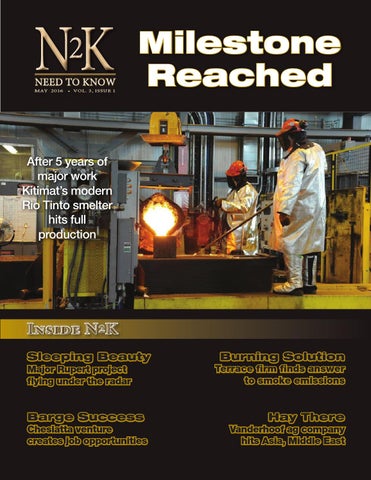
Milestone Reached
After 5 years of major work Kitimat’s modern Rio Tinto smelter hits full production
Inside N 2 K Sleeping Beauty Major Rupert project flying under the radar
Barge Success Cheslatta venture creates job opportunities
Burning Solution Terrace firm finds answer to smoke emissions
Hay There Vanderhoof ag company hits Asia, Middle East
A little friendly competition If you attend a Skills Canada event, you meet young individuals that can show you tricks from just about any trade you can imagine. In April 2016, competitors from post-secondary, secondary, middle and elementary schools competed in the Provincial Skills Canada British Columbia Competition in Abbotsford, BC. Justin Jansons, competitor in welding from Northwest Community College
Lucas Erni, competitor in carpentry from Hazelton Secondary School
Instructors from post-secondary institutions select qualified students who then compete in areas divided by training/grade levels at a regional level. Gold medal winners at the regional level then qualify to participate in the provincial level competition. Students from schools in our own backyard – Caledonia Secondary School, Northwest Community College, Hazelton Secondary School, Smithers Secondary, Houston Secondary School – had a strong presence at the event this year, many of whom earned their place in the provincial competition by winning at the regional level. LNG Canada had a chance to catch up with a few of those competitors, who were showing their stuff in categories spanning from carpentry to welding and more. Why are youth getting into the trades?
Jesse Sheppard, competitor in automotive service from Caledonia Senior Secondary School
In chatting with those students from Northwestern B.C., the reasons ranged from following in the footsteps of a respected relative, trying a class at school that opened eyes to new possibilities, craving a change, or discovering by chance a talent suited to a career in the trades. Jasmine Gardner, an assertive ninth grader and aspiring Jill of all trades told us, “I’m interested in taking
This space is a collaborative promotional venture by LNG Canada and N2K
this course where you do-over an RV. It involves 14 different trades so by the end you know a bit of each. Then I can fix my own house, I wouldn’t have to pay someone else to do it.” Another young man who competed in the welding competition told us that in the long run his hope is to get a job with LNG Canada in Kitimat, because “there’s more work in Kitimat at the moment … and great river fishing!” The aspirations of these individuals all look different, but the one thing they have in common is an impressive forwardlooking attitude. We were impressed by the thought they have already put into their futures. An 18-year-old carpentry competitor told us that he already knew he was in pursuit of his Red Seal and hopes to stay in Northern B.C. for the long haul. And another astute student, an aspiring hair dresser, pointed out that the trades are something we’ll always need. No matter what’s going on, you’ll always need someone who can build a house, someone to do your hair, someone who can cook … despite technology becoming more and more advanced, there are some things we’ll just always have a need for.
You
asked about
BUSINESS OPPORTUNITIES
Small business is the backbone of the local economy. We’re doing what we can now to support small business.
Come support local people as they take part in the ThriveNorth Business Challenge! Watch 12 young entrepreneurs pitch their business ideas for a total of $40,000 in prize money. Tyler Meers — Tyler Meers Photography
See what the emerging business ideas are coming out of the northwest. You can even cast your vote for the Audience Award! When: Saturday, May 7 from 2pm - 7:30pm Where: REM Lee Theatre - Terrace, BC. Register now at ThriveNorth.ca. Simone Crook and Kristine Ewald — Transcend Fitness ThriveNorth helps young entrepreneurs start or grow their own business. It is a joint initiative between Futurpreneur Canada and Prince Rupert LNG, the proposed LNG project on Ridley Island. Sign up for our email updates at www.princerupertlng.ca to stay informed. We also encourage you to visit Rosa and Herb at our local Prince Rupert office located at 610 2nd Avenue West.
Rosa Miller
Herb Pond
NK
NEED TO KNOW
2
Publisher & Editor-in-Chief Todd Hamilton Prince Rupert Ed Evans, Sales Trevor Budskin, Sales Kevin Campbell, Reporter Shannon Lough, Reporter Terrace Rod Link, Editor Bert Husband, Sales Erin Bowker, Sales Kitimat Louisa Genzale, Sales Smithers Grant Harris, Sales Nick Briere, Sales Xuyun Zeng, Reporter Houston Mary-Anne Ruiter, Sales Burns Lake Laura Blackwell, Sales Flavio Nienow, Editor Fort St. James/ Vanderhoof Pam Berger, Sales Vivian Chui, Reporter Barbara Latkowski, Reporter Haida Gwaii Quinn Bender, Sales Andrew Hudson, Reporter N2K CONTACT INFO:
Vanderhoof Fort St. James Burns Lake Houston Smithers Terrace Kitimat Prince Rupert Haida Gwaii
• • • • • • • • •
250-567-9258 250-567-9258 250-692-7526 250-845-2890 250-847-3266 250-638-7283 250-632-6144 250-624-8088 250-559-4680
N2K is a Black Press publication mailed or delivered by carrier to more than 30,000 homes and businesses throughout Northwest B.C. Our Head Office is located at: 737 Fraser Street, Prince Rupert, B.C., V8J 1R1 250-624-8088 Fax: 250-624-8085
F
NORTHWEST B.C.’S INDUSTRY MAGAZINE
or some, Northwest B.C. has been deemed Tomorrow Land. There is always talk of that next big project that will make all the difference. To be certain, for one reason or another, a number of major projects have stumbled on the way to the finish line, so it is understandable that there are those who have taken the ‘I’ll believe it when I see it’ stance on all the possibilities currently in the mix. However, the Top 2 projects that put Northwest B.C. on the industrial map continue to pay huge dividends to the socio-economic well-being of our region. 1) The Kitimat aluminum smelter. 2) The Prince Rupert port. In this issue of N2K, Kevin Campbell reports on Rio Tinto reaching full production following its major modernization project and Shannon Lough outlines the quietly unfolding expansion at the Port of Prince Rupert. The beneficial impact of both of these operations can be felt in every nook and cranny of Northwest B.C. And as we all await green lights on a number of other major projects, it is hard to overlook the continuing advance of the projects we already do have. As N2K celebrates going into its third year of informing all of Northwest B.C. — and to many other places in this country and elsewhere through our growing out-of-market subscriptions and online service — about the great things happening in our region, we will continue to highlight not only what may happen, but continue to focus on what is happening. After two years of talking to and reporting on all of the industry success stories going on in Northwest B.C., we have come to the realization that maybe John Lennon was right. “Life is what happens while you are busy making other plans...” So while some may be waiting for tomorrow to come, we humbly suggest that with all the activity, today isn’t all that bad and, in fact, maybe tomorrow has already arrived — it’s just early in the morning. Todd Hamilton N2K Publisher publisher@thenorthernview.com
Out-of-area subscriptions now available e-mail: circulation@thenorthernview.com View our e-version for free at: www.thenorthernview.com/eeditions
SAY YES TO OPPORTUNITY
We are proud to be a part of the local communities. New local jobs will give young people and future generations more opportunities to stay in northwest BC.
PNW LNG has generated the following local economic activity since September through our investigative work:
$9.4M Spent in total with local companies $2.4M Spent with First Nations businesses 225
Jobs for local residents and First Nations
For more information, visit one of our community offices in Port Edward or Prince Rupert, PacificNorthWestLNG.com or call 250.622.2727.
During our investigative work, we used local people and companies to provide the following: Environmental Monitoring
Electrical Installation and Maintenance
Safety Supplies
Engineering Services
Crane Equipment
Barges
Office Supplies
Accommodations
Geotechnical Services
Catering
First Aid Equipment and Services
Surveying Services
PacificNorthWestLNG.com
Canadian Energy. Global Reach.
A REALLY BIG DEAL
Massive Rupert port expansion 40 per cent complete
N
By Shannon Lough
orthwest B.C. is three hectares bigger today. The landmass has been added to Fairview terminal at a cost to DP World of $200 million to allow for two container ships to dock and unload in Prince Rupert Harbour. Project manager, Terry Stewart, for FRPD-BEL Gateway Joint Venture, explained the enormity of the Phase 2 port expansion since it began in March 2015. The intricate details of the work being done to extend the terminal and enlarge it from 360 to 765 metres, in order to add four large ship-loading cranes, has flown pretty much under the radar. “When I look around town it seems to me that this project is a bit of a sleeper project,” Stewart said. The work is 40 per cent complete with the goal of completion by June 2017. The most visible development is where a chunk of the earth has been excavated from the side of a hill and relocated to the new section of the terminal where the ocean used to be. “Everybody is hyped over LNG. This is real. There are hundreds of jobs here. From what I understand, DP World takes people in the door and they train them right here in town. You don’t have to go somewhere else for your education and you can stay here with that job. That’s a huge good news story that is tough to get out,”
N2K
“Everybody is hyped over LNG. This is real. There are hundreds of jobs here.” - Terry Stewart he said. Those jobs will come once the project to increase the terminal’s capacity by 500,000 containers per year is complete. The construction work happening now is temporary but it has still contributed to the economy on the North Coast. The construction is a joint venture between two B.C. companies, Fraser River Pile and Dredge to deal with the marine scope and BEL Contracting to manage the work on land.
Continued on Page 8
7
By the end of the project $39 million will have been spent locally.
“These two partners still don’t do everything themselves. They subcontract because there are certain things that specialists are better at and in particular local specialists,” Stewart said. Up to this point, the project has injected $15-million in the local economy. Stewart said that by the time they finish the work $39-million will be spent locally. Between 35 and 45 per cent of labourers are hired from the region. A total of $150 million will be spent in the province by the end of the project. The expansion may also be considered a “sleeper
project” due to the lack of noise complaints. There has been at least 150 blasts in the area, and Stewart said that while he’s been on site he might have only heard three or four. The specialists doing the blasting usually work in urban areas where they have to avoid disrupting nearby buildings and traffic. Also, the rock that is being blasted crumbles easily, and the blasts that were done were “small and muted”.
VANDERHOOF and DISTRICTS CO-OPERATIVE ASSOCIATION 15 Cardlock Locations: Fort St. James To Quesnel, Terrace To Valemount. Fuel Tanks Sales & Rentals, Bulk Fuel and Oil Deliveries: Vanderhoof Toll Free: 1-888-545-2667, Quesnel: 1-888-992-2667, Prince George: 1-866-309-2667 Houston: 1-800-848-6347, Terrace: 250-635-9595
Continued on Page 9
“The level of public enthusiasm in Prince Rupert for port development is one of the gateway’s most important strengths.”
Another point Stewart mentioned to the environmentalists in the room is that the project is using bubble curtain technology to avoid harm to the marine life. What they do is lay a hose on the seabed and pump air in it so the bubbles come to the surface and the fish stay away from the area. “You’ll have to ask the fish why they do that but its a great technology. So we’re able to work in the water and not harm fish, which is important.” The informational event drew a full crowd at the Port Interpretive Centre. Michael Gurney, the manager of
corporate communications at the Port of Prince Rupert said, “The level of public enthusiasm in Prince Rupert for port development is one of the gateway’s most important strengths.” “Residents here have a stake in the port’s growth — whether through direct employment or the general benefits of trade. With initiatives like the Trade Talks series, our aim is to provide insight into an industry that so many are already interested in.” -N2K-
RIO TINTO’S MODERN SMELTER HITS ITS FULL STRIDE
10
N2K
WORLD CLASS
Kitimat project a game-changer for metal production emissions
I
By Kevin Campbell
t’s finally here. Rio Tinto’s modernized smelter is fully online and, as of March 29, has reached full production. A project — almost five years in the making — to replace the aging smelter in its Kitimat location, Rio Tinto has torn down, constructed and rebuilt a new aluminium smelter, all to improve efficiency, reduce overall emissions to the environment, improve health and safety standards and provide area jobs for approximately 1,000 highly-skilled positions. Originally starting operations in 1954, Rio Tinto’s Kitimat Modernization Project (KMP) is revamping operations in every way. The old smelter, officially decommissioned on Oct. 15, 2015, used the older Soderberg technology. Six decades, an estimated 29 billion kg of aluminum and two trillion aluminum beverage cans later, the old smelter facility finally went dark, paving the way for the state-of-the-art proprietary AP40 smelting technology. The Aluminum Pechiney pre-bake tech allows for 384 pots in a single potline and its capacity has increased 48 per cent to 420,000 tonnes annually. “We have the ability to be the most competitive and best smelter in the world. We’ve got the best technology that we can have for producing metal,” said Kevin Dobbin, principal advisor community and
N2K
“We have the ability to be the most competitive and best smelter in the world.” - Kevin Dobbin social performance, B.C. operations. “So it’s a transition. All of our workers now are working toward the new smelter. It’s an adjustment. Some people compare it as going from a 1954 to 2016 Ferrari, it’s that much of a difference.” The KMP was a $4.8 billion investment by Rio Tinto and construction peaked with 3,500 workers working on the site. “We are now producing as much metal as we can,” added Dobbin. Although the new smelter consumes more power, the capacity has increased and overall emissions have been reduced by 50 per cent. Continued on Page 12
11
Kitimat Modernization Project achieves milestone “The emissions [measured so far] have been very low and steady. It is significantly below the [provincial] guidelines,” Dobbin said. “The emissions used to come right at the floor of the pots, so they were exposed and the emissions were coming out at the ground level exposing our employees to that. The new system is a closed system. The dispersion method is through 200-foot stacks in the sky at high speed intensity, so it’s hugely beneficial to our employees.” The KMP allows power to be sourced from the Rio
12
Tinto-owned Kemano hydroelectric power generating station, creating an overall lower carbon footprint. “Kitimat is a world-class aluminum plant, and I would like to thank all the people that have made this milestone possible, especially all our employees. I am particularly proud that this project was delivered with a world-class safety record ... Kitimat is now one of the lowest-cost and most efficient aluminium production facilities in the world,” said Rio Tinto aluminum chief executive Alf Barrios.
Mayor of Kitimat Phil Germuth also spoke glowingly of the KMP. “It’s going to have a huge impact long-term for sure. You look at all of B.C. and the aluminum industry – the smelter that was here before, of course, was brilliant, one of the only industries in B.C. that ran pretty much 24 hours a day, seven days a week for the first 60 years and we’re looking forward to another 60 years of certainty in the community of the aluminum industry being here,” Germuth said.
N2K
“Kitimat is a world-class aluminum plant, and I would like to thank all the people that have made this milestone possible.” - Alf Barros 13
CHESLATTA SUCCESS ... THE
E T E R C N O C M AN
Authorized Flygt Distributor& Repair Depot • Ready Mix Concrete Sales, Service, Rentals and Parts • Concrete Foundations • Excavating & Demolition • Concrete Pumping • Concrete Finishing • 100+ concrete blocks in stock • Drain Rock & Road Crush • Sand & Gravel • Snow Removal & Sanding
General Manager: Gerald Sensenig
250-692-3324 concrete-1@telus.net 2350 Fountain Road Burns Lake, BC V0J 1E1
SEE PAGE 15
UNUSED BARGE
NOW JOB CREATOR
C
By Flavio Nienow
heslatta Carrier Nation (CCN) has approximately 285 members and is located south of Francois Lake in an area known as the “Southside,” approximately 32 kilometres south of Burns Lake via Hwy. 35. When CCN purchased a commercial barge from Rio Tinto in 2012, the barge was not a necessity. “We had nothing happening in 2012,” said James Rakochy, CCN Marine Manager. “We purchased it on speculation that things would improve.” Although the barge was in full operation in the early 2000s, when logging companies were harvesting in the Southside, more profitable logging closer to the sawmills eventually pulled logging companies out of the area. “There was cheaper wood closer to the mills,” explained Rakochy. “So everybody left the area [Southside] and there was no demand for that barge.” Even though the barge had been sitting on Ootsa Lake for many years, not being used, Cheslatta saw the barge as an opportunity. They not only purchased the barge, but also two tug boats that belonged to a private logging contractor. “There was infrastructure there and we wanted to see it utilized,” said Rakochy. “We didn’t want those boats leaving the lake because to get one of those tug boats in and out of the lake is a big job.” As it turns out, Cheslatta’s investment paid off. In 2014, the area was struck by the biggest wildfire of the year in British Columbia. It occurred near the Chelaslie River, consuming approximately 1330 square kilometres, or 133,100 hectares. “We were ready with the barge and tug, so the government hired our barge services for three months to fight that fire to haul equipment back and forth.” In 2015, Cheslatta closed a two-year deal with Canfor. The deal allows Canfor to harvest areas affected by the mountain pine beetle epidemic on Cheslatta territory and to use CCN’s barge to carry wood across Ootsa Lake. All the wood has been transported to Canfor’s Plateau Sawmill in Vanderhoof. In the last nine months, the barge hauled 250,000 cubit metres of wood, which equates to an average of 28 truckloads per day. For its second year of operation, the barge is expected to carry another 250,000 cubic metres of wood.
N2K
“That was such an important part of why we bought it ... to provide jobs for Cheslatta people.” - James Rakochy
That barge has provided full-time work to four CCN band members, who are now captains and deckhands. In addition, 12 more band members are now being trained for marine operations,. “That was such an important part of why we bought it [the barge],” said Rakochy. “To provide jobs for Cheslatta people.” Rakochy said part of the profits will also be put toward housing and expansion of CCN’s marine operations. The tug boat that now works full time tugging the barge across Ootsa Lake - The Valerie - has a peculiar story itself. The 1950s’ tug boat, which sank in 2013, received a great deal of attention when a Discovery Channel film crew travelled to the Southside to recover it from Ootsa Lake. The recovery team included Jamie Davis, made famous in the television series Highway Thru Hell. The Valerie received a full restoration by Industrial Transformers Inc. early last year. The second tug boat - The Davis Straits -, which also sank and was recovered in 2013, is currently sitting in dry dock. However, Cheslatta has plans to give this tug a full restoration. “We may actually start cleaning it up in preparation to be restored this summer,” said Rachoky. “In anticipation of some other projects that might happen on the lake, we eventually see a use for that boat.” Although the contract with Canfor ends in 2017, Rakochy sees opportunity for at least three more years of salvaging on Cheslatta territory. “There should be no reason why that barge shouldn’t continue for another three years to remove the dead pine and get that forest replanted and regrown,” said Rakochy. “We’re hoping the province will find a way to keep that harvest going there [Southside],” he added. “Cheslatta is very proud of their marine operations on the Nechako reservoir and we want to see it continue.” -N2K-
15
GOLD PRICES KEY TO SKEENA ACQUISITION “Two million ounces is By Xuyun Zeng Skeena Resources Ltd. entered into an option agreement with Barrick Gold Inc. to acquire 100 per cent interest in the Snip gold mine on the Iskut River near the Alaskan border last month. The terms of the option are that Skeena will issue 3.25 million shares, worth about $260,000 as of April 12, to Barrick, and commit to putting in at least $2 million of work within the first 30 months, of which $500,000 must be spent within the first 12 months of the agreement. Barrick will also receive one per cent of the net smelter returns on that property. Barrick reserves a back-in right to earn 51 per cent interest once Skeena fulfills all conditions set out in the agreement and finds over 2 million ounces of gold at Snip. Barrick would pay three times Skeena’s work expenditures, which could exceed the $2 million promised. “Two million ounces is probably a figure that would interest Barrick, being a big gold mining company,” said
probably a figure that would interest Barrick ...” - Tony Perri
Skeena manager of investor relations Tony Perri. “These big companies, they mainly try to find resources of two to 10 million ounces before they get involved.” Perri said that both companies complement each other in that Skeena specializes in exploration while Barrick does mining. Barrick is based in Toronto and is the largest gold mining company in the world. “Typically, that’s their area of expertise, because they have mine engineers that can develop a potential mine much better than we would be able to do, and quite seriously, we don’t want to get in that area,” he said. Continued on Page 17
COMMERCIAL PRODUCTION TARGET 2017
ADVANCING CONSTRUCTION OF THE HIGH-GRADE GOLD BRUCEJACK PROJECT IN NORTHERN BC
PVG:TSX/NYSE | pretivm.com
Paving of Hwy 37, port operations at Stewart and the Northwest Transmission Line have made the Snip Mine more attractive However, if Skeena finds less than two million ounces of gold at the Snip gold mine and Barrick cannot exercise its back-in right, Perri said that Skeena would have other options. “We would probably get offers from other companies or Barrick may still choose to do an offer to take up the whole company, because Snip isn’t our only property, we have two other properties,” he said. “They have a lot of value of their own, and if we add another, let’s say, 1.99 million ounces on the rest of the portfolio, makes for a pretty attractive take out potential for the whole company.” The property consists of one mining lease and four mineral tenures covering about 1,932 hectares within the Golden Triangle. The acquisition of the mine was chiefly motivated by higher gold prices. “It always comes down to gold prices, because the infrastructure challenges can be overcome if you have a good enough gold price to make it worthwhile,” said Perri. During the mine’s time in operation from 1991-99, gold prices hovered around US$300-400. A minimum grade of 12 grams of gold per tonne was necessary for an economical operation, and Snip was producing 25 g/ tonne. A severe drop in mechanized mining shrunk from approximately 82 per cent in its first production year,
N2K
“At these gold prices, you’ll probably see lots of mines ... mining average grades of 2g/tonne ... [Snip produced 25g/tonne].” - Tony Perri 1991, to 16 per cent by in 1998, almost doubling the mining costs per unit. Gold surged to a high of US$1,890 in 2011 and was about US$1,242 in mid-April. “In today’s day, 12 g/tonne is considered high grade,” said Perri. “At these gold prices, you’ll probably see lots of mines that are in operation that are mining average grades of 2 g/tonne.” Improved infrastructure has also made the mining at Snip more attractive. Back then, the mine could only be accessed by plane or hovercraft from Alaska. Today, the paving of Highway 37, export facilities at Stewart and access to electricity have improved prospects. -N2K-
17
BURNING SOLUTION Timber Baron’s air curtain burners solve smoke problem By Rod Link
A
Terrace company may just have the answer to the clouds of smoke caused by the open burning of wood waste and other organic material. Depending upon needs and circumstances of a client Timber Baron Contracting (2013) Ltd. hauls large rectangular steel fireboxes to a specific location. Once waste has been piled in and lit, the air curtain burner goes to work. It’s called that because a blower powered by a diesel motor forces air over the flames throughout the firebox. Acting as a protective cover, the curtain of air helps keep We specialize in sustainable site, building & interior design, heritage restoration & project management.
Commercial
Custom Homes
Industrial
Town Houses
Cultural
Condos
Recreational
Float Homes
alora griffin architect Alora S. Griffin Architect AIBC, MRAIC, LEED AP Box 983, Prince Rupert, BC, V8J 4B7
Phone: (250)627-1777 Email: architect@citywest.ca Website: aloragriffinarchitect.ca
smoke and particulate matter from escaping, forcing both back down into the firebox where it is then consumed in the intense heat, explains Timber Baron president Mike Thomson. “You create a blanket over top and with convection on the bottom,” he said. The firebox itself is lined with reinforced concrete panels which become very hot themselves, adding to the overall heat of the firebox and generating the kinds of temperatures needed to ensure the waste is burned.
Continued on Page 19
Timber Baron’s largest air curtain burners at 30 feet long by eight feet wide can consume as much as 10 tons of material an hour. “Of course it depends on the kind of material. The drier the better. If you have large stumps with dirt and mud, that can take longer to burn,” said Thomson. The hotter the burn, the less smoke and particulate that rises into the air. The air curtain burner operator can also adjust the flow of air for the right combination to keep the fire burning at its optimal temperature. “It’s just like a carburetor, adjusting the air to fuel ratio,” says Thomson. What ash that’s left can either be buried on site or taken elsewhere for disposal. Thomson credits BC Hydro’s Northwest Transmission Line project in leading him to the air curtain burner technology. Like many Terrace and area companies, Timber Baron benefitted from the construction of the 287-kilovolt line which runs 344 kilometres north of BC Hydro’s Skeena Substation. Hired by the Nisga’a of the Nass Valley who were contracted by BC Hydro to clear the right-of-way for the line as it passed through their territory, Thomson ran into the challenge of what to do with the wood waste left after merchantable timber was removed. The traditional method of dealing with waste, piling it up high and then burning was discounted, particularly if the waste was located close to villages. “You could mulch and pile, but that would cause its own problems with leaching,” said Thomson. He also needed a workable solution that would keep right-
N2K
“There’s a social aspect to this as well by reducing emissions.” - Mike Thomson of-way clearing on schedule and within budget. Thomson’s search for a solution then lead him to the air curtain burners which are manufactured in the United States. They conform to California emissions standards, among the strictest in North America, which deal with factors such as allowable opacity of material being burned. Aside from the efficiency of dealing with waste, Thomson says air curtain burners also appeal to large industrial companies wanting good relations with the people who live where the projects are located. “There’s a social aspect to this as well by reducing emissions,” he said. Rio Tinto Alcan also hired Timber Baron to burn pallets and other waste wood material generated from its just-finished Kitimat smelter reconstruction project and the company has incinerated waste at a Fort St. John industrial subdivision. And Thomson’s been in touch with several of the companies that would build natural gas pipelines to proposed liquefied natural gas projects. He’s not aware of other companies in B.C. offering this kind of service although he’s heard they are used by some remote communities to dispose of waste that would otherwise be buried in landfills. -N2K-
19
Vanderhoof’s Tophay Agri-Industries to double its size
I
By Vivian Chui
Vanderhoof ’s hay is now nourishing livestock beyond Canada, reaching animals in Asia and the Middle East. Showcasing its hay-pressing machinery to more than 30 members of Vanderhoof ’s farming community in March, the Vanderhoof-based Tophay Agri-Industries Inc. is looking to expand its operations through local support, said the company’s spokesperson Relax Ding. Currently producing 10,000 to 15,000 metric tons of hay per year, Tophay aims to eventually increase its production to 50,000. This summer, the company will expand its equipment for hay compression to double its current size, Ding said. The machine cuts bales into three pieces and presses each to half its volume, producing half-cut bale blocks of 25 to 30 kilograms that are easy for conservation and shipping, he explained. “We can’t produce all the hay by ourselves, so that’s why we are working with the local farmers, to benefit each other,” he said, adding that hay is currently priced at $290 to $350 USD, while bales that have been rained on — about 30 per cent of all produced — tend to decrease in value by $50. “Our idea is to sell all the products from the farmers,” Ding said. Started in 2012, the company began with 72 acres of
20
land on Carmen Hill Road West and now own 12,000 acres in the region, he explained. Its directors, involved with China-based international businesses of various sectors such as logistics and electronics, found that China imported a large amount of alfalfa from the United States, and picked Vanderhoof for its location, he said. “Vanderhoof is the second biggest farming community in B.C.,” Ding said. “It’s close to the Prince George railway station, where we ship the hay to Prince Rupert.” The central B.C. climate is also a factor in the quality of hay produced. “Here there’s good land and good water,” Ding said. “The hay retains more sugars, since it’s so hot in the day and so cold at night in the north.” In the past, Japan was the biggest hay purchaser with 1 million tons per year, but China rose to the top this year with 1.2 million tons — Tophay customers included sheep farmers, race horsing associations, and Cirque de Soleil in China, he said. In the Middle East, Tophay’s hay was sold as feedstock for camels and dairy productions, and the company looks to explore the Japanese market this year.
Continued on Page 21
N2K
“People realize that quality hay will give them good production of the milk,” Ding said. Last June, David Martens and Sons Limited sold 3,200 acres of its 6,000-acre holdings to Tophay. The 60-year-old business, managed by David’s six children for the last 30 years after he died, kept its dairy production under Allan Martens and its beef herd under Richard Martens, as well as 1,000 acres under Dale and Sheila Martens, Dale said. “I think it’s been a positive thing for the community,” he said. “There’s extra options for the farmer to market their feed.” The couple looks to sell 300 acres of hay to Tophay this year, while Dale’s brothers will be cooperating with the company by trading high quality hay for feed of lower quality, Dale explained. “The cow calves usually use up your poor feed… they can survive on almost anything,” he said. “Might as well export the good stuff.” In the past, the family’s hay was used to feed domestic livestock. “Some years, of course, it’ll be better to sell the feed and they might make more that way than they do with the cattle.” Dale explained. “It’s like any other business…there are years where the cattle prices are good.” For Mayor Gerry Thiessen, who also attended the machinery showcase, the growth of hay exporting from Vanderhoof helps with the community in diversifying
Quality Through Craftsmanship EXPERTS IN Piping & Plumbing Structural Steel & Fabrication Flat Roofing
its industries. “Agriculture has always been the mainstay of Vanderhoof,” Thiessen said. “Nothing is a silver bullet, but bit by bit, it adds to our community.” -N2K-
PRINCE RUPERT’S OWN AIRLINE PROUDLY SERVING THE NORTH COAST SAFELY SINCE 1981 DAILY SCHEDULED SERVICE TO MASSET AND SURROUNDING COMMUNITIES
Sheet Metal & Cladding Machining Metal Working Millwrighting COMMERCIAL - INDUSTRIAL - RESIDENTIAL 245 - 3rd St. Kitimat Tel. 250-632-6859 Toll Free 1•877•632•6859 101first@101industries.com www.101industries.com
Serving the Northwest for Over 47 years
WHEN EXPERIENCE COUNTS FLY WITH INLAND AIR
Prince Rupert: 250-624-2577 • Queen Charlotte: 250-559-4222 Masset: 250-626-3225 • Toll Free: 1-888-624-2577
www.inlandair.bc.ca
edo@kitimat.ca www.kitimat.ca
Career Opportunities
Automotive Technician Charlotte Tire has an immediate opening for an eperienced auto technician. We are a very busy shop providing quality repairs on the Queen Charlotte Island. We offer a very competitive compensation package! Please e-mail resume: bill@ctires.ca
A division of
#UsedHelps
PRESERVING
TRADITIONAL FOOD
T
he Port of Prince Rupert announced late last month that a $244,000 investment from its Community Investment Fund will help preserve traditional food production, increase nutritional education and develop new skills within the Gitxaala Nation. A celebration in the coastal village of Kitkatla, BC to bless and commission two new community spaces: a garden and greenhouse where local produce will be grown, and a kitchen and eatery for food preparation and training. “We couldn’t be happier after seeing the impact of these projects first-hand,” said Don Krusel, President & CEO of the Port of Prince Rupert. “The community kitchen and garden are physical embodiments of the spirit of our Community Investment Fund, which was established to enable significant quality of life improvements to a broad demographic of community members. Experiencing these facilities, surrounded by members of the Gitxaala Nation, it was evident how useful these community assets already are, and will be for years to come.” “We are very thankful to the Port of Prince Rupert’s partnership and financial contributions, for the Green House and Community Kitchen.” said Clifford White, Chief Councillor of the Gitxaała Nation. “These new facilities will go a long way to fostering the greater independence and sustainability of our nation, providing meaningful educational opportunities while strengthening the social fabric of our community.”
Proposed Ridley Island Propane Export Terminal Project Site
PROPOSED RIDLEY ISLAND PROPANE EXPORT TERMINAL PROJECT PUBLIC COMMENTS INVITED BY MAY 20, 2016
In accordance with Section 67 of the Canadian Environmental Assessment Act, a federal environmental assessment of AltaGas’ proposed Ridley Island Propane Export Terminal, located near Port Edward and Prince Rupert, British Columbia, is being conducted by federally responsible authorities. A 30-day public comment period is now open. This public comment period is an opportunity for all stakeholders to provide input and feedback on the proposed Ridley Island Propane Export Terminal Project. The public is invited to comment on the Project Description, a document that includes information on the proponent and an overview of the Project. SEND Your written comments to info.ridleypropane@altagas.ca by May 20, 2016 PARTICIPATE IN AN OPEN HOUSE AND INFORMATION SESSION To learn more about the proposed Project May 10 - Port Edward 4:00 - 6:30 p.m. Community Centre Municipal Complex 770 Pacific Avenue VISIT ridleyislandpropane.com for more information about the Project and to obtain a digital copy of the Project Description
May 11 - Prince Rupert 4:00 - 6:30 p.m. North Coast Convention Centre 240 1st Avenue West
Trade is building stronger communities. The Port of Prince Rupert is growing opportunities and prosperity by connecting the communities of northern BC. Last year, port activity was directly responsible for the equivalent of 3,060 permanent full-time jobs. Watch and share our video tribute to the workers and families of BC’s gateway industry: youtube.com/rupertport.