Page W4 · Richmond Review
Friday, February 27, 2014
Friday, February 27, 2014
Richmond Review · Page W1
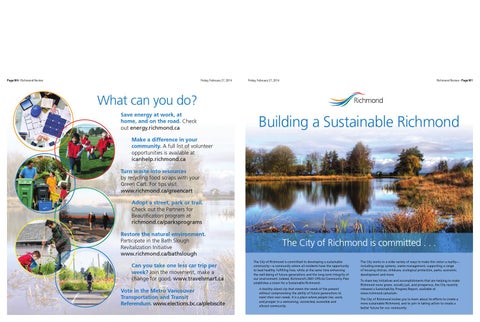
What can you do? Save energy at work, at home, and on the road. Check out energy.richmond.ca
Building a Sustainable Richmond
Make a difference in your community. A full list of volunteer opportunities is available at icanhelp.richmond.ca Turn waste into resources by recycling food scraps with your Green Cart. For tips visit www.richmond.ca/greencart Adopt a street, park or trail. Check out the Partners for Beautification program at richmond.ca/parksprograms Restore the natural environment. Participate in the Bath Slough Revitalization Initiative www.richmond.ca/bathslough Can you take one less car trip per week? Join the movement, make a change for good. www.travelsmart.ca Vote in the Metro Vancouver Transportation and Transit Referendum. www.elections.bc.ca/plebiscite
The City of Richmond is committed . . . The City of Richmond is committed to developing a sustainable community—a community where all residents have the opportunity to lead healthy, fulfilling lives, while at the same time enhancing the well-being of future generations and the long-term integrity of our environment. Indeed, Richmond’s 2041 Official Community Plan establishes a vision for a Sustainable Richmond: A healthy island city that meets the needs of the present without compromising the ability of future generations to meet their own needs. It is a place where people live, work, and prosper in a welcoming, connected, accessible and vibrant community.
The City works in a wide variety of ways to make this vision a reality— including energy systems, waste management, supporting a range of housing choices, childcare, ecological protection, parks, economic development and more. To share key initiatives and accomplishments that are helping to make Richmond more green, socially just, and prosperous, the City recently released a Sustainability Progress Report, available at www.richmond.ca/sustain. The City of Richmond invites you to learn about its efforts to create a more sustainable Richmond, and to join in taking action to create a better future for our community.
Page W2 · Richmond Review
Friday, February 27, 2014
Friday, February 27, 2014
Richmond Sustainability Action Highlights Climate Action The City has adopted strong targets to reduce greenhouse gas emissions and energy use, and is taking a range of actions to address climate change. Richmond is especially recognized as a leader on district energy systems, which can provide renewable energy for entire neighbourhoods from centralized sources. The City has received multiple awards for engineering and environmental excellence for the Alexandra District Energy Utility (ADEU), which uses renewable ground-source energy to heat and cool buildings in the West Cambie neighbourhood. The City is also proactively adapting to future climate change. For example, the City upgrades drainage, diking, and flood protection systems annually.
Leadership on Zero Waste Initiatives In 2013, the City achieved its goal of 70 per cent waste diversion from single family homes, two years ahead of schedule. The City is now expanding recycling and composting programs, to help multifamily and commercial buildings meet this target in 2015. Since 2013, the City has enhanced its Green Cart recycling program for food scraps and yard trimmings; expanded the range of materials accepted for recycling in the Blue Box and Blue Cart; and introduced a Large Item Pick Up program, making it easier for residents to recycle furniture and appliances.
Smart Transportation Investments The City is committed to improving our transportation infrastructure, so that more people will choose to walk, bike, roll, or take transit. The Canada Line has improved transportation options in City Centre, and exceeded ridership expectations. Since adopting its first On-Street Cycle Network Plan in 1996, the City has invested regularly in its bicycle routes, greenways, and trails. And the City supports low carbon electric vehicles, providing public charging stations, and requiring that new multifamily developments accommodate vehicle charging equipment.
Green Buildings In 2014, the City updated its High Performance Building Policy, setting strong green building standards for City facilities. The City also works with the development community to ensure new private developments’ high performance. In November 2014, the Richmond Building Energy Challenge was launched, a friendly competition to reduce energy use in larger buildings, which offers incentives for building operators to take energy management training.
A Resilient Economy The City works to develop a resilient economy—one that can thrive in the face of global economic and environmental change. The City’s Business Development Program helps businesses expand or relocate in Richmond; provides information; and identifies resources and incentives for local businesses. Richmond’s Employment Lands Strategy aims to ensure that sufficient land for key economic sectors, like light industry and office, are available in the future.
Social Development The City works to improve social conditions for all its residents, guided by the vision, goals and directions of the Richmond Social Development Strategy. As part of new developments, the City has secured 460 subsidized housing units since 2007, and 400 childcare spaces since the 1990s. Additional housing units, child care spaces, and other community amenities are forthcoming. The City is currently updating its Youth Services Plan—identifying priority areas of focus for youth services and programs for the next five years. Similarly, the City is updating its Older Adult Service Plan, and completing an AgeFriendly Community Assessment. In turn, the City will be pursuing official designation as an Age Friendly Community, in accordance with World Health Organization guidelines.
Arts, Heritage & Community Wellness Richmond is committed to supporting a flourishing culture, and a healthy, high quality of life for its residents. The City provides for a variety of cultural services, including the Richmond Public Library, Museum, Arts Centre, Gateway Theatre, and a range of public art and heritage assets. Likewise, our parks and open spaces and community facilities provide opportunities for the community to connect and engage in activities that support healthy, active lifestyles. To expand on its community amenities, the City is currently developing a new City Centre Community Centre, and the Minoru Recreation Complex, which includes new aquatic facilities, an older adults component and improved park amenities.
Ecological Protection Richmond is endowed with many areas of high ecological value—the Fraser River is one of the most productive salmon rivers on Earth, and Richmond’s West Dike, South Arm Islands, and the City’s system of parks and open spaces represent critical habitat for migrating birds and other wildlife. In recent years, the City acquired new parks and open spaces, and engaged in habitat protection and restoration in Terra Nova Rural Park, the Grauer Lands off the West Dike, the Northeast Bog forest, and Bath Slough, amongst other locales.
Local Agriculture & Food Security Richmond is committed to maintaining our community’s agricultural lands and the viability of farming. Additionally, the City supports opportunities for people to learn about, market and grow food. The City has entered into an agreement with the Sharing Farm Society to produce organic fruits and vegetables on 1.1 hectares in Terra Nova Rural Park to support greater food security for low-income families. And in partnership with Kwantlen Polytechnic University, the City endorsed that 1.8 hectares of park space be used as an “Incubator Farm” to support the next generation of farmers.
Planning for Tomorrow To accommodate future growth, Richmond strives to achieve a transit-oriented, urban village model of development. In 2014, the Federation of Canadian Municipalities recognized Richmond’s City Centre Area Plan with an Honourable Mention for Sustainable Community Planning.
Richmond Review · Page W3
Page W2 · Richmond Review
Friday, February 27, 2014
Friday, February 27, 2014
Richmond Sustainability Action Highlights Climate Action The City has adopted strong targets to reduce greenhouse gas emissions and energy use, and is taking a range of actions to address climate change. Richmond is especially recognized as a leader on district energy systems, which can provide renewable energy for entire neighbourhoods from centralized sources. The City has received multiple awards for engineering and environmental excellence for the Alexandra District Energy Utility (ADEU), which uses renewable ground-source energy to heat and cool buildings in the West Cambie neighbourhood. The City is also proactively adapting to future climate change. For example, the City upgrades drainage, diking, and flood protection systems annually.
Leadership on Zero Waste Initiatives In 2013, the City achieved its goal of 70 per cent waste diversion from single family homes, two years ahead of schedule. The City is now expanding recycling and composting programs, to help multifamily and commercial buildings meet this target in 2015. Since 2013, the City has enhanced its Green Cart recycling program for food scraps and yard trimmings; expanded the range of materials accepted for recycling in the Blue Box and Blue Cart; and introduced a Large Item Pick Up program, making it easier for residents to recycle furniture and appliances.
Smart Transportation Investments The City is committed to improving our transportation infrastructure, so that more people will choose to walk, bike, roll, or take transit. The Canada Line has improved transportation options in City Centre, and exceeded ridership expectations. Since adopting its first On-Street Cycle Network Plan in 1996, the City has invested regularly in its bicycle routes, greenways, and trails. And the City supports low carbon electric vehicles, providing public charging stations, and requiring that new multifamily developments accommodate vehicle charging equipment.
Green Buildings In 2014, the City updated its High Performance Building Policy, setting strong green building standards for City facilities. The City also works with the development community to ensure new private developments’ high performance. In November 2014, the Richmond Building Energy Challenge was launched, a friendly competition to reduce energy use in larger buildings, which offers incentives for building operators to take energy management training.
A Resilient Economy The City works to develop a resilient economy—one that can thrive in the face of global economic and environmental change. The City’s Business Development Program helps businesses expand or relocate in Richmond; provides information; and identifies resources and incentives for local businesses. Richmond’s Employment Lands Strategy aims to ensure that sufficient land for key economic sectors, like light industry and office, are available in the future.
Social Development The City works to improve social conditions for all its residents, guided by the vision, goals and directions of the Richmond Social Development Strategy. As part of new developments, the City has secured 460 subsidized housing units since 2007, and 400 childcare spaces since the 1990s. Additional housing units, child care spaces, and other community amenities are forthcoming. The City is currently updating its Youth Services Plan—identifying priority areas of focus for youth services and programs for the next five years. Similarly, the City is updating its Older Adult Service Plan, and completing an AgeFriendly Community Assessment. In turn, the City will be pursuing official designation as an Age Friendly Community, in accordance with World Health Organization guidelines.
Arts, Heritage & Community Wellness Richmond is committed to supporting a flourishing culture, and a healthy, high quality of life for its residents. The City provides for a variety of cultural services, including the Richmond Public Library, Museum, Arts Centre, Gateway Theatre, and a range of public art and heritage assets. Likewise, our parks and open spaces and community facilities provide opportunities for the community to connect and engage in activities that support healthy, active lifestyles. To expand on its community amenities, the City is currently developing a new City Centre Community Centre, and the Minoru Recreation Complex, which includes new aquatic facilities, an older adults component and improved park amenities.
Ecological Protection Richmond is endowed with many areas of high ecological value—the Fraser River is one of the most productive salmon rivers on Earth, and Richmond’s West Dike, South Arm Islands, and the City’s system of parks and open spaces represent critical habitat for migrating birds and other wildlife. In recent years, the City acquired new parks and open spaces, and engaged in habitat protection and restoration in Terra Nova Rural Park, the Grauer Lands off the West Dike, the Northeast Bog forest, and Bath Slough, amongst other locales.
Local Agriculture & Food Security Richmond is committed to maintaining our community’s agricultural lands and the viability of farming. Additionally, the City supports opportunities for people to learn about, market and grow food. The City has entered into an agreement with the Sharing Farm Society to produce organic fruits and vegetables on 1.1 hectares in Terra Nova Rural Park to support greater food security for low-income families. And in partnership with Kwantlen Polytechnic University, the City endorsed that 1.8 hectares of park space be used as an “Incubator Farm” to support the next generation of farmers.
Planning for Tomorrow To accommodate future growth, Richmond strives to achieve a transit-oriented, urban village model of development. In 2014, the Federation of Canadian Municipalities recognized Richmond’s City Centre Area Plan with an Honourable Mention for Sustainable Community Planning.
Richmond Review · Page W3
Page W4 · Richmond Review
Friday, February 27, 2014
Friday, February 27, 2014
Richmond Review · Page W1
What can you do? Save energy at work, at home, and on the road. Check out energy.richmond.ca
Building a Sustainable Richmond
Make a difference in your community. A full list of volunteer opportunities is available at icanhelp.richmond.ca Turn waste into resources by recycling food scraps with your Green Cart. For tips visit www.richmond.ca/greencart Adopt a street, park or trail. Check out the Partners for Beautification program at richmond.ca/parksprograms Restore the natural environment. Participate in the Bath Slough Revitalization Initiative www.richmond.ca/bathslough Can you take one less car trip per week? Join the movement, make a change for good. www.travelsmart.ca Vote in the Metro Vancouver Transportation and Transit Referendum. www.elections.bc.ca/plebiscite
The City of Richmond is committed . . . The City of Richmond is committed to developing a sustainable community—a community where all residents have the opportunity to lead healthy, fulfilling lives, while at the same time enhancing the well-being of future generations and the long-term integrity of our environment. Indeed, Richmond’s 2041 Official Community Plan establishes a vision for a Sustainable Richmond: A healthy island city that meets the needs of the present without compromising the ability of future generations to meet their own needs. It is a place where people live, work, and prosper in a welcoming, connected, accessible and vibrant community.
The City works in a wide variety of ways to make this vision a reality— including energy systems, waste management, supporting a range of housing choices, childcare, ecological protection, parks, economic development and more. To share key initiatives and accomplishments that are helping to make Richmond more green, socially just, and prosperous, the City recently released a Sustainability Progress Report, available at www.richmond.ca/sustain. The City of Richmond invites you to learn about its efforts to create a more sustainable Richmond, and to join in taking action to create a better future for our community.