Serving Northern British Columbia
SEPTEMBER 2014
www.pgfreepress.com
ATTACK OF THE PINE BEETLE
Forestry Week 2014
2
Prince George - NORTHERN
Friday, September 26, 2014
ON THE COVER
REPORT - Free Press
www.pgfreepress.com
What’s Inside 2014 4 10 Area-based tenure shelved..................................3 Attack of the pine beetle.......................................4-8 ITA set to work on trades.....................................9
12
Reducing dust explosion risk ...................... 10-11 New designation for Ancient Forest? .....................12 Forest industry in good shape................................13 Fire season a costly one ........................................14
13
Minister celebrates Forest Week ............................15
25 Ric har S I E ME NS/University of A lberta
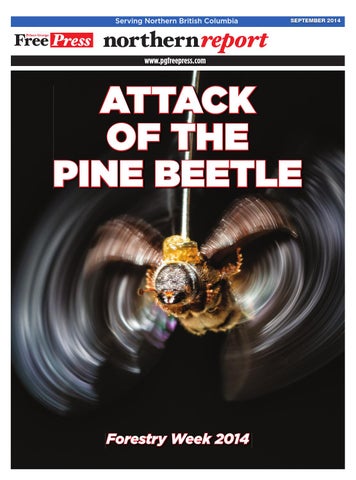
A mountain pine beetle flies while tethered to a flight mill.
TOP PRICES PAID FOR ALL METAL WE OFFER:
Powered by Metal Guided by Inner Strength, Since 1912
Roll-On/ Roll-Off Bins, Mobile Shears & Balers
Prince George Location: 250-963-6766 • 10338 Willow Cale Rd
Terrace Location: 250-635-1228 • 2550 Queensway Dr
Fort St John Location: 250-785-7900 • 9631 - 78th St Hours: Monday-Friday • 8am-5pm Saturdays 10am-4pm Prince George Construction Association
STEEL, COPPER, ALUMINUM, BRASS, STAINLESS STEEL, ELECTRIC WIRE & BATTERIES, RADIATORS, CATALYTIC CONVERTERS, ETC…also SCRAP VEHICLES
250.562.0065
www.pgfreepress.com
Prince George - NORTHERN
REPORT- Free Press
Friday, September 26, 2014
3
Area-based tenure reform proposal shelved for at least a couple of years Bill Phillips editor@pgfreepress.com The idea of moving the province more from a volume-based tenure system in our forests to an area-based one has been kicked around for decades. Under an area-based tenure system, forest companies would be allotted areas of forest to harvest trees and it would be the company’s responsibility to ensure its long-term viability, and fibre supply, from that set area. Under the current volume-based system, that long-term viability is determined by the province and allocated through the allowable annual cut determinations. The latest incarnation of the plan to move to area-based tenure was floated out earlier this year and Forest Minister Steve Thomson charged Jim Snetsinger to prepare a report on plan. Following the release of that report, it appears the move to area-based tenure will be put on hold, at least for now. “His report contains 35 recommendations covering the full spectrum of economic, social, environmental, First Nations and administrative issues surrounding the proposed conversion of volume-based forest licences to area-based tree farm licences,” said Thomson. “His report stresses the need for strong First Nations and community support for any proposed expansion of areabased tenures in the province and says new proposals should incorporate measureable and verifiable public benefits.
Free Press File Photo Forest Minister Steve Thomson.
“Jim’s recommendations provide a valuable roadmap on how to proceed. However, given the recent Supreme Court of Canada Tsilhqot’in decision and requests from forest companies and communities to focus on
key immediate priorities, the ministry will not be proceeding with legislative changes that would enable forest licence conversions in fall 2014 or spring 2015.” It’s a decision that is being supported by
1995 Quinn Street, Prince George 250-562-8171 • 1-888-552-5532 16 locations to serve British Columbia
the Council of Forest Industries. “We accept the minister’s decision,” said James Gorman, COFI president and chief executive officer. “Now isn’t the time to more forward on this.”
4
Friday, September 26, 2014
Prince George - NORTHERN
REPORT - Free Press
www.pgfreepress.com
Attack of the pine beetle When the mountain pine beetle began blazing a path across forests in British Columbia and Alberta, nobody could have imagined the extent of the damage to come. But as the insect devastated pine forests and disrupted communities, forest industries, recreational use, watersheds, and plant and wildlife habitats, the problem became disturbingly clear. Now, as the beetle creeps into the boreal forests of the Northwest Territories and Saskatchewan, with a real concern it may reach as far east as the Maritime provinces, researchers at the University of Alberta have responded to calls from government, industry, non-profit organizations and the general public to help conserve and protect an invaluable national resource at the heart of Canadian identity.
ECOLOGY OF SURPRISE Janice Cooke dubs it the “ecology of surprise.� Cooke, a researcher in the Department of Biological Sciences, is director of TRIA-Net, a national collaboration of 18 scientists (including six from the University of Alberta), government forestry officers, and representatives from industry and the not-for-profit sector. The new network is the third phase of the Tria Project, which was formed in 2007 to get research results to the front lines where they can be used in the fight to control the spread of the mountain pine beetle. One of a handful of Canadian researchers studying the beetle as it blazes a path through Canada’s pine forests, Cooke, fellow University of Alberta scientists and other national partners have rapidly accepted that today’s knowledge may not be enough to answer tomorrow’s questions about the minuscule but destructive bug. “We are having to adapt to what the beetle throws us, responding to the evolving developments of the outbreak and filling the knowledge gaps,� she says. “Mountain pine beetle is such an enormously complex problem, it requires a fundamentally different approach to create the new knowledge that is vital to controlling the spread of the beetle.� For Lorne Babiuk, the U of A’s vice-president of research—himself a world-renowned researcher in virol-
ogy and vaccine development—this ever-evolving quest to understand, predict and ultimately advise government, industry and the public on how to most efficiently battle the destructive insect’s spread is what drives pine beetle research at the university. “This is the type of work a researchintensive university such as the University of Alberta excels at,� Babiuk says. “We are able to respond when a pressing challenge like the pine beetle arises, and we have the expertise and capacity to tackle such a challenge head-on.� Anatomy of an invasion Mountain pine beetles are tiny, about the size of a grain of rice. The hard-shelled insects spread by flying, aided by wind currents. At its core, their ability to destroy trees is rather simple: the beetles starve the tree of nutrients, and the fungi they carry grow into the wood and disrupt water transport. The pine trees die in three stages, which can take up to several years: green, when the trees have been infested but their needles look normal and healthy; red, after the beetles have overcome the trees’ defences, and a change in needle colour indicates that the trees are dead; and grey, when the beetle has moved on and the needles have fallen away. A native to the pine forests of western North America, at lower-density population levels, the mountain pine beetle has played an important role in lodgepole and ponderosa pine forest renewal. It’s only when populations reach epidemic levels that we see large-scale mortality of forests, says Cooke. “This is exactly what happened during the first part of the 2000s,� she notes, “when conducive climatic conditions enabled mountain pine beetle population levels to soar to epidemic and even hyperepidemic levels in B.C.’s central interior.� By 2006, the mountain pine beetle had breached the Rocky Mountain barrier in a big way, flying and being carried in air currents over long distances to establish in the Peace River district of northwestern Alberta. Here, the lodgepole pine that makes up much of the historic habitat for mountain pine beetle hybridizes with jack pine, a species whose range stretches all the way to the Maritime provinces. Given this fresh territory, it only took a few years for the
mountain pine beetle to spread eastward across this hybrid zone in Alberta, successfully establishing in genetically pure jack pine and knocking at the doorstep of Saskatchewan’s northern forests. In the last couple of years, mountain pine beetle has even spread northward as far as the 60th parallel. “The mountain pine beetle is the most damaging forest insect in North America,� says Nadir Erbilgin, associate professor and Canada Research Chair in Forest Entomology. To date, more than 19 million hectares of Western Canadian forest land has suffered under the outbreak, a land mass the size of Lakes Superior, Michigan and Huron combined. More than one billion cubic metres of mature pine has been lost, damaging forest industries, recreational use, watersheds, and plant and wildlife habitats. Thousands of jobs have been lost, and governments in British Columbia and Alberta, as well as the federal government in Ottawa, have spent well over a billion dollars in public funds trying to stem the attack and diversify economies. Funding the fight Recognizing the risk, in 2014 the federal government gave Cooke a $3-million Strategic Network Grant from the Natural Sciences and Engineering Research Council of Canada (NSERC) to invest in TRIA-Net. Building on the strengths of the Tria research consortium that began back in 2007, researchers have used innovative genomics strategies—the same sorts of approaches used in medicine—to uncover some of the mountain pine beetle’s deepest secrets. Breakthroughs include a detailed map of the beetle’s adaptation-oriented genome as well as the genome of some of the fungal symbionts that help the beetle colonize pine trees. Researchers have also sequenced the genomes of lodgepole and jack pine, whose large genomes have made the work especially challenging. “We are collectively trying to provide the knowledge that is needed here and now to make decisions,� Cooke says. In 2011, it was a University of Alberta-led research team that determined the mountain pine beetle had invaded jack pine forests in Alberta, opening up the possibility for an
CONTINUED ON PAGE 5 CK Series
It eats
:H 63(&,$/,=( ,Q 3URYLGLQJ *HQHUDO 121 '(6758&7,9( 7(67,1* )RU 7KH )ROORZLQJ,QGXVWULHV 3XOS 3DSHU 3LSHOLQHV 2LO *DV 0LQLQJ )HUWLOL]HU PRUH
Chores Breakfast. for
0HHWLQJ WKH GHPDQGV RI D JURZLQJ IDVW SDFHG LQGXVWU\
6WULYLQJ WRZDUGV FXVWRPHU VHUYLFH VDIHW\ DQG UHOLDELOLW\
<RX KDYH < <RX KDYH VWX VWX VW II W VWX II WR JH R JH R JHW GR J W GRQH D QH DURXQ QH DURXQ QH D URXQG \R G \RXU O G \R XU ODQG" XU O DQG" <RX DQG" <RX R ZRQ ZRQȇW ȴ ȇW ȴ W ȴQG D Q QRWK QG D QRWKHU HU HU KS KS KS KS WUDFWRU WUDF WR PRUH WRU WRU PR ZLO ZLOOLQJ OLQJ DQG OLQJ DQG DQG DEO DEOH WR DEO H WR GR H WR GR GR LW W GR LW W GR LW WKDQ WKDQ KDQ WKH WKH &. WKH &. . :LWK : IHD IHDWXUH IHDWXUH WXUHV JD V JDORUH V JD ORUH ORUH and D T an and D T D TXLHW D TXLHW XLHW SR SRZHUI SR ZHUIXO ZHUI XO HFR XO HFR IULH IULHQGO\ IULH QGO\ GLH QGO\ GLHVHO GLH VHO HQJL VHO HQJLQH HQJL QH FKRU QH FKRUHV G FKRU HV GRQȇW HV G RQȇW VWD RQȇW VWD VWDQG D VWD QG D G D FKD FKD FKDQFH QFH Learn Lear n more more at at KiotiTi KiotiTi tiTier4. er4.com er4. com or take a test test es driv drive e at you yourr local local KIOT KIOTIIŽ GHD GHDOH GHDOHU
CASH Back Offers
0%
Financing
4 Year
Powertrain Warranty
KiotiTier4.com
Based e on purchase e off eligib eligibl igibl gib e n ne new e equipmen equipmen pment d defi defined in promotio defined omotional nal p program. ram. Financin na g is subject subject tto o credi c t appr approval. approval. val al. Of O ferr subject to change withou ith t t priorr notice. tice e Some restrict restrict estric ions on may apply. apply. See your your u authorized KIOTI Tractor ac actor Dealerr for details. details. tai Š 2014 KIOTI OT Tr Tractor Compa Company ny a Division of Daedong-USA Daedong-USA ng USA,, Inc ng-USA Inc.
Located next Located nexttoto
VW $YH 3ULQFH *HRUJH &RQYHQWLRQDO $GYDQFHG 8OWUDVRQLF LQVSHFWLRQ DQDO\VLV 3URYLGLQJ LQVSHFWLRQ VHUYLFHV JOREDOO\
250-596-2273 250-596-2273 wwwww.w. n onrot hr tehr ne ar nc raecargeea. cgae . c a
w w w. n o r t h e r n a c r e a g e . c a
4870 ContinentalWay Way •• Prince Prince George, 4870 Continental George,BCBC• •f a fxa: x2:5 02-5509-65-92 62 7- 24 2 7 4
www.pgfreepress.com
Prince George - NORTHERN
REPORT- Free Press
Friday, September 26, 2014
5
UofA heads up beetle research FROM PAGE 4 infestation stretching east across the Prairies all the way to the Atlantic. Working with Alberta Sustainable Resources Development and the Canadian Forest Service, a group of U of A tree biologists and geneticists discovered that as the mountain pine beetle spread eastward from central British Columbia, it successfully jumped species from its main host, the lodgepole pine, to the jack pine. Tracking the progress of the mountain pine beetle infestation across the province, they found the insect in jack pines as far east in Alberta as Slave Lake, 200 kilometres north of Edmonton. “It was tricky, but our research team used molecular markers to conclusively show that the latest pine species to be attacked was indeed jack pine,” says U of A molecular ecologist Catherine Cullingham. Confirming the pine beetle’s jump to another species was good news from a research perspective, but it also revealed a serious threat – a potential Canada-wide invasion. “Jack pine is the dominant pine species in Canada’s boreal forest,” Cooke says. “Its range extends east from Alberta all the way to the Maritime provinces.” The end of an endless sea of trees Two years ago, Evan Esch, then a master’s student working under John Spence in the Department of Renewable Resources, discovered that the beetle, in addition to attacking North America’s lodgepole and jack pines, was threatening to wipe out the remaining population of Alberta’s whitebark pine – a tree endangered across North America. His research showed that climate change was causing temperatures to rise in the cold mountain elevations where the whitebark pine grow, creating ripe conditions for the destructive beetle to spread. Erbilgin is building on Esch’s work, looking at the susceptibility of whitebark pine to mountain pine beetles and warming climate in western North America, including Alberta. The goal is to evaluate whether the defences of whitebark pine are compromised due to increasing global warming.
Richard SIEMENS/University of Alberta A mountain pine beetle flies while tethered to a flight mill.
The tree species had already been decimated by white pine blister rust, a fungal infection carried from Europe 100 years ago, making for what Esch describes as a “devastating one-two punch.” “There are a small number of trees that have resistance to the fungal disease, but we are concerned that the mountain pine beetle will kill them off. Areas that were historically climatically unfavourable to the beetle are becoming better for them, even at higher elevations and northern latitudes in Alberta.”
The whitebark pine grows in high elevations along the Rocky Mountains through to the coastal ranges in western North America, including Alberta, British Columbia, Montana, Idaho, Washington and California. The tree can live up to 1,000 years. It provides nutritious seeds crucial to the diet of birds, black bears and grizzly bears, and is often the last species at the treeline, where it regulates snow melt and stabilizes shallow subalpine soils in the mountains.
CONTINUED ON PAGE 6
ONE
STOP SHOP
HYDRAULIC PNEUMATIC ELECTROMECHANIC
Vancouver • Duncan • Campbell River • Prince George Edmonton • Calgary • Saskatoon • Winnipeg • and 7 other Coast-to-Coast locations
1-888-WAINBEE (924-6233) www.wainbee.com
6
Prince George - NORTHERN
Friday, September 26, 2014
Looking For
Red Seal Journeymen Electricians Both men & women
for Industrial Work in Northern BC $36.11/Hr $5.10/Hr into RRSPs 12% Holiday Pay Every Paycheck Medical & Dental After 90 Days Email a resume with names and phone numbers of 3 references and copies of tickets to
membership@ibew 993.org
Best Prices on Premiuim Quality Used Equipment *Attachments *Excavators *Forwarders *Wheel Loaders *Used Parts
Full Inventory Online at
REPORT - Free Press
www.pgfreepress.com
What can be done to fight back FROM PAGE 5 Esch studied the life history traits of the mountain pine beetle in whitebark pines, exploring the question of how well the insect reproduces in this type of pine. “Even though the tree isn’t as well suited to the beetle here because of Alberta’s cooler climate, the insect is still capable of killing whitebark pines and will still produce large broods in the oldest, most developed of these trees,” Esch says. “In both the short and long term, it means the mountain pine beetle will kill more of these trees.” Whitebark pine, made more vulnerable than lodgepole pine due to white pine blister rust, has consequently been listed as endangered by the Committee on the Status of Endangered Wildlife in Canada. “I think of the Canadian wilderness as an endless sea of trees,” Esch says. “The notion that this rugged, remote tree could go extinct in my lifetime is startling.”
FIGHTING BACK As the beetle spreads both north and east from its current vanguard in northern Alberta, scientists at the U of A are focusing on two of the newest questions posed by the insect: how easily it can keep spreading, and how far it can go. In her lab, Cooke focuses on the beetle’s spread eastward into jack pine of the boreal forest and on its recent spread into the Northwest Territories—distressing new feeding ground. “These forests have not been considered part of the mountain pine beetle’s native range, and to our knowledge have not sustained an outbreak in recent history. This raises a lot of questions about how easily mountain pine beetle can spread and become established in these new regions, perpetuating the outbreak,” says Cooke. “They are there now, and while they aren’t thriving in great numbers, if it takes fewer beetles to kill a tree, they don’t need large populations to persist and spread.” Northern forests, though less commercially important, are vital to First Nations communities for cultural and recreational purposes, shelter fragile ecosystems and are important for survival of species such as caribou. As an expert in tree genomics, Cooke will, in 2015, start testing row upon row of tender lodgepole and jack pine seedlings in her lab to discover whether northern and southern pine trees react differently to the fungus carried by the beetle. Both Cooke and Erbilgin are focused on how lodgepole and jack pine defences differ, genetically and chemically. They are examining how stressors like drought affect pine defences and whether a shorter growing season for northern trees makes them more susceptible to the beetle. Together with TRIA-Net researchers David Coltman and Cullingham, Cooke is investigating how the genetic makeup of pine trees might affect their vulnerability to the insect. The trio’s work has already revealed different genetic groupings within the geographic ranges of lodgepole and jack pines. A related question, posed by preliminary findings from other research groups, suggests that it takes fewer beetles to overcome the defences of jack pine compared with lodgepole pine. That dynamic is being explored by TRIA-Net researchers, including Erbilgin. “How are those differences meaningful to the beetle? This will give us an idea of how to predict risk, both short- and long-term, as the beetle spreads,” Cooke says. The resulting predictive models are being developed by TRIA-Net colleague Mark Lewis, who won Canada’s top mathematics prize in 2011 for his models of animal movement and the spread of invasive species. Meanwhile, U of A biologist Maya Evenden is exploring the beetle’s flight capacity, a scantily researched area to date. As with Cooke’s work, her research program is evolving to keep in step with the insect’s progress. “There was a real niche for that area of research,” says Evenden. Although work has been done with bark beetles on flight capacity, the mountain pine beetle is new territory. “The U of A stands alone in that.” Evenden’s lab in the Department of Biological Sciences houses 25 homemade gadgets called flight mills. Tethered to fine wires connected to the small machines, the beetles fly in
CONTINUED ON PAGE 7
“If it comes out of a heavy duty truck, chances are, we have it”
Over 20 Acres of Used Heavy Duty Truck Parts
www.banningequipment.com 250-564-7226
P P&& R R
scott@banningequipment.com
HEAVY TRUCKS & AUTO
8901 Penn Road Prince George
www.prhdtruck.com
New/Used Truck & Auto Parts Wrecking & Towing • ICBC Scrap-It Yard 15270 Hwy 97 South Prince George, BC V2N 5X7 250-963-3435
www.pgfreepress.com
Prince George - NORTHERN
REPORT- Free Press
Friday, September 26, 2014
7
Flight crucial to beetle spread FROM PAGE 6 circles around the mills (which vaguely resemble maypoles), while their flight time, speed and distance are recorded on a computer. Flight is crucial to the beetle’s spread; the females scout host trees and use pheromones – airborne chemical compounds that trigger a social response among individuals of the same species—to call in the rest of the swarm to feed. “We want to find out what aspects influence how well they fly, so that we can make spread models more realistic,” Evenden says. As the insect moves east across Alberta towards Saskatchewan, more accurate predictor models are important. “A good model can help us predict when the mountain pine beetle will be somewhere, which helps managers better implement their containment plans. If we wait until we find mass-attacked trees, we will be behind the eight-ball.” To date, Evenden’s lab has discovered that bigger beetles fly better and have more fat, and that the beetles which fly the farthest emerge from the host trees first. Also being explored are the roles metabolites like proteins, sugars and lipids play in affecting the beetle’s flight, and the potential cost to dispersal capacity from carrying mites during flight. Working with fellow U of A scientists and TRIA-Net member Felix Sperling and Coltman, Evenden will also identify beetle genes associated with dispersal capacity. U of A researchers are also closing in on developing an effective bait to get ahead of the destructive spread of the beetle. Nadir Erbilgin has been investigating pheromones emitted by the pest in North America’s lodgepole and jack pine forests. “Pheromones are essential for the mountain pine beetle to be able to spread and thrive, so we wanted to explore how we might use that to stop them,” Erbilgin says. The chemical compounds play a key role in the insect’s ability to find a mate and to overcome tree defences. Erbilgin’s research focuses on developing a bait that can be potentially used to monitor beetle activity specifically in jack pine forests.
Richard SIEMENS/University of Alberta Nadir Erbilgin holds a sample of mountain pine beetles in his lab.
“Right now we don’t know how efficient currently available commercial baits will be in catching beetles in jack pine forest, as they were developed to catch the beetle in lodgepole pine forests,” Erbilgin says. Because the trees differ in their chemistry relating to beetle attraction and colonization, differences in beetle responses are to be expected, he adds. Erbilgin and his team, which includes Evenden and several U of A graduate students, spent the summers of 2011 and 2012 testing the efficiency of a pheromone bait “that is showing promise,” he says. The bait, tested in Grande Prairie
lodgepole forests, works by attracting the beetles to traps. Traps with high numbers of beetle catches could indicate the levels of beetle population at a particular site. The eventual goal is to develop a bait for use in a provincial “trap tree” program, in which visual and chemical cues would combine to attract high numbers of beetles. Trap trees are used to concentrate and contain the local beetle population on certain trees. The infested trees are then used to assess the beetle population level and removed, along with the beetles.
CONTINUED ON PAGE 8
100% FORESTRY SMS Equipment is your one-stop equipment dealer for all of your forestry needs. We offer only world-renowned brand names that meet your standards of reliability and productivity.
Contact your local branch for more information. Prince George:
1 800-663-8745
smsequip.com
8
Friday, September 26, 2014
Prince George - NORTHERN
REPORT - Free Press
www.pgfreepress.com
Is the end really in sight? FROM PAGE 7 Erbilgin says the team’s field trials will continue in the summer of 2014, and the hope is to have an effective product developed for use within the next few years.
BEYOND THE BEETLE The devastating effects of the mountain pine beetle are obvious. But what isn’t clear is what will happen after the destructive insect moves on. What kind of forest will grow in its wake? To help answer that question, U of A forestry professors Uldis Silins and Ellen Macdonald from the Department of Renewable Resources have been looking to the future, well past the invasion of mountain pine beetle, to a long-term goal of forest recovery, resilience and resistance. “There is no doubt that we’ll have to make management choices and be thoughtful of what kind of forests we will develop,” says Silins. As part of an overall study focused on what effect the beetle invasion has on forest hydrology and vegetation, Silins and Macdonald have been busy in the forests of west-central Alberta. Though some understanding has been gained from pine regeneration in British Columbia, Alberta’s lodgepole pine forests are different in important ways, and further research has been required. Since 2008, Silins and Macdonald have been simulating mountain pine beetle kill in selected stands of lodgepole, tracking the stages of the trees’ decline and death from green to red to grey. With funding from the Foothills Research Institute, they are studying how beetle attack and the regrowth of vegetation afterwards changes the cycling of water in pine forests as the dead trees enter the grey attack stage, when they lose their needles and are no longer able to capture rain or snowfall. “Once the needles fall off, more precipitation reaches the ground,” says Silins. The loss of trees also means they aren’t consuming the water, which adds to the problem. That excess water soaks into the ground and may help vegetation
regrow, but could also increase the flow of rivers and streams, draining beetle-affected forests. Believing that many of the lodgepole pine sites will need assistance once the mountain pine beetle moves on, Silins and Macdonald, along with Erbilgin, professor of silviculture Victor Lieffers, professor of fire science Mike Flannigan, and members of the Forest Resource Improvement Association of Alberta, are looking at the best way to facilitate lodgepole pine regeneration in beetlekilled stands. Though fire is likely the best treatment, prescribed burns can be difficult and uncertain. The researchers would like to use some innovative approaches, such as mechanical and partial harvesting treatments, to help prepare seedbeds for natural regeneration. Richard SIEMENS/University of Alberta Through all of this, the goal is to develop forests Janice Cooke, co-director of TRIA-Net, holds a pine that are better suited to handle whatever nature – and seedling. humans – throw at them. “We have to develop resilient forests that are resistant to fires, drought and insect atThe majority of Alberta’s pine beetle control lies along tacks,” Silins suggests. a leading edge spanning much of central and west-central Getting ahead of the ‘ecology of surprise’ Alberta, from Grande Prairie to Hinton, Edson, Whitecourt Cooke, Erbilgin, Evenden and their U of A colleagues in and Slave Lake and down the eastern slopes of the Rockies. TRIA-Net hope their collective work takes away some of the Placing a priority on specifically targeted areas appears to be element of surprise posed by the mountain pine beetle, to working. help those battling it on the front lines. “We’ve had a lot of success with our program over the last “Our goal is to keep the toolkit dynamic for forestry conseveral years. We are actively managing the mountain pine servation managers,” Cooke says. “Forest managers have an beetle, where the numbers are either decreasing or holding important mandate to control mountain pine beetle both for in check. Everybody is looking to Alberta.” this and future outbreaks, and we are there to help them. UlUPDATE: Reports from the Northwest Territories hightimately we want to develop new mathematical models and light the ever-changing dynamic of the outbreak. Based on other tools that can improve the decision-making process.” this recent information, TRIA-Net director Janice Cooke Alberta now has the largest management program in reports, “Forest fires have since destroyed the stands in the Canada, and Samis’s team has shared its knowledge with Northwest Territories in which the attacked trees had been colleagues looking to develop similar practices in the Yukon, identified. Aerial surveys conducted in July of this year in Northwest Territories, Saskatchewan and Ontario. Lessons partnership with the Canadian Forest Service did not reveal learned in B.C. have guided much of the response. any further attacked trees. However, the survey would not “We have to be very aggressive with the mountain pine have picked up any trees that would have been attacked beetle in order to be effective. One of the biggest things B.C. this year, if there are any. Mountain pine beetle still lurks in told us was that we needed to recognize up front that not all northern forests in B.C. and Alberta, and could once again of the areas would be successfully treated. We had to prioricross the 60th parallel, given that it has happened before.” tize based on values of risk and potential spread,” she says. - Courtesy of the University of Alberta
Contact your local Mack Dealer for more information
250-563-4414 2355 S. NICHOLSON STREET, PRINCE GEORGE
BABINE TRUCK & EQUIPMENT LTD. Prince George - Sales, Parts & Service 9341 Rock Island Rd 250-562-7422 1-877-888-7422
Smithers - Parts & Service 3364 Yellowhead Hwy 250-847-3981 1-888-847-3981
Prince George - NORTHERN
www.pgfreepress.com
REPORT- Free Press
Friday, September 26, 2014
9
ITA gets ready for trades jobs push Bill Phillips Northern Report When it comes to trades training, Gary Herman knows what he’s talking about. A certified die-maker who cut his teeth in Ontario’s manufacturing industry, Herman is the new chief executive officer of B.C. Industry Training Authority. He served as interim CEO for a year following Kevin Evans’ departure in 2013. With the province on the cusp of what he calls a development boom, Herman is keen on his new role. “This is a crucial time for B.C. to take advantage of these new opportunities,” he told the Free Press. “I’m very excited, coming from a trades background, to build a strong trades training program. ITA is here to serve the needs of industry.” Herman comes to the job after a mandatory review of the authority, which leads and coordinates British Columbia’s skilled trades system and hot on the heels of the B.C. Skills for Jobs Blueprint that predicts huge numbers of job openings in the province over the next eight years. Herman says the report predicts that 104,000 of those jobs, province-wide, will be in the trades. In the North Coast and Nechako regions, the focal point of pipelines and liquefied natural gas, the Blueprint says there will be 19,000 job openings. Of those, Herman says, 18 per cent, or about 3,600, will be in trades.
Currently in the region there are 900 apprentices registered with 300 company sponsors. The work for the ITA is just beginning. The ITA has developed a transition plan that focuses on four main areas – youth and apprenticeship support, an LNG action plan, realigning training investment closer to demand, and transforming industry relations. Sector advisory groups will be established that will work with the ITA and government. Each sector will have an industry relations manager. In addition there will be 15 apprenticeship advisors throughout the province by the end of the December, five of those will have aboriginal expertise. “We have the province covered by sector, then regionally with the apprentice advisors,” Herman said. The ITA has also created a new trade – the construction craft worker. “They are the construction labourer,” Herman said. “They are the most populous worker on a worksite. They do everything on a site, in addition to the other trades. We were very happy to move forward on that.” Eight other provinces already recognized the trade. It will be a two-year Red Seal trade. “It’s the Number 1 required occupation for LNG,” Herman said. “If five LNG plants go ahead, more than 19,000 of these folks will be required. “We see that as a very good thing for the North. We also see it as a very good introduction to the trades for First Nations folks.”
Industry Training Authority chief executive officer Gary Herman.
B.C. Safety Authority Licenced Safety Valve Repairs Over 40 Years of Service
“Celebrating over 20 years at our Prince George location and over 48 years in the safety valve and industrial valve service and repair Industry” Authorized Repair Centre for: TuÅine-Xomox Velan Durabla
1415 Santa Fe Avenue Prince George, Bc V2n-5T5 Fax: (250) 561-8768 Phone: (250) 561-8769 Website: Www.Vanvalve.Com E-Mail: Info@Vanvalve.Com
10
Prince George - NORTHERN
Friday, September 26, 2014
REPORT - Free Press
www.pgfreepress.com
Dealing with sawmill dust Conifex puts $12 million into Ft. St. James and Mackenzie Bill Phillips Northern Report It’s probably less than a couple of grams of dust. Not much in the scheme of things. In fact, if you knocked over your can of icing sugar you’d probably spill more on the floor. And, dust has pretty
Ken Shields
much the same consistency as icing sugar. Those couple of grams of dust, however, when blown over a spark, create an instantaneous wall of flame about three feet high. It’s a dust explosion. When done by UNBC chemistry professor Todd Whitcombe, it’s an exciting but sobering demonstration. That dust, the same consistency as baking powder, is the same dust that accumulates in every nook and cranny of every sawmill in the province and, because it is so fine, it hangs in the air like a cloud. When one sees what a couple of grams of it, combined with a spark, can do, one can only imagine the horror of a sawmill full of dust igniting. Such explosions have taken the lives of four men in northBill PHILLIPS/Free Press ern B.C. over the past Steelworkers Local 1-424 president Frank Everitt speaks while Conifex executive vice-president Pat Bell looks on during an announcement recently that the forest company is investing $12 million in couple of years and dust abatement programs at its mills in Mackenzie and Fort St. James. injured dozens more. The tragedies at Lakeland Mills in Prince George and Babine Forest Products in Burns Lake have shone the spotlight in the dark and dusty corners of sawmills, that are now looking at ways to ensure dust, particularly from trees killed by the mountain pine beetle, doesn’t build up. To that end, Conifex has sunk $12 million into making sure dust doesn’t build up in its Mackenzie and Fort St. James sawmills. “Our priority is to have a very safe work environment,� said Conifex CEO Ken Shields. The $12 million will be split with $7 million going to Fort St. James and $5 million to Mackenzie. Shields said the reason is that the Fort St. James is a bit larger than the Mackenzie mill. Proportionately, however, the expenditures are the same. Slated to be complete later this year,
For all your welding needs, please contact us at:
Lincoln Welder 305G
#K1726-5
$4,499
Offer expires Oct. 18/14
www.praxair.ca
CONTINUED ON PAGE 11
43;)6
463(9'87
b0E[R 1S[IVW
b7RS[ &PS[IVW
b'LST 7E[W b&VYWL 'YXXIVW
1601 Central Street Prince George, BC, V2N 1P6 Phone 250-563-3641
the changes are designed to contain and extract combustible dust from the mills. It involves installation of a bag house, a system that will extract dust produced in the mill. Conifex safety director Doug Beattie likened it to a large Dyson vacuum cleaner. Once the dust is collected out of the air, the fresh air is then circulated back into the mill. The collected dust will be stored and eventually used to fuel the bio-energy system at the Mackenzie mill. “For us it is about building momentum,� said Pat Bell, Conifex executive vice-president, who pointed out that the company is unique in that it has created a full time safety director. “Conifex has selected the highest level
b',%-27%;7
b0IEJ &PS[IVW b7QEPP )RKMRIW
b6)4%-67 XS EPP QEOIW QSHIPW
2SVXL 'LEMR7E[W 0XH WX %ZI 4+
2); 3;2)67 1SRX] 1EG1EWXIV 'SYVXRI] 7XYFFW
Prince George - NORTHERN
www.pgfreepress.com
REPORT- Free Press
Friday, September 26, 2014
11
Bill PHILLIPS/Free Press UNBC professor Todd Whitcombe demonstrates a dust explosion to Conifex workers during an announcement that the company is putting $12 million into dust supression equipment at its mills in Fort St. James and Mackenzie.
Conifex dealing with dust
MOBILE FIELD SERVICE
FROM PAGE 10 of control (of dust) possible,” said Beattie. “The only higher level of control is total elimination. There’s no way to totally eliminate it.” He said the equipment consists of 50,000 and 60,000 CFM Cyclo dust collectors … a bag house. He said there will also be spark detection systems that, if a spark is detected, will try to extinguish it immediately. “The performance target for this project is to be able to have our shifts operate without having any dust accumulate over one-eighth of an inch over five per cent of the area,” said Beattie. The move is supported wholeheartedly by the United Steelworkers union. “We are very proud to support what Conifex has said they’re going to do,” said Frank Everitt, Local 1-424 president. “(The $12 million) is a substantial amount of money to ensure that each and everyone of us are able to go to work and come home in the same condition as we started in the morning.” He said this “raises the bar” in the industry and encouraged other mills to do the same.
SERVICING THE AREAS OF
POWER GENERATION / INDUSTRIAL ENGINES
Prince George Fort St. James Vanderhoof Mackenzie Houston
AUTHORIZED FACTORY WA R R A N T Y D E P O T R e p a i r s To A l l M a k e s o f We l d e r s M I L L E R , H O B A RT, L I N C O L N , A LW, T H E R M A L D Y N A M I C S
250.562.2728 1.800.374.6766
DEUTZ - PERKINS - VOLVO 7 H.P. TO 9800 H.P. AIR & WATER COOLED SALES - SERVICE - PARTS
1846 Quinn St., Prince George
Contact Equipment Service at
250-562-8171 or Toll Free 1-888-562-5532 Servicing Forestry, Crane, Construction, Mining Equipment
12
Friday, September 26, 2014
Forest trivia Did you know? Explorer Captain Cook was the first European to make use of B.C.’s forest products. Sailing masts were fashioned from the tallest Douglas-firs. B.C. lumber was used for trestles, ties and bridges on the Canadian Pacific Railway. B.C.’s first sawmill was built in 1847 at Esquimalt Harbour. B.C. is the world’s largest exporter of softwood lumber. Less than 1 per cent of forest land is harvested each year. B.C. is Canada’s most ecologically diverse province, with temperate rainforests, dry pine forests, alpine meadows and more. B.C. has more than 40 different species of native trees. B.C. spruce was used to build British Mosquito fighter bombers during the Second World War. The masts and booms of the famous Bluenose schooner, pictured on the dime, were made from B.C. Douglas-fir. One metric tonne of dry wood pulp will make...1 tonne of newspaper, 1,400 lbs of magazine paper and 0.9 tonne of toilet paper. Sawmills use computers and lasers to get the most value out of every log. Roofing shakes are made from blocks of wood too small to cut into lumber. An average house requires 15,000 board feet of lumber. Tree cellulose is a thickening ingredient in ketchup, ice cream and thousands of common foods. Disposable medical lab coats are made from the woven fibres of western red cedar. Wood is the only renewable, biodegradable, natural and non-toxic building material in the world. B.C. planted its six billionth tree in 2008. The first lumber sawn in B.C. was floor planks for a Vancouver Island dairy farm. B.C.’s first pulp mill was built in 1894 at Port Alberni. More than half of B.C.’s old growth forests are protected in parks or otherwise off-limits to harvesting.
Prince George - NORTHERN
REPORT - Free Press
www.pgfreepress.com
Ancient designation
The Caledonia Ramblers are hoping to have the Ancient Forest, located 113 kilometres east of Prince George, declared as a World Heritage Site. The Ancient Forest is a unique inland wet-temperate rainforest. It is an involved process to get the declaration, which requires a provincial park designation. The Regional District of Fraser-Fort George will provide a letter of support for the provincial park designation.
FOREST LICENSE MANAGEMENT LOG BROKER
Let us help you fast track your career. eer. eer
BUY & SELL LOGS OPERATE RE-LOAD SORT YARD
Forestry, Construction, Mining, Oil & Gas Certification Courses Looking industry?Check Checkour our Lookingfor foraajob jobin inthe theforestry mining industry? to get get you websitefor forfull full course course details details to website you started! started!
MOBILE CHIPPING & GRINDING
Forestry Equipment Operator Certification Courses Compliance Courses & Customized Compliance and Safety Programs
127-403 MACKENZIE BLVD. MACKENZIE, B.C.
Funding and Job Placement Programs
250 997-7790 9185 Rock Island Road, Prince George, BC V2N 5T4 Office: 250-563-1998 • Toll Free: 1-877-563-1998
www.obrientraining.com
MACKENZIE FIBRE MANAGEMENT CORPORATION
admin@mackenziefibre.com
www.pgfreepress.com
Prince George - NORTHERN
REPORT- Free Press
Friday, September 26, 2014
13
Forest industry looking good says Council of Forest Industries president Bill Phillips Northern Report While things might not be as good in the forest industry as they once were, things are certainly better than they were a just a few short years ago. “Things are good in the forest industry,” said James Gorman, president and chief executive officer for the Council of Forest Industries. “From a market perspective, things are improving. The days of 2008 and 2009 are certainly behind us.” That improvement comes on two fronts – a minor rebound in the U.S. housing market and continuing emergence of markets in China. In the U.S., he said, 1.1 million housing starts were predicted for the year and they expect that to go 1.3 million next year. “The U.S. is getting stronger and at the same time Asian markets are getting stronger,” he said, in particular the Chinese market. “We’re taking advantage of that diversity, which is a diversity, from a market perspective, that didn’t exist seven or eight years ago.” Nick Arkle of Gorman Bros. Lumber said where the U.S. housing starts are at now, is probably the new norm, so opening markets in Asia has certainly helped. “We can’t afford to lose what we’ve gained in Asia,” he said, adding that the trade missions are very important. To put that into perspective, B.C.’s share of the Asian market, in 2003, was about 13 per cent. Now it’s about 41 per cent. In addition, in 2003, 83 per cent of B.C.’s lumber exports were headed to the U.S., now it’s about 54 per cent. High lumber prices are also helping the industry. While the markets may be getting better, there are still challenges ahead for the industry. One of the big ones is the mid-term timber supply that will see a decrease in allow-
able annual cut levels throughout the province, but more acutely in the North where the mountain pine beetle has wreaked so much devastation. “We do expect that production in British Columbia will decline between now and 2022,” said Gorman. During the peak years of the beetle infestation, the allowable annual cut, province-wide, Bill PHILLIPS/Northern Report went as high as It’s all smiles, more or less, in the forest industry these days, according to Nick Arkle, left, 70 million cubic of Gorman Bros. Lumber and James Gorman, president and Chief Executive Officer of the metres. That Council of Forest Industries. could drop as low as 42 million cubic Gorman. In addition, 56 per cent of all biomass-generated metres in the next few years. electricity in Canada comes from B.C. pellets. Mills often “There are some challenges ahead,” Gorman said. “But, use their own residual biomass to generate electricity and they’re in the future and we’re able to plan for them.” power their own mills. Bioenergy is another growth sector of the forest industry “We do think this is the next area of great innovation,” and that, according to Gorman and Arkle, needs a strong said Gorman, adding the industry has made investment in dimension lumber sector to continue to grow. biomass. “Two-by-four dimension lumber is what is always B.C. produces 65 per cent of all the wood pellets progoing to make those (biomass industries) viable. It has to be duced in Canada and 15 per cent of the world product, said based off a regular sawmilling operation.”
14
Prince George - NORTHERN
Friday, September 26, 2014
REPORT - Free Press
www.pgfreepress.com
Fire season a costly one Jeff Nagel Northern Report This summer’s wildfire season will go down as one of the most destructive on record in B.C. As of the end of August, fires had burned up more than 330,000 hectares across the province and are expected to soon surpass the 337,000 hectares destroyed in the 2010 fire season. This year is still far short of 1958, when 856,000 hectares burned, but 2014 could move into fifth place if it surpasses 1950’s 343,339 hectares, or even third if it tops the 351,000 lost in 1971. While much timber has burned, no homes or other significant structures have been lost this year, so by that measure it’s been nowhere near as catastrophic as the 2003 fire season, when more than 300 homes were lost or damaged in the Okanagan Mountain and McClure fires. But it has been costly. The province has so far spent more than $246 million fighting wildfires, almost four times what was budgeted, and more than the $212 million expended in 2010. Despite wet weather on the Labour Day weekend, fire officials are bracing for more warm dry spells in September. “It’s unlikely we’ve seen the end of the fire season by any stretch of the imagination,” fire information officer Dustin Eno said. The actual number of fires this year – just over 1,300 – is well below the average of 1,600 a year. But many of the fires have been very large. The biggest, and still only 20 per cent contained, is the 130,000-hectare Chelaslie River fire, which is between Anahim Lake and Burns Lake, near Entiako and Tweedsmuir provincial parks. Homes remain under evacuation order there. The largest evacuations this summer have included the China Nose fire near Houston and the McAllister fire, which forced the evacuation of the entire town of Hudson’s Hope in July.
Photo courtesy of the B.C. Forest Service The Chelaslie fire, this year’s largest having burned more than 130,000 hectares of forest.
Assisting B.C. crews have been large numbers of imported firefighters and equipment, from other provinces, Alaska and Australia. “We’ve brought in a lot and have been very grateful to be able to draw on those relationships, both right across Canada and internationally,” Eno said.
MOBILE FIELD SERVICE
“Last year we exported a lot of firefighters to fight in other jurisdictions and this year they were able to return that favour.” There are still 152 active fires and another 85 out-ofprovince firefighters arrived Thursday from Ontario so B.C. crews could take mandatory days off.
RELIABLE SERVICE YOU CAN COUNT ON FOR OVER
50 YEARS
SERVICING THE AREAS OF
Prince George Fort St. James Vanderhoof
We service Northern BC, the Cariboo & the Okanagan
Roll Off Bins • Lugger Bins • Picker Trucks • Low Beds Demolition & Yard Cleanups • Competitive Prices Paid
Contact Kenworth Service at
250-562-8171 or Toll Free 1-888-562-5532 Servicing Heavy Duty Trucks
Prince George 302 – 2nd Avenue e 250-562-1177
Terrace 5206 Keith Ave 250-638-6378
Monday to Friday 8 am - 4:30 pm 1-877-566-1177 • AllensScrap.com
Prince George - NORTHERN
www.pgfreepress.com
REPORT- Free Press
Friday, September 26, 2014
15
Minister celebrates Forest Week In recognition of National Forest Week, Sept. 21-27, 2014, Forests, Lands and Natural Resource Operations Minister Steve Thomson has released the following statement: “As the Minister of Forests, Lands and Natural Resource Operations, I look forward to celebrating National Forest Week. “This year’s theme, Sunrise in the Forest, not only speaks to the natural beauty of B.C.’s forests, but the resiliency of the forest sector. Since the downturn of 2009, B.C.’s forest economy has been steadily recovering. From 2009 to 2013, timber harvesting has increased 47 per cent, the value of B.C.’s forest product exports increased by 53 per cent to a total of $11.6 billion and employment increased by 13 per
cent, providing 58,000 direct jobs throughout the province. “In 2009, government introduced the Wood First Act to require that wood be considered as a primary building material in public sector construction, and 53 local governments, have followed suit by adopting wood-first bylaws, policies or resolutions of their own. Changes to the BC Building Code in 2009 increasing the maximum height of wood frame residential construction from four storeys to six, has translated into over 200 mid-rise buildings completed or under construction. “To ensure we have forests for future generations to enjoy, companies are legally required to reforest the areas they harvest. While an average of 200 million seedlings are plant-
ed each year, in 2014, we managed to plant over 240 million. We manage our forests for 11 different values, including provisions for wildlife habitat, cultural heritage, biodiversity and recreation. “The provincial National Forest Week coalition has also produced a Tree Identification App. It will be available for download from www.abcfp.ca/about_us/events/national_ forest_week.asp on Sept. 23. The app provides photos and information on every native tree found in B.C., and also allows you to take photos and record notes and GPS the location of your favourite trees. “I encourage you to take the time to enjoy and learn more about B.C.’s forests this National Forest Week.”
Improving stewardship of B.C.’s forests for the future The Forest Practices Board released its 2013-14 annual report recently, which summarizes the board’s work over the past year, as well as highlights work currently underway. “Board audits continue to find consistent compliance with forest practices law by major licensees,” said Tim Ryan, board chair. “But there are lingering areas of improvement that require attention, such as roads and bridges. As well, smaller licensees tend to have more compliance problems.” The board completed eight reports on current forestry issues, 12 audits of forestry and range operations, six investigations of public complaints and responded to 73 concerns from the public. “During the last year, the board prepared a special report on the 10-
year-old Forest and Range Practices Act and published several special reports on topics such as salvage harvesting of beetle-killed forests in the interior and bridge construction on forestry roads,” said Ryan. “We are pleased with the responses to our reports over the past year and the efforts government and industry have made to respond to the concerns we raised, particularly in our report on forest roads and bridges. Our annual report highlights several cases where our work led directly to improvements in forest practices and communication with the public.” The Forest Practices Board is B.C.’s independent watchdog for sound forest and range practices, reporting its findings and recommendations directly to the public and government.
ON GRINDERS PETERS S / WOODLAND CHIPPER
ING COMBINATION A WINN
1195
Cellular stores: Westgate Plaza 250-964-4881 Parkwood Place 250-562-4880
SOLD & SERVICED BY WOODLAND EQUIPMENT
Prince George 1-877-561-2456 Kamloops 1-877-372-2855 | Vernon 1-877-542-2280
16
Prince George - NORTHERN
Friday, September 26, 2014
REPORT - Free Press
www.pgfreepress.com
31
$!% &""
Varsteel Purchases Herr-Voss Stamco ELT Enhanced Leveling Technology April 14, 2014 - Herr-Voss Stamco recently received an order from Varsteel Ltd. of Lethbridge, Alberta Canada for an Enhanced Leveling Technology (ELT) retroďŹ t. This new enhancing leveler will process material up to .500 in. by 96 in. wide. Herr-Voss Stamco’s ELT enhanced leveling technology is a superior method for producing stay-at material during and after post processing by lasers, plasma, and water jet cutting. This technology can be deployed as part of a new cut-to-length line, a compliment to an existing cut-to-length line, or as a stand-alone process with the ability to enhance individual sheets. Enhancing Leveling Technology has proven to be more operationally efďŹ cient than current methods while costing considerably less than alternative processes.
Rick Fagan Hunter Becenko Structural / Processing Sales Branch Manager hunter.becenko@varsteel.ca rick.fagan@varsteel.ca Ward Goulden ward.goulden@varsteel.ca Assistant Branch Manager Don Thackray Outside Sales don.thackray@varsteel.ca Bob Cowan bob.cowan@varsteel.ca Shop Foreman Angela Buchi angela.buchi@varsteel.ca Administrative Assistant
Julie Umpherville Auto Cad Specialist / Processing Sales julie.umpherville@varsteel.ca