October October 2013 2013
Creating a legacy of a caring community
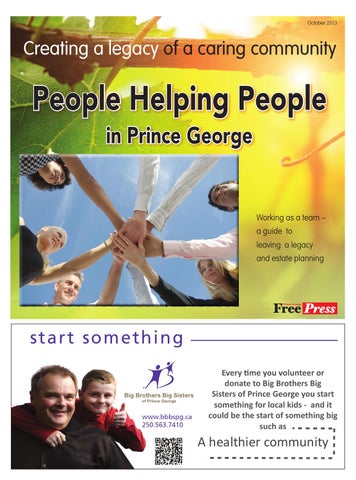
People Helping People in Prince George
Working as a team – a guide to leaving a legacy and estate planning
start some thi ng
www.bbbspg.ca 250.563.7410
donate to Big Brothers Big Sisters of Prince George you start something for local kids - and it could be the start of something big such as
A healthier community
2
People Helping People
OCTOBER 2013
www.pgfreepress.com
Four ways to make a rich Christmas Mike Ray A Bid for Change There are a million and one ways to spend your money and time, and with Christmas right around the corner, there will be even more ways to spend both, such as parties, presents, Boxing Day sales, and volunteer work, (and those are just some of the few that come to mind). Thankfully, Christmas is also a time when many people look forward to spending money and giving to others, which is why we generally don’t think twice about it, but here are a few creative tips to help you have a Rich Christmas: Find ways to spend time together – Let’s be
honest...most of us consider our time to be one of the most valuable things we have, so what better way is there to give to others than to give of our time. Find some creative ways to spend time with family friends this holiday season by doing things like planning a night out at a local restaurant, plan a family board game or video game night, arrange a weekly workout session together at a local gym, or even schedule a winter-time photo-shoot with a local photographer not afraid of the snow! Shop local – One of the easiest ways to help grow your community is to shop at the stores that are locally owned and operated, (often these stores will boast this, so it is generally easy to tell which ones are local). By shopping
local, you guarantee that the most amount of money will stay in Prince George, as most local business owners ALSO shop local! When local stores are supported, the community wins! Look for businesses partnering with local charities – When you know that your purchase is also benefitting a local charity, it’s like killing two birds with one stone. Many local businesses partner with great local charities like the Prince George Hospice Society or Big Brothers Big Sisters of Prince George, and will often guarantee that a portion of sales during a specific event or promotion will go to support these charities. Further, many of these charities are also locally run, so again, the money raised also stays right here in Prince George. Be a part of something big – Many organi-
zations like the Salvation Army need people to help run their kettle campaigns or help serve Christmas dinner. Or, perhaps you have a great voice and wouldn’t mind singing carols at a nursing home, or you know of a local fundraiser that needs help selling raffle tickets. The sense of joy that comes about by being part of something big in the community can stir the heart and provide a lasting memory, so don’t miss out! There are lots of great ways to make your Christmas even bigger and better than last year, and although these are only four simple ideas, there are many more out there, so just keep your eyes open and when you come across something that stirs your heart, jump on it.
culling and hunting, and the donor is opposed to such methods, the donor’s values will be compromised. Red Flags: Red flags are financial or operational indicators that are unreasonable or fall outside the norm for the sector. Common red flags include the inability to produce • Philosophy - the organization’s mission, objectives, financial statements, salaries that are disproportionate for the size and scope of the position statements and values. organization and a lack of demonstrable achievements. One red flag that most people • Red Flags - operational indicators that are not the overlook, and is the easiest and perhaps most important to validate, is a lack of support norm for the sector. from or collaboration with peers in their sector. • Efficiencies - the financial and operational conduct Efficiency: Efficiency refers to how the financial conduct of an organization meaof the organization sures up against pre-determined benchmarks, such as administrative or fundraising • People - the abilities and diversity of those who costs and program expenses. Review their strategic plan and see how well their objecwork in and support the organization tives align with their budget. Confirm that they have a diversity of funding sources and Philosophy: Donors should ensure the organizafinances in reserve to sustain an economic downturn. tion’s overall philosophy and mission aligns with their Although much importance is placed on efficiency, it is not the best reflection of own values. Position statements should disclose what effectiveness. the organization supports, and what it is against. Ask People: As in the corporate world, the people employed by an organization are the the organization about their past achievements, what key to its success. outcomes they hope to realize in the future, and what View the backgrounds of the management team, assess the turnover rate and, again, strategies and tactics they will use to resolve a problem. see what their peers and supporters have to say about the organization. An example of how an organization’s goals and a The PREP Framework is by no means a perfect tool, but donors should garner donor’s values can become misaligned is with wildlife enough information to ensure they focus their charitable dollars on capable, fiscally protection groups. Both the charity and donor may responsible, effective organizations with philosophies that align with their values. An share a goal of conserving wildlife, but if the organihonest and effective charity will be willing to answer questions about what they have zation’s population management strategy includes accomplished, where they are going, and how gifts will be used.
A little prep work can go a long way Leanne McConnachie, M.Sc. Vancouver Human Society When it comes to charitable giving, the best advice is this: Choose the issues that have personal meaning and then look for focused, outcome-based organizations whose philosophies and position statements align with these values, who collaborate with or are supported by their peers, and whose financials are generally sound. For a large gift or bequest, split it amongst several groups who use different strategies to achieve similar outcomes. The reason is simple: no single organization working alone is as effective as several groups working together or in parallel to reach a desired outcome. To determine what questions donors should ask in order to choose the most effective charities, there are four key areas for evaluation, known as the PREP Framework:
Carefree Society is your local Handy Dart and Community Bus operator We provide specialized door to door transportation, operating as a shared taxi. To use our service you must have a disability that prevents you from using the city bus. Carefree is dedicated to our Community, continually fund raising for bus replacement and extra service demands. A Legacy gift will ensure our ability to serve your community.
Your gift will help ensure that British Columbians with spinal cord injury (and related disabilities) & their families will continue to receive the essential support and services needed to help them adjust, adapt and thrive - whether they are dealing with a new injury or struggling with the ongoing challenges of living and aging with a physical disability.
For more information, visit www.sci-bc.ca or call 1-800-689-2477 Please note: gifts should be made to our legal name, which remains Canadian Paraplegic Association (BC)
Carefree Society 2832 Queensway St. Prince George, BC V2L 4M5 Charitable Tax Number 11883-8358-RR0001
People Helping People
www.pgfreepress.com
OCTOBER 2013
3
Many ways to give through CNC If you’re hoping to buy a ticket to CNC’s Global Gourmet Fundraising Gala, you may be out of luck. Seats for the ever-popular fundraiser, where donors buy equipment for students, usually sells out weeks before the event. “It’s a great time for donors to get together and enjoy fantastic cuisine from around the globe, created and showcased by our very own Professional Cook students,” said Annette Stevens, CNC’s Fundraising and Alumni co-ordinator. “It gives our donors an opportunity to meet our students, employees and learn first-hand about the array of programs the college has and what we offer to the community.” Since 2009, more than $460,000 has been raised for scholarships, bursaries and equipment purchases during four unique events. That includes Global Gourmet where $246,000 has been raised in equipment purchases for a variety of programs in health sciences, trades, technologies, and university studies. The equipment includes a hospital bed and blood pressure cuffs for nursing; a dissecting microscope for medical laboratory technology; a lead apron set for medical radiography; tricycles for the college’s daycare; a skeleton and skin calipers for kinesiology and welding helmets and tool boxes for trades. “Donors recognize the need for state-of-the-art equipment required for CNC programs and are generous with their donations to ensure we get what we need to get that equipment directly into the hands of our students,” said Stevens. “When I bring up the gala with perspective donors, they can’t wait to get their invitation. Donors who can’t make it that night ask me directly what is on the equipment wish list and generously donate online. “We try and make each and every donor feel special – no matter what the size of their donation.” But Global Gourmet isn’t the only CNC fundraiser held throughout the year. When former CNC student Dillon Adey died in a motorcycle accident on June 1, 2009, his family created the Dillon Adey Memorial Endowment Bursary and an annual bursary.
“That was one of the toughest things I have ever had to do, visit a family (whom I had never met before) in the midst of their grieving,” said Stevens. “My heart broke and bled for them, but we had an instant connection. We have become like a family.” The Adey family worked tirelessly to increase the funds for these awards and by honouring their son, they have helped many deserving students as pursue their dreams. In June, 2010, 144 people teed off at the first Dillon Adey Memorial Cup Golf Tournament that is now held every Father’s Day weekend. It’s how the majority of funds are raised for both bursaries. The 2013 tournament raised $17,032, In June 2013, five students received awards ranging from $500 to $1,450. When CNC’s Medical Radiography Technology program opened its doors to 16 students in September, 2011, a prominent Prince George radiologist decided to step in and help them. Dr. Chong Lim, the premier radiologist in northern B.C. for more than 46 years, partnered with the college to create the Dr. Chong Lim Endowment Fund. It will provide bursaries and scholarships for the life of the program. “We reached our $100,000 goal by selling puzzle pieces ranging from $100 - $2,500,” explained Stevens. “Donors bought puzzle pieces and put family names, company names and logos on a giant puzzle which will be displayed outside the medical radiography lab. “We received exceptional support from our local medical
community because they hold Dr. Lim in high regard and were very excited to be part of this legacy.” CNC’s Dental Hygiene program celebrated its 25th anniversary in 2012. Based on the success of the Dr. Chong Lim puzzle, the college once again sold puzzle pieces in the hopes of reaching $25,000 in honour of 25 years for dental awards. This time, the dental community stepped up and raised $32,768. The completed puzzle will be displayed in the entrance of the college’s dental studies department. The last five years have been a worthwhile endeavour for Stevens. “The award recipients I have spoken directly to have been extremely grateful for the money they have received,” she said. “From students celebrating academic achievement to single parents or struggling young students trying to juggle their course loads and part-time jobs, each and every one has a story and are thankful for what CNC can offer them.” Interested in exploring opportunities for donating? Contact Annette Stevens, Communication Services at 250-562-2131, ext. 5313 or Stevensan@cnc.bc.ca.
The Fraser-Fort George Museum Society PO Box 1779, Prince George British Columbia V2L 4V7 Museum and Science Centre
Contact: Tracy Calogheros CEO tracy@theexplorationplace.com 250-981-5910
CRA Number R118930700 BC Society Act # S-9084
h p tthe he ffuture uture Your gift wwillill shape
yest y,today tod && tomorrow tomorrow ~~ making ki g history history ryy together tog ogg ther ~~ yesterday, www.theexplorationplace.com
4
OCTOBER 2013
People Helping People
www.pgfreepress.com
What is planned giving? Planforgifts.com Definition: Fundraising that involves estate and/or financial planning to facilitate the gift. Estate gifts form 86 per cent of planned gifts. The others include gifts of publicly traded securities, life insurance, trusts, annuities, real estate, private company shares, flow through shares, RRSPs and other noncash gifts. CAGP-ACPDP Definition : Gift Planning is the donor-centered process of planning charitable gifts, whether current or future gifts, that meets philanthropic goals and balances personal, family, and tax considerations. Why is Gift Planning Important? There are approximately 200,000 charities and nonprofits in Canada . Many of them will fail to raise enough funds to support their missions and will eventually cease to exist due to underfunding. The reason for this is simple; these organizations focus on outdated fundraising methods and realize too low a return on their fundraising effort and investment to survive. Canvassing, lotteries, events such as golf tournaments and galas, and direct mail are producing declining returns after cost. Charities must adapt to our changing society and our uncertain economic times by seeking new and more effective methods of raising money. It is estimated that Canadians donated securities worth up to $1 billion in 2006. We hold $2.36 Trillion in our homes, land, income properties and vacation properties. Because of real estate values, large charitable estate gifts are becoming commonplace. One large estate or planned gift can be transformational for a smaller charitable organiza-
tion and the effort to acquire that gift can be minimal in comparison to traditional forms of fundraising. The Most Common Types of Planned Giving Gifts and Their Tax Effect Generally, donors can claim a tax credit as follows: • Federal tax credit is 15 per cent of the first $200 of charitable gifts • Federal tax credit is 29 per cent of gifts in excess of $200 • Donors can claim maximum annual charitable contributions equal to 75 per cent of income • Charitable contributions in excess of the annual limit can be carried forward five years Estates: Estate tax credits are as follows: • Federal tax credit is 17 per cent of the first $200 of charitable gifts • Federal tax credit is 29 per cent of gifts in excess of $200 • Gifts made in the year of death and through the estate can equal 100 per cent of income on date-of-death tax return and can be carried back one year. Gifts through a will usually take two forms: outright gifts of a specified cash amount or a portion (usually a percentage) of the residue of the estate. The residue of the estate is the amount left after the expenses, taxes and other bequests have been paid. Gifts of residue often prove to be the larger of the two forms of gifts. Donors can also leave charitable gifts through testamentary trusts in their wills. Typically, a trust is established to allow the surviving spouse (or other individual) to receive income from the estate assets during their lifetime.
Diabetes is a growing epidemic. With more than 20 Canadians diagnosed every hour, chances are diabetes will affect you or someone you love. But you can make a difference…
Let a cure for diabetes be your legacy Please join the fight against diabetes by leaving a gift in your Will. For more information on legacy giving and/or other giving opportunities visit diabetes.ca, call 1-800-BANTING (226-8464) or contact Boyanne at 250-561-9284.
diabetes.ca
Charitable Registration #11883 0744 RR0001
People Helping People
www.pgfreepress.com
OCTOBER 2013
5
Your gift of a lifetime - leave a legacy Peter Chipman, BBA, CFRE Dir. of planned giving, Variety - Children’s Charity Every day in British Columbia, people’s lives are enriched by the work of not-for-profit and charitable organizations in our communities. Meals for isolated seniors, equipment and services for ‘special needs children’, summer jobs for disadvantaged high school students, funding for mental health or cancer research or a live performance by a local arts organization are just some of the ways not-for-profit organizations improve our lives. Financial assistance is essential to support this work. A vast majority of British Columbia residents generously give their money and time to local not-for-profits. But many people are unaware that by making a gift in their Will or estate plan to the charities of their choice, they can continue to help people in need and support their favourite cause, far beyond their lifetime. And there may be tax benefits from these charitable gifts either now or later to your estate or both. This is because there may be substantial income tax to pay on your final tax return that a charitable bequest will help offset. The donation can be large or small depending on your means and motivation. It can be money, insurance, property, shares or other assets, but one thing is vital. It needs to be in your Will. Variety - The Children’s Charity of BC is often the recipient of a legacy from the Will of a generous benefactor. Many of these people made the decision to include Variety’s ‘special needs’ children’ in their Will years ago. And many Canadians still have not prepared a Will (approximately 60 per cent) so if this includes you, perhaps now is the time to think about it. Whether you make a charitable gift now or you do so through your Will, you should be comfortable that your generous gift is being used wisely. Variety receives donations and legacies from people all around the province, so here are some examples of how children with special needs in BC have benefited through your gifts to Variety - The Children’s Charity. You have seen our ‘Sunshine Coaches’ (especially equipped vans) on the road for years now, over 570 of them, helping B.C.’s kids get out and enjoy their community. Children’s
departments at hospitals around the province have received special equipment and upgrades from Variety, and we have helped build most child development centres. Now we help individual children and their families in B.C. as you have seen by watching our Variety - Show of Hearts Telethon on Global Television each February. This coming year our Variety Show of Hearts telethon will be the weekend of January 25-26, 2014. This change in dates is necessary due
to a conflict in airing the television coverage of the Olympics being held in Russia in mid-February. So, please be assured that your generous donations to Variety are being wisely spent where it counts, on the children who have special needs here in B.C. And also know that when you make a charitable gift as a bequest in your Will, you are making the most generous gift that you possibly can, and it will last far beyond your lifetime. We call it the Gift of a Lifetime.
Your charitable legacy is told in your life story It is has been my pleasure to walk Canadians through this conversation with charities and now as a service to private clients. When they spend a little time asking themselves the questions above the list comes out: Churches, pet shelters, community cenBeing a fundraiser in charities for over a decade I continue tres, hospitals, hospices, libraries, Colleges and Universities, parks to look out onto a sea of brochures talking about donation and trails – the first reaction is “oh my! How could we forget…”. tax benefits filled with charts of numbers. Now as a philanWhy? Most people give, because they’re asked. Don’t let someone thropic advisor I get asked all the time for quotes for clients else hijack your legacy. as to “how much they should give” in their estate. Leaving a A couple I know are both hard workers but wanted to leave a legacy – by the numbers? legacy that truly spoke to their story. They carved out a day on the Starting the charitable gift conversation with tax numbers weekend, told friends and family they were away and talked about is like asking for the nutritional value of a double ice cream who they are, how they met, what they love in life and what they sundae, the health benefits of roller coasters or the ‘returnwant to make possible for others. On Monday they sent me their on-investment’ of your dog or cat. These are comfort things, giving plan with the note “Paul, we start this week invigorated! they are why life is worth living. Many of our parents wrote Instead of the few charities we support now we have a list and a cheques on the kitchen table to charitable organizations the plan that makes us feel fantastic! You’re right, we worked a lifetime world over because they made a human connection with for this money and it should be a reflection of that hard work and other people in need. our values”. Now don’t get me wrong, they took that plan, gave it Today, many business owners and entrepreneurs of the to their accountant and she optimized it for tax effectiveness. But baby-boom generation ask the same question of charities as it was the dog wagging the tail, not the other way around. they ask investors – what is the impact? Is my money being For most of us, we haven’t written huge cheques to charity in used well? our lifetime – and yes the Canadian tax advantages in estate givThis is your life story told through a well-planned estate – ing are the best in the western world. But shouldn’t it feel good to so take a stroll through your life, it won’t take long, and find help others? Start with that feeling, let your advisors crunch the the points where your values and charities meet. What did numbers. Our team at Scotiatrust can help you with your legacy my parents value? Who helped us when we had nothing? here in Prince George or across Canada. Where did I learn right and wrong? What did my alma-matAfter all, charity starts in the heart, not the head. er give me besides a degree? Why did I start my business? Paul Nazareth is part of Canada’s largest philanthropic advisory I love my pet, where did I get it from? Who cared for my team with Scotia Private Client Group. He teaches with the Canaparents in their final days? dian Association of Gift Planners and the Georgian College.
Paul Nazareth Scotia Private Client Group
You can create a lasting legacy of love for all of BC’s children When you include BC Children’s Hospital as part of your estate plans you could be saving the life of a child 20 or more years from now.
Small Patients Great Needs CNC has been training students in health sciences, trades, and university transfer education since 1969. Your investment in our students is an investment in our community’s future. Purchase state-of-the-art equipment which will go directly into the hands of our students, or honour your loved ones with a scholarship, bursary, or endowment. You will receive a tax receipt for any donation to CNC. Contact Annette Stevens, Fundraising Coordinator at 250-562-2131 ext. 5313 or email stevensan@cnc.bc.ca
College of New Caledonia B R I T I S H C O L U M B I A • C A N A D A • W W W . C N C . B C . C A
For more information please contact the Gift & Estate Planning team at 1-888-663-3033 or plannedgivinginfo@bcchf.ca.
www.bcchf.ca
6
People Helping People
OCTOBER 2013
www.pgfreepress.com
Top five things to think about when considering drafting your will Approximately 60 per cent of British Columbians die each year without a will. This means that for those individuals, provincial legislation, and potentially the Public Guardian and Trustee, decides who is in charge of your assets, who gets what and
who will take the responsibility of caring for your children. Dying without a will also means that your philanthropic intentions cannot be fulfilled. Procrastination underlies this statistic – sometimes the decisions to be made in a
will just seem too overwhelming. So here is a practical step-to-step guide to the major decisions you need to make to begin your will planning: 1. Who’s in Charge? Someone must be appointed to look after your estate and to make decisions. This person is called your Executor/Executrix. They should be someone your age or younger that has either (or both) the smarts or the technical skills to deal with the decisions that are required. Sometimes this is someone in your life; sometimes your estate might be too complicated or your family relationships are too complicated for a friend or family member to comfortably manage – then you should look for a trust corporation. 2. Minor Children and Guardians. If you have children under the age of 19 then you must appoint a guardian for them in case both you and their other parent dies before they are of age. This is the single most important reason to have a will. No one can ever replace a parent, but both parents must come to a decision for the sake of your children. Too many will plans flounder on a disagreement between the parents over the appointment of a guardian – remember, this is very unlikely to ever occur – just choose the best possible person in your lives. Remember also that a will can always be revised as your circumstances, and your children’s circumstances, change. 3. Don’t Worry about Your Stuff. Many individuals get bogged down thinking they need to provide a comprehensive list of who is to receive their personal and household articles. You don’t! Often the best solution is to simply include a choosing mechanism in your will – pick an order, or have your ben-
eficiaries cut cards to decide an order, and then let them choose. It’s fair, limits arguments and ensures that someone doesn’t get saddled with a piano they don’t want! 4. Who Gets What? If you’re married or common law it’s usually pretty simple – everything goes to your spouse; when you’re both gone, everything goes to your children, equally. There are tax disincentives and inheritance legislation disincentives that make departing from this standard form of distribution complicated – if your situation is more complicated, that is, you’re in a second marriage, you have an estranged child or you or your spouse is a US citizen you need legal advice. An experienced legal advisor will easily be able to explain the best options for you. 5. Giving Back. During your life you have probably been the recipient of many community benefits, public health care being a significant one. Including a bequest or residue gift to a charity(ies) in your community should be part of everyone’s estate plan. Not only does it fulfill your philanthropic legacy but it can be a practical way to limit taxes to your estate. So - the bottom line? Dying without a will is always more complicated and expensive. Try to use these simple tips to break the logjam and get your will done. Remember to seek legal and/or financial advice from a professional to avoid headaches down the road. It doesn’t have to be perfect – you can always change it in future – but it will always be better than the alternative! To request our Guide to Giving booklet or learn more about BC Children’s Hospital Foundation, please contact the Diane Haarstad of the Gift & Estate Planning team at dhaarstad@bcchf.ca or 604-875-3679. By BC Children’s Hospital Foundation
Dying without a will means your philanthropic intentions cannot be fulfilled
Leave a legacy of hope e for a better future Helping people since 1957 957
950 K Kerry St St.,
Visitit our website Vi b it Charity Number 11910 3323 RR0001
www.aimhi.ca www aimhi ca
Follow us on Facebook and Twitter
Prince George, BC V2M 5A3
250-564-6408
People Helping People
www.pgfreepress.com
Checklist for charitable bequests Malcolm D. Burrows Scotia Private Client Group Should you contact a charity to inform them of a bequest or gift by will? Traditionally, the answer to this question has been “no”. The reasons are usually privacy and a desire to retain flexibility, but it’s helpful to speak to your intended beneficiaries and conduct due diligence. The most basic level of due diligence is confirming the charity’s registration and correct legal name. Registered charities may have different operating and legal names. An incorrect name or designation could cause your gift to fail, which creates legal costs for your estate and trouble for your executor and other beneficiaries. Canada Revenue Agency lists all registered charities online. Getting the name right is just the start. A bequest is probably the largest gift of your life so don’t be shy about asking a few probing questions of your intended beneficiaries. If the contemplated bequest is significant in value or central to your estate plan, arrange a meeting with the charity to ask questions in person. Or you can have an advisor, such as your lawyer or trust officer, ask for you. The following due diligence checklist will help ensure your legacy gift effective and personally meaningful. Charitable Bequest Checklist 1) Use of bequests: What is the charity’s policy on the use of undesignated bequests? Are they spent immediately or are they invested? Are they used to pay a deficit, support fundraising, or pay for the direct programs and services of the charity? 2) Accountability: Are the charity’s annual report and audited statement available to the public? How does the charity report to donors and executors? What percentage of annual
revenue is devoted to charitable purposes? 3) Gift designation: Can your gift support a particular area or purpose? What are the charity’s future priorities? If you are interested in a particular purpose, does the charity share your commitment? 4) Privacy Policy: Does the charity have a privacy policy? Can a donor remain anonymous? If the donor is anonymous, who at the charity will know about your plans? Will a request for no solicitations or contact be respected? 5) Donor recognition: Are donors of bequests and planned gifts recognized after the gifts are received? Does the charity have an optional program to recognize and involve future gift donors during life? 6) Tax Considerations: There are ways to enhance, supplement or even replace a gift by will. Options include donations of public securities, life insurance, and RRSP/RRIFs. What experience does the charity have with these gifts and how willing are they to work with you and your advisors to implement a plan? 7) Staff Gift Planner: Does the charity have a staff gift planner or planned giving officer? Does he or she have any professional designations? Has the planner adopted the Canadian Association of Gift Planners’ Ethical Code? 8) Personal endowment funds: Does the charity have an endowment that makes an annual payout for charitable activities? Are donors able to name endowment funds with their bequest? If so, is there a minimum contribution level to establish the fund? Do donors/executors receive ongoing reports on the fund? 9) Charity Stability: How stable is the charity in terms of funding, staff, volunteers, governance and programs? Will the charity be in existence to receive a gift that will arrive many years in the future?
DMC
OCTOBER 2013
DEAN MASON & COMPANY INC
celebrating over
CHARTERED ACCOUNTANTS
Your business success relies on timely and reliable advice. Our trusted advisor team provides a broad range of accounting and taxation services.
innovation - the key to your success
growth - solutions tailored to enhance business value
diversification - unique solutions to expand your products or markets
trust - building trusted
696 Brunswick Street Prince George, BC V2L 2C1 Fax: 250.563.3281 Toll free: 877-278-9977 www.dmca.bc.ca
250.564.2660
relationships ensures your business has a bright future
Attentive | Collaborative | Community Supporters | Personable | Responsive
What is a great legacy of a life lived? Helping future generations reach their full potential.
Consider a legacy gift to UNBC that will touch the lives of students, the future alumni who will strengthen northern communities. Forever. Giving can be as simple as a bequest to UNBC in your will or trust. Consider naming UNBC as a beneficiary of a life insurance policy or investments. Talk to us today about how you can ensure your wishes endow future generations. Call 250-960-5750 or email giving@unbc.ca 2012 Political Science Graduate Naomi Findlay of Burns Lake
Charitable Number 121620 7350 RR0001
7
8
People Helping People
OCTOBER 2013
www.pgfreepress.com
BC NEW HOPE RECOVERY SOCIETY
Prince George Needs her Creativity!
Addiction Recovery & Therapeutic Community Baldy Hughes Therapeutic Community is the premier recovery community in British Columbia catering to men suffering from addiction. Our model is an innovative and novel approach to treating substance abuse and is inspired by the highly respected and world-renowned therapeutic community in Italy. The success of our abstinence-based program can be attributed to long-term treatment in a remote recovery community setting.
Creativity is the core of her ability to come up with innovation and solutions to problems.
Your legacy is an investment in the young minds that will help the community prosper in the coming decades. Any contribution you are able to make is a generous one.
Contact: Peter Thompson, Managing Director Two Rivers Gallery 725 Civic Plaza Prince George BC V2L 5T1 Tel: 250-614-7803 peter@tworiversgallery.ca
Prince George Regional Art Gallery Association CRA# 107858763RR0001
Bequeathments & Legacy Gifts You may include in your will a provision for the BC New Hope Recovery Society. This could be for a specific sum of money, a particular property, or a percentage of your estate. If you are interested in making a legacy contribution of this type to Baldy Hughes please contact us by email at info@baldyhughes.ca.
BALDY HUGHES THERAPEUTIC COMMUNITY 34000 Blackwater Rd Prince George, BC V2N 6H1
Phone: 250-964-3136 Fax: 250-964-3162 info@baldyhughes.ca
Your legacy: a better future for everyone touched by cancer. Discovery needs willing partners. When you remember the BC Cancer Foundation in your will, you’ll be supporting world-renowned research in BC that is shaping the future of cancer care. Please be sure to use the full legal name of our organization:
BC Cancer Foundation Registration Number: 11881 8434 RR0001 Toll free 1.888.906.2873 www.bccancerfoundation.com