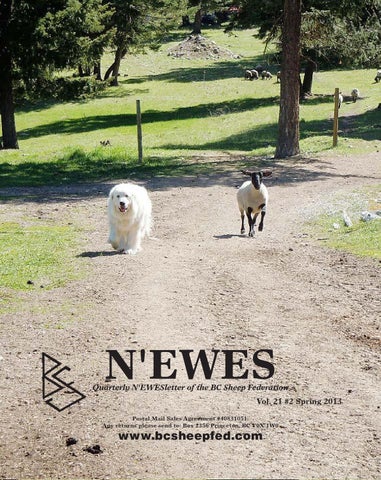
N'EWES
Quarterly N'EWESletter of the BC Sheep Federation Vol. 21 #2 Spring 2013 Postal Mail Sales Agreement #40831051. Any returns please send to: Box 2356 Princeton, BC V0X 1W0
www.bcsheepfed.com
OFFICERS & DIRECTORS BC Sheep Federation
A message from our Editor
President Roma Tingle 250-963-7301 Fort George Shepherds Association rhtingle@xplornet.com
Finally, some wonderful weather in early May to bring green grass and some nice grazing! The lambs sure appreciate it! The BC Purebred members have been working tirelessly to host the All Canada Classic Sheep Show and Sale to BC, June 28, 29 & 30. See you all in Barriere.
Past President Barbara Johnstone-Grimmer 250-629-3819 Representative to Canadian Sheep Federation and Inter Island Sheep Breeders Association firhill@gulfislands.com Vice President Gabriel Newman 250-503-3188 Okanagan Shuswap Sheep Producers gabrielnewman@shaw.ca Recording & Membership Secretary Barbara Ydenberg 604-856-3365/ 604-727-4182 Lower Mainland Sheep Producers Association bydenberg@gmail.com
The BCSF AGM and Seminar Prince George Oct. 4-6
Treasurer Kathy Millar 250-748-0487 2881 Mountain Road Duncan, BC, V9L 6N4 homefarm@telus.net
~ Bev Greenwell
SPRING 2013 Editor - Bev Greenwell Please make payments for memberships, subscriptions and advertising to: Kathy Millar, BCFS Treasurer 2881 Mountain Road Duncan, BC V9L 6N4 homefarm@telus.net Produced for the BC Sheep Federation BCFS N'EWES articles may be reprinted in other publications, on condition that the content is unchanged and credit given to N'EWES as the source. Views and opinions expressed in this publication are those of the authors an do not imply the support of the BC Sheep Federation. The editorial board has the right to refuse material which it considers unsuitable for insertion or to edit material to conform to space availability.
Creative & Published by;
SPOTLIGHT The Similkameen
PUBLISHED EVERY WEDNESDAY Annual subscription: $30 locally, $45 elsewhere in Canada Creative Production: Lisa Carleton - Associate Publisher/Editor
Rod Hennecker 250-395-3580 Cariboo Sheep Breeders Association ceeds@bcinternet.net Bev Greenwell 250-295-6419 N'EWES Editor BC Purebred Sheep Breeders' Association happyhollow@nethop.net Rob Horstman 250-992-8447 Quesnel Sheep Producers Association hbpaints@gmail.com ~ Front cover courtesy of Bev Greenwell
BCFS Mission Statement
To promote sustained growth and development of a unified, market responsive, profitable and commercially viable sheep industry in British Columbia.
Website: http://bcsheepfed.com
Proudly serving the community since 1948 • www.similkameenspotlight.com
Street Address: 282 Bridge Box 340 • Princeton, B.C. V0X 1W0 Phone: 250-295-3535 Fax: 250-295-7322 Email: lisa@similkameenspotlight.com
OFFS Steering Committee Rep Val Gerber 250-676-9234 Upper North Thompson Sheep Breeders Association stump_pasture42@xplornet.com
Advertising Rates Full Page $250ea / $800yr. 2/3 Page $200ea / $700yr. 1/2 Page $150ea / $500yr. 1/4 Page $120ea / $400yr. Business Card $50ea / $150yr. Breeders Card $50ea / $100yr.
2
Classified Ads: 25 - 50 words $30.00 25 words or less $20.00 *A year of ads is for 4 Issues
Advertising Contact:
Lisa Carleton 250-295-3535 lisa@similkameenspotlight.com
Vol. 21 #2 Spring 2013
Canada Classic BC Purebred Sheep Breeders Association
Schedule of Events Wednesday, June 26 Barn open to accept early arrivals by appointment only Thursday, June 27 9:00 am Barn open for arrivals and trade show set-up Friday, June 28 7:00-11:00 am Trade show set-up (must be completed by 11am) 8:00 am - 6 pm Concession open 12:00 pm All animals must be in the barn 12:00 pm Opening Ceremonies 1:00 pm Sifting and veterinary inspection of sheep** 1:00 pm Educational demonstrations 7:00 pm Lamb Burger Exhibitor and sponsor social Saturday, June 29 8:00 am - 5 pm Concession open 10:00 am - 5 pm Trade Show open 10:00 am All Canada Sheep Classic 2013 Purebred Show - Judges: Doug Higginson & Raymond Reade 1:00 pm Judging of fleeces, followed by silent auction of fleeces 5:00 pm Trade Show, concession and barn close 6:00 pm Happy Hour 7:00 pm Lamb Banquet, followed by fun auction. Be sure to order your tickets.
~ Bev Greenwell
O
ver 350 sheep from accross Canada have been entered in the 2013 All Canada Sheep Show and Sale to be held June 28, 29 and 30 in Barriere. Sheep to see - and possibly take home! Sheep items and supplies to see - and possibly take home! New ideas , people to meet and friendships to gain! Good food, good people, good sheep, good time! Be sure to mark your calendar! See you there!
"Lamb cuddles" ~ Avely Ranch, UNTSA
Sunday, June 30 - Sale Day 8:00 am - 6 pm Concession open 9:00 am - 4 pm Trade Show 11:00 am All Canada Sheep Classic 2013 Purebred Sale Noon Fleece silent auction ends 9:00 pm All sheep must be removed from the barn*** Please Note: *** All exhibitors must be present at time of examination of their animals *** Sheep will be released when the sale is completed. A “release slip” is required. For more information contact: BC Purebred Sheep Breeders’ Association Barb Ydenberg Lorea Tomsin Richard Herlinveaux 1-604-856-3365 1-250-656-2378 1-250-656-7651 bydenberg@gmail.com countrywools@hotmail.com growwell@telus.net
www.bcsheepfed.com
3
~ Roma Tingle & Monty
President's Message
W
hen I started to cobble something together to put in the newsletter, it was the middle of April and I was sitting looking out on fields of white! Fortunately the ground has now surfaced and some green grass has actually appeared. This spring has been the worst we have seen in a number of years for excess snow and cold weather. Even now at the end of April we had a mixed bag of snow hail and wind today – I am not about to put away my toque and mitts quite yet! We winter lamb and except for a couple of yearlings are done – and several of our lambs have again found homes with 4-H members. We seem to have a resurgence of 4-H sheep clubs, which is heartening to see. Also, we have had several inquiries from folks interested in getting into sheep – a trend I believe assisted by a local initiative of Beyond the Marketplace, funded by the Investment Agriculture Foundation to mentor new farmers. A number of local farmer’s and ranchers are also involved with students from UNBC, and have offered land to grow crops and support agriculture activities. These activities all will help bring young people a bit closer to see where their food comes from and be more involved in it’s production. There seems to be a strong local demand for lamb, but larger producers are facing low prices when shipping their lambs, not only in BC but also across the country. It’s hard to believe with the huge potential for our product that there is a disconnect in the opportunity to supply a superior product to the marketplace and be appropriately paid for it. There needs to be a concerted and coordinated effort by producers to better respond to this issue. While we appreciate the work by the CSF on our behalf, it is a concern that we may be missing the boat in not working on a solution in time to keep current producers around and encourage others to raise sheep. Our interaction with the Canadian Sheep Federation is ongoing and Barbara Grimmer is your BC representative. She has been tireless in supporting BC’s position on the CSF board. In addition to Barb, we have hard working purebred breeders such as directors Barb Ydenberg and Bev Greenwell putting in hours of time for the upcoming Classic in Barriere this June. Bev has also been the one putting in endless hours editing our excellent newsletter. Please take a moment if you have an opportunity to thank your representatives for all their voluntary hard work on your behalf. Also thanks go out to Peter Bailey of Farmington, BC in the BC Peace for keeping up our visibility. Peter submitted an ad for BC sheep Federation in the Northern Horizon newspaper, which has resulted in new memberships for BCSF. Thank you Peter! This year we have also joined the BC Abattoir’s association, as well as F.A.R.M. Community Council both of which we hope will encourage exchange of information and increase communication between organizations that affect many of us. Last but not least – a reminder that the fall AGM and Seminars will be in Prince George this year.
Mark October 4-6, 2013 on your calendars and be sure to set your sights northward and visit our neck of the woods. We are trying to have an interesting and informative program. See our next N’Ewes for details. "The first day of spring is one thing, and the first spring day is another. The difference between them is sometimes as great as a month." ~ Henry Van Dyke TABLE OF CONTENTS: Officers and Directors................................................... Page 02 BC Purebred Sheep Breeders/Classic..........................Page 03 From the President........................................................Page 04 Advertisers Index..........................................................Page 06 REPORTS Canadian Sheep Federation Report............................Page 05 Cariboo Sheep Breeders Association Report...............Page 06 Upper North Thompson Report....................................Page 07 Okanagan Shuswap Report..........................................Page 08 Inter-Island Report........................................................Page 09 Lower Mainland Report................................................ Page 10 News Provincial Predator Conflict Prevention..........................Page 11 Food Safe Farm Practices Training............................... Page 12 Export Opportunities Expand........................................Page 13 EFP and BMP Program Launch ...................................Page 14 Sheep Value Chain Roundtable....................................Page 15 Biosecurity Standard Released.....................................Page 16 SHEEP Bits 'n Bites Wool Projects................................................................Page 17 Wool Skirting Table.......................................................Page 18 Pup Bonding.................................................................Page 19 Kuvasz Guardian Dogs.................................................Page 20 Breeders Pages ...........................................................Page 22 Membership Form.........................................................Page 24
4
Vol. 21 #2 Spring 2013
Provincial News Canadian Sheep Federation Report ~ Barbara Johnstone Grimmer
T
he Canadian Sheep Federation has been very active in the past year, particularly with the work involving the renewal of our organization to be a financially self-sustaining, effective and responsive federation. This has included work on our governance, involving a governance consultant, a governance committee and the executive board members. As a member of the executive, I was able to bring the perspective and experience of a lean organization as a BCSF board member to a governance workshop in Toronto in December. Although a two day meeting for me takes six days with ferry travel and plane cancellations, and BC does not pay a per diem for meetings compared to other provinces, it was well worth the cross-country travel for a face-to-face meeting. A Governance Paper was drafted from the meeting and distributed to the members of CSF for comment, which are due May 1st for the CSF Board to chew on further. One of the main features proposed is a smaller board with one representative per province, and a tag fee which will replace the provincial dues. The tag fee is intended as an interim measure to ensure financial stability of CSF while we work towards a national check-off. The tag fee was the first step in our renewal, and BC one of the first provinces to implement the $.25 per CSIPtag fee. This will ensure that BC has a place at the national table for sheep policy. This fee is voluntary and producers who wish reimbursement can contact CSF for a refund. The governance meeting followed our annual CSF AGM and Sheep Value Chain Roundtable (ShVCRT) with AAFC in November in Ottawa. The goal of the CSF Board meeting prior to the AGM was to build on the work that had been accomplished over the past year on CSF Renewal and to move forward in building a stronger, more unified sheep industry. There was discussion of the Communications Policy, a Governance Workshop and signing off of the 20122017 CSF Business Plan. The highlight was a presentation by Federation des Produceurs d’Agneaux et Moutons du Quebec (Federation of Producers of Lamb and Sheep in Quebec). Marie-Eve Tremblay with FPAMQ gave a presentation on the marketing agency created in 2002. The Federation acts as an intermediary between producers and buyers for heavy lambs. Payment is based on quality, and contracts are negotiated annually for the marketing quarters. The entire meeting, AGM and ShVCRT were conducted in both official languages. This greatly improved the relationship with the Quebec producers, and has inspired CSF to work toward becoming a truly national and bilingual organization. Last but definitely not least, the final major project that will monopolize much of the CSF Board’s time this year is to hire a new Executive Director. Jennifer MacTavish has resigned as CSF Executive Director effective March 31, 2013, and has accepted the General Manager position for the Ontario Sheep Marketing Agency. Jennifer joined CSF in May 2003
as OFFS Coordinator and became its Executive Director in March 2004. During her time as ED, she helped to increase the organization’s national presence, including the development of the Sheep Value Chain Round table along with playing an integral role in the evolution of the Canadian Sheep Identification Program and On-Farm Food Safety Programs. The board has enlisted the support of RANA Consulting to assist with the transition as we search for a suitable candidate. We have advertised across Canada, and have formed a search committee from our CSF Executive. The CSF Board decided to emphasize bilingualism as important in an Executive Director, and the location of the CSF office is to move to the National Capital Region in order to more efficiently liaise with AAFC, CFIA and other national commodity agencies. On the topic of tags, the CFIA has been conducting audits of CSIP tags, which are required on every sheep leaving the home farm. There are reports of different abattoirs requesting CSIP tags to be submitted in bags, and not in the sheep’s ear. This request apparently originates from the individual CFIA inspectors who currently inspect livestock and meat at every Class A and B abattoir in BC. To ensure that producers are not fined for non-compliance, I would suggest that sheep producers ship their sheep with the tags in the ears – and be sure they are approved in sheep. There are reports of some producers using the cattle RFID tags in their sheep. This is not allowed. Some producers have been fined for non-compliance in other provinces, for either using no tag, the wrong tag, or having the tag but not putting it in the ear of the sheep. This has been discussed in meetings with the CFIA in Ottawa, who find it hard to believe that the inspectors in BC aren’t following the rules. The goal of the CSIP tags is to be part of a full all-livestock traceability system for disease control and food safety, which at this time is not expected to be in place before 2015. The CSF appreciates the patience of our producers as we work on behalf of all sheep producers with the various government agencies. As the representative for BC on the CSF Board, I serve on the Executive as Secretary. Our Executive Committee has a conference call every Tuesday evening and also serves as Finance Committee and Executive Director Search Committee. Our whole CSF Board has a conference call every 4-6 weeks. It has been a privilege to represent BC as a CSF Director. The Canadian Sheep Federation is a national, non-profit federation of provincial sheep organizations and other national sheep organizations (CSBA, CCWG) that represent all Canadian sheep producers. Its mission is to further the viability, expansion and prosperity of the Canadian sheep and wool industry.
www.bcsheepfed.com
5
Provincial News Cariboo Sheep Breeders Association
S
~ Cynthia Mailhot
pring is Sprung! or at least I hope so. The weather is finally warming up and we should be starting our big group lambing by the 1st of May. Most of the girls already have bags so I expect MOST of the lambs will be born in a 2 week period. Last year we had 149 babies born in 20 days and most of them were twins. Our barn was stuffed. Hopefully with our new barn being pressed into service (already used to finish the market lambs) it will be easier to move around and give each ewe a more comfortable space. We had about 40 lambs born in Feb. and March, all in the old barn where they had to share the space. Consequently, some of the lambs think they have 2 or 3 moms. They were moved into the new barn for a while and then into the feeder fence pens outside where the lambs can get through the fence to enjoy a bit of alfalfa pellets without being pushed out of the way. This has worked remarkably well. One group of lambs has even found the first green shoots of grass on the hill behind the feeder pen. Our “Meadows” are in their annual spring flood which brings many migratory waterfowl for a stopover. This water is open before most of the larger lakes have thawed and we have a wide variety of birds visiting us before the water drains away and the grass starts growing up through the water. This is a natural fertilizing system and leaves the ground rejuvenated with all sorts of micro-nutrients, all the better to grow healthy grass and hay. We held our AGM this early spring, had a great turnout and a few new people. All the exec positions will stay the same, with Mike Doherty being the President, myself the Vice and Karen Moores will continue to be the Secretary/ Treasurer.
Our Field Day this year will be held at Spokin Lake Farms, Mike and Anna Doherty will be hosting this tour. There will be a Heading Dog Demonstration and other small workshops of interest. Please join us on Sunday, June 23, 2013, starting at 10am. Please bring something to share for the Pot-Luck Lunch. Coffee and Tea supplied. Location is at 3849 Spokin Lake Road, (off the Horsefly Rd). If you need more info, you can email me at themeadows@ pioneerranch.ca or call Karen at 250-398-7647 in the evening. Thanks.
Advertisers index Douglas Lake Equipment............................. Page 7 Valley Livestock Supplies............................. Page 8 Buckerfields................................................. Page 8 Canadian Cooperative Wool Growers......... Page 9 Tappen Valley Farm................................... Page 12 Grober........................................................ Page 13 Custom Woolen Mills................................. Page 14 Beaverhill Auction....................................... Page 14 Ferris Fencing............................................ Page 15 Vanderveen Hay Sales............................... Page 16 Otter Lake Farm......................................... Page 16
Cottonwood Farm...................................... Page 22 Bramblewood Farm.................................... Page 22 Wind’s Reach Farm Clun Forest Sheep.... Page 22 Olde Country Registered Sheep................ Page 22 Home Farm Shetlands.............................. Page 22 GenOvis.................................................... Page 22 Bee Jay Dorsets & Mountainside Southdowns .................................................................. Page 22 Happy Hollow Farm................................... Page 23 B.C Stock Dog Association........................ Page 23 Schoolside Suffolks.................................... Page 23
6
Vol. 21 #2 Spring 2013
Provincial News UPPER NORTH THOMPSON SHEEP ASSOCIATION ~ Valerie Gerber
L
ambing is winding down here in the Upper North Thompson Valley. The grass is growing well and hay still left in the barns. Visitors are still arriving though to visit the lambing area and the most fun are the Hay Wagon Rides through the meadows and winding through the bunches of sheep and almost month old lambs. A few orphan lambs remain for lots of cuddles and bottle feedings. It is interesting to note that there are more and more people who want to come and volunteer their time on farms. There are many who really want the hands on experience. We were not able to accommodate all the people who wanted to come this year and I hear similar on other farms. Many of these are city people but some are those pursuing agriculture careers as well. Many of the orphan lamb sales were for those wanting to start a little flock with ewe lambs. Again, we didn’t have enough lambs to fill the orders. Our last meeting in Barriere was well attended with a luncheon at the Station House Restaurant. It is yet to be decided where our Field Day will be this summer. Some Barriere area farms have offered their places for a potluck and farm tour. We will keep you posted. The All Canada Sheep Classic will be coming up soon in Barriere and many of our group will be helping out with that.
Have a great summer everyone!
Call us for all your equipment needs! Douglas lake equipment toll Free: 1-800-553-7482 Work: 250-851-2044 ext. 2 Fax: 250-851-8571 Happy customer, Bev Greenwell of Happy Hollow Farms proudly shows off her Kubota tractor!
Douglas lake equipment ltD. 706 Carrier Road kamloops, B.C. V2H 1g2
www.douglaslakeequipment.com
www.bcsheepfed.com
7
Provincial News
Okanagan Shuswap Sheep Producers
~ Gabriel Newman
W
ell, it looks like May is just around the corner and I am behind on just about everything. Perhaps it is because spring came early here that I feel behind. I remember looking around the place in early March wondering what month it is and what I am suppose to be doing. “Isn’t there usually snow on the ground now,” I wondered. The warmer spring does make for nicer lambing though the mud isn’t ideal. I was not involved in OSSPA much over the past while for family reasons but it nice to know that the group carried on just fine without me. Actually, I doubt they missed me at all. I am kidding, they were very supportive, offering to come help shear the sheep and carry some of my responsibilities until things settled down. It was touching to know that there were a group of people who were genuinely concerned and willing to help. It is an added benefit to being a member of OSSPA. This winter OSSPA held, as we always do, a number of educational talks as part of our monthly meetings. Last month had a trapper come in and talk about trapping, various predators, and the laws around predator control. It was fascinating. I left the meeting reflecting on how much a discrepancy there is between the general public and realities of producing food and just our interface with nature in general. I know many of us walked away from that talk having learned something. Our meetings are always interesting. In the next couple months we will be having a felting workshop that will be open to the public. You can visit our website to find out more details.
Speaking of website, OSSPA has just launched a website. It is still in its infancy but it has meeting dates and times, a full member’s listing with products they sell, the history of the organization, links to other sheep related sites (including the BCSF site) and soon it will also have a classified listing. I am very excited. It took us a while to get here but I think it looks good and I hope it proves to be a benefit. Please check it out at www.okanaganshuswapsheep.ca.
Serving your community since
1919!
ABBOTSFORD DUNCAN KELOWNA W. KELOWNA NANAIMO PARKSVILLE SAANICH SALMON ARM
34633 Vye Rd. 5410 Trans Canada Hwy. 103-1889 Springfield Rd. 2565 Main St. Hwy.97 S 1-1277 Island Hwy. S 587 Alberni Hwy. 1970 Keating Cross Rd. 1771-10th Ave. S.W.
www.buckerfields.org
8
556-7477 748-8171 860-2346 768-8870 753-4221 248-3243 652-9188 832-8424
Vol. 21 #2 Spring 2013
Provincial News Inter-Island Sheep Breeders ~ Barbara Johnstone Grimmer
F
or the islands, winter was pretty mild and spring is well underway, marked by lambing and the shearer doing the rounds. Hopefully everyone’s lambing has been successful. IISBA submitted a SID Application for a listserv/website to improve networking and communications on our big network of islands, and hopefully will be successful. Now that our 2013 calendars are up on the wall, mark September 29, 2013 for IISBA’s next AGM, to be held in Victoria.
"Visiting Sheep Dogs" ~ Avely Ranch, UNTSA
"Crystal's Lamb" ~ OSSPA
CCWG Livestock Supplies Ltd. Wool and Mohair Bought Year-Round for Your Convenience Sheepskins and Woolens Supplying Sheep and Cattle Producers with a complete line of supplies: • Shearing Supplies • Show Supplies • Animal Health Products • Gallagher Power Fencing • Drenchers, Foot Trimmers • Rey Tags • Call about our Handling Equipment
Available at Lethbridge Branch:
AVAILABLE NOW! Sheep Identification Tags 1-800-567-3693
Ask for our FREE catalogue today!
• Specialty Feeds • Weatherguard #12 • Range Blocks • Mineral Blocks •Dew Drop Milk Replacer • Loose Cobalt Salt • Block Salt • Creep Feed • Grober Milk Replacer • Z-Tags for Sheep
Mail orders receive prompt attention.
Canadian Co-operative Wool Growers Limited 918-1st Avenue S., Lethbridge, AB T1J 0A9 Wool Dept. Phone: 403-327-3760 Email: ccwgab@telusplanet.net Monday - Friday 8:30 a.m. - 5:00 p.m. Saturdays 8:30 a.m. - 4:00 p.m. Supplies Dept. Phone: 1-800-567-3693 Fax: 403-380-6982
www.bcsheepfed.com
9
Provincial News Lower Mainland Sheep Producers
~ Barbara Ydenberg
W
ell another season of lambing is under my belt. That makes 10 crops of lambs for me. I always wish it had gone a little bit better; a few more lambs, that I hadn’t lost that one, or that I didn’t have to get up at 2 am on those cold rainy nights. But I really love lambing time and watching those little babies grow. The LMSPA continues to meet monthly at our general meetings with an educational component. The executive directors also meet monthly to take care of the planning and business end of things. It seems to me that my report on the BC Sheep Federation activities is one of the most essential parts of the business meeting. Our membership has grown to 60 members. In January we had a presentation of what to keep in your lambing kit and other equipment you would find handy to have in the barn at lambing time. In February we watched part of Dr. David Henderson’s DVD on “lambing.” For our newer members, these sessions provide much-needed information that they are hungry for. In March, Dr. Lethan Dwan from the Langley Animal Clinic came to speak about parasites and deworming protocols. Lethan is our favourite young Scottish vet. He is very knowledgeable and gives a great presentation punctuated with lots of humour. He prefaced his talk by saying that he has changed his approach to parasite control in the 6 or so years he has been treating sheep in the Fraser Valley. This has been tailored to our weather conditions, the types of flocks most of us have, and the size of our farms. He cautioned us that we could see the most significant worm load this year that has been seen in a long time due to the mild and wet winter we’ve had. He talked about Nemotodirus battus infections that he often sees here in young lambs that have been turned out onto pasture 3 to 4 weeks earlier. Doing fecals on sheep is always useful to find answers for unthrifty lambs or ewes with ‘dirty bums.’
Lethan gave us a worming protocol for our area: use ‘white’ dewormers (Valbazan or Safeguard) at lambing time, another dose in mid-Spring, and at pretupping (that’s Scottish for putting the ram in at breeding time!!). An inbetween dose in mid- to late summer of a ‘clear’ dewormer (Ivomectin) is also recommended. Mass Emergence Syndrome can happen after deworming, as it seems that a mass emergence of larvae is triggered about 2 weeks later. We had a discussion about pasture rotation and its role in parasite control. Lethan pointed out that most parasite eggs can survive to the hatching stage for 3 weeks up to 2 years on our pastures. So unless you don’t return your animals to a pasture for 2 years, you are not really accomplishing anything. It is beneficial of course to keep the forage growth sufficient so that the animals are less likely to graze everything to the roots.
That was Dr. Dwan’s final talk with us since we had to say goodbye to him as he heads off to a new part of his life in New Brunswick. We wished him all the best there. Lethan is about to become a new father since his wife is pregnant with twins. Good lambing percentage! In May we are expecting a speaker from the BC Assessment Authority to come and talk on qualifying for farm status. This will be of interest to a lot of our members since that is often a major incentive to get into sheep production. The LMSPA is busy planning for another Fleece Show and Sale to be held on Saturday, September 14, 2013. It’s always a great event with lots of demos, cash prizes and buyers. Information is on our website. We’ll be having our annual farm visit/tour in May. The Higginson family of Chilliwack has invited us to come ad see their flock of Southdowns Our website at www.lmspa.ca has been improved and updated recently. It is worth checking out.
10
Vol. 21 #2 Spring 2013
Provincial News Protection of livestock from Predators
T
Submitted by: Sgt. Darrell Ashworth Provincial Predator Conflict Prevention and Response Coordinator
he concerns producers have about protecting their livestock are paramount and personal. There is no question they know every animal they have, when it was born and what it looks like. So, when they are impacted by a predator not only is it a financial loss with a lasting economic impact; it’s personal as well. Most producers have vast experience in keeping their animals safe and know what works best for them in their particular set up or ranch. As the protector of the herd, there are ways that the producer can reduce conflicts with large predators. These protection methods change depending on the location of the livestock, time of year, herd size and age and number of people available to help. On the ranch, one best management practices is to maintain good animal husbandry. One such practice includes the establishing and maintaining of a dead animal burial pit. These pits need to be located far from your livestock and preferably from your residence as well. This will help in reducing predators from inadvertently locating and feeding in your burial pit. The pit should be a minimum of 8-10 feet deep and I would suggest burying the carcasses each time you put them in the pit. If possible a protective fence should be erected around the pit to discourage predators from entering your pit. If you have dead livestock in your pasture, remove it from the pasture as soon as possible and bury it in the pit. Not leaving them in the pasture to rot, will reduce the opportunity for predators to feed on them and eliminates the opportunity for secondary feeding. Other possible methods of reducing conflicts with predators would include: Reduce any other attractants that may bring in predators in. Keep lambing barns clean and removing any attractants caused by lambing. Have defined storage areas at least 200 meters away from lambing areas. Castrate lambs two weeks before putting them out to pasture or grazing areas. Utilize livestock guardian dogs to protect the herd. Sheep on range are much more difficult to protect and are more susceptible to predator conflict. There are many ways to protect the herd such as: Guardian dogs, portable fencing, electric fencing or pens. Portable fencing is cost effective, easy to set up, but can cause stress to the herd and can have a negative impact on native plants if over grazed. Another effective method to protect the herd is to utilize Range Riders. Most sheep and cattle producers have range riders out on a daily or weekly basis. The primary goal of a range rider is to reduce predator livestock conflict "Summer Shepherding" ~ Avely Ranch, UNTSA and livestock losses. Range riders are a proven method to reduce predator livestock conflicts. Predators often keep their distance from areas where there is a frequent of human activity or presence, and tend to move on to other food sources or locations. This management method/tool is probably the most effective way of protecting your herd. By having riders on grazing tenures, it provides them with the opportunity to observe first-hand the overall health of the herd, and also with the opportunity to observe any predator livestock conflicts and possibly the chance to remove them, if warranted. By having a rider present, he or she can secure the needed evidence to successfully complete the predator livestock attack and subsequent investigation and provide the opportunity of mitigation by either the COS or by them. Further, the range rider can observe agitation in a herd caused by predators, and make note of any tracks, scat and other evidence caused by these predators. Riders should then report their findings to their manager and to the Conservation Officer Service to determine the best method of response. Having an increased human presence, such as a range rider, will provide you with the opportunity to manage your herd by removing the sick or weakened animals, which attract predators. Range riders are a proven method to reduce predator sheep conflicts. All producers should check their herd on a regular basis and record all observations in a field book and report any signs of livestock depredation to the Conservation Officer Service RAPP Line 1-877-952-7277.
www.bcsheepfed.com
11
News New Food Safe Farm Practices Online Training Modules Launched ~ Canadian Sheep Federation Guelph, Ontario – The Canadian Sheep Federation is proud to announce the release of new online training modules for the Canadian Sheep and Lamb Food Safe Farm Practices Program. The new modules can be accessed through the Canadian Sheep Federation’s website at: http://www.cansheep. ca/cms/en/Programs/FoodSafeFarmPractices/Training/ Training.aspx. The Food Safe Farm Practices Program is an on-farm food safety program created by the Canadian Sheep Federation for sheep and dairy sheep producers across Canada. The program can easily be adapted to any farm in order to help producers to address on-farm food safety. For those producers wishing to become certified on the program, taking a training session is required. In the past, training has been available online or through in-person training sessions. Since funding for on-farm implementation of food safety initiatives, such as equipment, producer training and audits, have been passed on to the provincial governments, funding for in-person training sessions can only be accessed within the province making it difficult to provide this type of training. Some producers actually prefer the convenience and format of online, self-directed learning. The online modules provide this type of training for producers. Whether your goal is to become certified on the program or simply to learn more about on-farm food safety, these new modules have the added convenience of easily fitting into a producer’s busy schedule. This latest updates to the training site have made the modules easier to understand and navigate, as well as bringing the modules more in line with updates made to on-farm food safety and the Food Safe Farm Practices Producer Manual over the last five years. The new training site coincides with the release of the latest version of the Producer Manual, which can also be downloaded from the Canadian Sheep Federation’s website under the Food Safe Farm Practices Program information. The Canadian Sheep Federation worked with Farms.com Professional Services to create the training website. Farms. com Professional Services is a full service interactive technology firm specializing in the agriculture, food, and natural resource sectors. Using industry expertise, they align innovative technologies and ideas, enabling their clients to achieve measurable success. Farms.com Professional Services has a defined expertise in the Not-For-Profit, Agri-business, Food, and Rural Lifestyle sectors. It is part of the Farms.com group of companies.
"Suffolks Stroll" ~ Happy Hollow Farm Farms.com Ltd. is a leading provider of innovative news information products and services for the global agriculture and food industries. Farms.com can be accessed through its internationally recognized agriculture information portal, which has business services and resources for more than 25,000 agribusiness professionals and livestock and crop producers who use it each day.
Farms.com Powering Your Success!
The Canadian Sheep Federation is a national, non-profit organization that represents all Canadian sheep producers. Its mission is further the viability, expansion and prosperity of the Canadian sheep and wool industry. For more information contact the Canadian Sheep Federation at 1-888-6847739 or info@cansheep.ca. This project was made possible by funding from Agriculture and Agri-Food Canada (AAFC) through its Canadian Integrated Food Safety Initiative (CIFSI). AAFC is pleased to participate in this project and is committed to working with its industry partners to increase public awareness of the importance of the agri-food industry to Canada.
Tappen Valley Farm Tappen, BC
Wanted to buy — all year Sheep & Goats Lambs 70 to 100lbs
Dan Sandys Phone: 250-833-2373 Email: mdbarns@telus.net
12
Vol. 21 #2 Spring 2013
News Canada Expands Export Opportunities for Sheep and Goat Genetics to Turkey Ottawa, Ontario, May 7, 2013 – Beginning today, Canadian producers will benefit from more export opportunities in the Middle East. Agriculture Minister Gerry Ritz announced today that Turkey has approved imports of sheep and goat genetics from Canada. "We are pleased that Turkey recognizes the safety and high quality of Canadian agricultural products," said Minister Ritz. "This agreement is an important achievement in our continued efforts to expand market access so Canadian producers can continue to grow our economy." Access to the Turkish market flows from the Government's trade expansion goals and is the result of its focused efforts to create new opportunities and science-based trade for Canadian producers. Successful expansion of the Turkish market will also result in better awareness of Canadian products and services in the surrounding countries, leading to potential new market opportunities. Advancing trade with other countries in this region has been at the forefront for Canadian producers, as Turkey is viewed as a priority and emerging market. "The Canadian Livestock Genetics Association (CLGA) thanks the Government of Canada for finalizing these protocols," said Rick McRonald, President of the CLGA. "The demand in Turkey for Canadian sheep and goat genetics is growing, so the resolution of the interruption in technical market access came at a crucial time. Canadian exporters will now be able to engage with their Turkish clients and partners in the confidence that technical barriers to trade in semen and embryos have been removed." Total Canadian exports of animal genetics (semen and embryos) reached $103.6 million in 2012, representing an important export commodity. Producers will now have access to another market open to our high-quality agricultural products. The CLGA estimates the potential value of this market to be $250 000 over five years. End-of-year trade statistics indicate that 2012 was Canada's best export year on record for the agriculture and food industry. In 2012, exports of Canadian agricultural and seafood products reached $47.7 billion, up 7.4 per cent from $44.4 billion in 2011. Today's announcement is another example of what is being accomplished to enhance competitiveness and long-term growth in Canadian agriculture—priorities under the Growing Forward 2 policy framework. In addition to multi-year funding for risk management programs, Growing Forward 2 includes $3 billion in strategic initiatives for innovation, competitiveness, and market development.
" Flow through fence" ~ Cynthia Mailhot
www.bcsheepfed.com
13
News EFP and BMP Program Launch To industry associations, BCAC directors, committee members, The Environmental Farm Plan and Beneficial Management Practices Programs are officially underway! If you are, or have had contact, or will have contact with farmers, ranchers or First Nations agriculture operations that have expressed interest in these two programs, you can indicate the programs are currently available. There will be no public announcements or press releases during the provincial election (writ) period so we will need to rely on word of mouth. The programs will operate in much the same manner as Growing Forward 1 (2008-2013) for this first year of Growing Forward 2 (ending March 31, 2014). EFP’s will be completed by agriculture operations with the assistance of Planning Advisor’s, once the EFP is completed producers can access the BMP program if they have action items that fit in the onfarm incentive program. Program information (including a BMP list), BMP application forms and contact information for Planning Advisors can be found on the program’s website (www.bcefp.ca). We strongly encourage producers who wish to participate in the EFP and/or BMP Programs to contact a Planning Advisor to begin the process.
Gabriel Newman - OSSPA
PO Box 957, Tofield AB T0B 4J0 Phone: 780-662-9384 Fax: 780-662-3615
R. R. 1 Carstairs, Alberta T0M 0N0 Phone/Fax (403) 337-2221
• Comforters • Mattress Pads • Sleeping Bags • Batts • Roping 4-Str. • Yarns • Work Socks
• Custom Services Washing Dying Carding Spinning Sewing Knitting
Western Canada’s Largest Regular Sheep & Goat Sale Regular Sales at (11:00 a.m.) 2nd & 4th Monday every month from January to July weekly Monday Sales from August to December. (except holidays) Sunday receiving hours - 3 p.m. to 8 p.m. The best buyer support from across Canada. Order buyers representing local meat packers as well as meat packers on the West Coast, Ontario and Quebec.
Book your animals with Doug at 780-777-4540 Market reports available at
www.beaverhillauctions.com 14
Vol. 21 #2 Spring 2013
News Sheep Value Chain Roundtable Bulletin –November 13-14, 2012 The Sheep Value Chain Roundtable (ShVCRT) met in Ottawa on November 13 and 14, 2012. The discussions focused on animal health products, processing capacity, sheep research, traceability and working group updates.The Medications Working Group (MWG) presented their workplan and progress to date. The Veterinary Drug Initiative, part of the Regulatory Cooperation Council (RCC), presented who they are and how they are working on harmonizing drug reviews. A presentation on the Canadian Global Food Animal Residue Avoidance Databank (CgFARAD) was given, and the ShVCRT members provided support for this initiative to continue. The Expansion Working Group (EWG) provided an update including a five year plan. It also included a Cost of Production discussion. Going forward, the EWG will be looking at measuring key performance benchmarks. Additional presentations and discussions were held regarding the national slaughter capacity profile and CFIA discussed the modernized meat inspection process. A summary of all Canadian sheep research was presented. A Research Working Group (RWG) will be established to help compile all the sheep research done, and facilitate the implementation of a national sheep research strategy. A large portion of the meeting focussed on traceability. The Alberta flock management approach was presented, and Agri-Traçabilité Quebec outlined the process to which it has arrived at their actual traceability system. The Canadian Food Inspection Agency discussed a proposed federal regulatory amendment for livestock traceability. The members of the ShVCRT also helped develop a revised implementation/action plan for Canadian sheep traceability. Topics of discussion included: current status, gaps and challenges, premises identification, movement reporting, use of tags, costs associated, communications and legislation/regulations. A conference call of the Sheep Value Chain Roundtable will be organized in the spring 2013 and the next face-to-face meeting will be held in November, 2013. For more information on the Sheep Value Chain Roundtable, please contact John Ross, Agriculture and Agri-Food Canada, (613) 773-0220.
FERRIS FENCING
Ask for Our 2013 Catalogue
Are you overgrazing & constantly maintaining permanent interior fences?
ON! OLUTI
S
We have nets suitable for all other Farm Livestock - ie: Poultry, Hogs, Goats, etc.
Complete with Posts Wide selection ranging from 26” - 48” high x 164 ft. long.
Electric Nets - Total Portability. Predator Protection Easily maintain your pastures and no longer let permanent fences get in the way of pasture management. Complete Portable Electric Systems General Farm. Horse. Wildlife Exclusion. Vineyard. Tel: 250-757-9677 info@ferrisfencing.com
Fax: 250-757-9670 www.ferrisfencing.com
Solar Battery 110 V Fence Controllers
1-800-665-3307
www.bcsheepfed.com
15
News National Sheep On-Farm Biosecurity Standard Released OTTAWA, March 28, 2013: A new voluntary biosecurity standard was introduced today that will help sheep producers improve the health of their flocks and strengthen their on-farm biosecurity activities. “Producers can use the Standard to create a biosecurity plan that meets the specific needs of their operation,” said Agriculture Minister Gerry Ritz. “Strengthening on-farm biosecurity protects animal health and, in effect, supports the continued delivery of high quality products.” “On behalf of the Canadian sheep industry, I want to thank the Canadian producers who volunteered their time to develop this standard,” said Andrew Gordanier, Chairman of the Canadian Sheep Federation. “This voluntary standard will provide the industry with valuable tools that will contribute to the health of the Canadian flock and help to ensure its long-term viability and sustainability.” The National Standard is a voluntary tool designed to help producers minimize and control the risk of disease entering their farms, spreading within the farm or to neighbouring farms.
Photo: "Jack with Lamb" ~ Gabriel Newman - OSSPA
BONDED HAY DEALERS
18726 - 56 Avenue Surrey, BC V3S 1G1 Phone: 604-576-1177 1-800-663-2678 Fax: 604-574-7777 vanderveen@telus.net
The Standard is divided into four principles: Animal health management practices Record keeping Farm, facilities and equipment People The National Sheep On-Farm Biosecurity Standard was developed over two years through a partnership with the Canadian Sheep Federation and the Canadian Food Inspection Agency (CFIA), in collaboration with producers, academia, and provincial governments. Funding was provided by the Growing Forward policy initiative of Agriculture and Agri-Food Canada. It was designed specifically for the Canadian sheep industry, and is applicable to farm operations of all types and sizes. BC Sheep Federation members have been sent a free copy of the Standard, a Producer Planning Guide, and a laminated biosecurity poster. The poster can be customized using an erasable marker to list prescribed biosecurity practices, and posted on your farm. To order an electronic copy of the Standard or to learn more about biosecurity, visit the CFIA’s website at www.inspection.gc.ca/biosecurity.
For all your hay needs, call the industry leaders... ...in business over 30 years! “One Bale, One Ton, One Trailer.”
www.vanderveenhay.com 16
Vol. 21 #2 Spring 2013
Sheep Bits 'n Bites Wool Projects ~ Barbara Ydenberg - Wind’s Reach Farm
I
am always looking for easy things to do with my wool after shearing my Cluns. A few months ago someone showed our local Weavers and Spinners Guild some felted wool dryer balls she had made after seeing them at a craft fair. It looked pretty easy and like it might be a good way to use up all the pounds of roving I have so I gave them a try. Aside from being cost-saving and environmentally friendly, they are very easy to make. Both of these sites will give you complete instructions: www.seasonedhomemaker.com and www.ehow.com
Another thing I have tried is using old wool in my hanging baskets instead of moss. For this I used an old wool batt torn into strips and simply worked in tiers as I wound it around the wire of the baskets, filled with potting soil and laid the plants in as I went. They ended up very heavy, but have the benefit of not drying out and the wool looks quite nice in there as the flowers fill it in.
Felted wool dryer balls will cut down on the time needed to dry a load of laundry and will cut down on static cling. The balls bounce around and keep the clothes apart to dry faster. There are many websites with instructions to make your own, but the steps are basically very simple. You will need feltable yarn or rovings or both, old panty hose, and some cord or acrylic yarn. Start by wrapping yarn into a tight ball. I found this is a good way to use up old bits of yarn leftover from other projects. Make a ball about the size of a golf ball. Continue the ball with roving until you have a ball slightly bigger than a tennis ball. Wrap some yarn that will felt around the ball randomly and tuck the end in with a crochet hook. Stuff each ball into the leg of an old nylon stocking and tie each ball off with a piece of cord or yarn that will not felt. When you have the stocking complete wash in as hot water in the washing machine and dry on high heat. Repeat the washing and drying to felt completely. The dryer balls are ready to be used. Put about 3 or 4 in with your laundry as it goes in the dryer. *** I played around with the outside of the balls. Some are pure white and some are finished with dyed yarn or dyed roving to give them some color. Dryer balls such as these are selling for about $5 per ball at craft sales around the Lower Mainland. ****
www.bcsheepfed.com
17
Sheep Bits 'n Bites Wool Skirting Table ~ Mike Doherty This is an item every sheep farm needs. When I decided to build one I couldn’t find any plans so I made it up. This one works quite well but the slats could be further apart. • Build a 2x2 frame first, use screws to connect corners & use angle brackets, small shelf brackets would work,inside corners • Rip the slats from 1” lumber , 12 ft. long. i made them 5/8 x 1 1/8 • Round off the top edges with a sander or hand plane to avoid slivers and to keep the wool from catching • When installing slats use a 2x2 spacer to speed things up • Drill pilot holes and countersink each hole to avoid splitting slats. • Use 2 1/4 x #8 screws and take care when driving them to keep from splitting wood • As you can see ours is hinged onto the wall to fold up when not in use. Make sure it has a good strong hook on it so it won’t come down on your partners head.
18
Vol. 21 #2 Spring 2013
Sheep Bits 'n Bites Bonding ~ Bryan Looker
W
ell, you have a new pup. The question(s) is when should I start training. I am of the opinion that training can not start until there is a bond between you and the pup. Now, if you look at that statement something should leap out at you! If the pup is going to bond to you then how can you send it away to be trained? That is a good question for which there is many answers, some good and some not so good. This will be the topic of another article in the future. When I get a pup for myself, I start out with the pup spending a good part of the time with my wife. That mothering instinct goes along way to eventually bonding with me. A pup has to be a pup. A pup has to learn some basic manners and the mothering instinct usually facilitates this and usually in a very short period of time. Of course this means that both of you are reading from the same script ie using the same commands. During this phase, I feed the pup, as I do with all my dogs. You know where I’m going with this. If I am feeding the pup the pup begins to see the association between me and the pack and quickly begins to find it’s place in the pecking order. I also take the pup in the car/truck anytime I go on short trips. This is usually to town for one reason or another.
When I am in town I will put a leash on the pup and take it for a short walk exposing it to different sounds, smells, noises, and people. Holding a leash during this time also allows the pup to associate me as the pack leader. Of course there is plenty of praise, at the appropriate time of course, which the pup will also associate with pleasing me as the leader. This routine will continue until it is ready for training. I will take the pup to, usually, sheep, the first time between 4 or 5 months of age. If the interest is there in any form, then this is my que to having the pup move from my wife to me. The pup is now officially mine and will be with me most of the time. The the real bonding begins. When I am asked to train a dog, I usually turn the possible engagement down for the reasons stated above. I am often asked to evaluate a dog to determine if it is ready for training or shows any interest. I have found quite often a handler will say they want to begin training a dog, but there is no bond there. As most of my training is now handler training, I will usually send the handler home with instructions to bond with the dog. When this is done then I will start working with the handler and dog. Training goes much quicker and usually with better results. This also applies to the owner doing the training. Without bonding you usually end up with a dog working for its self and not working for or with you. It can still be a good working dog but there will always be something missing. Bryan can be contacted at Hillside Farm in Miocene BC 250.296.0047 or crdogs@xplornet.com
www.bcsheepfed.com
19
Sheep Bits 'n Bites Kuvasz Guardian Dogs ~ Natasha Baronas
I
have always enjoyed watching the quiet grazing ways and perpetual cud chewing of sheep, but one day, while sitting peacefully amongst a neighbour’s flock, I had a pastoral epiphany, discovering the joy of simply “being” with the sheep. Our family has had Kuvasz as companions for many years. Once I had been struck with the joy of actually being with sheep, I developed a burning desire to see these beautiful dogs actually working with livestock. When the opportunity arose for me to introduce a litter of my Kuvasz puppies to the a neighbor’s flock, I was hooked, and it was then that I knew I needed sheep. I first acquired just one, solitary sheep, named Dixie. She was enlisted to act as a surrogate mother to two bottle-baby lambs whose owner desperately needed help rearing helpless orphan lambs. From the frying pan into the fire, I quickly learned that my plans for Dixie and the plans of the lambs were two separate matters! Regardless of the errors of my thinking, my Kuvasz now had sheep to be introduced to. I quickly learned that contrary to popular belief, one does not just “plunk” the dogs with sheep, walk away, and expect them to instinctively guard them. While there is an ancient knowledge embedded within the heritage of our magnificent breed, there is also a learning curve, and introductions need to be made carefully, and with supervision. I learned that there wasn’t only the issue of introducing the dogs to the sheep, but the sheep needed to recognize that the dogs weren’t going to hurt them. Dogs are normally considered predators to sheep, but unless sheep have been previously introduced to experienced and calm flock guardians, their instinct to protect themselves kicks in when they come into close proximity to dogs. Lambs frolic and leap about as they test their legs and this makes for an attractive novelty item for the dogs to discover. As my dogs were novices to being guardians these bouncy baby lambs were very inviting to a game of chase. We needed to be shepherds to the dogs as well as the sheep. Careful introductions were made in close quarters where they were given opportunity to smell butts and ears. Keisha was the first of my kuvasz to be granted access to my small flock. She performed marvelously and was quickly given opportunity to be loose with them while I was present; it was as if she’d been doing this all of her life. Keisha made good decisions and remained calm with the flock. Close quarters were one thing, but when granted access to the flock with more space, the antics of the lambs proved a little more difficult to resist. Some well timed corrections quickly nipped those actions in the bud. Keisha figured out what was acceptable behavior quickly and she quickly settled into the job of watching “her flock”. Keisha was a mature dog when she was exposed to the sheep, but her daughter Heidi was another story.
Heidi was an 11 month old puppy who seemed to think that life was a big game. She was a girl who was full of beans, vim, and vigor. She humbled me as I tried to figure out ways to accustom her to the sheep without chasing. I first tried using a dangle board, a short length of one-by-four board attached to her collar, tied just low enough to dangle just below her chest. This board needed to be used with supervision as there was always the potential for injury to her and to anyone who might be in her path as she came running by. Kuvasz, however, are very smart, and the dangle board did not slow her down one iota. Heidi learned how to maneuver herself with speed of a bullet train. Heidi traipsed about without a care for her or anyone else’s safety. It was clear that she needed to mature and that this was going to take some work. I continued allowing her to be with the sheep, but only on leash, so that she could be mentored and given time to mature.
Heidi’s father Moby adjusted easily to becoming a guardian. He loved everyone and everything so when Dixie the ewe arrived, he simply took her under his wing, and decided that this grass chewing “dog” was his buddy. As it turned out, after the return of the bottle baby lambs to their original home, he became the sole protector of Dixie.
Kuvasz Guardian Dogs continued next page...
20
Vol. 21 #2 Spring 2013
Sheep Bits 'n Bites
Kuvasz Guardian Dogs from page 20... As everyone knows, sheep are not solitary animals and need other sheep to be happy. Moby made for a good temporary sheep, but Dixie really needed a flock. Another ewe and an enormous ram were brought into our fold. Our flock grew from three to seven that year and then to seventeen the following spring. As time has progressed, our knowledge and experience grew as well. Suffice it to say, the Kuvasz have come to work successfully as the guardians of our flock, but it took knowledge, perseverance, and the patience to make careful and good introductions to guide our Kuvasz into this success. Experience has shown that the best way to go about introducing a puppy to livestock is to have an escape proof pen with both a top and bottom that can be placed with the livestock. Here your puppy can have food, shelter, and even protection from the livestock as the pup and flock gets used to one another. If a puppy has been raised with livestock it will be quite familiar to the sounds and smells. If not, this method will acclimate the puppy to its new charges. It is most important to teach the puppy that all good things happen to the puppy when it is with the livestock - praise, attention, and treats. Your puppy should accompany you as you go about your chores so that it gets used to being on a leash and learning the routines of your homestead. Whenever possible, it is best to introduce the puppy to your more docile animals first. If you do not have docile livestock it is up to you to protect your puppy from the more aggressive livestock. As you gain confidence in your puppy you can open its pen so that the puppy can come and go and start interacting with its flock. It can retreat to this pen as a place of safety if it gets overwhelmed. Puppies need to be handled by its owner on a daily basis when it is with the flock. Developing a good relationship with your future Livestock Guardian Dog is a must. In time you will be able to allow your pup more and more access to the flock. At first, much of that access needs to be done with a watchful eye. Remember that a puppy is learning at an alarmingly rapid rate and has a great deal of energy that needs to be properly directed. A playful pup may well engage in a game with young stock which can lead to chasing, nipping, or possibly injury. Together with your escape proof pen, patience is the key. Puppies can have periods of regression where they seem to “forget” their role, but such lapses are usually short lived. Remember that a Kuvasz can take up to three years to reach full maturity.
If they do not have an older experienced dog to act as a mentor, it is up to the owner to provide this guidance. There is a happy ending to Heidi’s story, as she has matured and protects our sheep flawlessly. While she still has boundless energy she moves through the flock and they trust her implicitly. When she barks an alarm, the sheep pay attention. Heidi is mentoring another youngster currently and with her guidance, that puppy is quickly turning into a very good guardian as well. Some good internet resources are: www.lgd.org/ and you can join their LGD-L list or read their FAQ. There is much information on this site or you can join Working LGD’s finance.groups.yahoo.com/group/workingLGDs/ You will need to have a Yahoo account to join this forum. Some book resources are: “Livestock Protection Dogs: Selection, Care, and Training” by Orsyia Dawydiak and David Sims “Storey’s Working Animals: Livestock Guardians - Using Dogs, Donkeys, and Llamas to Protect Your Herd” by Janet Vorwald Dohner
www.bcsheepfed.com
21
Breeders Page rican Clun Fo me r
es t Association
clun Forest
The Nort hA
Wind’s Reach FaRm sheep
Registered Breeding stock/market Lamb Barbara Ydenberg 27382 84th Ave., Langley, BC V1M 3L4 bydenberg@gmail.com www.windsreachsheep.com (604)856-3365
"Bonding" ~ Bryan Looker
Gen Ovis Canada’s National Genetic Improvement Program Performance Testing for Canada’s Sheep KATHY VELOCCI / B.C. Regional Resource Vernon, BC Phone: 250-545-4185 Email: rkvbc@shaw.ca
www.genovis.ca
Shetlands
Breeding for quality eeces & healthy sheep Registered Breeding Stock
Kathy Millar, Duncan, BC 250-748-0487
homefarm@telus.net Member NASSA Flock #780
BRAMBLEWOOD FARM DORSETS, ROMNEYS, and COLOURED LONGWOOLS
• PUREBRED BREEDING STOCK • HANDSPINNING FLEECES • FREEZER LAMB VISITORS WELCOME
www.countrywools.com
27482 104 AVE. MAPLE RIDGE, BC V2W 1M6
JO & DAVID SLEIGH PHONE: 604-462-9465 joannasleigh@aol.com
BEEJAY DORSETS AND MOUNTAIN SIDE SOUTHDOWNS Prince George, B.C. We will have a good selection of dorset ewe & ram lambs, a few southdowns and dorset sired crossbred ewe lambs for sale.
Phone: Earl or Val Jackson 250-963-9409 Email: pineview@telus.net
ALL INQUIRIES ARE WELCOME
22
Vol. 21 #2 Spring 2013
Breeders Page Classifieds and Notices Maremma Working Stock Guardian Pups for Sale Born/Live with Sheep or Goats $450 each Ready to go now. No Sunday calls please. 604-796-8557 www.agf.gov.bc.ca/lhmr/pubs/keeping_flocks_healthy.pdf The Keeping Flocks Healthy: Sheep and Goats manual is available online at the above link.
" Submissive behaviour in a pup" ~ Natasha Baronas
CCWG Director - British Columbia Ken Mallinson from Langley has indicated he will not seek re-election for another term as CCWG Director representing British Columbia shareholders. Sincere appreciation is extended to Ken for his many years of dedicated service on the CCWG board. The position is open to BC sheep producers who are shareholders and wool shippers to CCWG. The Canadian Co-operative Wool Growers Limited Board of Directors is comprised of 10 directors from across Canada who each serve alternating two year terms. An executive committee is then elected annually from within the Board of Directors, by the Board of Directors. The Canadian Co-operative Wool Growers Limited (CCWG) is a producer owned co-operative involved in the collection, grading and marketing of the Canadian wool clip to domestic and global markets. The co-op also operates a large network of dealers for farm supplies and wool clothing. For further information contact: Donna Zeman, Executive Director Canadian Co-operative Wool Growers Limited Box 130 142 Franktown Rd Carleton Place, ON K7C 3P3 613-257-2714 Fax 613-257-8896 donna@wool.ca www.wool.ca
Schoolside Suffolks & NorthCountry Cheviots Freda Horton
2625, 13th Street Keremeos, BC V0X 1N6 Phone: (250) 499-5612
Email: schoolside@nethop.net More than just a friend... a working partner.
Registered Suffolks Genotyped for Scrapie Resistance
BC STOCK DOG ASSOCIATION
Promoting the use and training of working stock dogs
$20.00 membership offers you • Education, trials, clinics • Demonstrations • Quarterly newsletter • Contact with others interested in working stock dogs.
Bev Greenwell & Charles Weber
Fore more information, contact President, Larry Cochlan Phone 250-459-2521 Email: lcochlan@telus.net
www.stockdog.bc.ca
1193 Hwy 3 East, PO Box 2356 Princeton, B.C. V0X 1W0
Phone/Fax 250-295-6419 Cell: 250-582-9414 www.happyhollowfarm.ca happyhollow@nethop.net
www.bcsheepfed.com
23
BC SHEEP FEDERATION Membership Application Form Supporting BC’s Sheep and Wool Industry on a Provincial and Federal Level
*PLEASE PRINT* Name of Farm __________________________________________________________________ Name of Member ________________________________________________________________ Address _______________________________________________________________________ Town ___________________________________ Postal Code __________________________ Phone (____) ________________ Fax (____) __________________ Email _________________________________________ I am currently a member of (local organization)_________________________________________ ___________________________________________________________________________ MEMBERSHIP DUES $20 Per Year: Membership includes a subscription to the N’ewes and a free listing in the “Buyers Guide” on our website: www.bcsheepfed.com Please send your dues along with this application/renewal form to: Barbara Ydenberg, Membership Secretary 604-856-3365 27382 84th Ave. Langley BC V1M 3L4 bydenberg@gmail.com
***************************************************************************** For your FREE LISTING in the “Buyers Guide” on the website, add the following information (If You already have an entry in the Guide, please note only the changes to your information) Breed(s) of Sheep_________________________________________________________________ Do you sell Registered Breeding Stock YES _____ NO ______ Approx # of Lambs sold/year A = 125 B = 25 - 50 C = 50 - 100 D = 100 - 500 E = 500+ Months Market Lambs Available _______________________ Other products you sell ___________________________________________________________ ___________________________________________________________________________ ***************************************************************************** PLEASE NoTE: BCSF members will be mailed the N’Ewes, quarterly as well as information thought to be of value to sheep producers. Please mark the box below if you DO NOT want this information. (Privacy regulations requirement.)
*****************************************************************************
~ Membership renewal is every September ~
www.bcsheepfed.com