N'EWES
Quarterly N'EWESletter of the BC Sheep Federation Vol. 20 #2 Winter Spring 2012 2011
Postal Mail Sales Agreement #40831051. Any returns please send to: Box 2356 Princeton, BC V0X 1W0
www.bcsheepfed.com
OFFICERS & DIRECTORS BC Sheep Federation
N'EWES
President Barbara Johnstone-Grimmer President and Representative to Canadian Sheep Federation and Inter Island Sheep Breeders Association 250-629-3819 firhill@gulfislands.com
A message from our Editor
Spring weather has suddenly sprung here in the Similkameen Valley. Lambs are on the ground, pastures are slowly greening, and all the spring field work of spreading manure, harrowing, fertilizing and preparing any re-seeding of hay fields is upon us. We seem to move from winter doldrums to spring activity over night! So much has to be done in such a short amount of time. Soon we will be watering! To all readers - keep those letters, articles, comments, ideas and pictures coming! This is your magazine, it is YOUR input that makes it!
Spring 2012 Editor - Bev Greenwell Please make payments for memberships, subscriptions and advertising to: Kathy Millar, BCFS Treasurer and Membership Secretary 2881 Mountain Road Duncan, BC V9L 6N4 homefarm@telus.net PRODUCED FOR THE BC SHEEP FEDERATION BCFS N'EWES articles may be reprinted in other publications, on condition that the content is unchanged and credit given to N'EWES as the source. Views and opinions expressed in this publication are those of the authors an do not imply the support of the BC Sheep Federation. The editorial board has the right to refuse material which it considers unsuitable for insertion or to edit material to conform to space availability.
SPOTLIGHT The Similkameen
1SPVEMZ TFSWJOH UIF DPNNVOJUZ TJODF r XXX TJNJMLBNFFOTQPUMJHIU DPN
Street Address: 282 Bridge Box 340 • Princeton, B.C. V0X 1W0 Phone: 250-295-3535 Fax: 250-295-7322 Email: lisa@similkameenspotlight.com PUBLISHED EVERY WEDNESDAY Annual subscription: $30 locally, $45 elsewhere in Canada Creative Production: Lisa Carleton - Associate Publisher
2
Vice President Roma Tingle 250-963-7301 Fort George Shepherds Association rhtingle@xplornet.com Recording Secretary Barbara Ydenberg 604-856-3365/ 604-727-4182 Lower Mainland Sheep Producers Association bydenberg@gmail.com Treasurer and Membership Secretary Kathy Millar 250-748-0487 2881 Mountain Road Duncan, BC, V9L 6N4 homefarm@telus.net
~ Bev Greenwell
Creative & Published by;
Past President Bev Greenwell 250-295-6419 BC Purebred Sheep Breeders' Association happyhollow@nethop.net
OFFS Steering Committee Rep Val Gerber 250-676-9234 Upper North Thompson Sheep Breeders Association stump_pasture42@xplornet.com Rod Hennecker 250-395-3580 Cariboo Sheep Breeders Association ceeds@bcinternet.net Gabriel Newman 250-503-3188 Okanagan Shuswap Sheep Producers gabrielnewman@shaw.ca Simon North 250-793-7162 Dawson Creek Sheep Breeders northfarmsltd@gmail.com
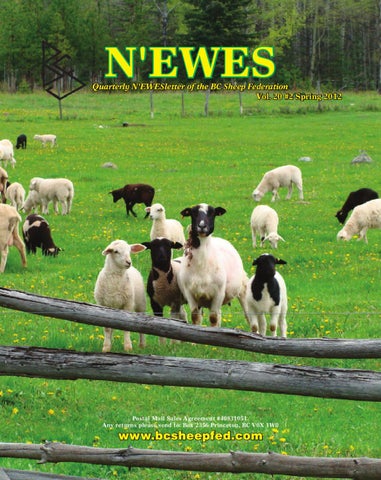
~ Front cover courtesy of Cynthia Mailhot, The Meadows Ranch
BCFS MISSION STATEMENT To promote sustained growth and development of a uniďŹ ed, market responsive, proďŹ table and commercially viable sheep industry in British Columbia.
Website: http://bcsheepfed.com ADVERTISING RATES Full Page: $250ea / $800yr. 2/3 Page $200ea / $700yr. 1/2 Page $150ea / $500yr. 1/3 Page $120ea / $400yr. 1/4 Page $90ea / $300yr. Business Card $50ea / $150yr. Breeders Card $50ea / $100yr.
Classified Ads: 25 - 50 words $30.00 25 words or less $20.00 *A year of ads is for 4 Issues
Advertising Contact:
Lisa Carleton 250-295-3535 lisa@similkameenspotlight.com
Vol. 20 #2 Spring 2012
President's Message ~ Barbara Johnstone Grimmer
e are just finishing up our lambing with a fine crop of lambs this year, and I hope it has gone well for everyone. It has indeed been extra busy, especially since I injured my leg slipping in the mud, and re-injured it feeding a boisterous group of hungry ewes. As a result everything seems to take longer to do around here. I hate to jinks things, but I have really noticed a lack of eagles and ravens which is a good thing for us (and the lambs). At the same time, there were reports of hordes of eagles in the Fraser Valley. Coincidence? After lambing, we will have shearing to look forward to. Both lamb and wool prices are up, which is good news for everyone. The provincial government is still sorting out how our meat inspection will look as the CFIA moves out of the provincial inspection business, and some producers are considering bypassing direct marketing altogether by selling through the new Canadian Lamb Company. I just found out that the federal government is now saying that full traceability won’t be achieved until 2015 because they want all species to be ready at the same time. The CSF has met the requirements for the earlier deadline of 2013, which is frustrating to say the least. Stay tuned for the ever evolving saga. I was able to attend the Investment Agriculture Showcase of funded projects in Abbotsford on March 23rd. The keynote speaker, Dr David Sparling of the University of Western Ontario, spoke on “Farming and Food in 2020”. The take home message was that the world expects more from agriculture - more food, safer food, more environmental stewardship, etc... in fact, more of everything. It was an interesting talk and I took pages of notes, but in the end Dr. Sparling said what we all know to be true. — You can’t predict the future. Not entirely, anyway.
W
TABLE OF CONTENTS Officers and Directors................................................... Page 02 From the President........................................................Page 03 Letters to the Editor.......................................................Page 04 Advertisers Index..........................................................Page 05 REPORTS Canadian Sheep Federation Report.............................Page 05 BC Purebred Sheep Breeders Association Report.......Page 06 Cariboo Sheep Breeders Association Report...............Page 07 North Cariboo Sheep Association Report.....................Page 07 Upper North Thompson Report....................................Page 08 Fort George Shepherds Report....................................Page 08 Okanagan Shuswap Report..........................................Page 09 Inter-Island Report........................................................Page 10 Okanagan Shuswap 4-H Club Update..........................Page 10 Lower Mainland Report................................................ Page 11 NEWS BC Abattoir Inspection System Review.........................Page 12 Investment Agriculture Foundation................................Page 13 Obituary - Geoffrey Bodman.........................................Page 14 Wild Candid Trapping Course........................................Page 15 Sheep Industry Development Fund Update..................Page 16 SHEEP HEALTH Phalaris SPP Intoxication..............................................Page 17 Lamb Bloat....................................................................Page 18 Schmallenberg Viris......................................................Page 20 Feeding Haylage to Sheep........................................... Page 21 Breeders Pages ...........................................................Page 22 Membership Form.........................................................Page 24
www.bcsheepfed.com
3
Letters to the Editor Sheep like the N'EWES too!
The sheer ecstasy of life Dear Editor, I’m currently reading a very interesting book called “The Omnivore’s Dilemma” by Michael Pollan. One of the things he does is visit a “grass farmer” named Joel Salatin in Virginia, who raises beef, pigs, turkeys, rabbits broiler chickens and eggs, in a very efficient and holistic manner. He quotes him as saying, “One of the greatest assets of a farm is the sheer ecstasy of life.” This pretty much sums up, for me, why I love my little postage stamp farm. I would guess it applies to a lot of us who love our sheep. Margaret Sampson
Dear Editor, The N’ewes is the favorite bit of reading amongst our bottle fed lambs. (Freckles enjoying Fall edition) We just finished shearing and are pleased that the weather didn’t crap out on us. I still feel a bit sorry for the old girls without their sweaters on, in this not so balmy weather. Nicola VonRosen of Outlaw Meats, Clinton
Congratulations on a job well done.
Hardly need to use the warming box, mostly just use these coats!
Dear BC Sheep Federation Directors: At the recent meeting of our association, Mr. Ken Mallinson held up the Winter issue of the N’Ewes, which he had received just that day. He thought that this was the best issue ever produced and asked that we send a letter of congratulations to you for a job well done. The N’Ewes consistently covers topics of major importance to BC sheep producers.
A few of Margaret’s innovations.
You should give yourselves a big pat on the back for producing such a quality newsletter. It reflects the enormous effort that goes into the N’Ewes. Thanks again for your hard work on our behalf. Sincerely, Barbara Ydenberg - Secretary, LMSPA
Gen Ovis Canada’s National Genetic Improvement Program Performance Testing for Canada’s Sheep KATHY VELOCCI / B.C. Regional Resource Vernon, BC Phone: 250-545-4185 Email: rkvbc@shaw.ca
www.genovis.ca 4
Warren & Norine Moore and Friends
6th Annual Pound Maker Ram Sale 11am on May 24, 2012 – Fort Macleod Alberta
115 Yearling Rams * Suffolk * Hampshire * Dorset * Rambouillet * *North Country Cheviot * Coloured * For more information contact Warren 403-625-6519 Vol. 20 #2 Spring 2012
Provincial News CANADIAN SHEEP FEDERATION ~ Barbara Johnstone Grimmer
For example, most recently the case of the missing Shropshire sheep that were under CFIA quarantine became he Canadian Sheep Federation (CSF) and the an issue for the CSF, who has been working with the CFIA Canadian sheep industry at large are facing to ensure that efforts to control scrapie in Canada are in an exciting time in the evolution of the sheep the Canadian sheep producers’ best interests. Shortly after value chain. Huge Montana Jone’s sheep were opportunities exist today to announced “missing” the CSF grow markets, increase value board was informed, and the for all stakeholders, and CSF issued a press release secure the prosperity of the to clarify the position of the industry for the future. CSF in scrapie eradication in CSF plays a central role Canada. in coordinating efforts to The CSF has also recently make this happen, including become aware that the federal resources like a website government’s timeline in intended to "help existing achieving national traceability lamb producers and new has been extended to 2015 entrants find the information in order to bring all livestock and contacts they need to groups in compliance at the grow and prosper. “ from the same time, which is frustrating CSF website. to the CSF who has worked to The CSF Board is made up be on target with the original of sheep organizations from Ewe with Dorper Cross Lambs at the Meadows Ranch date of January 2013. We each province in Canada. The are currently discussing the Executive Director, Jennifer implications of this change. MacTavish, and the CSF Chair, Andrew Trepanier, both The CSF also works to ensure that Canadian producers directly communicate with the federal government (AAFC, have the information and tools available to them to CFIA) regarding matters affecting the sheep industry in become productive and successful sheep producers. A Canada. Provincial representatives provide feedback to current project is the development of a Master shepherds the CSF Board. Jennifer monitors current international and course. The CSF is also actively involved in a review of the national news and issues for the provincial members and organizations structure to ensure its viability in the future. all Canadian sheep producers.
T
ADVERTISERS INDEX Ashton Oasis Farm......................................Page 22 B.C. Purebred Sheep Breeder’s Association ......................................................................Page 06 B.C Stock Dog Association.......................... Page 22 Beaverhill Auction......................................... Page 12 Bee Jay Dorsets & Mountainside Southdowns ..................................................................... Page 23 Buckerfields.................................................. Page 10 Canadian Cooperative Wool Growers.......... Page 16 Cerdinen Livestock....................................... Page 22 Copping, Phillip............................................ Page 17 Cottonwood Farm......................................... Page 22 Custom Woolen Mills.................................... Page 19 Double JT Ranch......................................... Page 22 Ferris Fencing...............................................Page 13 GenOvis....................................................... Page 04 Grober...........................................................Page 09
Happy Hollow Farm...................................... Page 23 Hazelmere Farms......................................... Page 23 Home Farm Shetlands................................. Page 23 Meadow Valley Meats.................................. Page 19 Misty Meadow Farm.....................................Page 22 Olde Country Registered Sheep.................. Page 22 Qualicum Bay Fiberworks............................ Page 10 Schoolside Suffolks & North Country Cheviots ..................................................................... Page 22 Tappen Valley............................................... Page 12 Tatlayoko Fold Registered Shetland Sheep ..................................................................... Page 23 Valley Livestock Supplies.............................Page 17 Warren & Noreen Moore & Friends...............Page 04 Wind’s Reach Farm Clun Forest Sheep....... Page 23
www.bcsheepfed.com
5
Provincial News BC PUREBRED SHEEP BREEDERS ASSOCIATION ~ Bev Greenwell he All Canada Sheep Classic Show and Sale is coming to BC in 2013! It will be held in Barriere at the North Thompson Agriplex June 27 June 30th. So MARK your calendar! There will be sheep to see and buy from accross Canada. This is the place to bring new outside genetics into your flock. The sheep are all vet checked and go through a culling committee for any faults or non breed type traits before going through the show and sale. The CSBA also requires sellers to guarantee all sheep to be breeders. Shearing Day: a Celebration of Spring Shearing Day is a special day on any sheep ranch, and ours isn’t any different. Shearing is a big day, not just because the sheep are loosing their winter coats (sweaters), but we use this opportunity to go through each and every mature sheep for health checks, worming, vaccination, and foot trimming. We gather together a number of friends to form a ‘production line’ for all the details. A sheep gatherer (or two) brings the sheep to our shearer, who is given a nice bright airy place to work. After shearing, the sheep is passed over to the foot trimming crew. We find it faster, and easier on everybody, to have one hold while two of us trim the feet. It also helps us keep up to the shearer. The same crew also worms at this time and does a vaccination. The wool is picked up and passed over to 2 wool handlers, who carefully skirt and sort the fleeces and pack into burlap bags for shipping.
T
Martin Lubben and Trina Adams skirt, sort and pack the wool at Happy Hollow Farms in Princeton. The ewes are put back with their lambs after shearing. It always takes awhile for the lambs to recognize their mamas afterwards. They do look like ‘Shorn Sheep’ as my mother used to say after I had a short haircut! Once everybody is matched back up, life settles down to a calmness one hasn’t seen or heard for a year! The ewes truly enjoy being short and clean. Sometimes older ewes can be seen taking a delightful run and jump like a lamb, enjoying her new found freedom. A large lunch, this year of baked salmon, was provided mid way through shearing.
BRITISH COLUMBIA PUREBRED SHEEP BREEDERS’ ASSOCIATION “Better your best” with BC Purebred scrapie resistant breeding stock “BC Purebred Sheep Breeders have been testing their flocks for scrapie resistance since 2005”
For more information or membership contact: Dave Ellison (250) 828-2390 delmar@ocis.net Freda Horton (250) 499-5612
or visit our website... www.bcsheep.com 6
Vol. 20 #2 Spring 2012
Provincial News CARIBOO SHEEP BREEDERS ASSN. ~Cynthia Mailhot, Vice President
The possibility of an additional association for Sheep producers: The North Cariboo Sheep Association is looking for members.
s the season turns from winter into spring our list of “to do’s” gets longer. While we got the eastern side of the roof on the barn, the weather hasn’t cooperated on a weekend to get the other half on. The snow and ice are slowly disappearing and then we will end up with muck everywhere. Our over-ambitious Dorper Ram has resulted in 20 early lambs, including 2 sets of triplets, many of which were born in the snow. A heated rice bag (for your neck or back) worked wonders under the chilled babies. Consequently, I didn’t lose one except for the one the Ravens attacked. We had our AGM this past March and added a few new faces to our roster. Rod Hennicker, after 12 years as president and about 30 years as a member, has stepped down from that position although he will remain our area Rep. to the BC Sheep Federation and will continue to keep us up to date on both the National and Provincial level. Mike Doherty is the new President while I remain the Vice President. Karen Moores is our new Secretary/Treasurer replacing Inga Wiggins who also spent many years taking care of the details. Without Rod and Inga’s dedication, we would not have had the terrific leadership that they provided. Our Directors are: Bryan Looker, Keith Mailhot, Nola Keenan, Anna Doherty, Gigi Krumsiek, and Adam Runnalls. At the meeting, Damian Petman gave us a presentation about her work with the Agricultural Enterprise Center in 100 Mile House. We also discussed the implications of the new Premise ID program from BC Ag. This year we are having a Field Day at the Horse Lake Community Farm on Sunday, June 10th. This is Rod Hennicker’s place of operations outside of 100 Mile House. We are planning a Meet, Greet and Coffee at 12 noon, with a tour following and then a pot luck dinner to follow about 4pm. The Horse Lake Community Farm produces sheep, hogs, bedding plants and a market garden so this will be a very interesting visit indeed. Anyone interested in joining us are most welcome and you can call 250-2963595 for more information or email myself at: themeadows@pioneerranch.ca
A
NORTH CARIBOO SHEEP ASSOCIATION
reetings to everyone from Quesnel. Hope your winter is going as well as ours is up here, beautiful sunny days and mild temperatures have sure been enjoyed by all. The North Cariboo Sheep Producers group is a reformed and re-titled version of the Quesnel Sheep & Goat Association of a few years back. We are a group of like minded Sheep producers that are looking forward to the continued growth of the lamb market as well as the spin off markets that will be developing for Commercial Breeding stock, older sheep and culls. We are based out of Quesnel, and consist of small scale producers as well as some newly formed large scale producers in the area. Members flock size’s range in size from 2 or 3 animals right up to 100 head and growing. Education is going to be one of the main focuses for our group. Introducing new producers or hobby farm owners to the Sheep industry, supporting 4-H events, local Farmers Market, and Fall Fair will be just some of the events that our group will be getting involved with. We also hope to host a canine trapping course, or have hosted one already by the time this article is printed. Wolves and coyotes are a huge problem up here with Cougars being a close second to the canine predator. We also will be undertaking a relationship with our local sales auction barn to try and host a yearly sheep sale for Market Lamb, Ewe’s, Rams and Culls. We hope to be able to incorporate a Ram “show” within this auction, for animals that producers wish to showcase. Invitations would go out to all the major buyers and hopefully we can encourage participants in this sale that would keep our great BC genetics and flock quality on this side of the Rocky Mountains. As we are a newly re-formed non-profit society, we are still in our growing stages but if you wish to become a member or part of this motivated association, please contact Rob Horstman at hbpaints@gmail.com. We look forward to a productive 2012 and wish all other producers great success.
G
Sincerely, Rob Horstman President – North Cariboo Sheep Producers Association
www.bcsheepfed.com
www.bcsheepfed.com
7
Provincial News FORT GEORGE SHEPHERDS ~ Roma Tingle ust a few days before Easter and the Easter Bunny is going to need spikes on his snowshoes to get around to hide those eggs. We woke up to another snowy scene April 3, just when we were starting to see patches of bare ground. North of Prince George there is still considerable snow, but where we are on the Fraser River spring usually comes a bit earlier. It’s hard to believe that we normally would be turning out on grass in less than 6 weeks. The spring has been cool and it seems to have been a long winter, even though we were spared any prolonged really cold outbreaks of weather. Most of the sheep producers don’t winter lamb, but those of us that do are finished or close to finishing and from what I have heard, lambing seems to have gone well. Some have said that they have had more singles than usual likely due to feed quality at breeding time. Last year’s hay crop was a concern, but most people have made adjustments for lower than usual protein content. Most local farmers and ranchers did not get to their hay crop until early August, due to lack of warm weather and too much rain without extended
J
dry days. West of Prince George the weather was a bit better and there was lots of feed available, so prices have been reasonable. Demand for 4-H lambs has been strong and we have had a number of calls from repeat buyers as well as new ones. We appreciate the 4-H members coming back to buy their lambs and enjoy seeing them blossom under their care. We have also been supplying some lambs to the Fort St James Historical Museum on Stuart Lake. A number of years ago the manager called to buy some lambs for the site wanting to have some livestock on hand for the tourist season. To quote from their web page “Fort St. James National Historic Site is a restored Hudson’s Bay Company post on the southern shores of Stuart Lake in the interior of British Columbia. It is commemorated as a centre of trade and commerce in the 19th century fur trade. Originally established by Simon Fraser for the North West Company in 1806, this place displays the largest group of original wooden buildings representing the fur trade in Canada. The story revolves around the relationships and interactions between the fur traders and Native Peoples of the region, namely the Carrier First Nations.”
UPPER NORTH THOMPSON SHEEP PRODUCERS ASSOCIATION ~ Valerie Gerber he snow is nearly gone in the Upper North Thompson – some have finished lambing and some of us just beginning. April tends to be a dry month in our area and is great for lambing out of doors. It is still snowing in the high country which is good. Hard to believe that in 3 ½ mths we will be shepherding in the alpine – how quickly the seasons change. Outside my office window, a new little 4 month old, tricoloured male border collie sleeps on the porch. The perfect age for starting to learn about moving ewes and lambs from field to field – if only we all had his energy! The large Guard Pups (11 mths old) tower over him and try to play and we have lots of good laughs with them all! We have had a couple of ewes go down with what appears to be thiamine deficiency – first time ever this time of year and before lambing. 3 – 5 ccs of thiamine injected seems to do the trick. Always something new to keep us on our toes! We were saddened to hear of the passing of long time sheep producer, Geoff Bodman of Pinantan Lake, near Kamloops this winter. Our thoughts and sympathy go out to his wife, Shirley and her family. As many of you will remember, his daughter, Jennifer Cunningham is a past president of BCSF and the whole family have worked tirelessly on behalf of the BC Sheep Industry over the years. There are few left of his generation, with one foot still in the
T
8
history of our industry and another stepping out and embracing the new. Our (late) annual meeting will be held at Cindy Stutt’s ranch near Barriere on Wednesday, May 30th at noon and we’ll be sharing in a potluck lunch together and then touring her farm and facilities. If you live in the vicinity and are not a member of our local group, please feel free to come and join us. Phone me at 250 676-9234 for more info. Look forward to seeing you all then.
Guardian Maremma playing with new border collie pup, Winchester (Chester). Vol. 20 #2 Spring 2012
Provincial News OKANAGAN SHUSWAP SHEEP PRODUCERS ~ Gabriel Newman appy Spring everyone! Or, at least I think it is spring. I have been fooled a couple times this year. Heavy wet snow falling and then quickly melting on frozen ground in February had a number of us diverting streams of slush away from our barns. Why does the run off always divert toward the barn? OSSPA has been busy this winter. We have had a number of new members join us so our group is expanding to the point that there is a shortage of chairs. This is a good problem to have. Our group is quite varied now. We have purebred breeder, intensive full time farmers, small scale producers, all the way to brand new shepherds anticipating their first spring of lambing. We are pleased to represent such a wide perspective of sheep producers. We continue with our monthly educational program. We have had talks on lambing, kidney stones in sheep and farm id. The spring and summer look to be busy as well. Contact me for details about upcoming sessions. Speaking of contacting, we, OSSPA, realized that we wanted to be more accessible to other sheep producers and possible consumers. To aid in this outreach we have created a website committee that is looking into the feasibility of creating a website for OSSPA. Factors such as cost, time commitment from our volunteer groups and the mandate of the site are key. On a personal note, I have noticed that for new small producers that do not have an established customer list and rely on farm gate sales, that it has become increasingly difficult to put the word out to potential customers. A local online classified service, Castanet.net, no longer allows ads for meat products stating, “As set forth by the Provincial Health Services Authority, the requirements for sale of foods can vary depending on many factors. To ensure that these standards are upheld for the safety of our viewers, Castanet will only accept ads for fresh fruit, vegetables and nuts. For further information please contact local Environmental Health authorities.” A “one stop for all things sheep locally” would be a benefit for most producers and especially customers who are frustrated at how hard it is to find product. Whether this gets addressed with our website remains to be seen. I will keep you posted. Happy lambing!
H
www.bcsheepfed.com
9
Provincial News OKANAGAN SHUSWAP 4-H LAMB CLUB
INTER ISLAND SHEEP BREEDERS ASSN. ~ Barbara Johnstone Grimmer o connect all sheep producers on Vancouver Island and the Gulf Islands, Jacques Campbell of Saturna Island has been tasked with the job of setting up an internet communications/ website/listserv. A few emails have been passed back and forth on this, as IISBA sorts out the system that will work best for our members.We are very hopeful that this will increase our membership significantly, because the “inter islands” cover a very large and sometimes disconnected area, and this “virtual meeting place” will help bring us closer together. In other news, Salt Spring Island will soon have an inspected multi- species abattoir. The main abattoir component itself will be mobile and is being built on Vancouver Island. The rest of the abattoir is being built on Salt Spring in modular components on site for the cut and wrap, cooler, freezer, offal and hide rooms. It is an exciting project bullt with community-raised funds and matching funds from the government. This will increase capacity for the Gulf Islands, adding to the abattoir on Gabriola (Bolton’s) and Jacques Campbell’s on Saturna. Already poultry production has greatly increased on Salt Spring, and no doubt lamb production will increase very quickly as well. This will also reduce the pressure on the Metchosin abattoir which processes quite a few lambs and is usually over capacity.
T
Members pictured from left to right: Brianna VanEeden, Meagan Sloot, Nick Froese, Jenelle Vallee, Emily Austin, Jocelyn Vallee and Sydney Hogg. In front is our helper Ellie Sloot. The club members are standing in front of our trailer loaded with 199 bags of composted sheep manure that they bagged. ~ Rhodena Findlay e are in our second year of operation and seven members are busy with their ewes lambing and the selection of project lambs will begin soon. On March 31st. our members had their meeting and also spent about one and a half hours bagging up (with help from parents and leaders) composted sheep manure for sale at our local garden centre, Blue Mountain Nursery. The Morris’ that own Blue Mountain supported our club by purchasing the bagged “fertilizer” from our club. Albert Finlay had made what the members call the “bagginator” for helping to make the task much easier. This framework and chute for bagging did speed up the process considerably from last year. The members are raising funds for club jackets. They also plan to attend Provincial Winter Fair in Barriere this fall and are fund raising for that as well.
W
Qualicum Bay Fibre Works Quality Processing of your Quality Fibre
Anna Runnings 2565 Bantam Road Qualicum Beach, BC V9K 2A3 (250) 757-8844 Email: annarunn@telus.net The fibre you send in is the fibre you get back ~ Guaranteed!
www.qualicumbayfibreworks.com
10
Serving your community since
1919!
ABBOTSFORD DUNCAN KELOWNA W. KELOWNA NANAIMO PARKSVILLE SAANICH SALMON ARM
34633 Vye Rd. 5410 Trans Canada Hwy. 103-1889 Springfield Rd. 2565 Main St. Hwy.97 S 1-1277 Island Hwy. S 587 Alberni Hwy. 1970 Keating Cross Rd. 1771-10th Ave. S.W.
556-7477 748-8171 860-2346 768-8870 753-4221 248-3243 652-9188 832-8424
www.buckerfields.org
Vol. 20 #2 Spring 2012
Provincial News LOWER MAINLAND SHEEP PRODUCERS ASSOCIATION ~ BarbYdenberg
ur association seems to be growing in numbers, which is a good thing because there are a lot of small flocks popping up all over the Fraser Valley. A typical new member is older and usually new to sheep farming. They join to get advice and have their questions answered about this new activity they have jumped into. Much of the time they have been hoping that keeping a small flock of ewes on their properties will qualify them for farm tax status and that is always a major driving force here as land taxes climb and climb. Our group has been required to have in place liability insurance for our meetings and for our field trips and other activities. We were shocked at the cost and have tried to find an umbrella organization which might offer us the same coverage at less cost, but to no avail. If anyone else knows of one that might help us please let us know. At our January meeting we held a bit of a panel on lambing and the supplies one needs to keep in the barn. A couple of us just brought our lambing kits, ready to discuss each items’ use, but member Margaret Sampson brought a whole truckload of things. She had a hog panel, which she uses to construct temporary lambing pens. There was her homemade lamb warming box, made of plywood and screen, which fits one small lamb and can be heated with a heat lamp. I’m sure the equipment seemed overwhelming to new farmers, but we showed everything we could think of: from prolapse harnesses to tail dockers, Ketamalt to obstetric lubricants, iodine to lamb wool-overs. Everyone received a copy of lambing malpresentations and ‘how to deliver’ instructions. We talked about vaccinating the ewes with 8-way and whether or not to give selenium and vitamin E. We reminded everyone about the new tagging requirements and gave some instruction on tag application. It was a very busy and full night. Our February meeting was the evening before the Canid Trapping Course began here. Drew Carmichael, from Ardcorp and Pete Wise, from the BC Trappers’ Association, came to the meeting to tell us a bit about the Wild Predator Loss Prevention Pilot Program and a brief summary of
O
what the course would be about. We managed to fill two sessions of the Trapping Course and held them at two different farms in the Langley area. The weather was great, the course was terrific and we all had a really great time. Drew and Pete were very entertaining presenters, sometimes outdoing each other with tales of predators. Pete has a HUGE knowledge of trapping and snaring and of general behavior of wildlife. I am very appreciative of the opportunity to take this course. In March, David Sullivan (Sully), of FARSHA, the Farm and Ranch Safety and Health Association came to speak to us. Basically they are there to protect us from WorkSafeBC ever coming into our lives. FARSHA is expert on all the WCB requirements and tries to make sure farmers are doing everything possible to stay safe and keep their workers safe as well. FARSHA will come to your farm and teach about tractor, bobcat or forklift safety as well as on livestock handling. They are funded by Farmers of BC and are a free service. Check out the website at: www.farsha.bc.ca When asked about the most common injury to sheep farmers, Sully had to think for a minute, but said it is probably being knocked over by an animal. He is keen to help any group or individual in the province who might want to consult with him about safety issues. And he has lots of experience with sheep. That brings us to April when Gordon Yard is coming to talk to us about everyone’s favorite topic: farm taxes. In May we have a speaker booked to talk about nutrition. Upcoming events: The LMSPA Annual Fleece Show and Sale has been booked for September 15th. This is our major event for the year and always draws many local weavers and spinners. A few photos of one of my Clun Forest ewes with 10 minute old lambs and some 3-4 week old lambs. All done lambing now. All has gone really well.
www.bcsheepfed.com
11
News B.C. ABATTOIR INSPECTION SYSTEM REVIEW n the spring of 2010, the B.C. Government requested a review of the meat inspection system in provincially licensed Class A and B abattoirs. Class A and B abattoirs form part of British Columbia’s graduated approach to licensing of meat facilities. They can sell meat products anywhere within provincial boundaries. At present, the Class A and B plants are inspected by the Canadian Food Inspection Agency (CFIA), under contract with the BC Centre for Disease Control. The CFIA has notified the B.C. Government that it will no longer provide meat inspection services after December 31, 2013. Therefore, B.C. is developing a provincially operated meat inspection system to replace the role of the CFIA by this date. The Ministry of Health established a steering committee in 2010 to develop a report with options for a new provincial meat inspection system. This process, entitled the B.C. Abattoir Inspection Review, was a collaborative effort of the Ministry of Health, Ministry of Agriculture, BC Centre for Disease Control and BC Food Processors Association. Maintaining or improving food safety, industry support, livestock health and welfare, and cost efficiency were key objectives for a new provincial meat inspection system.
I
Report on the B.C. Abattoir Inspection System Review The Report on the B.C. Abattoir Inspection Review describes the goals, objectives and scope of the review. It also explains the four-phase consultation process, and consultations with an expert advisory panel and a reference group of abattoir operators. The report presents nine recommendations, and two meat inspection system options identified as a possible best fit for the province. In addition, it provides an assessment of both system options, and advice to the government about implementing either option as the basis of a new meat inspection system in British Columbia. Continued Consultations with Industry The B.C. Ministries of Agriculture and Health welcome input from the provincial livestock, meat processing and retail industries, as well as other interested parties, on implementing the recommendations provided by the Report on the B.C. Abattoir Inspection System Review. Consultation sessions for members of the provincial meat industry are being held across the province, by invitation, during March and April 2012. Related Links • Meat Industry Enhancement Strategy • Health Authorities • Environmental Health Protection • BC Centre for Disease Control (BCCDC)
PO Box 957, Tofield AB T0B 4J0 Phone: 780-662-9384 Fax: 780-662-3615
Western Canada’s Largest Regular Sheep & Goat Sale Dave Cadsand shearing
Tappen Valley Farm Tappen, BC
Wanted to buy — all year Sheep & Goats Lambs 70 to 100lbs
Dan Sandys Phone: 250-833-2373 Email: mdbarns@telus.net 12
Regular Sales at (11:00 a.m.) 2nd & 4th Monday every month from January to July weekly Monday Sales from August to December. (except holidays) Sunday receiving hours - 3 p.m. to 8 p.m. The best buyer support from across Canada. Order buyers representing local meat packers as well as meat packers on the West Coast, Ontario and Quebec.
Pre-book your animals with Miles at 780-656-2405 Market reports available at
www.beaverhillauctions.com Vol. 20 #2 Spring 2012
News nvestment Agriculture Foundation for BC held a special luncheon presentation on Food and Farming in 2020 and a showcase of IAF projects on March 23, 2012. The BC Sheep Federation was represented by Barbara Johnstone Grimmer, Barbara Ydenberg and Kathy Hope.
I
The keynote speaker was David Sparling of the Ivey School of Economics, University of Guelph. He gave us his view of the world projected into 2020 and the role of farming in the future. Basically his message was that the trend towards food that is healthier, requiring less energy to produce, and grown with more concern for the environment will continue to strengthen. Consumers will be more connected to their food, but not necessarily to the farmer. He asked us to think whether that was really necessary. Sparling stressed the need for a Canadian brand and for improved traceability. There will be more product identification, more premise identification and more movement tracking in the future. A showcase of B.C. projects featuring recipients of IAF funding was on display for our viewing. Presenters included the B.C. Food Processors’ Association, B.C. Blueberry Council, BC 4H Provincial Council, Horse Council of B.C., B.C. Landscape & Nursery Association, B.C. Agriculture Council, Certified Organic Associations of B.C., B.C. Association of Farmers’ Markets and several other organizations. The Investment Agriculture Foundation is a not-for-profit organization that strategically invests funds on behalf of the federal and provincial governments in support of innovative projects that benefit the agriculture and agri-food industry in British Columbia. More information about the Investment Agriculture Foundation, the programs it administers and the 2011 Annual Report can be found online at www.iafbc.ca
SERVING CANADIAN AGRICULTURE SINCE 1986 Sustainable Pasture Management
Split-Top Posts allow easy adjustment of posts if needed. Semi - Rigid Vertical Stays provide stability.
Electric Nets 26” - 48” High
Double Pin Step-in Posts built into the netting every 11ft provides easy installation.
Also MASTERFENCE for poor grounding conditions
What you’ll require:
Stainless Steel Conductors will not rust and has higher tensile strength than copper or aluminum.
Fence Controller OR
OR
Solar Dual Purpose
Battery
110 V. or 12 V. Battery Operated
Fence Tester
Crocodile Clip
Ground Rod & Clamp
Ask for Catalogue - wide selection of fence controllers and farm fencing products
FERRIS FENCING
Tel: 250-757-9677 Fax: 250-757-9670 1-800-665-3307
www.ferrisfencing.com info@ferrisfencing.com
www.bcsheepfed.com
13
News GEOFFREY FRANCIS BODMAN April 23, 1924 – January 21, 2012 Geoff is remembered with love by his wife of 52 years Shirley, his daughters Jennifer (Chris) Cunningham, Jocelyn (Graham) Atkin, son Dean (Theresa) Bodman and his grandchildren Malcolm, Zachary, Maggie, Jeremy and Noah, all of Pinantan, B.C. Geoff will also be remembered by his bother Alan of Victoria, B.C. and many many nieces and nephews throughout B.C. He is predeceased by his brother Phil. Geoff’s was a life well lived. Born in Grand Forks, B.C., he grew up in Rock Creek and the Kettle Valley area. His tales of family, ranch life and adventures with his school chums were colourfully told at many family gatherings. Friends from his school years stayed in touch over all the years and many visits to the Kettle Valley kept these friendships vibrant. In 1937, the family moved to Vancouver Island, ϐirst to Parksville and then to Victoria. In 1944 Geoff followed his brothers into the army, volunteering for the Canadian #1 Special Wireless Group, which saw service in New Guinea and Australia. Again, strong friendships were made during these years and several reunions were held with two being hosted by Geoff and Shirley at their ranch in Pinantan. Upon his return from military service, Geoff completed his high school at Victoria College and, following in his father’s footsteps, joined the BC Forest Service in 1947. Geoff attended the BC Forest Service Ranger School in Surrey in 1955 and worked as Deputy Ranger in Salmon Arm, and Forest Ranger in Alexis Creek and Blue River before serving in the Kamloops District Ofϐice until 1965. As Forest Ranger in Alexis Creek, Geoff was instrumental in the creation of a protected nesting area for White Pelicans at Strum Lake, now part of White Pelican Provincial Park. In 1957, Geoff met Shirley, the love of his life, in Kamloops. They were married in 1959 and lived in Alexis Creek and Blue River before moving to Westsyde in Kamloops. In 1964 they bought their ranch east of Pinantan Lake, naming it Jay Springs Ranch, which 14
began with a herd of Brown Swiss dairy cows before they decided to focus on raising sheep. The family continues to reside and raise sheep at Jay Springs to this day. Many long-term Pinantan residents will remember Geoff from his years as a school bus driver once kids started to be transported to Kamloops for school. In 1976 Geoff was honoured to be chosen as a Nufϐield Farming Scholar and travelled to the UK to study British farming practices. As always happened with Geoff, more life long friendships were made; he and Shirley travelled to many countries attending Nufϐield reunions and hosted several fellow scholars at Jay Springs Ranch. His love of birding and the wonders of the natural world led him to be a founding member of the Kamloops Naturalist Club and an avid participant in bird counts throughout the region. Birding was a constant activity on any walk, drive or holiday trip and anyone with him on the trip would learn from his vast knowledge. Geoff was committed to public service. He served two terms as a director for the TNRD, was Chair of the Agriculture Advisory Committee of the PNE, sat on numerous boards and committees and was active in many organizations such as the BC Sheep Breeders Cooperative and the Kamloops and District Woodlot Association. The family is eternally indebted to the wonderful care aides, nurses and staff at The Hamlets who cared for Geoff as he struggled with failing health and dementia through his ϐinal months. Thanks are also due to Dr. Waller and Dr. Boughton for their care. A celebration of Geoff’s life was held at Jay Springs Ranch on April 28, 2012. In lieu of ϐlowers, memorial donations to the Royal Canadian Legion “Poppy Trust Fund” would be appreciated. Vol. 20 #2 Spring 2012
News WILD CANID TRAPPING COURSE ~ Barb Ydenberg he Wild Canid Trapping Course was held in the Fraser Valley in two sessions from February 2nd to 5th . Nearly twenty LMSPA members attended and were joined by two independent trappers and a couple other interested farmers. The course was funded by ARDCORP as part of the Wild Predator Loss Prevention Pilot Project. The instructors were Pete Wise from the BC Trappers’ Association and Drew Carmichael from ARDCORP. We focused mostly on coyotes, as they are the primary predator in the Lower Mainland. We also had a lot of consideration for our urban/rural setting and the impact of domestic dogs on sheep. The first day was spent in the classroom, so to speak, learning about canine behavior and various humane trapping systems. Drew had done some homework into the local by-laws and regulations. No hunting license or tag is needed, but a trapping license is necessary under the Wildlife Act and is acquired through the Permits and Authorization Service Bureau (PASB). Information and forms are available online at: www.env.gov.bc.ca/pasb It is especially important that any wildlife that you kill or wound while protecting your property must be promptly reported to an officer, either a Conservation Officer or a Wildlife Officer. A person who fails to report as required commits an offence. The most appropriate way to report is by contacting the 24 hour toll free Conservation Officer RAPP Line at 1-877-952-RAPP (7277). Ranchers and farmers are exempt from taking the 3 day Trappers Education course, although it is highly recommended. The onus is on the individual to know what is required. To find out about the education program and when and where the courses are offered contact the BC Trappers Association by calling their office in Prince George at 250-962-5452. Drew suggested that two publications out of Alberta are highly useful when dealing with predator problems. They are “Coyote Predation of Livestock” and “Methods of Investigating Predation of Livestock.” Both are available for purchase on-line. There are some other publications available through the BC websites at: www.ardcorp.ca and www.cattlemen.bc.ca/wplccp.htm Trapper Pete then took over the course with some interesting information about coyotes. The average weight of
T
a coyote is 25 to 26 pounds. The depth of chest is only about 7 inches. The coyote is very tough and they are survivors. All this is pertinent to controlling them. Coyotes breed in January or February. The pups are born in 60 to 63 days, so April or May. The adults will start roaming with the pups at the 15th of June and the pups will go off on their own in July or August. This is often the time for overnight destruction of a group of lambs. Coyotes like particular den sites. They will typically have 1 to 4 pups, but they can adjust litter sizes to make up for losses, or more will move in to fill a void in an area. They are omnivores, meaning they will eat anything. Coyotes have very good memories, they are suspicious, and they are fast. They can run up to 70 km/hr. They are very hard to live trap. Pete moved into showing us a variety of traps, which he had brought with him. He told us how to prepare newly purchased traps for use. He suggested taking them to the car wash for a good clean. That is followed with a boiling water bath and Arm and Hammer Baking Soda. He then boils them in clean water and dips them in wax, then in something called Formula One plus two cans of water. The ‘dog’ of the trap, which is the little release, should be filed at an angle for smoother release and the brass nut should be adjusted to trigger at 3 pounds. Pete did show us some snares and all about setting them safely but a farmer cannot use them to kill, only to hold the predator, as in a foot snare. The humane methods of trapping were always stressed in this course. Pete is actually a huge lover and respecter of ALL animals. He emphasized the need to be very vigilant about setting traps and that you have to go and check them at least every 24 hours. A trapped coyote must be shot asap, and he recommends bagging the head and that you not let the body touch the ground, as the scent will alert other coyotes if you plan to set in the same site again. Choosing a set site was the next item to be taught. There is about 8 to 9 inches between a coyote’s nose to his front paw, so if you are constructing a site with bait, keep that in mind. We had a lot of fun listening to Pete’s concoctions for baits and lures and how happy his wife is with his ‘brews’ of mice or urine or other unmentionables. Bait is something that qualifies as food and a lure can be long-distance call which might be urine, scent glands, or paws.
www.bcsheepfed.com
Continued page 16
15
News WILD CANID TRAPPING COURSE cont. On the second day of the course, Drew and Pete made sure we were all competent at setting the traps and snares safely and for maximum success. We went outside to a variety of locations and practiced digging the traps in and doing things like setting bait and lures. As if to prove to us that these were in fact foot hold traps and were designed to hold, not injure, Pete’s Border Collie actually stepped right on a set trap, catching her foot firmly in it. She yelped but once Pete had freed her, there was no harm done. The dog then went to his truck and stayed well clear of any sets. We set snares in a tree line, making sure to get the wires about head height and well-concealed. They had to be carefully set so as not to kill, just to hold. A snare would be a very tricky thing to use in an urban-rural setting such as ours because of the possibility of catching a neighbor’s pet dog. We talked about prevention with motion sensor activated lights, radios or water. Changing schedules and moving equipment around on the farm will also help to confuse the coyote. Good husbandry practices such as lambing indoors or keeping lambs in at night, disposing of deadstock or afterbirths properly, allowing lambs to heal from tail docking and castrating before turning out onto pasture and most of all keeping a frequent watch on the flock will all help to reduce predator losses. Good fencing is a must and putting flagging tape or shiny things out on fences will help too. If these things fail, then it is time to turn to trapping or shooting to stop the predation. If you have ANY problems you should ALWAYS call RAPP 1-877-952-7277
SHEEP INDUSTRY DEVELOPMENT FUND UPDATE
T
he SID Fund may only be used for sheep research projects, technology development projects, technology transfer projects, environmental management projects, market development projects and training projects approved for funding by the Federation. The Sheep Industry Development Trust Fund is due to expire in 2015. At present there is approximately $25,000 uncommitted dollars left in the trust. Activity in the last year has been low. The committee met by conference call in November 2011. Two new projects and one final report were approved. Two projects are still active and the committee has had two requests for information on prospective projects. A work plan is being developed to determine the best use of the remaining funds in the trust. The committee encourages sheep producers to consider applying for funds from the trust, and reminds producers that the fund requires matching contributions, a portion of which can be in-kind. Please direct any questions to Roma Tingle, ph./fax250-963-7301, or email to rhtingle@xplornet.com.
CCWG Livestock Supplies Ltd. Wool and Mohair Bought Year-Round for Your Convenience Sheepskins and Woolens Supplying Sheep and Cattle Producers with a complete line of supplies: • Shearing Supplies • Show Supplies • Animal Health Products • Gallagher Power Fencing • Drenchers, Foot Trimmers • Rey Tags • Call about our Handling Equipment
Available at Lethbridge Branch:
AVAILABLE NOW! Sheep Identification Tags 1-800-567-3693
Ask for our FREE catalogue today!
• Specialty Feeds • Weatherguard #12 • Range Blocks • Mineral Blocks •Dew Drop Milk Replacer • Loose Cobalt Salt • Block Salt • Creep Feed • Grober Milk Replacer • Z-Tags for Sheep
Mail orders receive prompt attention.
Canadian Co-operative Wool Growers Limited 918-1st Avenue S., Lethbridge, AB T1J 0A9 Wool Dept. Phone: 403-327-3760 Email: ccwgab@telusplanet.net Monday - Friday 8:30 a.m. - 5:00 p.m. Saturdays 8:30 a.m. - 4:00 p.m. Supplies Dept. Phone: 1-800-567-3693 Fax: 403-380-6982 16
Vol. 20 #2 Spring 2012
Sheep Health SUSPECTED PHALARIS SPP. INTOXICATION IN A HERD OF SHEEP ~ Chelsea G. Himsworth, DVM, MVetSc, Dipl ACVP istory: In July 2011, a herd of sheep from the Kelowna area was afflicted by a progressive neurological disease. Affected animals were unable to stand and their back legs were held out in rigid extension. The animals would go on to die and the producer estimated that 4-5 animals had died in this manner over the preceding 4-6 weeks. The producer euthanized two affected sheep and submitted them to the Animal Health Centre. Post mortem findings: Both sheep had extreme extension and rigidity of the hind legs but there were no other obvious abnormalities on gross post-mortem. On microscopic examination of the brain stem, neurons contained an abnormal dark-brown, granular pigment. Diagnosis: The clinical presentation, in combination with the pigment in the neurons, was suggestive of Phalaris spp. intoxication. Several species of Phalaris spp., (often known as canarygrass) are known to be toxic for sheep and other herbivores. Animals may die suddenly or may develop neurological disease including tremors, stiffness, collapse and seizures, prior to death. The most consistent finding in cases of Phalaris spp. intoxication is granular pigment within the neurons of the brain stem, as was observed in this case. Clinical disease can occur immediately after ingestion of the plant or may be delayed for several months. Phalaris spp. toxicity has been reported in multiple locations around the world. Although there have been no reported cases of Phalaris spp. intoxication in BC, this nondescript grass is common throughout southern-areas of the province. Unfortunately, we were unable to determine if this herd has been exposed to Phalaris spp.. The herd was sold soon after the diagnosis was made, and although the new owner reported that animals continued to be affected, s/he subsequently ceased contact with the laboratory. Discussion: Plant intoxications can be very difficult to diagnose for a variety of reasons including the fact that: 1) the clinical disease and post-mortem lesions are often minimal and non-specific, 2) there are no laboratory tests to diagnose plant intoxications, 3) it can be difficult to determine which plants pastured animals consume, and 4) it is very difficult for non-experts to identify toxic plants, particularly grasses. For these reasons it is likely that many plant-related intoxications in animals go undiagnosed. In
H
any case where plant intoxication is suspected, a diagnosis is best achieved through cooperation among the producer, attending veterinarian, and pathologist. First it is important to note that this toxicity has been associated with a variety of canarygrasses (not just reed canary), including bulbous canarygrass, timothy canarygrass, reed canarygrass, annual canarygrass, and Carolina canarygrass. The concentration of the toxic component of the plant (tryptamine alkaloid) decreases rapidly during the drying process, therefore animals grazing canarygrass on pasture are at far greater risk than animals consuming the plant in hay. Interestingly, cobalt is thought to provide some protection against toxicity by supporting the growth of rumen bacteria capable of breaking down toxic alkaloids. Conversely supplementation with large amounts of ‘high energy feeds’ (e.g., corn) may promote toxicity by destroying these ‘detoxifying’ ruminal bacteria. There is relatively little information about this toxicity in generally and no information regarding BC, specifically. For this reason it is difficult to comment on the overall significance of Phalaris spp. toxicity for BC sheep producers. I hope that this case will encourage BC sheep producers to submit deceased animals to the Animal Health Centre so that we may work together to improve our knowledge and understanding of diseases affecting the BC sheep population. The Animal Health Centre is a full service veterinary diagnostic laboratory. It employs a wide variety of animal health specialists including pathologists, bacteriologists, virologists, and industry specialists. The Animal Health Centre offers a range of diagnostic services including complete post mortem examinations. Post mortem examinations ($74 HST included) are conducted by experienced veterinary pathologists (veterinarians with a speciality in disease diagnosis). A post mortem examination includes necropsy (a thorough external and internal examination), histopathology (examination of tissues under the microscope), and any necessary testing for bacteria, viruses, toxins etc. These post mortems are an excellent way to investigate illness and death in sheep. However, we also offer a multitude of testing services for those wishing to submit samples from live or dead animals and we accept submissions from both producers and veterinarians. Please refer to the website (http://www.agf.gov.bc.ca/ahc/index. htm) for a full list of tests and associated prices.
PROFESSIONAL SHEARER Phillip Copping Canadian Co-operative Wool Growers Agent Nancy & Ken Mallinson 6535-240th Street Langley, BC V2Y 2G9 Phone: 604-534-2616
Õ Lamb and Goat Supplies Õ Electric Fencing Õ Books and Videos Õ Spinning and Weaving Supplies Õ Comb and Cutter Sharpening Fax: 604-534-2682 nancyken@uniserve.com www.bcsheepfed.com
3225 Upper McLeod Road Armstrong, BC V0E 1B8
Phone: 250-546-8394 17
Sheep Health KEEPING AFLOAT WITH LITTLE LAMB BLOAT very year it seems there is something new to learn or find out at lambing time. Sooner or later, it seems you will come across just about everything raising livestock. Not having started out knowing much about sheep production, even though we raised cattle for years, the learning curve had its ups and downs. Some things I have found are: . 1. Every situation is a bit different given your particular circumstances . 2. Few veterinarians know a lot about sheep . 3. Old wives tales and “hysterical” information can’t be believed . 4. Old wives tales and “hysterical “ information can be useful . 5. There is no quick reference guide or phone call to make to get information in a hurry . 6. Regardless of how much you might think you have prepared for lambing time, it won’t be enough . 7. Everyone has their own methods of dealing with problems, most of which are not useful for your particular problem . 8. Sheep are incredibly tough . 9. Sheep are incredibly fragile . 10. There are only two kinds of sheep – dead or alive.
E
Before everyone jumps all over me about getting on the Internet – and other resources for help – I should say I am quite computer literate, have Internet access and own a library of books, magazines, research information etc. on sheep production. But – when you are in a hurry to deal with a problem – usually you find yourself researching it after the fact to find out why you won or lost. After buying a very expensive veterinary book for sheep farmers, I decided I probably wouldn’t use it too much. Regardless of how bright of eye or bushy of wool my flock seemed to be, according to this helpful treatise, they could be harboring all sorts of exotic diseases or about to keel over any minute. Not to say any information can’t be of value – but it’s important to have a good understanding of the cause and affect of whatever problem you are faced with. Knowing your flock is critical. The history of the animals, the circumstances around the issue, if there have been any external changes - such as changes in feed, movement of stock, etc. or changes in timing of feeding or people looking after your livestock, can help you decide on appropriate responses and filter the possibilities to resolve the problem. My most recent challenge has been dealing with bottle or “bummer” lambs on commercial milk replacer. After several years of raising some “bottle” babies, I sometimes wonder 18
if I am very much farther ahead in figuring out the best way to deal with them. I haven’t had to foster too many - so far, to warrant getting into lamb bars, or elaborate feeding systems. Usually they are chilled lambs that can’t go back to their moms, or one of triplets that needs a bit of TLC. Each year I have carefully babied these little ones through the first day then the first 3 or 4 days, then the first 3-4 weeks, with relatively good success. Not to say I haven’t lost the odd one. I feed them individually so I know how much each is getting to eat, especially if there is a week or two difference in age, and they have access to solid feed and clean water all the time. But, around 3-4 weeks of age, they all seem to go through a period of bloating, regardless of the fact that nothing has changed in their feeding. I usually keep them on the milk replacer for about 6 weeks, depending on their size and weight. One year I was feeding 7 lambs and for 7 days when they were about 3 weeks old they all bloated, one after another, one per day. I did get them all through it, but it was a scary time, particularly when you have all the time and money invested in getting them that far. There are lots of theories on why this happens – the main one being that this is about the age when their digestive systems are developing, and they have not had a chance to build up the “good bugs”, or flora and fauna in the rumen. Although I have talked to people and researched this extensively, there still doesn’t seem to be a definitive answer as to why this happens. But – more recently there has been studies done that seem to suggest that there is a “perfect storm” of things all happening about the same time that lead to this problem. In severe cases, the lambs die before any preventative measures can be taken. Since lambs nursing on ewes don’t seem to have this problem, it is related to feeding them artificially on milk replacer, and possibly whether or not they received ewe’s colostrum or a commercial substitute. Most times this type of bloating (there are many other causes of bloat we won’t go into here) is called “abomasal bloat”. It comes on very quickly and lambs can bloat and die within minutes. Continued page 19
Vol. 20 #2 Spring 2012
Sheep Health KEEPING AFLOAT WITH LITTLE LAMB BLOAT continued. So what is this “perfect storm”? . 1. Bottle lambs are fed less often than nursing lambs and fed larger quantities at once . 2. Milk replacer needs to be mixed with warm water to distribute the fat and often is fed warm . 3. At about the time the lambs are developing their digestive systems, (about 3 weeks of age) they are vulnerable to changes in feed and feeding schedules – often bottle babies are now only being fed twice or even once a day and may be taking in too much milk all at once. This floods their tummies with a warm nutritious substance that is a perfect breeding environment for bacteria. More recent studies from post mortems of lambs that have died from abomasal bloat have found that concentrations of a Sarcinia bacteria exist only under these conditions. These bacteria are fermenters and feed on the milk sugars producing large quantities of gas. The stomach contents become more acidic which prohibits the growth of other bacteria. The gas has nowhere to go and bloats the abomasum, putting pressure on other internal organs. Death is from heart failure from the pressure. Most times by the time the bloating is visible it is too late to save the lamb. So – what can you do? . 1. Feed and store the milk replacer at or below 40 F. . 2. Feed good quality milk replacer and check the expiry date on the bag . It should not be more than a year old. If you have any left over, store in a clean container with tightly fitting lid in a cooler or freezer. Some people have fed it out to their lambs in their feed rather than keep any over. . 3. Have milk replacer available all the time by way of a lamb bar, which lets lambs feed more often. Milk replacer can be kept cool by leaving a pop bottle or container of frozen water floating in the milk. (Of course feeding this way can
• Beef • Veal • Bison • Lamb • Goat • Deer WE PROVIDE CUSTOM SLAUGHTER SERVICES FOR ALL TYPES OF LIVESTOCK
Serving the Community Together
WANTED: ALL SIZE MARKET GOATS AND LAMBS PROVINCIALLY INSPECTED ABATTOIR BC#34
18315 FORD ROAD PITT MEADOWS
604/465-4752 ashiq@meadowvalleymeats.com
.
.
.
be problematic if the outside temperature is in negative double digits ! ) 4. Some success has been found in adding a pro-biotic yogurt or feeding it individually to help establish and maintain good bacteria in the stomach 5. Giving lambs Pepto-Bismol orally can help reduce the gas and interfere with bacteria multiplying. (dosage according to weight of lamb) 6. Using oil or baking soda or other human digestive disorder products can help coat the stomach and reduce the gas
It is distressing to lose one of these lambs after so much effort has been put into getting them on their feet, not to mention the fact that they become quite attached to you – and it’s not too long before you are giving them names like Pepto or Pinky, and figuring out how not to put them on the trailer when the time comes. Happy lambing!! Submitted by Roma Tingle. Prince George, BC Reference : Ontario Ministry of Agriculture (www.omafra.gov.on.ca) Artificial Rearing of Lambs
Custom Woolen Mills • Comforters • Mattress Pads • Sleeping Bags • Batts • Rovings • Yarns • Work Socks • Custom Services 100% WOOL CANADIAN For Details:
Custom
W len
Mills Ltd.
RR#1 Carstairs, AB. T0M 0N0 Phone/Fax: (403) 337-2221 Email: info@customwoolenmills.com
www.customwoolenmills.com
www.bcsheepfed.com
19
Sheep Health NEW AND EMERGING DISEASE REPORTED IN EUROPE From the Flock, February 2012 cientists in Europe have reported the discovery of a new virus, informally named the “Schmallenberg virus”, with diagnosed cases confirmed in Germany, the Netherlands, Belgium, Britain, France and most recently in Italy. First detected in dairy cattle in August of 2011, this orthobunyavirus has now been detected in over 590 cattle, sheep and goats throughout northern Europe (as of February 9th, 2012). Orthobunyavirus are a diverse genus of viruses found world-wide that are transmitted mainly by gnats and primarily affect ruminants, although some North American species of the virus can affect humans. The Schmallenberg virus causes fever, diarrhoea and lost production in live animals and mummified foetuses, stillbirths and birth defects of offspring of infected females. The Schmallenberg virus is thought to be transmitted by insects, primarily by midges (Culicoides spp.). To date no animal to animal transmission has been demonstrated except trans-placental transmission from a viremic dam to the foetus (European Commission, 2012). Symptoms in live animals have been observed mainly during the lengthy active midge season (April – November) and subside within a few days with a very short viral period of only 1-6 days. Foetal infection at this phase plays a much more severe role in this disease. If a pregnant female is infected during a vulnerable phase of pregnancy, thought to be 28-36 days gestation in sheep and 75-110 days in cattle (FLI, 2012), the virus could infect the fetus causing serious damage. Observed birth defects to date include severe arthrogryposes (tendon shortening of the ankle), torticollis (contraction of the muscles of the cervical spine) and hydrocephalus (accumulation of water on the brain). Due to the delay between infection of pregnant females and birth of affected offspring, scientists and producers are bracing for many more positive cases as the lambing, kidding and calving seasons unfold. A risk assessment conducted by the European Centre for Disease Prevention and Control in Stockholm in December 2011 suggests that it is “unlikely that this virus will cause disease in humans, but it cannot be excluded at this stage”. ( HYPERLINK “http://ecdc.europa.eu/en/publications/ Publications/Forms/ECDC_DispForm.aspx?ID=795” http://ecdc.europa.eu/en/publications/Publications/Forms/ ECDC_DispForm.aspx?ID=795). The risk assessment went on to suggest that the health of vets and producers in close contact with infected animals be closely monitored. Scientists are scrambling to understand more about the Schmallenberg virus. It remains unclear whether this exotic virus has only recently been introduced to the region or if it has been present for some time in small ruminants and has only recently been diagnosed. If the disease has been newly introduced, animal health officials are anticipating
S
20
a rapid spread of the disease and a large number of malformed lambs, calves and kids are expected. The Freidrich-Loffler-Institut (FLI) as developed a method for detecting the virus, RT-PCR testing, that is currently available to veterinary and research institutes in Europe. Producers and veterinarians are encouraged to report suspected cases to local veterinary authorities citing the need to contain and control the disease as it poses considerable risk to the industry. No vaccines are currently available for the disease. The Schmallenberg virus, and the related Simbu serogroup Orthobunyaviruses, is not included in the list of diseases subjected to international notification or standards on trade established by the OIE and current knowledge of the disease suggests that it does not need to be addressed differently than its genus of viruses. However, affected EU members have notified the OIE of outbreaks of the disease under the notification procedure for emerging diseases (European Commission, 2012). The EU is not currently imposing trade restrictions in relation to the Schmallenberg virus. With respect to international trade, the OIE recommends following bluetongue protocol for the trade of semen and live non-pregnant animals and Akabane virus protocol for the trade of embryos. The OIE suggests that more data is urgently needed to make recommendations for the safe trade of live pregnant animals, and further research necessary to establish the potential existence of viraemic healthy newborns and any risk associated with their trade (OIE, 2012). The Canadian Food Inspection Agency has created a web page dedicated to the Schmallenberg virus, aimed at keeping Canadian producers and industry members updated on the status of the disease. For more information about what the Schmallenberg virus means to Canada, visit: HYPERLINK “http://www.inspection.gc.ca/ animals/terrestrial-animals/diseases/schmallenberg-virus/ schmallenberg-virus/eng/1328804118103/132880421082 2” http://www.inspection.gc.ca/animals/terrestrial-animals/ diseases/schmallenberg-virus/schmallenberg-virus/eng/1 328804118103/1328804210822. Funding for the National TSE Eradication Plan is provided through Agriculture and Agri-Food Canada’s (AAFC) AgriFlexibility Fund, as part of Canada’s Economic Action Plan. Opinions expressed in this document are those of the Canadian Sheep Federation and not necessarily those of AAFC. References Friedrich-Loeffler-Institut, 2012. Information of the FriedrichLoeffler-Institut on ‘Schmallenberg virus’ (European Shamonda-like orthobunyavirus). Federal Research Institute for Animal Health, Germany. European Commission. HYPERLINK “http://ec.europa.eu/food/animal/ diseases/schmallenberg_virus/docs/information_1818_note_240112_ en.pdf” http://ec.europa.eu/food/animal/diseases/schmallenberg_virus/ docs/information_1818_note_240112_en.pdf. Accessed 21-02-12.
Vol. 20 #2 Spring 2012
Sheep Health FEEDING HAYLAGE TO SHEEP ~ Everett Dixon Top Shelf Feeds oor weather during haying season often forces sheep producers to make less than ideal hay. As hay is the base of the winter ration for sheep, feeding poor quality hay adds extra costs in additional feed or poorer performance. Unpredictable weather along with new harvesting methods makes feeding haylage to sheep an attractive option. Feeding haylage to sheep is not a new idea; however, it is not as common as in other ruminants such as cattle. In this article we will define what is haylage, discuss the advantages and disadvantages of haylage and give some tips on how to make good quality haylage. The term haylage refers to high moisture grass that has been preserved or ensiled in the absence of air. The acids produced by the fermentation of carbohydrates in the plant drop the pH and “pickle� the crop. Silage is the general term given crops that have undergone the process of ensiling; ensiled grass is referred to as haylage. Many crops including corn, barley, oats, grass and peas can be ensiled. There are two things to remember, the moisture at harvest should be between 40 and 50% as wet silage promotes the growth of clostridia bacteria. Clostridia produce butyric acid an undesired fermentation. The second is in order to produce the desired acids the grass should have high levels of sugars. Grass cut for haylage when the first heads appear and in the afternoon to maximize the sugar content of the crop. Fermentation Basics: The aim of the ensiling process is to create an acid environment in the forage as quickly as possible in order to stop the breakdown of plant sugars and starches. Two types of fermentation take place in a recently cut forage; aerobic (oxygen dependent) and anaerobic (in the absence of oxygen). At harvest organisms found on the plant use the oxygen trapped between the plant particles and oxygen produced by normal plant respiration to break down sugars and starches into heat and water. As the oxygen is depleted, usually after 24 hours, anaerobic organisms start to ferment the available sugars and starches into acids. Usually the acetic acid producing bacteria are the first to appear, fermenting sugars and starches until pH falls below 5.0, usually the first 7 days. This level of pH inhibits the acetic acid bacteria and promotes the lactic acid producing bacteria. The lactic acid bacteria are preferred because lactic acid is a stronger acid than acetic and will acidify the silage quicker. Three weeks after ensiling the pH of the silage reaches 4.0, microbial growth is inhibited. The silage is considered stable and will remain so until it is opened for feeding. Oxygen is the enemy to making good silage, therefore it is important to keep silage storage well sealed.
P
Silage can stored in several ways, towers, bunkers, covered piles on the ground, plastic bags and wrapped round bales. For the average size flock, wrapped silage bales are the most practical. The haylage in these bales is called balage, a term we will use for the rest of this article. Some of the advantages of feeding balage include: lower crop losses the crop can be cut at the optimal time and harvested without waiting for the grass to dry down; bales can be stored outside and more nutrients are retained in the bales. Disadvantages include: More costly than hay; bales weigh more than an equivalent sized hay bale; you will need specialized equipment to wrap and move bales; you will need to check bales for holes and repair them on a regular basis; once opened the bales needs to be fed within 4 or 5 days and the bale quality can vary from bale to bale. A disadvantage of feeding balage to sheep is the danger of Listeriosis, a bacterial disease caused by Listeria monocytogenes. Symptoms include depression, weakness, paralysis of the tongue and jaw, blindness, circling and head pressing. It may also cause ewes to abort in their last trimester of pregnancy. L. monocytogenes can be found in feces, soil and rotting vegetation. The good news is that it does not survive in acid environments. Balage with a pH below 5.6 is acidic enough to eliminate the bacteria. As the bacterium is found in the soil, it is important that the crop is cut high enough to prevent soil contamination. Listeriosis can be confused with another common nutritional disease of sheep, polioencephalomalacia (PEM) a deficiency of vitamin B1 or thiamine. Sheep fed rations high in grain, or plants that are high in thiaminase such as pigweed or high dietary sulfur levels can contract PEM. Symptoms are similar to Listeriosis; depression, signs of excitation, head pressing, as well as blindness and star gazing. An injection of thiamine will allow one to know if the animal is suffering from PEM or Listeriosis. Some steps to prevent listeriosis include wrapping the bales with plenty of plastic, waiting three to four weeks after harvest before feeding haylage, not feeding mouldy bales, feeding each bale of haylage to a sufficient number of animals so that it will be consumed within one or two days and repairing any holes made in the bale wrapping. In summary, feeding balage can be a good option for sheep producers. It is important, however, that care is taken in the storage of the bales to prevent oxygen from entering and causing spoilage. It is recommended that you test your balage for nutrients and pH to minimize the danger of listeriosis.
www.bcsheepfed.com
21
Breeders Page Double JT Ranch Purebred Horned Dorset sheep
Todd & Josee Lang 6309 Buckhorn Road Kamloops, BC Phone: 250-828-2293
joseetoddlang@yahoo.ca
Misty Meadow Farm /
Registered Suffolks & Hampshires Lambs & Yearlings
Tracey Jakobsen Don Blishen
Salmon Arm, BC 250-832-4438 donsandy@airspeedwireless.ca
More than just a friend... a working partner.
BC STOCK DOG ASSOCIATION
Promoting the use and training of working stock dogs
$20.00 membership offers you • Education, trials, clinics • Demonstrations • Quarterly newsletter • Contact with others interested in working stock dogs.
Fore more information, contact President, Jennifer L’Arrivee Phone 250-569-0359 Email: sheepdog@telus.net
www.stockdog.bc.ca
Schoolside Suffolks & NorthCountry Cheviots Freda Horton 2625, 13th Street Keremeos, BC V0X 1N6 Phone: (250) 499-5612
Email: schoolside@nethop.net
A Small Family Farm Suffolk and Cotswold Pure Bred Registered Sheep
Cynthia Tupholme & Kylarra Simmers Salt Spring Island, BC Phone: (250) 537-5142 Email: cerdinen4stock@yahoo.ca website: http://cerdinenlivestock.weebly.com
Ashton Oasis Farm Registered Icelandic Sheep Rare Purebred Guernsey Milk Cows Khaki Campbell Ducks & Eggs Free Range Chickens Heritage Beltsville Small White Turkeys Purebred Maremma at Stud
www.countrywools.com 22
Herman and Inger Drescher 892 Mabel Lake Road, Enderby, BC V0E 1V5 ashton.oasis@gmail.com 250-838-2655 Vol. 20 #2 Spring 2012
Breeders Page Hazelmere Farms Purebred Hampshire and Texel Sheep
Robin Herlinveaux 1424 Laurel Road North Saanich, BC V8L 5K8 Phone: 250-656-7561 Fax: 250-655-6608 Cell: 250-812-0658 Email: herlinveaux@shaw.ca
BEEJAY DORSETS AND MOUNTAIN SIDE SOUTHDOWNS Prince George, B.C.
Marissa Campbell of Saanich 4H Lamb Club shearing a suffolk sheep—being coached by Jarett Horton.
We will have a good selection of dorset ewe & ram lambs, a few southdowns and dorset sired crossbred ewe lambs for sale.
Phone: Earl or Val Jackson 250-963-9409 Email: pineview@telus.net ALL INQUIRIES ARE WELCOME
TATLAYOKO FOLD REGISTERED SHETLAND SHEEP P.O. Box 36 Tatlayoko Lake, BC, Canada V0L 1W0 Phone: 250-476-1220 Member, NASSA
www.tatlayokofold.com
rican Clun Fo me r
es t Association
Clun Forest
The Nort hA
WIND’S REACH FARM Sheep
Registered Breeding Stock/Market Lamb Barbara Ydenberg 27382 84th Ave., Langley, BC V1M 3L4 bydenberg@gmail.com (604)856-3365
Shetlands
Breeding for quality Áeeces & healthy sheep Registered Breeding Stock
Kathy Millar, Duncan, BC 250-748-0487
homefarm@telus.net Member NASSA Flock #780
www.bcsheepfed.com
23
BC SHEEP FEDERATION Membership Application Form Supporting BC’s Sheep and Wool Industry on a Provincial and Federal Level
*PLEASE PRINT* Name of Farm __________________________________________________________________ Name of Member ________________________________________________________________ Address _______________________________________________________________________ Town ___________________________________ Postal Code __________________________ Phone (____) ________________ Fax (____) __________________ Email _________________________________________ I am currently a member of ________________________________________________________ ___________________________________________________________________________ MEMBERSHIP DUES $20 Per Year: Membership includes a subscription to the N’ewes and a free listing in the “Buyers Guide” on our website: www.bcsheepfed.com Please send your dues along with this application/renewal form to: Kathy Millar, Membership Secretary (250) 748-0487 2881 Mountain Road Duncan, BC, V9L 6N4 homefarm@telus.net ***************************************************************************** For your FREE LISTING in the “Buyers Guide” on the website, add the following information (If You already have an entry in the Guide, please note only the changes to your information) Breed(s) of Sheep_________________________________________________________________ Do you sell Registered Breeding Stock YES _____ NO ______ Approx # of Lambs sold/year A = 125 B = 25 - 50 C = 50 - 100 D = 100 - 500 E = 500+ Month Market Lambs Available _______________________ Other products you sell ___________________________________________________________ ___________________________________________________________________________ ***************************************************************************** PLEASE NOTE: BCSF members will be mailed the N’ewes, quarterly as well as information thought to be of value to sheep producers. Please mark the box below if you DO NOT want this information. (Privacy regulations requirement.)
*****************************************************************************
MEMBERSHIP EXPIRY: ~ Memberships due now - Be sure to renew yours today.
www.bcsheepfed.com