VISION FOR COMMUNITY BUILDS A FOLLOWING NEGOTIATES WITH POWER
WHO ARE YOUR PEOPLE?
CIVIC LEADERSHIP AND THE SOURCES OF POWER
LOREN MCARTHUR | JUNE 2026


WHO ARE YOUR PEOPLE?
Civic Leadership and the Sources of Power
In February 2026, 50 people from Minnesota flew to Washington, DC to meet with Democratic and Republican congressional leaders. This delegation was not the typical group of corporate leaders or lobbyists in business suits one often sees roaming Capitol Hill. They were everyday Minnesotans who had endured and resisted the federal government’s weeks-long campaign of brutality that began when 3,000 ICE and Border Patrol agents descended on their state in early December 2025.
The visit to Capitol Hill was an important moment in one of the most powerful and effective campaigns of civil resistance since the Civil Rights Movement.
The delegation included Patty O’Keefe, a volunteer ICE observer who followed ICE agents who were making arrests in the Twin Cities, for which she was unlawfully arrested, pepper sprayed, and detained for hours.1 Juan Leon, owner of Twin Cities company Leo’s Towing, also attended the meetings on Capitol Hill. During the ICE deployment in Minnesota, ICE agents snatched people from their cars and detained them at the Whipple Federal Building in downtown Minneapolis. Leon towed the abandoned cars to their owners’ families for free
– as many as six or seven cars per day, and more than 250 cars in all. 2 Martha Bardwell, lead pastor of Our Savior’s Lutheran Church in Minneapolis, was also part of the group. Bardwell organized a statewide clergy rapid response network to monitor and respond to ICE activities. She was arrested along with 98 other clergy at a 1,000-person protest at the Minneapolis–Saint Paul International Airport. During the protest, she and 300 others blocked traffic into and out of the airport, demanding that Delta Airlines and Signature
provide
1 Raza, Sarah. “Minneapolis Duo Details Their ICE Detention, Including Pressure to Rat Out Others.” AP News, 13 Jan. 2026, apnews.com/article/immigration-protest-arrests-detention-ice-8993bfd5d54b870521ec5b44fc42cd71
2 Campos, Ray. “Twin Cities Tow Truck Driver Returns Abandoned Vehicles to Families after ICE Arrests.” CBS News Minnesota, 4 Feb. 2026, www.cbsnews.com/minnesota/news/twin-cities-tow-truck-driver-returns-abandoned-vehicles-ice-arrests/
3 Anderson, Meg, Jasmine Garsd, and Sarah Ventre. “Minnesota Protests Trump Administration’s Immigration Crackdown.” NPR, 23 Jan. 2026, www.npr.org/2026/01/23/nx-s1-5686733/minnesotans-day-of-ice-protests
any future support for deportation flights.3 Bardwell also helped organize a sit-in at Target’s corporate headquarters, demanding (and winning) a meeting with the company’s CEO – part of an effort to pressure the company to stop allowing ICE to use Target parking lots as staging locations for their operations.4
The delegation’s5 demands were simple:
1 ICE must leave Minnesota now.
2 Any officer who kills a civilian must be held legally accountable, beginning with investigations and charges on the part of local officials.
3 There can be no additional federal funding for ICE in the upcoming congressional budget.
4 There must be an investigation into ICE’s violation of the human and constitutional rights of Americans and our neighbors.
The visit to Capitol Hill was an important moment in one of the most powerful and effective campaigns of civil resistance since the Civil Rights Movement. The next day, Hakeem Jeffries, Chuck Schumer, and virtually the entire Democratic caucus voted against funding DHS, ushering in a partial government shutdown.
The story is also a window into the civic leadership that brought structure,
strategic focus, and power to that campaign: The leaders who flew to Washington are not isolated actors. They are affiliated with a constellation of faith-based, labor, and civic organizations in Minnesota, including Faith in Minnesota and Unidos MN, among others – that has been working for years to develop deep civic leadership networks and to build power to influence the state’s governing institutions.
During ICE and CBP’s occupation, more than 30,000 people in Minnesota were trained and acted as ICE observers.6
Minnesotans organized vast and extensive mutual aid networks to support immigrant families terrified of leaving their homes: delivering food and medicine, driving kids to school, and raising money to provide emergency rent and other financial support. After the killing of Renee Good, one of two Minnesotans shot and killed by ICE agents for engaging in peaceful protest, Minnesotans took to the streets by the tens of thousands in subzero temperatures. On January 23, 2026, they coordinated a massive day-long general strike in which hundreds of businesses voluntarily shuttered. By some estimates, a full quarter of the state’s population participated in the strike. Civic organizations coordinated pressure campaigns to push major US corporations, including Target, Delta, and US Bank, to cease cooperating with ICE.
The movement was shaped by an extensive network of trained and experienced grassroots civic leaders who had relationships in their neighborhoods, schools, congregations, mosques, tenants’ associations, and other institutions, and with decisionmakers in business and government.
4 “Faces on the Frontlines.” Inequality.org, 21 Jan. 2026, inequality.org/wp-content/uploads/2026/01/inequality-newsletter-january-21-2026.html
5 Details on the Minnesota delegation’s meetings on Capitol Hill and on the leaders involved in those meetings are based on a March 9, 2025 interview with Doran Schrantz.
6 Gordon, Kelly and Ellen Finn. “Nearly 30,000 Minnesotans Trained as Constitutional Observers,” MPR News, 2 Feb. 2026, https://www.mprnews.org/story/2026/02/02/immigrant-defense-network-training-constitutional-observers

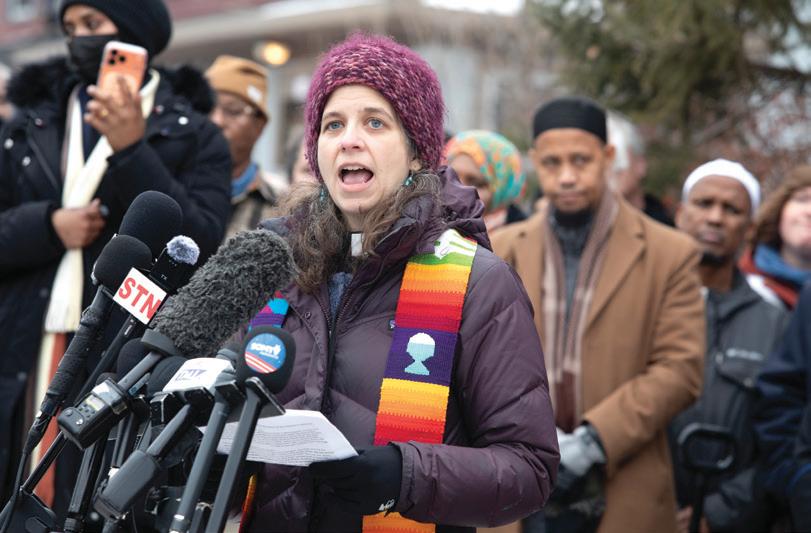
Martha Bardwell organized a clergy rapid response network to monitor and respond to ICE activities in Minnesota. —Photo by Sarah Whiting
WHAT IS A CIVIC LEADER?
VISION FOR COMMUNITY:
Has a deep commitment to the community and a vision and drive to achieve a better life for people in that community
BUILDS A FOLLOWING: Organizes a base of people with shared interests
NEGOTIATES WITH POWER: Brings people into public action and negotiates with political and economic decisionmakers to achieve their shared goals
The movement in Minnesota radically shifted the narrative on federal immigration policies, sparked congressional leaders to take a harder line in demanding accountability measures, and drove the vast majority of ICE and CBP personnel out of the city and state. Less than a month after the Minnesota delegation’s meetings on Capitol Hill, DHS Secretary Kristi Noem would lose her job and Border Patrol commander-at-large Greg Bovino would be ushered into retirement.
The movement was an organic, mass uprising of people willing to sacrifice their time, comfort, safety - even their lives - to protect their neighbors. But it was not wholly spontaneous. The movement was shaped by an extensive network of trained and experienced grassroots civic leaders who had relationships in their neighborhoods, schools, congregations, mosques, tenants’ associations, and other institutions, and with decision-makers in business and government. Many were longstanding leaders recruited through organizations like Faith in Minnesota and Unidos MN, trained and mentored on how to build teams of people to engage in collective action. Public leaders who over the course of years had found their voices and agency in civic organizations guided the mass resistance in Minnesota,
steered it in strategic directions, ensured that it remained disciplined, coherent, and nonviolent, and brought the community’s demands from the street directly into the halls of power. The deep well of civic leadership in Minnesota converted mass participation into power and is responsible for the movement’s successes.
The role of civic leaders in a multiracial democracy
Our democracy is rooted in our norms, laws, and institutions: free and fair elections, representative government, adherence to the rule of law, the guarantee of individual civil rights and liberties. But in a genuine democracy, everyday people – not a narrow, minority of elites or wealthy individuals and institutions – drive government decisions. How? Everyday people acting individually rarely have the capacity to make government responsive to their interests. They need to organize with others to build collective power and take action together to assert their interests effectively in public life.
Civic leaders, like Bardwell, are people who take responsibility for organizing others to discern and act on their collective interests. Leaders build a base of followers7 who, when they act
The deep well of civic leadership in Minnesota converted mass participation into power and is responsible for the movement’s successes.

strategically and cohesively, have the power to influence political and economic decisions, to shape laws and their application and the behaviors and actions of private sector institutions.
strategic capacity to paid advocates and national staff rather than larger constituencies or mass memberships. Everyday people are treated like objects to be moved to enhance others’ power.
Everyday people are treated like objects to be moved to enhance others’ power. These transactional approaches overlook the critical importance of cultivating the agency, leadership, and power of everyday people to solve the problems that concern them.
Our country is known for our civic organizations, inheritors of a tradition of organizing that stretches back to the founding of our country (and before).8 Alexis de Tocqueville marveled at the wealth of civic leadership and organizing in 19th century America:
As soon as several of the inhabitants of the United States have conceived a sentiment or an idea that they want to produce in the world, they seek each other out; and when they have found each other, they unite. From then on, they are no longer isolated men, but a power one sees from afar, whose actions serve as an example; a power that speaks, and to which one listens.9
Our democratic system of government needs the kind of powerful civic leadership that Tocqueville observed and that we witnessed in Minnesota. But in today’s America, the art of civic leadership has given way to elite-driven, technocratic solutions. In politics and civil society, mass marketing and mobilization strategies predominate. Instead of training and developing leaders to be “a power that speaks, and to which one listens,” we mobilize disconnected individuals to take discrete actions like voting or emailing a member of Congress. Many nonprofits and political organizations limit agency, decision-making, and
These transactional approaches overlook the critical importance of cultivating the agency, leadership, and power of everyday people to solve the problems that concern them. This blind spot hollows out the civic traditions, organizations, and leadership essential for realizing democratic selfgovernance. As our civic institutions and practices wither, government becomes less and less responsive to everyday Americans and increasingly captured by deep-pocketed corporations and a plutocratic elite. The result is a downward spiral: people grow cynical about their ability to shape governance and millions withdraw from the civic activism and leadership that we need more than ever to make government accountable to everyday people.
This report highlights civic leaders who have built a base of followers and, acting collectively, wield power in public decision-making in significant ways. The details for their stories are drawn from the author’s interviews with each leader. With this publication, we aim to play a part in re-energizing the traditions of civic leadership and organizing that are vital to building a democracy that reflects the voice and interests of all people.
Instead of training and developing leaders to be “a power that speaks, and to which one listens,” we mobilize disconnected individuals to take discrete actions like voting or emailing a member of Congress.
Greer saw voting as one tool for her community to build power. In 2020, she and two others from MAC went through formal training to become county deputy registrars in Shelby County.
A VISION FOR COMMUNITY:
Tameka Greer and Memphis Artists for Change
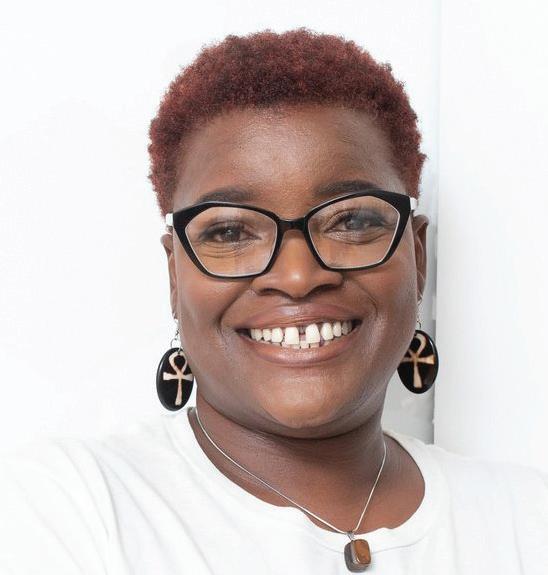
Tameka Greer grew up in the Westwood community in South Memphis, in a neighborhood wedged between two highway overpasses and locally known as “the Hole.” It is a neglected, high-poverty neighborhood, but Greer was blessed with a strong family who supported her and nurtured her artistic interests: choir, theatre, poetry, audiovisual arts, and more. Today, Greer is a spoken word artist, poet, and playwright and has been a leader in the Black artist community in Memphis since the 1990s. She co-founded one of the longest running and largest open mic series in the city and established an artists’ space called Artistik Lounge that hosts live music, events for visual artists, and other artistic exhibitions and performances.
In 2012, a community activist challenged Greer on Facebook about what she and her fellow artists were doing to help the community. Artists are focused on making art, but are they putting their hands to work to improve the community in which they live? Greer decided to respond to the challenge. She and a group of nine other artists began volunteering to support community organizations and nonprofits. At their first volunteer event, they served breakfast to 80 kids at the Buckman Boys and Girls Club in North Memphis. Memphis Artists for Change (MAC) was born.
For several years, MAC focused on direct service activities: coordinating food, clothing, and school supply drives, cooking hot meals for children in need, organizing benefit concerts to support people with medical transportation, and the like. Greer also developed mutual aid and cooperative economic programs
for artists, creating an artist-owned co-working space and co-op, Mecca Memphis, where artists display and sell their artwork. The community grew.
In 2020, the murder of George Floyd sparked protests in Memphis, a city with a long history of over-policing and police brutality, and provoked a shift in Greer’s work and mindset. She recognized that meeting the needs of her community required more than food drives and mutual aid programs - as important as that work is:
When 2020 hit, we knew we would never mutual aid our way out of those issues. We knew we needed to build power in such a way that we were attacking the issues from a different way. We didn’t pivot away from mutual aid, we… expanded into community organizing.
Building a civic home
Greer saw voting as one tool for her community to build power. In 2020, she and two others from MAC went through formal training to become county deputy registrars in Shelby County. Their early voter registration efforts were modest in reach and Greer soon realized they would need to recruit and train many others to achieve scale. They also quickly discovered the larger structural barriers that prevent people in their community from voting: many of the people they tried to register had been stripped of their right to vote due to prior felony convictions.
In 2022, Greer learned that the state and county planned to remove tens of thousands more people from the voter rolls who had not voted in recent elections. For Greer, the systemic effort to disenfranchise the Black community
in Tennessee revealed the latent potential of her community’s power:
It was enlightening. There’s power here, right? Twenty percent of Black people in Tennessee can’t vote due to voter disenfranchisement, due to having their rights taken because of having a felony conviction. That’s one out of five Black people in Tennessee. Then you couple it with these purge numbers. There has to be something in what they’re trying to take away. If we just connect people back to the voting rolls – those who’ve already registered – the amount of power we could wield, not just in this region, but in this state, would be something amazing.
Greer met with the Shelby County election commission chair, Linda Phillips, who acknowledged that the county had a list of voters at risk of being removed from the rolls if those voters did not renew their registrations. But Phillips refused to publicize the list or share it with MAC, claiming that the election commission would contact voters individually and that there was no need to make the list public.
Greer was skeptical. She was concerned that some voters might miss a written communication from the election commission - many poorer Black folks
move frequently. In addition, she wanted MAC to implement a voter outreach program and proactively contact everyone on the list to make sure they took action to stay on the rolls. They needed a public list to implement this program.
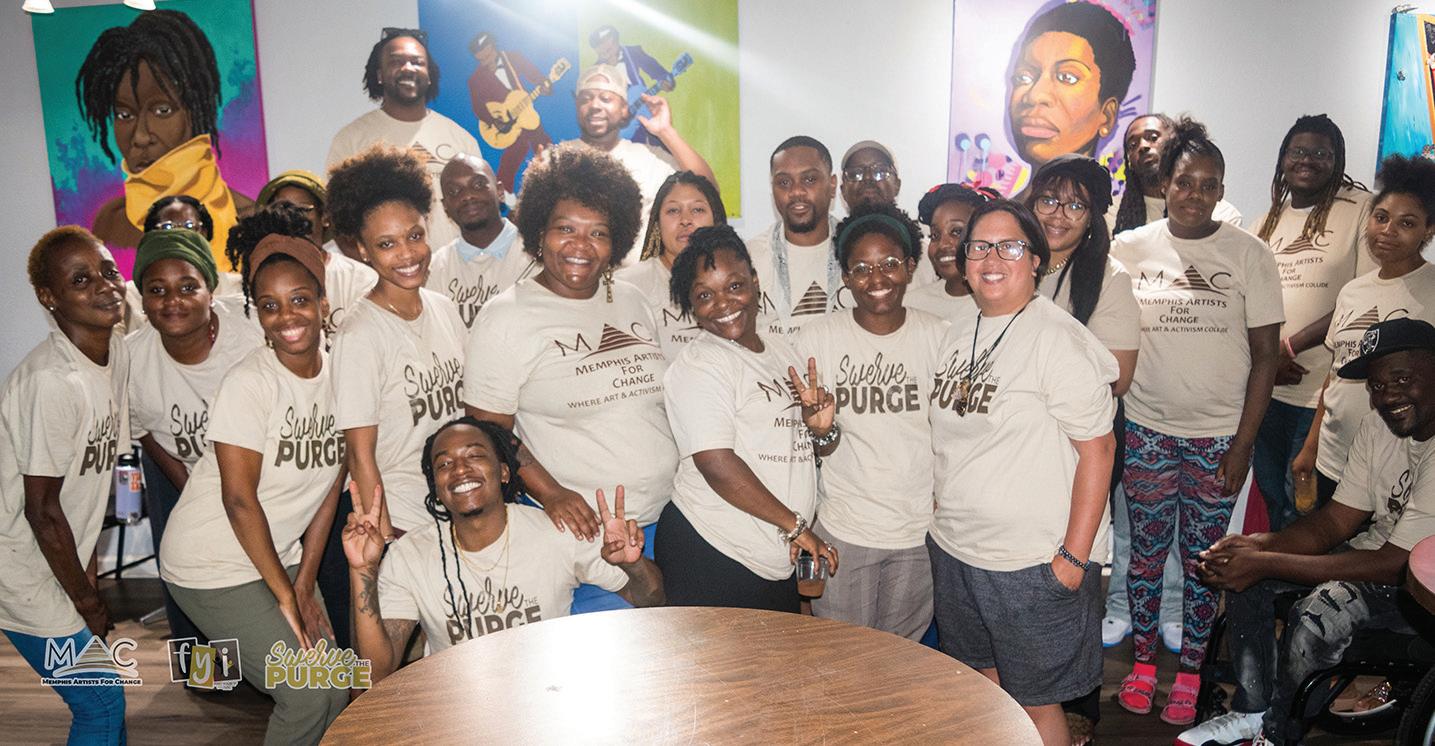
So Greer and MAC coordinated a week of action to pressure the election commission. They held a press conference in front of Phillips’s office and organized a phone banking campaign to generate calls to Phillips and her fellow commissioners. They named their campaign “Swerve the Purge.” At MAC’s next meeting with the election commission, Phillips agreed to publish the list of some 60,000 voters.
MAC went to work on an outreach campaign to contact everyone on the list. Greer was surprised to discover that her own husband was on the list, although he had not received any notification from the election commission that his registration was at risk of being purged. His inclusion on the list validated Greer’s concerns about how the commission was operating. MAC sent postcards to voters at risk of being purged and mobilized artists and volunteers to go door to door in neighborhoods with high concentrations of people on the purge list. Meanwhile, Greer and her team continued to
20%
“Twenty percent of Black people in Tennessee can’t vote due to voter disenfranchisement, due to having their rights taken because of having a felony conviction.”
MAC volunteers went door to door in Shelby County to prevent people from being removed from the voter rolls.
negotiate with Phillips and got the election commission to publish updated versions of the list on a regular basis.
At this stage in MAC’s development, Greer was working with a team of about 30 active volunteer followers, including artists and community members. The successes they had negotiating with the commission were relatively modest and did not require a large-scale, sustained pressure campaign. But the Swerve the Purge campaign was pivotal to the evolution of MAC and of Greer’s leadership. The campaign gave Greer and her base a taste of their power and a sense of their political agency.
Swerve the Purge was life-changing for the organization. The community started seeing that there was a place that they would find as their political home. It was a realization of power. […] We have built the machine that allows people to explore their own selfinterest in such a way that they decide how they want to change or develop their own society for the betterment of their own self-interest. That’s a different thing than providing a space for people to come. It is that thing now.
The neighborhood swimming pool and a colossal data center
Greer understood that the basis of her community’s power depends on more than just their vote: power is built on relationships and the development of civic leadership.10 To grow MAC’s power, she needed to find and support more leaders like her who are committed to moving networks of people into action on their shared interests.
One of these leaders is Joseph Cox, a MAC member and volunteer leader also born and raised in Westwood. According to Greer, “he was a problem for the community, getting in trouble, running with the wrong crowd.” Today, Cox is part of the solution. He is the founder of Youth of Westwood, a nonprofit dedicated to supporting and mentoring young people in the neighborhood. Known in the community as “Mr. Joe,”11 Cox hosts daily cookouts for neighborhood kids in the summer, hauling a huge grill on the back of his truck and setting it up outside the community center in Westwood. The same community center where Greer played softball and basketball as a kid.
At one of the cookouts, Cox shared his concerns about the community center with Greer. The center is a public facility and should provide a safe space for recreation, connection, and belonging for young people from a neighborhood where crime and violence are prevalent. However, the center offers few meaningful activities and is far too difficult for many kids to access. Joining the community center required going through an online registration process and providing a birth certificate and proof of residency – hurdles that stymied many poor kids and families. Cox also wanted the center to re-open its swimming pool,
10 For an extensive exploration of the nature of civic power, how people build it, and how to understand and measure it, see Cushman, Joy and Elizabeth McKenna. “Power Metrics: Measuring What Matters to Build a Multiracial Democracy.” Democracy & Power Innovation Fund, 2023 and Han, Hahrie, et al. Prisms of the People. 2020, https://doi.org/10.7208/chicago/9780226744063.001.0001
11 Pimpo, Stephen. “’Youth of Westwood’ founder ‘Mr. Joe’ fighting to change lives in Memphis neighborhood.” ABC24, 7 Mar. 2024, https://www.localmemphis.com/article/news/community/youth-of-westwood-mr-joe-fighting-change-lives-memphis-neighborhood/522e889bbe9-e4c3-4a1c-8f52-60a357332c48
which had been closed for four years, even though the city had approved funding to renovate the pool years earlier.
Greer challenged Cox to take action on his concerns. She and two other organizers at MAC, Klore Hammonds and Joshua Adams, mentored Cox as he mobilized neighborhood kids and residents to attend city council and park commission meetings. During a week of action, Cox, his neighborhood team, and community members created and placed yard signs with inspirational messages outside the community center, organized a cook-out and information session with the local neighborhood association, and met with the new director of the city’s parks department. The director agreed to repair the pool immediately. After four years of inaction, the city re-opened the pool in March 2026.
Like MAC’s victory with the election commission, the campaign to improve the community center has given the residents of Westwood a taste of their collective power. And the experience has primed them for action in even bigger fights.
Greer and Cox are now engaging the Westwood community in a struggle over an enormous data center in their neighborhood that is owned and operated by xAI, Elon Musk’s artificial intelligence company. Aptly named “Colossus,” this data center is part of a larger, multifacility supercomputing complex in the greater Memphis area that has been described as “the world’s largest AI training facility.”12 The city and county greenlit the Westwood data center, which includes more than 30 methane gas turbines releasing toxic air pollutants,13 despite community opposition to its construction in one of the most polluted neighborhoods in the city.
Greer and Cox are clear about their demands and interests. At this stage, the data center is a done deal and cannot be shut down, at least in the near term. In partnership with two local environmental groups, Memphis Community Against Pollution and Young Gifted and Green, they are instead focused on securing commitments from city and county leaders to reinvest tax revenues from the data center directly into the Westwood community. Cox is working with his base in Westwood to shape a set of demands for how those tax resources should benefit the community, including residents suffering from asthma and respiratory conditions linked to environmental pollution. MAC has joined a broader fight to push for a moratorium on new data center permits, stronger health and environmental justice reviews, and community benefits agreements that will ensure protections and economic benefits for communities where data centers are constructed.14

Like MAC’s victory with the election commission, the campaign to improve the community center has given the residents of Westwood a taste of their collective power. And the experience has primed them for action in even bigger fights.
While nascent, MAC’s engagement in the data center campaign provides a window into how people can achieve a degree of democratic oversight and accountability with tech behemoths like xAI. Elon Musk, the first person in the world to amass a personal fortune of more than $1 trillion, is one of the most powerful people in the world. Still, his company cannot operate a data center without the approval of local communities and their elected officials. The same is true for the other Big Tech companies that are constructing data centers all over the country to power their AI systems. Public leaders like Tameka Greer who are clear about their interests, who have built an organized power base, and who are in relationship with their local officials can bring real leverage into negotiations on behalf of their community’s interests.
12 Crosley, Blake. “xAI Colossus Hits 2 GW: 555,000 GPUs, $18B, Largest AI Site.” Introl, 3 Jan 2026, https://introl.com/blog/xai-colossus-2gigawatt-expansion-555k-gpus-january-2026
13 Hilt, Eric. “Elon Musk’s xAI facility is using gas turbines in South Memphis, we’re taking action.” Southern Environmental Law Center, 17 Jun. 2025, https://www.selc.org/news/resistance-against-elon-musks-xai-facility-in-south-memphis-gets-stronger/ 14 McCorkle, Brionte and Tameka Greer. “The Hidden Cost of Data Centers in the South.” The Augusta Press, 13 Oct. 2025, https://theaugustapress.com/the-hidden-costs-of-data-centers-in-the-south-new/
Civic leaders like Greer are people who love the people in the place where they are. A congregation. A school. A neighborhood. A city.
The people are the purpose
Greer’s civic leadership is anchored in a deep commitment to the people and communities in Memphis whose stories parallel her own. Despite growing up poor, Greer thrived in a large, supportive family (her grandfather and grandmother had 23 children between them, and Greer quips that she has too many cousins to count) who modeled community leadership.
My grandmother and grandfather were the people in the community where everybody knew they could eat; where if you needed a job, my granddaddy gonna put a hammer in your hand, right?
The people in Greer’s life had few economic resources, yet they were committed to doing what they could to lift up their community and her. This upbringing is the inspiration of Greer’s own leadership.
Somebody saw the little poor Black girl in South Memphis and invested in her. Somebody poured knowledge and time in me and made me believe that I was powerful, and powerful enough to change things, and made me believe that about other people. I tell people, if you cut me, I do believe I bleed. I bleed Memphis. If I leave this place and go to other cities, I’m always like, “How can I bring this back?” There’s always something about this place that calls me in such a way that I feel obligated to it.
Somebody saw me, and it is my call and duty to see others in the same way, to expose them to the power that they already have.
Greer points to a conversation with Phyllis Hill, one of her organizing mentors, as a moment that crystallized her commitment to centering people in her local community in her leadership:
Phyllis asked me a very important question: Who are your people? And where are they? And that, to me, has been the litmus test. Who are your people? It’s great if you can get out and get at a city council meeting and make great sound bites and make great points, even. But who’s with you?
Civic leaders like Greer are people who love the people in the place where they are. A congregation. A school. A neighborhood. A city. It is a leadership rooted in love for people and place that inspires someone to care about the kids in Westwood and to fight for the swimming pool at the community center. And when you help people fight to open the swimming pool, you build trust in communities that have been exploited and let down. When the swimming pool re-opens and people in the community get a taste of victory, their sense of their own power and possibilities expands. They know they can stand up to the corporate titans opening data centers in their backyard.

BUILDING A FOLLOWING:
Natalie Patrick-Knox and Parents for KC Kids
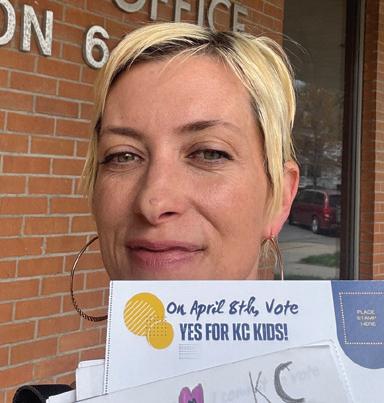
Natalie PatrickKnox was at a work meeting in Washington, DC when she received a chilling text message from Longfellow Elementary School, the neighborhood school in Kansas City where her daughter was a preschooler: The school had been evacuated and some students were in the hospital. Her daughter was at the Early Learning Center nearby, where Patrick-Knox and her husband were instructed to pick her up. The text message provided no further details.
to Patrick-Knox, likely went overlooked because of the raft of deferred maintenance issues across the district. The real culprit in this near tragedy was years of disinvestment in the schools.
It was close to being catastrophic. The crisis point was a result of disinvestment in the building, and the administration and the district having to learn to live with things being broken.
Patrick-Knox, her husband, and her two children live in midtown Kansas City, on the Missouri side. Their school district is majority Black and Hispanic (Patrick-Knox and her family are White). The city and its schools experienced
The last time voters in the Kansas City, Missouri public school district passed a school bond to help pay for infrastructure upgrades was 1967 – thirteen years after Brown v. Board.15
When Patrick-Knox’s husband arrived at the Early Learning Center, he learned that the situation was not quite as bad as their worst imaginings, but was nonetheless terrifying. There had been a carbon monoxide leak at the school. The alarms failed to sound. As children in her daughter’s classroom began to get sick, the teacher made an astute and potentially life-saving decision to evacuate her class, and the rest of the school followed suit. Several children and a couple of adults were poisoned badly enough that they were sent to the hospital. Everyone in the school had carbon monoxide poisoning, including her daughter, who was three years old and weighed 30 pounds.
The leak was caused by a blocked vent. The alarms did not sound because they were faulty – an issue that, according
wrenching “White flight” beginning in the 1950s, when the US Supreme Court’s historic ruling in Brown vs. the Board of Education mandated an end to racially segregated schools. In the wake of Brown, many White families moved across the state line to the Kansas side - a much Whiter part of the city due to a history of racial covenants and redlining aimed at excluding Black people.
The last time voters in the Kansas City, Missouri public school district passed a school bond to help pay for infrastructure upgrades was 1967 –thirteen years after Brown v. Board.15 In the decades since, the city’s shrinking tax base and lack of capital investment has led to the deterioration of school buildings and the neglect of critical infrastructure – including the carbon monoxide detectors at Longfellow.
The city and its schools experienced wrenching “White flight” beginning in the 1950s, when the US Supreme Court’s historic ruling in Brown vs. the Board of Education mandated an end to racially segregated schools.
Patrick-Knox was deliberate about building out a team structure that did not rely exclusively on her leadership. She built a committee of parents at FLA and, as her team connected with parents outside of FLA, they identified people willing to organize parent teams at other schools.
A once-in-a-generation opportunity
Patrick-Knox and her husband are committed to Kansas City public schools. They both grew up in the metro area – she in the suburbs, her husband in the city proper – and Patrick-Knox started her professional career in the city. She later moved to London and then Washington, DC, where she worked with Jobs with Justice doing federal advocacy on labor rights issues. When her family moved back to Kansas City in 2016, she and her husband enrolled their kids in the public schools, despite the hints and questions they received from friends and family suggesting they should move to the Kansas side or put their kids in private or charter schools. She even worked as a substitute teacher in the schools.
Despite the disinvestment in infrastructure and condition of the school buildings, Patrick-Knox remains committed to the public school system. Both her children now attend the Foreign Language Academy (FLA), a K-8 language immersion public magnet school that offers bilingual education in Mandarin and Spanish and is the only school in the central Midwest region with an International Baccalaureateaccredited program at the primary school level. When the school board put a new school bond on the ballot in 2025, she sprang into action.
We knew this was our opportunity to swing what we want to happen with the schools, which is more investment. Making the schools match the good things that are already happening in them: fixing the buildings, creating better outdoor spaces, helping to shift that image of the schools, because we already believed that they were good schools. It felt like this was a once- or twice-in-a-generation opportunity.
Patrick-Knox had just two months to organize parents and the community for the vote. She started by attending
parent-teacher organization (PTO) events to discuss the school bond. But while the PTO was a helpful place to begin connecting with other parents and informing them about the issue, it was more of a social club that organized school dances and cultural nights than a platform for organizing and advocacy.
So she linked up with two other FLA parents with organizing backgrounds: Molly Fleming and Rachel Hogan. Together, they started organizing town halls and events to educate parents about the pending vote on the school bond and the history of disinvestment in the school district, and challenged them to envision what the bond’s passage could mean for the schools. Patrick-Knox also organized playdates in the neighborhood park. While the children played, the parents leafleted people, asking them to sign voting pledge cards. Through the park playdates, Patrick-Knox extended her growing network beyond the FLA to parents at other schools in the district who would be voting on the bond.
We needed people to be in relationship with each other and talking about the issue, to get people out for this election that most people didn’t know was happening, around an issue that most people didn’t know how big of a deal it was, around a vote that required people voting to raise taxes for themselves. A general GOTV was what the district was operating on. They were sending out mailers to frequent voters. Meanwhile, we knew the people that had the most stakes in the game were parents. And they are not necessarily your most likely voters in an off-year April election. Busy parents might not be reading the Kansas City Star op-eds to understand why this vote is such a big deal, or even understand what a general obligation bond really does. We knew that it was about having parents talk to other parents as parents, to help people identify their own stakes, their own skin in the game.
Patrick-Knox was deliberate about building out a team structure that did not rely exclusively on her leadership. She built a committee of parents at FLA and, as her team connected with parents outside of FLA, they identified people willing to organize parent teams at other schools. The leaders of each of these core teams – currently active in about a third of the schools in the district – joined a “super committee” that provided coordination and strategic leadership across the entire district. In effect, Patrick-Knox built an organization with a honeycomb structure of interconnected teams and leaders, which they dubbed Parents for KC Kids.
or 10 parents, and send out GOTV postcards. She did not focus on raising money to pay for mailers, digital ads, or paid canvassers. Had she operated from a small, centralized team that focused on transactional mobilization tactics, even if they had won the bond vote,
This network is not tethered to a single issue or campaign; it exists for the protection and advancement of the parents and children of Kansas City.
85%
When the bond finally came up for vote in April 2025, 85% of voters in the district – a district that had not passed a school bond in 58 years – approved it.
When the bond finally came up for vote in April 2025, 85% of voters in the district – a district that had not passed a school bond in 58 years – approved it. In two months, Patrick-Knox and other parents had organized a broad and structured school-by-school base encompassing nearly 300 parents, students, and staff at 17 schools across the district. This network of parents and community members organized 56 canvasses at schools and local playgrounds, nearly two dozen organizing training and strategy sessions, and a rally with more than 200 people to win $474 million in new capital investment in the Kansas City public schools.16
Civic power is dynamic
Patrick-Knox’s organizing generated a lasting legacy in the parent leadership networks she created during the incredible bond campaign. The leadership and structure are durable.
Notice what she did not do. She did not sit down with a group of five parents,
the story would have ended there. But because Patrick-Knox invested her time in building relationships, developing teams of volunteers, and encouraging volunteers to build relationships of their own, there now exists an influential, dynamic, and growing network of parents across the district who are committed to continuing to take action together to improve their schools and communities. This network is not tethered to a single issue or campaign; it exists for the protection and advancement of the parents and children of Kansas City. In April 2025, just days before the school bond vote, federal agents came to the FLA – a destination school for Hispanic families who want their kids to maintain and deepen their Spanish language fluency – and arrested a parent at the school drop off line. The school community was horrified and felt deeply threatened.

Ultimately, PatrickKnox and the organized base of parents have built a sustained, dynamic power base in their community that is evolving and branching into new issues and campaigns that touch on the community’s shared concerns.
In response, Patrick-Knox created a family defense team within the larger Parents for KC Kids core team at FLA. The group advocated with the school district for know-your-rights and other services for immigrant families and began holding trainings for community members on how to respond to the presence of ICE officers and enforcement actions. They organized legal clinics for undocumented
Their preparations were tested in January 2026, when ICE agents were spotted operating near Garfield Elementary School in an immigrant-dense neighborhood. Community members contacted the ICE Watch hotline and notified the school principal, who implemented strict movement protocols during the student drop-off period in the morning. Neighbors who had been
As this story illustrates, civic power is dynamic in a way that paid mobilization structures that are focused on
advancing a specific issue campaign or winning an election are
and mixed-status families to help them to develop legal plans in the event any of their family members are detained, and trained teachers in their off-time on Fourth and Fifth Amendment protections for those who might be the targets of immigration enforcement activities. Just as with the school bond issue, PatrickKnox and her peers leveraged all of these activities to identify and recruit parents committed to setting up community defense teams in their own schools, extending the honeycomb structure of parent leadership across the district.
not.
trained as ICE monitors patrolled the school grounds and surrounding streets. No one was taken, and the kids entered the school undisturbed and unaware.
As this story illustrates, civic power is dynamic in a way that paid mobilization structures that are focused on advancing a specific issue campaign or winning an election are not. Constituencies of people in relationship with and committed to one another around their shared values and interests can take action and exert influence on multiple issues and
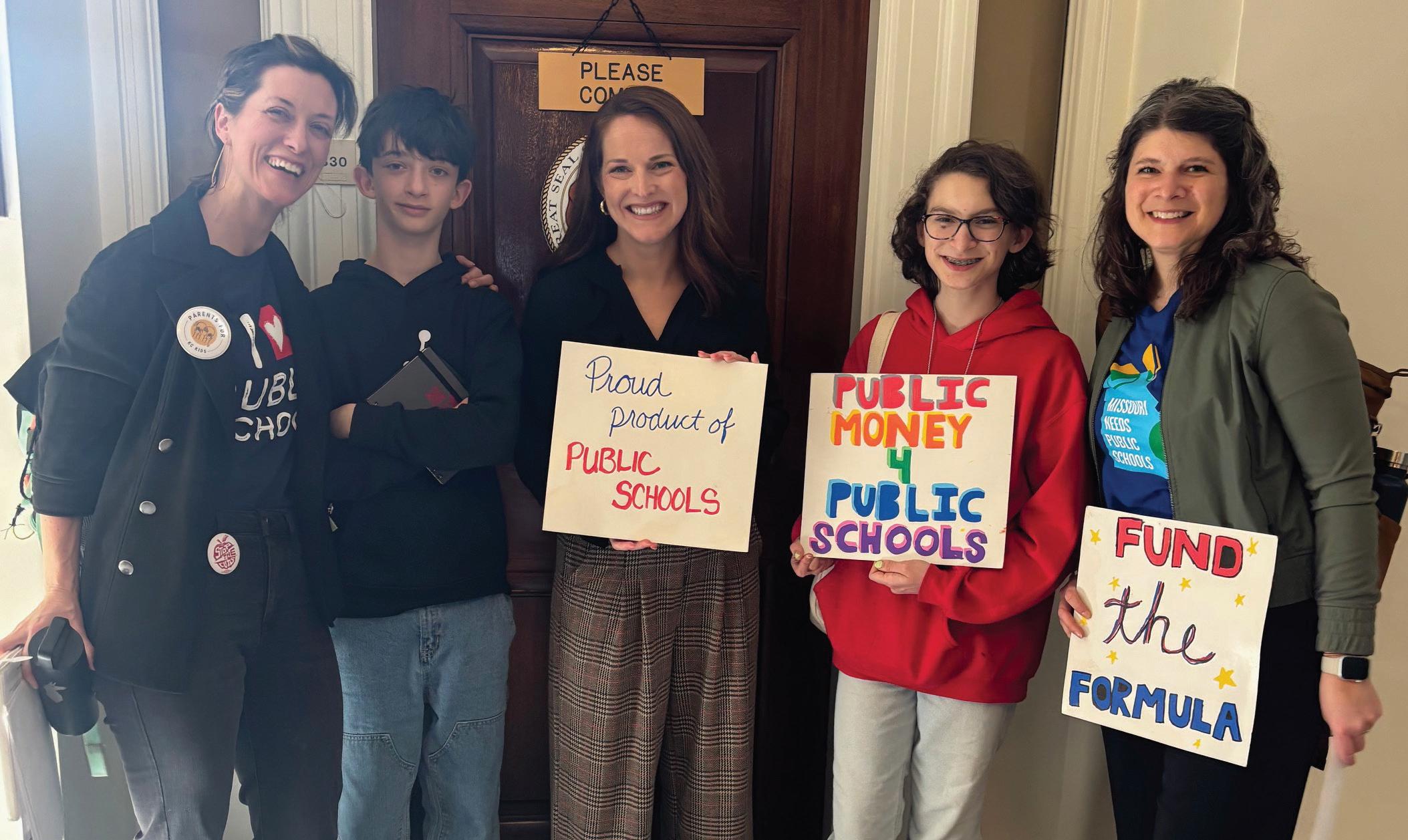
Patrick-Knox and Parents for KC Kids have met with state legislators in Jefferson City to advocate for robust funding of public schools.
in multiple power arenas. Ultimately, Patrick-Knox and the organized base of parents have built a sustained, dynamic power base in their community that is evolving and branching into new issues and campaigns that touch on the community’s shared concerns.
Parents for KC Kids has also started to assert power at the state level, in collaboration with civic power-building organizations such as the Missouri Organizing and Voter Engagement Collaborative (MOVE), Missouri Jobs with Justice, Missouri Workers Center, and Stand Up KC. In March 2026, Parents for KC Kids brought 150 parents, kids, and teachers from all 33 schools in the district to Jefferson City to meet with their state legislators and advocate for robust funding for public schools. While the school bond Patrick-Knox and her base won is generating capital to fix Kansas City school buildings, she and her fellow parent leaders recognize that they need to defend and ultimately expand the schools’ operating budgets to bring more teachers into the district, increase their pay, reduce class sizes, and improve the quality of instruction. Federal funding cuts in July 2025 resulted in painful
reductions to school programs across the district, including the elimination of a welcome center for immigrant students at the FLA. The governor of Missouri and legislative leaders are currently aiming to eliminate the state’s income tax, which would reduce the state budget by $5 billion and result in drastic cuts to public schools.17 Patrick-Knox understands she must continue to expand Parents for KC Kids’ base and build power in more legislative districts across the state.
For Patrick-Knox and her fellow civic leaders, the gravitational force that powers this network is not a single issue like school funding, but parents’ concerns, hopes, and dreams for their kids:
I’m motivated by my kids. I’m motivated by my kids’ friends, I’m motivated by the kids in my kids’ classes. I am clear about what’s at stake. It is my kids that are at stake, my kids’ education, how their friends are treated, and what sort of schools they’re in. And it’s been also easy to meet other people where their stakes are at, you know? It’s our kids that are on the line.

Schools in Black majority districts across the state were saddled with debt after losing enrollment to more loosely regulated charter schools and suffering financial penalties for poor performance on high-stakes tests that many criticize as racially biased.
NEGOTIATING WITH POWER:
Elnora Gavin and the Fight for Benton Harbor Schools
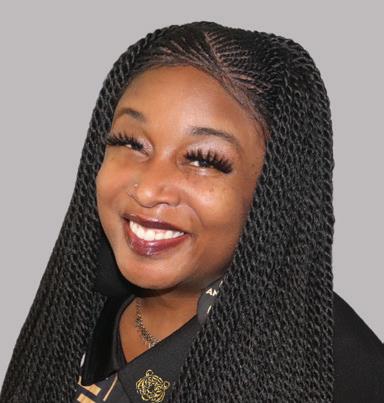
Elnora Gavin was born and raised in Benton Harbor, Michigan, a predominantly Black city of about 9,000 people located on Lake Michigan, about 100 miles northeast of Chicago. Gavin attended Howard University in Washington, DC and after graduation returned to Benton Harbor and began working as a teacher in the public schools. The schools were struggling. During the 1990s, conservative policymakers had enacted school choice policies that destabilized predominantly Black public school systems in high-poverty communities. Enrollment in Benton Harbor’s traditional public schools declined by more than three quarters from 1999 to 202418 and several elementary and middle schools were shuttered as thousands of families elected to move their kids to charter schools and neighboring school districts. On top of this, in 2006, the state phased out payments it had been making to Benton Harbor under a landmark 1977 desegregation lawsuit and the school district began running annual deficits.19 The city was taken over by a state-appointed emergency financial manager in 2010, 20 and the schools operated under a consent agreement with the state from 2014 to 2018 that subjected them to state oversight of budget and financial decisions. 21
Gavin wanted her students at Benton Harbor High School to understand and wrestle with the difficulties their school was experiencing, so she gave them an assignment to develop a school improvement project. The students focused on the problems of school violence and bullying that they experienced and that they saw as the ultimate cause of declining enrollments and related school closures. According to Gavin:
They were blaming themselves for the shutdowns
So she partnered with the school district’s African American History teacher, Marilyn Ross-Golden, to push her students into deeper research, where they discovered a larger pattern of structural racism. Schools in Black majority districts across the state were saddled with debt after losing enrollment to more loosely regulated charter schools and suffering financial penalties for poor performance on high-stakes tests that many criticize as racially biased. As the state intervened in the finances of these school districts (via consent agreements or appointment of emergency financial managers), the schools were forced to eliminate important courses and lay off critical teaching staff. For example, Benton Harbor High School stopped offering Algebra 2, calculus, Advanced Placement, and career and technical education classes. These cuts exacerbated the outflow of students and further reduced revenue under the state’s school funding formulas. 22
18 “Benton Harbor Area Schools.” Ballotpedia, https://ballotpedia.org/Benton_Harbor_Area_Schools,_Michigan, accessed 19 May 2026.
19 Waldman, Annie. “Held Back: Inside a Lost School Year.” ProPublica, 28 Jun. 2021, https://www.propublica.org/article/held-back-inside-a-lost-school-year
20 Davey, Monica. “A State Manager Takes Over and Cuts What a City Can’t.” New York Times, 26 Apr. 2011, https://www.nytimes.com/2011/04/27/us/27michigan.html
21 “What’s Next for the Financial Crisis in Benton Harbor Schools.” Citizens Research Council of Michigan, 11 Jul. 2019, https://crcmich.org/whats-next-for-the-financial-crisis-in-benton-harbor-schools
22 Waldman, “Held Back: Inside a Lost School Year.”
Saving Benton Harbor High School
In 2019, Governor Gretchen Whitmer issued an ultimatum to the Benton Harbor School Board: close Benton Harbor High School for a year or the state would dissolve the entire school district or convert it into a charter school system. 23 Whitmer cited poor student test performance and the district’s ongoing fiscal challenges as justifications.
According to Gavin, the mayor’s public support for the school had been tepid (and remained so until the community itself got mobilized); Gavin believes that the governor likely felt emboldened to make the move because she thought she would not pay a political cost:
She felt like it was not risky. She didn’t anticipate our networks or our grit.
The governor miscalculated. Gavin organized a team of students, community advocates, and teachers to drive a campaign to save the high school. Students coordinated events to educate their peers, organized a walkout, made presentations to the school board, and convened a town hall. They engaged in cultural organizing, producing the song “Get Up” that went viral and helped galvanize the community and shift the narrative about Benton Harbor’s public schools. Gavin and her team activated networks across the state, getting people from Detroit schools to join the fight and building broader power. Ultimately, they succeeded in getting the Benton Harbor School Board to reject the state’s ultimatum and propose an alternative plan to keep the high school open. Governor Whitmer, who had just won election on a platform backing public schools, conceded. 24
It was a big victory, but Gavin recognized that it might be a temporary one. Her father, Kenneth Gavin, who had been
a long-time attorney for the school district, warned her that, until Benton Harbor schools rid themselves of their debt, they would continue to face pressure to reduce academic offerings and experience declining enrollment, and the threat of closure would loom.
Winning school debt relief
So Gavin and her team set their sights on a more far-reaching transformation of the Benton Harbor schools and community, which she dubbed Fresh Start. Gavin wanted to revitalize the schools - not just keep the lights on - and for her community to reclaim control of the city’s development for the benefit of its mostly Black residents. She also aspired to spread this vision across other predominantly Black cities and communities in the state that had been subject to emergency management or state-imposed consent agreements and experienced many of the same challenges as Benton Harbor.
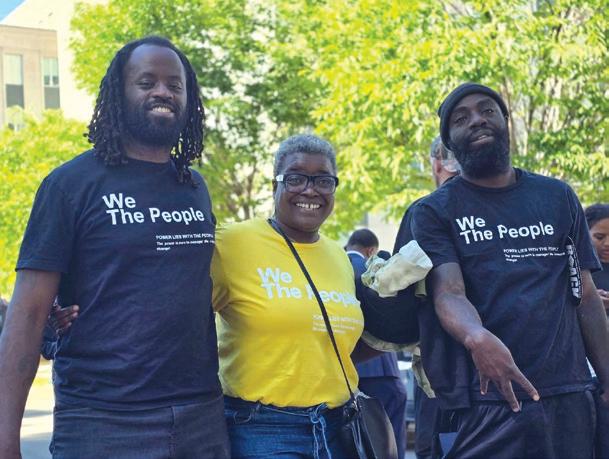
Gavin sought out Art Reyes, an organizer who had founded and was then the executive director of We the People Action Fund, a civic organization dedicated to building multiracial power and advancing racial justice in Michigan by organizing working-class constituencies across the state. Reyes brought Gavin onto the organizing staff
Gavin and her team activated networks across the state, getting people from Detroit schools to join the fight and building broader power. Ultimately, they succeeded in getting the Benton Harbor School Board to reject the state’s ultimatum and propose an alternative plan to keep the high school open.
23 “Dwyer, Dustin. “State backs off plan for Benton Harbor schools, and proposes a new approach.” Michigan Public, 17 Aug. 2019, https://www.michiganpublic.org/education/2019-08-17/state-backs-off-plan-for-benton-harbor-schools-and-proposes-a-new-approach.
In 2023, Gavin leveraged her constituency base and these relationships with other power players to mount a campaign for broader debt relief for six predominantly Black school districts across the state.
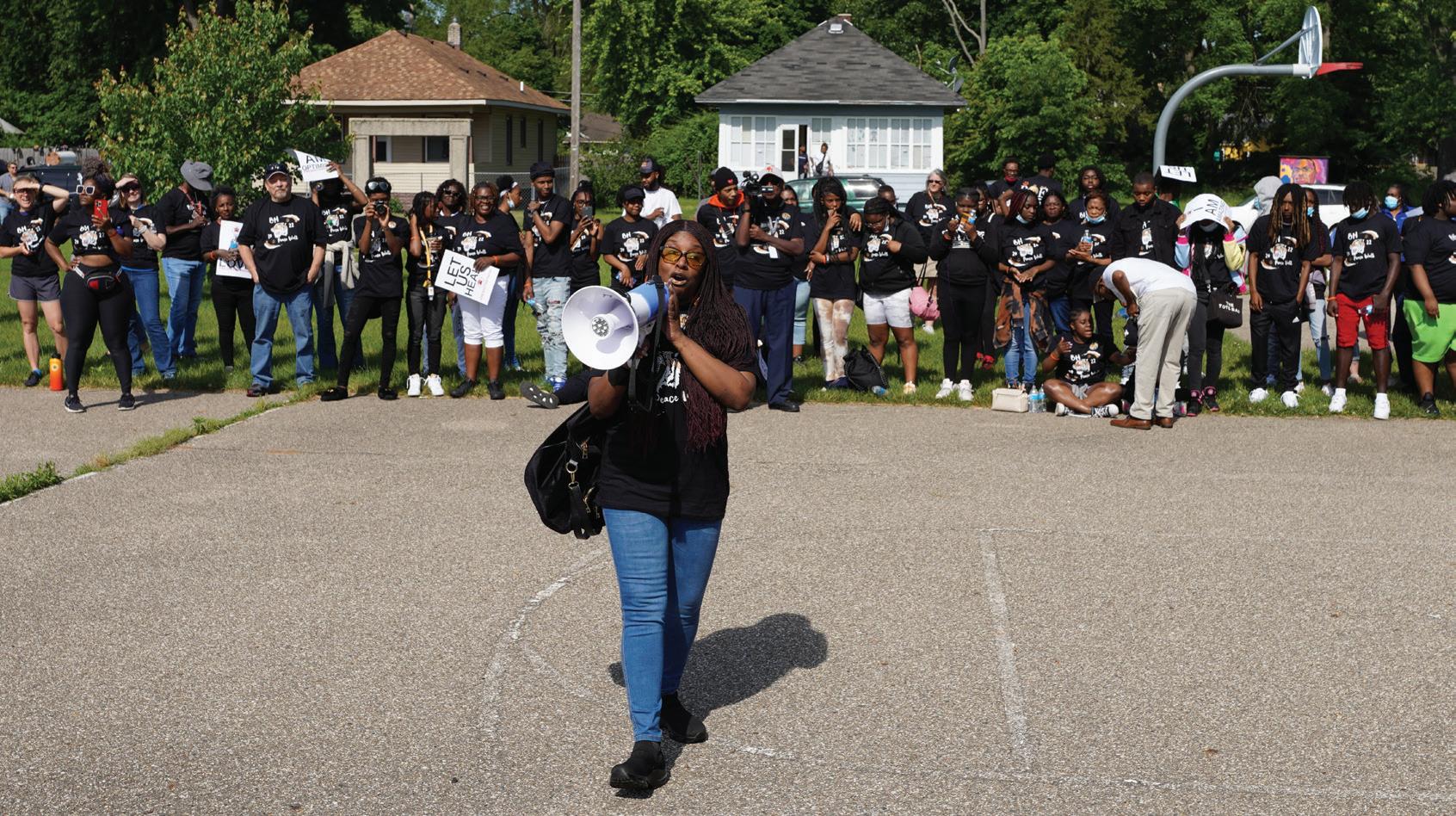
at We the People, where she began work under the supervision and mentorship of co-director Maria Ibarra-Frayre as the lead for the Fresh Start organizing project. Joining We the People Action Fund enabled Gavin and her local network to increase the sophistication of their power analysis and organizing strategy and to combine forces with a larger statewide organization and power base.
To achieve her goals – debt relief for the schools and enactment of a community benefits ordinance that would enable residents of Benton Harbor to take control of the development process in their city – Gavin needed to build more power locally. Gavin and Angela Doyle, another community leader who had worked alongside her in the campaign to save the high school, ran successful campaigns for school board in 2022. Two other people from her base, Rayonte Bell and Chokwe Pitchford, won seats on the county commission. Other members of Gavin’s network won election to the Benton Harbor City Council: Emma Kinnard as commissioner-at-large and Shaquille Turner as mayor pro tem. And a long-time ally, Joey Andrews, mounted a successful campaign for state representative for Michigan’s 38th House District. Andrews had been
a vocal advocate for saving the high school and made school debt relief one of the central issues in his campaign.
In 2023, Gavin leveraged her constituency base and these relationships with other power players to mount a campaign for broader debt relief for six predominantly Black school districts across the state. Ibarra-Frayre, who admired Gavin’s grit and leadership, was skeptical the campaign would be successful:
I remember having a bet, telling her if this happens, I will buy you dinner. She worked with State Representative Joey Andrews to negotiate not just erasing the school debt for Benton Harbor, but also the school debt of three other cities. A total of $114 million in debt was erased. I was out of the country when this happened and found out on social media. I thought, “Oh my God, she did this thing that I didn’t think was going to happen!”
As Gavin and her allies ratcheted up the pressure on Whitmer for debt relief, the governor sought to neutralize the public criticism. An aide called Gavin personally and asked for her to tamp down criticism on social media and to inform her networks that the governor had
Gavin and the Fresh Start team are fighting for bold, transformative changes for Benton Harbor and its schools.
but they don’t fully explain how Gavin was able to get the governor to keep Benton Harbor High School open or erase $114 million in debt. You need power to achieve outcomes like that. Gavin did not win on her own, as a solitary activist. She worked with many others who shared her values and vision. While Gavin answered her own call to lead, the source of her power is her base. It is organized people.
agreed to relieve the school debt. At that juncture, however, the governor had not yet signed the debt relief bill. Gavin didn’t fold. She told the aide that she would always tell the truth: she would tone down the criticism when the governor signed the bill. Whitmer kept her word and Gavin kept hers. She attended the bill signing ceremony and praised the governor for taking action to relieve school debt.
The back-channel exchange with Whitmer’s aide was a reflection of the power Gavin had built, and of the realities of negotiating in the larger power arena. Gavin and her community had selfinterests to advance, and so did the governor. Gavin’s leverage was based on her ability to mobilize a large base of people with clear, shared interests capable of imposing reputational costs on an elected official. For her part, the governor’s agreement to relieve the school debt rested on her confidence that doing so would allow her to shed a public controversy and win new political capital.
The source of power is people
When asked what makes Gavin an effective civic leader, Ibarra-Frayre said:
The word that best describes her is tenacious. She is doggedly committed and will fight to the death for her people and what she wants…She is bold and visionary.
Being tenacious, bold, and visionary are great and important leadership qualities,
In a democracy, enough people acting collectively and strategically can influence school board decisions, get community champions elected to office, and win major concessions from the governor.
According to Ibarra-Frayre, Gavin has extensive networks in the community and an ability to get people to turn out for important issues. For example, during the 2020 elections, the Proud Boys threatened to show up at the polls in Benton Harbor to intimidate voters. Gavin and her team persuaded members of Ruff Ryders, a Black motorcycle club, to come to the polls, where their presence instilled confidence and a sense of safety in voters and served as deterrence to the Proud Boys (who never did appear). She also recruited members of the high school marching band to play music and create a festive atmosphere at the polls.
Gavin has evolved further in her leadership in the last year. Ibarra-Frayre explains:
She’s always had people. But it’s her work, her people. Last year, there was a turning point. She’s always had a core team that is very committed to the work. She’s really good at building strong, trusting, deep relationships with people. Now she sees her role as deeply developing these leaders. She is asking leaders to take responsibility for building a following.
In other words, Gavin has evolved from being a leader with her own following to someone, like Greer and Patrick-Knox, who nurtures other leaders to build bases of their own – leaders who can operate
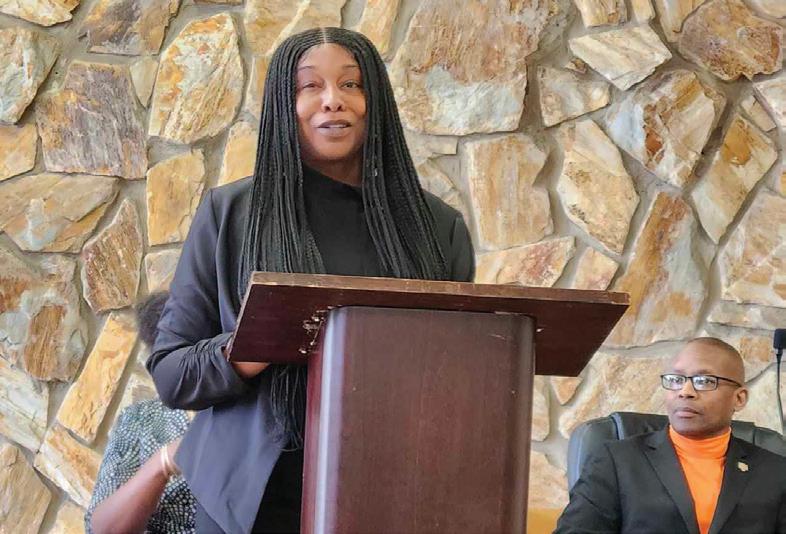
Gavin speaking at a press conference for debt relief. Her organizing won $114 million in school debt relief for majority-Black school districts in Michigan.
What
motivates me to be a civic leader, to fight for my community, is centered around the well-being of our children. In a community like ours, we are overcoming a great deal of trauma. And in education, a child spends thousands of hours in schools. It is important to me to make sure that time is spent cultivating their dreams and not their nightmares.
—ELNORA GAVIN
independently but remain in strategic alignment with her. Gavin realized she needed to shift her leadership approach as she worked to expand her influence across the state. She hopes to replicate her successes in Benton Harbor with other majority-Black communities across Michigan that had been under emergency management. This vision is not something she can do alone or with her local following. She needs to develop leaders who can build their own bases in each community. And the vision must be developed collectively:
In politics right now, you get these shiny candidates who have these narcissistic qualities. They’re power hungry, they’re drunk on power, and they’re very charismatic. And they have no problem selling out the community, but they look good. And that hasn’t worked for us. What really works is building the leadership and
justice goal for Gavin and her base. Many people in Gavin’s Fresh Start team took on responsibility to achieve this outcome. Teachers worked with their students to coordinate sign-on support letters, gather stories, win public endorsements from community leaders, and turn scores of people out to school board meetings. Doyle played an active role in the campaign and has since stepped into a major leadership role with Fresh Start, managing a team that conducts listening campaigns with the Benton Harbor base to shape new policy priorities.
Meanwhile, Gavin is not resting after her big school debt relief victory. She knows that Benton Harbor and other Black communities across the state need new public investment to replace teachers who were laid off, restore lost classes and programs, and lay the foundation for thriving schools and communities. She and her network successfully
In a democracy, enough people acting collectively and strategically can influence school board decisions, get community champions elected to office, and win major concessions from the governor.
capacity of the everyday person who really cares about the community. Helping them to see how their power in this equation matters. And that they deserve to be decision-makers. And organizing around that. Raising their awareness. Building the leadership capacity of those people who have done the work of organizing around a shared vision. And that’s what Fresh Start is, it’s a shared, communitydeveloped vision. And I believe that that’s what sets us apart - that the community can see themselves in it because it’s their solutions, not mine.
This new mindset is paying dividends. Last year, the school board voted to provide free driver’s education to Benton Harbor high school students, an important public safety and economic
advocated for $4 million from the state for a study to explore the cost and scope of long-term solutions to address the disinvestment in and damage to Black school districts that were subject to state oversight and control. Ultimately, she and the Fresh Start team have their sights set on negotiating with school, local, and state officials to secure community benefits agreements for Benton Harbor and other majority Black communities with policy commitments that can strengthen their schools.
THE LESSONS OF CIVIC LEADERS
There is potential for civic leadership everywhere – in every town, city, and county across the country – if we invest in and nurture it. Stories of civic leadership abound throughout the country.
Civic leaders like Tameka Greer, Natalie Patrick-Knox, and Elnora Gavin are deeply committed to their communities and have a vision and passion for improving the lives of the people in those communities. They have each cultivated a base of followers and moved them into action to fight for and win things that matter to them: new funding to rebuild their public schools, a swimming pool at a community center, the erasure of school debt.
with environmental justice organizations in her fight over the xAI data center.
Civic leadership is a craft. The knowledge and practices of civic leadership do not emerge in a vacuum; they are not reserved for an anointed few with innate, special talents or degrees. Effective civic leaders learn and hone their skills – how to build public relationships, discern shared concerns among a group of people and convert those concerns into public demands and campaigns, exercise power and negotiate with decisionmakers – with support from experienced organizers and mentors. Phyllis Hill, Molly Fleming, Art Reyes, and Maria
Civic leaders understand that they must join with others in broader organizations to deliver the transformational changes they and their communities want to see.
While these leaders are focused on highly localized constituencies, their power is not marginal. They are finding ways to leverage their local power bases to negotiate with powerful decision-makers and institutions: state legislative leaders in Missouri, a state governor in Michigan, a multi-billiondollar tech company. Their stories show us that a civic leader with a base of 50 or 100 people who is clear on their interests and committed to strategic, collective action can exercise significant influence in the larger power arena.
They do not gain influence alone. Civic leaders understand that they must join with others in broader organizations to deliver the transformational changes they and their communities want to see. To win bigger things, they expand their power bases by developing other leaders. They integrate their work with statewide civic organizations –Gavin with We the People Action Fund, Patrick-Knox with MOVE and other organizing groups in Missouri – and align their efforts with other advocacy and organizing groups, like Greer’s alliance
Ibarra-Frayre are some of the seasoned organizers who have mentored Tameka Greer, Natalie Patrick-Knox, and Elnora Gavin in the craft of civic leadership. Those organizers themselves were mentored by experienced organizers who came before them and took the time to teach and coach them in their craft.
Civic leaders are central to the promise of democracy, yet we have let this civic muscle atrophy. While US politics and civil society have become increasingly oriented towards online and techdriven strategies for communicating with and mobilizing people at scale, the beating heart of our democracy and its great hope are real people who have a vision for their communities, real relationships with each other and with their public officials, and the courage and commitment to fight for what they want. These civic leaders are zealously committed to people: listening to them, discerning their interests, and bringing them together to develop their agency and power. People are their purpose. People are the source of their power.
Civic leadership is a craft. The knowledge and practices of civic leadership do not emerge in a vacuum; they are not reserved for an anointed few with innate, special talents or degrees.

ACKNOWLEDGMENTS
Many thanks to Elnora Gavin, Tameka Greer, and Natalie Patrick-Knox for sharing their stories and for their courageous and inspiring leadership. Their vision, commitment, and work make our country stronger.
I am grateful to Doran Schrantz for recounting the tremendous efforts of grassroots leaders in Minnesota to resist the abuses and brutality of the immigration enforcement surge in that state. Trevor Cochlin helped fact check the details of that section of this report. Thanks also to Maria Ibarra-Frayre for sharing her insights into Elnora Gavin’s leadership and work.
Julie Fernandes and Joy Cushman provided editorial oversight in the development of this report and Anna Glass copyedited the text. Black Digital created the design.
ABOUT THE AUTHOR
Loren McArthur consults for philanthropies, funding intermediaries, donor collaboratives, and nonprofits on initiatives to strengthen US democracy and civil society. Previously, he served as head of thought leadership and senior advocacy lead at Arabella Advisors and led the civic engagement department at UnidosUS, the largest national Hispanic civil rights and advocacy organization in the US. He started his career as community organizer in the cities of Lawrence and Lowell, Massachusetts. Loren’s writing and thought leadership on philanthropy and the social sector have appeared in Stanford Social Innovation Review, The Chronicle of Philanthropy, Inside Philanthropy, and the Center for Effective Philanthropy.
WORKS CITED
Anderson, Meg, Jasmine Garsd, and Sarah Ventre. “Minnesota Protests Trump Administration’s Immigration Crackdown.” NPR, 23 Jan. 2026, www.npr.org/2026/01/23/nx-s1-5686733/ minnesotans-day-of-ice-protests
Arougheti, Ilana. “Kansas City Public Schools secure nearly 85% of votes for first bond in decades.” The Kansas City Star, 9 Apr. 2025, https://www.kansascity.com/news/politicsgovernment/election/article303765596.html.
“Benton Harbor Area Schools.” Ballotpedia, https://ballotpedia.org/Benton_ Harbor_Area_Schools,_Michigan
Campos, Ray. “Twin Cities Tow Truck Driver Returns Abandoned Vehicles to Families after ICE Arrests.” CBS News Minnesota, 4 Feb. 2026, www.cbsnews. com/minnesota/news/twin-cities-tow-truckdriver-returns-abandoned-vehicles-ice-arrests/
Crosley, Blake. “xAI Colossus Hits 2 GW: 555,000 GPUs, $18B, Largest AI Site.” Introl, 3 Jan. 2026, https://introl.com/blog/xai-colossus-2gigawatt-expansion-555k-gpus-january-2026.
Cushman, Joy and Elizabeth McKenna. “Power Metrics: Measuring What Matters to Build a Multiracial Democracy.” Democracy & Power Innovation Fund, 2023.
Davey, Monica. “A State Manager Takes Over and Cuts What a City Can’t.” New York Times, 26 Apr. 2011, https://www.nytimes. com/2011/04/27/us/27michigan.html
Dwyer, Dustin. “State backs off plan for Benton Harbor schools, and proposes a new approach.” Michigan Public, 17 Aug. 2019, https://www. michiganpublic.org/education/2019-08-17/ state-backs-off-plan-for-benton-harborschools-and-proposes-a-new-approach.
Elon Musk profile, Forbes, 19 May 2026, https:// www.forbes.com/profile/elon-musk/
“Faces on the Frontlines.” Inequality.org, 21 Jan. 2026, inequality.org/wp-content/uploads/2026/01/ inequality-newsletter-january-21-2026.html
Ganz, Marshall. “People, Power, Change: Organizing for Democratic Renewal.” Oxford University Press, 2024, https://global.oup.com/ academic/product/people-power-change9780197569009?cc=us&lang=en&.
Gordon, Kelly and Ellen Finn. “Nearly 30,000 Minnesotans Trained as Constitutional Observers,” MPR News, 2 Feb. 2026, https://www.mprnews. org/story/2026/02/02/immigrant-defensenetwork-training-constitutional-observers
Han, Hahrie. “How Organizations Develop Activists: Civic Associations and Leadership in the 21st Century.” Oxford UP, 2014, https://global.oup.com/ academic/product/how-organizations-developactivists-9780199336777;jsessionid=05E5AA33 05993B2243321AEABCC1CD8B?cc=us&lang=en.
Han, Hahrie, et al. Prisms of the People. 2020, https://doi.org/10.7208/ chicago/9780226744063.001.0001.
Hilt, Eric. “Elon Musk’s xAI facility is using gas turbines in South Memphis, we’re taking action.” Southern Environmental Law Center, 17 Jun. 2025, https://www.selc.org/news/ resistance-against-elon-musks-xai-facilityin-south-memphis-gets-stronger/
McCorkle, Brionte and Tameka Greer. “The Hidden Cost of Data Centers in the South.” The Augusta Press, 13 Oct. 2025, https:// theaugustapress.com/the-hidden-costsof-data-centers-in-the-south-new/.
Raza, Sarah. “Minneapolis Duo Details Their ICE Detention, Including Pressure to Rat Out Others.” AP News, 13 Jan. 2026, apnews.com/ article/immigration-protest-arrests-detentionice-8993bfd5d54b870521ec5b44fc42cd71
Pimpo, Stephen. “’Youth of Westwood’ founder ‘Mr. Joe’ fighting to change lives in Memphis neighborhood.” ABC24, 7 Mar. 2024, https:// www.localmemphis.com/article/news/ community/youth-of-westwood-mr-joe-fightingchange-lives-memphis-neighborhood/522e889bbe9-e4c3-4a1c-8f52-60a357332c48
“Schools Face 18% Cut Under Tax Scheme.” Missouri Budget Project, 4 Mar. 2026, https://mobudget. org/schools-face-18-cut-under-tax-scheme/
Tocqueville, Alexis de, et al. Democracy in America. University of Chicago Press, 2002. Volume II, Section 2, Chapter 5.
Waldman, Annie. “Held Back: Inside a Lost School Year.” ProPublica, 28 Jun. 2021, https://www.propublica.org/article/heldback-inside-a-lost-school-year
“What’s Next for the Financial Crisis in Benton Harbor Schools.” Citizens Research Council of Michigan, 11 Jul. 2019, https:// crcmich.org/whats-next-for-the-financialcrisis-in-benton-harbor-schools.