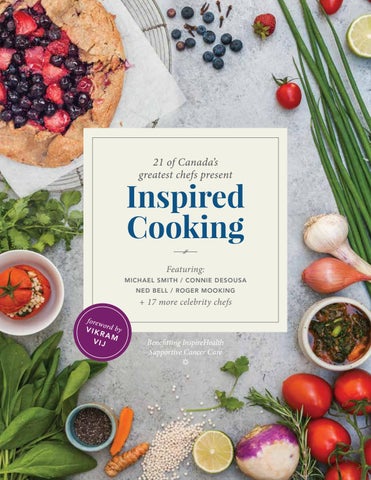
21 of Canada’s greatest chefs present
Inspired Cooking Featuring: MICHAEL SMITH / CONNIE DESOUSA NED BELL / ROGER MOOKING
+ 17 more celebrity chefs f o re w o V I K rd b y RAM VIJ
Benefitting InspireHealth Supportive Cancer Care
A
s a chef, I feel it’s my responsibility to use the healthiest, freshest ingredients possible. Chefs can and should take a leadership role when it comes to our national diet, and we should use that influence to effect positive change. Whether it’s demanding that our food producers, farmers, and suppliers provide us with the healthiest foods possible, using the most sustainable or non-impactful methods at their disposal, or participating in a project such as Inspired Cooking, we can all have a positive impact on how Canadians eat both now and in the future. This book provides essential information for healthy eating, recognizing the impact of diet on our daily lives and health. Food nourishes the body and the soul—another reason to cook with the best ingredients you can find, savour the meals you make, and enjoy the company you keep. Namaste.
– Vikram Vij
2
© 2016 Fresh Air Publishing ISBN: 978-0-9812281-1-2 No part of this book may be reproduced, transmitted, or distributed without the written permission of the publisher. Fresh Air Publishing. 200–375 Water St., Vancouver, B.C., V6B 5C6. info@freshairpublishing.ca E D ITOR IAL
Adrian Brijbassi – Editor Renée S. Suen – Recipes Editor Photographers: Julia Pelish, Mark Sissons Contributors: Petti Fong, Rod Charles, Michelle Hopkins, Katie Marti, Guillermo Serrano, Debra Smith, Sharman Yarnell ED ITOR IAL & P R OD UCTION
Fresh Air Publishing
Kat Morgenroth – Art Director / Designer Gordie Bowles – Production Christina Newberry – Copy Editor Lillie Louise Major – Food Photographer Genevieve Laplante – Food Stylist Josh Berson – Photographer
Dr. Janice Wright, MD, CCFP – CEO & Medical Doctor Angela Wright, BSc, CNP, RNCP – Lead Nutritionist Erin Roman, BSc, RD – Registered Dietitian Amber Baker, CNP, RNCP – Nutritionist Richard Somerset, MA, MAC, PG Dip Bus., – COO Stefenie Milosz – Manager of Communications, Marketing and Donor Relations The nutritional information in this book is not intended as a substitute for the medical advice of your healthcare professional. Printed in Canada on FSC certified paper by Hemlock Printers.
Cover photo by Lillie Louise Major Flap photo of Vikram Vij by Aaron Aubrey
21 of Canada’s greatest chefs present
Inspired Cooking Benefitting InspireHealth Supportive Cancer Care
Proudly supported by our presenting sponsor
editor’s note
A wife’s love, laughter, and light inspire a cookbook unlike any other
M
y wife would never call herself a foodie. She was a picky eater. Many things were too adventurous for her. Yet, Julia became one of the best food photographers I’ve ever known. She photographed plates meticulously—whether it was fish and chips or an exquisite spread of canapés. Her desire to present food that looked as fantastic as it tasted was rooted in her professionalism. She sought perfection with every photograph. Julia wanted her images to match the pride and dedication the chefs used when creating their dishes, which were labours of love. She was the most genuinely supportive person I have ever known, the most gentle soul and kind-hearted spirit. Days after Julia was diagnosed in April 2015 with glioblastoma multiforme—the most aggressive form of brain cancer—she and I joined InspireHealth. For several months, we took part in cooking classes, counselling sessions, and nutrition tutorials. Julia called InspireHealth her sanctuary from the clinical and sometimes cold world of mainstream medicine. The InspireHealth team boosted her spirits, instilled in her hope and confidence, and made her feel supported through the nightmare of a stage 4 cancer diagnosis. Julia was determined to find a way to thank InspireHealth for its comfort and services. The idea for Inspired Cooking was hers. She thought a cookbook featuring Canada’s best-known chefs discussing what nutrition means to them and providing cancer-prevention recipes could elevate InspireHealth’s profile, helping it expand to offer supportive cancer care to more Canadians. The plan was for Julia to photograph the chefs and the food, while I volunteered as editor of the cookbook. For more than 20 years, we had done everything together, so neither of us doubted we would be entwined in this project, too. But the disease showed no mercy. Julia passed away in my arms on March 10, 2016, just as work on Inspired Cooking began. This book, which features several of her photographs, is part of her legacy. Inside, you’ll find intimate insights into some of Canada’s leading culinary talents—and learn why beating cancer is so important to them, as well. You’ll also find stories of InspireHealth patients who are using nutrition to help them deal with their disease. For me, the cookbook is an expression of love and ongoing devotion to my wife. Julia would be ecstatic to know her idea has manifested into one of the most important cookbooks to be produced in Canada.
– Adrian Brijbassi
6
c e o s tat e m e n t
A team effort to promote healthier eating in Canada A message from Dr. Janice Wright, medical doctor and CEO of InspireHealth
Y
ou hold in your hands a dream that has become a reality. Our team and supporters are excited to share this book with you. We sincerely hope that the recipes, stories, and photos contained inside will inspire you to greater awareness of how eating healthfully—on your own or with loved ones—nourishes not only your body but also your mind and spirit. As a medical doctor working with cancer patients and their families, I witness every day how eating well— with attention to our individuality—benefits us in multiple ways. I have seen improvements in peoples’ digestion, energy levels, weight, mood, stamina, sleep, stress levels, and overall well-being after they adopt healthier eating habits. In addition, I have seen many people become excited about making choices that taste great and that they can also feel good about. Our cultural and culinary mindset is changing as we become increasingly aware of how food affects us and our precious health and well-being. Which brings me to our chefs. Each and every one of the 21 chefs featured in this book has volunteered their time, recipes, and heart to support this project. In this book, each chef shares the personal story of their passionate connection with food, life, and health. You will read about a first-hand experience of cancer, a road from vices to optimal health, role-modelling for the next generation, and a commitment to stewardship of the planet one plate at a time. Thank you for purchasing this book. Proceeds from each sale go directly to supportive programs for those living with cancer and their families. Additional content can be found on the Inspired Cooking website (inspiredcooking.ca). I am humbled every day by our patients’ eagerness to learn to take care of themselves and their families through healthy food and lifestyle choices. Their inspiring stories are shared in this book. We hope that it will encourage all of us to eat well, enjoy every bite, and live healthfully. With gratitude,
Janice Wright, MD, CCFP CEO, InspireHealth
7
12
Chef Stories
Western Canada 14 18 24 28 34 38 42 48 52 58 62
Jason Bangerter Victor Barry Roger Mooking Rob Gentile Patrice Demers Antonio Park Chris Aerni Michael Smith Jeremy Charles
70 74 80 84 90 94 100 104 110
photo
by aaron aubrey
Dale MacKay Connie DeSousa and John Jackson Roy Oh Ned Bell James Walt Stefan Hartmann Angus An Andrea Carlson Vikram Vij Jackie Kai Ellis Warren Barr
Eastern Canada
Survivor Stories Heart-warming and uplifting feature stories of cancer survivors Perseverance. Strength. Survival. These real-life profiles showcase courageous InspireHealth patients from all walks of life—and how healthy living brought them new-found hope. Some even look at that pivotal moment when they received their diagnosis as a gift to pay more attention to what matters most: health and happiness.
Corinne Steffen Dan Gunn Deanna Lee Gerry Gramek Janice Alexander
8
22 32 46 56 66
Jerry Ewen Peter Russell Steve Herringer Volker Bodegom
88 98 108 78
118
Recipes
Vegetarian
Pulse Tacos, page 120
Pulse Tacos Simple Lentil Curry Cruciferous Cacio e Pepe Puntarelle Salad Asian-Style Zucchini Portobello Mushrooms and Red Bell Peppers and Creamy Curry Kale Kimchi Kale Caesar Salad Eggplant, Tomato, and Green Onion Curry Moroccan Carrots Carrot and Coconut Milk Soup Raw Cauliflower Salad with Feta Cheese and Sultanas and Spiced Pumpkin Seeds Agassiz Rice Risotto with Black Trumpet Mushrooms Basic “Healing� Salad Dressing Quinoa Mango Salad Tomato Fondue Chili-Glazed Sweet Potatoes Carrot Bolognaise Raw Beet Salad or Dip Upcycled Vegetable Broth Potato Gnocchi with Asparagus, Peas, Lemon, and Chive Late Summer Leeks with Hazelnut Romesco Sauce Grilled Local Asparagus Bites with a Tarragon Dipping Sauce Sweet Potato and Lentil Soup Braised Cabbage and Apple Winter Cabbage Salad Beets and Quinoa Salad with a Maple Dressing Watermelon Gazpacho Breakfast Slaw Summer Fruits in Tomato Water Roasted Tomato Soup
120 122 122 123 123 124 126 126 127 127 128 130 131 131 132 132 133 134 136 136 137 138 140 141 141 142 143 143 144 144 145
did you know?
Phytonutrients are a family of chemicals that naturally occur in plants. More than four thousand phytochemicals are found in nature, such as salvestrols (in strawberries), resveratrol (in red grapes), carotenoids (in carrots), flavonoids (like quercetin in onions), and polyphenols (in green tea). Many are being researched for their promising roles in fighting disease. A diet high in vegetables, fruits, and other plant foods allows you to benefit from these natural compounds. 9
146
Recipes
Meat & Fish
Steamed Mussels with Lemongrass and Thai Basil, page 170
10
Roasted Halibut and Beet Salsa Turkey Breast “Porchetta Style” on a Stick Confit Sturgeon with Lentil Purée, Artichoke, and Sepia Mayonnaise Campari® Roasted Chicken with Fingerling Potato Salad Citrus Herb-Cured Tuna with Garden Garnishes Squid Ink Strozzapreti with Squid and Light Cherry Tomato Sauce Dungeness Crab Tacos with Radish Sprouts Cold Marinated Herrings Grilled Salmon with Corn Salsa Loaded Roasted Tomato of Yore® with Israeli Couscous, Spinach, and Double-Smoked Bacon Lobster Cobb Salad Ocean Wise Smoked Black Cod ‘Chowda’ Maple Denjang Salmon with Cauliflower Salad Local Baby Spuds Carbonara with Mushrooms ‘n Bacon Upcycled Bone Stock Green Papaya Salad Roast Chicken with Butternut Squash and Apples Steamed Mussels with Lemongrass and Thai Basil Pan-Seared Cod, Mussel, and White Bean Cassoulet with Smoked Bacon, Zucchini, and Fingerling Potatoes Chicken and Wakame Soup Thai Chicken Soup Smoked Quadra Island Mussels, Roasted Brussels, and Winter Chimichurri
148 150 152 154 154 155 156 158 160 162 164 164 165 166 168 168 169 170 172 174 175 176
178
Recipes
Desserts & Drinks Dark Chocolate and Tofu Cream Lemon Turmeric Pudding with Coconut Cream and Chia Seed Granola Turmeric Ginger Tea with Lemon and Honey Sugarless Maple, Carrot, and Oat Cookies Apple and Pear Baked Oatmeal Raw Berry Chia Crisp Seasonal Fruit Galette Rob Gentile’s Chia Seed Pudding Buttermilk Panna Cotta with Fresh Berries Chia Seed Pudding Four Ways Citrus and Honey Granité Lemon-Ginger Soda “Anti-Hangry” Granola Bars Chaga Tea Chia Fresca
180 182 184 184 185 185 188 188 190 191 192 194 194 195 195
Lemon Turmeric Pudding with Coconut Cream and Chia Seed Granola, page 182
11
12
Western Canada Chef Stories Dale MacKay Connie DeSousa and John Jackson Roy Oh Ned Bell James Walt Stefan Hartmann Angus An Andrea Carlson Vikram Vij Jackie Kai Ellis Warren Barr
14 18 24 28 34 38 42 48 52 58 62
13
14
Chef Dale MacKay Top Chef Canada winner refuses to allow cancer to curtail his ambitions
story by adrian brijbassi
photo
by j ulia pelish / vacay . ca
D
ale MacKay’s ascent to the elite ranks of Canadian culinary talent almost didn’t happen. The Saskatoon-born chef was 12 years old when he was diagnosed with sarcoma— a rare cancer that affects bone and tissue. A tough, rebellious kid, MacKay remembers dealing with the panic a cancer diagnosis can cause. “I didn’t think I was going to die, but I also knew it was risky and that if it was untreated I probably would be in serious trouble,” says MacKay, who endured radiation, chemotherapy, and two surgeries on his right leg. He couldn’t walk for three months, and still can’t feel his right shin. “When you look down at your own body and your leg looks like a piece of meat, it can really make you think,” MacKay recalls. He thought about life, death, and the future. Despite the traumatic episode, MacKay retained a feeling of invincibility. He smoked and became a heavy drug user. After leaving home at 15, he bought a ticket to Europe for “a lot of soul searching.” His soul, he discovered, was drawn to the kitchen. “If I didn’t have cooking, I don’t know what I would have done,” MacKay says. “I feel cooking saved me. It got me out of what I was into at the time, which was
15
16
by j ulia pelish / vacay . ca photo
mostly a lot of bad stuff. When I was 19, I saw a documentary about Gordon Ramsay, and two-and-a-half weeks later, I was moving to England.” MacKay went to work for Ramsay, the culinary master who has become a reality TV sensation thanks to programs such as Hell’s Kitchen. Ramsay used his rigorous, castigating style of domination to turn MacKay into a top talent. “Gordon being so cut and dry and so militant and so into what he was doing, I felt I wanted to be around that,” MacKay recalls. “I wanted to get my ass kicked; I wanted to be yelled at. I needed it. I wanted that discipline and to be put under the gun to that point.”
“The statistics are insane,” MacKay says about the amount of food grown in Saskatchewan, including more than half the world’s lentils, a superfood rich in fibre, folate, and thiamin (vitamin B1) that also contains many antioxidants—all characteristics of a cancer-fighting food.
Chef
d a l e m a c k ay
MacKay won the first Top Chef Canada cooking competition in 2011 and parlayed the national fame into Ayden Kitchen & Bar, a restaurant he co-owns and operates in his hometown, where he has elevated the cuisine of his home province and celebrates its immense bounty. Local producers raise meats and grow vegetables specifically for MacKay’s kitchen brigade, which includes co-owner and co-chef Nathan Guggenheimer. “The statistics are insane,” MacKay says about the amount of food grown in the province, including more than half the world’s lentils, a superfood rich in fibre, folate, and thiamin (vitamin B1) that also contains many antioxidants—all characteristics of a cancer-fighting food. “People never believe me when I tell them about what we can grow here. I think in the last 10 years people have been really starting to pay attention to healthy eating, and you see it more and more with the massive increase in demand for vegetarian meals. And cost comes in as well: Eating legumes and vegetables can be cost-effective compared to the rising cost of meat. For a long time, many of these products that we grew here were all going to India and Mexico, and to a large degree, they still do. But that’s changing. Now it’s becoming cool on the chef side of things to feature these ingredients. I know ‘Saskatchewan lentils’ and ‘Saskatchewan flour’ are words appearing on menus in Los Angeles and other places. It’s never been cool to live, work, or be from Saskatchewan, but it’s slowly becoming that way.” While MacKay’s restaurant customers flock to his brilliant cuisine, his 14-year-old son, Ayden, is a picky eater. MacKay uses his skills to help ensure that Ayden eats healthfully. “He wants pasta and chicken fingers and that kind of bullshit,” MacKay says. “If I want to make sure Ayden is having more vegetables, I put them in cold water in the fridge. That way they’re crunchy, and I serve them with a yogurt dip he likes. Sometimes I’ll give him a protein shake. Snacks are the key. Ayden and most kids I know, they want to eat and munch all the time. That’s where I think parents go wrong. There are lots of ways to make snacks healthy, and you don’t have to have three large meals every day.” Being a single parent has impacted MacKay’s own choices, too. “The more active I am, the healthier I eat. I have made conscious choices to eat better and to not smoke. I’m more aware now than I have been in the past that I did have cancer and there’s a chance it might recur,” MacKay says. “Because of Ayden, I feel it’s pretty important for me to be around.”
did you know?
A cup of cooked lentils provides about 16 grams of fibre, more than most Canadians get in a day. Soaking lentils for a few hours or overnight with some baking soda can make them easier to digest and therefore less likely to cause gas. You can also freeze them after cooking, so making a big batch is an excellent way to be proactive in the kitchen.
Chef’s Bio An apprentice of Gordon Ramsay and acclaimed chef Daniel Boulud, Dale MacKay won the first season of the Food Network Canada program Top Chef Canada. After running his own restaurant in Vancouver, he returned to Saskatoon, his hometown, to launch Ayden Kitchen & Bar. The restaurant has ranked on the Top 50 Restaurants in Canada list each year since opening in 2014. In 2016, MacKay and his partners opened Little Grouse on the Prairie, an Italian restaurant in downtown Saskatoon. achievements:
In 2015, MacKay launched the Prairie Feast festival, a celebration of Saskatchewan products and Saskatoon’s increasing importance on the culinary landscape. The festival showcases celebrity chefs, themed dinners, and local beverages.
n o ta b l e :
aydenkitchenandbar.com recipes
Squid Ink Strozzapreti with Squid and Light Tomato Sauce, page 155 Local Baby Spuds Carbonara with Mushrooms ’n Bacon, page 166 Sugarless Maple, Carrot, and Oat Cookies, page 184
17
18
Chefs Connie DeSousa and John Jackson CHARCUT’s dynamic duo bring nutrition into focus for their families and their guests in Calgary
story by debra smith
F
or John Jackson, fostering healthy food cravings is so important that he doesn’t mind resorting to a fib or two. “I do believe in lying to your children to get them to eat whatever is healthy for them,” says the co-chef and co-owner of CHARCUT Roast House and charbar, two popular restaurants in Calgary. “I told my daughter that the little baby carrots from our garden were called ice cream cones. By the time she discovered that ice cream cones were not carrots, it was too late. She loves them now.” The inspiration works both ways, as Jackson’s children give him a reason to stick to his diet. “I want to see my kids grow up. I want to see them graduate and get married, and I want to be a part of their lives,” says Jackson, who lost 70 pounds through diet changes and consistent exercise such as cycling. “The way I was living before was not healthy, as it is for many chefs. I was eating late at night. I was going down a slippery slope. Along with diet, I was missing activity, and Connie was an inspiration to me about that.” Connie DeSousa, Jackson’s business partner, incorporates physical activity into her balanced lifestyle. As one of Canada’s most recognizable celebrity
19
Chefs
connie desousa and john jackson
“Our employees are part-time gardeners, and we partner with the Southern Alberta Institute of Technology culinary school and whatever they can’t use, we get,” Jackson says. “Swiss chard, radishes, kale, squash, herbs, lovage, all different kinds of carrots. I love the spring vegetables, too: roots and shoots, fiddleheads, morels, peas, all the things that scream ‘fresh!’” chefs, DeSousa is aware she is a role model for others in her industry and for the population at large. “I love to run, and I believe there is a direct correlation between physical activity, what we consume, and how healthy we are,” says DeSousa, who rose to prominence as a contestant and then a judge on the Food Network Canada program Top Chef Canada. “We have to be aware of everything we eat.” Cancer has affected those close to both Jackson and DeSousa, and has impacted how they view nutrition. Of Jackson’s friends and family who have faced the disease, “some have fought and beat it, and some haven’t,” he says. His understanding of cancer-prevention practices has improved through their experiences. “I do believe that lifestyle and healthy eating helps to both prevent the disease and results in better outcomes after a diagnosis,” he says. “The thing that influenced that positive change for me was having children. When I started cooking for my first daughter, Francis, I found myself eating a lot healthier. Then I started really thinking about what I wanted her to eat and the cravings that I wanted her to develop.” For DeSousa, it was her mother’s and aunt’s cancer diagnoses that made her realize diet and lifestyle
20
changes can make a positive difference in dealing with the disease. “My mom is a breast cancer survivor, and my aunt just got diagnosed with pancreatic cancer,” DeSousa says. “I know my aunt is trying to change her lifestyle and add a little more activity and change her diet. The doctor says she needs to lose weight before her surgery, so diet and exercise are really important in that respect, too.” Unconventional and unabashed, DeSousa and Jackson have created menus at CHARCUT and charbar that are big on protein, healthy fats, eggs, nuts, cheese, and locally sourced vegetables. While they may not feature the kinds of dishes that usually spring to mind when you hear the word “diet,” they do feature foods that help keep blood sugar and insulin levels low. The menu at CHARCUT may also be a fit for people looking to limit their consumption of carbohydrates and focus more on whole foods as sources of protein and fat. Charbar has a more balanced menu that leans toward creative vegetable dishes, with seafood and grilled meats presented in such a way that it is easy for those with dietary restrictions to make healthy choices. “We source our food from a lot of local farmers
Chefs’ Bios
“The thing that influenced that positive change for me was having children,” Jackson says. “When I started cooking for my first daughter, Francis, I found myself eating a lot healthier. Then I started really thinking about what I wanted her to eat and the cravings that I wanted her to develop.” who have become personal friends over the years,” Jackson says, “and we have a very large garden in the back of Connie’s mother’s backyard. Our employees are part-time gardeners, and we partner with the Southern Alberta Institute of Technology culinary school and whatever they can’t use, we get: Swiss chard, radishes, kale, squash, herbs, lovage, all different kinds of carrots. I love the spring vegetables, too: roots and shoots, fiddleheads, morels, peas, all the things that scream ‘fresh!’”
Connie DeSousa’s culinary skills have taken her around the world, from Taku in Koln, Germany, to Michelin threestar restaurant Jean-Georges in New York City and Quince in San Francisco. John Jackson first met DeSousa in 1999 when she was his apprentice at the Owl’s Nest Dining Room in Calgary. Five years later, their paths diverged when he accepted a position as a chef de cuisine in New York City. They intersected again when the two chefs worked together to open the St. Regis Hotel in San Francisco, where Jackson served as executive chef. achievements:
In 2010, DeSousa and Jackson moved back to Calgary with their spouses to open CHARCUT. The philosophy of CHARCUT stems from DeSousa’s time at the famed Chez Panisse in Berkeley, California, where she fell in love with “working with simple, quality ingredients in a spectacular way.” The duo opened charbar in June 2015 in the historic Simmons Building.
n o ta b l e :
charcut.com recipes
Raw Cauliflower Salad with Feta Cheese
and Sultanas and Spiced Pumpkin Seeds, page 130 Grilled Local Asparagus Bites with a Tarragon Dipping Sauce, page 140 Turkey Breast “Porchetta Style” on a Stick, page 150
21
22
photo by joshua berson
“Now there is a deeper sense of everything and it’s a deliberate plan to always live like this for the rest of my life.”
survivor story
Corinne Steffen Learning to see cancer as ‘a gift to pay more attention’ to what matters most
story by petti fong
W
hen Corinne Steffen was a girl, no one ever talked about cancer prevention—and when someone had cancer, the only outcome you heard about was death. “Cancer was something that happened to someone who thought someone who knew someone who had it,” she says. “It wasn’t right in front of us, and as soon as you knew it was cancer, we all thought that person would die from it.” Steffen, the mother of three grown children, is proving that grim outcome no longer has to be the case. In February 2013, a cancer diagnosis “blindsided” the elementary school teacher. After bumping her chest while cleaning her car, Steffen discovered an unusually large bruise on her left breast. She soon found out that she had breast cancer. “Right away, I had to go into chemo,” Steffen recalls. “It didn’t seem right. I was always the one in the family who ate healthy. We have had a garden throughout the 30-plus years of our marriage, and we were physically fit.” For the first time in her life, Steffen experienced anxiety and sleeplessness. After her diagnosis, she went days without proper sleep and did circles around the house at night until friends would come by to take her out for a walk at 6 a.m. Rolf, Steffen’s husband, reminded her she had to let go of her need to control everything. After realizing she was doing too much, Steffen reached out to her friends and family for support. Through her network, she heard about InspireHealth and the care it offers to cancer patients. “They listened. That’s a big, big thing when you’re dealing with cancer,” Steffen says of InspireHealth. “They never made me feel
like I was obsessed or crazy, and the biggest thing they did was help instil in me that I could get my power back. They helped me discover myself again and make intuitive choices.” Steffen now takes extra care to make sure nothing goes to waste when it comes to eating. “Whatever is left over, whether it’s garlic peelings or onion peelings or any vegetables, it all goes into a soup,” says Steffen, who also grows many healthy foods herself. “Add a bit of Himalayan salt and I have my vegetable broth.” Steffen says she’s always checking in with InspireHealth’s nutrition team to find the latest research or techniques about ingredients and cooking. Among the knowledge she has gained: More of garlic’s beneficial nutrients emerge when it is left to sit for 10 minutes after chopping before adding it raw or cooked to the other ingredients in a recipe. “I now do lemon water in the morning and throw greens in everything,” Steffen says. “Ginger tea helped me with nausea, and I use miso all the time—like for stir-frying mushrooms.” The biggest change has been to find the freshest products she can from local growers. Last year, Steffen sent her husband in search of cherries she heard were grown near to their home in Abbotsford, a farming community east of Vancouver. The cherries were the biggest and juiciest the family had ever eaten, she says. “When I’m feeling good, I would say that this cancer was a gift to pay more attention to myself and be aware of the joy around me,” Steffen says. “Now there is a deeper sense of everything and it’s a deliberate plan to always live like this for the rest of my life.”
23
12 24
Chef Roy Oh Community, camaraderie, and a close-knit family inspire this talented chef
story by debra smith
F
rom the age of five, Roy Oh was determined to reach the stove. He would watch his mother’s every move in the kitchen with fascination and wanted to recreate her dishes as soon as his body attained the necessary inches to stand over a skillet. “I burned myself a few times when I wasn’t under her watchful eye,” he recalls with a chuckle. The pleasure of shared meals was a constant at Oh’s home. After long hours spent at their grocery store, his parents always found time to sit down to a family dinner. It is a tradition that is carried on in Oh’s own home, where his five-year-old daughter is already learning prep skills, gleefully chopping up carrots at her father’s side. This love of family and community has led to success for Oh at Anju, his award-winning, 112-seat modern Asian tapas restaurant and bar in downtown Calgary. With typical modesty, Oh acknowledges his mom and mentor on his restaurant’s website, writing: “The finest ingredient mom ever used was love.” At every Oh family meal, there was a steady demand for kimchi. This Korean staple is usually made from fermented Napa cabbage, red chilies, and garlic. In Korea, preparing kimchi was traditionally a
25
Chef
roy oh
“I feel that it’s my responsibility to provide local and high-quality ingredients,” Oh says, “and I’m taking on the learning process to find out how we can offer them to our guests.” fall event where extended families got together to fill clay pots with vegetables, brine, and spices. They buried the pots underground and unearthed them as needed during the winter. Today, refrigerators that are custom-made specifically for kimchi can be calibrated to produce subtle shifts in its spicy and sour flavours. Kimchi is ubiquitous in Korean fare, used as a side dish at every meal, a topping for everything from scrambled eggs to burgers, and in soups and stews. Seoul’s Museum Kimchikan (Kimchi Field Museum; yes, a museum dedicated entirely to this food) recognizes 187 types of kimchi. In addition, there are hundreds of heirloom family recipes devoted to this exceptionally healthy product. The kimchi at Anju is all made in-house
did you know?
Cultures from around the world have traditionally incorporated fermented foods into their diets, but many modern diets completely omit fermented foods. Kimchi, a traditional fermented food featured in South Korea and other Asian nations, packs some spice with every bite. Its sour flavour is telling of the wonderful probiotics contained in each mouthful. These lactic acid bacteria help to support your gut microbes, enhancing your immune system and keeping elimination regular.
26
Chef
roy oh
a week in advance of serving, using a variety of fresh ingredients such as daikon, ponytail radish, mustard greens, broccolini, cabbage, and kale. Restaurant patrons devour between 120 and 200 pounds of it every week. In Korea, kimchi is typically served with white rice, but the link between white rice and diabetes has led Oh to experiment with wild and brown rice instead. Oh is open to special menu requests because his daughter was born with severe allergies to fish, nuts, and gluten. Oh and his wife patiently experimented with her meals, slowly reintroducing trigger ingredients until she became symptom-free. The experience was a lesson in the healing power of diet and nutrition. The chef ’s philosophy towards ingredients and suppliers has evolved during the past 15 years. The more he learns about local, organic, and gluten-free options, the more he incorporates them into Anju’s dishes. “I feel that it’s my responsibility to provide local and highquality ingredients,” Oh says, “and I’m taking on the learning process to find out how we can offer them to our guests.”
Chef’s Bio Roy Oh has worked with several of Calgary’s top chefs and took to heart an early lesson that encouraged him to “cook the food that you grew up with, your ‘mother tongue’ of tastes. That way you’ll know the flavours inside and out and be able reproduce them perfectly.” That advice has led to numerous awards for Anju, including ranking on the Top 50 Restaurants in Canada list. achievements:
When 22 of the best chefs from around the world gathered in Calgary for the Cook It Raw culinary event in 2015, Oh invited them to join his annual Thanksgiving staff dinner at Anju, whose name translates to “food you eat with alcohol.” Albert Adrià, the celebrated Spanish chef of El Bulli and Tickets, asked if he could join Oh in the kitchen. Oh was puzzled. Why would this internationally acclaimed chef want to learn how to cook a turkey? He soon found out that what Adrià really wanted was an education in Korean cooking. Oh quickly called his mom. “You’ve got to get down here,” he told her. “You’re going to teach some of the best chefs in the world how to make kimchi.” anju.ca
n o ta b l e :
recipes
Kale Kimchi, page 126 Maple Denjang Salmon with Cauliflower Salad, page 165 Chicken and Wakame Soup, page 174 27
12 28
Chef
Ned Bell
Vancouver Aquarium’s Ocean Wise chef hopes to make Canada’s waters more sustainable
story by guillermo serrano
photo by vancouver aquarium marine science centre
N
ed Bell reckons the same conversation was going on in every reputable eatery across the country. How could restaurants make seafood more sustainable while serving their customers’ needs? In 2015, Bell took that conversation to the road, cycling across Canada to talk to chefs and hold events on the topic. “Tuna, salmon, cod, sometimes white fish, and shrimp. Those are the species we eat almost exclusively in North America,” he says. “We’re pretty boring eaters here. In other places, they’re eating down the food chain, eating whatever they can catch.” Bell has three sons, and is hopeful that by the time they grow up there will be a shift in the way we consume seafood. The executive chef of the Vancouver Aquarium Ocean Wise program is a regular on television programs such as Food Network Canada’s Cook Like a Chef. Yet, it is his menu choices that make people stop and thank him. Bell, who was previously executive chef at Yew Restaurant at the Four Seasons Hotel Vancouver, has become well known for his passion for sustainable seafood. During one of his final days cooking at Yew, a group of lunch guests motioned him over to the table when he walked through the dining room.
29
“Best chowder I’ve ever had,” one visitor said, shaking Bell’s hand enthusiastically. Bell has become used to accolades since beginning his professional cooking career in some of Vancouver’s top restaurants, including Le Crocodile. He has also worked in Ontario and opened his own restaurant, Murrieta’s Grill, in Calgary before returning to his roots in British Columbia’s fertile Okanagan Valley in 2007. He became executive chef at Yew in 2011 and joined the Vancouver Aquarium in 2016. Bell’s culinary life has focused on furthering the Ocean Wise program developed by the landmark aquarium. The program is designed to ensure the restaurant industry receives current scientific material about sustainable seafood—species caught or farmed using methods that consider the long-term health of the fish and other sea life. The Ocean Wise symbol on menus makes it easy for consumers to identify seafood dishes that are the most friendly to the oceans. “For a long time, there wasn’t a national conversation happening about the three oceans that surround our country. We were born on the back of the seafood industry,” Bell notes. “There are so many sustainable seafood choices out there in Canada, and we need to start recognizing the value of our food system.” Bell says he started cooking for his siblings after his parents divorced when he was 12 years old because he couldn’t stomach another frozen lasagna. As his knowledge of cooking has evolved, Bell’s view about what to serve has changed. He is inspired by other cultures, focusing less on animal protein and instead letting vegetables and wild regional seafood dominate. Even among seafood species, Bell is making changes based on predator/prey relationships in the ecosystems. He says albacore tuna is tastier and more sustainable than yellowfin and other predator tunas that have become overfished. His dedication to sustainability also plays a role in Bell’s commitment to educating consumers about how food choices are critical to better health. He promotes and volunteers for causes 30
did you know?
Cold water fish, including salmon, cod, sardines, halibut, and mackerel, are wonderful sources of anti-inflammatory omega-3 fats. Fats are an essential macronutrient important for cell membrane fluidity, hormone production, satiety, and nutrient absorption. Consider nuts and seeds, eggs and poultry, and grass-fed meats as excellent sources of fat in your diet, and opt for sustainable Ocean Wise–recommended seafood.
Chef
photos by vancouver aquarium marine science centre
ned bell
linked to cancer research. His reason is simple: He didn’t want to wait for cancer to take someone in his life before doing something to help fight the disease. “We need to eat more grains and lentils and fill up our bodies with nutrient-dense plants. We need to build relationships with the butcher, the fish monger,” he says. “Organics if you can afford it. Local where it’s available. Fresh as often as we can.” There are lessons to be learned from our ancestors, Bell believes. For too long, the culture of fast and processed foods dominated eating habits in the western world. Bell says cooking good food for the people you love should be the basic foundation of any diet. “We live in a big, big country with so many food choices,” he says. “And we have the ability to eat great food that will be good for us and the environment. As a chef, I feel an obligation to feed people the best food that I can.”
“For a long time, there wasn’t a national conversation happening about the three oceans that surround our country.We were born on the back of the seafood industry,” Bell says. “There are so many sustainable seafood choices out there in Canada, and we need to start recognizing the value of our food system.” Chef’s Bio After stints in Vancouver and Toronto, Bell earned Where Magazine’s best overall and rising star awards after opening Murrieta’s Grill in Calgary. In 2014, Foodservice and Hospitality Magazine named Bell chef of the year for his achievements as executive chef of Yew Restaurant at the Four Seasons Hotel Vancouver. achievements:
Bell’s vision for sustainable seafood led to Chefs for Oceans, a grassroots campaign to engage chefs and seafood lovers across Canada. His aim is to make sustainable seafood easily accessible to all Canadians within 10 years. In 2015, he cycled from St. John’s, Newfoundland and Labrador, to Vancouver. He visited every province, cycling 150 to 200 kilometres per day and stopping at dozens of restaurants to spread the word about sustainable seafood.
n o ta b l e :
vanaqua.org recipes
Dungeness Crab Tacos with Radish Sprouts, page 156 Ocean Wise Smoked Black Cod ‘Chowda’, page 164 Lobster Cobb Salad, page 164 31
32
photo by joshua berson
One of the biggest changes in Gunn’s life came through an InspireHealth suggestion to take on a project that had meaning to him. Yearning to develop a sense of community, Gunn started a vertical hydroponic farming project on Vancouver’s Commercial Drive with one of his engineering friends.
survivor story
Dan Gunn Choosing better nutrition, putting off surgery, and challenging the odds
story by petti fong
I
magine finding out when you’re 16 years old that you have a 90 per cent chance of getting cancer before you hit 40. That’s what happened to Dan Gunn. He learned he had a genetic disposition called familial adenomatous polyposis (FAP) that meant pre-cancerous polyps lining his colon would develop into cancer. “It’s rare, and the odds were not good,” Gunn says. “So I knew at that age that cancer was in my future.” Gunn’s doctor advised him to get a colectomy, a surgical procedure that would remove most of his colon. “I chose not to,” he says of one of the most important decisions of his life. “My family supported me when I chose instead to change my lifestyle, and that meant changing my diet. I began looking at nutrition very carefully and if there was anything that could be done with certain supplements. It was a wait-and-watch approach.” Over the years, Gunn tried different diets, including going vegetarian and gluten-free, and took an interest in cooking. He ate less dairy and processed foods, and eliminated refined sugar. Food was just the beginning of a quest that took hold in his early twenties, when he sought to understand what was happening inside his body. The journey to transform his life led him to question everything from his stress levels to his sleep patterns to his exercise routine. “A lot of my thinking was what can I do to avoid getting sick, what steps can I take, where could I go, and what could I do to stop this from happening to me?” Gunn says. He earned his engineering degree from the University of Victoria, but switched careers and travelled to Thailand to teach computer skills to children. He got married in 2010, at age 29, and at the end of that year had a surgical procedure to reduce the probability that the
pre-cancerous polyps in his small intestine would develop into cancer. In 2015, he made an appointment to get the colectomy recommended to him years earlier. Unlike most of InspireHealth’s patients, who have a recent diagnosis, Gunn had spent his entire adult life under the threat of developing cancer. “The health professionals at InspireHealth knew that by this point, I wasn’t interested in taking a lot of supplements or making complicated things or changes in my life. I was more interested in trying to accept the condition I had,” Gunn says. “What I really liked about being at InspireHealth was that they know cancer is a complex medical condition and there isn’t one magic pill you can take and then everything disappears.” Gunn learned some fundamentals about nutrition and how his unique anatomy affected the absorption of nutrients. After years of seeking complicated solutions, he learned to keep things simple and found that doing so made it easier to digest food. One of the biggest changes in Gunn’s life came through an InspireHealth suggestion to take on a project that had meaning to him. Yearning to develop a sense of community, Gunn started a vertical hydroponic farming project on Vancouver’s Commercial Drive with one of his engineering friends. Calling themselves Green Guys on the Drive, they grow beets, black chick peas, carrots, fennel, kohlrabi, onions, pac choi, sui choi, peas, and radishes. “The first year, we fed eight to 10 people off one unit. We fed 16 people the next year, and this is growing,” Gunn says. “This is the idea of community that many people are looking for in their lives, and it’s creating a healthy way of living.”
33
12 34
Chef James Walt Whistler’s culinary ace has a mountain of fun in and out of the kitchen
story by michelle hopkins
photo courtesy of toptable group
W
hile discussing his cooking philosophy at Whistler’s award-winning Araxi Restaurant + Oyster Bar, James Walt pauses for a moment. The executive chef says he finds it interesting that everyone talks about eating sustainable foods as if it were a fairly new concept. A resident of nearby Pemberton, a community praised as an agricultural hotbed of organic and sustainable farming, Walt brings up a good point. “This whole farm-to-table movement, one which was a way of life for many of our great-grandparents and grandparents, is more often than not a lifestyle choice for many,” he says after the moment of contemplation. Walt’s connection to the earth occurred early on. Growing up in a small farming community in the Ottawa Valley—just west of the nation’s capital— helped define his path as a chef, he believes. “Mom would cook dinner from whatever came out of the garden that morning,” he says of his childhood. “Eating a freshly picked apple or biting into a roast chicken thanks to the farmer next door was just what you did.” Walt admits he didn’t begin his farm-to-table culinary 35
Chef j a m e s w a lt
“I love the summer months. They are rich with an abundance of local crops, including nettles, wild watercress, spinach, and asparagus,” Walt says. “All of these great vegetables always find themselves on our summer menu.” journey with the altruism of an environmentalist. He was and is moved by the simple pursuit of great flavour. “As a chef, that’s what I’m driven to do,” he says. Before taking over the kitchen at Araxi, Walt honed his culinary skills at a number of distinguished restaurants, including Sooke Harbour House on Vancouver Island. Walt cultivated his passion for using locally sourced foods while cooking at that renowned property from 1992 to 1996. “When I worked at Sooke Harbour House, all of our ingredients came from within a 40-mile radius,” he explains. “That really forced me to cook seasonally and locally. In fact, the only exception was the chocolate and coffee. We also couldn’t use olive oil or lemons, so we substituted pumpkin seed oil for olive oil or found other ways to flavour the food, such as using seaweed.” After relocating to the Whistler area, Walt began working closely with local farmers and producers. He visits them as often as he can to hand-pick the freshest ingredients for the Araxi carte du jour. “I love the summer months. They are rich with an abundance of local crops, including nettles, wild watercress, spinach, and asparagus,” says Walt, who has adapted gracefully to life on the West Coast. “All of these great vegetables always find themselves on our summer menu.” Dishes featuring those ingredients, such as Walt’s stinging nettle gnocchi or grilled crispy asparagus
with curried salt served with a poached egg, are favourites with Araxi’s customers. For years, Walt and his wife, Tina, have grown their own vegetables and herbs on a small plot they lease from friends. “Here in Pemberton, it is easy to eat local, eat what is in season, and eat organic as much as possible,” he says. Along with their two young children, the Walts love to hike and bike in the warmer months, and break out the crosscountry skis and snowshoes upon the first snowfall of the season. Walt has indeed taken to the Whistler area, yet retains close ties to his roots in Ontario. Like many Canadians, he has personally been touched by cancer. His father, Gordon Walt, was diagnosed with prostate cancer in 2011. In part because the cancer was detected early, Walt’s father has fared well with his treatments. “When Dad received his diagnosis, we couldn’t believe it,” Walt recalls. “He was always such a big guy and really strong—the kind of guy you assume will live forever.” In the end, Walt can only hope that eating well and living an active lifestyle will help his family maintain good health. “That’s really all you can do,” he says.
did you know?
Omega-3s, like those found in wild salmon, promote anti-inflammatory actions in the body, reduce LDL cholesterol, and may boost mood and improve cognitive function.
36
photo courtesy of toptable group
Chef’s Bio James Walt is the author of Araxi: Roots to Shoots, Farm Fresh Recipes (2016) and the award-winning cookbook Araxi: Seasonal Recipes from the Celebrated Whistler Restaurant (2009). Walt has been voted best chef in Whistler four times by Pique Magazine and was inducted into the British Columbia Restaurant Association Hall of Fame in 2011. In 2009, chef Gordon Ramsay declared Araxi Restaurant + Oyster Bar the best restaurant in Canada, thrusting Walt into the international limelight. achievements:
n o t a b l e : Although
he has enjoyed many great moments and accolades in his career, Walt says one of his greatest honours is having been invited three times to cook at the fêted James Beard House in New York City. “Those were very cool times,” he says.
araxi.com
recipes
Roasted Tomato Soup, page 145
Roasted Halibut and Beet Salsa, page 148 Buttermilk Panna Cotta with Fresh Berries, page 190
37
12 38
Chef Stefan Hartmann Michelin-starred chef from Germany learns valuable life lessons from his mother’s passing
story by adrian brijbassi
photo
by herman chor / vacay . ca
S
tefan Hartmann says he knew before anyone else his mother was going to die. He saw her joy for life vanish, stripped away by cancer that relentlessly cut her off from the activities she enjoyed. When the disease took golf from her, Hartmann knew she would not keep fighting for long. Sadly, he was right. Less than two years after a stroke related to her cancer forced her to stop playing, she died at age 69. “She won championships in her age group. She loved to golf. It was a big part of her life to be on the course three or four days per week. At that age, you have your grandchildren and you have your hobbies. I knew she was so sad when she could no longer play the sport she loved,” says Hartmann, the German-born executive chef at Bauhaus in downtown Vancouver. “I knew then she was going to die. I knew it before anyone else, because I’m really my mother. We are so much alike, and I was the only one in the family who golfed, so I knew how much she loved it. When you don’t have that happiness anymore, somehow you won’t fight cancer.” Despite his intuition about his mom’s dwindling
39
Chef
s t e fa n h a rt m a n n
40
photo
time on earth, Hartmann steadfastly maintained his role as her caregiver until she died in 2013. She finally succumbed to cancer 18 years after she was first diagnosed with lymphoma, a blood cancer. Hartmann would travel almost every week from Berlin to Kiel in Northern Germany—a trek of approximately 400 kilometres—to feed her and help his father care for her. Although he is a chef who has earned a Michelin star—one of the highest honours in the culinary world—he wasn’t concerned about preparing fancy plates for his mother. He simply wanted her to swallow something. “We had to force her to eat because she developed cancer in her stomach, and that changed everything. She lost so much weight. Her taste changed and she didn’t want to eat. She would eat because of me. I made her eat,” he says. “I loved to bring her food, and not because I’m a chef, but because she was my mother.” Following what Hartmann calls “the darkest time of my life,” he closed Hartmanns, the restaurant that had made him a celebrated talent in Berlin, and relocated to Vancouver, accepting an offer from the film director and connoisseur Uwe Boll. Together, they launched Bauhaus, a fine-dining establishment
by rodrigo tibyriçá
“Certain things make you happy. I could see it also with my mom. It can be food, it can be a hobby, it can be cooking, if that’s what you’re interested in. But if you’re happy and not stressed out, you’re going to feel better,” Hartmann says.
in Gastown, a rapidly gentrifying area of the city. At Bauhaus, diners are treated to Hartmann’s stylish flavours and skilful technique. A passionate advocate for ethical agricultural practices and food sourcing, Hartmann laments the social and economic factors that keep many citizens in countries around the world from affording quality food—whether at a restaurant or at home. “When you think about it, it’s crazy expensive to eat vegetables, especially if they’re organic and you’re
Chef
by rodrigo tibyriçá
s t e fa n h a rt m a n n
photo
“I loved to bring her food, and not because I’m a chef, but because she was my mother.”
Chef’s Bio Stefan Hartmann is internationally acclaimed for his unique style that has been praised as “new German cuisine.” Born in Uelzen, Germany, Hartmann has worked in some of Europe’s most notable Michelin-starred restaurants, including Vau in Berlin and Maximin in Vence, France. In 2010, he earned a Michelin star of his own for his eponymous restaurant, which earned global applause from food critics. When Hartmanns closed, the chef moved to Vancouver to open Bauhaus, bringing to British Columbia his love and appreciation for European and German fine cuisine. achievements:
buying them from the grocery store,” Hartmann says, pointing out how cheap it is to purchase a hamburger from a fast-food restaurant compared to a healthy salad at a similar restaurant. “When you can buy a burger for 99 cents or two dollars, who can blame people for doing it if they’re not making a lot of money? We’re seeing that eating behaviours have changed a lot in the last 100 years. Poorer people are eating more meat, but it’s cheap meat that isn’t good for them over the long term.” A Statistics Canada study released in 2015 showed year-over-year fresh vegetable prices rose 11.5 per cent across the country, while meat prices increased only 4.4 per cent. As Hartmann hints, accessibility to exceptional food is becoming more and more difficult for some of the neediest people in society. Still, as he learned from his mother’s years of struggle, impeccable nutrition and consistent exercise can only curtail cancer for so long. This has taught him to maintain an equilibrium with food and life. “Certain things make you happy. I could see it also with my mom. It can be food, it can be a hobby, it can be cooking, if that’s what you’re interested in. But if you’re happy and not stressed out, you’re going to feel better,” he says. “You have to live as good as you can. That doesn’t mean go out and party. It means find ways to enjoy life as much as possible.”
Bauhaus debuted in 2015 and ranked on the Top 50 Restaurants in Canada list during its first year. The restaurant is inside a circa-1890 building that was formerly a saloon and hotel. With Hartmann at the helm, Bauhaus has quickly emerged as one of the nation’s must-dine experiences.
n o ta b l e :
bauhaus-restaurant.com recipes
Confit Sturgeon with Lentil Purée,
Artichoke, and Sepia Mayonnaise, page 152 41
12 42
Chef Angus An Finding balance in food and life while leading Vancouver’s most well-regarded Thai restaurant
story by adrian brijbassi
photo
by hamid attie
W
hen Angus An’s mother was diagnosed with cancer, he knew it was time to focus on his own health. The celebrated Vancouver chef admits he had fallen into habits common in the culinary industry. He was eating meals late, drinking more wine than he should, and not exercising enough. “Chefs are notorious for bad lifestyle choices, for how much we work, and for what we eat,” An says. “After my mom got cancer, I made a really firm dedication to not eat after nine o’clock at night and I made an effort to exercise.” An says his exercise regimen and new eating pattern have helped him get better sleep and feel more energetic. The changes complement the healthy diet he was already sharing with his wife, Kate, and nine-yearold son, Aidan. “Kate is super-health-conscious. We do all our own cold-pressed juices at home. For dinners, we will eat stir-fried vegetables,” says An, who credits his upbringing for his nutritious choices. Born in Taiwan, An moved to British Columbia with his parents in 1990, when he was 10 years old.
43
by ellen ho photo
“I think in general people are more health-conscious, and you see eating habits changing for the better.”
He recalls the dinner table being full of vegetables, in contrast to the homes of his new Canadian friends, where snacks were sugary or heavy with carbohydrates. “For Chinese people, we have a plate of protein—meat or fish—and a plate of greens. Always, we would have greens or vegetables, and it wasn’t a side thing. It was a focus of the meal,” he says. “I find people are stepping away from the continental way of eating, where your plate would be a large piece of protein, and it would be served with a starch, often potatoes, and then a bit of vegetables. I think in general people are more health-conscious, and you see eating habits changing for the better.” That change impacts An’s work as a chef. His flagship restaurant, Maenam, was Vancouver Magazine’s pick for restaurant of the year in 2016. The exquisite flavours coupled with An’s dedication to quality ingredients have garnered his Thai restaurant much praise and a devoted customer base. As he explains, the nutritional value of his dishes isn’t top of mind when he prepares a recipe, yet he understands Thai food is among the healthiest cuisines in the world, which benefits the guests at Maenam. “My goal as a chef is to serve tasty food. My goal as a business owner is to make sure my decisions are cost-effective and my customers are satisfied with what they’re eating. But I would be lying if I said we don’t care that what we are serving is also healthy,” says An, who also operates three other eateries in the Vancouver area. “I don’t think we are a health-conscious restaurant, but I think in this day and age if you don’t think about the things you’re eating 44
or serving, then people are going to notice and they’re going to make other choices. Nowadays, it seems everyone is more aware of what’s going on with the food they’re consuming.” Maenam’s curry paste is an example of how An is making his menu healthier by questioning where food is coming from. When the restaurant opened, Maenam purchased store-bought curry paste loaded with preservatives, An recalls. He knew the preservatives were added to allow retailers to keep the product on the store shelves for a long time, but An wondered how a food with so many unnatural ingredients could be healthy. “We quickly began to make our own curry paste, and now we go through upwards of 200 pounds of curry paste a week,” he says. Although he has a Taiwanese background, An has mastered Thailand’s flavours. He calls his discovery of the cuisine of that
Chef
photo
by hamid attie
angus an
southeast Asian nation “a really good accident.” An was a French-trained chef who would go through “five pounds of butter” an evening during his time in the kitchens of well-known fine-dining restaurants serving European fare. His understanding of cooking evolved when he moved to London to work at Nahm, the first Thai restaurant to receive a Michelin star, and he brought the lessons he learned back to Vancouver when he returned home in 2008. “Things really changed for me when I met chef David Thompson in London. His food at Nahm just blew me away. I learned how little I knew about food. They seasoned with flavour, not just salt and pepper,” he says. “Thai food has multiple layers of seasoning. We season with ingredients, we season with texture, we season with flavour. Learning how to make food from balancing the flavour, rather than just adding butter and vinegar, completely changed my approach to the food I cook.”
Chef’s Bio Angus An is a graduate of New York’s prestigious French Culinary Institute, where he worked under culinary greats including Jacques Pépin, Alain Sailhac, and André Soltner, and later apprenticed at Jean-Georges Vongerichten’s legendary Jo-Jo. An trained under chef Normand Laprise at Montréal’s Toqué before moving to London, where he worked at Michelin-starred restaurants including The Ledbury, The Fat Duck, and Nahm.
photo
by ellen ho
achievements:
Maenam has ranked on the Top 50 Restaurants in Canada list and was named restaurant of the year by Vancouver Magazine in 2016. An also operates Longtail Kitchen and Freebird Chicken Shack in New Westminster, as well as Fat Mao Noodles in Vancouver’s Chinatown.
n o ta b l e :
maenam.ca recipes
Green Papaya Salad, page 168
Steamed Mussels with Lemongrass and Thai Basil, page 170 Thai Chicken Soup, page 175
45
photo by joshua berson
“I had learned to be curious about knowing where food came from and why I was eating it, I began to understand why I ate what I ate. Everybody is different. Not everyone should be a raw vegan because your body may not be primed to do that.�
46
survivor story
Deanna Lee One hug leads to a world of change
story by petti fong
I
t was a hug that alerted Deanna Lee something was wrong. She had just returned from a holiday in Palm Springs, California, and met up with a friend who was heading on a vacation of her own. Lee gave her a good-bye hug. “I had this pain on the right side of my chest, and I knew right away that something wasn’t right,” Lee recalls of the grim moment she diagnosed herself. “It felt three inches big, and it was obvious when I looked in the mirror that there was a protrusion.” On her own holiday just two weeks earlier, Lee had indulged in a massage, allowing her the chance to relax from her job as a retail manager. Even lying face down during the massage, there was no indication anything was wrong. But the pain in her chest after the hug was so intense she couldn’t sleep that night. She found out in April 2011 that she had stage 3 breast cancer. Her family doctor recommended Lee go to InspireHealth. Within 15 minutes of attending her first meeting, Lee knew InspireHealth’s message would resonate with her. It convinced her to make nutrition a focus of her life. “It wasn’t about subscribing to any medication or particular way of eating, but the message was cancer is part of your life and let’s look at the whole of it, and I felt right away that this was a way of living that I wanted to pursue,” the Vancouverite says. Lee remembers feeling panicked about the food she was eating. In her mind, she believed food was the only thing that would cure her, and she became hyper-vigilant about what she consumed. “I really thought the choices I was making, the ‘wrong’ choices,
were going to kill me,” she says. “I didn’t know what kind of oil I should use for cooking. I knew I should eat certain vegetables. I was mostly a vegetarian when I was diagnosed, and I worried about what would happen if I started incorporating meat back in. Eating became somewhat stressful.” As someone who had previously valued food only for its convenience or ability to serve her cravings for salt and fat, Lee was challenged to lead a more nutritious life. She remembers clearly the culinary mishap she encountered the first time she decided to make something good for herself: a kale, spinach, yogurt, and blueberry smoothie. Her hand blender didn’t mash the ingredients up well enough, but she still drank what she calls her “chunky green yogurt” with a new appreciation for the commitment it would take to truly bring better nutrition into her life. During her treatments for cancer, Lee decided she would change her career. She went back to school and attained her diploma in holistic nutrition. “I had learned to be curious about knowing where food came from and why I was eating it,” she says. “I began to understand why I ate what I ate. Everybody is different. Not everyone should be a raw vegan because your body may not be primed to do that.” Lee says the solution for her was not to subscribe to any particular diet and to eat what her body needs. That required a shift in thinking. “Eat with mindfulness and be connected with how you feel,” she advises. “That’s the best thing you can do for yourself.” 47
12 48
Chef Andrea Carlson Pioneer of the 100-mile diet in Canada focuses her cuisine on British Columbia ingredients
story by michelle hopkins
photo by allison page
W
hile chatting in her eatery on Vancouver’s Main Street, the woman who pioneered the 100-mile diet in Canadian restaurants mentions another one of her firsts. In 2015, Andrea Carlson started cooking with the first British Columbia–grown spray-free brown rice, cultivated in nearby Abbotsford. Dubbed Seven Stars, the rice is served in a signature dish at Burdock & Co., Carlson’s much-touted Vancouver restaurant. The Asian-infused congee with salt-cured wild halibut demonstrates much of Carlson’s cooking philosophy, which she has developed over three decades in the Canadian restaurant industry. It features locally sourced and sustainable ingredients, incorporates Vancouver’s Asian influences, and is delicious and inventive. Carlson says she didn’t set out to become a pioneer, but being a groundbreaker is clearly in her personality. While at Sooke Harbour House near Victoria in the 1990s, she was surrounded by gardens and organic farms. Foods from those properties delivered nutritional benefits to guests staying at the
49
internationally renowned hotel overlooking Juan de Fuca Strait on Vancouver Island. The experience helped Carlson find her focus. When she became chef de cuisine at Raincity Grill, a Vancouver favourite before closing in 2014, Carlson introduced the 100-mile diet—a practice that promotes cooking with foods that originate within a 100-mile radius of where they are consumed. Nutritionists champion local and seasonal foods as fresh, healthy choices. To Carlson, the health gains were a wonderful byproduct of the 100-mile movement, not the motivation for advocating it. “Foods that are grown close to home are just tastier and fresher,” Carlson says. “My focus was not healthdriven; the flavour and seasonality came first.” At Burdock & Co., the native Vancouverite infuses her culinary wizardry with wild herbs, sustainable fish and meats, and organic seasonal produce from farmers with whom she has forged long-term relationships. “I have foragers who also provide me with wild nettles, watercress, and Minho lettuce,” she notes, pointing out the diverse range of products in the fertile 50
did you know?
Burdock is eaten like a root vegetable, especially in Asian cuisines. High in the fibre inulin, it is an excellent prebiotic for gut microorganisms. It has been used for thousands of years in both Chinese and Western folk medicine for its beneficial properties for skin and blood health.
territory surrounding the city. Carlson’s passion for cooking came early. Raised in a household where both parents worked full-time, Carlson often prepared her own meals. Her love of cooking was ignited at 13 when she came across Craig Claiborne’s The New York Times Cookbook. Who thinks to purchase a cookbook at 13? “I love food,” Carlson says with a laugh, “and since I had to cook for myself, oftentimes I wanted to experiment—and what better way than with a great cookbook?” It’s no surprise that the dedicated gardener selected burdock for her bistro’s moniker. “Burdock speaks to the Asian food scene in Vancouver, as well as a longstanding love I have of medicinal and folk remedies,” she says. “And it’s a liver tonic,
Chef
andrea carlson
“I have long had a personal interest in plants and their medicinal and magical properties,” Carlson says. “I find lemon verbena and mint immensely refreshing and centring. Catmint and valerian are part of my daily sleep tea.” and shiso, among others. They all contribute in one way or another to the inventive yet familiar flavours found in Carlson’s recipes. “I try not to manipulate things too much or dilute the dishes,” she says of her restaurant’s menu. “I like to go for lighter flavours so the food speaks for itself without distraction.” which a good number of my restaurant industry peers and myself can benefit from.” Carlson is also a huge proponent of organic grains and pulses. Her favourites are wheat berries, lentils, and barley, which she uses liberally both at home and in the bistro. Whether consciously or not, Carlson is offering superfoods in her restaurant. At home, her fondness for urban agriculture and farm-to-table cooking is her guiding philosophy, as well. “I have long had a personal interest in plants and their medicinal and magical properties,” Carlson says. “I find lemon verbena and mint immensely refreshing and centring. Catmint and valerian are part of my daily sleep tea.” Carlson and her life partner, Kevin Bismanis, avoid processed foods, refined sugars, and fast-food eateries of any kind. “When I want to indulge in a snack, there’s nothing I love more than either a turmeric smoothie, raw chocolate goji berries, or a kale salad,” she says. If she isn’t cooking or tending to her garden, Carlson will head with Bismanis to the woods or the beach for a long walk before going out for Indian food or pasta. Those outings refuel her for the work she does at Burdock & Co. Among the restaurant’s attributes is an extensive garden plot with a cornucopia of exotically named herbs: artemisia, angelica, mugwort, epazote, sansho, fuki, myoga,
Chef’s Bio Andrea Carlson is credited with conceiving the first Canadian restaurant menu based solely on the 100-mile diet. Regarded as a prominent player in Vancouver’s vibrant culinary scene, she is the chef and co-owner at Burdock & Co., and owner of the local community store/noodle soup bar Harvest Community Foods. Carlson’s passion for cooking with obscure wildflowers flourished while working at the award-winning Sooke Harbour House thanks to the resort’s extensive garden. achievements:
Carlson honed her culinary skills at some of British Columbia’s most renowned restaurants, including C Restaurant, Raincity Grill, and the legendary Bishop’s, where she served as executive chef.
n o ta b l e :
burdockandco.com recipes
Agassiz Rice Risotto with Black Trumpet Mushrooms, page 131 Late Summer Leeks with Hazelnut Romesco Sauce, page 138 Winter Cabbage Salad, page 142 51
12 52
Chef Vikram Vij Master of Indian cuisine builds an empire while changing perceptions of the food from his motherland
story by adrian brijbassi
photo
by aaron aubrey
V
ikram Vij had a revelation. Like many ideas with hefty results, this one started with something small. After creating one of Canada’s most celebrated restaurants and reinventing Indian cuisine, Vij envisioned taking his food to places where it was not possible for him to operate. His vision for Vij’s at Home, a line of frozen food products, was to bring flavourful Indian cuisine to home cooks across Canada. One morning in 2011, a pearl of insight came to him in an item that could fit between his thumb and forefinger. The chick pea solidified the concept of a healthy alternative to the standard frozen products at the grocery store. It also reinvigorated Vij’s primary goal as a chef: to alter the western world’s perception of Indian food. For decades, Vij has advocated for Indian cuisine, championing the food’s relevance for reasons beyond flavour or being a quick, inexpensive take-out option.
53
Chef
vikram vij
“Why the hell can’t we make healthy food? Why aren’t we talking about the medicinal value of these spices? Those are the questions that I asked myself, because they are important questions when you talk about the food we’re eating and the idea of what Indian food is.”
photo
by julia pelish / vacay . ca
“Why the hell can’t we make healthy food? Why aren’t we talking about the medicinal value of these spices? Those are the questions that I asked myself, because they are important questions when you talk about the food we’re eating and the idea of what Indian food is,” Vij says, sitting inside his 80-seat restaurant on Vancouver’s busy Cambie Street. This new location for Vij’s, the chef ’s flagship restaurant that has won global acclaim, opened in December 2015. “Grandmothers’ wisdom,” as Vij calls it, taught the people of Southeast Asia about the health benefits of ingredients used in Indian cooking long before western consumers became conscious of them. One generation would implore the next to eat turmeric, because it was supposed to help prevent disease, and not to forget fenugreek if a woman had recently given birth, because the plant is reputed to boost the production of breast milk. Scientific studies have shown we should listen to 54
our elders—especially if they’re from India. While Vij did not know the granular details behind the chick pea’s potent power when he was creating his product line, he did understand it was healthy, which meant it needed to be prominent in his recipes. He launched Vij’s at Home with 14 ready-to-cook dishes— including two chick pea curries—with organic ingredients. “That morning after we soaked the chick peas, I thought about Indian home cooks and what they use in their cooking. And it’s not these heavy, thick sauces that most people think about when they think about Indian food. They use simple ingredients. They have a lentil curry, a bit of rice, maybe dahl. It’s good spices, good food found in their villages and prepared in a healthy way,” says Vij, who trained at a culinary school in Vienna, Austria, and worked as a chef at the Banff Springs Hotel before moving to Vancouver. With his restaurants and cookbooks, Vij has not only elevated the stature of India’s cuisine, but also helped to open the pantries of the nation to a wider variety of food. Like the chick pea, some of those products are cultivated in Canada and then shipped around the world. For example, Saskatchewan is the world’s second-largest
Chef
vikram vij
Despite being so rich in these nutritious items, Canada is not a major purchaser of lentils or chick peas. A 2012 University of Manitoba study revealed that on average only 13 per cent of Canadians eat pulses each day.
13%
Chef’s Bio producer of pulses, a food group that includes chick peas and the lentils used in dahl, a soup that is a staple of Indian diets. India, which is the leader in pulse production, is also the greatest consumer of those high-fibre vegetarian products. It imports more than a million tonnes of lentils and yellow peas from Canada each year, almost all of it originating from Saskatchewan. Despite being so rich in these nutritious items, Canada is not a major purchaser of lentils or chick peas. A 2012 University of Manitoba study revealed that on average only 13 per cent of Canadians eat pulses each day. “These are some of the best chick peas and lentils you’ll find in the world, and Saskatchewan grows it, but most people there won’t eat it because those foods are not part of their diet,” Vij points out. “But it is getting better. People are learning more and more about different cultures. Twenty-five years ago, all food from India, China, Vietnam, Thailand was all considered Asian. Now, Canadians are starting to differentiate between those regions. They’ll say they want to eat Vietnamese tonight, or have food that is from Laos. When they come to one of my restaurants, they all of a sudden are asking what part of India the curry recipe comes from. They’re more curious and they’re more knowledgeable. In that sense, we’re going in the right direction.”
Vikram Vij operates four restaurants in British Columbia as well as a popular Vancouver food truck. He has published two best-selling cookbooks with his business partner Meeru Dhalwala. The Vij’s at Home line of healthy frozen food products is available in 350 grocery stores across Canada. Vij’s ranked as the number 1 restaurant in the nation in the 2012 Top 50 Restaurants in Canada list. Both Vij’s and My Shanti, located in suburban Surrey, ranked among the nation’s top restaurants in the 2015 list. achievements:
Vij reached mainstream prominence in Canadian culture during his stint on Dragons’ Den, the CBC program on which business moguls quickly— and often ruthlessly—evaluate entrepreneurs seeking capital investment.
n o ta b l e :
vijs.ca
recipes
Portobello Mushrooms and Red Bell Peppers
and Creamy Curry, page 124 Eggplant, Tomato, and Green Onion Curry, page 127 55
56
photo by joshua berson
Right away, Gramek says, he and his whole family started eating better, intent on staving off disease and illness. Through better food knowledge, they are living with more awareness of what they consume and greater self-care.
survivor
Gerry Gramek Healthier eating becomes a family affair
story by petti fong
T
he first trip to the supermarket after Gerry Gramek was diagnosed with colon cancer felt like a visit to a foreign country for his wife, Wendy Campbell. “I needed some salsa, and after I picked it up I looked at the labels and was shocked at how many grams of sugar are in a jar. It never occurred to me what was in food,” Campbell says. “We learned quickly. We had to—and we kept learning all the time.” Gramek’s doctor loaded him up with information when he was first diagnosed with the disease in 2011. “There wasn’t time to let it sink in,” he says. “Because of the virulent nature of the cancer, there wasn’t much of a wait for my surgery.” Gramek’s doctor advised that the best thing he could do for himself was to take control. “The instruction was if I’m just an observer and I’m not proactive, I then become a victim, and there was no time for that,” he says. “There was too much work to be done, too much for me to learn.” Taking control meant knowing exactly what was going into his body. Before his diagnosis, he assumed most reputable restaurants served the best food he could eat. “I thought the more expensive the meal, the better quality of food. And I now know that’s not true,” he says. “What I used to eat was rich on every level. Quite rich and quite abundant. I was a big eater, and now I feel full when I eat better foods in smaller quantities.” An avid collector of vintage cars, Gramek says it took his diagnosis to come to the simple realization that to maintain his
health he needed to give more thought to the fuel he put into his body. “I never paid attention to my body in that context before, but the bottom line is you are what you eat. If it’s junk going in, I’m going to be in trouble. I need to nourish myself properly,” he says. “I wouldn’t expect my car to run on junk, so why did I think my body could?” InspireHealth led Gramek to understand something that had been troubling him since his diagnosis. He was grateful to the surgeons for removing a significant part of the tumour in his colon, but his mind kept turning over the same thought. “What I was able to rationalize was this: My body facilitated the growth of cancer,” he says. “If that identifiable piece of me that had cancer was removed, does that mean I’m cancer-free? My logic concluded it wasn’t that easy. I had to change my chemical soup in my body.” Right away, Gramek says, he and his whole family started eating better, intent on staving off disease and illness. Through better food knowledge, they are living with more awareness of what they consume and greater self-care. “The magic here at InspireHealth is there are no two recipes that are going to be alike, as there are no two people who are alike, and no one with cancer who is alike. That’s one of the things I really appreciate here,” he says. “Everything is individualized—there are no cookie cutters. I’m the guy who needs to be responsible to follow through. It’s really empowering. Now I’m not a victim waiting for something to happen.” 57
12 58 photo
by joe chan
Chef Jackie Kai Ellis Vancouver designer turned French bakery owner offers a sweet approach to healthy living
story by mark sissons
H
ealthy eating is about much more than proper nutrition. Just ask the devoted patrons who line up each morning at Vancouver’s Beaucoup Bakery and Café for sweet temptations like chocolate almond croissants, chaussons aux pommes, Valrhona chocolate brownies, and crispy cardamom kouign-amann—served with espresso shots from local coffee roaster 49th Parallel. It’s all so deliciously decadent as to be considered a guilty pleasure by some, but not by Beaucoup’s owner, Jackie Kai Ellis. “I don’t care for guilty pleasures,” says Kai Ellis, who ran a successful design firm before dramatically shifting her life’s trajectory by opening Beaucoup in 2012. “I believe one should eat with conviction, even if it is cuisine involving heavy butter and cream-laden dishes. I have felt most healthy in my life when I eat to nourish all parts of myself, eating what my body craves, whether that is kale or a cookie, until my body is satiated, not necessarily my mind.” True nourishment, Kai Ellis believes, extends far beyond our often-narrow gastronomic definitions. “I’ve seen meals, bites, smells, or flavours feed hungers
59
Chef
jackie kai ellis
60
photo
in people that sustenance alone could not fill,” she says. “In this way, healthy eating to me is about nourishing ourselves and others in a holistic sense.” Kai Ellis traces her fascination with baking back to her early childhood, when she heard stories of her grandfather, a European-style pastry chef in Hong Kong. “He opened bakeries that were quite well known there at a time when such a pursuit was uncommon for a Chinese man,” she notes. “One location still remains open today, run by my second cousin.” Years later, while busy running her design business, Kai Ellis continued to find herself irresistibly drawn to the kitchen. Creating culinary art proved therapeutic and restorative. “Food brought a lot of rest and inspiration to me at a time when things didn’t seem so clear,” she recalls. “It was a connection I had to life and others, and I followed it as far as I could.” Sustaining that inspiration at first meant moonlighting as a home-based pastry chef. “I was giving away so many pastries each week,” Kai Ellis remembers, “that I decided to start a farmers’ market bakery out of my home to offset the cost of ingredients.” Then, after a couple of years spent designing by day and baking by night, she decided to take the plunge and follow her heart. She closed her design firm, relocated to Paris for a year, and enrolled
by joe chan
“I opened Beaucoup Bakery because I wanted others to taste and be fed by the same things that nourished me in my life.”
Chef
jackie kai ellis
While pastries may not rank among the most nutritious of foods, the Beaucoup patrons lucky enough to taste the results of Kai Ellis’s lifelong love affair with baking may discover that sometimes those sweet confections can provide the kind of satisfaction that transcends the body to feed the soul.
Chef’s Bio Jackie Kai Ellis has been named one of Western Living magazine’s Top Foodies Under 40, the emerging culinary artist of the year at the Mayor’s Arts Awards, and a culinary council member for Whole Foods Market. Her pastries have been cited as among Canada’s best in a variety of publications. achievements:
Each spring, Kai Ellis conducts intimate walking tours of Paris’s best pâtisseries and chocolate shops. “After Beaucoup opened, I found myself tasting my way through Paris again for inspiration and wanted to share it with others,” she explains. The Paris Tours are limited to six participants, visiting up to 10 shops and ending with a grand tasting of all the best items chosen from each shop. beaucoupbakery.com and theparistours.com n o ta b l e :
recipe
Lemon Turmeric Pudding with Coconut Cream and Chia
by lucille aballer
Seed Granola, page 182
photo
in the prestigious École Gastronomique Bellouet Conseil. “I never intended on becoming a chef, and I still don’t know if I call myself one,” she says. “All I wanted to do was immerse myself in something that I deeply loved.” Kai Ellis’s French culinary immersion also turned out to be an opportunity for self-rediscovery. “I realized I had been living a life of shoulds—I worked hard, contributed to my retirement plan, planned for children, and saved for a house,” she says. “Then one day, I just asked myself what it was all for and what I truly wanted versus what everyone wanted for me. The answer was to experience life.” She did just that in France—and discovered a new level of adoration for food, particularly those pastries she covets. “The reverence with which they held their food, not only the taste but the beauty of it, was something I had never seen before,” she says of Parisians. “The pastry shops resembled jewellery shops, and each piece of pastry was treated like a diamond ring.” Inspired by her studies, Kai Ellis designed Beaucoup Bakery & Café to be such a jewel among Vancouver’s boutique pâtisseries. It is an organic distillation of Kai Ellis’s Asian heritage, the classic North American baking techniques she grew up with, and her mastery of French baking culture. “I opened Beaucoup Bakery because I wanted others to taste and be fed by the same things that nourished me in my life,” she says.
61
12 62
photo
by michael becker
Chef Warren Barr Wickaninnish Inn’s executive chef takes a lighter approach to cooking at his Tofino restaurant
story by adrian brijbassi
O
ne afternoon in 2005, Warren Barr’s mother encouraged him to treat people in need to his culinary talent. She was receiving treatment for lung cancer at Lions Gate Hospital in North Vancouver and wanted to lighten the mood in a facility taut with stress. Barr brought in soup and canapés made with cancer-fighting ingredients. Feeding the patients turned out to be an emotionally uplifting gift. “My mom said it would brighten people’s day if they were able to eat food like that and give them a bit of a respite from what they were going through,” says Barr, who was then working at the Inn at Bay Fortune, a landmark Prince Edward Island restaurant. “Some people were crying when they saw the canapés. What I learned again was that food makes people happy.” Barr became executive chef at the Pointe Restaurant at the Wickaninnish Inn in 2013 and has elevated the dining experience to fantastic new territory. Based in Tofino, on British Columbia’s Pacific Coast, the Pointe overlooks the long beaches of the popular surf town.
63
Chef
warren barr
photo
by makito inomata
“Once we began steering away from gluten, we began hearing from our guests that they appreciate the lightness of the meal.”
As a leader in the culinary community, Barr is aware of the desire for local cuisine and diners’ changing habits. When he started his career in the early 2000s, the locavore movement was new to mainstream culture, and chefs and consumers were just becoming aware of genetically modified foods and the potential for a negative impact from gluten and processed wheat. “It wasn’t long ago that it would be rare for us to have a diner with a dietary restriction. Now, I would say it’s one in three of our customers,” Barr says. “It used to be that everything was gluten, and really nothing fills you up like a couple of pieces of bread. A lot of eating that way came from convenience, because we wanted to be full, and foods with gluten and lots of carbohydrates did that. But once we began steering away from gluten, we began hearing from our guests that they appreciate the lightness of the meal, because often they’re going to bed after they’ve finished their dinner at the restaurant.” Overeating can cause poor sleep, especially if your calorie intake at dinner is high. 64
Barr credits his appreciation for food sourcing to his time on Prince Edward Island, where he formed close relationships with farmers and suppliers. “I had zero connection with food before I moved to P.E.I.,” says Barr, who hails from Williams Lake, British Columbia. “I saw the difference of where the food comes from and how passionate the farmers are about the quality of the products they are bringing to you. There’s that sense of pride of growing something you know is good and wanting to share it with the world. I really started to understand what local food meant because of those farmers.” Like many chefs, Barr favours organic produce. Barr and the Pointe Restaurant are members of the Tofino Ucluelet Culinary Guild (TUCG), which sources organic and seasonal products. Formed in 2010, the TUCG delivers produce from Vancouver Island farms—including the fertile Cowichan Valley—to the remote coastal communities of Tofino and Ucluelet. It allows residents to access the same food as a chef of Barr’s calibre at a slight premium over what they would pay at a grocery store. “It tastes a lot better,” Barr says, “and it also leaves less of a carbon footprint. The quality of the product and everything about it is positive—except the cost. But consumers are happy to pay a bit more for it because they want that kind of assurance of what they’re eating.” There is more to be done, however. Barr points out that smoked foods—often prepared over charcoal— are likely to come under scrutiny because of the carcinogens released during smoking. Barr’s concern underscores his conscientiousness about his craft.
Chef
photo
photo
by kyler vos
by michael becker
warren barr
Chef’s Bio Warren Barr has worked at some of Canada’s leading culinary establishments, including the Inn at Bay Fortune and Le Crocodile. He joined the Wickaninnish Inn as sous chef in 2010 and took the helm as executive chef of the property’s Pointe Restaurant in 2013. achievements:
Having a mother who is a cancer survivor has caused him to think about how disease prevention relates to nutritional choices. In helping his mother, Sue, the chef discovered the benefits of shiitake mushrooms, which have a compound called lentinan that has shown favourable results in prolonging the life of some cancer patients, and red grapes rich in resveratrol, an antioxidant with a range of health benefits. “We hear a lot about cancer-causing foods but not as much about cancer-fighting ingredients,” he says. “When my mom was sick, I was doing some research and that was just about my first introduction to how foods can positively affect your ability to fight off disease. I realized that I was using a lot of those ingredients and practices already, because my values are to naturally go that way in how I go about getting my food and with my cooking.”
Barr spent five summers working as executive chef at the Inn at Bay Fortune in Prince Edward Island, which has been a proving ground for several outstanding Canadian chefs. In the winters, he worked in Montreal establishments including XO Le Restaurant at the venerable Hotel Le Saint-James. He brought practices learned in the Maritimes to the Wickaninnish Inn, building relationships with local suppliers to accentuate the property’s sense of place.
n o ta b l e :
wickinn.com/pointe-restaurant recipes
Carrot Bolognaise, page 134
Smoked Quadra Island Mussels, Roasted Brussels, and Winter Chimichurri, page 176 65
photo by joshua berson
“It’s not just what we eat but all these aspects in our lives: the social ties, the exercise, and the sleep and the food. You need it all to maintain a healthy body. I’m a happier person out of all this, and I’m more aware, and every day I try to be more alive.”
66
survivor story
Janice Alexander A daughter discovers ‘the right place’ for her father and herself
story by petti fong
W
hen Janice Alexander received her breast cancer diagnosis in 2012, she was already dealing with cancer on another front. Her father, who lived three provinces away, had been diagnosed with prostate cancer. “It was very hard because I couldn’t be there for him all the time, and he couldn’t be with me here all the time,” she says. “But we had each other, and we understood that we were both fighting and we were fighters.” After her diagnosis, Alexander, a resident of Burnaby, British Columbia, noticed a poster for InspireHealth at a health food store and asked what it was about. “They said this is a place for people who have been diagnosed with cancer and it’s not like other places,” she recalls. “I didn’t know what I should be doing, so I went in for their introductory meeting and I knew it was the right place for me and it was the right place for my father.” Alexander’s father lived in Winnipeg, where she grew up as one of nine kids. In Manitoba, Alexander’s siblings took her father to doctor appointments and offered other forms of support. “My father had come out and was with me at my first radiation appointment,” she says. “Emotionally, it was hard for him to see his daughter going through this, and it was hard for me to have found InspireHealth and know he couldn’t share that with me.” InspireHealth’s doctors, nutritionists, counsellors, and exercise therapists are located in British Columbia, but now all Canadians can access the organization’s services remotely by phone or online video-conference. Alexander learned about foods she had never tried before and began adding mushrooms and seeds to her diet. When her father was with her, Alexander made meals for him. She cooked thick stews and soups with salmon and cod, and although she couldn’t
convince him to eat lentils, she did introduce him to chick peas and hummus. She has maintained her nutritional regimen, making a smoothie for breakfast every morning. “I use kale and arugula and blueberries, a piece of ginger, and put parsley in there, and cilantro, coconut water, and my hemp seeds, chia seeds, and flax seeds,” she says. “I throw all that in my blender and let it whirl away, and I get this green, frothy drink.” But as she recovered from her treatments, Alexander realized changing her diet wasn’t enough. She was already eating mostly vegetables and no meat. Other aspects of her life needed to be addressed. “For the last two-and-a-half years before my diagnosis, I was under tremendous stress, working, travelling for work, going to school, and emotional stress with a partner. It all contributed, I know,” she says. “I’m the kind of person who if I set a goal for myself, I would stick to it. Even if it killed me.” Talking to other cancer patients, Alexander realized what she had sacrificed for her hectic life. “I lost close relationships,” she says. “I lost good friends I had made in school because I didn’t maintain ongoing contact with them. I was too busy flying off somewhere.” InspireHealth’s goal of helping patients and their families to look at their lifestyle, their eating habits, and how their bodies work and function pointed her towards a holistic approach. “Having the diagnosis was a blessing because it helped me to sit back and take stock of what’s really important and to try and understand me better and what was pushing me,” she says. “It’s not just what we eat but all these aspects in our lives: the social ties, the exercise, and the sleep and the food. You need it all to maintain a healthy body. I’m a happier person out of all this, and I’m more aware, and every day I try to be more alive.” 67
68
Eastern Canada Chef Stories Jason Bangerter Victor Barry Roger Mooking Rob Gentile Patrice Demers Antonio Park Chris Aerni Michael Smith Jeremy Charles
70 74 80 84 90 94 100 104 110 69
12 70
Chef Jason Bangerter Langdon Hall executive chef brings nutrition and taste to his customers — and his family
story by rod charles
photo
by bruce zinger
J
ason Bangerter was eight years old when his grandmother died of cancer, the first time he had to confront a death in his family. That his grandmother had battled a terrible disease was not easy to comprehend, let alone deal with emotionally. The painful period had a deep impact on Bangerter, and is evident in his desire to lead a health-inspired life at work and at home. “It stayed with me for a very long time. I was young. I didn’t understand,” Bangerter says of his grandmother’s passing. “It definitely affected my life. It makes you think. I love my wife and I want to be around my wife. Then all of a sudden I have children. That changes the whole game! Now, you start thinking about what you put in your body, what you feed your family; obviously, you start taking better care of yourself. These situations really pushed me to change my lifestyle for myself and my kids.” The executive chef at Langdon Hall Country House Hotel and Spa in Ontario’s gorgeous Waterloo Region is committed to creating a culture in which his two sons, Sebastian and Christian, eat vegetables and fresh,
71
Chef
jason bangerter
With access to 75 acres of jaw-dropping foraging opportunities and a beautiful vegetable garden on site, Bangerter and the team at Langdon Hall have worked hard to perfect the farm-to-table concept in Canada.
72
by jonathan bielaski
London and Berlin. In 2002, he returned to Toronto, where his career began, to work with the corporate restaurant group Oliver & Bonacini. Although Bangerter enjoyed his experiences in urban areas, he says it’s the countryside where he feels more at home, more at peace. In 2013, he became the executive chef at Langdon Hall, site of one of the nation’s most acclaimed restaurants. With access to 75 acres of jaw-dropping foraging opportunities and a beautiful vegetable garden on site, Bangerter and the team at Langdon Hall have worked hard to perfect the farm-to-table concept in Canada. “Before leaving the city, I could be stuck in traffic looking out my car window at a parking lot for 35 minutes at a time,” Bangerter recalls of his days commuting in Toronto. “Now, when I’m driving in to Langdon Hall, my biggest traffic worries are deer or wild turkey. The only things that honk at me now are roosters. The parking lot has been replaced with fresh vegetables from the garden or wild garlic from the forest.” His new lifestyle is reflected in the food he serves his guests, like pickerel with golden nugget squash and cauliflower, Brussels sprouts, and winter spice photo
nutritious food whenever possible. He describes his wife, Stacey, as a fabulous cook who creates healthy, clean cuisine, and insists it is up to parents to take the lead in directing their children—and themselves—to make the healthiest food choices possible. “Even now, my kids don’t care for hot dogs. We don’t stop them from having them. Once in a while they want to have a burger or something from a fast-food joint, so sure, they can have it. But as parents, we taught our kids what to eat, we brought them to farmers’ markets, we presented them with healthy food, and that’s what they ate,” Bangerter says. “They’ve never thought that a vegetable came from a grocery store. We’ve always had that connection to local farms, to farmers’ markets, to our community. Maybe it’s because I’m a chef, maybe it’s because that’s my philosophy with cooking, but I feel like my kids are in a spot now where they have the tools and they understand. You don’t have to be a chef to do this.” As one of Canada’s leading chefs, Bangerter has the ability to influence many people in his industry and community. His culinary skills have taken him to landmark properties in big European cities such as
photo
by jonathan bielaski
“To be honest, my lifestyle has changed quite a bit with having a garden, having the fresh air, and having a whole different culture and pace.... I think the environment plays a different role on your stress level and on your mental health.”
sauce Américaine, or lamb with wheat-berry porridge, woodroasted carrots, and Medjool dates. Breakfast is always a whirlwind of colourful fruit, cereals, and fresh-baked croissants, as well as selections such as the soft-poached duck egg with savoury butter croissant and foraged mushrooms with truffle hollandaise sauce. “I’ve been at Langdon Hall for three years, and it still feels like it’s week one in terms of how I love it, how I feel, how fresh everything is,” Bangerter says of the property that’s about one hour by car southwest of Toronto. “To be honest, my lifestyle has changed quite a bit with having a garden, having the fresh air, and having a whole different culture and pace. Not that it’s any easier in a place like this. In fact, it can be more difficult at a place like Langdon Hall. But I think the environment plays a different role on your stress level and on your mental health.”
Chef’s Bio Since joining Langdon Hall, Jason Bangerter has won several awards, including the Five Diamond Restaurant Award from CAA/AAA and gold at the Good Food Innovation Awards. In 2015, Bangerter was awarded the Rising Chef Trophy from Relais & Châteaux, a collection of elite hotel and restaurant properties around the world. Langdon Hall ranked in each of the first four years of the Top 50 Restaurants in Canada list. achievements:
Bangerter participated in the 2014 Gold Medal Plates competition in Toronto and received the bronze medal in the chefs competition benefitting Canadian Olympic and Paralympic athletes.
n o ta b l e :
langdonhall.ca recipes
Tomato Fondue, page 132
Watermelon Gazpacho, page 143 Summer Fruits in Tomato Water, page 144 Citrus Herb-Cured Tuna with Garden Garnishes, page 154 73
12 74
photo by nikki leigh m ckean
Chef Victor Barry Inspired by his father, the chef swaps pursuit of rankings for better health
story by renée s . suen
photo
by nikki leigh mckean
I
t was a sudden wake-up call for Victor Barry. The 34-year-old chef had been sacrificing everything in pursuit of fine-dining perfection, working hard to gain worldwide recognition. He was well on the way to achieving his goals. His restaurant Splendido, a top table in Toronto, was named among the best in the world. Then, in 2014, just two months after his first child, Charlotte, was born, Barry lost the most important man in his life: his father. “My dad smoked his whole life,” Barry says, suppressing a quiver in his voice as he explains his father overcame leukemia years earlier but then discovered an aggressive tumour in his lungs. “That was mid-February, and he passed away April 6.” Barry credits his father, a former stockbroker who loved dining out, for beginning his love affair with restaurants and food. “I can remember going to places like the Prince of Wales, or Vineland Estates Winery, back when Mark Picone was the chef,” Barry says, noting premier establishments in the Niagara-on-the-Lake area of
75
photos
by nikki leigh mckean
Ontario. “I remember eating out and food being a big part of our lives.” Growing up, Barry worked at his uncle’s pizzeria in Niagara Falls, a job intended to keep the impressionable 11-year-old out of trouble. It had the added benefit of instilling in him the work ethic necessary to excel in the kitchen. He quickly rose through the ranks of his high school cooking apprenticeship and then found a position at one of the venerable restaurants he used to enjoy with his dad. “When I started at Prince of Wales, I found this camaraderie
76
At Piano Piano, in Splendido’s former location, Barry still creates delicious food. But he has time to focus on his family, health, and wellness. The workaholic hasn’t given up on his dreams, but he is approaching them with prudence.
Chef
victor barry
and push that everyone talks about, the adrenaline. When you’re young, it’s easy to fall in love with dinner service, putting on the chef ’s whites and tying on my chef ’s scarf. I had a sense of pride when it came to putting it on. I would look at myself in the mirror to make sure it was perfect. I’d pride myself on being the first one there every day and last to leave. I spent every dollar I made on cookbooks. And when I didn’t have any money, I’d just sit at Chapters in St. Catharines and just read, read, read so that I could know everything,” Barry says. “That was 18 years ago. I fell in love with cooking, and I’m still in love with it.” After leaving the Niagara area, Barry furthered his training at Truffles at the Four Seasons Toronto and the two-Michelinstarred Gidleigh Park in England before finding his way to Vancouver’s Parkside. A vacation back in Toronto led to an opportunity to work for David Lee, chef-partner at Splendido. Eventually, Barry became the restaurant’s chef de cuisine and then its sole owner. He got married and became a father, and then the loss of his father made him rethink everything. “The stress of Splendido was constantly rising. I was trying to be the best restaurant in the country, trying to be innovative and on the cutting edge. It was also tough financially. All those things created so much pressure—$180 worth of pressure,” he says, mentioning the price Splendido charged diners for its tasting menu. “Cooking for people with huge expectations, and rightfully so, because the food should be incredible at that price. A restaurant at that level needs 14-hours-a-day commitment. It’s a constant juggling act of a hundred things, and it took its toll on everything. My health was a huge concern because as the stress levels of the restaurant rose, so did my weight. I was exhausted mentally. Then I had my second daughter, and I had two girls I wanted to spend more time with.” Together with his wife, Nikki Leigh McKean, Barry decided to end Splendido’s illustrious run after 25 years. “We were like, ‘You know what? Let’s go out on a high. We have this restaurant, let’s change it to something not as crazy, something a little more casual, a little more fun, that’s not so stressful,’” he says. At Piano Piano, in Splendido’s former location, Barry still creates delicious food. But he has time to focus on his family, health, and wellness. The workaholic hasn’t given up on his dreams, but he is approaching them with prudence. “I love what I do. I love coming to work every day,” he says. “It’s not easy to own a restaurant or be an entrepreneur. I want to work really hard, and I don’t think there’s anything wrong with that, but I want to do it in an environment that’s not stressful and have fun while doing it.”
Chef’s Bio With Victor Barry at the helm, Splendido Bar & Grill ranked sixth on the Top 50 Restaurants in Canada list in 2015 and was named among the best in the world by France’s highly respected La Liste. He is chef-partner of Fika Cafe with his wife, Nikki Leigh McKean. Barry opened Piano Piano in 2016. Inspired by the Italian phrase piano piano si va lontano, which translates to “slowly, slowly we go further,” Barry and McKean are slowing things down to encourage the enjoyment of great food, wine, and one another’s company. achievements:
Barry has won three bronze medals at Toronto’s Gold Medal Plates. He is the co-host of Dining INNvasion on Cottage Life.
n o ta b l e :
pianopianotherestaurant.com recipes
Potato Gnocchi with Asparagus, Peas, Lemon, and Chive, page 137 Seasonal Fruit Galette, page 188 Lemon-Ginger Soda, page 194 77
photo by joshua berson
“We’ve learned to read labels, and we now understand how our choices are making a difference.”
78
survivor story
Volker Bodegom Love and devotion flourish amid the darkness
story by petti fong
A
phone call from Volker Bodegom’s doctor just days before Christmas 2015 made clear to him and his fiancée, Dilek Cansin, that something was seriously wrong. Bodegom had been experiencing unsettling symptoms since May. A diagnosis of papillary thyroid cancer was just the beginning. More dire was his doctor’s increasing suspicion he might also have brain cancer. On December 22, after Bodegom’s thyroid surgery, a message from his neuro-oncologist strongly recommended an urgent visit to the emergency room for a brain biopsy, because the most skilled surgeons would soon be on holiday for the Christmas break. Cansin and Bodegom had planned a small wedding service near their home in Vancouver for December 28. Realizing surgery could very likely upset their plans, they hurriedly consulted their families and decided to move their nuptials forward to December 23. Because of the date change, they spent that night making phone calls, looking for a replacement wedding commissioner and new witnesses. After marrying at noon and a quick lunch, they went to the ER. They spent their honeymoon night in a private room at the hospital with the lights of a Christmas tree glowing outside their door. The biopsy was performed the next day. Bodegom went home late December 28, but when he began experiencing headaches on New Year’s Eve, Cansin insisted they return to the hospital. “That’s how we found out. We were told when cancer cells are angry, that’s what happens,” Cansin recalls of the moment she learned why her husband had such severe headaches. “We didn’t know how aggressive it was, what kind of cancer it was. But it was cancer.” When the couple answered the phone on January 2, the surgeon
laid out the facts: It was glioblastoma multiforme, an aggressive form of cancer. He said it was controllable, but not curable. “I remember thinking to myself, it’s not curable as far as he’s concerned,” Bodegom says. “But I knew there are constant developments in the field, and numerous instances of people who somehow beat the odds.” The couple had faith they could find a way to move forward. “I had followed a vegetarian diet ever since my early 20s, and so I was surprised at my diagnosis. I asked my neurologist how did I get cancer? His answer was ‘bad luck,’” Bodegom says. “Early on, we decided to think positive and be pro-active.” Their first stop was Banyen Books, a retailer in Vancouver’s Kitsilano neighbourhood that specializes in spiritual and healing resources. One of the first books Cansin picked up was about integrative health, which convinced her to learn about InspireHealth. Impressed by the organization’s program, the couple became members and signed up for cooking classes. They now begin each morning with hot lemon water with cayenne and grated fresh turmeric. Then they use a dozen or more different ingredients—including grains, seeds, and spices—which they grind up into a cereal, mix with water, and then top off with fresh fruits and walnuts. They also make a green smoothie with kale, Brussels sprouts or broccoli, blueberries or cranberries, ginger, and more. They add quinoa to many of their salads, and they eat green leafy vegetables at almost every meal. They also make curries, soups, and other foods that use ingredients InspireHealth recommends. “If there’s sugar in it—or bad fats and refined starches—we don’t eat it. No more unhealthy pastries, and we don’t miss them at all,” Bodegom says. “We’ve learned to read labels, and we now understand how our choices are making a difference.” 79
12 80
Chef Roger Mooking With four kids and a demanding career, eating healthy is all about balance—and moderation
story by rod charles
photo
by align creative minds
R
oger Mooking didn’t have an a-ha moment when it comes to understanding the importance of eating and cooking healthy. Eating nutritious, fresh, and delicious food was always the norm in his family. “Growing up, my household was always filled with homemade meals made from scratch with lots of vegetables,” says Mooking, a celebrity chef, restaurateur, Food Network Canada host, cookbook author, and award-winning recording artist. “It’s what I’ve known my whole life. Lots of vegetables, lots of whole grains, a variety of meats and seafood.” The Trinidadian-born, Alberta-raised chef, who studied at the George Brown College of Hospitality in Toronto, is skilled at fusing flavours from a range of cultures with vegetables to produce outstanding dishes.
81
Chef
roger mooking
photo
by align creative minds
“Life is just a balancing act, and if one day you are having a healthy day and eat a crunchy kale salad with flax and pumpkin seeds, and the next day you eat a bunch of deliciously crunchy fried chicken with buttery cheesy grits, then good for you.”
While Mooking goes to great lengths to create healthy meals, he tries not to preach. One word he uses a lot is moderation. “My grandmother taught me ‘all things in moderation,’ and we live by this, but there is certainly a focus on homemade meals, or restaurant meals that focus on proper cooking with proper ingredients,” says Mooking, a father of four. “My kids are very aware that we make the best efforts to make them healthy foods,
and I’ve even convinced them that ‘water juice’ is an actual beverage. Availability of unhealthy foods doesn’t worry me. It’s our job as parents to let them know about what is available to them and what choices will best suit the energy they need to succeed in their busy lives.” Mooking stresses fresh and nutritious foods in his recipes but admits he isn’t the kind of guy who will bring watercress sandwiches to a Grey Cup party. As a chef, he says, he cooks for his audience. If he’s cooking at a tailgate party before a big game, he’s not going to make a kale salad when he knows the majority of the guests are looking for ribs and brisket. “Given the opportunity, people will do what they want when they want, good or bad. Life is just a balancing act, and if one day you are having a healthy day and eat a crunchy kale salad with flax and pumpkin seeds, and the next day you eat a bunch of deliciously crunchy fried chicken with buttery cheesy grits, then good for you,” Mooking says. “There is something to be said for loving what you put into your mouth. But if you eat fried chicken every day, you will run into issues.”
did you know?
Grandmas around the world have been using bones to fortify soups and stews for centuries. Bone broth is rich in protein, gelatin, collagen, and minerals. It’s easy to digest and absorb the nutrients from bone broth, especially if you’re feeling low energy or have poor digestive function. Use as a soup base, a liquid for cooking grains, or just drink the bone broth as you would tea to benefit from its properties.
82
Chef
photo
by sunset ®
roger mooking
Chef’s Bio Roger Mooking is an acclaimed recording artist who was a member of the JUNO Award-winning soul trio Bass is Base. In his culinary career, this Trinidadian-born, Canadian-raised chef is a third-generation restaurateur with a globally influenced culinary style. Host and co-creator of the series Everyday Exotic, broadcast on Food Network Canada, he also appears as a judge on the network’s Chopped Canada. Chef Mooking is the co-host of the Food Network hit series Heat Seekers and host of Man Fire Food on Cooking Channel. Diners can find his cuisine at Toronto Pearson International Airport at the eatery Twist By Roger Mooking. photo
by nikki leigh mckean
achievements:
Mooking has dedicated his time and resources to a range of charities, including Save the Children. He is an ambassador for the Toronto-based charity Second Harvest, which helps feed families in need.
n o ta b l e :
rogermooking.com recipes
Campari® Roasted Chicken with Fingerling Potato Salad, page 154 Loaded Roasted Tomato of Yore® with Israeli Couscous, Spinach, and Double-Smoked Bacon, page 162 83
12 84
Chef Rob Gentile Health and wellness contribute to the success of this acclaimed Toronto chef story by renée s . suen
photo
by rick o ’ brien
R
ob Gentile admits his culinary journey has been challenging. The high-intensity environment of a kitchen led the 36-yearold to dabble in the “rock star” vices stereotypically associated with being a chef. That behaviour changed for good when he began to focus on healthful lifestyle practices, allowing him to manage the physical and mental stresses of the job. As his health changed, so did his attitude. Once he took his well-being seriously, his ability to lead also improved. “It was a bit of self-reflection. I was a bitter person. I complained a lot about people who were successful and made excuses as to why they were successful,” he says. “Then I realized that these successful people were no different than me. So why couldn’t I do that
85
Chef
rob gentile
photo
by renée s . suen
myself? I changed the way I thought of everything I do. I said to myself, I want to be a person that is not only the leader, but is also successful, and I can’t wait for it to be handed to me. I started to eat superhealthy, work out constantly, and take care of my body. I had more energy and was able to focus better. Only then did my career swing immediately.” The momentum has not slowed. In 2009, Gentile joined the King Street Food Company as managing partner and executive chef, running Toronto top tables Buca, Bar Buca, and Buca Yorkville. Recently, the company added Jamie’s Italian—a partnership with celebrity chef and food warrior Jamie Oliver—to its highly regarded portfolio. According to multiple restaurant surveys, Buca ranks among the best restaurants in the country. To maintain such success, Gentile knows he must take care of himself, too.
It was in his grandmother’s kitchen, feasting on the bountiful harvests from the family garden—a serious operation that included peaches, plums,and grapes—that Gentile learned never to settle for inferior ingredients. “The most important thing is that you have to be healthy in this business or you can’t physically do it,” he says. “I can’t tell you how many people I know of who have burned themselves out because they’re stressing their bodies with things like drugs or alcohol, all-nighters, partying and not sleeping, or eating poorly. Those habits don’t make sense to me.” Despite workdays that last 12 to 14 hours, Gentile’s early-morning routine might include yoga, running, weights, or cross-training. He bypasses the foie gras and butter at work to make nutritious meals like grilled chicken and vegetables for himself, and has replaced his daily soda habit with protein shakes. Gentile and his yoga-instructor wife, Audrey, recently started a series of week-long yoga retreats in Italy, a nod to their interests in food, fitness, and his
86
Italian roots. Eventually, the couple hopes to expand the program to other countries. “It’s cool,” Gentile says enthusiastically about the trips. “You have time for self-reflection, indulge in meditation, physical practice, have a bit of a vacation in Umbria, and the food doesn’t get any better than being there.” Raised in a single-parent home, Gentile, a second-generation Italian-Canadian, attributes his connection with food to time spent with his grandmother. It was in her kitchen, feasting on the bountiful harvests from the family garden—a serious operation that included peaches, plums, and grapes—that he learned never to settle for inferior ingredients. When it came time to work as a teenager, he naturally gravitated towards food.
Chef
rob gentile
by renée s . suen
“I can’t tell you how many people I know of who have burned themselves out because they’re stressing their bodies.... Those habits don’t make sense to me.” Chef’s Bio As part of the King Street Food Company’s Sotto una buona stella (Under a lucky star) dining series, Rob Gentile has led collaborative dinner events with Michelin-starred Italian culinary luminaries. Proceeds from the series support a scholarship fund for students at George Brown College’s Centre for Hospitality and Culinary Arts (Gentile’s alma mater). Toronto Life named Gentile’s Buca Yorkville as Toronto’s best new restaurant in 2015. All three Buca restaurants have ranked on the Top 50 Restaurants in Canada list.
photos
achievements:
“My mother said to me, ‘Whatever you choose to do, make sure you love it, because you’ll do it for the rest of your life.’ I was only 13 years old, and I was thinking about what I really enjoyed,” Gentile says of his decision to pursue a career in culinary arts. He began as a dishwasher at a diner in Brampton, Ontario, and graduated to helping a “slightly more professional chef ” with salad prep in a little Italian restaurant. He started to take on more hours, “working more in high school than anyone I knew.” Following high school, he enrolled in chef ’s school, and after completing his courses joined celebrity chef Mark McEwan in the kitchen for 10 years. “At the beginning it was a complete shock,” Gentile says of life in a fine-dining establishment, “because even though I had been working in restaurants for quite a while, it still wasn’t anything to that level. Once I got good at it, I developed the confidence, and was like, you know what? I think I can do this. That’s when I started to set goals for myself: I was going to be a chef with multiple restaurants. I wanted to make my own menus one day. I guess the rest is history.”
Gentile was honoured with the Gold Award for Independent Restaurateur in 2015 by the Ontario Hostelry Institute. Celebrity chef Jamie Oliver partnered with the King Street Food Company for his rustic Italian concept, Jamie’s Italian, after a 2011 dinner at Buca, which Oliver gushed was his “favourite meal of the year.”
n o ta b l e :
buca.ca
recipes
Cruciferous Cacio e Pepe, page 122
Puntarelle Salad, page 123 Rob Gentile’s Chia Seed Pudding, page 188 Chaga Tea, page 195
87
88
photo by joshua berson
Ewen overcame his aversion to vegetables and began putting more of them into his diet, consuming smoothies and salads often. Drinking kombucha, a fermented tea beverage, is also now part of his routine.
survivor story
Jerry Ewen Athlete’s ‘meat and potatoes’ diet receives a healthy overhaul
story by petti fong
E
very week, it was a routine workout for Jerry Ewen and two friends to climb the Grouse Grind, the famously difficult hiking trail in the North Shore Mountains that shadow Vancouver. An accomplished athlete, Ewen took for granted that he could run, walk, and cycle faster than everyone else he knew. “I’m a Saskatchewan farm boy, so I’ve had a love of doing physical things, and I love being involved in anything that moves,” says Ewen, who was prompted to see his doctor after his friends finally succeeded in winning the race to the top of Grouse Mountain. “All my life, I always beat these friends even though they were younger than me. They could never catch me. Slowly, they started gaining on me, and then they did the unthinkable: They passed me and left me behind.” At first Ewen, who now lives in Vancouver, thought it was simply age catching up with him. But he wasn’t happy with how his body behaved. He was dizzy at times, almost nauseated, and had a shortness of breath that he had never experienced as a lifelong athlete. His doctor found he had anemia, and when Ewen didn’t get any better, she sent him to see an oncologist. “I had gone to see this guy two times to do tests, and on the third time, when I went to his office and walked in the door, he got up from his seat and I knew this was not going to be good,” Ewen recalls.
Ewen learned he had prostate cancer in June 2015, three days before he and his wife were scheduled to visit her family in Chile. They decided to make the trip despite the dismal medical news. They planed to stay six weeks, but his wife’s large South American family, including an uncle who had cancer, urged Ewen to head home and start treatment as soon as possible. He did as they suggested and made lifestyle changes immediately. “It was a bit of a shock to learn that diet could be a part of the whole thing. I have friends who are vegetarians, friends who are vegan,” he says. “Over the years, many people told me about how important the food we put into our body was, and I was like, yeah, yeah, that’s nice. I like my meat and potatoes.” Ewen overcame his aversion to vegetables and began putting more of them into his diet, consuming smoothies and salads often. Drinking kombucha, a fermented tea beverage, is also now part of his routine. Since becoming a patient at InspireHealth, he has discovered foods such as ginger can help with digestion, and that staying away from processed foods and refined sugars is important in maintaining long-term health. “I’ve learned about avocado and chia seeds and even fermented food, which is probably still my biggest weakness. I don’t have a lot of taste for it, but I’m now willing to go more and more into discovering foods that I never would have considered before,” he says. “Even leafy greens.”
89
12 90
Chef Patrice Demers The master of sweets finds balance through moderation, exercise, and helping the next generation
story by renée s . suen
photo
by renée s . suen / vacay . ca
A
s one of the country’s foremost pastry chefs, Patrice Demers is no stranger to accolades. After visiting some of the best restaurants in Europe and the United States, he launched Les Chèvres and Les 400 Coups, both listed among Canada’s best restaurants. Dessert aficionados are enamoured with Demers’s innovative and well-composed creations, like his pot de crème and his Vert (Green), a complex combination of refreshing green apple granite and white chocolate yogurt mousse topped with extra virgin olive oil, toasted Sicilian pistachios, and young cilantro shoots. Others might recognize him as the host of Les Desserts de Patrice, a long-running television show on Quebec-based Canal Vie. After 15 years of working in restaurants, the École Hôtelière de Laval graduate is focusing his energies on Patrice Pâtissier, a 30-seat pastry shop in Montreal’s Little Burgundy neighbourhood. The warm and inviting space doubles as a restaurant and classroom where participants can learn how to make Demers’s desserts or participate in monthly wine workshops with his wife and business partner, Marie-Josée Beaudoin.
91
Chef
photos
by renée s . suen / vacay . ca
pat r i c e d e m e r s
It’s a must-visit spot for pastry lovers for the tender and buttery kouign-amann, the cannelés with crisp caramelized shell and a vanilla-infused custardy centre, and madeto-order chou à la crème—a cookie-topped tender choux pastry filled with banana, chocolate, or caramel and finished with ethereal whipped Chantilly cream. Although he’s known for his sweets, Demers doesn’t have a sweet tooth. He uses a restrained amount of sugar and prefers fresh fruits in his creations. “Flavours are first and foremost for me,” Demers says. Like my dessert Vert, that’s a perfect balance of acidity, not too sweet, with the complexity of the extra virgin olive oil and these amazing pistachios from Italy. It makes a lot of sense when you eat it.” The world traveller gets his inspiration through the many cookbooks he collects 92
and the restaurants at which he has dined. It was the first pastry book he bought, Pierre Hermé’s Plaisirs Sucres, that steered him down the path of pastry chef in 1997. “Up until that point I wasn’t that interested in pastry, but that book got me interested because even with the classical stuff, the flavours were unconventional for the time,” Demers says. “We have preconceived ideas about pastry, that it’s always rich, sweet, and unhealthy. I want to do more. I think it’s possible to have a rich, decadent dessert but healthier. With vegan desserts, it’s always the same stuff. Sometimes it’s good, but many times it doesn’t look appetizing. So we were able to make a nice chocolate soft-tofu cream that vegans in our cooking class hoping to impress their guests were able to do.” Demers began to pursue a more balanced
Chef
pat r i c e d e m e r s
lifestyle in response to the long workdays demanded of him in the restaurant environment. After constantly tasting his wares, Demers found himself craving lighter, healthier foods at the end of the day. “My parents aren’t super-into eating healthy, so when I moved out of their home I started to buy and eat better stuff. My wife and I like to go out to restaurants, and we don’t want to feel bad when we indulge and have a big tasting menu. We know that’s not the way we eat all the time, so we try to eat well on the days we’re not out. I’m a big fan of offal, but I don’t make it at home. When we’re at home, we try to eat more vegetables. A few days a week we don’t eat any meats,” he says. “And because we live close to the Atwater Market, we go there all the time. In the summertime we eat lots of vegetables and try to buy seasonal stuff all the time—organic, if possible.” He also began working out, running twice a week in the summer and training at the gym in the winter. Demers credits these regular sessions for the energy and strength he needs for 80-hour workweeks on his feet.
“You have to find the time,” Demers replies when asked how he manages to slip in the occasional 10-kilometre run. He adds that to work in the kitchen, “You need to be in quite good shape.” Despite his packed schedule, Demers and his wife are actively involved with La Tablée des Chefs, helping underprivileged Quebeckers achieve food autonomy through the transfer of cooking skills and nutrition knowledge. As a spokesperson for the organization, Demers has led activities such as summer cooking camps for young children. “It could be really simple stuff that most of them have never seen, like an eggplant. We talk about what it is, what you can do with it. Sometimes these foods are cheaper than buying a pack of noodles or a can of tomatoes. Plus it makes way more food and is healthier.”
“We have preconceived ideas about pastry, that it’s always rich, sweet, and unhealthy ... I think it’s possible to have a rich, decadent dessert but healthier.” Chef’s Bio Patrice Demers is an award-winning cookbook author and host of Canal Vie’s Les Desserts de Patrice. His restaurants Les Chèvres and Les 400 Coups have both earned significant honours. Les 400 Coups twice ranked in the top 10 of the Top 50 Restaurants in Canada list. Demers opened Patrice Pâtissier in 2014 with his wife and business partner, Marie-Josée Beaudoin. achievements:
Demers’s cookbook, Le Carte des Desserts, won the gold prize in the French cookbook category from the Canadian Culinary Book Awards in 2010.
n o ta b l e :
patricepatissier.ca recipes
Carrot and Coconut Milk Soup, page 128
Dark Chocolate and Tofu Cream, page 180 Citrus and Honey Granité, page 192
93
12 94
Chef Antonio Park This star Montreal chef is all about healthy eating and educating the young story by sharman yarnell
photos
by riccardo cellere
G
rowing up in South America, Antonio Park was oblivious to the world of supermarkets and processed, packaged foods. The talented chef well remembers standing at a counter beside his mother while she chopped, peeled, and prepared meals for the family at home. “I was surrounded by people who cooked,” says Park, who is now based in Montreal. “The thing that I learned about cooking from the basics is that when you live in South America, you don’t have to go buy things. There are bananas on trees, you go out and pluck them. You don’t have to go buy tomatoes. You don’t have to go buy apples because there are apple trees. You don’t have to go buy lychees—there are lychee trees and mango trees.” The look on his face as he leans forward with his hand out, holding an imaginary fruit in his palm, shows he can still taste and smell that goodness. It is that kind of zeal and understanding for food he aims to impart to young Canadians. Despite working a combined 100 hours per week at his two restaurants in Montreal’s Westmount
95
Chef
photos
by riccardo cellere
a n t o n i o pa r k
neighbourhood, Park finds time to teach and mentor young people on how to prepare nutritious meals. He is adamant that educating children about what they are eating will make a difference in their lives. To that end, he wants to change the menus in schools. If it’s done right, future generations’ habits can lead to healthier lifestyles and better food choices, Park believes. “They might start eating their spinach and broccoli!” he says. At home, his two children eat organic food, and Park is keenly aware of where the fish and meat on his table come from. “I know there are no hormones in the meat and that the beef is grass-fed,” he says, adding that he feels the biggest problem for our health today is preservatives in our foods. “When you see ‘preservatives’ on a package, you should dump it. That is so bad for you.” Born to South Korean parents and raised in Argentina, Paraguay, and Brazil, Park recalls walking outdoors and picking fresh fruit from the trees and vegetables from the garden. Fish was in abundance, and everything he ate was local. It’s no surprise that the food he consumed during his early years—and how it was gathered—plays a role in his work and life now. That freshness, from garden to table, is exactly what he strives for in his restaurants and at home. “I don’t eat frozen food. It’s very important to know where your food is coming from,” Park says. “Back 96
Chef
a n t o n i o pa r k
At home, Park’s two children eat organic food, and he is keenly aware of where the fish and meat on his table come from. “I know there are no hormones in the meat and that the beef is grass-fed,” he says. “When you see ‘preservatives’ on a package, you should dump it. That is so bad for you.” in the days of South America, everything was grown natural. They weren’t adding things to make food healthier, grow faster. Now, it’s mass-produced. You know those little tags on the tins that say where it is from? Well, what about the fish and the meat?” When he talks about food and cooking, Park’s face spreads into a warm smile. At the age of 15, he worked as a dishwasher in a Chinese buffet restaurant. That’s where he learned there was something special about life in a kitchen. “I loved the sound of people yelling in Chinese, the dishes, the sound of the dishwasher going, ‘wah wah.’ I fell in love with it.” He laughs at how funny it must sound to hear the story of a teenage boy enthusiastically skipping school to do the dishes at a restaurant. The joy of working in a kitchen has not abated. Indeed, Park is a workaholic. He cooks 16 hours a day. What does he do when he is stressed? He cooks! “When I cook, I am in my ball, there’s nobody
around, and I’m super-happy,” Park says. While he does believe such zest for his craft could be killed if he overdoes it, he so far continues to feel great pleasure when behind a stove. For Park, cooking is an expression of love, and it can be healing. As he says, food prepared from the heart is “some of the best medicine anyone can have.”
Chef’s Bio Antonio Park trained at culinary school in Japan and has worked as a chef in Tokyo, Osaka, New York, Toronto, and Montreal. His Park Restaurant, featuring Japanese cuisine with South American flavours, has ranked on the Top 50 Restaurants in Canada list, along with other accolades. Park’s second restaurant, Lavanderia, features Argentinian cuisine—its name is an homage to the laundry operation his parents had in South America, where they washed thousands of pairs of jeans a day. The chef also owns Park Market, a retail shop selling specialty items next door to his restaurants. achievements:
Park is a judge on the Food Network Canada programs Chopped Canada and Chopped Canada Teen Tournament. He has participated in fundraising efforts for the Cedars Cancer Institute and Sainte-Justine pediatric hospital. He helped to organize World Food Day, and in 2016, he created dishes inspired from his youth for The Ball for the Children’s, a charity event to benefit Montreal Children’s Hospital. parkresto.com and lavanderiaresto.com n o ta b l e :
recipes
Beets and Quinoa Salad with a Maple Dressing, page 143 Grilled Salmon with Corn Salsa, page 160 97
98
photo by joshua berson
The Russells started following the 80:20 rule. They eat healthy meals 80 per cent of the time and eat whatever they want the other 20 per cent. “We’re going for 100 per cent now, and it’s not hard to do. It’s easy, because we know the food we’re eating is good for us.”
survivor story
Peter Russell A father’s brain cancer diagnosis creates a family focus on nutrition
story by petti fong
P
eter and Mirella Russell vividly remember the weekend of their tenth anniversary, in August 2014. Instead of booking the most affordable vacation, as they would usually do, the Russells splurged on a $600 hotel room for a trip to Seattle. The couple and their two children, Daniel and Isabella, were excited for their weekend getaway, which offered a distraction from the growing fear something wasn’t right with Peter’s health. “I had begun to be aware of this numbness in my hand and pain in my shoulder,” he says. “I thought I had carpal tunnel syndrome, and then my right foot wasn’t reacting well, and that led to not hitting the brakes or gas pedals the way it should. I knew there was something wrong.” He was having trouble concentrating at work and started getting horrible headaches. His doctor booked a computed tomography (CT) scan, but that wouldn’t happen until after the Seattle trip. During the vacation, however, Peter became increasingly ill. He was not able to use his hand. His headache became so bad the family had to cut their trip short, driving straight to the Vancouver General Hospital emergency room. “You never expect it to be brain cancer. The way it works, for all cancers, they’ll say, it looks like this but we have to do pathology,” Peter recalls. “For me, they knew right away and they said it right away. It was cancer.” Within a week, Peter was in surgery. His wife, who had always been aware of good nutrition, worried about the impact of hospital food on her husband’s recovery. “There isn’t much you can do when this happens to your spouse,” she says. “But I knew food was automatically the way I could help.” Friends and family set up a meal train, bringing cooked meals for the family. A co-worker dropped off 14 fresh sockeye salmon, which went into the freezer. Two years later, the family was still eating some of that fish.
Overnight, Peter became a vegetarian. He cut out caffeine, sugar, and alcohol. The family’s next-door neighbours, a Chinese-Canadian family, made healing soups from traditional herbs. “There’s no better medicine than food made with love,” Mirella says. “We were so very lucky to get that love from people. We had stews and soups. There was so much food that we realized this was how our friends were showing that they cared and were there for us. They fed us with food that was going to help us.” Mirella, a stay-at-home mom who grew up in Europe, maintained her tradition of homemade meals. “Everything was home cooked. Homemade meals were an important part of my family and how I nurture my family,” she says. “We ate healthy, but now, since my husband’s diagnosis, we buy everything organic.” InspireHealth helped the entire family understand how to make healthful food choices even in new and challenging circumstances. “When you go through chemo, it’s difficult to stomach food,” he says. “You learn how to simplify and be aware of everything that goes into your system.” Foods like squash and eggplant can be great substitutes for processed pasta, the family learned, and the kids now have a favourite dish of black bean burgers with chopped carrots and onions, walnuts, parsley, chili powder, and turmeric. The Russells started following the 80:20 rule. They eat healthy meals 80 per cent of the time and eat whatever they want the other 20 per cent. “We’re going for 100 per cent now, and it’s not hard to do. It’s easy, because we know the food we’re eating is good for us,” Peter points out. “There’s nothing better we can do for ourselves as a family.” 99
12 100
Chef Chris Aerni Taking cues from generations past, this leading Atlantic Canada chef is ahead of his time story by katie marti
photo by province of new
Brunswick
C
hris Aerni does not like trends. While his personal approach to food and cooking may align with the farm-to-table restaurants and local food initiatives popping up across the world, he will most ardently assure you any connection to popular culture is purely coincidental. “I’ve always believed in these food philosophies,” says Aerni, one of the most well-respected culinary masters in Atlantic Canada. “You buy local, you buy fresh, you buy seasonal. We don’t do it because it’s trendy; we do it because that’s what it means to cook good, honest food.” Along with his wife and partner, Graziella, Aerni owns and operates Rossmount Inn, an 18-room manor house nestled between Chamcook Mountain and Passamaquoddy Bay in St. Andrews By-the-Sea, New Brunswick, a sublime seaside village that is a favourite getaway spot for residents of the Maritimes. The Swissborn couple bought the 87-acre property in 2001 after travelling the world working in hotels and restaurants. Their dream was to own a country inn in a beautiful place where food would play a prominent role.
101
Chef
chris aerni
“I’ve always believed in these food philosophies,” Aerni says. “You buy local, you buy fresh, you buy seasonal. We don’t do it because it’s trendy; we do it because that’s what it means to cook good, honest food.” The Maritimes in general and St. Andrews in particular make for the ideal location, given the small-town vibe and sweeping panoramas that characterize Canada’s East Coast, from forests and farmland to rugged coastal shorelines near the Bay of Fundy. Here, within one of the country’s oldest seaside resort communities, they’ve created a food lover’s paradise with simple, elegant dishes that showcase the region’s natural offerings while giving a nod to Aerni’s roots in traditional French cuisine. Designated a Canadian Signature Experience by Destination Canada, Rossmount Inn presents a culinary tour of the Maritimes, from cattails, fiddleheads, and mushrooms foraged on the property itself to fish and seafood caught fresh daily in the water that surrounds the property’s small peninsula on the southwestern tip of New Brunswick. A walk through the garden reveals a seemingly endless supply of root vegetables, salad greens, herbs, and edible flowers. Aerni’s ingredients are all within reach or, for those things he can’t harvest himself, a phone call away. “It’s a bit of a chef ’s dream to be able to go out into the woods or call up your friend who’s a fisherman and adjust your menu to suit the seasons and the local harvest,” Aerni says. “It’s a small 102
community here—everybody knows everybody. If someone calls me up and says they have something for me, it goes on the menu that day. If you want to cook seasonally, that’s how it works. You have to be spontaneous.” As for the health benefits of cooking with pure, simple ingredients, Aerni has a theory. “It all stems back to our grandmothers,” he explains. “They were using fresh, real ingredients because they didn’t have the huge grocery stores and modified products that we have now. They had no choice but to cook locally and seasonally. Today, we have all sorts of science and technology related to food, but our bodies have not evolved quite as quickly. As it turns out, these processed foods and preservatives are not so good for us. In some cases, food is making us sick. But if we go back to our roots and cook from scratch with the naturally occurring whole foods our grandmothers used to use, then food can also be a form of health care, I think.”
Chef
chris aerni
Chef’s Bio Chris Aerni received formal training as a chef and studied business with a focus on hospitality in Switzerland. He gained experience across the spectrum of hospitality and restaurant management before purchasing Rossmount Inn in 2001. Since then, Aerni’s kitchen has become a training ground for chefs and culinary students, and Rossmount Inn’s reputation has ascended. In 2016, the inn received the University of Guelph’s Good Food Innovation Award for its inventiveness. achievements:
Where to Eat in Canada rates Rossmount Inn as the only three-star destination in New Brunswick and one of only two such establishments in the Maritimes. Rossmount Inn has ranked on the Top 50 Restaurants in Canada list and is listed as a Canadian Signature Experience by Destination Canada, which markets the nation’s finest local activities and tourism operators to travellers around the world.
n o ta b l e :
Aerni’s garden and, by extension, his menu are built upon a foundation of superfoods. From berries rich in antioxidants to a wide variety of veggies full of essential vitamins and minerals, it’s all organic. He loves to prepare mackerel when the fish is in season, which is only for a few weeks each year. Aside from being quintessentially local and one of the more flavourful varieties of fish found naturally in the Bay of Fundy, the small species is high in vitamin B12 and contains nearly twice the amount of omega-3 fatty acids as salmon. He also makes a point of using whole grains and pulses, and even works with craft-made cooking oil from a nearby family farm. The menu at Rossmount Inn is always a surprise in terms of what ingredients will make an appearance, but one thing is guaranteed: The meal will be well balanced, made from local ingredients, and inspiring for those with an inclination to get back to the basics in their own kitchens at home.
rossmountinn.com recipe
Cold Marinated Herrings, page 158 103
12 104
photos by louise savoie
Chef Michael Smith A nutritional activist determined to change how Canadians eat at home
story by renée s . suen
M
ichael Smith had his epiphany in 2002. The chef had moved to Halifax to open his first restaurant, Maple. He had finished his first tenure at The Inn at Bay Fortune and had two cookbooks and a prestigious James Beard Award under his belt, not to mention a recognizable household name thanks to his shows The Inn Chef and Chef at Large. But the birth of his son, Gabe, made Smith realize he didn’t actually know much about food. “We were in development of our third TV show,” Smith explains. “The restaurants were top 10 in the country, and all of a sudden, overnight, I realized that I didn’t really understand food. I understood how to cook, and had trained in a lighter style of cooking. The food tasted good, and we were trend-setting, but I didn’t do it because of nutrition. I didn’t understand health and wellness; because until you’re responsible for another human being, I don’t think you really embrace it.” When Smith looked deeper into the issue, he was shocked to find a broken food system that was putting incredible strain on Canada’s healthcare system.
105
Chef
michael smith
photos by barbara perry
Upset with the lack of food education and skewed consumer expectations, he found an overwhelming onslaught of contradictory information that convinced Canadians eating well was complicated. “I eventually got over it and understood that the true solution to anything in life is pragmatism,” he says. Channelling his frustrations, Smith applied the same high standards expected in his kitchens to a new calling as a passionate home-cooking advocate. With his series Chef at Home, he inspires families to mindfully seek nutritious foods. For the household’s food decision-maker that means getting informed. Adhering to simple and sustainable practices like preparing nutrition-focused home-cooked meals and making conscientious purchases at the grocery store can help families regain control of their health.
photos by louise savoie
“If you’re a parent and you’re responsible for young kids, and you say you can’t cook, I will disagree. You can cook; it’s just that you just choose not to. If I have to be emphatic and frank to push some buttons, I will do that.”
106
Chef
michael smith
“If you’re a parent and you’re responsible for young kids, and you say you can’t cook, I will disagree. You can cook; it’s just that you just choose not to. If I have to be emphatic and frank to push some buttons, I will do that,” he says. “As human beings, we are wired to view the unknown as difficult, but once you overcome that hurdle, you’re going to start to quickly realize that it’s easy. For example, steamed broccoli. Do it once or twice and you’re going to see it’s intuitive. You don’t need a piece of paper to help you do this.” Smith has become a trusted resource for concerned families facing a sea of convenience foods. But the chef admits nutritional activism isn’t an easy path. Television production is an expensive venture. It’s often made possible through big sponsors, but Smith’s refusal to promote wares against the principles he fights for means he has had to find alternative allies. In the episodes of his show shot at the Real Canadian Superstore, a chain owned by food retailing giant Loblaws, Smith explored how to read a label, vented about why butter is better than margarine, and discussed why “whole grain” in a supermarket setting is meaningless. The chef has been a fixture at Ontario’s Queen’s Park, challenging
politicians there to take a proactive approach to health care. He has even spent time on Parliament Hill as part of his ambassadorship with the Canadian Produce Marketing Association and the #HalfYourPlate campaign, which promotes filling half of your plate with fruits and vegetables. “I know it can work, and I see evidence of it daily. Many new initiatives and interests are finally turning,” he said. “But there’s still a lot of troubling things in Big Food Inc. Fifteen years ago, I wouldn’t have known where the problem was. Now we understand that processed food is the problem, and all the things that underlie processed food. Knowing this allows me to direct people’s attention to it, and to the simple antidote.” He views his role as an ambassador for Saskatchewan Pulse Growers as part of the solution, including his pledge to eat more homegrown pulses in 2016, the United Nations International Year of the Pulses. “I know in my heart why this is important. It’s good work—it’s not the pedestal. I’ve just got to do the best I can do. There are a lot of people like this out there. I’m one of many. I recognize how lucky I am,” Smith says. “I feel just incredibly blessed that I’ve been able to add so much to this discourse.”
Chef’s Bio Michael Smith is a Food Network host, bestselling cookbook author, nutritional activist, James Beard Award– winning food media producer, innkeeper, father, and husband. His shows Chef Michael’s Kitchen, Chef at Home, and Chef Abroad are broadcast in more than 100 countries. He’s a Chopped Canada judge and has travelled the world for his web series, Lentil Hunter. In 2015, Smith and his wife, Chastity, took over as proprietors of The Inn at Bay Fortune on Prince Edward Island—relaunching the property where Smith made his name in the 1990s and adding a new dining experience focused on cooking with fire. achievements:
Smith is Prince Edward Island’s food ambassador. He led the team of chefs at the Whistler Athletes’ Village during the 2010 Winter Games and won the 2015 Taste Canada Award for best English cookbook for Family Meals. The chef has penned nine cookbooks.
photos by tim chin
n o ta b l e :
chefmichaelsmith.com recipes
Pulse Tacos, page 120
Chili-Glazed Sweet Potatoes, page 133 Roast Chicken with Butternut Squash and Apples, page 169 107
108
photo by joshua berson
“I’ve learned the power of vegetables, the power of good eating, and it made a big difference for me.”
survivor story
Steve Herringer Radio host becomes an advocate for healthy eating after his own cancer scare
story by petti fong
W
hen Steve Herringer was told he had prostate cancer, his first response was simply, “Oh.” Herringer’s calm reaction surprised his doctor. “He said, ‘You don’t look that upset. Most guys look like a deer caught in the headlights when they get that news,’” Herringer recalls. As he drove home from the doctor’s office, he had time to think about the visit. “The one thing that really struck me was I was embarrassed that I actually had this diagnosis. I thought it was a personal thing I could have avoided but I didn’t. I was embarrassed about that,” he says. “And then I thought, ‘How can I get this taken care of and swept under the mat?’” Herringer is no longer embarrassed he had prostate cancer. But it took going to InspireHealth’s two-day introductory seminar to fully understand what was happening. “It’s a very empowering two days, because you know you’re not alone. You know there are people who are understanding about what you’re going through and people with direction of where to go,” he says. “It’s not a death sentence. That’s the lesson in all of this. There are people out there who can help you medically, help you with exercise, and the best advice was to help you figure out how you’re going to eat, what your diet will become.” After his operation, which removed his prostate, Herringer shifted to a vegetarian diet. He was a self-professed “cookie
monster” in the past and would walk out of the kitchen with five cookies in each hand. Now, he has cut most sugar from his diet. He’s also become a public advocate for healthier eating. As he was heading into his recovery, Herringer, who does voice work, received a call from a friend at a radio station asking him to put together a talk show. Each week, Herringer can be found in his home studio hosting a radio program about natural health, often with guests from InspireHealth addressing the latest research from universities around the world on topics ranging from the benefits of green tea to how to enjoy better sleep. His surgery in 2008 convinced him to adopt new routines, which he maintains. Herringer starts every morning with lemon in hot water, and uses supplements including vitamin D. “I’ve learned the power of vegetables, the power of good eating, and it made a big difference for me,” he says. But it’s not just food that has changed his life. Herringer says InspireHealth taught him what integrated health really means. “How to knit together everything better is what integrated means. I understand the value of stress reduction, the value of lessening the effects of thinking we need to be at the top of our game all the time,” he says. “That’s the value in figuring out that you’re not just a blob of humanity waiting for this disease to terminate you. There are things you can do to feel good and empower yourself.”
109
12 110
Chef Jeremy Charles From heartbreak to healing for a brilliant Newfoundland chef
story by adrian brijbassi
photo
by jeremy charles
L
ife is terrible sometimes,” Jeremy Charles says. For Charles and his wife, Sarah, the most painful time occurred when they lost their son, Levi, who was born prematurely and could not survive. After his passing, they established the Dinner for Levi charity event to benefit the neonatal intensive care unit at the Janeway Children’s Health and Rehabilitation Centre in St. John’s, Newfoundland and Labrador. Since its debut in 2012, the dinner event featuring well-known chefs from across Canada has raised more than $200,000 for the hospital and kept Levi’s spirit alive. “Levi wasn’t here for a long time, but he made an impact on a lot of people,” Charles says. “When you have a loss like that, it really guides you, and we want to keep his memory alive. Every situation is different. Everybody deals with grief in different ways. For three or four years after he died, I didn’t really think about it too much. I made sure I kept busy. It took a lot of time before I could find a sense of peace.”
111
Chef
jeremy charles
112
photo
While there can be terrible times, life can have many moments of great joy, too. Charles has two young children and a dynamically successful culinary enterprise. He and his business partner, Jeremy Bonia, created the award-winning Raymonds and The Merchant Tavern. Their efforts have spearheaded a change in how others perceive cuisine from Canada’s easternmost province. They’ve also become leaders in the Newfoundland community, encouraging more and more people to grow and consume food close to home. “A lot of the inspiration is from tradition. It’s going back to our roots,” Bonia says of the change towards “craft gardening” in Newfoundland and elsewhere. “We have all this bounty at our door. You don’t have to go to the market or a grocery store. You can get what you want from your own home or your own community. What we’re seeing is more people now getting into having chicken coops in their backyards and going back to where things were 50 or 60 years ago.” At Raymonds, guests can expect to find many examples of the bounty Bonia speaks of. Set in a historic building with an immaculate dining room that overlooks St. John’s harbour, the menu features seasonal items from the Atlantic Coast, as well as an oyster bar that is always teeming with bivalves and crustaceans. Cod, the Newfoundland staple that sustained fishing communities for generations, is often on the menu, as is snow crab, found throughout the coastal communities of the province. You might even find moose ravioli or locally raised lamb as a course on the Raymonds tasting menu. “We think you should celebrate the ingredients close to you. For instance, all the berries we serve are always from Newfoundland,” says Charles, who also forages for ingredients.
by julia pelish
“We think you should celebrate the ingredients close to you. For instance, all the berries we serve are always from Newfoundland.”
He and Bonia recognize the need to shift how Canadians eat, and not just those who visit their restaurants. Cancer has impacted both of their families, and they know nutrition can lead to healthier lifestyles. They’ve scrutinized the source of many popular items, lamenting how much processed food is packaged and sold to consumers. “People listen to chefs right now and to what they have to say,” Charles says, explaining why he continues to advocate for the growing and raising of more nutritious foods. “When you think about it, our grandparents and great-grandparents were eating organically before it was a word. We have wild game, which is what helped sustain many communities, and then there’s nothing better than cod for you. So, in some ways, we’re going back to where things were, and that’s a good change in the long run.”
“When you think about it, our grandparents and greatgrandparents were eating organically before it was a word. We have wild game, which is what helped sustain many communities, and then there’s nothing better than cod for you. So, in some ways, we’re going back to where things were, and that’s a good change in the long run.” Chef’s Bio Jeremy Charles was head chef to the Molson and Bronfman families at the Molson Fly Fishing Camp in Godbout, Quebec. He also worked in Los Angeles and Chicago, where he staged and served as a private chef. Since opening Raymonds in 2010, Charles and Jeremy Bonia have received numerous accolades, including being named the number 1 restaurant in Canada in 2014 and 2015 in the Top 50 Restaurants in Canada list. achievements:
Raymonds is named after the fathers of the two owners. Both Charles’s and Bonia’s fathers were named Raymond. Information on the annual fundraising event for Charles’s late son can be found at DinnerForLevi.ca.
n o ta b l e : did you know?
Berries are bursting not only with flavour but also with antioxidants and other health-promoting phytonutrients. High in fibre and low in glycemic load (their low amount of natural sugar is released very slowly into the bloodstream), they are an excellent way to add
raymondsrestaurant.com
tasty nutrients to your meal. Blueberries, raspberries, strawberries, cranberries, blackberries, elderberries, goji berries, açai berries, mulberries—the list is long, and the benefits are many.
recipe
Pan-Seared Cod, Mussel, and White Bean Cassoulet with
Smoked Bacon, Zucchini, and Fingerling Potatoes, page 172 113
n u t r i t i o n i s t s tat e m e n t
Holistic Nutrition Begins at Home and With Family A message from Angela Wright, Lead Nutritionist at InspireHealth
M
y dad passed away from colorectal cancer when he was 54. I moved home to help look after him for the six months before he died. We went for walks outside and for drives in the country. My family felt quite helpless about what we could do about the cancer and Dad’s physical and mental health in general. Then a family friend brought over carrots and a juicer. This was the first inkling we had that dietary choices could have an impact on health. I grew up in rural Ontario on a diet that was very high in meat, potatoes, and packaged foods, and low on veggies. Juicing was an entirely new concept for us. Making the carrot juice for Dad not only provided him with nutrients but also gave us hope and a sense of empowerment. Finally, there was something we could do on a day-to-day basis to support Dad’s health and quality of life. This experience changed the course of my life, and I feel it was his parting gift to me. After he passed away, I went back to school to study holistic nutrition and opened a private practice in Ontario prior to moving to British Columbia. I even started dating my now-husband as a result of my move home to care for my dad. Learning that I didn’t have to wait to get cancer before I made changes to achieve optimal health was a mind-blowing “a-ha” moment for me. The empowerment of taking charge of something as simple as what I put in my mouth every day and how that moves the odds in my favour is what drives me to learn and do more and more for my own health, and for those who come to see me. What we eat provides the raw materials we use for almost all processes in our bodies. Our dietary choices can be either beneficial and move us towards health, or a burden that moves us closer to disease. On the surface, determining what is the “optimal diet” may seem complicated, but it really is simple. Instead of finding that one “magic” diet for all humans, we can embrace the concept that we are all different, so the optimal diet is unique to each person and each circumstance. The food choices you make can affect your mood, learning, sleep, energy, development and productivity—your whole being. As these are decisions made multiple times every day, now is the time to ensure they are working in your favour. Small changes in your dietary habits can allow for potentially large impacts on your well-being. By purchasing this book, you are supporting our work at InspireHealth. You are also giving yourself a great tool to get just a little more inspired about food, cooking, and the potential to feel empowered with your daily meal choices. Yours in good health,
Angela Wright, BSc, CNP, RNCP, Lead Nutritionist, InspireHealth 114
115 115
a note about ingredients
There are many important reasons to consider incorporating unprocessed, organic, whole and wild foods into your diet. A whole food is one that can be grown, raised, harvested or hunted. In general, when compared to processed foods, whole foods are more easily digested and useful to the body. The foods you consume most often have the biggest impact on your health. Each year the Environmental Working Group publishes a list called the Dirty Dozen and the Clean Fifteen, which is a great reference for choosing produce and can be found at www.ewg.org. When available and affordable consider choosing certified organic grass-fed or wild meats, eggs, and dairy. When considering unpasteurized ingredients (honey, raw apple cider vinegar) or raw eggs, please consult with your healthcare professional for your specific suitability and use. For more information on nutrition and food choices recommended by InspireHealth, refer to InspireHealth’s Supportive Cancer Care Guide, available at www.inspirehealth.ca.
116
Inspiration for Healthier Food Choices Here are a few guidelines to consider when creating your own personal optimal diet.
FEED YOUR BODY WHOLE FOODS: Be curious about how your food is grown or raised and consider this when making food choices.
influence your health positively. Feed friends and loved ones food that will benefit their health as well.
GROW SOMETHING: Gardening can be a fascinating and meditative hobby and skill. Start by growing herbs in a pot or a tomato plant on the deck.
PLAN: Being proactive in your food choices makes it much easier to make healthy choices and can be a big time saver. Batch cook and freeze healthy meals and pack healthy snacks for your day out.
COOK: Cook for fun and health. The opportunity to cook allows you to
BE KIND TO YOURSELF: No need to be perfect. Start with small changes
and notice the difference in how you feel. Remember that there are many resources available to support and guide you—read an inspiring cookbook, attend a cooking class, or book time with a dietitian or nutritionist. ENJOY AND APPRECIATE EVERY BITE: Think back to a time when foods of convenience didn’t exist and when simple, whole ingredients and hard work brought food to the table. Take pleasure in simple, whole, nutritious meals.
Conversion Table Spoons and Cups 3 teaspoons
1 tablespoon (15 ml)
1/16 cup
1/2 fl oz
6 teaspoons
2 tablespoons (30 ml)
1/8 cup
1 fl oz
12 teaspoons
4 tablespoons (59 ml)
1/4 cup
2 fl oz
24 teaspoons
8 tablespoons (118 ml)
1/2 cup
4 fl oz
48 teaspoons
16 tablespoons (237 ml)
1 cup
8 fl oz
Weight* oz
g
lb
1 28 8
Temperature
Herbs
Fahrenheit 1 tablespoon fresh
1 teaspoon dry
Celsius
350 180
227 -
375 190
16 454 1
400 200
* rounded
425 220 117
118
Recipes
Vegetarian
Pulse Tacos Simple Lentil Curry Cruciferous Cacio e Pepe Puntarelle Salad Asian-Style Zucchini Portobello Mushrooms and Red Bell Peppers and Creamy Curry Kale Kimchi Kale Caesar Salad Eggplant, Tomato, and Green Onion Curry Moroccan Carrots Carrot and Coconut Milk Soup Raw Cauliflower Salad with Feta Cheese and Sultanas and Spiced Pumpkin Seeds Agassiz Rice Risotto with Black Trumpet Mushrooms Basic “Healing” Salad Dressing Quinoa Mango Salad Tomato Fondue Chili-Glazed Sweet Potatoes Carrot Bolognaise Raw Beet Salad or Dip Upcycled Vegetable Broth Potato Gnocchi with Asparagus, Peas, Lemon, and Chive Late Summer Leeks with Hazelnut Romesco Sauce Grilled Local Asparagus Bites with a Tarragon Dipping Sauce Sweet Potato and Lentil Soup Braised Cabbage and Apple Winter Cabbage Salad Beets and Quinoa Salad with a Maple Dressing Watermelon Gazpacho Breakfast Slaw Summer Fruits in Tomato Water Roasted Tomato Soup
120 122 122 123 123 124 126 126 127 127 128 130 131 131 132 132 133 134 136 136 137 138 140 141 141 142 143 143 144 144 145
119
120
Recipes
v e g e ta r i a n
Pulse Tacos S E R V E S 4 T O 6 ( M A K E S 1 2 TA C O S )
by
ch Mi
ae l Sm ith © 2016
cook’s tip: Chef Smith, Canada’s ambassador for the United Nations International Year of Pulses in 2016, developed this meatless recipe using inexpensive nutrient-dense legumes. Preassemble the tacos for a quick and hearty meal, or make mealtime interactive by setting up a taco bar with each topping and the warm pulse filling in a separate dish.
INGREDIENTS Pulse filling 2 tbsp grapeseed oil 2 onions, small, thinly sliced 6 cloves garlic, thinly sliced 1 tbsp chili powder 1 tsp ground cumin 1 cup green lentils 1 19-oz can beans or chick peas, drained and rinsed
DIRECTIONS In a large skillet or sauté pan, heat the oil over medium-high heat. Toss in the onions, garlic, chili powder, and cumin. Sauté until the vegetables soften and the spice flavours brighten, about 3 or 4 minutes. Stir in the lentils, beans, water, and salt, and bring to a slow, steady simmer. Cover tightly and continue slowly cooking until the lentils are tender, 35 minutes. Stir in the hot sauce. » Fit a full leaf of lettuce into a hard taco shell. This will hold the fillings in when the hard shell inevitably breaks. Fill each taco with a heaping spoonful of the lentil-bean filling. Pack with cheese, salsa, and cilantro. Serve with the lime wedges.
2 cups water ½ tsp sea salt ½ tsp hot sauce, or more to taste
Taco toppings 1 head Bibb or iceberg lettuce, small 12 hard taco shells
did you know?
Folate (vitamin B9) gets its name from the Latin word for foliage, reflecting its high concentration in leafy greens such as collard, lettuce, and spinach. Chick peas (garbanzo beans) also contain high amounts of folate. Folic acid, the synthetic form, is found in fortified foods and some supplements. This vitamin is best known for its ability to prevent a certain birth defect and it also helps prevent anemia.
1 cup cheddar or taco blend cheese, grated 1 cup salsa ½ cup cilantro, chopped 2 limes, cut into wedges
121
Recipes
v e g e ta r i a n
Cruciferous Cacio e Pepe by
Serves 4
R
ob G
INGREDIENTS ¾ cup water ½ tbsp black peppercorns 1 sprig rosemary ½ tsp ground turmeric ¼ cup extra virgin olive oil 1 ½ cups cauliflower, cut into bite-sized pieces 1 ½ cups broccoli, cut into bite-sized pieces
e
ntile DIRECTIONS Heat the water to boiling and take it off heat. Steep peppercorns, rosemary, and turmeric in the hot water for 10 minutes to make a black pepper tea. Set aside. » In a large saucepan over medium-high heat, add oil and vegetables, cooking through until golden. Remove the pan from heat and deglaze the pan with ⅓ cup of the prepared black pepper tea. » Allow the pan to cool slightly, and gradually add small amounts of cheese to the vegetables, tossing to create an emulsion. Season with salt. » Pour all the vegetables into a large serving bowl and top with more cheese and fresh cracked black pepper.
3 ½ oz Pecorino Crotonese cheese, freshly grated Sea salt, to taste ½ tsp black pepper, cracked
did you know?
Broccoli is a source of vitamin C. Vitamin C helps to prevent cell damage and support immune function, and is essential for making many neurotransmitters. Broccoli’s vitamin C content starts to decline once it is harvested, so select fresh broccoli and store in an air-tight container in the fridge.
Simple Lentil Curry by
Tamara Mackenzie, Nutritionist at InspireHealth | Serves 6
INGREDIENTS 1 ½ cups red lentils 1 tbsp butter or coconut oil ½ onion, small, chopped 1 clove garlic, chopped 1 tsp ground turmeric 2 tsp curry powder 1 tsp ground cumin 1 tbsp ginger, grated 1 bay leaf 4 ½ cups water 1 ½ cups sweet potato, 1 medium, cubed 4 cups kale, 1 medium bunch, chopped, with stems and leaves separated 2 cups assorted vegetables (carrots, mushrooms, cauliflower, zucchini, potatoes, peas, etc.), cut into bite-sized pieces ½ tsp sea salt 1 can coconut milk (optional)
122
DIRECTIONS Soak the lentils for a few hours before using. Drain and set aside. » In a medium-sized pot, melt butter or coconut oil. Add onion, garlic, and spices (except bay leaf), and gently sauté for 5 minutes. Add soaked lentils, bay leaf, and water. Bring contents to a gentle boil, skimming and discarding any foam that rises to the surface. » Turn the temperature down to simmer, add the hearty vegetables (kale stems, sweet potato, carrots, etc.), and leave to cook for 30 to 45 minutes. Add tender vegetables (leafy greens including kale leaves) 5 minutes before serving. » When the lentils have cooked down to a purée and all the vegetables are cooked, season the curry with salt to taste. Ladle curry over brown rice, quinoa, or millet, or eat as a soup with whole grain bread. cook’s tip: Replace some or all of the water with the equivalent amount of coconut milk for a creamier curry.
Recipes
v e g e ta r i a n
Puntarelle Salad by
Serves 4
R
ob G
INGREDIENTS
entile
Turmeric pesto
Vinaigrette
Salad
2 cups basil leaves
3 tbsp white wine vinegar
¼ cup extra virgin olive oil
1 tbsp lemon juice
1 head puntarelle, about 1 lb, sliced into ⅛-inch strips
1 tbsp pine nuts, toasted
¼ cup extra virgin olive oil
1 clove garlic
1 pinch sea salt
¼ cup pine nuts, toasted 2 to 3 tbsp extra virgin olive oil ½ tsp sea salt
1 tsp ground turmeric
1 orange, large, cut into segments
1 tbsp Parmigiano-Reggiano cheese, grated
1 grapefruit, medium, cut into segments
2 tsp lemon juice Sea salt and cracked black pepper, to taste
DIRECTIONS Blend pesto ingredients in a food processor, pulsing until the mixture is smooth but not pureed. Set aside. » Pour both vinegar and lemon juice into a small bowl. Whisk in oil gradually. Add salt to taste. Set aside. » In a medium bowl, toss puntarelle with 3 tablespoons of pesto and 2 tablespoons of pine nuts. Drizzle with dressing and toss to mix. Season with salt and add more dressing to taste. » Divide salad into 2 to 4 bowls, then top with citrus segments and the remaining pine nuts. cook’s tips: You can replace the puntarelle with other members of the chicory family, including dandelion greens, escarole, and radicchio. To segment citrus fruits, start by trimming away the peel and pith of the fruit, then carefully slip a paring knife between the pulpy segment and the thin connective membrane. Slide the knife through the fruit until it reaches the middle of the fruit, then use a scooping motion to turn the knife under the bottom edge of the segment and peel it away from the membrane. Collect the wedge and continue the process for all remaining segments.
Asian-Style Zucchini by
Angela Wright, Nutritionist at InspireHealth | Serves 4
INGREDIENTS 2 tsp butter or coconut oil 1 clove garlic, chopped and left to sit exposed to the air for 10 minutes 1 large zucchini, halved lengthwise and cut crosswise into 1-inch slices
DIRECTIONS Melt the butter or coconut oil in a skillet over medium heat. Add garlic, stir, and cook for 2 minutes, or until fragrant and lightly golden. Stir in the zucchini and cook until lightly browned. Sprinkle in tamari and sesame seeds. Season with pepper to taste, and continue cooking until zucchini is well coated and tender. Serve warm or at room temperature.
1 tbsp tamari sauce 1 tbsp sesame seeds Cracked black pepper, to taste
did you know?
Garlic has been used for its health benefits for more than 5,000 years. Along with onions and leeks, garlic is a member of the allium family, which supports your immune system while feeding good bacteria and improving circulation. Smashing or chopping garlic and letting it sit exposed to the air for 10 minutes before adding to your dish activates its strongest phytonutrients. This brings more of the plant’s benefits into your meal—raw or cooked.
123
124
Recipes
v e g e ta r i a n
Portobello Mushrooms and Red Bell Peppers and Creamy Curry from Vij’s at Home: Relax, Honey by Meeru Dhalwala and Vikram Vij © 2010
by
e Me
ru
kr am Vij
SERVES 6
Vi Dh alwala and
cook’s tip: The creamy curry can be made ahead. Keep covered and refrigerated for up to two days, and reheat when ready to use. Paneer is a mild Indian cheese made from whole milk. It is available at most Indian grocers or large supermarkets.
INGREDIENTS
DIRECTIONS
Creamy curry
For the creamy curry: Combine cream and lemon juice in a large bowl and set aside. Heat the oil in a medium pan on medium for 1 minute. Add garlic (or onion) and sauté, stirring regularly for 3 to 4 minutes for garlic (or 6 to 8 minutes for onion), until golden brown. Be sure to scrape garlic from the sides of the pan if it starts to stick. Add turmeric, salt, paprika, and cayenne and stir well. Sauté spices for 2 to 3 minutes, then turn off the heat. » Mix the garlic/ onion spice mixture into the cream. Pour some of the cream back into the pan, swirling it to ensure all the garlic/onion or spices stuck on the sides are collected. Pour the cream mixture back into the bowl and set aside.
4 cups whipping cream 2 ½ tbsp fresh lemon juice, from about 1 large fruit ¼ cup grapeseed oil 2 ½ tbsp finely chopped garlic or 1 medium onion, chopped 1 tsp ground turmeric 1 ½ tsp sea salt 1 tbsp paprika ½ tsp ground cayenne pepper
Grilled mushrooms and peppers
⅓ cup grapeseed oil 1 ½ cups red onion, about 1 large, thinly sliced 1 tbsp ground cumin 1 tsp sea salt 6 large portobello mushrooms, cut into ½-inch-thick slices 3 red bell peppers, halved lengthwise, deseeded and cut into ½-inch slices 12 slices of paneer or toasted baguette, each ¼ inch thick
For the grilled mushrooms and peppers: In a large frying pan, heat oil for 45 seconds on medium high. Add onion and sauté for 5 minutes or until edges are brown. Stir in cumin and salt and sauté for 1 minute. Add mushrooms and bell peppers and sauté for 3 minutes, stirring regularly. Turn off the heat and allow the mixture to cool for 5 minutes. » Stir in the garlic/onion cream mixture. Turn the heat to medium-low and bring to a boil, stirring continuously. The mushrooms and bell peppers should be ready to eat, but if you prefer your vegetables on the softer side, heat them for another minute. Arrange 2 slices of paneer or baguette on each plate or shallow bowl. Divide vegetables and creamy curry equally overtop. Serve immediately.
did you know?
Mushrooms are one of the few food sources of vitamin D, which your body requires for bone health and mental well-being, among many other roles. Mushrooms are also studied for properties that support immune function, but need to be cooked to access these important phytonutrients. Try cooking mushrooms in a broth or soup, in stir-fry dishes, or as a tea when using them to fortify your diet.
125
Recipes
v e g e ta r i a n
Kale Kimchi by
Serves 6 1 bunch kale, about 1 lb, washed, trimmed of stems, and cut into 2-inch pieces ¼ cup kosher salt ⅛ cup rice flour ¾ cup water 1 tbsp ginger, minced ½ cup daikon, chopped ½ cup onion, chopped ¼ cup fish sauce ⅛ cup garlic, about 4 cloves, minced 3 tbsp gochugaru (Korean hot pepper flakes)
oy
R
INGREDIENTS
Oh DIRECTIONS Toss wet kale with the salt in a bowl and let sit for 30 to 45 minutes. (Periodically wash off a piece of kale and taste it to make sure the kale doesn’t get over-salted.) Rinse the kale and drain it very well. » While the kale is salting, combine rice flour and water in a small pot. Cook over medium heat for about 10 minutes. Remove from the heat and let cool. » In a food processor or blender, purée rice flour mixture, ginger, daikon, onion, fish sauce, and garlic. Transfer the purée to a large bowl and mix in the gochugaru. Taste paste and adjust flavour and seasoning if necessary. Mix in the drained kale. Transfer kale to a large mason jar, leaving some room at the top for the kale to expand during fermentation. Cover the jar tightly with plastic wrap and let it sit at room temperature for 24 hours. This starts the fermentation process. After 24 hours, seal the jar and refrigerate. Kimchi will be ready in a couple of days.
cook’s tip: Make this condiment ahead of time. Try serving it with Roy Oh’s Chicken and Wakame Soup (page 174) and steamed rice.
Kale Caesar Salad by
Amber Baker, Nutritionist at InspireHealth | Serves 6
INGREDIENTS Salad 1 ½ cups navy beans, cooked from ¾ cup dried beans 6 cups kale, about 1 large bunch, stemmed and chopped to bite-sized pieces 1 tsp sea salt ½ cup red onion, thinly sliced ¼ cup oil-packed, sulfite-free sundried tomatoes, chopped Dressing ¼ cup tahini ¼ cup water ½ lemon, zested and juiced 1 tbsp miso paste 1 to 2 cloves garlic, minced 2 tsp grainy Dijon mustard Sea salt and cracked black pepper, to taste
126
DIRECTIONS Rinse beans in cold water, then soak in 2 ½ cups water for 12 hours or overnight. Discard the soaking water and rinse with cold water before use. Alternatively, drain and rinse a 15-oz can of navy beans. » In a small bowl, use a fork to blend dressing ingredients together until smooth. Add additional water, 1 tablespoon at a time, to thin if necessary. Season with additional sea salt and set aside. (The dressing should be slightly salty.) » Place kale in a large bowl with a splash of water and a teaspoon of salt and massage the kale until tender. This should take a couple of minutes. Rinse and dry kale well. » Place the kale, beans, red onion, and sundried tomatoes into a large salad bowl. Add dressing and toss gently before serving.
Recipes
Vij’s: Elegant and Inspired Indian Cuisine by Vikram Vij and Meeru Dhalwala © 2006 | Serves 6
INGREDIENTS 7 oz green onions, about 8 stalks 1 cup plain yogurt, stirred 1 tbsp Mexican chili powder 1 tsp ground turmeric 1 tsp ground cayenne pepper 2 ½ tsp sea salt 1 eggplant, medium, skin on, diced into 1-inch cubes 2 cups tomatoes, about 2 large, chopped ½ cup grapeseed oil
ru Mee
from
by
Eggplant, Tomato, and Green Onion Curry
Dh a
ikr am Vij
v e g e ta r i a n
V nd
lwala a DIRECTIONS Wash and remove the root and hollow green ends of the green onions (store for another use or discard). Chop the white ends of the stalk into ¼-inch pieces. Chop the remaining green parts into ¾-inch pieces. Set aside. » In a large mixing bowl, combine yogurt, chili powder, turmeric, cayenne, and salt. Add the eggplant, tomatoes, and green onions to this curry mixture and stir well to ensure vegetables are completely coated. » In a shallow heavy-bottomed pan, heat oil over medium-high heat for 45 seconds. Pour curry into the pan and stir well. Sauté for about 3 minutes, then reduce the heat to medium-low and cover. Simmer for another 10 minutes, stirring once halfway through the cooking. Turn off the heat when the eggplant is slightly soft and creamy, and stir once more. Remove the lid if you are not going to serve the curry immediately, or the eggplant will become too mushy. » Ladle curry into 6 bowls. Serve with chapatis and/or raita.
cook’s tip: Raita is a savoury, spiced yogurt, but strained yogurt can be used in its place.
did you know?
Eggplant is a good source of antioxidant compounds that are shown to support cardiovascular health and cell membranes. Be sure to use a stainless-steel knife when preparing eggplant, as the spongy flesh will turn black if exposed to carbon steel.
Moroccan Carrots from
the InspireHealth archives | Serves 4
INGREDIENTS 10 carrots, cut into 1-inch pieces ¼ cup extra virgin olive oil 2 tsp apple cider vinegar ½ clove garlic, minced ½ tbsp ginger, grated ½ tsp ground cumin
DIRECTIONS Steam the carrots until fork tender, about 15 to 20 minutes. Allow to cool. » In a separate bowl, stir together the remaining ingredients, except parsley, to make a sauce, and adjust the seasoning if necessary. » Pour sauce onto the carrots and blend with an immersion blender until the carrots have a smooth consistency. Alternatively, mash carrots with a potato masher, then add the sauce and mix well. » Garnish with chopped parsley and serve.
½ tsp ground turmeric ¼ cup parsley, chopped
did you know?
The carotenoids found in carrots can have an antioxidant effect that protects cells and DNA from damage, and therefore may play a role in maintaining health and preventing disease. You can get more nutrients from your carrots by eating them with a source of fat, like extra virgin olive oil or butter, as carotenoids are fat-soluble.
127
128
Recipes
v e g e ta r i a n
Carrot and Coconut Milk Soup SERVES 4
cook’s tip: You can replace the Espelette pepper with hot paprika or cayenne pepper. by
ri Pat
ce D
emers
INGREDIENTS 4 tbsp extra virgin olive oil 1 onion, small, diced 2 cloves garlic, sliced 2 tbsp ginger, grated ½ tsp ground turmeric ½ tsp ground cumin ½ tsp fennel seeds
DIRECTIONS In a pot, heat oil on medium heat for 1 minute. Add onion, garlic, ginger, and spices to the hot oil and sweat for 2 minutes. Add chopped carrots and cook for 2 minutes more. » Pour water and coconut milk into the carrot mixture and cook for about 20 minutes, until carrots are soft. Let the mixture cool slightly, then purée with a blender or hand blender until completely smooth. Season with salt and pepper, and add lime juice. » Pour soup into bowls and serve topped with cilantro.
½ tsp ground Espelette pepper 4 cups carrots, chopped 2 cups water 2 cups coconut milk 4 tbsp lime juice Sea salt and cracked black pepper, to taste
did you know?
Coconut milk is loaded with healthful fats known as medium-chain triglycerides (MCTs), which your body can break down and assimilate easily. Coconuts are often heralded for supporting energy production and athletic maintenance. The nutrients in coconuts also help to resolve skin inflammation and increase the absorption of other nutrients.
4 tbsp cilantro, chopped
129
Recipes
INGREDIENTS Spiced pumpkin seeds 1 cup pumpkin seeds ½ tsp Dijon mustard ¼ tsp smoked paprika ¼ tsp ground cumin ⅛ tsp kosher salt
De
o Sousa and J
DIRECTIONS Preheat the oven to 325°F. » Mix all the ingredients for the pumpkin seeds in a large bowl until evenly coated. Line a baking tray with parchment paper and spread the mixture in an even layer. Bake for 5 to 8 minutes, or until the pumpkin seeds are lightly golden on the edges. » Combine the dressing ingredients and set aside. » Place cut cauliflower in a large bowl and add the feta and sultanas. Pour the dressing over the cauliflower and toss to coat evenly. Season with salt and pepper. » Arrange the salad on a large platter and serve topped with the pumpkin seeds.
Dressing ½ cup plain yogurt ½ cup sour cream 1 cup white wine vinegar ¼ cup fresh herbs (a mix of tarragon, basil, oregano, dill, mint, etc.), finely chopped Kosher salt and cracked black pepper, to taste Salad 1 head cauliflower, large, washed and cut into bite-sized florets 8 oz feta cheese, crumbled 1 cup sultanas
did you know?
Grass-fed dairy, like Tree Island Yogurt, is a rich source of omega-3 fats. The milk produced by grass-fed dairy cows is much higher in these essential anti-inflammatory fats than that from conventionally or organically raised grain-fed cattle. treeislandyogurt.com
130
nie Con
Serves 6
by
Raw Cauliflower Salad with Feta Cheese and Sultanas and Spiced Pumpkin Seeds
hn Jackson
v e g e ta r i a n
Recipes
v e g e ta r i a n
INGREDIENTS Risotto 7 tbsp butter, divided 2 shallots, small, finely diced 1 ½ cups risotto rice 4 to 5 cups water, kept on a simmer 3 tbsp lightly toasted risotto rice bran Sea salt, to taste ¾ cup gruyere-like cheese, shredded Mushrooms ½ tbsp butter ½ cup black trumpet mushrooms, trimmed and cleaned
nd rea Carlson
A
Serves 4
by
Agassiz Rice Risotto with Black Trumpet Mushrooms
DIRECTIONS In a large skillet over medium-high heat, sweat the shallots in 3 tablespoons of butter until tender. Add the rice and cook 2 minutes, stirring to coat grains in butter. Reduce heat to medium and add hot water, ½ cup at a time, stirring rice constantly to release starch from the grains. Cook until creamy and still toothy, about 25 minutes. Finish the risotto by stirring in 4 tablespoons of butter and the bran. Season generously with salt. » While the risotto is cooking, heat ½ tablespoon of butter in a small skillet over medium-high heat. Add the mushrooms and a sprinkle of salt. Sauté until wilted and tender, about 4 to 5 minutes. Remove from heat. » Divide risotto evenly into 4 bowls and top with mushrooms and cheese. cook’s tips: Chef Carlson uses Agassiz rice at her restaurant Burdock & Co., but you can use Carnaroli or Arborio rice instead. She also uses Heidi cheese from The Farm House Natural Cheeses, but any gruyere-like cheese will work.
Sea salt, to taste
Basic “Healing” Salad Dressing by
Tamara Mackenzie, Nutritionist at InspireHealth
INGREDIENTS For a single serving 3 tbsp extra virgin olive oil 1 tbsp apple cider vinegar or lemon, orange, or lime juice ½ clove garlic, minced 1 pinch sea salt For a jar ¾ cup extra virgin olive oil
DIRECTIONS Shake all ingredients together in a glass jar and store in the refrigerator for up to 1 week. VARIATIONS Try adding one or more of the following: Dijon mustard / Honey or pure maple syrup / Fresh or dried herbs such as basil, oregano, parsley, cilantro, chives, marjoram, dill, and thyme / Tahini cook’s tip: You can make the single-serving recipe directly in your salad bowl. Simply add your salad to the measured ingredients, toss, and serve.
¼ cup apple cider vinegar or lemon, orange, or lime juice 1 clove garlic, minced 1 pinch sea salt
did you know?
As a fermented food, raw or unpasteurized vinegar has been used to aid in digestion for centuries. Using it in a salad containing bitter greens like dandelion leaves, radicchio, or arugula is a great way to help turn on your digestive juices, allowing you to get more nutrients from your meal. Consult your healthcare provider for your specific suitability and use.
131
Recipes
v e g e ta r i a n
by
Tomato Fondue
o Jas
Serves 4
Ingredients 1 onion, medium, thinly sliced 6 cloves garlic, thinly sliced 20 basil leaves 2 tbsp extra virgin olive oil, plus more to finish 12 vine-ripened or quality preserved Roma tomatoes, seeded, chopped, with the core removed Parmesan cheese rind (optional)
nB
directions
angerter
In a medium pan on low heat, sweat onion, garlic, and basil leaves in the extra virgin olive oil until tender. Add the tomatoes and the Parmesan cheese rind, if using, and leave to simmer until the tomatoes are broken down and most of the juices have evaporated, about 30 to 45 minutes. Season with salt and pepper. cook’s tips: This is a versatile base that can be used to poach eggs for a healthy brunch, top fresh pasta, or as a pizza sauce. Chef Bangerter also suggests using it as a base for tomato soup or adding diced zucchini, eggplant, and anchovies to the sauce for a quick ratatouille.
Sea salt and cracked black pepper, to taste
Quinoa Mango Salad modified
from a recipe by Lisa Aschenbrenner, Nutritionist at InspireHealth | Serves 4-6
INGREDIENTS Quinoa
1 red pepper, medium, diced into ½-inch pieces
¾ cup uncooked quinoa
1 19-oz can chick peas, drained and rinsed
1 tbsp coconut oil
½ cup red onion, finely diced
1 tbsp curry powder
½ cup cilantro
½ tbsp sea salt
1 cup mango (1 medium fruit), diced into ½-inch chunks
1 ¼ cups water Salad
2 tbsp sesame oil 1 tbsp pure maple syrup ½ tbsp ginger, grated ½ tsp sea salt ½ cup apple cider vinegar
Sea salt, to taste
½ cup green onions, sliced into thin rounds
½ cup pumpkin seeds or sunflower seeds (optional)
10 asparagus spears, trimmed and cut into 1-inch pieces
½ cup cranberries or raisins (optional)
DIRECTIONS Soak quinoa for 30 minutes. Drain, then rinse quinoa until water runs clear and drain once more. » In a medium-sized saucepan, sauté curry powder in coconut oil over medium heat until fragrant. Add soaked quinoa, salt, and water, and cook the mixture on low heat, covered, for 20 minutes or until most of the water is absorbed. Take covered pot off heat and let stand for 20 minutes more. Fluff the cooked grains and set aside to cool. » Add vegetables, fruit, and optional ingredients to the cooked quinoa. In a small jar, mix the dressing together, then pour it over the salad. Toss salad, season with salt, and serve.
132
Dressing
did you know?
Quinoa is actually not a grain but a seed. It is part of the family that includes beets, chard, and spinach. A traditional food in many South American nations, it is traditionally eaten to provide strength and stamina. Quinoa contains all the essential amino acids, which makes it a complete protein source, though it is still predominately a carbohydrate-rich food choice. Quinoa makes a great gluten-free substitute for wheat, rye, and barley.
Recipes
Family Meals by Michael Smith © 2014 | Serves 4-6
ich 2 ael Smith ©
M
from
by
Chili-Glazed Sweet Potatoes
01 4
v e g e ta r i a n
INGREDIENTS 2 sweet potatoes, large, washed, with skin on 2 tbsp red pepper jelly 1 tbsp cumin seeds 1 tsp coriander seeds 1 tsp hot sauce, your choice ½ tsp sea salt
DIRECTIONS Preheat the oven to 400°F. » Cut each sweet potato in half lengthwise. Use the sharp point of a small knife to score the flesh ½-inch deep at ½-inch intervals. In a medium-sized baking pan, position the potatoes cut side up and bake for 45 minutes. » In a small bowl, stir together the jelly, cumin seeds, coriander seeds, hot sauce, and salt until well combined. Evenly spoon and smear the glaze all over the cut surface of the oven-hot potatoes. Continue to bake until the sweet potatoes are glazed and tender, another 15 minutes. Serve warm.
did you know?
Cumin is a key ingredient in curry powder mixes. This seed is found in many traditional Mexican, Middle Eastern, and Indian dishes and may help to support digestion.
excerpted from family meals by michael smith . copyright © michael smith , 2014. food
photography by ryan szulc . published by penguin , an imprint of penguin canada books inc .,
a division of penguin random house canada limited . all rights reserved .
133
did you know?
Thyme is a member of the mint family, but it has a very different flavour. Often described as woody or pungent, thyme pairs well with walnuts, grass-fed beef, grilled salmon, and lentils. Thyme is a great source of vitamin C, which helps to support immune function.
134
Recipes
v e g e ta r i a n
Carrot Bolognaise SERVES 6
by
cook’s tip: Don’t have a spiralizer? Use a julienne peeler or mandoline slicer (taking care to use a hand guard), run lengthwise on a box grater, or slice thin strands with a knife.
r Wa
re nB
arr
INGREDIENTS
4 ½ tbsp red wine vinegar
Rutabaga spaghetti
Carrot bolognaise
2 28-oz cans crushed tomatoes
3 rutabagas, large, peeled and halved
1 cup butter, divided
2 bay leaves
2 tbsp sea salt
4 bulbs garlic, small, sliced and divided
⅓ cup chopped + 1 sprig thyme
1 cup water
4 lbs purple carrots, ground using a coarse plate or grated
1 leek, whites only, diced into ½-inch pieces
3 tbsp extra virgin olive oil
2 onions, medium, sliced
1 stick celery, diced into ½-inch pieces
1 pinch sea salt
2 sprigs oregano, chiffonade
1 star anise
½ tbsp chili flakes
½ tsp black pepper, cracked
5 tbsp extra virgin olive oil
4 cups red wine
Sea salt, to taste
½ carrot, medium, diced into ½-inch pieces
Garnish 3 sprigs oregano, chopped 2 sprigs parsley, chopped Sea salt and cracked black pepper, to taste Parmesan cheese, grated
DIRECTIONS
For the carrot bolognaise: In a large rondeau on medium heat, heat all but 2 tablespoons of the butter until it foams and starts to brown. Add half of the sliced garlic to the butter and roast until the garlic starts to caramelize. Add the carrots to the butter and roast until most of the water has evaporated (around a third of the initial volume) and there is a rich roasted garlic aroma, about 12 to 15 minutes. Set aside. » Melt 2 tbsp of butter in a medium skillet on medium heat. Add the onions, pinch of salt, star anise, and pepper to the butter, stirring occasionally until the onions are well caramelized (deep golden brown), about 35 to 45 minutes. » In a large saucepan on medium heat, reduce the red wine and red wine vinegar to half the volume. Add the tomatoes, bay leaves and whole sprig of thyme to the reduced liquid and cook until the consistency has thickened. » In another rondeau on medium-high heat, sweat the leeks, diced carrot, celery, remaining garlic, chopped thyme, oregano, and chili flakes in the extra virgin olive oil. Add the cooked vegetables, roasted carrots and caramelized onions to the tomato-wine reduction. Season with salt to taste. Reserve.
For the rutabaga spaghetti: Using a spiralizer equipped with a 6-mm blade, turn the rutabaga into long, noodle-like strands. Toss the rutabaga spaghetti with the salt and let stand for 1 hour. Submerge the rutabaga in water to rinse off the extra salt; repeat 3 or 4 times until the salt is removed. The rutabaga should be pliable yet firm. » In a large saucepot on medium-high, heat the water and extra virgin olive oil. Add the rutabaga and cook until it starts to soften but is still firm (al dente), about 4 to 6 minutes. Drain and season the rutabaga to taste.
To finish: Reheat the carrot bolognaise; add the garnish oregano and parsley to the sauce, adjusting the seasoning if necessary. » Using a carving fork, turn the rutabaga noodles into neat spiral mounds. Place 1 mound neatly in the centre of each of 6 pasta bowls. Top with the carrot bolognaise and finish with Parmesan cheese.
135
Recipes
v e g e ta r i a n
Raw Beet Salad or Dip from
the InspireHealth archives | Serves 4
INGREDIENTS
DIRECTIONS
2 cups beets, peeled and grated
To make a salad: In a medium-sized bowl, toss together beets, red onion, sunflower
½ red onion, small, thinly sliced ½ cup cashews or sunflower seeds 1 tbsp cilantro, chopped 1 tbsp parsley, chopped ½ lemon, zested and juiced 1 tbsp Dijon mustard
seeds or cashews, and fresh herbs. Set aside. » In a bowl or food processor, combine the lemon juice and zest, Dijon mustard, tahini, sesame oil, salt and pepper, and avocado (if using) for the dressing. Toss the salad with the dressing and season to taste.
To make a dip: Blend all the ingredients except for the fresh herbs in a food processor until smooth. Add the fresh herbs to the mixture and process slightly until it’s speckled with green flecks throughout. Season the dip to taste, and serve with crackers or vegetable crudités.
2 tsp tahini 2 tbsp sesame oil Sea salt and cracked black pepper, to taste 1 ripe avocado (optional)
did you know?
The beet is a great two-in-one vegetable. The greens contain chlorophyll, which can aid in energy production and detoxification. Think outside the box with beets—grate beetroot raw into salads or use beet greens instead of spinach or Swiss chard in a sauté.
Upcycled Vegetable Broth by
Angela Wright, Nutritionist at InspireHealth | Makes 10 cups
INGREDIENTS Frozen vegetable scraps ½ cup dried mushrooms and/or seaweed (such as kombu or kelp) Additional onions, carrots, celery, and/or herbs and spices (optional) Herbs, the equivalent of ½ bunch parsley or cilantro 1 tbsp peppercorns 2 bay leaves Water
DIRECTIONS Fill a large stockpot with all the vegetables, herbs, and spices. Add water until it reaches 2 inches below the pot’s rim. Cover the stockpot and bring to a boil on medium-high heat. Once the pot comes to a boil, remove the lid and lower the heat to simmer for 2 to 4 hours. Top up the pot with more water if the surface of the broth dips below the level of the vegetables. Alternatively, broth can be cooked on low in a slow cooker for 4 hours. » Strain the broth through a large, coarse-mesh sieve or metal strainer to remove all the solids, collecting the liquid in a large bowl below. Season with salt. » Leave broth to cool before refrigerating or freezing. Broth can be stored in an airtight container in the refrigerator for up to a week, or frozen for up to 4 months. Note: If freezing, remember not to fill containers to the top, leaving space for the liquids to expand.
Sea salt, to taste
cook’s tips: Making your own broth might require a little forethought and planning, but it can add flavour and nutrients to many dishes without the additives and extras that may come in store-bought broth, stock, or bouillon. Simply keep a resealable freezer bag for vegetable scraps (i.e., onion skins, carrot and potato peels, mushroom stems, herbs, leaves, and fibrous stalks) to collect any leftovers gathered throughout the week. Fresh vegetables can also be used. Do note that cruciferous vegetables such as broccoli, cauliflower, Brussels sprouts, cabbage, rutabaga, and bok choy can add bitterness to the broth, so use your discretion if including those upcycled scraps. » Use this broth in any of the recipes requiring broth or stock, or enjoy on its own. For a non-vegetarian version, see Upcycled Bone Stock (page 28). 136
Recipes
v e g e ta r i a n
INGREDIENTS 3 russet potatoes, large, scrubbed Kosher salt 1 bunch green asparagus, cut into small rounds 2 cups green peas 2 egg yolks ½ egg white ½ cup Parmesan cheese, grated Nutmeg, to taste ⅓ to ½ cup all-purpose flour, plus more for dusting 2 tbsp extra virgin olive oil 4 lemons, large, juiced ½ cup chives, chopped Sea salt and cracked black pepper, to taste
cook’s tips: The freshly made gnocchi can be cooked immediately or within a couple of hours of making. They can also be frozen by placing the uncooked gnocchi in the freezer while they’re still on the baking sheet (until they are hard to the touch, about one hour) before storing. To cook, simply drop frozen gnocchi in boiling salted water in smaller batches (too many will cause the cooking water temperature to drop and could result in the gnocchi disintegrating in the water before it comes back to the boil).
cto r Bar y r
Vi
Serves 4
by
Potato Gnocchi with Asparagus, Peas, Lemon, and Chive
DIRECTIONS Preheat the oven to 400°F. » Pierce the skin of the potatoes with the tines of a fork and place them on a baking sheet lined with a layer of kosher salt. Bake until they are tender and easily pierced with a skewer, about 40 to 60 minutes. » While the potatoes are cooking, bring a medium pot of salted water to boil and prepare a large bowl of ice water nearby. Blanch the asparagus and peas in the hot water for 2 minutes, then shock the vegetables in the ice bath. Strain the vegetables and reserve. » Prepare a large pot with salted boiling water. Turn a baking sheet upside-down and cover it with parchment paper. Dust with flour and set aside. » Cut the cooked potatoes in half crosswise and pass the flesh through a ricer into a large bowl. Let cool until the potatoes are almost at room temperature. » Make a well in the centre of the potatoes and add the eggs, cheese, and nutmeg. Add 2 handfuls flour, about ⅓ cup, to the mixture and gently bring together with a wooden spoon. The dough should start to form in about 30 seconds. Try not to over-mix. It should feel soft, smooth, and slightly sticky. » Lightly flour a clean work surface. Turn the dough onto the floured work surface and start kneading the dough, working a little flour into it until it’s not as sticky or wet. Cover with a towel and reserve. » Clear the work surface of any bits of dough, and lightly reflour. Tear off a piece of the dough (covering the remainder with the towel so it doesn’t dry out). Using the palms of both hands, roll the dough piece into a rope about ¾ inch in diameter. Use a sharp knife and cut the rope crosswise into 1-inch pieces and place these on the parchment paper– topped baking sheet. » Bring the baking sheet to the pot of boiling water and shuffle the gnocchi into the boiling water. Turn the heat down to a low simmer; once the first of the gnocchi floats to the water’s surface, set a 2-minute timer. Drain gnocchi, reserving ¼ cup of the pasta water. » While the gnocchi are cooking, heat extra virgin olive oil in a large skillet over medium heat. Add the asparagus and peas. Gently toss in the gnocchi. Add lemon juice (to taste), reserved cooking liquid (if the sauce is a little too tart or thick), and chopped chives. Season with salt and pepper, then divide between plates and serve.
did you know?
Potatoes have some wonderful nutrient properties. The vitamins and minerals found in potatoes differ slightly between varieties and depending on the soil in which they are grown. Generally, potatoes are a good source of vitamin B6, potassium, copper, vitamin C, manganese, and phosphorus. Vitamin B6, the most prominent nutrient in potatoes, is required for carbohydrate metabolism and the production of the “feel-good” neurotransmitter serotonin.
137
138
Recipes
v e g e ta r i a n
Late Summer Leeks with Hazelnut Romesco Sauce SERVES 4
by
cook’s tips: Slender leeks have the best flavour. Look for small to medium-sized leeks with long white stems. This recipe will yield more romesco than needed. Store leftovers in a sealed container in the refrigerator for up to one week—it’s great on any grilled meat or fish.
dr An
ea C
arlson
INGREDIENTS
DIRECTIONS
1 cup water
For the romesco sauce:
2 dried ancho chilies, stems removed ½ cup hazelnuts ½ cup extra virgin olive oil, divided 2 cayenne chili peppers, seeded and stemmed 3 shallots, sliced 4 cloves garlic, peeled 4 cascade or similarly dense medium-sized tomatoes 2 tbsp apple cider vinegar or sherry vinegar Sea salt, to taste
Bring the water to a boil, then add the ancho chilies and leave them to soak in the hot water for 1 hour. » In a medium pan on medium heat, toast hazelnuts in ¼ cup of the oil until golden. Remove nuts from the oil and set aside. Add cayenne chili peppers to the oil and sweat until fragrant. Add the shallots and garlic to the peppers and sauté until translucent and soft. Add ancho chilies, the soaking water, and tomatoes to the pan, and cook, covered, over low heat for 10 minutes. » Pour the chili mixture, hazelnuts, vinegar, and remaining extra virgin olive oil into a blender and process until smooth. Season with salt.
For the leeks: Light a hot charcoal grill. Heavily char leeks on the grill, about 7 minutes, and wrap the leeks in a towel or a triple layer of newspaper to steam. Leave for 10 minutes. Peel off the outer charred layers of the leeks and serve the juicy, tender interiors with the romesco sauce as a dip.
8 whole slender leeks, washed and trimmed of dark green ends
139
Recipes
by
Grilled Local Asparagus Bites with a Tarragon Dipping Sauce
nie Con
De
Serves 4-6
hn Jackson
v e g e ta r i a n
o Sousa and J
INGREDIENTS
½ clove garlic
Asparagus
Tarragon dipping sauce
½ pinch saffron, steeped in ½ tbsp warm water
1 lb asparagus
1 slice whole grain bread, crusts removed
½ cup extra virgin olive oil
1 tbsp extra virgin olive oil
1 egg yolk
2 tbsp tarragon, chopped
½ lemon, juiced
½ tsp Dijon mustard
Sea salt, to taste
Sea salt and cracked black pepper, to taste
½ lemon, juiced
DIRECTIONS For the sauce: Tear the bread into pieces and pulse in a food processor until it becomes crumbs. Set aside. » Using the same food processor (or a hand blender), combine egg yolk, Dijon mustard, lemon juice, garlic, saffron, and the steeped saffron water. Process the mixture on high until smooth. Keep food processor on high speed and slowly drizzle in the extra virgin olive oil until it reaches a mayonnaise-like consistency. Pour the mixture into a bowl and fold in the fresh bread crumbs and tarragon. Season sauce with salt to taste. Cover the surface with plastic wrap and store sauce in the refrigerator.
For the asparagus: Pre-heat the grill to high. » Wash, trim dehydrated bottoms, and dry the asparagus spears by rolling them between clean kitchen towels. Line asparagus in the same direction on a cookie sheet. Drizzle extra virgin olive oil and lemon juice over the spears and gently toss to coat evenly. Liberally sprinkle salt and pepper over the asparagus. » Arrange the asparagus spears perpendicular to the grill grates (to prevent them from falling through), and leave to cook for 2 minutes before rolling them 180 degrees. Grill the opposite side for an additional 2 minutes before piling the cooked asparagus in the same direction on a platter. Top asparagus with the tarragon sauce and serve immediately.
did you know?
Asparagus contains anti-inflammatory nutrients and antioxidants, which may help to reduce the occurrence of many chronic conditions including some types of cancer. Asparagus also contains inulin, a great prebiotic to support good gut flora.
140
Recipes
v e g e ta r i a n
Sweet Potato and Lentil Soup by
Amber Baker, Nutritionist at InspireHealth
INGREDIENTS 2 tbsp coconut oil 1 onion, medium, diced ½ cup leeks, diced 1 tsp curry paste 1 apple, medium, peeled, cored, and diced 2 tsp ginger, grated 2 cloves garlic, minced 1 sweet potato or yam, medium, peeled and diced Sea salt and cracked black pepper, to taste 6 cups vegetable stock 1 cup red lentils, soaked overnight in 4 cups water with 1 tsp baking soda, rinsed well and drained ½ cup coconut milk ½ lime, juiced
DIRECTIONS Melt the coconut oil in a large soup pot on medium-high heat. Add the onions, leeks, and curry paste to the liquid oil and sauté until onions are translucent, about 5 minutes. Add the apple, ginger, garlic, and sweet potato. Season with salt and pepper. Gently cook vegetables for an additional 5 minutes. Add stock and lentils to the pot. Cover, bring soup to a boil, and return to a simmer for 20 minutes. » When the sweet potatoes are tender, add the coconut milk and lime juice. Blend soup until smooth with an immersion blender or in batches in a blender. » Divide soup between bowls and garnish with fresh cilantro before serving. cook’s tip: Try using the Upcycled Vegetable Broth (page 136) for this recipe.
did you know?
Sweet potatoes and yams are two distinct families of root vegetables. Most of what we find in North American stores is sweet potato; true yams can most often be found at international grocers. The sweet potato has higher nutrient value, though this quality varies with the colour of the skin and flesh. From white to orange to purple, the types of phytonutrients change with the colour you select, so try some of each in your diet.
¼ cup cilantro
Braised Cabbage and Apple by
Amber Baker, Nutritionist at InspireHealth | Serves 6
INGREDIENTS 2 tsp coconut oil 1 onion, medium, thinly sliced 2 apples, medium, cored and thinly sliced ½ head purple cabbage, shredded ½ cup apple cider 1 bay leaf 2 tsp apple cider vinegar Sea salt, to taste
DIRECTIONS Melt the coconut oil in a large skillet or pot over medium-high heat, then toss in sliced onion. Sauté until translucent and a bit caramelized at the edges, 6 to 8 minutes. Stir in the apples and sauté until fragrant, a further 2 to 3 minutes. Reduce heat to medium and toss in the shredded cabbage. Stir well to bring the apples and onions to the surface and cook for about 5 minutes. Add the apple cider to the cabbage and apples, then toss in the bay leaf. Simmer, uncovered, for 30 to 35 minutes or until the cabbage and apples soften and the liquid is largely evaporated. » Sprinkle the dish with sea salt and stir in the apple cider vinegar. Remove the bay leaf and continue cooking over medium heat for a further 2 to 3 minutes before serving.
did you know?
There’s a reason why they say an apple a day keeps the doctor away. Apples’ fibre and phytonutrients help to stabilize blood sugar and remove toxins from the body. Try homemade applesauce with cinnamon for a great midday snack.
141
Recipes
v e g e ta r i a n
INGREDIENTS Dressing ¾ cup pure maple syrup 1 cup apple cider vinegar ¾ cup tamari 1 ½ tbsp garlic, finely grated on a microplane 1 ½ tbsp ginger, finely grated on a microplane 1 cup grapeseed oil Salad 4 cups green cabbage, thinly sliced on a mandoline ½ cup mixed herbs (Thai basil, cilantro, and mint), leaves only 4 tbsp poppy seeds
DIRECTIONS Whisk all dressing ingredients together until emulsified. Place all salad ingredients in a large bowl, then lightly dress to taste.
did you know?
Cabbage is high in fibre, which helps to keep us regular. Brussels sprouts, kohlrabi, arugula, bok choy, broccoli, cauliflower, collard greens, kale, and turnips are also members of the cruciferous family. These veggies have anti-inflammatory properties, are full of antioxidants, and have been shown to reduce the occurrence of some cancers.
142
nd rea Carlson
A
Serves 6
by
Winter Cabbage Salad
Recipes
v e g e ta r i a n
INGREDIENTS Salad 1 red beet, large, washed 1 yellow beet, large, washed 2 tbsp vinegar 1 cup red quinoa ½ cup Italian parsley, chopped Sea salt and cracked black pepper, to taste ½ cup peanuts, roasted Maple dressing ½ cup raw unpasteurized apple cider or white wine vinegar
ton io Park
An
Serves 6
by
Beets and Quinoa Salad with a Maple Dressing
DIRECTIONS Place each beet in its own pot or saucepan and cover with cold water. Add 1 tbsp vinegar to each pot of water. Bring the water to a simmer and cook the beets until a skewer can easily pierce to the centre, about 45 minutes to 1 hour. Once cooked, remove the beets from their water baths and let cool until they are easy to handle. Peel the beets and cut them into bite-sized pieces, about ½-inch cubes. Store the beets in the refrigerator to cool. » Bring a medium pot of water to a boil. Add quinoa to the pot and cook for 15 minutes. When cooked, strain the quinoa and leave to cool in the refrigerator. » Combine all the dressing ingredients in a bowl or in a jar with a tight-fitting lid. » In a large bowl, toss the quinoa together with the red and yellow beets, parsley and maple dressing. Season the salad with salt and pepper and sprinkle on the roasted peanuts.
¼ cup pure maple syrup 1 cup extra virgin olive oil Sea salt and cracked black pepper, to taste
Watermelon Gazpacho 1 shallot, medium, diced 1 tsp ginger, minced 1 stick celery, large, diced 1 tsp extra virgin olive oil, plus more to finish 10 mint leaves, roughly chopped 15 basil leaves, roughly chopped 15 cilantro leaves, roughly chopped 1 cup lime juice 1 to 2 tbsp rice wine vinegar
so nB
Ja
INGREDIENTS
by
Serves 6
DIRECTIONS In a medium pan on low heat, sweat shallot, ginger, and celery in the extra virgin olive oil until tender and translucent. Add the contents of the pan to a bowl with the herbs, lime juice, and 1 tablespoon vinegar. Leave the contents to infuse their flavours and cool to room temperature. » Toss the watermelon, tomatoes, and peppers in a food processor with the flavoured liquid. Blend the contents until smooth. Line a fine-meshed sieve with 2 layers of cheesecloth and strain the soup, discarding the solids. Season with salt and pepper, and adjust the acidity with the remaining vinegar if required. Chill in the refrigerator. To serve, divide among 4 bowls and drizzle with extra virgin olive oil.
angerter
4 cups watermelon, seeded and diced 2 cups vine-ripened or heirloom tomatoes, diced 1 cup red bell peppers, diced 1 jalapeno or milder chili pepper, seeded and stemmed (or a few drops of Tabasco sauce) Sea salt and cracked black pepper, to taste
143
Recipes
v e g e ta r i a n
INGREDIENTS Tomato water 3 cups vine-ripened tomatoes, crushed 1 clove garlic 15 basil leaves 8 mint leaves 1 splash white balsamic vinegar or rice wine vinegar Sea salt and cracked black pepper, to taste Garnish 1 cup cherry tomatoes, blanched and peeled 1 cup cucumber, diced
o Jas
Serves 2-4
by
Summer Fruits in Tomato Water DIRECTIONS
nB
angerter
For the tomato water: Line a fine-meshed sieve with a few layers of cheesecloth and set it over a deep bowl. » In a blender or food processor, pulse together all the ingredients for the tomato water for about 20 seconds. Transfer the mixture to the prepared sieve. Cover and refrigerate overnight. Squeeze the cheesecloth to extract any remaining juice from the pulp. Discard the solids. Season the tomato water (add more vinegar, if needed), and store in a covered jar until ready to use.
To serve: Toss together the tomato, cucumbers, peach, and melon. Divide the salad among 4 widerimmed soup or pasta bowls. Garnish with herbs, flowers, and thin rings of pickled wild leeks, if using. Pour tomato water over salad and finish with salt and a drizzle of goodquality extra virgin extra virgin olive oil.
1 cup ripe peach or other stone fruit, sliced 1 cup Crenshaw, cantaloupe, or honeydew melon, diced Assorted fresh-picked tiny leaves and edible flowers (mint, basil, nasturtium, and marigold) Pickled wild leeks (optional) Sea salt Extra virgin olive oil
Breakfast Slaw by
Amber Baker, Nutritionist at InspireHealth | Serves 2-4
INGREDIENTS 1 cup carrot, grated 1 cup apple, grated 1 cup purple cabbage, grated ¼ cup hemp seeds ½ cup Brazil nuts, chopped
DIRECTIONS In a large bowl, toss together carrots, apple, cabbage, hemp seeds, and Brazil nuts. » In a separate small bowl, stir together orange juice, zest, and vanilla. Pour over salad and mix well. Sprinkle with pumpkin seeds and serve. cook’s tip: Try different nuts or seeds, or top the salad with avocado slices.
1 orange, zested and juiced ½ tsp pure vanilla extract 1 tbsp pumpkin seeds
144
did you know?
It only takes two Brazil nuts a day to get your recommended dietary allowance of selenium. Selenium is one of the trace minerals you need to make your own antioxidants in the liver. Selenium itself is an antioxidant, binding to potentially damaging compounds in your body before they can do harm. Selenium is also required for thyroid hormone production, which has a role in the regulation of mood, energy, weight, and temperature in the body.
Recipes
v e g e ta r i a n
m
Ja
Serves 4
by
Roasted Tomato Soup INGREDIENTS 7 vine-ripened tomatoes, medium, cores removed and halved 6 tbsp cold-pressed extra virgin olive oil, divided 1 onion, medium, sliced 1 bulb fennel, small, sliced 2 cloves garlic, sliced 1 bouquet garni (made using 6 leaves basil, 1 sprig rosemary, 1 bay leaf, and 5 white peppercorns wrapped in cheesecloth and secured with string) 6 tbsp honey or pure maple syrup ¼ cup tomato paste 1 28-oz can plum tomatoes 4 ½ cups vegetable or chicken stock ½ tbsp smoked paprika Sea salt, to taste ⅓ cup heavy cream (optional)
es W alt
DIRECTIONS Preheat the oven to 425°F. On a large baking tray or dish, place the tomatoes cut side down. Drizzle with 2 tablespoons of the extra virgin olive oil, season with salt, and roast in the oven until the skin starts to char and the tomatoes soften, about 15 to 20 minutes. Tomatoes can be left in the oven longer to achieve a smokier flavour; remove after the skins have darkened and the juices evaporate. » In a large saucepot, add the remaining extra virgin olive oil, onions, fennel, and garlic, and cook on medium heat until softened and slightly coloured, about 8 to 10 minutes. Add the bouquet garni, honey or pure maple syrup, and tomato paste to the pot. Let the contents cook for 3 to 4 minutes to release flavours and cook tomato paste. Add the canned tomatoes and let cook for 2 minutes. Next, add the vegetable or chicken stock and bring to a boil before adding the roasted tomatoes and all their juices and oils. Reduce the heat to a simmer for 8 to 10 minutes. Finally, add the paprika and season with salt. » Remove the pot from the heat and add the cream, if using. Carefully pour some of the soup into a blender or food processor and puree on high until smooth. Strain the contents in a strainer into a large container and discard solids. (Tip: drag a rubber spatula through the soup and press the solids against the side of the strainer to extract more liquid.) Repeat until the whole pot is processed. » Ladle the soup into bowls and garnish with fresh herbs, homemade croutons, or grated Parmesan cheese. cook’s tip: Try using the Upcycled Vegetable Broth (page 136) or Bone Stock (page 168) for this recipe.
did you know?
Tomatoes are rich in lycopene, a carotenoid and powerful antioxidant that helps to protect cells from damage. Research has shown that lycopene may help to reduce the occurrence of some cancers, including prostate, breast, lung, and bladder. Ensure you slowly cook tomatoes with a quality oil in order to optimize your absorption and assimilation of lycopene.
145
146
Recipes Meat & Fish Roasted Halibut and Beet Salsa Turkey Breast “Porchetta Style” on a Stick Confit Sturgeon with Lentil Purée, Artichoke, and Sepia Mayonnaise Campari® Roasted Chicken with Fingerling Potato Salad Citrus Herb-Cured Tuna with Garden Garnishes Squid Ink Strozzapreti with Squid and Light Cherry Tomato Sauce Dungeness Crab Tacos with Radish Sprouts Cold Marinated Herrings Grilled Salmon with Corn Salsa Loaded Roasted Tomato of Yore® with Israeli Couscous, Spinach, and Double-Smoked Bacon Lobster Cobb Salad Ocean Wise Smoked Black Cod ‘Chowda’ Maple Denjang Salmon with Cauliflower Salad Local Baby Spuds Carbonara with Mushrooms ‘n Bacon Upcycled Bone Stock Green Papaya Salad Roast Chicken with Butternut Squash and Apples Steamed Mussels with Lemongrass and Thai Basil Pan-Seared Cod, Mussel, and White Bean Cassoulet with Smoked Bacon, Zucchini, and Fingerling Potatoes Chicken and Wakame Soup Thai Chicken Soup Smoked Quadra Island Mussels, Roasted Brussels, and Winter Chimichurri
148 150 152 154 154 155 156 158 160 162 164 164 165 166 168 168 169 170 172 174 175 176
147
148
Recipes
m e at & f i s h
Roasted Halibut and Beet Salsa SERVES 4
by
e Jam
sW alt
INGREDIENTS
DIRECTIONS
Beet salsa
For the beet salsa: Either boil whole beets in water for 30 to 60 minutes
1 cup beets 1 small shallot, minced 1 tsp ginger, grated 1 orange, small, zested and juiced 2 tbsp maple or apple cider vinegar 3 tbsp extra virgin olive oil Sea salt and cracked white pepper to taste 1 tsp chives, chopped
Halibut 2 tbsp extra virgin olive oil 4 6-oz wild halibut fillets, 1 ½ inch thick Sea salt and cracked white pepper, to taste 2 sprigs thyme
(depending on size), or bake in a 375°F oven with a little water in the pan for 50 minutes, until cooked. Set aside until cool to touch, then peel skin (using gloves to prevent stained fingers), saving only the flesh. Dice into ¼-inch cubes. » In a bowl, combine remaining salsa ingredients except the chives. Toss and season lightly with salt and pepper. Place in the refrigerator until needed, and add chives before serving.
For the halibut: Preheat the oven to 375°F. » In an oven-proof sauté pan, heat the extra virgin olive oil on medium heat. Season the halibut with the salt and pepper. Place the halibut into the pan and add the sprigs of thyme. Cook for 2 to 3 minutes until the cooked side is golden, then transfer to the oven and leave to cook for an additional 5 minutes. (Note: Do not flip the fillet yet.) Remove the pan carefully from the oven and return to the stovetop set on medium heat. » Flip the halibut and add the butter to the pan. Evenly baste the fish with the melted butter for 1 minute. Remove the fish from the pan and place on individual plates. » Spoon the beet salsa over and around the fish. Serve with green salad, rice, or your favourite vegetable accompaniment.
2 tbsp unsalted butter did you know?
Extra virgin olive oil is rich in monounsaturated fats, which promote a healthy heart. When purchasing extra virgin olive oil, look for brands labeled “cold pressed,” ideally sold in a dark glass bottle. A good-quality extra virgin olive oil is visually cloudy and should smell and taste like olives.
149
did you know?
Turkey is a source of tryptophan, one of nine essential amino acids necessary for the development and function of many tissues and organs. Tryptophan is the raw material the body uses to make serotonin, the feel-good hormone, and melatonin, the sleep-regulation hormone. 150
Recipes
m e at & f i s h
Turkey Breast “Porchetta Style” on a Stick SERVES 6
by
De
on
Connie So u sa
s ck and John Ja
cook’s tips: Instead of a grill, the skewers can be roasted in a 350°F oven until the internal temperature of the turkey reaches 165°F, about 20 to 25 minutes. Kosher salt is recommended for the brine because its large, irregular-shaped crystals makes it less dense than the equivalent volume of table salt (meaning there’s less total sodium content). Kosher salt can be replaced with sea salt, but these specialty salts cost significantly more and are typically reserved for finishing a dish.
INGREDIENTS
Turkey
DIRECTIONS
Cucumber dip
12 6-inch bamboo skewers
For the cucumber dip: Salt the grated cucumber in a bowl, toss
½ Persian cucumber, grated ½ cup sour cream ½ cup Greek-style yogurt ½ clove garlic, grated on a microplane or finely minced ½ lemon, juiced ½ cup fennel tops, finely chopped Sea salt and cracked black pepper to taste
Brine
1 turkey breast, deboned with skin removed, about 1 ½ to 2 lbs
Porchetta seasoning ½ cup extra virgin olive oil ½ cup fennel tops (fronds and stalks) 1 sprig rosemary ½ orange, small, zested and juiced
5 cups water
½ lemon, zested and juiced
½ lemon
1 clove garlic
2 tbsp honey 2 bay leaves
½ tbsp fennel seeds, toasted
½ tbsp whole black peppercorns
½ tbsp black pepper, cracked
2 tbsp kosher salt ¼ bunch thyme ½ bulb garlic, smashed to separate cloves
and let sit for 15 minutes. Press the salted cucumber in a fine sieve or wring in the middle of a tea towel to drain the excess juice. Place the cucumber along with the rest of the dip ingredients in a bowl and mix well. Chill in the refrigerator and set aside. For the brine: Combine all the ingredients for the brine in a large pot and bring them to a boil. Cool the brine completely to refrigerator temperature. » While the brine cools, slice the turkey breast in half lengthwise (so that it’s halved in thickness) and then slice the fillets into 1-inch strips. Weave the turkey breast strips onto each skewer and place in a large, non-corrosive container, large enough to hold 3 litres of liquid. Pour the chilled brine over the turkey breast skewers and refrigerate for 8 hours. To cook: Preheat the grill to medium-high. Place all the ingredients for the porchetta seasoning in a food processor and blend until smooth. » Drain and discard the brine from the turkey skewers, then pat the skewers dry with paper towels. Pour the porchetta seasoning over the skewers and toss to coat evenly. » Brush the grill with a wire brush to remove any cooked particles, then season the grill lightly with an oil-soaked paper towel. Place the skewers in an even layer on the grill. After grill marks are achieved on one side of the turkey, flip the skewers to the other side and grill them to an internal temperature of 165°F. » Remove the skewers from the grill and place them on an oven-safe platter. » Cover the cooked skewers with foil and keep warm in a 150°F oven during batch grilling. » Arrange skewers on a platter and serve with the cucumber dip. 151
Recipes
m e at & f i s h
Confit Sturgeon with Lentil Purée, Artichoke, and Sepia Mayonnaise SERVES 2
by
fa Ste n
Ha rtmann
cook’s tip: Pick round, tight artichokes with firm green leaves. Avoid ones with woody stems. To clean an artichoke, remove the tough green exterior leaves until the tender inner leaves remain. Trim off the top third of the vegetable. Using a paring knife, peel the tough outer layers of the stem and the base of the leaves from the heart, then cut the artichoke in half lengthwise. Using a spoon, scoop out and discard the fibrous choke and thornlike inner leaves. Drop hearts into acidulated water (one cup of water with ½ teaspoon of lemon juice or vinegar) until ready to use. Try using the Upcycled Vegetable Broth (page 136) for this recipe.
DIRECTIONS
For the artichokes: Preheat the oven to 175°F. » In a medium pot, bring the broth to a boil. Add the shallots, bay leaves, thyme, rosemary, and wine and reduce by two-thirds. Add the lemon juice and strain the broth. » In a medium oven-safe bowl, submerge the artichokes in the seasoned broth and securely cover the bowl with aluminum foil. Cook in the oven until the artichokes are tender, about 40 minutes. Let cool. » Cut each artichoke into 8 pieces and place the wedges back into the broth. Add a few drops of extra virgin olive oil to the bowl and season artichokes with salt and pepper. Let marinate for 5 minutes or until ready to plate the dish.
For the sepia mayonnaise: Mix together the cuttlefish ink and the mayonnaise until the ink is fully incorporated and there are no lumps. Set aside.
For the lentil purée: In a medium pot on medium heat, sweat shallots in 1 teaspoon extra virgin olive oil. Add lentils to the shallots, then add tomato paste, cumin, bay leaf, and thyme, and cook for 1 minute. Add the vegetable broth and simmer uncovered on mediumlow, stirring occasionally until cooked, about 15 minutes. Using a blender or hand blender, purée the mixture, adding the lemon juice and 1 tablespoon extra virgin olive oil as the lentils become a uniform
152
mixture. Season with salt and pepper to taste. Reserve two-thirds of the purée.
Optional: Mix one-third of the purée with a little bit of vegetable broth until the puree has a runny consistency. Put the loose purée in an iSi bottle, charge it with 2 capsules, and dispense as a foam when plating the dish.
For the confit sturgeon: In a small pot on medium heat, season the extra virgin olive oil with thyme, garlic, and rosemary and bring to a boil. Remove the pot from the heat and let cool. Place a deep-frying or candy thermometer in the pot to monitor the oil temperature. » When the temperature registers 125–130°F, submerge sturgeon in the extra virgin olive oil and gently cook at 125°F for 10 minutes. If the temperature drops in the process, bring the oil back to 125°F, taking the pot off the heat when the oil is at 125°F again. Remove the sturgeon from the oil and place the fillets on a paper towel to drain and season with salt and pepper. Sprinkle with lemon juice. Set aside.
To finish: Just before serving, plate each dish with lentil purée, dividing confit sturgeon and seasoned artichoke wedges between the plates. Decorate with lentil foam, sepia mayonnaise, and cilantro cress.
INGREDIENTS
Sepia Mayonnaise
Artichokes
1 tbsp cuttlefish ink
1 ¼ cups vegetable broth, plus more to make a lentil foam
Sea salt and cracked black pepper, to taste
¾ cup + 2 tbsp vegetable broth
2 tbsp mayonnaise
½ lemon, juiced
Lemon juice, to taste
Lentil purée
Sea salt and cracked black pepper, to taste
Cilantro cress (optional)
2 shallots 2 bay leaves
2 shallots, diced
1 sprig thyme
1 tsp + 1 tbsp extra virgin olive oil
1 sprig rosemary ¾ cup + 2 tbsp white wine
½ cup red lentils, rinsed and drained
1 lemon, juiced
1 tsp tomato paste
2 cloves garlic
2 artichokes, trimmed with choke removed
1 tsp ground cumin
1 sprig rosemary
1 bay leaf
Sea salt and cracked black pepper, to taste
1 pinch thyme
2 7-oz wild sturgeon fillets, each cut into 4 pieces
Confit sturgeon 1 ¼ cups extra virgin olive oil 2 sprigs thyme
153 153
Recipes
m e at & f i s h
by
t® 201 6
o Roger M
Campari® Roasted Chicken with Fingerling Potato Salad
ok se ing and Sun
Serves 4-6
INGREDIENTS
DIRECTIONS
Campari® roasted chicken
For the roast chicken: Preheat the oven to 425°F. » Place 1 lb of tomatoes on a parchment-lined
1 lb Sunset® Campari® tomatoes 1 cup finely chopped white onion ¼ cup butter, softened 1 whole 4-5 lb chicken ¼ tsp Kosher salt ½ tsp fresh ground black pepper 8 whole Sunset® Campari® tomatoes to roast Fingerling potato salad 1 lb fingerling potatoes 1 Tbsp kosher salt Juice of half of a lemon ⅓ cup extra virgin olive oil ⅛ tsp freshly ground black pepper ½ cup chopped fresh dill
baking sheet and put in preheated oven for approximately 15 minutes or until softened and bursting. Remove from oven and allow the tomatoes to cool completely, then in a medium bowl crush them with your hands. Strain and reserve liquid for basting. » Reduce oven temperature to 375°F. » Add onions and butter to the crushed tomatoes and combine. Season with salt and pepper to taste, then stuff the paste under the skin of the chicken. Add the remaining mixture to the cavity of the chicken, rubbing all over the insides of the carcass. Season chicken skin with salt and pepper. » Place in large shallow roasting pan. » Place in the oven for 10 to15 minutes, then lower the temperature to 350°F and continue to cook for another hour. Baste with reserved tomato liquid as required. With last 10 minutes of cooking time remaining, add whole tomatoes to the tray, surrounding the chicken. Once cooked, allow to rest 20 minutes.
For the potato salad: In a large pot, add potatoes, cold water to cover and all but 1/8 teaspoon salt. Bring to the boil and cook about 15 minutes or until tender. Using a colander, drain the potatoes well. Once cool enough to handle, slice potatoes in half lengthwise. » In a medium bowl, mix warm potatoes with lemon juice, olive oil, salt, and pepper. Let potato salad cool till just warm and toss with fresh chopped dill. » Serve with chicken and whole roasted tomatoes.
Citrus Herb–Cured Tuna with Garden Garnishes
by
Serves 4
o Jas
INGREDIENTS 1 lb albacore tuna loin ⅔ cup kosher salt 1 cup light palm sugar 1 lemon, zested and cut into segments 1 lime, zested and cut into segments 1 orange, zested and cut into segments 2 stalks lemongrass, thinly sliced 2 cups + 2 tbsp mixed herbs (cilantro, dill, chervil, tarragon, basil, and/or mint), roughly chopped
nB
angerter
DIRECTIONS Pat the tuna dry and set aside. » In a medium bowl, mix together the salt, sugar, zest, lemongrass, 2 cups of herbs, and spices. Evenly spread half the mixture inside a medium-sized glass dish. Place the tuna on the mixture and top with the remaining mixture, completely coating the loin. Cover the fish and leave to cure in the refrigerator for 5 hours. » Remove the cure by rinsing the fish under cool tap water and pat to dry. Slice the fish against the grain and serve with the citrus segments and the remainder of the fresh-chopped herbs. » For a light meal, use the citrus segments to make an accompanying salad with shaved radishes, fennel, mixed greens, and herbs tossed in the Basic “Healing” Salad Dressing (page 131) or the sesame–Dijon mustard dressing for Roy Oh’s Maple Denjang Salmon with Cauliflower Salad (page 165). cook’s tip: This recipe can also be used to cure trout, salmon, or halibut. Look for fresh, sustainably harvested fish from a reputable fishmonger. To segment citrus fruits, start by trimming away the peel and
1 tsp peppercorns
pith, then carefully slip a paring knife between the pulpy segment and the thin connective membrane. Slide the
1 tsp coriander seeds, crushed
knife through the fruit until it reaches the middle, then use a scooping motion to turn the knife under the
4 star anise, crushed 154
bottom edge of the segment and peel it away from the membrane. Collect the wedge and continue the process for all remaining segments.
Recipes
m e at & f i s h
Dale MacKa
enh eimer
by
ya nd N an Gu ath
gg
Squid Ink Strozzapreti with Squid and Light Cherry Tomato Sauce Serves 4
INGREDIENTS Squid ink strozzapreti ¾ lb semolina flour, about 2 cups minus 2 tbsp, plus more for flouring 2 tsp cuttlefish ink 1 cup water Squid and tomato sauce 1 tbsp extra virgin olive oil, plus more to finish ½ cup white onion, diced into ¼-inch cubes 1 clove garlic 1 cup fennel, diced into ¼-inch cubes 1 pinch sea salt 1 cup heirloom cherry tomatoes, quartered 1 ½ tbsp pine nuts 1 tsp chili flakes ½ cup white wine 2 tbsp Italian flat leaf parsley, chopped 2 tbsp basil, torn 6 6-inch squid tubes, about 150 g, trimmed and cut into rings
DIRECTIONS For the pasta: Combine the pasta ingredients in the work bowl of a kitchen mixer fitted with the paddle attachment. Mix on medium-low speed until the dough has come together and is springy to the touch, approximately 5 to 7 minutes. If the dough seems dry and isn’t coming together, add a small amount of water. If the mixer is struggling to work the dough, transfer the dough to a work surface and knead it by hand until the dough is uniform and has a nice shine. » Let the dough rest at room temperature covered with a damp towel for at least 1 hour. If making more than 1 hour ahead, wrap the dough tightly in plastic wrap and store it in the refrigerator. Take the refrigerated dough out a half an hour before working with the dough and let it rise to room temperature. » When ready to form the pasta, lightly dust the work surface and a large baking sheet with semolina flour. Divide the rested dough into thirds, keeping the unused dough wrapped to prevent drying out. Shape the dough into a flat disk and roll with a rolling pin until it is 2 mm thick, lightly dusting the dough with more semolina flour if it begins to stick. » To make the strozzapreti, cut the dough into strips that are ⅜-inch wide. Take a strip of dough in one hand, laying it across your palm, then bring both palms together. Gently pull the palm of the hand not holding the dough across the other palm, lightly curling the dough into twisted ribbon in the process. Pinch the dough off every hand width, about 4 inches, dropping the finished strozzapreti onto the semolina flour–dusted baking sheet. Repeat with remaining pasta dough, lightly tossing the pasta with semolina flour in the process to prevent sticking together.
For the sauce: In a medium saucepot on medium heat, add extra virgin olive oil, then the onion, garlic, and fennel. Season with a pinch of salt and continue sweating the vegetables until they become translucent. Add the tomatoes, pine nuts, and chili flakes, allowing the tomatoes to release their juices and form a light tomato broth. Add the white wine and reduce heat to medium-low. Simmer for 5 minutes, then remove sauce from heat and reserve.
To finish: Bring a large pot of salted water to a rolling boil. » As the water comes to a boil, bring the sauce back to a light simmer and add the parsley, basil, and squid. Only flash poach the squid; cook them too long and they will become very chewy. » Cook the pasta until the desired tenderness is achieved, about 3 to 5 minutes. Drain the pasta and toss with the sauce. Season to taste. Finish pasta with a drizzle of bright and fruity extra virgin olive oil and serve. cook’s tips: Prepare the dough a couple of hours in advance of when you plan to roll out the pasta. Prepare the sauce while the dough rests. Strozzapreti are a type of hand-rolled twisted pasta that look like longer versions of cavatelli. If you are short on time, you can cut the rolled dough into linguine-like ribbons.
155
156
Recipes
m e at & f i s h
Dungeness Crab Tacos with Radish Sprouts S E R V E S 4 ( M A K E S 8 S M A L L TA C O S ) by
d Ne
Be ll
Modified from a recipe by Ned Bell in The Ocean Wise Cookbook 2: More Seafood Recipes that are Good for the Planet © 2015
INGREDIENTS
DIRECTIONS
Crispy wonton taco shells
For the taco shells:
8 wonton wrappers, cut into circles 3 inches in diameter ½ tbsp grapeseed oil
Toppings 2 ripe avocados 1 lemon, large, zested and juiced, divided Sea salt and cracked black pepper, to taste 2 tbsp miso paste 2 tbsp Dijon mustard 2 tbsp honey or pure maple syrup 1 cup grapeseed oil 1 ½ cups flaked Dungeness crab meat, cooked, shell removed
Preheat the oven to 400°F. » Arrange wonton wrappers on a parchmentlined baking sheet and brush the surface with oil. Bake for 7 to 10 minutes, or until the wrappers have crisped and become light golden brown. Remove from the oven and allow to cool.
Restaurant-style option: For a crisper shell, shallow fry the wrappers, one at a time, in ½ inch of grapeseed oil heated to 375°F in a heavy-bottomed pot. Drain shells on a layer of paper towels.
For the toppings: In a bowl, mash avocado with a fork, then season with 2 tsp lemon juice, salt, and pepper. » In a blender, mix remaining lemon juice with lemon zest, miso, mustard, honey, and grapeseed oil to make a dressing. Mix about ½ cup dressing into the crab meat and taste, adding more dressing if needed. » Top wonton shells with 3 tbsp of the crab meat mixture. Spoon the avocado mixture onto a plate and place assembled tacos on top. Garnish tacos with radish slices and sprouts.
4 radishes, thinly shaved 1 cup radish sprouts
did you know?
Fresh sprouts are loaded with enzymes, and sprouting makes the nutrients more bio-available to the body. Sprouts are often high in proteins, fibre, and nutrients.
157
158
Recipes
m e at & f i s h
Cold Marinated Herrings by
ri Ch
cook’s tip: If herrings or sardines aren’t available, try using smaller mackerels or smelts. Always look for fresh fish from a reputable fishmonger. The herrings are ready to be served after 24 hours but can be kept refrigerated for up to three weeks. Pickled herrings are great as an appetizer with sour cream and dark bread, as antipasti, or tossed in a cucumber, beet, and potato salad.
sA er n i
INGREDIENTS 1 to 2 lbs fresh small herrings Sea salt 1 red onion, large, peeled and sliced into ¼-inch × 1-inch pieces 1 carrot, large, peeled and cut into ¼-inch-thick circles 1 stick celery, large, cut crosswise into ¼-inch-thick half-moons 2 cloves garlic 4 sprigs thyme 10 whole cloves 4 bay leaves 20 whole white peppercorns 2 tbsp coconut sugar Raw unpasteurized apple cider or rice wine vinegar, to cover
DIRECTIONS To clean the herrings, first scale and remove the heads. Trim the fins and gut the fish. Fillet the fish by placing flesh side down on a flat surface and pressing down on the spine to flatten. Flip the fish over (with the skin side down), and starting from the head end, use the tip of a sharp knife to gently ease the backbone away from the flesh. Use tweezers to remove any remaining pin bones. Rise deboned fillets under cold water. » Sprinkle a thick layer of salt on the bottom of a nonreactive baking dish. Lay herrings side-by-side (without overlapping) over the salt, then cover with more salt. Repeat the layering process, topping each layer of herrings with a layer of salt until all the herrings are used. Leave to salt in a cool place for 40 minutes. After 40 minutes, rinse the fish well under cold water to remove excess salt. Dry the fish with a towel and set aside. » Mix the vegetables, herbs, and sugar in a bowl and reserve. » In a nonreactive dish with at least a 2-inch rim, place the fish side-by-side. Sprinkle the vegetable-herb mixture evenly over the fish. Repeat the layering process, topping each layer of fish with vegetable-herb mixture until all the fish are used. Pour the vinegar over the alternating layers of fish and vegetables until covered. Cover the dish and leave in the refrigerator for 24 to 36 hours.
159
160
Recipes
m e at & f i s h
Grilled Salmon with Corn Salsa SERVES 3
by
to An
ni oP ark
cook’s tip: You can easily remove corn kernels from the cob by standing the ear vertically with the thick end over the hole of a Bundt pan and slicing the kernels off using a sharp knife. Alternatively, a small upturned bowl can act as the pedestal inside a larger bowl that will catch the kernels.
INGREDIENTS Corn salsa 2 cobs corn, husk and silk removed 1 cup cherry tomatoes, halved ⅓ cup shallots, finely diced 1 cup cilantro, chopped ⅓ cup green onions, chopped 2 limes, juiced ½ cup extra virgin olive oil Sea salt and cracked black pepper, to taste
Salmon 3 7-oz wild salmon fillets Sea salt and cracked black pepper, to taste
DIRECTIONS For the salsa: Bring a medium pot of salted water to a boil over medium-high heat and cook the corn for 5 minutes. When the cob is cool enough to handle, remove the kernels from the cob and toss kernels with the remaining ingredients in a bowl. Season to taste and set aside.
For the salmon: Preheat the grill to medium heat. » Season both sides of the salmon with salt and black pepper and brush with bit of extra virgin olive oil. Place the salmon on the grill and cook on one side until the fish is about one-third of the way done, then flip the fillet to cook to medium, about 5 minutes. » Place the salmon on a plate and top with the corn salsa.
1 tbsp extra virgin olive oil
161
162
Recipes
m e at & f i s h
Loaded Roasted Tomato of Yore® with Israeli Couscous, Spinach, and Double-Smoked Bacon SERVES 4
by
g Ro
2 01 6
cook’s tip: Try using the Upcycled Bone Stock (page 168) for this recipe. et®
e
rM s ooki un ng and S
INGREDIENTS 1 cup Israeli couscous 2 cups chicken stock Grapeseed oil, to grease 4 whole Tomato of Yore® or beefsteak tomatoes 1 cup nitrate-free chopped bacon 2 tbsp finely diced white onion 3 cups baby spinach, finely chopped ⅛ tsp kosher salt ⅛ tsp ground black pepper
DIRECTIONS Preheat the oven to 375°F. » In a dry pan on medium-high heat, toast couscous for 2 minutes. Add stock and simmer uncovered for 10 minutes, making sure to stir pot occasionally to prevent couscous from burning. Remove from heat and reserve. » Grease an oven-safe dish with grapeseed oil and set aside. » Slice the top off each tomato and reserve. Using a spoon, scoop out the inside of each tomato to create a small cup and place the hollowed tomatoes in the greased dish. Purée the collected tomato pulp in a food processor or blender until smooth. » In a medium pan over medium-high heat, brown the bacon. Discard any excess fat. Reduce the heat to medium and add onions, cooking until softened. Add the chopped spinach and cook until wilted, letting any spinach juice reduce. Remove the pan from the heat and add the cooked couscous, seasoning the mixture with salt and pepper to taste. » Divide the mixture among the tomato cups and replace the tomato tops like lids. Add the tomato purée to the bottom of the oven-safe pan, then cover the pan with foil and bake the tomatoes for 25 to 30 minutes.
163
Recipes
m e at & f i s h
by
Lobster Cobb Salad
d Ne
Serves 4
INGREDIENTS 1 to 1 ½ lb lobster meat, cooked, shell removed 1 red pepper 1 yellow pepper 1 cup extra virgin olive oil ¼ cup lemon or lime juice ¼ cup honey or pure maple syrup 1 tbsp Dijon mustard ¼ head butter lettuce 1 egg, medium, poached ¼ avocado, peeled and sliced 3 to 5 cherry tomatoes 1 to 2 slices prosciutto, thinly shaved, cooked crispy or uncooked Sea salt and cracked black pepper, to taste
Be ll
DIRECTIONS In a deep pot of boiling water, cook the lobster for approximately 7 minutes for every pound. Remove the lobster from the water and plunge it immediately into an ice bath to halt the cooking process. Leave to chill completely for 20 minutes before cracking the lobster open to remove the meat from its shell. » Preheat the oven to 450°F. » Place the peppers in the oven on a parchment paper-lined baking sheet and roast until the skin blisters (looks charred), about 25 minutes. Remove the peppers from the oven and place them in a paper bag. Roll the bag’s opening closed and leave to cool (and steam) for about 15 minutes. Once cooled, strip off the charred skin and deseed the peppers, pulling off the stem and membrane in the process. Slice peppers into ⅛-inch strips and set aside. Use 3 tbsp of each colour of pepper in the salad. » Blend the oil, lemon or lime juice, honey, and Dijon mustard until emulsified. Set aside. » Place the lettuce and all remaining ingredients on a plate to build the salad and lay the cooked lobster on top of and around the vegetables. Spoon 2 to 3 tablespoons of the dressing over everything, then season with salt and pepper to taste. cook’s tips: The salad can also be made using 4 oz of cooked Dungeness crab meat or BC spot prawns. The recipe will make more dressing than needed. Keep unused portions in a sealed jar for up to one week in the refrigerator.
from a recipe by Ned Bell | Serves 4
INGREDIENTS Chowder 2 tbsp butter 1 onion, small, diced ½ cup celery, diced 1 tsp sea salt 1 tbsp white peppercorns ½ cup white wine
d Ne
modified
by
Ocean Wise Smoked Black Cod ‘Chowda’
B
ell DIRECTIONS In a heavy-bottomed pot, sauté the onion and celery in the butter over medium-high heat. Add the salt and peppercorns. Deglaze the pot with the wine and let cook for 2 to 3 minutes. Add the cream and juice, then leave to simmer for 20 minutes. Take the chowder off heat and purée with a blender or hand blender. » Place a portion of cod in the middle of each of 4 bowls and pour the warm soup over the fish. This will allow the cod to warm gently and add flavour to the soup. Divide the raw corn, potato, and apple among the bowls. Just before serving, drizzle a tablespoon of honey over each bowl of soup.
4 cups 35% whipping cream ½ cup apple juice Toppings 8 oz smoked black cod, divided into 4 portions ½ cup corn kernels, sliced off the cob 1 Yukon Gold potato, medium, steamed, peeled, and diced into ½-inch cubes 1 apple, small, diced into ⅓-inch cubes 4 tbsp honey, divided 164
cook’s tip: You can easily remove corn kernels from the cob by standing the ear vertically with the thick end over the hole of a Bundt pan and slicing the kernels off using a sharp knife. Alternatively, a small upturned bowl can act as the pedestal inside a larger bowl that will catch the kernels.
Recipes
m e at & f i s h
O Roy
Serves 4
by
Maple Denjang Salmon with Cauliflower Salad
h
INGREDIENTS
For the dressing: In a blender, combine lemon juice, mustard, sesame seeds, mirin,
Dressing
and rice vinegar until smooth. Switch settings to high and slowly add the oil until it’s emulsified. Season to taste and set aside.
1 lemon, juiced 2 tsp Dijon mustard ¼ cup roasted sesame seeds 1 tbsp mirin 2 tbsp rice vinegar 2 tbsp grapeseed oil Sea salt and cracked black pepper, to taste
For the salmon: Preheat the grill to medium heat. » Mix together the butter, denjang, and pure maple syrup with a fork. Set aside. » Lightly oil the grill. Season the salmon with salt and pepper and place the fish flesh side down on the preheated grill. Leave to cook for 4 to 6 minutes per side, depending on the desired level of doneness. Remove salmon from the grill and spread a generous amount of denjang-maple compound butter on each fillet.
Salmon
For the salad: Mix all the salad ingredients together in a large mixing bowl and season
2 tbsp unsalted butter at room temperature
with salt and pepper. Add dressing and toss well to combine. Serve with grilled salmon.
2 tbsp denjang (Korean miso paste) 3 tbsp pure maple syrup 4 6-oz wild salmon fillets Sea salt and cracked black pepper, to taste Salad ½ head cauliflower, cut into florets and thinly sliced on a mandoline 1 romaine heart, chopped into ½-inch slices 6 inner celery stalks, leaves removed, thinly sliced 2 green onions, chopped ¼ cup red onion, thinly sliced on a mandoline 1 Korean pear, medium, cut into matchsticks ¼ cup sliced almonds 1 tbsp black sesame seeds Zest from 1 lemon ½ tsp black pepper, cracked
DIRECTIONS did you know?
One cup of cauliflower contains almost as much vitamin C as an orange. Vitamin C is a powerful antioxidant and offers support to the immune system.
165
166
Recipes
m e at & f i s h
Local Baby Spuds Carbonara with Mushrooms ‘n Bacon SERVES 2 (OR 4 AS AN APPETIZER)
Dale
enh eimer
by
cook’s tip: Try using the Upcycled Bone Stock (page 168) for this recipe.
c Ma
gg
Ka y an Gu d Nathan
INGREDIENTS ¾ lb baby red potatoes, about the size of marbles 1 tbsp grapeseed oil 2 thick slices nitrate-free bacon, 3 oz each 3 oz porcini mushrooms, cleaned and diced 1 ½ oz morel mushrooms, cleaned and diced 1 ½ oz chanterelle mushrooms, cleaned and diced Sea salt, to taste 2 shallots, minced 2 cloves garlic, minced ½ sprig rosemary, chopped 3 sprigs thyme, chopped 4 tsp sherry vinegar 2 tbsp + 2 tsp dry white wine
DIRECTIONS Bring a pot of salted water to a boil over medium-high heat. Add the potatoes to the boiling water and cook until just tender, about 5 minutes depending on the size of the potatoes. Drain water and set potatoes aside. » In a medium skillet, heat oil on medium-high heat. When the oil has almost reached its smoke point, add the slices of bacon and caramelize each side. Take the bacon out of the pan and place on a plate lined with paper towels. Add the porcini to the skillet with the rendered bacon fat and sauté until they are golden brown. Add the morel and chanterelle mushrooms to the same skillet and continue to sauté. Season mushrooms with a pinch of salt, then turn the heat down to just below medium. Add shallots, garlic, rosemary, and thyme to the mushrooms, and cook until the shallots become translucent. Deglaze the pan with sherry vinegar. Pour the wine into the mushroom mixture and reduce. Add the chicken stock, then add the potatoes and bacon back into the skillet, and let reduce until a loose glaze forms. » Remove the skillet from the heat and stir in egg yolks, one at a time, until emulsified. If the sauce appears too thick, add a splash of water and stir well. » Divide the saucy potato mixture into wide-rimmed soup or pasta bowls and top with grated Parmesan.
6 tbsp + 2 tsp chicken stock 2 egg yolks 1 ½ oz Parmesan cheese, grated
167
Recipes
m e at & f i s h
by
Green Papaya Salad INGREDIENTS 1 tbsp tamarind pulp 4 to 6 bird’s eye chilies, green and/or red 2 to 4 garlic cloves 1 pinch sea salt 2 tbsp peanuts, roasted 4 tbsp dried shrimp 8 cherry tomatoes 4 tbsp carrot, shredded
g An
Serves 2
us
An
DIRECTIONS Soak 1 tablespoon of tamarind pulp in 5 tablespoons of hot water. Leave to soak until soft, about 10 minutes, and break up flesh and seeds with a fork or whisk. Strain to remove seeds. Reserve. » Place chilies, garlic, and salt in a mortar, and roughly pound with the pestle. Add peanuts and dried shrimp and pound the mixture into a coarse paste. Add cherry tomatoes, carrot, long beans, and green papaya to the paste, bruising the vegetables gently. Transfer all the contents to a bowl. » Mix together the palm sugar, 2 tablespoons of reserved tamarind water, lime juice, and fish sauce to make a dressing. Add dressing to the salad and adjust taste with more fish sauce, if desired. The salad should taste sour, salty, sweet, and hot.
24 long beans, cut into 1-inch pieces 2 cups green papaya, shredded 4 tbsp palm sugar, pound into a paste 2 tbsp lime juice 1 tbsp fish sauce, or to taste
did you know?
cook’s tip: Use the Upcycled Vegetable Broth (page TKTK) for this recipe.
Papayas contain high amounts of vitamin C, which is known for its antioxidant properties. This deliciously sweet tropical fruit’s flesh is also packed with enzymes that help to digest proteins and reduce inflammation.
Upcycled Bone Stock by
Angela Wright, Nutritionist at InspireHealth | Makes 10 cups
INGREDIENTS Frozen bone scraps, enough to fill half the pot Frozen vegetable scraps, enough to fill the remainder of the pot Additional onions, carrots, celery, and/or herbs and spices (optional) Herbs, the equivalent of ½ bunch parsley or cilantro 1 tbsp peppercorns 2 bay leaves 1 to 2 tbsp apple cider vinegar or lemon juice ½ cup dried mushrooms and/or seaweed (such as kombu or kelp) Water Sea salt, to taste
COOK TIMES
DIRECTIONS For large meat bones including beef, pork, or game, place bones in a roasting pan and roast in an oven at 350°F, turning once, until browned and fragrant, about 45 minutes. » In a large stockpot, add the (roasted) bones, vegetables, herbs, and spices. Add enough water to reach 2 inches below the pot’s rim. Add apple cider vinegar, cover the stockpot, and bring to a boil on medium-high heat. When the pot comes to a boil, lower the heat to simmer and leave to continue cooking, covered, for the time specified. » Alternatively, stock can be cooked on low in a slow cooker for the times listed. » Skim off any scum that forms on the pot while the stock cooks. » When the stock is done cooking, strain it through a large, coarse-mesh sieve or metal strainer to remove all the solids, collecting the liquid in a large bowl below. Season with salt. » Leave stock to cool before refrigerating or freezing. Stock can be stored in an airtight container in the refrigerator for up to a week, or frozen for up to 4 months. Note: If freezing, remember not to fill containers to the top, leaving space for the liquids to expand. cook’s tips: Keep a re-sealable freezer bag for vegetable scraps and another for bones (poultry, fish, and/or meat) in the freezer to collect any leftovers gathered throughout the
Shrimp stock: 2 hours
week. Soup bones can also be used. Do note that cruciferous vegetables such as broccoli, cauliflower,
Fish stock: 4 hours
Brussels sprouts, cabbage, rutabaga, and bok choy can add bitterness to the broth, so use your
Poultry stock: 8 to 24 hours
discretion if including those upcycled scraps. » Use stock in any of the recipes requiring broth or
Meat stock: 12 to 48 hours
stock, or enjoy on its own. For a vegetarian version, see Upcycled Vegetable Broth (page 136).
168
Recipes
m e at & f i s h
by
h Mic
Roast Chicken with Butternut Squash and Apples Serves 4-6
INGREDIENTS Vegetable base 1 butternut squash, medium size, peeled, seeded, and cut into large chunks 2 apples, large, seeded and cut into large chunks 2 onions, large, chopped 1 bulb garlic, peeled and separated into cloves 2 tbsp grapeseed oil 1 tbsp ground cumin 1 tsp ground cinnamon ½ tsp sea salt Black pepper, cracked
ae l Sm 15 ith © 20
DIRECTIONS Preheat the oven to 350°F. If the oven has a convection fan, turn it on. » In a large, heavy-bottomed roasting pan (large enough to hold the chicken), toss together the vegetable base ingredients and then spread the mixture in a thick, even layer. Season liberally. » Season the chicken inside and out with salt and pepper. Nestle it, breast side up, into the vegetable mixture. Bake until an instant read thermometer inserted into the thickest part of the chicken thigh registers at least 165°F and vegetables are tender and lightly browned, about 1 ½ to 2 hours. » Remove the pan from the oven. Using two sets of tongs, and with the chicken still in the pan, pull the meat from the bones. Gently toss the shredded chicken with the squash and apples in the pan, and serve directly from the pan. cook’s tip: Developed for the #HalfYourPlate campaign, this recipe encourages healthy eating through filling half your plate with fruits and
Chicken
vegetables. Besides the one-pan simplicity, roasting the chicken on top of the vegetables
1 whole chicken, 3 to 4 lbs
guarantees that not a drop of flavour is lost. Save the chicken bones to use in a stock
1 tsp sea salt
(see Upcycled Bone Stock, page 168).
Black pepper, cracked did you know?
Winter squash is loaded with beta-carotene, which the body converts to vitamin A, an antioxidant that supports vision.
169
170
Recipes
m e at & f i s h
by
g An us
An
Steamed Mussels with Lemongrass and Thai Basil SERVES 2
INGREDIENTS
DIRECTIONS
Nahm jim sauce
For the nahm jim sauce: Place everything in a blender and blend until
⅓ oz galangal, a piece about 1 inch × 1 inch × 1 inch
smooth. Store sauce in a sealed glass jar in the refrigerator until needed.
1 makrut lime, zested and juiced
For the mussels: Soak the mussels in fresh, cold water for 20 minutes to
3 green bird’s eye chilies 2 red bird’s eye chilies ½ cayenne pepper (optional) 3 cloves garlic ½ cup cilantro, stems only 4 tbsp palm sugar ⅓ cup + 2 tbsp lime juice ⅓ cup + 2 tbsp fish sauce
Mussels 1 lb fresh mussels 2 stalks lemongrass
expel excess sand. Transfer the mussels to another bowl filled with more cold water (avoid pouring the contents since the sand will settle to the bottom of the bowl). Discard any mussels that are broken, damaged, or dead (shells will remain open). Remove the mussels from the water and wash by lightly scrubbing the shells and removing any beards that might be attached. » Place the herbs, chilies, and shallots in a mortar and bruise with the pestle. Transfer into a medium saucepan with a tight-fitting lid and add mussels, Thai basil, tomatoes, and fish sauce. Cover and steam over medium heat for 4 minutes, or until all the mussels are open. Discard any mussels that have not opened. » Divide the mussels, tomatoes, and broth into 2 bowls. Garnish with fresh Thai basil and finely sliced lemongrass. Serve with nahm jim sauce.
4 lime leaves 4 bird’s eye chilies, bruised 2 pinches shallots, thinly sliced Thai basil, handful 4 tomatoes, quartered 1 tbsp fish sauce
did you know?
The entire cilantro plant is edible. Its leaves, stem, and seeds are a popular addition to traditional dishes from all over the world. Cilantro, also known as coriander, is heavily used in Southeast Asian, Indian, Mexican, and Middle Eastern dishes, providing a distinct flavour and a variety of phytonutrients. Some research suggests that it may also aid in the removal of heavy metals from the body.
171
Recipes
m e at & f i s h
Pan-Seared Cod, Mussel, and White Bean Cassoulet With Smoked Bacon, Zucchini, and Fingerling Potatoes SERVES 4
by
cook’s tip: Try using the Upcycled Vegetable Broth (page 136) or Bone Stock (page 168) for this recipe.
em Jer
yC
harle s
DIRECTIONS For the beans: Rinse beans in cold water, then leave to soak in 7 cups of water for 12 hours or overnight. Discard the soaking water and rinse with cold water before use. » Quarter 1 onion and cut 1 stick of celery into 2-inch pieces. In a medium-sized pot on medium-high heat, bring to a boil the beans, quartered onion, cut celery, carrot, 1 garlic clove, thyme, 1 bay leaf, and broth. Reduce heat and simmer contents until the beans become tender, about 50 to 60 minutes. Remove the pot from heat and let the beans come to room temperature in the liquid.
For the potatoes: Place potatoes in a large pot with the salt and enough cold water to cover. Bring the water to a boil on mediumhigh heat and cook the potatoes until tender, about 15 minutes. Drain the potatoes and leave to cool until they are easy to handle. Dice the potatoes and set aside. For the mussels: Soak the mussels in fresh, cold water for 20 minutes to expel excess sand. Transfer the mussels to another bowl filled with more cold water (avoid pouring the contents since the sand will settle to the bottom of the bowl). Discard any mussels that are broken, damaged, or dead (shells will remain open). Remove the mussels from the water and wash by lightly scrubbing the shells and removing any beards that might be attached. » Dice 1 onion, 2 celery stalks, and 2 cloves of garlic. In a large pot with a tight-fitting lid, sweat the onion, celery, garlic, shallot, and fennel in 1 tablespoon of grapeseed oil over medium heat until translucent, about 3 to 5 minutes. Add the mussels to the pot, then pour in the wine and Pernod (if using), and immediately cover with the lid. Steam the mussels for 4 minutes, or until the mussels have opened and are firm to the touch. Collect the mussel liquor 172
by straining the mussels and vegetables. Remove the mussels from their shells and reserve. Return the mussel liquor to the pot and let reduce on medium heat to half its original volume. Set aside.
For the white bean cassoulet: In a medium rondeau or Dutch oven on medium-high heat, sauté the bacon until the fat starts to render and the lardons begin to caramelize. Add the zucchini and sauté for a minute before adding the prepared beans and fingerling potatoes. When the mixture is hot, add in ½ cup of the reduced mussel liquor, 1 tablespoon of butter, and tarragon and let simmer. Remove from the heat, mix in the reserved mussels, and season to taste.
For the cod: Take the cod out of the refrigerator about 20 minutes before cooking to remove the chill. Place the fish, skin side down, on a couple of paper towels to remove any moisture. » On high heat, heat 2 tablespoons of grapeseed oil in a medium-sized skillet. Season 2 of the fillets with salt, then carefully place the fillets, skin side down, in the pan. Reduce heat to medium and cook for 4 to 5 minutes. Add 2 tablespoons of butter to the pan and gently baste the fish for an additional 1 to 2 minutes by tipping the skillet and collecting all the pooled juices with a large basting spoon, then spooning it over the top of the fillets. Gently flip the fillets over and cook for 30 seconds on the pan, continuing to baste the fish. Remove the fish from the pan, placing them on a plate lined with paper towels to absorb any excess grease. Clean the pan, discarding used fat, and repeat the process with the remaining fillets.
To serve: Divide the cassoulet into 4 large bowls, topping with equal amounts of the remaining mussel liquor. Top each cassoulet with a portion of the cod, with the crispy skin facing up, then garnish with some parsley and a drizzle of extra virgin olive oil.
INGREDIENTS 2 cups navy beans, dried 2 onions, medium, divided 3 sticks celery, divided 1 carrot, large, peeled and cut into 2-inch pieces 4 cloves garlic, divided 1 sprig thyme 2 bay leaves, divided 4 cups vegetable broth or bone stock 1 lb fingerling potatoes 1 tbsp coarse salt, plus more to finish 1 lb fresh mussels 1 shallot, diced ½ bulb fennel, medium, diced 5 tbsp grapeseed oil, divided 2 cups white wine (preferably something crisp and acidic like a Sauvignon blanc or Chenin blanc) ¼ cup Pernod (optional) ¼ lb nitrate-free bacon, cut into ¾-inch lardons 1 zucchini, diced 5 tbsp unsalted butter, divided 5 sprigs tarragon, chopped 4 8-oz cod fillets with skin attached 1 sprig Italian parsley, roughly chopped Extra virgin olive oil
173
Recipes
m e at & f i s h
INGREDIENTS 50 g dried wakame (seaweed) 1 whole chicken, 3 to 4 lbs Water 6 cloves garlic, peeled 2 tbsp reduced-sodium soy sauce 2 tbsp sesame oil Sea salt and cracked white pepper, to taste
y Ro
Serves 4-6
Oh
DIRECTIONS Soak the wakame in cold water for 30 minutes, then strain and roughly chop. » While the wakame is soaking, put the chicken in a large pot and add water until the chicken is submerged under 1 inch of water. Bring the pot to a boil, reduce heat to medium, and cook, covered, for 30 minutes. » Add wakame, garlic, soy sauce, sesame oil, and an additional 2 cups of water to the pot. Return the pot to a boil and then reduce heat to simmer for 30 minutes. Remove chicken bones, season the soup to taste, and serve. cook’s tip: Simmering the chicken to make this soup results in fall-off-the-bone meat. The soup can be served as a meal with steamed rice and Roy Oh’s Kale Kimchi (page 126).
did you know?
Sea vegetables are one of the few naturally rich food sources of iodine, a trace mineral that the body requires for healthy thyroid function. The thyroid has a role in regulating mood, metabolism, energy, and the body’s temperature. 174
by
Chicken and Wakame Soup
Recipes
m e at & f i s h
by
Thai Chicken Soup
u Ang
Serves 4 to 6
sA n
INGREDIENTS Chicken soup base
Dom kaa base
Soup
3 chicken legs, 1 to 2 lbs
Oyster mushrooms, separated into petals
Sea salt, to taste
1 ½ oz galangal, a piece about 2 ½ inches × 1 ½ inch × 1 inch
2 ⅔ cups coconut milk
6 lime leaves
4 cups coconut cream
2 ½ shallots, whole pieces
1 ½ lemongrass stalks, cut into 3-inch lengths
1 segment cilantro root, about 1 inch
1 oz galangal, a piece about 1 ½ inch × 1 inch × 1 inch
1 ½ lemongrass stalks, cut into 3-inch lengths
3 lime leaves
4 cups coconut cream
2 ⅔ cups coconut milk
2 ½ shallots, whole pieces
the same as coconut milk, creamed sweetened). If coconut cream is not available, look for boxed unsweetened creamed coconut and reconstitute the amount needed using a ratio of five parts water to two parts creamed coconut. For this recipe, that would be 3 cups plus 3 tbsp creamed coconut reconstituted in 5 cups minus 3 tbsp water.
Lime juice, to taste Garnish Nam prik pao (Thai chili jam) Cilantro leaves Pak chi farang (culantro), thinly sliced
Chili oil
Cilantro roots, handful
coconut, or cream of coconut (which is often
Fish sauce, to taste
Fried chilies
1 bird’s eye chili
cook’s tip: Coconut cream is not
8 bird’s eye chilies
DIRECTIONS
For the chicken soup base: In a container, salt the chicken, cover, and leave in the refrigerator overnight. » Preheat the oven to 325°F. » Rinse chicken well, pat dry, and place in an ovenproof pot with the coconut milk and coconut cream. Gently bruise the rest of the soup base with a mortar and pestle, then add them to the coconut and chicken mixture. Cover the pot with a lid and bring to a gentle simmer over medium heat. When the contents have reached a gentle simmer, place the covered pot in the oven, and braise the chicken until it is cooked through and tender, about 30 to 40 minutes. » Remove the pot from the oven and extract the chicken. Wait until the chicken is cool enough to handle and shred the chicken meat, discarding the bones and skin. Reserve meat. Strain the aromatics from the liquid and reserve—this is the chicken soup base.
For the dom kaa base: Gently bruise the herbs and aromatics for the dom kaa base and did you know?
Adding chilies to recipes improves the health benefits of the dish. Chilies are full of flavour and compounds that help to support your immune system. They’re also recognized to support cardiovascular health and act as natural relief for arthritic pain.
place them with the coconut milk and coconut cream in a pot. Heat the contents of the pot over medium heat until it reaches a gentle simmer, about 10 minutes.
For the soup: In a new pot, combine an equal amount of dom kaa base and chicken soup base. Add oyster mushrooms and shredded chicken meat and simmer with the chilies (lightly bruise before adding to pot). When the soup has come to a simmer, season with a tiny bit of fish sauce (if needed) and lime juice. Be careful not to over-season because the braised liquid will be salty from the chicken. The final result should taste sour, salty, hot, and sweet. Adjust accordingly. » Stir a tablespoon of chili jam into each bowl. Garnish with cilantro, pak chi farang, fried chilies, and chili oil.
175
Recipes
m e at & f i s h
Smoked Quadra Island Mussels, Roasted Brussels, and Winter Chimichurri SERVES 6
by
cook’s tips: Chef Barr uses Quadra Island mussels for this recipe, but any fresh, sustainably harvested mussels purchased from a reputable fishmonger will work just as well. This recipe will yield more chimichurri than required.
r Wa
re nB
arr
Leftovers can be stored in a sealed container in the refrigerator for up to one week—it’s great on eggs. Smoking the mussels adds depth of flavour to the dish but is not necessary for this recipe. Alternatively, set the oven to its lowest temperature setting and “dry” the mussels for 30 minutes on a baking sheet. The warm air will replicate the smoking process and firm up the mussels’ outside layer, improving their texture.
DIRECTIONS
For the winter chimichurri: In a blender, combine the extra virgin olive oil, vinegar, cumin, roasted jalapeno, and garlic. Once smooth, add the greens and purée. Season with salt and pepper and set aside.
For the smoked mussels: Soak the mussels in fresh, cold water for 20 minutes to expel excess sand. Transfer the mussels to another bowl filled with more cold water (avoid pouring the contents since the sand will settle to the bottom of the bowl). Discard any mussels that are broken, damaged, or dead (shells will remain open). Remove the mussels from the water and wash them by lightly scrubbing the shells and removing any beards that might be attached. » In a medium saucepan with a tight-fitting lid, melt 1 teaspoon of butter over medium heat. Once the butter begins to lightly foam, add the shallots and garlic, sautéing the mixture until it is aromatic. Add the thyme and mussels to the pan, stirring until all of the mussels are coated in the flavourful butter. Pour the wine into the pan and immediately cover with the lid. Steam the mussels for 4 minutes, or until the mussels have opened and are firm to the touch. Scoop the mussels onto a baking sheet, discarding any that have not opened, and leave to cool in the refrigerator in one even layer. Strain the liquid that remains in the pot and reserve for later. » While the mussels are cooling, start the smoker. Make a foil pouch by placing all the smoke ingredients in the centre of a large sheet of aluminum foil, folding in the ends to create a package. Cut some holes on one side of the pouch and place it, cut side up, under the cooking grate as close to the burner as possible. » When the 176
mussels are cool, gently pick them out of their shells and lay them on a smoking tray. Smoke the mussels for up to 2 hours. Set aside
For the Brussels sprouts: Preheat the oven to 400°F. » Trim the stems of the Brussels sprouts, but leave the buds fully intact. Remove any bruised outer leaves and cut the buds in half, lengthwise, from the root to the top. » Heat the oil in a large, heavy-bottomed frying pan on medium-high and place the Brussels sprouts in the pan, cut side down. Season with salt and transfer the pan to the oven to roast. Cook for 6 to 8 minutes until the buds have a crunchy texture on the outside and are soft on the inside.
To finish: Set a barbecue grill or grill pan to its highest temperature. » Grill the smoked mussels on one side, allowing the flesh to take on deep grill marks, then remove from the grill. » In a medium saucepan, simmer the reserved mussel liquid until it is reduced by half. Add the grilled mussels and remaining 1 teaspoon of cold butter to the pan, stirring until the butter melts, creating a rich and glossy butter-mounted sauce. Season mussels with salt and pepper. » Serve in low-rimmed bowls. Spread 1 tablespoon of chimichurri in a small circle at the base of each bowl. Arrange the roasted Brussels sprouts on top, tuck the mussels in between the Brussels sprouts, and spoon some of the sauce onto the bowl. Garnish each bowl with fresh cilantro and a drizzle of fresh lemon juice.
INGREDIENTS Winter chimichurri ⅓ cup + 2 tbsp extra virgin olive oil ⅓ cup red wine vinegar ½ tbsp cumin seeds, toasted 1 jalapeno pepper, roasted, peeled, and deseeded 1 ½ cloves garlic, sliced 1 cup curly kale, roughly chopped 1 cup flat leaf parsley, roughly chopped ½ cup cilantro, roughly chopped ½ tsp sea salt Cracked black pepper, to taste Mussels 2 lbs fresh mussels 2 tsp unsalted butter, divided 3 shallots, peeled and thinly sliced 5 cloves garlic, minced 2 sprigs thyme 3 tbsp white wine Optional: To smoke 1 tbsp cumin seeds Black pepper, cracked Sea salt 1 small handful Alder wood chips Brussels sprouts 30 Brussels sprouts, about 1 ½ lbs 3 tbsp grapeseed oil Garnish 1 lemon, juiced A few cilantro tips
Disclaimer: It’s good to be mindful about the quality and quantity of smoked foods in your diet. Talk to your healthcare provider for more information. 177
178
Recipes
Desserts & Drinks
Dark Chocolate and Tofu Cream Lemon Turmeric Pudding with Coconut Cream and Chia Seed Granola Turmeric Ginger Tea with Lemon and Honey Sugarless Maple, Carrot, and Oat Cookies Raw Berry Chia Crisp Apple and Pear Baked Oatmeal Seasonal Fruit Galette Rob Gentile’s Chia Seed Pudding Buttermilk Panna Cotta with Fresh Berries Chia Seed Pudding with Four Ways Citrus and Honey Granité Lemon-Ginger Soda “Anti-Hangry” Granola Bars Chaga Tea Chia Fresca
180 182 184 184 185 185 188 188 190 191 192 194 194 195 195
179
180
Recipes
desserts & drinks
Dark Chocolate and Tofu Cream SERVES 6
cook’s tip: The chocolate and tofu cream can be made ahead and will keep for up to five days. by
ri Pat
ce D
emers
INGREDIENTS Chocolate and tofu cream 340 g soft tofu ¼ tsp sea salt Seeds from 1 vanilla bean cut lengthwise and scraped 4 tbsp maple sugar 200 g dark chocolate (70%), melted
Blueberry and maple syrup topping
DIRECTIONS Purée the tofu, salt, vanilla bean seeds, and maple sugar in a blender. Add the melted dark chocolate and continue to blend for another minute. Pour chocolate mixture into small glasses or bowls and let set in the refrigerator, covered with plastic wrap, for a minimum of 3 hours. » In a hot pan, boil pure maple syrup for 1 minute. Add blueberries and cook for 30 seconds. Take the pan off the heat and add lemon zest and juice to the berries. Top each chocolate cream with the hot blueberries. » Serve immediately.
¼ cup pure maple syrup 2 cups blueberries 1 lemon, zested 1 tbsp lemon juice
did you know?
Soy is a wonderful source of fibre, protein, and phytoestrogens. Phytoestrogens are natural compounds found in a variety of plant foods that have been shown to help regulate hormone imbalances, hot flashes, and PMS-related symptoms. Opt for organic soy and traditionally prepared tofu that have been soaked and pressed.
181
Recipes
desserts & drinks
Lemon Turmeric Pudding with Coconut Cream and Chia Seed Granola SERVES 6-8 by
cook’s tips: The granola can be made up to two weeks in advance and stored in a sealed container in a cool, dry place. The whipped coconut cream can be made up to 24 hours in advance and kept in the refrigerator. Simply rewhip when ready to serve.
Ka Jackie
iE
llis
DIRECTIONS
For the granola: Preheat the oven to 275°F. » Place all the ingredients except for the dates into a medium-sized bowl and mix thoroughly. Evenly spread the mixture onto a parchment-lined baking sheet and bake, stirring every 5 minutes, until the granola becomes a deep golden brown, about 15 minutes. Remove the granola from the oven and allow to cool to room temperature. Stir in the dates and store in an airtight container until ready to use.
For the lemon turmeric pudding: In a small saucepan, mix ¼ cup of the lemon juice with the agar-agar and set aside. » In a high-performance blender, purée the remaining pudding ingredients (including the rest of the lemon juice) until smooth and liquefied. » Heat the agar-agar and lemon juice until the mixture begins to boil. Take saucepan off the heat. With the blender on low, add the warm agar-agar mixture in a slow, steady stream to the lemon pudding until it is incorporated. Divide the pudding among 6 to 8 cups or bowls and chill in the refrigerator for 2 to 24 hours.
For the coconut cream: Take care not to agitate the can of coconut cream while opening it. Spoon all of the thick cream that has separated from the coconut water into the chilled bowl of a stand mixer fitted with a whisk attachment. Add the honey, vanilla bean seeds and lemon zest and whisk until it’s thick and creamy like whipped cream. This works best when the cream is cold. Set aside.
To serve: Remove the lemon pudding from the refrigerator and top each dish with a dollop of coconut cream. Sprinkle the surface of the coconut cream with the granola and garnish with zest, dates, and fresh lemon segments. Serve immediately.
did you know?
While providing a satisfying sweetness, dates are loaded with fibre, which helps to slow the release of carbohydrates into the bloodstream. This helps to keep blood sugar consistent and avoids the “sugar crash” many experience when eating white sugar and refined grain products. The fibre also supports healthful colon function and provides a great food source to your gut bacteria.
182
INGREDIENTS Granola 1 cup rolled oats 2 tbsp black chia seeds 10 to 12 Brazil nuts, crushed 1 tbsp coconut sugar 2 tbsp honey or pure maple syrup 2 tbsp almond butter ¼ tsp sea salt 1 tbsp coconut oil ⅓ cup unsweetened coconut, shredded ribbons or flakes 4 Medjool dates, pitted and sliced lengthwise into thin strips
Lemon turmeric pudding 1 cup lemon juice, divided 1 tbsp agar-agar flakes or 1 tsp agar-agar powder or ½ bar agar-agar 600 g soft tofu 6 tbsp honey Zest from 8 lemons 2 tsp ground turmeric 1 tsp ginger, finely grated Seeds from 2 vanilla beans cut lengthwise and scraped 2 tbsp coconut oil
Coconut cream 1 can coconut cream, refrigerated overnight 2 tbsp honey Seeds from 2 vanilla beans cut lengthwise and scraped Zest from 1 lemon
Garnish 1 lemon, zested and segmented 2 Medjool dates, pitted and sliced lengthwise into thin strips 183
Recipes
INGREDIENTS 1 overripe banana, large, mashed ¼ cup pure maple syrup ¼ cup butter, softened to room temperature 1 egg ½ tsp nutmeg, freshly grated ½ tsp ground cinnamon Zest from 1 orange 1 cup carrots, finely grated 1 cup rolled oats ¼ cup walnuts, chopped
ac Dale M
Makes about 20 cookies
by
Sugarless Maple, Carrot, and Oat Cookies DIRECTIONS Preheat the oven to 350°F. » In a large bowl, whisk together everything except the carrots, oats, and walnuts. Once the wet ingredients are well mixed, stir in the remaining ingredients with a wooden spoon until combined. » Roll the dough into 1 ½ tablespoon balls and drop them onto a baking sheet. Gently flatten the cookie balls against the sheet’s surface to prevent them from rolling. » Bake for 12 to 15 minutes, until the cookies are lightly golden. Remove the baking sheet from the oven and leave to cool. The cookies should be a bit crunchy on the outside and chewy on the inside.
Gu ggenheimer
desserts & drinks
Ka y an athan dN
Turmeric Ginger Tea with Lemon and Honey by
Tamara Mackenzie, Nutritionist at InspireHealth | Serves 4
INGREDIENTS
Black pepper, a few cracks
DIRECTIONS Combine spices and water in a pot on the stove. Gently bring to a boil. Reduce heat, cover, and let simmer gently for 10 to 15 minutes. » Let cool slightly (covered) and then strain through a fine-mesh strainer. Add the lemon juice and sweeten with honey to taste. Serve warm.
½ tsp each ground cinnamon, cardamom, and cloves (optional, for a chai-like taste)
Variation: Golden Turmeric Milk
1 tsp ground turmeric or 1 tbsp fresh turmeric root, ground 1 ½ tbsp ginger, grated
4 cups water 2 lemons, juiced
In place of all or part of the water, use almond, hemp, or coconut milk to make a soothing, warm turmeric milk. (Exclude lemon juice.)
2 tsp honey, to taste did you know?
The turmeric root has a long list of benefits including that it may help to decrease inflammation. Excess inflammation can contribute to chronic diseases. Combining turmeric with foods like cracked peppercorns, cumin, oils, or cruciferous vegetables is an easy way to increase its absorption.
184
Recipes
desserts & drinks
Apple and Pear Baked Oatmeal by
Tamara Mackenzie, Nutritionist at InspireHealth | Serves 6
INGREDIENTS Dry ingredients 2 cups rolled oats 1 tsp aluminum-free baking powder 2 tsp ground cinnamon ½ tsp sea salt
Wet ingredients
DIRECTIONS Preheat the oven to 375°F. Grease a 7 × 11-inch oven-proof baking dish with butter or coconut oil. Set aside. » In a large bowl, mix the dry ingredients together. In a separate bowl, mix the wet ingredients together. Combine both dry and wet contents and mix well. Pour the batter into the prepared pan and sprinkle the top with the nuts. » Bake for 30 to 35 minutes, until the mixture is set and the nuts are lightly toasted. Let cool for a few minutes before serving.
3 tbsp butter or coconut oil, room temperature; more to grease the pan
cook’s tip: Have a nut allergy? Replace nut milk with coconut milk, hemp milk, oat milk, or rice milk. For topping, use flax, hemp, pumpkin, sesame, sunflower, or chia seeds.
1 egg, large, beaten 2 tsp pure vanilla extract 1 cup ripe banana, diced into ½-inch pieces 2 cups apples and pears, chopped into ½-inch chunks 2 cups almond or cashew milk 3 tbsp pure maple syrup
Try these variations Blueberry and cinnamon with walnuts Apple and cinnamon with almonds Peach with almonds Mango and coconut with Brazil nuts Pumpkin purée, cloves, ginger, and nutmeg with walnuts Pear and cranberries with hazelnuts
Topping ½ cup pecans or walnuts, chopped
did you know?
Whole grains, including oats, are a great source of fibre. Both soluble and insoluble forms of fiber are found in whole grains. This means whole grains are a great support for digestive health, cardiovascular and cholesterol health, blood sugar or regulation, and waste removal through the colon. A good general guideline to remember is the longer the oats take to cook, the slower their carbohydrates will be released into your bloodstream, so choose steel cut oats over instant oats more often.
Raw Berry Chia Crisp by
Amber Baker, Nutritionist at InspireHealth | Serves 4
INGREDIENTS
Raw crumble topping
Chia Crisp
¼ cup pumpkin seeds
2 cups seasonal berries (fresh or frozen)
¼ cup sunflower seeds
1 lemon, juiced
2 large dates, pitted
4 tbsp water
2 tsp water
1 tbsp honey
1 tsp ground cinnamon
3 tbsp chia seeds
½ tsp pure vanilla extract 1 pinch sea salt
DIRECTIONS Process berries, lemon juice, water, and honey in a blender until smooth. Incorporate mixture with chia seeds in a bowl. Refrigerate for 4 hours or overnight. » Coarsely chop the topping ingredients in a food processor or blender, pulsing and scraping down the sides, until crumbly and combined. Top gelled berry chia with the crumble just before serving. 185
186
Recipes
desserts & drinks
Seasonal Fruit Galette SERVES 8
by
Vi cto r Barry
cook’s tips: Fill this free-form rustic tart with your favourite combination of seasonal fruits, from sweet berries in the spring, to juicy stone fruits in the summer, to apples, pears, and dates in the fall, to pumpkin, sweet potatoes, and squash in the winter. The dough can be made two days ahead. Store well wrapped in the refrigerator, or freeze for up to a month.
INGREDIENTS Crust ¾ cup whole wheat flour, plus more for dusting ¾ cup almond flour ¼ tsp sea salt 1 tbsp coconut sugar ½ cup cold unsalted butter, cubed 1 tbsp lemon juice, cold 4 tsp water, ice cold, as needed
Filling 3 tbsp cornstarch ¼ cup coconut sugar, plus more to taste ⅛ tsp sea salt 1 tsp pure vanilla extract (optional) Zest of 1 lemon (optional, for berries) ½ tsp ground cinnamon (optional, for warmer flavours) 4 cups seasonal fruit (if using strawberries, sliced thick)
DIRECTIONS
For the crust: In a large bowl, mix together all the dry ingredients. Cut in the butter using a pastry blender until mixture is sandy-looking or crumbly. Add the lemon juice and work the dough until it comes together. If more liquid is required, add drops of water and knead until a dough forms (it shouldn’t be sticky). Shape the dough into a disk, then wrap tightly in plastic wrap and let rest in the refrigerator for 1 hour or overnight. » Allow the dough to rest at room temperature for 10 minutes before placing it on a piece of parchment paper that’s been slightly floured. Dust the dough with more flour and place another sheet of parchment paper on top. Roll the dough until it is 12 inches in diameter, repairing any tears with dough scraps. Transfer the parchmentsandwiched rolled dough to a baking sheet and let chill in the refrigerator for at least 1 hour before using.
To assemble: Preheat the oven to 375°F. » In a large bowl, mix the cornstarch, coconut sugar, salt, and desired optional flavours. Stir in the fruit until it is coated. » Remove the dough and baking sheet from the refrigerator and peel off the top parchment sheet. Pour the filling into the middle of the dough, leaving a 2-inch border. Gently fold the edges of the dough over so that it overlaps slightly, surrounding the fruit but not covering the centre of the pastry. » Bake the galette in the middle rack of the preheated oven until the crust is golden brown and the filling is bubbling, about 35 to 40 minutes. Let cool before serving. » The galette can be baked a day ahead and stored, tightly wrapped, at room temperature. Eat as is, or serve with the coconut cream from Jackie Kai Ellis’s Lemon Turmeric Pudding with Coconut Cream and Chia Seed Granola (page 182).
187
Recipes
desserts & drinks
Rob Gentile’s Chia Seed Pudding SERVES 6
by
cook’s tips: Chef Gentile shares a method to make homemade almond milk with equipment found at home in the recipe above, but you can use a cold-press juicer instead if you have one. Take care when sweetening with stevia; it is 150 times sweeter than sugar.
b Ro
Ge ntil e
INGREDIENTS
DIRECTIONS
Almond milk
For the almond milk: In a small bowl, combine a cup of the almonds with
1 cup almonds, raw 4 cups water, divided
Chia seed pudding 1 cup Greek yogurt ¼ cup black chia seeds 2 to 5 drops liquid stevia 1 cup wild blueberries Zest from ¼ lemon 6 to 10 mint leaves, chopped, to taste ¼ cup almonds, toasted and chopped
1 ½ cups of water. Cover and let soak for 6 hours. After 6 hours, remove the almonds and discard the soaking liquid. Rinse the almonds. Place the nuts in a blender with 2 ½ cups of water and blend on the highest setting for 5 minutes or until a smooth milk-like liquid is formed. » Line a fine-meshed sieve with 2 layers of cheesecloth and strain the almond-water mixture through it slowly, taking care to separate the solids from the milk. Squeeze any remaining liquid by pressing the back of a wooden spoon on the collected solids.
For the chia seed pudding: In a large bowl, mix together the yogurt, 1 cup prepared almond milk, chia seeds, and stevia. Cover and refrigerate overnight or until the mixture has a thick, creamy consistency and the chia seeds are swollen.
To serve: Mix the wild blueberries, zest, and mint into the chia seed pudding until incorporated. Divide the mixture among 6 small bowls or glasses and top with toasted almonds. Garnish with mint.
188
189
Recipes
desserts & drinks
INGREDIENTS 3 gelatin sheets 1 ½ cups whipping cream (35% or 36%) ¼ cup cane or coconut sugar ½ vanilla bean cut lengthwise and scraped ¾ cup buttermilk 1 cup seasonal berries (raspberries, strawberries, or blueberries) 1 tbsp ice wine or late harvest Riesling 1 tbsp mint leaves, torn
Jam
Serves 4
by
Buttermilk Panna Cotta with Fresh Berries
es Walt
DIRECTIONS Soak the gelatin in cold water in a shallow dish until soft. » In a small pot, combine the cream, sugar, and scraped vanilla bean with its seeds. Bring the contents to a boil, then transfer the hot cream to a bowl away from the heat. Squeeze the excess water from the gelatin and add the gelatin to the hot cream mixture, stirring until it is completely dissolved. Set aside to cool. » Once the mixture has cooled to room temperature, incorporate the buttermilk and pass the contents through a chinois or fine strainer into another bowl. » Prepare a large bowl of ice. Set the bowl with the panna cotta mixture over the ice bath and whisk constantly until it starts to thicken. (Whisking prevents the formation of lumps.) Divide the panna cotta among 4 glasses or cups and chill in the refrigerator until set, preferably overnight. » Toss together berries, wine, and mint. Place equal amounts of the berry mixture over each panna cotta and serve.
did you know?
Mint is a wonderful digestive support. It is classified as a carminative herb, which means it helps to relieve tissue tension and promotes relaxation of the smooth muscle of the digestive tract. This relaxation can be helpful in reducing indigestion symptoms such as bloating, belching, nausea, or heartburn. Mint is an incredibly resilient herb to add to your herb garden, but ensure it has its own pot, as it will grow in abundance.
190
Recipes
desserts & drinks
Chia Seed Pudding Four Ways by
Angela Wright, Nutritionist at InspireHealth | Serves 4
INGREDIENTS 1 ½ cups milk substitute (coconut, almond, rice, etc.) 1 tbsp pure maple syrup
DIRECTIONS In a bowl, whisk together milk substitute, pure maple syrup or honey, and vanilla until smooth. Stir in chia seeds. Leave mixture in the bowl or divide evenly between 4 glasses. Let sit at room temperature for 2 hours before serving.
or honey
directed above.
1 tsp pure vanilla extract ⅓ cup chia seeds
cook’s tips: The pudding can be made ahead of time. Simply cover the mixture tightly after mixing and let set in the refrigerator. Take the pudding out of the refrigerator 15 minutes before serving. It is best eaten within 24 hours but will keep for two to three days.
VAR I AT I O N 1 : CHA I COCON U T C H I A S E E D P U DDI N G
VARIATION 3: CHIA SEED
Additional ingredients
PUDDING WITH BERRY COMPOTE
1 ½ cups canned coconut milk (to replace
Additional ingredients
milk substitute)
2 cups fresh or frozen berries
½ tsp ground cinnamon
1 tbsp pure maple syrup or honey
½ tsp ground ginger
1 tbsp ground chia seeds
¼ tsp ground cardamom
» Directions: Make the chia pudding as above and set aside. » In a small saucepan, bring berries and pure maple syrup or honey to a boil on medium-high heat, then turn the heat down to simmer for 5 minutes. Take the pan off the stove and mix the ground chia seeds into the cooked berries and let cool. The ground chia will help thicken the compote. Top set pudding with evenly divided portions of the berry compote just before serving.
4 tsp dried coconut, slightly toasted
» Directions: Make the chia pudding as above, using coconut milk instead of milk substitute, and adding spices to the liquid ingredients before adding the chia seeds. Top set pudding with toasted coconut just before serving. VAR I AT I O N 2 : COCOA B A N A N A C H I A S E E D P U DDI N G
Additional ingredients 2 tbsp cacao powder
VA R I ATI ON 4 : CHOCOLATE M I NT
1 tbsp pure maple syrup or
CHI A SEED PU DDI N G
honey (optional)
Additional ingredients
2 bananas, medium, sliced
2 tbsp cacao powder
» Directions: Make the chia pudding as above, adding the cacao powder to the liquid ingredients before adding the chia seeds. Taste and adjust the sweetness with another tablespoon of pure maple syrup or honey, if necessary. » Spoon half of the chia mixture into 4 serving bowls. Place a layer of banana slices over the pudding, then top with the other half of the chia mixture. Top each pudding with the remaining banana slices and let set as
¼ to ½ tsp mint extract 2 tsp cacao nibs, chopped 1 tbsp pure maple syrup or honey (optional)
» Directions: Make the chia pudding as above, adding the cacao powder, mint extract, and cacao nibs to the liquid ingredients before adding the chia seeds. Taste and adjust the sweetness with another tablespoon of pure maple syrup or honey, if necessary.
191
192
Recipes
desserts & drinks
Citrus and Honey Granité SERVES 6
by
ri Pat
ce D
emers
cook’s tip: To segment citrus fruits, start by trimming away the peel and pith, then carefully slip a paring knife between the pulpy segment and the thin connective membrane. Slide the knife through the fruit until it reaches the middle, then use a scooping motion to turn the knife under the bottom edge of the segment and peel it away from the membrane. Collect the wedge and continue the process for all remaining segments.
INGREDIENTS Citrus and honey granité 2 cups citrus juice (made from ¾ cup clementine, ¾ cup grapefruit, ¼ cup lemon, ¼ cup lime) 3 lime leaves or the zest from 2 limes ⅓ cup honey
Citrus salad 2 grapefruits, large, cut into segments 2 oranges, large, cut into segments 2 clementines, large, cut into segments 2 tbsp honey
DIRECTIONS In a small pot on medium heat, mix together about a third of the juice with the lime leaves and honey. As soon as the contents come to a boil, take the pot off the heat, cover, and leave to infuse for 5 minutes. Pass the infusion through a tamis or strainer to remove the leaves or zest, and mix it with the remaining juice. Pour into a flat-bottomed freezer-safe container, cover, and freeze for at least 12 hours. » Mix the citrus segments with honey and lemon balm, then divide among 6 small bowls or glasses. » Take the granité out of the freezer and scrape at the surface with the tines of a fork until loose and fluffy. If the granité is too cold, let it sit 2 minutes on the counter before scraping it. Garnish each salad with 2 heaping tablespoons of granité and serve.
did you know?
Lemons contain unique flavonoids that, along with their high levels of vitamin C, may help to protect the body from negative environmental factors.
1 tbsp lemon balm or mint, thinly sliced
193
Recipes
desserts & drinks
t Vic
Serves 3
by
Lemon-Ginger Soda INGREDIENTS 9 tbsp lemon juice 3 tbsp honey 1 cup soda water
or B
arry
DIRECTIONS In a pitcher, combine the lemon juice, honey, soda water, and ginger beer. » Bruise the cilantro by squeezing the stems between your hands, then add it and the ice to the soda mixture. Stir gently and serve in large tumblers.
1 cup ginger beer Cilantro, a few sprigs Ice
“Anti-Hangry” Granola Bars by
Heather Woodruff, Nutritionist at InspireHealth | Makes 16 bars
INGREDIENTS 1 tsp coconut oil 2 cups rolled oats ½ cup brown rice, almond, or spelt flour ½ cup unsweetened coconut, shredded ½ cup pumpkin seeds ½ cup raisins or other dried fruit 2 tbsp ground cinnamon 1 ½ cups unsweetened applesauce 1 tbsp pure vanilla extract ¼ cup honey
did you know?
Pumpkin seeds have been used for centuries for their anti-parasitic properties. They are also high in the mineral zinc, which is required for proper testosterone production and function. Try lightly roasting them with a little oil and sea salt for a tasty snack or salad topper.
194
DIRECTIONS Preheat the oven to 350°F. Grease the bottom of an 8 × 12-inch oven-proof baking dish with coconut oil and set aside. » In a medium bowl, combine the oats, flour, shredded coconut, pumpkin seeds, raisins, and cinnamon. » In separate bowl, combine the applesauce, vanilla, and honey. Pour the wet mixture into the dry ingredients and mix well (it might be easier to do with your hands). » Pour the batter into the prepared baking dish and pat down evenly. Bake for 35 minutes. Remove the pan from the oven and let cool 10 to 15 minutes. While still warm, cut the granola into 16 bars or squares. Bars can be stored for up to 5 days in the refrigerator, or frozen for longer storage.
Recipes
desserts & drinks
by
Chaga Tea
Rob
Yields 1 cup spice mix
INGREDIENTS Spice mix 25 g dried ginger 100 g black peppercorns 75 g green cardamom 1 whole nutmeg 10 g cloves 10 g ground cinnamon
Ge ntil e
DIRECTIONS Toast all the spice mix ingredients in the oven until fragrant. Let cool, then grind everything together with a spice grinder or mortar and pestle. Store in a sealed glass jar in a cool, dark place. » Fill a large loose leaf tea filter with the spice mix and chaga. Set aside. » In a pot bring water to a boil. Reduce the heat to low and add the spice mix–chaga tea bag, steeping for 10 minutes. Add the milk and steep on low for another 40 minutes. Add lemongrass and mint leaves to the tea when it has turned a slightly darker colour; let steep another 10 minutes. Sweeten with stevia, honey, or pure maple syrup and serve. cook’s tip: Chaga mushroom can be purchased at a health food store or online
Tea 2 tbsp spice mix 5 g chaga, about 2 small chunks
from a reputable supplier. Keep the remainder of the mushroom in a sealed jar and store in a cool, dark place.
4 ½ cups water 1 cup whole milk 1 3-inch piece lemongrass, bruised 1 sprig mint, leaves only Stevia, honey, or pure maple syrup, to taste
did you know?
People living away from the equator often have low levels of vitamin D, also known as the sunshine vitamin. Mushrooms, including chaga, are one of the few naturally occurring food sources of vitamin D. Vitamin D promotes calcium absorption and is involved in bone health.
Chia Fresca from
the InspireHealth archives | Serves 4
INGREDIENTS 5 cups water 4 tbsp chia seeds 2 limes, juiced
DIRECTIONS Pour water into a pitcher or large mason jar and stir in chia seeds until they are evenly dispersed. Let the mixture sit for 10 minutes until the chia seeds become gelled. » Stir in the lime juice and sweeten with honey or pure maple syrup, to taste.
1 tsp honey or pure maple syrup did you know?
Chia seeds were the battle food of the Aztecs. They are high in soluble fibre, which aids in slowing carbohydrate release into the bloodstream, as well as binding wastes on the way out. High in protein and anti-inflammatory omega-3 fats, chia seeds were revered by ancient Mayans and Aztecs for their health benefits. Chia seeds can be added to oatmeal, smoothies, and soups to boost their nutrient quality. They’re the main superfood ingredient in Holy Crap cereals. holycrap.com
195
p r o m o t i o n a l pa r t n e r s
+
sponsors
Presenting Sponsor: Macdonald Real Estate Group is proud to support InspireHealth and Inspired Cooking. Cancer has touched many members of the Macdonald Realty family, and in recent years, several of our people have found vital support through the services offered by InspireHealth. As a B.C.-based company with 20 offices across the province, we are grateful to be able to support InspireHealth’s strategic locations in Vancouver, Victoria, and Kelowna. As real estate people, we know that the kitchen is the heart of every home, and we hope that you will enjoy the wonderful recipes featured in this cookbook collection for years to come. All the best, Macdonald Real Estate Group macrealty.com
Supporting Sponsors:
Local & Organic Groceries Delivered
Holy Crap holycrap.com
Kicking Horse Coffee kickinghorsecoffee.comÂ
196
Tree Island Yogurt treeislandyogurt.com
Spud.ca spud.ca
Two Rivers Specialty Meats tworiversmeats.ca
Index A
G
Agar-agar, flakes, powder 183
Chili, bird’s-eye, dried, flakes, powder 121,
Almond, butter, milk 165, 183, 184, 185, 188, 191
127, 133, 135, 139, 143, 155, 168, 171, 175
Galangal 171, 175 Garlic 121, 122, 123, 125, 126, 127, 129, 131, 132,
Apple, cider, juice, sauce 127, 131, 132, 139,
Chocolate 181, 191
135, 139, 140, 141, 142, 144, 145, 151, 152, 153,
141, 142, 143, 144, 149, 159, 164, 168, 169, 185,
Chives 131, 137, 149
155, 159, 167, 168, 169, 171, 172, 173, 174, 176,
187, 194
Cilantro 121, 129, 131, 132, 136, 141, 142,
177
Artichokes 152, 153
143, 152, 153, 154, 161, 168, 171, 175, 176,
Arugula 131, 142
177, 194
Ginger, beer 122, 126, 127, 129, 132, 141, 142, 149, 183, 184, 185, 191, 194, 195
Asparagus 132, 137, 140
Cinnamon 141, 169, 184, 185, 187, 191, 194, 195
Gochugaru (Korean hot pepper flakes) 126
Avocado 136, 144, 157, 164
Clementine 191
Goji berries 113
Cloves 184, 185, 195
Grapefruit 123, 193
Coconut, cream, milk, oil, sugar
Grapeseed oil 121, 125, 127, 142, 157, 163, 165,
B
122, 123, 129, 132, 141, 159, 175, 182,
Bacon 163, 167, 172, 173
183, 184, 185, 187, 190, 191, 194
Banana 184, 185, 191
Coriander 133, 154, 171
Basil 123, 130, 131, 132, 142, 143, 144, 145, 154,
Corn 161, 164
155, 171 Bay leaves 122, 135, 136, 141, 145, 151, 152, 153, 159, 168, 172, 173
167, 169, 172, 173, 177 Green onion 127, 132, 161, 165
Couscous 163
H
Crab 157, 164
Hazelnuts 139, 185
Cranberries 132
Honey 131, 145, 151, 157, 164, 182, 183, 184, 185,
Beans 121, 126, 168, 172, 173
Cream 125, 145, 164, 190
Beets 136, 143, 149, 159
Cucumber 144, 151, 159
Berries 113, 132, 181, 185, 187, 188, 190, 191
Cumin 121, 122, 125, 127, 129, 130, 133, 152, 153, 169, 176, 177, 184
Broth, bone, chicken,
191, 193, 194, 195
K
vegetable, stock 82, 125, 136, 141, 145, 152,
Curry paste, powder 122, 125, 127, 132, 133, 141
Kale 122, 126, 142, 174, 177
153, 155, 163, 167, 168, 169, 171, 172, 173
Cuttlefish 152, 153, 155
Kimchi 26, 126, 174
Broccoli 122, 136, 142, 168
D
L
Brussels sprouts 136, 142, 168, 176, 177
Daikon 126
Leeks 123,135, 139, 141, 144
Dates 182, 183, 185, 187
Lemon 123, 125, 126, 131, 136, 137, 140, 151, 152,
Brazil nuts 144, 183, 185 Bread 122, 140, 159
C Cabbage 136, 141, 142, 144, 168
Dill 130, 131, 154
153, 154, 157, 164, 165, 168, 176, 177, 181, 182, 183, 184, 185, 187, 188, 193, 194 Lemongrass 154, 171, 175, 195
Cashew, milk 136, 185
E
Cardamom 184, 191, 195
Egg 132, 137, 140, 164, 167, 176, 184, 185
Lettuce 121, 164, 165
Carrots 122, 127, 129, 135, 136, 144, 159, 168, 172,
Eggplant 127, 132
Lime, leaves 121, 129, 131, 141, 143, 154, 161, 164,
Lentils 121, 122, 134, 141, 152, 153
173, 184 Cauliflower 122, 130, 136, 142, 165, 168
168, 171, 175, 193, 195Lobster 164
Cayenne pepper 125, 127, 129, 139, 171
F
Celery 135, 136, 143, 159, 164, 165, 168, 172, 173
Fennel 129, 145, 151, 154, 155, 172, 173
M
Cheese, paneer 121, 122, 123, 125, 130, 131, 132,
Fish, cod, halibut, tuna, sturgeon 330, 36, 134,
Maple syrup, sugar 131, 132, 142, 143, 145, 157,
135, 137, 145, 167 Chia seeds 182, 183, 185, 188, 191, 195
136, 149, 152, 153, 154, 161, 159, 164, 165, 172, 173
164, 165, 181, 183, 184, 185, 191, 195 Mayonnaise 152, 153
Chick peas 121, 132
Fish sauce 126, 175
Melon, cantaloupe, honeydew 143, 144
Chicken 154, 169, 174, 175
Flax seeds 185
Milk 195
197
Index Q Mint leaves 130, 134, 142, 143, 144, 154, 188, 190,
Quinoa 122, 132, 143
191, 193, 195 Mirin 165
Tarragon 130, 140, 154, 172, 173 Thyme 131, 134, 135, 149, 151, 152, 153, 159, 167, 172, 173, 176, 177
Miso, denjang 126, 157, 165
R
Tofu 181, 183
Mushrooms, chaga 6122, 125, 131, 136, 167, 168,
Radish 154, 157
Tomatoes, tomato paste 126, 127, 132, 135,
Raisins 132, 194
139, 143, 144, 145, 152, 153, 154, 155, 161, 163,
175, 195 Mussels 171, 172, 173, 176, 177
Rice, brown rice, risotto 122, 126, 131, 149, 174,
Mustard 126, 130, 131, 136, 140, 154, 157, 164, 165
194, 195
164, 168, 171 Turmeric 122, 123, 125, 125, 127, 129, 182, 183, 184
Rice flour 126
O
Risotto 131 Romaine 165
V
Oats 183, 184, 185, 194, 195
Rosemary 122, 145, 151, 152, 153, 167
Vanilla 144, 181, 182, 183, 185, 187, 190, 191,194
Onions 121, 122, 123, 125, 126, 129, 132, 135, 136,
Rutabagas 135, 136, 168
Vinegar, apple cider, balsamic, rice, sherry
141, 145, 154, 155, 159, 161, 163, 164, 165, 168, 169, 172, 173 Orange, orange juice 123, 131, 144, 149, 151,154, 184, 193 Oregano 130, 131, 134, 135
P
123, 127, 130, 131, 132, 135, 139, 141, 142, 143, 144, 149, 152, 159, 165, 167, 168, 176, 177
S Saffron 140 Seaweed, kelp, kombu 136, 168, 174
W
Sesame seeds, oil 123, 132, 136, 165, 174, 185
Walnuts 184, 185
Shallots 131, 139, 143, 149, 152, 153, 161, 167, 171,
Wine, red, white 135, 152, 153, 155, 164, 167,
172, 173, 175, 176, 177
172, 173, 175, 177, 190
Palm sugar 154, 168, 171
Shrimp 168
Papaya 168
Sour cream 130, 151, 159
Paprika 125, 129, 130, 145
Soy sauce 174
Y
Parsley 127, 131, 135, 136, 143, 155, 168, 172,
Spinach 121, 132, 136, 163
Yogurt 127, 130, 151, 188
173, 177
Squash 169, 187
Peaches 144, 185
Squid 155
Peanuts 143, 168
Star anise 135, 154
Z
Pears 165, 185, 187
Sultanas 130
Zucchini 122, 123, 132, 172, 173
Peas 137
Stock, chicken, vegetable, bone broth 82,
Pecans 185
125, 136, 141, 145, 152, 153, 155, 163, 167, 168,
Peppercorns 122, 136, 145, 151, 154, 159, 164,
169, 171, 172, 173
168, 184, 195 Peppers 125, 139, 143 164, 171, 177
Sunflower seeds 132, 136, 185 Sweet potato, yam 122, 133, 141
Pine nuts 123, 155 Potatoes 122, 136, 137, 154, 159, 164, 167, 172, 173 Poppy seeds 142
T
Prosciutto 164
Tahini 127, 131, 136
Pumpkin seeds 130, 132, 144, 185, 187, 194
Tamari 123, 142
Puntarelle 123
Tamarind 168
198
Featuring stories and recipes from Canada’s top chefs Chris Aerni Angus An Jason Bangerter Warren Barr Victor Barry Ned Bell Andrea Carlson Jeremy Charles Patrice Demers Connie DeSousa & John Jackson Rob Gentile Stefan Hartmann Jackie Kai Ellis Dale MacKay Roger Mooking Roy Oh Antonio Park Michael Smith Vikram Vij James Walt
inspiredcooking.ca
199
This book, featuring healthy recipes from 21 of Canada’s top chefs, is inspired by the courage of those living with cancer and their families. We hope it will encourage you to eat well, enjoy every bite, and live healthfully. Proceeds from each sale of Inspired Cooking go directly to support InspireHealth, a not-for-profit supportive cancer care organization. Their programs and services enhance quality of life, health, and well-being during and after cancer treatment.
200