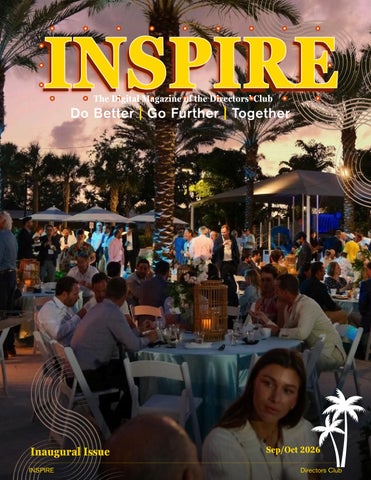
INSPIRE
INSPIRE The Digital Magazine of the Directors’ Club
Do Better | Go Further | Together
Inaugural Issue INSPIRE
Sep/Oct 2026 Directors Club
CONTENTS 1-
Editor’s Note
2-3
From The Desk of the CEO
4-
Topspin Digital
5-6 -
5 Career Challenges...And How to Overcome Them
7-8 -
The Second Half of A Racquet Pro’s Career
9-
Partner Spotlight: Off The Glass
10-13 -
KK&W Leadership Corner
14 -
Partner Spotlight: PickleTile
15-17 - The Next DOR: What GMs and Committees Are Really Looking For 18 19-20 21 22-24 25 26-28 29 30-31 INSPIRE
DCA Club Tour The Experience is the Product
BOAST IS BACK Where Will Your Next Teaching Pro Come From? DCA Retreat 2027 The DOR Doesn’t Need Another Lesson: The Profession Needs a New Definition
RacquetX <> DCA The Health of Your Program Directors Club
Editor’s Note This digital magazine is not just a series of anecdotes or articles of excess. This is the pulse of our industry. A chance for people to hear from each other and connect to something deeper than themselves. Within you will find thoughts from your peers, spotlights on industry leaders and businesses, and themes meant to push us all to reach higher.
EDITOR
Brock Orlowski
INSPIRE is not a place for fluff or to flaunt your success - it is a place to learn and grow...together.
INSPIRE
01
We don’t want to gatekeep, so if you have an idea for an article, a story, or something that’s worth reading, please submit requests to Brock at: brockorlowski@ftwaynecc.org.
Directors Club
INSPIRE Directors Club
From the
Desk of the
CEO
Welcome to the inaugural edition of The Directors Club digital magazine - Inspire! This bi-monthly magazine is another DCA member benefit, and it will serve several purposes. My specific responsibility will be to write a "From the CEO" column, which will be informative in nature. This particular message will explain how the digital magazine came to fruition and how my initial consulting role with DCA led me to becoming CEO.
So how did the digital magazine get started? We've wanted to publish a cutting edge, member and partner highlighting source of information for some time. Something that produced high level insights and connected the DCA members throughout the year. President and Founder, Jarrett Chirico, went to DCA member and Director of Racquets at Fort Wayne Country Club, Brock Orlowski with the idea of being the managing editor of a magazine. After careful consideration and discussion, the magazine has become a reality. Thanks, Brock, for your suggestion and the tremendous effort you have, and will continue to put into this magazine.
"Newsletters" have changed significantly over the years with the most prevalent change being the shortening of articles to be in line with our time-crunched world. "Short and Sweet" rules the day and my goal is to try to keep my message the same. Tha’s why we want this to be something new and honest.
From the Desk of
the CEO I think it is important to briefly tell you how I got here. After a 14-month stint as CEO of start-up certification organization (racketpro), Jarrett reached out to me in July 2025 about helping him scale and improve DCA. The initial role was as a consultant, which I could do remotely from Hilton Head, where I have been blessed to live with my family for more than 40 years. Another attractive plus - there was no overreaching Board or owner involved. During my 14 months consulting for DCA, Jarrett approached me several times to become the CEO. However, after rushing into my last CEO position, I wanted to take my time - kick the tires so to speak before deciding to drive the car. Plus, the end of my last two CEO stunts showed me the importance of being in a positive and forward-thinking work environment. To be honest, Jarrett and I are different in many ways – generationally, personality, work style, . . ., but those differences have led to fantastic working relationship. Our individual strengths complement one another, which has led to positive results. Those initial 14 months were productive as well as enjoyable. So as the first CEO of DCA, I'm excited to work with Jarrett and the amazing team to enhance DCA, help the organization grow, and improve the professional livelihood of all the Directors Club members.
While I am privileged to know the vast majority of DCA director members, I look forward to meeting all of you. In the meantime, if I can be of assistance to you, please feel free to reach out to me. With your help - Let's make DCA's 5th year the best ever!
Reach out to Dan at: 843-298-1113 or santorum@roadrunner.com
INSPIRE
5 Career Challenges By: Dan Beedle
A career in the racquet sports industry can be deeply rewarding, but it is rarely linear. Whether you are early in your journey or well established, there are common challenges many professionals encounter along the way. Recognizing them early and knowing where to find support can make the difference between stagnation and long-term growth and success.
1. You will eventually outgrow a job or facility Your first position is rarely your final destination. As your skills, ambitions, and interests evolve, you may find that a small facility, limited membership base, or capped compensation structure no longer aligns with your goals. Progression often requires moving to a larger club, a more specialized program, or an environment that better supports advancement and leadership opportunities.
2. Your success may threaten others
Progress attracts attention, and not all of it is positive. Developing strong players, earning certifications, receiving awards, or building a loyal client base can create tension with colleagues who feel threatened rather than inspired. In these moments, professionalism and perspective matter. Not every environment rewards excellence equally.
INSPIRE
3. You may hold higher standards than those around you Many professionals take pride in preparation, punctuality, continuing education, and delivering a consistently high-quality experience. It can be frustrating to watch others operate with lower standards while charging the same or more, especially when certifications, education, and effort are not recognized or rewarded within the facility.
4. Leadership may not be fair or objective
As you grow, you may bring forward ideas to improve programming, player engagement, or operational efficiency. Sometimes those ideas are welcomed. Other times they are dismissed due to internal politics, favoritism, or resistance to change. Seeing your work undermined or misattributed can be one of the most discouraging experiences in a professional setting.
5. You may feel lost or feel that you have peaked
After years of effort, it is natural to question what comes next, especially if recognition, advancement, or compensation do not match your contribution. Feeling stuck does not mean you have failed. It often means you need perspective, guidance, and a broader view of the industry. Directors Club
How DCA Helps You Navigate These Challenges Mentorship Directors Club of America connects professionals with experienced leaders who understand the realities of the industry. These relationships provide guidance, perspective, and practical advice on navigating career decisions, workplace dynamics, and long-term growth. Networking Conferences, workshops, and educational events create meaningful connections that often lead directly to new opportunities. Many roles in this industry are filled through trusted referrals, not job boards. A strong network keeps you informed and visible. Career Center and Industry Partnerships RSPA’s Career Center provides access to job opportunities nationwide, along with partnerships that expand career pathways beyond traditional roles. The racquet sports industry is smaller than it appears, and these connections matter. Continued Professional Growth Beyond DCA, organizations such as SETS, RSPA help professionals gain clarity, confidence, and strategic direction. One important lesson many learn is this: in a healthy environment, you are celebrated, not merely tolerated.
Contact Dan at: dan.beedle10s@gmail.com
Whether you are just starting out or navigating the middle chapters of your career, you do not have to face these challenges alone. Growth begins with investing in yourself through education, mentorship, and community. Directors Club of America provides the structure, support, and connections to help you move forward with purpose and confidence.
INSPIRE
Directors Club
The
Second Half of a
Racquet Professional’s Career By: Andrew Cordova A hip replacement forced me to ask an unexpected question: Are we building careers that allow racquet professionals to grow wiser—or careers that eventually run out of runway? This past Monday, at age fifty-five, I received a new right hip. For more than three decades, my body has been my office—professional tournaments, thousands of lessons, clinics, and countless hours doing what I love. Along the way came three knee surgeries, more strains than I can count, and endstage arthritis. I don’t regret any of it. This industry has given me lifelong friendships, extraordinary mentors, and opportunities around the world. But during sleepless nights after surgery, I found myself asking a question our industry rarely confronts: Where is an accomplished racquet professional supposed to go next? We have built a strong professional ladder—to a point. Assistant Professional, Head Professional, Director of Racquets. And then? For many, the only path upward is general management. But becoming responsible for an entire club should not be the only option for someone whose greatest strengths are building relationships, developing people, and growing racquet culture. No other mature profession requires its best people to leave their specialty in order to advance. Attorneys evolve toward strategy and mentorship. Physicians become department chairs. Why shouldn’t racquet sports offer the same trajectory?
INSPIRE INSPIRE
Perhaps our industry needs a Chief Racquet Officer—an executive whose responsibility extends into member experience, culture, strategy, and organizational leadership. Or a Director of Experiences, recognizing that racquet sports are often the doorway into a much larger relationship with the club. Directors Club 8
Our members don't experience their lives in departmental silos. Neither should we. A tournament can become a culinary weekend. A member trip can combine racquets, golf, wine, and culture. The professional who has spent years earning trust is uniquely positioned to create those experiences. Our product has never simply been racquet sports. Our product is community. And the best racquet professionals have earned a place at the center of it. But executive leadership shouldn't simply arrive with age. It should be earned—through years of meaningful service, demonstrated expertise, leadership results, industry contribution, and professional reputation. Not everyone would qualify. That's precisely the point. Create something worth aspiring to. We must also confront compensation. Our traditional model rewards physical production: modest salary, teach more, earn more. But as professionals raise families, accumulate injuries, and develop leadership capabilities, their value should reflect knowledge and impact—not simply physical capacity.
Technology creates new opportunity as well. Strategic planning, mentoring, curriculum development, and consulting don't always require standing courtside. Technology should never replace relationships—it should give great professionals more ways to deepen them.
My surgery hasn't left me wondering what this industry owes me. It owes me nothing. But I do expect it to keep evolving. I expect us to create opportunities worthy of the experience our professionals spend lifetimes accumulating. Our industry has spent decades teaching players how to extend their games. Now we need to extend the runway for the people who dedicate their lives to them.
The second half of a great racquet career should not be about stepping away. It should be about stepping up.
Contact Andrew at: andrewcordova1857@gmail.com
INSPIRE
INSPIRE
9
Directors Club
PARTNER SPOTLIGHT
Off The Glass THE ONLY PADEL COURT MANUFACTURER IN THE USA!
Off The Glass engineers our padel courts with one simple understanding. To elevate this beautiful game. That’s why we pay attention to the details: how energy moves through steel, how our glass returns the ball, and how a player may need to slide across the surface to make a shot. At Off the Glass, we understand how the smallest of details in engineering and design matter to players, not just because we build the court, but because we understand that a great padel court’s mechanics should never decide the point. Our courts are designed, fabricated, and assembled in the USA (Goshen, IN) by our team of engineers & professional installation partners who not only understand how they work, but who understand how they’re supposed to feel the moment you step on one.
We Elevate your Game. INSPIRE
Directors Club
YOUR NEXT JOB INTERVIEW STARTED YEARS AGO By Len Simard, Search & Consulting Executive, Kopplin, Kuebler & Wallace, USTA coaching, RSPA Master Professional, PTR, PPR, PPTR, DCA
O
one of the biggest misconceptions we encounter in executive search is that the interview process begins when a candidate hears about an opportunity and decides to apply. Your next job interview may have started five or even ten years ago. Long before a position profile is published, your candidacy is already taking shape. It is being influenced by your reputation, relationships, leadership, professional development, industry involvement, and the way you conduct yourself when nobody is offering you ia job.
YOUR REPUTATION ENTERS THE INTERVIEW ROOM BEFORE YOU DO. INSPIRE
"
How have you treated members, colleagues, employees, vendors, and fellow professionals? Have you built authentic relationships across the industry? Do people view you as someone who develops others, shares ideas, and contributes to time professioN? Have you continued to invest in your education, even when a promotion was not immediately available? Search committees are looking well beyond playing ability, teaching credentials, and technical knowledge. They want leaders who understand people, culture, communication, technology, financial performance, and the broader club operation. They also want evidence that a candidate has been preparing for greater responsibility, not simply looking for ia bigger title.
Directors Club
THE CASE FOR THE
DIRECTOR OF RACQUETS One of the most important measures of leadership is the success of the people you have developed.
The best Directors of Racquets continually prepare their assistants and professionals for greater responsibility. They provide opportunities for team members to lead events, manage budgets, create programming, communicate with committees, supervise employees, and solve problems.
They are not threatened when a talented assistant is ready to leave for a Director of Racquets position. They take pride in helping that person advance.
2
Developing others also creates a leadership legacy that extends well beyond the walls of your current club.
IN ALMOST EVERY INTERVIEW PROCESS, A VERSION OF THIS QUESTION COMES UP: ‘TELL US ABOUT THE PEOPLE YOU HAVE DEVELOPED.’ The more professionals you have helped move into leadership positions of their own, the more powerfully and authentically you can answer that question. It demonstrates that you can identify talent, build confidence, delegate responsibility, provide honest feedback, and create a culture in which people grow. Those are qualities every club should want in its next Director of Racquets.
INSPIRE
PAGE
When former assistants become successful Directors of Racquets, their careers become part of your professional story. That is not something you can manufacture during the application process. It is built through years of intentional mentorship and unselfish leadership.
Industry involvement is another important part of your preparation. Serving on committees, attending educational programs, presenting at conferences, contributing to professional associations, and mentoring younger professionals demonstrate curiosity and commitment.
These experiences strengthen your relationships and expose you to new ideas, operating models, and leadership perspectives. References are developed in much the same way. The strongest references are not simply recognizable names. They are people who have directly observed your leadership, character, judgment, and results over time. You cannot create those relationships once an application deadline appears.
Directors Club
3 BE READY. BE REMARKABLE. THE PROFESSIONAL PREPARATION ADVANTAGE
Then there is the more tangible side of being ready. I speak with racquets professionals every day who become excited about a Director of Racquets opportunity. Then they review the application requirements and realize the deadline is only a few weeks away. Suddenly, they recognize that they are not prepared to put their best foot forward. Their resume has not been updated in years. Their LinkedIn profile is incomplete or does not match their resume. They are unsure what belongs in a strong cover letter, so they submit a generic version that could have been sent to any club.
They do not have a professional portfolio, and gathering years of accomplishments, photographs, program information, budgets, marketing materials, and supporting documents becomes an overwhelming project.
Strong career materials cannot be assembled effectively at the last minute.
A professional portfolio should tell the story of your leadership and the impact you have made throughout your career. Building that story takes time, organization, and thoughtful reflection. The same is true of your resume and LinkedIn profile. They should support one another and communicate a consistent professional identity. Your accomplishments should be specific and measurable. Rather than simply stating that you managed a successful racquets program, explain how you increased participation, improved the member experience, developed your team, grew revenue, introduced new programming, or strengthened the club's culture. Your cover letter must also do more than repeat your resume or tell a club how exciting its opportunity appears. It should demonstrate that you understand the organization, its needs, and the leadership opportunity in front of it.
INSPIRE
Directors Club
4 FINAL THOUGHTS
Most importantly, your cover letter should answer this essential question: Why does this opportunity make sense for you at this stage of your career, both personally and professionally? That is the key. A search committee wants to understand not only why you are qualified, but why this is the right opportunity at the right time. What have you accomplished that has prepared you for this next step? What are you now ready to contribute? How does the position align with your family, your personal priorities, and your long term professional goals? A thoughtful and authentic answer can distinguish your letter from dozens of generic submissions.
Personal brand management ties all these elements together. Your personal brand is not a logo or a collection of social media posts. It is the consistent story the industry tells about you when you are not in the room. An active and thoughtful LinkedIn presence can support that story, but your daily conduct must validate it. What you communicate publicly and how you lead privately should reflect the same person.
The best time to prepare for your next opportunity is while you are fully engaged in your current one. Keep a record of your accomplishments and measurable results. Update your resume and LinkedIn profile regularly. Build your portfolio one project at a time. Invest in continuing education. Strengthen relationships. Develop your assistants. Mentor others. Ask for feedback and intentionally build the skills required for the position you hope to hold several years from now. Do not wait for the perfect position profile to appear before deciding what kind of leader you want to become. Your next opportunity will require strong materials, but it will also require a credible body of work behind them. Build your reputation. Develop the people around you. Prepare your resume and portfolio. Manage your professional presence. Most importantly, become the candidate you want the industry to see long before anyone offers you an interview.
MOST IMPORTANTLY, BECOME THE CANDIDATE YOU WANT THE INDUSTRY TO SEE LONG BEFORE ANYONE OFFERS YOU AN INTERVIEW. INSPIRE
Directors Club
S I T S A O B K C A B pricing A C D e v i s Exclu more! d n a s m r nifo for staff u
It's a Japanese Maple!
THE NEXT
DIRECTOR F OF
RACQUET SPORTS WHAT GMS AND SEARCH COMMITTEES ARE REALLY LOOKING FOR By: Ian H. Munroe, CCM, ECD
or years, the pathway to becoming a Director of Racquet Sports was fairly predictable. You become a great player, build a strong lesson book, run successful programs, develop relationships with members, and eventually earn the opportunity to lead a department.
Those things still matter. But at many of today’s best private clubs, they are no longer enough and are frankly missing the true attributes of a successful Director altogether. When a GM/COO or search committee hires a Director of Racquet Sports, we are not simply hiring the club’s best teaching professional. We are hiring an executive who is responsible for a business within the business. That distinction matters. The strongest candidates understand that their value is no longer measured by how many lessons they personally teach. Their success is measured by the quality of the team they build, the experiences that team creates, the financial and operational health of this department, and their ability to advance the broader mission of the club.
“
The first thing I am looking for is leadership capacity. Can you attract talented people? Can you develop them? Can you have difficult conversations, with both staff and Members? Can you establish expectations and hold people accountable while still creating an environment where employees want to work?
THE JOB IS TO BUILD PEOPLE WHO CAN SOLVE THOSE PROBLEMS WITHOUT YOU. GREAT DIRECTORS CREATE OTHER LEADERS. THEY COACH THEIR PROFESSIONALS, GIVE THEM OWNERSHIP, ALLOW THEM TO MAKE DECISIONS, AND REMAIN ACCOUNTABLE FOR THE FINAL RESULT.
”
INSPIRE
Perhaps most importantly, can you delegate?
Many Directors struggle here because the skills that made them successful as professionals can eventually limit them as executives. They have built their careers by being personally involved in everything. They teach the clinic. They run the tournament. They answer the member. They solve the scheduling problem. A Director cannot operate that way forever.
The job is to build people who can solve those problems without you. Great Directors create other leaders. They coach their professionals, give them ownership, allow them to make decisions, and remain accountable for the final result. That is the transition from producer to executive.
PAGE 1 OF 3
Directors Club
The Next
Director of Racquet Sports
Page 2 of 3
I am also looking for someone who understands that they own the racquets operation as though it were their own business. Know your numbers. Understand payroll. Understand programming profitability, participation trends, court utilization, retail, lesson revenue, labor efficiency, capital needs, and the department’s budget. Know why you are ahead or behind budget before the accounting department tells you and have solutions ready. Administrative strength is not the glamorous part of the position, but it is often what separates good professionals from outstanding Directors.
Your calendar matters. Your communication matters. Your face time with Members matters. Your staff schedules matter. Your follow-up matters. Your ability to prepare for meetings and communicate clearly with the GM/COO, committees, boards, members, and staff matters. The Director should never have to be chased for information.
But operational competence alone does not create a great racquets program. The best Directors also possess exceptional soft skills. They listen. A lot. They walk the facility. They talk to the Member who plays six days a week and the Member who plays twice a month. They understand the competitive player, the social player, the beginner, the junior parent, the longtime Member and the person who joined last week. They are curious about what Members are actually experiencing rather than assuming they already know what Members want.
Your calendar matters. Your communication matters. Your face time with members matters. Your staff schedules matter. Your follow-up matters.
At Winter Park Racquet Club, we live by our Service Mantra, GREET: Greatness Requires Exceptional, Every Time. That means recognizing Members, knowing their names, anticipating needs, taking ownership of their experience and delivering service that is exceptionally friendly, knowledgeable and consistent.
A Director must do more than demonstrate those behaviors personally. They must scale them. The question is whether the newest assistant professional knows Mrs. Smith’s name. The question is whether the newest assistant professional knows Mrs. Smith’s name. The question is whether the newest assistant professional knows Mrs. Smith’s name. Culture cannot live exclusively in the Director. It must travel through the organization under their leadership and example. INSPIRE Directors Club
2
THE NEXT
DIRECTOR
PAGE 3 OF 3
OF RACQUET SPORTS
There is another characteristic I believe search committees should examine carefully: restraint. When talented professionals arrive at a new club, there is tremendous temptation to immediately prove their value and make at immediate "impact". They see things they would change. They know what other clubs are doing. They have attended conferences, visited leading facilities and heard what the latest "industry standard" is. But sometimes, most times in fact, the smartest thing they can do is absolutely nothing. At least initially.
Contact Ian at: ian.munroe@wprc.net
THE DIRECTOR'S JOB IS TO BUILD A TEAM, CULTURE AND OPERATING SYSTEM CAPABLE OF CREATING GREAT MEMBER EXPERIENCES EVERY DAY, WHETHER THE DIRECTOR IS STANDING COURTSIDE OR NOT. INSPIRE
Every club has history. Every club has traditions. Every club has personalities, rhythms, sacred cows and cultural nuances that cannot be understood from a strategic plan, website or first month on the job. Learning and understanding those things takes time. Before changing something, understand why it exists. And even then, you may not want to change it if it has deep roots and meaning to most Members. A program that looks outdate to an outsider may be one of the most beloved traditions in the club. A training practice that is an important member of a Member's profile. You have not yet discovered. And yes, some Members will appear in an indoor best practices presentation may have tremendous emotional significance to the Membership for reasons you do not fully understand. Innovation is important. Blindly importing another club's playbook is not. Great Directors spend their first months listening, observing, asking questions and earning trust. Then, when change is necessary, they can explain not only what should change, but why it will make their particular club better. For professionals pursuing their next Director position, I would encourage you to prepare for interviews differently. Do not spend the entire conversation talking about your playing background, certifications, lesson philosophy or the tournaments you have run. Tell you how you lead. Tell us about someone you developed who became better because you mentored them. Tell us about a difficult personnel decision and how it made a positive impact despite its uncomfortableness. Explain how you build a departamento budget. Tell us what metrics you would review every month. Explain how you would learn the culture of a club before changing its programs. Tell you how you would form a department and how you would handle a long term. Most clubs have a strong leadership team. Show how you how you communicate upward to the GM/COOs and downward to your team. And demonstrate that you understand the biggest shift of all. The Director's job is no longer to personally create every great Member experience. The Director's job is to build a team, culture and operating system capable of creating great member experiences every day, whether the Director is standing alongside or not. That is what the GM/COOs and search committees should be hiring for. And that is what the next generation of great Directors of Racquet Sports should be preparing to become.
Directors Club
THE D
UB CL
ECTORS IR
See Yo!u There
DCA DCA
r u o T Club
2026
THE INDUSTRIES GREATEST LEADERS SHOWCASING THE WORLDS MOST ICONIC CLUBS
here are our planned locations for visits throughout 2026 NEWPORT
NYC BOROUGHS GREENWICH AREA LONG ISLAND DALLAS
RALEIGH CHARLOTTE
COLUMBIA JACKSONVILLE
ities, Different C lubs. lC Exceptiona
A ONE DC . FAMILY
FT. WAYNE AREA
NAPLES, FL SOUTHEAST FLORIDA HOUSTON CHICAGO
Who wants to be on the list FOR A DCA CLUB VISIT IN
2027?
more dates being added
The Experience Is The Product By: Seth Redelheim
There’s no question that racquet sports are booming. Led by the explosion of pickleball and a 54% increase in tennis participation since 2019, the future seems very bright indeed.This excitement has also led to another natural consequence: an entire industry chasing the next shiny object.We have an increasingly crowded frontier of new complementary raquet sports, a whole swath of new leagues and playing formats, and new apps for everything from court reservations to line calling to player matching, all being pushed into the spotlight by an industry eager to identify the next big thing. The hard part is sifting through out it all to decide what will actually increase member satisfaction, retention, and overall participation. Pickleball, Padel, Red-Ball Tennis, TYPTI, Triiples, Intense…You have to admit that the brass ring has gotten hard to see in the muddy water. Innovation is valuable—but we can become so focused on creating something new that we overlook what members actually experience every day.
INSPIRE
Because in the private club world, the program isn’t really the product. The experience is. Members step into a different world when they step onto the grounds of the club, using it as an escape from whatever stresses or problems they face at work or at home. They want to feel recognized, welcomed, connected, and accepted. Just as importantly, they want to trust that the details are being handled, that things will be done well, and that their experience will be consistently outstanding. The enduring value of a private club is not simply access to its amenities. It is the experience of belonging to the place. The fundamental standards of service remain one of the most important— and most often overlooked—areas where you can make a noticeable impact. The evolving operation of the raquets department demands more from a director than teaching a few lessons and hitting the golf course (love you Pete), but the fundamentals of a great teaching professional haven’t changed much. Do the simple stuff well! •Be on time and look sharp •Be prepared for the lesson and tailor it to your audience •Give the client your undivided attention •Provide service that is enjoyable •Demonstrate expertise in your field •Connect with the client on a personal level
19 10
None of that is revolutionary. In fact, most of it could have been written into a Head Professor’s job description 30 years ago. What has changed is where those expectations begin and end. Mike Barrel, International coach and director, told me that a good pro needs to be a Policeman, a Doctor, and a Bartender, all in the right mixture. Dave Dvorak, renowned tennis director in Atlanta, added that a good director had better also be a Marriage Counselor, a Meteorologist, and a Firefighter. Pretty tough job descriptions if you ask me.
Directors Club of America
We are seeing ever-increasing traffic on our courts, in our pro shops, and in our lounges and viewing areas. The modern racquets facility is no longer simply a place where members come to play and then leave. At many clubs, it has become one of the most active social centers on the property—and that changes our responsibility. We have expanded our scope to create a welcoming and inviting area where people can stay and feel surrounded by their community. They want to hang out by the fireplace and have a drink with friends. They want to feel comfortable staying after a match or clinic to have lunch in the Tennis Center with their weekly foursome. They want to linger—and that is a very good thing. Every additional minute a member chooses to spend at the club represents engagement: another conversation, another relationship, another meal, another introduction, another reason to return tomorrow. But the longer members stay, the more touchpoints we create, and every one of those touchpoints becomes part of the product. And increasingly, those touchpoints don't belong to a single department. A member may move from the tennis court to the locker room to lunch to the fitness center without ever thinking about our organizational chart. Our departments may operate vertically, but members experience the club horizontally. To them, it is all one club experience. That means our racquets staff must become more than teaching professionals— they are also hosts, connectors, problem-solvers, and ambassadors for the club. The fundamentals still matter; we’ve simply expanded the court on which we must execute them. Ironically, as technology makes our operations increasingly sophisticated, the fundamentals of great service remain remarkably human. Using members’ names Noticing who is new and who is missing Introducing different people and groups Anticipating needs before the member has to ask Communicating clearly across every channel Taking ownership of problems, not passing them on Being a steward of the facility and sweating the details It is in this part of our jobs where consistency really beats creativity. A spectacular member guest once a year doesn't compensate for an average experience the other 364 days. Nor does the newest clinic format, app, or social event matter much if the everyday fundamentals aren't being executed. Directors must establish expectations for what the member experience should look and feel like—and then develop a staff that delivers it consistently, even when the director isn't standing there. If the members’ experience changes dramatically depending on who is working that day, then you don't have a service culture; you have a few good employees. Clarity of vision and purpose comes from the top of the department. Whether establishing service standards, evaluating a new program, or deciding what not to pursue, the director has to make that vision unmistakable. As Andy Stanley puts it, “You can survive being wrong, but you can’t survive being unclear.” So, by all means, keep innovating. Try the new sport. Test the new format. Download the new app. Some of those ideas may become important parts of your operation. Just don't confuse innovation with excellence. Innovation may give members another reason to walk through the door, but what happens after they arrive determines whether they want to come back. What happens after they arrive determines whether they want to come back. After all, the program is not the product. The experience is.
Contact Seth at: sredelheim@westlakecountryclub.com
20 INSPIRE
Directors Club of America
PickleTile - Partner Spotlight PICKLETILE™ is a turnkey sports court construction and glass enclosure company specializing in the design, construction, and installation of highperformance tennis, pickleball, and padel facilities. Our scope includes court construction and resurfacing, our signature PICKLEGLASS™ soundand wind-blocking fencing systems, integrated sports lighting, canopies, and related site amenities. PICKLETILE™ is an official court builder and acoustic partner of USA Pickleball, the official glass fence of the RSPA, a partner of the International Association of Pickleball Professionals (IAPPF), and a Sponsor of The Director’s Club of America. We provide complete project support from design and engineering coordination through installation and final completion, serving country clubs, resorts, commercial developments, and private facilities nationwide.
INSPIRE
14
Directors Club
Where Will Your Next Teaching Pro Come From? Dominic Spicer, MBA, RSPA, DCA
There has been a lot of talk in the racquet sports industry about the challenge of keeping young professionals in the industry while also creating a pathway where a young individual could start a teaching position not just as a gig to get by while they figure out what they want to do long-term, but as a long-term career with longevity. I believe directors are responsible for providing this pathway and an opportunity to capture these younger professionals.
DIRECTORS ARE RESPONSIBLE FOR PROVIDING THIS PATHWAY AND AN OPPORTUNITY TO CAPTURE THESE YOUNGER PROFESSIONALS.
This year I attended my first RSPA Southern Conference. While it was a great networking experience for me, as one of the only attendees under the age of 30, the same conversation came up time and time again: "What made you come to the conference?" or "What do you think we need to do to get more pros here your age?" I had not realised it was such a pressing issue in our industry before now. So, it got me thinking: why did I drive five hours to Atlanta for a three-day conference where I lost $1,000 in teaching revenue and had to cover expenses to make the trip? Most teaching pros would think the same and say, "I'll pass," but how many of those professionals are in this industry for the long run? Personally, I see the value of connecting with masters of the industry who have been doing this longer than I've been alive. I see the importance of talking to vendors and other directors, listening to seminars and, to be quite honest, making myself relevant in the industry and making people aware of who I am and what I'm about.
2 Now, if you're a teaching pro reading this, let's have an honest conversation with ourselves right now: "Do you see yourself in this industry as a long-term career?" If the answer is "I'm not sure," perhaps the bigger question is whether anyone has shown you what a career in this industry can look like. If the answer is "no," good luck to you; you can close this now now. If the answer is yes, what are YOU going to do to progress your career and find the best opportunities out there? Are you willing to lose a couple of days of teaching money to attend a conference where you meet new people and potentially have new opportunities come your way? Do you go to a certification and collect the certificate without talking to anyone? I attended a pickleball certification and maintained a relationship with the coach developer, who asked me to present a seminar at a conference. The point of this is not to toot my own horn. The point is to show how there is so much more value out there than the $$$ you earn from teaching a couple of days of lessons.
Now, if you're a director reading this, first send the above paragraph to your teaching pros, because if you want to have a successful program, you want motivated teaching pros who are willing to progress, stay hungry and get better. That will make you look better. But that is not why you want this; you want this because it is your duty as a director and mentor in an industry of teaching professionals to pave the way and present the potential of an exciting career in racquets to your teaching pros. My director, Nate Palmer is my biggest mentor. He has been exceptional at presenting me with opportunities to further my education through conferences and certifications, but what he has done most importantly is reward hungry work ethic with more responsibility. Rewarding enquiries with stories and examples. Rewarding ideas with the freedom and assistance to execute. That, to me, is an exceptional director.
Now to the flip side. The Director of Racquets position is spoken about as the pinnacle of this industry. Now, I'm not saying it is or it isn't, but what about a teaching pro who loves teaching and just wants to teach? How do they progress, stay motivated and avoid burnout? They still need to be given responsibility when earned, even if they don't have any ambitions to become a director. They still need to learn, they still need to feel valued and rewarded with the opportunity to grow. They should still be pushed to go to conferences and hear from and see other teaching pros to refresh their teaching ideas, so clubs don't get bored of the same old teaching pro for 20 years.
THERE IS SO MUCH MORE VALUE OUT THERE THAN THE $$$ YOU EARN FROM TEACHING A COUPLE OF DAYS OF LESSONS.
The industry goal should not be: Teaching Pro
→ Head Pro → Director
Everybody’s goals are different. We need those older teaching pros who are excellent on court, well compensated, continually learning and love their job.
What tracks in both cases is that the DOR has a responsibility to help their staff grow to be the very best version of themselves, whether that is with the aim of achieving their dream job or by helping them become as happy and successful as possible in their current position. I believe more honest conversations need to happen between directors and teaching pros so there is more of an understanding of how they can help one another achieve success.
Contact Dom at: dominicspicer26@gmail.com
If a director wants to take care of their members, they take care of their staff. If a teaching pro is to stay in this industry, they need a director to take care of them.
CLOSING QUOTE:
Your next great teaching pro might already be standing on one of your courts. The question is whether they see today’s lessons as a job or the beginning of a career.
racquetx
THE DIRECTORS CLUB
T U O D L O S
TWO EVENTS. ONE WEEK.
The full experience built for club leadership. BACK TO BACK IN SOUTH FLORIDA.
TICKETS ON SALE NOW
THE DIRECTOR OF RACQUETS DOESN’T NEED ANOTHER LESSON.
THE PROFESSION NEEDS A NEW DEFINITION. By: Yev Supeko, Director of Racquets, Colonial Country Club
Every profession eventually reaches a point where its title no longer reflects the reality of the job.
I believe the Director of Racquets has reached that point. A Director who teaches many hours a week isn’t leading a department. They’re the department’s best-paid teaching pro.
If that sentence bothers you, good. Sit with it for a second before you keep reading.
None of this is a knock on the Head Professionals who built our profession. They were exceptional teachers, mentors, and ablassadors who grew the game through personal relationships and outstanding programming.
CREDIBILITY ISN’T BUILT BY HOURS LOGGED, IT’S BUILT BY RESULTS DELIVERED. They were exactly what clubs needed decades ago. The question isn’t whether they were successful. The question is whether today’s clubs require something different.
Over the past two decades, clubs have evolved dramatically. Member expectations have changed. Facilities have expanded.
Racquets departments now often include tennis, pickleball, padel, retail operations, junior development, adult programming, staffing, budgeting, marketing, technology, committee presentations, and strategic planning. In many clubs, the racquets operation has become one of the largest drivers of member engagement and one of the most visible departments in the organization. At some point, we stopped adding responsibilities to the Director of Racquets and quietly created an entirely different leadership role.
Yet we often continue evaluating that role through the same lens we used decades ago. One conversation seems to follow our industry everywhere: “Should the Director spend more time on the court?”
It’s a fair question, but I no longer believe it’s the right one. I know the counterargument, because I’ve made it to myself. A Director who’s rarely on court loses credibility with members. Staff won’t respect someone who doesn’t play the game they’re paid to teach. Members want to see their Director, not read about them in a newsletter. Those concerns are real. They’re also a different conversation than the one club needs to have, because credibility isn’t built by hours logged, it’s built by results delivered.
Technology has transformed how we communicate and operate.
INSPIRE
Directors Club
02
REDEFINING VALUE
There are still weeks when I move or delegate lessons because my schedule is filled with department meetings, planning, budgeting discussions, or staff development.
Earlier in my career, I felt guilty doing that. Like many Directors, I measured my own value by my personal production. The more I taught, the more valuable I believed I was.
Over time, my perspective changed. Every lesson I teach creates value for the members standing across the net. Every lesson I delegate creates an opportunity for another professional to grow. Every hour invested in developing my team, improving our operation, or helping strengthen the club has the potential to improve the experience of hundreds of members rather than a handful.
That doesn't diminish teaching. It redefines leadership.
THE TECHNOLOGY ISN'T CHANGING THE ARGUMENT. IT'S REMOVING OUR LAST EXCUSE FOR AVOIDING IT.
This is where the question of metrics stops being theoretical. Artificial intelligence will soon automate much of what used to fill a Director's calendar and quietly justify it as scheduling, reporting, routine communication, marketing. If our value is still measured in hours on court, that automation looks like a threat. If our value is measured in outcomes such as the team we build, the experience members have, the direction we set then it's simply capacity returned to us. Every hour AI hands back is another hour to invest in the parts of the job only a leader can do.
INSPIRE
The technology isn't changing the argument. It's removing our last excuse for avoiding it.
One of the most valuable lessons I've learned since joining Colonial Country Club didn't happen on a court. It happened in our weekly department head meetings, where leaders from across the club openly discuss challenges, opportunities, and ideas. Those conversations reminded me that members don't experience the Racquets Department in isolation. They experience one club that shifted my perspective from simply growing racquets participation to helping strengthen the overall member experience.
I know what some of you are thinking: this depends on the club. A let's say 400-member club with one or two pros isn't a 1,200-family club with a full department. Members at a smaller, more intimate relationship with their local, and that expectation is legitimate, not outdated. I agree. It does depend on the club. But that's not an argument against the redefinition but rather it's the argument for a threshold. Do the math on any large club. A department serving a thousand-plus families, with several fulltime professionals on staff, cannot be run on the assumption that the Director should also be teaching more. At that scale, "the Director should be on our court more" isn't really a philosophy anymore. It's arithmetic. There aren't enough hours in a week for one person to personally teach a meaningful share of a membership that size and run the department that serves them. Somewhere between a 400-member club and a 1,000-plus family club, the job quietly crosses a line from a teaching role with management attached, to a management that occasionally teaches. That Director who has crossed that haven't ever been told and are still being measured as if they hadn't. So, the real question isn't whether size matters. It's whether your club has already crossed that threshold and whether anyone's said so out loud.
Directors Club
PAGE
03
Before entering private clubs, I spent years managing in a commercial business environment. The more time I spend in both worlds, the more I realize that great leadership follows the same principles regardless of industry.
Financial stewardship, communication, innovation, strategic planning, and developing people aren’t corporate concepts. They’re leadership concepts.
At a certain size, the Director of Racquets isn’t just a title anymore, they’re functioning as the manager, and in some cases the CEO, of a department. Pretending otherwise doesn’t protect tradition. It just leaves the role underdeveloped for what it’s already become. We’ve done an exceptional job developing teaching professionals. We haven’t done the same for strategic leaders, and a lot of clubs are quietly paying the price for that gap without naming it.
Contact Yev at:
ysupeko@colonialfw.com
The modern Director of Racquets isn’t hired simply to be the best teaching professional in the department. They’re entrusted with building the best racquets operation for the club. That’s a different responsibility.
So, I’ll leave you with one final question: If your club were hiring its very first Director of Racquets tomorrow, would you write the same job description we wrote decades ago or one that reflects what today’s clubs truly need and expects?
THE MODERN DIRECTOR OF RACQUETS ISN’T HIRED SIMPLY TO BE THE BEST TEACHING PROFESSIONAL IN THE DEPARTMENT. INSPIRE
Directors Club
RETREAT EDITION
DCA
APRIL 11-13, 2027
SAVE THE DATE
RETREAT EDITION
BOCA WEST COUNTRY CLUB
THE DIRECTORS CLUB t u o d l o S Add your name to the wait list today!
INSPIRE, DCA
SEPTEMBER 2026
THE HEALTH OF YOUR PROGRAM WITH JARRETT CHIRICO INSIDE THE MIND OF A FIXER WHO’S REVIVING PROGRAM HEALTH. At just 41, I’ve watched Jarrett revive racquets programs that had lost their pulse. East Coast or West, North or South, the symptoms vary—but the cure is surprisingly consistent. It starts with
By: Bridget Chirico
diagnosing what’s actually broken. Consider this his prescription for a healthier racquets program.
When you look at a club’s financial performance, what are the first numbers or metrics you want to see?
Are we generating revenue because
Then
participation
simply
compensation structures. How are
because we are charging more? Those
the professionals being paid? What
are two very different stories, and the
are
distinction matters.
contracts properly structured? Are
Next, I evaluate lesson revenue by
they paid to be entrepreneurs? Does
I have always believed that the
professional. This is one of the most
the financial model make sense? In
numbers tell the story. Regardless of
important metrics in the business. It
all cases, this is only possible if the
the club, its location, its membership
tells me whether we have the right
Director has the right contract.
base, or its reputation, the financials
number
When evaluating any club or racquets
ultimately tell us what is happening
productive the team actually is, where
operation,
today and, more importantly, what is
opportunities exist, and how we can
request
possible tomorrow.
structure the program so professionals
financials.
The first thing I want to see is
can earn more. When professionals
provides the clarity necessary to
revenue. Revenue tells me the level
earn more the club thrives. This is
understand
of participation and gives me an
almost always an area that needs to be
opportunities, recognize problems,
immediate
fixed.
and make decisions with confidence
Q
understanding
of
the
of
is
strong,
or
professionals,
how
I
look
their
at
expenses
percentages?
I
believe
three
to
That
Are
you
five
the
should
years
historical
trends,
and
of
data identify
health and scale of the program.
rather than assumptions. All leaders
From there, I look closely at pricing.
should do this when looking at a new opportunity.
PAGE 1
INSPIRE
THE DIIRECTORS CLUB
Directors Club
My approach has consistently been simple: drive participation first which ultimately drives revenue, and then eliminate unnecessary losses. You can always fix your numbers once you have the numbers (revenue).
Q
What are the biggest revenue opportunities that clubs are currently overlooking?
I have built my career around creating those opportunities and I have seen firsthand what happens when professionals are treated like revenue-producing entrepreneurs rather than simply employees. The racquets department also has an enormous advantage that most other departments do not: multiple sports, multiple programs, and multiple revenue streams operating from the same footprint. And I don't care what puts a member on my court. Tennis. Pickleball. Padel. Platform tennis. Dodgeball. Nerf wars. Water wars. Mahjong, or any other social event. Adults or Juniors, it doesn't matter. Every additional participant creates another potential revenue stream, and every additional revenue stream creates another opportunity for the professional to earn more. That relationship should never be viewed as a conflict between the club and the professional. It should be designed as a multiplier. When professionals make more money because they are producing more, the club makes more money. When the club invests in opportunities that increase participation, professionals make more money. When professionals are financially motivated to create participation, members become more engaged and retention improves. One fuels the other.
PAGE 2
INSPIRE
The best racquets programs don't simply manage courts. They monetize every opportunity those courts create. And the best leaders don't put a ceiling on what their professionals can earn, they build a structure that gives them every reason to break through it.
Q
What is your philosophy on pricing? When should a club raise prices, and how do you determine what members are actually willing to pay?
I have always believed in being priced on the high side of the middle of the market. There is a narrative behind that position, and that narrative matters. It tells the membership that we understand the market, that we are not pricegouging them, and that we are committed to remaining competitive while still creating an environment where we can attract and retain the very best professionals. Pricing should move when the market dictates it but it should always have a reason behind it. The mistake many clubs make is believing that the path to more revenue is simply charging more. I believe the opposite. The objective is to create enough revenue streams and enough participation opportunities that professionals can make more money without constantly increasing the price to the member. I would much rather have a member playing three or four times a week and bringing their entire family into the program than have that same member play once a week at a higher price.The more people we have using the facility, the more opportunities we create for lessons, clinics, leagues, events, camps, and every other revenue-producing activity.
There has to be a balance between price and participation. When I look at clubs across the country, pricing is often established without enough thought behind the strategy. The question shouldn't simply be, “What can we charge?” The better question is, “What price creates the greatest overall value, participation, retention, and revenue opportunity?” At every club where I have been, we have not necessarily been the most expensive option in the market. Yet at Royal Oaks, we produced the highest revenue in the industry. We didn't accomplish that by simply charging more. We charged correctly, drove participation, built programming, created events, and developed a structure that allowed our professionals to earn at the highest levels. That is the model. Pricing should be intentional. Programming should be intentional. Compensation should be intentional. And every decision should consider the narrative it creates with the membership and the message it sends to the professionals we are trying to attract. Because ultimately, you cannot build a great racquets program without great people. It doesn't matter how incredible the facility is, how many courts you have, or how much money has been invested in the property. If you cannot attract and retain exceptional professionals, the program will eventually suffer. That is why pricing must support an environment where we can recruit the best, retain the best, and give the best people an opportunity to succeed. The goal isn't to be the most expensive club. The goal is to be the club that gets the most out of every dollar, every court, every member, every event, and every professional. That is what pricing with purpose looks like.
THE DIIRECTORS CLUB
Directors Club