You are Peter
by Deacon David Clifton
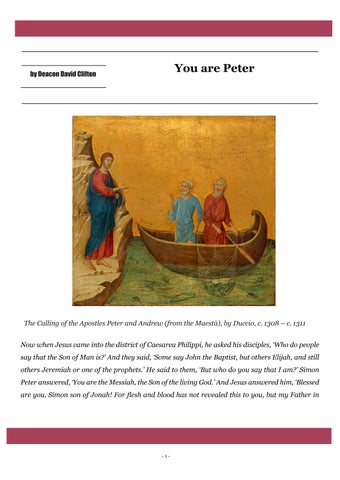
The Calling of the Apostles Peter and Andrew (from the Maestà), by Duccio, c. 1308 – c. 1311 Now when Jesus came into the district of Caesarea Philippi, he asked his disciples, ‘Who do people say that the Son of Man is?’ And they said, ‘Some say John the Baptist, but others Elijah, and still others Jeremiah or one of the prophets.’ He said to them, ‘But who do you say that I am?’ Simon Peter answered, ‘You are the Messiah, the Son of the living God.’ And Jesus answered him, ‘Blessed are you, Simon son of Jonah! For flesh and blood has not revealed this to you, but my Father in
-1-
heaven. And I tell you, you are Peter, and on this rock I will build my church, and the gates of Hades will not prevail against it. I will give you the keys of the kingdom of heaven, and whatever you bind on earth will be bound in heaven, and whatever you loose on earth will be loosed in heaven.’ [Mt 16: 13-20]
If you will forgive the pun, this is a key passage of Matthew’s gospel. Jesus gives to Simon a new name– Peter [in Hebrew Kepha, the Rock]. Upon this rock his Church will be built. He gives Peter ‘the keys of the kingdom of heaven’, and he invests him with authority to ‘bind’ and ‘loose’. All these expressions of Jesus are significant.
The change of name signifies the assignment of a particular mission. This is seen in the Old Testament, for example, with Abram (Abraham) and Jacob (Israel) and in the New Testament with Saul (Paul). Here, Peter’s mission is to be the Rock on which Jesus will build his Church. In the Old Testament God himself is often referred to as a rock. For example, He [God] is the
St Peter, portrait by Rembrandt (1632)
-2-
Christ Handing the Keys to St Peter, by Pietro Perugino (1481–1482) Rock [Deut 32: 4], You are my rock, my stronghold [Ps 30 (31): 4], for the Lord is an everlasting rock [Is 26: 4]. To call Peter by this name is to pick him out as the representative of God.
Peter is to be given the keys of the ‘kingdom of heaven’. There is a general misconception about this. Peter is popularly depicted as standing at the gates of heaven, using his keys to unlock them to admit those who deserve to enter. But the ‘kingdom of heaven’ does not refer to heaven. Matthew displays the Jewish reticence to refer explicitly to God. Whereas the other evangelists speak of the kingdom of God’, meaning his kingdom here on earth, Matthew calls it the ‘kingdom of heaven’. This is what we pray for in the Our Father, ‘Thy kingdom come, … on earth as it is in heaven’. What does it mean, then, to be given the keys of that kingdom on earth?
In the Book of Isaiah [22: 20-24], the prophet tells the palace secretary Shebna that he will be replaced by Eliakim, for God ‘will place on his shoulder the key to the house of David; he shall
-3-
open, and no one shall shut; he shall shut, and no one shall open.’ The sign of a key indicates control or authority; the one who holds the keys has the authority. Thus, the ‘key of David’ implies control of David’s domain. This control was promised to the Messiah in both the Old [Is 9: 6-7] and New Testaments [Lk 1: 32] In the Book of Revelation Jesus is the holder of the Key of David: ‘Thus says he who is holy and true, who holds the key of David; if he opens, nobody shuts and if he shuts nobody opens.’ [3: 7] The reference to ‘binding’ and ‘loosing’ is a Jewish legal term indicating the authority to state what is allowed and what is forbidden. This authority over Christ’s kingdom on earth – the Church - was to be given to Peter. Jesus is making a very significant statement. Peter becomes, as it were, the key to the presence of the king of heaven. It is through Peter that we have access to the kingdom of heaven. That is not to say that Peter is some kind of intermediary. We don’t need the Pope’s permission to pray to God. This is where the secondary meaning of ‘key’ comes in. A ‘key’ can also mean something that explains a mystery; something that gives insight into things beyond our understanding. It shows us the right path to follow. If Peter is that key, then we must hold fast to Peter. It is through him that we will find the right path to follow.
When Jesus appeared to the apostles after his resurrection, he took Peter aside and charged him to ‘feed my sheep’. [Jn 21: 15-17] He was appointing Peter the shepherd of his flock, the infant Church. The title of shepherd is, in the Old Testament, applied to God himself, for example: ‘The Lord is my shepherd …’ [Ps 23: 1], ‘Give ear, O Shepherd of Israel, you who lead Joseph like a flock!’ [Ps 80: 1] This role was one to be taken on by the promised Messiah, ‘He will feed his flock like a shepherd; he will gather the lambs in his arms.’ [Is 40: 11], and Jesus claimed this title by declaring, ‘I am the good shepherd’ [Jn 10: 14]. Now Jesus is passing this responsibility on to Peter. He does this in spite of Peter’s failings. Predicting Peter’s betrayal, he declares, ‘Simon, Simon, listen! Satan has demanded to sift all of you like wheat, but I have prayed for you that your own faith may not fail; and you, when once you have turned back, strengthen your brothers.’ [Lk 22: 32]
Jesus chooses Peter to be the leader of his Church. The Pope, as Peter’s successor, is the visible sign of the unity of that Church. The Second Vatican Council says of the Pope that, ‘…as the successor of Peter, [he] is the perpetual and visible source and foundation of the unity of the bishops and of the multitude of the faithful.’ [LG 23]. In the long history of the Church there are -4-
many examples of people trying to go their own way, separate from the leadership of Peter, and all result in a distortion of the truth. The New Testament itself shows us that the message of Jesus would never have survived without the Church to preserve it and protect it from error.
‘… the faith preached to men, which comes down to our time by means of the successions of the bishops. For it is a matter of necessity that every Church should agree with this Church [Rome], on account of its pre-eminent authority, that is, the faithful everywhere, inasmuch as the apostolic tradition has been preserved continuously by those [faithful men] who exist everywhere.’ Against Heresies, Irenaeus of Lyon (120-202), Book 3, Chapter 3, para 2
Apostle Peter striking the High Priests' servant Malchus with a sword in the Garden of Gethsemane, by Giuseppe Cesari, c. 1597
-5-