Parish Proclaimer
Winter 2017 edition
Cathedral Parish of Our Lady & St. Philip Howard Canon Tim Madeley - Dean Father Stanislaw Mycek - Assistant Priest Rev. Mr. David Clifton - Deacon Louise Sharp - Parish Secretary* Cathedral House, Parsons Hill, Arundel, West Sussex BN18 9AY Tel: 01903 882 297 Fax: 01903 885 335 Email: aruncath1@aol.com
Web: www.arundelcathedral.org * The Parish Office is open 9am – 1pm, Monday – Friday
Mass Times at Arundel Cathedral Sunday
Weekdays
Saturday
9.30am Family Mass on the third Sunday of the month; Children’s Liturgy available other Sundays. 11.15am Cathedral Choir. 10am Tuesday, Wednesday, Friday and Saturday. Saturday: Exposition of the Blessed Sacrament after Mass. 11am Benediction.
Mass Times at the Convent of The Poor Clares, Crossbush, near Arundel Saturday Sunday
Monday Friday
5.30pm 6.15pm 4.30pm 5.30pm
Vespers. Vigil Mass (entry at 6pm). Exposition of the Blessed Sacrament. Vespers and Benediction.
8.30am Mass
Sacrament of Reconciliation Saturday
Cathedral:
10.30am otherwise by appointment.
Convent :
Before/after the Saturday 6.15pm Mass.
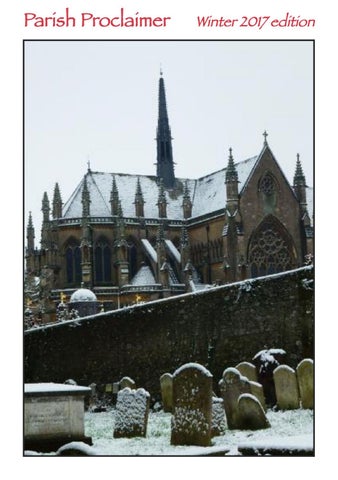
FRONT COVER South East aspect of Arundel Cathedral, from St. Philip’s Cemetery. Photograph taken by Oliver Hawkins reprinted with his permission.
The Parish Proclaimer is printed by Prontaprint Brighton & Hove - December 2017
WELCOME TO OUR WINTER EDITION A Reflection of the Winter Season By Deacon David Clifton The winter period in the Church falls into three very distinct phases. The first phase is Advent, a time of reflection and preparation for one of the most important feasts in the Church’s year; the commemoration of the Incarnation – God made flesh. This begins the second phase of winter the Christmas season, beginning on 25 December (despite the fact that the world outside seems to begin its celebration in November!) and lasts until the Baptism of the Lord – celebrated this winter on 8 January. The third phase is a rather quiet time until the beginning of Lent on Ash Wednesday (14 February 2018). Anyone planning a celebratory meal for St. Valentine’s day should remember that Ash Wednesday is a day of fasting and abstinence! Try, if you can, to enter into the mood of each of these ‘phases’ of winter. Christmas Day falls on a Monday this year, so Advent is as short as it can possibly be – three weeks and a day. Try to make the most of it as a time of preparation for the great feast of the Incarnation. Try not to get too caught up in all the shopping. The time leading up to any big event, a family holiday, a wedding, a birthday, can be a wonderful time of eager anticipation. That is the atmosphere of Advent, and it is well expressed in the Old Testament. The whole Old Testament is an unfolding of God's plan of redemption leading up to the Incarnation, the birth of the Messiah, Continued overleaf +++++++++++++++++++++++++++++++++++ ARTICLES FOR THE SPRING EDITION OF THE PARISH PROCLAIMER: Deadline for receipt - Tuesday, 6 February 2018 Please email your written piece and photos to clouter@mac.com or send by post to The Editor, Cathedral House, Parsons Hill, Arundel, West Sussex BN18 9AY including your name/address to enable us to return the photos. 3
the Redeemer, so it is instructive to look at the Old Testament readings for the Sundays of Advent. Meditating on these, however briefly, would make a very good preparation for Christmas. The second phase is Christmas itself. It is our privilege and joy to live in this ‘Messianic Age’. God did, indeed, come to dwell with us in the person of Jesus. And he still remains with us in his spirit-filled Church. This is what we celebrate at Christmas. We rejoice at God’s deep and personal involvement with us. ‘God so loved the world …’ (Jn 3: 16). Amid all the tinsel and presents; the rich food and drink, it would be good to remember to thank God for his goodness to us, and try to make our involvement with him more deep and personal. There are 15 days to the season of Christmas so you have plenty of time. Again, the readings for the main feasts in the Christmas season are a great source of material for meditation. The third phase is a more tranquil period. We are back to ‘Ordinary Time’ for a few weeks. It forms a buffer between Christmastide and Lent. It also occurs at a time of year when the weather can be particularly cold and bleak. Many people suffer a little from depression at this time of year. It may be a time when we need to live off the spiritual reserves that we have built up over Advent and Christmas – even more reason to celebrate them in a properly spiritual way. And even this early in the year the first flowers are beginning to show themselves, with a promise that spring is on its way. This is a symbol of the promise of the Resurrection, the whole basis of our Christian faith. Have a prayerful Advent, a Merry Christmas and a Happy New Year.
Deacon David
4
Duke Henry’s Other Legacy By Mary Corbyn Duke Henry’s monumental witness to his Catholic Faith is likely to be seen on the Arundel skyline for many generations to come, but his other, less spectacular, gift seems likely to fade from living memory, being constructed not of stone, but of paper. The book ARUNDEL HYMNS was a pioneering work in its day – published with Papal commendation: ‘from the Vatican – June 8th, 1898’ And of considerable importance in its efforts to encourage Catholic lay-men and women to sing. ARUNDEL HYMNS is the result of collaboration between Duke Henry and Charles Gatty – an educated layman who converted to Catholicism and made an enthusiastic contribution to the faith in and around Yeovil in Somerset, where he settled in 1857 ‘where there had been neither church nor priest for many years’, according to a contemporary account. It seems an extraordinary partnership between two unrelated and dissimilar people and a remarkable project on which to embark. The circumstances leading to this enterprise remain something of a mystery since no useful records of correspondence have so far come to light. Charles Gatty has left notebooks in which he records the many journeys he made throughout Europe in search of suitable material to be included in the hymnal and he must have been in frequent contact with Duke Henry, keeping him informed of progress and discussing choices for inclusion. In the years of upheaval, during and after the Reformation, English Catholics had largely fallen silent; such ‘singing of spiritual praise’ as had existed over the centuries in England was drawn mostly from the Divine Office – the Liturgy of the Hours – and kept alive in religious houses until they too were torn down or abandoned. Throughout penal times, many prayers and poems had been composed, copied secretly and passed between trusted friends ‘for their consolation’ both in and out of prison. Few have survived, since it would have been dangerous to be found in possession of such material. But some have – and first in the hymnal is ‘from a work 5
written in the Tower of London by the Venerable Philip Howard, Earl of Arundel’: ‘O Christ the glorious Crown, of virgins that are pure; Who dost a love and thirst for Thee, within their minds procure. Thou art the Spouse of those that chaste and humble be; The hope, the life, the only help of such as trust in Thee. It was the re-establishment of a Catholic hierarchy in England that set the ball rolling, but events in the wider world that gave it momentum. Waves of Irish people arrived in England to escape the poverty brought about by the potato famine in Ireland; they brought with them their customs, songs, and styles of worship – as immigrants do and have always done. At roughly the same time, many educated clergy, laymen and women made the journey from their Anglican roots to ‘come over to Rome’; foremost among them was John Henry Newman whose hymns provided – and still do provide – cornerstones of congregational singing. They expressed theological truths that Newman had sought and taught in his writings and sermons: “Praise to the Holiest in the height, and in the depth be praise…..” Straightforward enough, but verses 2 – 5 provide a carefully worked-out story of our redemption that would offer material for many a sermon: Verse 4: “O generous love! That he, who smote in man for man the foe, The double agony in man for man should undergo;” The hymn is No.6 in ARUNDEL HYMNS in the section devoted to ‘Almighty God and the Most Holy Trinity’. The contents of the hymnal are numbered to 308 but this is somewhat misleading, as those in Latin are accompanied by a translation – each with its own number. Thus: Adeste Fideles is printed in two parts, each with its translation, and separately numbered: 20, 21, 22 and 23. The hymns are arranged under headings, frequently sub-divided, reflecting devotional subjects and the Church’s seasons: Continued on page 8 6
N e ar
r e st e t n i nk 0% ba
rate
Let us show you low risk alternatives BOOK YOUR INITIAL CONSULTATION AT OUR EXPENSE
01903
882007
The Mellor Practice Ltd is an appointed representative of Lighthouse Advisory Services Limited which is authorised and regulated by the Financial Conduct Authority. The Mellor Practice Ltd, Registered in England, No. 10567558 Registered Office: 41b Beach Road, Littlehampton, West Sussex, BN17 5JA The value of your investments can go down as well as up, so you could get less back than you invested
Almighty God and the Most Holy Trinity The Sacred Humanity of Jesus: Advent Christmas and Epiphany Lent and the Passion of our Blessed Lord Easter and Ascension The Blessed Eucharist The Sacred Heart The Most Holy Name of Jesus Our Blessed Lord God the Holy Ghost The Blessed Virgin Mary The Saints, Apostles and Evangelists Martyrs and Confessors Our Guardian Angels The Memory of the Dead Judgement Heaven The Church and the Faith Penance Morning and Evening Hymns Various Hymns on the Christian Life Grace Before and After Meal School Song for a Fair Holiday
1 - 12 12 - 19 20 - 52 53 - 81 82 - 95 96 - 129 130 - 134 135 - 136 137 - 148 149 - 153 154 - 204 205 - 231 232 - 239 240 – 243 244 - 248 249 - 252 253 - 261 262 - 267 268 - 278 279 - 295 296 - 302 303 - 307 308
Catholics then, as now, loved and venerated familiar Latin hymns, but they welcomed the ‘new’ hymns that seemed to give more personal expression to their feelings of joy, sorrow, repentance and sense of unworthiness by focusing on the humanity of Jesus, of His Mother, and the Saints; perhaps offering a more ‘direct line’ to those beyond human reach than did the more formal prayers and rituals of the Liturgy and the Breviary. These ‘approaches’ became known generally as Devotions and achieved rapid popularity – especially when hymns would be sung: Holy Hours with Exposition of the Blessed Sacrament and Benediction, The Rosary, Stations of the Cross, processions and pilgrimages, Veneration of relics, litanies – and Missions! These were events, sometimes lasting several days, usually preached by members of Religious Orders from Europe where many had been founded.
8
No.275 in our hymnal is an ‘Invitation to the Mission’: “Oh come to the merciful Saviour who calls you Oh come to the Lord who forgives and forgets, Tho’ dark be the fortune on earth that befalls you, There’s a bright home above where the sun never sets.” We are accustomed to hymns that venerate The Cross, The Sacred Heart, and The Precious Blood, but might now shudder at paying homage to The Most Holy Spear and Nails and to the Most Holy Winding Sheet with its spelled-out realism: “Ah me, how naked art Thou laid! Bloodstain’d, distended, cold and dead! Joy of my soul – my Saviour sweet, Upon this sacred Winding-sheet.” More comforting then, to turn to the section headed ‘Various Hymns on the Christian Life’ and discover another hymn by John Henry Newman (No.296) – ‘The Pillar of the Cloud’ but known by its first line: “Lead, Kindly Light, amid the encircling gloom. Lead Thou me on. The night is dark and I am far from home. Lead Thou me on.” and, even better: ‘Meditation upon Heaven’ (No.261) written by the Venerable Philip Howard, Earl of Arundel, after his attainder: “No eye hath seen what joys the Saints obtain, No ear hath heard what comforts are possessed; No heart can think in what delight they reign, Nor pen express their happy port of rest. Where pleasure flows, and grief is never seen, Where good abounds, and ill is banish’d clean.” With 51 hymns to the Blessed Virgin Mary, there is no doubting Duke Henry’s devotion to Mary, especially to her shrine at Lourdes, already attracting pilgrims from far and wide. It seems that the Lourdes Pilgrims’ Hymn came too late for inclusion in the Hymnal, but a separate page, printed later, can be found after No.308. 9
There are hymns celebrating the (then) recently declared Dogma of the Immaculate Conception, the most popular, surely, being: “O purest of creatures, Sweet Mother, Sweet Maid! The one spotless womb wherein Jesus was laid Dark night hath come down on us, Mother, and we Look out for thy shining sweet Star of the Sea.” This section begins with the Magnificat (in Latin and in English) and concludes with an Evening Prayer – once favourite at the close of Sunday afternoon Benediction: “Darker and darker fall around the shadows from the pine; It is the hour, O Mother-Maid, to gather round thy shrine.” Two other hymns (Nos.174 and 5) honour Our Lady’s Expectation with some appealing sentiments: “Thou wast happy, blessed Mother! With the very bliss of Heaven, Since the Angel’s salutation in thy raptured ear was given. Since the Arc of that midnight, when thou wast anointed Queen. Like a river overflowing hath the grace within thee been.” Although still appearing in current hymnals, this is rarely sung – which seems regrettable. One hymn that has stood the test of time is (No.194): “Hail, Queen of Heaven, the Ocean’s Star! Guide of the wanderer here below!” thought to have been the first ‘new’ Catholic hymn to be written after the Reformation; it is by John Lingard, scholar (and priest) who lived from 1771 to 1851, so died before seeing his hymn in print. Still a favourite whenever two or three Catholics are gathered together! But the hymn that most evokes the spirit of those times with its rousing words and exhilarating tune is, of course “Faith of Our Fathers” (No.264) by Father Frederick Continued on page 12 10
CATHEDRAL GIFT SHOP
( ( & "
#" #"
&, ' ' (" $ #* & ' (" ' ! " ##! ' ( " " ) ' %) $! "(
#
&)"
(" "
)' # ( " ##$ ','( !
)'' +
An extensive range of high quality religious gifts and cards for Advent, Christmas, Lent, Easter, Pentecost, baptisms, weddings, funerals, birthdays, special anniversaries and other occasions. The Gift Shop is situated in the North Transept by the Shrine of St. Philip Howard. From 1/11/17 - 31/3/18 Monday - Saturday 10.30am - 12 noon From 1/4/18 - 31/10/18 Monday - Saturday 10.30am - 4.30pm PLEASE NOTE We rely on volunteers to help in the gift shop so our opening hours may vary slightly.
Faber – probably the most prolific hymn-writer of his day, Oratorian and mentor to young Duke Henry. “Faith of our Fathers, Living still, in spite of dungeon, fire and sword: Oh how our hearts beat high with joy whene’er we hear that glorious word! And so they did – and still do! Back to ARUNDEL HYMNS and Charles Gatty. He must have been tireless in promoting the hymnal, producing several ‘experimental’ sections for distribution among people with influence; he organised recitals of Catholic church music and circulated sheet music among publishers of the day. Among ‘authors unknown’ (and there were quite a number of these) one hymn achieved instant popularity, prompting Arthur Boosey – a well-known music publisher to write to Charles Gatty in November 1896: “We are already asked for ‘Come to the Manger’ and have one order for six dozen.” By December 1897, Charles Gatty was receiving Royalties at ten shillings for a thousand copies of the carol – “eventually to be included in my Hymn Book”. And so it was – and still remains a firm favourite with congregations of all shades and sizes. ARUNDEL HYMNS has been overtaken by many hymnals since its publication in 1901, but it was a trail-blazer for congregational singing – which still has some way to go within Catholic Worship. Its hymns are reminders of the enthusiasm with which they were sung, after centuries of hidden piety and forbidden religious practice. Duke Henry and Charles Gatty must be remembered and honoured for their remarkable contribution to Catholic tradition in England. Editor’s Note: This is the last article Mary Corbyn wrote before her death on 4 September. I received a neatly handwritten letter from Mary, dated 13 August 2017 a letter that I want to share with you, relating to this article. Dear Alex, This is something of a ‘health warning’ (shock, at least!) so brace yourself for the
12
arrival - some time soon - of a fairly long piece on ARUNDEL HYMNS, as promised from ages past. I’m struggling to get this on paper before Duke Henry’s centenary year runs out. But it’s getting a bit out of hand! I realise, of course, that it’s well past its use-by date, but I think you’re probably used to that. Is there a winter edition of the Proclaimer before Christmas? Or like ‘A Green Bough’ is it all over (so to speak) by November? Or it could wait till 2018, except that it will no longer be within the centenary? I hope you’re enjoying the non-summer - or have enjoyed. Haven’t seen you up at Crossbush lately. I still get there for the Vigil Mass most weeks, care of my good friend Vicki. Very best wishes, Mary Well, I made contact with Mary as, at that time I had just about completed the Autumn magazine and promised her that I will place it in the Winter Proclaimer. Jo Briscoe kindly typed up Mary’s exquisitely handwritten article and I made sure it would be the first feature for every Proclaimer reader to read! Mary has been a regular contributor for our parish magazine that goes way back to an early one, Lent 2004, in my archive. Inside this issue is Mary’s article ‘Why Candlemass?’ which is now on page 43 of this magazine for everyone to read. What follows is a poem composed by Ray Weatherley: Goodbye Mary 1
3
Now that the ‘gentle one’ has left us With a fine memorial, with little fuss; Life in Arundel Cathedral not the same, From choir to holy dusters, Mary’s the name.
As she drifts up to meet her namesake With as much as she’s allowed to take; Kindly people like Mary don’t grow on trees Going through life, barely creating a breeze.
2 ‘Green Bough’ with Mary always at the mast Directing her willing and talented cast, Giving much joy to many a needy folk, Helping them with their loneliness yoke.
4 Will we all miss her presence? - Yes! Being around as much as good Queen Bess; Her reign now over, will her legacy survive, Or will the bees remain trapped in the hive?
13
Henry XV Duke of Norfolk By Canon Tim Madeley Henry Fitzalan Howard was born on 27 December 1847 in Carlton House Terrace in London. He was styled Baron Maltravers, being son of the heir apparent to the XIII Duke of Norfolk (his grandfather and the present Duke’s great great great grandfather). On the death of the XIII Duke in 1856, Henry was styled Earl of Arundel and Surrey when his father became Henry Granville, XIV Duke of Norfolk. Henry, baptised at the Oratory Church in London, grew up in a devout Catholic Christian family spending much time here in Arundel Castle and in London. He was the eldest son of a family of six girls and two boys. One sister became a Carmelite nun, another a Sister of Charity while a third devoted her life to working with people in the slums of the East End of London. Henry and his brother Edmund were educated at the Oratory School in Edgbaston under the direction of John Henry Newman. Henry’s father, Duke Henry Granville died at the early age of 40 and so at the age of 12, Henry became the XV Duke of Norfolk in 1860. Henry and his devotion to St. Philip Neri St. Philip Neri (1515-1595) was a priest born in Florence, who founded the Congregation of the Oratory. This saint was noted for his joyful demeanour and for the great love that he showed to those that came to him for confession or counsel. St. Philip’s congregation is a pontifical society of apostolic life of Catholic priests and lay-brothers who live together in a community bound together by no formal vows but only with the bond of charity. Today these ‘Oratorians’ are living around the world in 70 Oratories containing 500 priests. Cardinal John Henry Newman set up the first English Oratory in Birmingham in 1848 and this was followed by one in London in 1849 (initially in the Strand, later at Brompton) with Frederick Faber as superior. These Oratorian Fathers acted as Spiritual Directors to the Norfolk family so it was no surprise that when Henry married Lady Flora Abney-Hastings, the marriage took place at the Brompton 14
Oratory in 1877. Duchess Flora died of Bright’s disease in April 1887 aged 33. At the age of 56 in 1904, Henry married the 27 year old Hon. Gwendolen ConstableMaxwell, eldest daughter of the 11th Lord Herries of Terregles. Henry, his faith and family Duke Henry grew up in a devout Catholic family where the Eucharist (the Body of Christ) present in the tabernacle in this chapel was central to their life of faith. This is evidenced by Henry, when rebuilding the castle at Arundel, putting at the centre of the reconstruction, near the Barons Hall, a most magnificent chapel for the family to worship in on a daily basis. The chapel has one of the finest late Victorian interiors and yet was influenced by the architecture of Westminster Abbey and Lincoln and Salisbury Cathedrals. Duke Henry’s family began when Duchess Flora gave birth to Philip, Earl of Arundel & Surrey on 7 September 1879. The boy however was blind and epileptic and his mother was unable to bear any more children. After her death in 1887, Henry cared for his son alone until Philip died on 8 July 1902. Having married Duchess Gwendolen in 1904, the couple were blessed with four children: Lady Mary Rachel (1905-92), Bernard Marmaduke, Earl of Arundel & Surrey and later 16th Duke of Norfolk (1908-75), Lady Katherine Mary (1912-2000) and Lady Winifred Alice (1914-2006). Bernard was laid to rest in the Fitzalan Chapel while his sisters’ graves are in St. Philip’s Cemetery next to the Cathedral Centre. Henry and his public service Although Duke Henry was a quiet and retiring man, he played an active part in public life throughout his ducal life. On inheriting the dukedom in 1860 he immediately took his place in the House of Lords. With this came the hereditary title of Earl Marshal. As such he (and his successors including the current holder, Duke Edward) is the eighth of the Great Officers of State in the United Kingdom, ranking beneath the Lord High Constable and above the Lord High Admiral. The Earl Marshal has among his responsibilities the organisation of major ceremonial state occasions like the monarch's coronation in Westminster Abbey and state funerals. He is also a leading officer of arms and oversees the College of Arms. With property not only in Arundel but also in London and Sheffield, Duke Henry 15
held office as Mayor of Arundel (1902), Mayor of Sheffield (1895-97) and Lord Mayor of the City of Westminster (1900). The Duke also served under Prime Minister Lord Salisbury as the Postmaster General (1895-1900) resigning to fight in the Second Boer War as a lieutenant colonel in the Imperial Yeomanry. He was wounded close to Pretoria and invalided home. Henry and his generosity in great things Duke Henry’s generosity was unbounded. Although giving financial help to hundreds of deserving causes, he centred his philanthropy on reintegrating Catholics into civic life after hundreds of years of exclusion and persecution. This most particularly included places of worship and education establishments. This life of benefactor began as soon as he came of age, celebrating that great event with the building (1868-1873) of the Church of St. Philip Neri in Arundel (now the Cathedral Church of Our Lady and St. Philip Howard). The Duke took particular interest in the architectural detail of this fabulous building designed by Joseph Hansom and in Medieval French Gothic style. Next, to celebrate his 1877 marriage to Lady Flora Abney-Hastings, Duke Henry commissioned the even bigger Church of St. John the Baptist in Norwich. In English Medieval Gothic style it took until 1910 to complete long after the death of his beloved wife. This church since 1976 has been the Cathedral Church of the Catholic Diocese of East Anglia. To encourage Catholics into higher education, Duke Henry co-founded St. Edmund’s College, Cambridge and gave money for the building of the University of Sheffield, becoming its first Chancellor (1905-1917). Henry and influences to his life There were two major religious influences in Duke Henry’s life, influences that affected many others years after his death. The first is his pilgrimage to Lourdes. Duke Henry and Duchess Flora’s only child Philip was born blind and epileptic and the couple well believed in the power of God through the intercession of Our Lady of Lourdes to help them as a family to cope with his disabilities. At this time, the apparitions of Our Lady in Lourdes, France were fairly recent but the place was becoming popular as a place of pilgrimage across the universal church. Duke Henry, in taking his son Philip to Lourdes, encouraged many others (to this day) to Continued on page 18 16
&'
##
% !' ! #
# % ! ' % "' % * ! !' " &" %# % ! % &'"%
'
&
* # & '" ) & ' +"(% " '" && && +"(% " ! & (&& ' *"% % $( % '" % # % ! % &'"% ' '" *"% ! "% % + *"% & %% "(' * ' % ( "!& % ' "! '" ' "% ! '% & !( '(% ! &'"%+ " ' " "(% " * ! %# % ! % &'"% ! + *"% & "# ' ! ' &' ! % ( ' "% ! % '(%! '" +"( #
##
## % !''
''#
% ( #$
## % !''
$ "
"% / +' (
+# ( &1 !. ,- ")., ,#-. -
,")+- / &% +)' -" -)/( ' !(# #
(-
) #(
* (
+
& -)
#(
")#
,-&
% %$# $ " "# " & # % " # %# ## % " ## #$ %## ' $ $
""( " % ( "
! # % ( $ "
&&& % ( $ "
# $
% %
" #
.
(,
)
+
(
+ &
$.,-
/#-" #-, ( + (!
)'')
- .* -)
)' )+-
&
+
+.(
( ).,
/// +
-"
(- +
(- ,")*, ( + ,- .+ (-,
+))',
"
" "
). &
* +%#(! )( ,#-
&
+.(
( ).,
., , 0
& !' #& )' +.(
& )'
!. ,-, /#(
make a similar pilgrimage. It was appropriate that Duke Henry died on the Feast of Our Lady of Lourdes, 11 February. The Holy Eucharist was the other great influence in Duke Henry’s life. His devotion to the Body of Christ was exemplified in replicating the Italian practice of having a Carpet of Flowers to celebrate the Feast of Corpus Christi. This he instigated in Arundel for the first time in 1878 and this tradition continues to this day. Henry always took his part in carrying the canopy which shielded the Blessed Sacrament on the procession to Arundel Castle on this Feast Day. Henry and his generosity of small things In addition to building churches, erecting altars and convents, Duke Henry’s generosity was also notable in the small items he gave to support faith communities particularly here in Arundel. Three items of particular significance were gifted to the parish by the Duke: a silver casket decorated with 17th Century Flemish reliefs given for use at the Altar of Repose on Holy Thursday. The panels depict regal scenes from the Old Testament: the judgement of Solomon, the death of Absolom, David and Goliath in the valley of Terebinth and the anointing of David by the prophet Samuel. Often on display during Corpus Christi is a silver gilt monstrance created in 1904 by Hardman Powell & Co, Birmingham. (A monstrance is used for the adoration of the presence of Christ in the Eucharist.) It was bought by the Catholics of England and Wales as a gift to Duke Henry to celebrate his marriage to the Hon. Gwendolen Constable Maxwell on 15 February 1904. Henry then passed it on for use in this church. Used at Christmas and during Corpus Christi are four gilt and red lamps purchased on behalf of Duke Henry from the Grand Canal in Venice. They were used in the Blessed Sacrament Processions but being rather heavy they tend now to be used for static decoration within the Cathedral Church. Henry and his legacy for future generations Duke Henry was a descendant of St. Philip Howard who died in the Tower of London after 10 years of imprisonment by Queen Elizabeth I for his Catholic faith.
18
The continuity of faith and tradition showed by St. Philip was re-echoed down the ages by many generations of the Fitzalan Howard family. This has continued to the present day. Duke Henry died in 1917 and is buried with Duchess Flora and son, Philip in the Fitzalan Chapel. His successors have continued his roles as Duke of Norfolk, Earl Marshal and benefactor to the Church. Bernard Marmaduke succeeded to the dukedom as the 16th Duke of Norfolk at the age of 9. He married the Hon. Lavinia Strutt on 27 January 1937. The couple had four daughters, Ladies Anne, Mary, Sarah and Jane. Jane is the sole survivor, her sisters having died over the last three years and are laid to rest in St. Philip’s Cemetery, London Road just down from the Cathedral. +++++++++++++++++++++++++++++++++++
Two New Servants for Arundel & Brighton Diocese Courtesy of A&B News, September 2017
Tristan Cranfield with his parents, Lorraine and Michael
Paul Bilton and Tristan Cranfield from A&B Diocese were ordained in July, Paul in St. Paul’s Church, Haywards Heath, and Tristan in the Villa Palazzola, just outside Rome. Paul is a Permanent Deacon serving in Haywards Heath Parish, while Tristan is at the Venerable English College in Rome, preparing for his ordination to the Priesthood. The word ‘Deacon’ means ‘servant’. In this case the deacon serves the Church, particularly by assisting the bishop and the priest, and also ‘promoting and sustaining the apostolic activities of the laity’ (Pope St. John Paul II).
19
There is a triple focus: proclaiming, preaching and teaching the Word; assisting at the Altar in the Liturgy, and the care of the poor and needy. The role of Deacon is an ancient one, going back to apostolic times, and the permanent diaconate flourished up to the fifth century, but then declined in the Western Church, surviving as an intermediate stage for candidates preparing for the priesthood. Restored by the Second Vatican Council, the permanent diaconate has since flourished and there are currently 50 Permanent Deacons in the A&B Diocese. Tristan’s ordination was held in a small church dedicated to Our Lady of the Snows at Villa Palazzola, the summer residence of the Venerable English College. He reflects that ‘thankfully, having made a good retreat and having had plenty of time over the last few months to reflect on the particular nature of the diaconate meant that, on the day, my brothers and I were able to concentrate well on the meaning of what was going on in the various parts of the Ordination Rite... it was all the more meaningful and powerful in opening our eyes to God’s presence in the rite, and in the Mass, because we were well prepared to take part in it.’ Mass was followed by lunch in the Villa gardens with a few members of the family and friends, including several priests from A&B Diocese. Tristan will spend his final academic year in Rome, finishing studies in preparation for ordination to the priesthood in 2018. He adds, ‘Please pray for me, and for my brother seminarians from A&B during this time, and for more vocations in the priesthood.’ O Lord, my God, You renew the Church in every age by raising up priests outstanding in holiness, living witnesses of Your unchanging Love. In Your Plan for our salvationYou provide shepherds for Your people. Fill the hearts of young men with the spirit of courage and love that they may answer Your call generously. Give parents the grace to encourage vocations in their family by prayer and good example. Raise up worthy priests for Your Altars and ardent, but gentle servants of the Gospel. Give the Church more priests and keep them faithful in their love and service. May many young men choose to serve You by devoting themselves to the service of Your people. Prayer courtesy of www.catholic.org 20
ARUNDEL FINE GLASS STUDIO Fine glass engraving for those special gifts. We also sell modern and classical style glassware.
Visit our shop in Arundel: The Old Stable, Tarrant Street
01903 883 597 www.arundelglass.com
' (*' $#( $#0) ( "%!. *) )' ( $,# $#( ' ) !) $ ) )' # , ) ( () $' ) , ) #. ' ' ( '+ ) $# ' '( # ) # ( $ )( $,# ' $' , " #. ' $"" # ) $#( % ') '$" () # ' )' ,$' (* ( ' "$+ ! ' ( # $' !$, ' # $ ) '$,# %'*# # # ' # ' "$+ ! , $ ' ( + ' ! ' # ( '+ ( ' &* ! ()( $*# ! # #(*' #
+
) $# ! '$ / " %* ! !
" #. )' (*' $#( , ' $*' ' # , () !$ !!. ) (% %! #) ' ( *() $*)( $ $*' $,# $%% ,$$ ! # (*%%!. ' ,$$ # *( $#
$$
# . ! ).
. ! "$() $ ! () ' . ! #
'*# ! # '$" , '
+ ,
!! (%
)( $ $ )*"% ' ' #"
)' (*' '. ( "$+ ! #) # # *)) # # # # ( %# )*' # )$# " # ' ' ' () " ) ( + $+ ' # !! $ () *(( -
PRAYER By Jo Briscoe ‘Great is the mystery of the faith. This mystery requires that the faithful believe in it, that they celebrate it, and that they live from it in a vital and personal relationship with the living and true God. This relationship is prayer.’ [Catechism of the Catholic Church] Prayer of Cardinal Basil Hume: Ever-listening God, give me the faith to trust in you, the patience to listen to you and not tell you what I think you should do. Help me to pray the words, ‘Your will be done on earth as it is in heaven’; and having prayed this way, may I accept your will. Dear God, we long to be with you, to be in your presence. In this pilgrimage on earth may we never lose sight of you and draw ever closer to you. Give us the strength each day to stand back and dedicate some time solely to you. Cardinal Basil Hume, through his books, has been of great influence to me, especially in his spirituality. He was an English Roman Catholic Bishop. He was a monk and priest of the English Benedictine monastery of Ampleforth Abbey and its Abbot for thirteen years until his appointment as Archbishop of Westminster in 1976. His elevation to Cardinal followed during the same year. (In the first few years 22
of my own conversion, I spent whole days at Ampleforth Abbey accompanied by the young Priest who was my inspiration – all the Brothers were still talking about their beloved Abbot!). In the Prologue to a publication by Ampleforth Abbey entitled “Saint Benedict’s Prayer Book”, it states: “Some may think that the point of prayer is to get our own way with extra-terrestrial help, or to save us from facing the problems of life, or to provide an escape from ‘reality’, or to give an emotional uplift that makes you feel good. Some may think that prayer is a way of expanding our consciousness which is achieved by our own discipline and personal effort at self-improvement. These are caricatures of what Christian prayer really is. There may be a strand of truth in some of them, but they miss the real point of prayer. To get to the true meaning of Christian prayer we have to go back to the beginning. We need first of all to face the truth, at once awesome and reassuring, that we are not alone in a time-bound universe; that another mode of being interpenetrates the life we live in sound and sight and sensation; that the very heart, in every sense of the word, of that other life is love. Thus St. Paul writes in Galatians 2: “I am living here and now this mortal life, but my real life is the faith I have in the Son of God, who loved me and gave himself for me.” That gives the clue to where Christian prayer begins…. In responding through prayer we begin to find our way to a love beyond imagining. That is what prayer is about.” What is prayer? “For me, prayer is a surge of the heart, it is a simple look turned toward heaven, it is a cry of recognition and of love, embracing both trial and joy” – St. Thérèse of Lisieux Prayer is the response of faith and love to the free promise of salvation. Prayer is the raising of one’s mind and heart to God. Prayer is talking and listening to God. As in a close human relationship, words are used to express love, to ask for help, and to talk over what lies near to the heart. Humility is the foundation of prayer. Only when we humbly acknowledge that we do not know how to pray as we ought, are we ready to receive freely the gift of prayer. According to Scripture, it is the heart that prays. We all know God in different ways, therefore every person’s prayers are unique. No one else shares quite the same relationship with God. That is why personal, extempore prayer is so important. But we also have much in common as human 23
beings, so written prayers can reflect the desires of many hearts, just as great love poetry expresses the feelings of thousands who are in love. To quote again from the Catechism of the Catholic Church: “One enters into prayer as one enters into the liturgy: by the narrow gate of faith. Through the signs of his presence, it is the Face of the Lord that we seek and desire; it is his Word that we want to hear and keep. The Holy Spirit ……. teaches us to pray in hope….. Hope does not disappoint us, because God’s love has been poured into our hearts by the Holy Spirit who has been given to us. Prayer, formed by the liturgical life, draws everything into the love by which we are loved in Christ and which enables us to respond to him by loving as he has loved us. Love is the source of prayer, whoever draws from it reaches the summit of prayer. In the words of the Curé of Ars: I love you, O my God, and my only desire is to love you until the last breath of my life. I love you, O my infinitely lovable God and I would rather die loving you, than live without loving you. I love you, Lord, and the only grace I ask is to love you eternally. My God, if my tongue cannot say in every moment that I love you, I want my heart to repeat it to you as often as I draw breath.” The Curé of Ars (Parish Priest of Ars in France) was St. John Vianney who is venerated in the Catholic Church as a Saint and as the Patron Saint of Parish Priests. (This special love, expressed here, is described in an Encyclical Letter from Pope Benedict XVI, entitled Deus Caritas – God is Love, as Agapé which is described in Lexicons as “to take pleasure in the thing, prize it above all other things, be unwilling to abandon it or do without it.” Agapé puts the beloved first and sacrifices pride, self interest and possessions for the sake of that beloved. This is the love that God has for us which inspired him to sacrifice His son and for His son to obey and sacrifice himself. It is the kind of love we are commanded to have for one another. The other kind of love is Eros – a love felt particularly within the body – an exulted and beautifully idealistic love, usually between a man and woman, but can also be “platonic” and extend to deeply intimate friendships. The Dictionary definition of agape is: “Christian fellowship, esp. as distinct from erotic love”. [The Greek interpretation is ‘brotherly love’]. However, this is a subject Continued on page 26 24
of its own importance, open for discussion independently.) A good prayer implies God’s greatness, his otherness from us and his worthiness to be praised and respected. Our Father is in heaven, which means that he is great beyond our comprehension and good beyond our understanding, but God is our Father and a good prayer helps us to feel close to him and in touch. Sometimes the words are majestic and the rhythms beautiful but, when the words are conversational and the mood immediate, the true spirit of prayer can still be captured. A good prayer is honest and sincere. There is no room for pretence when we are talking to God who knows us through and through. Prayer should help us all to look at ourselves and our world more through the eyes of God. Where does prayer come from? Whether prayer is expressed in words or gestures, it is the whole man who prays. But in naming the source of prayer, scripture speaks sometimes of the soul or the spirit, but most often of the heart. According to scripture, it is the heart that prays. If our heart is far from God, the words of prayer are in vain. The heart is our hidden centre, beyond the grasp of our reason and of others; only the spirit of God can fathom the human heart and know it fully. The heart is the place of decision, deeper than our psychic drives. It is the place of truth, where we choose life or death. Prayer is the living relationship of the children of God with their Father through the heart. I think we are all familiar with the Psalms – we sing them or say them at every Mass. THE PSALMS – The Songs of Prayer From the time of David to the coming of the Messiah texts appearing in these sacred books of Psalms show a deepening in prayer for oneself and in prayer for others. The Psalms were collected into the five books of the Psalter (or Praises) – the masterwork of prayer in the Old Testament. The Psalms both nourished and expressed the prayer of the People of God gathered during the great feasts at Jerusalem. Their prayer is inseparably personal and communal; it concerns both those who are praying, and all men. Their prayer recalls the saving events of the past, yet extends into the future, even to the end of history; it commemorates the promises God has already kept, and awaits the Messiah who will fulfil them definitively. Prayed by Christ and fulfilled in him, the Psalms remain essential to the prayer of the Church. In Him the Psalms continue to teach us how to pray. Within the Psalms, we can extract the many sentiments of the human heart expressed in them: joy, gratitude, thanksgiving, love, tenderness, enthusiasm, but 26
also intense suffering, complaint, pleas for help and for justice which sometimes leads to anger. In the Psalms, the human being fully discovers himself. THE EUCHARIST This contains and expresses all forms of prayer: it is ‘the pure offering’ of the whole Body of Christ to the glory of God’s name. It is the sacrifice of praise. MARY, MOTHER OF GOD In prayer the Holy Spirit unites us to the person of the only Son, in his glorified humanity, through which and in which our filial prayer unites us in the Church with the Mother of Jesus. In the Acts of the Apostles 1: 14, we hear that the disciples went to the upper room, after Jesus’ ascension into heaven, and joined in continuous prayer, together with several women including Mary the Mother of Jesus. Mary, accepting God’s will, gave her consent in faith at the Annunciation and maintained it without hesitation right until being at the foot of the Cross. Ever since, her motherhood has extended to the whole of humanity. She has shown us the way. Jesus is the way of our prayer; Mary, his mother and ours, is wholly transparent to him: she shows the way and is herself the Sign of the way. Beginning with Mary’s unique co-operation with the working of the Holy Spirit, the churches developed their prayer to the holy Mother of God, centring it on the person of Christ. Mary is the perfect prayer, a figure of the Church. When we pray to her, we are adhering with her to the plan of the Father, who sends his Son to save all men. She has become the mother of all the living. We can pray with and to her. The prayer of the Church is sustained by the prayer of Mary and united with it in hope. Because of Mary’s singular co-operation with the action of the Holy Spirit, the Church loves to pray in communion with the Virgin Mary, to magnify with her the great things the Lord has done for her and to entrust supplications and praises to her. THE SAINTS The witnesses who have preceded us into the Kingdom, especially those whom the Church recognises as saints, share in the living tradition of prayer by the example of their lives, the transmission of their writings and their prayer today. They contemplate God, praise him and constantly care for those whom they have left on earth. When they entered into the joy of their Master, they were put in charge of many things. Their intercession is their most exalted service to God’s plan. We can and should ask them to intercede for us and for the whole world. Being more closely united to Christ, those who dwell in heaven fix the whole Church more firmly in holiness – they do not cease to intercede with the Father for us, as they proffer the
27
merits which they acquired on earth through the one mediator between God and men, Christ Jesus. So by their fraternal concern is our weakness greatly helped. In the words of St. Paul to Timothy - “In every place, then, I want the men to lift their hands up reverently in prayer, with no anger or argument.” So it is only as we gain more and more knowledge of our Catholic faith that we understand the greater picture of, firstly, the importance of our Lady and, secondly, the Saints whose example has gone before us, that we realise the inspiration that is given to us and how important it is to express our gratitude for that inspiration and example and to seek their help through our own prayers. We should also remember that Jesus, upon returning from prayer in a quiet place, was asked by one of his disciples: “Lord, teach us to pray.” In response to this request, the Lord entrusts to his disciples and to his Church, the fundamental Christian prayer – “Our Father”. The Lord’s Prayer is truly the summary of the whole gospel. Since the Lord, after handing over the practice of prayer, said “Ask and you will receive”, and since everyone has petitions which are peculiar to his own circumstances, the regular and appropriate prayer (the Lord’s Prayer) is said first, as the foundation of further desires. In the writings attributed to St. Thomas Aquinas, Scholar and Doctor of the church, he says: “The Lord’s Prayer is the most perfect of prayers. In it we ask, not only for all the things we can rightly desire, but also in the sequence that they should be desired. This prayer teaches us not only to ask for things, but also in what order we should desire them.” St. Augustine concludes “Run through all the words of the holy prayers in Scripture and I do not think that you will find anything in them that is not contained and included in the Lord’s Prayer.” We in the Church end our prayers with ’Amen’. In Hebrew, ‘Amen’ comes from the same root as the word for ‘believe’. This root expresses solidity, trustworthiness, faithfulness, and so we can understand why ‘Amen’ may express both God’s faithfulness towards us and our trust in him. To believe is to say ‘Amen’ to God’s words, promises and commandments; to entrust oneself completely to him who is the ‘Amen’ of infinite love and perfect faithfulness. That is why, at the end of every Eucharistic prayer, the priest says “through him, and with him, and in him, O God almighty Father, in the unity of the Holy Spirit, all glory and honour is yours, for ever and ever. AMEN.” The habitual difficulty in prayer is distraction. It can affect words and their meaning 28
in vocal prayer; it can concern, more profoundly, Him to whom we are praying, in vocal prayer, meditation and contemplative prayer. All that is necessary is to turn back to our heart: for a distraction reveals to us what we are attached to, and this humble awareness before the Lord should awaken our preferential love for him and lead us resolutely to offer him our heart to be purified. Therein lies the battle, the choice of which master to serve! St. Paul said to the Ephesians “Pray all the time, asking for what you need, praying in the Spirit on every possible occasion. Never get tired of staying awake to pray for all the saints; and pray for me to be given the opportunity to open my mouth and speak without fear.” The following words are taken from Cardinal Basil Hume’s “The mystery of Love” – “When you get no consolation in prayer, when you feel you are getting nowhere, that may be the best prayer you have ever said, because you are doing it not for your sake, but for God’s. Always seek the God of consolation; never seek the consolations of God. It is always that way round. Quite often we are in a kind of distraught mood, and simply don’t know how to pray, feeling that deep sense of being lost. It is good at such times to see oneself rather like the lost sheep in the parable, caught in the briars, surrounded by fog; the more you try to escape from the brambles, the more you get entangled. The more you try to rush through the fog, the more likely you are to get lost. When you are in that mood, just wait in your prayer, wait for him to come and disentangle you.” Blessed John Henry Newman (recently made Blessed by Pope Benedict XVI whilst in Birmingham in 2010) makes these comments: “What is prayer? It is (if it may be said reverently) conversing with God. We converse with our fellow-men, and then we use familiar language, because they are our fellows. We converse with God, and then we use the lowliest, awfullest, [awe-inspiring – not unpleasant] calmest, concisest language we can, because He is God.” Blessed John Henry Newman also says: “As our bodily life discovers itself by its activity, so is the presence of the Holy Spirit in us discovered by a spiritual activity; and this activity is the spirit of continual prayer. Prayer is to spiritual life what the beating of the pulse and the drawing of the breath are to the life of the body.” This is a prayer by Blessed John Henry Newman, which was used daily by Mother Teresa’s Missionaries of Charity: “Dear Jesus, help us to spread your fragrance everywhere we go, flood our souls with your spirit and life. 29
Penetrate and possess our whole being so utterly that our lives may only be a radiance of yours. Shine through us and be so in us that every soul we come in contact with may feel your presence in our soul. Let them look up and see no longer us but only Jesus! Stay with us and then we shall begin to shine as you shine; so to shine as to be a light to others; the light, O Jesus, will be all from you, none of it will be ours; it will be you shining on others through us….” John Henry Newman (1801 – 1890). Again, quoting from St. Paul’s one complete prayer for his converts in Ephesus, “May he, out of the rich treasury of his glory, strengthen you through his spirit with a power that reaches your innermost being. May Christ find a dwelling-place, through faith in your hearts; may your lives be rooted in love, founded on love. May you and all the saints be enabled to measure, in all its breadth and length and height and depth, the love of Christ, to know what passes knowledge. May you be filled with all the completion God has to give, through prayer.” I would like to finish, as indeed I started, with the wise words of Cardinal Basil Hume. These are his words: “We pray in order to be closer to God. … This already shows one important result of our praying. God is in touch with us, as friends can be in touch, making known to us what He wants of us. We begin to sense, almost by instinct, what is pleasing to Him and what is not. Furthermore, we begin to understand things about Him which we did not before. For instance, we may suddenly realise how much He wants us, just from reading about Our Lord’s attitude to people in the Gospel. What was once just a story which might have been told by an acquaintance, becomes a personal message from one who is fast becoming a firm friend. Again, the result of prayer will be to keep God and His will for us at the top of our priorities. We shall too, be more sensitive to the needs of other people and be moved to do something to help. If we keep our eyes on God, we cannot fail to see the needs of our neighbour. Wisdom and understanding are the fruits of prayer. We become clearer about the end to which we are travelling on life’s pilgrimage, and more certain of the means to be adopted to get there. And however rough the going becomes, we have the courage to go on, remaining deep down at peace through prayer.” This is part of a Homily spoken by Cardinal Hume at Midnight Mass in Westminster Cathedral in 1997: Continued on page 32 30
!$
! # !!
41 ( !"/ $ #(+ !"
! &
.
.
* % #
!
!
+
' " !%
$# " !
! # !+ $
& $ " . '# " " . % # . "# " !% # ! " * ! ! " . " !% # . !( . ! !#( #
#
" ! $# # ##% ! -
!
$ !
& "
!# !
$!% ( !"
". # & ! . " . #!$ #$! $ . # " . ! % & (" .
#
% !" " . # ! # ".
) , 12:14 993:15 . (, 18992 918596 . # , 18644 388272 , $ ! "0 " ! % # "- -$ &&&" ! % # "- -$
A well-known Archbishop of Canterbury, and one much respected, once said that there is a space within each person which only God can fill. It is a saying that I have always found to he helpful, and important. That space within me is waiting for God; if I do not admit him into my life, then there will always be an emptiness within me, a void. You may wonder about that space within you, as I do about mine within me. But I find consolation in this thought: there was no room for him in the inn, so it was in a stable – a cave hewn out of rock on the side of a hill – that Jesus came into this world. Could any place be more unsuitable or unpromising than this? So take heart. Your space may seem to you to he unsuitable; certainly unpromising.. He does, however, wish and choose to occupy that space within you. How do I understand that coming of him into that space? I believe that it is the language of friendship or love which will help us to do so. God wants to dwell in our thoughts. He wants to have a place in our affections. Two lovers thinking about each other, two lovers wanting each other: there is a good starting point for our reflection. TEN ‘GOLDEN RULES FOR PRAYER 1. Plan to pray; do not leave it to chance. Select a time and a place (a room at home, on the ‘bus, taking a walk). 2. Decide on how long you will spend in trying to pray (five minutes, ten, fifteen, thirty or more). 3. Decide what you are going to do when you pray, e.g. which prayer to select to say slowly and lovingly; or which passage from the Bible to read prayerfully. Sometimes use your own words; sometimes just he still and silent. Follow your inclination 4. Always start by asking the Holy Spirit for help in your prayers. Pray: “Come Holy Spirit, teach me to pray; help me to do it”. 5. Remember you are trying to get in touch with a Person, and that Person is God – Father or Son or Holy Spirit. He is wanting to get in touch with you. 6. Don’t be a slave to one way of praying. Choose the one that you find easiest, and try some other method when the one you are using becomes a burden or doesn’t help. 7. Don’t look for results. 8. If you have distractions, then turn your distractions into your prayer. (If a car passes the window in the wrong gear, then say something to God about the Driver I mean a kind prayer for the welfare of the driver, not necessarily for his driving or gearbox!). 32
9. If you always feel dry and uninterested at prayer, then read a spiritual book or pamphlet. Spiritual reading is important. 10. Trying to pray is praying. Never give up trying. Extract from “To be a Pilgrim” by Basil Hume (1984) +++++++++++++++++++++++++++++++++++
Celebrating a Golden Wedding Anniversary By Colin Swanton
Carol & Charles Perceval
Bridge played a large part in the early years of Charles’ and Carol’s relationship as his grandmother and her mother often played bridge together whilst Charles, who was 14 and Carol, aged 12, were sent off to spend ‘bridge’ time together and amuse themselves. They were told to keep out of the way and often they took themselves off somewhere, which sometimes included a steamer trip on the Thames. After schooling was completed they went to different universities. After his education at Ampleforth, Charles went to Worcester College in Oxford where he studied History and Carol to Edinburgh to study Law. Degrees were completed by 1964, the relationship flourished and the couple married in 1967, celebrating their Golden Wedding anniversary in October 2017. Their first house (in 1968) was in Ashbourne, Derbyshire, which suited their first jobs after university - Charles at Rolls Royce Aero Engines and Carol at a firm of solicitors - both in Derby.
33
Children arrived: Lucy in December 1968; Peter in November 1970; Anna in 1972, and Isabel in 1976. In 1977, Charles joined Saudi Arabian Airlines and the family moved to Jeddah to live. Whilst there, the family were able to travel around the world for holidays and enjoy their passion for the Middle East. The family moved back to England in 1983 Carol returned with the children first and joined a firm of solicitors in Sussex, where she was a partner for a number of years, and Charles followed. They had a two-year break soon after their return and went to Papua New Guinea where Charles worked for the airline and Carol practised Law. Their first house in Arundel was Warningcamp Farmhouse where they lived until June this year when they bought their current house close to the Cathedral. The couple have five grandchildren. Whilst their actual golden wedding anniversary was on 21 October this year, they celebrated with a family party held at Warningcamp Heritage Centre the week before. +++++++++++++++++++++++++++++++++++
On yer bike! By Alwyn Dow This epithet usually means ‘Get Lost’ but for me it’s ‘Get Out and About’ taking in the country lanes around Barnham on my bike. Something interesting is often around the corner and so it was last week when I found out that an RC Mass is held at 9.30 on Monday mornings at the Anglican Church of St. Mary in Barnham way down a leafy lane behind the Murrell Arms. Unknown to me (being new) an arrangement had been made some years ago when our RC chapel closed down. Furthermore there is a wall plinth dedicated to the war dead ‘of two wars’ but there is only one name from WW11 compared to 14 from WW1. This especially interested me as I had been involved with the restoration of the Eastergate Lion in its early stages and you should see it now. So get ‘On Yer Bike’ when you can and see what you miss when you go whizzing by at speed in your car. 34
St. Mary the Virgin Church, Barnham
Eastergate Lion
5457'7> 7+8/*+498
/8
7')+ #.+
:1+ 5,
57,521 '4* #.+ /8.56 5, 7:4*+2
7/-.954
7+-/89+7+* ).'7/9> <.58+ '/3 /8 95 +4)5:7'-+ 9.+ :8+ '4* '667+)/'9/54 5, 9.+ '9.+*7'2 .:7). 5, 9.+ /5)+8+ '4* 95 675;/*+ ,/4'4)/'2 8:66579 ,57 /98 3'/49+4'4)+ '4* +4.'4)+3+49
> 05/4/4- 9.+ 533:4/9> 5, 7/+4*8 >5: </22 (+ 8:66579/4- 9.+ 59.+7 .:7). 5, 9.+ /5)+8+ 5, 7:4*+2 '4* 7/-.954 459+* '8 54+ 5, 9.+ 4+89 +='362+8 5, 59./) !+;/;'2 7)./9+)9:7+ (:/2*/4-8 /4 9.+ )5:497> &5: </22 7+)+/;+ 459/,/)'9/54 5, '22 6:(2/) +;+498 '9 9.+ '9.+*7'2 '4* +405> 9.+ ,5225</4- '44:'2 7/+4*8A +;+498 #.+ 7/+4*8A *;+49 $+86+78 "5)/'2 +;+498 </9. 59.+7 7/+4*8 5, 7:4*+2 '9.+*7'2 44:'2 7/+4*8A '88 +'89 5, "9 ./2/6 5<'7* 44:'2 ":33+7 +2+(7'9/54 '79/)/6'9+ /4 %571/4- '79/+8 9'81 95 )2+'4 '4* 9/*> 9.+ )+3+9+7> !+)+/;+ @ 574+78954+A ' 7/+4*8A 9</)+ >+'72> +<82+99+7 .'7/9> !+-/897'9/54
5
536'4>
5
#.+8+ .+26 95 ')./+;+ 9.+ '/3 5, 9.+ 7/+4*8 5, 9.+ /4/3:3 ).'7-+8 2/89+* (+25<
'9.+*7'2
7/+4* ? 6+7 '44:3 5/49 7/+4*8 ? 6+7 '44:3 '9754 ? 6+7 '44:3 /,+ +3(+78./6 ? 57657'9+ +3(+7 ?
#+2+6.54+ 3'/2 '7:4)'9.,7/+4*8 (9)544+)9 )53 %+(8/9+ <<< '7:4*+2)'9.+*7'2,7/+4*8 57-
4-2'4* 2/3/9+* (> -:'7'49++ '4* .';/4- 45 8.'7+ )'6/9'2
God made Heaven and Earth and Mississippi Recounted by Graham Rodmell Those of us whose greatest exposure to land law is the purchase of a dwelling or two, will not necessarily be excited by the process of checking titles to land. Because all but perhaps 20/25% of land titles are now registered with H.M. Land Registry and therefore effectively carry a state guarantee, we can relax, knowing that a challenge to the title is virtually impossible. The registration system was introduced by a law of 1925 and compulsory registration spread widely and progressively throughout England and Wales. Some years ago, a publication called the ‘Forest Scene’, published by the Ontario Forest Information Service, published for general amusement a formal requisition and reply that had been dealt with between attorneys regarding some land in Mississippi required for a proposed pulpwood yard site. The pulp wood company's adviser had already received proof of title back to 1806 but was not satisfied with this and asked for evidence of earlier title. He received the following reply from the Mississippi attorney: "Gentlemen: Please be advised that the Government of the United States acquired the territory, including the tract to which your inquiry applies, by purchase from the Government of France in the year 1803. The Government of France acquired title by conquest from the Government of Spain; that Government of Spain acquired title by discovery by one Christopher Columbus, a resident of Genoa, Italy, traveller and explorer, who by agreement concerning the acquisition of title to any lands discovered, travelled and explored under the sponsorship and patronage of Her Majesty, the Queen of Spain. And the Queen of Spain had verified her agreement and received sanction of her title by the consent of the Pope, a resident of Rome and ex-officio representative of Jesus Christ. Jesus Christ was the son and heir apparent of the Almighty God from whom he received His authority and the Almighty God made Mississippi." I do not imagine that the company adviser required further clarification, although he might have tested the last few lines with a theologian?
36
"7/" -/&3 1" %&/" ),+$ !&01 + " 1/ +0#"/ ,*- +6 2+!"/1 (&+$ &/-,/1 0" -,/1 &16 +! ,1%"/ * ',/ !"01&+ 1&,+ 4,/( #,/ ,3"/ 1"+ 6" /0 ,2 '201 +""! 1, %" ( 20 ,21 ,+ %" ( 1/ !" +! 0"" %,4 4" % 3" ),,("! #1"/ * +6 -",-)" 4%, )&(" 1%" 4 6 4" /" ,*-"1"+1 &+ 4% 1 4" !, 4&1% 1%" /&$%1 3"%& )" 1 1%" /&$%1 1&*" 1 1%" /&$%1 ), 1&,+ #,/ 6,2 , 4%"1%"/ &170 1/&- 1, 1%" &/-,/1 / &)4 6 01 1&,+ ,/ 1%" 1/" ,/ 1 (&+$ $/,2- ,# -",-)" 1, 4"!!&+$ ), 1&,+ ,/-,/ 1" "3"+1 ,/ *20& #"01&3 ) ! *0 &/-,/1 /0 4&)) " $) ! 1, %")- 6,2 " )0, % 3" 4 1"/-/,,# )2$$ $" 1/ &)"/ #,/ "51/ )2$$ $" ,/ 0(& ".2&-*"+1 " -/&!" ,2/0")3"0 ,+ 1%" )&"+1 /" ,**"+! 1&,+0 4" $"1 #/,* 1&*" 1, 1&*" 0, 6,2 + " 002/"! ,# ,2/ 1,- .2 )&16 0"/3& " &+ )) 1% 1 4" !, 1, %")- 6,2 ,+ 6,2/ 4 6 %,& " ,# 0 ),,+ +! "01 1" /0 -)20 0" 1"/ )) &/ ,+!&1&,+"! #2))6 &+02/"! +! * &+1 &+"! 1, %&$% 01 +! /! #,/ ), ) 1/ 3") ,/
0" 1"/ 3"%& )" + " -/,3&!"! 4&1% /" 0,+ #,/ ), ) + 1&,+4&!" 2/,-" + 1/ 3") # /".2&/"!
%&)! 0" 10
)) !/&3"/0 %,)! 2//"+1 )& "+0"! 4&1%
+ " * !" 3 &)
)" +,1& "
)"
&+ - 00"+$"/ 1/ +0-,/1 1&,+ +! /2+ &01/& 1 ,2+ &)
2/ !/&3"/0 4&)) *""1 6,2 &+0&!" 1%" 1"/*&+ ) 2+)"00 !3&0"! !&##"/"+1)6 6 6,2
, ,,(
3"%& )" -)" 0"
))
,/
+,4
)1"/+ 1&3")6 -)" 0" 3&0&1 444 ! *0 &/-,/1 /0 ,* 1, 20" ,2/ ,+)&+" /"0"/3 1&,+ +! - 6 6 6 )
Cardinal Cormac Murphy-O’Connor - A Memoir By Peter Cullinane
Shortly after rugby was introduced in my alma mater St. John’s College, Southsea in 1959, I was quite surprised to see run out onto the pitch the young and noticeably tall curate from our next parish, still under 30 years of age and already known to me. It was in fact Fr. Cormac, coming to coach the sport and my surprise was that I did not know of his interest in the sport, still less that he also played for Portsmouth Rugby Club. No-one would have dreamt at that time of the high office he would eventually occupy. (I do not know whether he saw or what he thought of the hastily written and famous notice, now part of Johannian history, when flooding affected the fields : “Rugby cancelled- football still on.”!) I first met Fr. Cormac at my aunt’s house in Farlington where he frequently came on his afternoon off to play the piano. He gave great support to her Catholic Bookshop venture in the then Mile End Convent in Portsmouth and we followed his later clerical appointments with great interest. Many years later he entertained me to a leisurely supper at his Portswood parish in Southampton when I was undertaking a pre-exam accountancy course, shortly before his posting as Rector of the English College. After his return as diocesan Bishop we met at the occasional confirmation or social function and I was always amazed at his outstanding memory for names and places all those years previously. More recently I was impressed by his witty speech at the consecration of Bishop 38
Richard in May 2015 when I was delighted be able to speak with him for quite some time during the social afterwards. On the last occasion that I met and spoke to him, the 60th ordination anniversary in November 2016, I thought that despite the amusing speech and genial manner as ever, he had suddenly aged but this may have been due to incipient ill-health. I do not and cannot claim to have known Cormac well but I always felt that he saw only the good, or potential for good in everyone, unaware maybe that there could be a downside which led him to make mistakes in appointments from time to time. Unusually for an Irishman, he sometimes backed the wrong horse! He never lost his gentle and genial manner and I was moved by Fr. Aaron Spinelli’s account in the recent A+B News of how Bishop Cormac had always discreetly nurtured his vocation. As Chris Bain of Cafod put it, you always felt that he was actually listening to you. Cormac’s calm acceptance in his last days of death without fear, as he expressed it, must be deeply consoling to those of us who find it hard to copy his equanimity. Although unable to attend his funeral as it was a ticket-only event, I attended both the Arundel Requiem and that at Westminster Cathedral. +++++++++++++++++++++++++++++++++++
All about Saint John Bosco Courteous of www.catholic.org St. John Bosco, also known as Giovanni Melchiorre Bosco and Don Bosco, was born in Becchi, Italy, on August 16, 1815. His birth came just after the end of the Napoleonic Wars that ravaged the area. Compounding the problems on his birthday, there was also a drought and a famine at the time of his birth. At the age of two, John lost his father, leaving him and his two older brothers to be raised by his mother, Margherita. His "Mama Margherita Occhiena" would herself be declared venerable by the Church in 2006. 39
Raised primarily by his mother, John attended church and became very devout. When he was not in church, he helped his family grow food and raise sheep. They were very poor, but despite their poverty his mother also found enough to share with the homeless who sometimes came to the door seeking food, shelter or clothing. When John was nine years old, he had the first of several vivid dreams that would influence his life. In his dream, he encountered a multitude of boys who swore as they played. Among these boys, he encountered a great, majestic man and woman. The man told him that in meekness and charity, he would "conquer these your friends." Then a lady, also majestic said, "Be strong, humble and robust. When the time comes, you will understand everything." This dream influenced John for the rest of his life. Not long afterwards, John witnessed a travelling troupe of circus performers. He was enthralled by their magic tricks and acrobatics. He realised if he learned their tricks, he could use them to attract others and hold their attention. He studied their tricks and learned how to perform some himself. One Sunday evening, John staged a show for the children he played with and was heartily applauded. At the end of the show, he recited the homily he heard earlier in the day. He ended by inviting his neighbours to pray with him. His shows and games were repeated and during this time, John discerned the call to become a priest. To be a priest, John required an education, something he lacked because of poverty. However, he found a priest willing to provide him with some teaching and a few 40
books. John's older brother became angry at this apparent disloyalty, and he reportedly whipped John saying he's "a farmer like us!" John was undeterred, and as soon as he could he left home to look for work as a hired farm labourer. He was only 12 when he departed, a decision hastened by his brother's hostility. John had difficulty finding work, but managed to find a job at a vineyard. He laboured for two more years before he met Joseph Cafasso, a priest who was willing to help him. Cafasso himself would later be recognised as a saint for his work, particularly ministering to prisoners and the condemned. In 1835, John entered the seminary and following six years of study and preparation, he was ordained a priest in 1841. His first assignment was to the city of Turin. The city was in the throes of industrialisation so it had slums and widespread poverty. It was into these poor neighbourhoods that John, now known as Fr. Bosco, went to work with the children of the poor. While visiting the prisons, Fr. Bosco noticed a large number of boys, between the ages of 12 and 18, inside. The conditions were deplorable, and he felt moved to do more to help other boys from ending up there. He went into the streets and started to meet young men and boys where they worked and played. He used his talents as a performer, doing tricks to capture attention, then sharing with the children his message for the day. When he was not preaching, Fr. Bosco worked tirelessly seeking work for boys who needed it, and searching for lodgings for others. His mother began to help him, and she became known as "Mamma Margherita." By the 1860s, Fr. Bosco and his mother were responsible for lodging 800 boys. Fr. Bosco also negotiated new rights for boys who were employed as apprentices. A common problem was the abuse of apprentices, with their employers using them to perform manual labour and menial work unrelated to their apprenticeship. Fr. Bosco negotiated contracts which forbade such abuse, a sweeping reform for that time. The boys he hired out were also given feast days off and could no longer be beaten. Fr. Bosco also identified boys he thought would make good priests and encouraged them to consider a vocation to the priesthood. Then, he helped to prepare those who responded favorably in their path to ordination. Fr. Bosco was not without some controversy. Some parish priests accused him of 41
stealing boys from their parishes. The Chief of Police of Turin was opposed to his catechising of boys in the streets, which he claimed was political subversion. In 1859, Fr. Bosco established the Society of St. Francis de Sales. He organised 15 seminarians and one teenage boy into the group. Their purpose was to carry on his charitable work, helping boys with their faith formation and to stay out of trouble. The organisation still exists today and continues to help people, especially children around the world. In the years that followed, Fr. Bosco expanded his mission, which had, and still has, much work to do. Fr. Bosco died on January 31, 1888. The call for his canonisation was immediate. Pope Pius XI knew Fr. Bosco personally and agreed, declaring him blessed in 1929. St. John Bosco was canonised on Easter Sunday 1934 and he was given the title, "Father and Teacher of Youth." In 2002, Pope John Paul II was petitioned to declare St. John Bosco the Patron of Stage Magicians. St. Bosco had pioneered the art of what is today called "Gospel Magic," using magic and other feats to attract attention and engage the youth. Saint John Bosco is the patron saint of apprentices, editors and publishers, school children, magicians and juvenile delinquents. His Feast Day is on 31 January.
St. John Bosco Friend of the young, Teacher in the ways of God, Your dedication to empowering the needy inspires us still. Help me to work for a better world, where the young are given the chance to flourish, where the poor’s dream for justice can come true, and where God’s compassion is shown to be real. Intercede for me as I bring my needs to you and to Our heavenly Mother, the Help of Christians.
42
Why Candlemass? By Mary Corbyn, featured in the Lent 2004 Parish Proclaimer “Forty days ago we celebrated the joyful feast of the birth of our Lord Jesus Christ. Today we recall the holy day on which he was presented in the temple, fulfilling the law of Moses and at the same time going to meet his faithful people’. With these words the priest greets the people who gather on 2 February to celebrate the feast known to us as The Presentation of the Lord but which, in the Eastern churches had the older name of The Meeting - the infant Jesus meeting two old people, Simeon and Anna, who had been waiting and praying for the promised Messiah. St. Luke describes the scene, but makes no mention of candles, introduced into the celebration to represent the words of holy Simeon: “Mine eyes have seen the salvation which you have prepared for all the nations to see, a light to enlighten the Gentiles and the glory of your people Israel.” Each candle carried in procession proclaims Jesus as Light of the World; a light which neither blinds nor dazzles, but gently enters our lives to illuminate the darker places and to burn steadily wherever the flame of faith is carried. A lighted candle can have many meanings: celebration, rememberance, comfort, hope, promise, protection - and presence; it is a universal symbol, but for Christians, a reminder that Christ is present in all the situations of our lives. +++++++++++++++++++++++++++++++++++
My Childhood Christmas in Limerick By Marion Riley Thirteen Christmases, thirteen.That's all I ever spent in Limerick city where I was born. A fraction of my life, yet they were the most memorable and magical times before we became part of the sad exodus from Ireland in the Fifties. There wasn't much build-up to Christmas in those days. Shops only displayed their gifts, fairy lights and decorations about a fortnight before. There was no television 43
gifts, fairy lights and decorations about a fortnight before. There was no television but as a special treat me and my siblings went to the pictures and shed tears when Bambi lost his mother or booed at Snow White's wicked stepmother. Another exciting event was writing to Santa Claus living far away in cold, icy Lapland. Dear Santa, please can I have a doll with blue eyes and golden hair? Please can I have a bow and arrow, a book, pens for painting and drawing? I've been a very good girl, I helped Mammy around the house, learnt to make a bed, to clean the brass and silver. Such modest requests compared to today when computers, PlayStations, X-boxes and mobile phones are the norm. On Christmas Eve the house was a hive of activity with neighbours, friends and family calling. Turf fires were lit in every fire grate.Candles shone and holly nestled behind pictures and on the mantelpiece. My uncle cycled in from the country with a large turkey or goose balanced on the handlebars for my mother to pluck. She slaved away in the kitchen, perspiration running down her cheeks and sneezing as she pulled out the feathers. Then my uncle, a priest from the Mill Hill Fathers in Kilkenny, arrived in his car bearing bouquets of chrysanthemums with enormous blooms. His pipe and cigar smoke filled the house with its powerful aroma and to this day I love that smell as it always reminds me of my childhood. Me and my brothers and sisters were flying around the house in a real state of excitement by this time but we had to stay quiet for what seemed like an eternity while my uncle said his Office (prayers priests say daily). Up and down the rooms he roamed, muttering while we sat subdued by his sanctity. At dusk my mother gathered us all together to witness the lighting of a large red candle which she placed reverently in the window to guide Our Lady and St. Joseph on their way. I still keep to this tradition and that is when Christmas truly arrives nowadays in our home. On Christmas Eve night, I used to look out the window with the curtains drawn in the hope that I would see Santa Claus and his reindeer fly through the sky. My one worry was that he would be burnt as he came down the chimney or that the whisky
44
left out for him would be drank by my father. So I watched my Dad like a hawk. After the excitement of Christmas Eve and Christmas Day were over, we usually felt disorientated, what with being up late and getting up for early Mass. So when gangs of boys and young men clattered up the path early on St. Stephen’s Day, (Boxing Day in UK) our whole house was caught off guard. Mum and Dad groaned in dismay at being disturbed and as for us children, the Wren boys frightened the life out of us. We were never ready for them. They arrived like an invasion from another world. They wore shabby old jackets, their faces were painted and they played the tin whistle or a fiddle. They even had a little dog with a paper ruffle around its neck. They loudly sang: The Wren the Wren, the King of the Birds, On Stephen's Day he was caught in the furze. Up with the kettle and down with the pan Give us your answer and let us be gone. After they left, we all jumped back into our cosy beds and spent the rest of the
"
"
#
!" #!! % &
$$$
"
# "!!#!! %
"
# #
morning reading our books while our parents had a well deserved sleep. The Christmases of my childhood seem a thousand years ago, when on wings I flew the starlit stairs to sleep under the magic of Santa's spell. Memories of my parents' love so long ago have stayed with me all my life. And I hope my grandchildren in this materialistic age, experience their Christmases with simple joy and childhood innocence, before Santa disappears, never to return. +++++++++++++++++++++++++++++++++++
Dublin, Ireland, has been chosen by Pope Francis to host the next World Meeting of Families from 21-26 August 2018, guided by the theme “The Gospel of the Family: Joy for the World”. Held every three years, this major international event brings together families from across the world to celebrate, pray and reflect upon the central importance of marriage and the family as the cornerstone of our lives, of society and of the Church. The event has at its heart the following key moments: 21 August - a National Opening of WMOF2018, which will take place simultaneously in all the different dioceses of Ireland. 22-24 August - a 3-day Congress. Each day will reflect on the theme “The Gospel of the Family: Joy for the World” chosen by the Holy Father and will include an enriching programme for adults of keynote speakers, workshops, talks, testimonies and discussions; an engaging and exciting programme for young people as well as fun activities for children. The Congress will also include daily celebration of the Eucharist, prayerful activities, exhibitions, cultural events and musical performances. 25 August - a Festival of Families, comprising a reflective concert style event within a prayerful and joyful atmosphere, in which personal stories of faith will be shared by families from all continents. 26 August - WMOF2018 will close with a solemn Eucharistic Celebration, that will gather thousands of people from Ireland and all over the world. Visit www.worldmeeting2018.ie/en/About/About-WMOF2018 to read more. Email wmof2018@dabnet.org to make contact.
46
! -*.*-4- /' 2"5*.(2 /. &5&183)*.( *. 23/1& ./6
"1/,*.& "1+ ,,*2 )"5& #/3) #&&. *. 3)& #"3)1//- #42*.&22 '/1 8&"12 )&,0*.( 3/ #1*.( 3)&*1 $423/-&129 *%&"2 3/ ,*'& '/1 " .&6 #"3)1//2)/6&1 1//- 6&3 1//- /1 $,/"+ 1//)*.+ 6)"3 3)&8 $". %/ '/1 8/4 1*()3 ./6 *() 31&&3
14.%&,
&23 422&7
666 "14.%&,#"3)1//-2 $/ 4+
' &# (!
% ' !'(%+ % &' (% !' ! %"" & "! " ' " &' ! %(! ) %+' ! & " ! "(% & ! ! "%! ! " & ! & ! ' %!""! ' & ! ( ! ! "'' %
! ,& & ! !"*! * ") % "" $( '+ " "" ! (& ! '% ! % & " #%" (
"(& & &* % '
' "!
"( ! ! (& ' %% !' '% ' %(! # "!
&
&
!'(%+ "% % # &
News from St. Philip’s Catholic Primary School By Sydney Bridges, Deputy Headteacher As part of the Diocesan ‘Grandparents week’, grandparents of our pupils visited St. Philip’s to enjoy a cup of tea and a biscuit. Children from all year groups had the opportunity to sit and chat with their grandparents. It allowed us to celebrate the special gift of grandparents. We wanted to acknowledge the impact they have in our children’s lives and to say thank you for all that they contribute to the development of our pupils. Many families took it as an opportunity to invite those grandparents who live far away to come and visit and spend some time with the wider family. There was a fantastic sense of community in the hall and even with two separate sessions, there was standing room only! What a wonderful feeling for all the children to see how much their grandparents want to celebrate their learning with them. The Diocese promotes this important role and how faith sharing, as well as support for the family offered by grandparents, is at the heart of many family communities. In a wider context, it is important for our children to recognise that the offer of a cup of tea or coffee can also show that we are open to friendship and kindness. The cup of tea itself is unimportant but gives a simple message to others and demonstrates to them that they are valued and supported. Loneliness can be lifted when someone comes round to make some tea; grief can feel temporarily gone when others take time to listen over a hot drink; under strain or overworked, the offer of tea shows compassion and understanding to others. Thank you to everyone who attended the tea and especially to the staff and parents who helped to serve the teas and coffees. As part of the Young Writer’s Competition, a child in our school wrote a poem called ‘To the World to Come’. It really shows the innocence and hope that all of our young children have in a world that needs so much healing. Please visit www.stphilipsarundel.org.uk to read more about our school. Editor’s Note: You can read the poem, written by Brian Tsikata (8 years’ old) in the ‘And finally’ feature on page 54. 48
News from St. Philip Howard Catholic High School From David Carter, Headteacher - Chapel Fundraising Success at SPH Our sincere thanks go to all those who contributed so generously to the fundraising campaign for a new school chapel at St Philip Howard Catholic School. You’ve helped us raise an amazing £40,000 and this, together with some additional capital grants, mean we can start building! The chapel will seat 100 people, with a kitchen and amenities, and will be open for parish use whenever required. Thank you so much for making this possible! We’re very eagerly awaiting the start of the building work, and if all goes to plan, we should have our new Chapel ready by Easter. It’ll be a real blessing to the whole school community and beyond, and we’re so grateful to everyone who has helped make this possible for us. If you’d like to see the plans and pictures of the chapel design, they can be viewed on www.sphcs.co.uk From Clare Long, Chaplain - Celebrating the Newest Members of our Community At the start of September, we once again welcomed out newest intake of students to SPH. This year, that welcome included an extra 30 smiling faces as we increased our numbers in Year 7 from 150 to 180. The end of September saw a packed school hall as we gathered as a Year 7 community along with family and friends to celebrate a successful first month at secondary school and to pray for the future. Students from across the Year Group got involved with preparing the readings, the prayers and times of reflection, and with the leadership of Fr. Chris Bergin from Our Lady of Sorrows, Bognor Regis, we truly gave thanks to God for the wonderful young people He has entrusted to us this year, and asked his blessing on all they will do at St Philip Howard and beyond. Our additional tutor group has allowed us the opportunity to adopt a new House Saint, and after consulting with our three Deanery Primary Schools, St. Teresa of Calcutta was chosen to join the ranks of St. Cuthman, St. Dunstan, St. Edmund Campion, St. Richard and St. Wilfrid as saints whose lives can inspire us in our faith journeys both at school and beyond. Please do keep all new members of our community, students, staff and governors in your prayers in the coming year just as we remember our parish communities in our prayers too. Visit www.sphcs.co.uk to read more about St. Philip Howard Catholic High School.
49
Parish Diary DECEMBER Sunday 10th Wednesday 13th Saturday 16th
Tuesday 19th Thursday 21st Sunday 24th
Monday 25th
JANUARY Sunday 7th
Tuesday 16th Saturday 27th
Wednesday 31st FEBRUARY Saturday 3rd
6.30pm
Friends of Arundel Cathedral Advent Vespers (all welcome) 6.30pm Worthing Deanery Schools Advent Service 7.00pm Arun Choral Society Carol Concert with local schools tickets from 01243 86646 or www.arunchoralsociety.co.uk 2.00pm St. Philip’s Catholic Primary School Service 7.30pm G4 Concert in Cathedral 4th SUNDAY OF ADVENT 9.30am & Masses at Cathedral 11.15am 4.30pm Cathedral closes CHRISTMAS EVE 10.30pm Cathedral re-opens 11.00pm Carols and Readings 11.30pm Midnight Mass CHRISTMAS DAY 9.30am Family Mass 11.15am Choir Mass
EPIPHANY 6.15pm (6th) 9.30am & 11.15am 7.30pm 6.15pm 7.00pm 10.00am
6.15pm
Mass in the Convent of the Poor Clares Masses at Cathedral Parish Core Team Meeting Mass in the Cathedral (NOT Convent) Stegaurach event – details available in the latest newsletter Mass in the Fitzalan Chapel
Mass in the Cathedral (NOT Convent)
50
Saturday 10th
Saturday 17th Saturday 24th
Lunchtime recital by Quorum Chamber Choir (free entry, retiring collection) ASH WEDNESDAY (BEGINNING OF LENT) 8.30am Mass in the Convent of the Poor Clares 10.00am & Masses in the Cathedral 8.00pm 2.30pm Diocesan Rite of Election Service am First Confessions
MARCH Saturday 3rd
7.00pm
Wednesday 14th
Tuesday 13th Thursday 15th Saturday 17th
1.00pm
7.30pm 11.00am 7.30pm
Sandgate Singers Concert ‘The Armed Man’ - www.sandgatesingers.com for further details and tickets Parish Core Team Meeting Chapter Mass Handel’s Messiah by Angmering Chorale www.theangmeringchorale.org.uk for further details and tickets
+++++++++++++++++++++++++++++++++++
From Mary Corbyn’s Prayer Card By Boethius O Father, give the spirit power to climb to the fountain of all light and be purified. Break through the mists of earth, the weight of the clod, shine forth in splendour, That thou are calm weather and quiet resting place for faithful souls. To see thee is the end and the beginning. Thou carriest us and Thou dost go before, Thou are the journey and the journey’s end. 51
Congratulations & Commemorations Baptisms 5th August - Jasmine Teresa Lewington-Morris 13th August - Hector Leo Christopher Anthony Hall 10th September - Ava Grace Bydawell 8th October - Chloe Biddlecombe 8th October - Arie Max Biddlecombe 14th October - Jaeger Thorsten Trent 28th October - Pierre Simon Banks 26th November - Leo James Delucia 26th November - Zach Robert DeLucia Marriages 12th August - Benjamin Andrews & Claudia Welbourne 12th August - Anthony Hamer & Agnes Salmon 17th August - Patrick Quigley & Rachel Davies 16th September - Niall O’Hagan & Charlotte Kavalieros Deaths 4th April - James William Barker (77 years) - ashes buried 21st September 14th September - Christine Mary Smith (89 years) 28th September - Doreen Mewis (known as Rosemary) (80 years) 10th October - Canon Gerry Coates (88 years) 30th October - Michael Alfred Grant Barrett (75 years) 27th November - Anne Godfrey (93 years)
52
Parish Notice Board WELCOME! If you are a new parishioner, we hope that you will quickly feel at home with us... Please make sure that you have completed one of the special forms kept at the back of the Cathedral (to the left of where the newspapers are displayed) so that you can be registered on our Parish Database.
ALTAR SERVERS NEEDED FOR 9.30/11.15am MASSES Female or male, young or old, all are most welcome to apply as long as you have made your communion or enrolled in the first communion group. We need servers for both Sunday Masses and for other services for the Diocese. Experience is not required as training will be given. If interested please speak to Graham or Ian (Sacristy) or Louise Sharp at the Cathedral Office on 01903 882297 or email aruncath1@aol.com
JOIN THE ARUNDEL CATHEDRAL CHOIR We sing at the Sunday 11.15am Mass as well as perform a variety of music from different styles and periods from plain chant to modern day settings by living composers and everything in-between! If you think you might be interested, please contact Elizabeth Stratford, Director of Music, for an informal discussion on 07971 090 724 or email her at elizabethstratford@msn.com. She is keen to welcome new members and to promote varied repertoire appropriate to the liturgy and her particular skills lie in building confidence in singers and training voices, paying keen attention to blend and accuracy.
HOUSEBOUND? If you or a family member is unable to come to Mass due to illness or infirmity please call us on 01903 882 297 NOW YOU’VE READ OUR MAGAZINE HOW ABOUT WRITING FOR US? Our Parish Proclaimer is only as good as what’s put into it from people who like to share their faith, thoughts and experiences. We are grateful to receive anything of interest, no article too big or too small. So whether you want to write about a visit to a place of interest, going to a concert or another event, a reflection on an aspect of faith or anything else you would like to share, please send it to the Editor whose contact details you will find on page 3 in this magazine. Thank you in advance!
WELCOME PEOPLE AS THEY ARRIVE FOR MASS! Can you help one Sunday within 9 weeks to welcome parishioners as they arrive for 9.30am or 11.15am Masses? If you can please contact: 9.30am Mass Mike Webster - 01798 812764 leonierowan@btinternet,com 11.15am Mass Jennifer Robinson - 01903 713050 filumenacat@yahoo.co.uk
CHURCH CLEANERS URGENTLY WANTED To join an enthusiastic team of volunteers on Friday mornings or if you prefer another day no problem at all! Please call the Parish Office: 01903 882 297
And finally... To the World to come To the world to come. I will sing a song to the new world tomorrow. A song of love and laughter. A new world of peace and love. A new world when nations will love all nations. When there will be no war. When children won’t lose their parents and loved ones. When children won’t suffer for the mistakes of others. When children won’t be denied the power of education. I will sing a new song to the new world to come. A song of freedom for all. A song of how beautiful the world would be if we live at peace with all. A song of no killing and fighting. A song of love over hate. A song of waking up from my dream when everyone would smile at each other when they meet. When we can share the little we have with those in need. When we can reach out for help. I will sing a song to the new world to come. The world I see in my dreams. A world beautiful to live in. A world that will make each and everyone have respect for one another. A world that will be united forever. This is my dream. To wake up and sing this song to the new world to come. Composed by Brian Tsikata (8 years’ old) from St. Philip’s Catholic Primary School.
Views expressed in the Parish Proclaimer are not necessarily the views of The Catholic Church, the Catholic Diocese of Arundel & Brighton, its affiliated companies and charities, employees thereof or persons otherwise associated directly or indirectly. The content of the Parish Proclaimer is provided by parishioners and advertisers, published in good faith, without guarantee. The Arundel and Brighton Diocesan Trust is a Registered Charity - Reg. No. 252878 The Editor of the Parish Proclaimer is Alexander R. Clouter, a parishioner who happens to be a writer, proofreader and graphic designer. Email: here@rite4u.biz
A Prayer for the Winter Season
As a part of nature's wondrous cycle Of new birth, growth, fruitfulness and death We rejoice in the creation of new life, For parenthood, the passing on of knowledge, For understanding and the wisdom of years. We are grateful for those who have gone before Passing on to us our spiritual heritage. May our lives blossom as the apple tree in Spring May we become fruitful in thought and deed And may the seed of love that falls to the ground Linger beyond our time on this earth. Copyright Š John Birch, 2016 www.faithandworship.com Photograph courtesy of www.cs.man.ac.uk/~david/orkney/olavswood.html