by Xavier Calmet
Science and Catholic Faith: Two Wings of the Same Truth
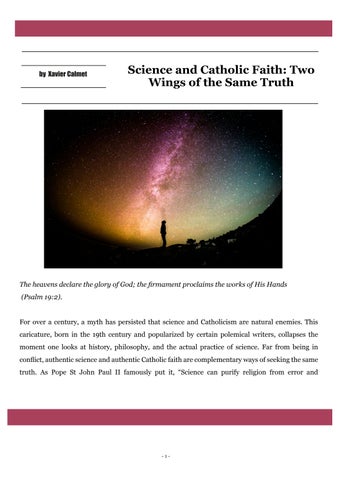
The heavens declare the glory of God; the firmament proclaims the works of His Hands (Psalm 19:2).
For over a century, a myth has persisted that science and Catholicism are natural enemies. This caricature, born in the 19th century and popularized by certain polemical writers, collapses the moment one looks at history, philosophy, and the actual practice of science. Far from being in conflict, authentic science and authentic Catholic faith are complementary ways of seeking the same truth. As Pope St John Paul II famously put it, “Science can purify religion from error and
-1-
superstition; religion can purify science from idolatry and false absolutes. Each can draw the other into a wider world, a world in which both can flourish.” (1)
1. The Church Gave Birth to Modern Science
The historical record is unambiguous: many of the greatest pioneers of science were devout Catholics, and some were priests or clergymen. Nicolaus Copernicus, who placed the sun at the centre of the solar system, was a canon of Frombork Cathedral. Gregor Mendel, the father of genetics, was an Augustinian friar. Georges Lemaître, the Belgian priest who first proposed what we now call the Big Bang theory which strongly suggests a universe with a beginning, was the father of modern cosmology(2). The Jesuit order alone has contributed dozens of worldclass scientists—mathematicians, astronomers, seismologists—over four centuries. The very notion of a lawful, intelligible universe that can be investigated rationally is rooted in the Christian conviction that the world was created by a reasonable God whose intelligence is reflected in nature.
2. Faith Is Complete; Science Is Always Provisional
Catholic doctrine rests on divine revelation that ended with the death of the last apostle. There will be no new public revelation before the return of Christ. The deposit of faith is closed and immutable. Science, by contrast, is inherently provisional and continuously progressing. The scientific method deliberately refuses to pronounce absolute, final truths. A theory is accepted only until a new experiment or observation demands its modification or abandonment. Yesterday’s “settled science” becomes tomorrow’s historical curiosity. This humility is built into the method itself. Historically, established laws of nature have been updated regularly. For example, Newton’s law of gravitation was superseded by Einstein’s theory of general relativity which we know is not compatible with the laws of quantum physics and it will eventually be replaced by a yet unknown theory of quantum gravitation.
-2-
Furthermore, most laws of nature are expressed as differential equations—equations that describe how things change from one moment to the next. Two well-known examples are Maxwell’s equations of electromagnetism and Einstein’s field equations of general relativity. The latter are astonishingly good at telling us how the universe evolves once it is already running. But they are silent about two absolutely crucial things: initial conditions and boundary conditions.
Imagine a simple pendulum. Give a physicist the length of the string, the mass of the bob and the strength of the gravitational field, and he can predict the motion of the bob with exquisite
-3-
precision. But to make that prediction he must first be told: from what height was the bob released? Was it given a push, and if so, how hard and in which direction? Those starting details—the initial conditions—are not contained in the equations themselves; they have to be measured and inserted by hand in the equations. Furthermore, classical mechanics, the law of nature used to describe the motion of the pendulum, does not explain why the pendulum exists in the first place. The same is true, on a cosmic scale, for the entire universe. Einstein’s equations tell us how spacetime curves in the presence of matter and energy, and how that curvature in turn affects the motion of matter. Feed in the original amount of matter and energy at the big bang, and the equations will describe the future expansion (or contraction) of the cosmos. But they say nothing about where the matter and energy or the equations themselves come from, nor why the universe began in such an extraordinarily ordered, low-entropy state 13.8 billion years ago, nor why the fundamental constants (the strength of gravity, the mass of the electron, the fine-structure constant, etc.) have precisely the values that permit atoms, stars, planets, and people to exist. Those values are also “put in by hand.” Change any one of them by even a tiny fraction, and the universe becomes a lifeless soup of radiation or collapses back on itself almost instantly.
This delicate balancing act is called the fine-tuning of the cosmos. It is not a fringe idea; it is acknowledged by physicists across the ideological spectrum. The late atheist astrophysicist Fred Hoyle, after discovering how carbon is formed in stars, admitted, “A common-sense interpretation of the facts suggests that a superintellect has monkeyed with physics”(3) although he proposed naturalistic explanations rather than divine agency. A modern realisation of these naturalistic explanations is the multiverse idea.
3. The Multiverse “Explanation” and Why It Fails
Some scientists, uncomfortable with the appearance of design, propose that our universe is just one among an infinite number of universes—a multiverse—with every possible combination of constants realized somewhere. We naturally find ourselves in one of the rare universes where the constants allow life, because if they didn’t, we wouldn’t be here to notice. This idea was
-4-
pioneered notably by the late Stephen Hawking.
However, this idea has two fatal problems. First, it is untestable and therefore lies outside science altogether. No conceivable experiment or observation can detect other universes that, by definition, have no causal contact with ours. Second, and more philosophically devastating, it merely pushes the problem back one step. Who or what generated the multiverse mechanism itself? Who set up the cosmic slot machine that endlessly spits out new universes? In modern quantum field theory, even the “vacuum” is not nothing; it is a seething sea of virtual particles governed by highly specific laws. Where did those laws and the vacuum come from?
-5-
St Thomas Aquinas, seven centuries before modern cosmology, argued that whatever exists in motion or change must ultimately trace its existence back to something that is itself unmoved and uncaused— pure Act, ipsum esse subsistens, the sheer act of “to be” itself. We call this uncaused cause God. Even an infinite regress of caused causes cannot explain its own existence; there must be a First Cause outside the chain. The multiverse hypothesis, far from eliminating the need for God, simply moves the location
of
the
mystery.
The
vacuum
that
supposedly produces universes still needs an explanation for its own existence and for the extraordinarily ordered laws it obeys. Aquinas’s argument remains untouched.
Conclusion
Science tells us how the heavens go; faith tells us why there are heavens at all. The more deeply science probes the structure of reality, the more it uncovers levels of order, beauty, and apparent purpose that cry out for an explanation beyond the physical. The Catholic faith does not fear this exploration; it welcomes it. The same Church that teaches that God created the world ex nihilo also insists that He created it with an intelligible rational structure that human minds—made, after all, in His image—can come to understand.
-6-
An icon of the crucifixion speaking to Thomas Aquinas is depicted on this stained glass window in Saint Patrick Church in Columbus, Ohio
There is no contradiction between science and Catholic faith because both are ordered toward truth, and truth cannot contradict truth. They are two wings lifting the human spirit toward the contemplation of the same divine Reality—who is at once the Author of the book of Scripture and the Author of the book of Nature.
An honest scientist honours the Creator by
understanding and revealing the beauty of His creation.
Supreme Lord (attributed to St Albert the Great)
We pray to You, O Lord, who are the supreme Truth, and all truth is from you.
We beseech You, O Lord, who are the highest Wisdom, and all the wise depend on You for their wisdom.
You are the supreme Joy, and all who are happy owe it to You. You are the Light of minds, and all receive their understanding from You. We love, we love You above all.
We seek You, we follow You, and we are ready to serve You. We desire to dwell under Your power for You are the King of all. Amen.
1. Letter of Saint John Paul II to Reverend George V. Coyne, S.J. Director of the Vatican Observatory, 1988. 2. The Russian scientist Alexander Friedmann proposed the expanding universe a few years before Lemaître, although Lemaître was unaware of his work. 3. The Universe: Past and Present Reflections, published in November 1981 in the California Institute of Technology's magazine, Engineering and Science.
-7-