Parish Proclaimer
Winter 2018 edition
Cathedral Parish of Our Lady & St. Philip Howard Canon Tim Madeley - Dean Rev. Mr. David Clifton - Deacon (Retired) Louise Sharp - Parish Secretary* Cathedral House, Parsons Hill, Arundel, West Sussex BN18 9AY Tel: 01903 882 297 Fax: 01903 885 335 Email: aruncath1@aol.com
Website: www.arundelcathedral.org * The Parish Office is open 9am – 1pm, Monday – Friday.
Mass Times at Arundel Cathedral Sunday
Weekdays
Saturday
9.30am Family Mass on the third Sunday of the month Children’s Liturgy available other Sundays 11.15am Cathedral Choir 10.00am Tuesday, Wednesday, Friday and Saturday Saturday: Exposition of the Blessed Sacrament after Mass 11.00am Benediction
Mass Times at the Convent of The Poor Clares, Crossbush, near Arundel Saturday Sunday Monday Friday
5.30pm Vespers 6.15pm Vigil Mass (entry at 6pm) 4.30pm Exposition of the Blessed Sacrament 5.30pm Vespers and Benediction 8.30am Mass
Sacrament of Reconciliation Saturday
Cathedral:
10.30am otherwise by appointment
Convent :
Before/after the Saturday 6.15pm Mass
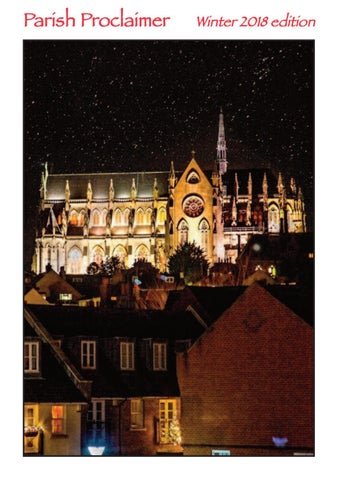
FRONT COVER Southern aspect of Arundel Cathedral on a starlit evening one Christmas. Photograph taken by Kevin Barrett. BACK COVER Adoremus 2018 Carpet of Flowers at Liverpool Metropolitan Cathedral. Photograph of the floral carpet taken by Canon Tim Madeley.
The Parish Proclaimer is printed by Prontaprint Brighton & Hove - December 2018.
WELCOME TO OUR WINTER EDITION A Winter Reflection By Rev. David Clifton. Deacon (Retired) Traditionally, the celebration of Christmas lasts twelve days, from the Nativity on 25 December to the Feast of Epiphany on 6 January. The Feast of the Nativity is a celebration of the pivotal event in the whole history of humanity – the uniting of humanity and divinity in a single person, to enable us to share in the divine life, if we will only allow God to work in us. Surely a worthy reason for great celebration. Priests may celebrate Mass three times on this day, each with its own readings and prayers, at midnight, dawn and during the day. And there are other customs that can help to focus our minds on the reason for our celebration. What follows are some suggestions: THE CHRISTMAS CRIB St. Francis is credited with having invented the Christmas crib, but the devotion is far older than that. The site of Christ’s birth was venerated from the earliest times, and prayers around a copy of the manger spread over the whole Christian world. But abuses crept in and in the end Pope Honorius, in the 13th century, put a stop to the whole thing. A few years later St. Francis was permitted to make a simple wooden manger and gather his followers round to sing songs in honour of Christ’s birth. THE CHRISTMAS CANDLE On Christmas Eve our ancestors tried to turn night into day to welcome Christ, the light of the world. Enormous logs, called Christmas blocks, were lighted and meals were taken in their light and warmth and were as festive as the family could afford. When candles became common, outsized candles added to the light, and were lit for meals every day until Twelfth-day. Try lighting as many candles as you can get instead of electric light during these twelve Christmas days. It can also be a regular reminder of the coming of Christ, if at all meals one place is left empty for Christ.
3
OTHER FEASTS Almost every day of the twelve is a feast in its own right. In the past it was the custom to fast on the eve of great feasts, but there was a popular saying: ‘Blessed be St. Stephen, there’s no fast on his even!’, because his Feast Day is on 26 December. He was the first Christian martyr, and known for his acts of charity. This day was traditionally a day off for servants and they were given a 'Christmas Box' by their master (hence Boxing Day). The servants would also go home to give 'Christmas Boxes' to their families. It is a day for visiting friends and giving them small gifts. 27 December is the Feast of St. John, apostle and Evangelist. Though he wasn't martyred, it wasn't for his enemies' lack of trying. According to legend, he was served poisoned wine, but survived because he blessed the wine before he put it to his lips. It became the custom to drink wine before dinner as a toast to St. John. ‘I drink you the love of St. John.’ The Feast of Holy Innocents falls on 28 December. Considered a sombre day in remembrance of the massacre of young children in Bethlehem by King Herod the Great in his attempt to kill the infant Jesus (Matthew 2:16–18). The slain children were regarded by the early church as the first martyrs, but it is uncertain when the day was first kept as a saint’s day. It may have been celebrated with Epiphany, but by the 5th century it was kept as a separate festival. In Rome it was a day of fasting and mourning. 29 December is a ‘local’ Feast Day – St. Thomas Becket, martyr. This year 30 December is a Sunday and is the Feast of the Holy Family, another reminder of the events of Bethlehem. The purpose of the Feast is to present the Holy Family as the model for all Christian families, and for domestic life in general. Our family life becomes sanctified when we live the life of the Church within our homes. This is called the ‘domestic church’ or the ‘church in miniature.’ This Feast Day is most especially a time for the family to spend time together, and in particular to pray together. 31 December is not a feast in its own right, but the Feast of Christmas continues. It is an optional memorial of St. Sylvester, a pope in the fourth century. This day is also New Year’s Eve, a day for watching, and praying, through the night as the New Year begins. 1 January is the Solemnity of Mary, the Mother of God, a Feast in celebration of 4
Mary's motherhood of Jesus, God incarnate. This doctrine was defined by the Council of Ephesus in 431 It is an assertion of the divinity of Christ. The title is thus fundamentally more about Christ than about Mary. Its link with Christmas is obvious. Pope Paul VI assigned this day World Day of Peace. It is a good time to pray for peace in the world, and to give a donation to an organisation that promotes peace. This is officially the end of the Christmas Octave, but traditionally the feast still continues until the twelfth day, 6 January the Solemnity of Epiphany. In times past this was the great Feast of Christmas, and is sometimes known as ‘Old Christmas Day’. The word ‘epiphany’ means ‘showing’ and is the occasion when Christ was shown to the world, represented by the wise men in Matthew’s Gospel. This was traditionally the day when presents were given. As recently as the 1950s, Twelfth Night in Britain was a night for wassailing. Wassailers, like carol singers, go from house to house singing and wishing their neighbours good health. This could be a good day to sing carols together, particularly those referring to the wise men. The celebrations do not end here! The final echo of Christmas can be heard on 2 February, the Feast of Candlemas, commemorating the visit of the Holy Family to the temple where old Simeon refers to Jesus as ‘the light to enlighten the gentiles’. We are back where we came in, celebrating the coming of the Light of the World. On behalf of the clergy and staff of Arundel Cathedral, we warmly wish all our magazine readers a truly Holy and Happy Christmas and New Year!
++++++++++++++++++++++++++
ENCOUNTER Catholic evenings for young adults Live music, inspiring talks, food, adoration and friendly people! From 7.30pm, 2 February and 2 March 2019 at Our Lady of Sorrows, Bognor Regis - Facebook; EncounterBognorRegis 5
Visit our Cathedral Gift Shop this winter! By Jenny Bloxham
The Cathedral Gift Shop is open every day and we stock an extensive range of quality gifts. In addition we are able to offer a selection of seasonal items with a varied price range. These include: ADVENT CALENDARS CHRISTMAS & NEW YEAR CARDS 2019 CALENDARS NATIVITY SETS, STATUES, ORNAMENTS CHRISTMAS TREE BAUBLES CHILDREN’S BOOKS You could even find that special or last minute gift! In addition to the normal shop opening and for your convenience we will continue to have a table (situated by the Baptistery) again with a variety of seasonal items after both Sunday Masses (9.30am and 11.15am) during December. The dates are Sunday 16th and 23rd so come and see our beautiful top quality Christmas gifts! After the Christmas/New Year festivities are over, there are other beautiful gifts for any special occasions: baptisms, First Communion and confirmations, weddings, birthdays, funerals as well as remembering lost loved ones. You simply have to visit our Gift Shop, situated in the North Transept by the Shrine of St. Philip Howard, to see the extensive variety of gifts on display! You will also be able to see everything online as well at www.arundelcathedral.org. The shop (and tables during Christmas) are staffed by volunteers so all proceeds go directly to the Cathedral for our central purchasing of new gifts. You can purchase by cash or cheque but we are not able to offer any kind of card payment at this time. 6
/ +' (
+# ( &1 !. ,- ")., ,#-. -
,")+- / &% +)' -" -)/( ' !(# #
(-
) #(
* (
+
& -)
ARUNDEL FINE GLASS STUDIO Fine glass engraving for those special gifts.
#(
")#
,-&
-"
(- + + &
( + (!
(- ,")*, ( + ,- .+ (-,
) +))',
)'')
- .* -)
)' )+-
&
+
). &
* +%#(! )( ,#-
We also sell modern and classical style glassware. .
(,
(
+.(
&
., , 0
Visit our shop in Arundel: The Old Stable, Tarrant Street +
01903 883 597 www.arundelglass.com
( ).,
/// +
+.(
( ).,
& !' #& )' +.(
& )'
' (*' $#( $#0) ( "%!. *) )' ( $,# $#( ' ) !) $ ) )' # , ) ( () $' ) , ) #. ' ' ( '+ ) $# ' '( # ) # ( $ )( $,# ' $' , " #. ' $"" # ) $#( % ') '$" () # ' )' ,$' (* ( ' "$+ ! ' ( # $' !$, ' # $ ) '$,# %'*# # # ' # ' "$+ ! , $ ' ( + ' ! ' # ( '+ ( ' &* ! ()( $*# ! # #(*' #
+
) $# ! '$ / " %* ! !
" #. )' (*' $#( , ' $*' ' # , () !$ !!. ) (% %! #) ' ( *() $*)( $ $*' $,# $%% ,$$ ! # (*%%!. ' ,$$ # *( $#
$$
# . ! ).
. ! "$() $ ! () ' . ! #
'*# ! # '$" , '
+ ,
!! (%
$.,-
/#-" #-,
)( $ $ )*"% ' ' #"
)' (*' '. ( "$+ ! #) # # *)) # # # # ( %# )*' # )$# " # ' ' ' () " ) ( + $+ ' # !! $ () *(( -
! . ,-, /#(
The Holy Sacrament of the Eucharist By Jo Briscoe Our Catechism states “At the Last Supper, on the night he was betrayed, our Saviour instituted the Eucharistic sacrifice of his Body and Blood. This he did in order to perpetuate the sacrifice of the Cross throughout the ages until he should come again, and so to entrust to his beloved Spouse – the Church – a memorial of his death and resurrection: a sacrament of love, a sign of unity, a bond of charity, a Paschal banquet ‘in which Christ is consumed, the mind is filled with grace, and a pledge of future glory is given to us’. “Those who go to the Lord’s Table to receive the sacrament of the Eucharist, must give thanks for the boundless love of God and celebrate the sacrament with both joy and thanksgiving.” The Last Supper was instituted on Maundy Thursday – prior to the crucifixion – Maundy deriving from ‘mandatum’ meaning “command” or the Washing of the Feet. The name is taken from the first few Latin words sung at the ceremony of the washing of the feet, “Mandatum novum do vobis ut diligatis invicem sicut dilexi vos”, “I give you a new commandment, That ye love one another as I have loved you”. Only the Gospel of John relates the story of the Washing of Feet (and, of course, John’s Gospel is unique in many other ways) – none of the three synoptic Gospels mention this action. (Foot washing was a common courtesy in entertaining guests in those days when people walked in bare feet, or minimal sandals on dusty roads – which is perhaps why the synoptic Gospels rather took it for granted!). Our Lord chose to wash the feet of his chosen Apostles – chosen to work with him at the beginning of his Ministry, despite some opposition (especially from Peter!), to set an example. He instructed His disciples: “If I then, your Lord and Teacher, have washed your feet, you also ought to wash one another’s feet. For I have given you an example, that you should do as I have done to you. Most assuredly, I say to you, a servant is not greater than his master; nor is he who is sent greater than he who sent him. If you know these things, blessed are you if you do them.” St. Thomas Aquinas, an Italian Dominican Friar, Catholic Priest and Doctor of the Church, was an immensely influential philosopher, theologian and jurist in the tradition of scholasticism – for him the Last Supper and the Cross form the summit of the teaching that wisdom flows from intrinsic grace, rather than external power. 8
For St. Thomas Aquinas, at the Last Supper Christ taught by example, showing the value of humility (as reflected in John’s Gospel’s foot washing narrative) and selfsacrifice, rather than by exhibiting external, miraculous powers. And also, at the Last Supper, Christ made the promise to be present in the Sacrament of the Eucharist at all times, and to be with those who partake in it, as he was with his disciples at the Last Supper. Each of the synoptic Gospels relate the words of institution differently – though with exactly the same meaning and outcome. St. Paul also relates a version to the Christians in Corinth. He related that Our Lord said: “This is my body that is for you. Do this in remembrance of me….. This cup is the new covenant in my blood. Do this, as often as you drink it, in remembrance of me.” In biblical times, meals meant more than just eating food: they were important in Jewish life and in Jesus’ ministry as a celebration of God’s sustenance and saving presence. Meals were also seen as a tangible demonstration of God’s acceptance of and reconciliation with humans, and signified a foretaste of the abundant blessings that communion with God would one day yield. His ‘feasting rather than fasting’ approach to life and his willingness to eat with outcasts and those on the margins of society were distinctive characteristics of Jesus. Our Catechism quotes “The Eucharist is ‘the source and summit of the Christian life’. The other sacraments, and indeed all ecclesiastical ministries and works of the apostolate, are bound up with the Eucharist and are oriented towards it. For in the blessed Eucharist is contained the whole spiritual good of the Church, namely Christ himself. In brief, the Eucharist is the sum and summary of our faith: ‘Our way of thinking is attuned to the Eucharist, and the Eucharist in turn confirms our way of thinking.’” If Christians have celebrated the Eucharist from the beginning and in a form whose substance has not changed despite the great diversity of times and liturgies, it is because we know ourselves to be bound by the command the Lord gave on the eve of his Passion: ‘Do this in remembrance of me’. We carry out this command of the Lord by celebrating the memorial of his sacrifice. In so doing, we offer to the Father what he has himself given us: the gifts of his creation, bread and wine which, by the power of the Holy Spirit and by the words of Christ, have become the body and blood of Christ. Christ is thus really and mysteriously made present. St. John Chrysostom declares “It is not man that causes the things offered to 9
become the Body and Blood of Christ, but he who was crucified for us, Christ himself. The priest, in the role of Christ, pronounces these words, but their power and grace are God’s. This is my body, he says. This word transforms the things offered.” The Council of Trent summarises the Catholic faith by declaring “Because Christ our Redeemer said that it was truly his body that he was offering under the species of bread, it has always been the conviction of the Church of God, and this holy Council now declares again, that by the consecration of the bread and wine there takes place a change of the whole substance of the bread into the substance of the body of Christ our Lord and of the whole substance of the wine into the substance of his blood. This change the holy Catholic Church has fittingly and properly called transubstantiation.” It is highly fitting that Christ should have wanted to remain present to his Church in this unique way. Since Christ was about to take his departure from his own in his visible form, he wanted to give us his sacramental presence; since he was about to offer himself on the cross to save us, he wanted us to have the memorial of the love with which he loved us ‘to the end’, even to the giving of his life. In his Eucharistic presence he remains mysteriously in our midst as the one who loved us and gave himself up for us, and he remains under signs that express and communicate this love: ‘The Church and the world have a great need for Eucharistic worship, Jesus awaits us in this sacrament of love. Let us not refuse the time to go to meet him in adoration, in contemplation full of faith, and open to making amends for the serious offences and crimes of the world. Let our adoration never cease.’ The Eucharistic celebration always includes: the proclamation of the Word of God; thanksgiving to God the Father for all his benefits, above all the gift of his Son; the consecration of bread and wine; and participation in the liturgical banquet by receiving the Lord’s body and blood. These elements constitute one single act of worship. It contains both teaching and action, words and deeds; a full share in the Mass includes listening to the readings, prayers and homily as well as adoring the presence of Christ in the sacred elements and receiving Holy Communion. In fact, one does not really adore, whatever the attitude of one’s body, unless one has listened to the words ‘If you love me, keep my commandments’. A proper attitude to Christ involves our listening to him as teacher. From beginning to end, the Mass is an indivisible whole; one cannot separate one part from another, making one more important than the other, any more than in 10
John 6 one can separate out the words about bread and wine, body and blood, from those about teaching and obedience: the phrases of the message are inextricably interwoven, expressing the unity and simplicity as well as the complexity and richness of what it means to come to Christ, be a disciple of his, live ‘in him’. It is a mistake to imagine that any one part of the Mass can be neglected because less important than any other part; going to Mass is for us today the essential means of entry into God’s continuing communication of his own life to us on our behalf; it is our way of access to Christ, the way which he has given us, the way by which our entire lives receive from him their meaning, their transformation and the ultimate completion which he has prepared for them. The Eucharist is the ‘sacrament of love’ which revives our own love and which teaches us that all real love always involves listening, openness, sacrificial self-giving and sharing one’s life with another. It is in the Eucharistic assembly of the faithful that the Priests exercise in a supreme degree their sacred office; there, acting in the person of Christ and proclaiming his mystery, they unite the votive offerings of the faithful to the sacrifice of Christ their head, and in the sacrifice of the Mass they make present again and apply, until the coming of the Lord, the unique sacrifice of the New Testament, that namely of Christ offering himself once for all a spotless victim to the Father. From this unique sacrifice their whole priestly ministry draws its strength. The whole concern of doctrine and its teaching must be directed to the love that never ends. Whether something is proposed for belief, for hope or for action, the love of our Lord must always be made accessible, so that anyone can see that all the works of perfect Christian virtue spring from love and have no other objective than to arrive at love. This applies in a special way to the Church’s teaching on the Eucharist. Once we understand the Eucharist in this way, it will be obvious why the Catholic Church emphasises so strongly that regular participation in the Eucharist is vital for maintaining and deepening our life together in Christ. It is there above all that the Risen Christ is present for us, drawing us ever deeper into the mystery of his saving love, ever deeper into the life of the Living God: “The Church knows that the Lord comes even now in the Eucharist, and that he is there in our midst.” This makes the doxology to the Eucharist Prayer so very special and all embracing - at the end of every Eucharistic Prayer, the priest says “Through him, and with him, and in him, O God, almighty Father, in the unity of the Holy Spirit, all glory and honour is yours, almighty Father, for ever and ever, Amen.” By joining in this ‘Amen’ we are 11
confirming all we believe and worship in Our Lord. In the writings of Pope Benedict XVI, “The sacrament of charity, the Holy Eucharist, is the gift that Jesus Christ makes of himself, thus revealing to us God’s infinite love for every man and woman. This wondrous sacrament makes manifest that ‘greater’ love which led him to ‘lay down his life for his friends’. Jesus did indeed love them ‘to the end’. In those words John, the Evangelist, introduces Christ’s act of immense humility: before dying for us on the Cross, he tied a towel around himself and washed the feet of his disciples. In the same way, Jesus continues, in the sacrament of the Eucharist, to love us ‘to the end’, even to offering us his Body and his Blood. What amazement must the Apostles have felt in witnessing what the Lord did and said during that Supper! What wonder must the Eucharistic mystery also awaken in our own hearts! “From the Annunciation to the Cross, Mary is the one who received the Word, made flesh within her and then silenced in death. It is she, lastly, who took into her arms the lifeless body of the one who truly loved his own to the end!’ Consequently, every time we approach the Body and Blood of Christ in the Eucharistic liturgy, we also turn to her who, by her complete fidelity, received Christ’s sacrifice for the whole Church. The Synod Fathers rightly declared that ‘Mary inaugurates the Church’s participation in the sacrifice of the Redeemer’. She is the Immaculata, who receives God’s gift unconditionally and is thus associated with his work of salvation. Mary of Nazareth, icon of the nascent Church, is the model for each of us, called to receive the gift that Jesus makes of himself in the Eucharist.” There is a well-known saying that “Once you understand the Eucharist, you can never leave the Church – not because the Church will not let you, but because your heart will not let you”. ++++++++++++++++++++++++++
Back Issues of The Parish Proclaimer If you’re collecting our parish magazine and perhaps missing a particular issue or more, email clouter@mac.com with your requirement. The magazine stock dates from Autumn 2014 through to Summer 2018. An email will be sent confirming your order and it will be up to you to collect the magazines from the Sacristy, marked for your attention. 12
Annual Parish Barbecue By Barbara & Bryden Isbister
On what started out as a somewhat grim, chilly and overcast day, but transformed into a beautiful sunny afternoon of 24 degrees, the Parish Barbecue took place in the beautiful gardens of Cathedral House on Sunday 16 September. There was plenty to interest young and old; from “Adopt a Soft Toy”, to books and bric-a-brac, including a range of pictures and paintings to grace any walls. Tombola, a plant sale and children’s games were also available. In addition to all this, was the BBQ, which was excellent, with burgers, sausages and salad, and cooked on site by a valiant team of parishioners who worked tirelessly in the heat throughout the afternoon. For dessert a sumptuously delicious cake stall and strawberries and cream were on offer – making it an impossible choice as they all looked wonderful. Tea, coffee, drinks and a slick Pimms stall topped this off in perfect style. A great time was had by all and a great opportunity to mix with members of the parish and get to know new members, in the sunshine amidst the magnificent surroundings of the Cathedral gardens. Thanks to all those who helped to make this happen, to all who attended and for the glorious weather. 14
Our Little Duke and the Little Man Courtesy of Cornerstone magazine, Autumn edition
Henry XV Duke of Norfolk
Pope Benedict XV
The Great War brought about something of a conflict between Henry XV Duke of Norfolk, known to all as Our Little Duke, and Pope Benedict XV, known as ‘Il Piccoletto’ (The Little Man); two men of small stature and great moral purpose. Pope Benedict had been elected to the Papacy in September 1914, shortly after the outbreak of a war he described as ‘the suicide of civilised Europe’. He immediately declared the neutrality of the Vatican, and set about urging all parties to negotiate. Both sides rejected his intervention. In England a group of Catholic pacifists formed ‘The Guild of the Pope’s Peace’, calling on the authorities to follow Benedict’s call, and persuaded the Catholic Truth Society to publish their manifesto in the CTS monthly journal. The reaction of the Hierarchy was immediate. Cardinal Bourne asked Duke Henry to demand a retraction, and the Bishop of Southwark, Peter Amigo, in whose diocese the CTS was based, effectively ordered the Society to comply. Duke Henry, who had throughout his life exemplified loyalty both to the Crown and to the Church, was discreet in his opposition to Benedict, but the open hostility to the Pope voiced by Cardinal Bourne and the English bishops is one of the less attractive aspects of the Catholic community’s anxiety to be seen as patriotic Englishmen. One wonders what kind of sermons Fr. Archibald MacCall gave the Arundel parishioners during the war years. 15
The Corpus Christi Carpet of Flowers 1916 Courtesy of Cornerstone magazine, Autumn edition
When Duke Henry instituted the floral celebration in the 1870s he was able to call on an army of estate workers to carry out the decorations. In 1917, with so many of this men at the Front, the tradition was discontinued, and only reinstated after the cessation of hostilities. Duke Henry died in 1917; one of his last public appearances was to host a garden party in the Castle for 800 wounded soldiers from Sussex hospitals. Over the years the number of Castle staff diminished, and the work involved with the Carpet of Flowers was taken over by Tortington School and then by parishioners, so there have been no subsequent breaks in this beautiful tradition. 16
+!#%,-!+! !( ).+ #! -$! -$! -$! + & ( -) *+)/% ! ' %(-!( (
$ +%-1 0$),! %' %, -) .,! ( **+! % -%)( )" $.+ $ )" -$! %) !,! "%( ( % & ,.**)+- ")+ %-, ! ( !($ ( !'!(-
#!-+# +#+ #/ ," 5-2 4'** #,(-5 ,,2 * #3#,10 *')# &# /'#,"08 "3#,1 #0.#/0 /'#,"08 00 # 01 -$ 1 &'*'. -4 /" (-', ', 0-+# -/)',% /1'#0 2++#/ #*# / 1'-,0 0-!' * #3#,10 4'1& -1&#/ /'#,"0 -$ /2,"#* 1&#"/ * .*20 5-2 4'** /#!#'3# 7 -/,#/01-,#8 ' ,,2 * ,#40*#11#/
((. &
!' !+,$%*
!!,
/'#," 6 '$# #+ #/ 6 -',1 /'#,"0 6 -/.-/ 1# #+ #/ 6 1/-, 6 &'0 '0 -,# . 5+#,1 -,*5
+.( -$"+%!( , - )((! - )' 000 +.( !& -$! + &"+%!( , )+#
& /'15
-
-+. ,5
-
,%* ,"
Is your answer ‘YES’ to any of these questions? Then we can help you!
Ɣ Confused by the array of pensions options? Ɣ Need to invest an inheritance or pension lump sum? Ɣ Worried about long term care funding? Ɣ Fed up with your cash ISA return?
Ɣ Ethical investment a concern? Call us on 0 1903 882007 Visit our website www.themellorpractice.co.uk Or drop in to our office 31 Chapel Road, Worthing, BN11 1EG The Mellor Practice Ltd is an appointed representative of Lighthouse Advisory Services Limited, which is authorised and regulated by the Financial Conduct Authority. The Mellor Practice Ltd, Registered in England, No. 10567558 Registered Office: 41b Beach Road, Littlehampton, West Sussex, BN17 5JA The value of your investments can go down as well as up, so you could get less back than you invested.
The Friends of Arundel Cathedral What this registered charity is all about The Friends are people from all over the world, united by their common love of the Cathedral Church of Our Lady and Saint Philip Howard in Arundel, West Sussex. Founded in 1985, the Friends have contributed over £1,000,000 in support to the Cathedral, as well as building up an investment fund to help provide grants in the future. The running and maintenance costs of the Cathedral are in excess of £3,000 per week, which is well beyond the means of the small Catholic parish of Arundel, and substantial support is needed from the Diocese of Arundel and Brighton. The Friends of Arundel Cathedral was formed to help the Diocese in this important work. Join the Friends and enjoy these benefits: social events with other Friends of Arundel Cathedral, Annual Friends’ Mass (Feast of St. Philip Howard) and ‘Cornerstone’, the Friends' bi-annual newsletter. Visit www.arundelcathedralfriends.org/welcome.htm to read more about us and there is a useful link in the Donate section to make a secure online donation via BT MyDonate. From Canon Tim Madeley... We are very grateful to ‘The Friends’ for giving the Diocese a cheque for £200,000 on the Solemnity of St. Philip Howard to help fund the restoration of the Rose Window and other maintenance work. Bishop Richard said “This is an amazing amount” and this acts as an encouragement for people in the Diocese and beyond to join ‘The Friends’ and take an active interest in our ‘Mother Church’. NEW ARUNDEL CATHEDRAL VISITORS GUIDE A new Visitors Guide has been produced by The Friends of Arundel Cathedral. Printed in full colour this free guide folds out to a large plan to highlight all aspects of the Cathedral, each with a written description. There is also a brief history of how the Cathedral came about alongside details of the Diocese and what The Friends of the Cathedral are all about. The guides are in dispensers at the back of the Cathedral for everyone to read and keep.
18
Adoremus Carpet of Flowers By the Flying Carpet Team Our journey started in October 2017 (at the Friends of Arundel Cathedral AGM) when Bishop Richard announced that the Arundel flower team would lay a Carpet of Flowers in Liverpool Metropolitan Cathedral of Christ the King in September 2018 for the Adoremus Eucharistic Conference. After the shock of the huge task in front of us, we set to and arranged a meeting to discuss issues involved to get this plan started. The first thing to do was to ascertain the size and design of the carpet for which Oliver Hawkins became involved. He decided to take a trip to Liverpool and arranged to see the Dean, Canon Tony O’Brien to size up the area involved. He then came back to us to discuss and sketch out the pattern relating to the logo of the Adoremus Conference. This was put on hold until after Christmas although seemingly a long way off, logistic plans had to be made. We met with Bishop Richard after Mass in February 2018 to go through plans and to show him the design of the carpet and to agree a budget. This was done and so it was all systems go. Although Oliver had told us the size of the aisle and seen it on the Internet, three of us involved decided to make a day trip to Liverpool to get a feel of the Cathedral and to ascertain where we could store the flower heads and greenery. On 28 February 2018, tickets were bought, the ‘Beast from the East’ arrived as we made our way by train to Liverpool. Trains were running well and we arrived in Lime Street about midday. We made our way to the Cathedral, all of us never having experienced such cold weather. We met with Canon Tony and his secretary Claire who were a delight and answered all our queries and assured us of their help and support. Whilst there, we took the opportunity to book hotel rooms near the Cathedral for the team – another job done – and made our way home before trains were cancelled. In June, Oliver & Diana Hawkins and Faith Thomas drew the design onto the paper which had to be cut and joined to get the correct width. When finished, the paper was rolled and stored in the Cathedral attic. The next task was to calculate the amount of chrysanthemum flowers and colours needed for the design. This is not an exact science as we have no idea how big the flower heads will be or how many we 19
could get from each stem, but an estimate based on past experience was used. From then onwards, life revolved around the logistics of gathering everything together that we would need. This included buckets, ropes, tape, boxes to carry the greenery in, boxes folded down for transportation purposes, to put the flower heads in after cutting, protection for the two rolls of paper used for the design and other items which might come in handy. The number of people we could take to Liverpool was nothing like the amount we would need to complete the task ahead but we had a great deal of support from the people of Liverpool who volunteered to help lay the carpet. It was necessary for us to arrive in Liverpool on the Tuesday before the conference as the flowers were being delivered on Wednesday morning so that we could begin the carpet on Thursday. The greenery needed for the background of the carpet was supplied by the Norfolk Estate and it was thanks to the many parishioners who came along on the Monday before our departure to cut the greenery which filled the 16 boxes and was just perfect. That same evening we transported the greenery, the rolls of paper and the buckets and miscellaneous items over to Yapton to be loaded onto a hire van in which David Baker, our regular flower supplier, and Martin were to bring the flowers up to Liverpool early on Wednesday morning. On Tuesday 4 September, Mary Bagg, Mary Harding, Ruth Johnstone, Lorraine Cranfield, Margaret Robinson and Jim & Margaret Myerscough travelled to Liverpool to lay the carpet. On Wednesday morning David and Martin arrived and we were able to unload the flowers, put them into the buckets and lay the paper with the design down the main aisle. Wednesday also saw the arrival of Canon Tim and then Pat & Tudor Thomas who regularly help at Arundel and who had driven from their home in Pembrokeshire to Liverpool. On Thursday morning we all attended Mass at 8am before starting the day and 20
laying the carpet. Margaret Robinson was in charge of the flower head cutting which was taking place in the Gibberd room situated downstairs from the Cathedral. Pat Thomas was also chief teamaker as well as flower head cutting. So many lovely people from Liverpool arrived to help with both the head cutting and laying of the carpet. There were two young men from Afghanistan, an Iranian couple, and many other nationalities - it was like the United Nations. Everything went like clockwork so much so that we had finished the carpet by 1.30pm. Having thanked our Liverpool helpers, we had a well deserved lunch before heading back to begin the great clear up. We must mention the security team at the Cathedral who were so helpful to us and who could still smile after all the questions and requests we made of them. They also cleared away the carpet on the Sunday after the Procession of the Blessed Sacrament. Canon Tim, Mary Harding and Lorraine Cranfield stayed on for the Adoremus Conference whilst the rest of us returned home to Arundel on Friday morning, tired but so pleased that everything worked out so well. CORRECTIONS & CLARIFICATIONS In the autumn magazine the back cover featured a photo of the 2018 Corpus Christi Carpet of Flowers taken by Focus Photography, Shoreham-on-Sea. 21
Adoremus National Eucharistic Pilgrimage and Congress By Lorraine Cranfield The Congress began on Friday in the Arena by the Docks. The majority of our team returned home leaving Canon Tim, Mary Harding and I to attend as delegates for our Parish. Friday’s theme explored the place of Eucharistic Adoration with keynote speakers and presentation sets. The day finished with Choral Vespers and Mass in the Cathedral. We returned to the Hope University where we were now staying to find that two further coach loads of people had arrived from the Diocese. We had an early start on Saturday to attend Morning Prayer and Mass celebrated by Bishop Richard before being driven down to the Arena for the second day of the Congress. The keynote speaker was an American, Bishop Robert Baron, who addressed us twice during the day urging us to put Jesus Christ at the centre of our lives as every thing else is immaterial. The Bishop was an inspirational speaker and we were all very engaged by him. The day concluded with a reflection by Cardinal Vincent Nichols who talking about the Eucharistic Procession to be held on the Sunday and said it was a penitential procession for a crucified Jesus. He spoke of the numerous scandals involving many clergy that were unfolding around the world and prayed for the victims of abuse. Exposition and Benediction then followed concluding with the Evening Prayer of Corpus Christi. There were approximately seven thousand people present in the Arena. On Sunday there were two identical Solemn Masses at the Cathedral. We attended the 11.30am Mass celebrated by the Cardinal. A large number of Seminarians, Deacons, Priests, Bishops and Archbishops processed in to take their places around the altar. The Cathedral Choir sang beautifully and the music was enhanced by the organ, trumpets and drums. Entry was by ticket only and the very large Cathedral was full of delegates from every diocese in England and Wales. At the end of the service Cardinal Nichols carried the Precious Body of Christ over the floral carpet and the Eucharistic Procession around the streets of Liverpool began. There had not been a Eucharistic Congress in Britain since 1908 and on that occasion an outside procession was not allowed. Several thousand people joined the Procession singing hymns despite the torrential rain that soon drenched our hymn sheets. It certainly felt like a penitential procession as we sang the words “wash me with water flowing from his side” in Soul of my Saviour.
22
When the Procession returned to the Cathedral, the service of Benediction took place at the top of the steps as the faithful filled the street below. We the Delegates were urged by many of the speakers during the Congress to go home to our parishes and encourage our communities to spend time in adoration of our Lord Jesus Christ, either simply by praying in front of the tabernacle or attending a service of Exposition and Benediction. We have the opportunity for the latter on Saturday at 10.30 am in the Cathedral or on Sunday at 4.30 pm at the Convent. Mary and I agreed that it was a great privilege to have stayed on to attend the Congress. It was a marvellous experience to meet and talk to so many Catholics from all over the country and to join with them as we expressed our faith in the Risen Lord in this unique way.
23
Candlelight Funds Celebrate a life and give hope to thousands more via CAFOD Give in memory to keep their light shining. A Candlelight Fund is a special fund in memory of a loved one who has died. It will celebrate their life and touch the lives of thousands more. There are no targets, deadlines or minimum amounts involved. This is your fund and you can grow it in whatever way feels comfortable. It can be a private act of remembrance - donating to mark special moments like a loved one’s birthday - or you can invite others to join in too. If you’d like to support a particular area of CAFOD’s work that meant a lot to your loved one, they will do their best to accomodate that. Just let CAFOD know. You can set up your Candlelight Fund either by calling Roisin Beirne on 020 7095 5348, by email candlelight@cafod.org.uk or visit www.cafod.org.uk/candlelight. In return you will receive a welcome pack to help get your fund up and running as well as an annual update on the progress of your fund. Leaflets are also available at the back of the Cathedral with a freepost form to complete and return. You can also have an online page where you, your friends and family can personalise your fund, donate in memory, share photos and memories, leave messages of love and support plus see how much you’ve raised. If you’d like an online page, please advise CAFOD your email address so that they can send you a link to activate your online page. A light giving light to others. Love can do incredible things. Your Candlelight Fund will help ensure that no one is beyond reach. It will offer emergency support to those devastated by conflict and natural disasters and build a brighter future for the world’s poorest people by providing food, water, healthcare and education. Your fund will shine a light of hope on families in need around the world. 24
How the BBC lost (and found) the plot with Fr. John Gerard By Mike Webster I watched a programme on BBC2 on Saturday evening, 3 November, entitled Elizabeth 1’s Secret Agents. I was curious to find out if the Fr. John Gerard SJ, who was featured, was a member of a family local to where I used to live. Indeed the original seat of the Gerard family, Old Bryn Hall, was approx. 1 mile away from my home in my youth. The original seat of the Gerard family dates back to 1250. Thomas Gerard was High Sheriff of Lancashire in 1557. His son, Thomas Gerard, was created Baronet Gerard of Bryn in 1611. The Gerards were Royalists during the English Civil War. In 1651, Charles II travelled through Wigan and lodged at Bryn Hall on his way from Scotland to his ultimate defeat at the Battle of Worcester. John Gerard (1564 - 1637) was an English Jesuit priest, the second son of Sir Thomas Gerard of Bryn, in Ashton-in-Makerfield, Lancashire. John Gerard is noted not only for successfully hiding from the English authorities for eight years before his capture, but for enduring extensive torture, escaping from the Tower of London and, after recovering, continuing with his covert mission. After his escape to the continent, he was later instructed by his Jesuit superiors to write a book about his life (in Latin). An English translation, published in 1951, is a rare first-hand account of the dangerous world of a Catholic priest in Elizabethan England. The Roman Catholic Martyr and Saint, Edmund Arrowsmith was related to the Gerards on his mother's side. Bryan Arrowsmith’s mother was Margery Gerard, a member of the Lancashire Gerard family. Among his mother's relations was Father John Gerard and another martyr, the Blessed Miles Gerard. He was baptised Bryan, but always used his confirmation name of Edmund, after an uncle who trained English priests in France. After his execution his hand was reportedly cut off and preserved at Bryn Hall in a white silk bag it was referred to as the 'holy hand'. St. Oswald and St. Arrowsmith’s Church in Ashton-in-Makerfield houses the shrine of the Holy Hand of St. Edmund Arrowsmith. He was martyred at Lancaster in 1628 by being hung, drawn and quartered. In their book, Faith and Martyrdom The Holy Hand of Saint Edmund 25
Arrowsmith, David W. Atherton and Michael P. Peyton 2013 account the many miracles performed by St. Edmund Arrowsmith. When a BBC TV series claimed that Fr. John Gerard blessed the Gunpowder Plot, Michael Maslinski who is a 10-times great nephew of Fr. John Gerard complained. Until October 2017, when the BBC surprisingly and erroneously gave him a prominent role in the Gunpowder Plot, few people had heard of Fr. John Gerard SJ. Strangely, the publicity surrounding the BBC’s decision to apologise and re-edit the documentary has received far more attention than the programme itself. So who was the real Fr. Gerard? He was one of those courageous Catholic priests who, after training on the continent, returned to their native land to work on the English Mission, helping to keep Catholicism alive during the years of religious persecution in the reigns of Elizabeth I and James I. These brave men operated undercover and lived in continual fear of capture, imprisonment, torture and the most barbaric forms of execution. There were competing claims to the English throne, and numerous plots to unseat the monarch often involved Catholics, and sometimes even priests, rebelling against the intolerable repression of their religion. Protestant England was surrounded by hostile Catholic powers and it is hardly surprising that Catholics were viewed as a potential threat. Indeed, it suited the authorities to represent Catholic priests, particularly Jesuits, as agents of foreign powers. It was in these dangerous circumstances that Fr. Gerard, a tall and dashing young Jesuit, landed by night on the Norfolk coast, shortly after the defeat of the Spanish Armada, when anti-Catholic feelings were at a high. Disguising himself first as a falconer and then as a country gentlemen, he met contacts in Norwich who introduced him to a network of Catholic sympathisers across Norfolk and nearby counties. Moving from one country house to another, Fr. Gerard managed to persuade their owners, at substantial risk to themselves, to use their houses as centres for building local Catholic communities. In the process he made numerous converts to the faith, at least 30 of whom subsequently became priests themselves. Continued on page 28
26
VISIT THE CATHEDRAL GIFT SHOP
&'
##
% !' ! #
# % ! ' % "' % * ! !' " &" %# % ! % &'"%
A broad range of high quality religious books, gifts and cards for Advent, Christmas, Lent, Easter, Pentecost, baptisms, weddings, funerals, birthdays, special anniversaries and other occasions.
Monday - Friday: 10.30am - 12.30pm/1.30 - 4.30pm Saturday: 11.15am - 5pm Sunday: after the 9.30/11.15 am Masses
#
PLEASE NOTE We rely on volunteers to help in the Gift Shop so our opening hours may vary slightly.
#$
" "
"%
""( " % ( "
## % !'' ## % !''
$ "
% %$# $ " "# " & # % " # %# ## % " ## #$ %## ' $ $
## ''#
( (
"
! # % ( $ "
&&& % ( $ "
# $
"
& "
&, ' ' (" $ #* & ' (" ' ! " ##! ' ( " " ) ' %) $! "(
(" "
)' # ( " ##$ ','( !
#
% %
&
* # & '" ) & ' +"(% " '" && && +"(% " ! & (&& ' *"% % $( % '" % # % ! % &'"% ' '" *"% ! "% % + *"% & %% "(' * ' % ( "!& % ' "! '" ' "% ! '% & !( '(% ! &'"%+ " ' " "(% " * ! %# % ! % &'"% ! + *"% & "# ' ! ' &' ! % ( ' "% ! % '(%! '" +"(
The Gift Shop is situated in the North Transept by the Shrine of St. Philip Howard.
% (
'
#" #"
#
&)"
)'' +
He was far from the only priest operating in this way, but he was certainly one of the most successful. His conviction and commitment, combined with great charisma and intelligence, made him a persuasive advocate for his faith. Fr. Gerard was also exceptionally courageous and resourceful, which helped him to escape capture on numerous occasions. But after six years he was seized and imprisoned. He spent three years in the Clink prison, where, remarkably, he managed to turn a cell into a chapel, said daily Mass for Catholic inmates, administered the sacraments and inspired yet more conversions. Many Catholics came to the prison to visit him and receive the sacraments. He also managed to coordinate the activities of other priests arriving in London from the continent, including renting and maintaining ‘safe’ houses for their use and providing them with financial support. He was able to do all this because he first bribed his gaoler and then befriended him. (The gaoler himself eventually converted to Catholicism.) After three years Fr. Gerard was moved to the Tower of London where he was further interrogated and badly tortured. But despite being weakened by imprisonment and ill treatment, he engineered a daring and ingenious escape across the moat, listed by Time magazine as one of the 10 greatest prison escapes in history. Somehow he managed to resume his activities and continue his mission for another eight years, until he was forced to leave the country in the aftermath of the Gunpowder Plot. As a priest, he knew several of the plotters and was quite close to at least one of them, whom he had converted to Catholicism. Robert Cecil, James I’s spymaster and principal adviser, wanted to pin the blame for the Gunpowder Plot on the Jesuits and on John Gerard in particular, whose earlier escape from the Tower had not been forgotten. But despite extreme methods, Cecil was unable to extract any credible evidence against Fr. Gerard. Under interrogation and in one case torture, the two surviving plotters ‘admitted’ that he had said Mass for them after their first meeting, but both firmly insisted that he had no knowledge of the plot itself. Another of the plotters wrote that they had deliberately kept him in the dark, because they knew he was opposed to violence and would have talked them out of it. Fr. Gerard lived for another 30 years, latterly as spiritual director of the English College in Rome. On the instruction of his superiors, he wrote his autobiography, The Hunted Priest, which is widely regarded as the most authoritative and readable 28
contemporary account of the life of English Catholics during the persecution. He has been an inspiration to members of the Gerard family for hundreds of years and it came as a shock to see him featured in the BBC historical drama Gunpowder, clearly represented as being ‘in on the plot’. The characterisation of Fr. Gerard was so far removed from all historical accounts that Michael Maslinski believed it could only have been a deliberate misrepresentation. He complained to the BBC that the priest they called ‘Fr. Gerard’ was an entirely fictitious character, and that it was unethical to use the name of a real person whom the drama was implicating in a serious crime. The BBC did not dispute Michael’s comments, but its guidelines for historical dramas allow substantial leeway in departing from the facts. They clearly need to be changed. This was followed by a historical documentary series on BBC2, Elizabeth I’s Secret Agents. In this series, Fr. Gerard was given a starring role at the centre of the Gunpowder Plot, suggesting not only that he had prior knowledge of it, but also that he supported it and, most offensively, that he blessed the plot ‘in the Blood of Christ’. It was clearly stated that he played a leading role in devising the plot. The apparent reason for this misrepresentation was to support one of the key dramatic themes in the series: a supposed ‘arch rivalry’ between Fr. Gerard and Robert Cecil, which seems to have been based more on creative conjecture than a balanced appraisal of evidence. The misleading statements came mainly in the programme narrative rather than in the contributions of several eminent historians, whose involvement lent the series unwarranted credibility. Working through the BBC’s complaints process took a great deal of patience and tenacity: it involved at least six exchanges of letters, as the complaint gradually filtered up to the top level. The eventual outcome, however, was a great credit to the corporation. It accepted that the programmes were ‘seriously misleading’ and a ‘breach of editorial standards’. It has agreed to publish an apology on its website and has had the series re-edited to reflect Michael Maslinski’s complaints, prior to re-broadcast. He believes he could hardly have asked for more.
29
Parish People - Ian Hunter By Colin Swanton
Marian & Ian Hunter
Last Easter Ian was received into the Catholic Church. Married to Marian for some 40 years – a Catholic from birth – he told me how she had inspired him to look deeply into our faith and after instruction, mainly from Fr. Stan but also from Canon Tim, Ian became a Catholic at the Easter Solemn Vigil Mass earlier this year. It was during a Mass that Ian attended whilst on holiday in Ireland that he had a cathartic experience which led to his decision to become a Catholic. Since he started the process, Ian says that he has become a much calmer person and has remained so also due to the discussions that he has had with the priests. Ian was a police officer for some 30 years in London, which included a period of recruit training at Hendon. This helped him to rethink his approach to his lifestyle. He volunteered for everything, became more rounded as an individual and a more thoughtful person. When the couple met, Ian was a police officer working in Oxford Street in London and Marian was a store detective working in Debenhams. A classic opportunity for the meeting of a future partner, he said, as apparently, it is not uncommon for romance to blossom and relationships to develop between police officers working in busy shopping areas and store detectives. Their marriage was celebrated in St. Dunstan’s Church in Chiswick. On the morning of the wedding, the priest became ill and was unable to officiate, so a young priest on his way to Ireland was diverted to Chiswick to conduct the marriage service! The couple’s first home was in North Harrow but they have moved around a lot due Continued on page 32 30
% ' !'(%+ % &' (% !' ! %"" & "! " ' " &' ! %(!
' &# (!
) %+' ! & " ! "(% & ! ! "%! ! " & ! & ! ' %!""! ' & ! ( ! ! "'' %
! ,& & ! !"*! * ") % "" $( '+ " "" ! (& ! '% ! % & " #%" (
"(& & &* % '
' "!
&
&
!'(%+ "% % # &
"( ! ! (& ' %% !' '% ' %(! # "!
!$
! # !!
41 ( !"/ $ #(+ !"
! &
.
.
* % #
!
!
+
' " !%
$# " !
! # !+ $
& $ " . '# " " . % # . "# " !% # ! " * ! ! " . " !% # . !( . ! !#( #
#
" ! $# # ##% ! -
!
$ !
& "
!# !
$!% ( !"
". # & ! . " . #!$ #$! $ . # " . ! % & (" .
#
% !" " . # ! # ".
) , 12:14 993:15 . (, 18992 918596 . # , 18644 388272 , $ ! "0 " ! % # "- -$ &&&" ! % # "- -$
to Ian’s work as a policeman. This included a 3-year stay in Ireland in Lanesborough, Co. Longford where they celebrated their 25th wedding anniversary, including renewing their vows. Their ruby wedding anniversary was celebrated in the Church of Saint Anne in the Vatican. During their time together, Ian and Marion have both had to look after parents who suffered with dementia. Their experiences were very different, as they learned how the illness affects other sufferers, with one person reacting calmly, and another becoming aggressive. Ian and Marian moved to the Arundel area in August 2016 and say that they have settled here “completely 100%.” They have one daughter and one granddaughter who is 17 months old. They generally attend Mass in the Cathedral, where Ian has become a reader and both recently were asked to regularly take the offertory gifts up to the altar during Mass. ++++++++++++++++++++++++++
News from Mary’s Dowry Productions Original Catholic Films on DVD In this new film ‘Our Lady and the visionaries of Knock’ we look at the circumstances surrounding the apparition, the fifteen witnesses, Archdeacon Cavanagh who was the parish priest of Knock at that time and step back into Ireland’s past to 1536 when an Apostate Catholic King turned his bitter eyes upon a green emerald country that had once been described as the land of Saints and Scholars.
Saint Gemma Galgani is known throughout the Catholic world as the ‘Flower of Lucca’, the ‘Gem of Christ’ and ‘Daughter of the Passion’. As a young girl she was moved by the accounts of Christ’s Passion. She offered her life and prayers to Jesus in reparation for sin and for the conversion of sinners. experienced the Passion of Christ every Thursday through to Friday, bore the visible stigmata and interceded for souls in a special mission as a victim soul until the end of her holy life at aged 25.
32
We look at the life of Saint Mechtilde of Magdeburg, her Beguine vocation, who the Beguines were and their significance today, Saint Mechtilde’s writings in ‘The Flowing Light of the Godhead’, and in particular her writings and visions of the Holy Souls in Purgatory. She spent the last years of her life with the nuns at Helfta, including Saint Gertrude the Great and Saint Mechtilde of Hackeborn, both of whom have been called heralds of the devotion to the Sacred Heart of Jesus.
Thank you once again for your continued support of Mary's Dowry Productions. We are an independent Catholic film production Apostolate founded in 2007 and run by volunteers. Sales of DVDs help to produce new Catholic films and spread the lives of the saints through the New Media. MDP offer a wide range of other gifts: music CDs (either individual or in Box Sets), books, magnets, cards and prints. There is something for everyone! Visit www.marysdowryproductions.org and feast your eyes on our wide range of religious gifts! ++++++++++++++++++++++++++
Remembering Arundel’s Fallen By local researchers on behalf of Arundel Museum Photographs supplied from Mark Phillips
Major J Herington unveils the Great War Memorial
In 1914 Arundel had a population of 2665 of which 695 men either volunteered or were already serving with the forces. Of the 93 men who died and whose names were recorded on the Arundel War Memorial in 1921, 80 served in the Army, with 37 enlisted into The Royal Sussex Regiment. Nineteen of these men were members of 33
Unveiling Ceremony of the Great War Memorial
the locally recruited 4th Battalion, Royal Sussex Regiment. Arundel’s civic War Memorial stands in the Town Square. It is made from Wealden sandstone and is in the shape of a Latin cross. Celtic crosses are carved on both the front and rear faces of the memorial which are reminiscent of the temporary wooden grave markers used during the Great War. The cross stands on a plinth on which the 93 names of those who lost their lives during the Great War are inscribed. Later the names of the 26 townspeople who lost their lives during the Second World War were added above. The dedication on the memorial reads: They whose names are recorded on this memorial were numbered among those who at the call of King and Country left all that was dear to them endured hardness, faced dangers and finally passed out of sight of men by the path of duty and self sacrifice. Giving up their own lives that others might live in freedom let those that come after see to it that they are not forgotten. ++++++++++++++++++++++++++
Remembered Remembered is a dynamic new charity. Its foundation was inspired by the enormous impact of the There But Not There installation in Penshurst Church in Kent over the Remembrance period of 2016. Remembered has three simple but significant aims: To Commemorate the Fallen through highlighting the sacrifices made. The 2018 34
Armistice Project, There But Not There, was the Centenary Commemoration for the end of the First World War. To Educate all generations, particularly today’s younger generation, born nearly 100 years after the outbreak of the Great War (later to be called the First World War) to understand what led to the slaughter of 888,246 British and Commonwealth men. To help Heal those suffering from the hidden wounds of post-traumatic stress disorder and other lasting legacies of combat, by raising funds for our beneficiary charities. Today, the mental health taboo of Post Traumatic Stress, or ‘shell shock’ as it was known in the Great War, is being broken and Remembered aims to play a significant role in helping build better futures for veterans and those suffering from mental illness. The installation of 51 transparent seated military figures in the Penshurst Church over Remembrance 2016 lit a touch paper in the psyche of all who saw it. Given that widespread resonance, There But Not There aimed to place in 2018 a military representative figure for every name on local war memorials around the country, into their place of worship, their school, their workplace or wherever their
absence was keenly felt. These transparent silhouettes went to all the communities across the country for Remembrance 2018, the centenary commemoration of the end of the 1914-1918 First World War. There But Not There was the defining centenary commemoration of the end of the 1914-1918 war, installed where the men and women came from across the country, back in the communities they left behind. The charity has a range of gifts that can still be purchased through their website at https://shop.therebutnotthere.org.uk/collections/our-products ++++++++++++++++++++++++++
Reflections A letter to the Editor from May Sheehan
Dear Editor, Please find enclosed a photograph taken by Ian from Yapton Cottage Gardening Society. It was entered in their competition for people of Arundel. Ian had hoped to capture the reflections of the lovely stained glass windows in the Perspex Tommys at the Cathedral. Thought it would be of interest for the Winter Parish Proclaimer. Many thanks from May Sheehan Editorial Note You will be able to see the colour version on www.arundelcatheral.org 36
The Wind on the Downs Courtesy of poetrysociety.org.uk Thursday 2 October was National Poetry Day, and the theme was ‘Remember’. To mark the centenary of the First World War, the Poetry Society and Canal & River Trust have made a new film of a little-known poem from the First World War as part of the Arts on the Waterways Initiative 2014. The poem, by Marian Allen, was written in May 1917, a few days after she received the news that her fiancé, Arthur Tylston Greg, had been killed in action. A Flying Officer in the Royal Flying Corps, Arthur was fatally shot in an air battle over St. Quentin, and died on St. George’s Day, 23 April 1917, aged 22. The heart-breaking series of sonnets that Marian wrote in Arthur’s memory were published as ‘The Wind on the Downs’. In ‘The Wind on the Downs’ Marian Allen recalls their life before the war, especially the walks they used to take together along the canal towpath in Oxford. I like to think of you as brown and tall, As strong and living as you used to be, In khaki tunic, Sam Brown belt and all, And standing there and laughing down at me. Because they tell me, dear, that you are dead, Because I can no longer see your face, You have not died, it is not true, instead You seek adventure some other place. That you are round about me, I believe; I hear you laughing as you used to do, Yet loving all the things I think of you; And knowing you are happy, should I grieve? You follow and are watchful where I go; How should you leave me, having loved me so?
We walked along the towpath, you and I, Beside the sluggish-moving, still canal; It seemed impossible that you should die: I think of you the same and always shall. We thought of many things and spoke of few, And life lay all uncertianly before, And now I walk alone and think of you, And wonder what new kingdoms you explore. Over the railway line, across the grass, While up above the golden wings are spread, Flying, ever flying overhead, Here still I see your khaki figure pass, And when I leave meadow, almost wait, That you should open first the wooden gate.
The poem began life as two unnamed sonnets in Allen’s collection called The Wind on the Downs. As they appeared one after the other, later anthologists have conflated them into one poem and adopted the title of the collection. Confusingly Allen wrote another poem titled ‘The Wind on the Downs’ but these two unnamed sonnets have become better known under that title. The poem was republished from The Poetry Society, who have made every effort to trace copyright holders and to obtain their permission for the use of copyright 37
material. The Poetry Society apologizes for any errors or omissions and would be grateful if notified of any corrections via... https://poetrysociety.org.uk/poetry-society-information/contact-us/ The Poetry Society and the Canal & River Trust commissioned a new animation of Allen’s poem by artist Linda Hughes. The poem is read by National Theatre actress Olivia Vinall who is a similar age to Marian Allen when she wrote the poem. Linda Hughes studied illustration in Edinburgh and animation at the Royal College of Art, London. Her work has appeared on Channel Four, and she won a Gold Plaque at the Chicago Film Festival for a previous animated film. She co-curated an exhibition at the Poetry Society in 2012, to celebrate 200 years since the birth of Edward Lear, and will shortly finish a completely hand-drawn film about a fairground, for Creative Scotland. Visit https://vimeo.com/107023488 to see the short film portraying ‘The Wind on the Downs.’ ++++++++++++++++++++++++++
Remembrance Sunday at the War Memorial, Arundel, 11 November 2018 Photographed by Charles Waring for Littlehampton Gazette
“When you go Home, tell them of us and say, For your Tomorrow, we gave our Today” John Maxwell Edmunds 1916 38
Seasonal Comedy Corner What do you get when you cross an apple with a Christmas tree? A pineapple! Who hides in the bakery during Christmas? A mince spy! Why didn’t the skeleton go to the New Year Party? He had no body to go with! What Christmas carol do they sing in the desert? Oh camel ye faithful! Where do polar bears vote? In the North Poll! What do snowmen like to do on the weekend? Chill out. Why was Father Christmas’ little helper depressed? Because he had low elf esteem! What do you get when you cross a snowman and a dog? Frostbite.
"
"
#
!" #!! % &
$$$
"
# "!!#!! %
"
# #
Early Encounters with Mother Church - II By Graham Rodmell A contribution under this title in the 2018 Summer Proclaimer explained some of the early influences on my extended journey towards the Catholic Church. I was committed to belief in key matters of faith, but my timid response left me hitting the ball into the long grass to be resolved at a later date. I was confronted by a forthright written challenge from the then Director of the Catholic Enquiry Centre (CEC), Fr. George Dwyer - "When our Lord knocks on the door you can't keep him waiting. He goes away if you hear and refuse to open. This is a question of saving your soul. There will hardly be a second chance." This was strong language to an impressionable, albeit late, teenager. The 'Dwyer challenge' called for action. I had a few RC acquaintances, but hardly any close RC friends. I had attended a non-conformist public school. The school had unwittingly propelled me towards Rome when permission was granted to a school debating group to invite an RC priest to visit and talk about the history of organised religion. A youngish and enthusiastic priest from the Catholic Church in the nearby suburban town centre made a presentation, which he illustrated with a drawing of a tree. This showed through its thick and thin branches a variety of Christian denominations, all directly, or in some later cases, very indirectly, derived from the main trunk, which signified the one true Church founded under the first Pope Peter 'Tu es Petrus....' (Mt16:18) and other Petrine texts. My personal attendances at meetings of this debating group were normally characterised by frequent interventions, but on this occasion, I fell silent and contented myself with trying to rationalise the compelling truths that were emerging from the priest's historical and factual approach to his subject. He took us through from the Great Orthodox Schism of Constantinople to the multiple founding of sects in the USA, which were little more than 'twigs' in the illustrative 'tree'! Another history student and I, walking homewards that evening, shared our reactions to the strong claims made in the young priest's presentation. To my relief, we found ourselves in substantial agreement. In some ways, it would have been simpler to say 'Yes' to what looked like divine revelation of truth, but having decided to 'park' the problem to return at a later date, I needed a campaign plan that would help me to deal with the uncomfortable aspects of the Dwyer challenge. It sounds ludicrous now, but in those early days of my encounters with the Church and among the section of society within which I 40
lived, it was not fully 'respectable' to be Catholic, whilst the Church of England was frequently referred to as 'the Tory Party at prayer' and therefore self-evidently respectable! Several of my contemporaries were happy to be members of the Young Conservatives and were supportive of official overseas aid policies and other measures to relieve poverty at home and abroad. This was at the time of Prime Minister Harold Macmillan's (Supermac) 'compassionate conservatism'. Anglican churches all displayed signs of their level of churchmanship - low, biblebased evangelical, through 'via media' (sanctuary lamps and reservation of the Sacrament for giving communion to the sick which was held to comply with the law) through to high, ritualistic, Anglo-Catholic (A-C) liturgy and ritual. The very highest were frequently described as 'spiky'. At the time, one could probably have described their liturgy and ritual as almost indistinguishable from that of the true Catholic Church, except when I finally moved to be instructed and received, my first impression was that Anglican care of these matters was more Catholic than Rome's. This was especially true of the fine choral tradition of Anglican liturgy. This helped when I looked for a temporary 'practising' home in nearby A-C churches. The two leading 'candidates' were St. John the Divine in Richmond and All Saints in East Sheen. All Saints won my vote, because already in the choir were friends whom I had met at the Barnes Choral Society, where the conductor was also the Director of Music at All Saints. At this time, I had abandoned any idea of qualifying to teach music in schools, and was pursuing training for a career in law as a solicitor. I enjoyed advocacy and tended to see all aspects of arguments. I employed this skill in testing conclusions on matters of faith. This came home to me when I wanted to participate in receiving Holy Communion with the rest of the choir. For this to be allowed, I had first to be confirmed in the Anglican Church. When I approached, the priest in charge of All Saints (Fr. Eagle) for preparation for confirmation, he refused, declaring that I was already far too 'Papal' in my views. I had been 'rumbled'! Whilst at the College of Law, one of my fellow students was a man in his forties who had been a married Anglican clergyman and had recently been received into the Catholic Church. Obviously he’d had to give up priestly practice and was studying law as a career. He was being supported financially by the Catholic Converts Aid Society (CCAS), now renamed the St. Barnabas Society. He was content to engage in conversation, but was careful to speak only about the reasons for his own conversion and not to advocate any particular course of action for myself. He was a very serious law student who needed to qualify to start practising and cease relying 41
on the CCAS to support his family. Alongside my enjoyment of the A-C liturgy and my law studies, I was reading books and booklets promoting the views of those who felt able to reconcile A-C practice with remaining outside the 'true' Church - a position which, in my more 'honest' moments I felt to be irreconcilable. Most of them were part of the Church Union and the Church Literature Association. Gatherings of the Church Union would see hundreds of Anglican clergy wearing birettas and full clerical garb normally associated with RC clergy. It was important to understand something of the Oxford Movement and the Tractarians. One of the more learned books was written by Bishop Charles Gore who had served as Principal of Pusey House at Oxford. He was one of the founding members of the Community of the Resurrection (CR) based at Mirfield.near Huddersfield, which was regarded as a good location for social work in the industrial north of England. The CR was well known by my generation for the work of Fr. Trevor Huddleston in fighting apartheid in South Africa. I recall a booklet produced by Fr. Frederic Hood, who was the A-C Vicar of St. Mary Aldermary in Watling Street in the City of London, which was one of the numerous churches I would visit on my frequent trips to London. All the 'externals' of RC practice were evident. The booklet was entitled 'English Catholicism and the See of Rome' and sought to place development of trends in the thinking of A-C clergy in a context where they are on an equal footing with Rome and Constantinople (together constituting the one Great Church). Although one of the greatest Catholic theologians of the 19th century, Blessed John Henry Newman, took the logical step of committing to Rome, not all the A-C scholars found it necessary to do so. So long as some leading Anglicans remained closely aligned with RC practice, I was able to assert (erroneously as I recognised) that my temporary respite of worshipping in A-C churches had the merit of respectability' and 'acceptability'. It was all needless hard work, when my confusions could have been removed or eased at a stroke, by a simple 'Yes'! One day I 'discovered' Westminster Cathedral. I stumbled upon this vast neoByzantine basilica as I was walking through streets close to Victoria Station in an autumn dusk. Crowds were pouring out into streets in the vicinity. It was such a contrast from today's bold and open approach across Cathedral Piazza from Victoria Street. For a first visit, the impression inside bore some comparison with the modest Continued on page 44 42
! -*.*-4- /' 2"5*.(2 /. &5&183)*.( *. 23/1& ./6
"1/,*.& "1+ ,,*2 )"5& #/3) #&&. *. 3)& #"3)1//- #42*.&22 '/1 8&"12 )&,0*.( 3/ #1*.( 3)&*1 $423/-&129 *%&"2 3/ ,*'& '/1 " .&6 #"3)1//2)/6&1 1//- 6&3 1//- /1 $,/"+ 1//)*.+ 6)"3 3)&8 $". %/ '/1 8/4 1*()3 ./6 *() 31&&3
14.%&,
&23 422&7
666 "14.%&,#"3)1//-2 $/ 4+
Interior of Westminster Cathedral
approach - here were important artistic and spiritual treasures which inspired awe, even if the building remained unfinished. There was a quiet yet constantly active population that never seemed to distract those who were kneeling, sitting or standing in prayer and worship. Every soul was important and treated with respect, but the huge scale of the Cathedral put each person into a dynamic perspective. To make time for a visit whenever my study or work allowed, I quickly put the Cathedral among my most frequently visited churches apart from my A-C parish church. It was not long before I knew the time to drop into Vespers sung either by men, or boys from the Choir School. I had vinyl recordings and came to appreciate the particular quality of Latin plainchant and polyphony sung by the Cathedral Choir. The Sunday morning High Mass was a joy which reignited my resolve to be received. Meanwhile, I had been correctly denied confirmation and communion in the Anglican Church and my heart began to seek the interior conversion that I felt might come from confession through a priest intermediary. I had seen the queues which formed outside the old-fashioned confessionals at the Cathedral. I knew the appropriate formulae to be adopted and in a prayerful approach I set about writing down all my manifold sins. As this was to be effectively my 'first confession' it would be inevitably long-winded and demanded courage. My heart sank as I came to the front of the queue, not only because of what might be the consequence of seeking absolution that I knew I should be denied, but because the vintage confessionals permitted waiting penitents to hear rather too much of earlier confessions by others! I naturally required confidentiality and anonymity. The darkness would make reading my notes impossible. Mercifully, I had read them through frequently and felt I should be 'word perfect'!
44
When the time came, I felt very sorry for the confessor, those in the queue and myself, but I went ahead. Surely, Our Lord would not despise a contrite heart! I started by levelling with the priest and telling him that I had not been received. He immediately explained that he would not be able to give me sacramental absolution. He steered me towards instruction, which I stubbornly declined. Having thus correctly lowered my expectations, he then cheerfully invited me to demonstrate true contrition by declaring my sins that I am sure, took an unconscionably long time. He congratulated me, but as expected, denied penance and absolution. I expect he prayed most earnestly that in future he would be spared cases of similarly complicated souls who had temporarily lost their way! ++++++++++++++++++++++++++
Saints of the Roman Canon - 11 By Canon Tim Madeley
Saint Felicity
Saint Perpetua
At this juncture in the Roman Canon our attention is drawn to a series of seven women listed in the first Eucharistic Prayer. The first two of these saints are Felicity and Perpetua. They were martyred together in Carthage, North Africa around the years 202/3 AD in the persecutions during the reign of the Roman Emperor Septimus Severus (11 April 145 – 4 February 211). At the beginning of Severus' reign, the Emperor Trajan's policy toward the Christians was still in force. That is, Christians were only to be punished if they refused to worship the emperor and the gods, but they were not to be sought out. Therefore, persecution was inconsistent, local, and sporadic. Faced with internal dissidence and external threats, Severus felt the need 45
to promote religious harmony by promoting syncretism. He, possibly, issued an edict that punished conversion to Judaism and Christianity. A number of persecutions of Christians occurred in the Roman Empire during his reign and are traditionally attributed to Severus by the early Christian community. However, these were probably the result of local persecutions rather than empire-wide actions or decrees by the Emperor. The accounts of the deaths of Perpetua and Felicity were most likely written by Tertullian and was in such high regard that it was regularly read in the churches of North Africa as an encouragement to the faithful. Perpetua, the twenty two year old daughter of a pagan nobleman was the mother of an infant still in swaddling clothes when she died for her Catholic faith. Felicity was a slave who while in prison gave birth to a premature child. With them in their confinement were three other catechumens and all were later joined by Saturus, who was their teacher. Perpetua had been baptised just prior going to prison but the others including Felicity received that sacrament in prison just prior to their deaths in the great amphitheatre in Carthage. Their courage for their faith rose above their maternal love for their offspring despite the begging of a prison guard to Felicity to renounce the faith for the sake of her new born child. She replied reflecting on her love of Christ: “Today it is I who suffer in giving birth, but then it will be another who will suffer in me, because I shall suffer for him.” On the day of their execution, the martyrs were led into the amphitheatre. At the demand of the crowd they were first scourged before a line of gladiators; then a wild cow was set upon the women. Wounded by the wild animal, they gave each other the kiss of peace and were then put to the sword. Their Feast Day is 7 March.
St. Philip’s School is selected to be one of the the Co-op Charities of the Year! From 28 October 2018 until 28 October 2019 any money spent in your local Co-op store will give funding to St. Philip’s School project. If you’re already a Co-op member (i.e. you have a key fob or card) then you simply log in using your membership number (on your key fob/card) and click on the 1% project link https:/www.coop.co.uk/membership Just click on St. Philip’s link and confirm, then any spending will be recognised in any of the Co-op stores for a 15-mile radius. The more you use it, the more St. Philip’s will raise!
46
"7/" -/&3 1" %&/" ),+$ !&01 + " 1/ +0#"/ ,*- +6 2+!"/1 (&+$ &/-,/1 0" -,/1 &16 +! ,1%"/ * ',/ !"01&+ 1&,+ 4,/( #,/ ,3"/ 1"+ 6" /0 ,2 '201 +""! 1, %" ( 20 ,21 ,+ %" ( 1/ !" +! 0"" %,4 4" % 3" ),,("! #1"/ * +6 -",-)" 4%, )&(" 1%" 4 6 4" /" ,*-"1"+1 &+ 4% 1 4" !, 4&1% 1%" /&$%1 3"%& )" 1 1%" /&$%1 1&*" 1 1%" /&$%1 ), 1&,+ #,/ 6,2 , 4%"1%"/ &170 1/&- 1, 1%" &/-,/1 / &)4 6 01 1&,+ ,/ 1%" 1/" ,/ 1 (&+$ $/,2- ,# -",-)" 1, 4"!!&+$ ), 1&,+ ,/-,/ 1" "3"+1 ,/ *20& #"01&3 ) ! *0 &/-,/1 /0 4&)) " $) ! 1, %")- 6,2 " )0, % 3" 4 1"/-/,,# )2$$ $" 1/ &)"/ #,/ "51/ )2$$ $" ,/ 0(& ".2&-*"+1 " -/&!" ,2/0")3"0 ,+ 1%" )&"+1 /" ,**"+! 1&,+0 4" $"1 #/,* 1&*" 1, 1&*" 0, 6,2 + " 002/"! ,# ,2/ 1,- .2 )&16 0"/3& " &+ )) 1% 1 4" !, 1, %")- 6,2 ,+ 6,2/ 4 6 %,& " ,# 0 ),,+ +! "01 1" /0 -)20 0" 1"/ )) &/ ,+!&1&,+"! #2))6 &+02/"! +! * &+1 &+"! 1, %&$% 01 +! /! #,/ ), ) 1/ 3") ,/
0" 1"/ 3"%& )" + " -/,3&!"! 4&1% /" 0,+ #,/ ), ) + 1&,+4&!" 2/,-" + 1/ 3") # /".2&/"!
%&)! 0" 10
)) !/&3"/0 %,)! 2//"+1 )& "+0"! 4&1%
+ " * !" 3 &)
)" +,1& "
)"
&+ - 00"+$"/ 1/ +0-,/1 1&,+ +! /2+ &01/& 1 ,2+ &)
2/ !/&3"/0 4&)) *""1 6,2 &+0&!" 1%" 1"/*&+ ) 2+)"00 !3&0"! !&##"/"+1)6 6 6,2
, ,,(
3"%& )" -)" 0"
))
,/
+,4
)1"/+ 1&3")6 -)" 0" 3&0&1 444 ! *0 &/-,/1 /0 ,* 1, 20" ,2/ ,+)&+" /"0"/3 1&,+ +! - 6 6 6 )
News from St. Philip’s Catholic Primary School
St. Philips Reception Class
From Sydney Bridges, Deputy Headteacher ‘Children are a gift from the Lord’ Psalm 127 I am blessed to be embarking on my seventh year at St. Philip’s, which means that I have had the privilege of seeing our current Year 6 children make their journey through the school, all the way from Reception class. These once tiny children have grown to be mature, kind members of our school community. One way that they show this maturity is by becoming Faith Buddies to our Reception Class - a privilege reserved for Year 6. They share time together on a regular basis, buddying up for activities such as School Masses, trips and sharing each other’s work. Over the course of the year, the bond between individuals becomes stronger, with some friendships lasting even when the Faith Buddies have moved onto secondary school. Reception Class children can be fragile, and motivating the older children to protect them and nurture them really helps them to settle into our school community. This said, our new children have taken starting school in their stride. They have already achieved so much. They have started attending whole school worship assemblies, taken part in the Harvest Festival by bringing in food donations, dressed in purple to raise money for Mental Health Awareness Day and invited their grandparents to a special tea to celebrate Grandparents Week. They have done all of this as well as settling into a new class, with a new teacher and making new friends. Children remind us to live more, trust more, laugh more, and seek the love of our Heavenly Father more. God calls us His children, because the love of a child is so precious. We look forward to the journey that our new Reception Class children will take with us at St. Philip’s and we hope that their time with us will prepare them to become strong leaders; modeling kindness, compassion, love and respect. 48
News from St. Philip Howard Catholic High School From David Carter, Headteacher It has been another busy start to the academic year at St. Philip Howard School. Following another year of record results at GCSE and A Level which place us at the top of the tables for West Sussex and in the top 10% nationally. We are looking forward to our continued work developing our Teaching School Alliance and the Bosco Catholic Education Trust (BCET). BCET is the Diocesan Multi-Academy Trust for Sussex and has been formed to enable Catholic schools in the Diocese to collaborate on a strategic level, benefit from shared expertise and raise standards for all children in our schools. Whilst at present BCET formally includes SPH and St. Mary’s Catholic School in Worthing, we are working with other Catholic schools in the Deanery and beyond and expect more schools to join the Trust in the coming years. Do keep the work of our Catholic schools in your prayers. From Theresa McNamara, Chaplain As a school, we have encouraged some of our older students to go on pilgrimage to Lourdes with the Diocese for a number of years now. Each summer this provides some of our pupils a fantastic opportunity to put their faith into context and experience the love of God in a truly Spirit filled place. It is rather fitting therefore, that as our Year 7 has yet again grown in number this September, our newest addition to our House Saints is Saint Bernadette. Bernadette was humble, faithful, honest and extremely brave; many traits that we should all strive to exhibit in our everyday lives. This September brought about change for the rest of the SPH community too, as Clare Long, Chaplain to the school for the past seven years, left to pursue a career in Mental Health Nursing. We pray for her, for our new students, for those beginning their journey to exams, and all staff at St. Philip Howard, as we move forward into new challenges and experiences in this academic year. May Saint Bernadette, St. Philip Howard, and all our House Saints pray for us throughout this year as we look for ways to grow in faith, aid our community, and put our Faith into Action
49
Parish Diary DECEMBER Monday 17th
7.30pm
G4 Concert (Sold out)
Tuesday 18th
2.00pm
St. Philip’s School Christmas Service
Wednesday 19th
11.00am 7.00pm
Thursday 20th
7.30pm
Requiem Mass for Fr. David Goddard RIP Ordination to the priesthood of Jack Lusted Parish Penitential Service
Friday 21st
12 noon
Wedding Mass (no 10am Mass)
Sunday 23rd
9.30am & 11.15am
Masses at the Cathedral
Monday 24th
CHRISTMAS EVE 4.00pm Cathedral closes 10.30pm Cathedral re-opens 11.00pm Carols and Readings 11.30pm Midnight Mass
Tuesday 25th
CHRISTMAS DAY 9.30am & Masses at the Cathedral 11.15am
JANUARY 2019 Sunday 6th
EPIPHANY 6.15pm (Sat) 9.30am & 11.15am
Mass in the Convent of the Poor Clares Masses in the Cathedral
Sunday 13th
9.30am
Mass & Baptisms
Friday 25th
2.00pm
Holocaust Memorial Service at the Baptist Chapel 50
MARCH Wednesday 6th
Saturday 9th
ASH WEDNESDAY 8.30am Mass at the Convent of the Poor Clares 10.00am & Masses at the Cathedral 8.00pm 2.30pm
Rite of Election
Thursday 14th
11.00am
Chapter Mass
Saturday 16th
12 noon
Organ Recital
Friday 22nd
10.00am
Mass in the Fitzalan Chapel
Saturday 23rd
7.30pm
Sunday 24th
11.15am
The Angmering Chorale Concert to purchase tickets please visit www.theangmeringchorale.org.uk /programme.htm
Mass with visiting choir from Mayfield School ++++++++++++++++++++++++++
Arundel Cathedral Archive By Hilary Caws It was on 1st July 1873 when the church of St. Philip Neri first opened its doors that our archive began. In the old adage that ’today is the history of tomorrow’ so began a squirrelling away of the day to day ephemera of community life, as well as official directives and bulletins. Although it is a relatively small archive it is nevertheless the story of our parish. It is our people we see in photographs, hear in letters and join in worship, using a plethora of service sheets, programmes of social events and special occasions across the ages. Photographs are a key element, although adding dates and putting names to faces is often difficult! The good news is that with your contributions the collection is growing week by week. During the year Remembrance has been ever with us. The Silhouettes commemorating the 93 men of Arundel who lost their lives in the First World War have provoked so many memories, prayers and conversations along with personal items which have enriched our parish community. Of course our story continues...
51
Congratulations & Commemorations
Baptisms 16th September - Arthur Veikko Hurme 13th October - Thomas Malcolm Parker 28th October - Benjamin Paul Whitehouse 28th October - Emil Samuel Whitehouse Willey Marriages 15th September - Jamie Towe & Fiona Sutherland
Deaths 3rd November - Thomas (aka Peter) Henry Nicholson (92 years) 21st November - Angela Chadwick (87 years)
52
Parish Notice Board WELCOME! If you are a new parishioner, we hope that you will quickly feel at home with us... Please make sure that you have completed one of the special forms kept at the back of the Cathedral (to the left of where the newspapers are displayed) so that you can be registered on our Parish Database.
CAN YOU BE AN ALTAR SERVER FOR 9.30/11.15am MASSES Female or male, young or old, all are most welcome to apply as long as you have made your communion or enrolled in the first communion group. We need servers for both Sunday Masses and for other services for the Diocese. Experience is not required as training will be given. If interested please speak to Graham or Ian (Sacristy) or Louise Sharp at the Cathedral Office on 01903 882297 or email aruncath1@aol.com
HOUSEBOUND? If you or a family member, or you may have a neighbour who is unable to come to Mass due to illness or infirmity please call us on
01903 882 297.
VOLUNTEERS NEEDED DURING SUNDAY MASS If you go to 9.30am or 11.15am Mass can you help us as a Welcomer or Collector once every 3 months? If you can, please contact: 9.30am Mass Mike Webster - 01798 812764 leonierowan@btinternet,com 11.15am Mass Jennifer Robinson - 01903 713050 filumenacat@yahoo.co.uk
IN NEED OF HOLY DUSTERS! Join our enthusiastic team to help us clean our Cathedral on Friday mornings, or if you prefer another day, please call Louise Sharp on 01903 882 297.
PARISH PROCLAIMER SPRING ISSUE The deadline for articles in this issue is 6 February 2019. Please email your written piece and photos (JPG high resolution) to clouter@mac.com or send by post to The Editor, Cathedral House, Parsons Hill, Arundel BN18 9AY including your name and address to enable us to return your photos if necessary.
And finally... HAVING PLAYED THE CHRISTMAS MUSIC By Ian Caws Driving back from the first Mass of Christmas under the downs, I pulled over, watched sheep in a field. And nothing there to amaze me, only a soft compulsion between the stars and a frost hardening its grip, so I was contented to be alone. Not knowing about the silence that slid between our instruments and where I left myself at a time to be collected. Nothing to do under the Christmas star but feel the silence grow all in the soft stillness until gone and there was no more. And I knew the secret in the silence just for a while, though could not hear its name, although guessing it could visit me once and in that place. The music we had played would return and the cold might leave me numb but not like the silence that Christmastide. Silence is not emptiness or music only memory. To be in that place then and to find Christmas for its own sake, maybe at a time of its own choosing, that was enough. After melody peace and solitariness, the east facing. Views expressed in the Parish Proclaimer are not necessarily the views of The Catholic Church, the Catholic Diocese of Arundel & Brighton, its affiliated companies and charities, employees thereof or persons otherwise associated directly or indirectly. The content of the Parish Proclaimer is provided by parishioners and advertisers, published in good faith, without guarantee. The Arundel and Brighton Diocesan Trust is a Registered Charity - Reg. No. 252878 The Editor of the Parish Proclaimer is Alexander R. Clouter, a parishioner who happens to be a writer, proofreader and graphic designer. Email: here@rite4u.biz