Parish Proclaimer
Winter 2016 Edition
Cathedral Parish of Our Lady & St. Philip Howard Canon Tim Madeley - Dean Father Stanislaw Mycek - Assistant Priest Rev. Mr. David Clifton - Deacon Louise Sharp - Parish Secretary* Cathedral House, Parsons Hill, Arundel, West Sussex BN18 9AY Tel: 01903 882 297 Fax: 01903 885 335 Email: aruncath1@aol.com
Web: www.arundelcathedral.org * The Parish Office is open 9am – 1pm, Monday – Friday
Mass Times at Arundel Cathedral Sunday
Weekdays
Saturday
9.30am Family Mass on the third Sunday of the month; Children’s Liturgy available other Sundays. 11.15am Cathedral Choir. 10am Tuesday, Wednesday, Friday and Saturday. Saturday: Exposition of the Blessed Sacrament after Mass. 11am Benediction.
Mass Times at the Convent of The Poor Clares, Crossbush, near Arundel Saturday Sunday
Monday Friday
5.30pm 6.15pm 4.30pm 5.30pm
Vespers. Vigil Mass (entry at 6pm). Exposition of the Blessed Sacrament. Vespers and Benediction.
8.30am Mass
Sacrament of Reconciliation Saturday
Cathedral:
10.30am otherwise by appointment.
Convent :
Before/after the Saturday 6.15pm Mass.
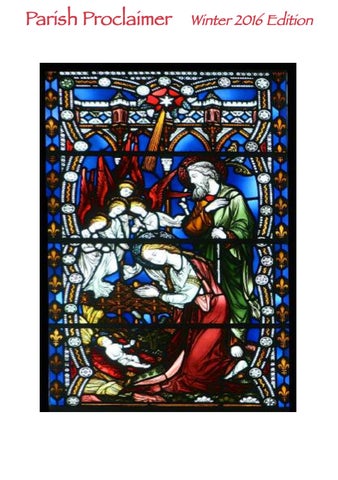
FRONT COVER The Nativity from the North Transept stained glaas window in Arundel Cathedral. Photograph taken by Oliver Hawkins reprinted with his permission.
The Parish Proclaimer is printed by Prontaprint Brighton & Hove - December 2016
WELCOME TO OUR WINTER EDITION Let us increase our faith! By Father Stan Mycek There is a request of the Apostles in the Gospel in which, I reckon, each one of us may find a bit of a personal desire: Lord, increase our faith but Jesus does not answer directly to our request. First He describes the power of faith in terms of doing impossible things for a man like commanding a tree: be uprooted and planted in the sea. And then, He gives quite challenging advice: change mentality and become a mere servant (see Luke, 17:5-10). We may be surprised by hearing such a strange combination of believing and serving. But Jesus, as true God and true man, knows perfectly well the secret desires of the human heart and all temptations that want to destroy it. The apostles asked Jesus to increase their faith. The request was right but their intentions were not pure. We get to know it when we listen to Jesus’ answer. They wanted stronger faith to show off, to impress. There was vain glory that wanted to poison their minds and hearts. Jesus invites them to conversion and directs them to learn from Him, their Master. That is why we should read His answer in the following way: the power of faith is not for showing off, but for doing good; for being merciful. The Saints, meditating on the Gospel and looking at their lives, discovered a very useful lesson. They said: Continued overleaf +++++++++++++++++++++++++++++++++++ ARTICLES FOR THE SPRING EDITION OF THE PARISH PROCLAIMER: Deadline for receipt - Tuesday, 7 February 2017 Please email your written piece and photos to clouter@mac.com or send by post to The Editor, Cathedral House, Parsons Hill, Arundel, West Sussex BN18 9AY including your name/address to enable us to return the photos. 3
“Pride is the first obstacle for and the last enemy of spiritual life.” It is the first obstacle because it does not want to obey God’s word and His commandments. It is the last enemy, because those who have been living a spiritual life start boasting about it and looking down on other people, gifted by God in a different way than them. The right measure for us is Christ. When we look closely at His life we have to say that Jesus in the Gospel does not give an abstract counsel. He actually speaks about Himself: about His trust and obedience to God and about His merciful serving other people. But if we stopped at this point it could be only a superficial description of his life. We need to go deeper. We need to listen to Him and do what He does and says. Jesus’ whole life gives us a very simple message: when you allow God to love you, when you are loved by Him you are able to love wisely yourself and others. Concluding the Year of Mercy, let us pray as often as possible: Lord, increase my faith in your merciful love; increase my faith in the saving power of your love; increase my faith in that simple truth that I am loved by you and you give me the power to love wisely You, myself and other people. On behalf of the Clergy and staff of the Cathedral, we wish you and your families a peaceful, prayerful Christmas and a healthy, holy New Year. God bless,
Fr. Stan
4
Michelangelo’s Pietà By Jo Briscoe
Our Cathedral’s Pietà - a painted replica situated to the east of the Baptistry - is, I feel, often either taken for granted, or passed without word. It was presented to our Cathedral by the 1st Battalion of the Prince of Wales Leinster Regiment in 1905. It is, however, a replica of the specific work, now in St. Peter’s Basilica in the Vatican city, of a Renaissance sculpture by Michelangelo di Lodovico Buonarroti Simoni who subsequently sculpted a number of works of the same theme. ‘Pietà’ (Italian for ‘pity’) indicates the quality of devotion and dedication - in this case, Our Lady’s motherly devotion and dedication to her beloved son. The Michelangelo sculpture was originally commissioned for the French Cardinal Jean Bilhères de Lagraulas, who was a representative in Rome. The theme is of Northern origin, popular in those days in France, but had not the same popularity at that same time in Italy. The original sculpture, in Carrara marble, was made for the Cardinal’s funeral monument, placed in the Chapel of Santa Petronilla, a Roman mausoleum near the south transept of Saint Peter’s, which the Cardinal chose as his funerary chapel. However, it was moved to its current location in the first chapel on the right as one enters the Basilica, in the 18th century, following demolition of the chapel during some rebuilding of the Basilica. The Pietà is currently shielded by thick bulletproof acrylic glass after being vandalised in 1972.
5
Michelangelo’s interpretation of the Pietà is unprecedented in Italian sculpture. It is an important work as it balances the Renaissance ideal of classical beauty with naturalism. Sculpting of the work took less than two years which is quite amazing! The structure is pyramidal and the vertex coincides with Mary’s head. The statue widens progressively down the drapery of Mary’s dress, to the base - the rock of Golgotha. The figures are quite out of proportion, due to the difficulty of depicting a fully-grown man cradled full-length on a woman’s lap. Much of Mary’s body is concealed by her monumental drapery and the relationship of the figures appears quite natural. Michelangelo’s interpretation of the Pietà was far different from those previously created by other artists, as he sculpted a young and beautiful Mary rather than an older woman around 50 years of age. The Madonna is represented as being very young for the mother of a 33-year-old son, which is not uncommon in depictions of her at the time of the Passion of Christ. One explanation is that her youth symbolises her incorruptible purity - as indeed, Michelangelo said himself. The marks of the Crucifixion are limited to very small nail marks and an indication of the wound in Jesus’ side. Christ’s face does not reveal signs of The Passion; Michelangelo did not want his version of the Pietà to represent death, but rather to show the “religious vision of abandonment and a serene face of the Son”, thus the representation of the communion between man and God by the sanctification through Christ. In the words of Giorgio Vasari (a student of Michelangelo and an enthusiastic friend) who idolised Michelangelo as an artist and revered him as a man and who also wrote ‘Life of Michelangelo’: “The Pietà was a revelation of all the potentialities and force of the art of sculpture. It would be impossible for any craftsman or sculptor no matter how brilliant ever to surpass the grace or design of this work or try to cut and polish the marble with the skill that Michelangelo displayed. “Among the many beautiful features, this is notably demonstrated by the body of Christ itself. It would be impossible to find a body showing greater mastery of art and possessing more beautiful members, or a nude with more detail in the muscles, veins and nerves stretched over their framework of bones, or a more deathly corpse. It staggers belief that the hand of an artist could have executed this inspired and admirable work so perfectly and in so short a time (only two years). “It is certainly a miracle that a formless block of stone could ever have been reduced to a perfection that nature is scarcely able to create in the flesh”. This masterpiece 6
dates from 1499, when the artist was only 24 years old. The Madonna’s youthful, sweet face expresses her submission to destiny, as she cradles the dead Christ’s limp body on her lap, yet the drapery of her dress and veil suggest an extraordinary physical and moral strength, that contrasts with the delicate 15th century features. Michelangelo put into this work so much love and effort that he left his name written across the drapery over Our Lady’s breast, something he never did again in any of his works! We may not have the beauty of the original Michelangelo Pietà sculpture in our Cathedral, but reflection on the details of that original’s very special features replicated here may inspire our appreciation of our own Pietà with its spiritual meaning and values. So whatever Mass you go to, please wander over to the Baptistry either before or after the service, look at the Pietà and pray in silence the Angelus (Hail Mary, full of grace...) and the Salve Regina (Hail, holy Queen, mother of mercy...).
PACATA HOME
& garden
painting & decorating property refurbishments project management
A small, family-owned firm, we cov er all aspects of property and garden maintenance, refurbishement & project management. We aim to h elp you maintain and enhance y our hom e, and ou r friendly team are all fully-insured, qualified profes sionals . Services we provide include: painting & decorating kitchens & bathrooms electrical works small building works plumbing tiling, floor ing & carpet in g carpentry fences & gates gardening service interior design service contact us to arrange a free consultation & estimate appointment
01243 784440 07507 444556 pacatahome@outlook.com www.pacatahome.co.uk
The Poor Clares in Africa By Sr. Angela
As I write this Sr. Leo, our Abbess, is with our community in Myanga, Kenya where one of our young sisters, Sr. Scholastica has just made her Solemn Profession bringing the number of finally professed Kenyan sisters up to four. We have been getting the most wonderful letters from Srs. Leo and Margaret. It is Sr. Margaret’s first time in Africa and she is experiencing the wonder of that continent that each of us who have been there did on our first visits. All of us have discovered the beauty and the joy that Africa, in spite of all the poverty and suffering, radiates. Our connection with Africa began 25 years ago in 1991 when, after a very lengthy process of community discernment (we were 46 in number at the time) we decided to make a foundation in Kenya. That decision had then to be implemented and this led us into further discernment and far reaching decisions. Sr. Aelred, who was the Abbess at the time, was invited to attend a federation meeting of all the East African Poor Clare communities as a beginning. She found the experience absolutely wonderful - deeply lifegiving and enriching - and she was able to pass on to all of us some of her joy and enthusiasm. After her return we had yet more soul searching and lengthy discernments and eventually we decided that three sisters - Leo, Pat and Angela - should go to Africa on a fact finding mission. We went to stay with the sisters in Mbarara in Uganda for six months to see how the sisters there lived out their vocation. From there we also visited other East African communities, in Malawi, Zambia and Tanzania. Each of these visits was wonderful and the sisters taught us all so much about living our Poor Clare and Arundel vocation in an African context and environment that we could not have learnt in any other way. The experience in each of these monasteries 8
was deeply lifegiving and enriching. There was a spirit of deep joy and commitment among the sisters of each community and they taught us in new and very amazing ways more about the simplicity of Clare and Francis. We were privileged to join in their joyful and wholehearted liturgies and they taught us about the gift of using our whole body in praising God through dance and joyful movement. They also opened their hearts and homes to us in a very deep way. Every week we sent letters home to our community here in Arundel and this enabled all the sisters to share in our enthusiasm and the wonder of all that was being revealed to us. Just before we left Uganda the sisters there kept the Silver Jubilee of their foundation, which was a wonderful gift, and it was the last celebration that we had with them before we left to begin our adventures in Kenya. We travelled across Uganda, which certainly deserves its name - the pearl of Africa into Kenya where we were welcomed by the Bishop of Bungoma, Bishop Longinus Atundo, who had actually visited England earlier in the year and had driven past our convent door when he was staying in Worthing with his secretary Fr. John Olliver MHM, though he did not know that we were there or what we were planning to do at that time. He was delighted to welcome us into his diocese and and we stayed with him in Bishop’s House while he took us to possible sites where we could build our monastery. Also he took us each Sunday to a different Parish in the diocese where he was confirming young people. We were always brought up onto the altar at the end of each celebration and invited to introduce ourselves. This was no mean feat and of course what we said was translated into the local language and we were always received with great excitement, enthusiasm and really wild ululating - the latter being a very characteristic response in Africa usually led by the women and sometimes they are very very LOUD! Srs. Leo and Margaret began their visit to Africa this time with a visit to our sisters in Uganda who are now keeping their Golden Jubilee. Sr. Emmanuel, a lovely Rwandan sister, who is now Abbess asked Sr. Leo if they could do this as a way of linking our two communities even more closely. Perhaps another scribe in another edition of this magazine could share some of their wonderful joy over the past few weeks? The monastery in Myanga was opened on 1 December 1992 so they will be keeping the Silver Jubilee of their foundation next year and I am sure that there will be great celebrations then. Over the years most sisters from the Arundel community have been able to visit Myanga and that little community is our greatest gift and joy from the Lord. We are all very happy that we have been asked and enabled to plant the 9
Poor Clare life in Kenya. We continue to exchange weekly letters that keep us deeply united with one other. There are now 11 sisters in Myanga: four have made Solemn Profession, three are in temporary vows and there are two postulants as well as the two Arundel sisters – Marion and Felicity. Sr. Reginnah, who was the first to take Solemn Vows, is now the sister in charge of the community in Myanga; Sr. Caroline Clare is Novice Mistress and Sr. Gertrude helps with the teaching of the young ones in the novitate. Each one of them has attended extensive formation programmes that have enabled them to grow and blossom into a maturity that has given each of them the confidence they need to accept the offices that have been laid on them. It is not always easy of course and there are times when we all have to face difficulties that crop up but the great love among us, that has always been a characteristic of our Arundel community, is visible and really tangible among our young sisters in Kenya. We have been deeply blessed and we never cease to thank God for allowing us to be involved in this great work of spreading his kingdom. Let me close by sending all of you our loving prayers and good wishes for a very happy Christmas with much joy in the New Year. +++++++++++++++++++++++++++++++++++
Parish People - Philip Ivor Wood By Colin Swanton Philip, who has served in the Cathedral for over 50 years, was born in Blackheath, London on 1 June 1929. His schooling started at Christ College in Blackheath (the prep. school for the main college in Horsham) and the family lived in a large Victorian house. The family were Anglican and attended All Saints’ Church in Blackheath. His mother longed for a more modern house and the family moved to Kidbrook when Philip was about six or seven years old. Philip’s father worked for Siemens Bros. in Woolwich but when the Second World War started he was designing radar equipment and production moved to Kingston upon Thames. Philip went to Tiffin Boys’ Grammar School and was confirmed Continued on page 12 10
Sarah-Louise Textiles & Haberdashery Shop
!
Unit 11, The Old Printworks Arcade, Tarrant Street, Arundel, BN18 9JH. 01903 882295 www.sarah-louisedesigns.com
3%/5-,% 4%*#-+% (,#*2$(,& #'(*$/%,
Wide Range of wools, yarns, fabric, haberdashery & local crafts. Alteration service.
.%,(,& (+%0 -,$!5 !+ .+ 2%0$!5 *-0%$ %$,%0$!5 !+ .+ '2/0$!5 !+ .+ /($!5 !+ .+ !12/$!5 !+ .+ 2,$!5 !,) -*($!50 *-0%$
Do come and see us!
,(1 2%%, 1/%%1 /2,$%*
%*%"/!1(,& 5%!/0 (, /2,$%*
' &# (!
% ' !'(%+ % &' (% !' ! %"" & "! " ' " &' ! %(! ) %+' ! & " ! "(% & ! ! "%! ! " & ! & ! ' %!""! ' & ! ( ! ! "'' %
! ,& & ! !"*! * ") % "" $( '+ " "" ! (& ! '% ! % & " #%" (
,#% !&!(, !4!/$%$ 01!/0 "5 '% --$ !*-, 2($%
"(& & &* % '
' "!
"( ! ! (& ' %% !' '% ' %(! # "!
&
&
!'(%+ "% % # &
Church of England and first became an altar server at the Anglican Church in Kingston. The family later worshipped at St. Andrew’s Anglo-Catholic Church. It was when Philip was ten, and the family were living in Surbiton, that he met his wife-to-be, Judith (then eight years old) who lived next door. As Philip says, “After that meeting we lived together for all the rest of our lives!” At that time, Judith was attending Surbiton High School. Both she and Philip went to Kingston School of Art and then onto the Royal Academy School. When the war ended, Philip was called up and went into the RAF whilst Judith went on to the Slade University College. Philip was sent to the Joint Air Photographic Intelligence Centre at RAF Wyton in Cambridgeshire (a unit later known to Bishop Richard when he was Bishop to the Forces). Although he was still an Anglican at that time, Philip started to serve at a Catholic church. With their relationship as strong and loving as ever, Philip and Judith decided to get married when he was about 25 years old. Judith went to see the priest who was at St. Raphael’s Roman Catholic Church in Kingston upon Thames but because Philip was not yet a Catholic, they were refused and were told to try the priest at Holy Name in Esher. A Fr. Desmond Leahy was prepared to marry them and Philip was received into the Catholic Church around the same time. Judith continued at the Slade before she joined the Old Vic, designing props for sets and costumes for the Royal Ballet. She was also an artist – Philip showed me some of her paintings hanging in his house today. During his service in the RAF, Philip was stationed at Saxton Wold RAF base, near Scarborough, at the time of the Korean War and he painted murals in the chapel on the site. After he left the RAF, Philip joined the GLC architects department designing models for the Queen 12
Elizabeth Hall and the Hayward Art Gallery. At that time Judith and Philip lived in a small house in Lambeth so they could both walk to work. A few years into the marriage, two children were born to the couple: Francesca who now lives with Philip in Arundel and Theodore, a professional photographer specialising in covering news, politics, show business, the Royal Family and weddings. Francesca’s interests are textile based – Philip says she has excellent colour sense and has designed and created some lovely textiles. She joined with the rest of the family when they organised a family exhibition of their talents: Judith’s paintings, Theodore’s photographs, Philip’s models and Francesca’s textiles. During Philip’s time with the GLC, Sir Denys Ladsun, an eminent architect (designer of the Royal National Theatre amongst numerous other buildings) visited the GLC and invited Philip to ‘come and see me’. Philip went and was immediately offered a job in his company designing and making models, including some of the Royal National Theatre, which are still in the Victoria and Albert Museum today. He joined Sir Denys Ladsun in 1964 and it was whilst he was working for Sir Denys that he was introduced to Ranee Barr, an admired Sri Lankan poet, who soon became a close friend to his family. Philip has a long time interest in steam trains. He says this is probably because a grandmother on his father’s side was a Stevenson (of Stevenson’s Rocket fame). He has made a model of the locomotive ‘Duchess of Norfolk’ which is now in Arundel Castle. Both Philip and Judith have exhibited paintings in the Royal Academy. At home, Philip has some models that he has made including Arundel Cathedral, Canterbury Cathedral and St. Albans. When he and Judith lived in Lambeth, in 1966 they also moved into a weekend cottage in Houghton, which allowed Philip to continue serving in the Cathedral. He first learnt how to serve whilst he was at Christ’s College where he also acted as a sub-deacon (no longer a ministry in the Church) so was able to sing the Gospel in Latin during Mass. He has served many Masses for both Cardinal Cormac Murphy O’Connor and Canon Tony Whale in their time at the Cathedral. Judith was first to decide to learn to drive and acquired an Austin 7 Chummy car to do just this. Philip then followed and thought to himself that he would like something bigger and bought a Rolls Royce 20/25 car, which he kept for some while before it became too expensive to run and he, reluctantly, had to sell it.
13
When Ken Livingstone was leader of the Greater London Council, the council compulsorily purchased Philip and Judith’s house in Lambeth. They moved into a tower block on the Pepys Estate and lived there for two or three years. Judith’s mother had a large Victorian house in Surbiton, which Philip and Judith eventually took over and lived in for some ten to fifteen years. Four years ago, Philip and Judith downsized and moved into a house in King Street in Arundel. Sadly, Judith died just before Easter this year. Philip continues to live there and also still serves at the 11.15am Sunday Mass as well as on special occasions. +++++++++++++++++++++++++++++++++++
Points to ponder on Courtesy of The Green Bough The paradox of our time in history is that we have taller buildings but shorter tempers, wider motorways but narrower viewpoints. We spend more but have less, we buy more but enjoy less. We have bigger houses and smaller families, more conveniences but less time. We have more degrees but less sense, more knowledge but less judgement, more experts yet more problems, more medicine but less wellness. We drink too much, smoke too much, spend too recklessly, laugh too little, drive too fast, get too angry, stay up too late, get up too tired, read too little, watch television too much and pray too seldom. We have multiplied our possessions but reduced our values. We talk too much, love too seldom and hate too often. We’ve learned how to make a living but not a life. We’ve added years to life but not life to years. We’ve been all the way to the moon and back but have trouble crossing the street to meet a new neighbour. We conquered outer space but not inner space. We’ve done larger things but not better things. We’ve cleaned up the air but polluted the soul. We’ve conquered the atom but not our prejudice. We write more but learn less. We plan more but accomplish less. We’ve learned to rush but not to wait. We build more computers to hold more information to produce more copies than ever, but we communicate less and less. These are the times of fast foods and slow digestion, big men and small characters, steep profits and shallow relationships.
14
These are the days of two incomes but more divorces, fancier houses but broken homes. These are days of quick trips, disposable nappies, throwaway morality, one-night stands, overweight bodies and pills that do everything from cheer to quiet to kill. It is a time when there is much in the showroom window and nothing in the stockroom. A time when technology can bring an email letter to you and a time when you can choose either to share an insight or just hit delete. Life is not measured by the number of breaths we take, but by the moments that take our breath away. George Carlin, an American comedian +++++++++++++++++++++++++++++++++++
Fulfilling a showbiz dream By Stephanie Hawkey with an article from The Worthing Herald
Alexei Hawkey has been an altar server in Arundel Cathedral since the age of 6 years’ old and reaching his 10th year this coming Christmas after being enrolled into the Guild of St. Stephen in 2006. My son is now off to pastures new to fulfill his showbiz dream of dancing and performing on the West End stages. Alexei, who turned 18 on 9 August, has been offered a full-time 3-year scholarship to study Professional Dance and Musical Theatre at the Performers College in Essex. The following article was featured in The Worthing Herald on 8 September 2016 and thanks to Alex Clouter who spoke to Phil Hewitt, the Group Arts Editor of the newspaper, we are allowed to reproduce it in our parish magazine... 15
A young Angmering performer is taking a major step towards fulfilling his showbiz dreams. Alexei Hawkey, who turned 18 on August 9, has been offered a full three-year scholarship to study professional dance and musical theatre at Performers College, Essex. He has just finished two years of training at Northbrook College, studying dance and performing arts, gaining top marks and enjoying all the opportunities on offer. In his time at Northbrook, he performed at Move It in London both years, performing with university-level students at Olympia and Excel. He also stepped up to the challenge of playing the leading male in Barry Manilow’s Copacabana, playing Tony/Stephen in his first year. In his second year at Northbrook, he played the Baker in their dance show of Into The Woods. He was also the assistant director in their final major project towards the end of the year. Now he’s ready for the next move: “I just love the adrenalin you get, the excitement, the whole process of doing a show. I love the passion and the friends you make. The highlight is the opening night of a show where you can hear the audience coming in, you are waiting for beginners’ call… For me the highlight was playing Buttons in Cinderella for Littlehampton Musical Comedy Society. I was shaking in the wings! But you just try deep breathing. I try to do a few stretches, and it was great.” Alexei has been involved in many productions in the area. He has been involved in productions in Littlehampton, Worthing, Brighton, Crawley, Southwick and London. As well as Buttons, he has played Billy Goose in Mother Goose for Littlehampton Musical Comedy Society’s yearly pantomimes. He also got the opportunity to take part in Janet Lewis’ English Youth Ballet production of Giselle at the Connaught Theatre, Worthing, where he played a Huntsmen and Wilfrid in 2011. Alexei developed his passion for dance and performing at an early age, starting at a Young Ones Entertainment Group every Wednesday evening in Rustington, run by Susan Pitt. At the age of seven, he was cast in Oliver with LMCS, with the opening night falling on his eighth birthday. He then went to a performing arts school in Worthing called RSOPA, where he took lessons in ballet, tap, modern and musical theatre. He also took parts in their main productions (High School Musical, Aladdin Jr, The Wiz, Our House). Continued on page 18 16
&'
##
% !' ! #
# % ! ' % "' % * ! !' " &" %# % ! % &'"%
'
&
* # & '" ) & ' +"(% " '" && && +"(% " ! & (&& ' *"% % $( % '" % # % ! % &'"% ' '" *"% ! "% % + *"% & %% "(' * ' % ( "!& % ' "! '" ' "% ! '% & !( '(% ! &'"%+ " ' " "(% " * ! %# % ! % &'"% ! + *"% & "# ' ! ' &' ! % ( ' "% ! % '(%! '" +"( # ''#
## ## % !''
ARUNDEL FINE GLASS STUDIO Fine glass engraving for those special gifts. We also sell modern and classical style glassware.
Visit our shop in Arundel: The Old Stable, Tarrant Street
"
01903 883 597 www.arundelglass.com
"
% ( #$
"
$ "
"%
% %$# $ " "# " & # % " # %# ## % " ## #$ %## ' $ $
""( " % ( "
! # % ( $ "
&&& % ( $ "
# $
% %
" #
After a few years of training, he then moved to Angmering School of Dance where he took lessons in ballet, tap, modern, free style and contemporary. In his time at Angmering School of Dance, he was awarded best concept in his choreography piece. He also got the opportunity to perform at Her Majesty’s Theatre in London (home to The Phantom of The Opera) with this dance school. He also played the character of one of his idols Ron Moody, portraying the part of Fagin in their musical theatre company performance of Oliver. In his time at Northbrook College, he moved to Glendale Theatre Arts, where he takes lessons in stretch and strengthen, ballet, jazz, modern, tap, contemporary and boys-only classes. Not surprisingly, he feels he has got the potential to go all the way in the business: “I feel I could go quite far if I keep my determination and dedication.� His hope, after training, is to deepen his experience aboard the cruise ships before ultimately going on to set up his own theatre company. This is where the article from The Worthing Herald finishes. Alexei will be back from time to time during the holidays. +++++++++++++++++++++++++++++++++++
In memory of Christopher Paul Dinham RIP 25 July 1936 - 8 September 2016 Chris was a regular contributor to the Parish Proclaimer, providing many crosswords. It was certainly a strong passion he had, not just with writing the clues but also the design of the black and white crossword grid. There was a Requiem Mass held at the Cathedral on 16 September where family, friends and colleagues got together to celebrate his life. Members of his family spoke about Chris in his younger days, showing his happiness of being a loving husband, father, grandfather and uncle. He had a deep passion for classical music and steam railways. He sang in the Cathedral Choir for a long time and also was in the team of readers for the 10am weekday Masses. He will be sorely missed by all those who knew him: family, friends, colleagues and parishioners. Thanks, Chris, for all that you have done for our parish community. 18
Cathedral Choir News By Elizabeth Stratford Exam Results We congratulate the following on recent examination successes: Indigo Ashworth – Grade 3 singing – merit Indigo Ashworth – Grade 1 harp – distinction Oscar Smith – B. Mus(Hons) Vocal Performance – Upper Second Class Jake Stevenson – B. Mus(Hons) Vocal Performance – First Class New to the choir We welcome Suzanne Weaver to the Cathedral Choir. Suzanne has a great deal of musical experience having sung with Brighton Festival Chorus, Bournemouth Symphony Chorus, the London Philharmonic Choir and London Symphony Chorus to name a few so we are tremendously lucky to have her singing alto with us. She is already a firm fixture as her cassock has been ordered and she's on the responsorial psalm rota so look (and listen) out for her in the coming weeks and make her feel welcome. The other new faces, though you are more likely to hear than see them, so to speak, are Alex Eadon and John Sharples who have been playing for most of the choral Masses and other services since last September helped by other deputies when they are committed elsewhere. Occasionally Alex sings the psalm from the ambo (he is a tenor) but many of you now recognize him. He’s just recorded a CD of the Cathedral organ featuring well known music by Widor, Wagner, Mendelssohn and Bach and this is now available from Alex, Elizabeth or the Cathedral Shop. Alex is the Assistant Director of Music at Eastbourne College where he lives with his wife Nicki and son Thomas. His family are musical – his dad worked for Decca Records as a recording engineer for many years and both Alex and his younger brother Ben (now a vicar in the Anglican church but also a very good bass) were choristers at King’s College Cambridge under Stephen Cleobury. After leaving King’s, Alex went to Harrow School with a music scholarship before progressing to the Royal Academy of Music to study organ performance where his teachers included Nicholas Kynaston, David Titterington and Patrick Russill. He was organist at Saint Martin-in-the-Fields during his gap year and held various other London 19
appointments whilst studying. He plays the organ, harpsichord, trombone and the piano (and adds that he was good enough to have played the trombone in the BBC Proms!). His favourite pieces of choral music include Bring us, O Lord God by William H Harris (ES – that’s mine too), Belshazzer’s Feast by William Walton and Requiem by Durufle – “Can’t narrow it down to one”. His favourite thing about singing is that having been part of liturgical choirs since almost before he can remember, he doesn’t really know any different. When asked which his favourite service was, he replied, “Any service for which I haven’t had to practise much!” John works in IT consultancy in London but has been a church musician for many years, beginning to play the organ aged 14. He sang in the choir of Chester Cathedral whilst a student and was organ scholar at Chester College. John has held a non-musical day job since 1984 but has always maintained his organ playing along with training choirs. For many years he played the organ in Lambeth Palace for the Archbishop of Canterbury, as well as in churches in South London and Surrey and also spent a period as organist of Woldingham School. He has accompanied choirs in many services and concerts and given solo recitals in St. Paul's Cathedral in . London and St Thomas' Church, Fifth Avenue, New York City. As well as playing the organ he plays piano (“If I have to”) and sings tenor. His favourite piece of choral music is difficult to pinpoint but as he loves Tudor choral music so he says, “perhaps When David heard by Thomas Tomkins as it is a beautiful piece and very reflective if rather sad!” Favourite composer is J S Bach. John likes coming to the Cathedral because “I get to play a wonderful organ in a glorious building and get to work with a wonderful choir on a great variety of music.” Choral Scholars Name: Oscar Smith. Voice part: bass (but can also sing tenor, alto and a sort of soprano). Age: 23. Degree/study: Just completed undergraduate degree at the University of Chichester and now started an MA in Music Performance specialising in extended vocal techniques. Did you sing in choirs when you were younger? No. When did you join the Cathedral Choir? January 2015. Do you sing with any other choirs now? Just with Pieces of Eight (a vocal octet I run) outside of the Cathedral. Play any instruments? Piano. Continued on page 22 20
$$ #
$& '$" * & %" &! ' $ &)& ! ! ! + %!'$ !! * & + *& % ( $$ + ! ) " &)# ! $)' % ) $ ) $ + ) ! & $% !$ & %& % ( $% #' &+ &$ & ! + & ! $ % '% '$ $ & &'$+ &!) !'% ! & %&$ & % %! !" !$ ' )& ! %! &% % /. $& 0 ' !$ &$ & ! ' + ' $$ # $& '$" * & &! %& + !( $ & $' & $ & $ ! + ! % &% %& '%% * !$ !$ ( $+ %" &$ & !$ &)! &)# ! $)' % ( '*'$+ $!! % ) & %' & % " '% & ! & % $ ) %% !! % ( $! - " $ & $$ # $& '$" * & &! ( ' !'% ( ) & %'" $ !! ! + ,, $ & &)# ! $)' % %" ! & +/ ( & $& &0 ) & !'$% !$ ! + - " $ " $%! % & !'$ ) &! % ) &0% ! '" !! $+ +& " ! % %" % ( $+
&)#
!
$)'
% # &$" ) '
(& ( ,'
()&
*** &)#
,'
&)# "
!
!) ! %& &
'( )'' + %"
)#
,'
! $)' * '(')'' + $"
"
%"
Favourite composer: James Ray. Favourite piece of music: Rimsky Korsakov, Our Father. Why do you like singing with us? I enjoy singing at the Cathedral because of the familial feel it provides. Favourite service in the church’s year - EASTER VIGIL!!! Name: Ruth Parsons. Voice part: Soprano. Age: 21. Degree/study: BMus Music Performance (in the 4th year). Did you sing in choirs when you were younger? Yes, as a child I sang in the Milton Keynes Youth Choir. When did you join the Cathedral choir? March 2015. Do you sing with any other choirs now? Pieces of Eight and the University Chamber Choir. Play any instruments? I used to play guitar a bit. Favourite composer: Vivaldi. Favourite piece of music: Faure’s Requiem. Why do you like singing with us? I enjoy singing at the Cathedral because it is a friendly environment where I feel really welcome and it also gives me an opportunity to do the thing I love. Favourite service in the church’s year – Easter Vigil (it was also one of the first services I did). Name: Grace Crumplin. Voice part: Soprano or alto (either is fine and I just do as I’m told!). Age: 22. Degree/study: I’m in third year of the BMus with Vocal Teaching course at the University of Chichester). Did you sing in choirs when you were younger? Sang in my church choir back home (Isle of Wight). When did you join the Cathedral choir: April 2016. Do you sing with any other choirs now? University Chamber Choir, Otter Consort, Pieces of Eight and some other bits and pieces. Play any instruments? Guitar. Favourite composer: Purcell. Favorite piece of music: O Lorde, the maker of al thing by John Joubert Why do you like singing with us? I enjoy the Cathedral and singing alongside people who share the same love of music. 22
Favourite service in the church’s year - I like Advent and Christmas services, hehe! Name: Jeremy Fisher. Voice part: Tenor. Age: 19. Degree/study: Second year of BMus Music Performance at the University of Chichester. Did you sing in choirs when you were younger? I’ve sung in choirs since I was 8 years old. (ES: the choir are currently having a competition to find a piece of sacred music that Jeremy doesn’t know/hasn’t sung before. He’s been here 6 months and we haven’t managed it yet.) When did you join the Cathedral choir: April 2016. Do you sing with any other choirs now? University Chamber Choir, Otter Consort and I dep(utise) at a few cathedrals around the country. Play any instruments? Yes, French Horn, and my degree study is conducting. Favourite composer: J S Bach. Favourite piece of music: The Lamentations of Jeremiah by Tallis Why do you like singing with us? My favourite part of singing at the Cathedral is the community and the people here. Favourite service in the church’s year: Probably the Advent Procession. (ES – I haven’t yet broken the news that we don’t have one at Arundel – yet!) We were lucky to have Jake for just a term as he completed his performance degree in Chichester – he’s now in London but pops back to see us when he can. Name: Jake Stevenson. Voice part: Bass. Age: 23. Degree/study: I’ve just completed my undergraduate degree at the University of Chichester and am now reading for an MMus in Performance at the London College of Music for a year. My degree is centred around vocal health and the way we explain it to training singers. Did you sing in choirs when you were younger? As a kid I sang in a Gospel choir. When did you join the Cathedral choir: April 2016. Do you sing with any other choirs now? LCM Postgraduate Voices and the LCM Choir. Play any instruments? Piano, but I’m terrible at it. Favourite composer: Schubert. Favourite piece of music: currently working on Schubert’s Winterreise. Why did you like singing with us? I loved singing at Arundel for the wonderful 23
community atmosphere and the beautiful sound created there. Favourite service in the church’s year? Looking back, I enjoyed Corpus Christi the most, even though it lasted 4 hours! Elizabeth Stratford continues... The Cathedral Choir are busy preparing for Christmas having already produced a programme of Renaissance Music for the St. Philip Howard Masses in October and John Rutter’s Requiem for Remembrance Sunday this term. Often we celebrate the choristers’ achievements, news and experiences but this issue I thought we’d focus on some of the newer faces - our choral scholars are a tremendous blessing, an inspiration to the choristers and help us maintain a high level of musical performance to glorify God. They are a vital part of the choir and we could not do what we do without them. St. Augustine said, “He who sings prays twice” so do say hello if you have the opportunity now that you have read about them here first! +++++++++++++++++++++++++++++++++++
Mary Tudor, Queen of England A new region-free DVD from Mary Dowry Productions
The much maligned English monarch, Queen Mary I of England, was demonised by her enemies following her death as they sought to regain their power over England, particularly through religion. This was especially attained by their sobriquet ‘Bloody Mary’ by which Mary Tudor is still known today. Yet she was much beloved by her people and her reign as England’s first Queen was filled with advances in commerce, economy, exploration, industry and the nationwide task of restoring England’s ancient Catholic faith and heritage. In this film, Queen Mary Tudor, Queen of England, takes us through the story of her life, from her birth in 1516 to her death at age 42 in 1558. Her personal motto, ‘Truth is the daughter of time’, is especially relevant today. Mary Tudor: Queen of England has a runtime of 55 minutes and is now available worldwide on DVD via www.marysdowryproductions.org 24
CATHEDRAL GIFT SHOP An extensive range of high quality religious gifts and cards for Lent, Easter, baptisms, weddings, funerals, birthdays, special anniversaries and other occasions. The Gift Shop is situated in the North Transept by the Shrine of St. Philip Howard. From 1/11/14 - 31/3/15 Monday - Saturday 10.30am - 12 noon From 1/4/15 - 31/10/15 Monday - Saturday 10.30am - 4.30pm PLEASE NOTE We rely on volunteers to help in the gift shop so our opening hours may vary slightly.
+!#%,-!+! !( ).+ #! -$! -$! -$! + & ( -) *+)/% ! ' %(-!( (
$ +%-1 0$),! %' %, -) .,! ( **+! % -%)( )" $.+ $ )" -$! %) !,! "%( ( % & ,.**)+- ")+ %-, ! ( !($ ( !'!(-
#!-+# +#+ #/ ," 5-2 4'** #,(-5 ,,2 * #3#,10 *')# &# /'#,"08 "3#,1 #0.#/0 /'#,"08 00 # 01 -$ 1 &'*'. -4 /" (-', ', 0-+# -/)',% /1'#0 2++#/ #*# / 1'-,0 0-!' * #3#,10 4'1& -1&#/ /'#,"0 -$ /2,"#* 1&#"/ * .*20 5-2 4'** /#!#'3# 7 -/,#/01-,#8 ' ,,2 * ,#40*#11#/
((. &
!' !+,$%*
!!,
/'#," 6 '$# #+ #/ 6 -',1 /'#,"0 6 -/.-/ 1# #+ #/ 6 1/-, 6 &'0 '0 -,# . 5+#,1 -,*5
+.( -$"+%!( , - )((! - )' 000 +.( !& -$! + &"+%!( , )+#
& /'15
-
-+. ,5
-
,%* ,"
A new Provost By Canon Tim Madeley
On 1 September, following the death of Provost Tony Whale, The Cathedral Chapter elected Monsignor Canon John Hull as his replacement. Following ratification of the election by Bishop Richard, Monsignor Hull accepted the post. The Chapter of Canons, established in 1967 consists of one Provost and eleven canons. Their role is to safeguard the Cathedral, in spiritual, financial and physical ways and act as an advisory group to the Bishop. They usually meet twice a year, in the spring and the autumn. It is the Chapter who proposes a terna of three names for the Nuncio in the selection of a new Bishop. Provost Hull as he now is, is no stranger to the Cathedral having been on the Chapter a good many years. He has been parish priest of Patcham for a long period during which he has held the role of Chancellor and Vicar General in the Diocese. He has just retired from being the Moderator of the Curia (in other words having been in charge of diocesan employees). +++++++++++++++++++++++++++++++++++
Proclaim the Joy of Love O God. who sent your Son into the world as the true light, pour out the Spirit he promised to sow the seeds of truth in people’s hearts. Awaken our faith, we pray, so that walking in the ways of salvation and love, we may call all people to become one in Christ. We make this prayer through the same Christ our Lord, Amen. 26
St Nicholas of Myra Courtesy of stnicholascenter.org and Wikipedia The true story of Santa Claus begins with Nicholas, who was born to a Greek family during the third century in the village of Patara, a port on the Mediterranean coast. They later went to live in Myra, Lycea (part of modern-day Demre) at a time when the region was Greek and is now on the southern coast of Turkey. His wealthy parents, who raised him to be a devout Christian, suddenly died in an epidemic while Nicholas was still young. He was raised by his uncle - also named Nicholas who was the bishop of Patara. He tonsured the young Nicholas as a reader and later ordained him a presbyter (priest). Obeying Jesus' words to ‘sell what you own and give the money to the poor’ Nicholas used his whole inheritance to assist the needy, the sick, and the suffering. He dedicated his life to serving God and he was made Bishop of Myra while still a young man. Bishop Nicholas became known throughout the land for his generosity to those in need, his love for children, and his concern for sailors and ships. Under the Roman Emperor Diocletian, who ruthlessly persecuted Christians, Bishop Nicholas suffered for his faith, was exiled and imprisoned. The prisons were so full of bishops, priests and deacons, there was no room for the ‘real’ criminals - the murderers, thieves and robbers. After his release, Nicholas attended the Council of Nicaea in AD 325. He died December 6, AD 343 in Myra and was buried in his Cathedral Church in Demre, where a unique relic, called manna, formed in his grave. This liquid substance, said to have healing powers, fostered the growth of devotion to Nicholas. The anniversary of his death became a day of celebration, St. Nicholas Day, 6 December (19 December on the Julian Calendar). Through the centuries many stories and legends have been told of St. Nicholas' life and deeds. These accounts help us understand his extraordinary character and why he is so beloved and revered as protector and helper of those in need. One story tells of a poor man with three daughters. In those days a young woman's father had to offer prospective husbands something of value - a dowry. The larger the dowry, the better the chance that a young woman would find a good husband. Without a dowry, a woman was unlikely to marry. This poor man's daughters, without dowries, were therefore destined to be sold into slavery. Mysteriously, on three different occasions, a bag of gold appeared in their home providing the needed dowries. The bags of gold, tossed through an open window, are said to have landed 27
in stockings or shoes left before the fire to dry. This led to the custom of children hanging stockings or putting out shoes, eagerly awaiting gifts from Saint Nicholas. Sometimes the story is told with gold balls instead of bags of gold. That is why three gold balls, sometimes represented as oranges, are one of the symbols shown with St. Nicholas. And so St. Nicholas is a gift-giver. One of the oldest stories showing St. Nicholas as a protector of children takes place long after his death. The townspeople of Myra were celebrating the good saint on the eve of his feast day when a band of Arab pirates from Crete came into the district. They stole treasures from the Church of Saint Nicholas to take away as booty. As they were leaving town, they snatched a young boy, Basilios, to make into a slave. The emir, or ruler, selected Basilios to be his personal cupbearer, as not knowing the language, Basilios would not understand what the king said to those around him. So, for the next year Basilios waited on the king, bringing his wine in a beautiful golden cup. Meanwhile, as Basilios was fulfilling his tasks serving the emir, he was suddenly whisked up and away. For Basilios' parents, devastated at the loss of their only child, the year passed slowly, filled with grief. As the next St. Nicholas' feast day got nearer, Basilios' mother would not join in the festivity, as it was now a day of tragedy. However, she was persuaded to have a simple observance at home, with quiet prayers for Basilios' safekeeping. One day St. Nicholas appeared to the terrified boy, blessed him, and set him down at his home back in Myra. Imagine the joy and wonderment when Basilios amazingly appeared before his parents, still holding the king's golden cup. This is the first story told of St. Nicholas protecting children, which became his primary role in the West. Another story tells of three theological students, travelling on their way to study in Athens. A wicked innkeeper robbed and murdered them, hiding their remains in a large pickling tub. It so happened that Bishop Nicholas, travelling along the same route, stopped at this very inn. In the night he dreamed of the crime, got up, and summoned the innkeeper. As Nicholas prayed earnestly to God the three boys were restored to life and wholeness. In France the story is told of three small children, wandering in their play until lost, lured, and captured by an evil butcher. Then Saint Nicholas appears and appeals to God to return them to life and to their families. And so St. Nicholas is the patron and protector of children. Several stories tell of Nicholas and the sea. When he was young, Nicholas sought the holy by making a pilgrimage to the Holy Land. There as he walked where Jesus walked, he sought to more deeply experience Jesus' life, passion, and resurrection. Returning by sea, a mighty storm threatened to wreck the ship. Nicholas calmly 28
prayed. The terrified sailors were amazed when the wind and waves suddenly calmed, sparing them all. And so St. Nicholas is the patron of sailors and voyagers. Other stories tell of Nicholas saving his people from famine, sparing the lives of those innocently accused, and much more. He did many kind and generous deeds in secret, expecting nothing in return. Within a century of his death he was celebrated as a saint. Today he is venerated in the East as wonder, or miracle worker and in the West as patron of a great variety of persons: children, students, mariners, bankers, scholars, pawn-brokers, orphans, labourers, travellers, merchants, judges, paupers, marriageable maidens, victims of judicial mistakes, captives, perfumers, even thieves and murderers! He is known as the friend and protector of all in trouble or need. Sailors, claiming St. Nicholas as patron, carried stories of his favour and protection far and wide. St. Nicholas chapels were built in many seaports. As his popularity spread during the Middle Ages, he became the patron saint of Apulia (Italy), Sicily, Greece, and Lorraine (France), and many cities in Germany, Austria, Switzerland, Italy, Russia, Belgium, and the Netherlands. Following his baptism, Grand Prince Vladimir 1 brought St. Nicholas' stories and devotions to St. Nicholas back to his homeland where Nicholas became the most beloved saint. Nicholas was so widely revered that thousands of churches were named for him, including three hundred in Belgium, thirty-four in Rome, twenty-three in the Netherlands and more than four hundred in England. St. Nicholas' tomb in Myra became a popular place of pilgrimage. Because of the 29
many wars and attacks in the region, some Christians were concerned that access to the tomb might become difficult. For both the religious and commercial advantages of a major pilgrimage site, the Italian cities of Venice and Bari vied to get the Saint Nicholas relics. In the spring of 1087, sailors from Bari succeeded in spiriting away the bones, bringing them to Bari, a seaport on the southeast coast of Italy. An impressive church was built over St. Nicholas' crypt and many faithful journeyed to honour the saint who had rescued children, prisoners, sailors, famine victims, and many others through his compassion, generosity, and the countless miracles attributed to his intercession. The St. Nicholas shrine in Bari was one of medieval Europe's great pilgrimage centres and St. Nicholas became known as ‘Saint in Bari.’ To this day many millions of pilgrims and tourists visit Bari's great Basilica di San Nicola. Through the centuries St. Nicholas has continued to be venerated by Catholics and Orthodox and honoured by Protestants. By his example of generosity to those in need, especially children, Widely celebrated in Europe, St. Nicholas' Feast Day, 6 December, kept alive the stories of his goodness and generosity. In Germany and Poland, boys dressed as bishops begged alms for the poor, and sometimes for themselves! In the Netherlands and Belgium, St. Nicholas arrived on a steamship from Spain to ride a white horse on his gift-giving rounds. 6 December is still the main day for gift-giving and of course merrymaking in much of Europe. For example, in the Netherlands St. Nicholas is celebrated on the 5th, the eve of the day, by sharing candies (thrown in the door), chocolate initial letters, small gifts, and riddles. Dutch children leave carrots and hay in their shoes for the saint's horse, hoping St. Nicholas will exchange them for small gifts. Simple gift-giving in early Advent helps preserve a Christmas Day focus on the Christ Child. St. Nicholas amazingly continues to be a model for the compassionate life. He has thus become the model for Santa Claus, whose modern name comes from the Dutch ‘Sinterklaas’, itself from a series of elisions and corruptions of the transliteration of ‘Saint Nikolaos.’ (Russian icon on p29 depicting Saint Nicholas with scenes from his life. Late 15th century or early 16th century. National Museum, Stockholm.)
30
Arundel Memories of Alfred Peckham - Part 2 By Mark Phillips While looking through my library I came across a document I did not recall seeing before. This contained random reminiscences of life in Arundel in the early part of the 1900s, written by Alfred Peckham. Alfred was born in 1905 and put these memories to paper in 1985, four years before he died. In the previous Parish Proclaimer I shared with you Alfred’s memories of moving to Arundel and his childhood experiences in the town before the first world war. This month in the second and final part Alfred recalls the local Arundel shops, traffic, religion, fairs and the coal cart incident. Shops Alfred remembers the wonderful ‘olde worlde’ grocery shop belonging to Miss Watkins on the corner of Tarrant Street and the High Street that is now La Campania Restaurant. “It should have been preserved as a national monument. It had sacks of grain, corn and suchlike on the ground around the counter, numberless hams (the shop was renowned for smoking its own bacon in the smokehouses at the rear of the shop), strings of onions and other produce hanging from the rafters, huge decorated metal containers for tea, huge cheeses and mounds of butter and an all pervading lovely smell, I fear has gone forever from grocery establishments now.” A very popular grocer was Bennett’s, located at the bottom of Maltravers Street. Alfred has the following fond memories of the goodies the children purchased there: “We would spend our weekly penny at Mrs Bennett's shop and huge supplies of sweets could be got for this. Liquorice strips were perhaps the favourite although there was also brandy balls (gobstoppers). A small handful cost a penny and each one changed colour as you sucked it and it got smaller until it disappeared. Sherbet dabs were lovely - a round flat sweet on a stick and a tube full of sherbet powder and you dipped the stick in and sucked until the sherbet was gone and then you ate the sweet. The only thing we did not eat, despite our good teeth, was the stick!” During his time in Arundel, Alfred lived at the top of King Street near a grocery shop run by the Burchell family. In the early 1900s, William Burchell was known locally as ‘Billy Split-raisin’ as he was allegedly so mean he would split a raisin in half to balance his scales. “On the corner of Bond Street and King Street opposite our house 31
was a small grocery store (photo above) and in the side window there was for many years a bottle of Camp coffee complete with the soldier in kilts on its label. We kids used to admire this very much.” Traffic Alfred notes that the traffic was all horse-drawn carts and timber wagons in the town at least up until the First World War. He recalls seeing the great logging wagons coming down the upper London Road or the Chichester Road. “…they had a pair of great draught horses, pulling a kind of two-wheeled pivoted platform with the driver sitting on it, usually on one of the shafts attached to the horses. This was connected to a pair of heavy wheels, with another platform, about 15 or 20 feet behind by a great axle, like a telegraph pole and would contain anything up to six huge tree trunks.” Apart from these vehicles and traps and carriages, the only other horse vehicle Alfred could remember were the Sparks and Sons furniture wagons that would occupy a good half of the width of the street and delivered to and from Sparks Auction Rooms in Tarrant Street. He had little recollection of motor vehicles coming to Arundel other than tourists arriving by charabanc, a sort of early bus. Religion and Christmas Arundel was and still is the main residence of the Premier Duke of the UK, the Duke of Norfolk, “…who was also the leading Roman Catholic in the country.” Alfred continues: “Duke Henry, who built a huge Roman Catholic church at the top of King Street (elevated to the rank of cathedral in 1965) was still living when I was a child, and I remember the Christmas parties he gave, in the castle for the Arundel children. 32
The Great Hall in Arundel Castle
On one night the Roman Catholic children had their party and the Protestants on the following night. Possibly due to lack of room but more likely to avoid battles between the various creeds.” This traditional party was held at the castle in the Great Hall, now better known as the Barons Hall, which was decorated for the occasion with a large Christmas tree and roaring log fires. I suspect, however, it was the main event of the huge feast that most children looked forward to. Traditionally this was always presided over by the Duke who Alfred remembers as “…an imposing bearded figure.” During this period there was a large division between many Protestant and Catholics in the town, each having their own churches and schools and just like Alfred, I can recall my own schooldays in the 1960s and how, “… from the school, we all marched in a long crocodile up Maltravers Street, over the road and up the steep Parson's Hill and from there turned right and along to the old St. Nicholas Parish Church” where Alfred and his classmates “…sat in several rows of pews to the right by the side of the choir where in winter our feet dangled over the stone-flagged floor and we suffered agonies from chilblains, very prevalent in those days.” Fairs Twice a year a huge circus/fair would come to Arundel and was given permission to set up in the old ‘Cows Field’ which is now mostly covered over by the western roundabout that forms the end of the A27 relief road. In Alfred’s words “… there was rather a wet field and a stream ran through it (the Spring Ditch – author) which came from the water cress beds on the other side of the stone-walled causeway. We 33
were allowed to go and have rides on the roundabout and I remember so vividly the magnificent mechanical bands on the inside with figures playing instruments and banging drums, all driven by the electricity generated by the great steam-driven traction engines. We could hear it playing even from the top of King Street. The one tune I can always remember it playing was ‘How yer gonna keep them down on the farm.’ Oh, wonderful memories.” The coal cart accident This incident appears to have been so memorable that it has gone down in Arundel history to be recalled second and third-hand, always with a different twist, often by relatives of those who lived in the town at the time. The following is Alfred’s recollection of the sad event which is not for the faint-hearted. “A coal cart used to deliver coal starting from the top of King Street as the hill being so steep. The coalman had to fix brake shoes or skids under the back wheels of the cart to help the horse support the weight while the coalman delivered the coal. These skids were sort of iron shoes attached to the cart by iron chains and were slipped under the front of the back wheels. Thus the back wheels were blocked and when the horse pulled, the cart would slide rather than roll down the hill on the skids. One day we heard a great shouting and clattering out in the front. We ran out into the street to see what was happening, but we were too late. It seemed that the horse was frightened by something before the skids were fixed and bolted down the hill. The bottom the hill is very steep with quite a sharp bend and leading to the T-junction of Maltravers Street that had a high solid stone terrace on the opposite side. The poor horse could not have had a hope in heaven of pulling up and so ran full tilt into this wall with all the weight of the loaded coal cart behind it. The aftermath is best left to the imagination. This tragedy for the poor horse and the coalman, who had lost his livelihood, was the talking point for days.” I will allow Alfred to conclude this month’s article, which is a short comment on traffic in the town during his childhood. A topic that can still be very relevant yet emotive in our day. One can only imagine our now busy town when “…the idea of there being any danger never entered our heads as there was little danger in slow-moving horse-drawn traffic.” Get to know more about Arundel’s past... Join us at our Gatherings next year in the Ballroom of the Norfolk Arms, 7pm for 7.30pm on 6 January and 3 February.
34
.+ + ,- .+ '- #, () ' +(& . , 2 -"+(.!" -( -.+ 2 / +2 0 $
,
,(' %
(%
%# #(.,
- -" " +- ( " +,(', % %# , ' .-- + # -#(' -( %( % ' , ,(' % #'!+ # '-, + % 1 #' (+& % #'#'! ' #&) % , +/#
) '
. ,
)+#/ #,
2
-.+
#'#'! / #% %
.'#*. %2 ( (+ %.' " ,
+
(+
2 %.' "
+ & '., -" ' , ,(' %%2
- -" ) +,(',000 -" ) +,(',,-%
$ &(
*
"&
%" " $% &" $ $"'# "" ! %
" )$
++ '- -
% %
" '! 0 $%2 (+ #'' +,
( .$ ( .$ +.'
%
&%
' #&'$ % %&$ & "$ $ % % # & % ' % & ! $ % ! "& $ ( %% % )$
#'' +
"&
* ! %#" $ "$ "'& ""$ ! ! ""$ '% ") %
0,
'
(+ .) -( !. ,-, 1 %.,#/ .,
%% %
*
"" "
( ( & "
#" #"
&, ' ' (" $ #* & ' (" ' ! " ##! ' ( " " ) ' %) $! "(
#
&)"
(" "
)' # ( " ##$ ','( !
)'' +
Celebrating a Golden Wedding Anniversary By Colin Swanton
Diana and Oliver Hawkins celebrated their Golden Wedding anniversary on 6 August this year having been married in Arundel Cathedral in 1966 by Mgr. Alfred Gilbey, the Catholic Chaplain from Cambridge University, together with Diana’s vicar from St. Peter’s church in Parham. The couple worked and lived in London at that time, Oliver as a consultant in design management and Diana as a fashion designer. After three years Diana longed to be able to cycle to a beach and Oliver needed access to London; they concluded that Arundel would be a good choice and bought the house in Tarrant Street in which they still live. The couple met at art school in Worthing (then West Sussex College of Design and now Northbrook College) where Diana was studying Fashion and Oliver was taking a one-year course before moving on to Cambridge for a three-year course on Architecture and Art History. Oliver found that this course gave him an excellent grounding for work in later life. The actual occasion of their meeting was when Oliver compèred a fashion show in which Diana was modelling. Both were committed to working in London at the start of their married life and both turned to lecturing, before long, at the Art College in Worthing. Family came in the 1970’s – two daughters, Tabitha and Olivia – and Olivia has since given them two granddaughters. Currently Tabitha is an Art Director working freelance in London, whilst Olivia is a Maths teacher at the Towers Convent School in Upper Beeding. 36
Church life fills much of their spare time. Oliver for some ten years now has escorted groups of people looking around the Cathedral. He served on the Parish Council in the time of Canon John Grant and was Chairman of the Friends of Arundel Cathedral from 2007 to 2010. Oliver still has connections with the Friends as he is editor of the Cornerstone magazine, and is a close friend of Patrick Burgess, the current chairman – they were at a Jesuit School and then at Cambridge University together and they have known each other a long time! Oliver constructed the enormous paschal candle used at Eastertide, and also designs and makes sculptures out of recycled materials – often driftwood and old nails. Diana worships at St. Nicholas Church in Arundel where she has used her talents as a fashion designer to make as many as seventeen choir robes in use at services. She has a studio in their house for design and creating fashion; she loves gardening and has two patches to tend – one at their home and the other at Tower House Allotments. Diana is involved in a number of Fair Trade activities, and enjoys sport, particularly swimming, tennis and tai chi. The couple also own a beach hut at Goring by Sea. Their Golden Wedding celebrations started with a Mass at the Cathedral with their daughters where they were married 50 years previously and ended with a family gathering in the same house in which they had their original reception. Oliver also stood on the same box on both occasions to say a few words to their guests! +++++++++++++++++++++++++++++++++++
St. Margaret of Scotland - a great saint! By Melinda Heathcote When I became a Catholic back in early 1973 the priest asked me if I had a favourite saint. Although I’d never thought much about this, St. Margaret of Scotland came to my mind immediately. I’d visited her little chapel at Edinburgh Castle a year or two earlier, and been touched by the inscription on a small plaque there which said how much she had been loved by the people of Scotland and how she helped to bring charity and faith to the country. So I took the name Margaret as my confirmation name. Since then a Scottish friend from Edinburgh has told me several anecdotes about St. Margaret which may or may not be true. Perhaps one of our readers will know? 37
One is that when it was decided to remove her remains from the first burial place at Dunfermline, the men who tried to lift her coffin found it impossible to move. They were strong men and were understandably perplexed. Eventually one of them suggested they move the King’s coffin with hers, at which point they were easily able to lift both. She would not be parted from her husband even in death. Another story is that she used to go around the countryside with her servants giving alms to poor people that she met. The servants advised one another not to take any especially loved jewellery or valuables with them on these trips, as when Queen Margaret ran out of money she would ask them to donate their own possessions. It was said that on one occasion King Malcolm noticed that his coffers at the Castle were much depleted by the Queen’s gifts to those in need. He told her that he would have her arrested and taken in arms for stealing his money! I always found this a most touching example of a joke between them. And finally a connection for me was that she was dying and heard the news of her husband’s and son's deaths in battle on (or near) my birthday, 12 November, and died on 16 November – the birthday of my older brother. Also she was born in the year “47” as was I, only 900 years later! This all seemed to confirm that I should take her to be my patron saint. Here are some actual facts about her written by Lucy Menzies... Continued on page 40 38
"7/" -/&3 1" %&/" ),+$ !&01 + " 1/ +0#"/ ,*- +6 2+!"/1 (&+$ &/-,/1 0" -,/1 &16 +! ,1%"/ * ',/ !"01&+ 1&,+ 4,/( #,/ ,3"/ 1"+ 6" /0 ,2 '201 +""! 1, %" ( 20 ,21 ,+ %" ( 1/ !" +! 0"" %,4 4" % 3" ),,("! #1"/ * +6 -",-)" 4%, )&(" 1%" 4 6 4" /" ,*-"1"+1 &+ 4% 1 4" !, 4&1% 1%" /&$%1 3"%& )" 1 1%" /&$%1 1&*" 1 1%" /&$%1 ), 1&,+ #,/ 6,2 , 4%"1%"/ &170 1/&- 1, 1%" &/-,/1 / &)4 6 01 1&,+ ,/ 1%" 1/" ,/ 1 (&+$ $/,2- ,# -",-)" 1, 4"!!&+$ ), 1&,+ ,/-,/ 1" "3"+1 ,/ *20& #"01&3 ) ! *0 &/-,/1 /0 4&)) " $) ! 1, %")- 6,2 " )0, % 3" 4 1"/-/,,# )2$$ $" 1/ &)"/ #,/ "51/ )2$$ $" ,/ 0(& ".2&-*"+1 " -/&!" ,2/0")3"0 ,+ 1%" )&"+1 /" ,**"+! 1&,+0 4" $"1 #/,* 1&*" 1, 1&*" 0, 6,2 + " 002/"! ,# ,2/ 1,- .2 )&16 0"/3& " &+ )) 1% 1 4" !, 1, %")- 6,2 ,+ 6,2/ 4 6 %,& " ,# 0 ),,+ +! "01 1" /0 -)20 0" 1"/ )) &/ ,+!&1&,+"! #2))6 &+02/"! +! * &+1 &+"! 1, %&$% 01 +! /! #,/ ), ) 1/ 3") ,/
0" 1"/ 3"%& )" + " -/,3&!"! 4&1% /" 0,+ #,/ ), ) + 1&,+4&!" 2/,-" + 1/ 3") # /".2&/"!
%&)! 0" 10
)) !/&3"/0 %,)! 2//"+1 )& "+0"! 4&1%
+ " * !" 3 &)
)" +,1& "
)"
&+ - 00"+$"/ 1/ +0-,/1 1&,+ +! /2+ &01/& 1 ,2+ &)
2/ !/&3"/0 4&)) *""1 6,2 &+0&!" 1%" 1"/*&+ ) 2+)"00 !3&0"! !&##"/"+1)6 6 6,2
, ,,(
3"%& )" -)" 0"
))
,/
+,4
)1"/+ 1&3")6 -)" 0" 3&0&1 444 ! *0 &/-,/1 /0 ,* 1, 20" ,2/ ,+)&+" /"0"/3 1&,+ +! - 6 6 6 )
St. Margaret Queen of Scotland c. 1047-1093 QUEEN MARGARET of Scotland, born in southern Hungary, was the grand-daughter of the English king, Edmund Ironside. According to tradition, after the Norman Invasion her mother decided to leave England with her children and return to the continent. However, a storm drove their ship north to Scotland, where they sought the protection of King Malcolm III. The spot where they are said to have landed is known today as St. Margaret's Hope. Margaret was now about twenty years old. Malcolm was then about forty, and without the companionship of a wife. The Anglo-Saxon Chronicle tells us that “he soon began to yearn for Edgar's sister as his wife.” But Margaret's inclination and upbringing had prepared her for the cloister rather than the crown, and Malcolm, though he had many great and manly virtues, was a tempestuous monarch. It was only after long consideration, “yielding rather to the will of her friends rather than her own,” that in 1070 Margaret was married to the King of Scotland, The AngloSaxon Chronicle tells the story: “Then the king received her though it was against her will. And her customs pleased him and he thanked God who had by his power given him such a consort; and wisely bethought him since he was very prudent and turned himself to God ...” She was only the wife of the king; yet she came to have the leading voice in changes which affected the social as well as the spiritual life of Scotland. It was Malcolm's adoration of his wife which gave her this power with him. Her selflessness influenced him the more that his own nature was undisciplined. “Although he could not read he would turn over the books she used for her devotions, kissing them and taking them in his hands ...Sometimes he sent for a worker in precious metals whom he commanded to ornament that book with gold and gems and when the work was finished the king himself used to carry the volume to the Queen as a proof of his devotion.” The miracle is that the Scots, ever jealous of their liberties, accepted the reforms she introduced, once she had won their hearts, she had won her cause. And she herself was so simple and attractive that they felt her way must be a good way. Her people had free access to her. There was a stone called St. Margaret's Stone near Dunfermline, on which tradition says she used to sit so that anyone in trouble might come to her. Every morning “at the first hour of the day” (though she had already spent many hours in prayer and the saying of the Psalms) nine little orphans were 40
brought to her. “When the little ones were carried to her, she did not think it beneath her to take them upon her knee and to get their pap ready for them and this she used to put into their mouths with the spoon which she herself used... The Queen did this act of charity for the sake of Christ, as one of Christ's servants.” It was also the custom at Dunfermline that any destitute poor should come every morning to “the royal hall”; when they were seated round it, then “the King and Queen entered ... With the exception of the chaplains and a few attendants, no one was permitted to be present at their alms deeds. The King on one side and the Queen on the other, waited on Christ in the person of His poor.” The coming of Queen Margaret to Scotland marked a new era in Scottish history. Such a life could not fail to be a power for good, and for centuries she was honoured as the ideal of a holy woman who lived in the world. Margaret's children played a great part in the history of Scotland and of England and of Europe. She brought them up well. In her nursery, though every part of the child's being was developed, her children were taught first of all to love Christ. “If you love Him, my darlings, He will give you prosperity in this life and everlasting happiness with all the saints.” As she lay dying, in an extremity of weakness, clasping in her hands a certain black cross she held in deep veneration, her son Edgar came in with the news that her husband and her eldest son had been killed in a battle at Alnwick. No murmur escaped her, we are told; her last words were of praise and thanksgiving to God. "Her departure was so calm and tranquil that her friends concluded her soul passed to the land of Eternal rest and peace." (From St. Margaret Queen of Scotland and Her Chapel, St. Margaret's Chapel Guild) +++++++++++++++++++++++++++++++++++
A NATIVITY SET FOR SALE A fine set of ex-convent 11 Nativity figures..early 20th century 18 inches high for those not kneeling. £350 for the set. Please call 02380 235716 for further information - Julian Davies 41
From the Cathedral Archives - 1 The Processional Cross By Michael Rycroft
A magnificent silver gilt cross, made in Aachen by Augustus Witte and given to the Church in 1884 by Captain Kemp of Lyminster House. The cross measures 36” x 22” and together with the pole weighs 18 lbs. It was cleaned in 1978 by Vanpoulles Ltd. On the front of the cross is an 8” silver figure of Christ, above which is an I.N.R.I. in silver. At the top is the eagle of St. John; to the left, the angel of St. Matthew. To the right, the lion of St. Mark and at the bottom the bull of St. Luke under which is a small statue of St. Philip Neri, all of which are silver. There are forty - one precious stones, one of which is missing. Around the base are eight large semi-precious stones. On the back is a 3” statue of Our Blessed Lady carrying the child Jesus plus three flower decorations at the three ends of the cross, all in silver. There are forty rubies around the side of the cross and at the bottom in silver is a coat of arms around which is written ‘Qui Deus in [Lachrimi in exuie moerai]’ under which is a silver statue of St. William. Around the base of the cross is written W.K. Dd Hanc Crucem Ecclesiast.Philippi Nerii In Arundel MDCCCIXXXIV. Aug Witte Fecit Aachen. On the pole is written Unica Spes Ave Crux. This cross is housed in a wooden box that was made for it. Captain Thomas Read Kemp was the builder of Kemp Town in Brighton. He and his wife lived at Dale Park, near Arundel, which was once one of the biggest houses in the county. The house was built in the 1780s and was owned by Captain Kemp in 1824. It was demolished around 1960. This is the processional cross used in the Cathedral on more solemn occasions. 42
!$
! # !!
41 ( !"/ $ #(+ !"
! &
.
.
* % #
!
!
+
' " !%
$# " !
" ! $# # ##% ! -
! # !+ $
& $ " . '# " " . % # . "# " !% # ! " * ! ! " . " !% # . !( . ! !#( #
#
& "
!
$ !
!# !
$!% ( !"
". # & ! . " . #!$ #$! $ . # " . ! % & (" .
#
% !" " . # ! # ".
) , 12:14 993:15 . (, 18992 918596 . # , 18644 388272 , $ ! "0 " ! % # "- -$ &&&" ! % # "- -$
*'+'*0* ,$
. 1'+%. ,+ #1#-4/&'+% '+ ./,-#
" !
'%& /-##/
-0+"#)
222 -0+"#)
0..#3
/&-,,*. !, 0(
Merville Retreat By Canon Tim Madeley
The clergy recently went on retreat with Bishop Richard to a small town in France on the Belgium border called Merville. The retreat was led by Dom Benedict OSB from Pluscarden Abbey, Elgin. Among his varied spiritual talks during the week was one on the work of the Holy Spirit as seen in the hymn Veni Creator Spiritus. Below is just a flavour of what he said: I can’t leave this subject without making some mention of the phenomenon known as Baptism in the Holy Spirit. St. John the Baptist proclaimed of the Messiah: He will baptise you in the Holy Spirit and in Fire (Lk 3:16). Then at the beginning of Acts St. Luke recalls words of the risen Jesus while at table with the disciples: Not many days from now, you are going to be baptised with the Holy Spirit (Acts 1:5). We normally think of baptism in the Holy Spirit as referring particularly to the charisms proper to Pentecost. The Holy Spirit is entirely free to confer these as he wills. This is shown particularly in Acts, when the Holy Spirit descends on the gentile Cornelius and his household, so that they all speak in tongues and proclaim God’s greatness, even before they have been baptised in water (Acts 10:44, 11:16). Later there is the episode when St. Paul encounters disciples of St. John the Baptist at Ephesus. They tell him that they have never even heard of such a thing as the Holy Spirit. So Paul baptises them, then lays his hands on them. At that, the Holy Spirit comes down upon them, and they speak in tongues and prophecy (Acts 19:6). The usual Catholic explanation for baptism in the Holy Spirit is that, for those who have already been sacramentally baptised and confirmed, the graces already radically possessed are released, or come into effect in a new way, or are brought 44
into a new sort of actuality. It’s not a question of the Holy Spirit coming to be where before he was not. Rather, it’s a question of him freely choosing to bestow special graces. The Scholastics typically and very usefully distinguish two sorts of grace. There is created grace: gratia gratis data – grace freely given – this covers everything from speaking in tongues to the ability to perform a virtuous act to understanding some aspect of Christian doctrine. Then there is uncreated grace – the Holy Spirit himself – gratia gratum faciens – the grace that makes us pleasing to God: justification, sanctification, the divine indwelling. Imple superna gratia we pray in our hymn. Surely this prayer covers both sorts of grace. Give us all the gifts we need, we pray, or all the gifts you want to give us, in order that we may be fruitful servants, able to carry out your will in all things. But also: fill us with yourself, with sanctifying grace, to prepare us for our eternity with you in heaven. +++++++++++++++++++++++++++++++++++
Comedy with the Clergy this Christmas After the Advent church service, eight year old Lee said to the priest: “When I grow up, I'm going to give you some money.” “Well, thank you,” the priest replied, “but why?” “Because my father says that you're one of the poorest priests we've ever had.” Andrew was watching his father, a vicar, write a sermon for the Christmas service. “How do you know what to say?” Andrew asked. “Why, God tells me”, the father replied. His son thought for a moment and then replied, “Oh, then why do you keep crossing things out?” Father George was opening his Christmas cards one December morning. Out of one the cards came a single sheet of paper on it was written only one word: 'Fool'. The following Sunday, in church, Father George announced to the congregation, “I have known many people who have written notes to me and forgotten to sign their names But this week I received a note from someone who signed his name and had forgotten to write a letter.” 45
Saints of the Roman Canon - Part 9 By Canon Tim Madeley
The next saint featured in the second part of the Roman Canon (Eucharistic Prayer 1) is one that is greatly known: Saint Ignatius of Antioch (c.50-107AD). This martyr was the 3rd Bishop of Antioch following in the footsteps of St. Peter who first preached the Gospel in that city. He was also a student of the Apostle John and one of the pre-eminent early Church Fathers known for the writings and teaching. Amongst the writings that are still with us are the Letters to the Ephesians, the Magnesians, the Trallians, the Romans, the Philadelphians, the Smyrnaeans and to Polycarp, the Bishop of Smyrna. These documents give us an example of very early Christian theology and they contain such topics including ecclesiology (the study of the Church), the sacraments, and the role of bishops. In speaking of the authority of the Church, he is said to have been the one to first use the term "Catholic Church" which as a testament to his theology is still in use today. Ignatius was condemned to death for his faith through the rulings of the Emperor Trajan and he was taken to Rome under military guard. Some of his surviving letters were written on that journey to Rome where he met his death fed to two hungry lions in the amphitheatre, the Circus Maximus. The remains of his body were carried back to Antioch by his companions and were interred just outside the city gates. The relics were later moved by the Emperor Theodosius II to the Tychaeum, or Temple of Tyche, which had been converted into a church dedicated to Ignatius. In 637 the relics were transferred to the Basilica of San Clemente in Rome. Ignatius’ Feast Day is celebrated on 17 October.
46
News from St. Philip’s Catholic Primary School By Sydney Bridges, Deputy Headteacher We are well into our first term at St. Philip's and we have welcomed thirty new Reception Class children into our school community as well as thirteen new children who have joined us across different year groups. It has been a joy getting to know all of their names and faces and we look forward to discovering their God-given talents as they journey with us through the school. It has been a busy start to the term. As part of the Diocesan Catholic Grandparents’ Week, the grandparents of St. Philip’s children were invited to come into the school for afternoon tea. We were overwhelmed by such a huge response from so many kind and supportive grandparents. Children from all year groups got the opportunity to share a cake and juice and talk to their special guests. As the school hall filled with chatter, you could feel the special relationship that each and every child has with their grandparent and it was a lovely opportunity to welcome them into our school environment and share in our school community. Grandparents play such an important role in children's lives and are often looked up to for guidance and help - as well as sometimes doing the school run! We understand their importance and their imperative role of keeping faith at the heart of the family and to pass on the traditions and values that we, as a school, believe in so strongly. Thank you to everyone who attended the tea and especially to the parents who helped to serve the teas and coffees. On Saturday 1 October, some of the children at St. Philip’s were lucky enough to take part in the Gift Art Trail exhibition that was hosted in the Cathedral. Three churches hosted exhibitions and performances at the same time to celebrate our God-given creative gifts. The theme was ‘Light in the Darkness’ and the school contributed an impressive lighthouse decorated with felt covered stones and clay stars hanging above it. The weekly Arts Award Club, led by Esther Young, meant that many children were included in creating the impressive art work. Visit our website - www.stphilipsarundel.org.uk - to read more about our school, a community inspired by Christ and the Gospel teachings in which we strive to create a safe, secure and happy environment where all are valued and welcomed in a caring and supportive atmosphere.
48
News from St. Philip Howard Catholic High School By David Carter, Headteacher There is much to be thankful for this half term. We’ve had a superb start to the year for all our new students in Year 7 and 12 and those who have joined us in other Years. Students have been working hard in class and engaging with the multitude of enrichment activities at school. We’ve had our opening Mass, welcome evenings, trips and Deep Learning Days. Open Evening was a real celebration. I think next year I might ban all adults (including myself!) from speaking. Our students do such a great job; they are our best advert and could run the show on their own! We were very excited to receive an invitation to apply for World Class School status. To achieve the award, a dedicated group of students from all key stages have given up their free time to complete a range of reviews, all designed to show that our school is truly world class. We have our fingers tightly crossed that our application will be successful! Very excitingly, on 19th October our Sixth form students Rosie, Hanako, Ellie, Mollie, Sam, George, Nick, Sam and Bruno are travelling to our partner school, ES Kagogo, in north east Rwanda. During our 10-day stay they will take part in a range of lessons in the school, help with English language and ICT skills and join in with extra-curricular activities. They will visit a home for former street children, a rehabilitation centre for women and support conservation in the Volcanoes National Parks. We are still hoping to raise enough money to be able to take a couple of new laptops. It would ve appreciated if you could llease support our mission at: www.justgiving.com/crowdfunding/SphtoRwanda16. For more information, please contact Alison Baker at abaker@sphcs.co.uk. News from our Chaplain The end of the summer term might have meant weeks off and holidays to some, but to a group of us from SPH, the arrival of the summer holidays meant it was nearly time to pack our bags and head off with the Diocesan pilgrimage to Lourdes. The school has had a number of young people taking part over the years, and this year was no exception. I had the immense privilege as a leader of the Redshirts, the programme for young people in Years 10 and 11 for my first experience of the Arundel and Brighton pilgrimage. Around 700 people from all over Sussex and Surrey make the journey to Lourdes: the sick and disabled as the VIPs (very important pilgrims), many of our clergy, our Bishop, families, young people, helpers and many other parishioners. Recognising the importance of coming together in prayer, staff from all four of our Deanery Schools gathered at SPH on 3rd October to celebrate Mass and pray for the year ahead. The event, which is hosted by a different school each year, is a great opportunity to both pray and share together in our important work of education. Do keep all the children and young people (and the staff!) in our schools in your prayers throughout the year as we continue to learn and grow together.
49
Parish Diary DECEMBER Wednesday 14th Friday 16th
Saturday 24th
Sunday 25th
Monday 26th Saturday 31st
2pm 7pm
St Philip’s School Christmas Service Messiaen Series Organ Recital – Robert Sholl Tickets £5.00 or season ticket £25.00 available by calling 07971 090724 or email: arundelorganrecitals@gmail.com CHRISTMAS EVE 10.30pm Cathedral opens 11.00pm Carols & Readings 11.30pm Midnight Mass with Bishop Richard Moth CHRISTMAS DAY 9.30am Family Mass 11.15am Sung Mass 8.30am Convent of the Poor Clares Mass for the Feast of St. Stephen 3.30pm Wedding
JANUARY Sunday 1st
9.30am 11.15am
Friday 27th Tuesday 31st
10am
Mass} Solemnity of Mary, the Mother of God Mass} Holocaust Memorial Day Service Arundel Baptist Church Mass in the Fitzalan Chapel
FEBRUARY Saturday 11th Saturday 25th
10am All day
Mass in the Fitzalan Chapel ‘A Day with Mary’ - for details visit www.adaywithmary.org/
MARCH Wednesday 1st
ASH WEDNESDAY (BEGINNING OF LENT) 8.30am Convent of the Poor Clares, Crossbush 10am Cathedral 8pm Cathedral
50
' (*' $#( $#0) ( "%!. *) )' ( $,# $#( ' ) !) $ ) )' # , ) ( () $' ) , ) #. ' ' ( '+ ) $# ' '( # ) # ( $ )( $,# ' $' , " #. ' $"" # ) $#( % ') '$" () # ' )' ,$' (* ( ' "$+ ! ' ( # $' !$, ' # $ ) '$,# %'*# # # ' # ' "$+ ! , $ ' ( + ' ! ' # ( '+ ( ' &* ! ()( $*# ! # #(*' #
+
) $# ! '$ / " %* ! !
" #. )' (*' $#( , ' $*' ' # , () !$ !!. ) (% %! #) ' ( *() $*)( $ $*' $,# $%% ,$$ ! # (*%%!. ' ,$$ # *( $#
$$
# . ! ).
. ! "$() $ ! () ' . ! #
'*# ! # '$" , '
+ ,
!! (%
)( $ $ )*"% ' ' #"
)' (*' '. ( "$+ ! #) # # *)) # # # # ( %# )*' # )$# " # ' ' ' () " ) ( + $+ ' # !! $ () *(( -
Congratulations & Commemorations
Baptisms 4th September - Scarlett Hensley 18th September - CĂŠdric Jacques Henri Calmet 18th September - Sadie Rose Caws 2nd October - Jaron Amelio Thehan Jayarathne 29th October - Oliver Joseph Bracken
Marriages None
Deaths 8th September - Christopher Paul Dinham (80 years) 14th November - Constance Catherine Kennedy Corcoran (93 years)
52
Parish Notice Board WELCOME! If you are a new parishioner, we hope that you will quickly feel at home with us... Please make sure that you have completed one of the special forms kept at the back of the Cathedral (to the left of where the newspapers are displayed) so that you can be registered on our Parish Database.
ALTAR SERVERS NEEDED FOR 9.30/11.15am MASSES Female or male, young or old, all are most welcome to apply as long as you have made your communion or enrolled in the first communion group. We need servers for both Sunday Masses and for other services for the Diocese. Experience is not required as training will be given. If interested please speak to Graham or Ian (Sacristy) or Louise Sharp at the Cathedral Office on 01903 882297 or email aruncath1@aol.com
YOUNG PEOPLE’S HOLY LAND PILGRIMAGE 21 - 29 October 2017 for 18-35 year olds Full details are available from the Parish Office.
CORPUS CHRISTI A HUGE THANK YOU to all who worked so hard to make this annual event so splendid. A lot of hours go into this during the week leading up to Corpus Christi as well as throughout the whole year. We do need more help and ideally more young people to ensure the future success of all we do together.
Put 14/15 June 2017 in your diary!
HOUSEBOUND? If you or a family member is unable to come to Mass due to illness or infirmity please call us on 01903 882 297
OUR PARISH MAGAZINE IS ALL ABOUT YOU! Our Parish Proclaimer is only as good as what’s put into it from people who like to share their faith, thoughts and experiences. We are grateful to receive anything of interest, no article too big or too small. So whether you want to write about a visit to a place of interest, going to a concert or another event, a reflection on an aspect of faith or anything else you would like to share, please send it to the Editor whose contact details you will find on page 3 in this magazine. Thank you in advance!
WELCOME PEOPLE AS THEY ARRIVE FOR MASS! Can you help one Sunday within 9 weeks to welcome parishioners as they arrive for 9.30am or 11.15am Masses? If you can please contact: 9.30am Mass Mike Webster - 01798 812764 leonierowan@btinternet,com 11.15am Mass Jennifer Robinson - 01903 713050 filumenacat@yahoo.co.uk
CHURCH CLEANERS URGENTLY WANTED To join an enthusiastic team of volunteers on Friday mornings or if you prefer another day no problem at all! Please call the Parish Office: 01903 882 297
And finally... How ‘O Holy Night’, featured on the back cover, came about. The words and lyrics of the old carol Cantique de Noël were written by Placide Cappeau de Roquemaure (1808 - 1877) in 1847. Cappeau was a wine seller by trade but was asked by the parish priest to write a poem for Christmas. He obliged and wrote the beautiful words. He then realised that it should have music to accompany the words and he approached his friend Adolphe Charles Adam(1803 1856). He agreed and the music for the poem was therefore composed by Adolphe Charles Adam. It was translated into English with the title O Holy Night by John Sullivan Dwight (1813 - 1893), a Boston music teacher and music journalist, as well as co-founder of The Harvard Music Society. As a child, Adolphe Adam preferred to improvise music on his own rather than study music seriously. Jean-Louis Adam, his father, was a pianist and teacher but was firmly set against the idea of his son following in his footsteps. Adam was determined, however, and studied and composed secretly under the tutelage of his older friend Ferdinand Hérold, a popular composer of the day. When Adam was 17, his father relented, and he was permitted to study at the Paris Conservatoire but only after he promised that he would learn music only as an amusement, not as a career. He entered the Paris Conservatoire in 1821, where he studied organ and harmonium under the celebrated opera composer François-Adrien Boieldieu. By age 20, he was writing songs for vaudeville houses and playing in the orchestra at Gymnasie Dramatique, where he later became chorus master. By 1830, Adam had completed twenty-eight works for the theatre. He wrote several ballets and 39 operas He is probably best remembered for the ballet Giselle (1841) and of course the music for O Holy Night.
Views expressed in the Parish Proclaimer are not necessarily the views of The Catholic Church, the Catholic Diocese of Arundel & Brighton, its affiliated companies and charities, employees thereof or persons otherwise associated directly or indirectly. The content of the Parish Proclaimer is provided by parishioners and advertisers, published in good faith, without guarantee. The Arundel and Brighton Diocesan Trust is a Registered Charity - No. 252878 The Editor of the Parish Proclaimer is Alexander Clouter, a parishioner who happens to be a writer, proofreader and graphic designer. Email: here@rite4u.biz
Together we can go places
Whatever your plans for the future – for your home, family or business -
GWCA Solicitors are the local law firm to help you on your way.
You may be moving house, setting up a new business, or perhaps need a Will.
GWCA can also help at those more difficult times - divorce and separation, an
accident claim or resolving a commercial dispute.
We offer a professional service at affordable rates. To find out how we can
help you, call us on an email to info@gwca.co.uk
, visit www.gwca.co.uk or send
GWCA Solicitors - for the important things in life
G W
&
C A Green Wright Chalton Annis SOLICITORS
$ *:&$ RIILFH QHDU \RX $UXQGHO 7DUUDQW 6WUHHW *RULQJ *RULQJ 5RDG +RYH %RXQGDU\ 5RDG 5XVWLQJWRQ 7KH 6WUHHW 6WH\QLQJ +LJK 6WUHHW :RUWKLQJ /LYHUSRRO 7HUUDFH
REGULATED BY THE SOLICITORS REGULATION AUTHORITY
O Holy Night
O holy night! The stars are brightly shining, It is the night of our dear Saviour’s birth. Long lay the world in sin and error pining, ‘Til He appear’d and the soul felt its worth. A thrill of hope the weary world rejoices, For yonder breaks a new and glorious morn. Fall on your knees! O hear the angel voices! O night divine, O night when Christ was born; O night divine, O night, O night Divine. Led by the light of Faith serenely beaming, With glowing hearts by His cradle we stand. So led by light of a star sweetly gleaming, Here come the wise men from Orient land. The King of Kings lay thus in lowly manger; In all our trials born to be our friend. He knows our need, to our weakness is no stranger, Behold your King! Before Him lowly bend! Truly He taught us to love one another; His law is love and His gospel is peace. Chains shall He break for the slave is our brother; And in His name all oppression shall cease. Sweet hymns of joy in grateful chorus raise we, Let all within us praise His holy name. Christ is the Lord! O praise His Name forever, His power and glory evermore proclaim. You can read more about how this carol evolved on page 54 inside.