Arundel Cathedral
PARISH PROCLAIMER Summer 2020 Edition
Cathedral Parish of Our Lady & St. Philip Howard Canon David Parmiter - Dean Rev. Mr. David Clifton - Deacon (Retired) Louise Sharp - Cathedral Secretary* Cathedral House, Parsons Hill, Arundel, West Sussex BN18 9AY Tel: 01903 882 297 Fax: 01903 885 335 Email: arundel@abdiocese.org.uk
Website: www.arundelcathedral.uk * The Parish Office is open 9am - 1pm, Monday - Friday.
Mass Times at Arundel Cathedral Sunday
Weekdays
Saturday
9.30am Family Mass on the third Sunday of the month Children’s Liturgy available other Sundays 11.15am Cathedral Choir 10.00am Tuesday, Wednesday, Friday and Saturday Saturday: Exposition of the Blessed Sacrament after Mass 11.00am Benediction
Mass Times at the Convent of The Poor Clares, Crossbush, near Arundel Saturday Sunday Monday Friday
5.30pm Vespers 6.15pm Vigil Mass (entry at 6pm) 4.30pm Exposition of the Blessed Sacrament 5.30pm Vespers and Benediction 8.30am Mass
Sacrament of Reconciliation Saturday
Cathedral: Convent :
10.30am otherwise by appointment Before/after the Saturday 6.15pm Mass
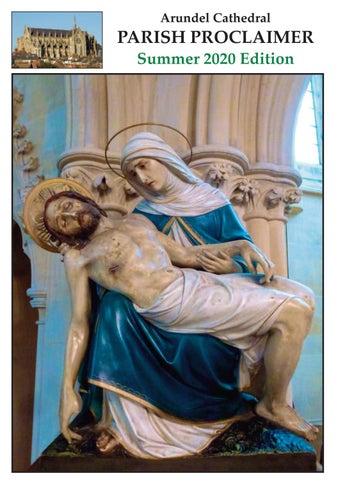
FRONT COVER Our Cathedral’s Pieta - a painted replica of the original sculpture in the Chapel of Santa Petrinilla, St. Peter’s - is situated close to the Baptistry. It was presented to the Cathedral in 1905 by the 1st Batallion of Prince of Wales Leinster Regiment. Photograph taken by Oliver Hawkins, reprinted with his permission.
The Parish Proclaimer is printed by Prontaprint Brighton & Hove - June 2020.
Welcome to our Summer Edition!
Lockdown Reflections By Canon David Parmiter
We have been blessed by sunshine recently, which is something to be thankful for during this period when our lives have been disrupted and we are not sure what the future may hold. Like many problems the virus has different aspects and will be far reaching, going beyond the period in lockdown, changing the way we live for some time to come yet. Probably, it will be a gradual process of releasing one set of safety measures after another as the risk of infection decreases and medical and scientific advances help reduce its impact. This situation is one that most of us would not have anticipated and not being able to get together to worship and carry out our usual activities as a Parish has been very disruptive. For me personally, having arrived last October and still getting to know the Parish and the Town I have had to accept that getting to know the people and the place will take place not only in a different way but in some respects has to go ‘on hold’ and develop more slowly than usual. What has been very uplifting is how people in the Parish and in the town have come together to help one another. Some of this effort has been organised on a collective basis and other parts of this effort has been done on a smaller scale. I am sure this has worked together well. Essential and key workers have been very impressive. The reflections that I have heard and read from those working in the health and care sectors have highlighted the value of human life and how much skill, care and effort goes into caring for those who are sick or at the end of life and for their families and friends. The ministry of healing has been very evident in these past few weeks. Although not all are able to recover their health the act of caring (given in many ways) brings healing to those who find themselves going to our heavenly Father and those who mourn their loss. In this I do not discount the value of prayer. To me this is a foundation, not only for my life, but for life in general. I see the prayer of the Christian Church supporting and upholding the activities of all those people of good will who love others according to the mind of Christ. So, the prayers of individual Christians are vital. To me prayer is light in darkness, like the sunshine we have been enjoying recently. You will have noticed that during the first few weeks of lockdown the streets were much quieter. I was hearing the birds sing, the wind blow (as it does round the Cathedral) and 3
the silence. Yes, the silence, I heard the silence. When all is silent, or nearly all, I sense that I can hear something. It is like being able to hear life itself. Not the busyness of life, but the sense of being alive and being part of something bigger that does not name itself yet is present. There is something present in the silence, and I would call that presence God. On a good day, the silence is love that can enfold you. I appreciate that not all feel this way and for many who are alone silence can become oppressive. It is a personal thing and, I admit, dependent on mood as there are some days when I need company and during the lockdown the radio has become a companion. But the re-discovery of listening could become important in post lockdown life. Many will have important stories to tell about life in lockdown and how the virus has affected them and their loved ones. Those stories will be on-going and the need for people who are able to listen with understanding and compassion will be great. May be the lockdown has taught me something about the value of listening, not just to the natural world and to the silence but also to others and most importantly to God. I make a note not to be ‘doing’ things all the time, but to listen. This is, perhaps, the ‘sunshine’ that helps us to see and understand more deeply. These are some of my lockdown reflections so far. That whilst it is true the virus has many and far reaching aspects, so to is our response, composed as it is in many ways which are all interwoven, but I believe are founded on the bedrock of prayer and good will. The silence we sometimes experience helps us to listen and understand, not only to those who need to share, but to the God whose presence is life and love. God bless you. ++++++++++++++++++++
Arundel Cathedral’s Website New content update Bryden Isbister has been busy in setting up a series of live streams on the website for viewers to ‘virtually’ attend Masses. The first stream featured Bishop Richard Moth celebrating the 5th Sunday of Lent on 29 March. Since then there have been an additional 19 streams, the latest one being Trinity Sunday. Everyone has the chance to see any of the streams by clicking on the ‘Arundel Cathedral Live Stream’ photograph on the home page that appears when you log onto www.arundelcathedral.uk Also available on the home page are various reflections written by Canon David, Bishop Richard’s Podcast, updates on coronavirus, the latest Weekly Newsletter and amongst other interesting features, you can see some amazing photos taken celebrating VE Day in Arundel. Alongside the home page there are nine other sections on the website covering different aspects of the Cathedral like the history, who’s who, music, parish life, magazine and the gift shop. On page 54 you can read some interesting stats about our website!
4
& * $%
% # #&
! 51 *'.2 916 8+5* 9163 3')6.#3 13 1%%#4+10#. %*13'4 #0& '33#0&4
!# !
& !&%$ % # #$ !# ! % " #% $ ' #$ # $ & # # "% ! $ #!$$ $% &$$ ) $
! % % !#
# (3'' '45+/#5' 01 %1053#%54 &'&+%#5'& 45#(( %.+'05 5'45+/10+#.4 23+%'4 (31/ : 2'3 *163
##* !# & * !" $ ! ! & * % # !&
((( & * % #
!&
"
"
4*122+0) *164'81323'4%3+25+10 %1..'%5+10 23'2#3+0) /'#.4 8#4*+0) #0& +310+0) *'.2 8+5* %133'4210&'0%' 5'# #0& %1/2#09 2#3%'. %1..'%5+10 13 2145+0) #0& 41 /6%* /13' 51 *'.2 916
" Chatelaine Boutique is set in the heart of the beautifully historic town of Arundel with its own castle and cathedral, river and breathtaking views. We are a stylish, upmarket dress agency that offers you a mixture of new and preloved top quality designer pieces... fashion that does not cost the Earth.
1 The Old Mill, River Road, Arundel BN18 9JR 01903 884350 sheila@chatelaineofarundel.co.uk www.chatelaineofarundel.co.uk
chatelaineboutique
888 *1/'/#+&*'.2'34 %1 6*1/'/#&'*'.2'34 ; 5=4 41 0+%' 8*'0 '$'%%# #0& *'3 5'#/ *#7' $''0 +0 51 %.'#0 *' *164' +40=5 ,645 %.'#0 +5 42#3-.'4 < 34 /+5* 360&'. ; '$'%%# .11-'& #(5'3 /9 /6/ +0 645+0)510 8*'0 4*' *#& '#3.9 104'5 &'/'05+# 1 10' %16.& *#7' .11-'& #(5'3 *'3 #09 $'55'3 8+4* 916 )3'#5 46%%'44 +44 3+))4 10&10
The Year of the Word By Jo Briscoe Worship of the Eucharistic Mystery: the intimate connection of ‘The Word’ and Holy Communion Within ‘The Year of the Word’ - The God who Speaks (our study and commitment of this year - which must also be ongoing thereafter) denotes the important connection to us all of the ‘word of God’ read within the Eucharist. The ‘word’ must always be respected and participated in, and this will lead us - body, mind, and soul - to our devotion and worship within the Eucharist and prove our gratitude for the Lord’s Communion gift which, to denote His great sacrifice for us, He has so lovingly given! There are special ways of achieving this, and I quote the relevant section of the Papal Encyclical entitled “Instruction concerning Worship of the Eucharistic Mystery”: “The Mass: The two parts which in a sense go to make up the Mass, namely the Liturgy of the Word and the Eucharistic Liturgy, are so closely connected that they form but one single act of worship. A person should not, therefore, approach the table of the Bread of the Lord without having first been at the table of His Word. Sacred Scripture is, therefore, of the highest importance in the celebration of Mass. Consequently, there can be no disregarding what the Church has laid down….” Within the Mass, Sacred Scripture is all embracing - from The Word is taken the readings, which are then explained in the homily, and the psalms that are sung. From Scripture the petitions, prayers and liturgical hymns receive their inspiration and substance. From Scripture the liturgical actions and signs draw their meaning. Even more, it must be said that Christ himself is present in His word, since it is He who speaks when Scripture is read in Church. The word of God constantly proclaimed in the liturgy is always a living and effective word through the power of the Holy Spirit. It expresses the Father’s love that never fails in its effectiveness towards us. The expansion of God’s word in time takes place above all in the Eucharistic celebration. Scripture itself points us towards an appreciation of its own unbreakable bond with the Eucharist: Pope Benedict XVI wrote in his ‘Verbum Domini’, “It can never be forgotten that the divine word, read and proclaimed by the Church, has as its one purpose the sacrifice of the new covenant and the banquet of grace, that is, the Eucharist. Word and Eucharist are so deeply bound together that we cannot understand one without the other: the word of God sacramentally takes flesh in the event of the Eucharist. “The Eucharist opens us to an understanding of Scripture, just as Scripture, for its part, illumines and explains the mystery of the Eucharist. Unless we acknowledge the Lord’s 6
reason the Church has always honoured the word of God and the Eucharistic mystery with the same reverence.” We all need to think more deeply about the Mass and what it means! True Christian discipleship is not primarily following after Christ, or imitating Him, but being in Christ, being immersed, plunged or inserted into the saving person and work of Christ Himself. It is in the liturgy within the Eucharist that this is made possible. The Holy Spirit is the Church’s living memory - it is because the Spirit is present in the Eucharist as the living memory of the Church that the Eucharist can be a memorial in the full sense of the word. The whole Eucharist is very much the work of the Holy Spirit. In the Liturgy of the Word, the Spirit ‘recalls’ all that God has done for us, awakening the memory of the Church and inspiring thanksgiving and praise. But the liturgy is more than this: because in each celebration there is an outpouring of the Holy Spirit, the saving events we recall are actualised - made powerfully present. The word, which comes down from the highest heaven, spoken in the heart of the Trinity, touches the densest part of our being, our body (through the concrete act of reconciliation). This is the course of the word. It unites heaven and earth. It is always necessary to ensure that the Word received, like a beam of light coming from the mouth of God, is truly incarnated. If the word is incarnated we will notice remarkable progress and are certain to see changes rapidly occurring in our life: • it is more ordered
!$
! # !!
41 ( !"/ $ #(+ !"
! &
.
.
* % #
!
! +
' " !%
$# " !
! # !+ $
& $ " . '# " " . % # . "# " !% # ! " * ! ! " . " !% # . !( . ! !#( #
#
& "
" ! $# # ##% ! -
!
$ !
!# !
$!% ( !"
". # & ! . " . #!$ #$! $ . # " . ! % & (" .
#
% !" " . # ! # ".
) , 12:14 993:15 . (, 18992 918596 . # , 18644 388272 , $ ! "0 " ! % # "- -$ &&&" ! % # "- -$
• greater clarity of the ideas and the acts accomplished all throughout the day • a stronger faith • a will that frees itself from slavery, and becomes more solid, firmer in the will of God • consolation and strength coming from the daily encounter with the living Christ and hearing him who speaks to us in our attentive silence and guides us in what we do • finally, staunch perseverance and resistance in life’s trials. In addition to this, it is good to note that one of the greatest advantages of lectio is simply the fact that our intellect is no longer at the mercy of the many thoughts jostling it; it has become disciplined, since it is nurtured by an intense light which illuminates it from the morning on and all throughout the day. Whatever way we receive communion, it is Christ himself that we receive, and it is important that we prepare ourselves for so holy a moment. The one hour’s fast before receiving communion - hardly a great inconvenience! - helps us to think about the meaning of what we are to do. Simple things like what we wear, how we participate, are meant to express ‘the respect, solemnity and joy’ of the Eucharist. What matters most, however, is our inward preparation, allowing our hearts, minds and lives to be purified, renewed and opened to the presence of Christ. When we come to Mass, to the Lord’s Supper, we join the apostles, the saints throughout the ages, and the Church throughout the world to be together with our Risen Lord, to listen to his Word, to share his life given to us and to open our lives to his presence. At this sacred banquet in which Christ is received, the memory of his passion is renewed, our lives are filled with grace, and a promise of future glory is given to us. The Eucharist is the ‘sacrament of love’ which revives our own love and which teaches us that all real love always involves listening, openness, sacrificial self-giving and sharing one’s life with another - all achieved by true preparation for the Eucharist. The Prologue to the Catechism ends with these words from the Roman Catechism of 1566: The whole concern of doctrine and its teaching must be directed to the love that never ends. Whether something is proposed for belief, for hope or for action, the love of our Lord must always be made accessible, so that anyone can see that all the works of perfect Christian virtue spring from love and have no other objective than to arrive at love. This applies in a special way to the Church’s teaching on the Eucharist and its guiding ‘word’. Once we understand the Eucharist in this way, it will be obvious why the Catholic Church emphasises so strongly that regular participation in the Eucharist is vital for maintaining and deepening our life together in Christ. It is through ‘The Word of God’ above all, that the Risen Christ is present for us, drawing us ever deeper into the mystery of his saving love, ever deeper into the life of the Living God: “The Church knows that the 8
Lord comes even now in the Eucharist, and that he is there in our midst”. In the words of Cardinal Basil Hume: “Every time we celebrate Mass all the suffering and agony of mankind is present. Through that offering, love, forgiveness and hope are in some way being given. Not just to this community round this altar but, like the pebble cast into the pond, the ripples go on and on outwards. So the Mass makes present that one complete Sacrifice of Christ, re-enacted through the consecrated bread and wine - the Body and Blood of Christ - transcending time and space, enabling us to be present at the foot of the cross, and close to the empty tomb. It is our earthly way of being involved in the great heavenly liturgy which is going on all the time. It is the Church’s most precious treasure. It must be ours! “Only God could devise what he has, in fact, devised, for every time the Mass is said the Sacrifice of Calvary is repeated. Every time you receive Holy Communion the life of the risen Christ is given to you. We witness two things: our gift to God, and the gift of God to us. It is Christ who gives himself to his Father, together with ourselves, and it is Christ who is given to us in Holy Communion.” It is so important for us to fulfil the will of God in the way He asks us. We need to show Him ardency within our personal need to listen to His word, which, in its planned and enlightening way, leads us to the personal satisfaction of proving our love and devotion through accepting His precious Gift of the Eucharist. Not just within the Year of the Word (during which we need to increase our worship and understanding), but always, let us really and truly prepare ourselves and let us respect the greatest Gifts from God - the Eucharist - necessarily combined with the actual Word of God to which we must commit ourselves within every celebration of Mass. ++++++++++++++++++++
To have eyes for the good things of the Lord is to live by faith, to see life with the eyes of faith. Cardinal Vincent Nichols
9
O Sacred Heart & Sweet Sacrament Divine The story of the person behind these hymns 1. Sweet Sacrament divine, Hid in thine earthly home; Lo! round thy lowly shrine, With suppliant hearts we come; Jesus, to thee our voice we raise In songs of love and heartfelt praise Sweet Sacrament divine. (sung twice)
1. O Sacred Heart, our home lies deep in thee; on earth thou art an exile’s rest, in heav’n the glory of the blest, O Sacred Heart. 2. O Sacred Heart, thou fount of contrite tears; where’er those living waters flow, new life to sinners they bestow, O Sacred Heart.
2. Sweet Sacrament of peace, Dear home of every heart, Where restless yearnings cease, And sorrows all depart. There in thine ear, all trustfully, We tell our tale of misery, Sweet Sacrament of peace. (sung twice)
3. O Sacred Heart, our trust is all in thee, For though earth’s night be dark and drear, thou breathest rest where thou art near, O Sacred Heart.
3. Sweet Sacrament of rest, Ark from the ocean's roar, Within thy shelter blest Soon may we reach the shore; Save us, for still the tempest raves, Save, lest we sink beneath the waves: Sweet Sacrament of rest. (sung twice)
4. O Sacred Heart, when shades of death shall fall, receive us ‘neath thy gentle care, and save us from the tempter’s snare, O Sacred Heart. 5. O Sacred Heart, lead exiled children home, where we may ever rest near thee, in peace and joy eternally, O Sacred Heart.
4. Sweet Sacrament divine, Earth's light and jubilee, In thy far depths doth shine The Godhead's majesty; Sweet light, so shine on us, we pray That earthly joys may fade away: Sweet Sacrament divine. (sung twice)
Fr. Francis Stanfield is well known for O Sacred Heart and Sweet Sacrament Divine, which he composed while he was Parish Priest at ‘the Actors’ Church’ Corpus Christi at Covent Garden in London. This was the first Catholic Church in this land to be dedicated to Corpus Christi after the Protestant Reformation and it was built in reparation for the sins committed against the Blessed Sacrament in those days and in the centuries that followed. Cardinal Manning opened the church on 20 October 1874 to reaffirm the beating heart of our Catholic life, the Mass, i.e. the earthly reality and presence of the Body and Blood of Christ. Corpus Christi Catholic Church is also the home of The Catholic Association of the Performing Arts (formerly the Catholic Stage Guild). Francis was born into a large family at Camden, London on 5 November 1835 with many brothers and sisters much older than him. His father, Clarkson Stanfield (1793 - 1867) was a famous landscape painter, a friend of Charles Dickens and involved in the theatrical world like Francis’ grandfather, James Stanfield. Francis’ mother, Rebecca Adcock (1808 - 1875) Continued on page 12 10
/%(3.(: 64(6/ ,4 &633(05.: &.14(' '6( 51 ! 46$. 12(0,0* +1634 $3( "('0(4'$:4 51 60'$:4 ,0&.6',0* $0- 1.,'$: 10'$:4 $.. :($3 3160' .($4( 45$: ,0 516&+ 7,$ 41&,$. /(',$ "(;7( %((0 4+$3,0* /(/13,(4 (9+,%,54 $0' 4513,(4 )31/ 5+( /64(6/ $0' 816.' .17( 51 +($3 8+$5 5+( /64(6/ /($04 51 :16 64,0* 5+( 5$* : /%(3.(:
3( :16 /,44,0* /%(3.(: "+: 015 *(5 &3($5,7( $0' 265 :163 5+,0-,0* &$24 10 )13 163 4(.(&5,10 1) $&5,7,5,(4 :16 &$0 '1 )31/ +1/( #16 &$0 ),0' 5+(4( 10 888 $/%(3.(:/64(6/ &1 6$-( 463( 51 4+$3( :163 $&5,7,5,(4 10 41&,$. /(',$ $0' 5$* 64 +( &633(05 4,56$5,10 +$4 4(3,164 ),0$0&,$. ,/2.,&$5,104 )13 5+( 64(6/ 41 8( $3( *3$5()6. )13 $0: 4622135 5+$5 :16 /$: %( $%.( 51 2317,'( ,0 5+,4 ',)),&6.5 5,/( 7,$ 163 645 ,7,0* $*( 63 &$/2$,*0 ,4 &$..(' (.2 /%(3.(: 64(6/ "( .11- )138$3' 51 8(.&1/,0* :16 %$&- 51 5+( (8 $30 1$'
64(6/ $4 4110 $4 8( &$0 3(12(0 $*$,0
/%(3.(: 64(6/ /%(3.(: ($3 360'(. "(45 644(9
"(%4,5( 888 $/%(3.(:/64(6/ &1 6(.(2+10( /$,. 1)),&( $/%(3.(:/64(6/ &1 6(*,45(3(' &+$3,5: 06/%(3
was an equally famous actress. She was the second wife of Clarkson bearing nine other children with Francis as the youngest. His first wife was also an actress, Mary Hutchinson. who had two children. Mary died soon after the birth of their second child and sadly in the 1850s the two children died. Clarkson Stanfield was born a Catholic and became increasingly devout in middle age after the tragedy of losing members of his family. He brought up the rest of his sons and daughters in the Catholic faith. Only two of his sons decided to become priests: Raymund and Francis. In 1861 Fr. Francis became Parish Priest for the Church of The Immaculate Conception and Saint Joseph in Hertford. Only two years before the foundation stone was laid by Cardinal Wiseman and a year later he opened the church, so Fr. Francis was the first resident priest! In the early 1880s Fr. Francis moved to Corpus Christi in London as Parish Priest where he wrote the two most well-known hymns. The hymns are quite a legacy, and not just for their devotional nature. They also make a connection between Corpus Christi and most of the Catholic Churches in the English-speaking world. Francis Stanfield died on 12 May 1914. It was somewhat fitting that with Fr. Francis as Parish Priest in the ‘Actors’ Church’, his parents and grandfather were actively involved with the theatre in Ireland and in London! ++++++++++++++++++++
The Late Monsignor Edward Browne A rather sad story by David Martin From 1945 to 1956, Monsignor Edward Browne was Head Priest overseeing the running and operation of St. Philip Neri church (now Arundel Cathedral). During that period I had become an altar server and undertook many such duties not only with Monsignor Browne, but also with the the other priests active at the time within the church. It was one particular morning however during my period as an altar server that a very sad and deeply distressful happening occurred with reference to above. I awaited the arrival of Monsignor Browne in the vestry and I was already in my vestments (Cassock and Cotter). This was approximately 6.45 am. The daily Mass would normally begin at 7.00 am. However, by 7.15 am Monsignor Browne had not arrived and I was getting a little worried. I then sought out the housekeeper who stated she would look for
12
him. Ten minutes or so later Monsignor Browne eventually entered the sacristy robing room looking particularly pale and slightly unsteady on his feet. “Hello David,“ he said, “Sorry I’m late, but I don’t feel too good, but I will be OK in a few moments.” For the next five minutes or so he just stood with his hands resting on the top of the vestment table. His breathing was heavy and laboured. “Is there anything I can do Monsignor?“ I enquired, becoming very concerned about his condition. I then asked, “Shall I get the housekeeper to call the doctor?” “No,“ he replied, “Just give me a few moments and meanwhile can you please go and tell the congregation (who were mainly Nuns) that we will begin Mass shortly and apologise for the delay.” At this point and before I could carry out his request, one of the Nuns attending for the Mass entered the sacristy to check on the situation. She, likewise, became very concerned. However, Monsignor ‘assured’ her that all was well, although it was very clear that his condition was of a worrying nature. By now it was approximately 7.30 am. Monsignor Browne had, by this time, struggled into his religious robes, with our joint assistance and he turned to me and said “OK David, I’m ready.“ We subsequently entered on to the high altar and proceeded with the Mass. He struggled painfully with the proceedings and after only five minutes or so into the Mass he stopped and leant heavily on the altar. His arms were quivering and his breathing heavy. What should I do? I was getting concerned and obviously so were the few parishioners attending the Mass. However, he struggled painfully on in his determination to finish the Mass, but it was not to be. Whilst approximately half way through, I was serving him the wine and water and he bent over and said to me in a very low voice “David, I will have to stop now and go to my bed. Will you please explain this to the congregation?” With that the Mass had come to an untimely end and I duly helped him back to the sacristy. After helping him to remove his religious garments, he turned, patted me on the head, thanked me, gave a little smile and disappeared slowly into his private quarters. Some days later, it was announced that he had sadly passed away. He was a truly remarkable man and well respected. As a foot note to this episode, my attendance as an altar server at this point in time, was to such an extent that I seemed to be never away from the church. Perhaps that was why, in retrospect, even up to the age of twelve years, I felt that I was possibly destined for the priesthood? However those thoughts were soon to be changed in a few years whereby my destiny was to be in a completely different direction.
13
Why do we regularly walk the Camino in stages? by Kitty Hooey
Kitty and Anthony walking Camino Francés for the second time: April 2019
My husband Anthony & I have walked the various routes of the Camino Santiago de Compostela almost every year since 2013. It has changed our lives. Many people walk the Camino Francés in one hit - St. Jean Pied de Port to Santiago - 800 km - in anything between 31 days and 6 weeks. We chose to walk for seven full days each time (+ 3 days travelling). We were working and could not afford more time off. For our first Camino Francés we walked in the spring and the autumn over a two year period to reach Santiago for the first time. Since then we have walked the various routes once a year - either spring or autumn - and each time we arrive in Santiago we feel a sense of spiritual homecoming. The Camino de Santiago, known in English as the Way of Saint James, is an ancient pilgrimage to the shrine of Saint James the Great in the Basilica of Santiago in north western Spain. We originally walked the Camino in thanksgiving and as we walked it helped to quieten the ‘monkey brain’ and helped us to think through some big decisions that needed to be made. Since then we have walked the Camino Portuguese from Porto to Santiago in twelve days 227 km. The Camino Inglés from A Coruña to Santiago in only four days - 73km. And we are now walking the Camino Francés once again. Continued on page 16 14
Is your answer ‘YES’ to any of these questions? Then we can help you!
Ɣ Confused by the array of pensions options? Ɣ Need to invest an inheritance or pension lump sum? Ɣ Worried about long term care funding? Ɣ Fed up with your cash ISA return?
Ɣ Ethical investment a concern? Call us on 0 1903 882007 Visit our website www.themellorpractice.co.uk Or drop in to our office 31 Chapel Road, Worthing, BN11 1EG The Mellor Practice Ltd is an appointed representative of Lighthouse Advisory Services Limited, which is authorised and regulated by the Financial Conduct Authority. The Mellor Practice Ltd, Registered in England, No. 10567558 Registered Office: 41b Beach Road, Littlehampton, West Sussex, BN17 5JA The value of your investments can go down as well as up, so you could get less back than you invested.
No No more more trips trips tto o tthe he tip. tip. Enjoy E njjoy g great reat benefits benefits A 240-litre 24 0 -l it re wheelie wh ee l ie b bin i n sspecifically peci fica l ly for for garden ga rden waste w a s te Conven ient kerbside kerbside collections col lec t ion s Convenient E mp t i e d e ver y ffortnight o r t n i g ht Emptied every F i l l iit. t. C lose iit. t. F or ge t a bout iit. t. Fill Close Forget about
Join today 0800 0858 286 greenwasteclub.co.uk *Offer closes 30/11 /20. New customers and first bin only.
* % 15 F OFF OF ODE CODE QUOTE C QUOTE A RISH15 PARISH15 P
Camino Francés - Meseta, large and expansive flat plains, September 2013
Why do we continue to walk the Camino in stages? There is a freedom from the everyday constraints of our lives as we walk in the fresh air carrying our every day needs on our backs, Rosary beads swinging in our hands as we start the day, not knowing where we will put down our weary bodies that night. The Lord will provide. The camaraderie amongst the pilgrims and walkers is one of friendly encouragement which sometimes leads to a lasting friendship on one’s return home. One hears the most amazing ‘Stories of Life' from others - sometimes almost like a confession. One learns to do with so much less - less food, less clothes, less talking. A common spirit is present and one is never lonely. One enjoys the NOW: just being together - sometimes talking, sometimes in silence. We enjoy the breathtaking views along the Pyrenees; the high plateau of the Meseta with its majestic vistas of the mountains in the distance; walking above the clouds on Alto de San Roque (1270m); the leafy walks through forests in Galicia; astonishment when seeing the ancient Celtic houses called Palloza for the first time; listening to the sounds of the birds and the bubbling streams we cross; seeing a large field filled with giant sun flowers all facing the same way towards the sun; and the pretty colourful Spring flowers along the way. One walks in the glory of GOD’s creation. It is a daily challenge to walk those distances day after day with a full backpack, but the feeling of self achievement - besides the bodily aches & pains - is so rewarding. I feel that continually walking The Camino in parts, the lessons I’ve learnt stay with me longer and are renewed each time I walk The Camino. And lastly as my friend Terry from New Zealand entitled his book: God’s Cocaine The Addiction of the Camino. It gets into your soul! I returned home a different person to that one who set out. Kurt from Leipzig said to me: 16
- If you pilgrimage to Rome, you discover the Pope. - If you pilgrimage to Jerusalem, you discover JESUS. - If you pilgrimage to Santiago de Compostela, you discover yourself. And so I have learnt to declutter my life both of possessions and of commitments - quality instead of quantity. The Camino has made me more at peace with myself and life. My favourite saying I found along the Camino: - I dreamt that Life was Joy. - I woke up and realised that Life was Service - I did Service, and I found that Life is Joy. Buene Camino.
Anthony & Kitty arriving in Santiago: May 2018
++++++++++++++++++++
Christian Meditation By Jim Edwards A lot of our Parishioners don't realise that a Meditation Group exists at our Crossbush Convent. Under normal circumstances, it meets every Tuesday evening at 7 pm. See below for more information. No church for ages, why not try meditating? For all those who go to church most Sundays, the sudden and complete shutdown of the churches in response to the Coronavirus pandemic must have come as a shock - for some, an enormous shock. And the clergy, like everyone else, are working on imaginative ways that they can offer support within these constraints.
17
So what can we do at home on our own to feel we are still part of a worshipping community? Well, one possibility is to watch the Mass via live streaming on your tablet or computer. And in addition, and perhaps surprising and initially unfamiliar, is to try Christian Meditation. Far from being a strange, ‘foreign’ custom, a simple form of meditation has been part of the Christian tradition right back to the early centuries, and even to Jesus himself. It just got rather lost in more recent times. For the last 50 years or so, the tradition has been revived, and there is now a World Community for Christian Meditation (WCCM) - ecumenical, and with a strong presence in the UK. WCCM recommends a short time of meditation - about 20 minutes - twice a day. The short version of ‘How to meditate’ is in the box below. But as long as you have Internet access, it’s best to go to the following website: https://www.christianmeditation.org.uk or http://www.wccm.org. There is a great deal of help, resources and information on these websites. As they all say, meditating is ‘simple, but not easy’. But, with practice and perseverance it will bring rewards, and perhaps a new dimension to your spiritual life. It’s for everyone young (including children!), old, new Christians and (really!) old hands, and those whose links to ‘church’ are at best tenuous. And, for all of us stuck at home, you become part of a very real, though invisible, worldwide Christian community.
Sit down. Sit still with your back straight. Close your eyes lightly. Sit relaxed but alert. Then interiorly, silently begin to recite a single word, a prayer word or mantra. We recommend the ancient Christian prayer-word "Maranatha". Say it as four equal syllables. Breathe normally and give your full attention to the word as you say it, silently, gently, faithfully and - above all - simply. The essence of meditation is simplicity. Stay with the same word during the whole meditation and in each meditation day to day. Don't visualise but listen to the word, as you say it. Let go of all thoughts (even good thoughts), images and other words. Don’t fight your distractions: let them go by saying your word faithfully, gently and attentively and returning to it as soon as you realise you have stopped saying it or when your attention wanders. Meditate twice a day, morning and evening, for between 20 and 30 minutes. It may take a time to develop this discipline and the support of a tradition and community is always helpful.
18
Losing You By Tony Hicks A warmth lingers where your hand found rest a warmth that was gently bred in your heart, Mournfully now it fades away for you have left like a candle guttering into the coming dark. Now softly I lay my hand where yours did lie and sense the precious fading warmth of you, And try to keep that warmth from growing old using my heart’s flame to strike yours anew. For even the very warmth of you is precious so far more precious than mere life to me, That such a sad loss would see you lessened as one missing wave shall diminish the sea. But my hand can feel your warmth no longer for that most fleeting moment is forever lost, For cruellest time has pulled the past asunder and the tempered stone has returned to frost. I grieve over the precious warmth that died but how shall I hold these memories of you, Your smile, your love, your burning bright eye I'm cursed that in their finding, I lose them too.
20
Andrew Brearley-Smith RIP 21 October 1928 - 1 January 2019
Anne writes... I recently read ‘The Dash’, a short simple poem by Linda Ellis about the importance of how we live and love, and how we spend our ‘dash’ between the dates we will find inscribed on our tombstone. Andrew’s dash followed his birth in Sydney, Australia in 1928 on 22nd October (there) but, as it happened, 21st October (here). So, two consecutive celebrations if he was lucky! His father was ‘in steel’ and involved with the construction of Sydney Harbour Bridge but, as a result of the economic downturn, decided to return to England with his family in ’31. With 6 million people unemployed here and no welfare state, life continued to prove difficult. However, an opportunity at ICI’s head office provided temporary respite until his father found his feet in the steel industry again. For the young Andrew, there was a succession of junior schools - Stockton-on-Tees, Ebbw Vale, Darlington, Harrogate, King’s School Harrow - as the family trailed his father’s employment, latterly as one of Lord Beaverbrook’s Directors within the Ministry of Aircraft Production. After being effectively bombed out of their home, then in Pinner, Andrew was safely squirreled away at Bloxham School in rural Oxfordshire for the duration of the War. Although used to seeing and, to some extent, experiencing hardship, Bloxham came as a rude shock. It was a distinctly Spartan lifestyle. Looking back, Andrew admitted it was very good for him; and it was not without excitement. He recalled the pupils being sworn to secrecy when Frank Whittle first conducted trials of his jet engine in fighter planes, using the airfield adjacent to the school. Heady stuff for teenage boys! Then there was the appointment of a young land Army girl to look after the small dairy herd at the school. It proved too much for the older boys. No details needed; but there was much amusement when her replacement, specially selected to avoid any further ‘distraction’, bewitched one of the bachelor housemasters. They were to ‘marry and live happily ever after’. In ‘43, Andrew was confirmed by the Lord Bishop of Oxford. Perhaps it had not quite dawned upon his parents, one from a staunch Methodist family and the other from a strict 21
Victorian family observing Chapel twice on Sundays (with family hymns in the evening) that Bloxham was a high Anglican church school established in the 1800s for the sons of the clergy! (Had they lived, they would have been even more surprised, long after we were married, to learn of his becoming a Roman Catholic!). As a chorister, organist, sacristan and prefect of Chapel, the Chaplain thought Andrew must be destined for the Church. However, Andrew harboured no such ambitions. The school cadet force, then compulsory, had long enticed him with thoughts of the Army well before he joined it in the middle of the ice-cold winter of 1946/47. The few months between leaving Bloxham and enlisting at Sandhurst were not spent idly. No such luxury as a ‘gap year’in those days. His parents thought it wise to keep him well occupied and arranged for him to attend a short apprenticeship as a metal machinist in the workshop of a large motor company in Camden Town, then a somewhat sleazy rundown suburb of London. To counterbalance this, and compensate for Andrew’s want of social grace, his mother enrolled him in weekly ballroom dancing lessons. I can vouch for the fact that he learned more skill at the lathe than at the foxtrot. Come the day, all arms training and academic studies at the Royal Academy, Sandhurst were swiftly followed by training at the (now Royal) School of Military Engineering which, for the duration of WW2 and immediately after, had moved to Ripon. Weekends allowed Andrew to take advantage of instructors from the RE Flying Club and a nearby airfield to learn to fly a glider. The machine was primitive, an SG trainer with wings over a single keel, one seat, no fuselage and no instruments - just a joy stick and rudder bar at one’s feet. Exhilarating! Less ‘exhilarating’ on returning from one of these jaunts was the result of seriously misjudging a sharp bend on a motorcycle, skidding and sliding into a heap alongside a petrol pump, of all things! Three weeks in York Military Hospital and charges - for damaging an Army bike while not on duty and driving at a danger to the public - made for an object lesson. Andrew had already been posted as a Troop Commander to 36 Army Engineer Regiment in Kent before having to ‘face the music’ at the Magistrate’s Court in Harrogate. The silver lining in this rather expensive episode (no travel warrant permitted) was that it allowed him to reconnect with a very pretty nurse! Andrew was always one to look on the bright side of life. 36 Army Engineer Regiment, established to undertake major works projects, had been tasked with building a 1,050 foot Bailey bridge over 5 piled piers 60 feet over the Thames, to access the Festival of Britain site on the South bank, upstream of Hungerford railway bridge. Andrew was in charge of the advance party to procure all the plant and equipment for this project: there is no evidence that he was in any way responsible for a section of bridge falling into the river! Life seemed very dull after returning to barracks in Kent; but by the mid 50s, Andrew was 22
in Egypt, during which time he took a detachment to sea for 6 months with a Royal NavyAmphibious Squadron in the Mediterranean and Red Sea. A training mission in central Africa was followed by a secondment in Southern Rhodesia. Then Christmas Island, as Adjutant of 38 Engineer Regiment overseeing the construction tasks for the British atomic test site in the Pacific, together with planning and implementing the personnel safety scheme for 5000 men (and 2 women!) during the H bomb test. Frantic reports about life surrounded by land crabs and the difficulty of burying anyone who had the temerity to die out there. Back in the UK, a year at Joint Services Staff College was followed by three more as a Major in Training Brigade Headquarters throughout the UK and, thereafter, two years as Officer Commanding an armoured engineer squadron back in Germany. His first appointment as a Lt Colonel was spent at Headquarters British Forces Near East in Cyprus. Tales, many best left unrepeated, were regaled about VIP visits (Secretary of State, Peers of the Realm, MPs and C-in-C liaison with Ambassadors and High Commissioners throughout the Near East). Busy, but lovely too, with time to teach water skiing and enjoy the delights of Happy Valley. As the 60s turned to 70s, Andrew took command of the newly formed 73 Engineer Regiment prior to his appointment as Chief Instructor of the Field Engineer School, Royal School of Military Engineering at Chatham, a position which he particularly relished. An OBE came up with the rations in ‘72, and as a Colonel, he rounded off his military experience as Assistant Adjutant General in the Ministry of Defence, Personnel Branch. Andrew loved being in the Army. He was incredibly proud of his regiment and his men. When able to recall his dreams, they invariably always went back to that episode in his life; and he loved to regale lunch/dinner guests with amusing tales (and occasional mishaps) whilst serving Queen and country. He was gregarious and a very generous host and, like most men I suppose, assumed the responsibility of selecting a pleasing wine to accompany our meal. Our supply is stored in an under-stairs cupboard accessed from our kitchen. It is a handy hide-away but, with its perilously low lintel, not exactly user-friendly. Andrew always maintained that if the alcohol didn’t kill him, getting to it probably would. Being wheelchair-bound in his later years did not deter him one jot. He spent a few weeks on the dole after leaving the Army in 1976 before his second career as Director General of a charity now known as Action Medical Research. The charity had been founded midst the polio epidemic in the early 50s but had widened its remit, supporting both medical and bio-engineering projects into other long-term crippling conditions. At the time, it was struggling a bit. Whilst the transition into civilian life and, in particular, managing a predominantly female staff was daunting, the challenge was appealing and the nature of the research held a fascination. Andrew’s drive and sense of
23
order ensured the charity was soon in better shape. His commitment and integrity enhanced its reputation. More than once he courageously turned down the offer of a much-needed large donation because of the potentially compromising strings attached. It was not long before he joined forces with three other charity bosses to found the Association of Medical Research Charities, originally set up as a ‘talking shop’ to discuss issues of mutual interest, set standards and agree best practice. He later chaired this Association, always keen to ensure that within the initial group of members, the smaller research charities were not totally swamped by the ‘big boys’. It was typical of him. It was the extent of the collective funds which these charities made to the medical research field which fuelled the need to establish the organisation on a formal footing, complete with a proper secretariat. Only then could it represent the voluntary sector to government more truly and with more muscle. Andrew chalked it up as one of his major achievements to have been a key player in spearheading this development. Some 30+ years further on, the Association’s membership is now c140, responsible for some £1.3 billion, and more than 40%, of all publicly funded medical research in the UK. His appointment in the charity also led to membership of the Snowdon Award Scheme and, somewhat later, to being invited to serve on The Prince of Wales Group on Disability. Coming from his background in the Army, Andrew did not tolerate idleness or insubordination. There was a famous occasion during a restructuring exercise in the charity (he had a penchant for these) involving both building works and personnel, when one truculent member of staff refused point bank to vacate his office and move elsewhere. The impasse was resolved when Andrew had a quiet word in the builder’s ears and the said member of staff returned after his weekend to find that two walls of his office had been completely removed, leaving him open-plan to the main stairwell. Andrew was attracted to situations, however precarious, where he felt he could make a difference. He was not afraid to be bold or tenacious. When he was invited to join the board of governors at Handcross Park School in the 80s, the school was not thriving. There is no doubt that his involvement and subsequent leadership as Chairman of the board at least sowed the seeds which led to it blossoming into the school it is today (awarded 2019 Prep School of the Year). He regarded the turn-around in the school’s fortunes as a terrific achievement, made all the more fun by being able to rekindle his great love for building projects whilst there. The walls of our study at home were always festooned with architects’ drawings of one sort or another. If you have read this far, you deserve a medal for perseverance!! Those of you who knew Andrew will know how much he valued his faith, treasured his family and loved his home. Together, they were his anchor in life and sustained him, in 24
particular, when declining health meant that he gradually had to let go of many activities which he enjoyed post retirement. Golf, woodturning, choral singing and gardening required physical stamina he could no longer muster. Flying, which he took up at the age of 80, had to be abandoned when he was unable to clamber into the cockpit of his Piper. Over time, he became increasingly housebound with even occasional trips to the theatre and regular attendance at church impossible to manage. He rarely complained and was incredibly brave. I lost count of the times he was whisked away in an ambulance with blue lights flashing (actually he did complain then!). Like an expectant mother, I always kept his bag packed. It is a mark of his resilience and zest for life that during his last month, he enjoyed two long lunch get-togethers (one with his 91 year-old and dearest Army friend from Sandhurst days) and told daughter Jane over breakfast one morning that ‘Life is great’. He was taken into St. Richard’s just days later. He died peacefully in the very early hours of New Year’s Day amid the global celebratory fireworks. His ‘dash’ of 91 years concluded. I am so grateful to Canon David for visiting Andrew and thankful that so many members of our family and friends were able to spend time with him during those last precious days. I have an abiding memory of three of our younger grandchildren standing by his bed on New Year’s Eve, saying their good-byes and giving him a loving, and well-deserved, farewell salute.
Andrew (91 years) with great grandson Cyrus (6 months)
I feel I have been enveloped by love and prayer as I cared, and now grieve, for Andrew. I thank all of you who have shown such kindness. It will not be forgotten. Among the many messages, the following prayer touched my heart profoundly. It stays with me: and I offer it here, given the uncertainties of the pandemic which challenge us all. Lord, help us to gather our strength in difficult times so that we can go on living, believing in the meaning of future days. Be so good as to give us that hope. Be so good.
25
Walking with Jesus By Fra’ Ian Scott The following feature appeared in the 20 May 2005 issue of The Catholic Herald. Fra’ Ian Scott says Arundel's Corpus Christi celebrations evoke the May ceremonies of pre-Reformation England. The unprecedented worldwide interest in the death and funeral of the late Holy Father demonstrated in unmistakable terms that non-Catholics as well as Catholics are interested and intrigued by the Church, its message and its liturgy. It is therefore particularly appropriate that there has been a revival of Corpus Christi processions over the past few years, partly due to the encouragement of Pope John Paul II and the present Pope, and the fact that this year had been designated the Year of the Eucharist. The great Feast of Corpus Christi was first instituted in 1230 by the Blessed Juliano, who had a vision of the Blessed Sacrament. The Feast was confirmed in 1264 by a Bull of Pope Urban IV. In the 14th century the Feast became universal and, after the horrors of the Black Death in 1314, an increasingly richer cult of the exposed and reserved Eucharist unfolded across western Europe, emphasising extra-liturgical eucharistic worship. In the 14th century arose the Corpus Christi procession. On the Corpus Christi Feast, the host was first covered up in the pyx but later was uncovered in a "crystal-pyx" or a monstrance (ostensorium) and paraded through towns, villages and fields. This procession, which became one of the most popular festivities of the medieval and more modern Church, was surrounded with even greater pomp, as well as entertainment: mountebanks, mendicants, jesters and jongleurs thronged the streets and hung on to the procession by its coat-tails. After all, May is the "merry month" and associated with maypoles, dancing and general jollity. Inevitably, this was all swept away at the Reformation, to the great distress of the average Englishman, who, as Eamon Duffy points out in his book The Stripping of the Altars, was devoted to all the customs, rituals and jollification of the Old Faith. As someone once said: "Before the Reformation, Christianity was perceived as being enjoyable." After Catholic Emancipation there was a significant revival of interest in the customs of the Middle Ages. Encouraged by the spirit of 19th century romanticism, the novels of Sir Walter Scott and the great Gothic revivalists, the time was right once more for the restoration of the old ceremonies and festivals. Noblemen such as the 3rd Marquess of Bute and the 15th Duke of Norfolk felt that it was their duty to reinstate the Church festivities Continued on page 28
26
#80# .0'4 2# &'0# *-,% "'12 ,!# 20 ,1$#0 !-+. ,7 3,"#02 )',% '0.-02 1# .-02 !'27 ," -2� + (-0 "#12', 2'-, 5-0) $-0 -4#0 2#, 7# 01 # 5#*!-+# -2& .#01-, * ," 31',#11 !*'#,21 -, - 0" # -$$#0 2&# ""#" -,31 -$ . 7',% -,*',# -0 ', 2&# 4#&'!*# 31',% ,7 + (-0 "# '2 -0 !0#"'2 ! 0" .0'-0 2- 7-30 (-30,#7 - 5� '281 20'. 2- 2&# '0.-02 1# .-02 0 '*5 7 12 2'-, 2&# 20# -0 2 )',% %0-3. -$ .#-.*# 2- 5#""',% *-! 2'-, !-0.-0 2# #4#,2 -0 +31'! $#12'4 * " +1 '0.-02 01 5'** # 4#07 %* " 2- &#*. 7-3
$ 0#/3'0#" 5 2#0.0--$ *3%% %# 20 '*#0 $-0 #620 *3%% %# -0 1)' #/3'.+#,2 ! , # .0-4'"#" # .0'"# -301#*4#1 -, 2&# !312-+#0 0#!-++#," 2'-,1 5# %#2 $0-+ 2'+# 2- 2'+# 1- 7-3 ! , # 1130#" -$ -30 2-. /3 *'27 1#04'!# 7 %-',% -32 -$ -30 5 7 2- &#*. 7-3 -, 7-30 5 7 &-'!# -$ 1 *--, ," #12 2# ! 01 .*31 , 1# 2#0 ** '0 !-,"'2'-,#" $3**7 ',130#" ," + ',2 ',#" 2- &'%& 12 ," 0" $-0 *-! * 20 4#* -0
1# 2#0 4#&'!*# ! , # .0-4'"#" 5'2& 0# 1-, $-0 *-! * , 2'-,5'"# 30-.# , 20 4#*
*# ,-2'!#
&'*" 1# 21 7-3 .0-4'"# ," 5# *--) $2#0 ** "0'4#01 &-*" !300#,2 0# *'!#,1#" 5'2&
', 11#,%#0 0 ,1.-02 2'-, ," 03, '120'!2 -3,!'*
30 "0'4#01 5'** +##2 7-3 ',1'"# 2&# 2#0+', * 3,*#11 "4'1#" "'$$#0#,2*7 7 7-3
- --)
4#&'!*# .*# 1# ! ** -0
*2#0, 2'4#*7 .*# 1# 4'1'2 555 " +1 '0.-02! 01 !-+ 2- 31# -30 -,*',# 0#1#04 2'-, ," . 7 7 7 * "# '2 -0 !0#"'2 ! 0" -3 ! , *1- 0# " !312-+#018 $##" !) $0-+ -30 5# 1'2#
for the benefit and instruction of their families, retainers and tenants. Henry, the 15th Duke, revived the Corpus Christi procession in 1883 and old photos show the tremendous crowds that came to look and participate. In his youth, the Duke had seen the impressive carpets of flowers laid in the naves of continental cathedrals and he had the brilliant idea of persuading the good women of Arundel (in England) to do the same. This they have continued to do with even greater success than their continental cousins, having at their disposal all the profusion of flora that this beautiful country of ours puts forth in the month of May. The enthusiasm for this festival continued unabated between the wars but sadly, after Vatican II, the old habits were often actively discouraged and began to fade away. As one wise woman in Arundel put it, "at the slightest sign of a cloud, the Bishop clapped his hands and gleefully cancelled the procession". The late Holy Father had a great affection for the Feast of Corpus Christi and this is shared by his successor, Benedict XVI. The Feast of Corpus Christi falls on May 26 (2005) and in the charming medieval town of Arundel, in West Sussex, a procession of the Blessed Sacrament will take place after High Mass at 5.30pm in the Cathedral of St. Philip Howard. Each year the symbolism on the carpet of flowers changes. This year the merry wives of Arundel have woven references to the Holy Eucharist as well as to the 40th anniversary of the founding of the diocese. The side chapels of the Cathedral - built in French decorated Gothic-style in the 19th century by Charles Aloysius Hansom, inventor of the Hansom cab - are also filled with spectacular displays of flowers. The procession winds its way along the narrow streets, escorted by the clergy, the Knights of Malta and the other Papal Orders. It then arrives at the spectacular castle, seat of the Dukes of Norfolk, Earl Marshals of England. Here, in the massive quadrangle of the castle, at an altar specially constructed for the occasion, Benediction takes place, surrounded by flowers and amid clouds of incense. The procession then returns to the cathedral. The name of Howard has been a constant motif in the history of England since the 14th century. Catherine Howard, Henry VIII’s fourth queen, was beheaded and her stepgrandson, the fourth Duke, met the same fate in the reign of Queen Elizabeth. A Flower Festival bedecks the nearby Fitzalan Chapel, the necropolis of the FitzalanHoward family where so many famous scions of this great family lie, from May 25 to 30. The Arundel Corpus Christi Festival is one of the rarest and most colourful pageants in the Church calendar and is, by any reckoning, a unique event in England's green and pleasant land.
28
2005 Carpet of Flowers
This year, once again, the people of England will find that, despite the sometimes active discouragement of those in authority, they love their feasts and they love their processions and they are determined to maintain this glorious piece of Old England. They used to sing an old carol, whose words are highly symbolic as well as strangely beautiful, combining both the drama and the mystery of the Eucharist itself. Its music makes a fitting conclusion to a visit to this extraordinary occasion:
Corpus Christi Carol Lully, lullay; lully, lullay: The falcon hath borne my love away. He bore him up, he bore him down; He bore him into an orchard brown. In that orchard there was a hall, That was hanged with purple and pall. And in the hall there was a bed: It was hanged with gold so red. 29
And in that bed there lieth a knight, His wounds bleeding day and night. By that bed’s side there kneeleth a may, And she weepeth both night and day. And by that bed’s side there standeth a stone, Corpus Christi written thereon. Editor’s note: Thanks to Dan Hitchens, editor of The Catholic Herald, who helped me with details of a contact, Philippa Leslie, Communications Director of the Order of Malta , who in turn managed to get the approval of Fra’ Ian Scott for featuring ‘Walking with Jesus’ in our parish magazine. ++++++++++++++++++++
A Tale of the Unexpected By Patrick Burgess Here at the Cathedral, we have got used to seeing St. John Ambulance posted by the tower to care for those visiting us to see the Carpet of Flowers. And we have seen Knights of St. John in the Order of Malta walking in the Corpus Christi Procession, on the route of which, by the way, we pass a notice in the grounds of the Priory explaining that it is managed by the ’Orders of St. John Care Homes Trust’. Maybe on your way to the celebration you passed one of our local St. John Ambulance stations, in Worthing, Littlehampton, Bognor or Chichester. It’s just possible that you know that embedded in one of the old houses of Poling village is the medieval building of one of the earliest Commanderies of the Order of St. John in England. How has all of this come to be? The story starts with a monk in Jerusalem - Blessed Gerard - founding a hospital in the buildings of the Byzantine church of St. John the Baptist, close by the even more ancient Church of the Holy Sepulchre, soon after the City had been captured by the First Crusade. People gathered round him - nobles who had come with the Crusade - and formed themselves into a body, or ‘Order’, devoted to the service of the poor and the sick, yet also prepared to act militarily to protect pilgrims visiting the Holy Land. They took vows and lived by a Rule but the guiding principle was that, whatever their elevated station in life, the members of the Order must regard the poor and the sick as their Lords and Masters. Thus began the Johannine tradition of chivalric service. Then fast forward if you will to 1291, when the Kingdom of Jerusalem fell. The Knights of St. John - by then very powerful, and augmented by a considerable part of the wealth of Continued on page 32 30
the Knights Templar, who had been disbanded earlier in that century - followed the exiled King to Cyprus. When that monarchy fell, the Oder took over for itself the island of Rhodes. A brave and hard but unsuccessful battle with the Turks, who were just over the water in Asia Minor, sometime later resulted in them moving to Malta and fortifying that island, just as they had Rhodes. And just as at Rhodes, the Ottoman Empire eventually laid siege to them there. But by extraordinarily heroic efforts, the Turks were soundly defeated and the Order continued in command of Malta - its sovereign territory - until, in the chaos of the Napoleonic Wars, the French Emperor persuaded the Pope to disband the Knights of St. John and expelled them from the Island. Through all this time the Order had continued with its knights in religious vows - it was as much a religious order as a straight up and down order of chivalry and it continued to follow the precepts of Blessed Gerard in its members’ charitable work. At this point in the story we need to break off and jog back to the Reformation and, first, to England. There, in the course of the dissolution of the monasteries, the English branch of the Order (the different nationalities were called ‘langues’) was abolished and its buildings all round the country were sold off, while its Priory Church in Clerkenwell was, partly demolished, turned into a parish church. When Mary came to the throne she restored the English Langue, but her sister Elizabeth, while not closing it down formally, let it fall into desuetude. Nonetheless, individual English Catholics continued to join the ranks of the Order abroad. After the French Revolution and all the subsequent disturbances in Europe, a number of French Knights of the Order came to England and began to pursue their charitable works here. They developed the idea of being the first to get help to the injured and sick - ‘first aid’! They caught the eye of various grandees in the City of London and of some junior members of Queen Victoria’s family. Victoria’s daughter had become the Empress of Germany (where another Langue of the Maltese Order had been separated from its stem in the wars of religion and was leading a life of its own, though in the same Johannine tradition but as a Protestant order). Thus it came about that Queen Victoria decided to found the Venerable Order of St. John in the United Kingdom as an Order of the Crown incorporated by Royal Charter, with its own knights and ladies and with her and her descendants as its Sovereigns. It was to act as the guardian and leader of the by then well-established St. John Ambulance Brigade. Subsequently, in recognition of the courage of its members especially in wartime, the ‘Most’ was added to the ’Venerable’ in its title. Early on it was able to acquire the remains of the old monastic buildings in Clerkenwell (and the Priory Church and the museum are very well worth a visit). The Most Venerable Order now has more than 300,000 volunteers in St. John Ambulance and some 20, 000 in the various ranks of the Order spread across forty-one countries and 32
(originally established under Queen Victoria’s patronage) runs the famous St. John Eye Hospital in Jerusalem. This year, in England, they have been the principal provider of the volunteer staff at the new Nightingale Hospital in east London. The Order of Malta operates all round the world with 80,000 members and volunteers working in disaster areas and refugee camps as well as running hospitals. In England it is headquartered just by the St. John and St. Elizabeth Hospital in (no coincidence!) in St. John’s Wood. At the centre of Jerusalem in the late 19th century, Victorian members of the Most Venerable Order also purchased a large piece of land - the Muristan - on a spot just by the original church of St. John. There, in the sight of the Holy Sepulchre, the Most Venerable Order and the Sovereign Military Order together minister to the poor and afflicted - right in the centre of the Holy City. Things have almost gone full circle! In the last thirty years the Orders of St. John - the Sovereign Military Order of Malta, the Most Venerable Order and the German -based Johanniter have drawn closer together with shared projects (like our Priory in Arundel) around the world and shared international liaison meetings. The Order of Malta is Catholic, of course, the Johanniter are largely Lutheran but, as a State Order in England, the Most Venerable Order, while retaining the tradition that its senior members must be practising Christians, is ecumenical in its outlook and in its membership - indeed at the moment its two most senior Officers after the Queen and the Duke of Gloucester are Roman Catholic - myself as Chancellor and Professor Mark Compton as Lord Prior - as are a large number of the volunteers in St. John Ambulance. Most important of all, through this nearly one thousand years of tumbling history, members of the Orders, remembering their founding vocation, still call each other ‘confrere’and ‘consoeur’and continue to work for the relief of the poor and the sick and afflicted of every creed and colour, all round the world. As the Latin motto says what they are and what they stand for: ‘For the Faith: for the Service of Humanity’.
33
Offertory A chance to support your parish online Canon David is very grateful for those parishioners who have been in touch to arrange standing orders, gift aid and have also sent in cheques and cash. The Diocese has launched an online ‘parish offertory support’ campaign. Please visit https://www.justgiving.com/campaign/parishoffertory The money you donate will go in a central Diocesan pot, so it is very important that when you donate, you also name the Parish - Arundel Cathedral - or Canon David as your Parish Priest. This will ensure your donation will come to the parish and not to a different one. Our churches across the Diocese depend on cash donations for 50% of their income on average. At this difficult time, when we’re unable to attend Mass in church, you can support your own Parish by donating your offertory online via the link above. Thank you. ++++++++++++++++++++
First Holy Communion Group By Betsy Vernon, Lead Catechist The Poor Clare Sisters at Crossbush in our Arundel Cathedral parish, have a very special relationship with our Arundel catechists and the yearly First Holy Communion Group because annually as part of the preparation for the sacraments of Reconciliation and First Holy Communion, the group of children and their parents or grandparents visit the Poor Clare Community for an explanation and experience of the religious life of the Poor Clare Sisters, what they do plus the history behind this enclosed order. This year on 20th February, as you can see from the photographs taken, we had a beautiful, spiritual and uplifting experience that Sr. Graça led and prepared in a Taizé style of prayer and reflection in their striking chapel dedicated to both St. Claire and St. Francis of Assisi. Twenty-one families attended plus Carmel and Betsy (unfortunately Stephanie was away visiting her son in the Caribbean). I know all the families came away prayerfully, uplifted and calm, understanding much more about the work of the Poor Clares Convent. Thank you Sr. Graça and the Poor Clare Continued on page 36 34
+ 4'"# / +%# ,$ / +"0 )'(# 2/ 0&)#6 '+!#+1 )#5 +"#/ 2/)'+%1,+ /" ) !(4,," +" * +6 *,/# /,)'+# /( ))'0 & 3# ,1& ##+ '+ 1&# 20'+#00 $,/ ,3#/ 6# /0 &#)-'+% 1, /'+% 1&#'/ !201,*#/07 '"# 0 1, )'$# $,/ +#4 ),,( 1, 1&#'/ 1&/,,* 0&,4#/ /,,* 4#1 /,,* ,/ !), ( /,,* ,*# 2- 4'1& 1&# -) + 6,2 4 +1 +" 1C)) !,*# !( 4'1& .2,1# 1& 1 4')) # 1 1&# /#01 '1& -#!1 !2) / )# ,+ /'%&1 +,4 1&'+( 4& 1 1 ! + ", $,/ 6,2 1&'0 6# /
$
'%& 1/##1
/2+"#)
444 /2+"#)
#01 200#5
1&/,,*0 !, 2(
,) ;%2 -7 8,) 4)6*)'8 &%7) *36 869) *33( (6-2/ 03:)67 '%780) :-7-8367 (3+ ;%0/)67 6%') +3)67 %2( %28-59) )28,97-%787 2 -22 692 &= 4)340) ()(-'%8)( 83 +33( *33( ;%61 ,374-8%0-8= %2( 4)6732%0 7)6:-')
>
#?
'37= %6)% ;,-', '%2 &) '968%-2)( 3** *631 8,) 6)78 3* 8,) 6)78%96%28 7)%8-2+ 94 83 (-2)67 %6392( % 7-2+0) 8%&0) -2:-8-2+ =39 83 )2.3= 8,) *%&90397 6-8-7, *33( -2 8,) )<'097-:) '314%2= 3* =396 3;2 +6394 *8)62332 8)% -7 %:%-0%&0) %2( ;) '%2 36+%2-7) =396 3;2 92-59) %*8)62332 8)% ')0)&6%8-32 ,%14%+2) ,3'3,30-' 36 "-28%+) )2 -+,8 ;,%8):)6 =39 ;%28 ;) %6) ,)6) 83 -274-6)
! 96 63317 %6) 4%6)( &%'/ 78=0) ;-8, ,32)78 '6)%896) '31*3687 )<')00)28 1%886)77)7 *-2) 0-2)2 7,))87 &%8,63&)7 70-44)67 %', 6331 -7 (-**)6)28 8%/-2+ 8,)-6 2%1)7 *631 8,) 03'%0 '39286=7-() 6-:)67 %2( 4)%/7
# 378 =396 ;)((-2+ %2( 36 =396 *92'8-32 -2 740)2(396 ',%61 #) '%2 463:-() 8%-036 1%() 4%'/%+)7 83 79-8 =396 :)6= 74)'-%0 3''%7-32 6)78%96%28 4)340) &9**)8 4)340) ):)2-2+ 6)')48-32 %2( )<'097-:) 97) 4)340)
! ;;; 7;%2%692()0 '3 9/
' &# (!
% ' !'(%+ % &' (% !' ! %"" & "! " ' " &' ! %(! ) %+' ! & " ! "(% & ! ! "%! ! " & ! & ! ' %!""! ' & ! ( ! ! "'' %
! ,& & ! !"*! * ") % "" $( '+ " "" ! (& ! '% ! % & " #%" (
"(& & &* % '
' "!
"( ! ! (& ' %% !' '% ' %(! # "!
&
&
!'(%+ "% % # &
Photos taken by Betsy Vernon with the approval of the parents.
Community for inviting us to share your tranquil setting and chapel. A spiritual haven in our parish.
STOP PRESS Adam and Betsy Vernon started a Zoom Coffee Meet Up at 10.30 am each Sunday and before the 11.15 am live streaming of the Mass from Arundel Cathedral. All are welcome - just check the Cathedral’s latest newsletter each week to get the code and password and Adam and Betsy will invite you to join. Say ‘hello’ visually to all our parishioners and have a chat! ++++++++++++++++++++
A Prayer for Catechists Lord God, source of all wisdom and knowledge, you sent your Son, Jesus Christ, to live among us and to proclaim his message of faith, hope, and love to all nations. In your goodness bless our brothers and sisters who have offered themselves as catechists for your Church. Strengthen them with your gifts that they may teach by word and example the truth which comes from you. We ask this through Christ our Lord. Amen
36
2&(*34&2&% $)"2*48 7)03& "*. *3 40 &/$052"(& 4)& 53& "/% "112&$*"4*0/ 0' 4)& "4)&%2"- )52$) 0' 4)& *0$&3& "/% 40 1206*%& '*/"/$*"- 3511024 '02 *43 ."*/4&/"/$& "/% &/)"/$&.&/4 &$0.& " .&.#&2 "/% 805 7*-- &/+08 "//5"&6&/43 -*,& )& 2*&/%3; %6&/4 &31&23 2*&/%3; "33 &"34 0' 4 )*-*1 07"2% +0*/ */ 30.& !02,*/( "24*&3 5..&2 &-"4*0/3 30$*"- &6&/43 7*4) 04)&2 2*&/%3 0' 25/%&- "4)&%2"- 1-53 805 7*-- 2&$&*6& : 02/&2340/&; " #* "//5"- /&73-&44&2 //5"- &.#&23)*1 &&3 2*&/% 9 *'& &.#&2 9 0*/4 2*&/%3 9 02102"4& &.#&2 9 "420/ 9 )*3 *3 0/& 1"8.&/4 0/-8 '*% +++ '*%
)! '" % ( #
)!
) &%%
) &$
' # '" % ( &'
)"2*48 0 0.1"/8 0 /(-"/% -*.*4&% #8 (5"2"/4&& )"6*/( /0 3)"2& $"1*4"-
' (*' $#( $#0) ( "%!. *) )' ( $,# $#( ' ) !) $ ) )' # , ) ( () $' ) , ) #. ' ' ( '+ ) $# ' '( # ) # ( $ )( $,# ' $' , " #. ' $"" # ) $#( % ') '$" () # ' )' ,$' (* ( ' "$+ ! ' ( # $' !$, ' # $ ) '$,# %'*# # # ' # ' "$+ ! , $ ' ( + ' ! ' # ( '+ ( ' &* ! ()( $*# ! # #(*' #
+
) $# ! '$ / " %* ! !
" #. )' (*' $#( , ' $*' ' # , () !$ !!. ) (% %! #) ' ( *() $*)( $ $*' $,# $%% ,$$ ! # (*%%!. ' ,$$ # *( $#
$$
# . ! ).
. ! "$() $ ! () ' . ! #
'*# ! # '$" , '
+ ,
!! (%
)( $ $ )*"% ' ' #"
)' (*' '. ( "$+ ! #) # # *)) # # # # ( %# )*' # )$# " # ' ' ' () " ) ( + $+ ' # !! $ () *(( -
Life By Henry Van Dyke Let me but live my life from year to year, With forward face and unreluctant soul; Not hurrying to, nor turning from the goal; Not mourning for the things that disappear In the dim past, nor holding back in fear From what the future veils; but with a whole And happy heart, that pays its toll To Youth and Age, and travels on with cheer. So let the way wind up the hill or down, O'er rough or smooth, the journey will be joy: Still seeking what I sought when but a boy, New friendship, high adventure, and a crown, My heart will keep the courage of the quest, And hope the road's last turn will be the best. ++++++++++++++++++++
A Visit to India By Barbara Isbister It is true, absolutely true: India is a stunning, enthralling country, full of amazing anomalies and astounding sights that make you stop and think. Every turn presents a riot of colour, noise, smells, endless movement to fill the senses to overload. The contrasts are incredible. What strikes you first is the immense number of people buzzing randomly through the streets. Piles of rubbish strewn along the broken pavements which become dirt tracks here and there, on the road from the airport into the centre of Delhi. Old people, young people, children look at our coach. They smile at us and wave enthusiastically. We return their infectious smiles and wave back, delighted at this basic, welcoming exchange of greetings. The throbbing heart of the country beats continually. There is little stillness and no silence. Horns pamp incessantly as drivers vie to the ‘me first’ mantra. But it is all done good naturedly. There is no road rage here. We go on a tuk-tuk ride to visit a mosque, through the old centre of the capital, and 38
wonder if we will make it in one piece. The rickshaw rider cycles with us in tow through the narrowest of streets with the biggest, deepest potholes ever seen. Live electricity cables hang a foot above the heads of market stall holders carrying stacks of exotic vegetables on their heads and shoulders. The noise and chaos are exuberant. Amid the shambolic traffic and countless pedestrians, animals co-exist. Monkeys move, precariously, jumping between the live cables they use as lianas and branches. Cows, sacred cows, must not be harmed. They wander freely through the streets. They are revered. They have unquestionable right of way. They cross the road as traffic swerves and screeches to a halt to avoid them. They sit on the central reservation of the dual carriageway. And when they are ill, diseased or old and weary, they are not slaughtered. They go to a Cow Care Home where they are taken care of for as long as needed. Monumental forts at Jaipur and Jodhpur. Magical palaces set on a beautiful lake at Udaipur. Arriving at Agra in the evening, we rush to the rooftop of our small
"
"
#
!" #!! % &
$$$
"
# "!!#!! %
"
# #
hotel to catch our first and only opportunity of a glimpse of the vast, orange setting sun over the distant view of the Taj Mahal. Magnificent. We are all completely besotted with the sight before our eyes and gaze spellbound until the light fades. Early the next morning we visit the Taj, built as a tomb by the Mughal emperor, Shah Jahan for his beloved wife, Mumtaz Mahal. They are both entombed there, buried side by side. The site is outstandingly moving; a testimony to love. Its milky-white, lace-like stonework shines out; reflected shimmering in the turquoise pools surrounding it. We see more and more. More smiling, happy faces at a school we visit. In the poorest of circumstances, the children are bursting with joy and enthusiasm to learn. We spend time there talking to the Headmaster and to the children, eager to speak English to us. They ask us to send them books and pictures of the UK. ‘Education is very important in India,’ the Headmaster explains. ‘These children will never be able to go to the UK. They will only know what they can see in books.’ As we arrive at Jaipur railway station, we are met with perhaps one of the most astonishing and unexpected sights. Pink saris: a group of predominantly, pink-clad young women and girls incongruously standing on the railway tracks. They are working, ensuring the safety and efficiency of the railway lines in Jaipur. They dip their dainty, ungloved hands into a tub of thick, black grease. They spend most of the day bent double, removing the metal track fittings and lubricating them with the treacle-like substance and
40
repositioning them, before they are refitted ready for the oncoming trains. A line of young children stands by on the platform parallel to their mothers. They watch them work instead of being at school. They cannot go to school because there is no one to take them there at the specified time. Visitors from Europe watch in dumb disbelief. A one-kilometre long freight train arrives dispersing the group off the tracks. It hurtles through the station on the newly greased rails without problem and without stopping. How fortunate we are, with or without lockdown. Think of India. Think of them and pray for them. God’s children. ++++++++++++++++++++
Ramblings of an isolated old woman By Lorraine Cranfield It is the 2nd Sunday of Easter and as an over seventy I have been isolated for five weeks now. However today I have been (virtually) firstly to Our Lady of Ransom, Eastbourne where my son celebrated Holy Mass followed by a visit to the Cathedral to join Bishop Richard. How lucky we are to be able to watch streamed services; it has been a life saver for Michael and me. We should be in Cornwall today! Tristan had suggested that he would drive us down to stay for a week in a cottage near St. Ives a few yards from a pub and a short walk across the cliffs to a lighthouse and coast. As the weather now is superb it makes it doubly sad that we are not able to be there. My paternal grandmother was Cornish so I was looking forward to tracing my roots. Last summer Michael and I went by train to Eastbourne to stay with Tristan for a couple of days. We arrived late afternoon and were immediately whisked off to walk across National Trust owned land to the cliffs overlooking the Seven Sisters. It was a wonderful walk across the closely cropped fields through flocks of bleating sheep, big blue skies and singing larks with the sea as a backdrop. After returning to the car we drove through winding lanes to Alfriston which we explored on foot. We reached St. Andrew’s Church and I remembered that I had family buried there so we started an extensive search of the churchyard eventually finding the family graves of my great grandparents, and a great uncle and aunt. The inscription on my great grandfather’s headstone stated that he was a farmer from Milton Farm in this Parish. After 41
a look at the map we drove back to find the farm. The farm house, an impressive Georgian building, appeared now to be a private dwelling. Whether it was owned by the family or whether they were tenants is still a mystery. They had ten children so I think it unlikely that they were landed gentry. The following day was spent exploring Charleston Manor, the home and garden belonging to the Bells and the Bloomsbury Set. A very interesting house uniquely decorated by its occupants and well worth a visit if you are in the area. It seems a lifetime away now as we remain in the confines of our home. God be with you all and may we meet again soon. Take care. ++++++++++++++++++++
The Good Lord works in Mysterious Ways! By Ray Weatherley Many years of work controlling climate change, Ignored by most, considered out of range; Very few prepared to alter a lifestyle, Others make a gesture, but once in a while. World conferences held and targets set Much talking, but so far, no actions yet; China a powerhouse unable to slow down Supplying the world goods, town by town. Along comes Corona Virus, courtesy of China, Spreads to all countries, major to minor; Factories closed and mass travel ceased, Panic sets in thanks to this Corona beast. Jet planes grounded, customers keep away Essential travel now the order of the day; World pollution levels set to quickly improve, Climate change activists now really in their groove! Most human beings are designed for panic, Helped along by this global pandemic; When the ‘dust settles’ and it has gone away Will the changes it caused ‘carry the day’?
42
!"#$% &'()"#*+,)%-."/+0+'1%$+ !"#$%&'()"#*+,)%-."/+0+'1%$+ +Homecare Service 2$%3.4$-+Homecare 2$%3.4$-
01243 528777 IInter-County nter-County pr ides itself prides itself in in providing providing hi gh qua lity, professional proffessional care high quality, care in in the the local community. community. Our local Our goal goal is is to to enable enable people to to remain remain living living in people in their their own own home whilst whilst maintaining maintaining their home their independence and and lifestyle, independence lifestyle, through through the the provision of a reliable, reliable, flexible provision ffllexible and and tailored service service to to suit tailored suit individual individual needs. needs. Whether you need need help Whether help with with shopping shopping once a week, week, or daily daily support once support with with personal care, care, Inter-County Inter-County can personal can accommodate your needs accommodate needs and and provide provide with the the support support you ne you with need ed to to stay stay at at hom homee aand nd llive ive life life your your way. way.
O Our ur services services include: include: •
Personal Care
•
Night Duties
•
Respite
•
Live In Care
•
Medication
•
Meal Preparation
•
Domestic Support
•
Social Engagements
R Rated ated by by C CQC QC as a G GOOD OOD service service W: www.i!nter-county.co.uk
E: info@inter-county.co.uk
Hubble, Infinity and Beyond! By Mike Webster
The recent celebrations surrounding the 30th anniversary of the launch of the Hubble telescope have presented us with some eye watering statistics, some of which are not easy to comprehend, plus an array of fantastic photos. Since its launch in 1990, the Hubble Space Telescope has changed our fundamental understanding of the universe. One of the main scientific justifications for building Hubble was to measure the size and age of the universe and to test theories about its origin. It has revealed the most distant galaxies ever observed. Because of the time it has taken their light to reach us, we see some of these galaxies as they were just half a billion years after the Big Bang; it is difficult to take in these kind of figures. One photo produced is of a region where stars are forming close to our Milky Way galaxy, about 163,000 light-years from Earth. Before the telescope, launched in 1990, astronomers didn't know whether the universe was 10 billion years old or 20 billion years old. Hubble's survey of pulsating stars narrowed the uncertainty, and we now know the age extremely well, at 13.8 billion. There is no evidence that the universe has an edge. The part of the universe we can observe from Earth is filled more or less with galaxies extending in every direction as far as we can see - more than 10 billion light-years, or about 6 billion trillion miles - what! Scientists do not believe there is an end to space. However, we can only see a certain volume of all that's out there. Since the universe is 13.8 billion years old, light from a galaxy more than 13.8 billion light-years away hasn't had time to reach us yet, so we have no way of knowing such a galaxy exists. Just try to take that in. Essentially, since its inception, the cosmos has been growing at an ever increasing rate. Cosmologists estimate that the oldest photons that we can observe have travelled a distance of 45-47 billion light-years since the Big Bang. That means the universe we can see is some 93 billion light-years wide (give or take a few
44
light-years). The observable universe only contains the light that has had time to reach us. What is beyond that? The amazing photos taken and made available on the Internet are judged to be the twelve best photos taken in all the universe. Whether or not you agree with mythologist Joseph Campbell, who said God is the greatest unknowable mystery, viewing these photographs may give you the sense that you are watching some great power in action. No matter your belief in a divine intelligence, anyone can enjoy these amazing images and help appreciate what NASA’s Hubble space telescope has provided for us. Inevitably in all this the thoughts and views of Stephen Hawking are quoted. He was a vocal champion of the Big Bang theory - the idea that the universe began by exploding suddenly out of an “ultradense singularity smaller than an atom� mystified me too! Hawking believes that from this speck emerged all the matter, energy and empty space that the universe would ever contain, and all that raw material evolved into the cosmos we perceive today by following a strict set of scientific laws. To Hawking and the many like-minded scientists, the combined laws of gravity, relativity, quantum physics and a few other rules could explain everything that ever happened or ever will happen in our known universe. Hawking believed that with the universe running on a scientifically guided autopilot, the only role for an all-powerful deity might be setting the initial conditions of the universe so that those laws could take shape - a divine creator who caused the Big Bang to bang, then stepped back to behold His work. A myriad of professionals and a cluster of amateur scientists have expressed their opinions and beliefs on the existence of God and his role, or not, in the creation of what we see before us. We are at an interesting point in the challenges with which these discoveries present us. Many commentators have reiterated Christian belief that God created the universe. They go on to point out that there are two stories of how God created it and which are found at the beginning of the book of Genesis in the Bible. Some Christians regard Genesis 1 and Genesis 2 as two totally separate stories that have a similar meaning. Others see the two chapters as part of one continuous story.
45
Canon David Parmiter Oliver Hawkins introduces Arundel Cathedral’s new Dean
When The Bell featured a day in the life of the Arundel Cathedral Dean, Tim Madeley, we had no idea that he would be leaving us before the next issue was out. Tim is now enjoying a sabbatical year, studying church history in Oxford, and his formidable black German Shepherd and his fleet of London Black Cabs are no longer in evidence. Tim’s replacement is Canon David Parmiter - as in the Church of England Canons are drawn from senior clergy within the diocese - who has previously served as parish priest in Godalming. The appointment of parish priests in the Catholic Church are made by the Bishop alone, albeit with the advice of an Episcopal Council, moving priests around within the Diocese, with no fixed term of office. Arundel was fortunate, for example, to have had the greatly loved Tony Whale for eighteen years, but lengths of stay are seldom as long. The Church of England manages things rather differently. Priests are free to apply for available posts, regardless of diocese, and the relevant Bishop will provide the parish with a shortlist of approved candidates. Thereafter it is up to the parish’s own Churchwardens to select their preferred applicant. Once a vicar is appointed he or she can expect to stay in post until retirement. The first David Parmiter heard about a possible posting in Arundel was at a school gathering in his parish in Godalming, in a rather cryptic question from David Moth, the Bishop of Arundel & Brighton: ‘If I was to say Arundel, what would you say?’. Following a sharp intake of breath, and a considerable period of thought and prayer, Fr. David felt happy to take on the challenge of a very large church in a very small parish, and the unique set of circumstances that surround the diocesan Cathedral. Whether the Bishop mentioned that it is possible to see the sea from the windows of the priest’s house is not recorded, but to a man born and bred in Brighton, with appreciation of working in a number of coastal parishes, this would have been something of an incentive. Continued on page 48
46
VISIT THE CATHEDRAL GIFT SHOP A broad range of high quality religious books, gifts and cards for Advent, Christmas, Lent, Easter, Pentecost, baptisms, weddings, funerals, birthdays, special anniversaries and other occasions. The Gift Shop is situated in the North Transept by the Shrine of St. Philip Howard. Monday - Friday: 10.30am - 12.30pm/1.30 - 4.30pm Saturday: 11.15am - 5pm Sunday: after the 9.30/11.15 am Masses PLEASE NOTE We rely on volunteers to help in the Gift Shop so our opening hours may vary slightly.
!
" !
( ( & "
&, ' ' (" $ #* & ' (" ' ! " ##! ' ( " " ) ' %) $! "(
(" "
)' # ( " ##$ ','( !
! #" #"
#
&)"
)'' +
"
Fr. David’s family was not Catholic, in fact it was only in his teens that he was baptised, but his parents sent him to Catholic schools in Brighton, liking the ethos of St. Bernadette’s primary school, and then of Cardinal Newman Comprehensive in Hove. Something about the atmosphere at school clearly worked for him, and at fourteen he became a Catholic, followed in due course by his father and mother. Leaving Cardinal Newman after GCSEs David trained in personnel management at Brighton University, and settled into seventeen very happy years working for East Sussex County Council in Lewes. David regards his time there as enormously fruitful for his eventual vocation as a priest. East Sussex’s Human Resources department was responsible for around 25,000 individuals, operating in a very wide range of activities, and with local government reorganisation leading to the establishment of Brighton as a unitary authority there were numerous strategic as well as day-to-day issues to be dealt with. But David felt an increasingly strong call to the priesthood, an avenue he had first considered at school, and one that he could see as a ‘continuity of service’ with the work he had been involved in, rather than a complete break. At Mass on Sunday watching the priest he says he felt ‘I could be doing that’. When he said to the parish priest ‘I think I may have a calling’ the priest replied ‘I think you may have, too’. There followed a series of interviews and selection procedures, psychological assessments and what David describes as ‘trial by sherry’, being interrogated by the then Bishop Cormac Murphy-O’Connor in Storrington, all leading to six years at the English College in Rome. The College, founded in the sixteenth century for the training of English and Welsh priests, provided a stimulating base at the centre of the Eternal City. As a seminarian there David may or may not have been aware that the splendid late seventeenth-century buildings had been funded by Philip Howard, third son of the Earl of Arundel, whose namesake had died for his faith in the Tower of London a hundred years before. He would certainly not have known that his career as a priest was to lead him to the Cathedral of St. Philip Howard in Arundel. The English College not only provided a sound training for the priesthood, but also the opportunity to work alongside colleagues from all over Britain, to hear a succession of high-profile visiting speakers, and to make friends with people from all over the world, while breathing the history and culture of Rome. Once ordained and returned to England David’s first post was at St. Joseph’s, Redhill and then the church of Our Lady of Ransom in Eastbourne, back by the sea. Subsequent postings included Woking, and a brief stay at Egham, at the northern-most point in the Diocese, then back to the coast at Bexhill-on-Sea, and eventually to Godalming. While in his last post David had begun to introduce the ideas of the Canadian Fr. James Mallon, whose book Divine Renovation, described as a step-by-step manual for transforming a parish, has been widely influential in North America. Much of the basis for the kind of renovation involved is associated with the Alpha movement, which had its origins in London with the Church of England, and Fr. Mallon has been accused of ‘ stealing it all from the Protestants’, a charge with which he is only too happy to concur. It 48
will be interesting to see what kind of developments take place in Arundel, a town with a strong ecumenical tradition. For the time being Canon David is busy finding his feet, having arrived at what was by chance a particularly hectic period, when he must have imagined the Parish spent its whole time drinking sparkling wine in the Cathedral Centre. With things more settled now he can concentrate on the management of the parish, and the oversight of the Cathedral church. Meetings are already taking place in preparation for the Feast of Corpus Christi and the Carpet of Flowers, and there will be numerous other demands for his attention. He may possibly find time for his favorite activities, a walk on the beach, or an occasional game of golf back in Bexhill. We wish him every success in his new parish. This article first appeared in the spring issue of The Bell. ++++++++++++++++++++
In praise of benches By Hilary Caws Somewhere to sit, rest, pray, praise, or just to relax and recover from the walk up the hill. I must admit I have often thought, why not chairs, modern, easy to move around, lighter in colour… BUT... a heartfelt, uncharacteristic outburst from Lady Mary Mumford changed my whole perspective… The oak trees which provided the wood for the Cathedral’s benches, had grown from saplings to full mature oaks, across the road on the Arundel Estate. They had been planted by Lady Mary’s family and given to our parish church, then dedicated to St. Philip Neri. However, as the years go by the now familiar, solid wood benches have become a changeless, constant and often necessary part of the liturgical cycle. Is it the connection with the world of Creation I have experienced, as I have found my fingertips tracing the curves and swirls of the annual rings, smoothing over the well-polished surfaces, exploring the gnarled notches now shiny with age? Could these be in some way a reflection of our lives? Through several generations these solid English Oaks have become an intrinsic part of our community life, providing support and space for reflection. How many people have sat, praised, prayed, listened and found solace within the natural, homely space they provide… not only during the ups and downs of everyday life but also the national events, especially the two World Wars. I have met so many visitors just sitting amid our
49
quiet ‘trees’, offloading cares and worries, making connections between heaven and earth, then leaving with a quiet smile... Of course both the trees and the wood they provide, have a significant and tangible connection within our belief and practice. Many of our crucifixes including those attached to Rosaries are of wood. The liturgical year and in particular Good Friday, brings us face to face with the wood of the Cross. The Veneration of the Cross forms a central part of the service during which we hear the words, not once but three times as the Cross is raised : 'Behold the wood of the Cross, on which hung the salvation of the world’. While it may be stretching a point it seems that the oak tree in its natural growing state provides a whole environment, home, safety and shelter for innumerable forms of life, which may also add an extra poignancy and relevance here in our beautiful Cathedral, as it provides an uplifting meeting point for the people of God. Just as the wood of our benches has undergone transformation from tree to plank to seating while at the same time uniting our parish family, perhaps we too, on a similar journey, may be transformed… ++++++++++++++++++++
Pope Francis’ Prayer to Mary during the coronavirus pandemic Courtesy of www.catholicbishops.ie O Mary, you always shine on our path as a sign of salvation and of hope. We entrust ourselves to you, Health of the Sick, who at the cross took part in Jesus’ pain, keeping your faith firm. You, Salvation of the Roman People, know what we need, and we are sure you will provide so that, as in Cana of Galilee, we may return to joy and to feasting after this time of trial. Help us, Mother of Divine Love, to conform to the will of the Father and to do as we are told by Jesus, who has taken upon himself our sufferings and carried our sorrows to lead us, through the cross, to the joy of the resurrection. Amen. Under your protection, we seek refuge, Holy Mother of God. Do not disdain the entreaties of we who are in trial, but deliver us from every danger, O glorious and blessed Virgin. 50
News from St. Philip’s Catholic Primary School By Sydney Bridges, Deputy Headteacher On 20th March we closed our school to most of our pupils as the whole country went into lockdown. We remain open for the children of Key Workers and vulnerable children and our staff have been coming in to school on a rota to teach them. Over the past few weeks, they have done some very exciting things in school, including daily Joe Wicks PE lessons, Maths, English, Science and Art. Some of the children have been using their Design Technology skills to build a whole model village of Arundel. They have been creating woodland artwork in our Forest School area and celebrated our Easter Holy Week with prayer and by decorating a cross with flowers. We have managed to adhere to the social distancing rules, children have adapted well to the much smaller class sizes and being taught by teachers different to their usual ones. Mrs Horne has been in school every day ensuring that children are safe and helping to organise the home learning for the rest of our children learning from home. The children at home have been doing some fantastic work and have shared it with us on a regular basis. They have been doing daily English and Maths and they have been learning all about the topics that they would have been studying in school. Some have also been doing some fantastic things as families that they wouldn’t normally have the chance to do. We have been able to keep in touch with families over the phone, emails, the school website and our school Facebook page. Each class is now set up on Google Classrooms which provides each pupil with a log in to a virtual classroom where their teacher can set them work to complete. Children can talk to one another on it, receive video lessons and teachers can give feedback on the work they have completed. As school slowly returns to normal, with pupils joining us on a phased basis, communicating online will continue to be most children’s main way of accessing education. It has been a very strange and challenging time but the children and their families have really showed how adaptive and engaged they have been. Canon David has provided us with weekly reflections for parents and children that we share each week on our school website. Our staff team have been fantastic and have risen to so many challenges, from coming into school to teach the Key Worker children, to setting up their own virtual online classroom so that the children who are home learning are able to access the curriculum. We look forward to things returning to normal with a new perspective on how we all live and learn together. Please visit: www.stphilipsarundel.org.uk to see some of the wonderful things our school has been up to during lockdown.
51
News from St. Philip Howard Catholic High School By David Carter, Headteacher The challenge of educating students and supporting families at home during this period of lockdown, is one that staff have embraced at SPH; learning all sorts of new skills in the process, not least improving their IT expertise! As difficult a time it has been for many, suffering loss, and experiencing isolation and anxiety, there have also been so many uplifting and heart-warming stories, messages and small acts of kindness evident throughout society and within the SPH community. Early on in the crisis, SPH donated all their available PPE such as science googles (over 250 pairs) to local hospitals, care homes and GPs. Along with their online learning, students have spent valuable time with their families, exercising regularly, reading more and immersing themselves in a personal Passion Project of their choice; from learning sign language and a new language, to hosting podcasts and running exercise classes for their street. In doing so our students are developing skills and character traits that they might not have had the opportunity to do so had we not had this challenge to rise to. Whilst we look forward to the time that we can start opening up the school to more children, we keep all those in our community and parishes in our prayers, thankful for the amazing work and commitment of all those on the frontline and undertaking critical roles, from food production and delivery to maintaining basic services and support. News from SPH Chaplaincy - Joe Farrel, Chaplain Apprentice As the Lord blesses us with the warmth of summer, we would usually be taking many of our students out for Days of Reflection. But, with lockdown limiting what it is we can do at this time we must remember that every day becomes a day to reflect. A time to gather your thoughts, be grateful and appreciate those around you. However negativity can spiral out of control, paired with pressures and uncertainties our young people face; we as a chaplaincy provide a sanctuary, with daily reflections and weekly youtube videos. It is important that they know that we are still here supporting them and praying for them in each step of the path they tread. A time of prayer, offering up to the Lord any worries that they may be facing, and providing an outlet to overcome them all. As Psalm 94 says “Whenever I am anxious and worried, you comfort me and make me glad� We must look to the future and what is to come with joy, praying in our hearts that we continue to share this love with one another, to unite as one. In keeping with this we as a school have asked that each and every member of the SPH family, staff and students alike, take up a passion project. A time of personal endeavour into a field of choice, something new to learn, create or skill to master. Many students are learning new languages, others creating glorious pieces of art, and we look forward to seeing the results of all their hard work. As with everything we do, the feeling of community and family unifies us in times of need and change. We ask your continued prayers for us in these uncertain times, as we do for you. Please visit https://www.sphcs.co.uk to read more about our vibrant school that nurtures individual talent and respect for others. With our faith in Jesus we learn, grow and achieve. Together, we make a difference.
52
Congratulations & Commemorations From Louise Sharp, Cathedral Secretary
Baptisms None
Marriages 8th February - Samuel Foulkes-Arnold & Gillian Coyle
Deaths 26th September 2019 - Pat Hay-Will, ashes buried 17 March 2020 (91 years) 13th January - Valerie Wright (80 years) 25th February - Edmund Kirkby-Bott (70 years) 11th April - Marie Beattie (53 years) 23rd April - Stacey Bond (52 years) 28th May - Gwennie Margaret Jones - known as Jennie (93 years) 4th June - Mary Elizabeth Taylor (72 years)
53
PARISH NOTICES WELCOME! If you are a new parishioner, we hope that you will quickly feel at home with us. Please make sure that you have completed one of the special forms kept at the back of the Cathedral (to the left of where the newspapers are displayed) so that you can be registered on our Parish Database.
CAN YOU BE AN ALTAR SERVER FOR 9.30/11.15am MASSES? Female or male, young or old, all are most welcome to apply as long as you have made your communion or enrolled in the first communion group. We need servers for both Sunday Masses and for other services for the Diocese. Experience is not required as training will be given. If interested please speak to Graham or Ian (Sacristy) or contact Louise Sharp on 01903 882 297 or email arundel@abdiocese.org.uk.
ANNUAL PARISH BBQ Sunday, 6 September 2020
Save the date, subject to the latest COVED-19 conditions. Please read the latest Weekly Newsletter online at www.arundelcathedral.uk
HOUSEBOUND? If you or a family member, or you may have a neighbour, who is unable to come to Mass due to illness or infirmity, please call us on
01903 882 297.
INTERESTING STATISTICS ABOUT OUR WEBSITE There have been over 45,000 views of the live streams. The most popular was the NHS Mass which was broadcast nationally and had 16,000 views. There are more than 1000 people who have subscribed to the channel and so get updates on new streams. The streaming of one Mass was photographed and appeared in The UK national Guardian newspaper.
PARISH PROCLAIMER AUTUMN ISSUE The deadline for articles in this issue is 5 August 2020. Please email your written piece and photos (JPG high resolution) to clouter@mac.com or send by post to The Editor, Cathedral House, Parsons Hill, Arundel BN18 9AY including your name and address to enable us to return your photos if necessary.
A Summer Blessing
May you walk with God this summer in whatever you do, wherever you go. Walking with God means… walking with honesty and with courage, walking with love and respect. and concern for the feelings of others
on every day and in every situation. Talking with God means… praying words of praise for the beauty of creation, saying prayers of thanks for friends and good times, asking God’s help in all your decisions, expressing sorrow when you have failed
May you talk to God this summer
May you talk with God every day. Amen Courtesy of www.catholicdigest.com
Views expressed in the Parish Proclaimer are not necessarily the views of The Catholic Church, the Catholic Diocese of Arundel & Brighton, its affiliated companies and charities, employees thereof or persons otherwise associated directly or indirectly. The content of the Parish Proclaimer is provided by parishioners and advertisers, published in good faith, without guarantee. The Arundel and Brighton Diocesan Trust is a Registered Charity - Reg. No. 252878 The Editor of the Parish Proclaimer is Alexander R. Clouter, a parishioner who happens to be a writer, proofreader and graphic designer. Email: here@rite4u.biz