Parish Proclaimer
Autumn 2015 Edition
Cathedral Parish of Our Lady & St. Philip Howard Canon Tim Madeley - Dean Father Stanislaw Mycek - Assistant Priest Rev. Mr. David Clifton - Deacon Louise Sharp - Parish Secretary* Cathedral House, Parsons Hill, Arundel, West Sussex BN18 9AY Tel: 01903 882 297 Fax: 01903 885 335 Email: aruncath1@aol.com
Web: www.arundelcathedral.org * The Parish Office is open 9am – 1pm, Monday – Friday
MASS TIMES AT THE CATHEDRAL Sunday
Weekdays
Saturday
9.30am Family Mass on the third Sunday of the month; Children’s Liturgy available other Sundays. 11.15am Cathedral Choir. 10am Tuesday, Wednesday, Friday and Saturday. Saturday: Exposition of the Blessed Sacrament after Mass. 11am Benediction.
MASS TIMES AT THE CONVENT OF THE POOR CLARES, CROSSBUSH Saturday 5.30pm Vespers. 6.15pm Vigil Mass (entry at 6pm). Sunday 4.30pm Exposition of the Blessed Sacrament. 5.30pm Vespers and Benediction. Monday Friday
8.30am Mass
SACRAMENT OF RECONCILIATION Saturday
Cathedral:
10.30am otherwise by appointment.
Convent :
Before/after the Saturday 6.15pm Mass.
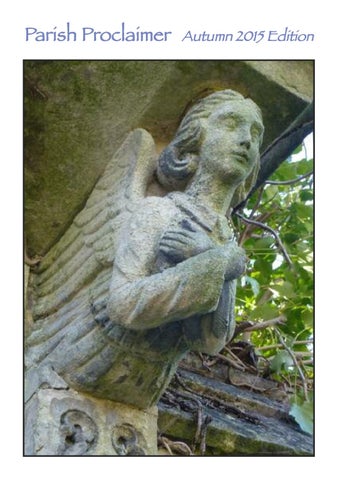
FRONT COVER An angelic feature from a grave memorial in Arundel Cemetery. Photograph taken by Oliver Hawkins reprinted with his permission. BACK COVER Carpet of Flowers displayed during Corpus Christ in June 2015. Photograph taken by Focus Photography of Shoreham.
A moment’s thought By Canon Tim Madeley
At Patsy Vincent’s Requiem Mass on 4 August, the first reading was taken from St. Paul’s letter to the Romans – the first line always seems appropriate at funerals – “The life and death of each of us has its influence on others” (Romans 14:7). But we shouldn’t allow it to be just at someone’s death when we reflect on these words. Each of us influences others, for good or for bad, whether we like it or not. This can be terribly challenging if we reflect back on the wavering paths of our lives. We cannot change the past but we can influence the future. Here in our diocese and in our Cathedral we are in a period of change. We have a new Bishop and we have to get use to his ways just as he has to get used to ours and all of us (Bishop, clergy and people) will need to adapt just a little bit to be accommodating to the other person. We must try and welcome this with open arms as it helps us to challenge why we do certain things, helps us to accept change and ultimately helps us to look at the bigger picture of how we influence others. Let us be open to the Holy Spirit which accomplishes so much in us if only we open our hearts to him. ++++++++++++++++++++++++ ARTICLES FOR THE WINTER ISSUE OF THE PARISH PROCLAIMER: Deadline for receipt - Tuesday, 13 October 2015 Please email your written piece and photos to clouter@mac.com or post to Cathedral House, Parsons Hill, Arundel, West Sussex BN18 9AY including your name/address to enable us to return the photos.
3
Parish People - Bishop Richard By Colin Swanton I intended to write an article about our new Bishop and discussed this with him when I served the Mass he celebrated at the Poor Clares Convent the day after his Installation Mass at the Cathedral. He agreed to write the piece himself and I said that as a lot had already been published in the Catholic press about himself perhaps he could write about his first two Masses in his Diocese – the Installation Mass and the one at the Poor Clares – writing about his thoughts and feelings and perhaps comparing and contrasting these two Masses. Here is his article: Thoughts from a newly-installed Bishop 28th May 2015 dawned fair, if a little windy on the hill of Arundel. It was a significant date, the 50th Anniversary of the establishment of the Diocese and a wonderful day for on which to be installed as the new Bishop. As the procession approached the West Door of the Cathedral, the Litany of Saints could be heard: the Diocese seeking the intercession of the Patrons of the Religious Orders, Parishes and Schools of the Diocese. From the moment of the Provost’s welcome at the door of the Cathedral, right through to the dismissal at the end of Mass, the prayers of all gathered were truly palpable. The atmosphere was one of joy and a real sense of the Church of the Diocese gathered to give thanks for a Golden Jubilee and to welcome the new Bishop. The celebration of Mass, concelebrated by the priests of the Diocese and Bishops from across the country, marked the culmination of so much prayer and preparation – not only for the Liturgy itself, but also the anticipation of a Diocese awaiting the appointment of a new Bishop. It also marked a new beginning – the next 50 years and more of the Diocese and the start of my service to the People and Priests of Arundel & Brighton. The Liturgy was truly wonderful and I am immensely grateful to all who did so much to ensure such a tremendous celebration – and to all who attended: people, priests, deacons and religious from the Diocese, old friends – many in uniform – from the Bishopric of the Forces, Bishops, Cardinals and the Apostolic Nuncio, as well as representatives from other Christian communities and civic guests too. Thanks go, also, to His Grace, the Duke of Norfolk and all in the Castle for facilitating the reception afterwards, where all were able to gather and enjoy good company in fine 4
surroundings. It was a truly blessed day and I know many will – along with me – remember it for many years to come. The next morning found me in the quieter atmosphere of the community of the Poor Clares in Crossbush, just across the River Arun. The Community Mass, while not in the grandeur of the Cathedral, was no less wonderful. To be able to celebrate with one of the contemplative communities of the Diocese was a great blessing and I enjoyed greatly meeting with the community afterwards. Mass is always special and we are blessed to have monastic and contemplative communities who offer so much, through prayer and witness, to the life of the Diocese. Now after a couple of months serving the Diocese, I have visited all the deaneries and a number of our schools. The welcome that I have received from everyone has – without exception – been very warm indeed and it has been so encouraging to hear about and see so much that is good and fruitful in the life of our Diocese. Festival 50 at the Amex Stadium was a further witness to the life of the Diocese. To see so many gathered to celebrate the Diocesan Jubilee, to pray together, to share the many facets of Diocesan life and to rejoice in the celebration of the Eucharist was yet another memorable day and a powerful witness to the Gospel and the life of the Church. Within the week, I shall be in Lourdes with the Diocesan Pilgrimage and look forward very much to being with so many from across the Diocese for what will, I am sure, be a time of grace and blessing for everyone. May I take this opportunity to express my thanks for these great events, to share with you the joy of these last two months and to ask your prayers for me and for all in the Diocese as we look to the future. There are many opportunities and there will also be challenges as we continue to proclaim the truths of the Faith in the society in which we live. May the Lord bless us all in the task that lies ahead. With ! every Blessing,
!
5
The Diocese of Arundel & Brighton and Arundel Cathedral, 1965 - 2015 From the Order of Service for the Installation of Right Reverend Charles Phillip Richard Moth as Fifth Bishop of Arundel & Brighton It was on 14th June 1965 that the title Arundelliensis - Brichtelmestunensis was first heard in this Cathedral. Bishop David Cashman, an Auxiliary Bishop in Westminster, was installed as the first Bishop of the Diocese of Arundel & Brighton, in the presence of the Apostolic Delegate to Great Britain, Archbishop Hyginus Cardinale and his Eminence Cardinal John Carmel Heenan. In the Apostolic Constitution Romanorum Pontificum of Pope Paul VI of the 23rd May 1965 it was decreed that from the territory of the Diocese of Southwark, a new Diocese called Arundel & Brighton should be created and that the Diocese of Southwark would be created as a Metroploitan See, with Suffragan Dioceses of Arundel & Brighton, Plymouth and Portsmouth. The Episcopal Seat was to be in the town of Arundel and the then Parish Church, dedicated to St. Philip Neri, was to become the Cathedral of the new Diocese. Following the canonisation of Philip Howard, Earl of Arundel, his body was enshrined in the Cathedral, henceforth known as the Cathedral of our Lady and St. Philip Howard. In its fifty years, the Diocese has built itself up in accordance with the spirit of the Second Vatican Council, and with God’s blessings, and looks forward with hope that it will grow and flourish. As the Constitution founding the Diocese stated, the Popes always have a great solicitude for the faithful of this country, and this has been shown by Pope Paul VI, Pope John Paul II (now St. John Paul II) - the first Pope to fly into Gatwick - Pope Benedict, and now Pope Francis, in providing Bishops. We remember especially Pope Francis as the Letter of Appointment of our new Bishop, Richard Moth, is read out, and as he is installed in his Episcopal Chair, with his Coat of Arms and motto “Pax et gaudium in Domino” - “Peace and joy in the Lord”, with its echoes of Pope Francis’ encyclical Evangelii Gaudium. The crozier which will be presented to Bishop Richard during his installation was originally presented to Archbishop William Godfrey by his friends at Ushaw College on 29th June 1939 on him becoming the Apostolic Delegate to Great Britain. Before Continued on page 8 6
leaving Rome to take up his position he ordained six students to the priesthood at the Venerable English College, one of whom was David Cashman, later to become his secretary at Wimbledon, and later still to become his auxiliary bishop when he became (Cardinal) Archbishop of Westminster. The crozier came into Bishop Cashman’s possession after the death of Cardinal Godfrey in 1963 and so came with him on the formation of the Diocese of Arundel & Brighton in 1965. The ring belonged to Bishop Cashman and is described in the inventory as “Large gold ring with amber stone, each side of which is a golden rose.” The Mass setting used in today’s liturgy, “Missa Orbis Factor”, was commissioned in 2010 by the Diocese of Arundel & Brighton to celebrate the Golden Jubilee of the Diocese. It is based on the Kyrie of Mass XI, Orbis Factor. Paul Inwood, the composer, was the Diocesan Director of Music from 1986 to 1991. The anthem, “O Praise the Lord”, was commissioned by Arundel Cathedral to celebrate the Jubilee. Neil Cox, the composer, writes, “The sound of the choir and the organ in Arundel Cathedral proved a great inspiration to me. I think the wonderful acoustic of the building gives music a majesty and a grandeur that is utterly thrilling, so I wanted the piece to be joyous and extrovert. I very much hope that it will help the congregation in the celebration of this great service.” FROM THE DECREE OF THE SECOND VATICAN COUNCIL ON THE PASTORAL OFFICE OF BISHOPS IN THE CHURCH CHRISTUS DOMINUS Christ the Lord, Son of the living God, came that he might save his people from their sons, and that all humankind might be made holy. Just as he himself was sent by the Father, so he also sent his Apostles. Therefore, he sanctified them, conferring on them the Holy Spirit, so that they too might glorify the Father upon earth and save humankind, ‘for the building up of the Body of Christ” (Eph 4:12), which is the Church. Sharing in concern for all the churches, bishops exercise their episcopal office, received through episcopal consecration, in communion with and under the authority of the Supreme Pontiff. All are united in a college or body with respect to teaching the universal Church of God and governing her as shepherds. They exercise this office individually over the portions of the Lord’s flock assigned to them, each one taking care of the particular church committed to them. 8
COAT OF ARMS FOR THE FIFTH BISHOP OF ARUNDEL & BRIGHTON
“Peace and Joy to the Lord” The Grant of Arms contains the following description: Paly-wavy of ten Bleu-celeste and Gules on a Chief Or four Crosses of Jerusalem the outer pair issuant Gules. Ten wavy stripes in sky blue and red, with a gold field above containing four red Jerusalem Crosses, the outer pair appearing from the side. The wavy stripes are a reference to Bishop Richard’s place of birth (the Zambian Arms consisting of similar stripes in black and silver), in this case with blue a reminder of Our Lady and the red a reminder of the English Martyrs. The Crosses of Jerusalem are a reference to Bishop Richard’s membership of the Equestrian Order of the Holy Sepulchre of Jerusalem. The Cross and Green Hat (galero), with its rows of six tassels on each side, are customary in the Arms of the Bishop.
9
Hello Sally: a tribute to bell ringers By Graham Rodmell
St Michael's Church, Amberley and bell tower
One of the great advantages for Arundel Cathedral of having renewed its distinctive flèche or spire in 2011, was the restored working of the suspended bell for the since the former 40 feet high glass reinforced plastic (GRP) version had replaced the original model. Now, if you listen very carefully on a day that the Arundel wind is not blowing too strongly, a rather apologetic bell sound can be heard, particularly inside and occasionally even from outside! It whispers a gentle summons to Mass (hoping not to wake anyone up), signals the most solemn part of the Mass for all to share and reminds us to recite the beautiful traditional devotion of the Angelus three times a day. In the presence of a bell ringing enthusiast, please do not boast that the bell is a super-electronic automatically controlled model, requiring nothing more manual than a surreptitious flick of a switch or a measure of reprogramming. Our monotone bell is simply no match for the Anglican churches of St. Nicholas Arundel and St. Michael Amberley, both beautiful Pre-Reformation churches in the Catholic Cathedral parish. Therefore, if one wants to learn something of the ancient skills of bell ringing within the Parish, it is necessary to go to one of these. In the summer of 2014, my daughter Antonia, my son-in-law Sam and I were looking for a new challenge to tackle. We were the core of the students enrolled on a course organised by the resourceful Tower Captain at Amberley, Elizabeth Butler. The sound of bells over a rural village is a special part of life in a village like Amberley. Every art or skill necessarily generates its own vocabulary which is an indispensable part of bell ringing. ‘Sally’ in the title (derived from Old French ‘saillir’ – to burst forth) refers to the bushy part of the bell rope used for ‘hand strokes’, just above the 10
‘tail’ which is used for ‘back strokes’. The experienced bell-ringer produces a smooth and constant flow of both strokes. As a total beginner, I was relieved to be allowed to do either one or the other, thus sharing responsibility with a member of ‘faculty’; this comprised Graham Hills (then Ringing Master of the Western Division of West Sussex Bell Ringers), his wife Moya and Christine Butterfield (Education Officer of the same Division); all were greatly encouraged by Elizabeth Butler. I did not ask to see the course risk evaluation, but it was clear that 'faculty' had a sharp appreciation of the inherent risks. Towers are rather restricted areas. Those seated around the walls should not cross their legs, or an over-active ‘tail’ could catch the loose foot, whisk the careless fellow to the ceiling and drop him upside down on to the floor. It was also obvious that ‘boarders’ (including angry local residents upset by the less satisfactory attempts of students) had occasionally to be repelled, as once all ringers are ‘aboard’ in the Amberley tower, all access is barred by the lowering of the final piece of floor. The course proved to be a lot of fun, but it seems that even experienced ringers are given to swearing - there is a Tower swear box with a fixed tariff. To suggest that all Tower expenses are funded from the proceeds of the box is simply untrue! If I may share with would-be bell ringers some wisdom distilled from my own experience: - Ringing is ‘touchy feely’ (hence the reference to ‘strokes’) and requires constant awareness of whether the bell is 'up' or 'down'. You cannot rely on sight as the bells cannot be seen. The bell is prevented from travelling more than 360 degrees on a single swing by a ‘stay’, but it is not good practice to rely on a bell’s hitting it, as a stay is made of fairly soft wood that could give way following regular misuse by a student. When pulling the rope, practise the ‘in-between’ – neither too strong nor too weak. - To avoid accidents, bells should be left in the 'down' position. There is a universal code adopted by bell ringers that first requires knowledge of how to tie a bowline knot (scouts come into their own), which tidies up the tail – then the angle of the final loop gives the clue as to whether the bell is 'up' or 'down'. Not everyone knows this however, so with both hands on the rope, gently pull on the Sally and rely on your own sensitivity. - Look straight ahead at all times – you catch the sally when it comes up into view; don’t look down or you will catch it too soon and attempt the impossible of pushing a slack rope; don’t look up or you will get something nasty in your eye. 11
Graham Hill is presented with Chain of Office as new Master of SCACR by Christine Baldock, outgoing Sussex Ringing Master.
- Knowledge of musical notation does not help – changes are written as a series of geometric shapes. Numeracy (being able to count up to five, or even eight in some towers) is vital, and a nodding acquaintance with algorithm a distinct advantage when ringing prescribed changes – mercifully, we graduated at the stage of ringing basic peels. - Indecision does not work – at some stage commitment is required. On a peel, that moment is when the band leader says “treble’s going – it’s gone”. That is the signal when you have to activate your bell according to the pre-determined sequence. “Stand” is an interesting command. I concluded that it meant ‘stop’, because I was already ‘standing’, but instead of an immediate stop (I caused some concern when I simply let go of the rope!) its true meaning is a controlled stop, after one more swing. Happy couples at weddings pay for the services of the band of ringers and so they should, because it is highly skilled. The advertisement for the course claimed that ringing was well within the capabilities of most people between the ages of 10 to 80. This is true, but as I am close to the upper limit, I shall only continue to develop my contribution to liturgical music through singing and occasional keyboard. Besides, 10 year olds would find the maths rather easier. Appreciation is due to members of 'faculty' for being so thoughtful, patient and flexible. Since our course, Graham Hills received a special honour by being made the Ringing Master of Sussex County Association of Change Ringers (SCACR). I am sure this had nothing to do with his attempting to teach me, or anyone else with severe bell ringing learning difficulties! 12
G W & C A
Together we can go places
Green Wright Chalton Annis SOLICITORS
Green Wright Chalton Annis are authorised and regulated by the Solicitors Regulation Authority. No. 205902
GWCA Solicitors - here for you; wherever your life takes you
You may be moving house, setting up a business or need a Will. GWCA can also help at those more difficult times - divorce and separation, an accident claim or resolving a commercial dispute.
GWCA - an office near you G G G G G
Arundel Goring Rustington Steyning Worthing
1 Tarrant Street. 01903 881122 305-307 Goring Rd. 01903 700220 112 The Street. 01903 774131 60 High Street. 01903 814190 13-14 Liverpool Terrace. 01903 234064
!$
! # !!
.
.
* % #
41 ( !"/ $ #(+ !"
! &
!
We offer a professional service at affordable rates. To find out how we can help you, call your nearest office, visit www.gwca.co.uk or send an email to info@gwca.co.uk
!
+
' " !%
$# " !
! # !+ $
& $ " . '# " " . % # . "# " !% # ! " * ! ! " . " !% # . !( . ! !#( #
#
" ! $# # ##% ! -
!
$ !
& "
!# !
$!% ( !"
". # & ! . " . #!$ #$! $ . # " . ! % & (" .
#
% !" " . # ! # ".
) , 12:14 993:15 . (, 18992 918596 . # , 18644 388272 , $ ! "0 " ! % # "- -$ &&&" ! % # "- -$
T HE F RIENDS OF
A RUNDEL CATHEDR AL Honorary Presidents: HG The Duke of Norfolk and The Bishop of Arundel & Brighton
The Friends of Arundel Cathedral is a registered charity whose aim is to encourage the use and appreciation of the Cathedral church of the Diocese, and to provide ÄUHUJPHS Z\WWVY[ MVY P[Z THPU[LUHUJL HUK LUOHUJLTLU[
Join today! By joining the Community of Friends you will be supporting the Mother Church of WKH 'LRFHVH RI $UXQGHO DQG %ULJKWRQ QRWHG DV RQH RI WKH ÀQHVW H[DPSOHV RI *RWKLF 5HYLYDO $UFKLWHFWXUH EXLOGLQJV LQ WKH FRXQWU\ <RX ZLOO UHFHLYH QRWLÀFDWLRQ RI DOO SXEOLF HYHQWV DW WKH &DWKHGUDO DQG HQMR\ WKH IROORZLQJ DQQXDO )ULHQGV· HYHQWV • 7 KH )ULHQGV· $GYHQW 9HVSHUV
• $ QQXDO 6XPPHU &HOHEUDWLRQ
• 6 RFLDO HYHQWV ZLWK RWKHU )ULHQGV of Arundel Cathedral
• 3 DUWLFLSDWH LQ :RUNLQJ 3DUWLHV WDVN WR FOHDQ DQG WLG\ the cemetery)
• $ QQXDO )ULHQGV· 0DVV )HDVW RI 6W 3KLOLS +RZDUG
• 5 HFHLYH &RUQHUVWRQH )ULHQGV· twice yearly Newsletter
Membership Fees 7KHVH KHOS XV DFKLHYH RXU DLPV 0LQLPXP FKDUJHV OLVWHG EHORZ • )ULHQG … SD
• /LIH PHPEHU …
• -RLQW )ULHQGV … SD
• &RUSRUDWH 0HPEHU … SD
• 3DWURQ … SD
7KH )ULHQGV RI $UXQGHO &DWKHGUDO &DWKHGUDO +RXVH 3DUVRQ·V +LOO $UXQGHO :HVW 6XVVH[ %1 $<
T | E aruncathfriends@btconnect.com | www.arundelcathedralfriends.org Charity No. | Company No. (QJODQG (limited by guarantee and having no share capital)
Music for a Summer’s Evening In aid of St. Barnabas Hospice By Peter Ozanne, Asst. Band Secretary, Salvation Army
It was a privilege for The Worthing Salvation Army Band to play in the Cathedral again this year and we thank the Cathedral for allowing us to do so. It is always a pleasure to play music in such a fine Cathedral, very much enhanced by the displays of flowers following the Corpus Christi Festival of Flowers. We were joined by our songster brigade (choir) and their songs suited the acoustics of the magnificent building. The band’s contribution included an arrangement of Amazing Grace written by an American Salvationist, William Himes, who came over to Worthing last year to visit us for the band’s 130th anniversary. This piece, although very familiar to many folk, resounded within the Cathedral during the first half and gave true pause for thought. In the second half of the concert the band played two classical pieces: Polonaise in Ab by Chopin and Melody in A by Brahms. The Songsters sang a total of four songs Let everything that has Breath, Your Grace Still Amazes Me, Grace and the last song, David Danced, which was partly sung in Spanish. Undoubtedly, the highlight of the evening was the contribution by the four young soloists from Prebendal School in Chichester: Lina Mazzone (Piano) Clair de Lune by Debussy Polly Maltby (Vocal) I’m not that Girl by Schwartz Rebecca Stone (Flute) Sonata by Donizetti Alexander Smith (Cello) Allegro Appassionato by Saint Saens 15
These four young musicians are very talented and will all move on to study music as a career. It is also right to mention their accompanist, Ian Richardson, who teaches and mentors them. During the evening £416 was raised for St. Barnabas Hospice. Finally, we would like to thank Chris Buckwell and Alex Clouter who facilitated and advertised the concert. Their efforts were very much appreciated. It is hoped that we have the opportunity to perform again in this great Cathedral. +++++++++++++++++++++++++
A Reflection on the First Joyful Mystery of the Rosary By Peter Cockin THE MESSENGER The Messenger walked quietly along the dry, dusty road towards the little village of which it seemed no-one had ever heard. Many forms of transport were available to him for he stood high in the councils of his lord’s forces, but he chose not to use them. This was a quiet, rural community. A horse could provoke comment, only a walker or a donkey passed without question, and questioning was the one thing the Messenger had to avoid. So near now the final objective, no whisper must come to the enemies’ ears. Not after all these ages of planning, strategems and treasons, advances and failures, retreats that turned into routs, weak allies who backslid at the first challenge, disasters leavened only by some act of grandiloquent courage. But now, now if the Message were acted upon, then now the plans called for the great counter-attack against the enemy to begin, to break the back of the revolt raised by the enemy so long ago. Such plans stretching through time and over the face of the world, so daring in their scope and sacrifice, and yet now victory could like at the end of the Path. All now would depend on how the recipient of the message would react. Nothing could be promised, only blood, sweat, toil and tears lay in the future, but only willing acceptance could suffice. Continued on page 18 16
Proclaimer Crossword Puzzle 31 By Chris Dinham
ACROSS 1. Sea boulders (5) 8. Surgery and medicine for your cure (9) 9. Not true; improper and unreal (5) 10. Soon, or by and by (9) 11. Attaches, joins or fastens together (5) 12. Echoed; copied (8) 15. Perhaps it’s funny pictures or just comic strips (8) 17. Make smaller; come to a point (5) 18. Meet unexpectedly (9) 20. A relative of yours? (5) 21. On foot, a child dashes all over the place (4,5) 22. A girl’s name; part of a Christmas Carol title (5)
DOWN 1. If you do, you may win goods or prizes (6) 2. It’s important for your dates (8) 3. They are important for ups and downs (5) 4. In moderate tin (anag) firmness of purpose (13) 5. Avenues, lanes, roads; there are others too (7) 6. Following; later one coming (6) 7. Wasn’t anywhere, didn’t move out (6) 13. Very hot, lush and sultry (8) 14. A favourite, well liked and approved (7) 15. A small but favourite fruit (6) 16. A person is this when eats too much (6) 17. Honesty; accuracy; spot on (5) 19. It could hurt; a plant needs this for support (4)
17
Now here was the house he wanted. Intelligence had told him that the person he sought would be in the little garden at this time of day, and so he passed confidently through the side gate. Yes... there. There was the small figure sitting quietly under the Jacaranda tree. Quietly he advanced so as not to cause alarm. As he knelt before the small person, the Messenger saw recognition dawn in her eyes as, drawing a deep breath, he began his message, “Hail Mary.....” Courtesy of A Green Bough, a seasonal magazine sent free to the sick and the housebound, or elderly people and their friends. “If you keep a green bough in your heart, the singing bird will come.” +++++++++++++++++++++++++
Special Congratulations....
... to Hannah and Noah Yeates on the birth of their twin sons: Seve (5lb 4oz) and Hunter (6lb 2oz) on 29 June 2015. Both parents and their children are doing well!! More about the Yeates family in the next issue. 18
' &# (!
% ' !'(%+ % &' (% !' ! %"" & "! " ' " &' ! %(! ) %+' ! & " ! "(% & ! ! "%! ! " & ! & ! ' %!""! ' & ! ( ! ! "'' %
! ,& & ! !"*! * ") % "" $( '+ " "" ! (& ! '% ! % & " #%" (
"(& & &* % '
' "!
"( ! ! (& ' %% !' '% ' %(! # "!
'
)
)
+ # ( )$ !! '$ ! " ' ' '*# !.( # () $*) &* $" , ' # ) ( $%
'*#
!
'' #) )' ) () *(( -
,,, ' ' '
) $*
'(
&
&
!'(%+ "% % # &
Echlas Al Azzah... a remarkable woman By Anne Alidina
Echlas with Anne
Echlas Al Azzah is a Palestinian refugee. She is 43 years old and lives in the smallest refugee camp in Bethleham, in fact it is the smallest Palestinian refugee camp anywhere. What makes her remarkable is the fact that she is severely disabled with muscular dystrophy yet lives independently in the family house relying on international volunteers for her care. The house is all on the ground floor, has a small garden with a lemon tree, a peach tree and prolifically growing pelargoniums and now my contribution of sweet peas, marigolds and morning glory, which I grew from seed while I was there. The house is spacious with three large bedrooms, one ensuite, a lesson room, shower room, kitchen and lounge, and probably not how most people would imagine a refugee camp. It is worn and shabby, however, and only two rings work on the cooker, making cooking challenging but there is a fridge freezer and a washing machine that has to be used carefully otherwise the electrics will blow or the water will run out. Things function adequately but there are no luxuries and nothing is replaced unnecessarily. Despite the fairly basic conditions Echlas is reluctant to give up the home where she has lived all her life. Her family would be happier if she lived with one of them but she wants to maintain her independence and stay in the house that she shared with her mother who died five years ago. Twenty years ago Echlas had the idea to recruit international volunteers to help with her care in return for board and lodging and the opportunity to experience Palestinian culture in a refugee camp. Later on she also offered free Arabic lessons. 20
As internationals are only allowed a three month visa, Echlas has known a fair number over the years and remembers them all, prompted by her ‘volunteer tree’ on the wall of her bedroom where pictures that she has drawn of the volunteers sit in the branches. Ten years ago Echlas started giving Arabic lessons and this was a way of helping to support herself financially. She advertises locally and most of her students are volunteers in National Government Officers (NGOs), although some are employed. Through them she widens her network even further and many carry on having lessons via Skype with her when they return home. Echlas advertises for her volunteers privately so no organisations are involved so consequently there is no vetting procedure in place and her only way of assessing potential volunteers is via email and Skype before they arrive in her home to take care of all her physical needs 24/7, to cook, to look after the house and also be a companion. In all the time that Echlas has relied on volunteers she has had very few whom she did not get on with or who did not fit in which says much about Echlas’ tolerance, especially as some have just left school. I must have been the oldest volunteer ever! Most come from Europe, especially Germany, Scandinavia, and America but there is always a risk that they will be denied entry to Israel by the border authority, as happened twice while I was there, leaving Echlas with no one to look after her for a week when I left. Echlas is a third generation refugee and it is no coincidence that her surname is the same as the camp name. In 1948 when the Palestinians were forcibly driven out of their homes by Israeli forces, Echlas’ family moved to Hebron, a town not far from their village of Beit Jibreen. Many of the villagers moved to camps set up by the UN in Bethlehem. Echlas’ grandfather was employed by UNRWA (United Nations Relief & Work Agency) and became manager of Aida and Al Azzah camps in Bethlehem. The Al Azzah clan is huge as I discovered when it seemed that most of the taxi 21
drivers, waiters and shopkeepers were Al Azzahs. Echlas’ mother married a man from Hebron and lived there with their four children until he was imprisoned for 6 years for his political views. She could not afford to pay the rent so her father found her a room in Al Azzah camp (now the kitchen). The communal toilet and bathroom was at least 5 minutes’ walk away so Echlas’ mother collected materials and built her own bathroom. She supported her family by doing needlework, which local Catholic nuns bought from her and sold to pilgrims. When her husband was released from prison they acquired more land and gradually built the house which Echlas still lives in. Her mother seems to have been a very strong and resourceful woman, helping other families with her gift of healing and was well liked and respected in the camp. Her father was a communist and continued to be politically active for the welfare of his fellow refugees. Of the original four children two died, one at nine of polio and a girl as an infant of ‘fever’. They went on to have four more girls and three boys but the youngest boy died at one year after he was made to stand at a checkpoint with his pregnant mother, for hours in the blazing sun. The shock of his death caused complications with the pregnancy, hence Echlas was born with muscular dystrophy. Facilities for disabled children and adults were limited and Echlas was not able to go to school so learnt from her mother and siblings. About 10 years ago Echlas was the victim of a hit and run while she was out in her electric wheelchair. The perpetrator, an Israeli settler, was caught at the checkpoint but was not penalised so Echlas received no compensation as the court ruled that “she was disabled anyway”. Her wheelchair was badly damaged, as was Echlas who had to spend a year in an Israeli hospital. She did not see any of her family for six months as they were denied permits to travel. She had a traumatic time both 22
physically and emotionally as she was ostracized by the Israeli patients when they discovered she was Palestinian. Despite this trauma Echlas still travels about the roads in her ageing wheelchair, dodging the traffic. Palestine is not wheelchair friendly but drivers are, on the whole, very skilful and tolerant, although the liberal beeping of horns does not reflect that. Access to shops, restaurants and public buildings is restricted to wheelchair users but Echlas knows the places she is able to access and asks shopkeepers to come out to her, which they always do. Negotiating the souk takes determination, courage and patience, not to be embarked upon lightly as the road is rough, vehicles insist on forcing their way down through the narrow, shopper-packed street, which causes mayhem and much loud beeping. Echlas has an electric and manual wheelchairs, a bed that can be raised and lowered and a special ‘bath’ in the shower room but she has to be manually lifted in and out of bed as a conventional hoist does not fit her distorted body shape. Echlas is extremely patient and tolerant with her volunteers who she has to teach how to move and position her. The only movement and control she has in her right hand enables her to control her mouse for her computer and in her left she can hold a fork to eat with, a cup, a cigarette and her mobile, which she manipulates with her lips and nose. She only complains about lack of salt in her food (she uses a lot) and the Israelis but considering she has to put up with varying degrees of culinary and domestic skills she is remarkably cheerful. She is vegetarian, which is an advantage as meat is expensive but luckily she has memorized a number of recipes that she uses to supervise the cooking until the volunteer is competent and can be trusted to serve up something edible. A lively mind has set Echlas on a new venture, which she hopes to accomplish this summer. Her aim is to learn German as next to English this is the most useful language for her. In the past she has travelled to Spain, Sweden and Germany and has a number of friends in Germany who have offered accommodation. She wants to do an intensive German course at a German university in order to eventually expand her earning potential by doing translating as well as her Arabic lessons. If she is granted a visa, never guaranteed, then her dream may be realised if she gets enough funding, which is underway. If the visa is denied then she will use the money raised to buy a new wheelchair as the present one is struggling now. Echlas certainly lives a full and interesting life due to her determined attitude, optimism, courage and love of life. She has a large, supportive, loving family who 23
obviously care deeply for her but she in turn has a very caring, generous attitude and always thinks of others. She never misses a birthday, getting her personalised cards made at the ‘copy shop’ and choosing just the right gift within her limited budget. Echlas helps a local family whose father is a political prisoner, by contributing to school trips for the children and giving shekels to the boy when he does her shopping and she supports a family in Gaza getting funding to have windows and doors replaced after the summer’s bombardment when they were blown out. They still have no roof. The three months I lived with Echlas were an education in many ways and I will always be grateful to her for giving me that experience. I am also thankful to her loving, crazy family, to the friendly, cheerful people in the camp and in Bethlehem, to all the internationals I met and all the people living under occupation and working for a just and peaceful future. This is a very short account of Echlas life but I will be giving illustrated talks on my refugee camp experience.
NEW DVD FEATURING ST. RICHARD OF CHICHESTER Filmed on location in the City of Chichester, the historic village of Tarring and on the South Downs, this creative and informative film presents the life of St. Richard of Chichester as well as historical and spiritual details and facts linked to this famous Bishop's life. In this film we look at the history of the City of Chichester, St. Richard's whole life and his place in the Christian Church in the aftermath of his death to the present day. This new film is a creative way to learn the life of one of the great figures of medieval England and the Church. Available from www.marysdowryproductions.org
24
3%/5-,% 4%*#-+% (,#*2$(,& #'(*$/%, ( ( & "
&, ' ' (" $ #* & ' (" ' ! " ##! ' ( " " ) ' %) $! "(
#" #"
#
&)"
("
)' # ( " " ##$ ','( !
)'' +
.%,(,& (+%0 -,$!5 !+ .+ 2%0$!5 *-0%$ %$,%0$!5 !+ .+ '2/0$!5 !+ .+ /($!5 !+ .+ !12/$!5 !+ .+ 2,$!5 !,) -*($!50 *-0%$
CATHEDRAL GIFT SHOP An extensive range of high quality religious gifts and cards for Lent, Easter, baptisms, weddings, funerals, birthdays, special anniversaries and other occasions.
,(1 2%%, 1/%%1 /2,$%*
The Gift Shop is situated in the North Transept by the Shrine of St. Philip Howard. From 1/11/14 - 31/3/15 Monday - Saturday 10.30am - 12 noon From 1/4/15 - 31/10/15 Monday - Saturday 10.30am - 4.30pm PLEASE NOTE We rely on volunteers to help in the gift shop so our opening hours may vary slightly.
4!/$%$ 01!/0 "5 '% --$ !*-, 2($%
Being a Helper in Lourdes By Bryony Morison
Lourdes, a place of love, friendship, care, happiness and sadness is the place I chose to go during my summer, to be a first time helper after being a Redshirt two years ago. My second time in Lourdes I knew would hold new experiences and a new perspective on how I view Lourdes and my faith as I spent my week there helping those in need of care or friendship. Being a helper for the first time was an exciting experience. Each day I was paired with a different helper and pilgrim. Throughout the week we would take them shopping, go to Mass or even go for an ice cream. Throughout my week in Lourdes I began to understand what being a Helper actually meant. Every day was busy but always started with Mass. One of the most memorable moments for me was the Anointing of the Sick Mass in the underground basilica where I sung the psalm. This is an extremely emotional Mass and I was glad to have the privilege to sing the psalm. On the same day we also had the Blessed Sacrament Procession around the grotto leading into the basilica where Mass was held. The next day was the visits to the Baths, however I went with the pilgrims to the Prairie (place of prayer) to talk about the importance of water and how it brings life. It was here that all of us, priest, helpers and pilgrims blessed each other’s hands and feet with the holy water from the spring. This for me was a special moment that each of us as individuals, unknown to each other at the beginning of the week were able to share a special moment together and form friendships. Another place where friendships of all ages could be formed was at the well-known L’ittle Flower’ restaurant/bar where Bishop Richard and quite a few pilgrims and helpers and seminarians would gather to socialise in the evening after a long hot 26
day. Another special moment for me was visiting the Grotto with my friends that I made when I was a former member of Arundel Cathedral Choir. We went to the Grotto to light a candle and say the rosary for a special friend from the choir who is desperately ill. I lit this candle along with other candles with special meaning for my other friends and family, particularly for my brother Ryan who is suffering from an incurable illness. Lighting the candles at the Grotto this year was a very special personal moment for me, which held great importance for me and my friends. At the beginning of the week however I did not feel like I was able to get fully involved like the other helpers who were able to physically help by pushing around the pilgrims in wheel chairs, I was not able to help with the wheelchairs as I did not feel safe doing so as I am only 4’11”. The way in which I found my role in ‘helping’ was through just being there for someone to talk to as many people can be lonely at the start of their Lourdes journey, but this feeling is soon erased when you are on the pilgrimage. Lourdes is a place of love and friendship and in my role as a helper, I began to see once again that sense of community and family that everyone shares. This is why I felt it important to always make any pilgrim feel involved and never feel lonely because most of the time, all people want is a good chat, or to be listen to and heard. Singing in the choir and working with Anne Ward was also a wonderful experience this year as I sung solos in concerts and in Masses both in the underground basilica and the Grotto at the anointing of the sick. Many people who I did not know would thank me for my singing and how much they enjoyed it. People also said how my singing and the music had touched them and brought them into the presence of God during Mass. I was truly touched by all the comments I received. I had found what my role as a helper was, it was through my singing that I helped people to experience something while in prayer at Lourdes. The gift that God has given me, 27
my voice, is what identified for me what it was to be a helper. Lourdes is special, it has a sense of magic about it, and it’s something that just cannot be easily explained. Lourdes always feels like a second home, a family, which is shown by the many wonderful people that return each year willing to care, love, form friendships and learn from others. Lourdes has a wonderful sense of community bringing many different people to one united place all there for the same reason, to feel God’s presence and to care for others which is seen through the many wonderful different acts of kindness. Lourdes truly is that little bit of heaven on Earth.
+++++++++++++++++++++++++
You’re not from round here, are you? By Mike Webster When my wife, Ann and I lived in Walberton we were invited to a party in Slindon (one mile away). We were button-holed by a county-type lady who obviously heard our ‘north country’ accents and came over to investigate. “You’re not from round here, are you?”, she directed. “No”, I said, “We are from Walberton”. After an exclaimation of “Owhhhh”, she wandered off. It was a delight to witness the total confusion in her face. I was ‘reprimanded’ by Ann!! Now that every high street in our wonderful country looks identical, and any hint of individuality has been sieved out and everyone under the age of 30 years uses exactly the same Australian rising inflection in speech, much of modern life has taken on a bland, homogenised feel and appearance. Wherever you go, it all looks and sounds the same. Except that is for accents. 28
The days of speaking in a BBC ‘voice’ are disappearing in many areas of life today. Regional accents are in; Scottish accents are the ones to have at the BBC at the present time. Inevitably I am asked about The North. But what is ‘The North’ anyway? Obviously, geographically we know roughly what we are talking about; we can argue about Derbyshire, but between Cheshire and Scotland no one is going to dispute what the north is. It is all too easy to associate a ‘northern accent’ with poverty, poor education, low pay, coal in the bath, fire-belching mills. It used to be thought that someone with a northern regional accent could not have "class". Now, few people really think so narrowly. Culturally, we may think we know what we are talking about, but all attempts to pin this down prove difficult due to geographical narrowness and outdated stereotyping. It is often the case where people refer to ‘the northern accent’, without making any distinction between accents from Manchester, Liverpool, Blackburn, Leeds, Bradford, Newcastle and Carlisle. These are all distinct from one another, and distinct yet again from rural accents. Almost all, too, have different versions belonging to the working class and the middle class. In most cases, I can easily tell whether someone comes from Preston or from Wigan, 22 miles apart. The difference between the Yorkshire and Lancashire accent is so marked that it is hard to understand how they could ever be lumped together as typifying ‘the northern accent’. Northumberland and Cumbrian accents are probably more clearly defined and more easily identifiable by those in the southern counties. And then there is something vague and varied and known as ‘northern culture’. Even stereotypes vary dramatically, from the gruff Yorkshire farmer to the weeping adult Scouser, laying flowers at the site of some celebrity’s death. Then there are the differences between Asian communities in Bradford and those in Bethnal Green. No longer a Pakistani/Bangladeshi divide, but by now a north/south one; or even the distinction between the long established Afro-Caribbean communities in Toxteth, Liverpool, Chapeltown, Leeds, St. Paul’s, Bristol and Brixton. It comes as something of a shock when.. - You thought your accent was barely noticeable, but to people in the south you’re basically Peter Kay - If you have a genuinely broad accent, you have to say everything twice so people understand 29
- You’re mortified when you go back home and your friends and family tell you you’re starting to sound more like a southerner - People are just generally friendlier in the North (you miss being able to say hello to strangers at the bus stop without causing them to back away in alarm) - Sometimes you meet people who’ve never been to the north at all, who think that everything looks like this...
... where as it looks like this and no matter where you are, you’ll always be proud of your northern roots...
When reading about the North, seldom is mentioned made of the Lancashire and Yorkshire gentry who have done so much to shape the region. But well-known stately homes are as clearly in the North as is Blackpool. The truth is that, usually, all the comparisons between northern manners (warm, inclusive, sing-a-long, put the kettle on, love) and southern (cold, snooty, judgmental, Jamie Oliver-favouring) are actually between a working-class culture and a middle-class one. Then there are the ‘professional northerners’ who have moved south and become northerners when it suits them. Northerners have clung onto the Medieval pronunciation of everyday words – but Continued on page 32 30
*'+'*0* ,$
. 1'+%. ,+ #1#-4/&'+% '+ ./,-#
" !
'%& /-##/
-0+"#)
222 -0+"#)
0..#3
/&-,,*. !, 0(
southern intonations are slowly infiltrating northwards, a new study has claimed. Research by Manchester University shows a huge regional mix in the way we speak as well as the words used for trousers, bread, shoes, and evening meals. Linguists who have built up a ‘map’ of English regional accents warn we could eventually be speaking like southerners as their pronunciation for words such as ‘one’, ‘more’, and ‘foot’ spreads north. There remains a clear North-South divide when it comes to the phrases describing everyday objects. According to the poll of 1,400 people, most northerners tucked into ‘barms’, ‘baps’ and ‘buns’, while the only Southern equivalent were ‘rolls’. Northerners be warned as the findings showed the northern march of southern accents. It has been reported that the northern way of rhyming the words ‘put’ and ‘cut’, for example, is faithful to how these words were pronounced centuries ago. Speakers in the South moved away from this pronunciation in the 1500s, but their way of saying these words didn’t make it to the North. Those in the Midlands were caught between two stools, with residents in Birmingham and its surrounding areas sharing traits from both the two camps. The experience of most immigrant groups is that they bring their accents to their new country, but, in order to fit in, many adopt the prevailing speech of the dominant majority. But when at home, they tend to use ancestral dialect. As we are forced to interact more and more often with people whom, a century ago, we would never have met, we have to find comfortable ways of communicating with them. This does not mean that the rich diversity of speech that characterises the Englishspeaking world will be impoverished. It simply means that every dialect has its place, and the place for some is at home, not abroad. There's no reason to be ashamed of a northern voice, but that doesn't mean you want every Tom, Dick or Harriet using it. +++++++++++++++++++++++++
The Beginning of The Green Bough Magazine By Mary Corbyn Having passed about two-thirds of my life never far from the shade of A Green Bough it still surprises me to be asked “How did it all begin?” and “How did you get involved?” It was like this: At the time (60 or more years ago) I was teaching at the local all-age Primary School with a senior teacher of considerable experience and (in her words) ‘an anecdotal 32
Mary Corbyn, photographed by Colin Swanton
life’ - meaning that she had been about a bit and knew a lot of people! Margaret, being a noticing sort of person, saw that, while people were living longer and therefore getting older, they seemed to be staying younger and looking for more from life than an armchair and the wireless. She coined the name “Young-in-Heart” to describe them and began to consider ways to make life more agreeable for them. Being ‘on the spot’ I got drawn in to all this - outings, tea-parties and musical soirées at first, nothing very original until ‘chance’ or perhaps The Holy Spirit intervened and Margaret was asked to take over a newly-launched magazine ‘for Indoor People’; the founder, herself an ‘indoor person’ having died shortly after the first issue appeared. An appeal in a (Catholic) newspaper for someone to pick up the baton (or, in this case, the ‘Bough’) was answered by Margaret, who then found herself the editor of A Green Bough which soon expanded its scope to include our ‘Young-inHeart’ group. The founder had chosen the title from a Chinese proverb: “Keep a green bough in your heart and presently God will send you a singing bird.” A green bough is one that still has life, promise and fruit - a future, then, for those who might feel useless and ‘left behind’ in a world where life goes on elsewhere. So this nearly-new ‘Bough’ was transplanted to Arundel under new management but with the same purpose: this magazine wasn’t just for them (the readers) but by 33
them. At first, having no existing readership to call on, pages had to be filled - and Margaret’s friends, far and near, were invited to contribute - anything printable and entertaining (in the widest sense). So we got all sorts of ‘copy’ - some amusing, some thoughtful, some quite personal (memories, favourite poems) travellers’ tales and, most popular, ‘sayings’ from children and from parish papers! In fact - a rich ‘out of the mouths’ collection to suit all tastes! Before long, boxes of ‘copy’ began to accumulate and overflow which have been inherited by editors who succeeded Margaret. Harry Steward was the first, helped by Jo, his wife, and Adèle, his daughter. Harry took the ‘Bough’ to unimagined heights with his love of words and true devotion to the spirit of the ’Bough’ - an act I found hard to follow when it was my turn, seven or eight years ago. Now its my spare room that overflows with boxes and piles of paper... Why is it so hard to throw anything away? Well, I’m coasting towards ‘retirement’ whatever that is - and looking at Melinda with great confidence (yes, she knows)! I hope she finds it as rewarding as I’ve done, especially remembering the amazing circle of friends acquired along the way (some have been there as long as I have). It is - and has always been so - the readers who make the ‘Bough’ what it is; so a huge vote of thanks to you all and may there still be a singing bird for those with ears to hear. +++++++++++++++++++++++++
‘Fifty Years of Priesthood’ Film In celebration of our Diocesan Golden Jubilee, Arundel & Brighton Vocations has produced a film celebrating 50 years of priesthood. To view please go to YouTube and type ‘Gaudium priesthood’. Alternatively use any search engine and type the following: ‘I will give you shephers blog’. You can also type the address below in the address bar of your search engine: http://youtu.be/QcvlhsTNEmw 34
Memories of an Arundel ‘Mullet’ - Part 1 By Mark Phillips
Roland Puttock
Extracts from an interview with Roland recorded by the Arundel Museum Oral history Group in the year 2000. In May this year Arundel lost one of its great characters in Roland Puttock who sadly passed away in the town hospital. Roland was well known around the town and for many years from 1970 he was the Comptroller (No, not a spelling mistake.) at Arundel Castle. He was born in Arundel as was his father before him and as such both were proud ‘Mullets’, the name given to those born within the Parish. Although the family were Catholic and attended the Roman Catholic Church, later to become a Cathedral, Roland went to the Church of England school in School Lane because the Catholic school was run by ‘unqualified nuns’ and did not have a very good reputation. This ‘Did not please the Roman Catholics!’ ‘I had quite a tough time at the ‘wrong’ school. We used to sing songs about the Catholics and they used to sing songs about us. Even so, I remember that there was always a woodwork class at the Roman Catholic school and we boys would attend this every week while the girls went there to attend cookery lessons. But the Catholic children did not like us going to their school, they would say, “Oh, here they come again.”’ ‘When I used to go to school I had a friend who I used to call on every morning. We used to play in the fields which is where Torton Hill and Pearson Road estates are now – we called it ‘The Mountains’. We would play there until we heard the school bell ring at which point we would run like crazy to get to school on time.’ ‘I used to get a penny a week to spend on sweets and there were plenty of places to 35
spend it. There was a sweet shop in School Lane called Lawrence’s, one on the corner of the Slipe called Spence, just along Tarrant Street was Brown’s (we used to call it ‘Sweety Browns’), on the left hand side there was Dean’s and there was another in Norfolk Terrace which was run by the Bennett’s. They used to make their own sweets.’ ‘When we were young, the duchess used to visit both schools. At Christmas they used to give a party for the local children at the castle, and it was always held in the Barons Hall. The Roman Catholic school always went up on the first day and the Church of England went on the second day. As kids we used to say that we got the left-over’s! We used to go up and have tea and be given presents off the tree. There were always tea chests by the door as you came out of the Barons Hall, and you'd get an apple and an orange and a bag of sweets that were given to you by the duke's sisters.’ Just before D Day Roland recalls standing in awe while watching a large number of tanks driving along the A27 into Arundel and parking up under the trees along Mill Road – then referred to locally as ‘New Road’. ‘I remember one day a tank came down and parked outside my house in Wood View. Imagine that – a tank parking outside my house! The man got out and knocked on the door wanting to speak to my sister. We had a lot of military in the town and obviously they used to invite the girls out. The troops and the local people usually got on very well.’ ‘On 1st August 1940 I awoke to hear this terrible sound of an aircraft coming down – which happened to be a German Junkers 88 – and I jumped out of bed and looked out of the window and saw it flying past. One of the crew tried to parachute out but was caught on the tail of the plane so he was dragged down with it as it crashed through some Beech trees and into Swanbourne Lake. Fifty years later in 1990 I received a call saying some men from the RAF were at the castle and wanted to see me. They had found five 500lb bombs in the wreck and after defusing them, they thought they would ask if we would like them back which I thought was very funny. We kept one which is still on display in the castle. As I was saying goodbye to the RAF I suddenly realised that it was 1st August – exactly fifty years to the very day that the plane crashed. It was quite extraordinary!’ Roland goes on to say, ‘Because the Castle Estate had so much property, they had their own fire brigade. On the top of the old Victory pub in Bond Street there was a bell under a wooden construction. Whenever there was a fire, the Victory pub people had to ring this bell. That was the means of communicating with the fire 36
brigade who all lived nearby and as children we used to enjoy watching all the men run out of their houses.’ ‘When Duke Bernard and Duchess Lavinia came back from their honeymoon in 1937, they were met at the station by the station master in full regalia and were pulled up from the station in an open landau by the men of two fire brigades. The town often used to welcome the family back like that, with ceremonial and triumphal arches and so on.’ Roland was in the army until 1948 and after that he got a job in the office at Amberley Chalk Quarry, near Arundel working for the Pepper family. ‘All the people working in the Quarry were locals from the village but they wanted me to work in the office. Maybe they didn’t want the locals to know what the finances were, and that sort of thing. I hadn’t been there that long when the Manager, who was sitting next to me in the office on the office bench, suddenly dropped dead beside me. Another man was asked to be the Manager. Believe it or not he hadn’t been in the position for very long before he died as well, so the Pepper family said to me that I would have to be the Manager. I thought, two dead will I be the third one? - this is a bit worrying! So I became the Manager and ran the quarry until it closed in 1968.’
3 $ & $ 7 $ + 2 0 ( * $ 5 ' ( 1 3$,17,1* '(&25$7,1* 3523(57< 5()85%,6+0(176 352-(&7 0$1$*(0(17
$ VPDOO IDPLO\ -RZQHG ILUP ZH FRYHU DOO DVSHFWV RI SURSHUW\ DQG JDUGHQ PDLQWHQDQFH UHIXUELVKHPHQW SURMHFW PDQDJHPHQW :H D L P W R K HO S \ RX PD L Q WD L Q D Q G HQ K D Q F H \ RX U K R P H DQG RXU IULHQGO\ WHDP DUH DOO IXOO\ -LQVXUHG TXDOLILHG S U R I H V V L R Q D O V 6 H U Y L F H V Z H S U R Y L G H L Q F O X G H 3 $ , 1 7 , 1 * ' ( & 2 5 $7 , 1 * . , 7 & + ( 1 6 % $7 + 5 2 2 0 6 3 / 8 0 % , 1 * 7 , / , 1 * ) / 2 2 5 , 1 * & $ 5 3 ( 7 , 1 * * $ 5 ' ( 1 , 1 * 6 ( 59 , & (
60$// %8,/',1* :25.6 (/(&75,&$/ :25.6 & $ 5 3 ( 1 7 5< ) ( 1 & ( 6 * $7 ( 6 , 1 7 ( 5 , 2 5 ' ( 6 , * 1 6 ( 59 , & (
&217$& 7 86 72 $55$1*( $ )5(( &216 8/7$7,21
(67,0$7( $332,170(17
SDFDWDKRPH#RXWORRN FRP
‘
Duke Bernard & Duchess Lavinia receive a hearty welcome home by the town, following their wedding at Brompton Oratory in London, 1937
Mr. White’ who had been running the transport business’ then approached me and asked me if I would like to go and work for him and run his business. It was quite a shock for me as I had been working at the quarry for twenty years but I said I would on one condition: that if something else happened we would shake hands and part as friends. So finally that’s what happened.’ ‘In 1970 totally out of the blue I had a telephone call from the agent at Arundel Castle asking me to go and see him. When I got up there he said, “Sit down, I just want to know if you’d like to come and run the castle”! I was quite shocked and I said I‘d let him know, which I did and said’ ‘OK, I’ll give it a go’.’ ‘Then the day came when I was officially to meet my boss. I arrived wearing my best suit and Duke Bernard turned up, along with his Agent, casually dressed with his hands in his pockets. He walked over, stretched out his hand to shake mine and said, ‘Good morning Roland, how’s your mother?’ which was the last thing you expect to hear on your first day in a job let alone from the premier peer of England! He asked me to sit down and said “Anything you want to ask me?” so I asked him a couple of questions and that was the end of the meeting. He got up and left. A bunch of keys was then thrown at me across the table and the Duke’s Agent said, “Well, there you are, get on with it”! And so I became Comptroller of the castle and the Duke and I were to get on very well together.’ Editor’s Note: This is to thank the kind cooperation of Mark Phillips to allow us to include his feature in our parish magazine; Part 2 will appear in the winter issue. 38
Saints of the Roman Canon - Part 7 By Canon Tim Madeley
Having examined the saints occurring before the consecration in Eucharistic Prayer 1 (The Roman Canon) we now turn to those which occur after. The start of the text reads ‘To us, also, your servants, who, though sinners, hope in your abundant mercies, graciously grant some share and fellowship with your holy Apostles and Martyrs.....’ Ironically, the text then starts with two key martyrs before it attends to two of the ‘lesser’ apostles. The first martyr mentioned is John the Baptist, son of Zechariah and Elizabeth (cousin of the Virgin Mary), herald of Jesus Christ and theologically the bridge between the Old and New Testaments of the Bible. His birth to barren parents continuing a scriptural theme that in the past had included the patriarch Isaac, prophet Samuel and the judge Samson. His wild, simplistic way of living and vehement preaching to turn away from sin and prepare for the Messiah led many thousands to a life of conversion but also made enemies of those in authority including King Herod whose second wife, Herodias orchestrated his execution by beheading. Together with the Virgin Mary, John is the only saint whose birth and death are celebrated universally in the Church (24 June and 29 August). The second martyr mentioned is St. Stephen, the proto-martyr of Christian witness after the death and resurrection of Christ. Stephen was one of the seven selected to help the Apostles in the physical ministry of serving the poor and needy. He is described in The Acts of the Apostles as ‘a man full of faith and of the Holy Spirit’ (Acts 6:5). The ministry of the seven evolved very quickly into the order of deacons 39
that we have now. Stephen’s ministry expanded beyond serving the poor for scripture mentions his miracles and great signs worked among the people, that with a wisdom that confounded the enemies of the faith ultimately led to his downfall and stoning to death outside the city of Jerusalem. He was buried near the northern gate of the city but over the centuries his relics were distributed to Prague, northern Africa, Constantinople and Rome which helped foster devotion to this great martyr. In the local churches of the world he is well known as the patron saint of altar servers. His Feast Day is 26 December. +++++++++++++++++++++++++
A Blessing for all us pet animals! Yes, it’s me, Phoebe! Autumn’s here although I thought it started much earlier with the wet, windy and cold weather back in August while running and sniffing around in the garden of Cathedral House, where I live with Canon Tim and Fr. Stan. A whole year has gone by since my last Dog Blog in and the highlight for me this year was the visit of a Very Important Person to the Cathedral to become a Bishop in a special Mass. When he arrived, I was rather excited, with my tail wagging as I barked loudly. Bishop Richard then stopped in the hall and spoke to me: “Be quiet, I am your Bishop!” Needless to say, I calmed down and was on my best behaviour!! Now we have another special Mass coming up on Saturday, 3 October at 2.30pm in the Cathedral so all pets are most welcome to the Blessing, whether they have four, two or no legs, and regardless of colour, hair or no hair!! Of course we pets will need our owners and families with us so that we can come along and make a noise while they pray and sing for us. Afterwards there’s plenty of food and drinks for humans and pets at the Cathedral Centre so we can all have a party together! 40
‘The deep breath before the plunge…’ By Father Bruno Clifton OP
Fr. Bruno Clifton OP with Fr. Craig McMahon OSA, an Augustian friar
At 11pm I stood alone in the mist and gloaming. Rothay Park was deserted, resting, waiting, conserving energy before the Midnight beginning heading into the hills. Ambleside slept. Yet there was the line – 110km started… and finished here. It was chilly and clear – mists swirling. Perfect weather. After a last look around, I headed for my tent to prepare. . The briefing had been at 8pm. ‘Look after yourselves out there; take care of each other; we’ll get you around…’ And now we were standing in the starters’ corridor, headlamps alight, water bottles stowed, plenty of nutrition. And we were off. I began to run at what I thought was a very conservative pace, given that the distance was considerable. But I quickly noticed I was leaving the field behind. Slowing to what seemed a light jog I realised that what lay ahead might be beyond my expectations. We made our way through the town, taking a few streets, running past well wishers: those who had woken up to give us their support; those who were still up, falling out of the pubs. All cheered us on. And then we were off the road and into the hills! And the sharp incline slowed the whole field to a walk. I decided to try to make up some ground and took the hills at a fast hike, passing a few people. I reflected that I should have kept my speed up at the very beginning where the field was thinner; avoiding what had become a bottleneck of runners along the narrow trails. Making our way up through the trees, soon Ambleside lay below us on our right, 41
streetlights gleaming in the darkness, the mist churning in front of our torches. And this created an atmosphere during those first three hours of the race that it is impossible to describe. When we emerged from the woods and took to high ground, the lamps of those ahead and behind lit up the sky through the haze of the night, the experience of which is unique to an event like this. You see little but a long procession of lights winding up and down the contours of the route, reassurance that you are one of many out there, at dead of night, on the trail. Cresting Garburn Pass, the first major peak after a tough climb the next challenge was staying on my feet as we scrambled down the steep descent, rocks and scree lying under foot illuminated by nothing but the spot of light from my head torch. This was hard on the knees and ankles. I didn’t take it too fast and came out on the level unscathed. And there was the first checkpoint in Kentmere Village – 12.4km in an hour and a half! This was how challenging the terrain was, but despite the modest pace I was pleased and felt ready to go: full of running. I didn’t linger at the feed station but filled up with water, ate a flapjack and dashed out the door of the Village Institute back on to the trail and into the night. The second leg took us onto even more challenging and substantial hill country. Leaving Kentmere we dropped down to cross a stream and then made our way through sleeping farm land with curious insomniac sheep staring as we passed, their eyes points, reflecting the concentrated light of our lamps. And then we were climbing, step after step, one foot in front of the other, the path winding back and forth to cope with the steepness of the ascent. It is difficult to say whether the Continued on page 44 42
& / * /"&&"& +!'( & $" &+
%"$1 *-& 2
*'% '-* +!'(
# + ( +,*" + % " * % , ' ',! * "*,*
,' '* * + & /" ! + $' $ "*1 %"$# & '* &" *' *" +
*'% '-*
2
& ''*+ '* '-, ''*+ / ' * '-* !'% % "+! + & # + /",! ,! )- $",1 ' ,! "& * " &,+ / -+ ,! , * $' $$1 +'-* , * '* $$ %"$" + /",! +% $$ "+! + '* !"$ * & & +( " " . , *" & . & & $-, & * )-"* % &,+ , -+ #&'/ " 1'- / &, +( " $ -& ,"'& & / 3$$ ! $( '&
1 -&
, -* 1
1
%
%
(%
& ,* , +, -++ 0 ///
+#1&+
*-& ' -#
(%
$
procession of lights in front and behind helped or hindered as the never-ending climb shone out through the misty night. This was Nan Bield Pass and the climb burned in my legs. At the top were two marshals checking our progress, who must have climbed up there themselves! ‘Careful on the way down,’ one said. And he was not wrong – the first glimmer of dawn was not yet strong enough to lighten the steep rocky track and once again, points of light from the torches were our only guide. It was here that my ankle first showed signs of weakening. Trying to descend the steep rocky trail the uneven terrain pushed my feet this way and that and finally, on one large rock, I twisted my ankle. As I carried on, my foot didn’t feel too bad and I reached the bottom and the second checkpoint at Mardale Head. However, the damage was done and it was more the sustained movement and use of my foot over the rough and undulating ground that made the injury gradually worse and worse. By now the dawn was breaking and the weak light nevertheless meant that there was no more need for torches. It was 3:45am and I was 22.22km in. The route now went round a lake, Haweswater, but the contour was unforgiving, up and down. My foot began to make running impossible, so I began to walk – and I walked the rest of the way into Bampton, then over Askham Moor to the tiny hamlet of Howtown (50.13km) where I finally asked if there was a medic I could see. The terrain had been much more gentle to this point and yet the frustrating thing was being unable to get up to a running pace and seeing many people come up, ask if I was ok and then gradually disappear as they jogged out of sight. Howtown Bobbin Mill did not have a medic, but, they said, the next checkpoint would and it wasn’t far, less than 10km, if I felt I could go on. I thought I could, knowing that from there, Glenridding effectively halfway, it would be easy to take 44
me back to Ambleside, should I need to pull out. What they didn’t say was that this 9.93km Leg 5 went over another mountain! Slowly in the now sunny morning I made my way up over Boredale Hause, meeting ramblers who were just out for the day. The descent into Glenridding was very steep and my foot was quite sore, but the bright sun shone and the views were spectacular. The Lake District at its best. At the bottom, there was a long flat section along the roads into the town and at last, the checkpoint at 60.06km, a little over half way. It was 9am – I had been going for nearly nine hours. I sat down and the medic looked at my ankle. It was the tendon mostly which was inflamed and tendinitis it proved to be when I saw the doctor later. The advice was: the second half isn’t easier – more of the same to continue wearing at your feet. So, I pulled out, not wanting to do any long-term damage. The Ultimate Trails Ultramarathon had won – this time – but it won’t beat me next year! +++++++++++++++++++++++++
Comedy with the Clergy A catechist asked the children in her class to draw a picture of their favourite Bible stories. Fr. James arrived as they are drawing. When they finished, the priest walked around to each child until he stopped at Jack, proudly standing up holding his picture showing 4 people on an aeroplane. “It’s the flight to Egypt,” he explained. “I see,” replied Fr. James, “I recognise Joseph, Mary and Baby Jesus but who’s the fourth person?” “Oh, that’s Pontius the Pilot!” A parish priest was asked to handle the paperwork of Mary, who had recently died, on behalf of her sister as she had poor eyesight. After talking through a few letters to her, he came across one envelope titled ‘My funeral wishes’. He had the OK from the sister to open it with her saying that Mary had asked that she didn’t want any male pallbearers as she had never married. The priest took the note from the envelope and read it out: “They wouldn’t take me out while I was alive, so I don’t want them to take me out when I’m dead.” What do you call a sleepwalking nun? A roamin’ Catholic! 45
Thing of Beauty By Ray Weatherley
Deep in West Sussex there’s a feast for the eyes A garden of gardens, a wondrous surprise: This beautiful garden is such a delight Visited by wildlife, by day and by night: You can view this wonder in all seasons round, Where in Spring, daffodils and blossom abound. Follows summer flowers in a wild array, Which make their appearance at all times of day. The fruit then appears first starting with cherries; Followed by apples, pears, walnuts and berries. Autumn arrives with it’s oranges and reds; At the first frost, leaves fall and cover the beds. Then winter passes, not normally severe, With a cover of snow, but not every year: To visit this garden is a rare treat indeed, Most especially when you now feel the need To wander around in solitary thought; To bring to mind that happiness you sought; Or when you are embarking on the path of life By forgetting your woes, troubles and strife. The beauty of this garden is a must to see; As are most things in nature - completely free.
46
Proclaimer Crossword Puzzle 30 - Solution By Chris Dinham
Across: 1. Modulation 7. Eve 8. Dietician 9. Super 10. Easter 13. Routine 14. Ran 15. SOS 17. Guarded 20. Portia 21. Close 24. Checkmate 25. Urn 26. Conference Down: 1. Midyear 2. Dressinggown 3. Loiter 4. Trip 5. Owns 6. Every 11, Roars 12. Steep 16. Scalene 18. Docker 19. Scout 22. Echo 23. Reef ++++++++++++++++++++++++
Ministries of Welcome! Do you have a winning smile, a welcoming face, enjoy meeting people? Do you want to put it to the test? Then consider joining the Cathedral’s Welcomers’ Groups for either the 9.30am or 11.15am Masses on Sunday. You would be needed about one Sunday in nine which gives you time to plan your other commitments. 9.30am Mass Please ring Mike Webster on 01798 812764 or e-mail leonierowan@btinternet.com 11.15am Mass Please ring Jennifer Robinson on 01903 713050 or email filumenacat@yahoo.co.uk ++++++++++++++++++++++++
Vox Celestis The 'a cappella' choir specializing in the music of St Hildegard of Bingen, will give a recital in Arundel Cathedral on 10th October at 7.30pm. Together with the soloist Elizabeth Barlow, they will contrast Hildegard's music with recent settings of poems by Gerard Manley Hopkins and Blessed John Henry Newman. After the interval when a glass of wine will be served (included in the ticket price of £10), Vox Celestis will sing excerpts from 'Gerontius' a sacred melodrama derived from Newman's 'The Dream of Gerontius. Tickets will be available on the door or in advance from Arundel Cathedral. 47
Parish Diary SEPTEMBER Saturday 19th Thursday 24th Saturday 26th Monday 28th
1.00pm 3.00pm 10.00am 7.30pm 12.00pm 2.30pm
Wedding Wedding St. Francis of Assisi Primary School visit First Communion Parent Meeting Diocesan Servers’ Mass Lady Sarah Clutton Memorial Mass
OCTOBER Friday 2nd Saturday 3rd Sunday 4th Saturday 10th Thursday 15th Saturday 17th Sunday 18th
Saturday 24th
CAFOD HARVEST FAST DAY 12.30pm Wedding 2.30pm Animal Blessing Service 9.30am First Communion Enrolment Mass 7.30pm Vox Celestis Concert 2.00pm Diocesan Mass for retired Director of Education 12 noon Diocesan Wedding Anniversaries Mass 3.00pm St. Philip Howard Mass followed by tea in Cathedral Centre and then the Friends of Arundel Cathedral’ AGM 7.30pm Arun Choral Society Concert For tickets call 01243 866469 or visit www.arunchoralsociety.co.uk
NOVEMBER Sunday 1st
Monday 2nd Thursday 5th
ALL SAINTS DAY Masses at 6.15pm at the Convent on Saturday 31st, 9.30am & 11.15am in the Cathedral 10.00am Mass in the Fitzalan Chapel 11.00am Chapter Mass with Bishop Richard
48
Sunday 8th
Tuesday 10th Friday 13th Sunday 15th Friday 20th Saturday 21st Wednesday 25th Sunday 29th
REMEMBRANCE SUNDAY Mass at the Convent of the Poor Clares Saturday 7th at 6.15pm; Masses at 9.30am and 11.30am (not 11.15am) 10.45am Remembrance Service in the Town Square 3.00pm Blessing of Graves in St. Philip’s Cemetery 11.00am Deanery Mass for Deceased Clergy 7.00pm
Catenian Quiz Night in the Cathedral Centre 3.00pm Knights of St. Columba Mass for deceased members 10.00am Mass in the Fitzalan Chapel 7.30pm The Angmering Chorale Concert - tickets from www.theangmeringchorale.org.uk 10.00am Mass in the Fitzalan Chapel FIRST SUNDAY OF ADVENT
DECEMBER Wednesday 2nd Saturday 5th
6.45pm 7.00pm
Sunday 6th
6.00pm
Thursday 9th Thursday 10th Saturday 12th
6.30pm 10.00am 7.00pm
Monday 14th
7.45pm
Cathedral Deanery Schools Advent Service Arun Choral Society Carol Concert with local schools; tickets from 01243 86646 or from www.arunchoralsociety.co.uk Friends of Arundel Cathedral Advent Vespers - all welcome Worthing Deanery Schools Advent Service Mass in the Fitzalan Chapel Arun Choral Society Carol Concert with local schools; tickets from 01243 86646 or from www.arunchoralsociety.co.uk Mass in the Castle Chapel
++++++++++++++++++++++++
Seasonal Greetings to Everyone! This is more than likely your first Happy Christmas and New Year 2016 greeting! Very best wishes to all our readers from everyone at the Cathedral: Canon Tim, Father Stan, Deacon David, Louise Sharp & Phoebe 49
News from St. Philip’s Catholic Primary School By Elizabeth Hargreaves, Deputy Headteacher FAITH IN ACTION But Jesus called them to him, saying, “Let the children come to me, and do not hinder them, for to such belongs the kingdom of God. (Luke 18: 16) Recently Year 4 children attended their first residential visit to Lodge Hill. The experiences there will stay with them for ever as they faced challenges, took risks, learnt new skills and put their trust in the adults around them and each other. Scaling walls and map reading their way around a large wood they supported and encouraged each other, all together clapping spontaneously when a member of the group mastered something that everyone knew was a particularly good achievement for that individual. Building shelters, singing and playing guitars around the campfire, they had made, gave some a chance to share their talents to entertain, and not a TV in sight. They shared each meal together and prayers of thanksgiving for the food were spoken from the heart, as they were encouraged to make up their own prayers and say them before eating. They followed the lead of the ‘grown ups’ and served each other before serving themselves and waited until the last person was ready before clearing their plates away. At night time they patiently supported those children who felt vulnerable about being away from home and comforted them by ‘cheered them up’. Reception class have developed independent skills and are continuing to learn about their worth as unique children of God made in his image and likeness. They are ready to move into the next class in the same way that all our children, especially Year 6 class are fully prepared to take their next step in their learning. We are proud of their achievements in all areas of the curriculum and how hard they have worked this year but more importantly the attitude they show to others. How much we can learn from our children about humility in placing our trust in God our Father when we face difficult times in our lives. Taking risks and seeing Christ in others, offering support to the vulnerable members of our community and encouraging them as they face another challenging day. Working together and realising we are part of the wider global community we can follow the lead of the children to care for the environment and speak up for those who need our support. I have been privileged to witness our new head teacher, Mrs Lucy Horne, facing the challenges and taking risks to lead our school into the future in her first year as our head teacher. Building on the good foundations of Catholic Education at St Philip’s she has shown courage and faith as she successfully comes to the end of her first academic year. We can provide a good learning environment for our children, give them opportunities to discover their talents and teach them to ‘treat one another as they would like to be treated’ but we can also learn from them too.
50
WE WORK HERE SO THAT YOU CAN LIVE HERE
OR HERE Arundel Estate Agents Tel: 01903 885 678 simswilliams.co.uk
OR HERE
OR HERE Walberton Old Bosham Chichester
Congratulations & Commemorations Baptisms 24th May - Jack Joseph Coleman Richardson- Aitken 31st May - Zachary Henry James Luckin 14th June - Molly Lashwood 14th June - Noah Lashwood 12th July - Iva Janet Kirkham
First Holy Communicants Marina Barcia Lilly Buckley Callum Cleall Leah Felix Matthew Hicks Bethan Hill Amber Leeson-Cole
Emma Leeson-Cole Orlaith Lydon Nadia Oleksy Caoimhe Osborne Tobias Savage-Bell Freddie Tomlinson Jacob Tuppen
Marriages 1st August - Andrew Edwards & Kimberley Madden 7th August - Nicholas Denham & Rachel Stempien
Deaths 14th June - Lady Sarah Clutton (73 years) 18th July - Patsy Vincent (83 years) 19th July - James Carr-Jones (53 years) 22nd August - Bernard Hayward (80 years)
Parish Notice Board HOUSEBOUND?
WELCOME!
If you or a family member is unable to come to Mass due to illness or infirmity please call us on 01903 882 297
If you are a new parishioner, we hope that you will quickly feel at home with us... Please make sure that you have completed one of the special forms kept at the back of the Cathedral (to the left of where the newspapers are displayed) so that you can be registered on our Parish Database.
ALTAR SERVERS NEEDED FOR 9.30/11.15am MASSES Female or male, young or old, all are most welcome to apply as long as you have made your communion or enrolled in the first communion group. We need servers for both Sunday Masses and for other services for the Diocese. Experience is not required as training will be given. If interested please speak to Graham or Ian (Sacristy) or Louise Sharp at the Cathedral Office on 01903 882297 or email aruncath1@aol.com
ALIVE IN CHRIST! This is a group for women aged 18 - 35 to discover and respond to the call of Christ. The group offers a space to journey with others seeking to tune-in more deeply to the call of Christ in your life, to discern His will for you, discover deeper meaning and direction, and to grow in the trust and freedom to respond generously to the Gospel. Meetings are the last Tuesday of each month at Vocations House, Stagelands in Crawley RH11 7QD. Starts from 6.15pm for Mass with discussions and Adoration, finishing with Benediction at 9pm.
PILGRIMAGE TO FATIMA 22 - 28 November 2015 ÂŁ629 incl all excusions
For a report of Bishop Richard’s Installation, copies of the Order of Service/Homily and a link to photos, visit www.abdiocese.org.uk
St. John Vianney Group This group meets monthly and is for all men aged 18 - 35 who are brave enough to consider a specific vocation from the Lord. It is particularly (though not exclusively)suitable for those daring to consider a vocation to the priesthood. Meetings are the first Sunday of each month in Crawley at 5pm for Mass followed by pizza, talk, discussion and Adoration, finishing with Benediction at 8.30pm.Venue: Vocations House, Stagelands, Crawley, W. Sussex RH11 7QD
Call Mrs Mozzi on 0208 472 0843 or 07859 027301 EARLY BOOKING STRONGLY RECOMMENDED
CHURCH CLEANERS URGENTLY WANTED To join an enthusiastic team of volunteers on Friday mornings or if you prefer another day no problem at all! Please call the Parish Office: 01903 882 297
And finally... A poem by William Blake (from Poetical Sketches, 1783)
To Autumn O Autumn, laden with fruit, and stain’d With the blood of the grape, pass not, but sit Beneath my shady roof; there thou may’st rest, And tune thy jolly voice to my fresh pipe, And all the daughters of the year shall dance! Sing now the lusty song of fruits and flowers. “The narrow bud opens her beauties to The sun, and love runs in her thrilling veins; Blossoms hang round the brows of Morning, and Flourish down the bright cheek of modest Eve, Till clust’ring Summer breaks forth into singing, And feather’d clouds strew flowers round her head. “The spirits of the air live in the smells Of fruit; and Joy, with pinions light, roves round The gardens, or sits singing in the trees.” Thus sang the jolly Autumn as he sat, Then rose, girded himself, and o’er the bleak Hills fled from our sight; but left his golden load.
Views expressed in the Parish Proclaimer are not necessarily the views of The Catholic Church, the Catholic Diocese of Arundel & Brighton, its affiliated companies and charities, employees thereof or persons otherwise associated directly or indirectly. The content of the Parish Proclaimer is provided by parishioners and advertisers, published in good faith, without guarantee. The Arundel and Brighton Diocesan Trust is a Registered Charity - No. 252878 The Editor of the Parish Proclaimer is Alexander Clouter, a parishioner who happens to be a writer, proofreader and graphic designer. Email: here@rite4u.biz The Parish Proclaimer is printed by Prontaprint Brighton & Hove - September 2015
!6.! ,.%2 0! $%.! (+*# %/0 * ! 0. */"!. +), *5 1* !.0 '%*# %.,+.0 /! ,+.0 +0$!. ) &+. !/0%* 0%+* 3+.' "+. +2!. 0!* 5! ./
%05 *
+1 &1/0 *!! 0+ $! ' 1/ +10 +* $! ' 0. ! * /!! $+3 3! $ 2! (++'! "0!. ) *5 ,!+,(! 3$+ (%'! 0$! 3 5 3! .! +),!0!*0 %* 3$ 0 3! + 3%0$ 0$! .%#$0 2!$% (! 0 0$! .%#$0 0%)! 0 0$! .%#$0 (+ 0%+* "+. 5+1 + 3$!0$!. %06/ 0.%, 0+ 0$! %.,+.0 . %(3 5 /0 0%+* +. 0$! 0.! +. 0 '%*# #.+1, +" ,!+,(! 0+ 3! %*# (+ 0%+* +.,+. 0! !2!*0 +. )1/% "!/0%2 ( )/ %.,+.0 ./ 3%(( ! #( 0+ $!(, 5+1 ! (/+ $ 2! 3 0!.,.++" (1## #! 0. %(!. "+. !40. (1## #! +. /'% !-1%,)!*0 ! ,.% ! +1./!(2!/ +* 0$! (%!*0 .! +))!* 0%+*/ 3! #!0 0%)! "0!. 0%)! /+ 5+1 //1.! +" +1. 0+, -1 (%05 /!.2% ! %* (( 0$ 0 3! + 0+ $!(, 5+1 +* 5+1. 3 5 $+% ! +" / (++* * !/0 0! ./ ,(1/ /! 0!. "1((5 %*/1.! * ) %*0 %*! 0+ $%#$ /0 * +.
(( %. +* %0%+*! . "+. (+ ( 0. 2!(
/! 0!. 2!$% (! * ! ,.+2% ! 3%0$ .! /+* "+. (+ ( * 0%+*3% ! 1.+,! * 0. 2!( " .!-1%.!
$%( /! 0/
(( .%2!./ $+( 1..!*0 (% !*/! 3%0$
* !)
! 2 %(
((
(!
%* , //!*#!. 0. */,+.0 0%+* * .1* %/0.% 0 +1* %(
1. .%2!./ 3%(( )!!0 5+1 %*/% ! 0$! 0!.)%* ( 1*(!//
(! /!
(! *+0% !
2%/!
%""!.!*0(5 5 5+1
+.
(0!.* 0%2!(5 5+1 * 2%/%0 333 )/ %.,+.0 ./ +) 0+ 1/! +1. +*(%*! .!/!.2 0%+* * , 5 5 5 (
* !
Please pray for Right Rev. Richard Moth Fifth Bishop of Arundel & Brighton Installed 28 May 2015 O God, our ever-loving Father, you make visible throughout the world the one, holy, catholic and apostolic Church. Grant that your people in the Diocese of Arundel & Brighton, united with their Bishop, Richard, through the Gospel and the Eucharist, may faithfully reflect the universal Church and grow in fidelity and witness to Jesus, your Son, who is Lord for ever and ever. + Our Lady, Assumed into Heaven, pray for us. St. Phlip Howard, pray for us.