by Xavier Calmet
My Lord and my God The Real Presence: “This is My Body”
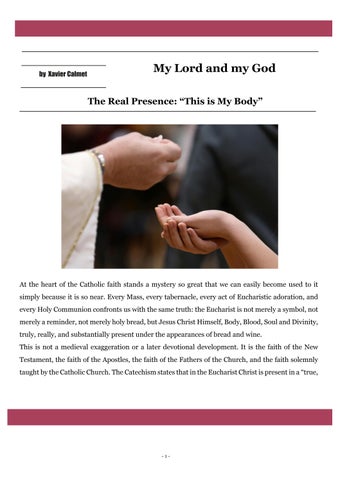
At the heart of the Catholic faith stands a mystery so great that we can easily become used to it simply because it is so near. Every Mass, every tabernacle, every act of Eucharistic adoration, and every Holy Communion confronts us with the same truth: the Eucharist is not merely a symbol, not merely a reminder, not merely holy bread, but Jesus Christ Himself, Body, Blood, Soul and Divinity, truly, really, and substantially present under the appearances of bread and wine. This is not a medieval exaggeration or a later devotional development. It is the faith of the New Testament, the faith of the Apostles, the faith of the Fathers of the Church, and the faith solemnly taught by the Catholic Church. The Catechism states that in the Eucharist Christ is present in a “true,
-1-
real, and substantial” manner (Catechism of the Catholic Church (CCC), 1374). It also teaches that this Eucharistic presence begins at the consecration and endures as long as the Eucharistic species (i.e. the appearances of bread and wine) remain (CCC 1377). Christ is present whole and entire under each species and whole and entire in every part of each species; the breaking of the Host does not divide Christ (CCC 1377). The question, then, is not whether Catholics have been too reverent towards the Eucharist. The question is whether we have been reverent enough.
The Words of Christ Our Lord’s teaching on the Eucharist is given with particular force in the sixth chapter of St John’s Gospel. After the multiplication of the loaves, Jesus tells the crowd that He is the true bread from heaven: “I am the bread of life” (Jn 6:35). He then makes the teaching still more explicit: “The bread which I shall give for the life of the world is my flesh” (Jn 6:51). His hearers understand that this is a shocking claim. They ask, “How can this man give us his flesh to eat?” (Jn 6:52). At this point, Our Lord could have explained that He was speaking only figuratively. He could have softened His language. He could have said, “I only mean that you must believe in Me.” Instead, He intensifies the teaching: “Truly, truly, I say to you, unless you eat the flesh of the Son of man and drink his blood, you have no life in you” (Jn 6:53). He continues: “He who eats my flesh and drinks my blood has eternal life, and I will raise him up at the last day” (Jn 6:54). Then come the decisive words: “For my flesh is food indeed, and my blood is drink indeed” (Jn 6:55). The reaction is dramatic. Many of His disciples say, “This is a hard saying; who can listen to it?” (Jn 6:60). St John then tells us that “many of his disciples drew back and no longer went about with him” (Jn 6:66). This detail is crucial. Jesus lets them go. He does not call them back to say, “You have misunderstood Me.” Instead, He turns to the Twelve and asks, “Will you also go away?” (Jn 6:67). St Peter replies with faith: “Lord, to whom shall we go? You have the words of eternal life” (Jn 6:68). The Eucharistic teaching of John 6 belongs to the wider scandal of the Incarnation. God has truly taken flesh: “The Word became flesh and dwelt among us” (Jn 1:14). Therefore, it is not unthinkable that the same Lord who took flesh in the womb of the Virgin Mary should give us that flesh sacramentally as heavenly food. The offence taken by some of His hearers was real.
-2-
Later, Christ’s enemies accuse Him of blasphemy because He makes Himself equal with God: “You, being a man, make yourself God” (Jn 10:33; cf. Mk 14:61–64). The Eucharistic discourse already reveals the same stumbling-block: God comes too close. He gives not merely an idea, but Himself. At the Last Supper, the promise of John 6 becomes sacrament. Jesus takes bread and says, “Take, eat; this is my body” (Mt 26:26; cf. Mk 14:22; Lk 22:19). He takes the chalice and says, “Drink of it, all of you; for this is my blood of the covenant” (Mt 26:27–28; cf. Mk 14:24; Lk 22:20). St Luke additionally records: “Do this in remembrance of me” (Lk 22:19). This “remembrance” is not a mere mental recollection. In biblical worship, memorial makes present before God the saving act He has accomplished. The Mass is not a new sacrifice separate from Calvary; it is the one sacrifice of Christ made sacramentally present.
-3-
St Paul and the Apostolic Faith St Paul is equally clear. Writing to the Corinthians, he asks: “The cup of blessing which we bless, is it not a participation in the blood of Christ? The bread which we break, is it not a participation in the body of Christ?” (1 Cor 10:16). He does not say that the bread and cup are merely reminders. They are a real communion in Christ’s Body and Blood. In 1 Corinthians 11, St Paul gives the earliest written account of the institution of the Eucharist. He reports the words of the Lord: “This is my body which is for you” and “This cup is the new covenant in my blood” (1 Cor 11:24–25). Then he gives a grave warning: “Whoever, therefore, eats the bread or drinks the cup of the Lord in an unworthy manner will be guilty of profaning the body and blood of the Lord” (1 Cor 11:27). He adds: “Let a man examine himself, and so eat of the bread and drink of the cup” (1 Cor 11:28). Anyone who eats and drinks “without discerning the body” eats and drinks judgment upon himself (1 Cor 11:29). This warning makes little sense if the Eucharist is only symbolic bread. St Paul says something far stronger: an unworthy communicant sins against the Body and Blood of the Lord. The Apostolic Church clearly received Christ’s words literally and sacramentally.
The Witness of the Early Church The earliest Christian writers after the Apostles speak in the same way. Around AD 110, St Ignatius of Antioch, on his way to martyrdom in Rome, wrote against those who denied the true humanity of Christ. He says that such people abstain from the Eucharist because they do not confess it “to be the flesh of our Saviour Jesus Christ,” the same flesh which suffered for our sins and was raised by the Father (St Ignatius of Antioch, Letter to the Smyrnaeans, 7). This is an astonishingly early witness. St Ignatius was not speculating centuries after the Apostles. He lived in the generation immediately following them. For him, denial of the Eucharist as the flesh of Christ is linked to denial of the Incarnation itself. St Justin Martyr, writing in Rome in the middle of the second century, gives one of the earliest descriptions of the Mass. In his First Apology, he explains that Christians do not receive the Eucharist as “common bread and common drink.” Rather, just as Jesus Christ became flesh for our salvation, so the food consecrated by the prayer of His word is the flesh and blood of that same incarnate Jesus (St Justin Martyr, First Apology, 66).
-4-
St Irenaeus of Lyons, writing later in the second century, argues against the Gnostics (1) by appealing to the Eucharist. If our flesh is nourished by the Body and Blood of the Lord, how can anyone claim that the flesh is incapable of resurrection? He writes that the bread, having received the Word of God, becomes the Eucharist, “which is the body and blood of Christ” (St Irenaeus, Against Heresies, V.2.3). St Cyril of Jerusalem, in the fourth century, teaches the newly baptised with directness: since Christ Himself declared the bread to be His Body, who would dare doubt? Since He declared the wine to be His Blood, who would say otherwise? (St Cyril of Jerusalem, Mystagogical Catecheses, IV.1–3). The Catholic instinct is simple: faith receives what Christ says because Christ says it. The Church Fathers do not speak as though the Eucharist were a symbol. They speak as men who believe that the altar gives us the same Christ who was born of Mary, crucified under Pontius Pilate, risen from the dead, and now glorified at the right hand of the Father.
Eucharistic Miracles and St Carlo Acutis The Church does not base her faith in the Real Presence on miracles. She bases it on the words of Christ. Yet, in His mercy, God has sometimes granted signs to strengthen weak faith. Eucharistic miracles, when carefully investigated and approved by ecclesiastical authority, are not replacements for doctrine; they are reminders. They point back to the central truth: the Host is not a thing but a Person. In recent times, St Carlo Acutis has become one of the most beloved witnesses to this truth. Born in London in 1991 and raised in Milan, Carlo died of leukaemia in 2006 at the age of fifteen. He had a deep devotion to the Eucharist and used his computer skills to catalogue Eucharistic miracles from around the world. He was canonised by Pope Leo XIV on 7 September 2025. Carlo’s life is important because he shows that Eucharistic faith is not nostalgia. It is not only for monks, nuns, priests, or the elderly. A teenage boy in trainers, using a computer, understood something many adults forget: if the Eucharist is Jesus, then the Mass is the centre of life. Carlo
-5-
famously called the Eucharist his “highway to heaven.” That is not sentimental language. It is sound theology expressed by a saint.
Every Particle Contains the Whole Christ Catholic reverence towards the Eucharist follows directly from Catholic doctrine. The Church teaches that Christ is present whole and entire under each species and whole and entire in every part of each species (CCC 1377). This means that the smallest particle of the consecrated Host, so long as the appearance of bread remains, contains Christ fully. The breaking of the Host does not divide Christ. This is why the priest handles the consecrated Host with such care. This is why the sacred vessels are purified. This is why the corporal (2) is used on the altar. This is why fragments are treated with reverence. This is why the Church has traditionally used a Communion paten or plate beneath the chin of the communicant: not because Catholics are fussy about externals, but because faith has consequences. The General Instruction of the Roman Missal states that after Communion, any remaining fragments are to be collected, and that the sacred vessels are purified (General Instruction of the Roman Missal, 163, 183, 278–279). The instruction Redemptionis Sacramentum explicitly says: “The Communion-plate for the Communion of the faithful should be retained, so as to avoid the danger of the sacred host or some fragment of it falling” (Redemptionis Sacramentum, 93). These details are not empty ritualism. They are theology in action. If every particle of the consecrated Host contains Christ whole and entire, then no particle is “just a crumb.” It is the Lord.
Communion Under One Kind Because Christ is whole and entire under each species, it is not necessary for the faithful to receive under both kinds in order to receive the whole Christ. The Council of Trent taught that Christ is present whole and entire under the species of bread and whole and entire under the species of wine (Council of Trent, Session XIII, chapter 3; canon 3). The Catechism repeats the same doctrine: Christ is present whole and entire in each species and in each of their parts (CCC 1377).
-6-
This matters pastorally: no Catholic should think that receiving only the Sacred Host means receiving “less” of Christ. The smallest consecrated particle contains the whole Christ: Body, Blood, Soul and Divinity. At Mass, after the breaking of the Host, the priest places a small particle of the consecrated Host into the chalice. This rite is called the commingling. The General Instruction describes this action: the priest breaks the Host over the paten and places a small piece in the chalice while saying the prescribed prayer (The General Instruction of the Roman Missal (GIRM) 83). This symbolises the unity of the Body and Blood of the living and risen Christ. It does not mean that
Christ was absent from either species before the commingling. Rather, it expresses sacramentally the living unity of the Lord whom we receive.
Receiving Worthily If the Eucharist is truly Christ, then receiving Holy Communion is the most intimate act of union with Our Lord possible in this life. It is therefore never casual. It is never automatic. It is never
-7-
something we simply “go up for” because everyone else is going. St Paul commands self-examination before Communion: “Let a man examine himself” (1 Cor 11:28). The Catechism teaches the same: “Anyone conscious of a grave sin must receive the sacrament of Reconciliation before coming to communion” (CCC 1385). To be in a state of grace means to possess sanctifying grace, the life of God in the soul. Mortal sin destroys charity in the heart and cuts the soul off from that life. The Catechism explains that for a sin to be mortal three conditions must be present together: grave matter, full knowledge, and deliberate consent (CCC 1857). A person conscious of mortal sin must not receive Holy Communion without first receiving sacramental absolution. This is not harshness. It is mercy. Confession is not an obstacle placed between us and Jesus; it is the ordinary sacramental way by which Jesus restores us to life when we have fallen. Frequent confession forms the conscience, humbles the soul, strengthens us against sin, and prepares us to receive Our Lord with greater purity and love. We should also recover the simple truth that not receiving Communion at a particular Mass can itself be an act of reverence. If one is not properly disposed, it is better to remain in the pew, make a spiritual communion, and go to confession as soon as possible. That is not failure. It is faith.
Reverence of Body and Soul The Church permits different lawful ways of receiving Holy Communion, according to the discipline in force. But the traditional Catholic instinct has always seen kneeling and receiving on the tongue as especially expressive of adoration, humility, and childlike dependence. We kneel because we are before the King of kings. We receive on the tongue because the Eucharist is a gift before it is an action. We do not take Christ; we receive Him. This is not about judging others. It is about asking what best expresses the truth. If the Host is truly the Lord, then our gestures should preach that truth. The body teaches the soul. A casual posture can slowly produce a casual faith. A reverent posture can awaken wonder. The words we say before Communion already teach us the proper attitude: “Lord, I am not
-8-
worthy.” We do not come because we are worthy in ourselves. We come because He calls us, heals us, and feeds us. But precisely because He is so generous, we must not become careless.
Conclusion: The Eucharistic Test The doctrine of the Real Presence tests the seriousness of our faith. If the Eucharist is only a symbol, then reverence is optional, confession is secondary, and the details of the liturgy may seem unimportant. But if the Eucharist is Jesus Christ Himself, then everything changes. The words of Christ are clear: “This is my body” (Mt 26:26). “This is my blood” (Mt 26:28). “My flesh is food indeed, and my blood is drink indeed” (Jn 6:55). The Apostles received these words literally and sacramentally. St Paul warned against unworthy Communion (1 Cor 11:27–29). The early Fathers confessed the Eucharist as the flesh and blood of Christ (St Ignatius, Smyrnaeans, 7; St Justin, First Apology, 66; St Irenaeus, Against Heresies, V.2.3). The Church’s liturgy guards every particle with reverence (GIRM 278–279; Redemptionis Sacramentum, 93). The saints, including St Carlo Acutis, show us that Eucharistic faith is the path to holiness. We should therefore return to the altar with renewed awe. We should genuflect carefully before the tabernacle. We should prepare before Mass. We should confess frequently. We should receive Holy Communion only in a state of grace. We should receive with the utmost reverence, ideally kneeling and on the tongue where possible. We should teach our children that the Host is not “bread” after the consecration, but Our Lord. The Real Presence is not one devotion among many. It is the beating heart of Catholic life. The same Jesus who walked in Galilee, who forgave sinners, who healed the sick, who died on Calvary and rose from the tomb, waits for us in the tabernacle and gives Himself to us in Holy Communion. “Lord, to whom shall we go? You have the words of eternal life” (Jn 6:68).
(1) Gnostics believed that salvation was achieved through secret, mystical knowledge (gnosis) rather than faith.
(2) A corporal is a square, white linen cloth placed on top of the altar during Mass. Its name comes from the Latin word corpus (meaning "body"). The chalice and paten rest on it, and it serves to catch any dropped fragments of the consecrated host.
-9-
- 10 -