by Professor Jim Lynch, OBE, KHS
Magnifica Humanitas On Safeguarding the Human Person in the Time of Artificial Intelligence
Encyclical Letter by Pope Leo XIV published 7 June 2025
In my 2022 article on Life in the Proclaimer, I pointed out the importance of the Encyclical Letter by Pope Francis, an industrial chemist by training, Laudato Si. On Care for Our Common Home published in 2015 as a critical analysis of the environment. Indeed, it was one of the documents which fostered my formation into the Roman Catholic Church. So, what could we expect from Pope Leo, a mathematician by training, in his first encyclical addressing the issue of artificial intelligence. Well, his 144-page document certainly does not disappoint and is indeed inspirational.
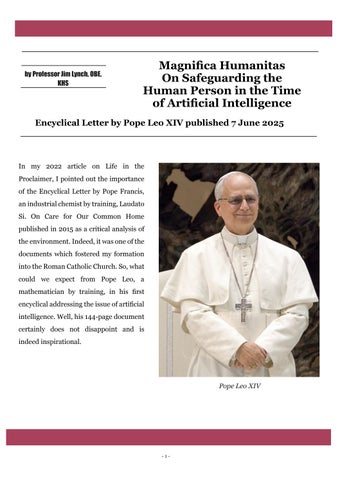
Pope Leo XIV
-1-
He starts by pointing out that humanity, created by God in all its grandeur, today faces a pivotal choice of creating a new Tower of Babel, based on artificial intelligence, or to build a city in which God and humanity dwell together. Artificial intelligence (AI) is the ability of a computer or a machine to copy human skills like learning and data processing to thinking and solving problems, all of which requires large data banks. It includes machine learning, data processing and automation. He spends the early part of the document discussing earlier papal encyclicals and the second Vatican Council especially in the context of the sanctity of life. Especially he refers to the need to recognise the equality of man in an era where so many are homeless and under privileged.
-2-
We already have seen that the big actors like Elon Musk as a pioneer of AI are incredibly wealthy and that their innovations might lead to a requirement for less employment and therefore result in more people entering poverty. He also recognises the incredible power of the technology to improve health with better diagnosis and treatment in healthcare. Indeed, the chief executive, Sir Pascal Soirot, of the global pharmaceutical company AstraZeneca, one of Britain’s largest public companies has stated that AI will not ‘kill’ large numbers of jobs but instead will help to increase productivity.
Bioethics should be at the centre of how we handle the opportunities and threats of AI. It covers the ethical issues related to health including those emerging from advances in biology, medicine
-3-
and technologies, making sure that human rights and dignity are protected. In a meeting of the Foundation of Science and Technology at the Royal Society on 16 June the new chief executive of UK Research and Innovation, Professor Sir Ian Chapman, raised the issue and I asked from the floor if he had considered Magnifica Humanitas.
His response was positively affirmative. I raised this the day after with Archbishop Richard Moth and he responded with pleasure and said that the Catholic Bishops’ Conference are forming an AI working party through the Department for Social Justice under Bishop Paul Hendricks. The speed of action is very encouraging. Pope Leo places the equal dignity of all human beings and the supreme value of human rights at the heart of his considerations. Social justice must grapple with the environment shaped by digital technologies and lead to the principle of Social Doctrine which rests the technology and economic actors rather than with States. Even when limitations such as human suffering are experienced, human wisdom dictates that we should integrate rather than suppress. In this respect we need to become more than human as Christian humanists like St Thomas Aquinas who died in1274 taught us. We must co-operate in the work of creation rather than be disinterested observers of technological processes which limit our freedom.
I could go on at length about the wisdom of the Pope Leo’s words but instead I would recommend everybody read a copy from the Catholic Truth Society which is available in the Cathedral Bookshop.
-4-