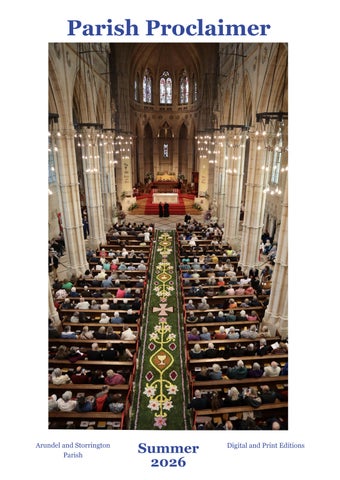
Parish Proclaimer
Arundel and Storrington Parish
Summer 2026
Digital and Print Editions
Corpus Christi 2026 Mass
Editor: Melinda Heathcote Design & Production: Bryden Isbister -2-
Contents Editor’s Note Dean’s Introduction Bishop Richard's Mass of Thanksgiving Archbishop's Installation Mass - our local servers! Choir News The Feast of Corpus Christi Solemnity of Corpus Christi in Arundel Cathedral 2026 Corpus Christi Catering 2026 Our Lady of Walsingham Statue A Joyful part of a Priest's Work The Fascinating Story Of The Only English Pope The 2026 Summer Investiture of the Equestrian Order of the Holy Sepulchre Truth Divine Mercy Reflection Friends Summer 2026 Vespers The Society of Saint Augustine of Canterbury AGM Gatwick Detainees Welfare Group Refugee Tales Event at Arundel Cathedral Deacon David's Silver Jubilee Money Changers in the Temple! Sunshine, Smiles and Community Spirit: Our Joint Parish Summer Gathering Choir Visit to Westminster Cathedral Dates at the Cathedral September 2026 - February 2027 Photo Credits
THANK YOU To the Friends of Arundel Cathedral for their generous sponsorship of the Proclaimer. ----- ** ----To become a Friend of Arundel Cathedral (the mother church of our diocese) Please contact: Lindsey Stratford, Cathedral House: 01903 884567 -3-
4 6 9 17 18 20 31 39 46 52 55 61 67 72 74 80 82 89 91 97 101 105 109
Editor’s Note
by Melinda Heathcote Editor
Summer 2026
Hello and welcome to this Summer edition of the Proclaimer.
We have plenty of news this time; most importantly a new Bishop-elect, Fr Stephen Wang, and we are very much looking forward to welcoming him to Arundel and Storrington Parish.
When you read this we shall be at the end of August, and possibly at the end of the very hot weather. As I write I am delighted to say that we had considerable rain last night, and as we prayed for rain at Mass last week, we can thank God for that blessing.
As you will see, this has been a very busy and active time in our parish, and we are always very grateful to those of you who send in articles and photos of events and news. Two major happenings which are included in this issue are the 3-day Investiture of the Knights of the Holy Sepulchre of Jerusalem which took place in July at Arundel and the services were concelebrated by Archbishop Richard Moth and Archbishop John Wilson together with other bishops and clergy and over 200 members and laity. This is the first time this Investiture has taken place in Arundel and was deemed a great success.
Another very large gathering was when The Friends of Arundel Cathedral welcomed over 220 people on the Gatwick Detainees Welfare Group’s annual Refugee Tales pilgrimage walk. The evening event for this was hosted by the Chief Executive of CAFOD.
-4-
Corpus Christi Altar Display
These and many other happenings in our parish are described in more detail in the following articles. We are blessed with having a strong community in both our churches and enjoy getting together – see our Summer Gathering!
Bryden has done his absolutely excellent job of putting this magazine together and getting it printed, for those of you who prefer hard copies, and put online for the rest. Martin has run his eagle eye over everything to ensure there are no mistakes, so I hope you will enjoy reading this.
Best wishes for the oncoming Autumn – Melinda – Editor Bryden – Design and Production Martin – Proofreader
-5-
by Father Stephen Dingley
Dean’s Introduction
Father Stephen Welcome to this summer’s edition of the Proclaimer. It will not surprise you to know that one theme has taken up a lot of my thoughts, prayers and time since the last edition: Bishops! On 19 December last year the Holy Father Pope Leo appointed our Bishop Richard Moth to be the next Archbishop of Westminster. It was a moment of mixed emotions. On the one hand I think we all shared a sense of joy—and dare one say, a little holy pride—that our bishop had been chosen for this role. On the other hand, we felt considerable sadness at the thought of losing our shepherd and friend. I am sure we all continue to hold Archbishop Richard in our prayers in his new and daunting role. Our Mass of thanksgiving for his ministry among us on 30 January was a lovely occasion, with a real feeling of warmth and a palpable sense of the “family” of the diocese. Canon Jonathan Martin’s beautiful words at the end of that Mass touched our hearts very deeply.
-6-
On the bishop’s cathedra or throne (which gives its name to a cathedral) is the crest of the current bishop, and in the sacristy are a picture of the bishop and a sign with his name (so visiting priests get it right in the Eucharistic prayer). It was with more than a little poignancy that I had to remove those on the evening before Archbishop Richard’s installation in Westminster. But the magnificence of that occasion was a wonderful counterbalance. It was a particular joy that two of our younger altar servers had been chosen by the Archbishop for a key role, that of presenting the crucifix and holy water to him as he solemnly entered his new cathedral. Dressed in Arundel purple cassocks, and carrying out their duties perfectly, they showed our Cathedral in an excellent light.
Then, of course, came the wait for a new bishop. “How long will it take?” people kept asking me. But I had no more information than anyone else. As it turned out, we didn’t have to wait too long—only until 2 July, when it was announced that Fr Stephen Wang had been appointed as our sixth bishop. As it turned out, I was hearing Confessions in Storrington when the news broke, so I found out just a little later than some other people, via a text message from our secretary Louise asking if we should share the news with the whole parish. The answer was—of course—yes!
Bishop-Elect Stephen
-7-
I was particularly joyful at his appointment, as I have known Fr Stephen since we were at university together (he was a few years below me) and then at seminary together in Rome (where he was just one year below me). We have also used his Sycamore videos in the parish for our Enquirer’s group and also for the Confirmation programme.
And then the meetings began. Organising an episcopal ordination is no small affair. There’s the liturgy, of course, but also the reception, the guest list and making sure we don’t have more people in the cathedral than can be safely accommodated, working out where all the bishops, priests and deacons will vest, and how many stewards we will need … and so on and on. Fortunately, there’s a great team of very competent people working on all of these things—it’s the only way it could happen. Just to give a flavour of the organisation needed, our first meeting took three and half hours just to work out what the questions were that we will need to address!
Let us hold Bishop-Elect Stephen in our prayers:
O God, eternal and loving Shepherd, we bless and thank you for the appointment of your servant, Stephen, to our Diocese of Arundel and Brighton. May your Holy Spirit grace him with a spirit of counsel and fortitude, a spirit of knowledge and piety, so that he may gently and courageously sanctify, teach and govern the Church of Arundel and Brighton as we work together to build up the kingdom of heaven. May he be a shepherd after your own heart, who, with compassion and wise discernment, will care for and lead your people with the joy of the Gospel. Through Christ our Lord. Amen.
Many thanks as ever to Melinda Heathcote and Bryden Isbister, and to all who have contributed to the contents and production of this issue of the Proclaimer. And may God bless all of you and your families and friends. -8-
Bishop Richard’s Mass of Thanksgiving
By Patrick Burgess
On Friday, 30th January, in what we surely know as one of the most beautiful Catholic cathedrals in the country, Bishop Richard gathered around him the flock which he had just been summoned to leave for a ‘Mass of Thanksgiving for his Ministry’, that is to say, the ten years of service and pastoral care which he has given to the Diocese of Arundel and Brighton. But it was not the beauty of the Cathedral that captured everybody’s heart that freezing cold evening but the love and respect for their Bishop which the ‘living stones’ in his charge – the people of Sussex and Surrey -were showing as they came in their hundreds to join this sad, happy celebration.
-9-
A delightful picture of Bishop Richard smiling broadly prefaced the Order of Service. Then the Sacristy bell tolled and some eighty clergy and thirty altar servers processed in, threading through the very large and overflowing congregation to the sound of ‘Christ is made the sure foundation’ into the light-filled Sanctuary. It was a happy touch that we were joined by the Anglican Bishop of Chichester.
Everyone’s voices, led by the Diocesan Choir, filled the graceful vaults with glorious sound and Bishop Richard, while thanking everyone fulsomely, urged us all not to forget the tasks ahead in building up the Church (work which under him - though it will be up to his successor as to whether it continues in the same form - has been significantly led and supported by the Pastoral Plan for the Diocese where there is still much to be done but where other dioceses are already writing in about what they can do to replicate the strategy).
- 10 -
Besides the clarity of the significant
otherwise than that the whole church was
planning
and
returning that affection with great warmth.
initiated
under
administrative Bishop
reforms Richard’s
leadership, everyone was very conscious of
Yet all too soon the Mass was drawing to a
the heartfelt concerns which he himself
close. Everyone seemed to put their heart and
had shown for all the souls in his care
soul into the recessional hymn, ‘Tell out my
‘whatever trouble vexed the mind or guilt
soul, the greatness of the Lord….’ And there
the heart oppressed’ and no one could not
was Bishop Richard standing
have been conscious during the Mass
door, wishing each of us, individually, farewell.
- 11 -
at the West
And on the back cover of the Order of Service was a delightful picture of our bishop waving goodbye: could it, one wondered, have been a little wistfully? Then after Mass everyone, by courtesy of his Grace the Duke, was able to retire to the Castle, gently to make merry in front of the blazing fires in the Barons Hall before going back out into the dark night - each of us a piece of living history.
- 12 -
- 13 -
- 14 -
- 15 -
- 16 -
Archbishop’s Installation Mass – our local servers!
by Melinda Heathcote
Connor (Top row third from right) “ All the people at the Cathedral were very welcoming to us. We felt it was a great honour to be part of the occasion and for our Cathedral at Arundel and for the whole A&B Diocese.” Karl: (Bottom row third from right) “It was the biggest thing I’ve ever done! We were very happy to be there.” Two of our Arundel Mass altar servers were honoured to be chosen to serve the Installation Mass at Westminster Cathedral for Archbishop Richard Moth on 14th February this year. Connor and Karl Collins were delighted to represent the Cathedral servers on this very special occasion.
- 17 -
Choir News
by Amelia
Amelia, one of the young Cathedral Choristers, writes about her experience singing in the Glyndebourne Festival this year.
Tosca performance at Glyndebourne Festival this year in which Ameila sang
(C) Glyndebourne Productions Ltd. Photograph by Richard Hubert Smith
- 18 -
Being a part of the children’s chorus in Glyndebourne’s first ever Tosca has been a very fun and memorable experience. In the audition process, which was over a weekend in February, we were split into groups - as there were about 300 children auditioning - and learnt some music from the opera and choreographed some movement to go with it. This was for the vocal and movement coaches to see how well we could act and sing while remembering choreography, but the chaperones (who accompany under 18s around the opera house) were also watching to see how we took on feedback and interacted with other singers.
Once I had officially been selected alongside 10 other children from GYO (Glyndebourne Youth Opera) to be part of the children’s chorus for Tosca, we began rehearsals including an ‘intensive week’ where we learnt the music and movement for the opera in more depth.
During the intensive week, we got to work with and learn from one of the assistant directors, Ollie Platt, vocal coach Mary King, baritone in the Glyndebourne chorus Andrew Davies and Italian coach Alessandra Testai. After the intensive week in April where we learnt the music, we were joined by ten boys from Trinity School and began to stage the opera. This was when we finally got to meet the director, Ted Huffman. This was done in a big room the size of the stage where the set can be put up for rehearsal purposes while other operas might be using the stage, and as Tosca is part of the summer season which is a very busy time at Glyndebourne, it was there that we did all of our rehearsals up until the dress rehearsal!
The dress rehearsal was open to the public and was when many performers’ families and friends came and watched. The children’s chorus are only on in the first of three acts in Tosca, [informally referred to as the Te Deum scene] so we usually went home after we had finished performing. However, for the open dress, opening and closing nights, we were allowed to stay until the end for the curtain call. There are two separate runs of Tosca with different principal casts and we are currently on the break in between runs. I have thoroughly enjoyed every aspect of being in this opera, from the stage to the dressing rooms, and am so grateful for the opportunity to sing with world renowned opera singers! I have loved performing in Tosca and very much look forward to the second set of performances!
- 19 -
by Barbara Isbister
The Feast of Corpus Christi
Abbot Paul Gunter carrying the Blessed Sacrament, Arundel Cathedral, June 2026
The Feast of Corpus Christi – Meaning and Significance ‘Corpus Christi’ is the Latin term for the body of Christ. The feast of Corpus Christi, also known as ‘The Solemnity of the Most Holy Body and Blood of Christ,’ is a celebration of the Real Presence of Christ in the Eucharist. A presence revealed by Jesus to the apostles at the Last Supper: ‘This is my body,… this is my blood.’ Echoed by Saint Paul, who reminds us of the mystery of the Eucharist: ‘The bread that we break, is it not a participation in the body of Christ?’ Corinthians 10: 16-17
- 20 -
Date of Celebration It seems fitting that the liturgical celebration of the feast was originally set by Pope Urban IV in 1264, and celebrated nine weeks after Maundy Thursday or 60 days after Easter Sunday, on the Thursday after Trinity Sunday. However, from 1970, following the second Vatican council, (1962-5), local bishops were given permission by Pope Paul VI to transpose the feast to the following Sunday, in order to accommodate attendance for the working public. It was not until 2006 that the Church in England and Wales transferred the day of celebration to the Sunday after Trinity Sunday. The feast is still also celebrated on Thursday in many countries (in 25, it is a public holiday), although Thursday is not a Holy Day of Obligation. Arundel has a historic exemption to celebrate the feast on Thursday, as it has done for almost 150 years, since 1877.
Origins and Development of the Feast The feast originated in 1264 following several events. It started in the early thirteenth century when a Belgian nun, Saint Juliana of Liège, had a vision of the moon with a dark spot on it. She heard a voice telling her the meaning of the vision was that a feast in honour of the Eucharist needed to be established. In 1246 she recounted her experience to a local archdeacon, which resulted in the Bishop of Liège holding a local celebration in the same year.
Secondly, in 1263 a miracle occurred in the Italian town of Bolsena when a consecrated host bled onto an altar cloth. It was thought that this was due to the doubt of the priest in the Real Presence of Christ in the Eucharist. As a result, Pope Urban IV (previously the local archdeacon that Saint Juliana had confided in), established the feast. By the following year, in 1264, Pope Urban IV decreed that everyone in the Latin Church should observe the feast on the Thursday after Trinity Sunday. He commissioned the theologian Saint Thomas Aquinas to write prayers and hymns for the feast.
The three elements of the Corpus Christi celebration which have been widely adopted are: Solemn Mass, Procession and Benediction. In the Procession, the celebrant carries the Blessed Sacrament in a monstrance (see photo) beneath a baldachin (canopy) supported on four poles
- 21 -
Corpus Christi, Arundel Cathedral, June 2026
and carried by four bearers. The clergy, lay orders and the congregation follow. The strewing of flowers by children along the procession route in front of the celebrant, together with the purpose of the Carpet of Flowers, prepared specifically for the celebrant to walk on while carrying the Blessed Sacrament are signs of love and devotion to the presence of Christ in the Eucharist.
The Spread of Corpus Christi in Europe One of the first processions was in Cologne in 1270. By the early fourteenth century the practice had spread to several other European countries. From 1320 Spain had a solemn procession and streetwide floral carpets. In the same year in Poland, children in Kraków were throwing flower petals in the outdoor procession; a custom which had started in 1247. The first recorded outdoor processions with many wearing traditional costumes, were in Vienna in 1363. In Portugal flower-petal carpets filled the streets, the celebration became a grand royal event and included the blessing of the sea. In many European countries, traditional costume was worn, or First Holy Communion clothing for those who
- 22 -
had received the Sacrament for the first time in the preceding weeks. Children would strew flowers in the path of the clerical procession carrying the Eucharist. These customs are still followed in a number of European countries today and in diasporas worldwide. Observance of the feast has spread to other parts of the world, including South American and African countries.
By 1311-12 the feast was confirmed obligatory for the whole church by Pope Clement V at the Council of Vienne.
In Rome the feast is celebrated by the Pope every year with a Papal-led procession in which he carries the Blessed Sacrament from the Basilica of San Giovanni in Laterano to the Basilica of Santa Maria Maggiore where Benediction follows.
Corpus Christi, Arundel Cathedral, June 2026 - 23 -
The tradition was brought to Arundel by the Duke of Norfolk, Duke Henry XV, who in 1873 built the church which later became Arundel Cathedral. Following a visit to Sutri, near Rome, where he first saw the custom of the carpet of flowers, he was inspired to introduce the tradition to Arundel Cathedral in 1877. Since then, a carpet of flowers has been laid every year until the present day. The only exceptions were two years: one during World War I and in 2020 during the Covid pandemic.
The monstrances at Arundel Cathedral, June 2026
- 24 -
Corpus Christi in Arundel 2026 - The Celebration The Mass, the Procession, Benediction ‘Like being in Heaven’
Abbot Paul Gunter celebrated the Mass for the feast of The Most Holy Body and Blood of Christ, Corpus Christi at 5.30pm on Thursday, 4 June 2026. In attendance were canons, priests and deacons from the diocese of Arundel and Brighton. The lay orders of the Knights and Dames of the Holy Sepulchre and the Knights of Saint Columba were also present. The Cathedral was full. Abbot Gunter delivered an uplifting homily, literally, inviting us to look up at the fan-vaulted ceiling and the skyward-rising columns. Also, inspirational: exploring the significance of ritual in religion, it was familiar, ‘it was like coming home,’ he said. The Solemn Mass was followed by the procession. Due to weather conditions, this took place inside the Cathedral this year. The Abbot carried the monstrance containing the Blessed Sacrament under an ombrellino (a small canopy) over the carpet of flowers and around the cathedral. The clergy and servers followed. The First Holy Communion children strewed flowers for the procession. One visitor I met afterwards, said to me. ‘It was like being in Heaven.’ I agreed.
Corpus Christi, Arundel Cathedral, June 2026 - 25 -
Corpus Christi – The Preparations and Process in Arundel Every year in Arundel, an innumerable number of volunteers from the diocese, the parish, local and even distant communities, some of whom make an annual trip, gather to prepare for the feast of Corpus Christi. Planning starts months earlier, including discussions about the design, themes, selection, quantities and colours of flowers and greenery needed for the carpet and for all the floral displays. Once the design for the carpet is agreed, the designers, Oliver and Diane Hawkins start work. The key theme of the carpet is, of course, Corpus Christi. To this end, images of the host and chalice
Preparations: the underlay and stencils for the design of the Carpet of Flowers, June 2026
- 26 -
are always included, and this year the centre piece was a cross. There were no other themes this year. In previous years, themes of Jubilee Year, Peace, Pope Francis and Pope Leo were used. Also, this year, the design was ‘different’ and more ‘abstract’ than usual, said Oliver. In previous years the patterns consisted of a series of regular shapes: diamonds, circles, for instance, filled with flowers. This year’s was more open, delicate and lighter in texture. The result? As usual, stunning. Visitors and parishioners alike did not cease to be impressed. On the Sunday before Corpus Christi, the designers fix the ‘underlay’ in place along the length of the 90-foot, stone aisle. It consists of thick brown paper. On to this, they draw round the pattern, using stencils they have made and architectural rulers. This takes most of the afternoon. The lines on the base paper provide the guidelines for the flower carpet layers.
Before any of this can start, the invisible battalions start work: tree cutting, loading and transporting branches for the greenery, from the Castle Estate, by kind permission of the Duke of Norfolk, and from other locations; heavy lifting, carrying, moving candle stands, carrying the surprisingly heavy water-filled containers of flowers are just some of the invaluable and important work they do behind the scenes.
We were delighted, for the second year running, to have pupils from St Philip Howard School who had recently been confirmed and other young people who generously gave of their time to help with some of the heavy lifting, carrying and other tasks. It was also very fortunate that there were many first-time volunteers who were very helpful. We hope they enjoyed the experience and will return next year.
In addition, there is an army of dedicated cutters, who spend hours cutting greenery for displays and for the carpet which takes place on Monday. On Tuesday many of them return, and more cutters join them to cut the flower heads. The care, precision and patience required is offset by the happy chatter, tea/coffee, sweet treats and encouragement provided by the Flower Team Leader, Sylvia Jones.
- 27 -
Preparations: cutting the greenery, June 2026 On Monday morning the flower arrangers arrive and produce magnificent displays on the altars, statues, the baptistry and in any nook that can be found. There is also a beautiful display of vestments enhanced by accompanying information. On Tuesday morning, the laying of the carpet begins. First the greenery is laid and then the flowers. This year there were between 12 and 16 ladies working on the carpet. It took all day.
Laying of the Carpet of Flowers for Corpus Christi, June 2026
- 28 -
The Carpet of Flowers, Arundel Cathedral, June 2026
- 29 -
Floral displays for Corpus Christi, June 2026
Video of the 2026 Carpet Preparation, Floral Arrangements and Drone View can be seen at: https://arundelcathedral.uk/view-2026-corpus-christi-carpet-of-flowers
Special thanks to the Flower Team who oversee all things floral, and especially to the Leader, Sylvia Jones.
Anyone interested in helping in any way is very welcome to come along. Please contact the Cathedral Office.
Members of the Flower Team, Floral Arrangers and Helpers, June 2026 - 30 -
Solemnity of Corpus Christi in Arundel Cathedral 2026
Reflection by Antonia Moffat
St Pio of Pietrelcina: “A thousand years of enjoying human glory is not worth even an hour spent sweetly communing with Jesus in the Blessed Sacrament.”
Establishment of the Feast of Corpus Christi: The Catholic Church honours Christ’s presence in the Most Holy Eucharist due to St Juliana of Liege, a Norbertine canoness who lived in the 13th century. She had a great love for the Holy Eucharist and was graced with vision in which she was shown the Church as a full moon with a dark spot. The significance of this indicated that the Church was lacking a feast especially celebrating the Body and Blood of Christ. This was shared with her
- 31 -
spiritual director who in turn consulted the local bishop. Bishop Robert de Thorte of Liege established the Feast in his local Diocese. It was extended to the universal Church following an intervention by St Thomas Aquinas, Doctor of the Church in 1264, with His Holiness Pope Urban IV.
This followed the Eucharistic miracle of Bolsena, Italy, which occurred in 1263. A priest doubting the doctrine of transubstantiation (the belief that the bread and wine become the Holy Body and Blood of Christ during the Consecration at Mass) was celebrating Mass when the consecrated host began to bleed onto the altar cloth, called a corporal. This miraculous corporal was taken to Orvieto, where Pope Urban IV was living, and the miracle is credited with inspiring him to establish the Feast of Corpus Christi.
The Meaning of Corpus Christi: The Solemnity of Corpus Christi is celebrated by the Catholic Church and commemorates the Body and Blood of Christ. It is a moveable solemnity on the Thursday following Trinity Sunday (eight weeks afer Easter Sunday). Thursday is the traditional day of the Feast, as it was on Holy Thursday that Our Blessed Lord hosted the Last Supper before his Sacred Passion, Death and Resurrection, and instituted the Sacrament of the Most Holy Eucharist and the Sacred Priesthood. In celebrating Corpus Christi, the Church honours Our Blessed Lord, celebrating the Real Presence of Jesus, Body, Blood, Soul and Divinity in the Most Holy Eucharist.
Corpus Christi Traditions: On this Holy day following Solemn Mass, Our Blessed Lord is placed in a Monstrance that is then carried by the priest in solemn procession to the joyous acclaim and adoration of the faithful. Scripture readings, Eucharistic prayers, devotions and hymns are sung. The procession ends with Benediction of the Blessed Sacrament. Eucharist Processions became more widespread from the 14th century and have been greatly encouraged by successive popes, church councils, documents and by many saints, thus highlighting the supreme importance of the Holy Eucharist
Arundel Cathedral and Corpus Christi: To celebrate the Solemnity of Corpus Christi, the clergy and faithful of Arundel Cathedral faithfully maintain a beautiful and sacred tradition of the creation of a floral carpet in honour of Our Lord and Saviour Jesus Christ, truly present in - 32 -
the Blessed Sacrament, which extends the
anymore, as in former ages of faith!
entire length of the cathedral’s central aisle of around 98/29.8m. Arundel Cathedral is perhaps one of the
Historical Context: This sacred tradition
few places left in the world which still
was started in 1877 by Henry Fitzalan-
keeps alive this sacred and spiritual
Howard, the 15th Duke of Norfolk, who also
tradition of the carpet of flowers for Our
founded the Church of Our Lady and St Philip
Blessed Lord. In some places, carpets of
Neri in 1873, built in the French Gothic style.
flowers are displayed but have no religious
This Church became a Cathedral in 1965,
ceremony
when the Diocese of Arundel & Brighton was
or
significance
attached
- 33 -
founded. The Cathedral took on the new name of Our Lady and St Philip Howard in 1973. This followed the canonisation of the 40 Martyrs of England and Wales on 25 October 1970, of which St Philip
Howard
(1st
Earl
of
Arundel) was one.
Duke Henry Fitzalan Howard whilst on holiday in the Italian village of Sutri, just outside Rome, was spiritually moved when he witnessed a Corpus Christi Procession through a beautiful carpet of flowers. This inspired him to introduce a carpet of flowers to Arundel which has continued ever since,
created, in the initial years, by the gardeners
with the exception of part of the
of the great Norfolk Estate. They grew the
First World war years when the
greenery and the flowers in the castle
Estate workers were at the Front,
grounds and prepared and laid the flowers.
and in 2020 due to the Covid Sylvia Jones is the current administrator of
pandemic.
the flower team, and the one who coordinates The
Arundel
Cathedral
the large group of volunteers numbering
Tradition of the Carpet of Flowers: The tradition of the magnificent Carpet of Flowers was originally implemented and
- 34 -
around 90, the ordering of the flowers, the collection of the greenery and their preparation, and most importantly she oversees the laying of the Carpet with expert flair and creativity.
Oliver Hawkins has prepared the carpet template over many decades and is a walking history book on the life and works of the 15th Duke, and the tradition of the Arundel Carpet of Flowers. Every year significant themes are chosen in close collaboration with the Cathedral Dean, and in continuity with the liturgical traditions of the Universal Church and local Diocese. Months of preparations go on behind the scenes, before the volunteer teams ever arrive!
xyx
- 35 -
The
highlighted
themes
for
2026: This year 2026 marked the 146th presentation of the Carpet of Flowers which reflected the themes of: the Holy Eucharistic Host and Sacred Chalice which enthrone the very body, blood, soul and divinity of Our Lord Jesus Christ truly present and entire in each Eucharistic Host and drop of Precious Blood. This importantly highlighted the celebration of the Holy Body and Blood of Christ – the very reason for the Solemnity of Corpus Christi. Secondary themes encouraged
prayers
for
peace
amongst the peoples of the war-torn areas of our suffering world.
The spiritual significance of the
and reality connected with the tradition of the
Carpet of Flowers: The carpet of
magnificent carpet of flowers. This was
flowers is designed to be enjoyed as a
prayerfully highlighted throughout the two
spectacle for the two days before the
days of viewing, as the Dean, Fr Stephen
solemn Mass of Corpus Christi and
Dingley encouraged a moment of Eucharistic
Blessed Sacrament Procession, which
and Scriptural Reflection each hour! All
are at the very heart of the celebration
present were called to prayer, to reflect in
of the solemnity of Corpus Christi.
moments of silence. A rota of Eucharistic
Many thousands from all over the
adorers were also encouraged to pray before
country come to view it. However,
the Tabernacle in the Blessed Sacrament
there is a deeply spiritual meaning
Chapel to ensure that constant prayers of
- 36 -
intercession were being offered up for peace and for all the intentions of those preparing and attending these great days of celebration and solemnity. It was a time of grace to be in prayer with our Eucharistic Lord.
A most beautiful Floral Pathway for our Eucharistic Lord: The tradition is that the bishop/abbot/priest, solemnly carrying the Blessed Sacrament, will be the first to tread the Carpet of Flowers with the Eucharistic Lord, focus of all our love, adoration, prayer and praise. The deeper meaning of the flowers is that they are a sign of love and sacrifice, a mirror image of
Deacon Roger Stone with Abbot Paul Gunter
the Sacrifice of Our Lord's own love for us, when he laid down his life for us on the Cross for the salvation of all. The glory of the beauty of the flowers, and of all the skill and sacrifice of time, of those who prepared and laid the carpet of flowers are sacrificed to God, acknowledging that He is the King of Kings, Lord of Lords, and author of all Life and of all Creation.
Mass of Corpus Christi in Arundel Cathedral – Corpus et Sanguinis Christi: Abbot Paul Gunter of Douai Benedictine Abbey, celebrated the beautiful Mass of the Solemnity of Corpus Christi.
- 37 -
Due to blustery wind and torrential rain the Blessed Sacrament Procession from the Cathedral to Arundel Castle was unable to go ahead. Instead we had the most beautiful procession of the Blessed Sacrament in and around the Cathedral. It was a precious moment when Abbot Paul processed through the carpet of flowers with Our Blessed Lord – the true laying down before the Living God, of all the time, gifts, talent and creativity of those who had worked so diligently to create the Carpet of Flowers.
This precious moment, reminded me, that all the glory and all thanksgiving is given to Jesus as our Saviour and Redeemer - Sweet Sacrament Divine, O Bread of Heaven, Let all mortal flesh keep silent, Soul of my Saviour, O Sacrament Most Holy - the first lines of many traditional Eucharistic hymns came to mind.
As the procession wended its way, so First Communion children followed. What was so beautiful was that young girls kissed the flowers each time before they were strewn before our Eucharistic Lord. They will surely remember that gesture of love forever! And certainly JESUS will! Abbot Paul continued to process the Blessed Sacrament around the Cathedral and finally again down the central aisle of flowers to give solemn Benediction. The celebrations ended with the spiritually electrifying hymn Faith of Our Fathers and an Organ Voluntary!
May the Most Holy Body and Blood of Christ be forever praised, loved, adored and glorified. Amen, Amen.
I leave you with these powerful words of exhortation from the recently canonised St Carlo Acutis: “Try to go every day to Mass and to receive Holy Communion. … If you can, stay a few minutes every day in Eucharistic Adoration in front of the tabernacle where Jesus is really present, and you will see your level of holiness increase considerably.”
- 38 -
Corpus Christi Catering 2026
by Adam Vernon
Preparing the sandwiches Another year of Corpus Christi has come and gone in a flash and yet there has been a massive team of volunteers supporting all the various areas to make the event a great success. I would like to take you through the journey that the Happy Catering Team has gone through this year, in order to prepare for and deliver its services in 2026. Father Stephen called a meeting of the Corpus Christi Steering Committee in November 2025 to set the scene, and from that point onwards we were left to make all the necessary arrangements for the catering. In April 2026, I asked for anyone who would like to volunteer to either be part of the Happy Team of Caterers in the Cathedral Centre, or offer to make and donate cakes which we would sell to the public over the two days of Corpus Christi.
- 39 -
I keep a record of all our food and drink supplies each time and refer to the previous year to refresh my memory of what is needed a few weeks beforehand. This year we purchased goods from eight different suppliers either online or face to face, amounting to just about £700 in preparation. The shopping takes a couple of days getting everything ready and fresh for the Wednesday and Thursday of Corpus Christi. Preparing the Cathedral Centre happens on the Tuesday, when Emer and I set up tables and chairs, the counters for selling tea, coffee, cakes and sandwiches, the pay desk with card machine and large cashbox (which somehow got lost and then was found in the Cathedral House – just in time!). We had an enhanced cake room with large rectangular tables which made the receiving and preparing cakes a dream this year! All the various laminated signs were put up, informing the public of where to go and what food and drink is available and at what price. The flower arrangers kindly make one large and striking arrangement for the ‘stage’ and 20 beautiful table decorations to adorn each table inside and out. The courtyard at the front had been weeded and swept clean by Bernard for us this year, which was a great help.
On the Wednesday morning, I arrived at 7.30 to put up the bunting outside the hall and the two big notices which direct visitors from the Cathedral down to the Cathedral Centre. And just as I was putting the tables and chairs out in the courtyard the rain started in earnest and I abandoned ship, and sadly we could not have the seating outside because of the really inclement weather over both days. Emer joined me at 8.00 (after collecting more donated cakes enroute) to start getting everything in order and ready for the early volunteers who arrived at 8.30 to start sandwich production! Bryden had kindly prepared and set up on the TV screen, our ‘rolling display’ which runs all the time in the Cathedral Centre and gives our customers numerous pieces of information from when the Mass is starting, what sandwiches we have on sale, how to call the local taxi, etc.
The Happy Team of Caterers have a very positive attitude, and it was like an old friends’ reunion getting back together each year. Everyone donned their black apron, name badge and gloves, and sandwiches started rolling off the production line in no time at all. We were now underway and had the display fridge full of wholemeal and white bread versions of our five different fillings. This year our new filling was Coronation Chicken which proved to be very popular with the visitors. Our first customer arrived at 9.00am asking ‘are you open yet’ which,
- 40 -
of course we were! It was initially a steady
and most dynamic group of 26 people who
start but picked up and soon we were at
worked their socks off over the two days.
standing room only (not being able to seat
It wouldn’t be a Corpus Christi without
anyone outside) luckily just for a few
someone getting stuck in the lift, (and I wasn’t
moments and continued to be busy
disappointed) and just about midday on
throughout.
Wednesday I heard the alarm going off
I was delighted that we had several new
intermittently, simultaneously as I heard
volunteers join the Happy Team of
someone saying ‘help, we’re stuck!’ I’m glad to
Caterers this year who blended seamlessly
say it was easily solved as they had let go of the
with the regulars and we had a brilliant
‘raise me up’ lever too soon and they’d stopped
- 41 -
about three inches from the top floor. On Thursday we had a gentleman stuck at the bottom, unable to open the door, luckily, I knew where the ‘special’ key was to open the door manually and he was soon out; with great relief! Blocked toilets being reported to us is an old favourite of ours during Corpus Christi, and our very own Toilet Queen rolled up her sleeves, went downstairs and grabbed the bucket to flush out the problem! However, after a second trip to fill the bucket, the Toilet Queen was disappointed to find water across the floor, only to discover with great hilarity that she had a ‘hole in her bucket dear Lisa!’. More toilets needed the extra bucket flush on Thursday too – this time with a different bucket. We were informed twice over the two days that no water was coming out of the taps in the toilets downstairs, however on examination we discovered the visitors were not putting their hands in the right place to activate the automatic sensors - easily solved! Our volunteers on the pay desk were challenged with the card machine signing itself out and odd screens
them great credit, there was not an ounce of anxiety or panic. On one occasion the power lead had become disconnected inside the device, and several times it seemed to jam on one screen, and although I managed to get it operating each time, I’m not quite sure what I did to sort it out. All these issues were hardly noticed, and were way overshadowed by the stream of compliments we received from our visitors and happy faces throughout the two days. We were blessed this year with a wonderful amount of super cakes, (which I was delighted about, as I was concerned cake supplies would be down due to some of our big contributors not being able to help this year) to the extent that we
coming up on a few occasions, but give
- 42 -
were able to have a table-sale at the back door of the kitchen for when all the children came out of school, which was a great success. And then after the overflow congregation came out of the Cathedral Centre after Mass we had a second table sale in the entrance hall, and sold every remaining cake, along with a complimentary bouquet of flowers made from the table decorations. As mentioned above, this year we had to close early to allow for the overflow congregation from the Cathedral to watch the Mass on a large screen in the hall, installed by the Diocesan IT manager. So, at 3.30pm we had to stop serving and set up the hall with theatre style seating to
- 43 -
accommodate
about
40/50
people who couldn’t fit in the Cathedral safely, whilst we were working discreetly and quietly in the kitchen to tidy away from two days of activities. Emer and I finally finished at 8.30pm on Thursday evening after two days working with our 26 brilliant volunteers. The leftover food and drinks were taken down to Stone Pillow in Chichester the following day, and
every minute!) Generous local people donated 86
the
was
baked items including: huge traybakes, loaf tin cakes,
enormously grateful indeed for
traditional round cakes, and sets/boxes of flapjacks,
the gift of very useful goodies for
cupcakes, shortbread, and brownies. All of which
their clients.
converted into 720 slices of cake including individual
Emer and I have done a couple of
cupcakes, brownies etc. Some of these were sold in
calculations which might be of
the “after school” boxes, in addition to the sale of five
interest.
made
whole cakes. During the week of Corpus Christi, I cut
approximately 260 sandwiches
some tracks in the road between my house,
and poured approximately 875
Chichester and Arundel travelling approximately 250
cups of tea and coffee. (that is an
miles collecting, preparing and returning all our
average of 60 cups an hour – one
resources over a seven-day period – full of good
lady
in
The
charge
team
cheer!
- 44 -
All in all, we had a fantastic Happy Catering Team who were an absolute pleasure to work with. We had such good spirits throughout both days, and everyone was willing to turn their hands to any job needed without hesitation. Truly a dream team.
- 45 -
Our Lady of Walsingham Statue
By Antonia Moffat
A new statue of Our Lady of Walsingham has been blessed and enthroned in Arundel Castle. Enter into the remarkable grace of Our Lady of Walsingham’s presence in Arundel Castle and how it relates to ages past, and directly to St Philip Howard, patron saint of the Dukes of Norfolk. “When England goes back to Walsingham, Our Lady will come back to England”. Prophecy of Pope Leo XIII when he signed the rescript for the restoration of Our Lady of Walsingham’s Shrine in 1897.
This statue of Our Lady of Walsingham in Arundel
Castle
was
commissioned
by
Georgina Duchess of Norfolk as an act of Reparation and was solemnly enthroned and blessed on 19 March 2026, Feast of St
The new statue of Our Lady of Walsingham in Arundel Castle
Joseph. Holy Mass was celebrated in reparation and thanksgiving in the adjacent
- 46 -
Fitzalan Chapel by Fr Stephen Dingley, Dean of Arundel Cathedral. Canon Alexander Sherbrooke parish priest of St Patrick’s Soho Square blessed and enthroned the statue, and Fr Rod Jones OSB parish priest of Worth Abbey read St Philip Howard’s Wracks of Walsingham.
The Sculptor and Sculpture of Our Lady of Walsingham. The statue was sculpted by renowned Catholic artist Martin Earle who specialises in artwork in service of the sacred liturgy. He carefully researched the materials, colour, and the symbolism included in the statue, so that it reflects as closely as possible what the original may have looked like. The statue is carved in English sycamore and painted in encaustic (wax) paints. He was particularly inspired by the 13th century battered, wooden English oak statue, to be found in the V&A Museum in London, which could in fact be the original statue of Our Lady of Walsingham, somehow salvaged and hidden from destructive reformers.
We experience Our Lady’s pity and sorrow for us poor sinners, her strength, and total obedience to God’s will, amidst the joy of caressing and presenting her Divine Son.
Our Lady of Walsingham Our Lady appeared in 1061 to Richeldis de Faverches, Lady of the Manor in Walsingham during the reign of King Edward the Confessor. Richeldis had a vision in which the Mother of God took her in spirit to Nazareth and showed her the holy House of the Annunciation. Our Lady requested that a replica of the holy House of Nazareth be built in Walsingham.
Religious Symbolism in the Statue Our Lady of Walsingham is the Seat of Wisdom and sits upon a throne. She is amidst two pillars which represent the Church as the gate of Heaven; the seven rings on these pillars signify the seven Sacraments and the seven gifts of the Holy Spirit; the arched back of the throne represents the rainbow, the sign of the Covenant between God and His people; the lily symbolises virginity, purity, sovereignty, sign of resplendent beauty and testifies that Our Lady remained the Blessed Virgin before, during and after the birth of the Saviour Jesus Christ; a toadstone symbolising evil is beneath her feet, showing that she crushes Satan and all his empty works; and finally she wears a Saxon Crown representing her Queenship. For Mary is Queen of Heaven and as Our Lady of Walsingham, the spiritual Queen of England. An ancient tradition
- 47 -
A stained glass window featuring Our Lady of Walsingham. All Saints Episcopal Church, Jensen Beach, Florida states that the Lily sprang from the
Arundel possessed no fewer than three
repentant tears of Eve as she went forth
important shrines to Our Lady. The shrine of
from
of
Our Lady of Arundel was located in a chapel
Walsingham is seen as the New Eve, the
near the site of the present cathedral. Thomas,
Mother of life, who bore JESUS, Saviour of
Earl of Arundel, in his will dated 10 October
the World.
1415, willed that his executors build at the
paradise.
Here
Our
Lady
Mary Gate in Arundel a chapel in honour of Arundel & Devotion to the Blessed
the Blessed Virgin Mary. In time, another
Virgin Mary
chapel of Our Lady stood over the Mary Gate,
Prior to the Reformation the town of
this was built at the close of the 13th century.
- 48 -
Our Lady was honoured under the title Our Lady of the Gate. The Shrine of Our Lady of Calceto was in the Augustinian Priory Church overlooking what is now the Causeway (Calceto).
Link with Henry, 15th Duke of Norfolk Our Lady of Walsingham is displayed in an Edicule (from the Latin aedicula meaning “little house”), which has traditionally served as a small ornate shrine for a treasured statue. This Edicule was originally purchased by Henry, 15th Duke of Norfolk (1847–1917),
who
extensively
rebuilt and restored Arundel Castle between the 1870s and 1890s, adding the Norfolk Family
The new statue of Our Lady of Walsingham
private Chapel. Duke Henry was
of fragments of ancient ruins dating back to
the duke who had the vision for
the 12th and 13th centuries, when the
the building and construction of
renown of Our Lady’s Shrine in Walsingham
Arundel Cathedral. As a young
would have been at its height.
student at the Oratory, he was taught by Cardinal John Henry
St Philip Howard & Walsingham
Newman, and they became great
St Philip Howard the 13th Earl of Arundel
friends in later life. Significantly
(1557-1595), of whom the present Duke of
alongside the statue are displays
- 49 -
Norfolk is a lineal descendant, penned a powerful lament on Walsingham’s destruction during the tragic English Reformation.
His lament entitled “The Wracks of Walsingham” probably written whilst he was imprisoned for his faith in the Tower of London, was discovered after his death. The Wracks demonstrate an overwhelming sorrow and grief over the destruction of Our Lady’s Shrine, and what this indicated to the peoples of faith at that time. St Philip Howard was canonised by Pope Paul VI in October 1970 as one of the forty Catholic martyrs of England and Wales.
Philip Howard at 18 years of age by George Gower, c. 1575
- 50 -
The presence of Our Lady of
A Pilgrim’s Prayer: Dear Lord, I am present
Walsingham
Castle
here at this shrine of Our Lady of Walsingham,
invites all who pass by to reflect
mindful of the martyrs and saints of the past
upon her message of hope and to
and the divisions within your Holy Church
spend some moments in prayer:
today. I seek forgiveness of all the sins
in
Arundel
committed by my own self, the leaders and “To all in any way distressed or
peoples
in
at
reconciliation and forgiveness for us all. I pray
Walsingham, shall be given
that our nation will return to the love of You and
succour. And there, in this little
of your Holy Mother and that once again it will
house
in
be proud of being her Dowry as pledged by King
remembrance the treat great
Richard II long ago. I ask that the Holy Spirit
joy of my “salutation”, when St
enters all our hearts and sweeps through this
Gabriel told me that I should
land renewing our faith and love of You, so that
become the Mother of God’s
once more we may be a truly holy nation at
Son.”
peace, and in harmony, with all the peoples of
need
that
shall
seek
be
me
held
of
our
country
and
ask
for
the world. Please Lord, may the past be put to Walsingham England’s
became
Nazareth.
as
rest so that all may be healed, and move on into
small
the future, in the joy of your love and mercy, in
known This
shrine of Our Lady of Walsingham in
the
glory
of
your
passion,
death
and
Arundel Castle arrives at a pivotal
Resurrection. I pray for the souls of all the
moment in world history, as nations
faithful departed of our land. May they rest in
face once again the tragic prospect of
peace. I ask this in the name of Jesus Christ your
a widening war. With this in mind,
Son. Amen.
we are invited to pray strongly for peace in the Middle East and
This article is a precis of that originally published in
throughout the world.
EWTN on 19 March 2026.
- 51 -
Fr Stephen Dingley
A Joyful part of a Priest’s Work
Fr Stephen, Alisa Strudwick and Deacon Roger One of the most joyful parts of the work of a priest is to accompany those who wish to become Catholics or complete their sacramental initiation into the Catholic Church. People come with all sorts of ages and backgrounds, but they have a shared enthusiasm for the Lord and His Good News. It is also a great privilege to see deep bonds of friendship growing among the group.
This year we were blessed at the Easter Vigil to have four adult baptisms (including one from Petworth parish), four child baptisms, four receptions into full communion with the Catholic Church, and three adults receiving Confirmation. Since then we have received one more person into full communion - and there are a good number in the pipeline for future years.
- 52 -
Please do pray for all of these people and their families - and do introduce yourselves if you meet any of them (if you haven’t already). They are a great gift to our communities. Please also keep up your prayer for the continuing success of the New Evangelisation. God bless, Fr Stephen
“RCIA changed my life; it brought me home” – Suzanne Clear
My RCIA Journey By Alisa Strudwick
My journey began one summer evening in August 2024, when my mum and I decided to go to Arundel Cathedral for Mass. Ever since then, we found ourselves coming more often, even though we didn't know anybody ... it was a new beginning for us.
After a year, it was put out in September 2025 about an RCIA course beginning. I came with my dad to the introduction and signed up; I didn't think l was going to enjoy the meet ups as much as I did, and in many of them I said very little but I listened. I knew if I didn't go I would miss the fun and the journey with the others ... I was determined not to miss any of the sessions.
In the November I’d applied for a job that I had set my heart on for some time. However, I didn't feel the interview went that well for me and a part of me had said I didn't want it anymore ... if I fast forward a little, I realised my heart had changed. Had God changed my heart?
In the meantime I found myself enjoying the company of new friends, chatting over coffee and learning more about Jesus and His church. So at the Easter Vigil I was baptised, confirmed and received the Holy Eucharist for the first time in the Roman Catholic church.
Thanks to everyone for making my journey so enjoyable and thanks be to God!
- 53 -
Alisa Strudwick with her certificate
- 54 -
The Fascinating Story Of The Only English Pope
by Michael Forbes Smith
Presentation by Adrian Waddingham CBE for the Friends Of Arundel Cathedral on 14 March 2026
Audience in the Cathedral Centre Adrian presenting It was a great pleasure to come to the Cathedral Centre to hear Adrian Waddingham recount the story of Nicholas Breakspear, “the only English Pope”.
He gave an excellent presentation:
Waddingham is a convincing and persuasive speaker who held the complete attention of a full house with ease.
- 55 -
Waddingham made the most of the sketchy details of Nicholas’ early life. I think he rather downgraded Nicholas’ ancestry – I suspect his father would certainly have provided for his offspring when entering the Church: he settled his other son in St Albans in due course. Be that as it may, there is no doubt, as Waddingham avers, that the refusal of the Abbot of St Albans to accept the teenage Nicholas into the monastery was the making of him. Again, it is a little difficult to visualise Nicholas as completely penniless as he pursued his way first to Surrey and then Paris – the idea of Nicholas and Thomas Beckett studying together at Merton Priory is intriguing: if he did it certainly didn’t affect his later dealings with Henry II as Pope. But these early years show a self-confidence and determination without which a youth of slender means would never have advanced – even with the introductions and the monastic hospitality he enjoyed along the way.
So, via the schools at Arles, Nicholas then found his way to St Ruf’s in Avignon, a community of Canon Regulars, living under the Augustinian Rule. Waddingham claims that this means Pope Leo is the second Augustinian pope. But Nicholas was a Canon Regular, not an Augustinian friar, like Pope Leo. In fact five Popes have been Canons Regular and Gregory VIII was a Norbertine, all following St Augustine’s rule: it depends on whether you categorise them as true Augustinians or not. The Vatican line would seem to be not!
Waddingham painted a fascinating and engrossing picture of Nicholas’ progress. Quite why the Canons at St Ruf’s did not foresee the disciplinarian in the precociously talented Nicholas is unclear – was he perhaps trying to bring St Ruf’s into closer conformity with the regular Augustinian communities he knew? But their “murmuring” (in the monastic vocabulary) to the gentle but strict Pope Eugenius then in exile in Paris was the beginning of Nicholas’ long and devoted service to him, first in Spain and then Scandinavia. Waddingham’s talk was enlivened by many wonderful asides – that there should be a “Breakspear Square” in Trondheim but no street name in his honour in England was particularly piquant, I thought. And I entirely support his parting shot that Arundel Cathedral ought to have a statue of him!
- 56 -
Adrian Waddingham's book on Breakspear
And so we come to his election as Pope Hadrianus IV (all my sources name him Hadrian rather than Adrian – the English language equivalent). In his book, Waddingham rightly lays stress on the fact that he was elected unanimously (in a conclave of 16) which, though shortly returned from the far North, demonstrates just how eminent he had already become.
My own view is that the emphasis on Adrian’s Englishness is a post-Reformation phenomenon: till then England was as central as any other European power to the Faith. Saxon kings were “protectors” of the Basilica of St Paul’s Without the Walls from 597AD: King Ine of Wessex has a good claim to have founded the first Roman hospice for foreign pilgrims around 727AD. King Henry VIII received the title
- 57 -
“Defender of the Faith” from the Pope before he reneged.
So the fact that
Hadrian/Adrian was English would have been irrelevant - he was the most able and obvious candidate. And since the English hierarchy was re-established there have only been 11 English cardinals though Cardinal Pole was certainly “papabile” in the 16th century.
Back
to
the
presentation.
As
Waddingham described so eloquently, Hadrian was no slouch in establishing his authority: as John Julius Norwich Patrick Burgess with Adrian Waddingham
says in “The Popes”, “energy and force
were desperately needed”. First, he put Rome under interdict, closing down all its churches within weeks of his coronation until the Romans got rid of the firebrand Arnold of Brescia who was holding the City hostage. It’s difficult to imagine just how draconian that was in its day: but it worked. And then there was his first, and successful, confrontation with the Emperor Frederick Barbarossa.
Waddingham’s book is a treasure of information both central and tangential to Adrian’s immediate progress. But, no criticism implied, it is focussed on the person rather than the times. And the times certainly were tumultuous throughout Europe – quite as much as the 19th-21st Centuries. “[t]he seeds of the sixteenth-century Reformation and Renaissance were
- 58 -
sown in a more far-reaching renaissance and reform …. when expanding agricultural wealth was spawning vast social and political changes” as Timothy McDermott puts it. The “Medieval Agricultural Revolution” was a technological step-change, with the mouldboard plough (first recorded in England in Liminge Monastery in Kent in the 7th Century), open field crop rotation, the move to cereals and the establishment of villages (both easier to tax by emerging aristocracies). It all came a cropper in the 13th Century but was in mid-swing during Adrian’s pontificate together with - probably what stimulated - the “Gregorian” church reforms on simony, celibacy, proper canonical elections, the authority of the pope and so forth that
Pope Adrian IV
- 59 -
characterised the times.
The
“murmuring” of St Ruf’s comes back to mind while Arnold of Brescia was certainly one of the wilder religious “reformers” of a tempestuous age.
Add to that
Barbarossa and William of Sicily, with Hadrian having to play off one against the other. At his sadly premature end he was allied to the
Sicilian-based
incipient
Lombard League. What his next move would have been we will never know.
Waddingham is not quite right over
the
papal
succession.
Hadrian had chosen his acolytes well – his Chancellor, Roland was elected as Alexander III by all but Pope Adrian IV, servus servorum dei, as depicted on a Benedictine chater, c.11501200 AD the three pro-imperialist cardinals among the 30-odd cardinal electors. How Victor IV managed for a few years to claim the papacy is a mystery, but Alexander proved his mettle in the end and went on to become one of the greatest of medieval popes, demonstrating Hadrian’s earlier perspicacity.
All in all, a riveting afternoon which, as you can see, sent me off on my own frolics into the life and times of Pope Hadrianus IV.
- 60 -
The 2026 Summer Investiture of the Equestrian Order of the Holy Sepulchre of Jerusalem in Arundel Cathedral
by Michael Forbes Smith President of the Southern Section
Investiture Service in Arundel Cathedral On 19 - 21 June, the England and Wales Lieutenancy of the Equestrian Order of the Holy Sepulchre of Jerusalem celebrated its summer Investiture at Arundel Cathedral. It was a resounding success, thanks first to our tireless, devoted team of organisers from the local branch – “Southern Section” – of the Order, to all the Cathedral clergy, staff, volunteers and choir (who excelled themselves throughout all three liturgies) and not least to the Dukes of both Norfolk and of Richmond & Gordon and their staffs.
- 61 -
The Order has its origins way back in the 11th Century – its first Priory outside the Holy Land was established in Warwick in 1109 AD. But it was re-established from 1847 by blessed Pope Pius IX with the task of providing both spiritual and material support to the newly established Latin Patriarchate of the Holy Land, which it has done to this day, investing knights and, since 1888 women as “dames”, to further that mission while intensifying their own spiritual development.
In England and Wales, the Order’s Lieutenancy holds two investitures every year, normally at Southwark Cathedral. But every few years the summer investiture is held in a provincial cathedral, a spiritual base for one of the Lieutenancy’s eight “Sections”. Southern Section covers the Dioceses of Arundel and Brighton and of Portsmouth: so, when, in June 2023, the then Lieutenant, HE Michael Byrne KGCHS asked for a willing volunteer to host the June 2026 investiture, I volunteered Arundel, not quite realising what I had let us in for! With the blessing of then Bishop Richard Moth KC*HS, who happened also to be my Section Prior and of the Cathedral Dean Fr Stephen Dingley we set to.
Investiture Service in Arundel Cathedral - 62 -
Reception in Goodwood House
It was clear from the start that this had to be a group endeavour. In addition to the liturgical services, we had to organise accommodation, transport, event venues and catering for, we estimated, 150-180 people. I wish to record my immense gratitude to Professor Jim Lynch KHS who led the Investiture Sub-Committee (aided by his dear wife Mary until her untimely death in December 2025 RIP), together with our Section Secretary Miles Simpson KCHS, Richard Bevan KHS, Sandra Williams DHS, Michael Heathcote KCHS, Graham Monet KHS, Donato Tallo KHS and Claire Fecher. As I was incapacitated through the crucial months of April and May the success we achieved was due to them – I cannot thank them enough. The many volunteers who were roped in as guides, marshals and stewards on the day were wonderfully friendly but efficient in guiding what turned out to be over 200 members and supporters.
- 63 -
In its 1917 Obituary of Henry, 15th Duke of Norfolk the Times notes that the architecture of his church at Arundel, completed 1873, typified his “infectious delight in the joys and humour of life”. It certainly is an ‘expression of a spirit of renewal’ with its soaring, sparkling interior, which captivated the knights and dames as we processed into the Cathedral at 6.00pm on Friday 19 June to the exquisite motets sung by the choir to celebrate the “Vigil-at-Arms”. Seven knights and two dames were to be invested. The purpose of the Vigil was to prepare them spiritually and receive their public commitment and fidelity to the ideals and work of the Order. This was carried out, and the candidates’ robes were blessed, by our Grand Prior, Archbishop John Wilson KC*HS. Our former Bishop, Archbishop Richard Moth KC*HS gave an uplifting homily, and an Adoration and Eucharistic Benediction brought the liturgy towards its close.
All 206 of our members and friends then moved to Arundel Castle and its awesome Barons Hall, where, in addition to the ample supplies of wine and food provided by Stuart Catering’s delightful young staff, the Duke of Norfolk spoke very warmly, noting that we had now celebrated Investitures at both of Duke Henry’s cathedrals – Norwich in 2023 and now here in Arundel.
The next day, Saturday 20 June, the Investiture service began promptly at 10.00am, with our “cortege” of knights and dames followed by the liturgical procession which included eight priests, three bishops and both Archbishops John Wilson and Richard Moth. Here, the investiture decree from our Grand Master Cardinal Filoni was read out, the candidates professed their desire to be invested to Archbishop John and were individually appointed by him as knights or dames before being robed by the Lieutenant of our Lieutenancy, HE John McNally KGCHS. A Missa Brevis by Hayden added delight as well as solemnity to the Mass which followed, and following Eucharist, before the dismissal, all we knights and dames recited a prayer to give us strength in our commitment to the Order before processing out of the Cathedral to a Bach Voluntary – one of my favourites as it happened!
- 64 -
Duke of Norfolk speaking in the Barons Hall, Arundel Castle
- 65 -
We then disrobed at the Cathedral Centre and travelled by coach to Goodwood House. The Duke of Richmond & Gordon was wonderfully generous to us, not least by giving us a reduced rate for rooms at The Goodwood Hotel of which 33 of us took advantage. Goodwood House was the venue for our post-Investiture reception and lunch. The Duke had opened the great Regency state apartments for us, with its Stubbs, Canalettos, tapestries and the unforgettable Egyptian dining room: a wonderfully generous gesture before we lunched – 201 of us – in the State Ballroom with its portraits and Van Dykes. Again, the standard both of the lunch and of the service, was magnificent.
On Sunday 21 June, 35 robed knights and dames filled the sanctuary for the 11.00 Sunday Mass, again with the choir on unparalleled form. It was a solemn but pleasingly cordial way to round off what is already being spoken of as one of the outstanding investitures of the Order in England and Wales. My thanks to everyone involved: this was, without doubt a communal success of which everyone of us can be proud.
- 66 -
Truth
by David Clifton
Pontius Pilate famously asked Jesus, ‘What is truth?’ [Jn 18: 38] At first sight this seems a simple enough question to answer. Facts are facts are they not? But how do we sort out fact from fiction? How do we know that we are not mistaken? How do we know that our understanding of a situation is the complete picture? One can tell the truth without telling the full story, and this can be more misleading than an outright lie. That is why witnesses, testifying before a court of law, promise not only to tell the truth, but to tell the ‘whole truth’. If justice is to be done then all the facts of the case must be disclosed.
- 67 -
Inversely, a fictional story, although factually incorrect, can be ‘true’ in the sense that it portrays the kind of situations, actions and feelings that do actually occur. What it describes is ‘true’ to reality – it is credible, not ‘far-fetched’. Jesus used this device in his parables. The stories he told were probably fictional, but they drew on the everyday experiences of the people he was speaking to: a shepherd caring for his flock, a woman making bread, a farmer sowing seed, workers being hired for work in the vineyard, a traveller being robbed. These stories were told to express some fundamental truth about the kingdom of God.
- 68 -
In the world at large, in these times, there is not a great regard for the truth. Telling lies seems no longer to be thought of as shameful. It is simply a device for negotiating the difficult path through life. Some regard truth as a ‘relative’ quantity. They believe that what is ‘true’ for me is not necessarily ‘true’ for you. Others see it as a ‘commodity’ that can be adapted to serve individual advantage. You can pick and choose those facts that support your point of view. The very concept of ‘spin’, beloved by politicians, is an attempt to present the facts in a way that looks favourable. An opponent may present the same facts with a negative ‘spin’. And there are politicians who seem to think that by saying something often enough, it becomes true – or maybe they hope that their listeners come to believe it to be true. We have seen on social media what has come to be called ‘fake news’, which is in fact, just lies, either deliberately fabricated to mislead, or misinformation passed on without verification.
But the New Testament, particularly John’s gospel, places great emphasis on the importance of truth. Jesus answers Pilate’s question, ‘For this I was born, and for this I came into the world, to testify to the truth. Everyone who belongs to the truth listens to my voice’ [Jn 18: 37]. He is often portrayed as beginning his teaching with the phrase, ‘Truly I say to you …’ . John declares that, ‘Grace and truth come through Jesus Christ’ [Jn 1: 17], and depicts Jesus calling the Holy Spirit the ‘Spirit of Truth’[1] [Jn 16:13]. He is the one who comes to guide and protect the Church. Jesus prays that his apostles be protected from the evil one, ‘Sanctify them in the truth; your word is truth. As you have sent me into the world, so I have sent them into the world. And for their sakes I sanctify myself, so that they also may be sanctified in truth’ [Jn 17: 17-19]. Paul is insistent that the ‘correct’ gospel, (ie the truth) should be taught in the new communities of Christians. He writes to the Galatians, ‘if anyone proclaims to you a gospel contrary to what you received (i.e. from Paul), let that one be accursed’ [Gal 1: 9]. And in the Book of Revelation [22: 15], those who do not tell the truth are specifically excluded from heaven.
So let us return to Pilate’s question, ‘What is truth?’, or how do we know what is the truth?
- 69 -
We all have a different ‘take’ on the world. This depends on our character and experiences. But if someone’s perception of the world is wildly at variance with reality, we regard them as mentally unbalanced. That person’s view of the world is untrue. The truth is the recognition of reality; of the way things actually are, not how we imagine them to be, or want them to be, or fear that they are. In the Book of Exodus God revealed to Moses his ‘name’, he told Moses that his name is ‘I am who I am’ [3: 14]. Another way of putting it is to say that God is the one who exists. God exists, not because He has been created, but because His existence is of his very nature. He is the one who is. So, if truth is the recognition of reality; of what is, then the absolute truth is the recognition of God, the fundamental and ultimate reality; the essential and supreme existence. Jesus, as God, can rightly claim to be the truth, ‘I am the way, and the truth, and the life’ [Jn 14: 6]. This is in contrast to the devil whom Jesus calls a liar and the ‘father of lies’ [Jn 8: 44]. The Christian vocation is to seek holiness; to seek the truth that is found in God. ‘Everyone who belongs to the truth listens to my voice’. Or to put it round the other way, anyone who listens to the voice of Jesus belongs to the truth.
Where do we hear the voice of Jesus?
After the Ascension, when Christ was no longer physically present in this world, the disciples felt abandoned and leaderless. It was only when the Holy Spirit came at Pentecost that they felt the strength to continue his mission to carry his word out to the whole world. At that defining moment the disciples were transformed from a group of individuals into a spirit filled Church, a body so closely bound together and bound to God that St Paul refers to it as ‘The Body of Christ’. [Col 1: 15-20]
This is not just a pious metaphor but seeks to express the intimate union of Christ with his Church and the members of that Church to one another. Although the physical appearance of Christ is no longer with us, his words and gestures remain. These are the words and gestures of the Spirit-filled Body of Christ – his Church – and as such they retain and communicate the power of Christ. The Church is thus not just a society of like-minded individuals who come together for mutual support and collective activity, like a musical society, or a gardening club. It is the means by which Christ acts in the world, to communicate his saving power to all mankind.
- 70 -
Irenaeus of Lyon (120-202) wrote in his book Against Heresies: Such was the horror which the apostles and their disciples had against holding even verbal communication with any corrupters of the truth; as Paul also says, "A man that is an heretic, after the first and second admonition, reject; knowing that he that is such is subverted, and sins, being condemned of himself.”[2]
And his next chapter is headed ‘The Truth is to Be Found Nowhere Else But in the Catholic Church, the Sole Depository of Apostolical Doctrine. Heresies are of Recent Formation, and Cannot Trace Their Origin up to the Apostles’. St Paul puts it plainly ‘… the Church of the living God, which is the pillar and bulwark of the truth.’ [1 Tim 3: 15]
[1] - This is variously translated, for example: ‘verily (i.e. truthfully) I say to you …’, ‘I tell you solemnly …’ [2] - Book 3, Chapter 3, para 5.
- 71 -
by Nicki Strudwick
Divine Mercy Reflection
When the hour came, And darkness did reign, Blood and water gushed forth, From our Saviour's side, Like at Meribah, in the desert, Moses struck the rock , Water flowed out, And Israel's thirst was quenched.
- 72 -
Our Lord God, faithful to the end, Showed his divine mercy, Although Israel did not believe, God forgave their sins, Outstretched his hand, And gave them manna from heaven.
O great and wonderous God, Abundant in mercies, O great and all powerful, How marvellous you are. With a thankful and grateful heart, Our praise, ascends to heaven. To your abode, where our ways are not yours. Majesty reigning on high, Seraphim and Cheribum continually adore, Saints continually implore, Righteousness,bravery and hope, On our behalf, And when, Our final resting place, With the elect arrives, Where the sun rises and the sun sets, Waves splashing up to the shore, The shore of heaven's door, Our reward awaits ...... Welcome friend , good and faithful!
- 73 -
by Liz McCombe
Friends Summer 2026 Vespers
Entrance to the Vespers Service After a morning of rain we all thought we might have to resort to plan B and hold the reception in the Cathedral Centre. However, all was well and a wonderful sunny and balmy evening was just perfect.
Sunlight filtered through the lovely rose window in the Cathedral and the beautiful voices of the choir, under the direction of the Director of Music, Elizabeth Stratford was both uplifting and inspiring. Members and guests included the Lord Lieutenant of West Sussex Lady Emma Barnard, Dr John Godfrey DL, David Shilton, Chairman of Arundel Museum and John Siebert, Chairman of
- 74 -
Chichester Cathedral Friends. We were treated to a liturgy that combined prayer, choral music and prayers of reflection and intercessions. Canon Jonathan Martin presided and was joined on the sanctuary by the Cathedral Dean, Father Stephen Dingley and Father Richard Biggerstaff, supported by Deacon Roger Stone.
After vespers, by courtesy of His Grace the Duke of Norfolk, our President members and guests were invited to a social gathering in the Collector Earl’s Garden. A chance to enjoy chatting to old friends and meeting new friends. Delicous canapes were served by our caterer Cathy Roberts and her helpers, all to the accompaniment of a light jazz trio led by Tim Parsons.
- 75 -
- 76 -
- 77 -
- 78 -
Those who wished were given a guided tour of the gardens by Head Gardener, Martin Duncan which was much appreciated. Sadly Martin and his wife Georgina are retiring and this will be the last time he will be able to share his vast knowledge with us. We wish them both a very happy retirement.
This year’s event was a wonderful occasion and enjoyed immensely by all who attended. It is hoped that others will be encouraged to join the Friends to help to support the preservation of our cherished Cathedral. More info from www.aruncathedralfriends.uk
- 79 -
by Maggie Burgess
The Society of Saint Augustine of Canterbury – AGM
Archbishop Richard with members of the Society at the AGM The AGM of the Society of Saint Augustine of Canterbury took place recently in the Throne Room of Archbishop’s House, Westminster. The Society was founded 120 years ago to support the maintenance of the fabric of Archbishop’s House, which was built not just as the base for the Archbishop’s pastoral work in the Archdiocese, but, importantly, and that is why it was financed by public subscription, as a national focal point where international and national ceremonies, receptions and meetings could take place in appropriately formal surroundings and where visiting dignitaries (which have included Pope St John Paul II) could stay. The Society’s constitution also allows it to provide for the Archbishop some modest support towards the expenses of his public role.
- 80 -
The speeches and talks at the formal meeting, led by the Chair, were thoroughly informative and most interesting. Quite a number of members of the Society who hail from Arundel and Brighton attended the meeting and the Mass in the Cathedral beforehand. It was, as always, a very companiable gathering and the Archbishop, for whom this was a first meeting with the Society, clearly enjoyed the opportunity to circulate among the members and guests and to chat with them all. New members are always very welcome; by joining, they will be helping the Society to fulfil the serious need for its indispensable work- please contact the Membership Secretary, Claudia Jasper: claudiajasper@icloud.com if you would like to be part of this. For further information please see our website: https://staugustineofcanterbury.org.uk/
Pictured above are Archbishop Richard with Vincent Keaveny (Chair) and Maggie Burgess (a member of Council) at the AGM
- 81 -
by Michael Heathcote, Trustee, Friends of Arundel Cathedral
Gatwick Detainees Welfare Group Refugee Tales Event at Arundel Cathedral
Attended by Mayor of Arundel and Georgina Duchess of Norfolk The Friends of Arundel Cathedral had the pleasure of welcoming 150 Refugee Tales walkers from this year’s 5-day walk from Angmering to Portsmouth. I liken their annual 5-day walks to the Canterbury Tales!
Their first night’s stop-over was at Arundel Cathedral Centre. Tea / coffee / water / cakes and biscuits were provided by the Friends as the walkers arrived at the Centre. Even after an 11 mile walk in the scorching heatwave, they all appeared happy and good humoured and obviously found the experience a bonding and supportive one. After tea and cakes they had supper prepared by their own caterer.
- 82 -
This was followed by an event at Arundel Cathedral comprising readings from prominent writers, their lived experiences, and performances from the Dovetail Da Capo Refugee Orchestra comprising musicians from many countries around the world.
The event was welcomed to the Cathedral by Fr Stephen and hosted by the CEO of CAFOD, Christine Allen. It was a packed Cathedral in the presence of the Mayor of Arundel and Georgina Duchess of Norfolk. A vote of thanks was given by Lara Bligh-Caplan (Chair of the Gatwick Detainees Welfare Group – GDWG).
Refugee orchestra (Dovetail Da Capo Orchestra) comprising players from many different countries - 83 -
Vote of thanks by GDWG chair Lara Bligh-Caplan
Hosted by CAFOD CEO Christine Allen
It was a memorable event and much enjoyed by all. An open letter from the parish priest of Worth Abbey was read out. He was the original chaplain at the refugee detention centres at Gatwick and his first-hand insight and experience and Christian humanity, that we should all try to follow, was a moving example that touched all our hearts. A copy of this letter is shown below.
Dear Refugee Tales, Thank you so much for inviting me to write to you. I was privileged to spend a good many years working in the chaplaincies of the Immigration Removal Centres at Gatwick Airport. I survived there by never saying what I thought about the whole system of detention, so it’s a great pleasure to be able to share my honest reactions with you today, knowing that you will understand and share them. My thanks also to whoever is kind enough to read these words to you. I am sorry not to be able to join you in person. I would like to begin with a word of deep appreciation for the act of witness which you are giving
- 84 -
during these days. In a society which has turned our national flags into symbols of hate and exclusion, you are the true nationalists, because you care about the culture of our nation, in which hospitality and welcome have such a long and honourable tradition, and you see the urgent need to preserve these values. Thank you for this.
What we encounter in the detention centres is the very opposite of this. Built as a maximum security prison, with a constant succession of metal doors and locks, Brook House imposes a regime which treats all detained people as if they were dangerous criminals. They are locked in their cells for up to 12 hours each day, with the company only of their room mate. They are effectively cut off from contact with the outside world, usually depending on the generosity of the Gatwick Detainees Welfare Group for phone credit to speak with family or friends, and, of course, a phone signal which works. The visits which members of the group make to detained people whose families are far away are a real lifeline for them, offering friendship and support, and helping to find a legal representative, and to maintain contact with them. Medical care is very rudimentary – Paracetamol for everything – and, if someone does manage to see a doctor outside the centre, the visit will often be made in handcuffs, and even on the end of a chain. Above all, the process of detention is psychologically so destructive, being of indefinite length, and renewable for no apparent reason. It frequently leads to serious mental illness, especially for those who are survivors of torture.
Is this an acceptable way to treat a human being? Somehow the authorities maintain the unspoken lie that it is. For a long while, on entering the centre one was greeted by a huge poster bearing words which purported to be those of a detained person, here styled a “resident”. It read: “Here we are all members of one big family, no matter who we are.” On reading that I always felt that I was entering the world of Through The Looking Glass.
But I would like to bear witness too to the strength of faith and character of so many men whom I met there, perhaps above all to their religious faith, which helped them somehow to rise above all the horrors and helped them trust that the God in whom they believed was on their side and supported them in every circumstance. I remember that in one of the chapels
- 85 -
Refreshments provided at the Cathedral Centre for the walkers
- 86 -
there was an icon – a traditional religious painting – a copy of the famous icon by Rublev. It tells the story of the visit which three strangers make to Abraham’s tent as they journey through the desert.
Abraham immediately gets up to welcome them and begs them to stay for a meal. He offers them the very best which his tent can offer. Before they leave to go on their way, they give him a gift – they promise that within a year his wife, Sarah, will give birth to the son for whom they long. A little later in the story it is revealed that they are God Himself. In the Greek tradition the icon is called Philoxenia, Love of the Stranger, or Hospitality. I reflected that this icon, hanging there in the chapel, was a wonderful, if unconscious, piece of subversive iconography. I think it offers us a valuable insight into hospitality: that those who come to us bring us something of the presence of God, and they bring gifts, though at the time we may not be aware of this. It also reminds us that the value of hospitality, which in the desert will often mean the difference between life and death, is a value which is central to our Jewish Christian heritage.
In the book of Leviticus in the Hebrew Scriptures there is passage which tells the people how they must act as the people who belong to God. We read here, Do not ill-treat any foreigners who live in your land. Instead, treat them as well as you treat citizens and love them as much as you love yourself. Remember, you were once foreigners in the land of Egypt. The call to hospitality is so clear. It demands that we recognise the equal dignity of every man and woman, regardless of their status and nationality. This recognises the truth that each of us is made in the image and likeness of God, and, as such, each deserves to be recognised as one who must be respected. Indeed, the tradition goes further, emphasising that those who are most vulnerable are those of whom we must take the greatest care: in the ancient world this meant widows, orphans and strangers. When the author speaks of the Jubilee Year, the redistribution of wealth, God affirms, The land belongs to me, and you are only strangers and guests of mine. In other words, no one has absolute ownership of land, and no absolute authority to exclude those who need to seek refuge.
- 87 -
This of course was the tradition which Jesus inherited, and he made it centre of the work of his ministry. He laid out what we might call his pastoral plan: he declares that he has been sent by God to bring good news to the poor, proclaim release for captives, to let the oppressed go free. This expresses his intention to defend the dignity of all, most especially of those in greatest need. In one of his parables he affirms that he identifies with all of these: When I was a stranger, you welcomed me…When I was in prison you visited me. He now invites us to fulfil his words.
When Pope Francis began his pontificate one of his first acts was to visit Lampedusa, a small island off the east coast of Tunisia, and, as an Italian possession, the southernmost point of Europe. As such, it had become the point which many men and women tried to reach in small boats from African countries. Overlooking a beach which was littered with life jackets and the remains of boats which had been wrecked offshore, he celebrated the Eucharist to show that God was indeed present in that place, among those who had survived the crossing and those who had died in the attempt.
Thank you all so much for coming today. May I close by wishing you every success in your chosen act of witness. May your walk bring joy and hope to many.
Yours.
Fr Paul
- 88 -
Deacon David’s Silver Jubilee
by Frances Challen
Deacon David On 13 July, Deacon David Clifton celebrated his 25th anniversary of ordination to the Permanent Diaconate.
Saturday evening Mass was celebrated by David’s son, Fr Bruno Clifton OP in thanksgiving for 25 years of faithful service to the Church and to our community.
- 89 -
Following Mass, we continued the celebrations with a drinks reception in the Cathedral garden. We had prayed for fine weather, and we got it!
Deacon David with Francis, Bruno and Monica
- 90 -
Money Changers in the Temple!
By Joanna Hall
We are all familiar with the episode in the Gospels when Jesus cleared the Temple, where merchants and consumers alike were accused of turning the Temple into a 'den of thieves'. His righteous anger was directed at the pursuit of money for its own sake in the house of God.
So it poses the question 'Is there a place for a shop in our Cathedral?' Before answering that question certain factors need to be considered:
1. Firstly and, it could be argued most importantly, does it interfere with worship in the Cathedral? In terms of location it is well tucked away by the St Philip Howard altar in the old porch, used by the Dukes of Norfolk and their families, so much so that some people are unaware of its presence! It is never open when Mass is in progress.
- 91 -
2. Does it operate to make a profit? Yes, it would make no economic sense to operate at a loss and incur additional expenses to the Cathedral. Rather it makes a useful contribution to the Cathedral's finances, helping to support the endeavours in the parish and beyond. How any profit is administered is in the domain of the Cathedral Dean for there are many areas of need.
3. What service does it provide? It caters for both physical and spiritual needs, which may be surprising. Physical, in that the stock that we carry, be it rosaries, crucifixes, prayer cards and so much more, meets a physical demand. These items
adorn a home, travel in a car, lorry or even a motor bike, they are tucked into a wallet or purse, sent to the sick and lonely, they are given to children and teenagers. They may be taken home as a memory of a visit, an aid to devotion and given as gifts to friends serving perhaps as a gentle nudge to a lapsed catholic, a comfort in times of sadness opening a train of thought. They spread the Word!
Spiritually, more difficult to measure, but nonetheless the shop provides very important support in this area. It is a
- 92 -
welcoming space open to anyone looking for comfort, information or just a listening ear. Welcome, to both parishioners and visitors alike, for often we are the only people in the Cathedral and so are representatives of our church. Acting as unofficial guides we can provide answers or if we don't know the answers can point people in the right direction. It is not uncommon for people to find their way to the shop in search of company and simple human contact. Some people haven't set foot in a church for many years and it can open in them a desire to talk, releasing memories long hidden that they want to share; we are not counsellors in any way but we can listen!
Service is the main focus of the shop; its customers are so much more than mere consumers. anonymous, but we all know who she is!) who 4. Who runs the shop and how much does
oversees the shop duties and the demanding,
it cost? The shop is run entirely by
behind the scenes, work. Working with volunteers
volunteers who give their time freely. We
requires very fluid management allowing for busy
work as a team with a very competent
lives and with commitments of their own. Stock
leader (who wishes to remain
- 93 -
control is another very important
each other's company and compare notes on
aspect of the shop's smooth
the ups and downs, the many funny
running, keeping pace with
incidents and the occasional irritations.
current trends and satisfying the seasonal demands of Christmas
6 Common criticisms? There will always be
and Easter and, in our Cathedral
critics and one of the most common ones
more specifically, Corpus Christi.
relates to the nature of the stock. Well
Team work is key to all of this.
perhaps there might be items that you do not like, but everybody's taste is different.
5. Is it rewarding for the
The gaudy beads can appeal greatly to a
volunteers? Yes, on so many
small girl whose first introduction it may be
levels, none of them financial!
to the rosary. Equally, bright colours can be
It's an opportunity to meet
a cultural reflection of someone's religious
people from far and wide, it's fun
devotion. Not all the stock is 'religious' but
and always unexpected; it can be
none is irreverent. Sometimes the messages
busy, it can be slow. The team
may seem a little trite but so often they can
get together regularly and enjoy
speak to a need for reassurance and hope.
- 94 -
As regards the quality there is a balance to be met; the standard is good and importantly affordable. We cater for our parishioners as well as those from other parishes. The Cathedral attracts many visitors from the UK and abroad.
7. Corpus Christi stalls? The stalls around the Cathedral at Corpus Christi: certainly some of them are stocked with items from the shop but by no means all. The Friends of the Cathedral, the Catenians, the Ministry of Consolation, the SVP Group and, very importantly, a stall catering for Mass intentions and the lighting of candles (that can't be done, for safety reasons,
when the Cathedral is dressed for Corpus Christi) and of course the Poor Clares all have stalls. The flow of people coming to see the Carpet and the flowers is often quite slow. The stalls offer opportunities to talk and share stories and, yes, buy items for family and friends. There are very few such outlets in the Diocese now. The income derived from sales is a welcome boost to the substantial costs of such an important feast.
Having given consideration to all these factors the answer to the question 'Is there a place for a shop in our Cathedral? has to be a resounding YES!!
- 95 -
You may now like to consider volunteering yourself. Just a few hours a week is not very demanding, rather very rewarding and FUN. Also, at another level, it is an important avenue of Evangelisation. What have you got to lose?
We currently have vacancies so if you're interested in joining our team please contact Louise or Jenny to have a chat and find out more.
- 96 -
Sunshine, Smiles, and Community Spirit: Our Joint Parish Summer Gathering
by Annette Cohen
It all began with a simple comment over a cup of coffee after Sunday Mass: "Wouldn't it be lovely if we had a barbecue?"
Those few words sparked a wave of enthusiasm that quickly grew into a thriving group. Fr Stephen suggested making it a joint Arundel and Storrington parish barbecue. Having hosted one previously, our friends from Storrington, alongside long-term parishioners from Arundel Cathedral,
- 97 -
were a fountain of knowledge—generously sharing their experience, pooling ideas, and guiding us every step of the way.
On Sunday, 19 July, that vision came to life as our parish communities gathered in the cathedral garden for an afternoon of fellowship.
As if by Divine provision, God even blessed us with the perfect weather. After a stretch of scorching heat, it was the coolest day we had seen in a long time—yet the sun was still shining brightly, and the trees provided plenty of gentle shade. For many of us, it was a wonderful opportunity to appreciate the Cathedral garden in a whole new light. Tucked behind the grand architecture, it is a magnificent green haven—a hidden
- 98 -
gem providing the perfect backdrop for being outdoors in God's wondrous creation. We even had drone footage taken on the day, which captured the stunning setting. Interestingly, despite giving out 110 tickets, the aerial view made it look as though we’d barely put a dent in the space! It really goes to show just how vast the garden truly is.
Over the past year, it has been heartwarming to see a steady increase in young families returning to Mass. To celebrate this growing vibrancy, entry was free for all children. They had the rear of the garden all to themselves, with cool shade and space to explore—it just felt so lovely. The area became a dedicated Children’s Zone filled with laughter. Our local Catholic
- 99 -
schools generously provided stilts, hoops, a badminton net, and a football goal. With the excitement of the World Cup final that evening, parents and children enthusiastically joined together for football, badminton, and crafts.
Of course, no event comes without a bit of drama! Following advice from the Fire Service it was considered that a live barbecue in the garden was too great a risk. With all the meat already ordered, we had to adapt quickly. It meant a lot of hard work, with volunteers tirelessly running back and forth between the Cathedral Centre kitchen and the garden to cook and transfer the food.
It was a true testament to our community spirit. Without hesitation, so many people instantly pitched in. Marquees were supplied, bunting was hung, and beautifully crafted floral arrangements added a touch of elegance to the garden. Everyone worked off their feet—a few of us certainly needed time off work afterwards to recover!
In truth, the way everything fell into place so effortlessly felt like the Holy Spirit truly at work throughout the entire organisation process. Looking ahead, we’ll certainly take a lesson from the heatwave and keep the food a little simpler with a garden party next time! Most importantly, seeing our growing parish community come together so warmly was a deep blessing. Thank you to everyone who helped, donated, and attended to make the day so memorable.
Drone Video of the event can be seen here: https://arundelcathedral.uk/summer-2026-barbecue
- 100 -
Choir Visit to Westminster Cathedral
by Elizabeth Stratford
On Saturday 30 May 2026, the Choir of Arundel Cathedral travelled to London (navigating various rail disruptions) to sing Mass at Westminster Cathedral.
Upon arrival, we were warmly welcomed by the Organ Scholar, Alexander Robson, who guided us through Westminster Cathedral Choir School to the library, where we were able to leave our belongings before rehearsal. The library contained a fascinating collection of books and manuscripts, and the choristers enjoyed learning a little about what life is like for the pupils who board at the Choir School. We were delighted when Simon Johnstone, Director of Music, popped his head round the door to say hello and thank us for coming, before Archbishop Richard offered
- 101 -
us a particularly warm welcome to Westminster. He stayed and chatted with the choristers, telling them about his office and how different living in London was, compared with Sussex.
After negotiating winding staircases and corridors, we finally emerged into the Cathedral apse. The view was breathtaking: the vast interior of Westminster Cathedral looked magnificent and, on such a warm day, was wonderfully cool. We rehearsed in the choir stalls with Alexander accompanying us at the organ before returning to the library for tea.
Soon it was time to change into cassocks and cottas and take our places in the choir stalls for Mass. The music included works by Harold Darke, John Ireland, James MacMillan and Richard Lloyd. In the stillness and reverence of the liturgy, we were able to absorb some of our surroundings, experience the incredible acoustics and offer prayers for those back at home.
Archbishop Richard with the Choir Photo Credit: Charlie Waring
- 102 -
We were greatly honoured to have Archbishop Richard presiding at the Mass. In his homily, he spoke warmly of his affection for Sussex and Arundel, recalling the many occasions on which he had heard the Cathedral Choir sing. The Cathedral was full and the opportunity to contribute to the liturgy was such an honour.
Alexander proved to be an outstanding accompanist throughout the service, and our own John Sharples brought the celebration to a splendid conclusion with J. S. Bach's Prelude in E-flat. Afterwards, the Choir processed to the sanctuary steps for a commemorative photograph with Archbishop Richard, bringing a memorable and inspiring day to a fitting close. Our thanks go to Fr Stephen for accompanying us, and all at Westminster Cathedral for the invitation and their
- 103 -
hospitality. It was a tremendous honour to sing and we hope to return in the future!
Chorister reflections:
“I thought it was a great experience to sing at Westminster Cathedral. I thought singing behind the altar instead of at the back felt a bit strange at first but when I got used to it I actually found it quite fun! The building itself is amazing but what impressed me the most were the beautiful mosaics on the ceiling! Overall I absolutely loved all of this amazing opportunity.” Rosie
"I loved seeing Archbishop Richard at Westminster Cathedral in London. Singing there felt like home." Maximilian
"The opportunity to sing at Westminster Cathedral was truly one I could never pass up! I had heard of it before but never really knew how breathtaking it was, and then I was asked to sing there — just wow. I was flabbergasted. It was a great trip for me to go on, to boost my confidence and to level up in being more mature in singing circumstances. I felt that after we did it, I was able to sing at Arundel Cathedral with more passion." Isis
"It was a great honour for me to sing at Westminster Cathedral, an unforgettable experience that I will cherish for the rest of my life." Zakhar
- 104 -
Dates at Cathedral September 2026 – February 2027 September Sat 5th
8.30am
Men’s Breakfast – Cathedral Centre
11am – 2pm
Reader Training Session
Sun 6th
2.00pm
BapCsm
Sat 12th
12 noon
Diocesan Altar Servers Mass
Tue 15th
10am
Mass in the Cathedral with St Philip’s Primary
Thu 24th
10am
Mass of AnoinCng at Our Lady of England, Storrington
Sat 26th
10am – 4pm
Friends of Arundel Cathedral Pilgrimage Walk www.arundelcathedralfriends.uk
Sun 27th
1-5pm
Catenians Open aTernoon at Cathedral Centre
7.30pm
London Concertante Concert www.londonconcertante.com
6.00pm
Mass at Our Lady of England Storrington (instead of 10am)
Thu 1st
9am – 2pm
Diocesan Secondary Schools Pilgrimage
Sat 3rd
8.30am
Men’s Breakfast – Cathedral Centre
11.30am
Diocesan Marriage Anniversaries Mass See www.abdiocese.org.uk/diocese/events
Thu 8th
10am – 12
Silver Sterlings meeCng to clean silver etc in preparaCon for the OrdinaCon.
Mon 19th
12 noon
Episcopal OrdinaCon of Bishop-Elect Stephen Wang (invitaCon only, live stream available)
Tue 29th
October
- 105 -
Sat 24th
All day
A Day with Mary www.adaywithmary.org
Sun 25th
7.30pm
Arun Choral society Concert www.arunchoralsociety.co.uk
Sat 31st
pm
BapCsm
Sun 1st
2-7pm
Sussex Chorus Concert Faure’s Requiem, Come and Sing www.sussexchorus.org
Mon 2nd
10.00am
Mass in Fitzalan Chapel
Sat 7th
8.30am
Men’s Breakfast – Cathedral Centre
Eve
Catenians Quiz Night at Cathedral Centre
November
Sun 8th
Tue 10th
Remembrance Sunday 11.30am
Mass (later Cme than usual)
10.00am
Deanery Mass for Deceased Clergy
Sunday 15th pm
Arundel Grave Blessing
Fri 20th
10.00am
Mass in Fitzalan Chapel
Sat 21st
12 noon
Diocesan OrdinaCons to the Permanent Diaconate
Sun 22nd
pm
Storrington Grave Blessing & Vespers
Wed 25th
10.00am
Mass in Fitzalan Chapel
Thu 26th
11.00am
Cathedral Chapter Mass (tbc)
Sun 29th
6.30pm
Friends Advent Vespers www.arundelcathedralfriends.uk
- 106 -
December Tue 1st
eve
Worthing Deanery Schools Advent Service
Wed 2nd
eve
Cathedral Deanery Schools Advent Service
Fri 4th
6.00pm
Town tree lighCng
Sat 5th
8.30am
Men’s Breakfast – Cathedral Centre
7pm
Cathedral choir Advent Concert
10.00am
Mass in Fitzalan Chapel
Eve
KSS Air Ambulance Concert www.aakss.org.uk
Sat 12th
1.00pm
BapCsm
Sun 13th
pm
Our Lady of England – Sandgate Choir Concert www.thesandgatechoir.com
7.30pm
Arun Choral Society www.arunchoralsociety.co.uk
2.00pm
St Philip’s Primary School KS2 Advent Service
Eve
Canine Partners Service www.caninepartners.org.uk
Sat 19th
12.30pm
BapCsm
Thu 24th
5.00pm
Vigil Mass of Christmas
11.00pm
Carols & Readings
11.30pm
Night Mass of Christmas
9.00am
Christmas Day Mass at Our Lady of England
11.00am
Christmas Day Mass in Arundel Cathedral
Thu 10th
Wed 16th
Fri 25th
- 107 -
2027 January Sat 23rd
All Day
Diocesan Youth Retreat Day See www.abdiocese.org.uk/diocese/events
Sat 6th
12.30pm
Wedding
Wed 10th
Ash Wednesday
February
10.00am
Mass – Arundel Cathedral
7.30pm
Mass – Our Lady of England, Storrington
Sat 13th Sat 20th
Diocesan Rite of ElecCon Service/s 1.30pm
Wedding
- 108 -
Photo Credits
Page
Credit
6, 74-79, 110
Andrew Mardel - ARM Photography Arundel and Brighton Diocese
Front Cover, 9-16, 20, 22-25, 31, 33-37
Communications Team
17, 55, 58, 61-63, 82-86
Michael Heathcote
18 24, 26, 28, 29, 30
Richard Hubert Smith Barbara Isbister
111
Matterport site for Arundel Cathedral
5, 28, 91-96, 97-99 39-45 46 48-50, 59, 60, 68
Bryden Isbister Adam Vernon Antonia Moffat Wikipedia
52-54 67, 71, 72
Nicki Strudwick Unsplash
80, 81 89, 90
Maggie Burgess Frances Challen
101-103 Backcover
Elizabeth Stratford From Drone video by James Isbister
- 109 -
- 110 -
- 111 -
Detail from a window in Arundel Cathedral, North East Wall of the Lady Chapel. It shows Our Lady as Star of the Sea, interceding for the souls of the faithful.