Arundel Cathedral
PARISH PROCLAIMER Winter 2020 Edition
Cathedral Parish of Our Lady & St. Philip Howard Canon David Parmiter - Dean Rev. Mr. David Clifton - Deacon (Retired) Louise Sharp - Cathedral Secretary* Cathedral House, Parsons Hill, Arundel, West Sussex BN18 9AY Telephone: 01903 882 297 Email: arundel@abdiocese.org.uk
Website: www.arundelcathedral.uk * The Parish Office is open 9am - 1pm, Monday - Friday.
Mass Times at Arundel Cathedral Saturday Sunday Weekdays
6.00pm 9.15am 11.15am 10.00am Tuesday, Wednesday, Thursday, Friday and Saturday
Convent of The Poor Clares, Crossbush, near Arundel The Convent Chapel is closed to the public due to COVID 19. Morning and Evening Prayer are live-streamed on Facebook most days as a way of sharing our lives and liturgy while we cannot invite anyone to join us physically. For everyone on Facebook please search for Poor Clares Arundel. We keep you in our prayers.
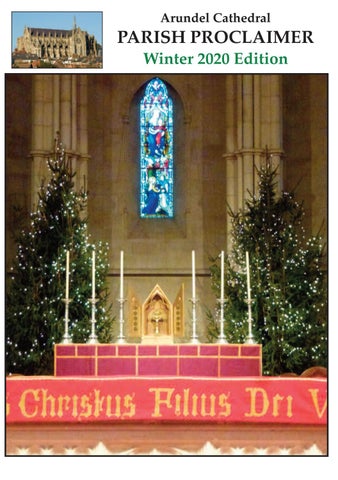
FRONT COVER The Cathedral’s Sanctuary during Advent and the Christmas season. Photograph taken by Oliver Hawkins, reprinted with his permission.
The Parish Proclaimer is printed by Prontaprint Brighton & Hove - Dec. 2020.
Welcome to our Winter Edition!
As Christians we have a story to tell By Canon David Parmiter
We are entering the season for celebration. Given the situation and the noises coming from the Government the celebrations may well have a different character. However, the story remains the same, with the same scenes that are very familiar, such as the crib. Last year Pope Francis wrote a short reflection on the crib, in which he said the following: “The enchanting image of the Christmas crib, so dear to the Christian people, never ceases to arouse amazement and wonder. The depiction of Jesus’s birth is itself a simple and joyful proclamation of the mystery of the Incarnation of the Son of God. The nativity scene is like a living Gospel rising-up from the pages of Scripture. As we contemplate the Christmas story, we are invited to set out on a spiritual journey, drawn by the humility of the God who became man in order to encounter every man and woman. We come realise that so great is his love for us that he became one of us, so that we in turn might become one with him.” (1) I know that I have used this quote before in other articles, talks and preaching but for many of us the crib is where we begin, as children, with Christmas - along with the nativity play. As well as letting us engage with the story it also shows us the importance of story telling and art in our spiritual lives. Those who look after us and teach us tell us the story of Jesus, then bring us to Church, pray with us and guide us into Christian living. The story of Jesus must run alongside these other things, or we will not understand. As Christians we have a story to tell. The story of Jesus and how we fit into this big picture of God’s love. In many ways this is the beginning of mission, sharing the Gospel of Jesus. I knew a priest who told me that if I wanted to be a good messenger of the Gospel, I should read novels. Not that the Gospel is like a novel, but in reading novels you learn the art of good story telling. We can do worse than to learn how to tell the story of Jesus and how that has impacted on our lives and, hopefully, is doing so now. I am still in the process of learning. The crib though is a wonderful example of how, very simply, the story of God’s love shown in Jesus is told. Throughout the next couple of weeks stories will be told, especially as we approach the New Year. Naturally enough these stories will focus on the extraordinary events of this 3
year. It will help us to remember and to try and see some meaning in what has happened. It is an important process. We will also go through the Christmas story again seeing once again new meanings and drawing fresh inspiration for the faith journey ahead. I return to the words of Pope Francis again who encourages this type of contemplation at Christmas time: “Dear brothers and sisters, the Christian crib is part of the precious yet demanding process of passing on the faith. Beginning in childhood, and at every stage of our lives, it teaches us to contemplate Jesus, to experience God’s love for us, to feel and believe that God is with us and that we are with him, his children, brothers and sisters all, thanks to that Child who is the Son of God and the Son of the Virgin Mary. And to realise that in that knowledge we find true happiness. Like Saint Francis, may we open our hearts to this simple grace, so that from our wonderment a humble prayer may arise: a prayer of thanksgiving to God, who wished to share with us his all, and thus never to leave us alone.” (2) If you do not display one, how about a crib in the window this year? With every blessing for Christmas and the New Year, Canon David. 1. Admirabile Signum, The Meaning & Importance of the Nativity Scene, Apostolic Letter, Pope Francis 2019 2. Ibid
++++++++++++++++++++
A prayer to say before the crib I adore Thee, O Word Incarnate, true Son of God from all eternity, and true Son of Mary ever Virgin in the fullness of time. When I adore Thy divine Person, and the Humanity united to Thy Divinity, I venerate the poor manger which welcomed Thee when an Infant, and which was truly the throne of Thy love. I prostrate myself before it with the simplicity of the shepherds, with the faith of Joseph, with the love of Mary. I bow down in veneration of this precious memorial of our salvation with the same spirit of mortification, poverty and humility with which Thou, though the Lord of heaven and earth, didst choose for Thyself a manger wherein to lay Thy tender infant limbs. And Thou, O Lord, who in Thine Infancy didst deign to lay Thyself in this manger, vouchsafe also to pour into my heart a drop of that joy to which the sight of Thy lovely Childhood, and the miracles which accompanied Thy Birth, gave rise. By that holy Birth, I now implore Thee to grant to all the world peace and goodwill, and in the name of the whole human race I render thanks and honour to God the Father, and to God the Holy Spirit, who with Thee live and reign, one God, world without end. Amen. From the Raccolta, posted by the Catholic Reader. http://thecatholicreader.blogspot.com
4
#80# .0'4 2# &'0# *-,% "'12 ,!# 20 ,1$#0 !-+. ,7 3,"#02 )',% '0.-02 1# .-02 !'27 ," -2� + (-0 "#12', 2'-, 5-0) $-0 -4#0 2#, 7# 01 # 5#*!-+# -2& .#01-, * ," 31',#11 !*'#,21 -, - 0" # -$$#0 2&# ""#" -,31 -$ . 7',% -,*',# -0 ', 2&# 4#&'!*# 31',% ,7 + (-0 "# '2 -0 !0#"'2 ! 0" .0'-0 2- 7-30 (-30,#7 - 5� '281 20'. 2- 2&# '0.-02 1# .-02 0 '*5 7 12 2'-, 2&# 20# -0 2 )',% %0-3. -$ .#-.*# 2- 5#""',% *-! 2'-, !-0.-0 2# #4#,2 -0 +31'! $#12'4 * " +1 '0.-02 01 5'** # 4#07 %* " 2- &#*. 7-3
$ 0#/3'0#" 5 2#0.0--$ *3%% %# 20 '*#0 $-0 #620 *3%% %# -0 1)' #/3'.+#,2 ! , # .0-4'"#" # .0'"# -301#*4#1 -, 2&# !312-+#0 0#!-++#," 2'-,1 5# %#2 $0-+ 2'+# 2- 2'+# 1- 7-3 ! , # 1130#" -$ -30 2-. /3 *'27 1#04'!# 7 %-',% -32 -$ -30 5 7 2- &#*. 7-3 -, 7-30 5 7 &-'!# -$ 1 *--, ," #12 2# ! 01 .*31 , 1# 2#0 ** '0 !-,"'2'-,#" $3**7 ',130#" ," + ',2 ',#" 2- &'%& 12 ," 0" $-0 *-! * 20 4#* -0
1# 2#0 4#&'!*# ! , # .0-4'"#" 5'2& 0# 1-, $-0 *-! * , 2'-,5'"# 30-.# , 20 4#*
*# ,-2'!#
&'*" 1# 21 7-3 .0-4'"# ," 5# *--) $2#0 ** "0'4#01 &-*" !300#,2 0# *'!#,1#" 5'2&
', 11#,%#0 0 ,1.-02 2'-, ," 03, '120'!2 -3,!'*
30 "0'4#01 5'** +##2 7-3 ',1'"# 2&# 2#0+', * 3,*#11 "4'1#" "'$$#0#,2*7 7 7-3
- --)
4#&'!*# .*# 1# ! ** -0
*2#0, 2'4#*7 .*# 1# 4'1'2 555 " +1 '0.-02! 01 !-+ 2- 31# -30 -,*',# 0#1#04 2'-, ," . 7 7 7 * "# '2 -0 !0#"'2 ! 0" -3 ! , *1- 0# " !312-+#018 $##" !) $0-+ -30 5# 1'2#
Diocesan Catholic Parish Churches – Part 10 St. Edmund, King & Martyr, Godalming, Surrey with St. Joseph’s, Milford
The parish of Godalming covers an area of approximately 100 square miles, being bounded on the north by the parish of Guildford, on the east by the parishes of Bramley and Cranleigh, on the south by the parish of Haslemere and on the west by the parish of Farnham. Godalming is the only town in the parish but there are large villages to the west and southwest, as well as rural areas. Parishioners turned out in large numbers on the evening of Sunday, 13 October 2019 to say goodbye and thank you to Canon David Parmiter and to wish him well on the next chapter on his journey. Mid-way through the evening everyone gathered around to hear parishioner Ian Honeysett’s characteristically joke-filled speech of appreciation of Fr. David which ended with a hilarious poem on the possibilities which may lie ahead on Fr. David’s journey from Priest to Canon to Dean, and possibly onwards to Bishop and St. David! Ian offered thanks on behalf of the parish to Fr. David for his two and half years as our Parish Priest and in his response, Fr. David thanked the parish and said that it is the parishioners that make the parish, and his prayer for our future is that we acquire the right facilities to enable our parish to become the best it can be. The parish community now look forward to continuing this journey with Father Jonathan. May God bless both these priests as they take up their new challenges.
The back-story of the Parish of St. Edmund A small iron church was built in Croft Road and opened by Bishop Bourne of Southwark on 26 November 1899, much to the relief of local Catholics who had had to gather together on Sundays to walk to Sutton Place or take the train to Guildford or even travel by horse and trap. In 1925 the parish hall was built on this site but the land was sold in 1997 for the building of flats. 6
The Sanctuary
When it was decided by Bishop Bourne to establish Godalming as a separate mission, he appointed Fr. St. George-Hyland to take charge. He arrived on 1 November 1904 and stayed in lodgings at 36 Croft Road. He saw opposite a "towering bank" of hillside, which was undeveloped and determined it should be the site for a new church. An anonymous benefactor gave money to start the project and work started in 1905. By 27 June 1906 work was completed on both church and presbytery and the Bishop opened the church. However, in 1925, a further debt was incurred when it was decided to build a parish hall. This was built by 1926 but that debt, too, was paid off by 1930 through fetes, whist drives, concerts and socials. The hall was used regularly for social activities, Advent and Passion Plays. At Christmas there would be a Christmas tree reaching to the ceiling and laden with toys for every child in the parish (all paid for by Canon Hyland). After First Communion or Confirmation services there would be a meal for the children and the Bishop. Students from the nearby St. John's Seminary, Wonersh also used the hall for social activities. During the Second World War and for a few years after, it was used by the Post Office as a sorting office and then by the Ministries of Food and of Labour (as a Labour exchange). Canon Hyland was very friendly with a curate from Godalming parish Church, Rev. Harvard Jones and the two men, both short in stature and wearing the traditional "parson" style of hat, would often be seen walking along the High Street, deep in conversation. At the age of 74, Canon Hyland died quite suddenly while on holiday in Devon. He was buried in a vault under the sanctuary of St. Edmund's Church. Canon Hyland was succeeded by the second-longest serving parish priest of Godalming, Canon Denis Hawkins (known as "The Hawk" a nickname that fitted him intellectually and physically as he was, then, thin and angular. He filled out in later years as photographs show; his housekeeper, Miss Connolly, is remembered as a great cook).
7
Canon Hawkins was a theologian and philosopher with an international reputation. His ability to explain Catholic teaching in a clear, precise manner made him a valued and respected member of a monthly Ecumenical Dialogue between three Catholic and Anglican clergy. The Catholic population swelled considerably after the Hungarian uprising in 1956 as many refugees were housed in the former Canadian Army Camp at Hydon Hill. Canon Hawkins died suddenly on 17 January 1964 at the age of just 57 a great blow to the parish and to the cause of ecumenism. In 1957 a site for a church was acquired in Milford because of the growth of the villages of Milford and Witley. It had been the orchard of a parishioner, Mr Hedley. Fr. Pledger determined to push forward the building of the church, which meant further fund-raising. Construction of St. Joseph's Church began in 1967 and the erection of a pre-fabricated building to replace the hall in Elstead took place in 1968, the latter being named the Chapel of Our Lady of the Assumption. Fr. Pledger introduced the first two lay readers in the parish Bill Wheeler and Bill Stammers, who were both trained by Fr. Bell, an assistant priest who spent a short time in Godalming. Fr. Pledger died suddenly on 3 June 1969, the third consecutive parish priest to die "in harness". Two significant events in Fr. McSheehy's time were the opening of St. Edmund's School and the start of a very successful ecumenical co-operation whereby we are able to celebrate Mass each Sunday morning in the Anglican church of St. John the Evangelist in Farncombe. The first Mass was celebrated there in 1974 and the arrangement is still going strong. It was while Fr. Tony Clarke was Parish Priest that Godalming had its first Catholic Mayor, Mrs Peggy Macfarlane (1984). Her Civic Service was held in St. Edmund's Church, with a guard of honour of Knights of St. Columbus lining the steps. In 1984 plans to relocate the Church to the west side of St. Edmund's School came to nothing, the first of several attempts to build a new Church with space for car-parking. In 1985 the decision was made to cease the celebration of Sunday Mass at Elstead and the building remained unused until its sale in 1992. Fr. (now Canon) Clarke left in 1990 to become parish priest of St. Mary of the Angels, Worthing. After an interval during which the parish was served by Fr. Andrew Brenninckmeyer OSB, Fr. Rowley arrived as parish priest. He had the dream of building one, central church large Continued on page 10 8
& * $%
% # #&
% ' !'(%+ % &' (% !' ! %"" & "! " ' " &' ! %(!
' &# (!
!# !
& !&%$ % # #$ !# ! % " #% $ ' #$ # $ & # # "% ! $ #!$$ $% &$$ ) $
! % % !#
.
!
' "!
* % #
! +
' " !%
$# "
& "
!
! # !+ $
& $ " . '# " " . % # . "# " !% # ! " * ! ! " . " !% # . !( . ! !#( #
#
" ! $# # ##% ! -
!
$ !
!# !
$!% ( !"
". # & ! . " . #!$ #$! $ . # " . ! % & (" .
#
&
&
!'(%+ "% % # &
# "!
41 ( !"/ $ #(+ !"
! &
"(& & &* % '
"( ! ! (& ' %% !' '% ' %(!
!&
!$
.
! ,& & ! !"*! * ") % "" $( '+ " "" ! (& ! '% ! % & " #%" (
##* !# & * !" $ ! ! & * % # !&
((( & * % #
! # !!
) %+' ! & " ! "(% & ! ! "%! ! " & ! & ! ' %!""! ' & ! ( ! ! "'' %
% !" " . # ! # ".
) , 12:14 993:15 . (, 18992 918596 . # , 18644 388272 , $ ! "0 " ! % # "- -$ &&&" ! % # "- -$
The Nave
Our Lady’s Chapel
enough to serve the whole parish with a hall and presbytery on the same site. Various sites were considered but none proved suitable. He soon set about reorganising the running of parish affairs. The previous Parish Council was replaced by a Finance & General Purposes Committee, and Co-ordinators were appointed in such areas as ecumenism, marriage and family life, pastoral renewal, social concerns and justice and peace. Fr. Mario came to the parish at the invitation of Fr. Bernard. He is included here because he was such a popular priest ! He had spent 31 years as a Xavierian Brother teaching but then decided to become a Benedictine. His sermons were wonderful and his series of talks on the history of the Church broke all records for attendance! Fr. Michael Perry arrived, in his quiet way, in September 1994 having been Parish priest in Claygate, Esher. He has been content to consolidate and develop the existing parish structures. With his backing, St. Edmund's and St. Joseph's churches have been completely redecorated and the roof is being restored at St. Joseph's (at considerable expense!). The Presbytery has been adapted to provide a Parish room downstairs and a very smart flat upstairs. St. Edmund's Hall was sold in 1997 to help pay for all this work.
10
On 8 October 1995, the 90th anniversary of the laying of the foundation stone of St. Edmund's was celebrated with a special Mass attended by 4 priests who had worked in the parish - Frs. P. Chick, G. McDermott, J.A. Clarke and C. Ingle.
The Parish of St. Edmund today Behind every church there is always an active and proactive group of parishioners voluntarily giving their all and St. Edmunds is no exception! There are teams of people involved in all aspects of the church’s activities and events like Children’s Liturgy, Gift Aid, Christian Unity, Bumps & Babes. Finance & General Services and so much more! Each team aims to help parishioners to form a closer relationship with God and to share that love with one another. And so to SPREAD THE GOOD NEWS by evangelising with LOVE! There’s a Parish AGM and a series of Parish Finance & General Purposes Committee Meeting during the course of the year. Thanks to some volunteers there is a new Parish Guide, a directory full of information about the many groups and activities run in the parish, together with up-to-date contact details for those coordinating them - available in printed form at the back of the church or on the website, details of which are at the end of this article. Sunday Masses - Saturday Vigil, 6pm at St. Edmund’s, Godalming and Sunday, 8.45am at St. John’s, Farncombe and 10.15am at St. Joseph’s, Milford. Weekday Masses - Tuesday, Thursday & Saturday, 9.30am at St. Edmund’s, Godalming and Wednesday & Friday, 9.30am at St. Joseph’s, Milford. Please note that weekday Masses are preceded by Morning Prayer at 9.15am. Holy Days - 9.30am at St. Joseph’s, Milford and 8pm at St. Edmund’s, Godalming. Please visit our website at https://stedsgod.com to read more about St. Edmund’s Parish. ++++++++++++++++++++
Christmas Video on the Cathedral’s website By Bryden Isbister I have produced a Christmas video, showing our crib with a soundtrack of ‘For unto us a child is born’ from Handel’s Messiah. Through a South Korean work contact I have been able to agree use of the recording from the world famous Anson City Choir in South Korea. In 2011 the Vatican Holy See invited the choir to perform at St. Peter's Basilica. You can see it on YouTube - https://www.youtube.com/watch?v=fNtyX3csK6A- or on our website. Enjoy! 11
50th Anniversary of the 40 Martyrs’ Canonisation Source: Votive Mass of the 40 Martyrs of England & Wales booklet The feast of the Forty Martyrs of England and Wales honours the hundreds of British men and women who suffered persecution and died for their Catholic faith during the sixteenth and seventeenth centuries in the wake of the dispute between the Pope and King Henry VIII. Countless loyal Catholics were tortured and killed between 1535 and 1679. On 4th May 1535, the first of these many martyrs of the English Reformation were hanged, drawn and quartered on the gallows at Tyburn. Although some have been canonised or beatified, the true number of those who died on the scaffold, perished in prison, or were tortured or persecuted for their faith - the ancient faith of their country - is not known. Thousands of others were driven into exile or deliberately reduced to penury under merciless penal laws. The martyrs celebrated today came from every walk of life: rich and poor; married and single; men and women; priests, religious and lay people. They are remembered for the example they gave of constancy in their faith, and courage in the face of persecution which lasted almost a hundred and fifty years and left a permanent mark on English culture. When King Henry VIII, after his break with Rome, proclaimed himself “the only Supreme head on earth of the Church of England”, Catholics felt that he had appropriated a supremacy in spiritual matters that belonged only to the Pope. While they wished to remain loyal subjects of the Crown, as the legitimately constituted authority, for reasons of conscience they refused to recognise the ‘spiritual supremacy’ of the King. When the Act of Supremacy was passed in 1534, many faced a serious dilemma, and even death, rather than act against their conscience and deny their Catholic faith. (From an ecumenical point of view, it is important to note that these deaths were not the result of internal struggles between Catholics and Anglicans; rather, that those who died were not willing to submit to what they saw was an illegitimate claim of the State. The schism created by Henry set in motion more than a century of religious turmoil during which Protestants were sometimes burned for heresy, with some 300 dying during the five-year reign of Queen Mary I as she struggled to re-establish the Catholic faith in England.) There were four distinct waves of persecution. The first followed the passing of the Act of Supremacy in 1534 when Henry VIII broke with Rome and suppressed the monasteries. The second came after 1570 when Pope Pius V, believing that Queen Elizabeth I was illegitimate and had no right to the throne of England, issued a papal bull excommunicating her and absolving all her subjects from allegiance to her and her laws. Persecution intensified markedly in the latter half of Elizabeth’s reign, following the arrival of the Jesuits on the English Mission, coupled with the threat of invasion by Spain. In 1581 an Act was passed that made it treason to withdraw English subjects from allegiance to the Queen or her Church, and in 1585 the entrance of Jesuits into the country was prohibited by law. The third wave followed the failed Gunpowder Plot in 1605. The final wave came in 1678, following the so-called ‘Popish Plot’, a totally fictitious but widely believed plot, 12
fabricated by Titus Oates, in which it was alleged that Jesuits were planning to overthrow King Charles II in order to bring his Catholic brother (later King James II) to the throne. Even this rumour was enough to stir a new and unprecedented era of persecution for Catholics. The cause of about three hundred martyrs was introduced in Rome shortly after the restoration of the Catholic hierarchy of England and Wales in 1850, and the long campaign began under Cardinals Wiseman and Manning. By 1935, nearly two hundred Reformation martyrs had been beatified (by Leo XIII and Pius XI), but only two of these had been canonised: in 1936, Cardinal John Fisher, Bishop of Rochester, and Henry VIII’s chancellor, Sir Thomas More, became the first Englishmen to be made saints since John of Bridlington in 1401. After the Second World War, the cause was revived in 1960 and, in 1970, the Vatican selected forty martyrs, men and women, lay and religious to represent the full group. On 25th October 1970, at St Peter's in Rome, Pope Paul VI canonised these forty English and Welsh martyrs as saints. Auberon Waugh described it as “the biggest moment for English Catholicism since Catholic emancipation in 1829”. In England, these martyrs were formerly commemorated by a feast day on 25th October, but they are now celebrated together with all the canonised or beatified martyrs of the English Reformation on 4th May. Each of the forty martyrs has their own day of memorial, but they are remembered as a group on this date, marking the first deaths at Tyburn in
Is your answer ‘YES’ to any of these questions? Then we can help you!
Ɣ Confused by the array of pensions options? Ɣ Need to invest an inheritance or pension lump sum? Ɣ Worried about long term care funding? Ɣ Fed up with your cash ISA return?
Ɣ Ethical investment a concern? Call us on 0 1903 882007 Visit our website www.themellorpractice.co.uk Or drop in to our office 31 Chapel Road, Worthing, BN11 1EG The Mellor Practice Ltd is an appointed representative of Lighthouse Advisory Services Limited, which is authorised and regulated by the Financial Conduct Authority. The Mellor Practice Ltd, Registered in England, No. 10567558 Registered Office: 41b Beach Road, Littlehampton, West Sussex, BN17 5JA The value of your investments can go down as well as up, so you could get less back than you invested.
1535 of those observed from the Tower of London by Thomas More “cheerfully going to their deaths as bridegrooms to their marriage.” In Wales, 25th October is kept as the feast of the Six Welsh Martyrs (from the group of forty) and their companions (the thirty-four English Martyrs). Wales continues to keep 4th May as a separate feast for the beatified martyrs of England and Wales. The 40 Martyrs (as presented in the order of service booklet for the Canonisation Mass in 1970) 1535
1539 1577 1585
1582 1584 1586 1588 1591
1594 1595
1598 1600 1601 1606 1608 1610 1612 1628 1641 1642 1645
St. John Houghton, Tyburn, 4th May St. Robert Lawrence, Tyburn, 4th May St. Augustine Webster, Tyburn, 4th May St. Richard Reynolds, Tyburn, 4th May St. John Stone, Canterbury, December (exact day not known) St. Cuthbert Mayne, Lanceston, 30th November St. Edmund Campion, Tyburn, 1st December St. Ralph Sherwin, Tyburn, 1st December St. Alexander Briant, Tyburn, 1st December St. John Payne, Chelmsford, 2nd April St. Luke Kirby, Tyburn, 30th May St. Richard Gwyn, Wrexham, 17th October St. Margaret Clitherow, York, 25th March St. Margaret Ward, Tyburn, 30th August St. Edmund Gennings, Gray’s Inn Fields, 10th December St. Swithun Wells, Gray’s Inn Fields, 10th December St. Eustace White, Tyburn, 10th December St. Polydore Plasden, Tyburn, 10th December St. John Boste, Durham, 24th July St. Robert Southwell, Tyburn, 21st February St. Henry Walpole, York, 7th April St. Philip Howard, Tower of London, 19th October St. John Jones, Southwark, 12th July St. John Rigby, Southwark, 21st June St. Anne Line, Tyburn, 27th February St. Nicholas Owen, Tower of London, 2nd March St. Thomas Garnet, Tyburn, 23rd June St. John Roberts, Tyburn, 10th December St. John Almond, Tyburn, 5th December St. Edmund Arrowsmith, Lancaster, 28th August St. Ambrose Barlow, Lancaster, 10th September St. Alban Rose, Tyburn, 31st January St. Henry Morse, Tyburn, 1st February 14
1654 1679
St. John Southworth, Tyburn, 28th June St. John Plessington, Chester, 19th July St. Philip Evans, Cardiff, 22nd July St. John Lloyd, Cardiff, 22nd July St. John Wall, Worcester, 22nd August St. John Kemble, Hereford, 22nd August St. David Lewis, Usk, 27th August
++++++++++++++++++++ Let us pray: O God, in whom there is no change or shadow of alteration, You gave courage to the Holy Martyrs. Grant unto us, we beseech You, through their intercession, the grace to always value the Holy Mass. May we be strengthened to serve You in imitation of the courage of these Holy Martyrs. We ask this through Jesus Christ, Your Son, who lives and reigns with You in the unity of the Holy Spirit, forever. Amen. ++++++++++++++++++++
From the book of ‘Arundel Hymns & Other Praises’ A Hymn wherein the praises of all creatures are offered up unto the Creator - from a Work written in the Tower of London by the Venerable Philip Howard, Earl of Arundel O Christ the glorious Crown Of virgins that are pure; Who dost a love and thirst for Thee, Within their minds procure; Thou art the Spouse of those That chaste and humble be, The hope, the life, the only help Of such as trust in Thee. All charity of those Whose souls Thy love doth warm; All simple plainness of such minds, As think no kind of harm; All sweet delights wherewith The patient hearts around, Do blaze Thy name, and with Thy praise, They make the world resound. The sky, the land, the sea, And all on earth below, The glory of Thy worthy Name,
15
Do with their praises show, The winter yields Thee praise, And summer doth the same; The sun, the moon, the stars and all, Do magnify Thy Name. The roses that appear So fair in outward sight; The violets which with their scent Do yield so great delight; The pearls, the precious stones, The birds, Thy praise do sing; The woods, the wells, and all the delights Which from this earth do spring. What creature, O sweet Lord, From praising Thee can stay? What earthly thing, but filled with joy, Thine honour doth bewray? Let us therefore with praise, Thy mighty works express, With heart and hand, with mind and all, Which we from Thee possess. ++++++++++++++++++++
Blessed Carlo Acutis is a Witness of Christ Courtesy of www.abdiocese.org Blessed Carlo Acutis (1991-2006), was beatified in the Basilica of San Francesco, in Assisi on Saturday 10th October. Anna Johnstone, Governess to Carlo’s brother and sister from 20152018, was at the Beatification in Italy. In her final article Anna writes: “Carlo lived and died a layman. I have spoken of aspects of his simple but powerful ‘way’; his desire to emulate the Beloved Disciple, daily resting his head on Jesus’ heart in prayer before the Blessed Sacrament, and daily being with Jesus at the foot of Calvary, during the Sacrifice of the Mass. I have spoken of his missionary zeal in creating online exhibitions and his passion to communicate the real presence of Jesus in the Holy Eucharist. “There are three other dimensions that I will highlight today. Blessed Carlo had a great devotion to Our Lady. He prayed the Rosary every day and said that his appointment with Continued on page 18 16
2&(*34&2&% $)"2*48 7)03& "*. *3 40 &/$052"(& 4)& 53& "/% "112&$*"4*0/ 0' 4)& "4)&%2"- )52$) 0' 4)& *0$&3& "/% 40 1206*%& '*/"/$*"- 3511024 '02 *43 ."*/4&/"/$& "/% &/)"/$&.&/4 &$0.& " .&.#&2 "/% 805 7*-- &/+08 "//5"&6&/43 -*,& )& 2*&/%3; %6&/4 &31&23 2*&/%3; "33 &"34 0' 4 )*-*1 07"2% +0*/ */ 30.& !02,*/( "24*&3 5..&2 &-"4*0/3 30$*"- &6&/43 7*4) 04)&2 2*&/%3 0' 25/%&- "4)&%2"- 1-53 805 7*-- 2&$&*6& : 02/&2340/&; " #* "//5"- /&73-&44&2 //5"- &.#&23)*1 &&3 2*&/% 9 *'& &.#&2 9 0*/4 2*&/%3 9 02102"4& &.#&2 9 "420/ 9 )*3 *3 0/& 1"8.&/4 0/-8 '*% +++ '*%
)! '" % ( #
)!
) &%%
) &$
' # '" % ( &'
)"2*48 0 0.1"/8 0 /(-"/% -*.*4&% #8 (5"2"/4&& )"6*/( /0 3)"2& $"1*4"-
! 51 *'.2 916 8+5* 9163 3')6.#3 13 1%%#4+10#. %*13'4 #0& '33#0&4
# (3'' '45+/#5' 01 %1053#%54 &'&+%#5'& 45#(( %.+'05 5'45+/10+#.4 23+%'4 (31/ : 2'3 *163
"
"
4*122+0) *164'81323'4%3+25+10 %1..'%5+10 23'2#3+0) /'#.4 8#4*+0) #0& +310+0) *'.2 8+5* %133'4210&'0%' 5'# #0& %1/2#09 2#3%'. %1..'%5+10 13 2145+0) #0& 41 /6%* /13' 51 *'.2 916
" Chatelaine Boutique is set in the heart of the beautifully historic town of Arundel with its own castle and cathedral, river and breathtaking views. We are a stylish, upmarket dress agency that offers you a mixture of new and preloved top quality designer pieces... fashion that does not cost the Earth.
1 The Old Mill, River Road, Arundel BN18 9JR 01903 884350 sheila@chatelaineofarundel.co.uk www.chatelaineofarundel.co.uk
chatelaineboutique
888 *1/'/#+&*'.2'34 %1 6*1/'/#&'*'.2'34 ; 5=4 41 0+%' 8*'0 '$'%%# #0& *'3 5'#/ *#7' $''0 +0 51 %.'#0 *' *164' +40=5 ,645 %.'#0 +5 42#3-.'4 < 34 /+5* 360&'. ; '$'%%# .11-'& #(5'3 /9 /6/ +0 645+0)510 8*'0 4*' *#& '#3.9 104'5 &'/'05+# 1 10' %16.& *#7' .11-'& #(5'3 *'3 #09 $'55'3 8+4* 916 )3'#5 46%%'44 +44 3+))4 10&10
Mary was the most delightful of his day. He had a particular devotion to Our Lady of Fatima. He tried to emulate the shepherds of Fatima with little sacrifices. Carlo also seemed to have a premonition that like Saints Jacinta and Francisco he would die young, (not because there were signs of ill health). I wonder if, in the future, he may be considered a sort of 4th child of Fatima? Carlo also had a great devotion to Our Lady of Pompei. The founder of the shrine of Pompei, Blessed Bartolo Longo, was, in fact, connected to two Saints who are ancestors of Blessed Carlo - Saints Giulia Salzano, foundress of the Catechetical Sisters of the Sacred Heart of Jesus, and Caterina Volpicelli (foundress of the Maids of the Sacred Heart of Jesus). One can only imagine the prayers from heaven, for Carlo, of these two Saints! “Carlo also had a wonderful catechesis on the Sacrament of Reconciliation, a Sacrament that he himself frequented weekly. (Carlo became a parish catechist to his peers, aged 11.) He used the image of a hot air balloon ascending. He compared the Sacrament to offloading weights from the basket, enabling the balloon to soar higher. “I’m sure you will agree that Blessed Carlo had a type of genius not just for computers but for our faith. The final weapon in his evangelising arsenal was the sheer balance, normality and generosity in which his focus and intensity was packaged. He was a ready and present friend to all, helping his classmates, engaging with all sorts of people in his local neighbourhood (which only became evident to his parents at his funeral and in the letters they received afterwards). And whether defending a disabled classmate or taking food and a sleeping bag to a homeless man, Blessed Carlo responded in a consistently Christian way, in the midst of his thoroughly modern life. We have a Blessed in jeans and Nike trainers! “Blessed Carlo blazed a simple path to heaven for young people and lay people; daily Mass, daily prayer in front of the Blessed Sacrament, weekly confession, daily rosary, generosity with his gifts and a spirit of friendship and kindness to all those around him. In fact, this pathway is not news to us, is it? But putting it all into practice is more difficult than it sounds. I have been very encouraged and inspired by Carlo’s triumphant witness and example of fulfilling these seeming ‘basics,’ in the midst of our very secular world. And I have felt strengthened by Blessed Carlo’s powerful prayers. This is encouragement, inspiration and strengthening that I wish you all. He is our friend. Blessed Carlo Acutis, pray for us. Our Lady of Fatima and Pompei, pray for us. Most sacred heart of Jesus, have mercy on us.” Anna has made a brief video of the Beatification https://youtu.be/9j-R0EVCGk8 Anna has two websites exploring Carlo’s life: www.ukmiracles.com www.carloacutis4schoolsUK.com
18
Light for the World By Sr. Aelred
The Poor Clares Community, 2020
In Lent 2019, we were approached by James Morgan, a musician in his own right and with his wife Juliette, a music producer, to see if we were willing to make a CD for Decca. The idea was to record chants, (that would be our part) to which he and Juliette would add a contemporary backing, with percussion, bells, maybe drums. To us this was a new and perhaps odd idea. Not only that but although we love singing, we have no illusions about ourselves and to think that we might be on a Decca recording seemed fanciful. The idea could have died a death there and then, had not Sr. Leo sensibly suggested, that since James had said in his email that his home was not too far away, why didn't we suggest he drop in one evening to Vespers, incognito, and draw his own conclusions. It meant he could quietly go off without embarrassment on either side if it was too awful. Well, he came, he listened, and the result was a long and lovely collaboration between ourselves, James, Juliette and Decca Records. The community were cautious, for many reasons, but the open and friendly discussions we had with James and Juliette, and several Decca personnel gradually brought about a great willingness to give the venture a try. Their original idea was to record established plainchant, and that is indeed featured on the CD, but we suggested other texts, from the Gospels, from the psalms and from our Franciscan sources. For several months in late 2019, James and Juliette came each Wednesday afternoon. James brought his own recording apparatus. He would sit at his machine wearing headphones while Juliette directed us. Since the recordings were to be given the backing in their own studio, we had to be absolutely on the note, even the slightest singing below the note could not be allowed. We would sing for two hours with a break for a cuppa, and, though it was hard work we enjoyed every minute of it. Most of us participated, though a few excused themselves for understandable reasons.
19
The Poor Clares Convent
Each week James and Juliette would bring the music they had written for one of our texts, and we would learn it, and finally record it. Two of us were remarking just this week on the experience of working with James and Juliette; they worked so beautifully together, so patiently, so professionally - add to that their patience with us, and our joy at what we were creating together, and now, with the success of the ‘Light for the World’ CD, which has taken us by surprise, it all comes together as an experience that has been blessed from start to finish. We are flooded with emails from people we don’t know, saying how the music has moved them, comforted them, and stopped them in their tracks. This is all we hoped for, our only reason for taking it on was to be ‘ambassadors for Christ’ and to touch that ‘God’ place in people. As I write this, we are overwhelmed with publicity - top of the Classic charts, on breakfast TV and Woman’s Hour, in the Tablet and the Observer! Decca ran out of CDs in the first few days, though a younger generation are listening to i-Tunes and Spotify, or even downloading the music onto their phones. Certainly it has touched a hunger, a need, and we hope it will continue to bring a sense of peace to people and an invitation to slow down and to find that inner place in each of us where Love dwells. We hope that by listening to ‘The Light for the World’ CD, you can have an experience of God’s love and peace, especially during these difficult times of anxiety and stress which we are living in. Happy listening! And remember to pass on the links below to your friends and family. The video on YouTube: https://www.youtube.com/watch?v=zs5rGW-RE38 Continued on page 22 20
0%(4/(; 75(70 ,5 &744(16/; &/25(' '7( 62 ! 57$/ 23(1,1* +2745 $4( "('1(5'$;5 62 71'$;5 ,1&/7',1* $1. 2/,'$; 21'$;5 $// ;($4 4271' /($5( 56$; ,1 627&+ 8,$ 52&,$/ 0(',$ "(=8( %((1 5+$4,1* 0(024,(5 (:+,%,65 $1' 5624,(5 )420 6+( 075(70 $1' 927/' /28( 62 +($4 9+$6 6+( 075(70 0($15 62 ;27 75,1* 6+( 6$* ; 0%(4/(;
4( ;27 0,55,1* 0%(4/(; "( +$8( $ 9,'( 4$1*( 2) 21/,1( -,*5$9 37<</(5 )24 &+,/'4(1 $1' ;271* 3(23/( 62 (1-2; #27 &$1 ),1' 6+(5( 21 999 $0%(4/(;075(70 &2 7. +( &744(16 5,67$6,21 +$5 5(4,275 ),1$1&,$/ ,03/,&$6,215 )24 6+( 75(70 52 9( $4( *4$6()7/ )24 $1; 5733246 6+$6 ;27 0$; %( $%/( 62 3428,'( ,1 6+,5 ',)),&7/6 6,0( 8,$ 274 756 ,8,1* $*( 74 &$03$,*1 ,5 &$//(' (/3 0%(4/(; 75(70 "( /22. )249$4' 62 9(/&20,1* ;27 %$&. 62 6+(
(9 $41
2$'
75(70 ,1 6+( 1($4 )7674(
0%(4/(; 75(70 0%(4/(; ($4 471'(/ "(56 755(:
"(%5,6( 999 $0%(4/(;075(70 &2 7. (/(3+21( 0$,/ 2)),&( $0%(4/(;075(70 &2 7. (*,56(4(' &+$4,6; 170%(4
We are selling the CDs for £10 each. If anyone wants theirs posted it will be £12.50 for one CD. The total cost to send two CDs is £23 and for sending three £33. Please make cheques payable to ‘Convent of Poor Clares’ and send together with your name and address to Poor Clares, Crossbush Lane, Crossbush, Arundel BN18 9PJ. Feel free to email us at arundel.poorclares@gmail.com if you have any questions. Alternatively listen and buy our CD from: https://PCOA.lnk.to/LightForTheWorldSo You can also purchase the CD via Amazon: https://www.amazon.co.uk Please visit The Poor Clares website: https://www.poorclaresarundel.org/ Thank you and may God bless and keep you
Postscript from Sr. Angela At the moment of writing this, Sr. Aelred is in hospital having had an operation for a hip replacement. She is recovering peacefully. ++++++++++++++++++++
A poem for those who have lost loved ones By Marion Riley I have been with my sister in Manchester for 3 weeks before she passed away from spine cancer after being isolated in 2 Birmingham hospitals for 5 months. After reading John O’ Donohue's poems, I wondered if the following one could find a space in the Parish Proclaimer magazine. It might help at Christmas, for those whose loved ones passed away this year.
A Blessing For Absence May you know that absence is alive with hidden presence, that nothing is ever lost or forgotten. May the absences in your life grow full of eternal echo. May you sense around you the secret Elsewhere, where the presences that have left you dwell. May you be generous in your embrace of loss. May the sore well of grief turn into a seamless flow of presence. May your compassion reach out to the ones we never hear from. 22
May you have the courage to speak for the excluded ones. May you become the gracious and passionate subject of your own life. May you not disrespect your mystery through brittle words or false belonging. May you be embraced by God in whom dawn and twilight are one. May your longing inhabit it’s dreams within the Great Belonging. This a a poem from To Bless the Space Between Us: A Book of Blessings by John O’Donohue.
About John O’Donohue John O'Donohue (1 January 1956 - 4 January 2008) was an Irish poet, author, priest, and Hegelian philosopher. He was a native Irish speaker, and as an author is best known for popularising Celtic spirituality. Eldest of four siblings, he was raised in west Ireland in the area of Connemara and County Clare, where his father Patrick O'Donohue was a stonemason, while his mother Josie O'Donohue was a housewife. O'Donohue became a novice at Maynooth, in north County Kildare; at the age of 18, here he earned degrees in English, Philosophy, and Theology at St. Patrick's College in County Kildare. He was ordained as Catholic priest on 6 June 1979. O'Donohue moved to Tübingen, Germany in 1986, and completed his dissertation in 1990 on German philosopher Georg Wilhelm Friedrich Hegel for his PhD in philosophical theology from University of Tübingen. In 1990, he returned to Ireland to continue his priestly duties, and began his post-doctoral work on the 13th century mystic, Meister Eckhart. Later in life, O’Donohue became a prominent speaker on creativity in the workplace. He consulted executives in the corporate sector “on integrating a sense of soul and of beauty into their leadership and their imagination about the people with whom they work”. Just two days after his 52nd birthday and two months after the publication of his final complete work, Benedictus: A Book of Blessings, O'Donohue died suddenly in his sleep on 4 January 2008 while on holiday near Avignon, France. The exact cause of death has not been released by his family, leaving writers of non-fiction to speculation regarding the cause of his untimely death. Articles and posts have listed an aneurysm, heart problem, and aspiration as possible causes. He was survived by his partner Kristine Fleck, his mother Josephine (Josie) O'Donohue, his brothers, Patrick (Pat) and Peter (PJ) O'Donohue, and his sister, Mary O'Donohue. You can visit his website at https://www.johnodonohue.com
23
News from the Cathedral Choir By Elizabeth Stratford Lockdown has impacted musicians significantly and here at the Cathedral I have tried to find ways to safeguard the mental health of the choristers and adults whilst we have been unable to meet in person. Initially I had all sorts of wide eyed plans to get the whole choir singing on digital platforms, assuming that it would sound just like Eric Whitacre’s “virtual choir” performances where hundreds (thousands?) of people take part. Simple right? Wrong. The first Zoom rehearsal I took was in March and most of the choristers and adults/ scholars eagerly logged on to see what we would do. One exercise in I knew it wouldn’t work - after asking the choir to sing a descending scale to brrrr everyone chimed in at different times and speeds and it all sounded like a car crash, though we had a good giggle about it. The rest of the session was basically a catch up and sharing of news. I came away feeling that even though we couldn’t sing in the way we were used to, there must be things we could do. At this stage nobody else was running online rehearsals so I used our sessions as wellbeing drop-ins, with the choristers meeting weekly and the adults a bit less frequently so that they could talk. In time, I talked to other choir trainers about what they were doing and most using Zoom, Microsoft Teams, Google Hangout Meets and so on were asking choristers to mute themselves during rehearsals and sing to themselves. Whilst this was an option for us, I was concerned that the amount of learning which would happen would be difficult to gauge as I wouldn’t be able to hear anything. Generally when we rehearse there are things which don’t go to plan and I spend quite a lot of time working on vowels and shapes with the choristers. Without being able to hear each child I didn’t feel this was the best option for us so instead came up with the following: The adults and choral scholars have had "virtual drinks"- a drink of their choice at home whilst logging on to see other members of the choir and the organists for a chat and to catch up on news. The choristers have had weekly Zoom meetings (at times as many as 3 per week serving as mental health/wellbeing drop-ins) which haven’t focused on singing (apart from ‘Happy Birthday’ to the relevant choristers) but have explored issues of loneliness, segregation, mental health and wellbeing, staying connected, black lives matter and other issues raised by the choristers. Other singing has been done offline though we did hilariously attempt to sing in canon with Post It notes stuck to our foreheads. I have devised quizzes (with Continued on page 26 24
VISIT THE CATHEDRAL GIFT SHOP A broad range of high quality religious books, gifts and cards for Advent, Christmas, Lent, Easter, Pentecost, baptisms, weddings, funerals, birthdays, special anniversaries and other occasions. The Gift Shop is situated in the North Transept by the Shrine of St. Philip Howard. Monday - Saturday: 10.30am - 4.00pm Sunday: 12.30 - 4.00pm
PLEASE NOTE We rely on volunteers to help in the Gift Shop so our opening hours may vary slightly.
!
" !
( ( & "
&, ' ' (" $ #* & ' (" ' ! " ##! ' ( " " ) ' %) $! "(
(" "
)' # ( " ##$ ','( !
! #" #"
#
&)"
)'' +
"
prizes) for the choristers and probationers as well as setting video projects for them and involving them in national projects which colleagues and charities have been running. To date we have managed the Beatles’ hit ‘All you need is love’, the Commonwealth song ‘Sing’ written by Andrew Lloyd Webber and Gary Barlow, Andrew Carter’s ‘Badgers and Hedgehogs’ from Benedicite and Josh Groban’s ‘You raise me up’ which we are currently editing. Each chorister video records their section(s) of each piece and they are then expertly mixed and mastered by Adrian Taylor and posted on YouTube. The choristers have enjoyed seeing and hearing themselves and solos have magically become less terrifying through this process! The bigger, national collaborations have been exciting and the choristers have described these enthusiastically to their friends. Tom Guthrie invited them to record ‘We'll meet again’ in memory of Dame Vera Lynn raising money for the Royal Variety Charity and Music and Theatre For All and they had a wonderful time trying to spot themselves as the screen filled with faces! Most recently 12 of the choristers took part in a version of the piece ‘Sing Forever’ by Robert Prizeman to raise money for The Cathedral Music Trust. This was an ambitious project combining the BBC Choristers of the Year, Aled Jones, soprano Elizabeth Watts and 269 choristers from 44 foundations in the UK to raise money to help safeguard our precious choral tradition. With almost 11,000 views the video achieved it’s £10,000 target in less than 72 hours once released. We now find ourselves in the summer holidays but at the time of writing we’ve just had a socially distanced picnic in Arundel Park for choir families which was well attended and meant that we could safely see each other, laugh and run around the park during a careful game of rounders. The future remains uncertain but our choirs are communities and must not be underestimated or dismissed lightly. We look forward to being able to sing together again and pray that we will be able to safely return to our ministry at the Cathedral soon. https://www.youtube.com/watch?v=IsPaGDvAQ0U - ‘Sing’ (Lloyd Webber/Barlow, Arundel Choristers) https://www.youtube.com/watch?v=uBJWhWH7miA - ‘We’ll Meet Again’ for Royal Variety Charity and Music and Theatre For All https://www.youtube.com/watch?v=bgqHHeyEG - ‘Sing Forever’, The Cathedral Music Trust
26
G4 Concert at Arundel Cathedral - 3 December 2021 By Nathan Lucas, Operations Manager, Amick Productions Ltd It is with regret that we announce that we are officially postponing our G4 Christmas tour for 2020. It simply is not viable for us to be touring this year, with covid cases on the rise, and local lockdowns etc. We will therefore postpone the show to 3 December 2021. We will be emailing all ticket holders to notify them, and automatically transferring their tickets over to the new date. We will also offer refunds to people who are unable to make the new date. If people keep their tickets, they will be entered into a draw (1 draw for each venue) where they can win a prize of an upgrade to Meet and Greet tickets and a full refund! Hopefully an incentive to keep as many bookings as possible. We will also be offering an early bird discount on tickets for next year's tour, to try and make the most of the current 5% VAT rate, and to try and drive some cash flow into the business, as we have had to cancel 120 shows this year! The offer will run until Christmas this year, with the hope that people may book tickets as Christmas gifts.The code will be EARLYBIRD10. Tickets for G4 can be purchased from www.g4official.com. ++++++++++++++++++++
Joy of living By Ray Weatherley The joy of living rests within us all Needing a catalyst to set it free; A kind word or deed could set the stall; Then emerges a smile for all to see. For some the joy could live deep inside, Its release may follow a difficult path; Come the trigger: it finds a place to hide; Often a frown being the aftermath. Many could require more to release joy; The fruits of good living often the need: Music, alcohol or drugs could be a decoy; Others may find it by doing a good deed. Everyone now may lead a complex life, Helping to stifle any joy within; By ignoring the matters causing the strife, Is the effort needed for a smile to begin. 27
Calling for your help By David Martin I have a wide variety of photographs in the family album and there are three in particular that I would appreciate if you could help me with.
1) The Choir of St.Philip Neri (now Arundel Cathedral) possibly taken around the 1930’s, venue unknown. Known identities as follows: Starting from 2nd left: Back Row ——- Reginald Carn (Uncle), Philip Taylor, Archibald Burtenshaw. 5th left: Middle Row ——- Frederick Myerscough (Uncle) 7th left: Middle Row ——- Robert Myerscough (Uncle) 3rd left: Front Row ——— Possibly my Grandfather Walter Carn (to be verified) 2) 1913 photograph of The Girls was taken at St. Philip’s School. (on page 29) Starting from the left: Front Row ——- Gladys Martin (née Carn), my mother. 3) The photograph of The Boys was taken at St. Mary’s School (now the Cathedral Centre) sometime possibly around the late 1920’s? (on page 29) Extreme right: Front Row —— Reginald Carn (Uncle) As a point of interest I have fond memories of the following persons who were members of the happy team of choristers during my membership of the choir in the 1950’s/1960’s but unfortunately no photos of them all together: Peter Lanaway, Peter Taylor, Patrick
28
Clear, Leo Pearson, Anthony Johnson, Gerald Johnson (brilliant organist), Philip Taylor (Choir Master & Organist), Philip Corbyn, Alfred Scutt, Robert Myerscough, Frederick Myerscough, Archibald Burtenshaw (apologies if I have missed some further members). If any parishioner recognises their family members or friends other than those mentioned within these old photographs that they are able to identify, then I would be extremely pleased to hear from you. Please call me on 01243 261023 or email rowenaj73@yahoo.com. I am currently in the throws of near completion of my “ Life Story “ and with their kind permission I would dearly love to incorporate, in part, their history within. All information obtained could possibly/subsequently be held within The Archives of The Cathedral for posterity. 29
These persons, in their time, were part of the backbone of the Catholic community throughout the good and sometimes very bad/sad times in our history. In my opinion, they should not just be forgotten or passed over, but should be remembered for their personal and valuable time, effort and service given over many years in supporting Arundel Cathedral and its parish community. ++++++++++++++++++++
My Vocation By Gustavo (Gus) Campanello
I was born in Argentina to non-practising Catholic Italian parents. My upbringing involved the things that many would describe as cultural Catholicism: my parents had me baptised as a baby, I received First Holy Communion at the age of nine, and I went to a Catholic school run by the Dominican Friars. However, thanks to those standard conventions of Catholic countries like mine, I could go deeper into our Catholic faith. It was undoubtedly during my school years when I learned about God, and the spark of faith gradually became the flame that would affect my entire life later on. Mainly my vocation story goes back to my preparation for First Holy Communion. It was then when I first felt the desire to become a priest. Consequently, upon finishing secondary school, I joined the religious life (The Discalced Carmelite Friars), but I decided to leave after a couple of years. Then I went to university, and I did my degree in EFL (English as a Foreign Language). After some time of working as a teacher, I moved into the business side of education - Human Resources. My career offered me many professional opportunities, and with that, also came my drifting away from the faith. The whirlpool of professional
Continued on page 32 30
!"#$% &'()"#*+,)%-."/+0+'1%$+ !"#$%&'()"#*+,)%-."/+0+'1%$+ +Homecare Service 2$%3.4$-+Homecare 2$%3.4$-
01243 528777 IInter-County nter-County pr ides itself prides itself in in providing providing hi gh qua lity, professional proffessional care high quality, care in in the the local community. community. Our local Our goal goal is is to to enable enable people to to remain remain living living in people in their their own own home whilst whilst maintaining maintaining their home their independence and and lifestyle, independence lifestyle, through through the the provision of a reliable, reliable, flexible provision ffllexible and and tailored service service to to suit tailored suit individual individual needs. needs. Whether you need need help Whether help with with shopping shopping once a week, week, or daily daily support once support with with personal care, care, Inter-County Inter-County can personal can accommodate your needs accommodate needs and and provide provide with the the support support you ne you with need ed to to stay stay at at hom homee aand nd llive ive life life your your way. way.
O Our ur services services include: include: •
Personal Care
•
Night Duties
•
Respite
•
Live In Care
•
Medication
•
Meal Preparation
•
Domestic Support
•
Social Engagements
R Rated ated by by C CQC QC as a G GOOD OOD service service W: www.i!nter-county.co.uk
E: info@inter-county.co.uk
life and 'human success' kept me busy and distracted for many years. However, the more achievements I got, the more I felt that the life I was living was not enough, that something was missing, and that was God. Therefore in 2008, I began my journey to God, the journey of the Prodigal son. I took a Sabbatical year and moved to Spain to be away from all the working and social distractions of my everyday life back home. Eventually, what had started as a Sabbatical year became a new life in a new country. My 're-conversion' was nothing spectacular and didn't happen overnight; it has been a long and slow process of un-learning and re-learning about Our Lord, the Faith, and myself. The stages of my journey of conversion might have changed over time, but it is all part of the same ongoing process that renews every day and will only end on my deathbed. And so it was that in my pursuit to find God (or better to let God find me again), my desire to become a priest gradually re-enkindled, although I dismissed it as a mental blip for quite a few years. At that time, the company I was working for in Spain offered me a position in the UK, so in 2011, I moved to Crawley. Soon after I arrived in the UK, I started a formal discernment process culminating in my application to seminary in 2017. At present, I am in my fourth year of formation at St. John's Seminary at Wonersh. The fourth year in seminary is of a particular character as it is the time when we, seminarians, interrupt our studies and are sent to a parish within our diocese to complete a year-long Extended Pastoral Placement (EPP). This stage of formation - as the Congregation for the Clergy put it - has a twofold purpose: on the one hand, it is about being inducted into the pastoral life, with a gradual assumption of responsibilities in a spirit of service; on the other hand, it is about making a suitable preparation, with the help of a specific accompaniment, in view of priesthood. To this end, Bishop Richard Moth allocated me to Arundel Cathedral as my EPP place and Canon David Parmiter as the priest-in-charge of accompanying me in this gradual entry to pastoral ministry. This ministry takes place within the context of the parish, e.g. the Liturgy, preparation for the reception of sacraments, participation in the local parish groups or any pastoral initiative of the community), and outside the parish, such as visiting and taking Holy Communion to the sick and homebound, pastoral care for prisoners and the sick in hospitals, and the pastoral ministry in primary and secondary schools. Unfortunately, the restrictions of the current pandemic have dramatically reduced the scope of pastoral activities that normally take place in the Cathedral. However, the COVID bans have become creative pastoral opportunities in many churches of our diocese, and our Cathedral has not been an exception. In conclusion, at this stage of my journey to priesthood, I can say that the desire that first led me into seminary has been gradually maturing and consolidating throughout this time. The journey hasn't always been easy, but like everything that comes from God, it has been worth it all the way.
32
The Son of God By Jeffrey Archer Introduction from Alex Clouter, magazine editor Kitty Hooey, although living in Ascot, visits Arundel Cathedral a few times a year. She has also written an article in our magazine earlier this year. For the past two years I have been sending 10 parish magazines to Kitty (she supplied the stamps) for her to give to friends in her local parish community. A few weeks ago she kindly sent me a nice gift as a thank you for what I was doing to help her. Alongside the gift she included a printed sheet featuring a piece of prose written by Jeffrey Archer with the title ‘The Son of God’. Yes, it is ‘the’ Jeffrey Archer who has written many novels and was a politician. He was inspired to write a modern version of the story of Jesus Christ from birth to crucifixion and beyond in just 356 words! He donated the story to Cancer Research UK in 2018 and it is printed inside one of their Christmas cards. Here it is...
The Son Of God He was born in a barn, his father a carpenter, and his mother a decent woman, but they were of no significance, and certainly couldn’t have afforded to give the boy a private education. And yet, as a teenager, he was arguing the toss with his elders and betters in the council chambers. He never got a proper job, just roamed around the countryside, unshaven, and living off bread and water and the occasional fish, while offering his opinions to those who cared to listen. He became the manager of a football team known as The Disciples, not one of them a star, in fact the twelfth man rather let the side down by accepting a transfer fee of thirty pieces of silver to play for the opposition. The authorities eventually arrested him as a rabble-rouser, but couldn’t decide what to charge him with, other than the fact he claimed he was the Son of God. They strung him up with a couple of criminals, and when he finally gave up the ghost, rather assumed that would be the last they’d hear of him. The Disciples were relegated at the end of the season, in fact the captain claimed on more than one occasion that he’d never been a member of his team. When he died at the age of thirty-three, there were no obituaries in the local press 33
reporting his achievements, no glossy supplements highlighting his colourful career, no radio programmes to discuss his legacy, and no box sets recording any of his miracles. But then, he’d never relied on focus groups to advise him on current trends, or advertising gurus to spend millions promoting his brand, or spin doctors to sharpen his image, and he didn’t require social media to keep his followers up to date, so you could be forgiven for assuming that he’d be forgotten in a few days. So how can one explain that over two thousand years later, Jesus Christ is still the bestknown celebrity on earth? Could it just be that he was the Son of God? ++++++++++++++++++++
Arundel Cathedral Organ By Pat D’Avray & Elizabeth Stratford who has provided additional information General description of the organ as a musical instrument Many friends of mine, who play the organ, often describe it as ‘an orchestra at our disposal’ - and I agree! We feel that its wonderful beauty of sound and range of expression causes the organ to be the ideal instrument for church worship, as hymns and pieces can be played on it, which reflect the whole range of our emotions in relation to our spiritual life and adoration of God. This is certainly true of our organ here at Arundel Cathedral.
The building of our organ and how it came to Arundel Following the Act of Catholic Emancipation in 1829, the Catholic faith experienced a period of resurgence, and the prominent Catholic family of the Norfolks in Arundel was highly influential; Duke Henry XV had a passion for organising and commissioning the building of great churches under his patronage, and our Cathedral (which was at that time the church of St. Philip Neri) was an important example of this. Our organ was originally built by William Hill (1789 - 1870) in partnership with his son, who was also called William Hill. The organ came from St. John’s church in Islington; little is known about when the organ was originally built, or about how it came to be chosen as the organ for our church, but we do know that the firm of William Hill and Son was already well known and highly regarded. Our church was designed by Aloysius Hansom (of ‘Hansom cab’ fame) and was built in Continued on page 36 34
"
"
#
!" #!! % &
$$$
"
# "!!#!! %
"
# #
A close-up of the Hill organ, restored in 2006
Horizontal trumpets
the astonishingly short time of three years. The opening ceremony on 1st July 1873 was a magnificent occasion. The Tablet of 1873 records: ‘The Pontifical High Mass was sung by the Bishop of Southwark; the music… was interpreted most effectively by the executants, vocal and instrumental. So also, in as far as the instruments were concerned, was the grand concluding march from the opera Tannhäuser by Wagner.’ The organ was brought down from Islington and was installed rapidly in time for this opening ceremony; further additions were then made by Thomas Hill, who inherited the firm from his father and grandfather.
A general description of our organ, and its place in the development of British organ building Our organ has three manuals (keyboards placed one above the other; each keyboard has black and white notes, arranged like those on the piano). Below the player there is a whole additional range of notes (pedals) played by the feet, using the toe or the heel of each foot). Stops are methods of selecting different sounds on the organ. Drawing a stop engages a particular sound which can be combined with other sounds for a particular effect. The stops have different names that describe the type of sound, which will be produced when the notes are played; for example: Diapason: a general, composite sound that gives a foundation for the playing of hymns. Octave: this brings into play a row of pipes that sound an octave higher than the written 36
musical note. Then there are various stops that enable the organ to imitate orchestral sounds: there are stops which, when they are pulled out, bring into play rows of pipes imitating the sounds of the Trumpet, Oboe, Flute, Viol (a string-like sound), Clarinet and Trombone. (These stops can be used to create a solo effect, or to be combined with others.) Until the beginning of the 19th century, British organs were fairly small in size, and had less variety of sound than they do now - the music written for these instruments was quite light in texture. Many attractive pieces written in the 17th and 18th century can be played very effectively on our organ. The Hill family of organ builders began their work quite early in the 19th century, and they were at the forefront of major innovations in British organ building during this period. They were influenced by previous developments in organ building, which had taken place in France and Germany. The composer Mendelssohn had an important influence on British organ building. Examples of these major developments in organ building included: A much greater range of ‘orchestral’ sounds, and a much wider tonal variety of sound, ranging from very quiet to thunderously loud! Pedals: the whole range of notes to be played by the feet was common in France and Germany, but very rare in Britain. The firm of William Hill and Son was again ‘revolutionary’ in this respect. Wind power: new, more advanced methods were developed, enabling increased wind power to be activated: this means that an impressive climax can be achieved by ‘building up the sound’. Three different keyboards are included in our organ: The ‘Great’ is the central keyboard and the most powerful in sound; The ‘Swell’ is the uppermost of the 3 keyboards and, like the ’Great’, has its own range of sounds ranging from very soft and gentle to very loud; The ’Choir’ is placed below the ‘Great’ and has mainly quieter sounds available, with the exception of the loud ‘horizontal trumpet’.
Special features of our organ The ‘horizontal trumpet’: trumpet-shaped pipes can be seen pointing forward, projecting the brilliance of the trumpet sound into the body of the church. The organ pipes are decorated beautifully in red and gold, creating a magnificent artistic 37
effect against the background of the rose window.
Changes made to our organ since it was first built Further work was done on the organ at later dates, including 1888, 1931, and 1968. In 1888 and 1931 work was done in order to solve some problems, for example: noisy ’action’ - when keys were played they made a distracting ’clicking’ sound’; also problems with ‘winding’, i.e. the wind power was not sufficient to maintain a strong sound, and when a loud piece of music was being played, the sound would fade and die away too quickly. In the revision undertaken in 1968, further rows of pipes were added, which produced sounds in imitation of those used in French organs at that time. These were included as part of the organ when I first played on it, in the late 1980s. Regarding the most recent work, this began in 2004 and was completed in 2006. Advisors on the project were Ian Bell, Elizabeth Stratford, Mark Wardell, Canon Jeff Scott and Nicholas Plumley. (Catherine, Paul and Nicholas Thislethwaite were not advisors, nor were they consulted at the time of the rebuild. Various historical advice existed, of note by Dr. John Rowntree, but was largely redundant at the point of the rebuild because the organ had deteriorated so significantly.) The main aim of the restoration was to ensure that the organ was all in working order and suitable for purpose (i.e. liturgical accompaniment and recital work). Much of the organ had deteriorated to such a level that certain sounds were unplayable, the wind was not sufficient for each manual and the mechanics of the instrument needed a massive overhaul. In addition, playing aids for organists were added and the console which was worn was replaced. Canon Whale oversaw much of the fundraising effort for the organ rebuild. It was Mgr. Jeff Scott who took the decision to go ahead with the project with a team of advisors. Canon Tim Madeley was not in post during the restoration so was not consulted on the works. Nicholas Plumley's book The Organ in Arundel Cathedral published by Positif Press in 2006 is an excellent source for the history of the organ and full details of the rebuilt organ. Highly recommended.
My experiences on the organ When I first played the organ it was as a ‘stand-in’ for Philip Taylor who was ill. Stephen Continued on page 40 38
$
,) ;%2 -7 8,) 4)6*)'8 &%7) *36 869) *33( (6-2/ 03:)67 '%780) :-7-8367 (3+ ;%0/)67 6%') +3)67 %2( %28-59) )28,97-%787 2 -22 692 &= 4)340) ()(-'%8)( 83 +33( *33( ;%61 ,374-8%0-8= %2( 4)6732%0 7)6:-')
>
#?
'37= %6)% ;,-', '%2 &) '968%-2)( 3** *631 8,) 6)78 3* 8,) 6)78%96%28 7)%8-2+ 94 83 (-2)67 %6392( % 7-2+0) 8%&0) -2:-8-2+ =39 83 )2.3= 8,) *%&90397 6-8-7, *33( -2 8,) )<'097-:) '314%2= 3* =396 3;2 +6394 *8)62332 8)% -7 %:%-0%&0) %2( ;) '%2 36+%2-7) =396 3;2 92-59) %*8)62332 8)% ')0)&6%8-32 ,%14%+2) ,3'3,30-' 36 "-28%+) )2 -+,8 ;,%8):)6 =39 ;%28 ;) %6) ,)6) 83 -274-6)
! 96 63317 %6) 4%6)( &%'/ 78=0) ;-8, ,32)78 '6)%896) '31*3687 )<')00)28 1%886)77)7 *-2) 0-2)2 7,))87 &%8,63&)7 70-44)67 %', 6331 -7 (-**)6)28 8%/-2+ 8,)-6 2%1)7 *631 8,) 03'%0 '39286=7-() 6-:)67 %2( 4)%/7
# 378 =396 ;)((-2+ %2( 36 =396 *92'8-32 -2 740)2(396 ',%61 #) '%2 463:-() 8%-036 1%() 4%'/%+)7 83 79-8 =396 :)6= 74)'-%0 3''%7-32 6)78%96%28 4)340) &9**)8 4)340) ):)2-2+ 6)')48-32 %2( )<'097-:) 97) 4)340)
! ;;; 7;%2%692()0 '3 9/
+ 4'"# / +%# ,$ / +"0 )'(# 2/ 0&)#6 '+!#+1 )#5 +"#/ 2/)'+%1,+ /" ) !(4,," +" * +6 *,/# /,)'+# /( ))'0 & 3# ,1& ##+ '+ 1&# 20'+#00 $,/ ,3#/ 6# /0 &#)-'+% 1, /'+% 1&#'/ !201,*#/07 '"# 0 1, )'$# $,/ +#4 ),,( 1, 1&#'/ 1&/,,* 0&,4#/ /,,* 4#1 /,,* ,/ !), ( /,,* ,*# 2- 4'1& 1&# -) + 6,2 4 +1 +" 1C)) !,*# !( 4'1& .2,1# 1& 1 4')) # 1 1&# /#01 '1& -#!1 !2) / )# ,+ /'%&1 +,4 1&'+( 4& 1 1 ! + ", $,/ 6,2 1&'0 6# /
'%& 1/##1
/2+"#)
444 /2+"#)
#01 200#5
1&/,,*0 !, 2(
Dean, the choir director, organised all the changes of sound activated by the stops on the organ, while I learnt the notes. The beauty of the organ entranced me and a few years later I was able to study it seriously, when I moved to West Sussex. Many visiting organists have expressed their high opinion of the organ’s beauty and impressive range of sounds, enabling repertoire to be played from a variety of composers from different periods and countries. Also in hymns the contrasts in the words can be very effectively brought out. For example, in the hymn Dear Lord and Father of mankind in the last verse, the sound can be built up dramatically at the words ’Breathe through the earthquake, wind and fire’, and the sound can then be gradually and expressively softened to express the words, ‘O still, small voice of calm’.
In conclusion One organ book which I have owned for a while, says in its introduction: ‘Welcome to the King of Instruments’; no, cancel that: ‘Welcome to the world’s greatest booby trap’. All organists can, I am sure, think of some time or other when they have fallen into a trap, musically speaking. Various examples from my own experience spring to mind…. Also, an example given in my organ book quoted above: “The organist had arrived to play a grand service on an unfamiliar organ, with the Bishop present amongst many other important dignitaries. Unfortunately he pressed the wrong button, and instead of a grand, dramatic drum-roll he got the sound ‘Cuckoo, cuckoo’”. Despite the occasional mishap, there is so much spiritual inspiration, and enjoyment, to be gained by playing this beautiful instrument. ++++++++++++++++++++
Chemin Neuf Community - A Passion for Unity Courtesy of www.chemin-neuf.org.uk The Chemin Neuf Community is a Roman Catholic Community with an ecumenical vocation, which grew out of a prayer group in Lyon, France, in 1973. It currently has around 2,000 members in over 30 countries. Singles, couples and families, celibates, lay or ordained have chosen the adventure of community life to follow Christ poor and humble, in order to serve the Church and the world. From the outset, in answering the call to proclaim the love of Christ to all people, the Community has had the mission to evangelise, and also to teach Christians in order for them to be strengthened in their faith, to give them the means to get involved, and to be supported in their responsibilities in the service of the Church and of society. 40
"Our Community is not an end in itself; the joy that we share in being brothers and sisters in Christ Jesus is equaled only by our common desire to announce the Good News of the Resurrection to others." Chemin Neuf Community Constitutions The Communiy has been active in the UK since 1993. Where to find us in the UK: Sclerder Abbey, Sclerder Lane, Looe, Cornwall PL13 2JD Tel: 01503 272 238 Email: sclerder@chemin-neuf.org Storrington Priory, School Lane, Storrington, Pulborough RH20 4LN Tel: 01903 742 150 Email:storrington@chemin-neuf.org London Cockfosters, Parish of Christ the King, 29 Bramley Road, Lonfon N14 4HE Tel: 0284 496 648 Email: cockfosters@rcdow.org.uk The Archbishop of Canterbury has invited four members of Chemin Neuf to live as a praying community at Lambeth Palace and help run a training programme for young people. Please visit this website for more details: http://www.stanselm.org.uk/ To read more about the wide variety of programmes during 2021 you’re welcome to visit our website: www.chemin-neuf.org.uk +++++++++++++++++++
A & B News A news update The diocesan newspaper which started life in 1965 as a magazine is no longer being published. A less frequent replacement is planned sometime next year. If you have e-mail and have not already signed up for the weekly diocesan newsletter, you can do that at https://abdiocese.org.uk/ scroll to the bottom of the page and sign up or you can access it though following the Diocese on Facebook and Twitter. There are lots of interesting resources signposted as well as up to date news from the Diocese and beyond. CATHEDRAL OPENING With effect from 2nd December the Cathedral will open each day, including Monday, from 9.30am to 4pm. On Sunday from 8.45am to 4pm. People should not socialise in the Cathedral with those outside their household or support bubble and keep the required distance.
41
St. Philip Neri, Apostle of Rome and Founder of The Congregation of the Oratory By Jo Briscoe
St. Philip Neri is one of the best-loved saints of all time. Known as the ‘Apostle of Rome’, he set in motion a great renewal of Christianity at the heart of the Church’s capital city. St. Philip’s foundation of the Oratory began by stimulating young laymen to conversion, prayer and apostolic works, and through them gradually brought about a reform of the entire Church, at all levels of society. St. Philip inspired many through his words, his miracles and his spiritual gifts, which show many similarities with other great saints. As is well known, originally our church was dedicated to the sixteenth century Italian priest, St. Philip Neri (1515-1595). St. Philip’s was seen to be a parish church for the Catholic community of Arundel and the surrounding villages in the Diocese of Southwark. With Duke Henry’s devotion to St. Philip Neri, an altar was built in the south transept, as well as a statue of the Saint, with stained glass windows above showing scenes from his life. With the new Diocese of Arundel and Brighton created in 1965, the church became a Cathedral, with the dedication changing to ‘Our Lady and St. Philip Neri’. Subsequently, in 1971 the remains of the martyred 13th Earl of Arundel, St. Philip Howard (1557-1595) were brought from the Fitzalan Chapel in the grounds of Arundel Castle and enshrined in the Cathedral. The Cathedral’s dedication finally changed in 1973 to ‘Our Lady and Continued on page 44 42
St. Philip Howard’. This followed the canonisation of Philip Howard, together with 39 English and Welsh Martyrs of the Reformation on 25 October 1970. St. Philip Neri lived in one of the most eventful centuries in the history of the Church: the time of the Protestant Revolt, the Council of Trent and the Catholic Counter-Reformation. Although the Church was then suffering from great laxity among both clergy and lay people, the 16th century was also the “Century of the Saints”. St. Philip was a contemporary of numerous canonised saints, including St. Teresa of Avila, St. John of the Cross, and St. Francis Xavier, and he knew personally St. Ignatius Loyola and St. Charles Borromeo. Yet when we read the life of St. Philip Neri, we find very little reference to the momentous events taking place in the Church as a whole. Philip was born in Florence, the eldest son of an established citizen of Florence and Philip lived with his family until reaching the age of 18 years and, having spent his young life quietly visiting the churches of the city where he had a deep inner devotion to God, and, although he never spoke of being a priest or a monk, he loved to visit S. Marco where he devoted his time praying, or sitting quietly in a corner of Santo Spirito delighted by frescoes in S. Croce, or the paintings of Blessed Fra Angelico, often on his knees in cloister, chapter-room and dormitory of S. Marco. He also had special friends among the Dominican fathers (which lasted for the whole of his life). When he reached 18 years old he left Florence and went to live with an uncle in Naples. Close by there was a sanctuary dedicated to the Holy Trinity, belonging to the Benedictine monks of Monte Cassino, and to this chapel, reached by an iron ladder, Philip used to pray in quiet and solitude. Whether it was the result of some sudden and extraordinary mystical experience, or whether it came only through the gradually deepening understanding and conviction as to God’s will, by which the Holy Spirit ordinarily speaks to the soul disposed to receive his inspirations, here, at any rate, the decision was made. He would leave his uncle and any prospects of wealth that his uncle could hold out to him, and set out for Rome, to do whatever God should call him to do. Beginning, probably, in 1534, Philip followed the course of philosophy at the university of Sapienza, and subsequently the course of theology under the Augustinian fathers of St. Augustine. His studies, however, were not allowed to interfere with his prayer; rather the contrary was the case. Because of his deep spirituality, Philip spent the next ten years of his life as a hermit, made up of pilgrimages to Seven Churches as well as other places with holy associations, whilst living in the caves of S. Sebastiano. In one particular chapel he had an extraordinary experience. He was twenty-nine years old at the time, and as the feast of Pentecost was approaching, Philip, who had always had a special devotion to the Holy Spirit, was praying with extreme earnestness for his gifts and graces, when he seemed to see a globe of fire which entered his mouth and sank down into his heart. At the same time, he was pervaded by a fire of love which seemed to be a positive physical heat, so that he had to throw himself on the ground and bare his breast to cool it. When he rose he was seized with a violent trembling, accompanied by an extraordinary sense of joy, and 44
putting his hand to his heart, he felt there a swelling as big as a man’s fist. (After his death it was discovered that the first two of the false ribs were broken, and the broken ends thrust outwards, never having rejoined or returned to the normal position during the fifty remaining years of Philip’s life.) At the same time there began that palpitation of the heart which lasted throughout his life, and made itself felt particularly when he was praying, hearing confessions, saying Mass or giving Communion, or when he was speaking on some subject which stirred his emotions. At the beginning of the 16th century, the religious situation in Rome was corrupt and lukewarm, and the people lived in a state of spiritual malaise. St. Philip’s mission was to convert and sanctify innumerable souls in Rome by preaching in the marketplaces, hearing confessions, directing souls, caring for the sick in the primitive hospitals of the day, ministering to needy pilgrims, and performing miracles, as well as by searching out wayward souls who did not recognise their own spiritual misery. This work was carried out through much personal contact and also through the congregation known as the “Oratory”. Philip was ordained in 1551, at the age of 36 years. After his ordination Philip went to live at S. Girolamo della Carita. This little church was the headquarters of an important Archconfraternity of Charity. The situation of the church gives us an interesting link between Philip and the persecuted English Catholics of Queen Elizabeth’s reign. The English College, founded by Gregory XIII, occupied, and still occupies, a site in the via di Monserrato directly opposite S. Girolamo della Carita. Philip must, therefore, have been constantly meeting the young students of the college, and he used to greet them with the words of the hymn in the Office of the Holy Innocents: Salvete Flores Martyrum (‘Hail, flowers of the Martyrs’). There is a tradition that they always went to get Philip’s blessing before setting out for their own country as priests, with the certainty of having to face a dreadful martyrdom should they fall into the hands of Elizabeth’s Government; but anyone who neglected, out of contempt, to get this blessing, ended by falling away from the faith. In those early days Philip would go down to the church first thing in the morning to his confessional, and scarcely stir from it till noon, his usual time for saying Mass. If no one came, he would stay near his confessional reading, or saying his office or rosary; or he would walk a little way outside the church, so that casual passers-by could see that he was available. Soon, however, there was never any lack of penitents. Those who went to Philip once, especially if they were young men, were conscious of some peculiar attraction in him which brought them back to him again and again, so that before long it was no extraordinary thing for him to have heard as many as forty confessions in his room before going down to the church! After the conversations they used to go for a walk together, perhaps to visit some church or other, and some of them would go back again with Philip to S. Girolamo for prayer in the evening. These two features, the conversation in the afternoon and the prayer in the evening are of great importance; they are the germ of all 45
that the Oratory was to become in its most essential elements. Philip led these young men towards devoting their lives to God. Philip’s apostolate and the spirit which directed it seemed to be that his method was to have no standardised form; he acted from day to day and from hour to hour according to the impulses of tender charity which moved him to treat one soul in this way and another in that, in obedience to the interior movements of the Holy Spirit, whose guidance he so humbly and constantly sought and so faithfully tried to follow. He won souls partly by his personal charm, and partly by the exercise of supernatural gifts. His friends testified of him that ‘He was so affectionate that he drew all the world after him in the most wonderful way imaginable. It was his desire to kindle in others the fire of the love of God with which he himself burned, a fire kept alive within himself by his unceasing prayer’. Unlike many of the great saints of that era, St. Philip found that his vocation was to a single city. The exact nature of his vocation had not always been clear. When he was around 42 years old, after having been a priest for about six years, he and several companions began reading the letters of St. Francis Xavier and other missionaries in India. They became fired with enthusiasm to go to the Far East to save souls and win the crown of martyrdom. But to make sure of God’s will, Philip consulted a holy Cistercian who was favoured with visions of St. John the Evangelist. The Cistercian reported that St. John had appeared and had delivered this message for Philip: “Rome is to be your Indies”. To the souls in Rome, then, St. Philip devoted his life. The distinctive mark of his apostolate was cheerfulness, and everyone was captivated by his supernatural charm. Philip soon became the most popular person in the city, and was generally known and loved as “the Apostle of Rome”. He was loved for his own sake and for his influence on Oratorians - including St. John Henry Newman - right down to our own times! The improvement in the religious spirit of Rome between the opening and closing years of the 16th century is largely attributable to this one man. By all he did to sanctify Rome, St. Philip Neri exerted an incalculable influence for good upon the Universal Church, which owes him - even to our own time - a debt of unimaginable magnitude. A short prayer dedicated to St. Philip Neri Courtesy of https://aleteia.org O holy St. Philip Neri, patron saint of joy, you who trusted Scripture’s promise that the Lord is always at hand and that we need not have anxiety about anything, in your compassion heal our worries and sorrows and lift the burdens from our hearts. We come to you as one whose heart swells with abundant love for God and all creation. Hear us, we pray, especially in this need (please make your request here). Keep us safe through your loving intercession, and may the joy of the Holy Spirit which filled your heart, St. Philip, transform our lives and bring us peace. Amen
46
' (*' $#( $#0) ( "%!. *) )' ( $,# $#( ' ) !) $ ) )' # , ) ( () $' ) , ) #. ' ' ( '+ ) $# ' '( # ) # ( $ )( $,# ' $' , " #. ' $"" # ) $#( % ') '$" () # ' )' ,$' (* ( ' "$+ ! ' ( # $' !$, ' # $ ) '$,# %'*# # # ' # ' "$+ ! , $ ' ( + ' ! ' # ( '+ ( ' &* ! ()( $*# ! # #(*' #
+
) $# ! '$ / " %* ! !
" #. )' (*' $#( , ' $*' ' # , () !$ !!. ) (% %! #) ' ( *() $*)( $ $*' $,# $%% ,$$ ! # (*%%!. ' ,$$ # *( $#
$$
# . ! ).
. ! "$() $ ! () ' . ! #
'*# ! # '$" , '
+ ,
!! (%
)( $ $ )*"% ' ' #"
)' (*' '. ( "$+ ! #) # # *)) # # # # ( %# )*' # )$# " # ' ' ' () " ) ( + $+ ' # !! $ () *(( -
Love in a Box 2020 Donations from the parish community
Melinda Heathcote with Canon David
Children from St. Philip’s
From Michael & Melinda Heathcote The support of our parish community was strong for this year’s ‘Love in a Box’ appeal. We received a total of 90 boxes. From Lucy Horne, headteacher from St. Philip’s Catholic Church: St. Philip’s Catholic Primary School has again teamed up with Arundel Cathedral to bring a little joy to underprivileged children. Each year, the school asks families to fill a shoebox with gifts like small toys, games, toiletries and chocolate, then decorate the box with Christmas paper. Head teacher Lucy Horne said: “The charity who organises it is Mustard Seed Relief Missions and they are based in East Sussex. The boxes are collected at school and then taken to join the other donations from the Cathedral, where they are collected by the charity. “Our families are always very generous and we usually have more than 50 boxes to donate. This year, even with the challenging economy, has been no exception. As a school, it is a wonderful way for our children to witness and to participate in ‘love in action’. We often talk about a small act making a big difference and this is evidenced in this activity. “As a school it is a wonderful way for our children to witness and to participate in ‘love in action’. The charity sends around 30,000 boxes yearly, each one is received by a child.”
48
News from St. Philip’s Catholic Primary School By Sydney Bridges, Deputy Headteacher On 20th March we closed our school to most of our pupils as the whole country went into lockdown. We remain open for the children of Key Workers and vulnerable children and our staff have been coming in to school on a rota to teach them. Over the past few weeks, they have done some very exciting things in school, including daily Joe Wicks PE lessons, Maths, English, Science and Art. Some of the children have been using their Design Technology skills to build a whole model village of Arundel. They have been creating woodland artwork in our forest school area and celebrated our Easter Holy Week with prayer and by decorating a cross with flowers. We have managed to adhere to the social distancing rules, children have adapted well to the much smaller class sizes and being taught by teachers different to their usual ones. Mrs Horne has been in school every day ensuring that children are safe and helping to organise the home learning for the rest of our children learning from home. The children at home have been doing some fantastic work and have shared it with us on a regular basis. They have been doing daily English and Maths and they have been learning all about the topics that they would have been studying in school. Some have also been doing some fantastic things as families that they wouldn’t normally have the chance to do. We have been able to keep in touch with families over the phone, emails, the school website and our school Facebook page. Each class is now set up on Google Classrooms which provides each pupil with a log-in to a virtual classroom where their teacher can set them work to complete. Children can talk to one another on it, receive video lessons and teachers can give feedback on the work they have completed. As school slowly returns to normal, with pupils joining us on a phased basis, communicating online will continue to be most children’s main way of accessing education. It has been a very strange and challenging time but the children and their families have really showed how adaptive and engaged they have been. Canon David has provided us with weekly reflections for Parents and Children that we share each week on our school website. Our staff team have been fantastic and have risen to so many challenges, from coming into school to teach the Key Worker children, to setting up their own virtual online classroom so that the children who are home learning are able to access the curriculum. We look forward to things returning to normal with a new perspective on how we all live and learn together. Please visit: www.stphilipsarundel.org.uk to see some of the wonderful things our school has been up to during lockdown.
49
News from St. Philip Howard Catholic High School By David Carter, Headteacher As a school community, we feel very blessed to have such a supportive and encouraging body of governors and parents. Developing these trusting and honest relationships is fundamental if we are to continue to do what’s right for the young people entrusted to our care. The pandemic, of course, presents challenges for us all, however, it has also encouraged greater collaboration, innovation and communication. We have all learnt a great deal and will no doubt take forward many new ways of working: whilst physically distant we remain emotionally close, being kind to one another, looking out for those most in need and keeping our Faith at the heart of all we say and do. One particular challenge has been supporting those families who have suffered most during the pandemic; those who have lost jobs, struggle to provide the necessary resources for home learning or just to make ends-meet. As a Trust we have launched a Covid19 Hardship Fund to support any family in need associated with the four schools in our Trust. If you are able to contribute a single or regular amount, please do so. Every small amount helps: https://cafdonate.cafonline.org/14749 Many thanks for all your continued support and prayers.
News from the SPH Chaplaincy Team By Joe Farrell With the majority of us unable to spend time together it is such a blessing to see young people enjoying quality time together. Our Year 7’s and 11’s have had their Days of Reflection and conference day in the last half term, spending a day really valuing each other's company and the fruits that blossom through their friendship. We have had the privilege of having guest speakers coming in to give our Year 11’s a new perspective and challenge their norms on their conference day. Our annual theme is “Made in God’s Image and Likeness” and really allows us to tackle the ever increasing issue of Identity. From Genesis to Paul’s letters, it allows us to care and appreciate the world around us, the people around us, and God ever present around us, even in a world dominated by the pandemic. As we look forward to the next half term and all the joy that will follow, the feeling of community and family unifies us in times of need and change. We ask your continued prayers for us in these uncertain times, as we do for you. To read more news about our school, please visit https://www.sphcs.co.uk
50
Parish Events Diary From Louise Sharp, Cathedral Secretary ALL OF THESE DATES BELOW MAY BE SUBJECT TO CANCELLATION OR A LIMIT ON NUMBERS ATTENDING, POSSIBLY AT SHORT NOTICE. For updates about any event, and in particular to check the times of Christmas Masses please see the Cathedral website or call the Cathedral Office. For the Cathedral opening hours on other days, please check the website or call the Cathedral Office. 10am daily Mass and 11.15am Sunday Mass are live streamed. on the Cathedral’s website: www.arundelcathedral.uk .
DECEMBER Sunday 20th
FOURTH SUNDAY OF ADVENT 6.00pm (Saturday 19th) 9.15am & Mass 11.15am The Christmas Masses are planned as follows: Thursday 24th 5.00pm Vigil Mass (already full) 12.00am Midnight Mass Friday 25th 9.15am & Mass 11.15am Places will need to be booked in advance. Please check the parish newsletter and website for updates. The Christmas Octave runs from 25th December to 1st January and daily Masses will take place as usual. JANUARY Saturday 2nd FEBRUARY Wednesday 17th
Saturday 20th MARCH Wednesday 31st
1.30pm
Wedding
ASH WEDNESDAY 10.00am & Masses in the Cathedral 8.00pm Time TBC Diocesan Rite of Election Service
6.00pm
Diocesan Chrism Mass
51
First Communion & Confirmation Listings From Louise Sharp, Cathedral Secretary Congratulations to all the following children and young people. Please keep them in your prayers.
First Communion James Bracken Jago Bradley Joy Campkin Amelia Cardy Alfie Chandler Erin Chandler Owen Chandler Naomi Felix Luca Frappell Milo Horne Molly Lashwood Noah Lashwood Benjamin Patrick Middleton Grace Estelle Middleton Lana O Murchu Ines de Simao Pereira e Pera Meirinhos Dylan Pilbeam Lula Grace Tuppen
Confirmation Amy Declas Jasmine Declas Lucie Fisher Oliver Horne Daisy Park
A Christmas Reflection from Cardinal Hume ‘I have begun to realise more intensely that the birth of Jesus Christ in that stable in Bethlehem is where my questions begin to be answered... He entered our world in order to enter our lives. He came to share what we are, to give meaning to what we do, to heal wounds, to give life.’
52
Congratulations & Commemorations From Louise Sharp, Cathedral Secretary Baptisms 19th September - Eliza Roberta Richardson 27th September - Eliza Rachel Fitzalan Howard 18th October - Ciara Lorraine Mathews 4th November - Tommy Henry Marley 4th November - Holly Matilda Marley
Marriages None
Deaths 7th September - George Patrick Murphy (89 years) 26th September - Fr. Albert van der Most (83 years) 18th October - Christopher Barrett (70 years)
53
PARISH NOTICES WELCOME! If you are a new parishioner, we hope that you will quickly feel at home with us. Please make sure that you have completed one of the special forms kept at the back of the Cathedral (to the left of where the newspapers are displayed) so that you can be registered on our Parish Database.
SECOND COLLECTIONS There are a number of Diocesan Collections which have not taken place due to COVID 19 lockdown. A collection box will be at the back of the Cathedral for second collections.
ANNUAL PARISH BBQ
HELP US TO STAY OPEN
Let’s hope and pray we can have our parish barbeque next year!
If you could spare an hour on a weekday to steward our opening, or less than an hour later in the day to clean the benches, or some time at the weekends to steward or clean, please call the Parish Office at
A Sunday in September 2021
Please read our latest Weekly Newsletter online at www.arundelcathedral.uk
01903 882 297.
THE STREAMING OF MASSES AT THE CATHEDRAL There have been over 45,000 views of the live streams. The most popular was the NHS Mass which was broadcast nationally and had 16,000 views. Church Services TV is now operational for the Mass streaming in many RC Cathedrals and churches across the British Isles.
NEWS FROM THE EDITOR It is with a heavy heart that I have to let you, the reader, know that I will be stepping down from producing the magazine. My circumstances have changed which means that from the beginning of 2021 I am unable to dedicate the voluntary time needed to do all the work to make the magazine happen. My best wishes to you all.
“LET THE LOVE THAT DWELLS IN YOUR HEARTS, SHINE FORTH IN YOUR DEEDS” ‘ In 1212 St. Clare, at the age of 18, left her aristocratic family and home to follow Jesus Christ in the footsteps of St. Francis of Assisi. Eight centuries later here we are, twenty-three women, from all backgrounds and several continents still on the same journey. Our life is lived within our monastery home. The heart of our calling is to be ‘sisters’ to one another and to all whom God has made. We try in our prayer and our living, to seek the face of God, by taking Christ as ‘our Way’ and by living his Gospel as faithfully as we can. Each day we hold up to God the needs of our world, asking for his peace and mercy. We try to live simply, growing as much as we can of what we eat, and sharing our resouces both spiritual and material. We pray that all who listen to this recording may experience something of the mystery of God.” See page 19 to read more about the Poor Clares of Arundel CD and how to buy it!
Views expressed in the Parish Proclaimer are not necessarily the views of The Catholic Church, the Catholic Diocese of Arundel & Brighton, its affiliated companies and charities, employees thereof or persons otherwise associated directly or indirectly. The content of the Parish Proclaimer is provided by parishioners and advertisers, published in good faith, without guarantee. The Arundel and Brighton Diocesan Trust is a Registered Charity - Reg. No. 252878
Quality, dignity and reliability Losing someone close to us is a painful and challenging H[SHULHQFH 2XU DLP DW +' 7ULEH LV to make the whole funeral process as simple and as stress-free as SRVVLEOH IRU \RX E\ RIIHULQJ D FRPSOHWH IXQHUDO VHUYLFH HQVXUHG E\ +' 7ULEHĹ?V ORQJ HVWDEOLVKHG UHSXWDWLRQ IRU TXDOLW\ GLJQLW\ and reliability. Our services &DOO KRXUV D GD\ GD\V D ZHHN
01903 234516 www.hdtribe.co.uk
Attendance cards
Flowers
Prepaid Funeral Plans
Bereavement Counselling
Funeral Poetry
Recording of Services/ Webcasts/Slideshows
Burials at sea
Green Burials Horse Drawn Funerals
Repatriation
Catering
Stonemasons
Chapel of Rest
Music
Vehicles
&RIĆ“QV
2UGHUV RI 6HUYLFH
Funeral Directors Directors since 1929. We We ensure ensure your loved ones receive receive the respect respect and An independent family run Funeral GLJQLW\ WKH\ GHVHUYH :LWK QLQH RIĆ“FHV FRYHULQJ PRVW RI :HVW 6XVVH[ ZH DUH LGHDOO\ SRVLWLRQHG WR JLYH \RX GLJQLW\ WKH\ GHVHUYH :LWK QLQH RIĆ“FHV FRYHULQJ PRVW RI :HVW 6XVVH[ ZH DUH LGHDOO\ SRVLWLRQHG WR JLYH \RX DQ HIĆ“FLHQW ORFDO DQG GHGLFDWHG IXQHUDO VHUYLFH DQ HIĆ“FLHQW ORFDO DQG GHGLFDWHG IXQHUDO VHUYLFH Worthing Worrthing 130 Broadwater Broadwater Rd Worthing Worrthing BN14 8HU
Sompting West West St St Sompting BN15 0DE
Lancing 28 South S Stt Lancing BN15 8A 8AG G
Shoreham-by-Sea Shoreham-by-Sea 101 Eastern Ave Ave Shoreham-by-Sea Shoreham-by-Sea BN43 6PE
Storrington Storrington 19 West West St St Storrington Storrington RH20 4DZ 4DZ
Littlehampton Lit tlehampton Surrey Stt 5 Surr ey S Littlehampton Lit tlehampton BN17 5AZ
Rustington R ustington Sea 63 Se a Lane Rustington R ustington BN16 2RQ
Goring-by-Sea Goring-bySea 259 Goring Rd Worthing W orthing BN12 4PA 4P PA A
Lyndhurst Road Lyndhurst R oad 61 L Lyndhurst yyndhurst Rd Worthing Worthing BN11 2DB