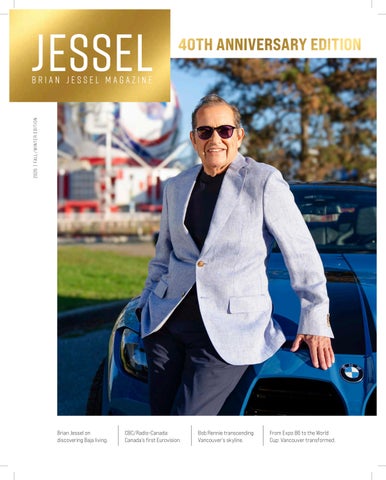
2026 | FALL / W IN TE R E D I TI O N
Brian Jessel on discovering Baja living.
CBC/Radio-Canada: Canada’s first Eurovision.
Bob Rennie transcending Vancouver’s skyline.
From Expo 86 to the World Cup: Vancouver transformed.
BÉZIER DESIGN MARCIO KOGAN / STUDIO MK27 MINOTTI.COM
JESSEL FALL/WINTER 2026
3
1706 WEST 1ST AVE VANCOUVER 604 683 1116 LIVINGSPACE.COM
SHAPED BY HAND, INSPIRED BY BEAUTY
STITTGEN.COM
A WEST VANCOUVERTRUSTED DESTINATION WEST VANCOUVER'S NAMEFOR FOROVER OVER22 70YEARS YEARS
1457 Bellevue Bellevue Ave, Ave, West West Vancouver Vancouver || 604 1457 604 925 925 8333 8333 STITTGEN.COM
TABLE OF CONTENTS Fall/Winter 2026
20 ANNALENA
15
The quiet pursuit of perfection.
26 BURNABY’S MAYOR MIKE HURLEY A quiet confidence and a welcome next-door.
MESSAGE FROM BRIAN
32 CANADA JOINS EUROVISION
Celebrating 40 years of relationships, community and a passion for excellence.
The search for the first artist to represent Canada in 2027.
16 OUR CITY TONIGHT
38 A $400-BILLION CLOSET
A look back 40 years to 1986 and 2 classic cocktails Vancouverites enjoyed.
Mine & Yours; helping to shape what the next era of luxury looks like.
15
20
JESSEL FALL/WINTER 2026
10
60 42
40+ years in the automotive industry; a ride well worth it.
68 WHAT A DIFFERENCE THE DECADES MAKE
ANGELA ARORA’S LONG GAME Success has never been about arriving. It has always been about becoming.
From Expo 86 to the World Cup: Vancouver changed more than any other city in Canada.
48 GOLF PRACTICE REIMAGINED
78 THE VALUE OF VANCOUVER
Trackman arrives at Golf Burnaby.
The attraction; space, privacy, stability and extraordinary geography; and the hesitation.
54 VANCOUVER GOLDENEYES The appetite for elite women’s hockey in Vancouver.
88
BRIAN AND THE LEAGUE OF GENTLEMEN
82 THE INTELLIGENT NATION Time; the greatest luxury of the future.
BEYOND THE SKYLINE The life, vision and legacy of Bob Rennie.
96 VANCOUVER BIENNALE A city as a work of art: two visions, one extraordinary canvas.
104 A NEW ERA FOR ANIMAL WELFARE When compassionate intervention becomes essential.
42
60
88
JESSEL FALL/WINTER 2026
11
Contents Continued
110
122 144
MY CABO
Brian Jessel on finding paradise, having no intention of slowing down.
132 PARADISE, TWICE DISCOVERED
THE HOUSE OF HAAS
THE LUXURY OF LINGERING A Tuscan celebration of friendship, food & La Dolce Vita.
Serving over 40 five-star hotels from The Four Seasons to Ritz Carltons.
From the desert of Todos Santos to the Sea of Cortez.
148 EVENTS PAGES; 40 YEARS
116 GAME OF THRONES
140 CHÂTEAU LESVESCAULT,
Connecting with the community, in style.
CINEMATOGRAPHER, ROBERT McLACHLAN
A SOUTH OF FRANCE DREAM COME TRUE
OF UNPARALLELED LUXURY
158 DRIVING IT HOME: NOW AND THEN
The walk in Whytecliff Park that changed his life forever.
The résumé of Fiona Benson: stunt performer, interior design and French cuisine.
The ultimate luxury: Being Vancouver.
110
122
144
JESSEL FALL/WINTER 2026
12
President Brian Jessel Managing Partner and CEO Jim Murray Director of Marketing and Communications Abdel Karim Awwad Brian Jessel Marketing Team Laure Caceres Razieh Motiei Nicolas Saba Managing Editor Abdel Karim Awwad Creative Director Petra Dueck Contributing Writers Harry van Hemmen Scott Jenson Harrison Vander Ranaa Patel Lesley Diana Kirsty Withams
Jim Gordon Harris Van Aaron Chapman Kelly Baldwin Leeta Liepins
Cover Story Team – Brian Jessel Writer, Aaron Chapman Photographer, Mohammad Alsaber Hair and Make-up, Farrah Sanei Videography, Shahaab Oshidary
JESSEL FALL/WINTER 2026
14
Contributing Photographers Mohammad Alsaber Paramount+ Jacob Couture Photography: Shehab Oshidary Trae Patton Peter Holst Warrick Page Kirsty Withams Ryan Green Justin Silvester Christopher Eurovision.com Saunders Emerson Miller Published by KE Collective Creation & Brian Jessel 2311 Boundary Road, Vancouver, BC V5M 4W5 © 2026 Brian Jessel. All rights reserved. No part of this magazine may be reproduced in any form without written permission from the publisher. The publisher is not responsible for unsolicited editorial material. Opinions expressed do not necessarily represent those of BMW Canada Inc.
@jesselmagazine
Brian Jessel on finding paradise and building a life in Cabo. Page 122.
MESSAGE FROM BRIAN Brian Jessel, President, Jessel Magazine Photography: Human Biography
F
orty years. It is remarkable how quickly time passes when you are doing something you love. When I started Brian Jessel BMW in 1986, I wanted to build more than a place to buy exceptional automobiles. I wanted people to feel welcome, to trust us and to know that relationships mattered. Four decades later, I am proud of what we have built together. Vancouver has been our home and inspiration. We have grown alongside this city, welcoming generations of customers, celebrating milestones and becoming part of their families’ stories. Some have been with us for decades; others are just beginning their BMW journey. I am grateful for their trust.
There is much to look forward to. BMW’s advances in design, electrification and technology promise an exciting future. Our introduction of the Retail.Next concept will elevate hospitality and personalized service. Our appointment as a BMW ALPINA Retailer Partner opens a new chapter in craftsmanship, performance and luxury. Jessel Magazine has spent more than two decades celebrating the people, businesses and experiences that make our region special.
To our customers, friends, partners and community, thank you for 40 years. The cars and technology have changed, but our values—integrity, relationships, hard work and a passion for excellence—remain. I cannot wait to see where the road takes us next.
15
Sincerely, Brian Jessel President, Brian Jessel BMW President, Jessel Magazine
JESSEL FALL/WINTER 2026
I have always believed that success carries a responsibility to give back. Supporting local charities, hospitals, arts, culture and community organizations has been among our greatest rewards. Equally important is the dedication of the thousands of people who have worked with us. To every member of our team, past and present, thank you.
OUR CITY TONIGHT
JESSEL FALL/WINTER 2026
16
Written by: Leeta Liepins and Jim Gordon
THE 1986 CLASSIC #2: HARVEY WALLBANGER 2.0
The first of the Our City Tonight “Cocktail Experts” is Micah Dew, Suntory Global Spirits Specialist, and bartender extraordinaire with over 28 years’ experience in the hospitality industry. His choice for “The Classic” is one that is often associated with a tropical vacation: the Piña Colada. We meet at the iconic Las Margaritas on 4th Ave, a restaurant that has been serving Mexican dishes inspired by Southern California and the Baja since 1994. They also know a thing or two about the Piña Colada, as does Micah. “Las Margaritas has a great vibe and a great culinary scene,” Micah says, “and is also known, of course, for the Margarita, the most famous cocktail around the world. But there’s another cocktail on the list that is actually still really popular from the 1970s and ’80s: the Piña Colada.” The ingredients include 2 oz of rum (in our case, the superb Brugal Añejo rum), 1.5 oz of some cream of coconut, and 2 oz of pineapple juice (some people add 0.25 oz of lime juice, as well). “You're going to mix those all together,” Micah says as we sample the first sips, “either shaking them up or blending it up—which is probably one of the most popular ways to enjoy a Piña Colada.” After a few more delicious sips, the discussion turns to that 1979 No. 1 hit song, “Escape (The Piña Colada Song),” which only helped increase the popularity of this timeless cocktail. lasmargaritas.com
Another of the Our City Tonight “Cocktail Experts” is Richard Goodine, who has over 35 years of experience running restaurants and got his start in this city managing The Cannery in the late ‘80s. His choice for “The Classic” is the Harvey Wallbanger—which many customers would’ve been ordering around this city in 1986. Richard decides to give this classic a bit of a modern take. At its core, the base is vodka and orange juice with Galliano. “Many would argue that this cocktail started as a Screwdriver and out of a desire for more flavour a bartender added Galliano and voilà, the Harvey Wallbanger was born,” Richard tells us. “So, we can’t lose the integrity of that because we still want to keep the look and feel of this classic.” His fresh spin starts by adding Absolut Tabasco, which will give it a little spicy hit that makes it interesting. To offset that and round it out, giving it a richer mouth feel, Richard adds mango purée. “To keep the integrity of this classic cocktail, but modernize it a bit, we went with the addition of Licor 43,” he says, “which is very similar to Galliano with its honey, vanilla notes—differentiated by being more citrusy and botanical-driven vs. woodsy and herbal-driven like the Galliano.” Then shake hard and serve over crushed ice with a sprig of mint. “The result is a rich, semi-sweet, but spicy cocktail with a complex mouth feel,” Richard says as we enjoy this delicious take on the Harvey Wallbanger.
17 JESSEL FALL/WINTER 2026
THE 1986 CLASSIC #1: PIÑA COLADA
OUR CITY TONIGHT
THE SPOT: SUMU TOKYO STREET FUSION
JESSEL FALL/WINTER 2026
18
There is a new restaurant on Burrard Street near Robson that opened in late August. SUMU’s concept begins with yakitori, a familiar sight in Tokyo’s street-food and casual dining scene, and binchotan, the clean-burning Japanese charcoal at the heart of the restaurant’s yakitori program. “Yakitori is an art,” says SUMU Food & Beverage Director Don Hua. “The charcoal burns at such a high temperature that the fat and juices drip onto it and comes back up as smoke, creating the flavour.” That attention to detail begins before a skewer ever reaches the grill. Take SUMU’s shio chicken, for example; the skin is carefully separated from the thigh before the chicken is portioned, the skin replaced and each piece skewered for cooking over
the binchotan charcoal. Under the philosophy “One Table, Different Cravings,” SUMU brings together yakitori, sushi, donburi and nabe, allowing everyone at the table to choose a different experience while still sharing the meal. For its nabe, or Japanese hot pots, SUMU slow-simmers its broths for 18 hours to naturally develop greater depth and flavour. Guests can select from a display of fresh ingredients upon entering the restaurant, which are then weighed and prepared for their individual nabe. With 131 seats, Hua says SUMU is bringing binchotan cooking to Vancouver on an ambitious scale—while maintaining the care and technique traditionally associated with yakitori. sumucanada.com
THE VIEW: BOORMAN AND THE DEVIL It was a sequel that seemingly couldn’t fail—and yet its failure has become the stuff of Hollywood legend. Following the phenomenal 1973 success of The Exorcist, 1977’s Exorcist II: The Heretic brought back Linda Blair, and though Ellen Burstyn declined, the film would add screen legend Richard Burton and recent Oscar winner Louise Fletcher. The directing duties went to John Boorman, who had a history of very good films like Deliverance and one of our 1960s favs, Point Blank. What could go wrong? Plenty. If we were studio executives back then, we would’ve green-lit this film without hesitation! Which leads us to a fascinating new documentary, Boorman and the Devil, from filmmaker David Kittredge. It examines the troubled production (including more than a month of shutdown when Boorman suffered a serious illness), a disastrous reception and lasting legacy as one of Hollywood’s most notorious sequels. Featuring Boorman, Blair and Fletcher, along with horror filmmakers including Joe Dante, Karyn Kusama and Mike Flanagan, the documentary also asks a
provocative question: was The Heretic simply a terrible movie—or a film that really wasn’t a sequel and didn’t deliver what the fans expected? Boorman and the Devil is now available for home viewing.
THE READ: CABIN COCKTAILS BY EMILY VIKRE
19
and other seasonal flavours—perfect for sipping on the dock, enjoying a backyard gathering or relaxing on a warm evening. It’s a fresh, inviting take on classic libations that encourages readers to experiment and have fun. vikredistillery.com T
JESSEL FALL/WINTER 2026
Emily Vikre’s new book, Cabin Cocktails, takes the classic cocktail and gives it a wonderfully unexpected cabin-country twist. With 70 seasonal recipes, Vikre shows that familiar favourites can be reinvented with imagination and a little playful experimentation. Think a Salted Chestnut Old Fashioned, an Apricot Negroni, a CranberryThyme Gin Cosmopolitan or a Gingersnap Old Fashioned. What makes the book especially appealing is Vikre’s ability to respect cocktail traditions while adding distinctive flavours that feel perfectly suited to fireside evenings, lakeside afternoons and après-ski gatherings. For summer, she brings that same creativity to refreshing cocktails featuring bright citrus, berries, herbs
“Restaurants are built by teams. Recognition is really a reflection of years of hard work, sacrifice and consistency from a lot of people who bring it all together.” — Chef Mike Robbins
JESSEL FALL/WINTER 2026
20
ANNALENA A quiet pursuit of perfection
T
here is a quiet confidence about AnnaLena that reveals itself long before the first course reaches the table.
Perhaps it is the warmth of the welcome as guests arrive. Perhaps it is the effortless rhythm of a dining room where every movement seems instinctive rather than rehearsed. Or perhaps it is the reassuring sense that everyone—from the kitchen to the front of house—is working together toward the same purpose: creating an evening that will be remembered long after the final glass has been poured.
When Robbins imagined AnnaLena more than a decade ago, his vision was surprisingly uncomplicated. He wanted to build a restaurant that reflected both his personality and the city he calls home—a place that felt creative without pretension, refined without formality, and unmistakably Vancouver. Twelve years later, that original dream continues to inspire him. “What keeps me motivated is still the same thing,” he reflects. “The chance to create something meaningful with talented people and to keep pushing ourselves forward.”
In an age where many restaurants chase attention through spectacle, AnnaLena has chosen a different path. It has quietly become one of Canada’s most celebrated spots not by following trends, but by remaining remarkably true to itself. Recognition has come in abundance, including Michelin distinction and national acclaim, yet success has never altered the philosophy that has guided Chef Mike Robbins and Co-Owner & General Manager Jeff Parr since the restaurant first opened its doors.
That desire to continually evolve is evident in every menu that leaves the kitchen. Robbins approaches cooking with remarkable restraint, believing that true sophistication comes not from adding more, but from knowing what to leave behind. Technique is essential, but only when it serves the ingredient rather than overshadowing it. His dishes possess a quiet elegance, allowing exceptional seafood, seasonal produce and carefully sourced ingredients to speak for themselves.
For Robbins, every accolade represents something much greater than personal achievement.
In many ways, Vancouver itself has become his greatest collaborator.
“Restaurants are built by teams,” he says with genuine humility. “Recognition is really a reflection of years of hard work, sacrifice and consistency from a lot of people who bring it all together.”
Surrounded by the Pacific Ocean, fertile farmland, mountain valleys and one of the world’s most culturally diverse communities, the city offers an endless source of inspiration. Robbins speaks enthusiastically about the farmers, fishermen, artisans and producers whose work forms the foundation of AnnaLena’s menus, while travel, books, conversations and cherished memories continually shape new ideas.
It is a sentiment that explains much about AnnaLena. Excellence here is never the work of a single individual. It is the product of countless shared moments—early mornings, late nights, careful preparation, spirited collaboration and a collective belief that every guest deserves something extraordinary.
The result is cuisine that feels deeply connected to its surroundings while remaining refreshingly original.
21 JESSEL FALL/WINTER 2026
By Harry van Hemmen
JESSEL FALL/WINTER 2026
22
YET EXCEPTIONAL FOOD TELLS ONLY PART OF THE ANNALENA STORY.
IT IS THIS PHILOSOPHY THAT TRANSFORMS DINNER INTO AN EXPERIENCE.
If Robbins provides the creative vision in the kitchen, Jeff Parr ensures that every guest experiences something far greater than a beautifully prepared meal. Under his guidance, hospitality becomes less about service and more about connection.
Luxury, after all, has never simply been about beautiful surroundings or exceptional ingredients. Its greatest expression lies in making people feel genuinely cared for.
“The best restaurants create a story,” Parr explains. “Something for the guest to connect with. The smaller you can make the details, the bigger you can make the impact.” Those words are reflected everywhere within AnnaLena. There is an ease to the service that cannot be manufactured, an attentiveness that feels sincere rather than scripted. Every interaction is thoughtful. Every recommendation feels personal. Every detail, no matter how small, contributes to an atmosphere where guests feel less like customers and more like welcomed friends.
Michelin recognition has undoubtedly brought international attention to AnnaLena, but Robbins is quick to point out that awards have never changed the restaurant’s daily purpose. “They validate the work we’ve put in,” he says, “but they don’t change our mindset.” That mindset remains rooted in curiosity, discipline and the understanding that excellence is never permanent. Every service begins again with the same commitment to improvement that existed on opening day. It is this quiet determination that continues to distinguish AnnaLena from so many of its contemporaries.
Looking toward the future, Robbins sees a city whose culinary identity is only beginning to emerge. Vancouver’s extraordinary diversity, its abundance of world-class ingredients and a new generation of ambitious young chefs give him every reason to believe that its finest chapters are still to come. “There is so much room for us to grow,” he says with unmistakable optimism. Asked what advice he would offer young chefs beginning their own journeys, his answer reflects the values that have guided his own career. Build strong foundations. Stay curious. Welcome adversity as an opportunity to learn. Above all, understand that consistency will carry you much further than the pursuit of perfection. It is advice that extends well beyond the kitchen. Perhaps that is why an evening at AnnaLena feels so memorable. It is not because every dish is technically flawless, nor because the restaurant has earned international accolades. It is because Mike Robbins and Jeff Parr have created something increasingly rare in today’s world: a place where excellence feels effortless because it is rooted in authenticity. Every plate tells a story of British Columbia. Every member of the team contributes to a shared vision. Every guest leaves having experienced something that cannot be replicated elsewhere. In the end, AnnaLena reminds us that great restaurants are never defined solely by what appears on the plate. They are defined by the people who devote themselves to creating moments of joy, conversation, discovery and connection. As Jeff Parr quietly observes, “It’s a process, and it takes time.”
Because the finest restaurants are not built overnight. They are shaped over years of shared purpose, unwavering commitment and thousands of thoughtful details that, together, create something truly extraordinary. And that is the story of AnnaLena. T
23 JESSEL FALL/WINTER 2026
It is a simple thought, yet perhaps it explains everything.
THE ESSENCE OF LUXURY EXCELLENCE IN EVERY DETAIL
PRECISION, PERFECTED. UNCOMPROMISING CRAFTSMANSHIP BMW CERTIFIED COLLISION REPAIR CENTRE BMW AND MINI’S HIGHEST LEVEL OF REPAIR AUTHORIZATION Since 1993, No. 1 Collision Group has set the benchmark for luxury collision repair. Family‑owned and guided by a philosophy of precision, our Lower Mainland facilities were built to mirror factory environments — engineered around advanced materials, exacting processes, and an unwavering commitment to detail. As a BMW Certified Collision Repair Centre, we uphold the highest level of collision repair authorization within the BMW and MINI network. This distinction reflects our dedication to factory‑approved standards and aligns us with the engineering values that define BMW and MINI performance, safety, and innovation. Modern BMW and MINI vehicles — from carbon‑fiber reinforced plastics and advanced metals to advanced EV platforms and integrated safety systems — are designed with remarkable sophistication. Their restoration requires factory authorization, direct manufacturer access, and the assurance of OEM standards. At No. 1 Collision, every BMW and MINI repair is performed with the same intention that shapes the vehicle itself — restoring structural integrity beneath the surface and refinement above it.
BECAUSE TRUE LUXURY IS NOT IMPROVISED. IT IS ENGINEERED.
REDEFINING COLLISION REPAIR A LUXURY REPAIR EXPERIENCE
STANDARDS, ELEVATED. SETTING A NEW STANDARD
www.no1collision.com
OUR CERTIFIED FACILITIES NO.1 COLLISION (GRANVILLE) 1520 W 3rd Ave, Vancouver 604‑732‑6584
NO.1 COLLISION (LOUGHEED) 3410 Lougheed Hwy, Vancouver 604‑253‑5550
NO.1 COLLISION (DOWNTOWN) 1055 Vernon Dr #100, Vancouver 778‑326‑0152
NO.1 COLLISION (RICHMOND) 11100 Cambie Rd #100, Richmond 604‑231‑9614
“Ambition without surrendering hospitality.”
JESSEL FALL/WINTER 2026
26
Burnaby Mayor Mike Hurley reflects on his vision for the city’s future.
The WELCOME Next Door
Mayor Mike Hurley and the quiet confidence of a city coming into its own
Story by: Harrison Vander Photos by: Mohammad Alsaber
T
It occurred to me that the feeling was, in miniature, exactly what a city hopes to create. If a business leader arriving from overseas, a young family considering a move or an entrepreneur looking for a Canadian home felt the same welcome, they might understand something essential about Burnaby before reading a single planning document. That may be the most useful way to understand Hurley’s Burnaby: ambition without surrendering hospitality. Born in Magherafelt, Northern Ireland, in 1958, Hurley came to Canada in 1983 and moved to Burnaby in 1988, the same year he joined the Burnaby Fire Department. His career there would include technical rescue, hazardous materials work, instruction and leadership roles up to Acting Assistant Chief. He later
served as president of both the Burnaby Firefighters Association and the BC Professional Fire Fighters Association before being elected mayor in 2018. His beginnings were more modest. One of eight children, Hurley remembers a childhood without much money or even a family car. There was farm work, walking, music, sport and the necessity of making your own fun. What remained was resilience and a work ethic, and he is emphatic that he would not trade that childhood. Music still runs through the family. Hurley told me he once played professionally on piano and keyboards, and he also confessed to another enthusiasm: a collection of roughly 26 guitars. Soccer remains part of the story, too. His official biography records that he played at the semi-professional level; today, he jokes that his knees are beginning to have the final say.
27
But it was Burnaby’s green space that first made the city feel like home. Hurley speaks about its parks not as municipal inventory but as part of daily life. Barnet Marine Park is a favourite; some mornings he is there around six, walking beside the inlet. That attachment to the ground beneath the skyline becomes important when he talks about what Burnaby is becoming.
JESSEL FALL/WINTER 2026
here are politicians who greet you like a constituent, and there are people who greet you like a neighbour. Within moments of meeting Burnaby Mayor Mike Hurley, the distinction felt important. There was no ceremonial distance to our conversation. He was warm, direct and immediately easy to talk to, and what began as a discussion about Burnaby soon moved naturally through Northern Ireland, music, guitars, family, firefighting and soccer.
“The theory is simple: Burnaby can become bigger without becoming less human.” For decades, Burnaby has existed beside a neighbour with one of the world’s more recognizable city names. Hurley does not appear troubled by that. “You’ll always be a little bit in Vancouver’s shadow,” he told me. “The world knows Vancouver.” Then came the line that could almost serve as Burnaby’s unofficial invitation: “Vancouver’s the name, but Burnaby’s the place to be.”
JESSEL FALL/WINTER 2026
28
The argument behind the line is increasingly tangible. Burnaby sits at the geographic heart of the Lower Mainland, served by major transit routes and anchored by Simon Fraser University and BCIT. Its economy includes significant concentrations in technology, life sciences, clean technology, digital media and film. In 2026, the City moved ahead with recommendations from its Task Force on Economic Growth and Resilience, including exploration of an innovation district intended to strengthen Burnaby’s high-tech and health sciences sectors.
Hurley sees the next opportunity in the same practical way he seems to see most things: build on what is already working. Burnaby’s four established urban centres—Metrotown, Brentwood, Lougheed and Edmonds—concentrate growth around transit. The newest Burnaby 2050 plan continues that approach as the city prepares for a population projected to reach roughly 360,000 by mid-century. The theory is simple: Burnaby can become bigger without becoming less human. The difficult part is proving it can be done. For Hurley, that test begins close to the ground. As Burnaby becomes denser and homes become smaller, he believes public space becomes more important, not less. Parks, trails, recreation facilities and places to gather are not decorative additions to a growing city; they are part of what allows people to feel that they belong to it.
Attendees at a 2025 event addressing historic discrimination.
The Christine Sinclair Community Centre is a useful example. The City purchased the former Fortius Sport & Health property for $26 million in 2021 and renamed the 146,000-square-foot facility for Burnabyborn soccer icon Christine Sinclair. What had been conceived largely around high-performance sport became a busy public recreation centre. Now the surrounding Burnaby Lake sports precinct is growing again. The new Burnaby Lake Recreation Centre is being built with a 10-lane, 50-metre competition pool, a second 25-metre pool and an NHL-sized arena, complementing the existing sports facilities nearby. Hurley sees the broader district becoming a destination for competition as well as community recreation. Even the former lodge space at the Sinclair centre is being brought back into service. In 2026, the City approved conversion of its 56 rooms into a city-run hotel intended in part to accommodate visiting sports teams and organizations. It is ambitious civic building, but Hurley tends to describe it in practical terms: facilities designed to serve generations. The emphasis is less on monument-making than on usefulness—what a city
can build now that will still matter long after the ribbon-cutting photographs have disappeared. That long view collides daily with immediate pressures: rapid population growth, housing demands, changing provincial rules, industrial activity, climate risk and the expectations of residents who want the city they love to remain recognizable. Here Hurley’s years in the fire service become more than biography. When a fire officer arrives at an emergency, he explained, everything can be happening at once. The leader’s job is not to be consumed by what is directly in front of him, but to step back, assess the larger picture, protect people and make a decision that will still make sense after the urgency has passed. “That has taught me a lot not to overreact too soon,” he said. That instinct followed him into labour relations, where he preferred mediation to unnecessary confrontation. The parties, after all, still had to work together when the argument ended. It follows him now into City Hall, and it gives particular weight to his enthusiasm for Burnaby’s new wildfire-detection system.
29 JESSEL FALL/WINTER 2026
Community representatives take the stage at Burnaby’s 2025 StreetFest celebration.
Mayor Mike Hurley beside a lake in Burnaby, a city whose green spaces he considers central to its identity.
JESSEL FALL/WINTER 2026
30
During our conversation, Hurley became animated describing sensors on Burnaby Mountain and cameras watching for the earliest sign of smoke. The final system, activated in May 2026, uses 45 ground sensors and five smoke-detection cameras, with devices positioned around forested areas and high-consequence locations, including the urban-wildland interface near Simon Fraser University and the Trans Mountain Tank Farm. The technology can identify heat and smoke in near real time and alert the Burnaby Fire Department before a small incident has the chance to become something much larger.
from civic construction to a joke about being photographed beside exceptionally tall athletes. That informality may reveal as much about his approach to leadership as any formal statement. His “Walk and Chat with the Mayor,” now in its eighth year, was created for much the same reason: not everyone is comfortable walking into City Hall, so sometimes City Hall should walk out to meet them. Burnaby’s business community reflects that same emphasis on connection. The Burnaby Board of Trade, which also serves as the City’s official economic-development office, reports more than 1,100 members. Hurley believes entrepreneurs
“[Fire service] has taught me a lot not to overreact too soon.”
Hurley sees the technology as something Burnaby can extend into other vulnerable green spaces. In our conversation, he specifically mentioned Central Park and Robert Burnaby Park as places he would like protected as the system expands. “I think it’s only the way of the future,” he said. Coming from a mayor who spent three decades as a firefighter, the comment carried less the tone of technological enthusiasm than of hard-earned caution: when fire is the threat, minutes matter. Yet our conversation rarely felt like a policy briefing. Hurley moved easily from economic development to rowing, from wildfire preparedness to family,
and established businesses alike benefit from a community willing to exchange ideas and help one another move forward. In that sense, what he imagines for Burnaby is not principally a skyline. It is what exists between the buildings: opportunity, education, parks, recreation, businesses and places where people encounter one another. When I left, I kept returning to that first impression—the immediate welcome. Cities spend enormous sums defining their brands. They commission strategies and slogans intended to tell the world what kind of place they are. Sometimes the more persuasive definition is simpler: it is how a place makes you feel when you arrive. Hurley came to Burnaby nearly four decades ago and found green space, opportunity and community. He stayed, served it as a firefighter, represented firefighters as a labour leader and eventually became its mayor. The skyline will continue to change. The population will grow. New industries will arrive. The promise beneath Hurley’s vision is that Burnaby can welcome all of that without becoming anonymous—that the parks will remain close, opportunity will remain within reach, and whether someone arrives from across the street or across the world, the city will still know how to make them feel at home. T
31 JESSEL FALL/WINTER 2026
For Hurley, this was not a passing policy point. He spoke about how dry the mountain can become and called interface fires—where wildland meets homes and infrastructure—frightening. His concern is informed by experience: he told me he had been in Fort McMurray and in Kelowna during the devastating 2003 fire season through his firefighting and union work. The City’s system has already demonstrated its value. In May, it detected a fire near local businesses before the first public call came in, giving crews an early warning. Burnaby is also working with SFU wildfire researchers on real-time weather and soil monitoring as the City prepares for a full-scale Burnaby Mountain emergency exercise in 2027.
JESSEL FALL/WINTER 2026
32
Eurovision CBC/Radio-Canada launches the search for the first artist to represent Canada in the Eurovision Song Contest 2027 Story by: Lesley Diana Photos courtesy of eurovision.com
DARA wins the 70th Eurovision Song Contest for Bulgaria, at the Wiener Stadthalle in Vienna, Austria. Photo: Corinne Cumming/EBU
From Céline Dion’s legendary 1988 victory for Switzerland to passionate fan campaigns across the country, Canada’s connection to Eurovision runs deep. Now, for the first time ever, a Canadian
act will take the Eurovision stage representing our own flag. This is a moment to celebrate! The Eurovision Song Contest is the largest live music competition in the world. A phenomenon among younger generations, it brings together hundreds of millions of people on television and digital platforms every year. Beyond music, it is also a powerful driver of cultural influence.
33 JESSEL FALL/WINTER 2026
A
fter years of dreaming, campaigning and building a movement, it’s finally happening: Canada will join over 40 countries to officially compete at the Eurovision Song Contest 2027.
Alma Bengtsson/EBU
Over the decades, Eurovision has helped reveal or propel the careers of artists such as ABBA, France Gall, Lara Fabian and Måneskin. For Canada, this historic first participation represents a unique opportunity to showcase the richness and diversity of our musical, cultural and artistic identity, as well as the exceptional creativity of our artists from coast to coast. CBC/Radio-Canada is launching a national search for the artist who will represent Canada for the very first time at the prestigious international music competition, in partnership with the European Broadcasting Union, to make this historic debut a reality. The chosen artist will then collaborate with top music industry talent to create Canada’s Eurovision song and performance. CBC/RadioCanada will determine a shortlist of finalists representing the rich diversity of the country’s musical talent. Finalists will be announced this fall.
JESSEL FALL/WINTER 2026
34
“We are seeking a magnetic Canadian performer with a genuine passion for representing Canada and a proven track record of captivating very large live audiences, whether through exceptional vocal power, electrifying stage presence or truly original artistry,” said Doug Smith, Executive Vice-President of CBC.
DARA wins the 70th Eurovision Song Contest for Bulgaria, at the Wiener Stadthalle in Vienna, Austria.
Canadian music fans, prepare to vote! Entries will move through a multi-stage selection process designed to find Canada’s ultimate performer. Canadians will then have their say on which finalist they want to represent our country through a digital vote. Videos featuring each artist will be posted on the Eurovision Song Contest Canada website. The public vote will then be combined with a review from a music industry jury to determine which finalist will represent Canada at the 2027 Eurovision Song Contest in Bulgaria. T More details on the CBC/Radio-Canada Eurovision portal: cbc.radio-canada.ca/en/eurovision. eurovisioncanada.ca
“We are seeking a magnetic Canadian performer with a genuine passion for representing Canada and a proven track record of captivating very large live audiences, whether through exceptional vocal power, electrifying stage presence or truly original artistry” — Doug Smith, Executive Vice-President of CBC
JESSEL FALL/WINTER 2026
Corinne Cumming/EBU
35
VANCOUVER
COQUITLAM
1275 W 6th Avenue Vancouver BC, Canada 604.730.1275
1348-C United Blvd. Coquitlam BC, Canada 604.529.6868
Mine & Yours owner & CEO Courtney Watkins with a curated edit of designer footwear.
JESSEL FALL/WINTER 2026
38
The $400 BILLION CLOSET Story by: Ranaa Photos by: Mohammad Alsaber
The way we buy, sell and think about fashion is changing. As the global resale market heads toward $400 billion, Mine & Yours is helping shape what the next era of luxury could look like.
T
The global resale apparel market is heading toward $400 billion by 2030 and is projected to grow twice as fast as the overall apparel market. Gen Z and Millennials are expected to drive more than 70 per cent of that growth.
For Mine & Yours, this is not simply about more people buying pre-loved. It is about changing the way people think about owning luxury altogether. The Vancouver-born brand has spent 13 years building an elevated approach to resale, creating a circular model where clients can both shop and sell. Across its stores and e-commerce platform, clients can discover designer handbags, accessories, ready-to-wear, shoes and menswear while unlocking value from pieces already sitting in their wardrobes.
39 JESSEL FALL/WINTER 2026
ake a look inside your closet. The designer bag you no longer reach for, the jacket you have been searching for from a past collection or the shoes ready for their next owner are all part of a much bigger shift happening in fashion.
Pre-loved Chanel handbags are part of Mine & Yours’ luxury resale collection.
Collectors have always understood that new does not automatically mean better. A rare watch or a sought-after piece from a past collection can become more desirable with time. That same mentality is now transforming fashion.
JESSEL FALL/WINTER 2026
40
Menswear represents a growing opportunity within that circular closet. Research shows that men are three times more likely to exclusively buy luxury and 1.5 times more likely to regularly clean out their closets than before. That makes them valuable buyers, but also potential sellers with significant value sitting unworn in their wardrobes. Mine & Yours is responding by expanding its selection of pre-loved designer menswear, including sought-after pieces that may be sold out, discontinued or difficult to find through traditional retail.
The appeal is not necessarily about paying less. It is about finding something exceptional, enjoying it and knowing there is an opportunity to pass it on when you are ready for what comes next. “Luxury car collectors have always understood that something doesn’t need to be new to be valuable,” says Mine & Yours owner Courtney Watkins. “We’re seeing that same mentality enter fashion. Clients want exceptional pieces, access to designs they can’t find elsewhere and the freedom to pass them on when they’re ready for something new.” That changing relationship with our closets is also creating an opportunity for Mine & Yours to think much bigger. “We’ve spent 13 years building Mine & Yours in Canada, and now we’re looking at where the brand can go next,” says Watkins. “We’re expanding
Mine & Yours owner & CEO Courtney Watkins (right) and Chief Brand Officer Sophia Koumbis at the brand’s signature handbag wall. A curated edit of pre-loved men’s accessories, including small leather goods, watches and belts.
into new cities, growing our partnerships and exploring opportunities beyond Canada. It feels like we’re entering an entirely new chapter.” While international opportunities are part of the longer-term vision, strengthening the brand’s presence in Canada remains the immediate priority. Partnerships, including one with a leading Canadian department store, offer a way to introduce resale within a traditional luxury environment and reach new markets without relying solely on standalone stores. The strategy reflects a broader shift within the industry. Resale is no longer operating outside traditional luxury retail. It is increasingly becoming part of how consumers discover, buy and sell designer fashion. For Chief Brand Officer Sophia Koumbis, maintaining the experience and community behind Mine & Yours is essential as the company grows. “I’m always thinking about the bigger picture, from our brand aesthetic to all of the details that make Mine & Yours what it is,” says Koumbis. “The most important part for me is elevating the customer journey, strengthening our culture and driving the future of Mine & Yours. I’m a big believer in
“I’m a big believer in supporting our community to build customer loyalty, and ultimately, that is what creates the incredible relationships we have with our customers.”
A jewel-toned top-handle handbag adds a statement piece to the luxury mix.
supporting our community to build customer loyalty, and ultimately, that is what creates the incredible relationships we have with our customers.” In the end, this shift is less about where people shop and more about how they think about ownership. Luxury no longer has to mean buying something new and keeping it forever. Increasingly, it means choosing well, enjoying what you own and knowing when it is time to let it move on. Because when an industry is heading toward $400 billion, what is hanging in your closet might be more powerful than you think. T
41 JESSEL FALL/WINTER 2026
Courtney Watkins amid Mine & Yours’ curated collection of pre-loved luxury.
JESSEL FALL/WINTER 2026
42
THE LONG GAME For Angela Arora, success has never been about arriving. It has always been about becoming. Story: Harris Van
Looking back today, Angela doesn’t speak first about victories or accolades. Instead, she remembers the joy of learning, the thrill of competition and the simple satisfaction of trying to become a little better each day. That perspective has remained remarkably unchanged. Although she has already earned provincial championships, represented Canada for five years, received a full NCAA Division I scholarship and captured a collegiate tournament victory, she views those accomplishments less as milestones of arrival than as stepping stones toward something still unfolding.
Professional golf, she believes, is not the destination. It is simply the next chapter.
WHERE PASSION BECAME PURPOSE As a child, Angela’s competitive spirit revealed itself almost immediately. Friendly putting contests with her father rarely stayed friendly for long. Winning mattered, but even more important was the challenge itself. Everything changed when she was 10 years old. Her father took her to Vancouver to see the LPGA CP Women’s Open, where she stood among the galleries watching her hero, Lexi Thompson, compete against the finest golfers in the world. For many young fans, the experience would become a treasured memory. For Angela, it became a vision of what might one day be possible.
43 JESSEL FALL/WINTER 2026
E
very athlete remembers the moment a dream first begins to feel real. For Angela Arora, that moment wasn’t standing on a championship podium or wearing the Canadian flag across her chest. It began much earlier, on a golf course in British Columbia, where a five-year-old girl accepted a golf club from her father and discovered a game that would quietly shape the course of her life.
JESSEL FALL/WINTER 2026
44
“Believe in yourself, enjoy what you’re doing and keep working hard. That’s what has carried me through every stage of my journey.”
Years later, she experienced one of sport’s rare fullcircle moments when she teed it up at the Canadian Women’s Open alongside many of those same players. Yet even now, she speaks less about fulfilling dreams than about discovering new ones.
Long before tournament week commences, she has already studied the course, adjusted her practice routines, refined every detail of her preparation and committed herself to doing everything within her control. Nutrition, recovery, training and course management all become part of a process built not around perfection, but around readiness. The discipline extends well beyond the fairways. Golf has taught her resilience when rounds don’t unfold as planned. It has introduced her to lifelong friendships, trusted coaches and competitors from around the world. It has also shown her that growth often comes from the days when nothing feels easy.
“Believe in yourself, enjoy what you’re doing and keep working hard she says. That’s what has carried me through every stage of my journey.”
Perhaps that is why she speaks so comfortably about the future.
THE BEAUTY OF THE PROCESS
There always are.
Golf has a unique way of revealing character. Unlike many sports, there are no teammates to rescue a difficult day and no clock to outrun a mistake. Success belongs to those willing to prepare patiently, accept setbacks gracefully and return tomorrow ready to begin again. Angela embraces that rhythm.
She understands there will be difficult rounds.
But she also knows they rarely define a career. “Golf has taught me discipline, patience, and that there’s always something more to learn.” That quiet humility is becoming increasingly rare in modern sport, where overnight success often dominates headlines. Angela seems content allowing progress to happen one swing, one practice session and one tournament at a time.
45 JESSEL FALL/WINTER 2026
From that point forward, golf became far more than an after-school activity. She committed herself to improving with purpose, setting goals that once seemed almost impossible—earning provincial championships, representing Team Canada, competing in NCAA Division I golf and one day playing alongside the very athletes who had inspired her.
STILL CLIMBING Among the moments Angela treasures most is wearing the Maple Leaf. Representing Canada for five years fulfilled a dream that began when she first picked up a golf club. Growing up in British Columbia—surrounded by outstanding players and supported by organizations like BC Golf—gave her both inspiration and opportunity, while continually reminding her that excellence is earned rather than assumed. Today, she begins perhaps the most demanding transition of her career. Having recently turned professional, she now prepares for LPGA Qualifying School, where the world’s best emerging golfers compete for an opportunity to reach the highest level of the game. She approaches the challenge with quiet confidence—not because she expects the journey to be easy, but because she has learned to trust the work that happens long before competition begins.
JESSEL FALL/WINTER 2026
46
Away from tournaments, balance remains important. Reading, following other sports and playing pickleball with friends provide moments to step away from scorecards and rankings, allowing her competitive spirit to breathe in different ways. Perhaps that is what makes Angela Arora’s story so compelling. She isn’t chasing perfection. She isn’t trying to prove she has arrived. She is simply embracing the privilege of pursuing something she loves, knowing that every season offers another opportunity to improve. The fairways ahead remain long. The goals remain ambitious. And that is exactly how she likes it. “The best part of the journey is knowing there’s still so much more to learn.” P
“The best part of the journey is knowing there’s still so much more to learn.”
JESSEL FALL/WINTER 2026
47
JESSEL FALL/WINTER 2026
48
PRACTICE REIMAGINED: Trackman arrives at Golf Burnaby
T
here was a time when a trip to the driving range was all about repetition. A bucket of balls, a favourite club and a rough guess at where each shot landed. Improvement came through feel, intuition and patience.
At both Burnaby Mountain and Riverway Driving Ranges, golfers can now access Trackman Range, a state-of-the-art ball tracking and performance system designed to transform the way players practice, compete and engage with the game. Included with every bucket purchase, the technology brings professional-level insights and interactive entertainment to golfers of every skill level. Photo: Peter Holst
49 JESSEL FALL/WINTER 2026
Today, that experience has evolved.
Photo: Peter Holst
JESSEL FALL/WINTER 2026
50
DATA MEETS DISCOVERY
MORE THAN A DRIVING RANGE
Each hitting stall is equipped with a 32-inch monitor that tracks every shot in real time, providing detailed feedback including carry distance, total distance, ball speed, launch angle, maximum height and shot dispersion. The result is an immediate understanding of what happens after every swing.
Beyond performance data, golfers can access interactive games, skills challenges and virtual golf experiences that blur the line between training and entertainment. Whether you’re enjoying a solo practice session, introducing friends to the sport or organizing a casual competition, every stall becomes a destination in itself.
For seasoned golfers, this means practicing with greater precision and purpose. For newcomers, it offers valuable insight that can help build confidence far more quickly than traditional range sessions.
The technology caters to a remarkably broad audience. Junior golfers can enjoy interactive games while casual players can add a competitive element to their range sessions through target-based
challenges and virtual rounds. Dedicated golfers, meanwhile, can analyze subtle variations between shots that would otherwise go unnoticed. It’s a modern approach that reflects how today’s consumers increasingly seek experiences that combine learning, social connection and technology.
BRINGING THE COURSE TO THE RANGE One of the most exciting features is the ability to play virtual golf courses directly from the driving range. Golfers can experience a rotating collection of courses from around the world, ranging from beginner-friendly layouts to championship-calibre venues. Players can compete against friends, play solo or simply explore courses they may never have the opportunity to visit in person.
A NEW ERA FOR GOLF BURNABY The arrival of Trackman is more than a technological upgrade. It represents a continued investment in creating exceptional golf experiences throughout Burnaby. Combined with heated stalls, extended operating hours, professional instruction through the Golf Academy and high-quality practice facilities, the addition of Trackman further elevates Burnaby Mountain and Riverway as premier destinations for golfers across Metro Vancouver.
In a sport where progress is often measured in small increments, Trackman offers something rare: instant understanding. It invites players to learn, compete and enjoy the game in ways that were once reserved for elite professionals. At Burnaby Mountain and Riverway, the future of golf practice has officially arrived, and it’s changing the game one swing at a time. T
51 JESSEL FALL/WINTER 2026
Perhaps most importantly, the system is designed to be accessible. There are no mandatory subscriptions, registrations or complicated setups required for core features. Golfers simply purchase a bucket of balls, step into a stall and begin exploring the possibilities.
Gabby Rosenthal on game day at the Pacific Coliseum
JESSEL FALL/WINTER 2026
54
Goldeneyes IGNITE THE WEST COAST HOCKEY FAN BASE Story by: Scott Jenson Photos by: PWHL n just one season of play, the Vancouver Goldeneyes established themselves as far more than the Professional Women’s Hockey League’s newest expansion franchise.
I
They quickly became one of the PWHL’s biggest success stories, building a passionate fan base while creating a connection with the hockey community on the West Coast. “From day one, fan support has been strong,” says Tania Richards, Vancouver Goldeneyes Director of Business Operations. “Before we even had a team name, fans were showing up for us—signing up for season ticket memberships, buying merchandise and showing their support online.
“Vancouver was more than ready for a PWHL team, and we’re excited to see what happens next as we enter our second season.” It’s been an idyllic relationship thus far between an energized fan base and the unfettered enthusiasm from the team.
55 JESSEL FALL/WINTER 2026
“This fan excitement and passion continued throughout our inaugural season, creating an incredible, exuberant atmosphere inside the Pacific Coliseum.
“Vancouver really welcomed us with open arms, and we in turn strive to represent the city well and we want to be a team that is quintessential to Vancouver.” “Vancouver really welcomed us with open arms,” says Richards, “and we in turn strive to represent the city well and we want to be a team that is quintessential to Vancouver. “The players love living here, and we aim to celebrate the natural beauty of our home and what makes Vancouver and its inhabitants so special in our branding, content and game experience.
JESSEL FALL/WINTER 2026
56
“Accessibility is also important to us—fans should always feel a sense of belonging when they step into our building for a Goldeneyes game.” Although the inaugural season came with the expected challenges of an expansion team, the Goldeneyes demonstrated resilience from opening night through the final game. The team battled through growing pains, showcased a talented roster featuring established
national team players and emerging stars, and laid a strong foundation for future success.
A roaring crowd at the Pacific Coliseum.
While a playoff berth ultimately remained out of reach, players and management consistently emphasized that the first season was about building an identity, developing chemistry and establishing a culture that can compete for championships in the years ahead.
1. Anna Segedi, Tereza Vanišová, Abby Boreen (left to right); 2. Jenn Gardiner; 3. Sarah Nurse; 4. Sophie Jaques, Gabby Rosenthal; 5. Emerance Maschmeyer.
Indeed, the Goldeneyes’ biggest victory may have come away from the standings. From the moment Vancouver was awarded a PWHL franchise, excitement surrounding the team continued to build. That enthusiasm translated into packed crowds at the venerable Pacific Coliseum throughout the season.
The home opener alone attracted nearly 15,000 fans, setting a league attendance record at the time, and the momentum never faded. Vancouver finished its inaugural campaign leading the PWHL in average attendance, regularly drawing crowds of more than 12,000 supporters. The atmosphere inside the Coliseum quickly became one of the league’s defining experiences. Families, longtime hockey fans and first-time spectators embraced the opportunity to support professional women’s hockey in Vancouver. Homemade signs, sold-out merchandise and thunderous ovations became common sights on game nights.
1
Visiting players and media alike noted the energy inside the building, while Goldeneyes players frequently credited the fans for making Vancouver feel like home. The connection between players and supporters became one of the defining characteristics of the Goldeneyes’ first season and helped establish a culture that extended well beyond the final score. The team’s success has also demonstrated the appetite for elite women’s hockey in British Columbia. Long before the franchise played its first game, Vancouver fans packed Rogers Arena during the PWHL Takeover Tour, proving the market was ready for a permanent team.
2
3
The Goldeneyes capitalized on that momentum by delivering an entertaining product and creating an inclusive game-day experience that appealed to fans of all ages. “Last season we had the largest average attendance in a Canadian home market and the second-highest single-season home market attendance in PWHL history,” says Richards.
JESSEL FALL/WINTER 2026
57
“Together with Seattle we generated the highest first-year merchandise sales of any teams in the league to date.” Social media conversations reflected that excitement throughout the season as fans
4
5
Tania Richards — Director of Business Operations for the Vancouver Goldeneyes
Fun and games on game day at the Pacific Coliseum.
praised not only the quality of play but also the welcoming atmosphere inside Pacific Coliseum.
franchises spend years trying to achieve; they have created a genuine bond with their community.
Many described becoming season-ticket holders after attending just one game, while others travelled significant distances to be part of the experience.
If the first season proved anything, it is that Vancouver was ready for professional women’s hockey and the Goldeneyes rewarded that faith by building a team and a culture that fans are eager to support.
The enthusiasm spread beyond traditional hockey circles, introducing new audiences to the sport and helping establish the Goldeneyes as an important part of Vancouver’s sporting landscape. While the inaugural campaign featured plenty of lessons on the ice, it also reinforced the organization’s long-term potential.
JESSEL FALL/WINTER 2026
58
Expansion teams rarely enjoy immediate competitive success, but the Goldeneyes showed enough promise to believe brighter days are ahead. With another offseason to build the roster and develop chemistry, expectations will naturally rise heading into Year 2. Perhaps most importantly, the Goldeneyes have already accomplished something many new
Wins and losses will continue to shape the story in the seasons ahead, but the inaugural campaign will be remembered for something even bigger: the arrival of a franchise that has already become a source of pride for the city and a model for what the PWHL can achieve in new markets. “We proved that the successful January 2025 Takeover Tour game at Rogers Arena was not a one-off,” says Richards, “that we have a strong product that people are interested in and invested in long-term. “We’re looking forward to continuing to build upon that for 2026-27 and beyond.” And with support being consistent, passionate and authentic, it certainly gives the organization a strong foundation as it builds toward the future. T
JESSEL FALL/WINTER 2026
59
JESSEL FALL/WINTER 2026
60
BRIAN JESSEL and the LEAGUE of GENTLEMEN 40+ years in the BMW business has been a ride well worth it—with some unexpected life lessons along the way Story by: Aaron Chapman Photos by: Mohammad Alsaber
W
hen Brian Jessel is asked what he recalls as his first memory—it is of cars.
“I know it’s going to sound strange, but I remember being in a crib in London, Ontario, and sitting outside and watching the cars go by. We lived next to a gas station, so even the smell of fuel was an early memory. I was a car guy right away,” he smiles. It’s the kind of innocent, cinematic, Rosebud-like early memory that might easily point to Jessel’s
destiny as an icon of success in the automotive business. But, perhaps a recollection may be too predictable or formulaic an answer, for a life that’s never really been predictable or formulaic. Speaking to Jessel in the showroom of his grand, nearly 70,000-square-foot new BMW facility on Vancouver’s Boundary Road, complete with a sales and service department, which even features a lounge to relax in, it’s the ideal location to look back on a life in business, as well as the business of life.
61 JESSEL FALL/WINTER 2026
Brian Jessel, the biggest fan of all things Vancouver, stands proudly in front of Science World's FIFA Ball.
Jessel’s biography is well-noted. Growing up in Ontario, he learned the business of buying and selling used cars from his father Bernie. In 1972, he moved to Vancouver after undertaking a cross-Canada tour, visiting some of his business and dealer contacts along the way.
corporate environment. There are companies in Canada who own as many as 60 to 80 dealerships, with even bigger conglomerates in the U.S. who own as many as 300 of them, and by sheer volume don’t forge the same relationships with buyers, even regular customers over time.
From Toronto to Sault Ste. Marie, onto Winnipeg and Edmonton, with numerous other stops (“In a Cadillac with no snow tires!”), he finally arrived in Vancouver.
“Now, myself—one of those gentleman car dealers—is an anomaly,” Jessel says.
“When I got here, even though it was raining, there was no snow,” he laughs. But it wasn’t just the gentler climate that convinced him
It was that lifetime love of cars that fuelled Jessel in those years, and he never could have predicted much beyond the weekly sales slips. “If you would have told me when I bought my first BMW
“I remember being in a crib in London, Ontario, and sitting outside and watching the cars go by.” to relocate. “Here in Vancouver at that time, anything was possible. It was the Wild West.” Jessel became a firsthand witness to the changes in the business history of car dealerships in the Lower Mainland. In the 1970s, established name leaders and owner-operators like ClarkeSimpkins and Brown Bros Ford dominated the local landscape that Jessel himself rose in.
JESSEL FALL/WINTER 2026
62
“These people were typically outstanding citizens in the community, well-to-do gentlemen.” Today, with consolidation, he notes it’s a much more
dealership, at some point it would be the biggest one in Canada—I would have laughed. That first dealership was in Abbotsford—the previous owner I bought it off had sold 50 cars a year. Eventually our company would grow and go on to sell 5,000 cars a year—a few times. I mean, that would have seemed impossible to me in the beginning.” The dealership’s move from Langley to Coquitlam, and later from Coquitlam to the current Boundary Road location, were significant shifts. “I worked seven days a week for six months. I was there every day. I just wanted to see how everything worked. I
JESSEL FALL/WINTER 2026
63
“If you would have told me when I bought my first BMW dealership, at some point it would be the biggest one in Canada—I would have laughed.”
JESSEL FALL/WINTER 2026
64
wanted to see when the sales team locked the door at night, to see what it was like when the service team opened in the morning,” he says, noting today he is less hands-on. He doesn’t need to be. “I’m not that person anymore, but we’ve been at Boundary Road now for 22 years.” And Jessel credits Jim Murray, his managing partner of over 20 years, with much of his success. “I not only trust him with my business, but my life,” Jessel says candidly. When he thinks of a life spent in the automotive business and of that emblematic circular BMW logo, it’s the word “Performance” which immediately comes to mind. “That’s what it’s all about. Hey, they weren’t always beautiful! But today, it’s the best of the best.” That passion for performance has extended to his charity interests. And it’s the work of the Brian Jessel Foundation, which hosted annual galas that turned his BMW showroom into an upscale nightclub and party space, that one can tell he’s still quietly proud of. The event brought together prominent business figures and celebrities, with music headliners like Colin James and the
“I’ve been wrong 927 times, and I’ve been right about 8 times. But the 8 times have been pretty good!” Barenaked Ladies, CeeLo Green, Shawn Hook and even former Tonight Show host Jay Leno on stage to entertain. Over its run, the event raised millions of dollars benefitting the Pancreatic Cancer Canada Foundation, the Canadian Cancer Society and their vital medical research and aftercare programs. It’s a cause near to Jessel’s heart. His father Bernie died of the disease, as did friend and fellow businessman Jack Poole, who was the head of the VANOC bid committee to bring the 2010 Winter Olympics to
65 JESSEL FALL/WINTER 2026
Brian Jessel, Abdel Awwad and Aaron Chapman discuss growing with the Vancouver market for 40 years.
Vancouver. Though instrumental in that successful bid, Poole tragically never got to witness the event, dying on the eve the Olympic flame was lit in Greece, on its way to Vancouver. Those sad turns made the research of pancreatic cancer his charity of choice. But car dealerships typically didn’t hold galas, and Jessel wanted to do something different. Once again, his own history was of great use in putting on something special. “We had some experience doing large-scale new car introductions—we did an introduction to the BMW 7 Series back in the 1990s at the Hotel Vancouver. I remember talking to the banquet manager and he couldn’t believe we wanted to get a car into the elevator to take up to the ballroom. But we did it!” Jessel and I meet again later at his home on Point Grey Road. From the back garden of his house, he has a remarkable view that covers
of the hardest things to deal with. Both Jim Murray and I like to give everybody a chance, but we’ve been lucky to hire some great people. To everyone who has been working for us for 10 years, I send them a little note on their anniversary. People are sometimes surprised by that—I know other dealerships don’t do it. But it’s a personal thing. Because we demand so much more from our employees as far as taking care of our clients, we need to be prepared to give back more than other dealership owners. “Some things don’t work out, and those wrong things can change your life,” Jessel reflects, “But sometimes what seems like a catastrophe, maybe 20 years later, maybe that’s best thing that ever happened to me. In the end, if you’re happy where you are today, you can’t go and say I wish I would have done this, or that.”
“I know it’s difficult out there for people. But hard work still counts.”
JESSEL FALL/WINTER 2026
66
an expanse from English Bay downtown out to the Strait of Georgia, which makes for his daily panorama. And, on a clear and warm morning like this, despite a few appointments that day, he laughingly says he is thinking of cancelling them and just enjoying the beautiful fall day.
All these years after he first arrived in Vancouver, Jessel knows the city has changed, and the highs and lows of the economy—more recently from COVID to a post-COVID boom in the car industry—have been a test. But he still believes in the city he made his trade in.
It’s a good day to ask him some further introspection he’s gained over the years not only in business, but life in general; such as, in business management, how much does one chase, and what do you leave to other people and employees?
“I know it’s difficult out there for people. But hard work still counts. People say luck is a big part of it. But luck is getting up in the morning and having a pile of cash at hand, then going to bed and getting up the next morning and having even more there—that’s lucky! Going out and earning the money, that’s work.”
“It’s a very interesting question. There are a lot of people who see a goal, and they work their whole lives towards it. It may not seem like it, but I was always going different directions and trying different things. People tell me, ‘What an amazing life. You’ve been so successful’, and I always say—‘I’ve been wrong 927 times, and I’ve been right about eight times. But the eight times have been pretty good!’ “Picking the right people is important—but sometimes their lives can change—that’s one
And at Jessel’s back garden, one still gets the feeling there’s some things he’s still chasing, and some things he’s happy to leave to his trusted team to pursue. But there’s a satisfaction and a contentment of wisdom that on a clear and sunny day, as that view of English Bay spreads all the way out to the Strait of Georgia, a couple of cancelled appointments that day won’t hurt at all. T
“Sometimes what seems like a catastrophe, maybe 20 years later seems, maybe that’s the best thing that ever happened to me.”
JESSEL FALL/WINTER 2026
67
JESSEL FALL/WINTER 2026
68
What a Difference the Decades Make From Expo 86 to the World Cup: Vancouver changed more than any other city in Canada. So what’s next? Story by: Aaron Chapman orty years… From the World’s Fair of Expo 86, to 40 years later with the 2026 FIFA World Cup—it’s stunning to look back at how far Vancouver has come during that time. We may never witness that same level of growth and change again.
F
69 JESSEL FALL/WINTER 2026
By 1986, the city had yet to really show its potential, or seemingly its destiny. It certainly wasn’t fathomable back then that Vancouver would or could host a FIFA World Cup. World Cup competitions were left to far-off exotic ports of call like Rome, Paris, London, Berlin, Buenos Aires and Rio de Janeiro. Not what was, in 1979, infamously called in ABC’s Wide World of Sports television broadcast during the New York Cosmos vs. Vancouver Whitecaps national soccer league championship match, the “Village of Vancouver.” Though with the Whitecaps win that day, some of us might have been dreaming about it.
JESSEL FALL/WINTER 2026
70
As a Vancouver historian who has written numerous books about how the city has changed over the years, I spend too much time debating with those who stridently insist that, “Vancouver was better before Expo 86,” as well as perhaps the myth that, “We invited the world and they never left!” While we might have enjoyed being a “best kept secret,” some of that growth and change that was in fact already happening in the 1970s foreshadowed that Vancouver was destined to greater prominence. We were just the last to know it. A more interesting question might ask, would we really want to go back to what Vancouver was like prior to 1986?
While we can immediately regard the cost of living was certainly more attractive compared to today, there was much to dislike about “old Vancouver,” much of which we seem to have forgotten with a prescription of rose-coloured-glasses. While we did certainly not manage the growth of the city over the years as judiciously as we could have—resulting in some of the issues of housing and affordability we undeniably deal with today—we might look back and instead see it as a time when Vancouver thankfully matured. Of the many unquestionable improvements, our public transportation is better today. The Skytrain—infrastructure that was ushered in by Expo 86—brought greater interconnections and liveability in the wider city as a whole.
JESSEL FALL/WINTER 2026
71
JESSEL FALL/WINTER 2026
72
False Creek was long past its boom time by the 1970s. Many industrial companies had abandoned or ceased operations there. It had become a rusted wasteland. Years of environmental abuse had even left the waters of False Creek grimly toxic. Dead harbour seals regularly coughed up between the log booms. Today, a stroll around the False Creek seawall, even on a rainy day, makes for—beyond compare—a more pleasant experience than it was half a century ago. The area is now cited as a global model of urban planning that even the odd whale swims in, to have a look around.
Even our food scene is better. While people look back with nostalgia on some old Vancouver restaurants like the Aristocratic, or The Only—it was diner food. Fine dining was much more scarce in old Vancouver. Immigration brought new flavours and chefs. Merely through the lens of what we eat, you can witness how the city has matured with a local culinary industry that now earns Michelin stars. And do any of us wish to go back to the days of No Sunday Shopping? When if you cared for a beer on the Sabbath, it required driving across the border down to Breakers bar in Point Roberts, Washington (likely leaving many to drive drunk back home!) The provincial liquor laws would thankfully change with the advent of Expo 86, when those in the hospitality business predicted that visiting global tourists looking to enjoy a civilized glass of wine in the afternoon would find our quaint Sunday “dry laws” old-fashioned and puritan to the point of embarrassed laughter.
73 JESSEL FALL/WINTER 2026
Crime issues have most surprisingly changed for the better. While we now deal with serious problems of street disorder once confined to areas like East Hastings, would any of us like to go back to the late 1970s, when sex workers caused disruption day and night for years in barricaded streets on the West End? And in those years, the homicide was double on average what it is today, with remarkably more murders in that same neighbourhood than there were in the Downtown Eastside.
There were certainly naysayers, complainers and sky-will-fall critics who said over the years none of these big events should happen. Before the gates ever opened, Expo 86 had strong critics. And to be fair, even in its largely regarded successful wake, the notion that staging any big to-do in Vancouver would be a guaranteed success just wasn’t the case. There were lots of unfortunate examples. The Vancouver Indy—which ran in the 1990s around the former site of the Expo lands—ended ignominiously in 2004, when the sponsorship ran out in a cacophony of noise complaints from the surrounding neighbourhood. An effort to bring car racing back in 2022 with Formula E Grand Prix had pre-sold 33,000 tickets before it was cancelled, because the promoter failed to do due-diligence and secure the necessary permits to run the race itself. Even big-time concert events like the Pemberton and Squamish Valley Music Festivals which brought global acts—like Drake, Pearl Jam, Tom Petty and Jay-Z—were cancelled after the organizers could no longer abide substantial annual losses. For all our talk of a “global city,” was Vancouver simply too “small time” to really be considered as such? And then there was another question: Vancouver’s seemingly nasty tendency towards anarchy in the streets. Two Stanley Cup riots fuelled naysayers further that we should avoid potential trouble altogether, and let some other city handle it. The best place for a party is someone else’s place.
JESSEL FALL/WINTER 2026
74
Vancouver admittedly has had a surprising number of mass public disturbances in its young history. From anti-Asian riots in 1907; not one—but two—Grey Cup riots in the 1960s; the Gastown Riot in 1971; and concerts that ended on a sour note, with the Rolling Stones in 1972 and Guns N’ Roses in 2002. Though, it’s interesting that mostly all the riots have happened in the spring and summer months—perhaps further illustrating the citizens of Vancouver’s relationship with weather. Had it rained on any of those events, maybe everyone would have just shuffled home?
JESSEL FALL/WINTER 2026
75
JESSEL FALL/WINTER 2026
76
The missing link in the 40-year time span between Expo 86 and the FIFA World Cup would certainly be the 2010 Winter Olympics. The undeniable success of those Games certainly seemed to give confidence that the city could successfully stage a global event. Though there were naysayers about the Winter Olympics, too. How many of us remember watercooler conversations from those who swore they would get out of the city for it? That there would be a nightmare of security and traffic issues, and too many problems accommodating so many visitors— all of which were certainly well forgotten by the Canadian Men’s Hockey gold medal win in overtime. We didn’t even look twice when the city saw the bill for the whole thing and costs were examined. Like a hungover partier looking at his credit card receipt the following morning, we shrugged and just accepted it as the cost of a good night out. So, what’s in Vancouver’s future? What will be the next global event that we can’t perhaps even imagine today, that might benchmark the next 40 years? Could it be the Major League Baseball franchise teased in this election year? Might we see a new stadium somewhere in the Lower Mainland to go with it? Could Vancouver display its versatility and host another Olympics? It’s been done before—Beijing emceed both the 2008 Summer Olympics and the Winter Games in 2022.
The show isn’t over yet. Bring on the next 40 years. T —Aaron Chapman is a historian, author of seven books on Vancouver and a two-time BC Book Prize winner. In 2020, he was elected to the Royal Historical Society. He lives in False Creek. aaronchapman.net.
77 JESSEL FALL/WINTER 2026
The costs are astounding, of course. The massive investments in infrastructure would be considerable at a time when ongoing issues of affordability, as well as financial stresses caused by certain global trade disputes, make it imprudent to dream so wildly. Well, there I go complaining—saying it can’t or shouldn’t happen. And we know which side of history those naysayers and complainers from decades ago—who swore Vancouver should never aspire to such heights—now fall on.
“Vancouver’s strongest luxury may be something money cannot easily manufacture: space, privacy, stability and extraordinary geography.”
JESSEL FALL/WINTER 2026
78
The VALUE of VANCOUVER The Attraction and the Hesitation
F
For much of its modern history, Vancouver luxury real estate could be sold with a simple proposition: buy into one of the world’s most beautiful and geographically constrained cities and let scarcity do the rest. Faith Wilson believes that proposition is changing. After more than three decades selling Vancouver homes, including some of British Columbia’s most exceptional properties, she has watched fortunes arrive, prices soar, governments intervene and buyers retreat. Yet she remains confident about Vancouver because what wealthy buyers increasingly want looks remarkably like what the city has been offering all along. Luxury is still about beautiful homes, extraordinary locations and owning something few others can afford. Increasingly, wealth is also looking for sanctuary: privacy, security, space, wellness, stability and access to nature. These have joined architecture, address and square footage in defining an exceptional property. Wilson has long viewed Vancouver’s attraction in similarly practical terms: mountains, ocean, forests and clean air combined with good schools, restaurants, cultural diversity, business infrastructure and an international airport.
Vancouver’s strongest luxury may be something money cannot easily manufacture: space, privacy, stability and extraordinary geography. There aren’t many important international cities where someone can own a substantial waterfront residence, reach an international airport quickly, maintain business connections across the Pacific, ski in the mountains and sail the coast while remaining part of a sophisticated metropolitan environment. Nor is Vancouver luxury confined to towers and penthouses. West Vancouver estates, substantial residences on Vancouver’s West Side, Southlands acreage and private properties elsewhere in the Lower Mainland offer something increasingly difficult to find in major world cities: privacy without isolation. Vancouver is no longer a place where buyers feel they have to decide before somebody else does. Sales have slowed, there are considerably more properties to choose from, and prices—particularly for detached homes—have softened. In August, fewer than 1,900 homes changed hands across Metro Vancouver, well below what would normally be expected for that time of year. For buyers at the upper end, that changes the conversation. People can compare, negotiate and walk away. After years when Vancouver buyers sometimes competed simply for the privilege of competing, they have regained something remarkably valuable: time.
79 JESSEL FALL/WINTER 2026
aith Wilson has spent more than three decades watching fortunes move through Vancouver real estate. Now, as the world’s wealthy reconsider what luxury means, she sees both an opportunity for the city—and a warning.
Story by: Harlen Admiree Photos by: Mohammad Alsaber
A buyer arriving with U.S. dollars, pounds or euros may see Vancouver prices differently from a Canadian earning and investing in Canadian dollars. For someone who believes in the city over a 10- or 20-year horizon, the opportunity may be less about finding a bargain than acquiring an exceptional property without having to fight for it. Wilson’s career has been spent at the upper end of a business where price alone seldom explains a decision. She understands that a beautiful house is not necessarily the right house and that wealthy clients have the ability to walk away. The objective is to understand what the buyer values and whether the property delivers it. The opportunity today is not necessarily to buy Vancouver cheaply. It is to buy something exceptional without having to fight for it. There is an uncomfortable contradiction at the centre of Vancouver’s international appeal: Canada has made ownership more difficult for some
also governments, taxation and the welcome—or lack of it—that accompanies their investment. The world’s wealthy are no longer simply comparing houses. They are comparing jurisdictions. Taxes are only part of the issue. Sophisticated wealth can accommodate substantial transaction costs; what it dislikes is uncertainty. An international family considering significant capital in Vancouver wants to understand how Canada regards that investment today and have some confidence about how it will regard it five or 10 years from now. That creates Vancouver’s luxury contradiction: the city increasingly possesses many qualities international wealth is searching for, while public policy can make establishing a foothold more complicated and expensive. At the top of the market, liquidity matters. The pool of people capable of buying a $10-million or $20-million residence is small, and anyone considering such a purchase has to think not only about buying it, but eventually selling it.
“The opportunity today is not necessarily to buy Vancouver cheaply. It is to buy something exceptional without having to fight for it.”
JESSEL FALL/WINTER 2026
80
globally mobile people Vancouver might otherwise attract. Federal restrictions on certain residential purchases by non-Canadians, British Columbia’s additional property transfer tax for foreign buyers in designated areas, vacancy taxes and Vancouver’s Empty Homes Tax have all changed the calculation. A foreign purchaser buying a $10-million Metro Vancouver property, for example, can face a 20 percent additional provincial property transfer tax—$2 million—before ordinary taxes and costs. An international buyer looking at Vancouver is not necessarily deciding between Vancouver and Toronto. Someone with the means to own a $10-million or $20-million home may also be looking at Switzerland, Monaco, Singapore, the Bahamas, the Cayman Islands, Portugal, Italy or the United Arab Emirates. They are comparing lifestyles and properties, but
Restrict the international pool too severely and that becomes a more serious consideration. Wilson’s experience through repeated Vancouver cycles provides the counterargument. The city’s strongest proposition was never simply that prices would perpetually rise. Its more durable value lies in scarcity. The ocean cannot be extended, the mountains cannot be moved and there is only so much land between them. Add international connectivity, political stability, education, culture, restaurants and a temperate climate, and Vancouver retains qualities that cannot be reproduced by building another luxury condominium tower elsewhere. The softer market may therefore be forcing a healthier conversation. Instead of asking how quickly a property will appreciate, buyers can ask whether it is something they genuinely want to own. Canadian citizens and permanent residents buying
12831 No. 4 Road, Richmond Available for purchase. Call 604.813.3656
“The world’s wealthy are no longer simply comparing houses. They are comparing jurisdictions.”
Wilson provides a surprisingly human counterpoint to talk of international money. She is less the archetype of the luxury real estate mogul than one might expect. She is curious, quick to laugh and allows a conversation to wander before bringing it back to the point. She remembers people and encounters from decades ago and speaks about her career without trying to make it sound grander than it was. “I’ve just really enjoyed this career,” she says. She remembers working constantly when she began—real estate, in her view, requires a 24/7 mentality—but says: “It didn’t feel like work.”
“I worked hard. I worked all the time. But it didn’t feel like work.” — Faith Wilson Away from the listings, negotiations and clients, her life sounds reassuringly ordinary. There are friends and family, a dog to walk and something simple to cook for dinner. In the early days, when difficult encounters bothered her, she discovered another habit. She would write the uncomfortable email, put everything she wanted to say into it—and then not send it. Writing it down, she says, provided its own closure. Perhaps that reflects more than three decades in a business famous for its highs and lows. Markets change, governments rewrite rules, buyers come and go and fortunes cross borders. The houses can be worth millions, but eventually the numbers and negotiations give way to something simpler. A house may be an asset, Vancouver an investment proposition and a changing market an opportunity. But in the end, somebody has to want to come home. T To learn more, visit faithwilson.com.
81 JESSEL FALL/WINTER 2026
a principal family residence avoid many barriers confronting foreign purchasers. International buyers who qualify can find something often missing from Vancouver’s hottest years: patience, selection and negotiating power. The question is not whether Vancouver remains an attractive place to live. It is whether Canada also wants it to remain an attractive place for global capital to invest.
JESSEL FALL/WINTER 2026
82
The INTELLIGENT NATION Time, the greatest luxury of the future Story: Jan Harland
Imagine the conversations when electricity first illuminated city streets. Some embraced it with wonder; others questioned whether anything so powerful could truly be trusted. The arrival of the automobile stirred similar emotions. How could machines travelling at unheard-of speeds possibly become part of ordinary life? Even the telephone, television and the internet were greeted with equal measures of fascination and uncertainty, yet history has a curious rhythm. The technologies that once seemed extraordinary eventually became almost invisible. Today, few of us stop to admire electric lights when we enter a room or marvel that a voice can travel halfway around the world in an instant. They have become so seamlessly woven into life that we notice only the comfort and convenience they provide.
Artificial intelligence appears to be following that same path. Much of today’s conversation centres on dramatic headlines—machines replacing jobs, computers writing stories, algorithms making decisions once reserved for people. It is enough to leave even the most optimistic among us wondering where this remarkable technology may ultimately lead. Perhaps, however, we are asking the wrong question. The future may not belong to machines at all. It may belong to people whose lives become a little easier, healthier and richer because intelligent technology quietly works in the background, allowing them to focus on what has always mattered most. That possibility is beginning to redefine one of society’s oldest ideas: luxury.
83 JESSEL FALL/WINTER 2026
E
very generation fears the future— until one day it quietly becomes everyday life. Every generation has believed it was standing at the edge of history.
For generations, luxury has been measured by possessions, exclusivity and craftsmanship. Beautiful homes, fine automobiles and unforgettable journeys have long represented lives well lived. Yet the meaning of luxury has always evolved alongside society itself. Increasingly, its highest expression may no longer be found in owning more things, but in enjoying more meaningful experiences. Imagine arriving at a favourite hotel after a long journey. The room feels immediately familiar. The lighting is just right. The temperature is comfortable. Dinner reflects both your favourite cuisine and your wellness goals without requiring explanation. Every detail feels effortless, not because someone has guessed correctly, but because countless small details have quietly come together to create a genuinely personal experience. The technology behind that experience may be extraordinarily sophisticated, yet the experience itself simply feels thoughtful. Perhaps that has always been the hallmark of exceptional hospitality. The finest service has never demanded attention for itself. It has always allowed guests to feel understood without ever feeling observed.
Heating adjusts before the weather changes. Lighting follows the natural rhythm of the day. Appliances quietly conserve energy without sacrificing comfort. Minor maintenance issues reveal themselves before they become expensive surprises. Family members living independently receive discreet support that provides reassurance without diminishing their dignity. None of these moments asks to be admired. Together, however, they begin returning something increasingly precious.
TIME Time no longer spent managing routine tasks. Time reclaimed for conversation, travel, reading, creativity or simply sharing another evening with family. History suggests that every meaningful innovation eventually gives humanity back a little more freedom. The washing machine returned hours once devoted to household labour. Air travel transformed weeks of travel into hours. The internet placed libraries, businesses and distant loved ones within easy reach. Artificial intelligence may become another chapter in that quiet tradition—not replacing human life, but removing some of the unnecessary complexity surrounding it.
“The finest luxury has never been about having more. It has always been about feeling understood.” JESSEL FALL/WINTER 2026
84
The finest luxury has never been about having more. It has always been about feeling understood.
Perhaps nowhere is that promise more profound than in healthcare.
The same quiet transformation is beginning to find its way into our homes.
For centuries, medicine has excelled at responding to illness. Increasingly, intelligent technologies offer something different: the possibility of recognizing subtle patterns long before symptoms become crises.
For decades, popular culture imagined futuristic houses filled with flashing screens and robotic voices announcing every movement. The reality emerging before us is considerably more elegant. Tomorrow’s home may simply become calmer.
Imagine wearable devices quietly noticing changes in heart rhythm months before a problem becomes serious. Recovery programs
“Tomorrow’s home may simply become calmer.” The greatest medical breakthrough may not be adding years to life, but adding life to the years we already have.
The conversation gradually shifts from extending life to enriching it.
Of course, every great transformation invites important questions. History reminds us that trust has always determined whether innovation ultimately succeeds. Railways required safe engineering. Aviation depended upon rigorous standards. Banking earned confidence through reliability. Each technological leap flourished only when people felt comfortable welcoming it into everyday life.
Longer careers inspired by purpose rather than necessity. Grandparents travelling with grandchildren. Experienced professionals sharing decades of wisdom because good health allows them to remain active and engaged. Longevity begins to feel less like an abstract scientific achievement and more like a deeply personal gift.
85 JESSEL FALL/WINTER 2026
that adapt daily to an individual’s progress. Treatments shaped around personal biology rather than broad statistical averages.
JESSEL FALL/WINTER 2026
86
ARTIFICIAL INTELLIGENCE IS NO DIFFERENT. The conversation extends beyond computers and software to something far more enduring: confidence. Confidence that personal information is respected. Confidence that innovation enriches communities. Confidence that education evolves alongside technology, allowing people to understand and benefit from the changes unfolding around them. Confidence that businesses, researchers and public institutions work together to create opportunities that are both imaginative and responsible. These foundations may never capture headlines, yet they quietly shape every extraordinary experience that follows. Throughout history, prosperous societies have invested in the infrastructure of their
The true measure of progress has never been the sophistication of our machines. It has always been the richness of our lives. One day, children may find it amusing that artificial intelligence once seemed mysterious or even intimidating. They may wonder how anyone planned complex journeys without intelligent assistants, how doctors identified illnesses without predictive tools, or why homes once required so much constant attention. The technology itself may have almost disappeared from view. What will remain are the moments it quietly made possible. A little more laughter around the dinner table. A little less worry about aging parents. A journey that unfolded effortlessly. An extra year of good health.
“The greatest medical breakthrough may not be adding years to life, but adding life to the years we already have.”
The infrastructure of the coming decades may be less visible, yet no less important. Digital networks, intelligent systems, research, education and secure technology are becoming part of the modern landscape upon which tomorrow’s prosperity will quietly be built. Perhaps that is why conversations about artificial intelligence increasingly feel less like conversations about technology and more like conversations about quality of life.
An ordinary afternoon made just a little more extraordinary because life felt less complicated than it once did. Perhaps every truly transformative invention follows the same path. It arrives with uncertainty, earns confidence through experience and ultimately becomes so gracefully woven into daily life that we stop noticing the technology altogether. Instead, we notice one another. The greatest technologies in history have never competed with humanity. They have quietly given humanity more time to be itself. T
87 JESSEL FALL/WINTER 2026
time. Roads connected communities. Railways opened continents. Airports expanded economies. Universities nurtured generations of thinkers and entrepreneurs.
JESSEL FALL/WINTER 2026
88
BEYOND the SKYLINE The life, vision and legacy of Bob Rennie Story by: Harrison Vander Photos by: Mohammad Alsaber
His name has become inseparable from Vancouver’s transformation into one of North America’s most admired urban centres. As a marketer, strategist and advisor, he helped redefine not only how real estate was sold, but how it was imagined
and understanding incomes, and need. Long before False Creek and Coal Harbour became coveted addresses, Rennie understood that buyers were investing in more than homes. They were investing in neighbourhoods, confidence and the future itself. That insight shaped an extraordinary career, but it does not fully explain the man. Before meeting Rennie, I had read the familiar biographies. They catalogued business success, landmark developments, philanthropy and one of Canada’s most significant private art collections. Yet they left unanswered the question that interested me most: How does Bob Rennie think?
89 JESSEL FALL/WINTER 2026
C
ities are remembered by their skylines— the towers that define them, the neighbourhoods that reshape them and the architecture that comes to symbolize an era. But skylines rarely tell the whole story. Behind every changing city are people who recognize possibilities long before everyone else. For more than half a century, Vancouver has had one of those people in Bob Rennie.
Seeing possibilities before others did. The answer emerged almost immediately. Our conversation moved easily from housing and economics to politics, education and contemporary art. The subjects changed, but the curiosity never did. Rennie has never separated business, culture and community. To him, they are connected by a single question: How do we leave a place better than we found it? Perhaps that is the clearest measure of Bob Rennie’s career. It has never been defined solely by the buildings he helped bring to market, but by an enduring fascination with people—their aspirations, their decisions and the communities they create.
PERSPECTIVE Learning that security is something we build. The moments that shape a life rarely seem important while they are happening. Their meaning emerges only years later, when scattered experiences reveal a pattern. Looking back, Bob Rennie’s early years in East Vancouver feel less like a prelude than the foundation for everything that followed. He has spoken openly about growing up in a home where stability could never be taken for granted. His parents’ relationship was turbulent, and during his teenage years his mother left several times, sometimes taking the furniture with her. It taught him early that security is not something you inherit—it is something you build.
JESSEL FALL/WINTER 2026
90
Three months before completing Grade 12 at Vancouver Technical Secondary School, Rennie left school. His education, however, did not end there. He applied for both his real estate and bartender’s licence. The real estate application came back first. Vancouver became his classroom. Its neighbourhoods taught him how communities evolve. Business taught him risk and discipline. Politics revealed the complexities of leadership. Above all, he learned to read people, understanding that decisions are driven as much by emotion as by logic, and a heavy reliance on data.
Years later, Vancouver Technical revisited his academic record and determined that he had already earned the credits required to graduate. By then, years of building a successful business and learning from life’s experiences had proved an invaluable education of their own. Instead of the honorary diploma they had planned to present, the school awarded him the Grade 12 diploma he had earned decades earlier. Just days before, Emily Carr University of Art + Design had presented him with an honorary doctorate. Rennie has also been presented with an honorary doctorate at Adler University. He still smiles at the irony that his high school diploma arrived after his doctorate. The story says less about credentials than about curiosity. Rennie never stopped learning. Long before he understood markets, he understood that a home represents security a neighbourhood offers belonging, and a city embodies possibility. That outlook distinguished him from many of his contemporaries. He wasn’t simply marketing buildings; he was helping people imagine the neighbourhoods and the lives they hoped to live inside them. It would also carry him far beyond real estate, into museums, galleries and conversations about history, identity and social justice, revealing a man whose influence extends well beyond the skyline that bears his imprint.
RECOGNIZING PATTERNS Understanding markets meant understanding people. By the time Bob Rennie had become one of Canada’s most influential real estate marketers, Vancouver was undergoing a profound transformation. A city once admired primarily for its setting was becoming an international destination for investment, immigration and ambitious urban development. From his vantage point, Rennie watched neighbourhoods reinvent themselves while helping developers understand not simply what buyers wanted, but
Bob Rennie casually wearing his favourite Paul Smith multicoloured plaid over-shirt.
JESSEL FALL/WINTER 2026
91
Bob Rennie admires Kehinde Wiley’s Portrait of Nelly Moudime, a striking reinterpretation of classical European portraiture.
JESSEL FALL/WINTER 2026
92
why they were willing to invest in communities that existed only on architectural drawings. His concept helped refine, professionalize and popularize the pre-sale in Vancouver at a time when the city was undergoing a dramatic transformation. Throughout our conversation, Rennie spoke about housing not as a commodity but as an interconnected system. Land, financing, construction costs, municipal approvals and consumer confidence were inseparable, each influencing the next. “You can’t just do five sides of a Rubik’s Cube,” he says, “you need all six to complete
ARTI-FACTS Collecting art became an act of listening. Spend enough time with Bob Rennie and your attention begins to drift from the conversation to the walls around him. The paintings are not displayed as trophies or symbols of wealth. They feel like chapters in an ongoing conversation about history, identity and the stories societies choose to remember. One work, in particular, demands a second look. At first, it resembles an American flag. Then the familiar markers disappear. The field is black. The stars are
To describe his role as marketing alone... misses the larger story. That perspective has made him a prominent voice in British Columbia’s housing debate. Rather than offering political prescriptions, he asks practical questions. What happens when approvals take longer than construction? How do rising costs reshape affordability? When do well-intentioned policies begin producing the opposite of their intended effect? During our interview, Rennie spoke candidly about weakening confidence in the market, lengthy approval timelines and policies that, in his view, often overlook the economics of building new homes. Whatever the topic, he returned to the same conclusion: housing succeeds only when every part of the system works together. It also explains why his work reached well beyond the projects marketed under Rennie. His career was built on understanding that buyers invest in more than buildings. They invest in trust—in a developer, in a neighbourhood and in the future those places promise. That same way of looking at the world would eventually lead him beyond real estate into contemporary art, where another chapter of his life was quietly taking shape.
gone. Created by the late American artist Barkley L. Hendricks, it is a painting Rennie returns to often— not for its rarity, but for the questions it continues to ask about identity, representation and belonging. For Rennie, collecting art was never about possession. It became a way of understanding the world through artists whose voices had too often been overlooked. When I asked what his collection was worth, he paused, sighed softly and glanced to the side before replying, “There are seven people managing it.” Some collections simply outgrow easy valuation. He traces that evolution to a conversation in the early 1990s with painter Kerry James Marshall. Marshall told him, “If you go into a museum and don’t see a Black figure in any paintings, you think it doesn’t belong on their walls. I’m going to change that.” The remark sharpened Rennie’s sense of purpose. He increasingly sought artists whose work challenged accepted histories and broadened the stories museums tell. African-American, Palestinian, Gender-Political and other artists exploring identity, memory and justice became central to a collection shaped as much by ideas as aesthetics. Among the works that has stayed with him is Nazis Murdered Jews, painted in 1936, years before the
93 JESSEL FALL/WINTER 2026
the puzzle.” Bob’s views were shaped less by ideology than by decades of watching markets respond to economics—and to human nature.
Holocaust. This work hangs in the Jewish museum in New York on Fifth Ave today. Rennie sees it as evidence that artists often detect history’s first tremors before the rest of society recognizes them. That philosophy eventually led to leadership roles with some of the world’s most respected museums and cultural institutions in Washington, London and Chicago. Rennie currently serves as Chair of Collectors at the National Gallery of Art in Washington, D.C. Last year, after nine years on the board of the Art Institute of Chicago, he concluded his service as Chair of Acquisitions and Trustee, and after a 17-year tenure, will step down as President of the Board of Trustees of the Tate Americas Foundation. Along the way, he came to believe that collecting carries obligations as well as privilege. Great art, he argues, should not disappear into private vaults. It belongs in public conversation.
THE LONG VIEW Success becomes responsibility. There comes a point in many successful lives when the questions begin to change. People stop asking how the business was built and begin asking what it can do for others. Our conversation gradually shifted away from markets and toward community. For Rennie, giving back was never presented as the reward for success. It was simply the next responsibility.
JESSEL FALL/WINTER 2026
94
The remark is understated, especially from someone whose professional accomplishments could easily dominate the conversation. Instead, he speaks about the institutions that matter most: health care, education, public service and the arts. It is here, more than in business, that his priorities become clear. His commitment to community extends well beyond business. In addition to serving as ViceChair of the VGH & UBC Hospital Foundation, he recently joined the boards of the Vancouver International Film Festival and the Vancouver Police Foundation, while also serving as Chair of the Advisory Board for the Peter P. Dhillon Centre
for Business Ethics at UBC’s Sauder School of Business. Together, these roles reflect a deeply held belief that strong communities are built on strong institutions—and that strong institutions require more than financial support. They require time, thoughtful judgment and an enduring commitment. Education holds particular significance. Having followed an unconventional path himself, Rennie understands that talent often appears before opportunity. His support of scholarships at Emily Carr is rooted in that conviction: investing in potential before the rest of the world recognizes it. Viewed this way, philanthropy is not separate from the career that came before it. It is an extension of the same instinct: identifying potential, investing early and believing that thoughtful decisions made today can improve lives tomorrow. Success, in Rennie’s view, carries responsibilities as well as rewards. When Bob Rennie speaks about the future, he does so with little interest in prediction. After decades of watching markets rise and fall, he knows economies are cyclical, governments change course and cities continually reinvent themselves. What matters most, he believes, is whether the institutions that give a community its character remain strong enough to outlast those changes. That belief has shaped much of his life beyond real estate. Rennie has devoted years to museums, hospitals, universities and cultural organizations, seeing them not as separate commitments, but as a continuation of the same work. Building a city, he believes, does not end when construction is complete. It continues through education, culture and the institutions that hold communities together. At one point our conversation turned to fellow Vancouver businessman Brian Jessel. Rennie spoke warmly of Jessel’s generosity and civic leadership, describing him as someone woven into the fabric of the city. It was intended as a tribute, but it also revealed something about Rennie himself. He measures success less by what someone has built than by what they have contributed.
As our conversation drew to a close, one thought lingered. Responsibility is a choice we make every day. Legacy is history’s decision.
BEYOND THE SKYLINE Legacy Leaving Bob Rennie’s home, I realized I had spent remarkably little time thinking about real estate. The skyline that made him famous had faded into the background, replaced by something more enduring: the impression of a man whose influence reaches well beyond the buildings associated with his name. His legacy will not be measured only in towers or neighbourhoods, but in the artists he championed, the students he encouraged and the people whose lives he quietly influenced. Cities are built with steel, concrete and glass, but they are remembered through those who help shape the lives within them. As our afternoon drew to a close, Bob reached for a small concertina-folded booklet that fit neatly into the palm of my hand. Inside were brief reflections gathered over a lifetime. Handing one to each of us, he smiled. “Something to carry with you always.” Then, with impeccable timing, he added, “My thing with small brochures is... how can I get one into every woman’s purse?” The room filled with warm laughter—the kind that comes only after hours of genuine conversation.
“My legacy now? Only history will decide.”
One day, today’s skyline will simply become tomorrow’s backdrop. Bob Rennie’s fingerprint will remain part of Vancouver’s story, but his lasting legacy will be found in the people he inspired, encouraged and believed in. In the end, that is the kind of architecture that endures. T
95 JESSEL FALL/WINTER 2026
Driving home, I opened the booklet again. It seemed to capture the man who had given it: thoughtful, unpretentious and quietly generous. It was more than a keepsake from an interview. It was a reminder that what stays with us is rarely the grand gesture, but the small kindness, the shared laugh or the thoughtful words that return long after the moment has passed.
A City as a Work of Art
Two visions, one extraordinary canvas: Barrie Mowatt brought international art into Vancouver’s everyday life. Now Marcello Dantas joins him to imagine the Vancouver Biennale’s next chapter. Story by: Harris Van Photos donated by: Vancouver Biennale
JESSEL FALL/WINTER 2026
96
T
he history of the world’s great biennales is also a history of cities learning to see themselves differently. Venice began the modern tradition in 1895, eventually making its palazzos, canals, gardens and Arsenale (Arsenale di Venezia) inseparable from the experience of
the art. São Paulo followed in 1951, Sydney in 1973 and Istanbul in 1987, each developing an identity rooted in its own geography and culture. Their enduring lesson is that a biennale becomes truly significant when the city stops being merely its host and becomes part of its meaning.
A-maze-ing Laughter Artist: Yue Minjun (b. 1962, China) Medium: 14 patinated cast-bronze figures Dimensions: 259 cm (102 in) tall Weight: 250 kg (551 lbs) Location: Morton Park (Davie Street and Denman Street) at English Bay in Vancouver
JESSEL FALL/WINTER 2026
97
1
“Instead of asking people to find the art, what if the art found them?” Barrie Mowatt saw that possibility in Vancouver. The city already possessed what no curator could commission: mountains rising behind the skyline, the Pacific meeting beaches minutes from downtown and forests woven into the metropolitan landscape. What Vancouver was still developing was the cultural confidence to use those qualities not simply as scenery, but as part of its artistic identity.
JESSEL FALL/WINTER 2026
98
Mowatt came to that idea after years on the other side of the gallery door. He established Buschlen Mowatt Fine Arts in 1979 and developed it into an internationally recognized gallery that operated until 2011. Yet galleries require an intentional encounter: people decide to go looking for art. Mowatt became fascinated by reversing that relationship. Instead of asking people to find the art, what if the art found them?
In 1998, working with the Vancouver Park Board, international sculpture was brought into the public realm around English Bay. Suddenly contemporary art belonged as much to the family walking the Seawall as to the collector or critic. There was no admission, no threshold and no requirement to understand. There was simply the encounter. From that experiment grew the Vancouver Biennale and an increasingly ambitious interpretation of the open-air museum: art where people live, work, play and transit, free for everyone to experience. Sculpture was joined by installation, film, performance, new media, education and artist residencies. Artists including Yue Minjun, Ai Weiwei, OSGEMEOS, Vik Muniz, Dennis Oppenheim and Michel Goulet became part of a cultural conversation unfolding across parks, waterfronts, transit corridors and neighbourhoods.
1, 2, 3. Barrie Mowatt; 4. Device to Root Out Evil – Dennis Oppenheim (USA, 2005—2007): Vancouver’s Harbour Green Park; 5. Trans Am Totem – Marcus Bowcott (Canada, 2015): Near Quebec Street and Milross Avenue; 6. Jaguar – John Henry (USA);
7 4 6
5 7. Giants – OSGEMEOS (Brazil, 2014): Twin artists Gustavo and Otávio Pandolfo transformed six Granville Island concrete silos into a monumental mural; 8. 217.5 Arc x 13 – Benar Venet (France, 2005—2007): Sunset Beach.
8
Yue Minjun’s A-maze-ing Laughter at English Bay perhaps captures Mowatt’s philosophy best. Children weave between its 14 bronze figures, visitors imitate their enormous grins and Vancouverites use them as a familiar landmark. Behind them are ocean, mountains and sky. Move the figures elsewhere and they remain Yue Minjun’s art, but they would no longer be Vancouver’s Yue Minjun. Barrie Mowatt didn’t simply bring international art to Vancouver; he allowed Vancouver to become part of the art.
persistence, a philanthropist’s belief in access and a provocateur’s understanding that worthwhile art can sometimes make people uncomfortable. Perhaps the greatest evidence of his success is that his original proposition no longer seems particularly radical. Vancouverites have grown accustomed to encountering ambitious art in unexpected places. Temporary works became memories; others became landmarks. Artists, students and communities became part of the Biennale’s history.
“A biennale becomes truly significant when the city stops being Such achievements required more than an eye for artists. Public art means governments, engineering, fundraising, neighbourhood interests and inevitable disagreement over what belongs in shared space. Mowatt has navigated that territory with a collector’s curiosity, an entrepreneur’s
Success, however, presents another challenge. Institutions can become so closely identified with their founders that protecting what worked begins to restrict what might come next. Mowatt’s response has been to trust the platform he created enough to invite another formidable imagination into it.
JESSEL FALL/WINTER 2026
merely its host and becomes part of its meaning.”
99
MARCELLO DANTAS: THE NEXT VIEW Marcello Dantas inherits an idea that has already proved itself. He doesn’t need to establish that Vancouver’s beaches, parks and neighbourhoods can become serious cultural spaces. Mowatt has spent more than a quarter-century doing that. As Senior Curator of the Vancouver Biennale, Dantas faces the more interesting question: how do you advance a successful idea without simply repeating it? The Brazilian curator, filmmaker and cultural producer has built an international career exploring the boundaries between art, architecture, technology, landscape and human experience. His work has included major international exhibitions and, more recently, co-curating Desert X AlUla 2024 in Saudi Arabia and serving as art director of SFER IK in Tulum, Mexico—places where environment isn’t background to the art but part of its meaning. Marcello Dantas doesn’t inherit a blank canvas. He inherits one layered with landscape, culture, history and more than 25 years of ambition. Importantly, Dantas already knows this canvas. He worked with the Vancouver Biennale more than a
“Marcello Dantas doesn’t inherit a blank canvas. He inherits one layered with landscape, culture, history and more than 25 years of ambition.”
JESSEL FALL/WINTER 2026
100
decade ago and in 2014 curated its International Pavilion, inviting eight emerging Brazilian artists to transform an industrial workshop into a collaborative arts project. That same period produced Vik Muniz’s remarkable Untitled (Wolf) in Squamish, a 30-by-17-metre image created from rocks, logs and wood chips with First Nations groups and the local community. Nature gradually reclaimed it, exactly as intended. That history offers a glimpse of what Dantas brings to Vancouver. Public art need not always be a monument placed permanently on a pedestal. It can be temporary, immersive, digital, performative or responsive; it can change with weather, water,
darkness or human participation. In Vancouver, where nature stubbornly refuses to remain in the background, those possibilities are compelling. Yet Vancouver isn’t an empty landscape waiting for an international curator to provide cultural meaning. Any serious conversation begins with the Indigenous peoples whose territories, knowledge and artistic traditions long predate the modern city. Around that foundation has grown a diverse creative community expressed through visual art, architecture, film, music, dance, design, technology, food and performance. The opportunity, therefore, is exchange rather than simply importation: international artists
Marcello Dantas. 1. Voxel Bridge – Jessica Angel (Columbia/USA, 2021); 2. Proud Youth – Chen Wenling (China, 2021): On waterfront; 3. Engagement – Dennis Oppenheim (USA, 2005-2007): Two monumental engagement rings topped with illuminated houses;
2
4 6
4. Freezing Water #7 - Ren Jun (China, 2009-2011) Vanier Park at night; 5. Love Your Bean – Cosimo Cavallaro (Canada, 2014-1016): Charleson Park; 6. Figures in Circle x 3 – Markus Schaller (Germany, 2005-2007): Near English Bay.
3
encountering Vancouver artists, contemporary practice engaging meaningfully with Indigenous knowledge, and galleries, schools, neighbourhoods and cultural organizations becoming participants rather than spectators. The world’s great biennales succeed because they could happen nowhere else. Vancouver’s opportunity is exactly the same. Venice succeeds because nowhere else can be Venice. Sydney is shaped by its harbour and AsiaPacific position; Istanbul by its place between continents. Vancouver’s ambition shouldn’t be to imitate them, but to recognize that its own landscape, people and cultural complexity are precisely what distinguish it. That is where Mowatt and Dantas meet. Mowatt’s journey began in Vancouver and reached outward, bringing the international art world into the public life of his city. Dantas has travelled internationally
5
and brings that perspective back. One understands what it took to build the platform; the other has been invited to explore what else it might become. This isn’t a passing of the torch so much as the lighting of another one. Mowatt carries the history, relationships and persistence that built the Biennale. Dantas brings another eye and another vocabulary. The promise lies in the conversation between them. The next great Vancouver Biennale will not simply bring the world to Vancouver. It will put Vancouver into conversation with the world. Barrie Mowatt spent more than a quarter-century establishing the canvas. Marcello Dantas has been invited to look at it differently. Vancouver no longer needs to ask whether it belongs in the international cultural conversation. It needs to decide what it wants to say when the world is listening. T
101 JESSEL FALL/WINTER 2026
1
VANCOUVER
COQUITLAM
1275 W 6th Avenue Vancouver BC, Canada 604.730.1275
1348-C United Blvd. Coquitlam BC, Canada 604.529.6868
A volunteer shares a moment with a dog in BC SPCA care, reflecting the compassion and human connection at the heart of animal welfare.
JESSEL FALL/WINTER 2026
104
A NEW ERA for ANIMAL WELFARE How prevention, community support and compassionate care are changing the way the BC SPCA helps animals Story by: Kelly Baldwin Photos: Courtesy BC SPCA
Kindness is at the heart of prevention, helping address the challenges that place animals at risk while strengthening the bond between
people and the animals they love. This means being there when a family is forced to evacuate during a wildfire, is facing an unexpected health crisis or struggling to afford pet food during a difficult period. Through emergency boarding and pet food banks, the BC SPCA provides support that helps keep beloved pets safe and connected to the people who care for them. By helping families navigate difficult circumstances, these programs do more than prevent heartbreak. They help prevent unnecessary surrenders, creating space and resources for other animals in need.
105 JESSEL FALL/WINTER 2026
R
eal progress begins when people unite around a shared purpose. Across B.C., a growing community of caring supporters is helping to redefine what is possible for vulnerable animals. Together, these efforts help ensure vulnerable animals receive the care they need while advancing broader movement toward a kinder, more compassionate society where animals and people thrive together.
The importance of that capacity becomes clear when animals arrive in care with nowhere else to turn. Earlier this year, BC SPCA Animal Protection Officers rescued 13 miniature dachshunds living in deeply concerning conditions. The dogs required medical attention, time to decompress, and patient, compassionate care before they could begin their recovery. Many had experienced very little positive interaction with people, making trust one of the first things that needed to be rebuilt. It would be easy to see a story like this and focus only on what went wrong. But animal welfare is also about what happens next. The moment an animal enters BC SPCA care is the beginning of a new chapter, one shaped by patience, expertise and the belief that every animal deserves the opportunity to thrive. 1 For the dachshunds, that meant individualized care based on their unique needs. Some required medical treatment. Others needed time, stability and gentle encouragement to gain confidence in a world that had not always been kind to them. Their journey reflects an important truth: meaningful animal welfare is not simply about rescue. It is about creating the conditions that allow healing and transformation to occur.
2
JESSEL FALL/WINTER 2026
106
3
Stories like this also highlight why prevention and intervention must work hand in hand. When a family receives temporary support through a pet food bank or emergency boarding program, an animal remains safely with the people who love them. At the same time, shelter space, staff expertise and critical resources remain available for other animals who may be facing urgent situations like the rescued dachshunds. Every animal’s path is different. Some need support that prevents a crisis from occurring in the first place. Others need a second chance after enduring neglect, illness or hardship. What connects both journeys is the understanding that lasting change happens when the right support is available at the right moment. By investing in both prevention and care, compassionate British Columbians are helping create a future where more animals can remain with their families, more vulnerable animals can access the help they need and more stories end not in crisis, but in hope.
1. Honeybee; 2. April; and 3. Penelope— three of 13 miniature dachshunds rescued by BC SPCA Animal Protection Officers earlier this year. The dogs needed medical care, time to decompress, and patient, compassionate support as they began rebuilding trust.
While some animals need support that helps prevent a crisis, others arrive in the care of the BC SPCA already experiencing its effects, requiring medical treatment, behavioural rehabilitation and time to heal.
WHEN PREVENTION IS NOT POSSIBLE, COMPASSIONATE INTERVENTION BECOMES ESSENTIAL By responding to immediate needs while also addressing the factors that place animals at risk, the BC SPCA can create lasting change for animals and the people who care for them. Last year, thanks to the commitment of compassionate supporters across B.C., the BC SPCA assisted more than 135,000 animals throughout the province. Looking ahead, the focus is on preventing suffering before it begins by tackling its root causes and strengthening the bond between people and animals.
ADDRESSING THE ROOT CAUSES OF ANIMAL SUFFERING Animal suffering is often shaped by factors beyond an animal’s control. By the time an animal reaches the BC SPCA, the crisis may be visible, but its causes are often much harder to see. Understanding what made that animal vulnerable in the first place can create opportunities to step in earlier and prevent suffering. When we understand what places animals at risk, we are able not only to respond with compassion, but to prevent suffering before it begins. For more than a century, the BC SPCA has worked toward a kinder future for animals. By advancing humane education, advocacy and systemic solutions that address the root causes of suffering, the organization is helping create lasting protections for animals and reducing vulnerability.
107 JESSEL FALL/WINTER 2026
Honeybee and a companion in a later photo following the rescue—a quieter moment that reflects the care, stability and rehabilitation that followed.
From hands-on animal care and rehabilitation to humane education and community support, the BC SPCA’s work takes many forms—all centred on helping animals thrive.
JESSEL FALL/WINTER 2026
108
Sometimes, prevention is not enough. When animals arrive in BC SPCA care, the goal is to ensure they receive the support that best meets their needs without losing valuable time. As more families can stay together through programs like emergency boarding and pet food banks, staff have greater capacity to focus on animals requiring intensive care and intervention. The BC SPCA’s Animal Flow team brings together key areas of care to better understand each animal’s circumstances and connect them with the support, resources and opportunities that will help them thrive. By connecting animals with the resources best suited to their needs, the BC SPCA supports a more effective decision-making process across the shelter system. This creates pathways to foster homes, behavioural support, transportation programs and adoption opportunities while ensuring space remains available for animals with nowhere else to turn. Every animal’s situation is different. Some require emergency medical treatment, while others may benefit from additional behavioural support, foster care or more time before finding a home. Compassionate support from animal lovers gives the BC SPCA the flexibility to respond to those needs with care that reflects the individual animal rather than a one-size-fits-all approach.
BUILDING A SUSTAINABLE FUTURE FOR ANIMALS For some, a little extra time, specialized support or a calmer environment can make all the difference in helping them build confidence and thrive. The Vancouver Island Animal Behavioural Centre (VIABC) in North Cowichan was created for animals who need more than shelter alone, providing tailored behavioural support in an environment designed around their individual needs. By connecting animals with the care best suited to them, the VIABC helps animals thrive while
strengthening support for staff and volunteers across the broader shelter system. That same philosophy extends beyond the walls of a BC SPCA facility. Animal well-being is deeply connected to human well-being, and the challenges people face often affect the animals they love. By working alongside community organizations, the BC SPCA can reach families earlier, provide support sooner and help prevent challenges from becoming crises. Community support makes it possible to move beyond simply responding to animal suffering and toward preventing it. By investing in long-term solutions, British Columbians are helping build a future where fewer animals become vulnerable in the first place. Corporate partners play a vital role in that vision. By bringing people together around a shared commitment to animal welfare, businesses help create the awareness, engagement and collective action needed to drive lasting change.
A FUTURE BUILT TOGETHER Strong partnerships make this work possible. As more people recognize the connection between animal welfare, human well-being and resilient communities, there are greater opportunities to address challenges early and prevent suffering before it begins. Helping families stay together with the animals they love is part of that vision. It reduces pressure on the shelter system and helps ensure resources remain available for animals facing the most urgent and complex circumstances. For more than a century, the BC SPCA has been there when animals need help. The years ahead are about extending that impact by reaching further upstream, responding sooner and creating lasting change for animals and the people who care for them. If you want to share your compassion and help create a kinder future where animals and people thrive together, you can learn more at spca.bc.ca or you can reach out by email at community@spca.bc.ca. T
109 JESSEL FALL/WINTER 2026
SUPPORTING EVERY ANIMAL’S UNIQUE JOURNEY
‘THE HOUSE
OF HAAS’ The inspiring story of world-class chocolatier Thomas Haas Story by: Scott Jenson Photos by: Jacob Couture
JESSEL FALL/WINTER 2026
110
JESSEL FALL/WINTER 2026
111
A
s one of Canada’s elite pastry chefs, Thomas Haas is renowned for combining imaginative European craftsmanship with fresh, high-quality ingredients. His passion for baking and the lure of chocolate emerged at an early age in his native Germany. Training extensively in Europe, he apprenticed alongside top pastry chefs in Michelin-starred restaurants. Haas was surrounded by a rich tradition of baking and confectionery, eventually mastering the precision and discipline required to create exceptional pastries and chocolates. He earned the title of Konditormeister, or Master Pastry Chef, before bringing his expertise to Canada over three decades ago. The local love affair was immediate. Today, an unwavering commitment to excellence, creativity and innovation has made the name Thomas Haas synonymous with premium chocolate and artisan desserts. “Being the fourth generation in the pastry and chocolate craft, I grew up in the business and experienced my grandparents and parents baking, cooking and serving their loyal customers,” he says. “There was no career decision to make—I was expected to continue…and so I did with no regrets. During my three-year apprenticeship I did learn from one of the best in the craft but also experienced old-school kitchen discipline, manipulation and mind games.
JESSEL FALL/WINTER 2026
112
In hindsight I am even thankful for that part as it taught me how not to live my work life and made me very resilient.” European training provided Haas a deep appreciation for classic techniques while encouraging him to experiment with new flavours and presentations. After moving to Canada in 1995, he quickly gained recognition working in several prestigious hotels and restaurants, including Vancouver’s Four Seasons.
Mango Passion Fruit Entremets (Entremets Mangue-Passion)
113 JESSEL FALL/WINTER 2026
Chocolate Raspberry Entremets (Entremets Chocolat-Framboise)
Haas earned numerous awards and built a reputation for producing acclaimed confections that were visually stunning. His dedication to quality impressed customers and industry professionals alike. “As a young 26-year-old German kid, my early work & travel dreams came true arriving in Vancouver,” adds Haas.
JESSEL FALL/WINTER 2026
114
“It felt special yet surprisingly comfortable right from the beginning; the mountains, the ocean, the young vibe and a city which seemed to be big enough to have fun yet small enough to not feel lost.” In 1998 Thomas (and Lisa) moved to NYC as the executive pastry chef to help famed restaurateur and chef Daniel Boulud launch his flagship restaurant Daniel in Manhattan Upper East Side. Upon their return back to Vancouver, Thomas and Lisa decided to start their chocolate business in 2001.
“We served over 40 five-star hotels from The Four Seasons to Ritz Carltons and eventually even the White House in Washington, D.C., with our handmade chocolates and confections.” In 2005, Thomas and Lisa opened their flagship pastry shop and patisserie café in North Vancouver. It quickly became a favourite destination for chocolate lovers and pastry enthusiasts seeking his culinary artistry. As demand grew, he expanded with a second location on West Broadway in Kitsilano. “In 2008 the economic crisis happened, affecting many parts of the economy. Budgets tightened and our lucky streak serving our beloved hotels across the continent ended abruptly. It was perfect timing to give our store another little sister and Broadway was born.” One of the defining characteristics of Thomas Haas Chocolates is the emphasis on handcrafted production.
Throughout his career, Thomas Haas has received numerous awards recognizing his skill and contribution to the pastry industry. He has been named one of North America’s top pastry chefs and has represented Canada in international culinary competitions. His achievements have inspired many aspiring pastry chefs who admire his combination of technical excellence, creativity and dedication to continuous learning. Beyond his professional success, Haas is respected for mentoring young chefs and sharing his knowledge through demonstrations and educational events. As for what the future holds for the next generation to follow in his footsteps, Haas is optimistic. “Our craft has evolved tremendously over the past two decades and we’re proud to have mentored many young chefs who came through our kitchens and see them creating their own success over the years.
“We served over 40 five-star hotels from the Four Seasons to Ritz Carltons and eventually even The White House in Washington DC, with our handmade chocolates and confections.”
This attention to detail ensures that every product meets the highest standards of flavour, texture and appearance. Haas believes that true quality comes from combining traditional techniques with continuous innovation, resulting in products that delight customers while respecting the craft of chocolate making. Sustainability and ingredients play important roles in Haas’s work. He carefully sources premium chocolate and high-quality ingredients to ensure consistent taste and responsible production.
Our proudest moment yet was when both of our kids, Taylor and Alessa, decided to join the family business as the fifth generation with their objective to also learn the craft and, in their own words, become competent in everything it takes to continue. How lucky again!” Thomas Haas is duly recognized as a leader in Canada’s artisan chocolate industry and through every handcrafted chocolate and carefully prepared pastry he creates, he continues to share his love of the craft. It’s proof positive that exceptional quality and genuine passion can create an enduring reputation that stands the test of time. T
115 JESSEL FALL/WINTER 2026
Each chocolate and pastry is carefully prepared by skilled artisans.
photo by: Schneider Filters JESSEL FALL/WINTER 2026
116
ROBERT MCLACHLAN CINEMATOGRAPHER Game of Thrones, Landman, 1923, Ray Donovan Story by: Lesley Diana
photo: Courtesy of Robert McLachlan Robert behind the scenes with Jon Voight on Ray Donovan.
2. With Bruno Gerussi and Jackson Davies on set of The Beachcombers; 3. Hanging out with Kiss.
photo: Courtesy of Robert McLachlan
Robert was recently in Vancouver to give a presentation to his fellow IATSE 669 camera members at the Rio Theatre, sharing the experiences that elevated him to work on some of the most-watched TV episodes ever produced. Joining him via Zoom were Billy Bob Thornton (Landman) and Liev Schreiber (Ray Donovan), confirming that Robert is not only a great director of photography but also garners the trust of his actors, who are willing to give him their time on a weekend.
2
117 JESSEL FALL/WINTER 2026
1. Robert with Anthony Hopkins;
1
photo by: Michael Wrinch
L
ittle did Award-winning Cinematographer Robert McLachlan know that a walk in Whytecliff Park would change his career path forever, when he ran into his close friend Patrick Ramsay, who was shooting the pilot for Arrow with David Nutter directing. As he left, he yelled to Patrick, “Give David my best and tell him to get me on bloody Game of Thrones!” Two weeks later, David called. Robert flew to Ireland to work on Season 3 of the HBO hit. He almost didn’t do it, then he remembered the advice that legendary Canadian DP Richard Leiterman had given him: “Never get too comfortable.” David and Robert worked well together for multiple seasons. Some of Robert’s best work ever. Game of Thrones credits opened many doors. Suddenly, he didn’t need a demo reel or to prove himself—it was a passport to getting hired on any big show.
3 photo: Courtesy of Robert McLachlan
118
photo by: Emerson Miller / Paramont Press
JESSEL FALL/WINTER 2026
photo by: Trae Patton / Paramont Press
Helen Mirren and Harrison Ford - 1923
Billy Bob Thornton - Landman
photo by: Ryan Green / Paramont Press
Nicole Kidman, Morgan Freeman, Michael Kelly and Zoe Saldaña - Lioness
Robert McLachlan grew up in Vancouver, taking Fine Arts at UBC, and Film and Communications at Simon Fraser University. A Canadian Cycling Champion and a Canada Games cycling gold medalist, Robert left a promising sporting career to pursue filmmaking. While in college, he founded Omnifilm Productions, where he produced, directed and photographed numerous award-winning international documentaries and over 350 TV commercials. Robert worked on many Vancouver TV and film productions, including The Beachcombers, Millennium and MacGyver, to name a few. He has demonstrated remarkable versatility as a cinematographer, moving with unusual ease between the best TV projects and theatrical films. He’s now photographed dozens of movies and hundreds of TV episodes, including arguably the most famous episode of TV ever, “The Red Wedding,” as well as one of the most expensive ever, “The Spoils of War”—both on Game of Thrones. All told, he earned two Emmy nominations during his time with that show.
119 JESSEL FALL/WINTER 2026
photo by: Christopher Saunders / Paramont Press
Robert eats some lunch on the Iron Throne at the Game of Thrones set
photo by: Emerson Miller / Paramont Press
His technical and artistic mastery, combined with a deep well of experience and a collaborative nature, can be credited with his being described as a “director’s dream.” He is a member of the U.S. and Canadian camera guilds, DGA and DGC, with extensive time logged working overseas in the U.K., Ireland, Croatia, Morocco, New Zealand, Iceland, South Africa and Mexico.
Billy Bob Thornton - Landman
“When you film most of the episodes of a TV series, you’re together every day and get to know each other well enough to know we are all swinging for the fence and not letting our work slip,” states Robert. “The cast on Game of Thrones was so diverse, and there were so many cinematographers working on a single season that the cinematographer/actor bond didn’t generally occur, so it was always very nice when you showed up on set and an actor said, ‘Thank goodness it’s you today.’ They knew they’d look good and that I work fast. Having an actor’s trust really makes your job easier. When I joined Lioness this season to shoot six of the eight episodes, the major pros in the cast, including Nicole Kidman, were pretty wary for the first few days till they saw that I was using every trick in the book to make them look as good as possible.”
“When you meet Rob as a DP, you know that he should be a director. Rob provides a level of comfort that allows an actor to do his job.” — Billy Bob Thornton
JESSEL FALL/WINTER 2026
120
photo by: Bettina Strauss
Robert behind the scenes on 1923.
“The greatest pleasure of working on Taylor Sheridan’s shows Yellowstone, 1923 and Landman stems from working with great writing that’s brought to life by great actors,” Robert continues. “Taylor is an actor and writes very specifically to play to the actors’ strengths. It is especially nice to work on a hit. For my technical crew and me, it often goes beyond that, because if we’ve been given the licence and support to create truly accomplished visuals that enhance the show, the rewards are even greater, knowing that we did some work that day to be proud of.” “Taylor Sheridan has a very specific way of shooting—one of the reasons I have fit in well there is that I didn’t tell them, ‘That’s not the right way to do this!’” he adds. “One secret to success for a DP is to read the room and adapt rather than bulldoze. Shooting 1923 in Montana, Cape Town and Malta, five cameras were the norm. Harrison Ford and Helen Mirren are such pros, which was enlightening. They never left the set—they’d sit there and rehearse while we set up and lit around them. They’d be kidding around until they heard ‘action,’ then give a
photo by: Abagail Durkan
killer performance, totally elevating what we thought was on the page and making it look so damned easy.” Robert has the actors’ eye and trust, which helps him move quickly through the scene with confidence. The highlights of shooting Landman and Lioness are working with his tried-and-true crew, knowing every day you’re crafting superior entertainment with incredible actors—Sam Elliott, Billy Bob Thornton, Nicole Kidman, Zoe Saldaña and Morgan Freeman. Having front row seats to watch them do their thing is priceless. Billy Bob Thornton says, “I love working with Rob; he’s our safety net and understands the shot, the actors, the scene. When you meet Rob as a DP, you know that he should be a director. Rob provides a level of comfort that allows an actor to do his job.” Robert encourages all of us to ask for what we want; you never know where it will lead. T Robert McLachlan ASC, CSC mclachlan.camera
121 JESSEL FALL/WINTER 2026
Robert speaks to fellow filmmakers at Rio Theatre.
JESSEL FALL/WINTER 2026
122
My Cabo Story by: Brian Jessel
finding paradise, building a life in Baja has no intention of slowing down
I
first came to Cabo San Lucas in 1975. I was travelling through Mexico, visiting different cities and regions, and Cabo was a stop on my way to La Paz. Even then, there was something about the place that stayed with me. I liked the people. I loved the weather. And the scenery was—and still is—unbelievable. More than half a century later, I’m still coming back. To me, Los Arcos is one of the wonders of the world. I never get tired of looking at it. People travel from all over the world just to catch a glimpse of those famous rocks rising out of the sea. I have the privilege of seeing them every day. Most mornings, I’m up early enough to watch the sun rise over them. That never gets old.
For years, I owned in Cabo at a timeshare. Then I heard about a development that would become Hacienda Beach Club & Residences. I read everything I could about it, studied the drawings and eventually made an offer on a home here in 2007. Then 2008 arrived and, as we all remember, the world more or less ended. Suddenly, instead of struggling to find a property, I had my choice of perhaps 20 different units. There was an opportunity in the middle of all that uncertainty, and I took it. I moved into Hacienda in January 2010. Sixteen years later, I can honestly say I love living here more today than I did when I arrived.
123 JESSEL FALL/WINTER 2026
Brian Jessel on and why he
A LIFE WITHIN WALKING DISTANCE
JESSEL FALL/WINTER 2026
124
Cabo has changed enormously. Development has accelerated, particularly during the years I’ve lived here, and occasionally the traffic can be frustrating. But where I live, I can avoid most of it. Hacienda is remarkably self-contained. I can go to the gym, have lunch at home, spend some time on the beach and have dinner without ever leaving the property. Some days, I don’t. When I do venture out, some of the best restaurants in Baja are within a 10-minute walk. Or I can get in the car, drive for an hour and
discover extraordinary scenery, little communities and some fantastic restaurants. What makes the place special, though, is the people. I genuinely like the people who live around me, but I have particular affection for those who work at Hacienda. They are wonderful. After all these years, I’m still struck by the warmth of Mexican hospitality and the genuine desire people have to look after their guests. There is a graciousness to it that is increasingly difficult to find elsewhere.
JESSEL FALL/WINTER 2026
125
My favourite bar. 1 Homes Beach Bar at sunset.
My rental penthouse condo at 1 Homes
JESSEL FALL/WINTER 2026
126
SUNRISE, TEA & A FEW EARLY EMAILS I’m usually up around six because I like watching the sunrise. I make some tea, look out at the water and catch up on my emails. Then I start sending messages to the office in Vancouver, which probably freaks everybody out because they’re arriving so early. Lunch is at one o’clock at my house. My housekeeper, Jenny, has worked with me for 16 years and she is a fabulous cook—a little blessing all by herself. In the morning, I tell her what I feel like eating. She shops for it, brings everything back and prepares lunch.
Sometimes it’s as simple as a salad. Other days, it might be an elaborate Mexican dish. Whatever it is, it’s always delicious. The afternoons are fairly relaxed. I’ll answer more emails, take a walk, perhaps do some grocery shopping. Everything I need is close by, so I hardly drive anymore. In the evening, my girlfriend usually comes over and we cook at home. About twice a week, we’ll go out for dinner. One night a week, we often walk over to 1 Homes Cabo, have a cocktail by the water, then come home and cook. It’s a pretty good routine.
127 JESSEL FALL/WINTER 2026
My days start early.
WHERE I EAT If you ask me for a favourite restaurant, Tres Sirenas is definitely near the top of the list.
JESSEL FALL/WINTER 2026
128
It’s part of restaurateur Edith Jiménez’s group, which also includes Edith’s and The Office on the Beach. Tres Sirenas has the combination I like: excellent food, great service and entertainment that adds to the evening without overwhelming it.
is Rooftop 360 at Corazón Cabo, just a short walk away. The views are terrific, the cocktails are good and there’s entertainment. I’m not really a bar person anymore. I’d rather sit in a good restaurant, have a drink, listen to some music and enjoy the evening. And the weather certainly helps.
I particularly like the fish. There was also a curried lobster I loved that disappeared from the menu— but they’re still kind enough to make it for me.
There have been years when I’ve gone through the entire month of November and into the first week of December without putting on long pants. No sweater. No long-sleeved shirt. Nothing.
For a drink, I love sitting beside the water and pool at 1 Homes Cabo. Another option
It’s warm during the day, warm at night and, for me, pretty close to perfect.
JESSEL FALL/WINTER 2026
129
LOOKING BEYOND CABO I’ve bought quite a few properties in Baja over the years and kept a number of them. Personally, I’m more interested in land than condominiums, although I’ve owned condos as well. I still believe there are opportunities here. The market is going through a temporary moment, but I think it will strengthen. There can be particularly good opportunities in lower-priced condominiums, and I’m very interested in the Pacific side north of Cabo. Todos Santos, Cerritos and Pescadero are areas I watch closely. They are still relatively inexpensive compared with Cabo and not nearly as crowded. That’s where I think some very interesting opportunities can be found. The restaurants are another reason to go. Some of the best dining in Baja is now in that entire corridor. I also love Todos Santos. I’ll occasionally spend a weekend there. The islands are spectacular, the boating in La Paz is some of the best in the region, and it’s close enough to make an easy escape. There are good restaurants throughout the area as well. In fact, I’ve put an offer on a property in the Todos Santos area that hasn’t even been built yet. If everything works out, that will become my second Baja home. My business partner already has a home in the area, and we both love it.
THE AIRPORT SECRET
JESSEL FALL/WINTER 2026
130
I’ve also discovered one of the tricks to enjoying Cabo: using the smaller Cabo San Lucas International Airport whenever I can. I’m not sure I should even tell you this. It has a limited number of destinations, so increasingly I’ll plan a trip around where I can fly directly from there. For me, it’s a much easier experience than travelling out to the larger Los Cabos International Airport near San José del Cabo.
It’s smaller, simpler and, in my experience, remarkably quick to get through. Once you get accustomed to that, it’s difficult to go back.
WHY I KEEP WORKING Living in Cabo doesn’t mean I’ve retired. In fact, I think continuing to work is important. I meet people who retired at 65 and, 10 years later, seem a little lost. They don’t work, they don’t go to the gym, and gradually their world becomes television, the newspaper and not much else. That isn’t for me. I want to know what’s happening in the world. I keep an eye on my business. I talk to my business partner and my managers. Sometimes I have an idea I want to discuss with them; sometimes they have an idea they want to discuss with me. The important thing is keeping your mind active. Even technology helps. I’m certainly not brilliant with a computer, but the fact that I have to use one, learn things and stay connected keeps my mind working. I think that matters enormously as we get older. Maybe that is part of what Cabo has given me. It isn’t simply a place to escape winter. It’s a place where I can have both worlds. I can wake before sunrise, drink tea while looking toward Los Arcos and send emails to Vancouver before anyone there wants to hear from me. I can work, go to the gym, walk the beach, enjoy lunch at home and have dinner at one of Baja’s best restaurants. And when I want something different, I can head north toward Todos Santos, Cerritos or Pescadero. I first arrived here in 1975, never imagining Cabo would become such an important part of my life.
Baja has become a heritage destination for my entire family.
More than 50 years later, I can still wake up, watch the sun come up over Los Arcos and feel fortunate that this is part of my everyday life.
If anything, I appreciate them more now. And after all these years, I still look out at Los Arcos and think the same thing: This is a pretty fantastic place. T
131 JESSEL FALL/WINTER 2026
Cabo has changed enormously since I first saw it. So have I. But the things that brought me here in the first place—the weather, the scenery, the people and that extraordinary view across the water—haven’t lost their appeal.
PARADISE, Twice Discovered From the desert of Todos Santos to the Sea of Cortez Story by: Jim Murray Photos by: Shahaab Oshidary
JESSEL FALL/WINTER 2026
132
T
here is a point in travelling when experience begins to alter expectation. Linda and I have been fortunate enough to stay in beautiful hotels and visit remarkable places, and over time you inevitably develop a certain immunity to the vocabulary of luxury: bigger rooms, finer linens, more elaborate spas, longer wine lists. All are pleasurable, certainly, but abundance alone eventually becomes less interesting. What becomes more interesting is restraint. I found myself thinking about that at Paradero Todos Santos, although not immediately. At first, Linda and I were simply trying to absorb the landscape. Baja California Sur has a geographical severity that photographs don’t quite prepare you for. Desert runs toward ocean, cactus rises against mountains and the Pacific appears almost implausibly blue beside a landscape so conspicuously short of water. There is very little softness to hide behind, yet the cumulative effect is strangely calming. The light has something to do with it. Shapes become sharper, shadows stretch across the ground and the desert changes character throughout the day until late afternoon, when its hard edges begin to soften. Paradero doesn’t attempt to correct any of this. It allows the desert to remain the desert. Much resort architecture is fundamentally an act of separation: we travel somewhere exotic and then construct walls, gardens and climate-controlled rooms to protect ourselves from the very place we came to experience. Paradero takes almost the opposite position. Its sand-toned walls and low concrete forms seem to rise from the earth; still water catches the enormous Baja sky; cactus gardens feel like extensions of the landscape. There is an almost monastic quality to the architecture, nothing especially anxious to impress you, and Linda and I found ourselves responding to that restraint. The longer we stayed, the more we appreciated its confidence. Paradero doesn’t constantly remind you that you are somewhere special. It leaves enough empty space for you to discover that yourself.
133 JESSEL FALL/WINTER 2026
Coastline around Isla Espíritu Santo, near La Paz, on the Sea of Cortez.
LEARNING THE RHYTHM OF THE DESERT
JESSEL FALL/WINTER 2026
134
Something subtle happens after a day or two: your attention changes. You notice the shadow of a cactus moving across a wall, the heat lifting as afternoon becomes evening, the silence between conversations. Breakfast lasts longer than it normally would. Dinner is no longer something fitted efficiently between activities. You sit longer, look around more, and even the telephone begins to seem vaguely intrusive.
The same tension between refinement and authenticity extends into Todos Santos itself. The town has galleries, artisans, restaurants and markets, contemporary work alongside traditional Mexican craft, with colour and creativity around corners where you don’t necessarily expect them. Yet it still feels like a town with a life independent of those who have travelled there to discover it.
People have been travelling to escape the tyranny of their schedules for centuries. What’s unusual is finding a hotel disciplined enough not to fill the resulting emptiness. The rooms and public spaces reinforce that feeling. The boundary between inside and outside seems deliberately uncertain, with architecture framing the landscape rather than shutting it out. Your eye is continually drawn beyond the building—to desert, mountain, cactus and sky. It is a subtle form of hospitality because the property itself gradually recedes from the experience.
That matters because tourism has an unfortunate habit of consuming precisely the qualities that made a destination desirable. The beautiful becomes fashionable, the fashionable becomes popular and eventually the original place can disappear beneath everyone’s enthusiasm for it. Todos Santos is not immune, but there remains an appealing conversation between old and new, local and international, cultivated and slightly rough around the edges.
Food follows much the same philosophy. Baja has developed a sophisticated culinary culture, but what appealed to Linda and me was how little the cooking seemed interested in proving it. Seafood, vegetables, herbs, citrus, smoke and fire belong naturally to the region’s culinary vocabulary, with ingredients allowed to retain their identity. There is a broader lesson in that: simplicity becomes interesting only when there is nowhere for mediocrity to hide.
For several days, this was our Baja: earth and stone, cactus and good food, long shadows and an almost improbable amount of sky. We had begun to understand its particular paradise. It wasn’t paradise in the conventional tropical sense. There was no attempt to make the desert behave like something it wasn’t. Its beauty came partly from absence—from the space between things and the silence surrounding them. We might easily have gone home believing we had found the Baja we came looking for, but then the journey changed direction and we went to sea.
Left: Avocado toast with poached egg garnished with thin strips of red vegetables, fresh herbs and greens, Right: Mushroom omelette with bean purée, Ocosingo cheese and fresh herbs.
JESSEL FALL/WINTER 2026
135
THE SECOND PARADISE The transition to the Sea of Cortez is almost cinematic. The ochres, browns and muted greens that had defined our days give way to water and light, while the intimate geometry of Paradero opens onto a horizon that seems to have no particular interest in ending. Waiting for us was Paradero’s customized Lagoon 46 sailing catamaran. At 46 feet, it has four private en-suite cabins, an interior living space and kitchen, open decks, and netted lounging areas at the bow. Those specifications are useful before you step aboard; once you do, they quickly become less interesting. Distance becomes more interesting.
JESSEL FALL/WINTER 2026
136
There is a wonderfully satisfying moment when the shoreline begins to recede. Roads disappear first, then buildings, then the familiar evidence of other people’s schedules. The coastline becomes a narrow band separating water from sky, and the world left ashore seems suddenly rather complicated. Linda and I stood looking back, watching Baja rearrange itself from this new perspective. Perhaps that is why sailing retains such a hold on the imagination. For thousands of years,
leaving shore meant surrendering a certain amount of control. Modern boats have thankfully removed much of the danger and discomfort, but something of that psychological transition remains. You have left, and for the next several hours—or longer on an overnight voyage—the boat becomes the circumference of your world. We thought we had discovered our Baja paradise in the desert. Then the shoreline began to disappear behind us. Paradero has understood that the real indulgence aboard the catamaran isn’t simply what has been added, but what has been taken away. There is a captain, local experience guide, Paradero chef and mixologist. Written down, that sounds elaborate. Aboard, it has almost the opposite effect because the practical business of the day disappears. Food is prepared without your having to think about where to eat. A drink arrives without a journey to a bar. The boat changes course while you remain absorbed in the coastline. Someone who understands these waters notices what you might otherwise miss. Gradually, you stop organizing the day and begin inhabiting it.
Jim and Linda far a-sea, dining on Paradero’s customized Lagoon 46 sailing catamaran.
The Sea of Cortez is not scenery in the conventional sense because you can enter it. The catamaran carries snorkelling, kayaking and paddleboarding equipment, while a dinghy can take guests toward remote stretches of shoreline. Longer voyages can include hiking and beach setups, and in-season there is the possibility of whale watching. Yet Linda and I came to appreciate something else: the temptation to convert every beautiful place into an itinerary should occasionally be resisted. There is a modern compulsion to do destinations. We make lists, schedule excursions, photograph evidence and move efficiently toward the next experience. The Sea of Cortez rewards a less ambitious approach. Sometimes you simply sit. From the deck, mountains that initially seem barren change character with the light. Empty beaches appear between rocky outcrops and disappear again. The water moves through shades of blue that seem excessive even by the standards of travel writing, and eventually you stop asking what time it is. There is something particularly intimate about experiencing that with the person you know best.
Linda would notice something along the coast and draw my attention to it; at other times neither of us felt much need to say anything. Silence is comfortable when the view is doing the talking, and the older I get, the more I suspect genuine indulgence often looks remarkably simple. Food, for example, tastes different on the water. Perhaps hunger is sharpened by salt air and swimming, or perhaps a meal becomes memorable simply because of where you eat it. There is something wonderfully civilized about being aboard a sailing boat while a chef works nearby, the coastline visible beyond the deck and the gentle movement of the sea beneath everything. You hear water against the hull and feel the warmth of the deck underfoot. The formality has disappeared, but the quality hasn’t. Nothing felt particularly ceremonial. There was no performance of luxury, which allowed us to enjoy its substance. There is something rather wonderful about sharing a drink as the light changes over the Sea of Cortez and realizing that nowhere else requires your presence.
137 JESSEL FALL/WINTER 2026
BLUE WITHOUT END
THE VALUE OF ACCESS Somewhere out there, with the Baja coastline becoming a distant edge between water and sky, I began thinking about how narrowly we sometimes define luxury. We tend to measure it in possessions: square footage, materials, brands, vintages and stars. Travel suggests another currency entirely—access. It is the ability to be somewhere difficult to reach, to have time without obligation, to enter a landscape rather than merely look at it. It is leaving a shoreline behind without worrying about when you have to return, swimming with no crowded beach at your back, climbing aboard hungry and finding lunch waiting, then sitting beside the person you love while an immense piece of the world moves quietly around you. Those things are harder to quantify, but they are also harder to forget. Paradero offers day and sunset journeys as well as private six- and eight-hour charters and overnight voyages. The catamaran can accommodate up to 12 guests privately and eight overnight. Those are the practical details. What stayed with Linda and me was moving between two landscapes that initially seemed opposite and discovering something curiously similar in each.
JESSEL FALL/WINTER 2026
138
The desert and the sea have more in common than one might imagine. Both are immense and can be unforgiving; both reduce human presence to a more appropriate scale. Most importantly, both contain a great deal of emptiness, although one expresses it through earth and silence, the other through water and horizon. Perhaps that is why Paradero works so naturally in both. On land, the architecture frames desert, mountains and sky without competing with them. At sea, the catamaran does essentially the same thing, providing comfort, food, shelter and thoughtful service before turning your attention outward. One paradise is grounded in stone, earth and cactus; the other moves beneath you.
WHAT REMAINS For travellers from Vancouver and Western Canada, perhaps this has particular resonance. We come from a landscape where mountains,
Jim and Linda enjoying unpolished Baja Landscape.
“Perhaps the journeys that stay with us are the ones that subtract something—noise, urgency, distraction, obligation.”
When Linda and I talk about the journey now, our memories don’t return as a catalogue of amenities. They arrive in fragments: morning light across concrete, cactus silhouetted against a vast sky, the pleasure of food that belongs to the landscape around it, the Baja shoreline becoming smaller behind us, water against the hull, the changing colour of the sea, sitting together as afternoon surrendered to evening. Looking toward land from the boat, the desert appeared completely different. The place we had just left—our first paradise—had become part of the horizon of the second, and that was when the two experiences became one. We had arrived in Todos Santos and found something increasingly difficult to find in contemporary travel: a place confident enough not to overwhelm its surroundings. Then we sailed into the Sea of Cortez
and discovered the same idea expressed differently—less architecture, more horizon; less earth, more water; the same invitation to pay attention. Travel is often sold as accumulation: the number of countries visited, restaurants booked and experiences collected. This journey left me thinking almost the opposite. Perhaps the journeys that remain with us are the ones that subtract something—noise, urgency, distraction, obligation—and leave enough room for us to notice what remains. For a few days, Linda and I found that kind of paradise in the desert of Todos Santos, in its silence, architecture, food and remarkable sense of space. Then we boarded a boat and found another one waiting on the Sea of Cortez. Two landscapes, each beautiful for almost opposite reasons; two interpretations of escape and two different ways of reminding us that the world is considerably larger than the portion of it we ordinarily occupy. And somehow, they became one journey: paradise, twice discovered. T
139 JESSEL FALL/WINTER 2026
ocean and wilderness have always informed our understanding of beauty. We don’t necessarily need nature polished before we can appreciate it, and Baja isn’t polished, nor should it be.
CHÂTEAU LESVESCAULT: A dream comes true in the South of France ife on Vancouver film sets for stunt performer Fiona Benson (née Roeske) was exciting, doubling Uma Thurman, Charlize Theron, Angie Everhart and Sharon Stone in stunt sequences over a 20-year period that made audiences gasp. Now, guests have the same reaction when walking into her magical French property, Château Lesvescault.
L JESSEL FALL/WINTER 2026
140
As well as loving the stunt business, Fiona’s other passions were interior design and French cuisine. She attended the prestigious Debrulle Cooking School for six months, and after meeting comedian John Cleese, the two produced and co-hosted a pilot for a TV stunt cooking show. She also
pursued an Interior Design degree at Yorkville University’s Institute of Design and received an award for a condo redesign from Canadian House and Home magazine. Her completely redesigned penthouse on Vancouver’s downtown harbour was featured on the HGTV series Lofty Ideas. Her passion for French design and cuisine led her to the French countryside. Fiona and her husband fell in love with a 15th-century listed château, originally the palace of the Bishops of Poitiers, which stands in the heart of the Charente, nestled near Cognac fields, markets, culinary artisans, and Michelin-starred chefs, and only two hours from Paris. They have spent the last four years renovating
Story by: Lesley Diana with Kirsty Withams in France Photos of the château and grounds: Justin Silvester Photos of Fiona: Kirsty Withams
the entire property, creating beautiful guest accommodations, complete with a heated saltwater pool, a pétanque court, a fully stocked potager, fountains, intimate seating areas throughout the gardens and a professional outdoor kitchen complex.
THE CULINARY RETREAT 141 JESSEL FALL/WINTER 2026
Inspired by conversations with Caren McSherry of Gourmet Warehouse in Vancouver, who said international chefs would love to come to a fully equipped venue in France to teach exclusive residential culinary delights to holidaying guests, Fiona and her husband were enchanted by the idea. They set about making this a reality, creating a wonderful French venue for luxury culinary holidays and inviting international chefs to come and teach the art of French cuisine.
Today, set in a stunning new outdoor teaching kitchen, overlooking the French gardens, Château Lesvescault welcomes chefs from around the world to share their expertise with guests through immersive culinary experiences in this private facility. Guests may learn timeless, classic techniques in “Mastering the Art of French Sauces” or discover delicious fish recipes such as “Poisson à la Bordelaise”, while discovering the exceptional produce and culinary traditions that make this region one of France’s gastronomic treasures. Beyond the kitchen, guests can immerse themselves in the rich culinary heritage of this region. Optional experiences include sommelier-guided Cognac tastings, guided tours of the beautiful distilleries and vineyards, and intimate wine tastings in the Château’s 15th-century tower. Spend a leisurely morning strolling around vibrant markets, exploring picturesque ancient villages, or simply relaxing with a good book while sipping chilled rosé by the pool before your afternoon culinary experience begins.
PASS THROUGH THE GATES. LEAVE THE WORLD BEHIND.
JESSEL FALL/WINTER 2026
142
The private entrance to Château Lesvescault is unlike any other in Villefagnan. Its massive round towers, connected by the 15th-century crenellated gallery, still bear the original corbels that carry vestiges of their medieval bretèches and machicolations. As the massive wooden gates close, you enter a place of peace and tranquility. The small pedestrian door beside the arch is another original feature, unchanged for 500 years. The two round towers, the entrance porch and the enclosing walls were officially listed as a Monument Historique by a decree dated 4 December 1951.
THREE GÎTES. SHARED GARDENS. PRIVATE RETREATS. What awaits are three beautifully appointed gîtes, magnificent French gardens with a 19th-century fountain, walled kitchen gardens and the kind of unhurried quiet that only centuries of stone can offer. Maison Juliette, Maison Olivier, and L’Orangerie each occupy their own restored stone buildings with their own history, their own character and their own private terraces. All three gîtes open onto the shared grounds of the domaine— ancient stone walls, peaceful fountains and the unhurried pace of the Charente. You will sleep inside a piece of French history.
ONE OF THE QUIETEST, MOST BEAUTIFUL CORNERS OF SOUTH-WEST FRANCE. Villefagnan sits at the heart of the Charente—equidistant from Cognac, Angoulême and Poitiers, and within an easy drive to the Dordogne, Saint-Émilion and Bordeaux, with its access to the famous Medoc and its world-class wines. The landscape is gentle and ancient: rolling fields, stone market towns, roads lined with plane trees, and a pace of life that has not changed in generations. From quaint French villages, artisanal cheesemakers and organic bakeries to Pierre Lecat Cognac Distillery, unforgettable French culinary adventures await, making this a vacation that will fulfill guests’ dreams. T Open May to September, an experience that lasts a lifetime can be booked on their website. chateau-lesvescault.com
JESSEL FALL/WINTER 2026
143
JESSEL FALL/WINTER 2026
144
The Luxury of Lingering T
here are journeys you plan around a destination, others around people. Sometimes you experience both. This summer, my wife and I travelled to Tuscany for a dear friend’s 60th birthday, beginning with several days in Florence before heading into the countryside.
FLORENCE: BEAUTY AT EVERY TURN We stayed at Portrait Firenze, an intimate hotel overlooking the Arno, steps from the Ponte Vecchio. Florence makes walking feel special. Renaissance façades, piazzas, church bells and Florentines make even an afternoon espresso seem sophisticated.
Story by: Jim Murray
Our days unfolded naturally. We wandered through boutiques, admired the architecture and stopped whenever we wished. Food played its part. Bistecca alla fiorentina, thick-cut and beautifully charred, captured everything I love about Italian cooking: exceptional ingredients without complication. An afternoon at Four Seasons Hotel Firenze, with its gardens, reminded us that luxury sometimes means having time to do less.
AN EVENING TO REMEMBER Our culinary highlight was dinner at Enoteca Pinchiorri. The cuisine was imaginative, the service beautifully choreographed and the legendary wine cellar extraordinary. Each pairing enhanced a memorable evening.
145 JESSEL FALL/WINTER 2026
A Tuscan celebration of friendship, food & La Dolce Vita
JESSEL FALL/WINTER 2026
146
INTO THE TUSCAN COUNTRYSIDE Leaving Florence, we drove through vineyards, olive groves and cypress-lined roads toward Torre a Cona, an estate amid rolling hills. If Florence represents Tuscany’s artistic soul, the countryside represents its heart. Life slowed immediately. The landscape invited long lunches and longer conversations, while food and wine reflected the surrounding countryside. It suited the birthday celebration perfectly.
SIXTY YEARS WORTH CELEBRATING For three days, friends and colleagues gathered from across Europe. There were dinners,
glasses raised, stories retold and plenty of laughter. Each evening, the setting sun turned the Tuscan hills golden as tables filled with Italian food, bottles were opened and conversations continued without anyone watching the time. What made the festivities special wasn’t extravagance, but the pleasure of being together. Travel’s greatest luxury is often time—time for another glass of wine, another story and another shared laugh.
THE TUSCAN WAY OF LIFE Perhaps Tuscany’s appeal lies in its philosophy of living well. Italians understand that life’s greatest pleasures are often simple: good food, fine wine, beautiful surroundings and meaningful friendships. Sometimes luxury is a perfectly cooked Bistecca, wandering Florence without a destination or sitting beneath the Tuscan sky surrounded by old friends. Our journey was brief, yet never felt incomplete. On the way home, I realized the finest journeys aren’t measured by places visited, but by the moments we bring home. And Tuscany gave us plenty. T
147 JESSEL FALL/WINTER 2026
Yet what stayed with me wasn’t a particular dish or bottle, but the occasion itself. Walking through Florence afterward, with the Ponte Vecchio illuminated above the Arno, I realized great restaurants create more than exceptional meals. They create lasting memories.
JESSEL EVENTS F
or four decades, Brian Jessel BMW has brought luxury, lifestyle, culture and community together. Brian Jessel Magazine Launch Celebrations, Burnaby Board of Trade International Business & Networking Events and the Drishti Awards reflect a tradition of celebrating achievements, sharing experiences and building connections that enrich our community.
JESSEL FALL/WINTER 2026
148
Celebrating Culture, Community and the Connections That Matter
JESSEL FALL/WINTER 2026
149
EVENTS Each gathering tells its own story. The DARPAN Extraordinary Achievement Awards honour individuals whose contributions to society deserve recognition. As guests gather to celebrate their accomplishments, the evening also offers time for conversation, renewed friendships and a chance to reflect on the people whose work has helped shape the community around us.
JESSEL FALL/WINTER 2026
150
Drishti Awards At the Drishti Awards, the presentations are only part of the occasion. Away from the stage, guests from across Vancouver have time to exchange ideas, meet new people and enjoy one another’s company while the celebrations continue. Here, conversations turn into friendships and ideas become opportunities, giving the evening a warmth that lasts well beyond the awards themselves.
JESSEL FALL/WINTER 2026
151
EVENTS Vancouver’s extraordinary cultural diversity finds vivid expression at Harmony of Cultures. Through art, music and performance, traditions are shared and guests are invited to experience the richness of cultures beyond their own. It is an occasion that honours heritage while making room for discovery, conversation and the generous hospitality that allows people from many different backgrounds to feel at home and appreciate our shared community.
JESSEL FALL/WINTER 2026
152
Fashion Celebrations At Harmony of Cultures and the Italian Fashion Show, the runway offers another way of telling cultural stories. Through colour, silhouette and individual style, both presentations celebrate the artistry of fashion and the diverse influences behind it.
JESSEL FALL/WINTER 2026
153
EVENTS International arts and cinema offer another way to experience the cultures that shape Vancouver. At the International South Asian Film Festival (iSAFF), movies become a starting point for exchange. Filmmakers, artists and audiences come together to discover new perspectives, discuss the stories on screen and carry those conversations beyond the theatre, creating connections that endure.
JESSEL FALL/WINTER 2026
154
Venetian Night At Venetian Night, a touch of theatre lends the evening its distinctive charm. Masks, elegant surroundings and a spirit of celebration set the scene, but the real pleasure is in the company. Thoughtful hospitality gives the occasion its warmth, reminding us that true luxury is not simply about exclusivity, but about making people feel genuinely welcomed and appreciated throughout the evening.
JESSEL FALL/WINTER 2026
155
EVENTS Lunar New Year Celebrations, Cambodian Cultural Celebrations and Spanish Fiesta offer a lively picture of Vancouver’s many traditions. Music, dance and cultural performances give each occasion its character, inviting guests to discover the richness of different communities and enjoy the pleasure of celebrating together.
JESSEL FALL/WINTER 2026
156
Military Gala With gratitude for four decades of friendships, partnerships and extraordinary gatherings, we look forward to creating new connections. Because the finest experiences are those we share.
157 JESSEL FALL/WINTER 2026
The Military Gala offers a striking contrast in mood. Its formal elegance and dignified setting reflect Brian Jessel BMW’s appreciation for ceremony, tradition and gracious hospitality.
DRIVING IT HOME
NOW & THEN By Harris Van
F
orty years ago, luxury in Vancouver was easier to recognize. It usually had a doorman, a French name, a wine list requiring reading glasses and, if possible, something flambéed at the table. A luxury car was large, leather-lined and preferably German. A luxury home had a view. If it had two views, somebody from Toronto was probably trying to buy it. Vancouver in 1986 was busy introducing itself to the world, and Expo 86 helped enormously. Before long, warehouses became Yaletown, industrial waterfront became glass towers, and the city discovered that an unobstructed view of the mountains could be measured not only in degrees, but in millions of dollars. We became very good at luxury. Perhaps too good.
JESSEL FALL/WINTER 2026
158
Today, you can walk along Alberni Street past names that once required a trip to Paris, London or New York. You can eat food prepared with the seriousness once reserved for surgery. You can buy chocolate made like jewellery, jewellery displayed like art, and art displayed outdoors where, rather inconveniently, everyone can enjoy it for free. Even golf has changed. Once, you hit a ball and blamed the wind. Now technology produces enough data to prove conclusively that the wind was innocent.
Vancouver Changing Its Look: Forty Years Later
But the interesting thing about luxury after 40 years is that it seems to be becoming less about having more and more about needing less. The best restaurants are not necessarily the ones with the most silverware. The best hotels understand that privacy can be more valuable than a chandelier. The best clothes whisper. The best cars are increasingly quiet. And perhaps the greatest extravagance in Vancouver is having enough time to sit beside the ocean and not check your phone. That may be Vancouver’s real achievement. We have spent four decades becoming wealthier, taller, more international, more sophisticated and considerably better fed. Yet the things that made this place luxurious back then are still the things no developer has managed to improve: mountains, ocean, forests, clean air, long summer evenings and the remarkable ability to ski in the morning and complain about traffic by lunch. We can order almost anything from anywhere, yet increasingly what we value most is what remains unmistakably here. Luxury used to announce itself. Now, at its best, it doesn’t have to. Which may explain Vancouver. After 40 years of trying to become a world-class city, we may finally have discovered the ultimate luxury: Being Vancouver. T
WEALTH ADVICE, TAILORED WITH EXPERTISE. Garry Zlotnik, FCPA, FCA, CFP, CLU, ChFC Chairman & CEO gzlotnik@zlc.ca
Protect and grow your wealth with tailored solutions and advice.