Congratulations to the 2024 Future 50 award winners! We are thrilled to recognize these companies, the fastestgrowing privately owned businesses in southeastern Wisconsin. They have demonstrated remarkable achievements, exhibiting substantial revenue and employment growth over the past three years. Hear from the Fast 5—the 5 fastest growing companies in the area—about the challenges and opportunities they faced along the way.
We invite you to join us in celebrating their remarkable accomplishments at the awards luncheon on September 20.
2024 Future 50 Winners:
A.B. Data, Ltd.
American Construction Services
Aras Promotions
Ark Staffing & CRNA Together
Basic Metals, Inc.
Benz Metal Products, Inc.
Best Version Media
Blast Cleaning Technologies, Inc.
Briohn Building Corporation
Campbell Construction JC, Inc.
CPV Paint & Graphics
Craft Beverage Warehouse LLC
Empower Electric
E-Plan Exam
Evans Transportation Services
F Street Group
GIGAFLIGHT Connectivity Inc.
Presenting Sponsor:
Glenn Rieder, LLC
Great Lakes Industrial
Inpro Corporation
James Imaging Systems
KDV Label, LLC
Koru Health, LLC
Lakeland Supply, Inc.
Lauber Business Partners, Inc.
Learning Exchange
Lee Mechanical
Magellan Promotions
MicroSynergies
MilwaukeeWarehouse
MKE Iron Erectors, Inc.
Moore Construction Services
Munson, Inc.
New Resources Consulting
Newport Network Solutions, Inc.
Optimum Crush, Inc.
Pattyn North America
Ready Rebound
River Run
RJ Schinner
Royal Basket Trucks, Inc.
SETGO Partners
SharkCrates
Stratus Industries LLC
TOTAL Mechanical, Inc.
Valor Technologies
VJS Construction Services
Vyron
Wixon
Wolter, Inc.
Partner:
Two manufacturers plan new HQs in the suburbs
By BizTimes Staff
Two Milwaukee-area manufacturers are planning new headquarters facilities in the suburbs.
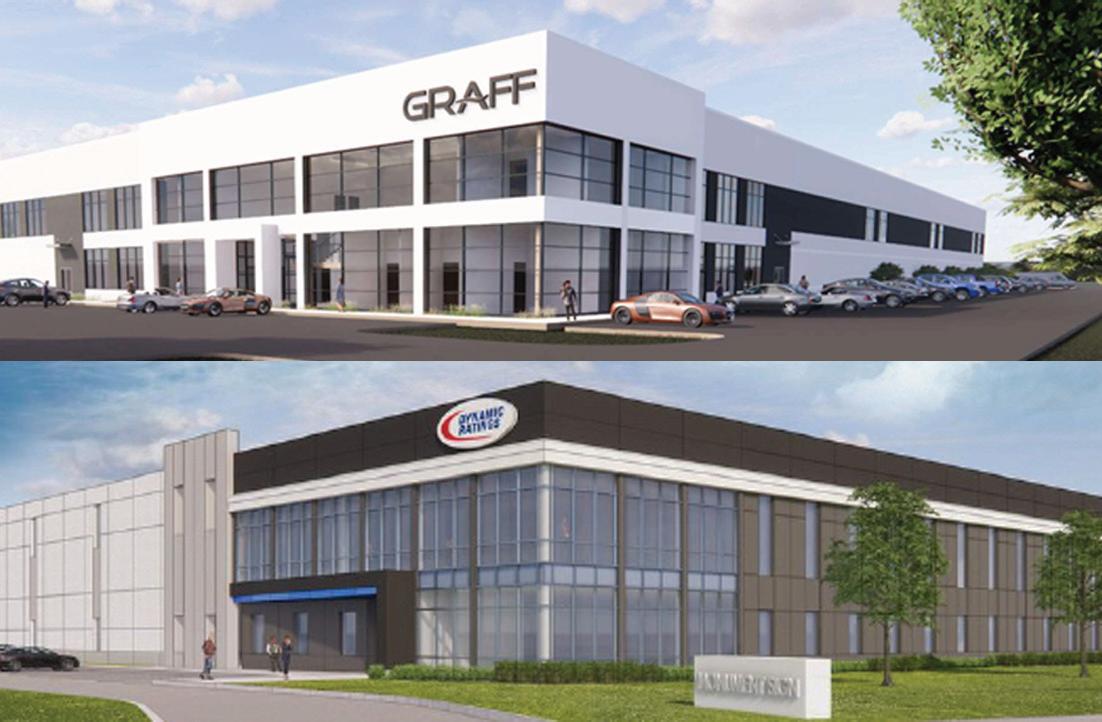
Milwaukee-based manufacturer Graff plans to build a new U.S. headquarters in Oak Creek, while Sussex-based Dynamic Ratings plans to build a new headquarters near its existing facility.
Graff is a manufacturer of luxury plumbing and hardware collections, ranging from bathroom
BY THE NUMBERS
to kitchen products. The company plans to build a 100,000-squarefoot building at 1901 and 1941 E. Rawson Ave. in Oak Creek. It would include a retail area (14,000 square feet) along with warehousing space. The retail portion of the space would be used for appointments with designers; the business would not be open to the public.
Graff wants to relocate from its current facility at 3701 W. Burnham
$10 MILLION
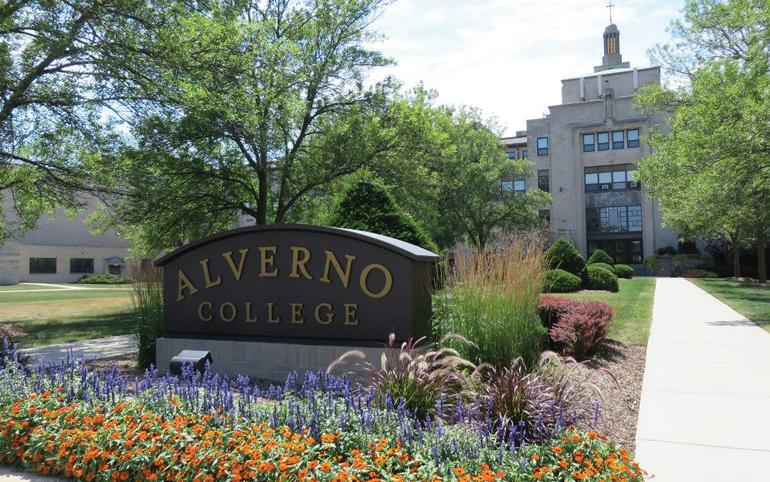
to Alverno College in Milwaukee.
Renderings of Graff’s proposed headquarters building in Oak Creek and Dynamic Ratings’ proposed headquarters building in Sussex.
teacher, donated
St. in the city of Milwaukee, according to documents submitted to the Oak Creek Plan Commission.
Graff employs more than 900 people and has office locations throughout Europe in addition to its Wisconsin headquarters. Graff is owned by parent company Meridian International Group.
Dynamic Ratings, which provides monitoring, control and communication solutions for electrical apparatus, is planning to build a new 150,000-square-foot headquarters in Sussex, at N53 W25314 Highlands Court.
The company is currently based down the street at N56 W24879 N. Corporate Circle and plans to break ground in September on the new headquarters, in the Highlands Business Park. The company moved into the 23,000-square-foot Corporate Circle facility in 2014.
“This new building project is part of Dynamic Rating’s strategy to increase manufacturing capacity and meet the needs of our customers,” Tony Pink, general manager and vice president for Dynamic Ratings, said in a statement. “We are proud to be in a position to share the good news about this significant investment in our community and to help the energy segment meet complex and evolving challenges driven by the ever-increasing need to deliver more power.”
The project, which could be completed in the fall of 2025, will include the addition of 32 additional employees, according to the statement from the company.
Dynamic Ratings purchased the 8.5-acre property on Highlands Court for $1.4 million from Wauwatosa-based commercial real estate firm Wangard Partners, according to state records.
The property is part of a 149acre development northwest of Highway 164 and County Highway K led by Wangard, which is catering the development to a variety of commercial users, including light industrial, food service, health services and retail.
Current tenants at the business park include Kwik Trip, Adron Tool Group, Stag Industrial and The Marek Group.
Dynamic Ratings has facilities and clients internationally, according to its website. The company is a wholly owned subsidiary of Australia-based Wilson Transformer Co.
Dynamic Ratings provides condition monitoring products and services to the utility industry to improve the safety and reliability of their assets, according to the company’s website. Dynamic Ratings’ services include online condition-based monitoring, transformer monitoring, circuit breaker and switchgear monitoring and substation asset management, among others.
Former Cisco Systems CEO John Morgridge and his wife Tashia, a former special education
The Edison brought its modern American menu and nostalgic feel to Milwaukee’s Historic Third Ward about a year ago, taking over a prime ground-floor spot inside the restored 1914 Commission Row Warehouse along the neighborhood’s main strip. It’s the latest concept by Milwaukee-based Benson’s Restaurant Group, operator of nearby Onesto, Blue Bat Kitchen and Smoke Shack.
The Edison’s weekday lunch service is popular among local professionals, especially Tuesdays, Wednesdays and Thursdays for large groups, according to general manager Patrick Erdman.
“We are very happy to be part of a neighborhood, to be so centralized and close to so many downtown office spaces,” said Erdman, adding the space is equipped with Wi-Fi, USB plugs and outlets for any remote work needs.
Between its dining area and speakeasy-inspired bar, the 5,300-square-foot restaurant seats up to 140 people, with additional seating on its outdoor patio. Walk-ins are welcome, but reservations are “always encouraged.”
3
1 2 3
2 1
A top choice among The Edison’s sandwich offerings, the bison burger stacks an 8-ounce patty with onion and bacon jam, pickled red onion and creamy herb dressing.
Open all summer long, The Edison’s sidewalk patio facing North Broadway places diners at the center of the action in the heart of the Third Ward.
The Edison’s assortment of salads appeals to many lunchtime diners. The chop features grilled cabbage, radish, carrot, hard-boiled egg, Door County cherry vinaigrette, creamy herb dressing and grilled shrimp.
REV UP
ROCKHOPPER ICE COLLECTION
LEADERSHIP:
Co-founders Daniel Guenther and Josh Cartellone
HEADQUARTERS: Pewaukee
WEBSITE: rockhopperice.com
WHAT IT DOES:
Creating an ice machine that can make custom-shaped cubes
FOUNDED: 2023
EMPLOYEES:
2 NEXT GOALS:
Lining up investors to support production FUNDING:
Raised $650,000 through a friends and family round
Rockhopper Ice Collective to tap into consumers’ unique ice preferences
By Ashley Smart, staff writer
IF YOU’VE EVER STOPPED to consider what kind of ice cubes are in your drink, you’re in the majority of Americans who have a preference for their ice.
Pewaukee-based startup Rockhopper Ice Collective wants to tap into consumers’ ice preferences and give restaurants an all-in-one solution. Co-founders Daniel Guenther and Josh Cartellone are in the final stages of building an ice machine that can make almost any ice cube shape imaginable.
The duo previously worked together at Accenture before Guenther left the company. He was unsure what he wanted to do but knew he wanted to enter the world of entrepreneurship.
The men, who are both trained engineers, continued to keep in touch and in January 2023, a light bulb went off.
Cartellone was out to dinner with his wife, Emily, when she questioned why customers can’t choose what kind of ice cubes to have in their drink.
“Josh texted me and said, ‘Hey Dan. Ice should be on the menu,’” Guenther recalled.
Both men dove into research and quickly found that Emily was not the only consumer with a preferred ice.
“When I grew up, we had Folgers coffee on the counter. That was what your parents and grandparents had to drink,” said Guenther. “There was no such thing as different kinds of coffee, you had two choices. Now, everyone has a preference. We thought ice could be going through a similar trend.”
The men initially considered the possibility of opening a store that would sell different kinds of ice. Through their discussions with restaurant equipment distributors, they realized there isn’t a single machine that can make varying ice cube shapes.
“I called and said I wanted to make the chewy ice that they make at Sonic, and I also want to make cubes,” said Cartellone. “They said that doesn’t exist, but if you had it, I could sell it to 20 customers today.”
Next, the men interviewed 300 people about their ice preferences and found that 60% of peo-
ple have a favorite type of ice. Serving more than one kind of ice can be difficult for restaurants since they typically only have enough space and money for one ice machine. That’s where Rockhopper’s forthcoming ice machine will help.
The startup’s machine will be able to form ice cubes into any shape imaginable as long as the design can fit within a cubic inch.
Once a final version of the machine is complete, restaurants will get the product for free and be charged per drink. Rockhopper will also provide restaurants with continuous maintenance for the machines.
“With every brand that we want to work with, we want to help them develop their own proprietary ice,” said Cartellone. “What would be iconic for Culvers? Maybe an ice cream cone (-shaped ice cube).”
The pair is focused on making sure they have investors lined up to support the actual production of the ice machines.
Rockhopper has raised about $650,000 through a friends and family round and will soon open a seed round.
“Josh and I have built a career on building new markets and new products and leveraging technology innovation,” said Guenther. “We worked on blockchain and virtual reality. We just think the best opportunity is now in ice.”
Dan Guenther
LILA ARYAN PHOTOGRAPHY
The latest area economic data.
Passenger traffic at Milwaukee Mitchell International Airport was up 10.9% during the first half of the year to 3,158,314.
For the first seven months of the year, home sales in the metro Milwaukee area were up 5.7%.
Wisconsin cranberry growers are expecting to harvest 4.9 million barrels of cranberries this year, down 10.4% from last year’s state harvest.
The seasonally adjusted unemployment rate in Wisconsin is 3.0%.
Occupancy rates for hotels in downtown Milwaukee for the week of the Republican National Convention in mid-July was 86.4%, compared to 67.5% the same week last year.
GETTING THERE
What’s your favorite part of working in education?
Dan Lindberg: “There are many things I love about working in education. I’m surrounded by kind, smart, talented, hardworking and articulate people who love working on challenging issues. Nothing beats the classroom though, helping students work through something challenging and new.”
What does your role as director of the applied AI lab entail?
“I help make AI accessible for all. I run the day-to-day operations of the lab, teach, present on AI, and I’m the program lead for the AI Data Specialist associate degree. I support WCTC’s internal operational AI efforts and collaborate with other colleges and universities as well.”
Why is it important for institutions like WCTC to invest in AI education?
“It took until the 1960s for 90% of U.S. households to have electricity. Why? All the systems, materials, labor and training required to update existing homes and build new homes. The analogy applies to AI because business processes and systems are being redesigned. A skilled workforce will help this transition.”
How do you spend your free time?
“My wife and I have two young kids, so our weekends revolve around them, visiting with extended family and seeing friends. It’s simple and wonderful. I read, play the sax and guitar and do a little woodworking from time to time. My wife and I are big Formula 1 fans.”
DAN LINDBERG
Applied AI Lab director Waukesha County Technical College
AGE: 36
HOMETOWN: Geneva, IL
EDUCATION: Bachelor’s in economics and political science with a marketing minor and master’s in applied economics, both from Marquette University
PREVIOUS POSITION: Founder and principal of Applied Economic Insight LLC
“Focus on what matters most. You can’t be everything or do everything, but you can pay attention to what’s most important to achieve your goals.”
This Q&A is an extended profile from Wisconsin 275, a special publication from BizTimes Media highlighting the most influential business leaders in the state. Visit: biztimes.com/wisconsin275 for more.
Mary Ellen Stanek is responsible for more than $100 billion in assets under management as managing director of Milwaukee-based Baird and co-chief investment officer of Baird Advisors. Recognized as a pioneer in fixed-income investing, Stanek has been named to Barron’s list of the 100 Most Influential Women in U.S. Finance and has been named Morningstar’s Outstanding Portfolio Manager. Previously, she was president and chief executive officer of Firstar Investment Research & Management Co. Stanek has garnered more than 15 awards for her civic and professional contributions in Milwaukee. She is past board chair of the Greater Milwaukee Committee, past co-chair of the Milwaukee 7, past president of TEMPO and a member of Professional Dimensions and Milwaukee Women inc. She serves on the boards of Baird Financial Group and WEC Energy Group, as well as many nonprofits.
Education:
Bachelor’s, Marquette University; MBA, University of Wisconsin-Milwaukee
What was your first job, and what did you learn from it?
“I was a college intern for a community bank, McHenry State Bank. I had to be ready to do anything needed from covering the receptionist/switchboard to teller. I learned to be flexible, adapt to the needs of the organization and that customers are key.”
What piece of advice has had the most significant impact on your career?
“Focus on what matters most. You can’t be everything or do everything, but you can pay attention to what’s most important to achieve your goals.”
What’s your hobby or passion?
“Family time. I particularly relish time with our grandchildren.”
If you could take a one-year sabbatical, what would you do?
“Teach.”
What’s the toughest business challenge you’ve had to overcome?
“At Firstar, leading a business and team through an acquisition and subsequent integration. Ultimately deciding to leave and start over. In hindsight it worked out extremely well, but it was difficult!”
What advice would you give to a young professional?
“Sometimes opportunities come before you think you’re completely ready. It did for me, I was 27 when I was given the top job. The advice I give young professionals is believe in yourself, work hard, surround yourself with great people and enjoy the journey.”
What is one thing you would change about Wisconsin to make it even better?
“Create more opportunities for young talent. Be seen as a destination to build your career and life. Milwaukee has so many great attributes! I didn’t grow up here but am a huge fan!”
Is there a nonprofit cause that has special meaning to you?
“All In Milwaukee, a college completion program that provides financial aid, advising, program and career support to high-potential, limited-income, diverse Milwaukee students to complete college, build meaningful careers and transform the Milwaukee community. Very impressive results and a game changer for Milwaukee.”
What is the biggest risk you have ever taken?
“Starting over in 2000 by leaving Firstar/FIRMCO and moving to Baird.”
What’s at the top of your bucket list?
“Trip around the world.”
What has you most excited about the future?
“Our people, they are awesome! Whatever is ahead, they will navigate the challenges and create opportunities.”
1
BEHIND THE SCENES
Source TEN
By Hunter Turpin, staff writer
At a shoot with Source TEN, a Milwaukee video production company, every detail matters.
The late July shoot was for a higher education video series, and the Source TEN team has it all scheduled –scene by scene, shot by shot.
Backpacks are stuffed with hoodies and books to give the classroom setting a more realistic look; extras playing students are shuffled around to make sure not too many black shirts are clustered on one side of the set.
Sandra Dempsey founded Source TEN in 2019 after leaving a job at a Spanish-language television station and seeing a market for Spanish speakers in the Milwaukee area that were often missed by advertisers and other content creators. The company works with businesses, organizations and nonprofits to create videos for product marketing, corporate videos and TV commercials, among others.
“Content creation is magical,” Dempsey said. “It’s literally making something that didn’t exist. I love it.”
2
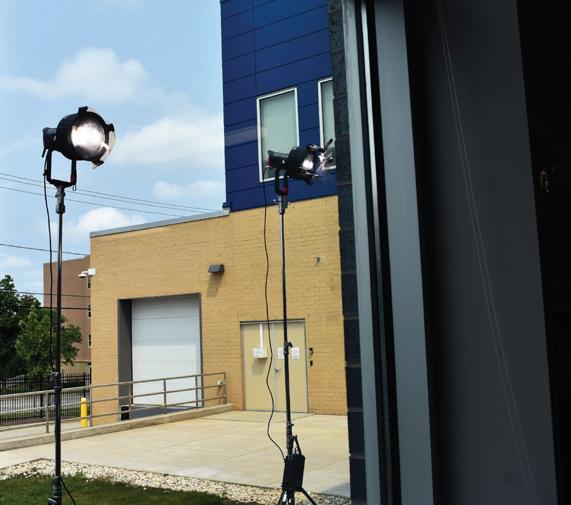
1 With cameras focused, microphones rolling and lights in position, the Source TEN team begins filming a video for a higher education partner.
2 Looking through a production monitor, executive producer Sandra Dempsey and director of photography Jay Gilbert fine-tune actor placement.
3
before recording starts.
3
4 5
4 Studio lights are set up outside the classroom’s windows to give the effect of bright, consistent sunlight for the duration of the multi-hour shoot.
5 The Source TEN team deliberates camera positioning and focus before shooting the video’s second shot.
Assistant director Marquel Henderson checks audio levels
La Lune Collection’s custom
rustic furniture drives the company’s
growth
WHEN CATHY and Mario Costantini first decided to start their own business in 1978, they were truly starting from scratch.
“I had nothing,” said Mario. “No business plan, no money, nothing.”
After securing a $50,000 line of credit through a bit of luck, the Costantinis opened an interior design company on Wisconsin Avenue in Milwaukee, later pivoting to making their own furniture.
The Costantinis were fond of more contemporary pieces of furniture, but they had difficulty making enough money to sustain that line of work.
They ended up pivoting to rustic furniture after they received an inquiry from a customer who came to their Wisconsin Avenue store to ask if they did any work for restaurants. That customer was looking for pieces to fit into his rustic-themed restaurants in Chicago.
“I went to the Golda Meir Library at UWM and looked up everything rustic,” said Mario. “Just anything I could find. I found some drawings of old rustic furniture that was created by immigrants. I thought it was so cool to take an unrefined branch of a tree and make furniture.”
The first rustic pieces of furniture the Costantinis designed were made from willow trees. That initial order was in the range of 200 to 300 items. The pieces were a hit, Mario said, and the couple received an influx of business inquiries.
That’s when they realized they had tapped into a new market. In 1979, La Lune Collection was
officially formed. One of their first customers was Ralph Lauren, who ordered several custom pieces for his home in New York.
After continually growing their business for several years, the couple bought their 25,000-squarefoot Burleigh Street facility in 1985. La Lune was a catalyst that helped transform its section of Milwaukee’s Riverwest neighborhood from troubled to desirable.
Today, the business produces about 1,000 pieces of furniture a month. About a third of those pieces are for commercial spaces, while the remaining two-thirds are for homes.
“We deal primarily with the interior design industry and one of our biggest markets is the mountain states,” said Mario. “People designing mountain homes in Wyoming or Colorado, they come to us.”
La Lune primarily uses wood from poplar and willow trees. Poplar is an invasive species in the northern part of Wisconsin. The Costantinis are often able to cut down poplar trees free of cost because most landowners view their removal as a favor, Mario said.
La Lune sources its wood within a 100-mile perimeter of Crandon, Wisconsin.
“We bend the wood when it’s freshly cut and we use heat and pressure and put it in a form,” said Mario. “Then we leave it in a kiln for several weeks to help it retain its shape.”
Each of La Lune’s 600 standard pieces of furniture have a
LA LUNE COLLECTION
930 E. Burleigh St., Milwaukee
INDUSTRY: Rustic furniture
EMPLOYEES: About 30 lalunecollection.com
hand-drawn rendering, complete with specifications. While no two pieces are exactly alike, there also isn’t huge variation between similar items.
Each piece of furniture starts in the frame department, where workers use the pre-drawn renderings to build out the needed wooden frames. From there, the frames move on to the upholstery department, where they’re stuffed with locally sourced foam and covered in the desired fabrics. The final stages include stops at the finishing and shipping departments.
The furniture requires minimal maintenance once it reaches its destination. Customers only need to brush the wood with a special oil to prevent it from cracking and peeling.
Custom work is what sustains La Lune, something that sets the company apart from other furniture manufacturers. A higher margin for error means most companies don’t
care to do custom work, Mario explained. About half of La Lune’s business is custom orders.
“It’s a way that we can compete with manufacturers in other parts of the world,” he said. “They can only get it from us, so price is a very secondary concern.”
Mario Costantini stands in the shipping department near some finished chairs.
Developer Fantasy Camp: Northridge 2.0
The City of Milwaukee taking control of former Northridge Mall property and demolishing the existing buildings creates an opportunity for a new development to bring needed investment on the far northwest side of the city. Teams of developers will share their ideas for transforming the site before the audience has a chance to pick their favorite.
Confirmed Speakers:
• Scott Lurie, Founder, F Street (1)
• Bob Monnat, Senior Partner, Mandel Group (2)
• Scott Yauck, President and CEO, Cobalt Partners (3)
Update on Milwaukee’s Development with Q&A
• Lafayette Crump, Milwaukee City Development Commissioner (4)
Current State of Capital Markets
• Billy Fox, Senior Vice President at MLG Capital (5)
Tracy Johnson, President & CEO, CARW
Networking Reception
The program concludes with an engaging networking reception, featuring an open bar and a selection of light hors d’oeuvres. This is your chance to mingle with the speakers and fellow attendees, exchange ideas, and build valuable professional connections in a relaxed and inviting atmosphere.
Harley revises some policies following DEI backlash on social media
FOLLOWING a weeks-long social media campaign targeting Harley-Davidson’s corporate policies and leadership, the company has responded to claims that it has “gone woke.”
The Milwaukee-based motorcycle manufacturer announced late last month several changes to its policies related to employee training and corporate sponsorships but stated the changes had already been in the works prior to criticism becoming rampant on social media.
In late July, Robby Starbuck, a conservative activist with more than half a million followers on X, formerly Twitter, launched a campaign to “expose” Harley-Davidson.
Starbuck has targeted other companies, including Tractor Supply, John Deere, Jack Daniel’s and Lowe’s. He listed nearly 20
of his “concerns” with the Harley brand, ranging from its involvement in pride events and trainings aimed at supporting the LGBTQ+ community, to its commitment to diversity, equity and inclusion (DEI) policies and legislation.
“I don’t think the values at corporate reflect the values of nearly any Harley-Davidson bikers,” said Starbuck. “Do Harley riders want the money they spend at Harley to be used later by corporate to push an ideology that’s diametrically opposed to their own values?”
Starbuck repeatedly shared a video clip of Jochen Zeitz, chief executive officer of Harley-Davidson, talking about a time when a fellow businessman called him “the sustainable Taliban.”
Calling Zeitz a “far left activist,” Starbuck pushed Harley’s board of directors to “fire their
Jochen Zeitz, chief executive officer of Harley-Davidson, is seen at the company’s Milwaukee headquarters during the 2024 Homecoming Festival held in July.
By Ashley Smart, staff writer
woke CEO” and eliminate his policies. His call to action gained the attention of national news outlets including Fox News and the New York Post.
In response to Starbuck’s campaign, several videos of Harley-Davidson riders removing the Harley shield from their motorcycles began to circulate online.
Last month, Harley-Davidson issued a statement saying company leadership is “saddened” by the negativity being shared on social media.
“For over 120 years, Harley-Davidson has brought the joy of motorcycling to riders around the world, no matter who they are, where they come from or what they believe in,” according to the statement. “We have a guiding principle: United We Ride. It defines how we run our business,
treat our people, and underscores our commitment to welcoming all.”
Following an internal stakeholder review that was launched earlier this year, Harley-Davidson is making some changes to its employee training and sponsorships and affiliations.
The company says it has not operated a “DEI function” since April and that it does not have hiring quotas or supplier diversity spending goals. Moving forward, all business employee resource groups will have executive management to ensure each group is solely focused on professional development, networking and mentoring.
As for the company’s sponsorships and affiliations, all sponsorship activities must now be approved through the company itself or through the Harley-Davidson Foundation.
“As a consumer brand, we will focus exclusively on growing the sport of motorcycling and retaining our loyal riding community in addition to the support we already provide to first responders, active military members and veterans,” the company stated in its announcement.
Finally, all employee training will be related to the needs of the business and “absent of socially motivated content” in the future. The company said only legally required training has ever been mandatory at Harley-Davidson.
The company will no longer participate in Human Rights Campaign scoring.
“We believe having both a broad employee and customer base is good for business and that ultimately everybody should experience the joy of riding a Harley-Davidson,” according to the statement. “We remain committed to listening to all members of our community as we continue our journey together as the most desirable
motorcycle brand in the world.”
HARLEY’S EVOLVING GOALS, WORKFORCE
When Zeitz took the helm at Harley-Davidson in 2020, the company introduced an inclusive stakeholder management report aimed at prioritizing the long-term growth of the company and the overall betterment of its communities and society.
“We have the opportunity to reset and reframe how we do business,” said Zeitz in the report. “Our future will be defined not only by our products and experiences, but how we deliver value for all of our stakeholders.”
The company unveiled several new goals, including diversifying its chain of suppliers, achieving net zero emissions by 2050, and creating a “diverse and high-performing workplace.”
By 2022, the most recent demographic data available, Harley’s global workforce had grown to 6,153 people, including 4,383 males and 1,170 females. Among U.S. employees, 3,960 (64.4%) identified as white, 494 (8%) as Black, 409 (6.6%) as Hispanic and 203 (3.3%) as Asian. International employees increased to 959, or 15.6% of the total workforce.
Harley’s new hires are also trending younger, with the number of employees under 30 increasing 57% from 975 in 2021 to 1,123 in 2022. By comparison, the 30-50 age group grew by 26.5% and the
In 2020, the company reported 5,300 global employees, including 3,783 males and 1,517 females. Of the company’s U.S. employee pool – which excludes the 778 workers who are categorized as international – 3,709 (70%) identified as white, 356 (6.7%) as Black, 261 (4.9%) as Hispanic and 125 (2.4%) as Asian.
over 50 age group grew by 8.4% from 2021 to 2022.
RESPONSE TO CHANGES
The changes Harley is making to its policies and employee training received mixed reactions.
Starbuck called the changes a “win” for his movement, saying at the time he was “three for three in taking down woke companies.” His overall call to action to American companies is that they remove any sort of political program or affiliations from their operations.
On the other hand, the Human Rights Campaign called Harley’s decision to back out of the scoring program “shameful.” The organization “strongly urged” the company to reverse its decision and “put people before politics.”
“Remember: LGBTQ+ people are motorcyclists too and our community holds $1.4 trillion in spending power,” the HRC said in a
statement posted to social media.
A handful of Milwaukee-area companies, including Rockwell Automation, ManpowerGroup, WEC Energy Group, Clarios and Froedtert Health, have since vocalized commitment to their own diversity initiatives.
Ugo Nwagbaraocha, president of Milwaukee-based Diamond Discs International and head of the National Association of Minority Contractors Wisconsin chapter, praised those companies for doubling down. In a LinkedIn post late last month, Nwagbaraocha said he was “disappointed” to learn of Harley’s decision to end programs for diversity in hiring and contracting minority suppliers.
Whether social media criticisms have had any impact financially on Harley-Davidson remains to be seen. The company will release its third quarter earnings later this fall. n
With deadline approaching, redevelopment of vacant Menomonee Valley building divides nearby businesses
ONCE THE HOME of a manufacturer of cookware and kitchen utensils, the blighted building at 324 N. 15th St. in the Menomonee Valley in Milwaukee has sat vacant for around 40 years. With major structural and environmental issues that have repelled potential new users for decades, a local developer emerged with a plan to repurpose the building
The plan, however, called for converting the building into 40 apartments, which would be a first in the Valley and has sparked opposition from some nearby businesses that want to protect the area’s industrial legacy. After lengthy public hearings this summer and dozens of letters submitted to the city for and against the
plan, developer Kendall Breunig of Sunset investors is undertaking a last-ditch effort to find a commercial user before his contract to purchase the building expires at the end of the year.
“The reality is that if we can’t come up with something, and it can’t be rezoned to residential, it has no viable use, which means the only option is to tear it down,” Breunig said.
The building, which totals about 50,000 square feet, has been for sale for about 20 years. Breunig started looking at it in 2017 with a plan to convert it into office space but says there’s no longer demand for that. And the four-story, 129-year-old building is obsolete for modern industrial use.
While the apartment plan would cost about $10 million, according to Breunig, converting the building into an office building would be more expensive. Due to the building’s structural issues, it cannot currently support the heavy loads tied to office use without reinforcing the building’s frame, which would drive up costs.
Breunig does not have an estimate for the cost of redeveloping the structure for office use.
The fire-damaged, vandalized building likely has three to five years before further deterioration makes it impossible to renovate, said Breunig, an engineer who’s redeveloped other historic buildings like the Pritzlaff Building near
The vacant building at 324 N. 15th St. in the Menomonee Valley.
the Third Ward.
The fate of the 15th Street building has divided nearby businesses and local officials. Opponents say housing doesn’t fit in with industrial uses in the surrounding area of the Menomonee Valley, while supporters say the plan is a good opportunity to make use of a property that will otherwise further fall into disrepair.
“The Valley has always been a place for jobs, and by starting to allow residential where it’s never existed before, there’s a concern from some of the larger manufacturers that if this starts turning and the Valley is no longer a job center, do they have a long-term future here?” said Corey Zetts, executive director of Menomonee Valley Partners.
The nonprofit agency helps lead redevelopment efforts in the Menomonee Valley and is among the opponents to the plan. Other opponents include nearby operators of two valley industrial businesses, Allied Insulation Supply Co. and Standard Electric Supply Co., as well as the Milwaukee Department of City Development.
Zetts said that having an isolated residential building in a business district could also create conflict with nearby businesses who are driving trucks throughout the Valley and operate 24/7. Further, Zetts said that nearby neighborhoods have space for housing and have more amenities to support it.
“I absolutely understand the frustration, but what I’ve been trying to communicate is that saving the building for a use that hurts some of the neighbors is going to have other repercussions,” Zetts said.
However, some of the valley’s newer, non-industrial business owners support Breunig’s residential proposal. Those include the owners of Plum Media Co. and Third Space Brewing.
Prior to 2020, Breunig said there was interest in the builidng from office users, but those users are no longer interested, he said.
Breunig is now working with Menomonee Valley Partners to take another look at potential office tenants, but there hasn’t been any interest aside from small tenants who could use a couple thousand square feet of space, which isn’t enough occupancy to justify the renovation, according to Breunig.
“People say it’s a great location, beautiful cream city brick building with exposed timbers, but timing is really the challenge,” Zetts said.
Since the building will take a few years to be ready for occupancy, Zetts said that Menomonee Valley Partners is targeting larger users that can make a commitment a few years out.
“At this point, all our efforts are in trying to find a user that could give (Breunig) the confidence to move forward without rezoning,” Zetts said.
Asked if the group has found any viable tenants, Zetts declined to comment.
In the past, Menomonee Valley Partners has purchased properties to hold on to until the right tenant or buyer is found. That was the case for the cluster of properties now home to the Urban Ecology Center and a parcel that became part of the Harley-Davidson Museum campus, but Zetts said that is not an option for the 15th Street building.
“We’re kind of a victim of our own success,” Zetts said. “The funds we’ve had to purchase properties in the past aren’t sufficient anymore. Property in the Valley is valued too high. This building is valued too high by the seller for us to participate.”
The building is currently listed for sale by Milwaukee-based commercial real estate firm The Barry Co. for $1.95 million.
“We know this business very well,” said Jim Barry, president of The Barry Co. “In the history of our company, we’ve done tens of thousands of deals, and this is not
a viable office development. For the life of me, I can’t understand why some can’t accept that. (Breunig) is by far the most qualified person in Milwaukee to realize this project.”
If a commercial tenant doesn’t emerge by the end of the year, Breunig said, he will pursue his residential rezoning request. As he delays a residential rezoning, Breunig is seeking to have the property designated historic by Milwaukee’s Historic Preservation Commission, which he said will help prevent attempts to demolish it.
“I’ve done four historic buildings, so I think it’s an area I’m fairly good at,” Breunig said. “I’d sure like the chance to do this one.”
“
The reality is that if we can’t come up with something, and it can’t be rezoned to residential, it has no viable use, which means the only option is to tear it down.”
— Kendall Breunig, Principal of Sunset Investors
HUNTER TURPIN Reporter
P / 414-336-7121
E / hunter.turpin@biztimes.com
T / @HunterDTurpin
FEATURED DEAL
CARMEN BUYS SITE FOR FIRST GROUND-UP PROJECT
An affiliate of Carmen Schools of Science and Technology, a network of public charter schools in Milwaukee, has purchased a 6-acre site on the city’s south side where it’s planning to build a new $55 million school.
The property at 2005 W. Oklahoma Ave. is currently occupied by Ascension Wisconsin Medical Arts Pavilion. It was sold by an Ascension affiliate for $4.4 million, according to state records.
The school would be the first ground-up project that Carmen has done.
Founded in 2007, Carmen runs three high schools, two middle schools and one elementary school in Milwaukee, but thus far all of its locations have been either co-located in Milwaukee Public Schools locations or in renovated schools.
Spanning approximately 124,000 square feet, with capacity for up to 1,100 students, the school will offer space for learning as well as community events.
Ambitious vision or unrealistic plan? A Madison developer’s eye-popping pitch for downtown Milwaukee
BY HUNTER TURPIN, staff writer
s the City of Milwaukee seeks a catalytic redevelopment of the Marcus Performing Arts Center parking structure site downtown, a Madison-based developer – still in its infancy – has emerged with an ambitious proposal.
With a $700 million price tag, the project could deliver the most residential units the city has ever seen in one development, the most office space since the COVID-19 pandemic rattled the office market and the biggest hotel built in downtown Milwaukee since the Hyatt Regency in 1979, as well as a significant amount of retail space.
If realized, the development would transform downtown Milwaukee and help advance several city goals. But some skeptics, including downtown Ald. Robert Bauman, are worried that the developers have bitten off more than they can chew, and that Milwaukee isn’t ready to digest a project of this size.
“I don’t think (the Department of City Development) adequately vetted the financial feasibility of what they’re proposing,” said Bauman, whose district includes the project site, located on North Water Street between East Highland Avenue and East State Street.
The project, proposed by Madison development firm Neutral – which rebranded in August from The Neutral Project – has defended its proposal, its leaders saying the firm can pull off the proposed development.
“Based on the mixed-use proposal we have in conjunction with the neighborhood that’s already there, we can be successful on the site and be very helpful for the city,” said Daniel Glaessl, chief product officer for Neutral.
Nathan Helbach
Partner and chief executive officer at Neutral
“We really don’t subscribe to the macro factors nor forecast, we really look at how do we make good investments with good criteria and invest for the long term.”
Daniel Glaessl
Partner and chief product officer at Neutral
“We are trying to connect the urban tissue that we see with this project and provide this kind of focal point in downtown,” he said.
The city-owned 2.4-acre site and its Marcus Center-owned 690-space parking structure has been eyed for redevelopment for at least 20 years, but multiple proposals haven’t come to fruition.
In 2002, Wauwatosa-based development firm Irgens Partners proposed an office and retail highrise on the site. Irgens cancelled its plans in 2007 and, soon after, the Marcus Performing Arts Center issued a request for proposals for redevelopment of the site, with plans to either extend its lease with the city or negotiate ownership rights to the site. It subsequently pursued redevelopment plans for a ballet building and sports medicine clinic as well as an 11-story building with a restaurant, meeting area and offices, but those plans were eventually dropped as well.
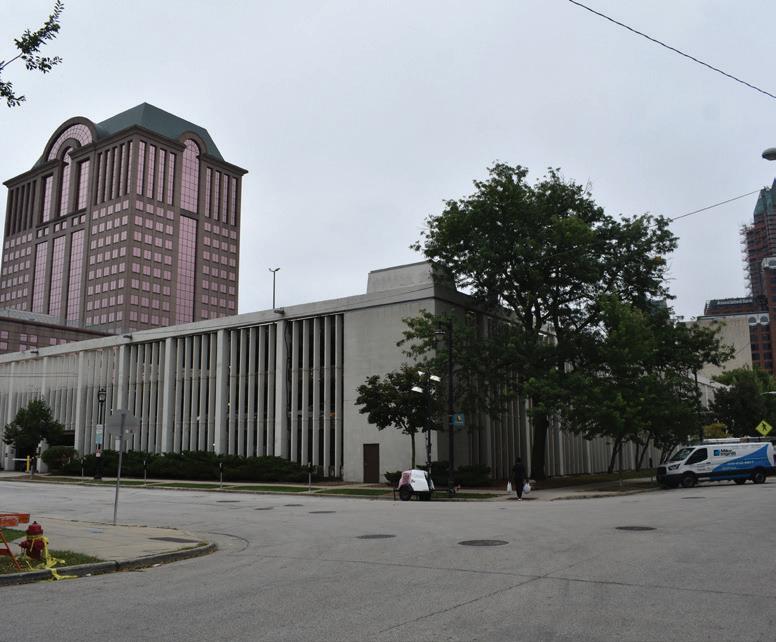
Known by some Milwaukeeans for the massive and snow-to-melt pile created each winter by the snow pushed off the top, the block-long parking structure is sandwiched between the Marcus Center and the Water Street nightlife district.
Last September, the City of Milwaukee issued a new RFP seeking an “aggressive mixed-use development” for the site that would bring density and “create a landmark.”
Can the developer do it?
In July, Milwaukee’s Department of City Development selected Neutral’s proposal, unveiling eye-catching renderings of a multi-building development including residential, office, hospitality and retail uses, with public plazas and paths and buildings reaching new heights in the city.
Neutral’s proposal could include up to 750 residential units, which is more than three times what other developers pitched for the site and the largest multifamily project ever in the city of Milwaukee, with the next largest being Mandel Group’s $190 million, multi-phase North End development, which includes about 650 units.
This building, primarily built with mass timber, would be the state’s tallest at 55 floors, overtaking the U.S. Bank Center, which has held the title of tallest building in the state since it was built in 1973.
But can the market support such a project?
“I think (feasibility of the project) is a fair concern, but we have provided our third-party market analysis, and it shows a lot of demand for residential units in Milwaukee for 2028 and onwards,” Glaessl said. “…A project of this size would definitely be absorbable based on the market studies.”
Downtown Milwaukee has seen multiple high-end apartment developments in recent years, including 7Seventy7 and Ascent, both of which saw 12-month lease-up periods, which is strong, according to Gard Pecor, a senior market analyst with CoStar.
More recently, The Couture and 333 Water have come online and are – so far – seeing slower lease-up periods, indicating softened demand for high-end apartments in downtown Milwaukee
currently, although demand for those units could pick up by the time Neutral breaks ground, Pecor said.
Neutral is planning on setting aside a portion of the development’s units as workforce housing, for those making between 60% to 100% of the area median income, said company partner and chief executive officer Nathan Helbach.
Workforce housing has significantly stronger demand in Milwaukee, according to Pecor, noting that Milwaukee has one of the tightest apartment markets in the country with low vacancies and rising rents.
The development could also include 190,000 square feet of office space, which would be the first major office building development in downtown Milwaukee since 2020, when BMO Tower and the Huron Building both opened.
“We have received some calls from potential tenants, and so there seems to be interest in class A office space,” Glaessl said. “A lot of things need to be figured out here, but there’s certainly some interest.”
Downtown Milwaukee’s office space vacancy rate is 17.6%, compared to 13.2% before the COVID-19 pandemic, according to the most recent report from the Commercial Association of Realtors Wisconsin. There’s about 230,000 square feet of available multitenant class A office space in the area.
“That sounds like a lot, but when you break it down building by building you can see that it’s pretty tight,” Pecor said.
The most contiguous space a user could get in a downtown office building that’s less than 10 years old is 57,000 square feet at the Huron Building, followed by about 27,600 at 833 East and 15,000 at BMO Tower.
“So that really eliminates all of the larger tenants that are possibly looking for new space,” Pecor said, pointing to tenants like law firm Michael Best & Friedrich, which occupies about 80,000 square feet at the BMO Tower as the building’s anchor tenant.
Office brokers who spoke to BizTimes for this story agree that landing a tenant that could occupy about half the building would be enough to get Neutral’s proposed project financed and off the ground, but they didn’t know of many tenants in the market currently looking for that amount of space, and tenants that might already be in the market would need to be pulled out of another downtown building.
“The office market is still challenged and that would be flooding the market with a lot of space,” said one broker. “The advantage for them is that, because there’s been no space developed (for several years) and not really any plans to develop any new space, they’d kind of be the only game in town.”
“I really can’t name that many tenants who are actively seeking much space in the near term,” an-
other broker said.
According to current plans, the southwestern portion of the site could be occupied by a 300-room hotel.
“On the hotel side, The Trade opened a while back now and it has been pretty successful,” Glaessl said, pointing to the 205-room, nine-story Marriott Autograph Collection hotel that opened in May 2023 in Deer District. “We do think that this location, with its proximity to the performing arts center and Fiserv Forum and so on, that additional hospitality capacity would definitely be economically feasible.”
A hospitality industry expert said that with the recent expansion of the Baird Center, as well as the continued success of Fiserv Forum and its surrounding Deer District, now is the time for more hotel rooms to be built in downtown Milwaukee but noted that there are multiple hotel proposals downtown that have struggled to secure necessary financing and break ground.
Across all of the buildings in Neutral’s proposed project, there is about 40,000 square feet of retail space planned, which is also significantly more than what other developers proposed for the site.
“We have a lot of retail in our proposal – basically the entire ground floor – and we see in downtown that there is a lot of (food and beverage) but actually very little diversified retail offerings,” Glaessl said.
Along with local restaurants, boutiques and a coffee shop, the firm is hoping to land a grocery store for a large part of the retail space. That would
Who is Neutral?
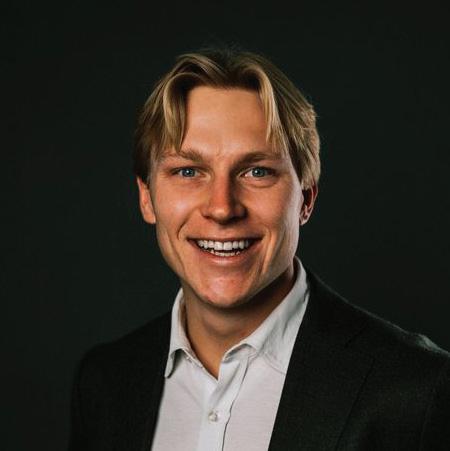
Founded in 2020, Madison-based development firm Neutral is based on a paper its 25-year-old founder Nate Helbach wrote while studying finance through Harvard Extension School. His thesis: by using mass timber and other low-carbon construction materials, developers can significantly reduce the environmental harm created throughout the construction process and maintenance of residential buildings.
“This big problem that we have is carbon and the non-sustainability of the built environment,” Helbach said. “Right now, most buildings are taking natural resources from earth and they’re not putting any of that back into the planet.”
To measure the effectiveness of this approach, Helbach says the firm uses life cycle analysis to measure the embodied carbon impact of its buildings and energy modeling tools to forecast their operational impact.
“Ultimately, the deals still have to pencil out and be sound investments with good metrics,” Helbach said. “It’s always this dichotomy between how far can we push on the sustainability side with maintaining the mandate from our investors and making financial returns.”
In pursuing that vision, Helbach has looked outside conventional thinking for development practices and building materials, especially when it comes to using mass timber as well as financing models. For instance, Neutral partnered with Milwaukee-based real estate technology startup e-States for one of its projects, where, through the blockchain-based platform, anybody can go through a streamlined online screening process and purchase shares to invest in the project.
Prior to starting Neutral, Helbach worked on the development
and investor relations teams for T. Wall Enterprises, a Middleton-based developer with more than 1,600 multifamily units in operation. Helbach said the experience helped him gain a holistic understanding of the development process.
Saying he always envisioned himself owning his own business, Helbach described starting Neutral as an “inflection point” in his career when he “had an opportunity.”
“I had a good relationship with two German investors, and I pitched my thesis to them on Neutral, and both of them were really excited about it,” Helbach said. “They had seen in the early and mid-2000s this wave of big sustainability initiatives and government regulations that had come into Europe. What they saw was the first movers in the market were the ones who were really successful.”
“They said, ‘We see an opportunity for investment,’ and they backed me and that was the impetus for why I was able to start Neutral.”
Since then, Neutral has proposed five projects, including the one at the Marcus Center parking structure site. The firm is currently wrapping up construction on its first project, a 206-unit mass timber apartment building, known as Bakers Place, in downtown Madison and has since proposed a second Madison project, with 30 units, that the firm is working on financing.
Neutral’s website shows a staff of 15, including Daniel Glaessl, partner and chief product officer at Neutral. He leads all of the firm’s development activities and has worked for several architectural firms during his career, including San Francisco-based Gensler, London-based Foster + Partners and London-based Gumuchdjian Architects.
In Milwaukee, Neutral has finished test piles and is eyeing a late 2024 or early 2025 construction start for The Edison, a 32-story, 383-unit apartment building on the Milwaukee River, just west of the Marcus Center parking structure site. Also a mass timber development, The Edison would become the tallest mass timber building in the world, overtaking Ascent, also in downtown Milwaukee and developed by New Land Enterprises.
The Edison was first pitched in 2021 as a much shorter building, but the project grew to the building planned today. The Barry Co. worked with Neutral to purchase the site for The Edison at 1005 N. Edison St.
“They worked through a lot of different issues, and at the end of the day they came through with a great plan,” said Jim Barry, president of The Barry Co., calling the Neutral team “creative.”
“The proposal for the site across the street would be very ambitious, but they’ve come through before and I have a lot of respect for their ability to get things done,” Barry said.
Neutral has also proposed a project in Fayetteville, Arkansas, and plans to expand in the northwestern Arkansas region in the next three to five years, according to Helbach.
“Our methodology from the start has been to build quality, sustainable buildings in markets that have good absorption, low vacancy and great rent growth,” Helbach said of the firm’s decision to build specifically in Madison, Milwaukee and Fayetteville – all cities that fit these criteria.
Although the early 2020s haven’t been kind to real estate developers, Helbach said the firm has managed to forge ahead.
“Ultimately, if we look at the 10-to-15-year timeline, real estate continues to trend up 7% to 9% return on investment per year,” Helbach said. “We really don’t subscribe to the macro factors nor forecast, we really look at how do we make good investments with good criteria and invest for the long term.”
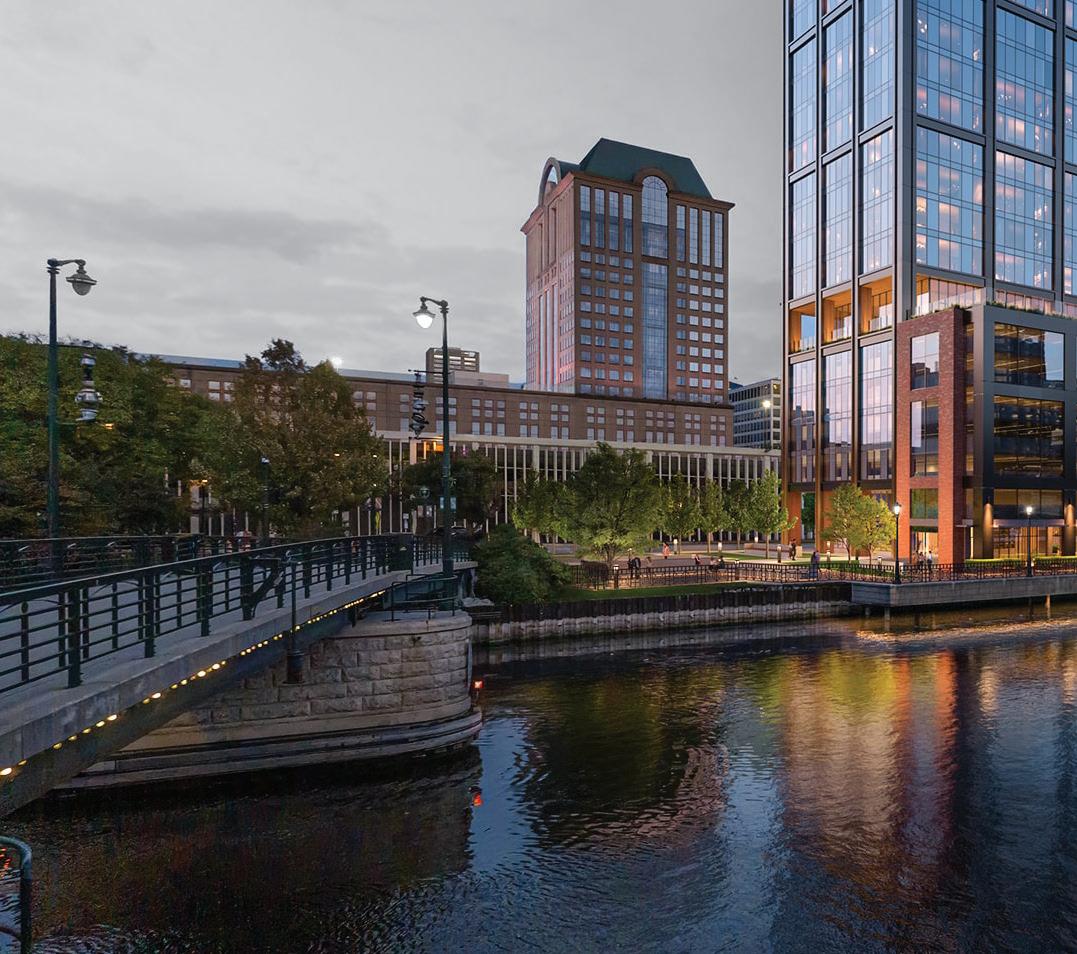
A rendering of The Edison, another project by Neutral.
be the second grocery store in that immediate area, with Fresh Thyme located just a few blocks north on the corner of North Water and East Pleasant streets, within the North End.
Retail brokers who spoke to BizTimes say that with the density proposed in Neutral’s development, neighborhood service-like retailers could be drawn there, but it would be a big change for downtown Milwaukee, where food and beverage operators typically perform best.
“We got calls from multiple people that were submitting RFPs (for the Marcus Center site) to get our opinion on the retail, and everyone I talked to I told to try to minimize the amount of retail square footage as much as possible,” one broker said. “We have so much retail space on the market, so we need more critical mass, more people.”
Additionally, the project could include 1,100 structured parking spaces, which would in part replace what the existing Marcus Center parking structure has, along with public plazas and walkways, which would connect the block to the surrounding area, according to Glaessl.
“We are trying to connect the urban tissue that we see with this project and provide this kind of focal point in downtown,” he said.
Private sector criticizes RFP process, TIF policy
As the city moves ahead with Neutral’s vision to breathe new life into the city-owned block, it’s doing so against a backdrop of one local developer criticizing the city’s RFP process, several local developers criticizing the city’s willingness to financially support development and an unimpressive record with RFPs.
In the past decade, the city has issued fewer RFPs for site redevelopments than in previous decades, and many of the RFPs that have been issued have not been successful. For instance, in 2016, the city sought development of a parking lot at North Vel R. Phillips and West Wisconsin avenues in Westown. After receiving two hospitality-based proposals, the city failed to negotiate with either and the site remained vacant. The city has since developed a portion of the site into Vel R. Phillips Plaza and issued a rolling RFP for the remainder of the site, which has not received any proposals after more than a year. Previously, in 2009, the city issued an RFP for the former U.S. Army Reserve site in the Bay View neighborhood, where nothing has been developed either.
“The city doesn’t have a great track record re-
cently with RFPs,” Pecor said. “There’s a lot of pressure on the city to get this one right and make sure the city doesn’t end up with egg on its face.”
At the Marcus Center parking structure site, the RFP received three responses. Neutral’s proposal was selected over proposals from Milwaukee-based New Land Enterprises and The Richman Group, a firm based in Greenwich, Connecticut, that was planning on partnering with Milwaukee-based Northernstar Cos., according to DCD. Richman Group’s $231 million proposal called for 106 market-rate apartments, 88 affordable apartments, 13,000 square feet of retail space and a 25,000-square-foot amenity area. New Land’s $350 million proposal for the site included 192 apartments, a 240-room hotel, 250,000 square feet of office space and 14,000 square feet of retail space, according to Bauman.
“I was a little surprised that we only received three proposals,” Bauman said. “If this site is so valuable and as valuable as everybody claims, then you would have thought it would have generated greater interest nationally than just three proposals.”
Tim Gokhman, managing director of New Land, agrees. Had the RFP been handled better,
Marcus performing arts center parking structure
1970: Parking structure opens
2002: Irgens proposed office and retail development
2007: Irgens drops plans
2010: Milwaukee Ballet, UW-Milwaukee and the Medical College of Wisconsin propose ballet building and sports medicine clinic
2018: UW-Milwaukee architecture students study concepts for a shared Milwaukee Public Museum and Betty Brinn Children’s Museum complex
2023: City of Milwaukee issues request for proposals for mixed-use development
2024: Department of City Development selects Neutral’s proposal
Gokhman said, it could have garnered several more responses.
On July 24, a hour before the city announced it had selected Neutral’s proposal, New Land withdrew its proposal from consideration and Gokhman sent a letter to DCD, blasting the department’s handling of the RFP process: “The RFP criteria and subsequent interview questions were handled unprofessionally and inconsistently… (DCD) had all the information it needed to make a decision by May 31st, which is when we were told to assume a decision would be made. That timeline has come and gone, with no warning, explanation or follow-up.”
“DCD’s lack of accountability and slow, inconsistent (and at times, inaccurate) communication during the RFP process is a clear indication of what the relationship would be like when the real complicated work starts,” the letter states.
Commissioner of the Department of City Development Lafayette Crump has defended DCD’s handling of the Marcus Center parking structure RFP, saying Gokhman’s criticisms of professionalism are not broad based.
While Gokhman is among the most vocal Milwaukee developers calling out the city, others share
Tallest buildings in Milwaukee:
Neutral hopes to include sustainability features in its development at the Marcus Center parking structure site.
Site plan for Neutral’s development proprosal for the Marcus Center parking structure site.
A street-level rendering of Neutral’s proposal for the Marcus Center parking structure site.
at least some of his views, particularly around the need for more consistency and clear, updated city policies around tax incremental financing.
The city has historically not considered TIF for market-rate housing or hotel developments, which is stated clearly in RFP documents for the Marcus Center parking structure site as well as the Vel R. Phillips and Wisconsin avenues site.
“For a project of this size and magnitude, it’s been very clearly communicated to the city by the real estate development community that projects like this (need) economic support from the city,” Gokhman said. “The city’s asking for a lot, things that are not asked for in traditional developments. When requests go above and beyond, then the support needs to go above and beyond. The expectations are not symmetrical. There’s a lot expected, and little provided.”
Being more aggressive and upfront about the incentives and support the city was willing to offer could have also encouraged more firms to submit proposals, according to Pecor.
“The city is really serious about seeing this to fruition, and they want to make this a big statement,” Pecor said. “I would think TIFing the site would be a no-brainer, and I would have expected it to be part of the RFP process.”
Crump has said that DCD is engaged with the development community with respect to how the city can improve its TIF policy and is assessing workforce housing metrics for its TIF policy.
Will the Common Council support it?
DCD has proposed a one-year exclusive right to negotiation with Neutral, which DCD and Neutral leaders say will be used to refine the concept plans and further assess feasibility.
“With all of our projects, we run very transparent, open design processes. We invite everybody to participate,” Glaessl said. “I think throughout that year-long process, a lot of the concerns around density and mix of use will be clearer because we’ll have more time to work with it, listen to the community, potential tenants.”
That period needs to be approved by Milwaukee’s Common Council, however, where it’s already facing some resistance.
Last month, Bauman put forth a resolution requesting that the city hire one or multiple independent consulting firms to study the feasibility of what’s been proposed. Bauman said his primary concerns with Neutral’s proposal are related to the development’s scale, phasing and Neutral’s track record, citing that the firm only has one project currently under construction, in Madison, and its other Milwaukee proposal, The Edison, has taken a while to finance and still hasn’t broken ground.
“I have concerns (The Edison) project won’t even get finished,” Bauman said. “Now, to come forward with a project that’s substantially larger,
I don’t think DCD adequately vetted the financial feasibility of what they’re proposing.”
Further, Bauman said the city has been burned by phased projects in the past, citing the Harley-Davidson Museum site redevelopment, which was supposed to include 100,000 square feet of office space that never materialized.
If an independent review finds Neutral’s proposal infeasible, Bauman said he’d like to see the process start over again.
“Go back to the drawing board and issue a new RFP,” he said. Asked what he’d like to see done differently in another RFP process, Bauman said, “I’d have to think about that.”
“I think that’s a dangerous precedent to set,” Pecor said. “Developers are experts in what they do, and they wouldn’t propose something that they don’t think they can do. They’ve all done their due diligence on what they think they can build. A study could take months, maybe a year, and every month you delay a project, it’s going to increase the cost of the project, too.”
If the third-party study determines Neutral’s proposal to be infeasible and the city re-issues the RFP, it could turn into a situation like at Vel R. Phillips and Wisconsin avenues site, where it’s a rolling RFP with no proposals, said Pecor.
Neutral leaders said the phasing of the project, which is anticipated to take about 10 years, will depend on when tenants come forward and demand arises for each use of the project.
“If the office tenants we are talking to, they want to move in at a certain date versus if another arrangement comes through, then we would prioritize that,” Glaessl said.
While a construction timeline for the first phase has not been outlined, construction wouldn’t likely begin for a few years, according to Glaessl, since the city has yet to approve DCD’s one-year negotiation period and individual components of Neutral’s project will still need to receive further city approval, be financed and the existing parking structure will need to be demolished.
Bauman’s resolution will likely be examined and voted on by the Zoning, Neighborhoods and Development Committee this month and, if passed, would go to the Common Council, which could take up to six months, according to Bauman. Mayor Cavalier Johnson could veto the item.
Separately, the Common Council will have to give DCD permission to enter into the contractual relationship with Neutral to begin the due diligence and negotiation process, which Bauman says doesn’t currently have support on the council.
“I have been given five pieces of paper regarding this process,” Bauman said. “I have a rendering of the Richman project, rendering of the New Land project, and two renderings of (Neutral’s). I have one piece of paper describing the proposals from a 30,000-foot view. I don’t think there’s eight votes on the council to grant the right to negotiate with (Neutral) without knowing more information.”
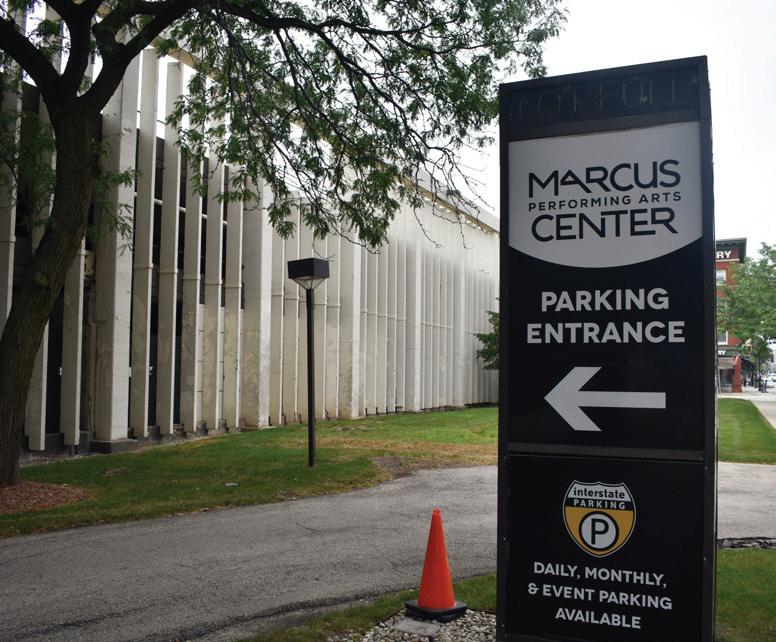
The Marcus Performing Arts Center parking structure includes 690 parking spaces. It sits on a 2.4-acre city-owned block.
PRESENTING SPONSOR:
Monday, September 30, 2024 | Brookfield Conference Center
Learn how to remain competitive by harnessing AI, machine learning, automation, 3D printing and more. Enhance efficiency, support your workforce, and strengthen your bottom line by attending the Next Generation Manufacturing Summit.
Join BizTimes Media for the Next Generation Manufacturing Summit for insights on how companies in one of Wisconsin’s most important industries are dealing with the challenges of today’s market while also preparing for tomorrow.
This year, the event will be a half-day program where you can immerse yourself in the latest industry trends with exhibitors, gain invaluable knowledge from thought-provoking seminars, and hear from a panel of local manufacturing leaders discussing trends and best practices. Following the program, join fellow attendees for cocktails and hors d’oeuvres at the networking reception.
Don’t miss this opportunity to make connections, learn and propel your business to new heights. Register now!
Confirmed Speakers:
• Thomas Carney, President, Royal Basket Trucks, Inc. (1)
• Rob Ewing, President, Wenthe-Davidson Engineering Co. (2)
• Sara Sina, President, The Howard Company (3)
• Todd Zakreski, President, HUSCO Automotive (4)
Breakout Sessions:
1:00-2:00 PM
• Mastering ERP Implementation – Dos and Don’ts for Seamless ERP Success
• Exit Planning Options: Internal Sale, External Sale, Private Equity, ESOP
• 3D Modeling: Transforming Manufacturing Marketing into Immersive Experiences
• Cyber Risk Simplified: Protect Yourself & Your Company with the Right Security and Coverage for 2024.
4:00-5:00 PM
• How to Excite & Inspire Your Workforce About Implementing Automation
• AI-Driven Solutions for Manufacturing Efficiency
• Not Another AI Presentation: Using Intellectual Property Fundamentals To Create Value And Mitigate Risk In Manufacturing
• Data-Driven Manufacturing: How to get relevant data, what to do with it, and it’s impact beyond the factory floor
SPONSORS:
Milwaukee employers say new downtown offices have bolstered their recruitment efforts
BY ASHLEY SMART, staff writer
getting our employees into the office.”
Since opening the new space, Becker said Milwaukee Tool has become an even more recognizable brand. Job seekers with different professional backgrounds, like human resources and finance professionals, now have Milwaukee Tool on their radar as a possible employer. That’s in addition to job seekers in more traditional industries like engineering.
“The overall sentiment from our candidate pool has been that they could potentially see themselves working at this exciting space,” said Becker. “The space is causing them to take a look at the job boards and really inquire.”
OVER THE PAST TWO YEARS, a spate of Wisconsin companies has opted to open new offices in downtown Milwaukee, with some businesses even choosing to relocate their headquarters.
Companies including Enerpac, Allspring Global Investments, Veolia North America, Milwaukee Tool, Fiserv and Regal Rexnord have either shifted to or increased their presence in downtown Milwaukee, or have announced plans to do so.
This wave of openings contradicts a national trend of companies downsizing their office spaces in prominent metro areas. Office vacancy rates reached a record 20.1% in the second quarter of 2024, according to data from Moody’s. That’s the highest level since 1979, when the organization began keeping track of data.
By comparison, the downtown Milwaukee area’s office market had a 17.6% vacancy rate in the second quarter, according to a report from the Commercial Association of Realtors Wisconsin and REDIComps, in partnership with Catylist, a Moody’s company.
A unique mix of amenities has allowed the city of Milwaukee to continue attracting new tenants.
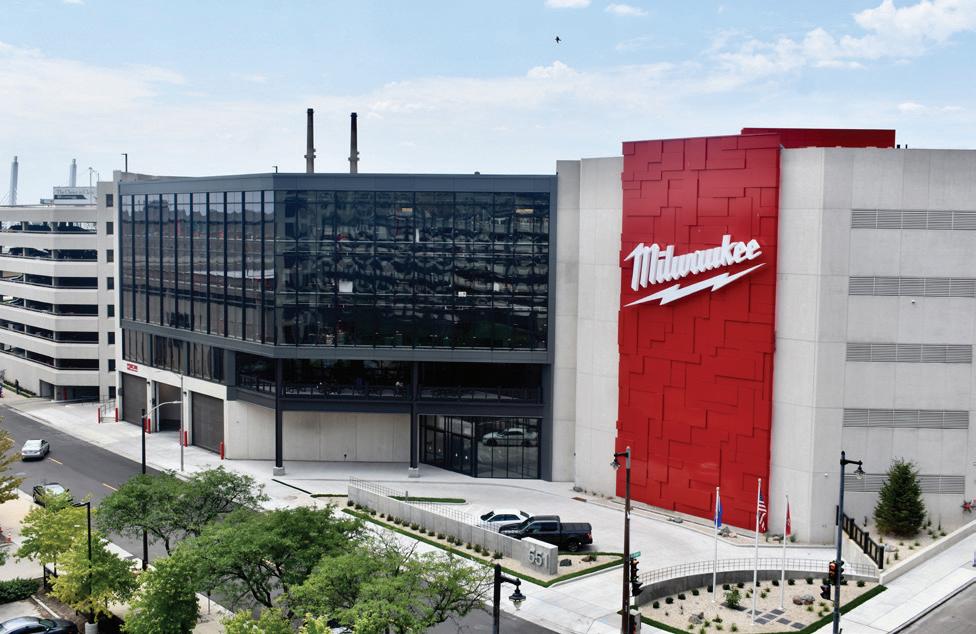
Among the largest office renovation projects recently completed is Milwaukee Tool’s five-story building located at 551 N. 5th St. The $40 million project was officially completed last July. About 900 employees work in the space.
The location of the building, nicknamed the Red Beacon, was highly attractive to Milwaukee Tool, according to Ashley Becker, vice president of talent management. The office can be seen from I-794 against the backdrop of Milwaukee’s skyline.
When it comes to recruiting younger workers, Becker said the downtown office allows Milwaukee Tool to market itself to potential employees as a key player in a vibrant downtown scene.
The company regularly recruits workers from local colleges and universities. While speaking with local students, Milwaukee Tool learned how important being in a big city is to young workers.
“The location of the building in the Westown neighborhood was really appealing to us with all the investment and energy that’s happening in the area,” said Becker.
The fact that the company wouldn’t need to complete a new building was also a winning point.
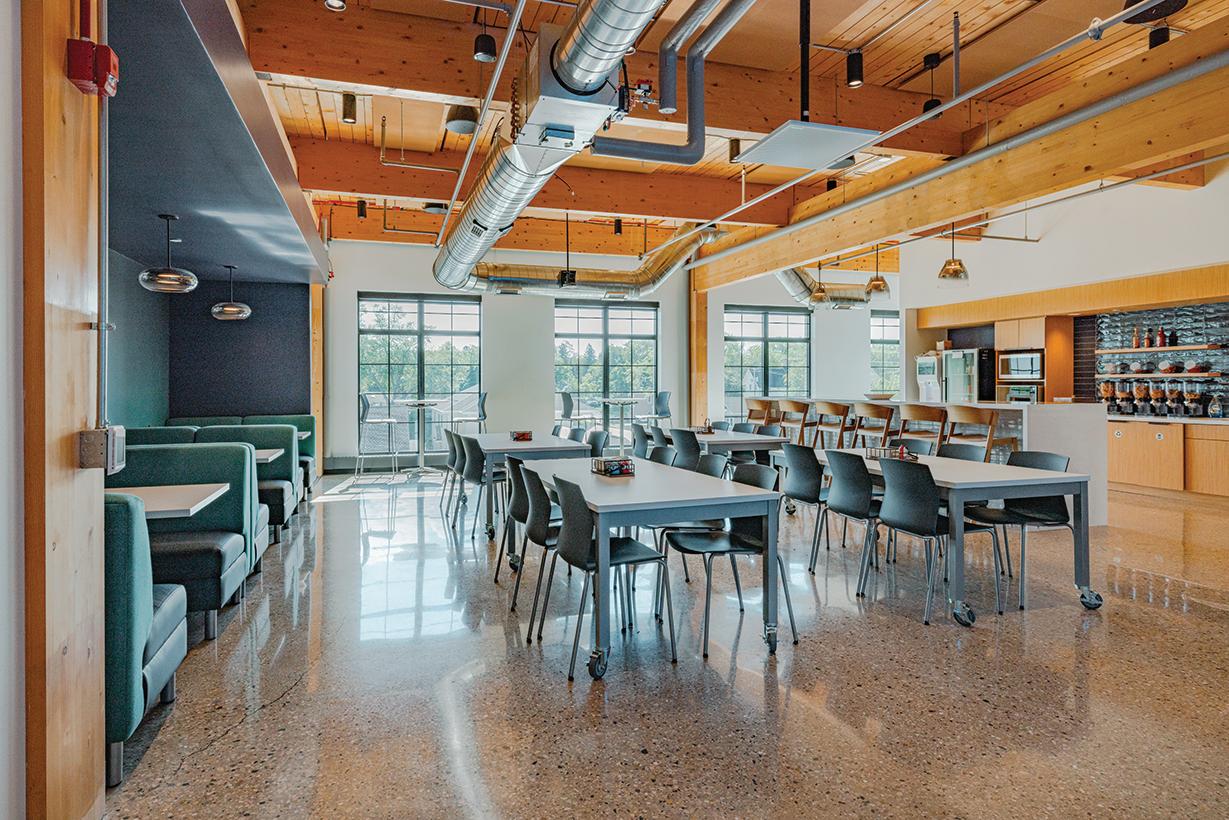
Milwaukee Tool focused on moving entire teams into the downtown office to encourage ongoing collaboration. That decision, coupled with unique amenities like an on-site gym and cafeteria, have created a special working environment, Becker said.
“I think people are really motivated to go into the office because of all the work that has gone into making it a place where people actually want to go,” she said. “We haven’t had any issues with
‘SURGING’ APPLICATIONS
Fintech company Fiserv officially opened its new 168,000-square-foot headquarters within downtown Milwaukee’s HUB640 building in March.
The new space has not only helped boost employee morale and productivity, but also bolstered Fiserv’s reputation as an “industry leading” employer, said Bob Hau, chief financial officer at Fiserv.
“Moreover, the collaborative nature of our company and networking opportunities provided by our physical office environment offers a unique selling point for prospective candidates,” said Hau.
Thanks in part to its new downtown space, Fiserv has seen a 56% surge in job applications from 2023 to 2024. Hau said the office has created a positive buzz and become a “powerful driver” for attracting top talent.
When making the decision to relocate its headquarters, Hau said Fiserv never considered another location except Milwaukee. The company had already invested heavily in Milwaukee when it acquired the naming rights to Fiserv Forum, and it wanted to continue increasing its investment in the community.
“We have tremendous talent and clients based here,” said Hau. “We knew we wanted to
Above: Milwaukee Tool’s downtown office is located at 551 N. 5th St.
Left: Workers gather in a common area at Fiserv’s Milwaukee office.
ASHLEY SMART
FISERV
have a dynamic, world-class hub location that would be an innovation center and a destination for Fiserv clients.”
The office’s proximity to amenities like Fiserv Forum was a deciding factor in the move. The addition of an innovation center allows Fiserv to bring clients into the city to showcase new technologies while also highlighting Milwaukee’s cultural and entertainment assets.
The city’s “vibrant” commercial and residential community, ease of accessibility by car and public transportation options were additional factors that led Fiserv to relocate downtown, said Hau.
“Our new headquarters is one of the largest fintech hubs in the Midwest and reflects our focus on creating value and enabling best-in-class results for our clients,” he said.
LOCATION IS KEY
When Boston-based Veolia North America announced plans to move its west side office to downtown Milwaukee last October, the company also cited a desire to attract new talent.
Location and logistics were key factors that led Veolia to select the ASQ Center on North Plankinton Avenue as its new office space, said Sylvain
Cornelie, vice president of digital business and technologies, corporate domain and enterprise solutions CIO at Veolia.
Amenities like the city’s skywalk system make it easy for employees to navigate downtown and enjoy the area’s plentiful attractions, he said.
Veolia officially moved into its new third-floor office space about two months ago. The building will also soon be home also to Menomonee Fallsbased Enerpac Tool Group, which is renovating the fourth floor for its new 56,000-sqaure-foot global headquarters. The company plans to move in late this year or early next year, and it will then rename the building as the Enerpac Center, taking over naming rights from anchor tenant American Society for Quality.
When considering a new office location, Veolia’s leaders made sure to engage their entire Milwaukee-area team. Employees helped design the different areas within the office, which include flexible space and private working booths, and had input on the furnishings that would be used.
“It’s definitely too early to say if people will be coming more often into the new office,” said Cornelie. “We definitely noticed an increase of employees coming in, but the space is still new. We
need more time to see if this is something that will work in the long run.”
In keeping with modern office design trends, Veolia strived to create a space that encourages collaboration. For example, there’s a large working lounge and a cafeteria with an open kitchen.
Veolia is also working to make itself a more recognizable brand in Milwaukee. The company expects to add signage to the top of the building by the end of the year, a design element that was important to the company when choosing a new space. Enerpac also has plans to add signage to the building.
“I’ve been living in the Milwaukee area for 10 years, and I’ve seen the downtown area evolving in a very positive way in that time,” said Cornelie.
The company also hopes to build brand awareness through community engagement, something that’s easier to achieve downtown, according to Cornelie. Veolia has become more involved with several United Way projects, including housing-related initiatives and back-toschool fundraisers.
“We’re invested in being here and truly becoming part of the Milwaukee community,” he said. ■
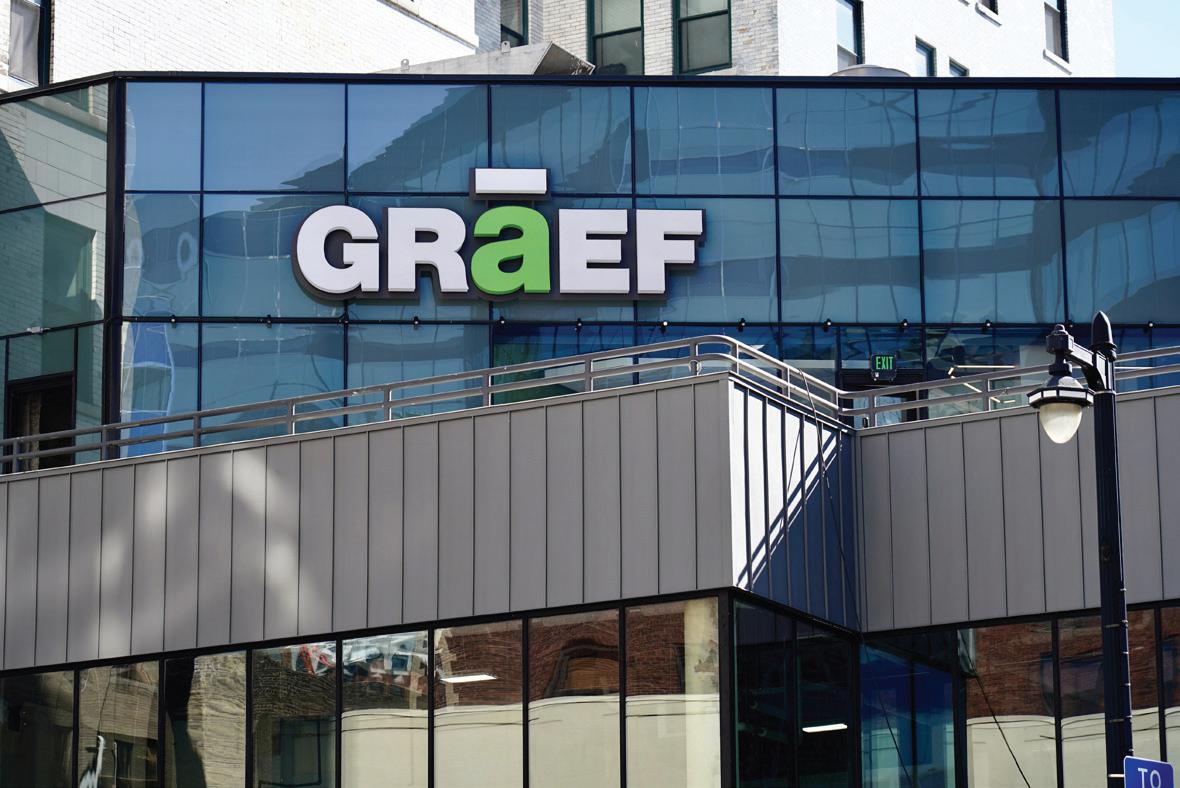
GRAEF and Associated Bank have both added signage to prominent downtown Milwaukee office buildings in recent years.
Downtown companies build brand awareness through prominent building signage
BY MAREDITHE MEYER, staff writer
local presence and raise its profile as “Milwaukee’s hometown bank,” said Marilka Velez, senior vice president, senior director of marketing at Associated Bank. Beyond moving hundreds of employees to the building, Associated invested heavily in improving its infrastructure – and curb appeal.
Following a multi-year planning process and several visibility studies, the company affixed its logo to three sides of the 28-story tower – ensuring the brand would be visible from downtown, the freeway and beyond – and installed programmable LED lighting around the building and on the rooftop to enhance its architectural features.
“We have received so many compliments on the result,” said Velez, “with people noticing the building in the Milwaukee skyline for the first time.” That’s been further evidenced by photos and videos of the illuminated building circulating social media in the months following the installation. And that’s a level of organic brand exposure money can’t buy.
For GRAEF, which moved its headquarters to The Avenue in 2019, placing its logo in a prominent spot – hoisted above the intersection of West Wisconsin Avenue and North King Drive – was crucial in strengthening its presence in the Milwaukee area. Its previous office location at the Honey Creek Corporate Center complex on the city’s far west side did not offer nearly that level of visibility.
TRAVEL EASTBOUND along I-794 in downtown Milwaukee and you’re sure to notice a mix of branding sprinkled among the city’s skyline. U.S. Bank, Quarles and Chase stand out atop the tallest office buildings just north of the elevated highway. Closer to eye level, the Milwaukee Public Market’s neon sign is hard to miss, especially at night.
Over the past couple years, there have been several new signs added to the corridor with a wave of companies relocating or expanding downtown.
Milwaukee Tool’s new office has become a landmark in the Westown neighborhood with its giant red wall and iconic logo facing I-794. Just a couple blocks east, fintech firm Fiserv installed multiple signs on the HUB640 building upon moving its corporate headquarters there early this year. Menomonee Falls-based Kohl’s Corp. opened a store location on the ground floor of the same building late last year, and its rooftop signage was ultimately affixed to a neighboring apartment building. Baird recently added its logo to the north and south sides of the U.S. Bank Center – and to Milwaukee’s convention hall, now known as the Baird Center. Other names now visible along I-794 include Regal Rexnord, Husch Blackwell, Old National Bank and Central Standard Craft Distillery.
Signage marking a company’s physical pres-
ence is usually just one piece of a larger strategy to market to both consumers and potential new employees – but it’s an increasingly important piece in today’s digital age.
Physical branding has the power to evoke a “very visceral, immediate reaction” from people, said Jim Merriman, senior vice president of custom venues at De Pere-based Jones Sign, a full-service signage company that has branded venues across the country, including pro sports stadiums, like Fiserv Forum and Lambeau Field, and corporate headquarters, like Intel.
“It’s not like seeing it on your (social media) feed or on your television or in print, it’s physical. You have all different kinds of emotions and connections because it goes into the living space where people are working, playing and experiencing life,” said Merriman.
It also reinforces the message that the company is reliable and metaphorically stands on stable ground.
“When you have a physical presence, people feel more comfortable,” said Merriman. “It’s comforting, like, ‘man, that brand’s not going anywhere, they’ve made it, they’ve arrived.’”
When Associated Bank purchased the former Milwaukee Center office tower in 2016 –renaming it the Associated Bank River Center – the company saw an opportunity to expand its
“Our sign was on a placard that, unless you looked for it, you weren’t going to find it,” said Pat Kressin, vice president of GRAEF. “Here, it’s meant to be bright, it’s meant to be interesting, and I know it’s improved our branding within the business community in downtown Milwaukee.”
Like Associated Bank’s LED lights, GRAEF’s sign can be programmed to display various colors to mark certain events or occasions, such as a Milwaukee Bucks playoff run or the recent Republican National Convention. Employees are encouraged to submit ideas for color themes based on causes they care about.
As a design-engineering firm with commercial clients across the nation, GRAEF has been involved in the installation of numerous signs, including, locally, Milwaukee Tool’s and the Bradley Symphony Center’s. In some instances, like the Milwaukee Art Museum, the building itself serves as the sign and name branding isn’t necessary.
“Signage can take a lot of different forms, and it’s really meant to be what is your brand and how does your sign go together,” said Kressin. “Ours is meant to be changing and part of the community because so much of the work we do is community based, that’s why we wanted ours to have the ability to change colors and support different types of groups.” ■
The Grain debuts as Hendricks Commercial Properties first mass timber project, located in the heart of Delafield, Wisconsin. Two, distinct buildings with 60,000 SF of office space, 18,000 SF of retail and restaurant space and 125 parking spots including underground parking options, completely transforming the one-acre vacant lot.
The Grain is Delafield’s first mass timber construction project filling a void within the city and making it a prime destination to work and play.
What is Mass Timber?
Mass timber is a state-of-the-art construction method that combines solid wood panels and beams to create a structure that’s exceptionally stable and versatile. It’s an environmentally friendly, low-carbon alternative to concrete and steel.
The Grain’s exterior brick façade differentiates itself from other mass timber projects throughout the country, giving it a timeless design that represents how buildings used to be made. Take a look inside however and you'll see interior finishes that represent the future of modern-day construction. Exposed columns and ceilings create an open, refined space for tenants, providing a more desirable and appealing office or retail space.
MERIT FINANCIAL ADVISORS entered the Wisconsin market in August 2022 by acquiring Sheboygan Falls-based Mersberger Financial Group. The Georgia-based firm has since made four additional acquisitions in the state, adding millions of dollars in assets under management to its Wisconsin presence.
Merit acquired Sheboygan-based Jochimsen Wealth Management in September 2022, De Perebased WealthPlan in May 2023, West Bend-based Reis Financial Services in June 2023, and Manitowoc-based Access Investment Advisors in March of this year.
Merit says it “expects to continue adding several new office locations per year in Wisconsin for the foreseeable future.”
Josh and Zach Mersberger are leading the Georgia-based company’s efforts as regional directors. It wasn’t long ago that they were on the other side of the equation, helping to run their family firm but also seeing a growing trend of industry consolidation.
In each of the past three years, there have been more than 300 merger and acquisition deals in the wealth management industry in the United States, involving firms with more than $100 million in assets under management, according to re-
search from Echelon Partners, a California-based investment banker. There were 968 total deals in those three years. For the duration of the 2010s, the average was 134 a year and the total number of deals that decade didn’t crack 200 until 2019.
Echelon is estimating 332 deals for 2024.
Zach and Josh had joined their family’s firm in 2010 and 2008, respectively. At the time, the company had around $50 million in assets under management and was in the midst of transitioning from a commission-based business to a fee-based business. The brothers worked to build out the firm’s financial planning and investment platforms.
With a focus on offering comprehensive financial planning and diversified investments, the firm grew to $200 million in assets under management by 2015. The family started executing its own succession plan as Josh and Zach each bought 25% of the firm. There was a plan in place for the brothers to acquire the remaining portion of the business in the coming years.
The firm continued to grow, mostly organically, and reached $1.2 billion in assets under management by 2021. At the same time, industry consolidation continued. Zach said they could see a gap emerging between the big and small firms.
NUMBER OF WEALTH MANAGEMENT M&A DEALS IN THE U.S. BY YEAR
Mersberger was left somewhere in the middle. No longer small like it was back in 2010, but also certainly not big.
“We could kind of see the trend that if we did not figure out how to scale ourselves and get much bigger, we were not going to be able to provide some of these services,” he said. “And probably someday, whether it was three years, five years, 10 years down the road, we would wake up one day to find that we can’t do a lot of the things these bigger firms now can, and we did not want that to happen.”
The firm initially looked at both whether it could grow enough on its own or if it should partner with a larger company; that’s where Merit Financial Advisors entered the picture.
One of the biggest challenges in deciding to go with a partner was the prospect of rebranding and giving up some independence. That meant the partner firm needed to be a good cultural fit with Mersberger. Merit was a good fit, Zach said, because they wanted the brothers to remain entrepreneurial, grow and help establish a presence in the upper Midwest. Zach and Josh would maintain leadership of day-to-day operations on the local level. It also helped that a significant portion of the deal was also structured as an exchange of equity, “which is a pretty awesome way to do the deal because Merit, their equity is growing very quickly,” Zach said.
The looming challenges of competing against firms with more and more scale may have been a driving force for Mersberger’s deal, but there’s another factor driving industry consolidation: the aging of financial advisors.
The average age of financial advisors in the U.S. was 56 as of 2023, according to a J.D. Power survey. One in five respondents to that survey said they planned to retire within the next five years. In 2019, J.D. Power found the average age was about 55 with around 20% of advisors over the age of 65.
The average age across all financial activities is 44 and 42 across the entire labor force, according to data from the U.S. Bureau of Labor Statistics.
Zach said within the world of independent advisors, many do not have a succession plan in place for their own business. With the backing of a national player and two leaders in their 30s, the Mersbergers knew they’d be able to offer a succession plan when they make acquisitions. Zach said it has been a part of most of the deals the firm has done since joining Merit.
“Usually, the advisor is not ready to retire immediately,” he said. “They may be wanting to be retiring in three years, five years, seven years or 10 years, but they’re looking to get that succession plan locked in so that they know their clients are taken care of, they know their team is taken care of and they know they can actually step away when it’s time and when they’re ready.”
*Estimate; Source: Echelon Partners. Data includes deals with involving firms with more than $100 million in assets.
WEALTH MANAGEMENT
How can employers engage employees in retirement planning?
BY ARTHUR THOMAS, staff writer
FOR YOUNGER WORKERS, the prospect of retirement may seem like a distant possibility. Those entering the workforce now have another four decades and a host of life milestones – marriage, kids, buying a home – before they might tap into their retirement savings.
Many also need to pay down student debt.
It’s not that employees don’t want financial help. A recent PNC Bank survey found 76% of Generation Z – and a similar number of millennial and Gen X workers – are very or somewhat stressed about their personal finances.
“Employers are uniquely positioned (to help), but they also need to understand their unique workforce,” said Kaley Keeley Buchanan, senior vice president and head of organizational financial wellness at PNC.
She noted many younger workers are focused on improving their credit before saving for retirement or may be dealing with student loans or other debt first.
The survey, which included 505 firms with $5 million in sales and at least 100 employees, found 94% of firms offer retirement plans. Just 52% of firms offered an employee match, up from 46% in 2023.
“It seems to be a table stakes benefit at this juncture,” Keeley Buchanan said. Among employees with access, 81% took advantage of employer plans and 71% utilized their employer’s match.
As for how to make employees feel more secure about their financial futures, offering more benefits was a top response among both employees and employers in the PNC survey. Financial
education was a top selection for employers while pay increases was a top option for workers.
“It’s hard for employers to compete on compensation and to compete on compensation alone,” Keeley Buchanan said.
The survey did find that 92% of Gen Z workers were more likely to stay with an employer that offers more financial wellness benefits, compared to 85% for millennials, 72% for Gen X and 64% of baby boomers.
Workers also listed financial planning and financial education as the second and third top benefits they want but don’t have. An emergency savings account was the top option.
On the other hand, just 6% of workers and 7% of employers said increased 401(k) contributions would make workers feel more secure in their financial future.
INCREASING ENROLLMENT AUTOMATICALLY
Federal legislation passed in late 2022 requires new employer-sponsored retirement plans to default to automatically enroll and escalate employee contributions.
“That, I think, is the biggest thing that an employer can do for retirement is getting young employees started early on, saving in the plan and then using the auto-escalation feature to get them up to an appropriate savings level,” said Bruce Lanser, senior retirement plan consultant in the Brookfield office of UBS Financial Services.
Lanser noted that when the idea of automatic enrollment first emerged, it was controversial. Many employers felt they couldn’t force an em-
ployee into their plan. However, he noted the key is that the change comes in how the question is asked: going from ‘do you want to opt in to saving?’ to ‘do you want to opt-out?’ Employees still have a choice.
Improving saving isn’t just a matter of changing the default option. How a company sets up its match also shapes employee saving rates. Lanser said research has shown the amount of an employer’s match matters less than the amount of contribution the employer is willing to match.
That means that if an employer matches 50% of employee contributions up to 4% of payroll, changing to a 100% match likely won’t have a big impact. However, if an employer were matching 100% of contributions up to 4% and changed to a 50% match up to 8%, employees would likely start saving more to max out their match.
GOING BEYOND THE NUMBERS
Plan defaults and the structure of an employer match might help boost saving, but helping employees make the most of their benefit and associate it with their employer requires going beyond the dollars and cents.
Lanser said there are a number of ways employers can help make employees aware of their benefits, starting with discussing them more than just once per year. This could take the form of regular webinars on financial topics or with a newsletter that links to relevant material.
“Just seeing it, even if they don’t necessarily read what that article is, but seeing that there are resources available to them,” Lanser said, noting employees may recall seeing something about a topic when they need help.
Some employers are also offering rewards for employee engagement with benefit plans. This could be as small as offering points in an employee wellness program for those who have a beneficiary listed for their retirement plan.
Leaders within a company can also help demonstrate the importance of benefits. Lanser noted that at one client he visits every other month to hold educational meetings, the owner is always in attendance.
“That demonstrates his commitment to that particular topic, to their financial wellbeing, because he’s in it as well,” Lanser said. “It’s not ‘oh, here’s something for you people to go do.’ It shows his commitment, his involvement, that he cares about the people.”
Some firms are also now providing employees an annual benefit statement, Lanser said. This document can include information like how much an employer paid for an employee’s health insurance or company contributions to a 401(k) spelled out in dollar terms, not just percentages.
It also offers a chance to make employees aware of relevant benefits they are not using. ■
Keep up with BizTimes’ roundup of the leaders making a difference throughout
At companies across southeast Wisconsin, notable executives are running businesses, navigating company restructurings, serving on boards, running marketing departments, and investing in growth throughout the region. The notable individuals profiled in these categories are nominated by their peers at work and in the community.
N OTA BLE VETERAN EXECUTIVES
These current and former service members are recognized by colleagues, superiors and others as leaders and role models within their workplaces as well as in the wider community.
- Nomination Deadline: October 4, 2024 -
Issue Date: November 11, 2024
Look for these upcoming Notable nominations!
Notable Health Care Leaders
Nomination deadline: November 1, 2024
Issue date: December 9, 2024
Notable Leaders in Higher Education
Nomination deadline: December 20, 2024
Issue date: January 27, 2025
Notable BIPOC Executives
Nomination deadline: January 27, 2025
Issue date: February 24, 2025
Notable Credit Union Leaders
Nomination deadline: February 17, 2025
Issue date: March 17, 2025
Notable Women in Construction, Design & Engineering
Nomination deadline: March 17, 2025
Issue date: April 14, 2025
Notable Nonprofit Board Leaders
Nomination deadline: April 14, 2025
Issue date: May 12, 2025
Notable Entrepreneurs
Nomination deadline: May 5, 2025
Issue date: June 2, 2025
Notable Leaders in STEM
Nomination deadline: May 26, 2025
Issue date: June 23, 2025
Notable Latino Leaders
Nomination deadline: June 23, 2025
Issue date: July 21, 2025
Notable General Counsels
Nomination deadline: July 21, 2025
Issue date: August 18, 2025
Notable Alumni
Nomination deadline: August 11, 2025
Issue date: September 8, 2025
Notable Leaders in Supply Chain & Logistics
Nomination deadline: August 25, 2025
Issue date: September 22, 2025
Notable Leaders in Insurance
Nomination deadline: September 8, 2025
Issue date: October 6, 2025
Notable Leaders in Commercial Real Estate
Nomination deadline: October 20, 2025
Issue date: November 17, 2025
Notable Health Care Heroes
Nomination deadline: November 17, 2025
Issue date: December 15, 2025
N OTA BLE WOMEN I N WEALTH MANAGEMENT
BizTimes Milwaukee is proud to present its inaugural showcase of Notable Women in Wealth Management, recognizing accomplished professionals who help clients grow their wealth and achieve their financial goals, while making a mark on a traditionally male-dominated field. The individuals on the following pages were nominated by their peers and highlight the talent in the region.
METHODOLOGY: The honorees did not pay to be included. Their profiles were drawn from nomination materials. This list features only individuals for whom nominations were submitted and accepted after a review by our editorial team. To qualify for the list, nominees must be based in southeast Wisconsin. They must be currently serving in a senior-level role at their firm, must hold a leadership position in their industry outside of their own organization, have made a significant contribution to advancing workplace equality at their own workplace or beyond, and act as a role model or mentor.
QUARLES & BRADY LLP
Amalia Todryk is a partner and the Wisconsin chair of the Estate, Trust & Wealth Preservation Practice Group at Quarles & Brady LLP in Milwaukee.
Recent client successes include negotiation and preparation of a multimillion-dollar charitable gift agreement for a landmark gift to a Milwaukee educational institution, according to John Emory Jr., president of Emory & Co.
“I have always been impressed with Amalia’s ability to help clients transfer stock in their companies to the next generation in a sensible and tax-efficient manner,” Emory said.
Todryk, for example, has worked with a closely held business valued at more than $1 billion and with its ownership held across multiple generations.
“She developed and implemented leveraged gifting programs for both first- and second-generation owners of the business to transfer significant ownership interests in the business to the next generation to reduce estate tax exposure while maintaining post-retirement income for the senior generations and ensuring the future viability of the business,” Emory said.
Todryk also advocates and advises for a wide range of community organizations, including the Medical College of Wisconsin Cancer Center, the Milwaukee Symphony Orchestra, the Wisconsin Humane Society and the Milwaukee Bar Association.
We proudly recognize all the notable women attorneys in Wisconsin in Quarles’ national Estate, Trust & Wealth Preservation Practice.
EMILY PHILLIPS DIRECTOR AND LEAD FINANCIAL ADVISOR
PHILLIPS RISTAU GROUP,
BAIRD
Emily Phillips, a director and lead financial advisor with Baird’s Phillips Ristau Group in Milwaukee, has extensive experience and a client-centric approach that has impacted the financial well-being of many individuals and families, according to Peggy Williams-Smith, president and CEO of Visit Milwaukee.
“Emily has consistently demonstrated her prowess in navigating complex financial landscapes,” said Williams-Smith. “Her expertise spans investment strategies, retirement planning, estate planning and risk management, allowing her to provide comprehensive solutions tailored to each client’s needs. Emily’s strategic acumen and ability to navigate market trends have helped clients achieve their financial goals, even in turbulent economic times.”
Phillips joined Baird in 2013 after working in the management consulting and information technology industries. She’s a founding partner of the six-person Phillips Ristau Group, which works with high-net-worth individuals, corporate executives and families in all phases of the wealth management process.
Phillips is actively involved in the business and nonprofit community, serving on several business advisory and nonprofit boards, including First Tee of Southeastern Wisconsin, TEMPO Milwaukee and Professional Dimensions.
STACY WILLIAMS DIRECTOR, SENIOR INVESTMENT CONSULTANT
THE HODGE WILLIAMS GROUP,
BAIRD
Stacy Williams, director and senior investment consultant at Baird’s The Hodge Williams Group in Milwaukee, provides investment consulting to families, endowments, corporations and retirement plans.
Williams has been with Baird for more than two decades. Prior to joining the private wealth management group, she was an associate equity research analyst in Baird’s Institutional Petroleum Research Group.
Williams was named one of Forbes Top Women Wealth Advisors in 2020 and a Forbes/SHOOK Best-In-State Wealth Advisor from 2022 to 2024.
“Stacy is a superb wealth manager, but I’m more inspired by how she serves her community,” said client Wendy Burke, president of Burke Properties.
Williams has been involved with United Way since 2006 and was recently appointed to the United Way Women United Global Leadership Council. She’s on the board of the Medical College of Wisconsin Neurosciences Research Center, serves on a committee for the Sharon Lynne Wilson Center, is an honorary trustee of the Milwaukee Rep and is a member of TEMPO Milwaukee.
DAWN RIPKEY
SENIOR VICE PRESIDENT - PRIVATE WEALTH MANAGEMENT
U.S. BANK
Dawn Ripkey, senior vice president of private wealth management at U.S. Bank in Milwaukee, serves clients ranging from small families to large institutions and leads a client team of professionals across all services.
“Dawn’s career has been one of growth and success developing new systems and programming and forging client relationships,” said Scott Ripkey, president of Fontana Partners Inc. “She has been a reliable counselor and mentor up and down the organizational chart wherever she has been.”
Ripkey leads the team at U.S. Bank that launched the “Women in Wealth” program in Milwaukee. This is a series of meetings and professional presentations that helps women clients and employees navigate the world of wealth management.
“Dawn is a quiet-confident leader by example,” according to a colleague. “Her mentorship and advocation for her team and client base up and down the ladder is a great skill. I tell people Dawn is the ‘gold standard’ in our industry.”
AMY KIISKILA DIRECTOR OF WEALTH STRATEGY
ANNEX WEALTH
MANAGEMENT
Amy Kiiskila is director of wealth strategy for Annex Private Client, a segment of Brookfield-based Annex Wealth Management. She has more than 25 years of experience in the industry and has positively impacted the lives of many on their financial journeys.
“Her accomplishments are many – JD, CFP, CPA, CLU,” said Mark Beck, chief growth officer at Annex Wealth Management.
“She uses her vast knowledge to empower, support and inform everyone she touches. Amy has a tireless pursuit of excellence for our clients, for our firm and for meeting and exceeding any challenges that present themselves.”
Kiiskila is active in various industry and community organizations, including the Milwaukee Estate Planning Forum, the Women and Girls Fund of Waukesha County and the Catholic Community Foundation.
“Amy’s passion truly is to enrich the lives of our clients and share her knowledge and experience with her team members,” said Brandon Lehman, director of Annex’s private client segment.
“Amy’s leadership, mentorship, passion to help others and drive to enrich the lives of clients and the community is continually demonstrated,” Beck said.
KATIE IVES SENIOR TRUST ADVISOR NORTHERN TRUST
Katie Ives is a senior trust advisor at Northern Trust in Milwaukee and has more than 20 years of experience. Ives provides holistic wealth management services to individuals, families, foundations and endowments. She has expertise in financial planning, estate planning, investments, tax management and financial education.
Before joining Northern Trust in 2008, Ives was an associate investment advisor at Landaas & Co. and held various roles in sales, service and training at Strong Funds.
“Her extensive background equips her with a deep understanding of financial complexities and client needs,” said Scott Marshall, CEO of Community Smiles Dental.
Ives serves on the board of Community Smiles Dental and has been a past board member of the Planned Giving Council of Eastern Wisconsin.
“Her commitment to both her profession and community underscores her exceptional contributions and leadership in wealth management,” Marshall said.
ANDREA BULEN PRESIDENT AND FINANCIAL ADVISOR SHAKESPEARE WEALTH MANAGEMENT
Andrea Bulen, president of Pewaukee-based Shakespeare Wealth Management, is a financial advisor and strategist to high-networth individuals and their families.
Since Bulen joined the firm in 2013, the number of client households has grown 112% and assets under management increased 370%, according to Lauren Loke, marketing director at Shakespeare Wealth Management.
“She created the necessary structures and processes that have benefited clients and fostered future growth,” Loke said. “Andrea also leads Shakespeare’s hiring process when recruiting new team members. She guides a culture of collaboration to ensure the long-term success of clients and the Shakespeare team. Andrea’s work ethic and leadership skills have proven instrumental in helping navigate volatile markets, implement new technologies, and manage day-to-day challenges.”
Bulen has been a member of the National Association of Personal Financial Advisors and Financial Planner Association for 17 years and served on the FPA board for three years. She also has provided pro bono work for Junior Achievement and volunteered for Habitat for Humanity and Boy Scouts of America.
DENISE BEAULIER
WEALTH MANAGEMENT ADVISOR NORTHWESTERN MUTUAL
Denise Beaulier, wealth management advisor at Milwaukee-based Northwestern Mutual, started her career at a small technology company while finishing her undergrad degree through night classes. After 27 years, Beaulier moved to the finance industry.
Some of her accomplishments were achieving several financial designations, including certified financial planner, chartered life underwriter, and wealth management advisor, according to Kate Inglish, chief marketing officer at Northwestern Mutual.
Beaulier has provided financial planning to more than 1,000 families and services more than $75 million of assets under management with her team. She was named a Forbes Best-inState Wealth Advisor in 2023 and 2024.
“However, the true reward is seeing her clients’ living their lives fully while maintaining their desired legacy goals,” said Inglish. “Denise approaches conversations with her clients in a comfortable, respectful manner, assuring they receive overall strategic planning, which goes beyond just asset class and ROI discussions.”
Beaulier is involved in Make-A-Wish, the Alzheimer’s Association and fundraising for St. Thomas Aquinas Church.
EMILY ZIMMERMAN
RELATIONSHIP
MANAGER
SPECTRUM INVESTMENT ADVISORS
Emily Zimmerman has a three-fold role as relationship manager at Mequon-based Spectrum Investment Advisors.
She assists plan sponsors and their committees with plan design, investment manager searches, investment performance monitoring and other Employee Retirement Income Security Act compliance issues, encourages and educates participants to save and invest for their retirement and provides overall financial wellness guidance to help participants create healthy financial habits outside of the retirement plan.
“With 15 years of experience, Emily has developed an understanding of the retirement savings landscape,” said Manuel Rosado, president of Spectrum. “She meets people where they are in their retirement journey, no matter how basic or complex their retirement goals may be and provides education.”
In 2023, Zimmerman was recognized by the National Association of Plan Advisors as a Top Women Advisor. She holds series 7 and series 66 licenses and has earned the designations of certified plan fiduciary advisor and certified health savings advisor. Zimmerman volunteers with SecureFutures, a financial literacy program that educates and empowers teenage students to make sound financial decisions.
LORI WATT FOUNDER, PRESIDENT AND CEO IAG WEALTH
PARTNERS
Lori Watt founded what is now Waukesha-based IAG Wealth Partners in 1985, when the financial planning profession was still in its early days. Today, she is president and CEO and has built IAG into a firm with 30 advisors and staff members.
Watt has been named to Forbes’ list of Top Women Wealth Advisors as well as Milwaukee Magazine’s Women of Distinction list. She has also been named to the Five Star Professional’s Five Star Wealth Manager list for multiple years.
In addition to serving her financial planning clients, Watt helps the next generation of financial advisors, according to Jacob Martin, marketing specialist at IAG.
“Lori enjoys mentoring the younger advisors, knowing that their careers and personal growth are a very important part of what makes IAG special. She makes sure IAG maintains a warm and inviting environment where every client, advisor and member of support staff feels truly valued,” Martin said.
JENNIFER D’AMATO SHAREHOLDER
REINHART BOERNER VAN DEUREN S.C.
Jennifer D’Amato, shareholder at Milwaukee-based Reinhart Boerner Van Deuren s.c., has spent the past three decades building a successful career as a business succession and high-net-worth estate planning attorney.
D’Amato, who served 12 years as Reinhart’s first female board director, is currently chair of the firm’s Trusts and Estates Practice, chair of the Trust Services Group and co-chair of the Fiduciary Litigation Service Group.
She is regarded as one of the leading trusts and estates attorneys in Wisconsin and has earned recognition as one of the Best Lawyers in America since 2007.
Outside Reinhart, D’Amato has served as chair of the trusts and estates section of the Milwaukee Bar Association, is the coeditor of the Wisconsin Probate Forms and Procedures Handbook published by the State Bar of Wisconsin and has taught as an adjunct professor at the University of Wisconsin Law School. She’s been a fellow of the American College of Trust and Estate Counsel for more than 20 years.
Her volunteer efforts have included Best Buddies, St. Francis Children’s Center board of directors, planned giving committee of the Ephraim Foundation and planned giving counsels for the Children’s Hospital Foundation and Wisconsin Historical Society.
JULIE ELLENBECKERLIPSKY
PRESIDENT AND SENIOR WEALTH ADVISOR
ELLENBECKER
INVESTMENT GROUP
Julie Ellenbecker-Lipsky, president and senior wealth advisor of Waukesha-based Ellenbecker Investment Group, is a natural leader and mentor for the women of the firm, according to Sara McGuire, director of marketing for Ellenbecker Investment Group.
“Her commitment to fostering growth and leadership is evident in her promotion of continued education and encouragement toward roles on nonprofit boards and committees,” said McGuire.
Under Ellenbecker-Lipsky’s mentorship, 25% of EIG employees serve on boards, and more than 50% of the client care team members have earned additional certifications, “gaining the confidence and skills to excel, growing both personally and professionally,” McGuire added.
Ellenbecker-Lipsky served on the Rogers Behavioral Health Foundation board for 11 years and contributes to the Boys & Girls Clubs of Greater Milwaukee as a committee member and host of the S’more Fun event at Camp Whitcomb/Mason. She also participated in the Waukesha County Business Alliance’s 2023 workshop on cultivating a culture of corporate philanthropy.
Reinhart proudly congratulates shareholder Jennifer D’Amato on being named a Notable Woman in Wealth Management
Jennifer chairs Reinhart’s Trusts and Estates Practice, where for more than three decades she has provided closely held business owners and wealthy families with the advice needed to minimize estate taxes and leave a lasting legacy.
reinhartlaw.com
JOAN KLIMPEL
SHAREHOLDER
GODFREY & KAHN S.C.
Joan Klimpel, shareholder and member of the Estate Planning practice at Milwaukee-based Godfrey & Kahn s.c., is a leader within the firm and beyond, colleagues say.
Klimpel is a member of Godfrey’s board of directors and its compensation committee.
“Joan’s dedication to her clients is unmatched. Joan inspires younger generations to do the same,” said Sophie Seaman, an associate at Godfrey who considers Klimpel a mentor.
Outside of the office, she’s a member of the Greater Milwaukee Foundation’s development and philanthropic services committee and chair of Children’s Wisconsin’s planned giving council.
“Joan is a very knowledgeable estate and wealth planner but has the unique ability to be able to develop deep relationships with clients and provide clear explanations of their planning,” said Peter Sommerhauser, senior shareholder at Godfrey.
“Our mutual clients rave about Joan’s organization and attention to detail,” said John Emory Jr., president of Emory & Co. “They know her advice and documents will work as intended.”
MELINDA WILKE
WEALTH MANAGEMENT
ADVISOR AND FOUNDER
WILKE WEALTH & INVESTMENT PLANNING
Melinda Wilke leads Northwestern Mutual’s Wilke Wealth & Investment Planning, an all-female financial planning firm based in Franklin. Wilke joined Northwestern Mutual in 2002 and is the founder of Wilke Wealth & Investment Planning, which provides wealth management and financial planning for medical professionals, business executives, women and families.
“Mindy is a groundbreaker who often raises her hand first, forges a path for others, and is relentless in her pursuit to give others her best; she is wholly focused on serving her clients, being a leading voice and role model across the industry,” said Renee Preis, director of insurance at Wilke.
Wilke has been selected as a Forbes Best-In-State Top Financial Security Professional three years in a row, most recently as no. 5 in Wisconsin in the 2024 rankings. In 2023, she was featured in Vogue as part of its Women of Milwaukee feature.
She also serves on several boards and committees, including the Franklin Library board, and mentors and coaches women who are beginning careers in financial planning and wealth management.
KELLY MOULD
SVP, WEALTH FIDUCIARY ADVISOR
JOHNSON FINANCIAL GROUP
Kelly Mould, senior vice president, wealth fiduciary advisor for Racine-based Johnson Financial Group, extends her influence through educational outreach, including speaking engagements and as host of the company’s “Your Money. Your Mission” podcast. “In addition, Kelly is a role model for anyone considering a return to school as an adult with the goals of remaking their careers and serving others,” said Anne O’Meara, conference director and program manager at the UWM School of Continuing Education.
Mould earned her law degree in 2011 from UW-Madison and is a certified wealth strategist, trust and fiduciary advisor. As a podcast host, she interviews experts on financial issues facing people in all stages of career and life.
Mould has been recognized with Johnson Financial Group’s Circle of Excellence Award four years in a row. She also serves as a speaker and writer at the firm, covering issues facing women and families.
Mould has served on five nonprofit boards and teaches financial literacy through Ascension’s Women of Worth program.
JULIE WILLIAMS
SENIOR
VICE
PRESIDENT AND FINANCIAL ADVISOR
WEALTHSPIRE ADVISORS
Julie Williams, senior vice president and financial advisor at Wealthspire Advisors in Delafield, has more than 25 years of experience in the financial services industry.
Colleagues say she is an advocate for people in need of guidance through times of life transition as well as an educator on planning for life’s milestones such as retirement, estate and tax planning and wealth transfer. Williams serves as the Midwest region’s lead for the firm’s 10 regional advisor associates.
“She pursued a master’s degree in social welfare to make a difference in people’s lives and to help people navigate and overcome difficult situations,” said Razi Hecht, Delafield office lead and senior vice president and financial advisor for Wealthspire. “She earned the accredited domestic partnership advisor designation to help serve clients in domestic partnerships. She is a mentor and guide for young investors, retirees and women seeking independence.”
Williams is currently the treasurer for the Cub Scouts of America and is involved with the Future Business Leaders of America, Wounded Warrior Project, Feeding America and World Central Kitchen.
ABCD: After Breast Cancer Diagnosis
» Financial donations
» Event sponsors
» Gift cards
CONTACT: Ashley Kopca ashley@abcdmentor.org
ACTS Housing
» Welcome Home basket items
» Become an Acts Sustainer
» Corporate sponsorship
CONTACT: Jessi Pham Jessica@actshousing.org
Alliance Française de Milwaukee
» Items for our silent auctions
» Sponsor an event
» Volunteer for an event
CONTACT: Erin Lewenauer ErinL@AFMilwaukee.org
American Heart Association
» Volunteers
» Donations
» Sponsors
CONTACT: Katie Connolly Katie.Connolly@heart.org
Archdiocese of Milwaukee
» Financial donations
CONTACT: Bob Pfundstein pfundstein@archmil.org
Blessings in a Backpack Waukesha County Chapter
» Donations
» Event sponsors
» Volunteers
CONTACT: Susan Reed susanr@blessingsinabackpack.org
Bookworm Gardens
» Children’s books
» Garbage bags & printer paper
» Horticultural supplies
CONTACT: Elizabeth Wieland info@bookwormgardens.org
Demystifying higher ed institution rankings and accreditation
BUSINESSES AND PARENTS frequently turn to college rankings and accreditations to discover the best school for their kids or future employees.
At cocktail parties, I smile as parents, hell-bent on their children going to the best college, try to tell me this school is better than that school because of the rankings. Schools themselves bend over backwards to report their rankings and tout their accreditation to student prospects and the employers who hire them upon graduation.
As an educator going on my 39th year in the trade, having taught high school and college – both undergraduate and graduate and now doctorate level – I have seen quite a bit that never gets reported. It is time to demystify education and all the hype surrounding this very important and costly decision.
There are two types of colleges or universities: teaching and research. All schools do a little of both teaching and research, but the main focus is still very distinct. Teaching schools are in place to teach and graduate students in a specific skill or knowledge, while research institutions are there to lead inquiry, such as the cure for cancer.
The teaching schools usually have smaller class sizes and are taught by the real professor while the research institutions are often taught by the teaching assistant to the professor who is too busy researching to teach little Johnny the basics of the class. Besides researching, these professors usually hire their best and brightest students to be graduate assistants who often oversee the professors research, experiments and fact finding. It is these
professors who also publish, speak on their area of expertise and look to move the needle of our understanding in this great, big universe.
When I advise parents and employers, they all ask the same question: Which is better? The simple answer is: It depends.
If Johnny has the goal of graduating from a school and then going to work, the teaching school should be more than adequate for his preparation.
Now, let’s take Jill. She wants to be a rocket scientist for NASA discovering unknown plant and animal species in deep space. I suggest the research school for her.
For most employers, the teaching school graduate should be just fine with all the skills needed in today’s competitive workforce. But there are some employers that need the analysts, researchers and probers that come out of the research institute.
A good number of my friends are currently doing the college search with their kids. They travel to the East Coast where they think all the good schools are located, where the ivy grows. But what is wrong with a “moss” school and what is so good about an Ivy League school?
Moss schools are the next tier down in the rankings. But here is a true story from my own experience and career: Jill has a choice between a local college that has been around for more than 100 years, or Harvard. If Jill goes to the local college, her pre and post program scores increase 20%-30%. She goes from being an average student versus her peers in the nation to being in the top two percentile. If Jill went to the Ivy school, she comes in at a 98% versus her peers, in the top 2% in the country, and exits the school in the top 2% in the country. Which school has done a better job of educating Jill? Well, that depends upon what we want for Jill and what kind of a student she is. Parents, be honest about your children and what type of student they are. Sending a student to the wrong school to satisfy your own ego is detrimental to the student and your pocketbook or theirs. Employers,
ask yourself which type of employee you really need.
There are a great deal of inputs that go into the college ranking output. There are international rankings, which attempt to measure schools by their peers around the globe and there are domestic rankings we are used to hearing about, which are an attempt to sell more magazines.
DAVID BORST
David Borst, Ed.D., is a former dean of the Concordia University Wisconsin School of Business. He currently sits on several boards, teaches at the doctoral level and runs the Milwaukee Lutheran High School honors academy. He can be reached at david.borst@cuw.com.
HUMAN RESOURCES
In reality, denial is a coping mechanism.
ANGER
Moving forward
Dealing with the stages of job loss grief
IN MORE THAN NINE YEARS as an advisor for the Lumen Christi Employment Network, I have seen numerous members of the group struggle with the grief associated with the loss of a job. In some cases, it paralyzes them and prevents them from moving forward with implementing the necessary job search activities.
Let’s look at each of the five stages of grief and discuss strategies that will help you successfully navigate each of these stages: denial, anger, bargaining, depression and acceptance, as outlined by Kimerly Holland in her article, “The Stages of Grief and What to Expect.”
Holland begins with an especially important observation, “Grief is very personal, it’s not very neat or linear.” We all experience grief differently and grieve in different ways.
The five stages of grief were first identified by Elizabeth Kubler Ross in her book, “On Death and Dying.” She goes on to discuss that while we all grieve differently, there are some commonalities. This statement is reinforced by my experience with and the observations of our network members. Let’s look at each stage as it relates to the loss of a job and its impact on the individual.
DENIAL
In this stage, you have time to gradually process the news and begin to move forward. I have observed this varies from individual to individual. They make statements such as, “They were mistaken, they will call tomorrow and ask me back,” or “They will realize they need me.” There is a danger to wallow in this stage and lose the needed momentum to initiate your search for your next position.
This second stage tends to mask or hide many of the emotions and pain that you are carrying resulting from the job loss. This anger may be directed at your old boss and reflect the bitterness you feel about your current situation. You need to address the source of this anger and the emotions you feel and begin to take positive steps to lessen the intensity of these feelings. Some examples of this anger would be, “I hate my ex-boss, I hope he/ she fails.” Some feelings of anger may be directed at yourself by saying, “I should have done more … or, if I did this.”
These statements are not productive. We need to learn from our mistakes and move on. In some cases, you may need the assistance of a mental health professional to move on. It is important that you realize when you are stuck in this stage and get help.
BARGAINING
When you are in this stage, you may feel helpless and vulnerable. You may fall into the trap of thinking about what ifs: “What if I had done this or that? Would I still be employed?” or “If only I had not done that.” An example of bargaining is, “If only I had worked more weekends or been timelier with my assignments.”
These statements that you make to yourself are also not productive. You need to learn from and not repeat these behaviors when you obtain a new position.
DEPRESSION
This stage of grief is not as active in your mind. Depression is a quieter stage of grief. This stage may present itself with the following symptoms: foggy, heavy and confused. It may also inhibit the functioning of an individual’s brain and body.
Depression is defined by Holland as “the eventual landing point” of any loss, including a job. You may be saying to yourself, “I don’t know how to go forward from here.” If you feel you are stuck in this stage, you need to seek the assistance of a mental health professional.
The depression stage is where you need to re-
alize that you need to start assembling a plan of action to get you to the next and final stage: acceptance. By joining an employment network or another support group, you will begin to realize you are not alone in this journey. You also remove yourself from the isolation of feeling “it’s me” and realize there are others in the same boat as you. You begin to enter into the final stage: acceptance.
ACCEPTANCE
Acceptance does not mean you have moved past the grief of the job loss. It does not mean you have started to accept it. In this stage, you should begin to realize that the bad days are going to be less and that there will be good days ahead. Your mantra should be, “I’ll be able to move forward from here and find a new position that I will be happy with and that utilizes my skills.”
Here is an opportunity to build upon your experience, your skill sets and knowledge to obtain a new position. It’s time to move in a more positive direction by assembling an action plan. This plan would include identifying your network of past business contacts, suppliers, fellow executives, friends, social contacts and even relatives. You should keep this group appraised of your progress in obtaining opportunities for networking, interviews and eventually landing a new job. ■
CARY SILVERSTEIN
Cary Silverstein, MBA, is a speaker, author and consultant, a former executive for Gimbel’s Midwest and JH Collectibles, and a former professor for DeVry University’s Keller Graduate School. He can be reached at csilve1013@aol.com.
Tip Sheet
tinue to operate in a hybrid environment. Amidst this shift, companies have adapted their onboarding practices to fit the needs of today’s workforce.
In a recent Harvard Business Review article, Dawn Klinghoffer, Karen Kocher and Natalie Luna share tips for companies onboarding new employees in a hybrid workplace.
How to onboard employees in a hybrid workplace
The COVID-19 pandemic led to countless changes in the workplace, including the dramatic shift to hybrid and remote work. Many companies saw the benefits of flexible work and con-
A FEW DAYS IN PERSON HAS BENEFITS
Data from an anonymous survey of Microsoft employees showed that new hires who spend one or two days a month with their manager and team within their first 90 days are more satisfied with their onboarding experience and take on more meaningful work.
“However, being in the office most of the time (more than 60% of workdays) brings no additional value for short-term (the first 90 days) or long-term (the first year) onboarding outcomes,” according to the article.
EVERY EMPLOYEE IS DIFFERENT
The needs of new hires vary, and some might require more in-person time. Compared to new hires who onboard off-site, those who regularly go into the office get more energy from work, find their work more meaningful and feel more included within their teams.
UNIVERSALLY USEFUL TOOLS
It is important to provide some resources that all new hires universally benefit from, according to the article. The top factors that make the most difference are clarity about roles and responsibilities, feedback on how new employees are doing and resources to help them answer questions.
“What’s needed is for managers to be intentional, provide structure, align on job expectations, set up their new hire with an onboarding buddy, establish onboarding milestones, give frequent actionable feedback, and provide a list of resources.”
WEST BEND INSURANCE COMPANY RAISES OVER $700,000 FOR CHARITY
On August 12, West Bend Insurance Company raised over $700,000 for charity. Funds managed by the Silver Lining Charitable Foundation are distributed to targeted non-profits through this biennial fundraising event. The 2024 Silver Lining Classic marks the tenth anniversary since 2006. This year’s benefiting charities—Evans Scholars Foundation, the Donald Driver Foundation, and the Pat Connaughton Foundation—received a $165,000 check. “This event has
TECHNOLOGY
CCB Technology
Promotes Steve Scherer to VP of Sales & Marketing
Scherer, after 10+ years at CCB Technology and significant contributions as VP of Sales, now adds Marketing to his role. This promotion, aligning Sales and Marketing, honors his achievements and pushes CCB’s strategic direction under his leadership.
LEGAL SERVICES
Meissner Tierney Fisher & Nichols S.C. Welcomes Raven R. Jelinske as an Attorney
MTFN welcomes Raven R. Jelinske as an associate attorney in the litigation practice group. “She comes to us with a wealth of practical litigation and insurance coverage experience, she’ll be a great fit with the firm,” said Shareholder Mark D. Malloy.
grown over the years, and I’m always grateful to our agents and everyone who generously support these wonderful causes,” said Kelly Tighe, SVP - Sales. Rob Jacques, president and CEO, added, “Since we initiated this event in 2006, West Bend has raised over $5 million for local charities.” All three charities serve youth and families by providing access to various resources, teaching valuable skills through sports, and offering scholarships for higher education.
ACCOUNTING
Vrakas CPAs + Advisors Welcomes New Audit Principal, Scott Blazek
Scott joins Vrakas with nearly a decade of assurance-focused experience in public accounting with a focus on the construction industry. He will mentor audit associates and participate alongside other firm leaders in executing firm growth initiatives.
LEGAL SERVICES
Michael R. Sherer has been promoted to Shareholder at von Briesen & Roper, s.c.
Michael focuses his practice on employment law counseling and employment litigation. He has significant experience with wage and hour claims, employment discrimination, Title I of the ADA, wage garnishments, restrictive covenants and other employment.
BANKING
Brian Neuman named Chief Operating Officer of Westbury Bank
Westbury Bank is pleased to announce that
Brian Neuman (42) has been promoted to Chief Operating Officer. Brian joined the Executive Team this year as SVP–Finance & Operations Manager. As COO, Brian is responsible for planning, organizing and controlling dayto-day operational activities of the Bank. He will collaborate on key sales and marketing initiatives with a specific focus on growth. He earned a BA degree from UW-Madison and an MBA from UW-Milwaukee. Brian is a lifelong resident of Hartland and is Treasurer of the Lake Country Swim Team, a member of the National W Club and coach of youth soccer and baseball.
ARCHITECTURE
Lauren Lederman Joins Kahler Slater as Healthcare Strategist
Lauren Lederman has joined Kahler Slater as Healthcare Strategist. She will work with healthcare clients across the US to align design with strategy, operations, and planning.
CONSTRUCTION
S.J. Janis Company
Promotes Kelly Ament to General Manager
We are pleased to announce the promotion of Kelly Ament to General Manager of the S.J. Janis Company, an Elm Grove full-service design/build residential remodeling company serving southeastern Wisconsin since 1951.
BANKING
Brad LaRue named Chief Lending Officer of Westbury Bank
Westbury Bank is pleased to announce that Brad LaRue (46) has been promoted to Chief Lending Officer. Brad joined Westbury in 2011 and most recently served as SVP – Commercial Lending. As Chief Lending Officer, Brad is responsible for overseeing the operations of the residential and commercial lending departments while working with the lending teams to manage the portfolios, foster relationships with clients and support the financial needs of our communities. He will work closely with senior management on overall Bank and lending strategies to align with the organization’s goals. Brad is a member of NAIOP and CAR-W.
BANKING
Forte Bank Hires
Todd Novotny as VP, Commercial Banker
Todd has nearly 20 years of experience at Milwaukee-area banks, including more than five years in commercial lending. He will be responsible for developing and managing relationship-focused partnerships with Forte Bank’s commercial banking customers.
ADVERTISE TODAY!
To place your listing, or for more information, please visit biztimes. com/bizconnect
Use BizPeople to share:
• New Hires
• Recent Promotions
• Career Updates & Milestones
• Accolades
• Recognition
• Board Appointments
META HOUSE ACQUIRES PROPERTY, GETS $15 MILLION TAX CREDIT FOR NEW CAMPUS
Milwaukee nonprofit Meta House has purchased the site for its planned $30 million campus in the city’s Piggsville neighborhood.
Meta House, currently based at 2625 N. Weil St. in the Riverwest neighborhood, provides treatment for women struggling with substance use and is planning to move its operations to a new facility to expand its services.
Meta House purchased the 4.8-acre property at 3901 W. Bluemound Road in Milwaukee for $925,000 from Molson Coors, according to state records.
CALENDAR
The First-Ring Industrial Redevelopment Enterprise Inc. authorized a $15 million new market tax credit to Meta House to help finance the project. Construction will begin this fall.
“We’re really excited to have this resource available to the women and families that we serve,” said Sarah Koehn, director of operations at Meta House. “So (we’re) just looking forward to breaking ground and getting underway.”
— Samantha Dietel, staff writer
CURATIVE CARE NETWORK INC.
1000 N. 92nd St., Wauwatosa 414-259-1414 | Curative.org
Facebook: facebook.com/CurativeCareWI
Disability:IN Wisconsin and Rockwell Automation will host their annual Disability in Wisconsin Charity Golf Outing on Thursday, Sept. 12, at 9:30 a.m., at Ironwood Golf Course, W270 N6166 Moraine Drive, Sussex.
Star Legacy Foundation will host its second annual golf outing on Friday, Sept. 13, from 8:30 a.m. to 3 p.m., at Brown Deer Park Golf Course, 7625 N. Range Line Road, Milwaukee.
Acts Housing will host its Neighborhood Table event on Thursday, Sept. 19, from 4 to 8 p.m., at the Mecca Sports Bar and Grill, 1134 Vel R. Phillips Ave., Milwaukee.
La Causa will hold a gala for its Crisis Nursery and Respite Center on Thursday, Sept. 19, at 5:30 p.m. at the Rooftop Ballroom of the Baird Center, 400 W. Wisconsin Ave., Milwaukee.
Greenfield Firefighters Local 1963 will host its 11th annual Toasting for Charities event on Saturday, Sept. 21, from 6 to 10 p.m., at the Greenfield Community Center, 7215 W. Cold Spring Road, Greenfield.
DONATION ROUNDUP
The MPS Foundation raised $20,000 at its inaugural golf outing at Brown Deer Park Golf Course. | The Milwaukee Brewers, Sargento and Hunger Task Force served lunches to 82 children and 10 adults at Merrill Park during their Summer Sizzle event. Across all Milwaukee Center for Independence sites, lunches were served to 1,500 children and 52 adults on July 26. | AT&T, the Donald Driver Foundation and Human-I-T teamed up to give 200 laptops and backpacks to Milwaukee students at the Boys & Girls Clubs of Greater Milwaukee. AT&T will also contribute $40,000 to the Boys & Girls Clubs of Greater Milwaukee to support digital literacy programs. | Through its Make It Better Foundation, Cousins Subs donated a combined $12,000 in grants to four local nonprofits: ABCD: After Breast Cancer Diagnosis, Bell Tower Memorial, Fostering Community and Sleep in Heavenly Peace.
Mission statement: Curative Care Network improves the function and quality of life for persons with disabilities or limiting conditions through high-quality care and services.
Primary focus: Curative Care Network is a leading community resource that provides high-quality services to children and adults with disabilities or limiting conditions at communitybased sites and natural settings in Milwaukee and surrounding counties. Our programs include:
» Birth to three - an early intervention program providing children with special needs assistance with movement, language, feeding/eating and/or talking.
Key donors: Curative is proud to partner with the United Way of Greater Milwaukee & Waukesha County as well as with Milwaukee County Department of Health and Human Services to provide their mission-driven work.
Executive leadership: Joy Gravos, president and CEO; Maureen Hodgden, executive director of operations and talent management; John Milazzo, director of information technology; David Kordich, director of quality and analytics.
» Children’s long-term support – serves children with physical, developmental or emotional disabilities by acting as advocates for the child and their families.
» Adult day services – provides adults with disabilities or limiting conditions fun activities and community outings based on their personal abilities, interests and goals.
» Curative New Berlin Therapies – a certified rehabilitation agency that provides pediatric outpatient therapy.
Board of directors: Matthew McBurney, chairperson; Jenny Hart, first vice chairperson; Joy Gravos, president; Dan Brenton, treasurer; Marita Stollenwerk, secretary; Steven Barney, director emeritus; members Stephanie Derks, Corey Radulovich, Tom Nackers, Susan O’Connell, and Ryan Parsons.
Is the organization actively seeking board members for the upcoming term? Yes
Roles it’s looking to fill: Board members with a desire to support a long-standing community organization, focused on helping people thrive.
Ways the business community can help: Support through volunteering and donations, including sponsorship of our 105th Anniversary Gala.
Number of employees: 230+
Key fundraising events: 105th Anniversary Gala – Nov. 7, 2024
GLANCE AT YESTERYEAR
VOLUME 30, NUMBER 8 | SEPTEMBER 9, 2024
126 N. Jefferson St., Suite 403, Milwaukee, WI 53202-6120
This undated photo shows the R. Laacke Co. store in Milwaukee. In 1887, Richard T. Laacke, an 18-year-old steeplejack, sign hanger and awning manufacturer started R. Laacke Co. The company expanded from signs to canvas products in the 1910s. It wasn’t until 1957 that R. Laacke Co. purchased Joys Brothers Co. and merged the two to create Laacke & Joys. Joys Brothers had started in 1844 as G.D. Norris & Co., a ship chandlery and sail loft on the Milwaukee River, before a name change in 1885.
— Photo courtesy of Laacke & Joys. To submit your company’s historic photos, visit biztimes.com/glance
Reflections on Milwaukee’s busy summer
SUMMER IS ALWAYS a busy season in Milwaukee as we try to squeeze in as many activities as possible during the best time of the year in the Midwest. But summer of 2024 was different, with the Republican National Convention and the now-annual Harley Homecoming Festival crammed into a full Milwaukee summer calendar.
Now that the kids are back in school, let’s take a look back on a few of the large-scale events that highlighted this crazy Milwaukee summer.
The RNC will go down as the most significant event in Milwaukee in 2024, but it was a mixed bag. Many downtown restaurants that were expecting a surge in business during the convention were extremely disappointed. The tight security perimeter around the area near Fiserv Forum inhibited RNC attendees from exploring the rest of the city. Others were bused in and out of the city
from hotels in outlying areas. Much of downtown Milwaukee felt dead during the RNC as many locals stayed away to avoid the craziness.
But many businesses did benefit from the RNC. The area’s hotels were packed while charging high rates. Additional flights were added at the airport. Numerous event venues were booked. Other service providers like caterers, florists and dry cleaners did well.
Few if any other events would require such tight security, but if Milwaukee ever hosts an event like the RNC again, greater effort must be taken to get attendees out and about.
As an annual event, the Harley Homecoming festival didn’t attract nearly as many Harley riders as it had every five years. But huge crowds, including many locals, attended the Jelly Roll and Red Hot Chili Peppers concerts at Veterans Park. It will take time to establish Milwaukee as an annual must-visit destination for Harley riders. But if the event can become anything like the annual Harley rally in Sturgis, South Dakota, it will have a tremendous impact on the region’s economy.
Wisconsin State Fair and Summerfest, Milwaukee’s biggest annual events, are trending in opposite directions.
SENIOR GRAPHIC DESIGNER Alex Schneider alex.schneider@biztimes.com
Independent & Locally Owned — Founded 1995 —
1,136,805, up 9% from the 2023 State Fair.
But Summerfest attendance this year was down 11% to 555,925. Attendance at Summerfest remains below pre-pandemic levels.
Summerfest attendance peaked at more than 1 million in 2001 and 2002 when Elizabeth “Bo” Black was executive director. She aggressively promoted Summerfest to maximize attendance. Her successor, Don Smiley, took a different approach, de-emphasizing attendance and seeking to improve the overall Summerfest experience with numerous facility improvements and other upgrades, but also a more expensive event for attendees.
Now led by Sarah Pancheri, Summerfest should consider some changes to increase attendance. A good start would be bringing back the traditional 11-day run rather than the three-weekend format of recent years, and scheduled for 2025. ■
A $13 MILLION RESEARCH LAB to be built at the Milwaukee Metropolitan Sewerage District’s South Shore facility in Oak Creek will give water technology companies the necessary space to pilot their water treatment innovations. The 5,000-square-foot lab, to be completed by 2026, is being supported with a $3.9 million grant from the U.S. Department of Energy and a $1.2 million grant from the U.S. Environmental Protection Agency. The remaining funding will be sourced through MMSD’s capital program. Anaheim, California-based Tomorrow Water and Loves Park, Illinois-based Aqua Aerobics will be the first companies to occupy the research lab. Both companies are focused on primary wastewater treatment. In a recent interview with BizTimes reporter Ashley Smart, MMSD executive director Kevin Shafer discussed the work that will take place in the new lab.
WHO WILL WORK THERE
“Primary filtration is an emerging technology for primary wastewater treatment. This technology is not currently installed at any wastewater treatment plant in the United States at the scale required at the South
Shore Water Reclamation Facility. Currently, there are two different and viable primary filtration technologies from two different suppliers: Proteus by Tomorrow Water and AquaPrime by Aqua Aerobics. Because of the innovative nature of this technology and the significant costs to implement the technology at SSWRF, district staff recommend conducting a large-scale pilot test of the primary filtration technology.”
NEED FOR NEW TECHNOLOGY
“South Shore came online in 1965, so we need to upgrade some of the systems. We’re always looking to find something that’s more efficient, lower cost, more climate resilient moving forward, and this technology, we’re hoping, will do that for us.
“We’ve had a lot of heavy rain in the Milwaukee region since Jan. 1. We’ve been able to handle the rainfall this year, but based on the models we’re seeing, those (rain totals) are just going to keep going up. We need to make sure we stay ahead of that as much as we can.”
END GOAL FOR THE NEW LAB
“(We want) to increase the exposure of these new technologies to the industries that would help them with their commercialization. We’ve got wonderful partners here in the Milwaukee area that are represented by The Water Council, so there will be a lot of partnerships with the companies that make up The Water Council … giving them a local footprint where they can test out some of their research. This lab will be just one more brick in building a water technology hub in the Milwaukee area.”