Address: Royal Palm Suites, 2/3 Curban Street Underwood, QLD 4119 Ph: (07) 3189 6535 E-mail: admin@jdmediacorp.com.au
Australian Indian Times is a monthly newspaper published in English. No material, including advertisements designed by Australian Indian Times, may be reproduced in part or who without the written consent of the manager. Opinions carried in Australian Indian Times are those of the writers and not necessarily endorsed by Australian Indian Times. Australian Indian Times will not be held liable for any advertising / editorial contentAdvertisers supply / approve content therefore should any content be deemed inappropriate it is the advertisers / correspondents responsibility. While every effort has been made to capture the true likeness to colour printing is an art and therefore we cannot guarantee an exact matching of product to image. Refund / Credit is not given as a result of the previous mentioned.
All corresondence should be addressed to: Australian Indian Times - 2/3 Curban Street Underwood, QLD 4119. Ph: (07) 3189 6535, Email: admin@jdmediacorp.com.au
From the Editor:
If you would like us to publish your letters, feedback, comments on any of our stories or suggest ideas columns or features, please send your submissions to:
Australian Indian Times 2/3 Curban Street Underwood, QLD 4119 or E-mail: admin@jdmediacorp.com.au
From the Publisher
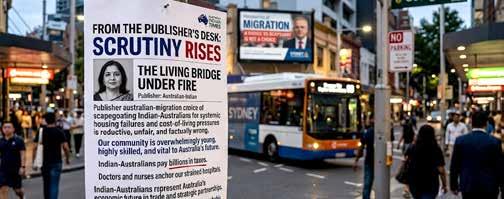
The Living Bridge Under Scrutiny—Why the Indian Diaspora is Vital to Australia’s Future
AS Australia marches steadily toward its next federal election, the national conversation has found its familiar, wellworn lightning rod: immigration. Turn on any talkback radio station, scroll through social media, or read the latest political op-eds, and you will find Net Overseas Migration (NOM) figures dissected with aggressive scrutiny.
In this hardening public discourse, a troubling shift has occurred. The Australian-Indian community, recently confirmed by the Australian Bureau of Statistics as the nation’s largest overseas-born migrant demographic, the increasingly finds itself unfairly positioned at the centre of complex anxieties surrounding housing shortages, infrastructure bottlenecks, and soaring cost-of-living pressures.
As publishers of the Australian Indian Times, we believe it is time to inject rigorous fact, economic reality, and profound cultural perspective into a debate that risks becoming dangerously reductive. To scapegoat the Indian diaspora for systemic, decades-long domestic policy failures in housing supply and infrastructure is not only intellectually dishonest; it ignores the foundational reality that modern Australia simply cannot function without the skills, taxes, and civic dedication of its Indian-Australian residents.
THE FISCAL ENGINE: PAYING TAXES AND BUILDING WEALTH
A persistent, flawed myth in populist migration debates is that incoming residents place an immediate, uncompensated drain on public resources. The empirical data tells the exact opposite story. The Indian diaspora in Australia is structurally unique: it is overwhelmingly young, highly educated, and economically productive, boasting a median age of just 36.
When a skilled professional or an international student arrives from India, they do not arrive to a blank ledger of public dependency. They enter the workforce immediately during their peak productive years. The Indian-Australian community represents one of the highest tax-paying demographics in the country. From the immediate payroll taxes deducted from their salaries to the Goods and Services Tax (GST) paid on everyday consumption, and the billions of dollars contributed through corporate tax, stamp duty, and visa application fees, this community heavily subsidizes the public infrastructure and social safety nets that all Australians rely upon.
Unlike older, aging demographics that naturally require greater fiscal drawdowns for pensions and healthcare, the youthful Indian diaspora is a net positive fiscal engine. They are actively funding the very roads, schools, and hospitals that critics accuse them of overcrowding.
THE BACKBONE OF THE FRONTLINE: MEDICAL SKILLS AND LIFESAVING CARE
Nowhere is Australia’s structural reliance on the Indian diaspora more visible—and more critical—than in our strained healthcare system. Walk into any major metropolitan hospital, rural clinic, or regional health hub across New
South Wales, Victoria, or Queensland, and you will find Indian-Australian doctors, specialists, nurses, and allied health professionals anchoring the frontline.
According to healthcare workforce data, thousands of Indian-trained medical graduates and skilled professionals migrate to Australia annually under strict skilled visa pathways. They do not displace local workers; they fill chronic, desperate shortages that local universities cannot meet fast enough. In regional and remote Australia, where the shortage of General Practitioners (GPs) often reaches crisis levels, it is frequently Indian doctors who relocate their lives to ensure rural families have access to primary care. To question the value of this migration path is to question the stability of our healthcare network.
SUSTAINING THE SOCIAL FABRIC: AGED CARE AND CHILD CARE
Beyond the high-tech corridors of hospitals and IT hubs, the Indian diaspora performs the vital, emotionally demanding work that keeps Australian society humane and functioning. Our nation is facing a dual demographic challenge: an rapidly aging population requiring intensive support, and working young families requiring affordable, high-quality early childhood education.
In the Aged Care sector, a sector fundamentally shaken by workforce shortages over the last several years, Indian-Australian workers have stepped into the breach. With deep-rooted cultural values that revere elders, Indian professionals and students bring not just labor, but genuine empathy, dignity, and care to vulnerable older Australians in residential facilities and home-care settings.
Similarly, in Child Care and early childhood education, the diaspora forms a significant pillar of the workforce. By providing dependable, professional care for Australia’s youngest generation, Indian childcare workers directly enable hundreds of thousands of Australian parents to return to the workforce, thereby unlocking billions of dollars in broader economic productivity.
SHIFTING
NEEDLE:
THE BILATERAL
TRADE AND STRATEGIC PARTNERSHIPS
On the geopolitical stage, the Indian diaspora serves as the indispensable "living bridge" that has transformed Australia-India relations from a history of polite neglect to an era of unprecedented strategic intimacy. The economic architecture of modern Australia is deeply tied to India, crystallized by the Economic
Cooperation and Trade Agreement (ECTA) and ongoing negotiations for a Comprehensive Economic Cooperation Agreement (CECA).
Indian-Australian entrepreneurs, corporate executives, and trade delegates possess the dual cultural literacy and market insights required to navigate the complexities of the Indian economy. Whether it is securing supply chains for critical minerals, expanding educational partnerships like the historic UNSW Bengaluru campus, or facilitating agricultural exports, the diaspora is the catalyst. As Australia seeks to diversify its sovereign trading partnerships away from historical over-dependencies, the Indian community provides the ultimate competitive advantage.
A CALL FOR MATURE
LEADERSHIP AND SOCIAL COHESION
Housing shortages and cost-of-living pressures are deeply painful realities affecting millions of Australians today. They are the consequence of a complex mix of global inflation, historic planning failures, high interest rates, and lagging construction pipelines. They are not caused by the arrival of a skilled Indian nurse, an IT engineer, or an ambitious international student.
When political rhetoric simplifies these systemic issues into a blunt attack on migration numbers, it erodes social cohesion and breeds casual xenophobia. It makes young Indian-Australians, who love this country and call it home, feel vulnerable in the suburbs they have worked so hard to build.
Australia’s greatness has always been its ability to build a highly successful, prosperous multicultural democracy out of orderly, targeted migration. The Indian diaspora does not take from the Australian table; they have baked a larger pie for everyone. As we head into a politically charged election season, let us demand a mature, fact-based discourse from our leaders. Let us celebrate, protect, and stand firmly with a community that gives so much to the peace, health, and prosperity of our shared nation.
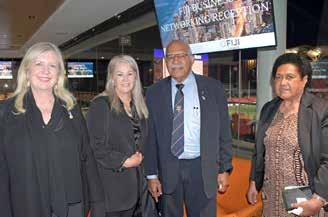
Adwin Awadh Meets Prime Minister of Fiji at Historic Flight Inauguration of Fiji Airways
GOLD Coast, Australia –
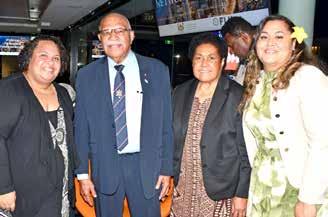
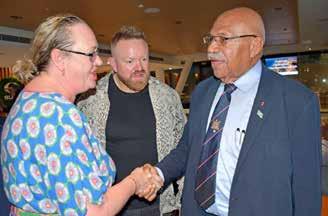
In a vibrant celebration of cultural exchange and entrepreneurship, Adwin Awadh, Development Director at Zeon Developments, had the distinct honor of meeting the Prime Minister of Fiji, The Honorable Sitiveni Rabuka during the inauguration of the new Fiji Airways flight connecting Nadi to Gold Coast.
As the crowd buzzed with excitement, Adwin stood out not just for his role in development but for his dynamic personality and creative spirit. An MBA graduate from Griffith University, Adwin was born in Suva, Fiji and has called Gold Coast his home for the past 40 years where he has carved a niche for himself in running Medical Businesses and in the competitive world of real estate development.
Zeon Developments, under his leadership, is spearheading four ambitious projects, each valued at $100 million, employing innovative construction methods such as modular and prefabrication in partnership with ARBT prefab & backed by Government Support from the $350million Investment in Infrastructure and Development Fund (IIDF).
“Building communities is not just about structures; it’s about creating spaces where people can thrive,”
Adwin shared during his conversation with the Prime Minister. His passion is evident as he discusses the potential of the new flight route to boost tourism and trade between Fiji and Australia & secured an invite from the Prime Minister to discuss potential development opportunities in Fiji.
Adwin's talents don’t end in the boardroom.
Beyond his professional achievements, Adwin is also a celebrated actor, recently winning an International Best Actor Award at ITFFA for his double role in the feature film Langha Phobia.
His diverse talents highlight the importance of creativity in leadership and community building.
“Film has the power to transcend boundaries and inspire change,” he remarked, reflecting on his dedication to storytelling.
As he mingled with other dignitaries, the conversation flowed, covering everything from economic strategies to the importance of cultural connections.
Adwin's vision for the future resonates with many—leveraging tourism to fuel economic growth and fostering partnerships that create lasting impact.
With the new Fiji Airways flight now operational, the future looks promising for both nations. Adwin Awadh’s journey is a testament to the power of collaboration,
“BUILDING COMMUNITIES IS NOT JUST ABOUT STRUCTURES; IT’S ABOUT CREATING SPACES WHERE PEOPLE CAN THRIVE,” ADWIN SHARED DURING HIS CONVERSATION WITH THE PRIME MINISTER. HIS PASSION IS EVIDENT AS HE DISCUSSES THE POTENTIAL OF THE NEW FLIGHT ROUTE TO BOOST TOURISM AND TRADE BETWEEN FIJI AND AUSTRALIA & SECURED AN INVITE FROM THE PRIME MINISTER TO DISCUSS POTENTIAL DEVELOPMENT OPPORTUNITIES IN FIJI.
innovation, and the belief that with the right vision, anything is possible. As the new flight route opens, it paves the way for greater connections and opportunities between Fiji and Gold Coast. Adwin Awadh’s involvement in this historic event underscores his commitment to fostering collaboration and driving progress in both development and the arts.
For more information about Adwin Awadh and Zeon Developments Investor Opportunities, please contact Adwin on 0415 557 430 or adwin@ zeon.com.au.
BAPS Charities Brisbane Walkathon brings community together
BAPS Charities organised its “In the Joy of Others” Walk and Run at New Farm Park, Brisbane, on Sunday 31 May 2026. Around 210 participants joined the event, including families, children, youth, volunteers and community members.
The walkathon started near the New Farm Park Ferry Terminal and followed the scenic pathway along the Brisbane River.
Participants enjoyed a peaceful morning walk while supporting the spirit of community service, unity and care for others.
The program included
registration, welcome address, guest addresses, announcements, a group photo, the walkathon and light refreshments.
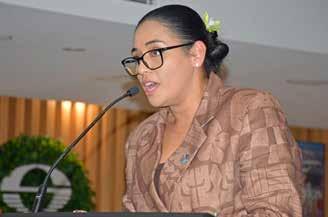
Sandy Landers, Brisbane City Councillor, attended as a guest speaker and appreciated the efforts of BAPS Charities and the volunteers for bringing the community together for a meaningful cause. The event was inspired by the life and message of His Holiness Pramukh Swami Maharaj, who taught, “In the joy of others lies our own.” This message continues to guide BAPS Charities in serving the wider community through compassion,
humility and selfless service.
BAPS Charities thanked all participants, volunteers and community members who helped make the walkathon a successful and uplifting event.
In the coming months, BAPS Charities will continue its community service activities, including a blanket drive and hot food drive to support people facing hardship.
The walkathon was a wonderful example of people coming together with one heart and one purpose, to serve others and spread kindness in the community.
Historic Shift: India Overtakes England as Australia’s Largest Migrant Demographic
IN a monumental milestone that marks a permanent shift in the nation’s multicultural fabric, India has officially overtaken England to become the largest source country for residents born overseas living in Australia.
The historic announcement comes courtesy of the latest demographic update released by the Australian Bureau of Statistics (ABS). The data confirms that the Indian-born population in Australia has surged to nearly 971,000 residents, edging past the UK-born demographic for the first time since European settlement. For a country whose modern migration history was structurally anchored toward Europe for centuries, the numbers represent an extraordinary, eradefining transition.
A YOUNG, VIBRANT, AND DYNAMIC DEMOGRAPHIC
Beyond the raw numbers, the ABS data reveals a stark and fascinating contrast between Australia’s traditional migrant
cohorts and the rapidly expanding Indian diaspora.
While older, traditional European migrant groups are largely reaching retirement age, the Indian-Australian community stands out as an overwhelmingly young, aspirational, and economically active powerhouse. The median age of Indian-born residents in Australia sits at just 36 years, compared to a much
older median age among UK-born residents.
This youthful profile means the diaspora is heavily concentrated within the prime workingage bracket, directly feeding vital skills into the Australian economy. From engineering and information technology to healthcare, education, and hospitality, Indian professionals are filling critical labour gaps and fuelling the nation’s postpandemic productivity.
EDUCATION AND SUBURBS FUELLING THE BOOM
The growth trajectory has been largely sustained by two main pathways: the thriving international student sector and Australia’s permanent skilled migration program. Tens of thousands of Indian students who arrived over the last decade have successfully transitioned into permanent residency, establishing deep roots
across metropolitan Australia.
Geographically, this historic surge is transforming local landscapes. Victoria and New South Wales remain the primary destinations, with western suburbs in Melbourne (such as Tarneit, Wyndham Vale, and Truganina) and Sydney (such as Harris Park and Blacktown) evolving into major cultural, commercial, and political hubs for
the community. The rise of these vibrant "Little Indias" reflects a diaspora that is not just growing in size but deeply embedding itself into the local civic identity.
RE-SHAPING AUSTRALIA’S FUTURE
Community leaders and sociologists view this shift as a natural evolution of Australia’s geopolitical alignment with the IndoPacific. Speaking on the milestone, migration experts emphasize that the Indian diaspora represents a "living bridge" that is completely redefining bilateral relations, trade, and mutual cultural respect between New Delhi and Canberra. With the population rapidly approaching the one-million mark, the Indian community's influence on Australian politics, business, cuisine, and sports is undeniable. As India takes the top spot in Australia’s migrant hierarchy, it marks the definitive beginning of a new chapter, one where the subcontinental diaspora is firmly steering the future of modern, multicultural Australia.
Sunny Bank Ramayan Mandali Supports New Hindu Temple Project with Generous Donation
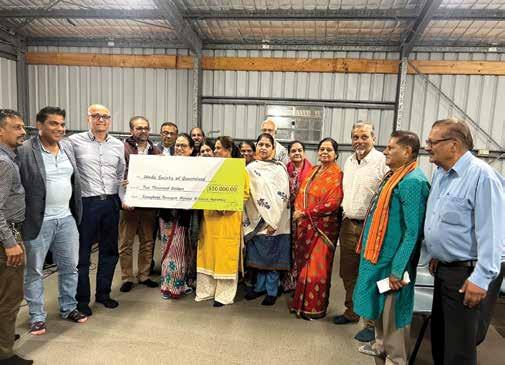
MEMBERS of the Sunny Bank Ramayan Mandali in Brisbane gathered last night to extend their support for the proposed $5 million Hindu temple project at Bracken Ridge, Queensland.
During a special presentation, the Mandali proudly donated $10,000 to the Hindu Society of Queensland. The cheque was formally handed over by representatives
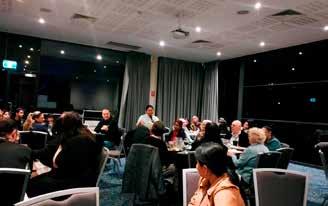
of the Mandali in the presence of community members and executives of the Hindu Society. The occasion was marked with warmth, devotion, and a shared vision for strengthening Hindu culture and spiritual life in Queensland. The donation reflects the Mandali’s ongoing commitment to supporting religious, cultural, and community initiatives that benefit
the wider Hindu diaspora in Australia. Members expressed their hope that the new temple will become a significant spiritual and cultural landmark for future generations. Photographs were taken to commemorate the occasion, capturing the spirit of unity and generosity between the Sunny Bank Ramayan Mandali and the Hindu Society of Queensland.
A Journey to Remember: GIRMIT at
MIFF
2026
Honouring a Founding Member and Lifelong Contributor – Mr Lekh Ram Sukh
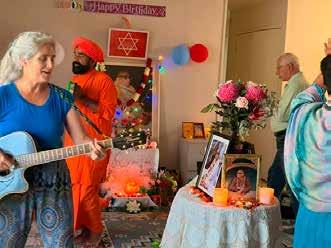
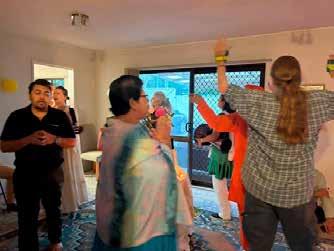
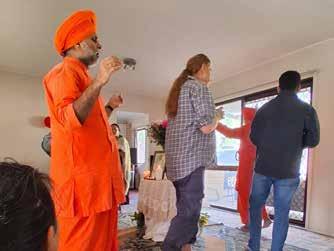
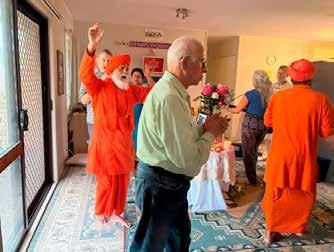
AT a recent gathering involving the Sunnybank Ramayan Mandali in Brisbane, we had the privilege of acknowledging and celebrating one of our respected elders and founding members of the Hindu community in Queensland, Mr Lekh Ram Sukh.
Mr Sukh was among the early pioneers and foundation members involved in the establishment of the Hindu Society of Queensland, formed in the early 1990s in Boondall, Brisbane. This organisation was created by Fiji-origin Hindu migrants who settled in
Australia following the 1987 Fiji military coup, and went on to become a cornerstone of Hindu religious and cultural life in Queensland.
Mr Sukh also played a significant role in the early development of the community that has now grown into today’s major initiative — the Bracken Ridge Hindu temple project.
Even today, at 83 years of age and living on a pension, Mr Sukh continues to show remarkable devotion and generosity. At the recent event, he contributed $2,000 from his former Mandali funds and personally donated a
further $2,000 in loving memory of his late wife, towards the ongoing temple project. His contribution reflects a lifetime of service, faith, and commitment to preserving Hindu culture and supporting community development in Queensland. We deeply honour his legacy, humility, and unwavering dedication to the Hindu community. The community expresses its heartfelt gratitude and prays for his good health and continued blessings.
Jai Shree Ram —Sunnybank
Ramayan Mandali
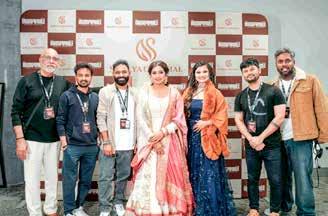
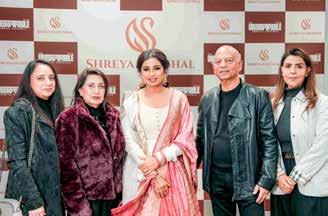
Night of Pure Magic: Shreya Ghoshal Captivates Sydney with "The Unstoppable Tour"
BY ENTERTAINMENT DESK
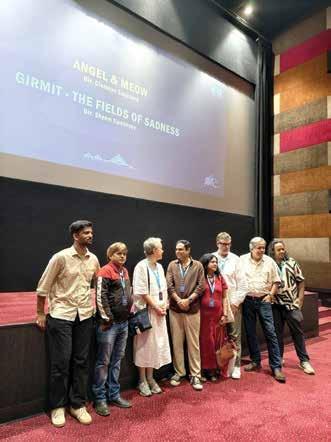
AS MIFF 2026 comes to a close, I look back with immense gratitude, pride, and unforgettable memories.
The journey of GIRMIT: The Fields of Sadness to the International Competition Section of the 19th Mumbai International Film Festival was much more than a film screening. It was an emotional journey of sharing the story of the Girmitiyas on one of the world's most respected documentary film platforms.
Watching our film on the big screen, alongside my crew, and engaging with filmmakers, critics, students, and audiences from around the world was a truly humbling experience. The conversations, appreciation, and emotional responses to the film reminded us why these stories must continue to be told.
My sincere thanks to MIFF 2026, NFDC India, the Ministry of Information & Broadcasting, the festival team, fellow filmmakers, delegates, critics, and audiences who made this experience so special.
Most importantly, I wish to thank our
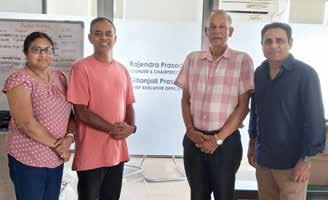
producers Rajendra Prasad, Aruna Prasad, Shavleen and Michael Heath. My dedicated crew Arunabha Mukherjee, Umakant Jagtap, Kisaloy Roy, Shamin Kulkarni, and Prakash Palav. our supporters and promoters worldwide; and the global Fiji-
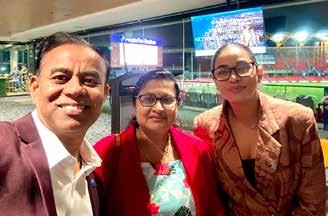
Indian community. This film is a reflection of your trust, support, and shared commitment to keeping the story of the Girmitiyas alive for future generations. These photographs capture moments that we will cherish for a lifetime. Thank you, MIFF 2026.
SYDNEY — The iconic and timeless voice of contemporary Indian music, Shreya Ghoshal, left an indelible mark on the Emerald City last weekend, delivering a spellbinding, soldout performance at the ICC Sydney (TikTok Entertainment Centre) on Saturday, 27 June 2026.
As part of the highly anticipated Australia and New Zealand leg of "The Unstoppable Tour," the night proved exactly why Ghoshal remains an unmatched force in the global music industry, drawing thousands of enthusiastic fans from across the Indian diaspora and beyond.
AN UNFORGETTABLE, IMMERSIVE ENTRANCE
Breaking the traditional barrier between artist and audience, Shreya Ghoshal surprised the Sydney crowd by making her grand entrance directly through the audience before stepping onto the main stage. The venue erupted into a frenzy of cheers and applause as fans caught a close-up glimpse of the melody queen.
Spanning a spectacular career of over two decades, her setlist was a masterclass in musical versatility.
From soulful, classicalinfused masterpieces to high-octane Bollywood chartbusters, Ghoshal effortlessly cruised through multiple Indian languages.
Fans were treated to breathtaking live renditions of iconic tracks like:
• Deewani Mastani and Pinga (from Bajirao Mastani)
• Ghar More Pardesiya
• Raabta
• Silsila Ye Chahat Ka
Celebrating Local Talent and "Female Power"
A defining highlight of the Sydney concert was Ghoshal’s commitment to collaborating with local artists. During a highenergy performance of the hit song Nagada Sang Dhol, a talented local Sydney dancer joined her on stage, sending the energy in the arena through the roof.
Reflecting on the
magical evening and her broader four-city tour— which also saw a female dhol player join her in Melbourne—Shreya Ghoshal shared her immense gratitude:
"Every city was filled with incredible energy, love, warmth, laughter, and celebration... One of the best parts was the surprises in every city. In Sydney, we had a fabulous dancer perform during Nagada Sang Dhol... There was a lot of female power joining us. Those moments made the performances even more magical. I truly feel that my tribe is growing with every show."
A GROWING CULTURAL PHENOMENON
With over 23,000 fans attending the tour across Auckland, Perth, Sydney, and Melbourne, the massive turnout highlights the sustained, booming demand for large-scale live performances by premium Indian artists in Australia.
For the community gathered in Sydney, the evening was more than just a concert; it was a vibrant celebration of shared heritage, nostalgia, and worldclass artistry. As Shreya Ghoshal moves forward with the global leg of her tour, Sydney fans are left with the lingering echoes of a truly unstoppable night.
By Sashi Lal-Sydney
Queensland at Heart: Sport, Community and Mental Wellbeing
BY XAVIER HERNANDEZ
HOW good does it feel to be a Queenslander! Like many of you, I'll be cheering on the mighty Queensland Maroons in the State of Origin decider. I also want to congratulate the Australian soccer team on their outstanding World Cup campaign. There's nothing quite like watching the game with family and friends, and I wish both teams the very best. It has been wonderful to see how far they have progressed, and we are all proud to support them.
While we enjoy life here in our beautiful state, my thoughts are also with those overseas who have recently experienced hardship, including communities affected by the devastating heatwave across Europe and the tragic earthquake in Venezuela. On behalf of the Australian Indian Times family, we send our heartfelt thoughts and prayers to everyone impacted.
In my previous column, I shared part two of my interview with Cr Nathan St Ledger, Councillor for Division 4 at the City of Logan. Thank you to everyone who took the time to read it and send your encouraging feedback. It is clear that these conversations are making a positive difference, and I hope they continue to encourage people to seek support when they need it. Enjoy the third part of the interview below.
PART THREE:
Xavier: In your opinion do family structures influence young people’s wellbeing?
Cr St Ledger: They have their effects because young people need their mum, young people need their dad, or they need those positive male and female influences in their lives to help show them and lead by example what it means to be a good person. Speaking from my perspective as a guy, my role is to show my daughter how she should be treated and what her expectations, as a minimum, should be. I should be modelling solutions and modelling how you treat people with love and respect. That is where that comes from. Sometimes, when things happen in different families, young people do not get that connection or cannot find that positive role model, and sometimes
they find it in the wrong place. That is why we are putting things in place for young people to be able to have those positive influences in their life.
Xavier: Are you able to share some words of wisdom about how to face challenges these days?
Cr St Ledger: I think it is hard. I had kids really young with my wife, and it was tough. Nothing that is worth fighting for is easy. Sometimes you have to take a breath, step back, look at what you can control, and control what you can control. Put one foot in front of the other. Do not look for a quantum leap or something massive, like winning the Lotto, to fix everything. It is a matter of deciding what is important to you, and hopefully it is not too many materialistic things. Concentrate on the things that are important to you, and the other stuff will follow. It is easy to sit and say that, but surround yourself with good people. Hurdles come along, and when they do, look for support and get that support to help you through it.
END OF INTERVIEW
I look forward to sharing more from my conversations with Cr Nathan St Ledger in future editions as we continue raising awareness around mental health and highlighting the people making a positive difference in our communities. One event I am particularly looking forward to is the Iconic India Day Fair 2026, proudly presented by GOPIO Queensland. To be held on Saturday, 15 August, at Roma Street Parkland, the event promises a fantastic celebration of India's Independence
Day through culture, food, music, dance, entertainment and community spirit. I was delighted to attend the official poster launch, and this year I will be volunteering at the GOPIO Queensland stall throughout the day. If you are attending, please come over and say hello.
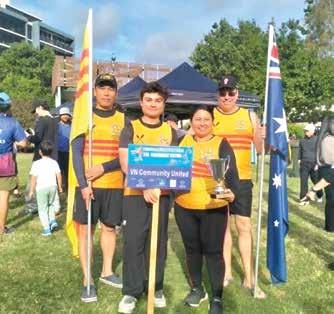
Another wonderful community celebration was the Parkinson Multicultural and Dragon Boat Festival at Ken Fletcher Park, Tennyson. Thousands of people attended to celebrate diversity, friendship and teamwork.
Congratulations to the Multicultural Vietnamese Community United team, made up of many members from Forest Lake, Inala and surrounding suburbs, who secured an outstanding secondplace finish in the community division after a thrilling day of racing. The team won its opening three races before narrowly missing first place in the grand final by only milliseconds.
Hosted by the Hakka Association of Queensland and powered by the Brisbane Typhoon Crew, the festival showcased the very best of Queensland's multicultural community. A special thank you goes to Brisbane Typhoon Crew for generously training and mentoring the Vietnamese Community United team in the lead-up to the event. Their commitment and expertise played a significant role in the team's success. Congratulations also to Khue Oanh Do, President of the Vietnamese Community in Australia – Queensland Chapter, who coordinated the team while also taking on the demanding role of drummer throughout the competition. Events
like these remind us that success comes through teamwork, trust and supporting one another.
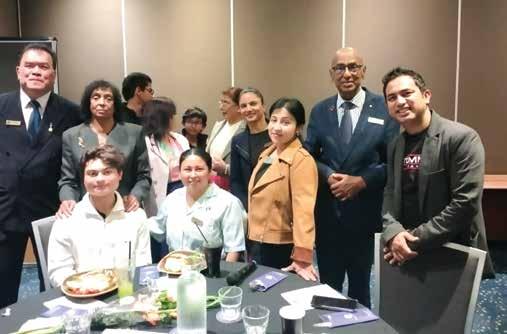
Congratulations are also in order for the Lions Club of Inala, which recently held its 2026–2027 Changeover Dinner. It was an honour to see Nayda Hernandez inducted as President alongside an experienced and passionate executive team committed to serving the community. With members bringing decades of volunteer, professional and leadership experience, the club is well positioned for another successful year of community service.
There has also been plenty of discussion surrounding Queensland's new personal mobility device laws, which commence on 1 July. Many parents and residents have welcomed the changes, saying they will help improve safety for everyone using our roads and pathways. For more information: https:// www.streetsmarts. initiatives.qld.gov.au/ebikes-e-scooters/ Across the community, I have also been speaking with residents about the Queensland Government's 2026–27 Budget. The feedback has been overwhelmingly positive, particularly around initiatives such as permanent 50-cent public transport fares, the Back to School Boost, Play On! sports vouchers, investment in schools and hospitals, and increased funding for housing and community infrastructure. For more information: https:// budget.qld.gov.au Finally, I want to end on a more serious note. Recently, a disturbing incident occurred in my local community of Forest Lake involving a 12-year-old boy who was thrown into the lake in the Lake Parklands by
older youths. Watching the footage was heartbreaking. Bullying has no place in our schools, workplaces or communities. It affects people of all ages and backgrounds, and we all have a responsibility to stand against it. I have grown watching people in high levels of government, business and community bully.
It doesn’t discriminate. If you or someone you know is experiencing bullying or struggling with their mental health, please speak to someone you trust or contact Lifeline on 13 11 14. You are also welcome to reach out to me or the Australian Indian Times family, and we will do our best to point you in the right direction.
Let's Break It Down
28 July 2026 is World Hepatitis Day. This year's theme is “Let’s break it down”.
MANY people find hepatitis confusing. Some people do not know they have it. Others are not sure where to get help. Let's break it down.
WHAT IS HEPATITIS?
Hepatitis is a disease that affects the liver. It can be caused by viruses, alcohol, some medicine or chemicals. When hepatitis is caused by a virus, it is called viral hepatitis. The most common types are hepatitis A, hepatitis B, hepatitis C. Of these, hepatitis B and hepatitis
C can become chronic (long term) infections. Over time, some chronic hepatitis can cause serious liver damage, liver failure, or liver cancer.
Many people with chronic hepatitis feel healthy and have no symptoms for many years. This is why testing is so important.
HEPATITIS AROUND THE WORLD
Around 287 million people worldwide are living with chronic hepatitis B or hepatitis C.
HEPATITIS IN AUSTRALIA
In Australia:
• More than 227,000 people are living
with chronic hepatitis B.
• More than 62,000 people are living with chronic hepatitis C.
• Over 30% of people with chronic hepatitis B do not know they have it.
• More than 70% of people with chronic hepatitis B are not having regular liver check-ups as recommended.
• Many people with chronic hepatitis B were born overseas.
CHRONIC HEPATITIS B: IT CAN BE MANAGED
There is no cure for hepatitis B yet, but it can be managed well. This means people with chronic hepatitis B need to see their doctor regularly for liver check-
ups, including blood tests, ultrasounds for some groups at increased risk of liver cancer, and FibroScans. Treatment may also be needed for some people.
Please remember that not everyone with chronic hepatitis B needs hepatitis B treatment, but everyone needs regular liver check-ups, even if they feel well. There is no such thing as a health carrier
HEPATITIS B
PREVENTION
There is a vaccine that can prevent hepatitis B. If you are not sure whether you have been vaccinated or protected, ask your doctor for a hepatitis B blood test.
If you were born in a country where hepatitis B is common, or live with someone who has hepatitis B, you may receive free hepatitis B vaccine, details can be found here: https://www.qld. gov.au/health/condition/ infections-andparasites/immunisation/ hepatitis-b.
CHRONIC HEPATITIS C: IT CAN BE CURED
The good news is that chronic hepatitis C can be cured.
Treatment:
• Is taken as
tablets.
• Usually lasts 8 to 12 weeks.
• Can be prescribed by a GP or Nurse Practitioner.
• Starts with a specific hepatitis C blood test.
A cure greatly reduces the risk of liver cirrhosis (scarring of the liver) and liver cancer.
As there is no vaccine for hepatitis C, it is important to avoid blood contact.
NEED HELP?
The Love Health Program at ECCQ can help you:
• Understand hepatitis B and hepatitis C through free community education and information
• Access testing –we provide free hepatitis B and C screening
• Access support –we provide free support for people with chronic hepatitis B or C and their families
• Access free Fibroscan - with your
Key message Hepatitis can be prevented, managed, and in the case of hepatitis C, cured. A simple test can protect your health.
Talk to your doctor today and take the first step toward a healthy liver.
doctor’s referral
Our bilingual community health workers can provide information and support in your language. For more information, contact: Email: health@eccq. com.au Information in different languages is available at: www.eccq.com.au/ bbv
Hepatitis, HIV/AIDS and Sexual Health Program Ethnic Communities Council of Queensland (ECCQ)
All talk and no action: Micro suburb founder slams government for lack of response. Other countries interested
AUSTRALIA'S housing crisis is no longer a lack of ideas, it is a lack of action.
While politicians continue to announce housing targets, affordability strategies, reviews, taskforces and emergency summits, an Australian-developed housing model already delivering results on the ground is being overlooked by the very governments claiming housing is their highest priority.
Peter Simms, founder and CEO of Land Title Communities, has issued a blunt challenge to governments, questioning whether politicians are genuinely interested in solving Australia's housing crisis or simply talking about it.
"Australians are being told housing affordability is one of the biggest issues facing the nation, yet when practical solutions are presented, the silence is deafening," Simms said.
"We keep hearing promises, targets and announcements. What we don't see is action."
Simms wrote to Federal Housing Minister Clare O'Neil in mid May seeking a meeting to showcase what he describes as a groundbreaking micro suburb model designed to rapidly increase housing supply and improve affordability.
He also extended an invitation to the Victorian Housing Minister to inspect existing developments and discuss how the model could be expanded nationally.
To date, he is still waiting for responses.
"Apparently everyone wants to solve the housing crisis until someone actually turns up with a solution," Simms said.
"We've invited ministers to see it firsthand. We've invited them to meet residents. We've invited them to see communities already operating successfully."
"So far, we're still waiting."
Simms said the lack of response is disappointing. He has now reached out to Angus Taylor and Pauline Hanson.
"These people seem intent on delivering results and reversing the terrible CGT changes that will only punish young people. I am sure they will back an Aussie innovation," Simms said.
THE AUSTRALIAN
HOUSING INNOVATION
ATTRACTING
OVERSEAS ATTENTION
What makes the
AUSTRALIANS ARE BEING TOLD HOUSING AFFORDABILITY IS ONE OF THE BIGGEST ISSUES FACING THE NATION, YET WHEN PRACTICAL SOLUTIONS ARE PRESENTED, THE SILENCE IS DEAFENING
situation even more frustrating, according to Simms, is that overseas markets are already showing interest in the concept.
"We have had enquiries from overseas groups wanting to understand how the model works and how it can be replicated," he said.
"It is astonishing that international markets appear more interested in Australian housing innovation than some of our own policymakers."
The concept centres on creating micro suburbs: carefully planned communities built on underutilised land featuring smart-sized homes, efficient design, lower development costs and significantly faster delivery timeframes.
Unlike traditional housing estates that can take years to navigate planning systems and approvals, Simms believes the model offers a practical pathway to delivering more homes, faster.
"We don't have a land shortage. We have a bureaucracy shortage, an approvals problem and an inability to embrace innovation," Simms said.
AUSTRALIANS DON'T NEED BIGGER HOMES, THEY NEED ATTAINABLE HOMES
Simms said one of the biggest misconceptions in Australia's housing debate is the belief that housing must continue following traditional models.
"Australians are not demanding larger homes, they are demanding homes they can actually afford," he said.
"Our model focuses on quality, liveability, ownership and community. It delivers what people need without forcing them into crushing debt."
Several projects have already been completed in Victoria, attracting strong demand from downsizers, retirees and
people looking for a more affordable pathway into home ownership.
"The feedback has been overwhelmingly positive because people are looking for alternatives," Simms said.
"People can purchase a furnished two bedroom home with land for as little as $380,000 in our micro suburbs."
THE FORGOTTEN SOLUTION SITTING IN PLAIN SIGHT
Simms believes micro suburbs could also unlock one of Australia's greatest untapped housing opportunities.
Millions of older Australians remain in large family homes because there are few attractive alternatives available.
Governments frequently talk about freeing up housing stock for younger families, yet Simms says little attention is given to creating destinations where older Australians actually want to move.
"You cannot tell people to downsize if there is nowhere suitable for them to go. Micro suburbs provide a genuine solution," Simms said.
"When retirees and downsizers move
into high-quality, low-maintenance communities, larger homes are released back into the market for families and first-home buyers."
"That helps everyone. The reality is that micro suburbs are not only good for downsizers, they are ideal for first home buyers and those seeking a modern lifestyle in a smarter setting."
HOUSING CRISIS BECOMING A NATIONAL EMBARRASSMENT
Simms said Australia's inability to deliver affordable housing despite abundant land and resources is becoming increasingly difficult to justify.
"We are one of the largest countries in the world, yet many Australians feel they have no chance of owning a home," he said.
"At some point we need to stop blaming market conditions, interest rates and global factors and start addressing the systems that are holding back supply."
He said planning delays, red tape and resistance to new approaches are creating unnecessary barriers.
"Every year
"IF GOVERNMENTS ARE SERIOUS ABOUT SOLVING THIS CRISIS, THEY NEED TO START ENGAGING WITH INNOVATORS, BUILDERS AND DEVELOPERS WHO ARE ALREADY CREATING SOLUTIONS."
"AT THE MOMENT IT FEELS LIKE POLITICIANS ARE VERY GOOD AT IDENTIFYING THE PROBLEM BUT FAR LESS INTERESTED IN BACKING PRACTICAL SOLUTIONS.
governments talk about housing becoming more affordable while housing becomes less affordable. That is not progress," Simms said.
LESS TALK AND MORE HOMES
Simms said Australians are growing tired of hearing politicians acknowledge the housing crisis without delivering meaningful change.
"The average Australian doesn't need another housing announcement, they need a roof over their head," Simms said.
"If governments are serious about solving this crisis, they need to start engaging with innovators, builders and developers who are already creating solutions."
"At the moment it feels like politicians are very good at identifying the problem but far less interested in backing practical solutions.
"Politicians need to come and have a look. There are many sites across Victoria with hundreds of plots of land that have been built on and are waiting to be built on that are available for sale.
"Why not see the
communities, meet the residents and look at the outcomes. If housing affordability really is a national priority, then surely proven ideas deserve a conversation because right now Australians don't need more talk, they need more homes.
"If other countries are looking at what we are doing, why aren't our own governments supporting what we are doing."
ABOUT LAND TITLE COMMUNITIES
Land Title Communities is an Australian property development business redefining retirement and downsizer living through its innovative registered leasehold title model.
The company delivers affordable, lifestylefocused micro suburbs where residents have a recognised interest in both their home and the land it sits on.
Founded by property expert Peter Simms, Land Title Communities is focused on creating secure, transparent and future-focused housing solutions for Australians seeking simplicity, stability and peace of mind.
The Rhythm of Belonging: How Desi Entertainment is Transforming the Australian Diaspora Experience
IN recent years, a massive wave of live concerts, plays, and cultural festivals has swept across Australian cities. Far from just musical performances, these events act as vital cultural anchors, offering the South Asian diaspora a powerful sense of home in an adopted country.
For anyone who has migrated thousands of kilometres, the initial feeling of dislocation can be sharp. There is an unspoken grief that comes with leaving behind the vibrant, chaotic, and deeply familiar rhythms of the subcontinent. While Australia offers incredible opportunities, safety, and natural beauty, it is perfectly natural to crave the
comfort of your roots. For the ever-growing Indian, Fijian, Pakistani, Bangladeshi, and Sri Lankan communities here, desi entertainment has become that muchneeded bridge across the ocean.
Whether you reside in Sydney’s cultural hubs like Parramatta, inner-city Melbourne, or right here in the suburbs of Brisbane, the live entertainment landscape is booming. Today, diasporas don't have to settle for nostalgic DVD viewings or waiting years for a trip back home. Top-tier performers regularly headline sold-out arena tours right in our backyard.
Consider the sheer variety filling event calendars. If you want a taste of Punjabi energy, artists the calibre of Babbu Maan and Karan Aujla sell out huge venues across the country. Classical and cinematic maestros, such as playback singer Sonu Nigam and the renowned Ustad Rahat Fateh Ali Khan who bring generations of musical nostalgia to cities like Brisbane, Sydney, and Melbourne.
But it isn't just massive
concerts that cultivate this feeling of home. Stand-up comedians like Kanan Gill, Harsh Gujral, and Jaspreet Singh travel across Australian venues, offering biting, relatable humour about immigrant quirks and the desi experience. These comedy sets provide a shared, collective catharsis. To laugh alongside hundreds of other expats at the everyday absurdities of living abroad is profoundly comforting.
Furthermore, community-driven
cultural events are thriving. The seasonal, high-energy celebrations of Garba with artists like Aditya Gadhavi or Geeta Rabari bring a vibrant slice of Navratri to Australian shores. Meanwhile, local theatre groups like Nautanki Theatre continue to weave semiautobiographical, South Asian-infused stories into the Australian performing arts scene, proving that diasporic identity can be beautifully preserved and expressed on stage.
What makes these
events so profoundly important is their dual nature. Yes, they provide a space to speak in mother tongues, eat street food, and sing along to regional folk songs. But more importantly, they are vital spaces where the diaspora comes together to build localized social networks. They offer safe, energetic environments where second-generation kids can engage with their heritage, and where newly arrived students can find a welcoming community to lean on
when homesickness hits.
Entertainment in Australia has evolved to reflect its beautifully rich, multicultural identity. By embracing desi concerts, plays, and festivals, the diaspora isn't just living in Australia, they are successfully carving out a vibrant, home-like corner of the subcontinent under the Southern Cross. To find upcoming cultural celebrations near you, check out local platforms like Indian Events in Australia or the Australian Indian Times for community gathering.
Pushpa Vaghela Leads IBP Team to Historic Blue Diamond Success
CREATING history is about having the courage to dream bigger, lead with purpose, serve with humility, whilst empowering others to believe that anything is possible. Being recognised as the first Blue Diamond in India, our IBP (India Business Pioneers) Team, are creating history in India as the highestperforming team. This is one of the greatest honours of the journey we have travelled together. This is far more than a business milestone it is a historic legacy that will inspire generations to come.
For me, this journey has always been driven by my faith and passion to help people live healthier, happier and betterquality lives. With vision, resilience, unwavering commitment and a team to unite around a shared purpose, extraordinary things become possible.
At a time when health challenges are affecting our communities around the world, IBP’s mission has never been more important. Through Weight Management, Beauty, Health and Wellbeing, we are empowering people to take control of their future, restore their confidence and improve their lives, for their loved ones, and the wider Indian community Every healthier individual, every more confident person, every family empowered and every new leader developed is the true measure of our success. We are not simply building a business, we are creating a movement for healthier communities, developing stronger leaders and creating a global movement that is transforming lives across India, Australia and beyond. This achievement
belongs to every member of our incredible IBP Team, whose belief to our shared vision of impacting millions has made this historic milestone possible.
Together, we have proven that people, united by an extraordinary purpose, can create a legacy that changes lives forever. If you are ready to become part of this historic
movement and make a meaningful difference to your own life and the lives of others, I invite you to connect with me.
Lets leave a legacy that future generations will thank us for.
Jitendra Deo Chief Executive Officer JD Group Australia
Drive your success with Aramex
put
Aramex Australia is an award-winning transport, logistics and courier company, operating with 29 Regional Franchisees and over 800 Courier territories.
Here at Aramex Brisbane, you will enjoy the backing of a global brand and unparalleled support and training, with the security of a scalable up-front investment and exclusive territory that’s yours to build.
Why Aramex Brisbane?
Low Cost of Entry
Rapidly Growing Industry
Easy to Operate Business
Training Provided
Marketing & Sales Support
An Exclusive Territory
Aramex Brisbane is
“Yes or No”: The Accountability Trap Politicians Set for Others
‘YES or no!’ ‘Don’t play with me here.’ ‘Please answer my question.’
‘Just answer this question.’ ‘We need the truth.’ ‘Can you answer the question please?’ ‘It’s a simple question.’ ‘You still haven’t answered my question.’
For several hours on 19 June 2026, parliamentarians serving on the Joint Committee on Corporations and Financial Services subjected current and former KPMG executives to scrutiny.
The Committee was examining allegations arising from disclosures made by a KPMG whistleblower. The hearing was uncomfortable and excruciatingly painful viewing. The spectacle was expected.
The questioning was relentless. Many types of elicitation and provocation methods were deployed: open questions, leading questions, loaded questions, rhetorical questions, inimical hypotheticals and preferential treatment exposures.
Committee members dissected answers with clinical precision. They demanded precision and clarification. The careful selection of words by KPMG executives was examined and replacement words of a caustic character were suggested. They challenged qualifications and caveats. They pressed the KPMG witnesses who appeared reluctant to answer directly. They were not going to accept rejections. More than once, they insisted upon a simple ‘yes or no’ response. At other times, Committee
members interrupted. At times they displayed visible frustration with answers they regarded as incomplete, evasive or unresponsive. The KPMG witnesses were pressed repeatedly to respond directly to the question asked.
The unmistakable commitment to accountability displayed by the Committee members on 19 June 2026 is not exceptional. Similar vigour can be observed in other parliamentary inquiries at home, and in select overseas legislatures where committee scrutiny takes on an equally exacting form. One need only look across the landscape in New Zealand and the United States to see a replica of the portrait: the same insistence on precision, and the same intolerance for evasion.
The Committee’s performance, at least in this instance and assuredly in all instances, would almost make the voter proud; the election of such tenacious and inquisitorial parliamentarians holding witnesses to account, despite the occasional distractions from Committee members ranging from the unprofessional to the pettifogging.
However, it was difficult not to be struck by a feature that may have eluded spectators, commentators and reporters who were too intently—and rightly so—focused on the day’s nadir and apogee, and less attuned to the wider dynamic at play.
It is tolerably clear from proceedings of various parliamentary committees that
politicians know exactly how an elusive witness acts and what an evasive answer looks like.
Not speculatively. Not approximately. Not probably. Not theoretically. Not as an abstract proposition discussed in a political science textbook. Not in the incubator of a lecture theatre. They recognise it instantly.
The moment a witness begins to wander from the question, politicians notice. The moment a witness seeks refuge in irrelevancies, politicians notice. The moment a witness attempts to answer a different question from the one asked, politicians notice.
They will have none of it, and they rightly object. Attempts at correction are instant, although oftentimes accompanied by theatre.
The KPMG committee hearing—which we may assume to be generally representative of all hearings of committees— demonstrated that politicians possess a highly developed understanding of accountability. They know that meaningful scrutiny requires witnesses to engage inextricably with the question. They know that accountability is undermined when answers become elusive, evasive or equivocative. They know that a person in a position of power should not be permitted to escape examination through clever wordplay or strategic diversion. The theatricality of exposing such tactics is breathtaking.
Yet there is an unforgettable and unforgivable irony at the heart of all
this. Parliamentary committees, comprised entirely of parliamentarians, approach their watchdog role characteristically uninhibited by the ‘unclean hands’ doctrine.
While not attempting in any way to engender sympathy for KPMG, many of the parliamentarians who demand direct answers from corporate executives themselves routinely resort to the same forms of evasion when placed under scrutiny by journalists and voters.
How often have we watched a minister refuse to answer a straightforward question? How often have we heard a politician respond to a query with a rehearsed talking point that bears little relation to what was asked? How often have we seen repeated attempts to change the subject, attack the premise of the question or simply consume the available time without providing a meaningful response? The answer, of course, is frequently, if not always. For those preferring quantitative evidence, there are legions of academic studies showing chronic evasion by politicians. They demand compliance or obedience from witnesses in committees, as much as they engage in evasion of their own in television studios. The contrast is impossible to ignore.
One defence offered by politicians is that government is different. Public issues are complex. Questions cannot always be reduced to a simple ‘yes or no’ answer. Direct answers are
impractical, unrealistic or inconsistent with the realities of public life. Context matters. But those features are also writ large within corporate Australia in equal measure. Yet the politicians only are permitted to play the game.
The Committee hearing also exposed a deeper inconsistency.
Parliamentarians are among the fiercest defenders of parliamentary privilege. They regard it as fundamental to democratic government. They insist it protects institutional interests that transcend the interests of individual members. They would rightly resist any suggestion that Parliament should waive its privilege (although waiver might be legally unachievable) simply because outsiders are resolved to questioning proceedings of Parliament outside of Parliament.
Yet when confronted with a claim for legal professional privilege which is often claimed by corporations, calm seas turn choppy.
During the KPMG hearing, enormous pressure was brought to bear upon KPMG to waive privilege. It is one thing to claim legal professional privilege incorrectly. To demand waiver of a properly claimed privilege is quite another. In any case, the message was clear: transparency required disclosure. Public confidence required disclosure. Accountability required disclosure.
Perhaps it did. Perhaps it did not. And
yes, the privileges are different. That is not the point. The poignant question is whether the principle is being applied consistently.
Privileges are not tested when the protected information is trivial, but when the information is important, controversial and highly sought after. The true measure of commitment to a privilege is whether one respects it when disregarding it would be politically convenient.
When the privilege belongs to Parliament, it is treated as sacred. When the privilege belongs to somebody else, it transmogrifies into an obstacle to transparency. This is not an argument for shielding misconduct. Nor is it a defence of KPMG. It is an observation about accountability, and the double standards politicians apply to it.
Watching the hearing, one wonders what might be achieved if ordinary hapless voters and the media possessed similar powers. For the media to be empowered to summon a politician to remain seated for hours while every inconsistency is explored and every qualification examined. It is a Panglossian wonder that will remain in the realm of fairytales. We the people are forever left writing letters, signing petitions, campaigning, protesting and lodging freedom of information requests. Ultimately, we the people are complicit for we have permitted this hypocrisy to live and thrive.
Nilay B. Patel is a lawyer based in Melbourne
Rising Wages May Force More Australian Business Owners to Sell
NEW workplace laws that started this week could force many small business owners to sell their businesses before they lose too much money.
On 1 July 2026, Australia’s National Minimum Wage went up from $24.95 to $26.44 an hour. Other minimum award wages also went up by 4.75%. At the same time, a new rule called "payday super" means bosses must now pay their staff's superannuation on the exact same day they pay their wages.
Experts say these combined changes will raise running costs overnight, especially for businesses that employ a lot of staff and already make very low profits.
The Profit Squeeze Mary Tamvakologos from the business-forsale website AnyBusiness AU says many owners have spent years dealing with rising costs for rent, insurance, and supplies. This new wage increase might be the final straw.
"Every business owner wants to pay their staff fairly," Ms. Tamvakologos said. "But small businesses do not have unlimited money to cover another jump in costs. In industries like hospitality, retail, and building, wages are the biggest expense. When profits are already low, even small wage rises can hurt a business badly."
She explained that these rising costs are changing when owners
choose to close or sell.
"Some owners will decide it is no longer worth running the business. Others will realize they need to sell right now, before their profits drop. Buyers look very closely at how much money a business
makes. If your profits drop over the next year, your business will be worth much less when you try to sell it."
Which Businesses Are Most at Risk?
According to AnyBusiness AU, the businesses facing the
most pressure right now are:
• Cafes, restaurants, and takeaway shops
• Retail stores
• Hair and beauty salons
• Childcare, aged care, and disability care providers
• Cleaning businesses
• Trades and builders with multiple workers
• Factories with large workforces
What Business Owners Should Do Now
Instead of panicking, experts say owners should use the next few weeks to see exactly how these changes will affect them.
OWNERS ARE ENCOURAGED TO:
• Check their wage budgets and staff costs.
• Update their cash flow plans.
• See if they need to raise their prices.
• Talk to an accountant about their profits.
• Get a professional business valuation if they want to sell in the next few years.
"The biggest mistake we see is owners waiting until they are already losing money before they try to sell," Ms. Tamvakologos said. "By then, buyers will notice the lower profits and offer less money. Finding out what your business is worth today gives you better options."
Credit: Mary Tamvakologos, Director of Operations at AnyBusiness AU https:// www.anybusiness.com. au/
ANTICIPATING
seasonal maintenance needs and planning is a key part of successful property management.
During winter, attention often turns to heating, mould, moisture, and leaks. Ventilation in cooler months can often be poor, and increased rainfall in some areas can further highlight existing issues. Older homes, in particular, may lack adequate heating, which should be considered to support
tenant comfort.
Addressing current maintenance is important, as is considering what may be required in the future.
In addition to responding to issues as they arise, staying ahead of essential maintenance often comes down to thinking for the seasons ahead.
Planning for the upcoming seasons is an effective strategy to ensure property maintenance remains under control. Alongside
regular property inspections and routine upkeep, there are also seasonal factors to consider and planning for these can benefit both landlords and tenants.
In many cases, planning ahead is beneficial as certain trades are more readily available outside of peak demand periods. Take property cooling, for example: during milder months there is less reliance on in-home cooling and fans, making
it an ideal time to service, repair or replace systems before they’ll be in high demand through warmer months.
While unexpected repairs will always arise from time to time, maintaining a regular maintenance checklist can be highly beneficial in planning and scheduling key works throughout the year.
Identifying upcoming works early, having a clear plan in place, communicating with tenants, and booking
The recent Federal Budget delivered what industry experts are calling the most significant shake
THE recent Federal Budget delivered what industry experts are calling the most significant shake-up to property-related tax policy in a generation. Rather than a quickfix cash splash, the focus is a structural, long-term overhaul aimed at tackling housing affordability and changing where investment money flows.
1. THE BIG POLICY CHANGES
The government's package hinges on two major tax reforms set to take effect on 1 July 2027:
• Negative Gearing Restricted: For established residential properties bought after Budget night, investors will no longer be able to offset rental losses directly against their wage income. Instead, those losses will be "quarantined" to be offset only against future rental income or capital gains. Crucially, new builds are exempt—investors can still negatively gear new properties to encourage more construction.
• Capital Gains Tax (CGT) Overhaul: The blanket 50% CGT discount for individuals and trusts is being replaced. Under the new rules, taxable capital gains will adjust for inflation (cost base indexation), but will face a minimum 30% tax rate on the real profit.
without immediate tax deductions against their salaries.
• The Lock-In" Effect: Because existing properties are grandfathered, current landlords have a massive incentive to hold onto their portfolios rather than sell. If they sell and try to buy another established property later, they lose their old tax perks.
THE CONSTRUCTION & BUILDING SECTOR
• Infrastructure Boost: To ensure supply keeps up, the Budget included a $2 billion Local Infrastructure Fund to fast-track "last-mile" infrastructure (roads, services, connections) needed to get land ready for building.
2. HOW THIS AFFECTS EVERYDAY AUSTRALIANS The immediate and medium-term impacts vary depending on where you sit in the market:
FIRST-HOME BUYERS
• The Upside: The ultimate goal of these changes is to level the playing field. By removing tax advantages
• Grandfathering: If you already own an investment property, your current negative gearing and CGT arrangements are locked in, meaning you won't be hit retrospectively.
on existing properties, the government expects to reduce fierce investor competition for established apartments, townhouses, and entrylevel homes. Treasury modelling suggests this could help an extra 75,000 Australians buy a home over the next decade.
• The Reality: Don't expect prices to plummet overnight. Major banks like CBA and Westpac note that the impact will be gradual, forecasting that house price growth will simply moderate
stalling relatively flat through 2026 and eventually tracking a few percentage points lower than it otherwise would have.
RENTER HOUSEHOLDS
• Rental Market Pressures: This is the biggest area of concern for everyday renters. Because "mum and dad" investors provide the vast majority of rental housing in Australia, a drop-off in investor confidence could initially tighten rental supply.
• Yields and Cost:
Major bank economists predict a gradual firming of average rental yields as the market "equalises" the tax changes, which likely means a combination of lower property prices and slightly firmer rent inflation in the transition period.
"MUM AND DAD" INVESTORS
• A Shift in Strategy: Everyday investors looking to build wealth through an established property will face tougher cash-flow dynamics
• Push to New Builds: With tax incentives specifically preserved for new constructions, investor activity is expected to swing heavily toward buying off-the-plan, new builds, and supporting build-torent projects.
Summary Takeaway: The housing market is transitioning from an investor-led boom into a more selective, regulated phase. While first-home buyers may face slightly less competition from investors for existing houses over the next few years, renters will want to keep a close eye on availability and local pricing as the market adjusts to the new tax environment.
'Buy Fake Reviews' Searches Surge 1,268% As SMEs Warn Of A Growing Online Trust Crisis
OVER 21,000 people searched how to buy fake reviews last month, while searches for fake business reviews topped 68,000 Businesses are facing a growing crisis of trust online, with new Google search analysis revealing searches for "buy fake reviews" have soared 1,268% over the past year, highlighting growing demand for services that artificially boost online reputations.
At the same time, searches for "fake business reviews" have increased 1,026% yearon-year, now reaching 68,000 monthly searches, suggesting consumers and business owners are becoming increasingly concerned about whether online ratings can be trusted.
Analysis by AnyBusiness.com.
au found "buy fake reviews" now attracts 21,000 searches every month globally, with five-year Google Trends data showing interest remained relatively flat before exploding over the past 12 months, suggesting review manipulation has become significantly more mainstream.
For small and mediumsized businesses, the implications are significant.
Unlike major brands that can absorb occasional fake reviews, SMEs often rely on relatively few reviews to build credibility,
meaning even a handful of fraudulent ratings can influence customer decisions, search visibility and revenue.
Mary Tamvakologos, Managing Director at AnyBusiness.com. au, says the figures reveal a worrying shift in how businesses are competing online.
"We've reached the point where thousands of people are actively searching for ways to buy fake reviews every month, while even more people are trying to work out whether the reviews they're reading are genuine. That's a trust problem for every business.
For SMEs especially, reputation has become one of their biggest commercial assets. A few
fake one-star reviews can discourage potential customers overnight, while competitors using fake five-star reviews create an unfair playing field."
WHY BUSINESSES SHOULD NEVER BUY FAKE REVIEWS
While paying for positive reviews may appear to be a quick way to improve ratings, Mary says the long-term consequences can be severe.
"Buying reviews is one of the biggest mistakes a business can make. Platforms such as Google are continually improving their systems for identifying suspicious review activity, and businesses caught manipulating
reviews risk having them removed, losing customer trust and, in some cases, having their business profiles restricted."
Beyond platform penalties, fake reviews can permanently damage consumer confidence.
Modern consumers are increasingly able to identify reviews that sound generic, repetitive or overly polished, and many will avoid businesses they believe are manipulating customer feedback.
"In today's market, authenticity wins," says Mary.
"Customers don't expect perfection. They expect honesty. A business with genuine reviews, including the
occasional criticism that has been handled professionally, is often more trustworthy than one with hundreds of suspicious five-star ratings."
HOW SMES CAN PROTECT THEIR REPUTATION
Mary recommends businesses take a proactive approach to managing their online reputation.
MONITOR REVIEWS CONSISTENTLY
Watch for sudden spikes in reviews, repeated wording, multiple reviews arriving within minutes of each other or accounts with little review history.
RESPOND PROFESSIONALLY
If you receive a suspicious review, remain calm and factual. Public responses demonstrate transparency to future customers while you report the review through the relevant platform.
GENERATE MORE GENUINE REVIEWS
The strongest defence against fake reviews is a consistent flow of authentic customer feedback. Ask satisfied customers to leave honest reviews after purchases, appointments or completed work.
BUILD REVIEWS ACROSS MULTIPLE PLATFORMS
Avoid relying on a
single review platform.
Establishing a presence across Google, Facebook, Trustpilot and industryspecific sites reduces the impact of manipulation on any one platform.
KEEP DETAILED
CUSTOMER RECORDS Invoices, booking confirmations, email correspondence and payment records can all help support requests to remove fraudulent reviews more quickly.
According to AnyBusiness.com.au online reviews now influence almost every stage of the customer journey, from whether a business appears in local search results to whether a customer clicks through, makes an enquiry or completes a purchase.
At the same time, advances in AI have made fake reviews faster to produce, more convincing to read and easier to generate at scale than ever before.
Mary Tamvakologos concludes: "Trust has become a competitive advantage. Businesses shouldn't be looking for shortcuts because customers are becoming far more sophisticated about spotting them."
"The businesses that will win over the next few years won't be the ones with the most perfect reviews. They'll be the ones with the most genuine relationships with their customers."
Melbourne Prepares for Historic Welcome as PM Modi Arrives for Annual Leaders’ Summit
EXCITEMENT within the Australian Indian diaspora has reached a fever pitch following official confirmation from the Ministry of External Affairs (MEA) that Indian Prime Minister Narendra Modi will embark on a high-profile state visit to Australia from July 8 to 10, 2026.
As the crown jewel of a fast-moving three-nation tour spanning Indonesia, Australia, and New Zealand, this visit shifts the traditional diplomatic spotlight squarely onto Melbourne. The city will serve as the principal hub for the 3rd AustraliaIndia Annual Leaders' Summit, highlighting the city’s booming status as a major epicentre for the Indian-Australian community.
A HIGH-POWERED BILATERAL AGENDA
Hosted by Australian Prime Minister Anthony
Albanese, the bilateral discussions will focus on expanding the deep Comprehensive Strategic Partnership launched between the two nations in 2020. Ahead of the high stakes talks, Prime Minister Albanese expressed his enthusiasm for the visit, stating: “I am honoured to
welcome my friend Prime Minister Modi to Australia for our Annual Leaders' Summit. The AustraliaIndia relationship has never been more consequential, and our partnership fosters peace, stability and prosperity in the Indo-Pacific.”
Key agenda items are set to explore emerging
horizons, including critical minerals, cybersecurity, defence, supply chain resilience, and clean energy. Beyond governmentto-government talks, PM Modi will call on Governor-General Sam Mostyn AC and participate in the India-Australia CEOs Forum, addressing
top-tier business leaders from both nations to further catalyse economic investment.
"MELBOURNE MEETS MODI": DIASPORA FRENZY AT MARVEL STADIUM
While the policy discussions are vital, the emotional and cultural heartbeat of the trip is undoubtedly the massive community reception. Arranged by the Australia India Foundation, a historic community summit titled “Melbourne Meets Modi” is scheduled for Thursday, July 9, 2026, at the iconic Marvel Stadium.
With recent Australian Bureau of Statistics (ABS) data confirming that Indian-born residents have officially become the largest migrant demographic in Australia, the anticipation for this address is unprecedented. Community groups, local
student associations, and cultural organizations are currently working around the clock to coordinate logistics, chartered buses, and security protocols for the tens of thousands of attendees expected to pack the stadium.
A STRONG PILLAR OF REGIONAL TIES
The timing of the visit is incredibly symbolic. Coming on the heels of major milestones, such as the newly signed free trade agreements in the region and growing educational partnerships, this visit underscores how heavily both nations rely on the diaspora to act as a living bridge. For the hundreds of thousands of IndianAustralians, next week’s summit is more than a diplomatic event; it is a profound celebration of identity, achievement, and a shared democratic future in the Indo-Pacific.
SMSF Property Lending in Australia: What to Know Before You Apply
BY ROSHIKA CHAND -HEIRS & LEGACY CO
MANY Australians work hard for decades, contribute to Super throughout their working lives, and trust it will quietly build in the background.
At some point, many begin asking deeper questions:
Could my Super be working differently?
Do I have more options than I realise?
Is property something my Super may be able to invest in?
For some individuals, a Self-Managed Super Fund (SMSF) may offer a more hands-on approach to managing retirement savings. Depending on personal circumstances, an SMSF can invest in a range of assets, including property, subject to superannuation laws, fund rules and lender requirements.
Where borrowing is involved, the process is often more specialised than a standard home loan, which is why understanding the basics early can be valuable.
What Is an SMSF?
An SMSF is a private super fund managed by its trustees and regulated by the Australian Taxation Office.
Put simply, it means members take a more active role in managing their super.
That responsibility can include:
• maintaining compliance
• keeping records
• ensuring the fund is run
for retirement purposes
• following an investment strategy
• working with accountants, advisers and other professionals where needed
For some, that level of control is appealing. For others, a traditional super fund may remain more suitable.
Can an SMSF Borrow to Buy Property?
In some circumstances, yes.
An SMSF may be able to borrow to purchase an investment property through a structure commonly known as a Limited Recourse Borrowing Arrangement (LRBA).
This area is more specialised than regular lending, and lender policies can vary significantly. Not every lender offers SMSF loans, and requirements may differ depending on the borrower profile, property type and fund structure.
Is There a Minimum Balance Required?
There is no fixed ATO minimum balance required to establish an SMSF. Generally, most lenders require balances of $150,000 plus. However, practical considerations often include:
• the fund balance
• accounting and audit costs
• legal setup costs
• loan costs (if borrowing)
• available cash buffers
• long-term plans for the fund
Some professionals may suggest higher balances depending on individual circumstances. This is best discussed with qualified advisers.
Four Important Facts About SMSF Property
Lending
1. Not All Lenders Assess the Same Way SMSF lending is a niche space. Deposit requirements, servicing methods and acceptable security properties can differ from lender to lender.
2. Property Rules Apply
There are restrictions around how SMSF-owned property can be used. For example, residential property is generally subject to rules involving members and related parties. Professional legal and accounting guidance is important here.
3. Costs Extend Beyond the Property Price
Alongside normal purchase costs, SMSF borrowing may also involve:
• legal documentation
• trust setup costs
• lender fees
• accounting and audit fees
• ongoing administration expenses
4. The Right Property Is Only One Part of the Picture Cash flow inside the fund, contribution strategy, rental income, vacancy risk and longterm goals can all be relevant.
Some borrowers explore properties with stronger income potential, such as dual-income dwellings on one title, subject to lender policy and legal suitability. It highlights an important point: the property itself is only one part of the broader decision.
Why
Some Clients Use a Mortgage Broker
A mortgage broker can help navigate the lending side of the process and save time comparing lender options.
This may include:
• identifying lenders active in SMSF lending
• explaining policy in clear language
• outlining likely documentation requirements
• coordinating with accountants or solicitors
• comparing available loan options
• guiding the process from enquiry through to settlement
With over 10 years of banking experience at the Big 4, including working closely with lending policy and credit processes, I support clients with clarity, care and a stepby-step approach.
I believe lending should feel informed, structured and
personal not confusing or transactional.
Before You Proceed
Many people choose to speak with relevant professionals about:
• whether an SMSF suits their circumstances
• tax implications
• trustee responsibilities
• retirement planning considerations
• estate planning
• risks and borrowing costs
Final Word
SMSF property lending can offer opportunities for some borrowers, but it also comes with responsibilities and complexity.
Understanding the rules, costs and lending requirements early can help you ask better questions and make informed decisions.
This article contains general information only and does not consider your objectives, financial situation or needs. It is not financial, tax, legal or credit advice. You should seek independent professional advice before making decisions regarding superannuation or property purchases.
If you would like to understand the lending process or explore available SMSF loan pathways, contact Roshika at Heirs & Legacy Co. English and Hindi spoken. www.heirsandlegacyco. com.au
Book an appointment or call to chat further.
Structure Lending. Build Wealth. Design Legacy.
Dakshinamnaaya Sringeri Sri Sharada Peetam Aham Brahmaasmi Foundation Vedanta Shravanam Program
Held In Brisbane, Queensland, Australia
On 4th Of May 2026
Venue: Vedanta Centre, Springfield Lakes, Brisbane
AHAM Brahmaasmi Foundation, functioning under the guidance of the Ubhaya Jagadgurus of Dakshinamnaaya Sringeri Sri Sharada Peetam, was established in 2022 with a vision to propagate and disseminate the teachings enjoined in the Vedas to mankind across the globe.
The Australian programs, with the blessings of the Ubhaya Jagadgurus, were launched in November 2024. The planning for the programs is done with the guidance from Chityala family and supported by Sri Neelakantan Ji and Bala Balachandran Ji of Melbourne and Babu Mahadevan Ji of Sydney. Chityala family have been touring with the vidwans and supporting the efforts of various cities in this journey of Advaita Vedanta Shravana. Thus far, 17 programs have been completed across Australia, at various centres, in Sydney, Melbourne, Canberra, Brisbane, Perth, Adelaide and West Melbourne. The topics covered include Advaita Vedanta Saramsa from Prakarna Granthas, Puranas and Ithihasa. Three notable, highly educated and welltrained Vidwans -Dr Vishwanath Ji, Dr Arjun Bharadwaj Ji and Dr Pushkar Pujari Ji have been delivering these sessions. The Vedanta Shravana sessions are intended to be held biannually in Australia, typically in May and November. Programs have been well received by the Australian community and the summary of the Vedanta Shravana session held on 4 May 2026 in Brisbane is provided below. The Astikas of Brisbane having experienced the blissful session of Vedanta Shravanam in November 2025 eagerly awaited the arrival of Vidwan Vishwanath Ji to listen to the exposition on Guru Mahima and Sadhana Panchakam and turned up in large numbers.
Vidwan Vishwanath Ji spoke eloquently on the topic for 4 hours, spanned over two sessions. His knowledge of the subject and his ability to articulate it with anecdotes from our daily life made sure that the Astikas were able to appreciate and understand the import of the subject matter. The program commenced with Guru Vandanam and an invocatory song on Goddess Sharadambal. Providing a background for the discourse, Vidwan Viswananth Ji explained that 'Veda' literally meant knowledge and 'Anta' meant the end or conclusion and accordingly 'Vedanta' is the concluding portion of the Vedas, which is the Upanishads. Shravana meant listening and not merely hearing. Hearing and imbibing what is heard is listening. The Vedanta, Upanishads, lays down the path for mankind to follow that enables the seeker to reach the goal of human life, which is Self–realisation. This path has stood the test of time and has been followed by our ancestors with proven results. Given one's limited life span, it would be efficient use of our time ifwe focussed on the proven path as laid out in the Upanishads. To drive home this point, Vidwan Viswanath Ji narrated the experience of Maharishi Bharadwaj who initially sought a life span of 100 years to study the Vedas and thereafter sought repeated extensions to complete the study. However, despite the multiple extensions to his life span, the Maharishi had only barely scratched the surface of the Vedas. To listen to the Upanishads and follow the path to achieve the goal of self–realisation, one needs to prepare oneself for this endeavour. These pre-requisites are essentially what the talks were about -Guru Mahima and Sadhana Panchakam.
While to ask who a Guru is would be a subjective question, it would be more appropriate to understand the true attributes of a Guru. In the Bhagavatam, to a question on the Guru, the answer provided is that the Atma is the Guru for the Atma. Although it may sound illogical, it would make sense if one were to break down the word Guru into Gu and Ru. 'Gu' means ignorance of the Self and 'Ru' means that which stops the ignorance from re-emerging. One who guides us to realise our own Self is indeed the Guru. Once a true aspirant seeks the refuge of a Guru, the pathway to Selfrealisation is ensured, as a result of the Guru's Kripa. All the knots of ignorance are removed by the grace of the Guru. The Vivekachudamani, written by Sri Shankara Bhagavatpada, states that the Guru should be a Shrotriyah ( one who is firmly established in t]:ie Vedas and Veda Dharma), Avrjinah (free from sins), Akamahatah (not driven by desires and attachment), Brahmavittamah (Knower of Brahman), Brahmani uparatah (always in state of Brahma Jnana), Shantah (calm), Nirindhana iva analah (self-illuminating), Ahetuka daya sindhuh (ocean of compassion without any reason), Anapeksah (having no demands), Banduh aanamatam sataam (a helpful friend to a true seeker). To such a Guru, a true aspirant must approach with humility and seek of Him Moksha (liberation) from Samsara Sagara ( ocean of transmigration). To a Mumukshu (true seeker ofMoksha), the Guru and the Paramatma are the same -the essence of Advaita. A Guru guides a true aspirant through the maze of accumulated Karma to Moksha. Vidwan Vishwanth Ji gave the analogy of how the Maarjaala kishora (kittens) are taken care of by the mother cat and how Markata kishora
(baby monkeys) hold on tightly to their mother to explain the true nature of the relationship that exists between a Guru and a true aspirant.
As Sri Shankara Bhagavatpada states in Bhaja Govindam lyrics, Guru chamambhuja nirhbharabhaktah samsarad achirad bhava mukthah, a true devoted aspirant who holds on to the feet of the Guru and follows His instructions is sure to be blessed with Moksha.
Concluding the discourse on Guru Mahima, Vidwan Vishwanath Ji said that Atma Vichara is only possible through the grace and guidance of a Guru.
The second session, which was on Sadhana Panchakam, commenced with Vidwan Vishwanath Ji quoting from Sri Shankara Bhadgavatpada's Vivekachudamani to emphasise the privilege and rarity of human life and how only humans are endowed with the ability to realise their true self. That being the case, it would be unwise of one to not utilise this life-time opportunity to follow the path of selfrealisation and pursue the goal of attaining Moksha, which literally means release. Keeping this in mind, the logical follow-up question would be as to how go about this quest -the 'what'· and 'how' of this release and what are the 'dos and don'ts' involved in this. The answer to this lies in the understanding that one is bound by the shackles of Samsara and, in the process, gets trapped in the continuous cycle of birth and death. We get caught in the trappings of the mundane existence and transient pleasures to the detriment of engaging in Atma Vichara and following the path to Moksha. It is attachment to the transient pleasures that causes bondage in Samsara. Having understood this, the question arises as to what is the way out?
The pathway is
provided in Upadesha Panchakam also known as Sadhana Panchakam, compiled by Sri Shankara Bhagavatpada, which lists 40 tenets of principled living that, when followed, will lead one to Moksha. This is a proven and tested manual for living and serves as a tool to enable one to establish themselves in the path of self-realisation, which will eventually lead to Moksha. The tenets that are prescribed include studying the Vedas regularly and imbibing them in the daily life,_ performing Nitya Karma sincerely to get the proper mind set, performing all activities as a service to God to get rid of the sense of doership, not indulging in Kamya Karma and detaching oneself from the objects of pleasure. Attachment can be conquered if one is able to identify defects in the objects of pleasure, which are transient in nature. This can enable one to progress in the path of Atma Vichara. A striking analogy would be to liking it to a farmer who is constantly on the lookout for weeds in his farm and removing them as, although the weeds may apparently look pleasing to the eye, they are detrimental to the crops. Keeping the company of the good, having an unshakeable faith in God like Prahlada, approaching a Guru who is established in Truth and following the teachings and guidance of the Guru, listening to the Upanishads and contemplating on them and taking recourse to them when confronted with conflicting thoughts further enable a spiritual aspirant to make progress in the path of Moksha. Abandoning the ego and controlling the sense of taste, one should take necessary care of one's body, without pampering it, and treating all food as Bhiksha. One should keep one's tongue in check, both in matters relating to food and
speech. Being content with oneself, being indifferent to the pairs of opposites (heat and cold, pain and pleasure etc) and dwelling in solitude further establishes one on the correct path. It is by following all the tenets, which are Sri Shankara Bhagavatpada' s Upadesha as the Sadhana to be undertaken by a spiritual aspirant, that enables a true aspirant to achieve the ultimate goal of life, which is selfrealization or Moksha. The conclusion of the second session was followed by a Q&A session in which the members of the audience posed their questions and doubts to Vidwan Vishwanath Ji, who provided valuable responses. The Vedanta Shravana program was very well received and appreciated by the audience of Brisbane. The program concluded with a vote of thanks by the organising team thanking Vedanta Centre, Brisbane, and Swamiji Atmeshanandaji for co-hosting the Vedanta Shravana program and providing the venue for the program and accommodation for the visiting Vidwan Sri Vishwanath Ji, Aham Brahmaasmi Foundation and Dakshninamnaya Sringeri Sri Sharada Peetham for taking the lead in disseminating the teachings of Sri Sankara Bhagavatpada and making this knowledge of Vedanta available to us here in Brisbane through eminent Vidwan Vishwanath Ji, the volunteers, led by lead co-ordinator Sri Suresh Radhakrishnan Ji, who assisted with all the logistics and arrap. ged lunch for all the participants and, last but not the least, the audience who turned up in good numbers and participated in the program. Submitted at the Holy Lotus Feet ofUbhaya Jagadgurus. Anantharaman Shishya
A Night of Pure Magic: Vijay Kumaran and Kavya Kumaran Mesmerize Sydney at The Liverpool Powerhouse
IN a breathtaking display of artistic synergy, musical powerhouse Vijay Kumaran joined forces with the sensationally talented Kavya Kumaran last weekend to deliver a spellbinding, sold-out performance in Western Sydney.
Hosted at the spectacular Powerhouse Theatre precinct in Liverpool, the highly anticipated concert turned into a grand, unforgettable celebration of South Asian musical heritage.
From the moment the lights lowered, the venue was charged with an
Pastor Suresh Dass Joseph josephdass@optusnet.com.au
DEAR reader, once again today we bring you the word of God. I want to talk to you about housing affordability and homelessness in Australia.
Housing affordability and homelessness have become some of the biggest challenges facing Australia today. More families are struggling to pay rent. More young people wonder if they will ever own a home.
More elderly Australians are facing housing insecurity. More people are sleeping in cars, on couches, or in temporary accommodation.
It is easy to look at
electric energy. The show, uniquely structured to bridge generations of musical styles, offered a masterclass in versatility, effortlessly guiding the audience from soulful classical melodies to high-octane modern blockbusters.
The evening opened by paying homage to the deep, classical roots of the subcontinent. Vijay and Kavya Kumaran captivated the audience from their very first notes, displaying immaculate vocal control and an undeniable onstage chemistry. The pristine acoustics of The Lighthouse allowed every
subtle nuance of their harmonies to resonate deeply with the crowd.
The duo began with a selection of deeply moving, traditional songs that wrapped the auditorium in a warm layer of nostalgia. Seamlessly pivoting into the rich, rhythmic world of Bollywood songs, the performance quickly shifted the atmosphere from intimate contemplation to collective, soaring euphoria. Backed by a phenomenal live orchestra featuring master harmonium and percussion players, the crowd was soon clapping
in unison, completely swept up in the spiritual cadence of the music.
Just as the audience was floating on classical nostalgia, the Kumaran duo completely transformed the energy of the room. The second half of the concert exploded into a vibrant, high-energy showcase of Bollywood chart-busters and contemporary South Asian anthems.
Kavya Kumaran completely commanded the stage, injecting a fresh, youthful, and magnetic dynamism that had fans instantly dancing in the aisles. Together with Vijay's
powerful, charismatic vocal delivery, the setlist became a non-stop barrage of rhythmic hits.
The seamless blending of traditional instruments with modern Western beats and heavy basslines brought a stadiumlike atmosphere to the Liverpool venue, proving the duo's exceptional ability to span multiple genres effortlessly.
Beyond the technical perfection and vocal brilliance, the concert stood as a beautiful testament to the power of cultural unity. By drawing together diverse pockets of the Indian and wider South Asian
Homelessness in Australia
these problems and feel overwhelmed. Some people think homelessness is simply the result of poor choices. Others believe it is only a government problem to solve. The reality is often more complex. Behind every housing struggle is a human story. People are facing rising living costs, unexpected illness, job loss, family breakdown, domestic violence, mental health challenges, or circumstances they never imagined would happen to them.
As Christians, we are called to look beyond the headlines and statistics. Jesus never saw people as problems to be managed. He saw people as loved. He saw the hungry, the lonely, the hurting, and the forgotten. He stopped, listened, cared, and acted.
The Bible teaches that every person is precious to God. It also reminds us that faith is not only about what we believe, but also about how we treat those around us. God's solution is not simply found in policies, programs, or economics alone— important as those things
are. His solution is also found in transformed hearts, compassionate communities, and ordinary people becoming His hands and feet in a hurting world. Isaiah says (Isaiah 58:7) "Share your bread with the hungry, and bring to your house the poor who are cast out."
The challenge before us is not simply, "How do we solve a housing crisis?" but also, "How do we love our neighbour in the middle of it?" When compassion meets practical action, lives can be changed, hope can be restored, and communities can become stronger.
With that in mind, here are three simple truths that can help guide our response.
1. EVERY PERSON HAS VALUE.
One myth is that homelessness only happens because people make bad choices. While personal choices can matter, many people face circumstances beyond their control—such as rising rents, illness, job loss, family breakdown, or unexpected hardship.
The Bible reminds us that every person is made in God's image and deserves dignity, compassion, and hope.
Genesis 1:27 says, "So God created man in His own image." That means before we ask, "What happened to them?" perhaps we should also ask, "How can I help them?" Jesus always saw the person before He saw the problem.
2. GOD CALLS US TO BE PART OF THE SOLUTION
Sometimes people think, "The government should fix this," while others think, "The church should fix this." The truth is that lasting change often happens when communities, churches, charities, businesses, governments, and individuals work together. God's answer is often found in ordinary people showing extraordinary love.
A meal shared, a spare room offered, practical support, encouragement, or simply treating someone with respect can become a doorway to hope.
1 John 3:18 says, "Let us not love in word or in tongue, but in deed and in truth."
This reminds us that we may not be able to help everyone, but we can help someone. Small acts of kindness can change a life.
3. GOD'S HEART IS FOR A HOME AND A FUTURE
Housing is more than bricks and mortar. People need belonging, security, community, and hope.
The Bible shows us a God who welcomes the stranger, cares for the vulnerable, and prepares a place for His people.
While practical solutions are important, we must never forget the deeper need for love, connection, purpose, and faith.
Psalm 68:6 tells us, "God puts lonely people into a loving family."
A house becomes a home when people know they are loved, valued, and not forgotten.
CONCLUSION
The housing affordability and homelessness crisis can
diaspora under one roof, the night became more than just a musical gig—it was a vibrant assertion of identity and community pride in the heart of Liverpool.
As the final notes of a high-power encore rang out to a resounding, roaring standing ovation, attendees left The Lighthouse carrying the lingering glow of an extraordinary evening. For Sydney's music lovers, Vijay and Kavya Kumaran didn't just put on a concert; they created an evening of pure, undeniable magic that will be remembered for years to come.
seem overwhelming, but we serve a God who specialises in bringing hope where hope seems lost. We may not be able to solve every problem, but we can all play a part in making a difference.
Perhaps the answer begins with a simple question: Who is my neighbour, and how can I love them today?
As followers of Christ, we are called to be His hands and feet in our communities. When we choose compassion over judgment, generosity over indifference, and action over apathy, we reflect the heart of Jesus. Every conversation, every act of kindness, every prayer, every meal shared, and every helping hand can become a seed of hope. Together, we can help build not only houses, but stronger communities where people are seen, valued, supported, and loved.
In a world where many are searching for a place to belong, God's people can help show them that they are not forgotten— and that there is hope for both today and tomorrow.
God bless you
Meditation: The Medicine Beyond Medicine
BY RAJYOGI BRAHMA KUMAR NIKUNJ JI
SINCE the day man discovered science, it has helped him immensely in improving his life and will continue to do so in future as well. However, in spite of all the scientific developments done over the years, it has so far not been able to achieve anything in the dimension of what health is. It may sound strange, but that is the fact. Because the whole work of science has been in the dimension of what disease is, so when you question a physician about diseases, he would give you various definitions, but the moment you ask him what health is, he tries to deceive you and says that when there is no disease, then whatever remains is health. This is where science lags behind, making way for Spirituality that gives complete clarity to mankind on various issues pertaining to mental and physical health. When an individual falls sick, the vibrations of the disease enter the soul, and that is why often the disease persists even after the body has been given the medical treatment and is cured. This persistence of the disease is there because of its vibrations which echo all the way to the innermost being of the person and for which medical science has no solution so far. It must thus be accepted that medical science
will always remain incomplete without meditation and hence it will be able to cure the disease, but we will not be able to cure the patient. Meditation is found in all cultures, religions and regions, both west and east. The standard dictionary definition is ‘thinking deeply or spiritually about a subject.’ Yet it is different from ordinary cognitive processes – being more than relaxation, concentration, contemplation or posturing. It is a technique or method of freeing one’s mind from emotions and other distractions to allow deeper insights into us and the world around us. The ultimate goal is
illumination, and while this may not be fully achieved, along the way peace and relaxation, quietening of emotions, insights and perspectives may be accomplished. It is now being widely accepted all over the world that stress or mental tension is the number one killer because it causes high blood pressure, heart diseases, asthma and many other psychosomatic diseases and even cancer if its duration or frequency is more than an individual can withstand. But it is not adequately realised even now that the modern system of medicine has no lasting remedy or real cure for it, for mental tension
is generally caused not by physical fatigue but by mental factors. If a person becomes increasingly suspicious of the motives of others, exaggerates his own importance and the things he has to do, frequently feels sad thinking that certain persons have slighted or neglected him, has too much expectations from others, has the habit of being over-critical of others, feels even small disappointments as too big, is too serious for keeping the deadlines of all his assignments and is always rushing and running to do things, or if anxiety dominates his thoughts, or he has the ambition to do more or have more than he has
the ability to do or have, then no medicine can save him from Stress. Such a person will have his anger, frustration, hatred or anxiety bottled up and would, ultimately, burst out or be weighted down. Medicines can keep these tendencies in check only for some time by affecting his consciousness or by producing, in him, a state akin to sleep, but medicines cannot free him from these tendencies or personality-traits which are the real cause of Stress. Under such conditions, the only antidote to man's negative mental-traits or thoughts is the mental repetition of positive thoughts that acts as
laser therapy at mental level. Not only does it cure a person of negative or harmful tendencies that lead to Stress, but it implants such thoughts that generates feelings of love, peace, harmony, faith and selfrespect. This meaningful repetition of positive thoughts that raises one's consciousness and brings about a qualitative and attitudinal shift is called Meditation. It is only this and no other remedy that really works. To tell the truth, there is no medicine to cure a person of his negative personalitytraits for a considerable period of time; except Meditation. That is why it is now being called future medication.
Ananda Purnima Celebrations
THE 105th Birth Anniversary of our beloved Baba Shrii Shrii Anandamurti ji (105th Ananda Purnima) was joyfully celebrated on 1st May 2026 at the Jagriti in Kingston, Brisbane, QLD, Australia.
The celebration began early at 5:00 a.m. with Paincajanya, followed by Prabhata Samgiita, Kirtan, meditation, and the reading of Ananda Vanii in various languages. In the afternoon, a three-hour Akhanda Kirtan was held from 3:00 p.m., accompanied by collective sadhana, Baba’s video
presentation, and another Ananda Vanii reading.
The event concluded with a delicious variety of food and a special cake, shared in a spirit of love and togetherness. Everyone deeply appreciated the strong spiritual vibration and the feeling of oneness. Margiis from both Brisbane, Toowoomba and Maleny participated and joyfully enjoyed the program.
Acarya Krsnapremananda Avadhuta Mobile +61422823341
Basava Samiti Asia Pacific hosts - Basava Jayanti Celebrations 2026 Uniting Communities Across Australia and beyond
BASAVA Samiti Asia Pacific Ltd (BSAPAC) proudly celebrated Basava Jayanti 2026 across its chapters in Brisbane, Sydney, Adelaide and Perth, bringing together hundreds of community members to honour the timeless teachings of Guru Basava.
The celebrations reflected the organisation's commitment to promoting equality, dignity of labour (Kayaka), selfless service (Dasoha), ethical leadership and community harmony.
Each chapter showcased a vibrant program of Vachana recitals, devotional music, dance, drama, children's performances, Learn2Grow presentations, awards and inspiring keynote addresses.
The events were attended by Mayors, Councillors, government representatives, multicultural leaders, sponsors, volunteers and families, highlighting the growing recognition of BSAPAC's contribution to strengthening multicultural communities across Australia.
This year's celebrations also recognised the outstanding achievements of volunteers, youth and community leaders whose dedication continues to advance the charity's mission to Engage, Educate, Empower and Enlighten. Through Basava Jayanthi and other events that the charity holds across the year, they aim to create a more supportive environment within families and the wider community where everyone can experience a profound sense of growth while contributing positively to society through
their actions and values, values that Basava Samiti wishes to promote.
In addition to fostering good values and actions, the charity also focuses on creating opportunities for intergenerational learning. This encourages the sharing of experiences and perspectives of all people, no matter their age, creating a stronger sense of community and ensuring that important values are passed on in meaningful ways.
Hon Mr. Ramjan Darga, Chief Advisor of BSAPAC provided an overview of the Charity’s advancement and future positioning of Guru Basava’s values and adoption. It also echoed the fabulous achievement of Mrs. Ammara Shaheer, Finalist Australian Not for Profit Technology Volunteer of the Year Award 2026 held on the 8 May 2026, at Telstra Customer Insight Centre, Melbourne. We also congratulated her recent appointment at on the large consulting firms as the Data
Analyst – Associate due to the rich experience she gained via the Learn2Grow Program of BSAPAC.
Driven entirely by volunteers and supported by generous sponsors and community partners, Basava Jayanti 2026 demonstrated the growing impact of BSAPAC in preserving cultural heritage while building an inclusive, future-focused society. The celebrations once again affirmed that Guru Basava's universal message of compassion, equality and service continues to inspire communities across generations and cultures.
Mrs. Girija Karekal founder and Executive Director is grateful to the contribution of Mrs. Nivedita H E (Brisbane Chapter), Mr. and Mrs. Tejaswi Karekal (Adelaide Chapter), Mr and Mrs. Ashok Patil (Perth Chapter), Mr. Jayaveer Prasad (Sydney Chapter), Mrs. Vijayalakshmi Boya (Event Manager) and their supportive teams across the continent. The celebration witnessed an overwhelming response from the community, with families, elders, youth, and children coming together.
BRISBANE – 13 JUNE 2026, MOOROOKA COMMUNITY CENTRE
The Basava Jayanthi event, held on 13th June 2026 at in Brisbane, was an interactive & engaging community event that brought together community members and distinguished guests, including Cr Sarah Hutton, Cr Steve Griffiths, Mr Ramjan Darga, Mr Umesh Chandra & Mrs Usha Chandra, Dr April Chrzanowski who was the guest speaker during the Ask Me Series of the Learn2Grow Program, and Federation of Indian Communities
Bharadwaj and several other emerging dancers performed and brightened the atmosphere. Mr. Dhayanand Modalee and Mr. Yogesh Khattar, from the Indo Australian Sanathan Society were recognised for their support to BSAPAC.
PERTH CHAPTER – 9 MAY 2026, MORLEY SPORTS AND RECREATION CENTRE
Queensland, President Dr. Preeti Suraj, for an evening of learning, reflection, and celebration of the birth anniversary of Guru Basava.
Mr. Siddesh Karekal, and Mr. Saketh Manda, students from University of Queensland and Queensland Academy of Science, Mathematics and Technology anchored the program. The senior most suburban citizen Ms. Ann who turns 90 years later in the year distributed the certificates along with Cr Hutton.
The highlight of the event was featured, where attendees were asked to listen to different scenarios, reflect on their own experiences, and answer the question, “What would Guru Basava do?”.
The session highlighted the teachings and philosophies associated with Guru Basava, focusing on values such as equality, compassion, and ethical living within real life scenarios that could be faced. This session encouraged meaningful dialogue and provided a deeper cultural and spiritual understanding from young and old across the community. We are grateful to the multicultural participation from different ethnicities.
SYDNEY CHAPTER – 13 JUNE 2026, ERMINGTON COMMUNITY CENTRE
Cr Charles Chen, Deputy Lord Mayor | Epping Ward, and the office of Lord Mayor Cr Martin Zaiter delegate Cr Sreeni Pillamarri. Company
Secretary Ms Alice Shore represented the board of directors. A wide variety of vachanas were sung by the group, several forms of Vachana Abhinaya and dances. Mrs. Nandini Chandrashekaran from the Natwar School of Arts and Dance, Ms. Sinchana
The event was further honoured by the presence of distinguished dignitaries including Consul Sri Naresh Kumar, Dr. Jags, MLA Riverton, Dr. K.B. Nagur, and Sri V.S. Teli, whose participation added great significance to the celebration. The auspicious occasion was blessed by the gracious presence of Poojya Dr. Shraddanand Swamiji, whose enlightening words on the timeless philosophy and values of Jagajyoti Basavanna inspired the gathering deeply. It was also a privilege to have the Presidents and representatives of ISWA, WAKS and VTCS join the event, showcasing the unity, harmony, and collaborative spirit within the broader community. The event featured devotional programs, cultural performances, inspiring speeches, and community interactions that beautifully reflected Guru Basava’s teachings of equality, compassion, Kayaka, and Dasoha.
ADELAIDE CHAPTER – 16 MAY 2026, ELIZA HALL, PROSPECT
These Chapters, namely the Adelade, Melbourne & Perth Chapters, celebrated Basava Jayanthi with a wide variety of participation from all over their communities in different areas; singing vachanas, dance performances, instrumental performances, and even a recitation from Shri Dr. Shradhanand Swamiji from Karnataka, India in Adelade’s Basava Jayanthi! Mr. Rajendra Pandey, Mr. Raghavendra Kulkarni, Mr. Narayana Rai, Mr. and Mrs. Ashok Patil (Perth Chapter President), Mr. and Mrs. V. S. Teli graced the occasion. The highlight of the program was the children’s drama on the integrity of tax and utilisation of Govt funds. Every part of the Basava Jayanthi event in the different Chapters of Basava Samiti throughout Australia reflect the truly incredible interconnectedness that they have, no matter how far apart these chapters might be. As an ACNC registered Charity (2020) BSAPAC has connected and united communities following the values of Guru Basava across Australia and beyond. We look forward to bringing the communities of all Chapters of Basava Samiti within Australia more exciting events such as Basava Jayanthi in the near future!
Jai Guru Basava.
The Significance of the Word “Bhagaván”
Calcutta, 13 January 1980 by
WE have been discussing the Giitá. In order to delve into the essential import of the Giitá, it was necessary [in previous discourses] to start with an introduction. About the Giitá it has been said, Yá Bhagavatá giitá sá Giitá [“That which has been sung by Bhagaván, the Lord, is the Giitá”]. Here the question of “Krśńa” arises. We have already examined some of the meanings of “Krśńa”. Moreover, it has also been shown that all those different meanings of the term converge at one point.
However, the word has other [than etymological] meanings also. For example, the terms bhagaván and “Krśńa” are identical in meaning: they are equivalent terms. What then is the meaning of bhagaván?
Bha + Ga + Suffix
In Sanskrit there are certain words which we use in a short form but which have profound meanings. The word bhagaván has two primary meanings. One of them is bha, which means bheti bhásyate sarván lokán [“that which illumines all the strata”].
What does loka mean here? In Bengali, lok means a man, a person; when we say Ekjan lok yácche, it means “A mánuśa [person] is going.” (In Marathi also the word mánuśa occurs, while in Assamese it is mánuh.) But in Sanskrit, loka has a different connotation; it stands for “layer” or “stratum”. So the sapta [seven] loka means seven layers of manifestation. These seven layers cover the entire continuum from Brahmá to the crudest matter –Abrahmastamba.
(Here the term “Brahma” does not stand for Brahma the Absolute, the Supreme Being. It is Brahmá which the term “Brahma” denotes here. “Brahmá” means “the Creator”. In the case of indeclinable words and adjectives the á is omitted, giving place to simple a. For example, we donʼt call a tree having many [bahu] branches [shákhá] a bahushákhá, but bahushákha. The á is dropped. Thus here the word “Brahma” is not Brahma the Absolute but Brahmá. We say Abrahmastamba – “From Brahmá the Creator to a blade of grass,” everything is permeated by Brahma.)
Now, this Brahmá the Creator is not a separate entity. Brahma + a = “Brahmá”. A means “creator”. You are making a doll out of a lump of clay, you are creating something – the acoustic root of this very act of creation is a. When Brahma is engaged in the act of creation, the a is added to Brahma and we get “Brahmá”. In other words, when the Supreme Entity Brahma is creating anything, He is Brahmá. (Take for instance Rambabu. He is a school teacher. Rambabu and the teacher are not two different beings. When Rambabu is in school with a cane in his hand, people call him a teacher. The two are not separate beings.)
Every entity in creation, from the subtlest stage to the crudest stage, is alive. Everything is vibrant with life. But why is everything alive, what fills everything with life? It is the sheer joy of living. If there were no joy, no delight, in living, no one would have lived. They would have left this world, by one means or other. Why then are they here? Because they get joy in living here. Else they would not have stayed on. Bhásyate sarváń lokániti – “The seven lokas shine with His light,” reflect the brilliance of His effulgent being; and His glory makes everything sparkle with joy. Delighted with that luminosity, the
hearts of all are dancing in joy. They want to live, to dance, to work, to see, to achieve, and to reach Parama Brahma in order to merge in Him with joy. To live like this – this very way of living – is ánanda [bliss]. The world has its being only because of this ánanda. And if this ánanda had not been there, the world also would not have existed at all.
Na vá are patyuh kámáya patih priyo bhavati; Atmanastu kámáya patih priyo bhavati.
Na vá are puttrasya kámáya puttrah priyo bhavati; Atmanastu kámáy puttrah priyo bhavati.
Na vá are sarvasya kámáya sarvaḿ priyaḿ bhavati; Atmanastu kámáya sarvaḿ priyaḿ bhavati.
“Why is my husband so dear? Because of the pleasure that he gives me. My husband is dear to me not because he is my husband as such. Why do I love my son? Because I get pleasure in loving him. My son is dear to me not because he is my son as such. And regarding the world, nothing in the world is loved for its own sake, but for the pleasure I derive from loving it.” Similarly, why do people want to live? Because they find pleasure in living, not because of any inherent attraction of the world. When they no longer find any joy in the world, then they no longer want to live. They want to leave the world. People often think, “Iʼd like to leave all this” – meaning that they are no longer finding in the world any joy in living. This is the psychology of human beings.
Thus the meaning of bha is bheti bhásyate lokán – “that which has infused the joy of living throughout the seven lokas, as a result of which everybodyʼs heart and mind has become illuminated”.
And ga means Gacchati yasmin, ágacchati yasmát [“One who comes also goes”]. Hence ga is used to denote that from which everything in the world comes, and into which everything in the world ultimately dissolves.
By conjoining bha and ga we get the word bhaga. Bhaga + the suffix matup in the first person singular form gives bhagaván.
Bhaga
Bhaga stands for six different attributes collected together – a synthesis of six attributes. One of these attributes is aeshvarya, which means “occult power”. (In Latin, if we wish to say “originating from cult”, the letter “o” is placed before “cult” as a prefix; and according to the rules of English grammar, “o” being a light vowel, the consonant coming immediately after gets doubled. In the word “requisition” we find “req”, but in the word “acquisition” we find that a “c” has been added after the “a”. In the same way, what a person gets in return for “cult”, the wealth he gets in return for cult and as a result of his devotion to ideals, is called “occult power”, which in Sanskrit is expressed by the term aeshvarya.)
The presence of all the different kinds of aeshvarya in a person is indeed one of the attributes of bhaga.
The second attribute is pratápa (administration), that is, the person has shásana [capacity to rule]. Everyone obeys the person, either out of fear or out of love.
The scriptures say that everything in the universe obeys the Supreme Entity. But why do they obey? Well, there is no other way but to
Shrii Shrii Anandamurti
do so. It is out of fear of Him that the wind is blowing. If there were no such fear, the wind might think of taking a little rest. In Sanskrit, one of the names for the wind is anil. Nil means “fixed”, “static” –that which is stuck in a particular position without movement –and anil means just the opposite. The Supreme Entity has pratápa. Bhiiśáhasmád váyuh pavate – “Out of fear of Him does the wind blow” –with the feeling that its movements are constantly watched from behind by a pair of eyes. Bhiisodeti súryah – “Out of fear of Him does the sun rise on time.” Not even a slight deviation is allowed. There is no scope for thinking “Today is Sunday, let me get up a little late.” It must rise at the right time.
Bhiisáhasmádagniscandrashca –“Out of fear of Him, Agni [fire-god], Indra [king of gods], Candra [moongod], Varuńa [water-god], all are going on with their allotted duties.”
The fire-god is performing its duty of burning; else the Supreme Entity will be displeased.
The word indra has different meanings, one of which is “big”, “superior”. Another meaning is “the shál tree”. That is a kind of very tall tree. In Sanskrit the shál tree is also called indra. It grows in plenty in the district of Bankura, and there is a particular place named Indrapur or Indpur, which means “the land of big shál trees”. Similarly, big kúpas [wells] are called indrakúpa. In Prákrta, it is indra-u-a; and in old Bengali it is indar-u-a, which in modern Bengali has come to be indárá. The same word in the rural dialect of Bihar has taken the form of inárá. All these variations have come out of the orginal indrakúpa. Another meaning of indra is “energy” – light energy, sound energy, electrical energy, etc. If we know the nature of these energies, we can put them to work. Even these energies follow a course of regularity in their duties. In fact, such regularity is obligatory or binding on them. They cannot do otherwise, because of fear of the Supreme Entity. Even death cannot go against the law. Mrtyur dhávati paiṋcamah – it must appear before one at the scheduled time. Each and everyone has to face death, as directed by the Supreme Entity Itself. That is why the Supreme Entity is called bhiisańa – “the terrible”.
Thus the first attribute of bhaga is aeshvarya, occult power, and the second is pratápa, commanding authority (in pure Bengali it is dápat and in Sanskrit pratápa).
Now we come to the third attribute – yasha. When the good qualities of a person are publicly acclaimed, that is yasha. (When those qualities are praised in rhythm, that is yashokiirtana, which should be sung not in a short and subdued way, but in a long and protracted tone, so that others may hear. Kiirtana is not something to be sung mentally.) Yasha, again, is of two types – positive and negative. If you are loud in speaking ill of others, that also is yasha, a negative yasha. So the third attribute of bhaga is this yasha, which, as we have seen, can be either positive or negative. It has been seen that whenever the Divine Entity has descended on the earth, one group of human beings has stood in its favour, while an opposite group has opposed it. Kansa was against Krśńa; Ravana was against Rama. (It is rather strange – either philosophically or politically – that the initial letter of each party is
the same as the initial letter of the opposite party.)
There is a story in the Rámáyańa. Once Hanuman had managed to sneak into the private room of Ravana in the guise of a Brahmin. His plan was to steal Ravanaʼs death-dealing weapon, the mrtyuváńa. Seeing him, the ladies of Ravanaʼs family said, “O revered one, please tell us, who will win the battle being fought between Rama and Ravana?” In reply, Hanuman, while jumping to escape, said: “Well, the winnerʼs name starts with the syllable rá.” The ladies took that to mean Ravana. But the name of his opponent also began with rá. Similarly, yasha can mean either positive yasha or negative yasha. Whenever the world is at the threshold of a great ideal, such situations will occur. The entire intellectuality, the entire world opinion, will be polarized. When polarization does not take place, and all movements are centred round the equator, that should be looked at as something very common, not at all as anything of importance, but a mere cosmetic make-up. That is not gold, nor is it silver. It is simply a piece of tinsel coated with gold or silver. But when you see that polarization has become complete, you should know that something big is going to happen. The fourth attribute is shrii. The word shrii is a combination of sha, ra and ii. Sha is the acoustic root of rajoguńa [the mutative principle]. Sha helps to make a person active, and helps the personʼs energy, intelligence and learning to become manifested. Whatever one does, one does with the help of sha, through the expression of rajoguńa. In the absence of rajoguńa, one cannot perform any action despite the potentiality one might be possessing. One will simply be an idiot of idiots – a burden on society. There are people who have intelligence, learning and energy, but who are like decrepit bulls, good for nothing. Again, there are people you will come across who are so lethargic and dilatory that they cannot accomplish even in days a piece of work that could normally be done in a few hours. They are practically worthless. They lack sha.
Next is ra, which is the acoustic root of energy. We have spoken earlier about energy. In Sanskrit, indra means energy – for example, light, sound, electricity. Where sha, that is, the rajoguńii vrtti [propensity], and ra, that is, energy, are both present, success is assured. Many may have a mind to do something, but do not have the requisite capability to do so. The desire is there, but no effective skill. Obviously, ra is absent here. Where both sha and ra are present we get shra, and adding the feminine uniiśa gives shrii. It is the legacy of India to prefix shrii to oneʼs name, because everybody wants it. Shrii means “charm” or “fascination”. You must have seen objects that instantly draw your attention. That means the particular object has an attractive force within it. There are some people who are not particularly learned or intelligent; nor are they adept at public speaking; but they are very good conversationalists. People gather round them eagerly to enjoy their pleasantries. That too is a kind of shrii. There are people who are not conversant with the intricacies of music, but they sing so melodiously that others rush to listen to them. That is the personʼs musical shrii. Hence that singer may
be honoured with the title giitáshrii. One who possesses this quality of shrii, this charm, this fascinating faculty, is said to have the fourth quality of bhaga. The fifth attribute is jiṋána. What is jiṋána? You read a book and retain in memory what is there in the book. That is not jiṋána. The real meaning of jiṋána is the subjectivization of objectivity. Today you read and tomorrow you forget. Those among you who have passed the MA examination, if asked to undergo the same examination right now, will not be successful, simply because you have forgotten everything, like food that has been digested without a trace. That indicates that that was not the real jiṋána. Real jiṋána – genuine knowledge – implies what has been learned in the past is retained even today and, when needed, can be reproduced as it was. But if there is distortion, if what was learned is not retained, that is not jiṋána. What remains permanently is the real jiṋána. Bookish knowledge, or knowledge obtained through hearsay, has no sound basis; it is constantly changing. That is not knowledge. But those elements of the information which are beneficial, and were acquired for the permanent welfare of people, are called vijiṋána [science]. Knowledge about the Supreme Entity is also called science, because that also is conducive to human well-being. That is why our scriptures have this to say about real knowledge:
Atmajiṋánaḿ vidurjiṋánaḿ jiṋánányanyáni yánitu; Táni jiṋánávabhásáni sárasyanaeva bodhanát. [Self-knowledge is the real knowledge – all other knowledge is a mere shadow of knowledge; and will not lead to realization of the truth.]
To know oneʼs own self, or self-knowledge, alone is true knowledge. Self-realization, that is, where the subjectivity and the objectivity coincide – there we say it is knowledge. There we have reached the pinnacle of knowledge. This is jiṋána.
The sixth attribute is vaerágya [renunciation]. Vi – rańj + ghaiṋ = virága. Rańj means “to colour”. Adding lyut to the root rańj we get raiṋjana [dyeing], and adding the suffix śak to rańj we get rajaka, that is, one who colours clothes with raiṋjak (rańj + ńak [dye]). Hence a rajak is one who dyes clothes. The root verb vi-rańj, on the other hand, means “to remove colour”. Thus virága is that which removes colour. And vaerágya is the abstract-noun form of virága.
Whatever things the people of this world are running after, whatever they think of or see, they focus on the colours. They see them, think of them. But what they perceive is the outer colouring of the objects. Say there is a black fruit hanging high up in the tree. Its very colour tells you it is a jám. (1) When we see the colour, we get attracted. But a being who lives in the world but is not attracted by anything of the world – whose mind is unaffected by the colours of the world – is a vaerágii; and that mental bháva [stance] is vaerágya. Now, these six attributes combined are what is known as bhaga. And one who has this bhaga is bhagaván. Bhaga + matup = bhagaván. [This bhaga is the second of] the two meanings of bhaga, as I have explained to you.
Calcutta, 13 January 1980
Breaking the Silence
WE often think domestic and family violence happens somewhere else, to someone else. Yet every week, another story reminds us that violence does not recognise culture, profession, education, age or social standing. It can affect anyone, anywhere, at any time.
As communities, we have made important progress in raising awareness, but our work is far from over. Conversations around domestic and family violence must continue, not only during awareness campaigns, but every day. The more we speak openly, the more we reduce stigma, encourage understanding, and let victim-survivors know they are not alone.
Community leaders, faith leaders, cultural organisations and everyday members of our communities all have a role to play. Creating safe spaces for people to seek help, believing those who disclose abuse, and connecting them with appropriate support services can make a profound difference. Protecting those at risk is not the responsibility of one person or one organisation. It is a responsibility we all share.
One question continues to surface whenever domestic violence is discussed: "Why didn't they just leave?" The answer is rarely simple. Many victim-survivors experience what is known as a trauma bond, a powerful emotional attachment that can develop through repeated cycles of abuse, remorse, affection and hope. This can be compounded by fear, financial dependence,
concern for children, cultural expectations, isolation, or uncertainty about what comes next. Leaving is often one of the most dangerous and difficult stages of an abusive relationship, not the easiest.
My first film, Seema, explored the cycle of violence and the hidden realities many victimsurvivors endure. The cycle often begins with rising tension, followed
by an incident of abuse, then apologies, promises to change and a period of calm before the pattern repeats. Through storytelling, my hope has never been to judge those who remain, but to help others understand why leaving is often far more complex than it appears.
Compassion is one of the most powerful tools we possess. Rather than asking why someone
The Human Thread with
Sabrina Iqbal Khan
ABOUT THE WRITER:
SABRINA Iqbal Khan is an international awardwinning filmmaker, producer and actress, a barrister to the High Court of Fiji and admitted to the Supreme Court of Victoria, 2007. She is a recipient of a Fijian Medal of Honour for community service, domestic violence awareness and poverty alleviation, and the winner of the 2025 New South Wales Human Rights Medal. Her first film, Seema, received recognition in the United States of America, where a national day was declared in honour of the film. Sabrina has also published in the field of cross-cultural dialogue, including developing a dialogue theory recognised by the American Center for Dialogue. With heritage connected to North West India, Bengal, Afghanistan and the wider Girmit diaspora experience, she writes on humanity, human rights, storytelling, and the social justice issues impacting our communities.
stayed, perhaps we should ask how we, as families, neighbours, colleagues and communities, can better support those finding the courage to leave, rebuild and heal. Every conversation that replaces judgment with understanding has the potential to save a life. The strongest communities are not those without problems, but those willing to face them together.
FAITH IS HERE… The Question That Began Under the Stars
Jesus said “Arise and Shine…”
"What if faith is not something we create, but something we discover?"
Some of my earliest memories are not of classrooms or playgrounds.
They are of sleeping beneath a sky filled with countless stars.
Growing up in South India, our small home became too warm during the summer months. Each evening my parents and seven children carried our bedding to the rooftop. The cool breeze became our air conditioning, and the stars became my first classroom.
As a little boy, I would lie beside my mother and ask questions that no one seemed able to answer completely.
Who made the stars?
Why are there so many?
Where did everything come from?
Those questions never left me.
I was born and raised in a loving Hindu family. Like millions of Indians, I learned to respect tradition, participate in rituals, and honour the faith of my parents. I sincerely believed that every religion was simply taking a different path to the same destination.
Yet something inside me kept searching.
The stars awakened questions that rituals alone could not satisfy.
Years later I discovered words that described my childhood better than I ever could:
"Now faith is confidence in what we hope for and assurance about what we do not see."
(Hebrews 11:1)
Faith was not presented as blind optimism.
It was presented as a response to Someone who had already revealed Himself.
Then another passage captured my heart:
"You will seek Me and find Me when you seek Me with all your heart." (Jeremiah 29:13)
That verse changed the way I viewed my search.
Perhaps God was not hiding from humanity.
Perhaps He was inviting us to seek Him.
As I continued reading the Bible, I noticed a pattern stretching from Genesis to Revelation.
Humanity repeatedly tried to shape God according to its own imagination.
At Mount Sinai, while Moses was receiving God's
commandments, the people grew impatient and fashioned a golden calf. They wanted something they could see, touch, and control.
It made me wonder.
Have we often preferred a god we can create rather than the God who reveals Himself?
There is a profound difference between the two.
One begins with human imagination.
The other begins with divine revelation.
One asks us to manufacture certainty.
The other invites us into a relationship built on truth.
My own journey was not about abandoning my culture.
It was about continuing my search until I encountered the One my heart had been seeking all along.
Faith did not grow because someone won an argument.
Faith was born through a personal encounter with truth.
That encounter changed not only what I believed but who I became.
If you are reading this from a Hindu, Muslim, Sikh, Christian, or any other background, my invitation is simple.
Don't stop asking questions.
Seek truth with your whole heart.
If there is a Creator who made the stars above us, surely He is able to make Himself known to those who genuinely seek Him.
My prayer is not that you would accept my faith.
My prayer is that you would begin your own journey of
seeking the One who promises, "You will seek Me and find Me when you seek Me with all your heart."
Perhaps your greatest
discovery is still ahead of you. Email us: navig8grace@gmail. com
Author: Finding Your Sunrise
Stop Saving Yourself
Sadhguru: Even today, with a population of 7.2 billion people, we still have enough resources on the planet if we learn to live sensibly. But that sensible living has not come in most of humanity. That mentality and attitude towards life has always been there, but the scale and our capacity to do things that has gone up phenomenally today. Even with the caveman, whoever was strongest tried to gather more. Even if the meat rotted in his cave – he did not have a refrigerator – it didn’t matter, he had to store more than others.
Once you think of economics and are in greed mode, scarcity is a big thing in your mind. Once scarcity is a big thing, saving yourself is a big thing. But you never understood that life cannot be saved, it can only be used, and whatever you use, whatever you throw out will be your quality. If you save your joy, at the end of your life no one will take account, “She saved every bit of joy in her. She’s the most joyfully dead.” They
will say, “This horrible creature never even smiled in her life.” But if you dispensed your joy and love every day, people would say, “Oh she was a joyful and loving being.” If you save all of it, that will not be a quality. What you save will never be your quality. What you dispense will be your quality.
In nature, everything is trying to dispense itself to the
maximum extent and to its fullest capability. Only human beings are trying to save. Because they save so much of their joy, their love and everything that is valuable to them, they have to do all kinds of activities to splurge. If human beings could just sit and be absolutely joyful, they would not be thinking of their evening wine or whisky. If every moment, they were bursting with their
joy, love and ecstasy, would they be looking forward to drink, sex or anything? They would be just fine. Such thoughts would not even enter their minds.
There is no point trying to save this life. You can't take it anywhere. You have to allow it to go into its full blossom now, here, not somewhere else. So do not try to save the fragrance of
life. Those who save will stink. Those who throw it out, they will be fragrant beings.
THAT MENTALITY AND ATTITUDE TOWARDS LIFE HAS ALWAYS BEEN THERE, BUT THE SCALE AND OUR CAPACITY TO DO THINGS THAT HAS GONE UP PHENOMENALLY TODAY. EVEN WITH THE CAVEMAN, WHOEVER WAS STRONGEST TRIED TO GATHER MORE. EVEN IF THE MEAT ROTTED IN HIS CAVE – HE DID NOT HAVE A REFRIGERATOR – IT DIDN’T MATTER, HE HAD TO STORE MORE THAN OTHERS.
Ranked amongst the fifty most influential people in India, Sadhguru is a Yogi, mystic, visionary and a New York Times bestselling author. Sadhguru has been conferred the Padma Vibhushan by the Government of India in 2017, the highest annual civilian award, accorded for exceptional and distinguished service. He is also the founder of the world’s largest people’s movement, Conscious Planet–Save Soil, which has touched over 4 billion people.
Who, What, Where, When...
Basava Samiti Asia Pacific hosts - Basava Jayanti Celebrations 2026
Uniting Communities Across Australia and beyond
Pictures of Shreya Ghoshal Show in Sydney
Pictures of Shreya Ghoshal Show in Sydney
Adwin Awadh with awards
Fiji Airways business network event
Supporting Bangladeshi Festival
Sydney Concert
Lions Club of Inala Changeover Dinner Celebrations- Nayda Hernandez- Incoming President for 2026/27
Fiji Girmit screening with director Shyam and Rajendra Prasad of Rajendras Supermarket
Calgary Stampede 2026: The Greatest Outdoor Show on Earth Returns to Alberta
CALGARY Alberta(AB):
Stampede week from Friday 3rd July to Sunday 12th July 2026.
The Calgary Stampede is an annual rodeo, exhibition, and festival held every July in Calgary, Alberta, Canada. The ten-day event, which bills itself as "The Greatest Outdoor Show on Earth", attracts over one million visitors per year and features one of the world's largest rodeos, a parade, midway, stage shows, concerts, agricultural competitions, chuckwagon racing, and First Nations exhibitions. In 2008, the Calgary Stampede was inducted into the ProRodeo Hall of Fame.
City-Wide Celebrations
The festivities extend well beyond the official Stampede Park. Across the city, businesses and residents embrace the "Wild West" atmosphere by throwing hundreds of free community pancake breakfasts, dressing in western wear, and attending major live concerts.
Diaspora Plunged into Uncertainty as VFS Global Suspends Indian Consular Services Across Australia
IN a sudden and deeply disruptive development for the nearly onemillion-strong Indian diaspora, VFS Global has announced the temporary suspension of all Consular, Passport, Visa (CPV), and Overseas Citizen of India (OCI) services across Australia.
Effective from July 1, 2026, the abrupt freeze was enacted in accordance with instructions issued by the High Commission of India in Canberra. With no confirmed resumption date in sight, the announcement has sparked widespread anxiety, leaving thousands of families, students, and travellers stranded in a state of administrative limbo.
PERFECT STORM: SCHOOL HOLIDAYS AND SUDDEN LEGAL TANGLES
The timing of the suspension could not be worse. Hitting right at the commencement of the winter school holiday period, a peak travel
window when thousands of Indian-Australians routinely visit family in India, the freeze has thrown meticulously planned itineraries into complete chaos. From urgent passport renewals to newborn OCI applications, the pipeline has ground to a complete halt.
While public notices from VFS Global initially offered little explanation beyond acting on official directives, emerging reports point to a complex legal battle unfolding behind the scenes.
Industry sources indicate that the sudden freeze is directly linked to an interim court order stemming from legal proceedings in India. The dispute involves the implementation of VFS Global’s recently awarded outsourcing contract to continue its 18-year tenure managing Indian consular services in Australia. A legal challenge to the contract rollout has temporarily
bottlenecked operations while courts review the tender proceedings.
WHAT HAPPENS TO YOUR APPLICATIONS?
To mitigate the escalating panic, VFS Global and the High Commission have clarified several key operational points for worried applicants:
• New Applications: No new visa, passport, or OCI applications are being accepted or processed at any VFS centre across Australia until further notice.
• In-Flight Applications: Applications already submitted and currently under processing will remain completely on hold and pending.
• Passport Collections: In a minor relief, passports that were fully processed and ready for collection prior to July 1 will continue to be returned via existing collection and postal methods.
EMERGENCY ASSISTANCE NOTICE Applicants facing
extreme medical emergencies, sudden family bereavements, or critical, non-negotiable travel needs are strongly advised not to go to VFS centres. Instead, they must contact the High Commission of India in Canberra or their local state Consulate General (Sydney, Melbourne,
or Perth) directly for emergency consular interventions.
DIASPORA REQUEST SWIFT RESOLUTION
Community forums and social media groups have been flooded with queries from stressed community members. Many have expressed
frustration over being caught in the crossfire of corporate and legal bureaucracy.
To handle the immense influx of concerned travellers, VFS Global has established a dedicated helpline (03 9956 3830) and mobilized an email response team (info.ind_ aus@vfshelpline.com).
JULY 2026
ARIES ( 21ST MARCH TO 20TH APRIL )
This month begins with emotional intensity, as Mars amplifies your passion and hunger for truth, especially in relationships. Singles may experience magnetic attractions, but pacing is crucial to avoid burnout. For couples, Venus supports emotional breakthroughs as past wounds may resurface, offering a chance for healing through open conversations. Financially, Mars boosts your confidence, making it a favorable time to pitch ideas, negotiate, or invest in self-growth. Professionally, new offers arise, yet Mercury advises caution. Academically, your curiosity thrives, making it a great time for skillbuilding. Health-wise, the South Node encourages movement, rest, and mindfulness balance your sensitive energy. As the month unfolds, Saturn brings stability to love. Financially, the North Node calls for reflection over action. Reevaluate spending and ensure your money aligns with your values. At work, clarity in chaos becomes your strength, even amid North Node disruptions. Personal development surges, it's a strong period for sustained academic or mental efforts. Physically, your instincts guide you well—pace is everything. In the latter half, Mercury sharpens your communication. Singles are drawn to values-based connections, while couples benefit from honest dialogue that resolves lingering tensions. Financial reevaluations arise under the South Node. Career-wise, strategic planning is key, whether you are refining a business model or work goals. Jupiter boosts focus and mental organization, especially in studies. By month’s end, Mars ignites romance and spontaneity. Financial clarity improves as Jupiter highlights your value, helping you negotiate or improve your work setup. Professionally, recognition arrives as your quiet efforts gain attention.
This month begins with a burst of joy and spontaneity in your love life, thanks to Venus. For those in relationships, surprise dates or shared hobbies will deepen your bond. Singles may experience an unexpected connection that sparks chemistry, stay open-minded as love may appear in surprising places. Saturn's steady influence prompts you to focus on financial balance and careful planning. Make steady progress toward long-term financial goals. Professionally, your hard work starts to pay off, and recognition or new responsibilities may come your way. With a focus on rest and emotional self-care, helping you stay grounded and healthy. As the month advances, emotional clarity arrives, particularly in love. Honest conversations with your partner will help clear misunderstandings, and single individuals may gain insight into their relationship needs. Saturn encourages financial discipline, making it a good time to tighten your budget and avoid big purchases. Career-wise, patience is required, but growth through resilience and teamwork is on the horizon. Stay open to new ideas and trust your academic instincts. Now, turn inward to recharge with gentle activities that restore your emotional balance. Midmonth brings emotional depth in your relationships, with Venus enhancing your nurturing qualities. Small gestures of affection will strengthen your bond, and single people may attract a person with shared values. Saturn urges financial caution; avoid impulsive spending and prioritize stability. In your career, North Node energy demands thoughtful expansion, so evaluate opportunities carefully. Balance group work with individual study, and focus on emotional renewal through rest and relaxation.
LIBRA ( 23RD SEPTEMBER TO 22ND OCTOBER )
This month brings deep emotional reflection and growth. Early on, the Moon and South Node encourage you to face past feelings and speak honestly with loved ones. If you are in a relationship, open talks can heal old wounds and strengthen your bond. Singles may meet someone who feels emotionally safe and genuine. Financially, expect some changes, new opportunities or unexpected expenses. Stay flexible and think carefully before making money decisions. Review your habits and be ready to adjust goals or savings plans. Midmonth, Venus and Mercury bring clarity and lightness to relationships and money matters. Couples will enjoy more harmony and shared dreams, while singles might find new connections that grow naturally. Financial focus shifts to valuing what truly matters, avoiding quick spending or risky deals. Career and business plans may need revisiting; delays are chances to adjust strategies, not to rush. Keep your mind clear and steady by balancing work with rest. Toward the end of the month, steady energy supports building solid foundations. In love, simple, calm moments deepen connections. Singles gain emotional clarity and focus on meaningful relationships. Financially, small, consistent actions like saving regularly help build security. At work, clear communication and calm leadership bring progress. Students benefit from reviewing lessons and teaching others. Throughout the month, take care of your body and mind with gentle self-care, mindful rest, and balanced activity to stay healthy and strong.
( 22ND DECEMBER TO 20TH JANUARY )
The month opens with emotionally reflective energy, guided by Venus and the Moon, prompting honesty and openness in relationships. Whether you are partnered or single, there is a call to be real, with yourself and others. This is a time for healing through conversation and recognizing emotional patterns that shape your connections. Singles may be drawn to calmer, more genuine bonds, while couples find renewed intimacy through shared downtime and intentional communication. Mid-month, Mercury and Saturn shift focus to finances and work. Practical reassessments are key: streamline spending, automate payments, and approach budgeting with clear logic. Small adjustments, especially in how you manage resources or delegate responsibilities, have lasting benefits. Some financial pressure may arise, but keeping a grounded mindset especially avoiding impulsive spending helps maintain stability. Jupiter may bring subtle gains or delayed payments, reaffirming that consistency pays off. In your career, Mars and Saturn energize strategic progress. This is a favorable time to refine plans, clarify roles in teamwork, and strengthen your leadership through patience, not pushiness. Opportunities may arise but will require careful analysis before committing. As the month progresses, the North Node enhances mental clarity and academic drive. Simplified study routines and focused learning time help turn information into long-term knowledge. Independent study and practical application are especially favored. Toward the end of the month, South Node energy asks you to slow down. Prioritize wellness through rest, hydration, and gentle movement. Emotional alignment and physical consistency bring you back into balance. Across all areas, steady progress, clear communication, and inner calm define your path forward.
TAURUS ( 21ST APRIL TO 21ST MAY )
This month brings a month of steady progress and emotional growth, as Venus and Mercury’s influences enhance your relationships and decision-making. In love, Mars infuses energy into your connections. Whether you are in a committed relationship or meeting someone new, open communication is key. Discussing future plans will help deepen your bond, but avoid rushing any major decisions. Venus encourages emotional warmth and meaningful growth in relationships, especially if you take things slow. Singles will find that self-love attracts genuine connections based on shared values. Financially, Saturn’s influence guides you toward long-term planning and steady growth. If you have been saving or investing wisely, this week brings opportunities for expansion, but avoid impulsive spending. Reassessing your budget and focusing on future security will create a solid foundation for the months ahead. If you are making financial decisions, Mercury advises careful consideration, especially with investments. Careerwise, Mercury clears mental fog and helps you gain clarity on your work direction. Recognition is growing, but it may still take time. Mars brings motivation to your work, so now is a good time to refine your strategy or take on more responsibilities. If you are self-employed, client feedback will help you improve your services and grow your reputation. In your studies, Mercury sharpens your focus and enhances your ability to stay organized. This is a good time to tackle challenging subjects or projects. Health-wise, focus on balance, rest, and nourishment. Consistent, mindful habits will support your overall well-being and help you feel stronger.
The month begins with Venus bringing charm and joy to your relationships. Couples enjoy lighthearted moments and creativity, while singles may feel drawn to lively social scenes. This is a good time to reconnect emotionally and have fun. Still, Saturn reminds you to stay mindful of money. Unexpected costs may pop up, so it’s wise to plan ahead and talk openly about financial matters. Mars gives your career a boost, helping you take bold ideas and turn them into focused action. Mercury supports strong communication and academic confidence, especially when working with others. The Moon encourages emotional renewal through rest and self-care. By mid-month, Mars sharpens emotional awareness, leading to deeper conversations and letting go of past relationship patterns. Singles may seek more meaningful bonds, while couples grow stronger through honesty and trust. Saturn continues to guide your finances, take time to think through new earning opportunities before jumping in. At work, Mercury improves your ability to lead and stay flexible as things shift. Academic work benefits from reviewing and organizing your thoughts clearly. In the second half of the month, Saturn helps bring steady progress in both love and money. You are drawn to what is stable and lasting. Mars keeps you moving forward in your career, with more chances to stand out and show your strengths. Mercury deepens your learning and trust in your own thinking. Venus encourages emotional healing and quiet reflection. By the end of the month, Mars and Venus blend energy and kindness in your relationships. Financial caution remains helpful, and your professional and academic clarity improves. With the Moon’s support, you finish the month feeling balanced, strong, and centered.
This month opens with a sense of stability, as Venus and Mercury foster emotional connection and thoughtful communication in relationships. Whether committed or single, you will feel drawn to loyalty, calmness, and shared values. Financially, Mars energizes your money zone, prompting smarter budgeting and income strategies. It's a good time to revisit savings goals, though caution is advised around emotional spending or lending to friends. Mid-month, emotional depth increases as the South Node stirs unresolved feelings in both relationships and communication. Old patterns may resurface, healing begins through honest dialogue. Singles may feel sudden romantic attraction; Venus highlights intuition, but urges clarity before committing. Professionally, momentum builds. North Node and Mars inspire bold yet strategic career steps. Past contacts or delayed projects may now come to life, act with purpose, not urgency. As the month progresses, the Moon, Venus, and Mars support joyful expression in love and creative pursuits. Romantic energy lightens; spontaneity revives partnerships and sparks new connections. Finances require caution; the South Node reminds you to read the fine print and stay grounded in long-term goals. Career-wise, confidence grows. Reclaim your independence and refine strategies that align with your evolving values. By month’s end, reflective South Node energy calls for inner clarity. Space in relationships can bring deeper understanding. North Node influences support disciplined money choices and practical planning. In work and wellness, structure is key. Review your progress, realign habits, and focus on routines that balance strength and rest. Mars empowers career clarity, while Venus supports emotional calm and physical renewal. This month ends with solid steps toward inner peace, financial stability, and personal growth.
AQUARIUS ( 21ST JANUARY TO 18TH FEBRUARY )
The month opens with a wave of emotional clarity as the Moon and Venus help you connect deeply in love. Singles move past surface-level connections, seeking depth and emotional alignment. Couples benefit from open, honest conversations that strengthen trust. Patience and emotional maturity supported by Saturn, create a safe space for lasting bonds to grow. Mid-month, Mercury brings practical focus to finances. It's a time to reassess spending habits, repair credit, or revisit budgeting systems. Avoid quick fixes or impulsive tech purchases; instead, fine-tune long-term strategies. A past investment or effort may finally pay off, easing financial stress. Jupiter and the North Node boost communication and career focus—your ability to express yourself clearly opens doors to valuable opportunities. Strategic networking, detailed paperwork, and thoughtful planning all contribute to long-term stability. Emotionally, the South Node brings old patterns to light. Whether in relationships or self-worth, you are encouraged to meet emotional triggers with compassion rather than resistance. Healing happens through honest conversations and quiet routines. Venus supports emotional grounding, helping singles seek stability and couples find comfort in the little things. In the latter half of the month, your professional and academic sectors thrive. Saturn brings structure to your goals, encouraging time management and teamwork. The North Node and Mercury highlight innovative learning and strong communication in collaborative settings. Stay flexible—new methods or technologies can boost progress. The month closes with vibrant romantic and physical energy, thanks to Mars. Confidence grows, and passion is high—just remember to temper intensity with emotional awareness.
GEMINI ( 22ND MAY TO 21ST JUNE )
This month brings a harmonious blend of playful energy and thoughtful reflection, guided by Venus, Mercury, Saturn, and Mars. Relationships, whether romantic or platonic, thrive with Venus and Mercury’s influence, allowing for lighthearted interactions and meaningful conversations. If you are in a relationship, spontaneous moments and shared laughter will strengthen your bond. For singles, attraction will arise from common interests and humor, making it a month of fun connections. Avoid rushing into serious commitments, as the energy is more about enjoying the present. Financially, Saturn advises caution. While Venus might tempt you to splurge, it's essential to strike a balance between treating yourself and keeping long-term financial goals in mind. Small financial wins, such as clearing a bill or finding savings, will provide confidence, but avoid impulsive purchases. Saturn also suggests being cautious with joint finances and always reviewing agreements carefully. At work, Mars brings energy but also the potential for burnout. Stay organized and pace yourself, especially when juggling multiple responsibilities. Creative ideas will flow, but take your time before making big decisions. For job seekers, steady progress is possible if you maintain patience. Students will benefit from breaking tasks into smaller, manageable parts and asking for help when needed. Healthwise, consistency is key. Gentle movement, balanced nutrition, and ample rest will keep you feeling rejuvenated.
VIRGO ( 23RD AUGUST TO 22ND SEPTEMBER )
The month begins on a steady and heartfelt note as Venus and Mercury support patience and emotional clarity in love. Whether you are in a relationship or single, your grounded approach builds lasting trust. Simple acts of kindness, honest conversations, and respect for emotional space deepen intimacy and create strong foundations. Resist rushing into anything new, slow growth brings meaningful connection. Mid-month, financial themes take center stage under the guidance of Mars, Venus, and Saturn. Surprise expenses may arise, but your practical mindset helps you adjust smoothly. This is an ideal time to refine your budget, trim unnecessary costs, and strengthen your emergency fund. Clear, honest discussions about money especially in shared arrangements, promote mutual trust. Offers for freelance work or side income may appear, but choose carefully to avoid overextension. Financial progress comes through organization and small, steady steps. Professionally, Mercury enhances your ability to plan, communicate, and lead. Though tasks may feel slow-moving, your consistency sets the stage for long-term success. Collaborative efforts benefit from your calm, structured approach. Business owners should revisit plans and streamline operations. Academic pursuits thrive when you focus deeply and avoid distractions. Structured learning sessions and revisiting tough material pay off, especially later in the month. As the month ends, the South and North Nodes support restoration and balance. Your quiet strength shines through, helping you end the month grounded, clear-minded, and fully prepared for what is ahead.
This month begins with heightened emotional intensity as Venus and the Moon stir your desire for deep, authentic connection. In relationships, this may lead to emotional conversations—don’t confuse intensity with conflict. Honest expression will strengthen bonds. Singles might feel torn between romantic attraction and emotional clarity, especially with the South Node highlighting the difference between chemistry and compatibility. By mid-month, the pace shifts with Mars and Jupiter fueling bold financial and professional moves. It’s an ideal window for launching new projects or revisiting old income ideas with fresh perspective. Mercury sharpens communication, making this a productive period for pitches, networking, or realigning with career goals. Just watch for impulsive spending, Saturn reminds you to prioritize long-term value over short-term excitement. Financial clarity improves when budgets are reviewed carefully and habits adjusted with discipline. In the latter half, North Node encourages selfreflection and learning. You may be inspired to explore new subjects, switch up study routines, or approach tasks more creatively. Academic progress will come through structure and curiosity, especially if you embrace new formats or collaborative settings. Meanwhile, Saturn rewards consistency in health—stick to simple habits that support energy, digestion, and emotional resilience. As the month ends, South Node guides you to slow down and care for your body and mind. Fatigue or stress signals the need for rest. Gentle routines, whole foods, and honest emotional processing will help you close the month with clarity, connection, and renewed inner strength. Each planetary influence supports your steady growth—emotionally, professionally, and physically if you stay practical and intentional.
PISCES ( 19TH FEBRUARY TO 20TH MARCH )
The month opens with a focus on emotional balance, as the Moon and Mercury highlight the tension between independence and connection. You may feel the urge to withdraw early in the month, but Venus gently reminds you that honest communication fosters trust. Singles benefit from self-reflection, breaking outdated patterns and gaining clarity. Financially, Saturn and Jupiter ask for mindfulness. Avoid stress spending, and mid-month Mercury helps you reset money goals or renegotiate terms. Small financial wins will lift your spirits. In your career, Mars supports clear boundaries and direct communication. Stay composed if deadlines shift unexpectedly. Quiet effort brings respect and, by the month's end, recognition may come subtly. Saturn’s influence in your finances encourages practical steps—track spending, avoid unnecessary risks, and refine your approach rather than chasing new gains. Romantic energy intensifies mid-month, with Venus and Mars awakening emotional courage. Relationships deepen through honesty and vulnerability, while singles attract meaningful connections through calm confidence. Emotional clarity may arrive through surprising conversations or quiet moments of insight. As the month concludes, Venus and the Moon create space for emotional healing and genuine connection. In love, you are encouraged to let go of perfection and be fully present. Saturn supports smart financial assessments—stick to realistic plans and uphold boundaries. Professionally, bold ideas and creative pivots are favored, but choose paths that align with long-term goals. Mentally, Mercury and the North Node enhance learning and focus—study subjects that blend emotion and intellect. Physically, balance is key: nourishing food, hydration, light movement, and restful routines will help you end the month steady, strong, and emotionally renewed.
CAPRICORN
LEO ( 23RD JULY TO 22ND AUGUST )
SAGITTARIUS ( 23RD NOVEMBER TO 21ST DECEMBER )
CANCER ( 22ND JUNE TO 22ND JULY )
SCORPIO ( 23RD OCTOBER TO 22ND NOVEMBER )
MATRIMONIAL
<KERALA based Roman Catholic family invites proposals for their 37 year old daughter, Master of Dental Surgery (MDS) working as Assistant Professor at a prominent dental college in Kerala. Seeking a Christian groom from a good family. All Christian denominations welcome. Contact: 0466 931 966, Email: rajeevrajangeorge@ gmail.com
<SRI LANKA born family residing in Brisbane seeking for a person for our slightly disabled daughter of 31 years old. She is independent in daily living and travelling. Have a permeant job and capable of driving. Friendly and a nice looking. Looking for an English-speaking partner who has a slight disability and below 40 years old. Any ethnicity is accepted. Looking for a kind person who can have a good marriage life. Interested family or person can contact using below contacts or please reply with details. palipane@tpg.com.au Mobile - 0431 207 021
ü For verification purposes,
please include your home address, email address and telephone numbers, including a daytime telephone number.
ü JD Media may read or share image of your story in Australian Indian radio and Global Indian TV.
ü This is a free service provided as an act of goodwill by JD Media Corporation.
HOUSE FOR RENT
< Chennai -NUNGAMBAKKA Ready to Occupy New 3BHK Flat in 1999 Sqft Vastu, Lift, 2CCP, CCTV, VDP, SMS+61451191270
BIRTHDAYS/ ANNIVERSARYS
ü For verification purposes, please include your home address, email address and telephone numbers, including a daytime telephone number.
ü JD Media may read or share image of your story in Australian Indian radio and Global Indian TV.
ü This is a free service
Book Your FREE Classified
Birthdays and Anniversaries, Matrimonial, Employment, In Memory, Notice and Events etc. for our community.
provided as an act of goodwill by JD Media Corporation.
MEMORIAL
ü For verification purposes, please include your home address, email address and telephone numbers, including a daytime telephone number.
ü JD Media may read or share image of your story in Australian Indian radio and Global Indian TV.
ü This is a free service provided as an act of goodwill by JD Media Corporation.
EMPLOYMENT
<Join JD Realty Group as a Licensed Real Estate Agent! Are you an experienced Licensed Real Estate Agent looking for a dynamic team to grow with? JD Realty Group invites you to join our expanding team. With a preference for 2-3 years of experience, this commissionbased role offers substantial potential, supported by a large clientele database and numerous lead opportunities. Please email your resume to sandy@jdrealtygroup.com.au to apply.
<Join JD Realty Group as a Licensed Mortgage
Broker! Are you a Licensed Mortgage Broker seeking an opportunity to thrive? JD Realty Group is seeking motivated professionals to join our team. Successful applicants will enjoy access to office space and essential data, enabling them to capitalize on our extensive resources. This commissionbased role offers substantial earning potential.To apply, please send your resume to sandy@jdrealtygroup.com.au.
<Join JD Media Corporation as a Radio Jockey (RJ)! Are you passionate about becoming an RJ? Look no further! JD Media Corporation is offering exciting opportunities for enthusiastic individuals to undergo training and host their own shows on Australian Indian Radio. This is a voluntary position aimed at those eager to explore the world of radio broadcasting. To apply, please send your resume to jd@jdmediacorp. com.au.
<Join JD Media Corporation as a correspondent. Are you passionate about becoming writer/journalist?
Look no further! JD Media Corporation is offering exciting opportunities for enthusiastic individuals to undergo training and contribute to Brisbane Indian Times. This is a voluntary position aimed at those eager to explore the world of Journalism To apply, please send your resume to jd@jdmediacorp. com.au.
<Join JD Media Corporation as a TV Reporter! Are you passionate about becoming a TV personality? Look no further! JD Media Corporation is offering exciting opportunities for enthusiastic individuals to undergo training and contribute to Global Indian Television. This voluntary position is perfect for those eager to explore the world of media. To apply, please send your resume to jd@ jdmediacorp.com.au.
<JD Electrical is looking for Subcontractors to install Solar and Storage Battery in Brisbane Toowoomba and Sunshine Coast. The applicants must have relevant licenses and insurances.
Please apply via email jd@ jdlectrical.com.au
<JD Electrical is looking for Subcontractors to carry out electrical works in Brisbane metro area. The applicants must have relevant licenses and insurances. Please apply via email jd@jdlectrical.com.au
<JD Electrical is looking for Subcontractors to carry out Air Conditioning in Brisbane metro area. The applicants must have relevant licenses and insurances. Please apply via email jd@jdlectrical.com. au
ü For verification purposes, please include your home address, email address and telephone numbers, including a daytime telephone number.
ü This is a free service provided as an act of goodwill by JD Media Corporation.
PUROHIT SERVICES
<PANDIT Dr. G A Tularam offers all 16 Vedic Sanskaar, Sanskrit Prayers, Hawans for weddings, death rites, new homes, anniversaries, birthdays, and more. For professional religious services, call 0468 366 797 or E: a.tularam28@gmail.com
Enforcement critical for repeat offenders as road deaths hit 150
RACQ has welcomed tougher laws introduced to crack down on dangerous and repeat traffic offenders and urged the Queensland Government to back them with greater enforcement.
Executive Manager Road Safety and Government Relations Joshua Cooney said RACQ has long been calling for new laws that target serious and repeat offences on our roads.
"These laws make it very clear dangerous driving and riding is a criminal offence and comes with serious consequences," Mr Cooney said.
"Queenslanders have experienced too much trauma on their roads for too long and these tougher laws will make a big difference.
"We support stronger penalties for drink and drug drivers, an immediate six-month suspension for highrange speeding and a mandatory drug driving education program for repeat offenders.
"Bigger jail sentences will also provide more justice to victims of dangerous driving.
"Collectively these reforms will act as a
strong deterrent to get repeat offenders off a pathway of escalating road crime.
"Mr Cooney said the Government should consider adding other interventions to this Bill to stop more repeat offenders earlier, before they kill or seriously injure themselves or someone else.
"The 4000 drivers charged with Dangerous Driving between 2021 and 2024 already racked up more than 95,000 traffic offences – that's an average of 23 offences each," he said.
"Data also shows us that Queensland recorded a 108% increase in fatalities involving unlicensed drivers between 2019 and 2025.
"Additional reforms that intervene earlier will strengthen the Bill and address these alarming statistics.
"As part of our 'Get Serious on Road Safety' campaign, we've been calling for stronger vehicle impoundment laws to remove cars from repeat offenders, reducing the opportunity for them to drive unlicensed and cause serious harm.
"RACQ warned that tougher laws will make
"THE 4000 DRIVERS CHARGED WITH DANGEROUS DRIVING BETWEEN 2021 AND 2024 ALREADY RACKED UP MORE THAN 95,000 TRAFFIC OFFENCES – THAT'S AN AVERAGE OF 23 OFFENCES EACH," HE SAID.
"DATA ALSO SHOWS US THAT QUEENSLAND RECORDED A 108% INCREASE IN FATALITIES INVOLVING UNLICENSED DRIVERS BETWEEN 2019 AND 2025.
little difference if they aren't enforced.
"We just hit 150 deaths on our State's roads so far this year – 15 more people killed than the same time last year.
"Queensland is experiencing a road safety crisis – if we don't have enough police out there on our roads enforcing the laws, deaths will continue to spiral out of control.
"For more information visit RACQ.com/ GetSeriousOnRoadSafety.
1-in-2 Women With Back Pain Report Mental Health Impacts As Cost Of Living
Prevents Them Seeking Treatment
National Spinal Health Month - A Healthy Spine Supports A Healthy Mind
TODAY, the Australian Chiropractors Association (ACA) released new national survey data revealing that 86.7% of Australian women suffered back pain in the past 12 months.
Of those women afflicted 77.3% experienced mental fatigue, 54.8% reported it added to their mental load, and 47.6% experienced a moderate-to-extreme mental health impact as a result of back pain.
The survey also highlighted spinal health issues in the context of family households revealing that back pain extends well beyond individual sufferers affecting 9.7 million Australian households (89.7%) with respondents reporting that in 5.4% of households a child under 18 is also living with back pain.
The new data obtained from the 2026 Spinal Health Survey, an independent national survey by Pureprofile (May 2026) of 1,040 Australian adults (528 Women and 512 Males), revealed that although back pain prevalence is slightly lower than men (87.5%), women experience significantly higher psychological consequences due to back pain with 47.6% of women with back pain in the last year reporting moderate-toextreme mental health impact, compared to 44.2% of men.
ACA Women In Chiropractic Chair Dr Ali Young said, “Although it’s well documented that back pain and mental health conditions are linked and can cause an impaired quality of life, the survey data is unambiguous with women suffering from back pain reporting higher rates of mental exhaustion, sleep disruption, depression and mental load compared to men; and were less likely to have sought diagnosis or professional treatment.
“With 53.7% of women suffering back pain reporting they’ve never sought a formal medical diagnosis,
saying the barriers partly financial; 49.7% of women said the cost of living has prevented them from seeking treatment which was 10.9 percentage points (a relative increase of 28.1%) higher than men (38.8%).
“The survey results should prompt a serious national conversation about how women can improve their spinal health because back pain is not just a musculoskeletal problem; it incorporates mental health, equity and quality-of-life issues that deserve far greater attention," she said.
The mental health burden of back pain in Australia shows the gender gap in mental health impact to be widest in the 25–30 age group, with 63.5% of women aged 25–30 having back pain reporting moderate-toextreme mental health impact compared to 44.7% of men in the same bracket - an 18.8 percentage point difference and the largest gender gap of any age group in the survey.
The survey also revealed that women are significantly more likely to suffer chronic pain than men with 46.5% of women with back pain reporting
having chronic pain compared with 41.6% of men, while among women aged 41–50, the chronic pain rate reaches 46.8% - 13.1 percentage points above men in the same bracket.
“With numerous studies finding people living with chronic back pain are at heightened risk of experiencing mental health problems including a study by the International Association for the Study of Pain (2021), the significantly high number of women reporting chronic back pain is concerning,” said Dr Young.
"Women are managing back pain alongside the mental, physical and financial demands of family life with the data showing the combined load is substantial,” said Dr Young.
Women reported that they were more likely than men to cite caregiving and household responsibilities as contributing to their back pain with 16.4% of women nominating housework as a trigger (vs 9.5% of men), and 7.6% cited caring for a child, elderly person or person with disability.
Pregnancy is also reported as a
contributing factor by 6.9% of women with back pain, with the physical demands of pregnancy followed by the sustained physical demands of early parenthood that represents a significant risk window for the development or worsening of spinal conditions.
In women, depression or anxiety from back pain peaked in the 51–60 age group at 17.1% - a critical age that coincides with peak income-earning, caring responsibilities and hormonal changes.
“It’s recognised by healthcare professionals that chronic back pain can lead to psychological and social problems when depressive symptoms worsen back pain and increase the disability associated with it, which in turn can exacerbate back pain’s negative impact on the mental health of sufferers,” she said.
“The vicious cycle of back pain triggering a mental health problem can lead to the original back pain problem worsening and continue to accelerate unabated in the absence of interventions to break the pain cycle, while the costs of musculoskeletal disorders (MSDs), including back pain, to
the Australian economy continue to rise substantially,” Dr Young said.
PainAustralia reports the annual cost to the Australian economy for chronic pain is $73.2 billion, and Musculoskeletal Australia reporting MSDs costing $55.1 billion, including direct health costs, lost productivity and reduced quality of life.
With 6.1 million Australians already affected by MSDs, according to a Deloitte Access Economics (2019) report the rising cost of MSDs in Australia presents a strong case for a proactive, strategic response to MSD management (including back pain).
Research by Monash University’s School of Public Health and Preventive Medicine (August 2025) has projected chronic back pain will cost the Australian economy $638 billion in lost productivity over the next decade, and that if we fail to tackle common back pain through promoting advice to stay active and receive appropriate care, by 2033, 3.2 million working-age Australians will be living with chronic back pain, leading to a loss of approximately 4.6 per
WITH NUMEROUS STUDIES FINDING PEOPLE LIVING WITH CHRONIC BACK PAIN ARE AT HEIGHTENED RISK OF EXPERIENCING MENTAL HEALTH PROBLEMS INCLUDING A STUDY BY THE INTERNATIONAL ASSOCIATION FOR THE STUDY OF PAIN (2021), THE SIGNIFICANTLY HIGH NUMBER OF WOMEN REPORTING CHRONIC BACK PAIN IS CONCERNING
cent to Australia’s Gross Domestic Product (GDP) over a 10-year period.
“With back pain posing a major public health burden impacting millions of women across Australia and long-term chronic back disorders projected to cost the Australian economy an estimated $638 billion in lost productivity over the next decade; greater awareness of the back pain burden women carry, early intervention and improved affordability would make a meaningful difference to the health and wellbeing of Australian women and their families," Dr Young said.
During Week 3 of National Spinal Health Month (15–21 June), the ACA is encouraging women and families to prioritise their spinal health and seek evidence-based, drugfree healthcare to help prevent developing a chronic condition and minimise the impact back pain has on their mental health.
Women are encouraged to access free spinal health resources, practical guides and information for families and schools at www.spinalhealth. org.au to improve their spinal health and overall wellbeing.
TRADITIONALLY the term Gita is explained by Sanskrit aphorism “Giyate stuyate yah sa Gita”. It translates to “That which is sung and glorified is the Gita.”
The root word for Gita is Gitam which is translated as song. Gitam is classified as a neutral gender word in Sanskrit and masculine in Hindi; however Gita is considered a feminine gender word due to its association with Upanishads, which belong to the feminine group. It is not uncommon to find names such as Bhagavadgitopanishad, Bhagavatigitopanishad, Shivgitopanishad and other similar book titles.
Hindu sacred texts including Purans, Ramayan and Mahabharat contain sections including themes on glorification of divine entities, moral teachings and spiritual and social guidance for cultured living. Many of these are known as Gita with prefixes referring to the specific divinity, personality or topic.
There are over one hundred Gitas which are either taken from major sacred books or composed by sages as independent texts. A number of widely known Gitas followed by their sources in brackets are listed below.
These are all sacred texts. The Bhagavadgita is the widely known Hindu scripture. It is also written as Bhagavad Gita. When most people speak of Gita, they generally mean the Bhagavad Gita.
BHAGAVAD GITA
The Bhagavad Gita is a section of the Mahabharat, an ancient epic composed in Sanskrit poems by Vedvyas Krishna Dvaipayan. It is located in the sixth book entitled the Bhishma Parva and contains 700 verses in 18 chapters. It is numbered in the English version of the Mahabharat as chapters 6.25-42, for example in the translation by Kisari Mohan Ganguli, and chapters 6.23-40 in the translation by John D. Smith. These differences are explained by the variance in original sources used for translation.
The Gita has been recognised as an important scripture of the Hindu religion with its authority similar to that of Upanishads and Brahma Sutra for centuries. The three together form Prasthantray, the foundational canonical texts of Hindu philosophy, specifically of the Vedant schools.
Adi Shankaracharya authored commentary on the Gita, Upanishads and Brahma Sutra. His writing is the earliest extant exposition on the Gita. He had made several references in his writings to earlier teachers who appear to have written on the subject before him, but their original works have not survived. The number of verses arranged by Shankaracharya has become the standard text of the book.
Gita is regarded as an Upanishad and hence it is also named Gitopanishad. A number of similarities between the Gita and Upanishads on philosophical topics is evident from their common themes and some shared verses.
There have been numerous interpretations of the Gita since Shankaracharya’s time (circa 8th century). The subsequent founders of almost all Hindu religious traditions since have produced commentaries on the Gita. Two of the most notable have been those written by Ramanujacharya and Madhavacharya. Other notables are Nimbarkacharya and Vallabhabhacharya. Successive acharyas, scholars, politicians and many others have produced translations in various languages. It is translated in all major languages of the world. By the 1980s, before the arrival of Internet, there were an estimated 3,000 translations of the Gita
in almost fifty languages, and nearly a thousand in English. The practice of translating and ongoing commentary on its content continues to date suggesting its relevance to contemporary audiences.
It is believed that the Bhagavad Gita was delivered on Shukla Ekadashi in the month of Margashirsh (NovDec). Gita Jayanti is celebrated annually on this day to honour the divine message. This day is also called Mokshada Ekadashi because it brings liberation (moksha).
Content - Its central component is the sermon in the battlefield of Kurukshetra between Arjun, a Pandav warrior, and Krishna, the god incarnate. The private discourse is described in answers to queries from King Dhritarastra to Sanjay, his charioteer and a trusted advisor.
When the war between Kauravs and Pandavs became inevitable, sage Vyas came to Dhritarastra and offered to grant him vision to observe the war directly. Dhritarastra declined the offer indicating that he did not wish to see the destruction of his clan, however he would accept hearing about it.
On the King’s request, Vyas granted the boon to Sanjay who would describe the war to the king. The blessing would allow Sanjay to see all that came to pass in the battlefield. He would be privy to everything, including people’s thoughts, and he would emerge alive from the warfare.
Eventually, the war started. After witnessing the first phase of the battle, Sanjay returned to Dhritarastra to report about it. He informed him about Bhishma’s death. Dhritarastra expressed grief and asked him to describe the preparation by the two opposing armies, including their arrangement in the battlefield. Sanjay answered his queries and subsequently the narrative moved towards the discourse between Arjun and Krishna, which forms the essence of the book.
The Gita being a discourse between Arjun, the most excellent human being, and Krishna, the God, is revered and is considered to include the essence of Hindu philosophical thoughts. It synthesises various elements, resulting in a book acceptable and applicable to almost all sects of Hindu tradition. Main warriors on the Pandavs side Krishna performed the duty of a charioteer and counsellor to Arjun, and also advised other Pandavs when necessary. He had pledged not to take weapons into the battle
field.
PANDAV BROTHERS:
1. Yudhishthirson of Kunti by Dharma, the god of righteousness, the eldest Pandav prince. Kunti also known as Pritha, was the first wife of Pandu.
2. Bhim – son of Kunti by Vayu the wind god, the most powerful of the Pandav princes, also known as Vrikodar (the wolf bellied) because of his insatiable appetite.
3. Arjun – son of Kunti by Indra the chief of gods, protagonist of the Bhagavad Gita.
4. Nakul – son of Madri by one of the Ashvins, the divine twin horsemen also known as physicians of gods and masters of medicines; Madri was the second wife of Pandu.
5. Sahadev – Son of Madri by the other of the Ashvins, a twin brother of Nakul.
PANDAV ALLIES:
1. Dhristadyumna – son of Drupad, commander in chief of Pandav armies.
2. Yuyudhan also known as Satyaki - a kinsman of Krishna and king of the Vrishni clan.
3. Virat – king of Matsya, at whose court Pandavs with Draupadi had taken refuge in disguise during the final year of their exile.
4. Drupad - king of Panchal, father of Dhristadyumna and his twin sister Draupadi, father-in-law of Pandavs.
5. Dhristaketu – king of Chedi, son of Shishupal.
6. Chekitan – a prince allied to Pandavs.
7. Kashiraj – king of Kashi.
8. Purujit and Kuntibhoj are two brothers; Purujit Kuntibhoj is sometimes taken as one.
9. Shaibya – king of the Sibi tribe.
10. Yudhamanyu and Uttamaujas - Panchal princes.
11. Abhimanyu – son of Arjun by his second wife Subhadra.
12. Draupadeya –sons of Draupadi.
13. Shikhandi – son of Drupad, an incarnation of Amba who had taken vows in her previous life to take revenge on Bhishma.
14. Uttar – son of Virat, brother-in-law of Abhimanyu.
15. Ghatotkach – son of Bhim by a rakshasi, named Hidimba.
16. Iravat – son of Arjun by a naga princess Ulupi.
17. Yuyutsu –Kauravs’ half-brother who defected to Pandavs.
18. Sahadev – king of Magadh, son of Jarasandh (different from the fifth Pandav).
19. Malayadhvaj - king of Pandya and southern regions.
Main warriors on the Kauravs side
KAURAV COURT MEMBERS:
1. Duryodhan – the eldest son of Dhritastra and instigator of events that led to the Mahabharat war. He is also addressed as Raja, the king.
2. Bhishma - the first commander in chief of the Kauravs army. He is the granduncle of both Kaurav and Pandav princes and is addressed by them as Pitamah. He is an elder warrior who despite his personal affection for the Pandavs, fought on the Kauravs’ side due to his vow of loyalty to the Hastinapur throne. He led the Kaurav army for ten days.
3. Drona - the royal preceptor in Hastinapur. He taught military arts and divine weapons to both the Pandav and Kaurav princes. He became commander in chief after Bhishma and led the Kaurav armies for five days. His sympathises lie with the Pandavs and he considered Arjun his finest disciple.
4. Karna – a powerful warrior and great general; a son of Kunti by the sun god before her marriage to Pandu. He was abandoned as an infant, left afloat in a river and brought up by a charioteer. Duryodhan crowned him with the kingship. Karna became his close friend and supporter. He led the Kaurav army for two days after Drona.
5. Kripa - the chief priest and a courtier in the Kuru royal court. He was a great general and is considered Cheeranjivi, immortal. He and his sister Kripi were adopted and brought up by king Shantanu, the great grandfather of Kauravs and Pandavs. Kripi was married to Drona.
6. Ashwatthama – son of Drona, the one who had the strength of a horse; also considered Cheeranjivi.
7. Dushasan – son of Dhritarastra and a warrior who dragged queen Draupadi by the hair to the Kaurav assembly after the first dice game; Vikarna and 97 more sons of Dhritrastra also fought and died in battles.
KAURAV ALLIES:
1) Bhagadatta – king of Pragjyotishpur.
2) Salya – king of Madra, brother of Madri, Pandu’s second wife.
3) Kritavarmachief of the Bhojas, and a commander of the Narayani Sena.
4) Jayadrath – king of Sindhu, a region near the Indus River.
5) Shakuni – king of Gandhar; brother-in-law of king Dhritarastra.
6) Sudakshina –king of the Kambhoj.
7) Somadatta - king of the Bahlik; Bhurishrava – son of Somadatta.
8) Shrutayudh –
king of Kaling.
9) Susharma - king of Trigarta.
10) Vind and Anuvind - two brothers and princes of Avanti.
11) Salva – king of the Salva people.
12) Surasen – king of Mathura.
13) Alambush - a powerful rakshas warrior; a brother of Baka and Kirmira whom Bhima had destroyed in the past.
SIZE OF ARMIES Pandavs and Kauravs assembled 18 akshauhini (divisions) of army that included 7 divisions by Pandavs and 11 divisions by Kauravs for the war in the field of Kurukshetra. Each division roughly consisted of 21,870 chariots, 21,870 elephants, 65,610 horses, and 109,350 foot-soldiers.
The Pandavs army was assembled through alliances secured directly by the Pandavs themselves and with support from various other sympathetic kings and allies. The main contributors to forming the seven akshauhini were Drupada, Virat, Dhrishtaketu, Sahadev, Satyaki, Kuntibhoj and Malayadhvaj. Additionally, the army was supported by the rakshas forces of Ghatotkach and naga forces of Iravan.
The Kuru army was a coalition of 11 akshauhini formed by the kingdom of Hastinapura in alliance with its supporters. The main contributors to the Kaurav forces included Bhagadatta, Salya, Kritavarma, Jayadrath, Shakuni, Karna, Bhurishrava, Sudakshina, Shrutayudh, Susharma and Kurus. Other allies included Surasen, Salva, Vind and Anuvind and rakshas chief Alambush.
NAME OF SHANKH (CONCH-SHELLS) BLOWN AT THE START OF THE WAR
The Shankh symbolises purity, auspiciousness, and the primordial sound OM. The blowing of it wards off evils, and invites divine presence. According to ancient texts, it appeared alongside Goddess Lakshmi during the churning of the ocean. Before the start of the war, warriors blew their conch-shells to declare their readiness to begin combat for victory of righteousness over unrighteousness. The Bhagavad Gita chapter 1, verses 14 – 16, describes the blowing of conches by Krishna and Pandavs. Their conch shells had specific names. Krishna’s conch shell was named Panchjanya. Arjun’s shell was called Devadatta. Bhim’s was known as Paundra. Yudhisthir’s was named Anantavijay. Nakul’s conch shell was Sughosh and Sahadev’s conch shell was known as Manipushpak.
AWADHESH SHARMA, www.hinduguru.com.au
Australian International Masters 2026 Set to Unite the Fiji Diaspora in a Spectacular Celebration of Football
THE countdown is on for the Total Focus Group Australian International Masters (AIM) 2026, with excitement building as the tournament prepares to become one of the largest and most prestigious international masters football events for the Fijian diaspora in Australia.
This year’s tournament promises to be bigger and better than ever, bringing together 31 teams, 58 thrilling matches, five competitive divisions, and participants from four nations. More than just a football tournament, AIM 2026 is a celebration of community, culture, friendship, and the enduring passion for the beautiful game.
The Queensland Fiji Football Association (QFFA) proudly extends a warm welcome to all visiting teams, officials, families, and supporters travelling from interstate and overseas. We hope you enjoy Queensland’s renowned hospitality, create lasting memories, and have a safe and enjoyable stay in the Sunshine State.
Every team has invested months of preparation, dedication, and commitment to earn their place in this remarkable event. We thank each club, player, volunteer, sponsor, and supporter for being part of the Total Focus Group AIM 2026 journey. Your contribution is what makes this tournament one of the highlights of the Fijian sporting calendar.
As the first whistle approaches, we wish every team the very best. May every match be played with passion, respect, sportsmanship, and pride. May the best teams rise to the occasion, and may the greatest winner of all be football itself—bringing people together, strengthening lifelong friendships, and celebrating the unity of the Fijian diaspora.
The action unfolds at Olympic United Football Club, Yeronga, where football fans can expect four unforgettable days of elite masters football,
fierce competition, family entertainment, and an atmosphere that truly showcases the spirit of the Fijian community.
QFFA President Jitendra Prasad expressed his excitement ahead of the tournament, praising the extraordinary efforts of the organising committee.
“The Australian International Masters has grown into a premier event that reflects the strength and unity of our community. This tournament is only possible because of the tireless dedication
of our executive team, volunteers, sponsors, and partners. I would particularly like to acknowledge Tournament Chair Imroz Mohammed, whose outstanding leadership, together with the commitment of the entire organising committee, has helped deliver what promises to be another exceptional
event. Their teamwork has been nothing short of remarkable.”
With preparations now complete, anticipation continues to build.
We are ready. Brisbane is ready. The teams are ready.
Now it is time for players, families, friends, and supporters to come together to celebrate
football, culture, and community.
Join us at Olympic United FC and be part of what promises to be another blockbuster Queensland Fiji Football Association event—where lifelong memories will be made, champions will be crowned, and the spirit of the Fijian diaspora will shine brighter than ever.
TFG AIM 2026 – The Team Behind the Dream
BEHIND every successful tournament is a team that works tirelessly, often away from the spotlight.
We proudly acknowledge the dedicated executives of TFG AIM 2026 who have given their time, energy, and commitment to make this event a reality. Countless meetings, planning sessions, phone calls, and late nights have gone into ensuring that AIM 2026 delivers an unforgettable experience for everyone involved. Their passion, teamwork, and unwavering dedication have helped us achieve
a historic milestone — the highest number of participating teams ever recorded for an AIM tournament in Australia.
This achievement belongs to every executive, volunteer, sponsor, and supporter who believed in the vision and worked together to bring it to life.
President Jitendra Prasad
Chairman Imroz Mohammed
Executive Secretary Aman Kumar
Tresurer Lawrence Chand
Executives: Vineet Raj
• Innovation
• Excellence
Together, we are not just organizing a tournament; we are creating a legacy for future generations.
A heartfelt thank you to our hardworking executive team for leaving no stone unturned in the pursuit of excellence.
TFG AIM 2026 –Together We Achieve More.
Yash Raj Kamal Deo Ray Ali Salik Hassan Hafiz Dean Abdul Rahim Kavin Amin Teamwork
Dia Mirza features in a crucial special appearance in Alpha
ONE of the most awaited films of the year, Alpha, has finally released in cinemas today. There has been tremendous curiosity surrounding the cameos in the film. The trailer had already revealed a glimpse of one such appearance – Hrithik Roshan. However, he isn’t the only surprise. Another actor who features in the film, and whose appearance was smartly kept under wraps, is Dia Mirza.
Dia Mirza appears at a crucial juncture in the narrative. In fact, it wouldn’t be wrong to say that her character helps drive the story forward. She has around 10 minutes of screen time and is credited under ‘Guest Appearance’ in
the opening credits of Alpha.
Alpha stars Alia Bhatt and Sharvari in the lead, supported by Anil Kapoor. Bobby Deol plays the antagonist. It is directed by Shiv Rawail, who earlier helmed the acclaimed Netflix series, The Railway Men. The action entertainer is
produced by Aditya Chopra’s Yash
Raj Films (YRF).
Alpha belongs to the YRF Spy Universe and is the seventh film in the cinematic universe. It began with Ek Tha Tiger (2012) and was followed by Tiger Zinda Hai (2017). Both films starred Salman Khan and
Katrina Kaif. But while Kabir Khan directed the former, Ali Abbas Zafar helmed the latter. Then, Siddharth Anand directed War (2019), starring Hrithik Roshan and Tiger Shroff. He also directed the next film of the universe – Pathaan (2023) – starring Shah Rukh Khan and Deepika Padukone. It was the first film of the Spy Universe to have a crossover, featuring a cameo by Salman Khan aka Tiger. Then, Shah Rukh Khan’s Pathaan character had a special appearance in Tiger 3 (2023). War 2 (2025) was the last film of the universe before Alpha. It starred Hrithik Roshan, Jr NTR and Kiara Advani and was directed by Ayan Mukerji.
Salman Khan’s Maatrubhumi faces delay as CBFC withholds clearance certificate despite title change
SALMAN Khan’s upcoming war drama Maatrubhumi, previously titled Battle of Galwan, has encountered another hurdle ahead of its theatrical release. According to an NDTV report, the Central Board of Film Certification (CBFC) has withheld the film’s clearance certificate until further notice, casting uncertainty over its release schedule.
The film, inspired by the 2020 Galwan Valley clash between Indian and Chinese troops, was initially slated to release on April 17, ahead of Eid. The date was later postponed, with the makers reportedly eyeing an August release around the Independence Day weekend. However, with the certification process still pending, the film is now expected to miss that release window as well.
Directed by Apoorva Lakhia and produced by Salma Khan under the Salman Khan Films
banner, Maatrubhumi stars Salman Khan in the role of Colonel Santosh Babu, the commanding officer of the 16 Bihar Regiment, who led Indian soldiers during the Galwan Valley confrontation while implementing a disengagement agreement at the border. Chitrangda Singh plays the female lead, while Abhilash Chaudhary and Ankur Bhatia also feature in
pivotal roles. The film’s music has been composed by Himesh Reshammiya.
The film had already sparked controversy even before its release. Following the circulation of its teaser online, several users on the Chinese social media platform Weibo criticised the project, alleging that it misrepresented the events surrounding the Galwan Valley clash.
Earlier this year, the Ministry of External Affairs (MEA) distanced itself from reports suggesting it had objected to the film. Responding to questions on the matter, External Affairs Ministry spokesperson Randhir Jaiswal said, “We understand that a film of this nature is being planned. Issues regarding filmmaking in India, as you are well aware, are looked after by the relevant authorities. And as far as we are concerned, MEA has no role in this or
such ventures.”
Sources had earlier indicated that the makers had changed the title from Battle of Galwan to Maatrubhumi, with related modifications being incorporated into the project. “The title of the film was recently changed from Battle of Galwan to Maatrubhumi. Changes are being made accordingly. It is likely that the release of the film may be further delayed. It is likely to be released in August around the Independence Day weekend,” sources had said.
The teaser for Maatrubhumi was unveiled on December 27, 2025, coinciding with Salman Khan’s 60th birthday. The actor was last seen in AR Murugadoss’ Sikandar, co-starring Rashmika Mandanna. With the CBFC yet to grant certification, the release date of Maatrubhumi now remains uncertain.
Dhamaal 4 undergoes CBFC changes; certain gestures modified, 7 words replaced
IT’S the season of comedies. After Pati Patni Aur Woh, Hai Jawani Toh Ishq Hona Hai and Welcome To The Jungle, it’s now for Dhamaal 4 to try its luck at the box office. The makers completed the censor process before time and in this article, Bollywood Hungama will exclusively focus on the cuts given to the film.
Dhamaal 4 was passed with a U/A 13+ certificate by the Central Board of Film Certification (CBFC). However, the film had to go through certain modifications. The scenes featuring ‘obscene’ hand gestures were suitably modified and replaced in two places.
Secondly, ‘obscene’ words were asked to be replaced in seven places in the film. On the positive side, no scene has been cut at any point in the film.
Once these changes were made, the makers of Dhamaal 4 were handed over the censor certificate
on July 2. The length of the film, as mentioned on the certificate, is 143.00 minutes. In other words, Dhamaal 4 is 2 hours and 23 minutes long.
Directed by Indra Kumar, Dhamaal 4 brings back the franchise’s core cast, including Ajay Devgn, Riteish Deshmukh, Arshad Warsi, Sanjay Mishra, and Jaaved Jaaferi. The ensemble cast also features Esha Gupta, Sanjeeda Shaikh, Anjali Anand, Upendra Limaye, Vijay Patkar, and Ravi Kishan, adding new faces to the comedy series.
Dhamaal 4 is presented by Gulshan Kumar and T-Series, in association with Devgn Films and is a T-Series Films, Maruti International, Panorama Studios production. It is directed by Indra Kumar and produced by Ajay Devgn, Bhushan Kumar, Krishan Kumar, Ashok Thakeria, Indra Kumar, Anand Pandit, and Kumar Mangat Pathak. Dhamaal 4 releases in cinemas on July 10.
S. S. Rajamouli on expanding the Baahubali universe through Baahubali: The Eternal War, “Animation is
FILMMAKER S. S. Rajamouli presented Baahubali: The Eternal War at the 2026 Annecy Animation Film Festival, where he shared a workin-progress look at the animated epic and spoke about the decision to bring the Baahubali universe into animation. The Baahubali franchise, comprising Baahubali: The Beginning and Baahubali: The
the only place where you can do justice to that description”
Conclusion, remains among the mostwatched Indian film franchises worldwide, having released across multiple languages and territories. A teaser for Baahubali: The Eternal War has already been released online, marking the first glimpse of the franchise's animated continuation. The Annecy Animation Film Festival, where the workin-progress presentation
took place, is among the leading global platforms for showcasing animated projects ahead of their release.
Speaking at the presentation, Rajamouli said, “We started writing so much about it, and in the process of creating those worlds and creating those characters, we created many instances which were as dramatic or more dramatic than the
scenes in the film itself.” He also spoke about the choice of medium for the project. “Indian mythology is so rich in its vivid descriptions about characters of other worlds,” Rajamouli said. “Animation is the only place where you can do justice to that description. Ishan was the person we were rating for to take Baahubali to the next step.”
Australian Indian Times - Distribution Centres
Name Address Name Address
NEW SOUTH WALES
Bansi Supermarket Unit 1/148 Walters Rd,Blacktown, 2148
Bigsmart Suite 1/56 Restwell St, Bankstown, 2200
Casula Indian Mart Shop10,633 Hume Highway, Casula, 2170
Indian Hprermarket 128 Frances St, Lidcombe, 2141
Koseli Megamart Unit 5/42-44 Queen St, Cambelltown, 2560
Little India Supermarket 1/29 Amax Avenue, Girraween, 2145
Milan Bazaar 69 Boomerang Pl, Seven Hills, 2147
Om Namah 65 Graftonn St, Coffs Harbour, 2450
Radhe WholeSale & Retail 8/12 Station St E, Harris Park, 2150
Townsville Indian Groceries 3/244 Ross River Rd, Townsville City, 4814
Tulsi Spice and Indian Restaurant Shop 8A/200 Grand Ave, Forest Lake, 4078
Vedanta Centre of Brisbane 96 Vedanta Dr, Springfield Lakes, 4300
SOUTH AUSTRALIA
Indian Traders 345 Anzac Hwy, Plympton, 5038
VICTORIA
Divya Indian Groceries 102 Coleman Rd, Boronia, 3155
Indiagate Spices And Groceries Unit 14C/ 560-590 High St, Epping, 3076
WESTERN AUSTRALIA
Quality Indian Groceries 1/1337 Albany Hwy, Cannington, 6107
Why Choose JD Electrical?
We’ve helped countless Brisbane families dramatically reduce their power bills with high-quality solar and battery installations backed by solid warranties and expert advice.
✅ Trusted local expertise
✅ Licensed & experienced team
✅ Transparent pricing and no pushy sales
✅ Ongoing support, not just installation
We offer free, no-obligation assessments just honest advice to help you make the best choice for your home Book your free assessment today Discount ends September 30 – appointment spots filling fast into August!
Installation from for 27.96kW Battery
$7499
Store your free daytime solar power for evening Cut your electricity bills by up to 90% Keep the lights on during blackouts Lock in energy savings for years to come