FOCUS TOPICS REAL ESTATE DERMATOLOGY JUNE 2015 / $5
Serving a 24 County Area, Including Birmingham, Huntsville, Montgomery & Tuscaloosa
On Rounds Dermatologist Combines Surgical Specialty with Missions Work Dr. Christopher Harmon’s life and career are a study in contrasts. As a dermatologist, his Birmingham practice uses technological advances that would have seemed, only a generation or two ago, like science fiction. But in his off-time, he travels to international regions so remote they don’t have doctors to treat even the most common medical ailments ... page 3
REAL ESTATE
Grandview Medical Center to Offer Quality Care in Birmingham and Beyond By Ann B. DeBellis
The fall 2015 opening of Grandview Medical Center will bring convenient access to quality hospital care to people who live and work along Birmingham’s U.S. 280 corridor, along with thousands of jobs and millions of dollars in tax revenue. Several months ahead of schedule, the grand opening of this new hospital and an adjacent physician office building is planned for October of this year. “Brasfield & Gorrie and A.G. Gaston have had great support from the various subcontractors and have been able to accelerate their work, so we have been able to change the anticipated move date to October 10th. That puts us several months ahead of schedule,” says Trinity (CONTINUED ON PAGE 10)
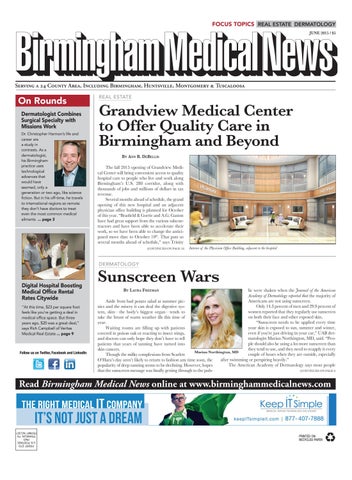
Interior of the Physician Office Building, adjacent to the hospital
DERMATOLOGY
Digital Hospital Boosting Medical Office Rental Rates Citywide “At this time, $23 per square foot feels like you’re getting a deal in medical office space. But three years ago, $20 was a great deal,” says Rich Campbell of Veritas Medical Real Estate ... page 9
Follow us on Twitter, Facebook and LinkedIn
Sunscreen Wars lic were shaken when the Journal of the American Academy of Dermatology reported that the majority of Americans are not using sunscreen. Aside from bad potato salad at summer picOnly 14.3 percent of men and 29.9 percent of nics and the misery it can deal the digestive syswomen reported that they regularly use sunscreen tem, skin—the body’s biggest organ—tends to on both their face and other exposed skin. take the brunt of warm weather ills this time of “Sunscreen needs to be applied every time year. your skin is exposed to sun, summer and winter, Waiting rooms are filling up with patients even if you’re just driving in your car,” UAB dercovered in poison oak or reacting to insect stings, matologist Marian Northington, MD, said. “Peoand doctors can only hope they don’t have to tell ple should also be using a lot more sunscreen than patients that years of tanning have turned into they tend to use, and they need to reapply it every skin cancers. Marian Northington, MD couple of hours when they are outside, especially Though the milky complexions from Scarlett after swimming or perspiring heavily.” O’Hara’s day aren’t likely to return to fashion any time soon, the The American Academy of Dermatology says most people popularity of deep tanning seems to be declining. However, hopes (CONTINUED ON PAGE 4) that the sunscreen message was finally getting through to the pubBy Laura Freeman
Read Birmingham Medical News online at www.birminghammedicalnews.com
The right medical IT COMPANY
IT’s not just a dream
medical
keepITsimpleit.com |
877- 407-7888 PRINTED ON RECYCLED PAPER
PRSRT STD U.S. POSTAGE PAID FRANKLIN, TN PERMIT NO.357
Civil & Complex Litigation
Divorce
White Collar & Criminal Defense
Governmental & Regulatory Affairs
Labor & Employment
Insurance Defense Mediation
Probate & Elder Law
Appellate Advocacy
We have a plan for the unplanned.
Attorneys at Law 2025 Third Avenue North, Suite 500, Birmingham, Alabama 35203 205-323-1888 WhiteArnoldDowd.com No representation is made that the quality of legal services to be performed is greater than the quality of legal services performed by other lawyers.
WAD Birmingham Medical News Lisha Ad.indd 1
2 • JUNE 2015
Birmingham Medical News
5/21/15 1:54 PM
HEALTHCARE SPOTLIGHT
Dermatologist Combines Surgical Specialty with Mission Work By DAle short
Dr. Christopher Harmon’s life and career are a study in contrasts. As a dermatologist, his Birmingham practice uses technological advances that would have seemed, only a generation or two ago, like science fiction. But in his off-time, he travels to international regions so remote they don’t have doctors to treat even the most common medical ailments. A native of Tupelo, Mississippi, Harmon set his sights early on becoming a physician. “I remember meeting with a career counselor in eighth grade,” he says, “and I already knew what I wanted to do. That early influence probably came from growing up near the area’s largest rural hospital. It had something like 800 beds in a town of 35,000 people. “A lot of my friends’ parents were doctors, so I had exposure to what they did. And the hospital had a program that was very progressive for its time--a summer program for pre-med students, where I worked as a scrub tech in the summers for three or four years during college. I knew most of the surgeons from the community, so it was a great experience.” It was during pre-med at Mississippi College in Clinton, medical school at Tulane, and an internship at Mayo Clinic that Harmon gravitated toward the field of dermatology. Today, he’s an expert in a specialized field of dermatologic surgery known as Mohs (pronounced “mose”), named for pioneering Wisconsin surgeon Frederic Mohs who began developing the process while still a medical student. For the past 20 years, Harmon says, “it’s been the gold standard for surgical management of skin cancers.” Also known as Mohs Micrographic Surgery (MMS), the technique uses microscopic tools combined with an exacting system of tissue dyes to concentrate on precisely targeting the malignant cells and severely limiting--often by as much as three-fourths--the amount of healthy tissue removed by conventional surgery, resulting in higher cure rates. The surgical procedure is so complex that students of it have to assist in at least 500 hours of the surgeries over a one to two-year fellowship. Each year a Mohs surgery fellow spends a year of training following their dermatology residency with Harmon and his partner, Dr. Evans Bailey, to become a Mohs surgeon. It was around the year 2000 that Harmon began his involvement in medical missions work, both locally and internationally. One local initiative was through the American Society for Dermatologic Surgery, on whose board he served. Members wanted to find ways to use their skills not just for affluent patients but also underserved populations. One initiative treats scarring in
Christopher Harmon, MD
victims of domestic violence; another helps with removing unwanted tattoos. On an international scale, his travels have taken him to locales ranging from the Middle East to the Peruvian Amazon. Every trip has been a learning experience, he says: “Basically we take a team of healthcare professionals and set up a walk-in clinic in an empty house or a school classroom. At first we thought we’d see a lot of
exotic tropical diseases, but the truth was that many common ailments here in the U.S. were the most common there also. “There is back pain and musculoskeletal pain with villagers who work as farmers and stay bent over much of the time. Impetigo is rampant because so many of the kids go barefoot. We see other common forms of skin conditions, and a lot of stomach aches from intestinal parasites. Fishermen have skin infections from snakebite or being stung by catfish. “With the back pain and musculoskeletal pain, we also help the workers learn to lift with their legs, and teach them better posture for working all day. Those solutions have more long-lasting results than just the nonsteroidals we can provide for them in the short term.” The team members also use the medical missions as a way of spreading their Christian faith and enabling a process they call “church planting,” helping local pastors set up new churches both to share the faith and see to the day-to-day needs of parishioners, especially widows and orphans. “We encourage our physicians and nurses to take time to pray with their patients and share their faith, things they don’t have the time or the leeway to do in a busy practice back home,” Harmon says. “Another satisfying thing we do is to bring several pairs of eyeglasses with us.
When you see a 30 or 40-year old adult simply put on a pair of readers or distance glasses and suddenly see the world clearly for the first time, it’s a very powerful moment. Often, in gratitude, they bring us eggs from their chickens, or a painting they have on the wall. “One of our most memorable experiences was when orthopedic surgeon John Morris treated a young man of 10 or 12 who had a broken leg from a fall. Dr. Morris had to put a makeshift cast of broomsticks and towels on the boy’s leg, and impressed on his family the need for him to stay in bed rather than continuing to hobble around. Six months later we were in the same area, at a house in the middle of a jungle, and saw that the boy was completely healed--running around, playing, and doing very well.” Harmon is engaged in two ministry efforts; one is called e3 Partners (e3partners. org) which helps with church-planting and growth; another is New Water Ministry (newwater.com) that operates a missionarytraining facility on Lake Martin, built in the wake of the 2011 tornadoes, with a working fruit farm that helps subsidize its outreach efforts. “We’re always looking for new people who have a heart for missions to help us,” he says. “It’s a great way for us all to come together.”
MGMA/Alabama Summer Conference
Rx for Healthcare –
Let The Music Play
August 3-5, 2015 Hilton Sandestin Beach Golf Resort & Spa Destin, FL
For more conference information and to register, please visit our website at www.almgma.com Birmingham Medical News
JUNE 2015 • 3
DERMATOLOGY
Sunscreen Wars, continued from page 1 need an ounce of sunscreen—about a shot glass full—to cover the face and other exposed areas of skin. Getting enough may take more than one layer. They also recommend a broad spectrum sunscreen that blocks both UVA and UVB rays. Why aren’t more people using sunscreen? Perhaps they don’t fully understand the damage UV radiation can do. Life is busy, and if they haven’t made it a habit, they may forget. Some males may feel that skincare is something manly men don’t do. Those are the typical answers. However, adding to sunscreen confusion are two new topics heating up the news and the internet. The first is the battle between congress and the FDA over the agency’s long backlog of applications for approval of next-generation sunscreen ingredients that have been available in the EU and most of the world for up to 15 years. Legislation unanimously passed in a rare show of bipartisanship was signed into law last November. The Sunscreen Innovation Act required that the FDA act on stalled applications for new ingredients within 300 days. Act they did—they said no to all the applications. A spokesperson for the FDA stated that insufficient data had been submitted to make a judgment on the long term safety of the new ingredients, especially in vulnerable populations like pregnant women, and particularly in view of the fact that unlike in the past, when sunscreen was used occasionally, current recommendations are for daily use in larger quantities.
On the other side of the problem, are concerns about ingredients and products the FDA does allow that would not be allowed under EU safety regulations, particularly those that offer inadequate UVA protection, are frequent allergens or suspected endocrine disrupters, or are inclined to develop free radicals, increasing the chances of DNA damage to skin cells. Perhaps the most frequently voiced objection is about nanoparticles used to block UV rays without leaving a white residue. The concern is that such fine particles with repeated use may be absorbed into the skin or inhaled into the lungs in sprays with long term effects that are unknown. Preliminary studies suggest that nanoparticles are not absorbed, but have not been sufficiently definitive to calm fears. The concern from congress and others pushing for approval of next generation sunscreens focus on the effects of UVA radiation. SPF only measures the effectiveness of sunscreens against UVB damage. Recent research shows that UVA rays, which are far more abundant than UVB rays, do play a role in the development of skin cancer over time. They also have a primary role in the premature aging effects from too much sun. Another frequently voiced concern is that sunscreens do not block all rays. People who use sunscreen to extend their time in the sun may be doing more accumulated damage to their skin than they realize. This is particularly disturbing since
K
Consumer Reports in the US and similar consumer organizations in the UK and Canada have published studies suggesting that up to a third of sunscreens on the market don’t perform as advertised. The most frequently cited problem is that their water resistance and SPF protection after water contact do not perform up to stated levels. So with all the confusion, what does a doctor recommend to patients? “People need sunscreen—SPF 30. Melanoma kills and sun damage ages,” Northington said. “However, don’t depend on sunscreens alone. Look for shade. Stay out of the sun as much as possible between 10:00 and 4:00. Wear UV protective clothing. Wear a hat that protects not only the front of your face, but also the sides.” In addition to a wide spectrum sunscreen that protects against both UVA and UVB rays, some dermatologists suggest using something with antioxidants to minimize the risk of free radical damage to the DNA in skin cells. Some moisturizers also have ingredients with naturally occurring SPF, such as red raspberry seed oil (SPF 28-50) and carrot seed oil (SPF 38-40). They are usually present in insufficient concentrations to use alone, but they could be a starting point for patients who won’t use other sunscreens. More research is needed to clear up the confusion and make the best possible choice available to the public. In the meantime, what can be done to ease the other miseries of summer skin?
Kassouf
Compliance Plus
Kassouf & Co introduces Compliance Plus — a comprehensive HIPAA readiness, management, and documentation solution. COMPLIANCE PLUS is much more than just an online HIPAA program. Compliance Plus connects our staff and resources with your staff, creating a collaborative portal to successfully implement a customized and ongoing HIPAA compliance program. COMPLIANCE PLUS is a partnership between your practice and our team of healthcare experts. This is not a do-it-yourself solution. We guide you through the HIPAA compliance process, providing the necessary documentation, analysis and training.
THROUGH COMPLIANCE PLUS YOU RECEIVE: • HIPAA project & task management • On-site IT annual risk assessment • Policy & procedure assessment • Access to the Kassouf Policy Library • Compliance risk management
• Initial on-site HIPAA training • Ongoing web-based HIPAA training • Monthly security updates to staff • Centralized document repository • Ongoing “security officer” support
COMPLIANCE PLUS is our commitment to be there when you need us — supporting you and your practice.
K a s s ou f C E R T I F I E D
P U B L I C
Co A C C O U N T A N T S
2208 University Boulevard | Birmingham, AL 35233 | 205-443-2500 | complianceplus.kassouf.com 4 • JUNE 2015
Birmingham Medical News
“For a bad case of poison oak, I prefer to use topical steroids. They bring relief without the side effects of other steroids,” Northington said. “To avoid heat rashes and fungal infection, keeping the skin clean and dry can help, especially drying well after showers in skin folds and between the toes.” For patients who tend to get poison oak so severe it requires a doctor visit, prevention can be as important as treatment. They should learn to recognize and avoid poison oak. They should especially know to never burn poison oak in an attempt to get rid of it, and to avoid inhaling smoke from areas where poison oak may be burning. One strategy is to assume whenever they are outside that they may have come into contact with poison oak and learn to remove it effectively. Most soaps are superfatted to make them more moisturizing, which makes them less than ideal for removing poison oak’s tenacious urushiol oil. This is one area where grandmother’s advice may be right—a laundry soap formulated to break up oil may be helpful in getting poison oak oil off. Old-fashioned Octagon may be impossible to find, but many artisan soapmakers make a lowsuperfat laundry soap, and in a pinch, a degreasing formula dishwashing detergent may help. Keep hands away from the face, and always wash hands before changing clothes to avoid waistband rash. Then wash ankles and anywhere else poison oak may have touched. Follow with lotion to replace skin oils that may have been washed away with the poison oak oil. Since tiger mosquitoes moved into Alabama, avoiding itchy bites and the possible diseases they can bring has grown into a bigger challenge. Unlike mosquitoes that typically bite in the early morning or late in the day, tiger mosquitoes, which can be identified by the white stripes on their back legs, are hungry all day. They are so persistent, they will bite through clothing and will keep looking till they find a spot of prime skin the insect repellent missed. For patients who can’t tolerate DEET repellants or are fearful of them, repellants containing lemon eucalyptus and/ or catnip may be an option. Some people do seem to attract more mosquitoes than others. Some theories are that high blood sugar, recent consumption of high potassium foods, warmer than average body temperature, and byproduct of metabolism in perspiration after exertion tend to attract mosquitoes. Patients who attract more than their share may also want to avoid toiletries scented with floral, fruit and food fragrance when they plan to be outside. A better choice would be plant-derived fragrances from botanicals that insects tend to avoid, such as lemongrass, lavender, tea tree, mint and eucalyptus.
DERMATOLOGY
Finally. A Clear Victory against Psoriasis Monoclonal Antibodies Targeting Interleukin Cytokines Effective in Trials By Laura Freeman
When Shawn Ingram’s doctor sent him home with steroids and a recommendation for dandruff shampoo, his frustration would be all too familiar to many psoriasis patients and their physicians. “I was covered from head to toe. The steroids barely eased the itching for a few days, and then it came back with a vengeance. I couldn’t even sit down for more than a few minutes without the skin coming off the back of my thighs. Every time I took off a shirt, it was covered in white flakes,” Ingram said. “When I heard there wasn’t anything else that could help me, I knew I had to find something. The constant itching was torment. So I searched online and read about the clinical trials Dr. Elewski is doing at UAB. One injection and the itching was gone in a few days. Within a couple of weeks, my skin started clearing. By the time I went back a month later, the symptoms were gone.” Ingram’s skin has been clear for a year now, and it is staying clear with an injection once every three months. His success story isn’t the only one Boni Elewski, MD is seeing in the clinical trials she has
Boni Elewski, MD (right) consults with Shawn Ingram.
been conducting on several drugs targeting Interleukin-17 and 23. The UAB professor of dermatology is the principal investigator for one of two studies on Secukinumab recently published in the New England Journal of Medicine, and she has conducted trials on related drugs including Brodalumab and Ixekizumab, which are expected to soon
receive FDA approval. “This is going to be a life changer for many patients,” Elewski said. “The phase two data on this family of drugs looked promising, and the response we’ve seen so far in phase three trials has been very encouraging. A statistically significant percentage of patients with moderate to severe psoriasis treated with Secukinumab
achieved skin clearance of up to 90 percent or more after 12 weeks, and with continued treatment, a majority of these patients were maintaining those results at one year.” In normal skin, the interlukin-17 cytokine activates the body’s immune system to heal cuts, scrapes and other injuries. However, people with psoriasis lesions can have many times as much IL-17 as those without. The healing process becomes a continuing loop of new cell production and inflammation. Secukinumab (Novartis) and Ixekizumab (Eli Lilly) target IL-17, while Brodalumab (Amgen) targets a specific receptor that binds to the IL-17 cytokine. “So far, these IL-17 inhibitors have been well tolerated. Since the new drugs are more targeted to only one cytokine, and there are a number of healthy people in the world who don’t even have IL-17, we feel the drugs are likely to score well on safety, though we will be evaluating fiveyear data to confirm that,” Elewski said. “There seems to be a genetic predisposition for psoriasis in some people. Along the way, something triggers the predisposition. It can be an illness, a (CONTINUED ON PAGE 12)
Being a Dad takes a lot of Heart. Take care of yours.
For more information or to find a physician, visit our website at cvapc.com. 205.510.5000 | cvapc.com Father’s Day is June 21st Birmingham Medical News
JUNE 2015 • 5
We care...and we give back We care... • We treat clients with the utmost respect • We are committed to great community service • We help those less fortunate • We always try to do the “right thing” • We want to leave the communities we serve better than we found them
We give back... • We give our time and financial resources to help those less fortunate • We provide exceptional and professional IT services to our clients • We encourage our employees to support the communities they live in • We support our military
Why Do You Think that Worker is an Independent Contractor? By Allen Sullivan
If you’re reading this article, you likely own or administer a medical practice of some sort. That practice may have workers of many stripes. Some of those workers may be treated as employees and some may be independent contractors. For example, some home health workers may be paid as independent contractors while others are not. If you help run a hospital, you may have noticed that some hospital doctors are considered contractors yet others are employees. But do you know why they are treated that way? Well, if the IRS or the Alabama Department of Revenue audits your practice, you may need to know why quickly.
Healthcare IT Can Be Risky Business. • Birmingham American Heart Wear a Helmet... The Economics of Worker Association Office
We give to...
• Tuscaloosa Habitat for Humanity • St. Jude’s Hospital
Classification
Since 2008 many companies have
And Have A Technology Partner With Interest At Heart Why Should You Care? cut costsYour whereverBest possible, which often
involves using independent contractors. Why? Employees are more expensive • Birmingham’s ProjectFor 19 Years, We Have Been That Partner. than independent contractors. Employees Homeless Connect carry the burdens of health care benefits, minimum wage limitations, fringe benefit • Wounded Warrior Project We have taken a leading role in HIPAA/HITECH costs. None of these issues arise with indeawareness and IT security preparedness. • The First Tee pendent contractors. • East Tennessee Children’s Hospital In addition to administrative burWe monitor our clients’ IT systems around the clock dens, employees also cost their em• Birmingham March ofand Dimes office only senior engineers perform scheduled ployers more in employment tax than maintenance and upgrades. We don’t outindependent contractors. All employers source anything. must generally pay employment taxes Integrated Solutions, a division of IT 4 the (Social Security, FICA, etc.) of around 7.5 provide data Planet, is a SERVICE drivenWe company. Weprotection solutions, utilizingtoa numerous wide range of products and techpercent of each employee’s salary. There offer professional IT services nologies, instead of what is simply our is no similar requirement related to indemedical clients in the Birmingham area. As branded offering. pendent contractors; they are responsible a result, we are the premier IT provider in the for their own employment taxes. Using Birmingham area. Our clients would say our We build disaster plans and fail-over the national income average of $43,000, responsiveness, our people, our professionalism systems for data, connectivity and an average employee costs his employer and our problem solving skills exceptional evenare cooling. We test real world about $3,700 more than an average inscenarios, and our strategic advantages overso we know they will dependent contractor in tax-related costs work when it counts. our competition. alone. Thus, all other things being equal, businesses treating their workers as inWe care and we give back...that is a priority We are partners with Medical dependent contractors have competitive and the “right” thing to do!Incorporated to bring state-of-theadvantages over those treating similar art backup power systems that run for workers as employees. hours current (and days) If you are not happy with your IT instead of just minprovider and would like toutes. get an assessment Independent Contractor or of your current situation, give us a call… Employee? We strive for economy wherever possible that would be the “right” thing to do. Because the worker classification de• Marine Toys for Tots Foundation
and integrity above everything, because that matters most of all.
Let us become your trusted practice partner. a division of:
www.it4theplanet.com 205-314-3444 Your Healthcare Technology Partner
www.ntgrated.com 205-314-3444
it4theplanet.com
6 • JUNE 2015
That is, you cannot simply label your worker an independent contractor and expect the IRS to take your word for it. Since 1987, the IRS has used a “20 Factor Test” to determine whether or not a business has control over a worker. Each factor indicates control or a lack of control, and, in turn, either employee or independent contractor status. For example, if you require your workers to attend formal training, then your control indicates employee status. Control is also evident if a worker must work set hours, gets paid by the hour, or can be terminated at any time. On the other hand, if a worker is paid on a per-task basis, does the same type of work for other companies, and provides his own tools and equipment, then the paying company doesn’t likely control the worker enough to trigger employee status.
wear a helmet 2.indd 1
Birmingham Medical News
cision affects the bottom line, many companies prefer to classify their workers as independent contractors. But what makes one worker an employee and another an independent contractor? In a word: control. If a company has control over how a worker performs her job, then that worker is most likely an employee. The substance of the worker/company relationship therefore determines the worker’s classification, no matter how the company and worker decide to define the relationship.
In 2009, the Government Accountability Office (“GAO”) took the IRS to task for its ineffective enforcement of employment tax compliance. The so-called “tax gap” -- the gap between taxes owed and those actually paid -- was widening at this time, and employment tax issues, like the misclassification of workers as independent contractors, played a significant part. The GAO report estimated that worker misclassification alone accounts for $1.8 billion of the tax gap. The U.S. Department of Labor estimated additional unemployment insurance revenue losses to be in the $400 million to $600 million range. Soon after the GAO report’s release, the IRS responded by announcing a “National Research Program” (“NRP”) -- the first of its type since 1984 -- to address issues that surfaced in the GAO report. In reality the NRP was more like a massive audit initiative. The IRS used the NRP to audit 6,000 U.S. companies, targeting broad cross-sections of employers nationwide: corporations and pass-through entities, profitable entities and those inthe-red, and operations large and small. Among other things, these audits analyzed the companies’ worker classification decisions. Armed with NRP data the IRS is identifying noncompliance patterns and using this information to audit others. Will the IRS again target health care companies like they did in the ‘90s after concluding a similar research project? We don’t know yet, but the employment tax world seems to run in cycles, and federal and state governments are under stress to plug widening budget holes. (CONTINUED ON PAGE 12)
4/25/2013 9:38:20 PM
REAL ESTATE
Medical Real Estate on the Move in Alabama Brookdale Rehab and Health Care Center Opens
By Ann Debellis
A number of medical real estate projects are under way in parts of Alabama. The following outlines some of the ventures taking place around the state.
St. Vincent’s Hospital – Chilton
St. Vincent’s Hospital and Chilton County are partnering to open a 30-bed hospital to serve the people of that county, which has been without a hospital since 2013. The hospital will be located on Highway 145 in Clanton near the area’s old hospital. Renovations to the old hospital were estimated at $11 million, so county officials voted to build a new facility. Voters passed a one-cent sales tax that will generate up to $3.5 million for the hospital. The St. Vincent’s St. Claire hospital in Pell City is a model for the Clanton facility. Chilton County health care officials have entered into a formal agreement with St. Vincent’s Health System which will operate the new medical facility. St. Vincent’s-Chilton is scheduled to open in 2016.
MedHelp 280
MedHelp Clinic – U.S. 280, Birmingham
The MedHelp Clinic on U.S. 280 in Birmingham has replaced its 9,000-squarefoot clinic with a new 40,000-square-foot facility. A new parking area will be constructed on the site of the old building. The new clinic will have a full-service laboratory with diagnostic imaging capabilities that include nuclear medicine and ultrasound. Other services will include urgent care, family medicine, cosmetic dermatology, and diagnostic imaging. “We also have an area where a specialist can rotate through our space on a daily basis,” says Tonya Cardwell White, Chief
Operating Officer. “This is part of a new venture for MedHelp to provide a comprehensive Medical Center.”
New Psychiatric Unit at Shelby Baptist Medical Center
Shelby Baptist Medical Center opened a new inpatient psychiatric acute care unit earlier this year in the hospital’s South Tower. The $1.6 million investment creates approximately 30 new jobs. The 20-bed unit is the only one of its kind in Shelby County and is a new service for Shelby Baptist. The unit will provide inpatient services to adults 19 and older.
A long-time dream became reality recently with the opening of Brookdale Place University Rehabilitation and Skilled Nursing Center. The 66-bed center is the final part of the 466-unit development in Homewood. The 47,000-square-foot center offers long-term skilled nursing care, along with physical, occupational, and speech therapy in its long-term care and short-term care units.
Vestavia Hills Plans Health Care Facilities at Patchwork Farms
Vestavia Hills officials have plans to build two health care facilities at Patchwork Farms, an 80-acre area near Cahaba River and Caldwell Mill roads between U.S. 280 and Interstate 459. Northport Holdings purchased seven acres for $1.4 million and plans to build a 70,000-square-foot nursing facility. The company plans to relocate 120 beds from Jefferson County’s Ketona nursing home. Northport Holdings is also planning a (CONTINUED ON PAGE 8)
Financial planning and wealth management like it should be: strategic, collaborative and acting in your best interest.
3800 Colonnade Parkway, Suite 300 • Birmingham, Alabama 35243 Phone: (205) 208.8700 • bridgeworthllc.com • Bridgeworth, LLC is a Registered Investment Adviser.
Birmingham Medical News
JUNE 2015 • 7
REAL ESTATE
Medical Real Estate on the Move in Alabama, continued from page 7 118-bed skilled nursing and rehabilitation facility on property near U.S. 31 and the I-65 interchange in Hoover. Capital Growth MedVest LLC also purchased seven acres for $1.4 million and plans to lease the property to Brookwood Medical Center to build a 56,000-squarefoot rehabilitation facility and geriatric psychiatric unit. The two facilities are expected to generate $18 million in revenue each year and create approximately 460 new jobs.
Bruno Cancer Center Provides Pinpoint Accurate Cancer Treatment
Cancer patients at St. Vincent’s Hospital’s Birmingham campus are receiving first-class treatment in the new Bruno Cancer Center that opened in August 2014. The 71,000-square-foot center is located on three floors and has 21 examination rooms that are outfitted with features that include advanced radiation technology with Varian TrueBeam STx; specialized assistance services including registered dieticians, pet therapy, and art therapy; free valet parking; support groups; nutrition classes and physical activity programs; Newk’s café; and a meditation room.
Strayer University Building Converts Space for Medical Tenants
24,000 square feet of the Strayer
Strayer University office building
University office building on Grandview Parkway have been converted to medical office space. Summit Internal Medicine has signed a contract for 4,000 square feet, and American Health Imaging has leased another 4,000 square feet. According to Walter Brown of Graham & Co., another 7,100 square feet of space is available across the street. “We can lease as small an area as 2,000 square feet or as much as 7,100 square feet,” he says.
Medplex Office Building to Be Sold
The 30,000-square-foot Medplex I office building on Valleydale Road is al-
Vincent’s One Nineteen health facility is scheduled for completion in fall 2015. The new building will house physician services, an ambulatory surgery center, and an urgent care center. St. Vincent’s expects residents of Northern Shelby County and those along the U.S. 280 corridor to be the primary users of the facility. Officials may add a small hospital to the complex in the future.
Alabama’s First Freestanding Emergency Department Open in Hoover
Medical West opened Alabama’s first freestanding emergency department facility in April near the intersection of U.S. 150 and I-459 in Hoover. An affiliate of UAB Health Systems, the Med West emergency room consists of 10 examination rooms, two trauma Medplex I building rooms, CT and tray scans, vascular and general ultrasound, most vacant and will be on the market laboratory rooms, and additional space soon. The one tenant still occupying space for expansion. will terminate its lease if someone wants to Brookwood Medical Center has occupy the three-floor building. begun construction on a freestanding emergency department to be located at Addition to St. Vincent’s One the intersection of U.S. 280 and Hwy. 119, and Baptist Health System is making Nineteen plans for one also. A 40,000-square-foot addition to St.
She grooms pets for a living. And she takes care of her employees’ health insurance coverage without any shortcuts. Sabrina chose Blue Cross and Blue Shield of Alabama for her pet store employees. They get an affordable plan with the largest network of doctors and hospitals in the state. This helps Sabrina retain her best employees without having to cut any corners. Just nails and fur.
AlabamaBlue.com Blue Cross and Blue Shield of Alabama is an independent licensee of the Blue Cross and Blue Shield Association.
8 • JUNE 2015
Birmingham Medical News
REAL ESTATE
SPORTS MEDICINE FOR ATHLETES Rich Campbell consults with a physician client.
Digital Hospital Boosting Medical Office Rental Rates Citywide By Jane Ehrhardt
“At this time, $23 per square foot feels like you’re getting a deal in medical office space. But three years ago, $20 was a great deal,” says Rich Campbell of Veritas Medical Real Estate. Prices for medical real estate began a steep rise this year in response to the physicians office building (POB) being built on the campus of Trinity hospital’s new location on Highway 280. The new building, dubbed the Grandview Physicians Plaza, will include 207,500 square feet spread over eight floors. Right now, according to the developer, Daniel Corporation, about 68 percent is leased. But that may be low-balling it, because Trinity is anticipated to request more than the 103,000 square feet they have committed to so far. The rental price at the Grandview runs $21 per square foot without operating costs. “We anticipate rental rates in the range of $30 to $32 per rentable square foot including operating expenses,” says Jim Adams with Daniel. “Those two numbers are apples and oranges, and physicians have to know how to decipher it,” says Campbell. “A lot of doctors get out into real estate and hear the on-campus rate is $21 and another offcampus landlord says $23, and the doctor does not know that the $23 is all inclusive — operations, taxes, insurance — but the $21 on-campus rate is only a base rate.” The actual costs to the physicians are not being hidden, stresses Campbell, it’s
just that physicians need to be educated on shopping for office space. “There are nuances in every lease,” he says. The rent at Grandview has spurred increases across the city. “It happened very quickly to buildings across from the hospital. They instantly raised their rates,” Campbell says. Before Grandview’s announcement, leases in that vicinity ran $21 to $23. “And they were pretty close to the hospital,” he says. “But now they’re $28 to $29 per square foot and they’ve not done anything extra to get that additional rental rate.” In Homewood, about 15 minutes away from Grandview, practices can still get space in existing buildings for $22 to $23 per square foot, including operating expenses. “But those owners are now thinking of charging $25 to catch up with the market,” Campbell says. “I think the rise in medical rental prices is inevitable. On Highways 119 and 280, where it’s not more convenient to the digital hospital, it’s now $25 per square foot.” Campbell doesn’t see any pattern to the trend of rising rents in the metro area. “I don’t think there is going to be a pattern,” he says. “It’s just landlords are going to be setting rents at the new norm of $25 to $30 per square foot. “The developer of Grandview is not being greedy,” Campbell says. “The new building is just more expensive to run. It’s a nicer building, and there’s more to it, so it’s requiring a low $30’s rent to cover that.”
… AND FOR THE REST OF US. OUR NON-OPERATIVE SPORTS MEDICINE PHYSICIANS
Emily B. Casey, M.D.
Ricardo E. Colberg, M.D.
José O. Ortega, M.D.
Cherie B. Miner, M.D.
OUR ORTHOPAEDIC SURGEONS
James R. Andrews, M.D.
E. Lyle Cain, Jr., M.D.
Andrew M. Cordover, M.D.
Jeffrey C. Davis, M.D.
Jeffrey R. Dugas, M.D
Benton A. Emblom, M.D.
James A Flanagan, Jr., M.D.
Samuel R. Goldstein, M.D.
Wayne McGough, Jr., M.D.
Kathleen E. McKeon, M.D.
Steven R. Nichols, M.D.
Norman E. Waldrop, III, M.D
SPECIALTIES Foot & Ankle • General Orthopaedics • Hand & Wrist Hip • Joint Replacement • Spine & Neck • Sports Medicine Non-Operative Sports Medicine for Adults & Children Birmingham
805 St. Vincent’s Dr, Ste 100 Birmingham AL 35205
Hoover
201 Doug Baker Blvd Hoover AL 35242
Pelham
3143 Pelham Pkwy Pelham AL 35124
Gardendale
2217 Decatur Hwy, Ste 101 Gardendale AL 35071
205.939.3699
AndrewsSportsMedicine.com
(CONTINUED ON PAGE 12)
Birmingham Medical News
JUNE 2015 • 9
REAL ESTATE
Grandview Medical Center to Offer Quality Care, continued from page 1 CEO Keith Granger. Cahaba Center at Grandview contains approximately 103 acres with about 65 of those acres open to development. The hospital parcel, containing the hospital, parking garage and Physician Office Building (POB), is on 13.5 acres. The 200,000-square-foot POB will house both single-physician practices as well as multi-specialty clinics. Daniel Corporation owns and will manage the leasing of the POB space. “We are currently working with Trinity to lease space to physicians in the new office building,” says Jim Adams, Senior Vice President for Daniel Corporation. “We hope to open the hospital and the POB simultaneously. We want to relocate many of the physicians who are currently on the Trinity campus as well as others and hope to have a good mix of specialists and family practice.” Grandview Medical Center will have several unique features that will be both attractive and convenient to patients. “The design of the campus and its focus on wayfinding throughout the facilities is unique,” Adams says. “We want to make sure that when you get to the campus, you can park easily and find where to go in the hospital and POB.” The 3,000-space parking garage will offer plenty of parking for visitors. For easy location of your car, each level of the deck will have different Birmingham-area themed markings and color codes as well as digital directional signs. The design of the elevator bank will make it easy to enter and exit both the hospital and POB from the garage. “Once you park, designated
Entrance to the new Grandview Medical Center
elevators will take you straight to either building. Elevator lobbies will make it easier to find physicians. No matter where you need to go, it is a straight shot from the parking garage,” Adams says. Local art and photography will be used throughout the hospital, and the patient rooms will convey a warm, hoteltype environment. “With the landscape of the area, patients and visitors will enjoy wooded scenery up and down the Cahaba River,” Granger says. “They also can see pleasing views toward the Galleria area and up to the Summit, as well as southeast down 280.” Trinity Chief Operating Officer Drew Mason says the new hospital will employ new technologies that will bring a high level of patient service. For example, the operating rooms will be equipped with a fully integrated Stryker operating system, and physicians and staff can access medical im-
aging and PACS systems to view operational information or medical records through digital monitors. “This integration of services will be a positive thing, because patient experience and clinical outcomes are a big focus of the new facility,” Mason says. “The patient experience will focus on three main systems: digital directional way-finding signage, patient interactive television, and electronic patient in-room communication boards,” Mason says. Medical communication systems will be accessible through digital technologies in treatment areas and in patient rooms, and digital signage will help visitors and patients find their way around the facilities. Patient rooms and a large number of medical/surgical rooms will have digital capability that will allow patients to access television, internet, and free movies through a 42-inch television mounted on the wall. “They also will be able to order
Spring has
Sprung
...and so has postnasal drip. But is it a cold or a sinus infection?
The signs can fool many people. But sinus infections usually need medical attention to fight the bacteria or fungus causing the distress. Some chronic sinusitis can last for months. There’s no need to suffer any longer. Come see our ENT specialists and otolaryngologist. A wide array of treatments exist from sprays to antibiotics to the newest breakthrough procedure of balloon sinuplasty to enlarge sinus cavities.
Call us today for more information.
205.988.6858
www.excelental.com 10 • JUNE 2015
Birmingham Medical News
dietary items online, purchase items from the gift shop, and access information from our service lines and the patient portal,” Mason says. “From a safety standpoint, we can also pull information that lists food allergies or access patient education materials based on the patient’s medical records.” Another 42-inch monitor in each room serves as a digital white board that lists the names of the patient’s nurse and physician, types of allergies, and standard precautions of which the staff needs to be aware. “This is new technology, and I’m not aware of any other hospital in the Southeast that has this exact system,” Mason says. Patient rooms and other areas in the facility are designed to minimize infection, maximize communication, and make sure patients and their families receive information regarding their disease or condition. Also, the design of the building allows for major services to be in close proximity to one another. Convenience for the patient is also important. For example, on the operating room floor, a patient comes into one room for pre-registration, preparation, surgery, and recovery. “We are trying to keep services as consolidated and convenient as possible,” Granger says. “For emergency room patients, the radiology department, cardiac catheterization lab, and other services often used for ER visits are all close to one another. From a patient flow perspective, we think that will work well.” Granger expects the new medical center to have a wide-reaching impact on the health care community. “From a longterm perspective, we are moving where many in Birmingham have moved over the last 10 to 20 years. By moving outside the I-459 perimeter, we are putting ourselves in a convenient location for households that have grown in and around the Birmingham area,” he says. “We are in close proximity to interstates 459, 59, 20, and 65. Because the interstate system is so well connected, people who take the I-459 perimeter will find themselves only a few minutes from our new location. “I believe we will expand the footprint of Birmingham as a health center in Alabama and perhaps other states, particularly for those whose subspecialty services are not typically available in smaller hospitals,” Granger says. “We want to create our future by working in those arenas, connecting ourselves, the state, the region, and the Southeast.” Granger expects Grandview Medical Center to become a flagship referral source for many people in our state and around the country. “It is a site where we can teach and educate physicians and recruit the best and brightest to be part of our medical staff. We expect our role to become more visible and to expand the Birmingham footprint of health care to a larger market and actually be complementary to other services that currently exist in our community,” he says. “We don’t see this as anything but a plusplus going forward, and we look forward to taking a leadership role as part of that system going forward.”
Birmingham Medical News
JUNE 2015 • 11
Why Do You Think, continued from page 6 In any event, the IRS clearly plans to intensify its worker classification audits. This audit uptick may also relate to the Affordable Care Act’s (ACA) requirement that companies with 50 full-time equivalent employees must offer those employees health insurance. The IRS may worry that ACA-related burdens will tempt more companies to attempt illegitimate contractor use. Any companies considering moving to a contractor-heavy workforce because of the ACA, or for other reasons, should therefore evaluate whether those workers may be reclassified as employees in an IRS audit.
Prepare Now
Companies can prepare for government scrutiny by reviewing their own compliance procedures, and perusing contracts with would-be independent con-
If you are an Administrator or Manager of a medical practice in Shelby or Chilton counties
JOIN US
Our
tractors. You may be able to avoid many penalties by disclosing past missteps to the IRS before an audit. And if you are audited, time is of the essence. Establish a proper chain of command to ensure that important notices, and their deadlines, don’t go unaddressed. Additionally, companies need procedures in place that guarantee that outside advisors are notified right away. Involving tax practitioners early in an audit may allow them to narrow the audit’s scope, and thereby reduce the costs of defending it. Spending a little time and money now can save a lot of both later. Allen Sullivan is a partner at Burr & Forman LLP, who specializes in tax law.
Digital Hospital Boosting Medical Office Rental Rates, continued from page 9 Adams says the culprit is rising construction costs. “Unfortunately construction costs go up and lease rates go up accordingly,” he says. “In many cases, the rent is more than physicians have been paying, but we tell them that if we could lease for less, we would because our objective is to get the building leased at 100 percent as soon as we can.” Moving to a new building can create opportunities for ongoing savings not possible in other situations. “It offers efficiencies they might not have in the design of their existing spaces,” Adams says. “This is an opportunity to better arrange the flow of their office.” Due to open October 10, Grandview Physicians Plaza will offer not only the convenience of being on Trinity’s new
Finally. A Clear Victory, continued form page 5
Our next meeting is
June 9th For information on membership & future meetings, contact Erin Fisher efisher@shelbydermatology.com
medication, drinking alcohol or smoking. Smoking particularly seems to be associated with greater difficulty in clearing psoriasis lesions. Stress seems to trigger flares. “Psoriasis also tends to come with other co-morbidities, so we try to make sure our participants have good follow-up with a physician who can monitor their overall health. The arthritis some patients experience turns out to be psoriatic arthritis. Metabolic syndrome is a frequent factor, so we may send participants to a nutritionist or get evaluations for other conditions that may be affecting their health.” For patients who are needle phobic or may be in other situations where injections
People make the difference! “I love it that in my job I can make a difference in someone’s life and see them smile. I know our residents depend on us to provide for their needs and wants when they can’t do it for themselves, so I enjoy going the extra mile to make them as comfortable as possible while they’re here with us.”
— Charysse Knight, LPN
AT SOUTH HAVEN, WE OFFER A CONTINUUM OF CARE: Skilled Nurses | Dementia Care | Long- Or Short-Term Care Speech Therapy, Occupational Therapy & Physical Therapy
(205) 822-1580 • Stop by for a tour
“Best Practice 2012 and 2013” 3141 Old Columbiana Road | Hoover AL 35226 | southhavenhealthandrehab.com 12 • JUNE 2015
Birmingham Medical News
campus, but will sit atop its own parking structure. “If you are seeing a physician on the fifth floor, you will get on the elevator in the parking garage and go straight to that floor,” Adams says. “You don’t have to stop in the lobby and switch elevators. It’s just a straight shot.” The moral of the story, says Campbell, is physicians with lower rents now — no matter if they are affiliated with Trinity or not — should be ready for a marketwide shift. “It’s beginning to happen now,” he says. “There are still good deals out there. But I think in 18 months, you will no longer be able to negotiate prices by saying you’ll just go somewhere with lower rents. I could be wrong. To some degree, I will be wrong, because landlords want doctors. But prices are rising.”
may be difficult, such as soldiers in combat zones, an oral drug already approved for arthritis may soon be approved for psoriasis. “Pfizer’s Tofacitinab works by a different mechanism and is somewhat slower, but it seems to work as well as high dose Embrel,” Elewski said. “What we need to let patients know is that with so many new options that will soon be available, there is hope. There should be a good choice for just about everybody.” The drug that brought Shawn Ingram so much relief, MK-3222 developed by Merck, takes a slightly different approach, but from a similar strategy. Instead of IL-17, it targets IL-23. It is a high-affinity humanized anti-IL-23p19 monoclonal antibody that doesn’t bind human IL-12. It recently earned its official name, Tildrakizumab, and is one of the more recent weapons in the psoriasis arsenal that are now in clinical trials. “Severe psoriasis can have such an impact on everyday life—not only the physical discomfort, but also social and emotional aspects, employment and finances, and the person’s self-image,” Elewski said. “One young woman came in covered head to toe in sweats and a hoodie. She had never had a date. She hadn’t been allowed to swim in a pool because her skin looked so bad. A month after the first injection, she came back wearing a tank top. She has a boyfriend. We all burst into tears and hugs. “Another patient was homeless. He smelled bad because no one, not even relatives, would let him use a shower because his skin was shedding so badly. He came back the next visit, and he was clean. His skin was healing. Now he has a job. He has a girlfriend. He has a life.”
REPRINTS: Want a reprint of a Medical News article to frame? A PDF to enhance your marketing materials? Email subscribe@medicalnewsinc.com for information.
Five Ways Millennials Have Shaken Up Healthcare They prefer alternative to single-source, PCP favored by older generations that thrive will be those that adapt sooner than later to the preferences of this fastpaced, technology-driven generation.” Growing trends among the millennials that are driving change in healthcare include:
By Julie PArKer
The most influential demographic group – millennials, ages 21-32, empowered by advances in technology – is turning America’s healthcare landscape upside down. In a recently released survey commissioned by PNC Healthcare, more than 5,000 participants nationwide explored the impact of patient-centered care among various age groups, including millennials, Generation X or Gen-Xers (ages 33-49), baby boomers (ages 50-71) and seniors (72+). The most significant finding: online shopping for doctors, webbased diagnostic tools and research about treatment options have a role in healthcare decisions for millennials, replacing the single-source, primary care physician (PCP) favored by older generations. “As millennials overtake boomers as the nation’s biggest consumer buying group, they will expect more efficient ways to make healthcare payments via digital channels that are consistent with their experiences in other industries,” said Shane Print, vice president of PNC Healthcare
Speedy delivery
for Florida, Alabama and Georgia. “It’ll be important for payers and providers to work together to meet these payment expectations by progressing further along the technology continuum, especially considering that much of the growth in the healthcare payments industry has been driven by a rise in patient responsibility. Those insurers and healthcare providers
When it comes to the drive-thru generation, millennials prefer retail (34 percent) and acute care clinics (25 percent) double that of boomers (17 and 14 percent, respectively) and seniors (15 and 11 percent, respectively). On the flip side, seniors (85 percent) and boomers (80 percent) visited their PCP significantly more than millennials at 61 percent. For example in Florida, Print noted that urgent, specialty and retail clinics over the last four years have grown dramatically. “Quick Care” availability has been recognized as a top priority by many healthcare organizations, and even large retailers and several pharmacy chains. Millennials expressed concern about this method of care and the quality of the patient’s care, based on who’s consulting with the patient (level
Ty Thomas, MD Chad Austin, MD Alex Pisaturo, MD Brian Thoma, MD
We do. Leg pain is one of the most common complaints we see. It can be mechanical, referred, radicular, neuropathic, and or vascular. Leg pain is usually a manifestation of an underlying chronic disease, which if not identified and treated, can result in serious complications. Leg pain can be quite difficult to diagnose and is often a mixed bag of neuropathic and vascular pathology. We specialize in diagnosing complicated leg pain and have excellent treatment options available to return function and quality to patients’ lives.
205-332-3160 Bamapain.com
Word-of-mouth marketing
Nearly 50 percent of millennials and Gen-Xers use online reviews, such as Yelp and Healthgrades, when shopping for a healthcare provider, compared to 40 percent of baby boomers and 28 percent for seniors. “The timely management of social media is critically important to the growth and success of healthcare,” said Print. “Bad patient reviews can come too easy, so making sure positive reviews greatly outnumber the negative ones is a constant challenge for all practices. Getting happy patients engaged with sharing their positive experience will continue to be important for a practice’s success.”
Kick the tires online before buying
Half of millennials and 52 percent of Gen X-ers checked online information about their insurance options during (CONTINUED ON PAGE 22)
Wade Martin, MD Audra Eason, MD Arrtie Pisaturo, MD
Alabama’s Comprehensive Pain Specialists
Who Treats Leg Pain?
Referrals... Made Simple.
of education), possible lack of patient’s accurate healthcare background, and pressure of being a “quick appointment.”
• Opiate & non-Opiate Medical Management • Cervical, Thoracic, & Lumbar Epidurals • Selective Nerve Root Blocks • Provocative Discography • Radiofrequency Ablation • Spinal Cord Stimulator Trials & Implants • Peripheral Nerve Blocks • SIJ Injections • Facet Injections & Medial Branch Blocks
Montclair Campus 860 Montclair Rd, Suite 955 Birmingham, AL 35213
Bessemer Campus 727 Memorial Drive Bessemer, AL 35022
Birmingham Medical News
JUNE 2015 • 13
Advancing Treatments in PAD Medronic’s newly FDA-approved, drug-coated balloon By Julie PArKer
On Feb. 3, Christopher Allen, MD, a cardiologist with St. Anthony’s Heart Specialty Associates in St. Louis, became the first physician in the Missouri metro area to use Medtronic’s IN.PACT Admiral drug-coated balloon (DCB) to treat peripheral artery disease (PAD) in the superficial femoral and popliteal arteries of the upper leg. That day also marked the first time the newly FDA-approved treatment became available. The patient: Jackie Christopher Allen, MD Gallino of South County, Mo., who had developed an ulcer in her leg because of a lack of blood flow, prompted by a significant blockage of plaque at an inflexion point. “We chose Jackie for this new treatment because of the location of the block-
age,” said Allen. “A regular stent wouldn’t have worked well for her in reopening this artery.” One thousand miles away, on March 2 at Largo Medical Center in Largo, Fla., Chris Wagner checked in at 6 am for a similar procedure. For nine years, he’d suffered from PAD, and was enthusiastic the promising new procedure would significantly reduce the risk of reinterventions in PAD. By 5 pm, the successful procedure completed, Wagner was headed home with a big smile on his face. “Now I’m in no pain,” said Wagner, 80. “I can walk up and down 17 stairs with no problem – and I don’t have stop.” For the procedure, Merrill Krolick, DO, an interventional cardiologist at the Tampa-area hospital, also used Medtronic’s IN.PACT Admiral DCB. Krolick is the second doctor on the Florida West Coast to perform the procedure. “Of all the technologies out now, Medtronic’s drug-coated balloon has the
Do you have a
senior in need? Call us today (205) 445-0705 Specializing in Alzheimer’s Care
Trust
the difference Choice Home Care can make. Our caregivers are skilled,experienced & compassionate.
Rely on our
Services Sitters / Companions • Personal Care Personal / Physical Therapy Light Housekeeping • Meal Preparation Med assistance • Errand Service Hospital / Facility Sitters • RN / LPN’s
3928 Montclair Rd, Ste 202, Birmingham AL 35213 Locally owned and operated since 2000
nurses & caregivers to provide innovative, goal-oriented treatment in the comfort of home.
Let us ease the burden. Our goal is to provide the best care possible, while ensuring our client has a compatible relationship with their caregiver.
lowest incidence of comeback rates within a year at 2.4 percent, compared to 20.6 percent treated with percutaneous transluminal angioplasty,” said Krolick. “That’s the home run.” Exceptionally positive clinical data on Medtronic’s solution, including study results and comeback rates, were revealed from the pivotal IN.PACT SFA Trial at the Vascular Interventions Advances (VIVA) annual conference last November. Medronic’s DCB arm of the IN.PACT SFA Trial demonstrated the lowest clinically-driven target lesion revascularization (CD-TLR) rate ever reported for an interventional treatment of PAD in the superficial femoral artery (SFA). The IN.PACT Admiral has proven effective in maintaining patency of the arterial lumen after one year in a trial, compared with traditional percutaneous transluminal angioplasty. Data also revealed the highest reported rates of primary patency, which measures sustained restoration of adequate blood flow through the treated segment of the artery. Based on Kaplan-Meier survival estimates for primary patency at 360 days, the data showed an 89.8 percent sustained restoration of blood flow in the DCB group, compared to 66.8 percent for the percutaneous transluminal angioplasty (PTA) group. Using the trial’s protocol definition, primary patency assessed at 12 months of follow-up was 82.2 percent for the DCB group, and 52.4 percent for the PTA group. “This is the best balloon technology out that has better results than conventional balloon angioplasty,” said Krolick. “Save the metal for a later time. Arteries don’t like metal.” During the IN.PACT Admiral DCB procedure, the balloon is inflated and
emits paclitaxel, an antiproliferative medication. The inflated balloon pushes plaque away to create a channel for blood flow; the medication on the balloon surface is absorbed into the artery wall. The balloon is then removed with only the medication left behind. The procedure is usually done on an outpatient basis. “Not only does this balloon reopen the affected artery, it delivers a drug designed to keep the artery from narrowing again by working to prevent scar tissue from forming,” said Allen. Other key features of Medtronic’s DCB: the highest rate of restored blood flow in the treated artery, a minimized need for durable implants that carry a risk of fracture in the vessel, and an exceptional safety profile. Sizes range from 4-7 mm, and lengths of 40, 60, 80, and 120 mm. Studies also show that a medication to the artery wall, as done with these balloons, helps keep the artery open longer than many other procedures and therapies available, and is more effective than stents at keeping the artery open long-term, while also reducing pain and downtime. The device has been cleared in Europe since 2009 and has already been used in approximately 100,000 patients.
HATFIELD
AUTO SERVICE
Your patients trust you to care for their health.
Trust us to care for the health of your car. “My car was leaking transmission fluid. I took it to three different shops, none of whom could find the leak. So I drove to Hatfield, where they located the leak and repaired it in a very short time.”
Steve Spencer, Owner & Publisher Birmingham Medical News Owned by the Hatfield family since 1958
Shuttle Service 6:30 am to 5:30 pm Monday – Friday Conveniently located in downtown Homewood, Alabama Follow us on 14 • JUNE 2015
Birmingham Medical News
871-9685
Birmingham Medical News
JUNE 2015 • 15
Mobile Health: Friend Or Foe By Beth Pittman
Cardiovascular Care Close to Home Cardiovascular Close Cardiovascular CareCare Close to Hometo Home Compassionate Staff
Advanced Technology
High-Quality Care
Compassionate Staff
Advanced Technology
High-Quality Care
Call (205) 856-2284 today to make an appointment. Call (205) 856-2284 today to make an appointment.
Call (205) 815-4800 today to make an appointment. Call (205) 815-4800 today to make an appointment.
Birmingham Heart Clinic & Vein Center 100 Pilot Medical Dr | Ste. 300 | Trussville Birmingham Heart Clinic & Vein Center St. Vincent’s 100 Blount Northside Medical Associates Pilot Medical Dr | Ste. 300 | Trussville 150 Gilbreath Dr | Oneonta 70 Plaza Dr | Pell City St. Vincent’s Blount Northside Medical Associates 150 Gilbreath Dr | Oneonta 70 Plaza Dr | Pell City
Michael T. Simpson, MD | Van C. Reeder, MD | Robert E. Foster, MD | C. Andrew Brian, MD Michael T. Simpson, MD | Van C. Reeder, MD | Robert E. Foster, MD | C. Andrew Brian, MD Brian Snoddy, MD | Harold P. Settle, MD | James R. Trimm, MD | Michael S. Bailey, MD Brian Snoddy, MD | Harold P. Settle, MD | James R. Trimm, MD | Michael S. Bailey, MD Jason B. Thompson, MD | Jacob Townsend, MD | Brian Flowers, MD | Robert Yoe IV, MD Jason B. Thompson, MD | Jacob Townsend, MD | Brian Flowers, MD | Robert Yoe IV, MD Michael T. Simpson, MD | Van C. Reeder, MD | Robert E. Foster, MD | C. Andrew Brian, MD www.birminghamheart.com Brian Snoddy, MD | Harold P. Settle, MD | James & R. www.bhcvein.com Trimm, MD | Michael S. Bailey, MD www.birminghamheart.com & www.bhcvein.com Jason B. Thompson, MD | Jacob Townsend, MD | Brian Flowers, MD | Robert Yoe IV, MD
www.birminghamheart.com & www.bhcvein.com
Ask for HEALTHSOUTH LAKESHORE REHABILITATION HOSPITAL A stroke can change your life in a matter of seconds. If it does, you don’t have to deal with it alone. Our program is stroke certified for the best possible care leading to a positive outcome. We’re close to home, for the added convenience of being near loved ones. And our specially trained physicians*, nurses and therapists use the latest advances in technology to help you return to an active lifestyle. For a higher level of care in stroke rehabilitation, choose HealthSouth Lakeshore Rehabilitation Hospital. * The hospital provides access to independent physicians.
A Higher Level of Care®
The Joint Commission Disease-Specific Care Certification in Brain Injury Rehabilitation and Stroke Rehabilitation
3800 Ridgeway Drive • Birmingham, AL 35209 205 868-2025 healthsouthlakeshorerehab.com ©2015 HealthSouth Corporation 710027
16 • JUNE 2015
Birmingham Medical News
Reports indicate that over 80 percent of physicians use either a cell phone or tablet in patient care and that by 2017 over 50 percent will utilize mHealth apps in delivering healthcare. A recent NIH study shows that the convenience, ease-ofuse and availability of mobile devices has resulted in better clinical decision making, improved accuracy, improved efficiency and enhanced productivity. In addition, the NIH associated use of mobile devices with better patient outcomes, evidenced by a reduction in adverse events and shorter hospital stays. Since healthcare services are mobile by nature, the appropriate use of properly secured smart phones, tablets and mobile apps can improve the delivery of healthcare and patient outcomes. While the FDA continues regulation of mHealth apps which perform medical device functions such as those that analyze and transmit data from connected devices like ECGs, February 2015 guidelines indicate FDA movement away from regulation of mHealth apps that pose a low risk to the public. These are apps such as those through which providers may perform administrative functions or interact with patients’ medical records in the EHR/EMR, patient self-management or self-monitoring of health information and patient coaching or education. This FDA movement may enable more innovation in mHealth. However, concern with privacy and security of patient information continues. The recent Ponemon Institute’s Fifth Annual Privacy and Security Healthcare Data Report states that 90 percent of healthcare organizations experienced a breach in the last year and, for the first year, criminal activity exceeded loss or theft as the largest cause. Human error is the largest contributing factor and smartphones and tablets are reported to be the most frequently compromised. Criminal activity continues to follow the money. Criminal attacks on healthcare organizations have increased 100 percent since 2010. The World Privacy Forum reports that the street price for stolen medical information is about $50 compared to $1 for a social security number and the payout is 10 to one over financial information. So, how can you reap the benefits of mHealth while securing the confidentiality, integrity and availability of your patient’s health information? The HIPAA Security Rule requires safeguards to maintain the security of ePHI. OCR and HHS have issued guidelines (http://www.healthit.gov/ providers-professionals/your-mobile-device-and-health-information-privacy-andsecurity) which recommend the following: • Encryption of the device and communications: Install and encrypt the device to insure that ePHI is secure and enable encryption of communications either through a VPN or a HIPAA compliant text messaging system. • Keys: Use passwords or other authen-
tication methods. While a PIN is typically the first level of entry into the device, an additional level of authentication such as domain authentication is recommended. • Remote Wipe: Install or activate remote wiping to erase data in the event the device is lost or stolen. • Firewalls: Install firewalls between public and private networks accessed through the device to prevent unauthorized access. • Security software: Install antivirus, antimalware and other software to protect against viruses, malicious attacks and spyware or malware attacks and do not allow any circumvention and update the security software. • Applications: Use only pre-approved mobile applications or research prior to downloading. • Physical control: Maintain physical control of devices and restrict access by unauthorized users. Prior to use, if personal devices are allowed (BYOD), or if organization issued devices are required, configure with appropriate security features. Prior to disposal of the device, insure all data is permanently removed. Use of a mobile device management system is recommended and will include security features such as encryption, secure communication, remote wiping, firewalls and multi-level authentication. There are a variety of programs available through service providers and third parties. The National Institute of Standards and Technology (NIST) also provides guidelines for securing mobile devices. (http://nvlpubs. nist.gov/nistpubs/SpecialPublications/ NIST.SP.800-124r1.pdf) Given the variety of healthcare information, the large number of persons who will touch the information, and the portable nature of mobile devices, there is higher risk of human error in mobile health. So it is recommended: • Instill privacy of patient information at the forefront of all technology uses and in the workplace culture. • Implement policies which are clear, concise and enforceable and provide meaningful real-life training. • Exercise control over the data. The HIPAA Privacy Rule mandates access or disclosure based on the “minimum necessary” rule. Limiting access or disclosure of patient information through mobile devices to those persons who need the information and limiting the content of information accessed or disclosed is critical. • Properly dispose of the mobile device. Completely delete all data before replacing or disposing of the device. • Finally, include mobile devices in your security risk assessment which is required by HIPAA. Beth Pitman is Counsel with the Birmingham office of Waller where she works with the healthcare practice.
Bending the Cost Curve with Telehealth By CINDY SANDERS
Richard S. Bakalar, MD, who has two decades of experience in telemedicine following a decade of clinical practice, has witnessed an evolution in the field that has moved distance medicine from being deployed almost exclusively to address exceptions to care to being employed to reach a much broader audience. Denver-based Bakalar, a managing director for KPMG, spent 25 years in nuclear medicine and internal medicine practice in the U.S. Navy. “I was asked by the Navy Surgeon General to set up a Navy telemedicine program,” he recalled, adding the goal was to provide continuity of care across 30 ships, 23 clinics and hospitals and four medical centers around the world … including the South Pole. “We had underserved populations on ships without access to specialty care,” he explained. With the telemedicine initiative, he continued, “They got the same kind of care as if they were in a major U.S. medical center.” The Navy’s use of the program mirrored what most telemedicine programs looked like 20 years ago, but Bakalar said the field is expanding beyond its traditional uses. “Today, telemedicine initiatives are around not only access to care
but also quality of care and reducing costs,” he said. Telemedicine allows smaller facilities and those in rural areas to maintain the quality typically found in major academic medical centers. With shortages in a number of specialties, Bakalar pointed out, telemedicine offers a unique solution to allow more patients access to specialty care. Cost and reimbursement were initially a concern for payers. However, Bakalar said time has allayed those fears. “The concern for the payers was this
would become something that would be overused and abused and wouldn’t be affordable,” he said. “The evidence hasn’t borne that out.” In fact, it has shown the opposite. For example, Bakalar said, a family with a child who becomes sick with an infection could utilize a virtual visit for a cost to the system of about $50, to a clinic for a cost in excess of $100, or to an Emergency Department for a bill typically in the neighborhood of $1000. Now, he continued, “Utilization is being driven by payers who are seeing the savings that can be accrued by these alternative models of care.” The difference in ‘telemedicine’ and ‘telehealth’ Bakalar explained is initiation by the consumer. Where telemedicine is a provider-to-provider interaction, telehealth is driven by consumers, who go online to see a virtual doctor licensed in their state. “That’s a newer, more modern approach of using technology to give patients the control and the ability to engage with their health providers in a way that’s more timely and convenient,” he noted. Obviously, Bakalar continued, remote care doesn’t work in every instance. “If you have chest pains, you are still going to go to the ER,” he said. Bakalar added
virtual visits are a great option, however, for complaints that are relatively minor or chronic in nature that could be addressed without emergency intervention. Despite the promises of the technology, there are still issues to be addressed. “One of the challenges with telehealth or telemedicine is to keep the network of providers connected,” Bakalar said. The technology is there. “The cloud has made mobile health very effective,” he noted. However, the biggest hurdles are issues with governance, regulation, reimbursement and licensing … which are more programmatic in nature … that need to be resolved before telehealth reaches its full potential. Increasingly, the reimbursement piece is being addressed as states adopt parity laws that mandate reimbursement for telemedicine and telehealth. The technology also plays into the Affordable Care Act’s emphasis on prevention and can help ACOs more easily address health promotion. Additionally, it has the opportunity to engage patients in a way that healthcare hasn’t before. “People are having choices they didn’t have before,” Bakalar said of the bottom line. “As we get into quality-based or value-based purchasing, we believe telehealth will become more prevalent and more widely accepted and more widely desired,” he concluded.
Birmingham Medical News
JUNE 2015 • 17
Helping Men Get Healthy Changing Trends
By CINDY SANDERS
American men live sicker and die younger than their female counterparts. However, Men’s Health Network is working to change the status quo by reaching out to men where they work, live, play and pray. “We want to make sure we are every place where men can be reached,” stated Ana N. Fadich, MPH, CHES, vice president of Men’s Health Network (MHN). It’s mission critical, she noted, given some of the sobering statistics about men and their well-being. Men have lower rates of health insurance coverage, a higher prevalence of death rates for nine of the 10 leading causes of death, fewer physician visits and cultural barriers to seeking help. “A lot of times, men feel they are invincible,” Fadich said. She added phrases like ‘man up,’ or ‘big boys don’t cry,’ or ‘walk it off’ are deeply engrained in the American experience. A lack of Ana N. Fadich awareness and education coupled with persisting cultural behaviors have had a sustained, negative impact on men’s health in the United States. To reverse this trend, MHN is employing a number of strategies in an effort to impact health in five key areas: • Reducing premature mortality of men and boys, • Enhancing physical and mental health of men for happier, fuller, healthier lives, • Reducing cycles of violence and addiction, • Energizing government involvement in men’s health issues, and • Encouraging women to expand on their traditional role as the family’s healthcare leader to promote healthcare services and healthy choices.
The Weaker Sex
While males might celebrate their
physical prowess, the reality is men are statistically the weaker sex. Fadich said men start out at a slight advantage with 105 boys being born for every 100 girls. However, she continued, “Once they hit (age) 34, the numbers for men begin to decline. At retirement age, there are about 80 men to every 100 women.” In general, men’s life expectancy tends to be five years less than that of women – 76.3 vs. 81.1 years, according to the latest data from the National Vital Statistics System. For non-Hispanic black males, life expectancy is even lower at 71.6 years. Additionally, the gender gap widens during teenage years and early 20s when more men than women are lost to accident, violence and suicide. In fact, suicide across all age groups is more prevalent in men. In 2013, men had a suicide rate of 20.2 vs. a rate of 5.5 for women. That year, death by suicide was 77.9 percent male compared to 22.1 percent female, according to the 2013 CDC Fatal Injury Report. A December 2013 report from the U.S. Department of Justice noted the nation’s homicide rate fell to 4.7 homicides per 100,000 residents in 2011, the lowest level since 1963. Even so, of the 14,610 homicides in 2011, men accounted for 11,370 victims. From 2002 to 2011, the average homicide rate for males was 3.6 times higher than that of females, and young adults ages 18 to 24 had the highest homicide rate of any age group.
Massage Therapy & BioMat
sessions available
Jean Marie Bottsford, LMT#1881
1915B Courtney Dr., Homewood, AL 35209 205-914-4699 jeanmarie.thebiomatcompany.com
18 • JUNE 2015
The BioMat combines Far Infrared Rays (FIR), negative ions and amethyst quartz to induce a state of relaxation that may help in healing.
Birmingham Medical News
Fadich said strategies including national awareness and educational campaigns, partnering with providers and organizations nationwide, and conducting screenings at events where men gather all enhance MHN’s efforts to change those trends. From experience, Fadich noted, when a man is asked why he hasn’t gone to the doctor, the answer more often than not is because he can’t afford the time away from work. The answer, she continued, is to bring the ‘doctor’s office’ to the workplace. Fadich said MHN has been to worksites from John Deere to Harley Davidson. “We bring the information to them,” she said. “Sometimes we do screenings – cholesterol, glucose, blood pressure, body fat and grip assessment.” Fadich added MHN also works with partners nationwide to provide information and brochures for those planning health fairs or lunch and learn series at workplaces throughout the country. The organization and its partners also have a strong presence at sporting events and in churches. “That’s where we do a lot of screenings and events – in the ‘play and pray’ portion of our mission,” Fadich said. She noted they have worked with the National Football League, National Basketball Association, and Major League Baseball in an attempt to reach men and boys. Churches also play a key role in getting the message across. “A lot of the folks we reach are underserved and minority populations, and they are very connected
to their churches,” she explained. Fadich added, “We always recommend they speak to their healthcare provider, but we get the conversation started.”
Provider Push
Fadich said physician visits really drop off for men after they age out of a pediatrician’s office. After that, she noted, “Women get called all the time for their pap smear or mammogram. Men aren’t getting those kinds of calls.” Knowing that physician encounters aren’t as frequent, the hope is that providers will start deeper conversations with men about family history, diet, prostate and testicular cancer, and other health concerns any time an opportunity presents … whether it’s after a sports injury, work accident or a collegiate STD scare. “We want men to start thinking about health at a younger age and recognize what they are doing now will affect health in their 50s and 60s,” Fadich said.
Men’s Health Month
Fadich noted Men’s Health Week – the week leading up to Father’s Day – started in 1994 and was signed into law by President Bill Clinton. “We encourage men to wear blue during that week in recognition of men’s health,” said Fadich, who added the number of events has grown so significantly over the years that one week is no longer sufficient. “Now we use the entire month of June to raise awareness about men’s health.” To request materials and resources or to learn how to partner with MHN, go online to menshealthnetwork.org or call (202) 543-MHN1 (6461).
Help on The Hill In April, Rep. Markwayne Mullin (R-Okla.) and Rep. Donald Payne, Jr. (D-N.J.) were announced as co-chairs of the newly re-authorized Congressional Men’s Health Caucus of the American Public Health Rep. Markwayne Mullin Association. The Caucus is dedicated to raising awareness of male health issues, encouraging men and boys to take an active role in their personal health, and promoting legislation that has a positive impact on the health of American men, boys and their families. The bipartisan Caucus, which was formed in 2010, works closely with Men’s Health Network to ensure issues affecting men and boys have Rep. Donald a place in government healthcare priorities. Payne “After witnessing my father lose his battle to colorectal cancer, it became my mission to raise awareness about the importance of preventive care and to help reduce health disparities across diseases from cancer to diabetes,” said Payne. Co-chair Mullin added, “I consider fitness a necessity to a good life so I’m proud to help lead the Men’s Health Caucus in its mission to promote healthy living across the country. It’s incredibly important that our nation’s youth understand how to exercise and eat right so that they can live healthy, productive lives.” The Caucus has established a Prostate Cancer Task Force, which is charged with increasing awareness of the disease. The group is also conducting outreach to three groups with especially high risk of developing prostate cancer – AfricanAmericans, veterans exposed to Agent Orange, and individuals with a family history of the disease. Additionally, the Caucus, in conjunction with Men’s Health Network, has led briefings on a number of topics impacting men’s health and will continue these efforts to educate Congress and the general public.
Birmingham Medical News
JUNE 2015 • 19
The Challenge: Getting Paid
This partner in patient receivables doesn’t send invoices until hospitals save money By JULIE PARKER
As the American culture shifts to grind more financial responsibility onto patients, hospitals are facing more costly hurtles. A few sobering facts: 81 percent of true self-pay responsibilities are never recovered; 75 percent of patient responsibilities are never collected; and self-pay is the third most frequent payment method after Medicaid and Medicare. On average, only 10 percent of patient receivables is collected at the time of service. More than half of all bad consumer debt relates to medical bills, leading an unprecedented number of patients to file for bankruptcy protection. “Hospitals have been dealing with self-
pay for some time, but not in the volume or dollars we see now,” said Sheila Schweitzer, CEO of PatientMatters, a 30-year veteran in healthcare administration – half on the payor side; half on the provider end. “The cash at stake is substantial and harder to collect than a third party. It’s imperative to have a patient receivables strategy in place, or bad debt and charity care will continue to skyrocket.” David Shelton, COO of PatientMatters pointed out the predicament: “The challenge we must address is helping our hospitals adapt, and adapt quickly.” For Schweitzer, PatientMatters was preceded by CareMedic Systems Inc., a healthcare technology revenue cycle firm
with 1,600 hospitals and 1,000 ancillary facilities at the time it was sold in 2009. CareMedic successfully brought to market the first enterprise class revenue management system: the electronic Financial Record (eFR). “Even though we focused on thirdparty billing and management, it became very obvious that patient receivables would be the next big challenge,” said Schweitzer, noting that in 2007, only 4 percent of revenues were coming from patients. By 2011, patient revenues averaged 32 percent. “The problem was growing really fast. Hospitals and physicians just aren’t accustomed to healing patients and then asking for money. We felt there had to be
We Specialize in: Document Storage Medical Records Management For over a quarter of a century, Lambert Record Center has been a trusted solution for records management.
EMR Conversions Document Destruction
(205) 224-5711 415 37th Street North Birmingham, AL 35222
lambertrecordcenter.com
20 • JUNE 2015
Birmingham Medical News
Known for the companies we keep.
a real behavior change of hospital staff and patients to improve the collection ratio of patient receivables.” Schweitzer and her executive team researched the market and couldn’t find a company with the technology infrastructure that adequately supported the data needed to convert patients’ complexities around their coverage. “We found that even the tightest-run patient access departments are having difficulty getting their arms around the evolving patient receivable,” she said. “The fact is, though healthcare reform may be a notable accelerant, the issue runs much deeper. Hospitals are seeing their revenue sources change completely as patients leapfrog private insurance (as) the third-largest payor.” Before opening PatientMatters, Schweitzer made two strategic acquisitions, including MASH (Medical Advocacy Services for Healthcare), a Medicaid eligibility service since 1988, and Kramer Technologies, a technology firm. “We took our time to really understand our market and hone our training, communications and processes to satisfy the hospitals and the patients,” she said. “We’re very bullish on where we are.” Since the firm opened in 2012, revenues have reached $25 million and employment tops 200. Based in Orlando, with offices in Houston and Ft. Worth, Texas, PatientMatters has hospital partnerships across the United States. The most recent hospital contract inked was St. Luke’s Cornwall Hospital, with campuses in Newburgh and Cornwall, NY. “We guarantee cost savings,” said Schweitzer. “We put resources on staff at the hospital. We only generate revenue after the hospital has seen an improvement. We’re not subscription- or fee-based. We actually align with the hospital. We only win when they win.” PatientMatters focuses strongly on the unique market of community hospitals, which cannot afford to have high patient receivables to continue to provide a sustained high level of care. “We feel so strongly that community hospitals are vital to this country,” said Schweitzer. “They’re usually the largest employer in the community and provide very good care. We worked on modeling our processes and approach for that midtier market.” PatientMatters places personnel with significant hospital operations experience in contracted hospital roles such as executive director of patient access and patient advocates. “We bring in statements we’ve carefully and thoughtfully designed with great input from focus groups of patients,” she explained. “On the back of the statement, we describe what everything means. We bring in many programs to help patients find ways to pay their bills. We find that most patients want to pay their bills if they understand what they’re being charged.”
The Competing P’s: Provision & Payment Changing reimbursement for new models of care By CINDY SANDERS
First the good news … providers are generally excited about the idea of moving to more holistic, integrated care with a focus on prevention, quality and outcomes. Now the not-sogood news … we have to figure out how to pay for it. “Providers are on board for the potential benefits from changes to the way we provide care, which is different from the way we pay for care,” noted Dion P. Sheidy, a partner in KPMG’s Health Care Advisory Practice. “This is a little bit of the elephant in the room.” Nashville-based Sheidy said the Centers for Medicare and Medicaid Services have stated their plans to significantly increase value-based payments to providers over the next few years. In a fact sheet released in late January, CMS noted improving quality and affordability of healthcare was as much a pillar of the Affordable Care Act as expanding access. The goal, the memo contin- Dion Sheidy ued, is to reward value (measured by quality of outcomes) and care coordination and efficiency rather
than volume and duplication. To that end, the Department of Health and Human Services has adopted a framework of four categories of payment: • category 1: fee-for-service with no link of payment to quality, • category 2: fee-for-service with a link of payment to quality, • category 3: alternative payment models built on fee-for-service architecture, and • category 4: population-based payment. Value-based purchasing includes payments in categories two through four. The stated goal is to have 30 percent of
Medicare payments in alternative payment models (categories three and four) by the end of 2016 and 50 percent by the end of 2018. Additionally, HHS hopes to have 85 percent of Medicare feefor-service payments in categories two through four by the end of 2016 and 90 percent by 2018. “Although they have put that out there, they have yet to put out guidance about how they expect to achieve it,” noted Sheidy. “These are huge jumps. We’re going to go from less than 10 percent in fiscal year 2015 to 90 percent with some link to quality in fiscal year 2018.” Sheidy added there is some ambiguity as to what CMS calls ‘alternative fee arrangements’ and that at this point there are a lot more questions than answers. While he doubts normal market forces would push payment reform fast enough to hit the HHS targets in the next three years, he said regulatory changes could be the driver to hasten the transition to value-based payment. “There are elements of the Affordable Care Act that have some pretty significant unknowns attached such as the Cadillac tax,” he continued. The chief un-
known, he continued, is “Does the Cadillac plan tax survive and get implemented as it stands today?” That question, he added, probably won’t be answered until after the presidential election. The 40 percent excise tax, which is currently scheduled to go into effect in 2018, is levied on healthcare benefits that exceed certain pre-set limits. Despite the name of the tax, Sheidy said its impact would be felt far beyond affluent circles. In fact, the thought is that a significant number of employers could wind up incurring the tax. “This cuts across political parties when it comes to the impact of this,” he said, noting teachers, labor unions and public officials often have strong healthcare benefit packages. “You’re talking about having an excise tax that indirectly impacts a significant amount of the population through employer-provided benefits.” He continued, “If this Cadillac tax survives, employers are going to be faced with having to change benefits, maintain benefit levels under a different cost structure, or pay the tax.” Sheidy added that since there doesn’t seem to be much enthusiasm for paying the tax, employers are going to look at how to bend plan design or the cost curve and will be more (CONTINUED ON PAGE 22)
Weily Soong, MD Meghan Lemke, MD Maxcie Sikora, MD John Anderson, MD Sunena Argo, MD James R. Bonner, MD (Emeritus) Patricia Luthin, CRNP Blake Youngblood, CRNP Liz DeBerry, CRNP
For appointments or information, call 205-871-9661
Ask the Allergist
What Does a “High Level” for Tree Pollen Mean? On our website, you can track the most current pollen and mold spore counts. But what does it really mean to allergy sufferers when the pollen count is high, moderate or low? The levels are determined by the National Allergy Bureau (NAB). Data from certified collection stations around the nation — including here at BirminghamSouthern College — pours into NAB showing the number of pollen grains or mold spores present per cubic meter of air on that day. The amount of allergens are then translated into levels: Low — concentrations less than the median or 50th percentile (meaning half of the counts were below the median) Moderate — concentrations between 50th and 75th percentile High — concentrations between the 75th and 99th percentile
Very High — above the 99th percentile (99% of the counts are below this level) These levels are not based on the health effects these allergens have on people. Thus a high level of tree pollen does not necessarily mean a high level of significant health effects. It does mean that the count that day of tree pollen is considerably higher than the majority of days and that if you are sensitive to tree pollen(s), then you should avoid outside activities and use appropriate medications as prescribed by your allergist to reduce the likelihood of developing allergy symptoms. The greater the number of pollen grains in the air of the type that triggers your allergy, the more precautions you should take. Staying aware of the pollen levels will help reduce your incidence of allergies.
www.alabamaallergy.com
5 Convenient Locations
Homewood • Hoover Chelsea • Cullman • Alabaster Same-day and next-day appointments available. Call today. We make it easy to refer patients. Birmingham Medical News
JUNE 2015 • 21
Share Your Company Message with every physician, every hospital executive and healthcare professionals throughout Birmingham.
For Advertising Opportunities contact Jason Irvin at 205.978.5127
Five Ways Millennials Have Shaken Up, continued from page 13 their last enrollment period, compared to 25 percent of seniors, who prefer printed materials (48 percent) or a company representative (38 percent) before selecting their plan.
Good faith, upfront estimates
One of five people surveyed by PNC listed unexpected/surprise bills as the No. 1 billing-related issue. With out-of-pocket costs on the rise, millennials are more inclined (41 percent) to request and receive estimates before undergoing treatment. Only 18 percent of seniors and 21 percent of boomers reported asking for or receiving information on costs upfront. Unfortu-
nately, 34 percent noted the final bill was higher than the estimate; only 8 percent reported a bill lower than estimate. “What we’ve found with our clients in the southeast is that healthcare practices are now more motivated than before to improve the patient’s experience around billing, payment plans, and care and insurance coverage education due to the need to comply with healthcare reform requirements and for the sake of improving the profitability of the practice,” added Print.
Kicking care down the road.
All age groups agreed that medical care is too expensive (79 percent) and
healthcare costs are unpredictable (77 percent). But more than half of millennials (54 percent) and Gen-Xers (53 percent) reported delaying or avoiding treatment because of cost, compared to seniors (18 percent) and boomers (37 percent). “What we’ve found locally,” added Print, “is that with many patients neglecting their care due to costs, practices are addressing this issues by offering free/low cost healthcare clinics, healthcare education, and automated patient payment programs.” PNC Healthcare is a member of The PNC Financial Services Group Inc. The survey was conducted by Shapiro+Raj in January.
The Competing P’s: Provision & Payment, continued from page 21 willing to consider value-based network designs. “The government … through statements around the move to the 80 percent (value-based purchasing) along with the continuing lingering effects of the Affordable Care Act … has really set the industry up for the opportunity for some significant impact on payment reform over a fairly short time frame,” he noted. “On the payer side, CMS is looking to change the payment mechanism. On the commercial side, we’re looking at the Cadillac tax and how to get costs under control. And all of those things share the
potential to come into play over the next several years. It’s almost like the perfect storm.” It’s not that the industry hasn’t taken any steps to prepare for a move to a different type of payment mechanism. Sheidy said the industry is already involved in demonstration projects, quality reporting and capturing data points. However, he pointed out, the true impact on payment of all that collection and monitoring is still pretty narrow. “People confuse population health with risk and payment,” he said. Now, we’re at the intersection of how to more
effectively, efficiently manage the health of a population while simultaneously figuring out how to link payment to these new practice models. While the industry has floated along with a foot in both the fee-for-service and value-based worlds for quite a while, Sheidy said the drivers are now in place, barring any changes, to force the movement to a more outcomes-based payment methodology in a very short window of time.
The Cardiac EP Services of Princeton Baptist Medical Center
205.786.2276 BaptistHealthAlabama.org 833 Princeton Avenue SW POB III, Suite 200A Fax: 205.786.6227 Email: ibrahim.hanna@bhsala.com
ACCEPTING NEW PATIENTS
Ibrahim Hanna, MD, Medical Director Over 10 years Of experience Arrhythmia Management | Atrial Fibrillation Clinic | Defibrillator & Pacemaker Implants Cardiac Device Explants | Electrophysiologic Studies & Ablations
22 • JUNE 2015
Birmingham Medical News
Safe Harbors for Management Contracts Liberalized by IRS Notice 2014-67 By Kathy Collier and Kevin Beatty
It’s not often that the IRS liberalizes its rules. It has done so with Notice 2014-67, which was published in December 2014 and was effective January 22, 2015. The Notice provides interim guidance for state or local governmental entities or Section 501(c)(3) organizations to determine if they will be considered by the IRS to have private business use of their bond-financed facilities as a result of participation in the Shared Savings Program though an accountable care organization (ACO) formed in response to the Affordable Care Act (ACA). The Notice also amends Revenue Procedure 97-13, which provides safe harbors for management and service contracts entered into by entities with tax-exempt bond financings in order to avoid private business use of their bond-financed facilities. Under ACA, the Department of Health and Human Services (HHS) was directed to establish a Medicare shared savings program to promote accountability for care of Medicare beneficiaries, improve coordination of fee-for-service items and services, and encourage investment in infrastructure and redesigned care processes for high quality and efficient service delivery. The aim is to have groups of health care providers come together to provide coordinated high quality care to Medicare patients with a financial incentive for doing so at a lower cost. In many instances, the doctors, hospitals and other providers joining together to coordinate care will include both taxable and taxexempt participants. Entities with tax-exempt financing were concerned that entering into an ACO arrangement would create private business use and thereby create a risk that bonds could be declared taxable by the IRS. The Notice addresses that concern by expanding the types of permitted productivity rewards that can be used in management or service contracts with private parties. It also establishes certain criteria that, if satisfied, would preclude a tax-exempt entity from having private business use of its facilities solely by participating in the Shared Savings Program through an ACO. Within that framework, the Notice creates a new category of contracts that meet the safe harbors for management and service contracts entered into with respect to bond-financed facilities. This category includes contracts with a term of 5 years or less that have compensation based on a stated amount, a periodic fixed fee, a capitation fee, a per-unit fee, a productivity award, a percentage of revenues, a percentage of expenses, or any combination of those measures other than a percentage of net income (i.e., a measure that includes both revenues and expenses, which has always been prohibited). This covers essentially all of the types of compensation that are permitted by the existing Rev. Proc. 97-13 safe harbors. The contract does not have to be terminable by the hospital prior to the end of the contract term.
Fortunately for tax-exempt borrowers, this new, more flexible safe harbor from private business use for management contracts is not limited to use in connection with an ACO arrangement. While the development of the new safe harbor was prompted by the need for guidance with respect to ACOs, a state or local governmental entity or Section 501(c)(3) organization can use these more flexible terms in negotiating management contracts with respect to any bond-financed facilities. This is an improvement over the existing 5-year safe harbor under Rev. Proc. 97-13 in several important respects. First, an entity is now permitted to have a binding contract for a full 5 year term. The early termination provision required by the Rev.
Proc. 97-13 safe harbor was often a point of contention between issuers or conduit borrowers and private parties. Second, the existing 5-year safe harbor required that at least fifty percent of the compensation payable to the private party under the agreement be fixed. The new 5-year safe harbor allows the private party and the issuer or conduit borrower much more flexibility with respect to compensation under the agreement. Third, Notice 2014-67 permits a new type of annual incentive payment based on satisfying quality performance standards. Rev. Proc. 97-13 allowed a similar productivity award based only on achievement of certain quantitative measures (e.g., revenue thresholds or cost reduction targets). The compensation arrangements and
other rules under the existing safe harbors for contracts with a term of 5 years or less are still available, but the new 5-year arrangement under Notice 2014-67 should be more useful in almost every case. Notice 2014-67 specifically permits application to existing agreements. As a result, the new safe harbor features of Notice 201467 can be included in new contracts and existing contracts can be amended to incorporate the new provisions without jeopardizing the tax exemption on outstanding bonds. Kathy Collier and Kevin Beatty are partners in the Birmingham office of Balch & Bingham.
No one takes better care of Alabama than Gentiva. In Birmingham, Gentiva’s care always feels like home, because it always comes right from the heart. Our services Notherapies, one takes better care and of Alabama than Gentiva. In Birmingham, Gentiva’s care include nursing, disease pain management, and hospice. So when always feels like home, because it always comes right from the heart. Our services you need us, we’ll be ready with leading clinical solutions and compassionate care include therapies, disease andthan painGentiva. management, and hospice. So when No onenursing, takes better care of Alabama In Birmingham, Gentiva’s care – right in the comfort of home. you need us, we’ll be ready with leading clinical solutions and compassionate care
always feels like home, because it always comes right from the heart. Our services – include right in the comfort of home. nursing, therapies, disease and pain management, and hospice. So when For more information, please contact: you need us, we’ll be ready with leading clinical solutions and compassionate care more please – right in information, the comfort of home.contact: Gentiva HomeFor Health 205.941.9981 Gentiva Home Health 205.941.9981 Gentiva Hospice 205.682.9441 Home Health & Hospice Gentiva Hospice 205.870.4340 Gentiva Hospice 205.682.9441 Home Health & Hospice For more information, please contact: Gentiva Home Health 205.941.9981 We accept patients for care regardless of age, race, color, national origin, religion, sex, disability, being a qualified disabled veteran, being a qualified disabled veteran of the Vietnam era, or any other category We accept patients for care regardless of age, race, color, national origin, religion, sex, disability, being a qualified disabled veteran, being a qualified disabled veteran of the Vietnam era, or any other category Gentiva Hospice 205.682.9441 Home Health & Hospice protected by law, or decisions regarding © 2011advance Gentiva Health ©Services, Inc. Health 3550 Services, Inc. 3550 protectedadvance by law, or directives. decisions regarding directives. 2011 Gentiva We accept patients for care regardless of age, race, color, national origin, religion, sex, disability, being a qualified disabled veteran, being a qualified disabled veteran of the Vietnam era, or any other category protected by law, or decisions regarding advance directives. © 2011 Gentiva Health Services, Inc. 3550
Home Health & Hospice Family of Companies HomeHome Health & Hospice Health & Hospice Family of Companies Family of Companies
Birmingham Medical News
JUNE 2015 • 23
The Literary Examiner BY TERRI SCHLICHENMEYER
The Man Who Touched His Own Heart: True Tales of Science, Surgery, and Mystery by Rob Dunn; c.2015, Little, Brown; $27.00 / $30.00 Canada; 384 pages Last weekend, you almost ran yourself ragged. Even just thinking about the work you did makes you tired. Inside tasks, outside chores, errands and repairs; In the end, you were beat. Finished, and in need of a rest - but doing so completely would mean the end of you. Find out more in The Man Who Touched His Own Heart by Rob Dunn. Long ago, before there were hospi-
tals and physicians to staff them, doctors operated under the assumption that the heart was the seat of emotion. Aristotle believed the brain was “nothing more than mucus,” that the heart was where thoughts originated. Hearts were mostly “untouchable,” and only observed when a patient was dead. All that changed in the summer of 1893 when an African American doc-
Do you want control of your radiology workflow? FINAO EQUIP converts imaging data to actionable, easy-to-use management metrics.
RADIOLOGY SOLUTIONS
FINAO’s EQUIP report card gives you the ability to convert vast radiology workflow data into actionable information to improve patient care and the efficiency of your radiology processes. Your real-time data is captured across your reading environment, without reliance on varying the Picture Archive and Communication System (PACS) or Radiology Information System (RIS). Vast data is converted into easy-to-use performance metrics, which allow better management of schedules, workloads and clinical and radiologist resources. EQUIP helps clinicians maximize the efficiency and quality of your patient’s imaging care.
tor had no other choice but to do the unthinkable. Dr. Daniel Hale Williams founded Provident Hospital and Training Association in Chicago specifically because of racial issues and lack of care for black patients. On the evening
With EQUIP, data and charts tell you the turn-around-time (TAT) metrics for Stat, Priority and Routine targets, and much more… • Average TAT in minutes • Reports meeting target time (% and quantity) • ER, Expedited and Routine studies meeting standard (% and quantity) • % of Stat vs. Routine • And many more
256-705-3462 finaosolutions.com Failure Is Not An Option MARCH (1,237)
98% STAT STUDIES (< 60 MIN)
Dictation/Voice Recognition • Diagnostic Reading • Critical Test Results Management • FINAO Image Gateway • Schedule View
Rated #1 hotel in Birmingham My hotel, located at 1023 20th Street South, is the best kept secret in Birmingham’s historic southside. With my New York boutiquestyle decor, the over-the-top H Martini Bar, and sophisticated, comfortable rooms, this is not your typical hotel. If you want to impress, this is the place to entertain and accommodate. Expect the unexpected at The Hotel Highland! Visit me at www.thehotelhighland.com to take a peek at what you’re missing. We now have the Choice Privileges Reward Program.
Renee Deason We accept UAB POs.
24 • JUNE 2015
Birmingham Medical News
five points south | 205-933-9555 | www.thehotelhighland.com
of July 9, an expressman was brought in with a knife wound that initially looked superficial but had, in fact, penetrated all the way into the heart. It was a “remarkably common” wound, and most people died of it. Williams, however, cut into his patient’s chest, repaired a hole in the man’s pericardium, and saved his life. When he performed his feat, Williams was not without knowledge of the heart. In ancient times, Galen studied gladiators and their heartbeats. Leonardo da Vinci reportedly did autopsies to aid in his study of the human body, as did others a few decades later. By the early 1800s, scientists even understood circulation. A cigar chomping, heavy drinker figured out how to thread a catheter into the heart by experimenting on himself, for which he won a Nobel Prize. A World War II volunteer crafted the heart-lung machine, an inventor created the first pacemaker, and hundreds of dogs died in the quest for transplant knowledge. And what happens next? Research. Says Dunn,” We know far less about hearts than doctors, scientists, and everyone else thinks.” You hear about hearts on the radio. Hearts are in everyday conversation, playing cards, and slogans. But what do you know about them? Plenty, after you’ve finished reading this book. But The Man Who Touched His Own Heart is much more than a story of our tickers. Author Rob Dunn also touches upon ancient history, medical history, philosophy, literature, and culture. Readers get a brief (but thorough) look at how we know what we know, how we can keep our hearts healthy, ways to live longer despite that science thinks we have a finite number of years in us, and what’s on the horizon. That makes a lively, sometimes humorous, and very helpful book to read. Having a basic knowledge of science will go a long way, but I otherwise think The Man Who Touched His Own Heart can be enjoyed by just about anybody. If you’re curious about what makes you tick, this book can’t be beat. Terri Schlichenmeyer. Terri is a professional book reviewer who has been reading since she was 3 years old and she never goes anywhere without a book.
Grand Rounds UAB One of Five Centers Chosen for Safra Fellowship
UAB has been chosen by the Michael J. Fox Foundation for Parkinson’s Research as one of five academic centers to host the inaugural class of the Edmond J. Safra Fellowship in Movement Disorders. By increasing resources for specialized training for clinician-researcher neurologists, the program aims to grow the global base of movement disorder specialists treating people with Parkinson’s and contributing to research about the disease. “There is a growing need for neurologists with additional training in movement disorders,” said David Standaert, MD, PhD, chair of the UAB Department of Neurology. “We are honored to have been selected David Standaert, by The Michael J. Fox MD, PhD Foundation to grow the number of clinician-researchers equipped to provide care to Parkinson’s patients.” UAB is now recruiting a neurology resident for the 2016-2018 Edmond J. Safra Fellowship in Movement Disorders class. The other centers selected for the Fellowship are Columbia University Medical Center in New York; Emory University in Atlanta; Northwestern University in Chicago; and Toronto Western Hospital in Ontario, Canada.
Courtney of BHS Appointed to Team Hospitalist
Lisa Courtney, MBA, MSHA has been appointed to Team Hospitalist, the Society of Hospital Medicine editorial board, consisting of physicians, physician assistants, nurse practitioners and administrators working in hospitalLisa Courtney, ist groups across the United MBA, MSHA States. Now in its seventh year, the group meets monthly to discuss hot topics in hospital medicine. Courtney serves as Director of Operations for the Hospitalist program at Baptist Health Systems where she is responsible for accounts receivable management across a multi-hospital hospitalist program; develops and attains budget objectives; and works with the medical directors and hospital staff on quality initiatives.
Nursing Homes in Project to Lower Urinary Tract Infections
Three Birmingham nursing homes, Arlington Rehabilitation & Healthcare Center, Cherry Hill Rehabilitation & Healthcare Center, and Eastview Rehabilitation & Healthcare Center, are participating in a project to reduce catheter associated urinary tract infections (CAUTI) in nursing home residents. Between one to three million nursing home residents get a healthcare-acquired infection each year, contributing to nearly 400,000 deaths annually. This program emphasizes infection prevention practice
and antibiotic stewardship to help eliminate CAUTIs. This national, three –year project is funded by the Agency for Healthcare Research and Quality, and is being led in Alabama by AQAF, the Quality Improvement Network-Quality Improvement Organization for the state.
Comprehensive Cancer Center Approved by CON Board
The Alabama Certificate of Need Board has unanimously approved Trinity Medical Center’s application for relocation and consolidation of cancer services to Grandview Medical Center. The project received a positive recommendation from the Administrative Law Judge before going to the CON board. Construction of the Comprehensive Cancer Center, to be located on the Grandview campus, is estimated to cost $20 million. Accredited by the American College of Surgeons Commission on Cancer, the Comprehensive Cancer Care Program will offer a multidisciplinary approach to the diagnosis and treatment of each individual cancer patient. Services include radiation and medical oncology, surgery, pathology, diagnostic radiology, pain management, rehabilitation and nutrition services. The center continues to offer community cancer screenings, cancer prevention actives, cancer support groups and education.
UAB Opens the Third Transverse Myelitis Clinic in the World
Transverse myelitis (TM) is a rare inflammatory disease causing injury to the spinal cord with varying degrees of weakness, sensory alterations, and autonomic dysfunction. In the United States, up to 10,000 people will develop TM annually with the disease most often striking people in their early 20’s to 40’s. About half of all TM patients experience significant recovery, but the other half have profound loss of motor skills or experience some level of paralysis. There were only two comprehensive clinics in the world for TM - at Johns Hopkins University and the University of Texas Southwestern – until UAB recently opened the multidisciplinary, comprehensive clinic for transverse myelitis at the Spain Rehabilitation Center. UAB’s transverse myelitis research efforts are spearheaded by Tara DeSilva, PhD, a scientist in the Department of Physical Medicine and Rehabilitation, along with Chander Raman, PhD, a professor in the Division of Clinical Immunology and Rheuma- Tara DiSilva, PhD tology, and Hui Hu, PhD, associate professor in the Department of Microbiology. Their collaboration seeks to understand how inflammation can damage or destroy myelin, the fatty insulating substance that covers nerve cell fibers.
meet on the greens Ross Bridge and Oxmoor Valley offer more than just great golf. They provide ideal locations for meetings and corporate golf outings. With a board room as big as all outdoors, get down to business and birdies on the Robert Trent Jones Golf Trail. Get in a few hours of number crunching in one of our meeting rooms, then hit the links. With beautiful outdoor scenery, an exquisite clubhouse and first-class catering, Ross Bridge and Oxmoor Valley help you close the deal on first class meetings.
ross bridge 205.949.3085
|
oxmoor valley 205.942.1177
RTJ637OV_RB_MedNews.indd 1
5/23/13 8:02 AM
Celebrate our
5th Anniversary. Join in the fun as we celebrate 5 years of building Active Minds, Healthy Bodies, and Happy ® Hearts. Festivities will include face painting, storytelling, dancing, arts and crafts, and more.
Saturday, June 13 10:00 a.m. to 1:00 p.m. Educational Child Care for Infants through Private Pre-Kindergarten and After School
Primrose School at Liberty Park 1800 Urban Center Pkwy | Vestavia Hills, AL 35242 205.969.8202 |PrimroseLibertyPark.com ©2015 Primrose School Franchising Company. All rights reserved.
Birmingham Medical News
JUNE 2015 • 25
Grand Rounds The Sanders Trust Acquires New York Cancer Center
The Sanders Trust (TST), based in Birmingham, has acquired a new $12 million cancer center located near Albany, New York. This property is the first New York acquisition for TST, which now has acquired or developed healthcare properties in 20 states. The 33,000-square Rance Sanders foot facility was completed in April of this year and is situated approximately 16 miles north of downtown Albany. “This acquisition furthers TST’s investment strategy of adding $100 to $200 million each year to our portfolio by acquiring and developing strategic healthcare properties nationwide,” said Rance Sanders, President of TST.
UAB Named Comprehensive Stroke Center
UAB has been named a Comprehensive Stroke Center by the Joint Commission and the American Heart Association/ American Stroke Association. The designation means UAB is part of an elite group of industry leaders in highly specialized stroke care. Comprehensive Stroke Center certification recognizes hospitals that have the staff, training and infrastructure to treat patients with the most complex strokes. The Joint Commission recognized UAB’s advanced imaging capabilities and 24-hour availability of specialized treatments, along with staff who possess the unique education and competencies to care for complex stroke patients. UAB, which is the first hospital with Comprehensive Stroke Center certification
in Alabama, has eight expert stroke physicians and the most board-certified vascular neurologists in the state, along with 350 nurses specially trained in stroke care. UAB treats over 1,100 strokes a year.
SVMIC Completes Board Leadership Transition
State Volunteer Mutual Insurance Company (SVMIC) recently completed a planned leadership transition within its Board of Directors. Dr. Hugh Francis of Memphis, Tennessee, succeeds Dr. Paul McNabb of Nashville, Tennessee, as Chair of the Board. Francis has previously served as Vice Chair of the Board since 2006. “This is a planned transition, and I am proud to assume leadership of our Board. We are grateful to Dr. McNabb for his 10 years of outstanding service as the Chair of our Board. I am pleased that Dr.
We’re in the neighborhood! You may drive by us every day. And that means when you’re in need of our services, we’re here. Close by. With our 14 surgical/procedural suites, you can be assured that most any outpatient surgery or procedure you may need, we can perform for you. When you’re with us, you’ll be in the hands of a board-certified specialist along with over 100 other compassionate, skilled staff who will care for you from start to finish.
You’re more than a patient to us.
You’re our neighbor. We’re Located
in Professional Office Building #52 on the St. Vincent’s East Campus. If you’re needing an outpatient procedure, let your physician or specialist know that you’d like to use our convenient, caring services.
EDITOR & PUBLISHER Steve Spencer
Our Services • • • • • • • • • • •
GI Endoscopic Procedures Orthopedic Surgery Hand & Wrist Surgery Foot & Ankle Surgery Pain Management Procedures General Surgery Ophthalmic Surgery Urologic Surgery Gynecological Procedures Ear, Nose & Throat Surgery Plastic Surgery
52 Medical Park Dr East, Suite 401 Birmingham AL 35235
838.3888 OSEsurg.com
26 • JUNE 2015
Birmingham Medical News
STAFF PHOTOGRAPHER Jimmy McGillis CONTRIBUTING WRITERS Ann DeBellis, Nancy Dorman-Hickson, Jane Ehrhardt, Sharon Fitzgerald Laura Freeman, Kathy Hagood Dale Short, Cindy Sanders Birmingham Medical News 270 Doug Baker Boulevard, Suite 700-400, 35242 205.215.7110 • FAX 205.437.1193 Ad Sales: 205.978.5127
——————————————————
See an accounting system that works with financial reporting and business intelligence to empower you to make business decisions with confidence. Call us, or e-mail: info@kianoff.com
Strengthening Business Performance Since 1986
CREATIVE DIRECTOR Susan Graham
or e-mailed to: editor@birminghammedicalnews.com
Are you a trusted advisor to a healthcare organization with multiple locations, physicians and profit centers? How is your visibility into the business side of these key components? Kianoff’s solution: business systems that integrate the parts so you can confidently address such healthcare business challenges as: • Earnings and profits by location and specialty • Physician, nurse practitioners/PAs contributions to profitability • Comparing profit centers month to month, year to year • Allocating overhead monthly at each profit center
1128 22nd Street South, Birmingham, AL 35205
VICE PRESDIENT OF OPERATIONS Jason Irvin
All editorial submissions should be mailed to: Birmingham Medical News 270 Doug Baker Boulevard, Suite 700-400 Birmingham, AL 35242
Multiple Physicians. Multiple Locations. Hard to Keep It All Straight?
205.592.9990 • www.kianof f.com
McNabb will remain on the Board and continue to be engaged in our leadership,” Francis said. Dr. John Lytle of Pine Bluff, Arkansas, steps into the role of Vice Chair. Lytle was elected to the Board in 2006 and most recently served as Secretary. In addition, he has served on SVMIC’s Arkansas Advisory Committee since its inception in 2003. Lytle’s election reinforces SVMIC’s position as the longest tenured writer of medical professional liability insurance in Arkansas, having written their first Arkansas policy 26 years ago. The new slate of Board officers also includes Dr. Katrina Hood of Lexington, Kentucky, as Secretary and Dr. Matthew Perkins of Smyrna, Tennessee, as Treasurer. SVMIC was founded by doctors in 1976 and provides medical professional liability insurance to 14,000 physicians in Tennessee, Arkansas, Virginia, Kentucky, Georgia, Alabama and Mississippi.
Learn More At the NEW: www.kianoff.com
All Subscription requests or address changes should be mailed to: Birmingham Medical News Attn: Subscription Department 270 Doug Baker Boulevard, Suite 700-400 Birmingham, AL 35242 or e-mailed to: steve@birminghammedicalnews.com Birmingham Medical News is published monthly by Steve Spencer ©2015 Birmingham Medical News, all rights reserved. Reproduction in whole or in part without written permission is prohibited. Birmingham Medial News will assume no reponsibilities for unsolicited materials. All letters sent to Medical News will be considered Medical News property and therefore unconditionally assigned to Medical News for publication and copyright purposes.
——————————————————
www.birminghammedicalnews.com
21,000 Healthcare Facilities 1,390 Cities 28 States
One company that delivers fiber solutions to ensure the health of critical patient information. Spectrum Business delivers the fiber services that help support healthcare providers and practices across the country in successfully using health IT—to maximize clinical and operational efficiency. With a superior fiber rich, proactively monitored network backed by an enterprise support team 24/7, we’ll continue to keep one of the nation’s largest health and information networks performing at its peak. Fiber Internet Data Networking Optical Ethernet Advanced Voice Solutions
To learn more contact:
Mike Grafstein Mike.Grafstein@charter.com 678-427-4497
© 2015 Charter Communications. Services may not be available in all areas. Restrictions apply. Call for details.
Birmingham Medical News
JUNE 2015 • 27
EVERY COMPANY FACES CHALLENGES. WORKING WITH YOUR LAW FIRM SHOULDN’T BE CHALLENGING. YOUR LAW FIRM SHOULD BE OUT IN FRONT, REMOVING CHALLENGES. THIS IS WHAT WE DO FOR SOME OF THE MOST RESPECTED COMPANIES IN HIGHLY REGULATED INDUSTRIES — AND WE HAVE TAKEN BOLD STEPS TO ENSURE A CLIENT EXPERIENCE AS FREE FROM CHALLENGES AS POSSIBLE.
PHONE NUMBER
8 0 0 -7 6 2 -2 4 2 6
WEB ADDRESS
www.balch.com
Alabama
Fl o r i d a
Ge o rgi a
Mi s s i s s i p p i
Was h i n gto n , DC
No representation is made that the quality of legal services to be performed is greater than the quality of legal services performed by other lawyers.
Balch_BhamMedNews_FullPG_Challenges_TM.indd 1
6/4/14 2:06 PM