FOCUS TOPICS PULMONARY/ENT DECEMBER 2015 / $5
Serving a 24 County Area, Including Birmingham, Huntsville, Montgomery & Tuscaloosa
On Rounds Treating Physical Problems with Spiritual Solutions Danika Yvette Hickman, MD is a pro when it comes to wearing a variety of hats. Not only is she a physician, she’s a wife, mother, author, chaplain, public speaker, radio show host… and the list goes on ... page 3
Long-Awaited ORBERA™ Intragastric Balloon System Now in Alabama
Advanced Surgeons Introduces Endoscopic Procedure for Obesity by
Laura Freeman
For people fighting to lose 40 to 50 extra pounds, weight loss strategies are definitely not a one size fits all proposition. They often find themselves in the unenviable “in between” position of being too heavy to sustain their efforts long enough to reach their goal weight and settle into maintaining it—and not heavy enough to qualify for weight loss surgery—or, at least, not before a creeping scale moves even higher. Until now, there hasn’t been much available in the U.S. to help these people lose weight. However, in August the FDA approved an endoscopic procedure that has been used successfully for two decades in Europe, Australia and South America, and it is being introduced in Alabama by Scott Pennington, Jr, MD FACS and John Touliatos, MD FACS of Advanced Surgeons at Grandview Medical Center. “I’ve been watching the ORBERA intragastric balloon for (CONTINUED ON PAGE 10)
Reducing the Cost of Human Lives and Health with Smoking Cessation Programs Cigarette smoking is the leading cause of preventable disease in the United States and accounts for one in every five deaths each year, according to the Centers for Disease Control and Prevention (CDC). Smokers are at risk for breathing problems, heart disease, as well as lung and other cancers ... page 5
Follow us on Twitter, Facebook and LinkedIn
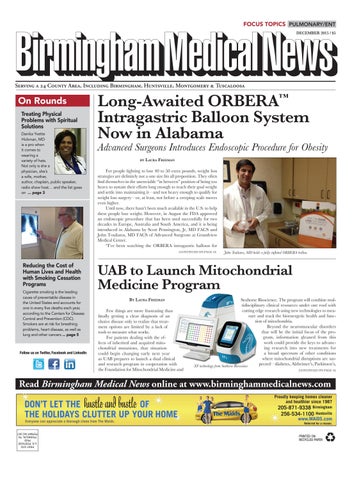
John Touliatos, MD holds a fully-inflated ORBERA ballon.
UAB to Launch Mitochondrial Medicine Program By Laura Freeman
Few things are more frustrating than finally getting a clear diagnosis of an elusive disease only to realize that treatment options are limited by a lack of tools to measure what works. For patients dealing with the effects of inherited and acquired mitochondrial mutations, that situation could begin changing early next year as UAB prepares to launch a dual clinical and research program in cooperation with the Foundation for Mitochondrial Medicine and
Seahorse Bioscience. The program will combine multidisciplinary clinical resources under one roof with cutting edge research using new technologies to measure and track the bioenergetic health and function of mitochondria. Beyond the neuromuscular disorders that will be the initial focus of the program, information gleaned from this work could provide the keys to advancing research into new treatments for a broad spectrum of other conditions where mitochondrial disruptions are suspected—diabetes, Alzheimer’s, Parkinson’s, XF technology from Seahorse Bioscience (CONTINUED ON PAGE 16)
Read Birmingham Medical News online at www.birminghammedicalnews.com
DON’T LET THE hustle and bustle OF Proudly keeping homes cleaner and hea Proudly keeping homes cleaner and healthier since 1987 UP YOUR DON’T LET THE hustle and bustle OF THE HOLIDAYSandCLUTTER 7 healthier since 1987 205-871-9338 Birmingham a thorough clean from The Maids. 256-534-1100 Huntsville THE HOLIDAYS CLUTTER UP YOUR HOME Everyone can appreciate770-579-6442 Proudly keeping home www.MAIDS.com www.MAIDS.com DON’T LET THE hustle and bustle OF Everyone can appreciate a thorough clean from The Maids. and healthier s HOME THE HOLIDAYS CLUTTER UP YOUR 770-57 www.M HOME Everyone can appreciate a thorough clean from The Maids.
Proudly keepin
Everyone can appreciate a thorough clean from The Maids.
Referred for a reason.
Referred for a reason.
PRINTED ON RECYCLED PAPER
Referre
PRST STD U.S. POSTAGE PAID FRANKLIN, TN PERMIT NO.357
deeP KnoWledge of your industry, Business and legal mat ters
When it comes to understanding and navigating healthcare regulations, We’re as serious as a myocardial infarction. our 250+ attorneys and lobbyists across 7 cities help heavily-regulated companies predictably move forward in less-than-predictable regulatory environments.
PHONE NUMBER
8 0 0 -7 6 2 -2 4 2 6
WEB ADDRESS
www.balch.com
Alabama
Fl o r i d a
Ge o rgi a
Mi s s i s s i p p i
Was h i n gto n , DC
No representation is made that the quality of legal services to be performed is greater than the quality of legal services performed by other lawyers.
Balch_BhamMedNews_FullPG_Healthcare_blue.indd 1
2 • DECEMBER 2015
Birmingham Medical News
12/12/13 10:10 AM
HEALTHCARE SPOTLIGHT
Treating Physical Problems with Spiritual Solutions by June
mathews
Danika Yvette Hickman, MD is a pro when it comes to wearing a variety of hats. Not only is she a physician, she’s a wife, mother, author, chaplain, public speaker, radio show host… and the list goes on. But juggling multiple roles doesn’t bother Hickman in the least. In fact, she thrives on it. Furthermore, she considers her busy life an intricately interwoven pattern of blessings bestowed on her by a loving Creator. “It all fits in,” she said. “One thing extends into another, and it all goes together. The overriding theme of my life is just to do God’s will. I balance everything with God.” A Board Certified Family Practice Physician, Hickman believes that addressing a patient’s spiritual condition along with his or her physical condition is a major key to effective treatment. “You have to get to the spiritual root,” she said. “I often ask a patient, ‘what’s going on in your home? What’s going on in your heart?’ Then I can understand a lot about what’s going on with their health.” Until recently, Hickman was exploring these issues with patients in Bessemer, where she’s been practicing for the past 10 years. But as of December 1st, she became affiliated with St. Vincent’s Family Care Office in Trussville. Before becoming a physician, Hickman initially considered pediatrics as a specialty but ultimately chose family medicine. Though her special interests are adolescent medicine and women’s health, she’s also interested in the role family history plays in health and how that information can be used to protect patients from diseases for which they genetically inclined.
Follow us on to begin receiving West TN Medical News in print or on your tablet or smartphone
@bhammednews for updates and
Danika Yvette Hickman, MD
For instance, if a patient’s history includes several family members with hypertension or diabetes, Hickman may recommend steps that can be taken to avoid letting associated factors like stress, weight
or diet get out of hand. “You see different patterns and themes in families, and I’ve always wanted to help the different generations,” she said. “I’ve had up to four generations in the same family under my care.” Hickman also seeks to gain an understanding of how an individual’s community life can affect one’s health and has thus cultivated an interest in addressing societal ills such as domestic violence. She regularly serves as a speaker at women’s and youth events, and often seeks out opportunities to become otherwise involved in combatting physical problems with spiritual solutions. Author of Fountain in the Valley, a book that ties together the spiritual and physical aspects of medicine, Hickman showed early signs of high achievement when she was named a National Merit Scholar and became valedictorian of her class at Fairfield High School. She later became salutatorian of her class at Jackson State University in Mississippi. Hickman went on to graduate from UAB School of Medicine and opted for
St. Vincent’s East Family Medicine Residency Program due to its focus on the spiritual aspects of treatment. “It’s unusual for doctors to tie the physical and spiritual aspects together, but it helps me minister to my patients,” she said. “I love to do that. I love mixing the physical and the spiritual, and I was taught during my residency to pray with my patients.” Given her gentle demeanor and approach to medical care, it’s hardly surprising that Hickman was named one of Birmingham’s Most Caring Doctors by BMetro magazine in 2014. Pursuant to online patient voting, she earned a Patient’s Choice Award in 2013 and Compassionate Doctor Recognition in 2012 and 2013. She was named Bessemer Doctor of the Year in 2015 and is the recipient of a WOW (Wonderful Outstanding Woman) award in medicine from the Birmingham Chapter of the NAACP. Recently featured on ABC 33/40’s Talk of Alabama, Hickman hosts a weekly Internet-based call-in radio show called “What Up, Doc?” on radioairjesus.com. “People from all over the world call in,” she said. Hickman has been married to her college sweetheart for 20 years, and they have two children. She is currently writing a second book.
Our five physicians have more than 60 years of combined Pediatric ENT experience with additional fellowship training in Pediatric ENT surgery. We provide assessment, treatment and management for children with conditions such as: o Ear infections (ear tubes) o Tonsil and adenoid problems o Sinus infections o Complex sinus problems o Hearing loss o Facial and neck masses o Airway obstruction and breathing disorders o Cosmetic issues such as prominent ears (otoplasty) and birthmarks of the face and neck
From left: Brian Kulbersh, MD; Audie L. Woolley, MD, FACS; Brian J. Wiatrak, MD, FACS, FAAP; J. Scott Hill, MD, FACS, FAAP; and Nicholas Smith, MD
Appointments 205.638.4949 FAX 205.638.4983
C H ILD R E N ’S R U SSE LL C A MP U S
C H I LD R E N ’S S O U T H
1600 7th Ave n ue S o uth Bi r m i n g ha m , A L 3 52 3 3
1940 Elme r J B isse ll Road B ir min gh am, A L 35243
www.WestTNMedicalNews.com breaking news
Birmingham Medical News
DECEMBER 2015 • 3
Alabama One Health Record® By Laura Freeman
In the middle of the night, a surgeon in Mobile takes an injured accident victim straight into surgery without having to wait for someone from the patient’s doctor’s office in Huntsville to find and email records warning of an abdominal aneurysm. In north Alabama, a doctor treats a heart attack victim from Birmingham. Even though the patient’s daughter doesn’t know what medications she takes, the doctor can see that she’s on blood thinner so he doesn’t make the mistake of prescribing too much. The ability to securely access patient records at the point of care, anywhere in Alabama, any time day or night, is becoming a reality through One Health Record®. Although the initiative is being coordinated by the Alabama Medicaid Agency in concert with a 23‐member Alabama Health Information Exchange Advisory Commission, this potentially life-saving resource can benefit any patient with medical records in Alabama, including Medicare and privately insured patients--if every hospital and health care provider joins the cooperative effort. “It’s also growing beyond the state,” Alabama Health Information Technology Coordinator and program director Paul And Have A Technology Partner With YourPMP, Bestsaid. Interest At Heart Brannan, “We’ve recently set up an exchange with For 19 Years, We Have Been That Partner. Georgia. If one of our patients is in Atlanta and needs care, their doctors We have taken a leading role in HIPAA/HITECH can check our records. awareness and IT security preparedness. If one of their patients is in Alabama, our doctors We monitor our clients’ IT systems around the clock and hospitals that are set Paul Brannan, and only senior engineers perform scheduled up to query can check maintenance and upgrades. We don’t outPMP theirs. We’re also looking source anything. at the possibility of cooperative exchanges We provide data protection solutions, utilizwith other adjoining states.” ing a wide range of products and techThe effort to make secure access to panologies, instead of what is simply our tient records available statewide has been branded offering. more than five years in the making, and was established as Alabama One Health Record We build disaster plans and fail-over three years ago. Over the past year, the prosystems for data, connectivity and even cooling. We test real world gram has been picking up momentum. scenarios, so we know they will “We have four hospitals and 20 clinics work when it counts. connected, and four more hospitals in the process of connecting, with the potential We are partners with Medical for up to 70 more clinics in the process,” Incorporated to bring state-of-theBrannan said. “As of now, more than 200 art backup power systems that run for providers are using our secure email and hours (and days) instead of just minaround 20 providers have a query-based utes. connection.” We strive for economy wherever possible With the federal push toward elecand integrity above everything, because that tronic records to streamline the exchange matters most of all. of information, similar efforts are underway in every state. Let us become your trusted practice partner. “If a provider in Alabama is interested in connecting, we work with their EMR a division of: vendor to develop smooth connectivity,” Brannan said. “There’s no cost for participating in One Health Record, but providers Your Healthcare Technology Partner www.it4theplanet.com 205-314-3444 may be able to qualify for funding assistance www.ntgrated.com it4theplanet.com to set up their electronic records system 205-314-3444 through the Meaningful Use program and
Happy Holidays to our customers and friends in the Birmingham medical community. We hope you have a great holiday season!
From the Integrated Solutions team! Healthcare IT Can Be Risky Business. Wear a Helmet...
4 • DECEMBER 2015
wear a helmet 2.indd 1 Birmingham Medical News
Medicaid. Medicaid providers in particular, especially those who are part of a regional care organization, should watch for new funding that is now under consideration and should become available soon if approved.” The mission of Alabama’s One Health Record is to improve the quality of the state’s health care delivery system through timely, secure and authorized exchange of patient health information among providers to create one longitudinal patient record to support patient-centered care and improvements in access and outcomes. A robust website, onehealthrecord. alabama.gov, outlines services, resources and types of information available, including lab results, radiology reports, discharge summaries, consultation notes, history and physical notes, operative notes and referrals. There is a physician portal, and the web-based platform includes sophisticated analytics that assist in applications for state and federal program incentives. Security of information and the need to protect patient privacy and confidentiality within HIPPA guidelines are top priorities. “We have strong encryption to protect data, and regular security audits to verify that our safeguards are working and up to date,” Brannan said. “Information can only be retrieved by an authorized user, and patient consent is required before their records can be queried.” Additional resources are planned for next summer when the program’s technology is scheduled to be upgraded. “We’re hoping to add public health reporting of immunizations and other data, and to also give hospitals the capability to send out alerts when patients are admitted, discharged or transferred,” Brannan said. “Other features can be added in the future, and we want to talk with participants to determine which functions would be of value to them. For example, we could add a patient portal where patients could retrieve copies of their discharge instructions and report back on how they are doing with their medication and recovery. If this is a function most providers already have in place on their own website, we could focus on other features that would benefit providers and patients.” One Health Record helps to ensure that all providers involved in caring for a patient—whether in a primary care setting, a specialists’ office or emergency department—have access to a complete longitudinal record of care. Providing a history of previous treatment helps physicians make better- informed treatment decisions. The exchange can also improve care coordination among health care providers to avoid adverse reactions and medication interactions. Treatment isn’t delayed due to lack of records, and referrals don’t have to be rescheduled while waiting for a file. “The best care happens when complete medical records are available, but it can only happen when everyone who provides care is connected,” Brannan said. 4/25/2013 9:38:20 PM
PULMONARY/ENT
Reducing the Cost of Human Lives and Health with Smoking Cessation Programs By Ann B. DeBellis
Cigarette smoking is the leading cause of preventable disease in the United States and accounts for one in every five deaths each year, according to the Centers for Disease Control and Prevention (CDC). Smokers are at risk for breathing problems, heart disease, as well as lung and other cancers. “More than 500,000 deaths each year in the U.S. are attributed to cigarette smoking. If you compare smoking-related deaths to the combination of deaths from AIDS, alcohol, vehicle accidents and firearms, those four together total only about a third of those deaths. The rest are related to smoking,” says Allan Goldstein, MD, a pulmonologist recently retired from Pulmonary Associates Allan Goldstein, MD studies an x-ray of a COPD patient. of the Southeast in Birmingham. a negative effect on the heart and blood “Data shows that about half of all vessels. Also, there are about 7,000 chemismokers die prematurely from a smokcals in the tars, and 60 are known to be ing-related disease,” he says. “We know carcinogens, so whether someone is chewthere are about 4,000 chemicals in cigaing, dipping or smoking, they are getting rette smoke and tobacco, many of which exposed to carcinogens that most likely are carcinogens. Nicotine is one that has
will cause health problems at some point.” Studies have shown that when people stop smoking, they see an immediate improvement in overall health. High blood pressure and the odds of getting heart disease drop, and the chances of getting emphysema, lung cancer and many other cancers also decrease. To help smokers stop, Goldstein and others from local hospitals, clinics, and the health department are working to develop a cessation program that can be used by individuals or businesses. “We want to help people stop smoking in a healthy way. Some people can quit cold turkey, but that usually doesn’t work for most people,” Goldstein says. “Some try electronic cigarettes to help break the habit, but we now know these devices have carcinogens as well. Evidence also shows that the e-cig just leads to smoking down the road. It’s like anything else, if you substitute one habit for another, usually you don’t solve it.” Counseling, along with appropriate
medications, has proven to be the most successful way to quit, especially for people with a long history of smoking. “It’s difficult for physicians to provide the appropriate counseling in a 15-minute visit a couple of times a year, but they still should counsel these patients on quitting. For those who want to quit, the physician should refer them to someone who can help. The successful programs meet for six consecutive weeks for about an hour, with follow-ups at three, six and 12 months. The sessions can be for an individual or in a group setting,” Goldstein says. “We have to treat smoking as an illness – which it is – and we need to stop making it out to be ‘just somebody’s habit.’” In addition to the cost to human lives and health, the CDC says that the total economic cost of smoking is more than $300 billion each year, and almost $170 billion of that is spent on direct medical care for adults. Almost $156 billion in costs results from lost productivity from premature death and exposure to secondhand smoke. Stopping this deadly habit is going to require a partnership between the medical, business, and health insurance (CONTINUED ON PAGE 11)
Helping patients focus on what really matters The Birmingham Pain Center has been your trusted provider of comprehensive twenty years. Our fellowship-trained, MICHAEL GIBSON, M.D.
. • NITIN CHHABRA, M.D.
• Anesthesia
Services
• • Psychological
Care • CAP Accredited Laboratory R. DANIEL CHANG, M.D.
205 • 313 •7246 | www.birminghampain.com 7500 Hugh Daniel Dr Ste 300, Birmingham, Al 35242
Birmingham Medical News
DECEMBER 2015 • 5
PULMONARY/ENT
Simple Blood Test Identifies Genetic Cause for COPD By Ann B. DeBellis
W
E
L
C
O
M
E
S
HEATHER WALDRUP, MD
Dr. Waldrup joins Advanced Surgeons with a medical degree from University of Alabama and five years of surgical experience with Baptist Health Systems in Birmingham. We are pleased to welcome Dr. Waldrup as a general surgeon into our practice.
TO REFER A PATIENT, PLEASE CALL 595-8985
GRANDVIEW PHYSICIANS PLAZA 3686 Grandview Parkway, Suite 400 Birmingham, Al 35243
WWW.ADVANCEDSURGEONSPC.COM
6 • DECEMBER 2015
Birmingham Medical News
More than 24 million Americans suffer from chronic obstructive pulmonary disease (COPD), which generally is caused by smoking and inhaling secondhand smoke or environmental pollutants. However, a small group of people develop COPD because of a genetic disease. Alpha-1 antitrypsin deficiency (alpha1) is an inherited condition that is passed from parents to their children. It affects approximately 100,000 people in the United States, or about three percent of the population with COPD. The alpha-1 protein is made in the liver and normally travels through the bloodstream to help protect the body’s organs, including the lungs, from the harmful effects of other proteins. If the alpha-1 proteins in the liver are not the correct shape, they can get stuck inside liver cells and can’t reach the bloodstream. As a result, not enough of the proteins travel to the lungs to protect them, which increases the risk of lung disease and possible liver disease. “This deficiency is under recognized and probably unknown to a lot of physicians,” says Christopher Roney, MD, a pulmonologist with Pulmonary & Sleep Associates of Alabama. “It can cause an emphysema-type condition in individuals with no history of smoking or other exposures that typically cause COPD or emphysema.” Symptoms typically are the same as with COPD, with slight differences. “These patients often present with a cough, wheezing, shortness of breath and chest tightness. In X-rays, the lungs look extra clear and hyper-ventilated like overinflated balloons,” Roney says. “In people with smoking-related COPD, emphysema typically is upper-lobe predominant. In alpha-1, we see lower lobe emphysema.” When patients with respiratory symptoms are referred to Roney, he tests pulmonary function for evidence of air flow disorders that indicate COPD. If the clinical situation fits, he screens them for alpha-1. “If newly diagnosed patients are young or have minimal risk factors for COPD such has smoking, family history, or toxic exposures, I test them for alpha1,” Roney says. “It’s a simple finger-prick blood test that can identify the alpha-1 enzyme level. The test also looks for genes associated with the enzyme deficiency. If these are present, along with a low enzyme level, they have the disease.” In a small percentage of these patients, alpha-1 can also affect the liver. “If the liver enzyme is misshapen and can’t exit the liver, it can build up and cause liver damage such as cirrhosis or hepatitis
Christopher Roney, MD examines a COPD patient.
and can increase the risk of liver cancer over time. Rarely, patients can develop a skin condition called panniculitis which is characterized by hardened skin with painful lumps and patches,” he says. “However, the biggest risk is the development of progressive lung disease which causes increasing damage and increased morbidity and mortality over time. Patients need to make sure any siblings and children are tested to see if they also have the deficiency.” Augmentation therapy is used to treat alpha-1 with a serum made with antitrypsin collected from human donors. The drug is infused once a week to provide patients with the protective enzyme. Researchers are studying an aerosol version of this therapy as well as therapies that will help misshapen alpha-1 proteins move from the liver into the bloodstream. “The goal is to prevent the progression of the lung disease so the patients’ conditions don’t worsen,” Roney says. “Regrettably, the therapy doesn’t treat the COPD condition. We just don’t want it to progress and cause the patient to die prematurely.” These patients, many of whom don’t smoke, will experience the same type of decline as an individual who smokes three packs a day if the condition is not diagnosed and treated. “The enzyme therapy will help slow the progression, but if someone with alpha-1 smokes, it is imperative that they quit. Smoking is the biggest risk to these patients,” Roney says. “It accelerates the loss of lung function over time and increases the risk of developing significant lung disease. If these patients still smoke, (CONTINUED ON PAGE 14)
Introducing Fresh
Healing Potential Realized
Naturally
bioACTIVE Announcing a breakthrough in regenerative medicine: Affinity fresh amniotic allografts.
NuTech’s breakthrough proprietary preservation system, AlloFreshTM, maintains the integrity and viability of fresh amniotic tissue. For the first time, surgeons can take full advantage of this unique tissue’s strength, flexibility, and (CONTINUED ON PAGE 8) healing potential. Affinity provides a natural solution for regenerative healing. 1–3
The Affinity Allograft Advantage
Proprietary Storage System
Durable and Flexible
42 Days of Viability
Contact NuTech at 800-824-9194 Learn more about how Affinity fresh allografts are transforming regenerative medicine: info@nutechmedical.com www.nutechmedical.com References: 1. Niknejad H, Peirovi H, Jorjani M, et al. Properties of the Amniotic Membrane For Potential Use in Tissue Engineering. Eur Cell Mater. 2008(15):88–89. 2. Wolbank S, Hildner F, Redl H, van Griensven M, Gabriel C, Hennerbichler S. Impact of human amniotic membrane preparation on release of angiogenic factors. J Tissue Eng Regen Med. 2009;3(8):651–654. 3. Gruss J, Jirsch D. Human amniotic membrane: a versatile wound dressing. Can Med Assoc J. 1978;118(10):1237–1246.
© 2015 NuTech Medical, Inc. NuTech name and logo are registered trademarks, and Affinity is a registered trademark of NuTech Medical, Inc. AlloFresh is a trademark of NuTech Medical, Inc. All Rights Reserved.
Birmingham Medical News
DECEMBER 2015 • 7
PULMONARY/ENT
It’s all in your head
New advances in treating sinus problems provide welcome relief to chronic sufferers By June Mathews
According to the CDC’s National Center for Health Statistics, over 28 million adults have been diagnosed with sinusitis, and in a year’s time, nearly eight million lost work days can be attributed to chronic sinusitis. So clearly, sinus problems make a huge impact on the day-today lives of Americans. But recent advances in treatment and technology are helping to ease the discomfort associated with ailing sinuses, and physicians like Scott Elledge, MD of ENT Associates in Birmingham are combining the latest methods with tried-andElledge, true treatments to give ScottMD their patients relief. “When you’re talking about sinusitis, you’re talking about problems with the nose,” Elledge said. “There are several things you do about these problems, some of them kind of new and some of them a little bit older, but they’re all coming together to make the management a lot more efficient and cost effective.” Sinuses are often difficult to treat due
to an almost gel-like goo called biofilm. Created by bacteria, biofilm’s consistency renders it nearly impervious to oral antibiotics, so medicating the underlying problem is difficult at best. But doctors have discovered that “washing” the sinuses clears away the goo and allows the medication do its job. “There’s been a lot of new research about using irrigations where you take a bottle or atomizer of saline, mix in an antibiotic or a steroid and use it to get rid of the goo,” Elledge said. “You can also add anti-fungal products if you’re treating a fungal infection.” Another helpful development is that instead of having to wait a few days or weeks for the bacteria collected on a swab to grow in a Petrie dish, labs can now take the swab and break down the proteins, thus giving them the ability to report back in a day or two. “They give us a report on all kinds of things,” he said. “The turnaround time allows us to treat the patient quicker, as well as more accurately. It makes the efficiency of treating someone so much better.” Elledge also finds an in-office CAT scanner that does a panoramic scan of the sinuses is helpful in decreasing turnaround
time on diagnoses. “We can get a scan that day, and by the end of the day, we’ve already got a really good plan from one office visit,” Elledge said. “It’s increasing our efficiency and keeping patients from having to come back for another office visit and pay another co-pay.” Used in conjunction with an endoscope (old technology), the scan becomes an even more valuable tool for understanding the anatomy. But new technology helps even more. “You can also put your disk of the CAT scan and put it into a surgical navigation machine, and it becomes a GPS for the sinuses,” Elledge said. “It’s like driving a car. You can get there, but it’s nice to have some navigation. It doesn’t take the place of the old technology, but it makes it better.” In his practice, Elledge also makes frequent use of a lighted balloon sinuplasty device, a tool that can be used to open closed-off passages in the sinuses. The light helps guide the surgeon to the right place where the balloon device can then stretch the closed-off passage. “We’ve been doing this procedure for years, but this tool changes how we do it,”
he said. “It makes it easier to get into narrow places, and we’re finding that it leaves the tissue less inflamed compared to techniques in which we’d take an instrument and kind of bite away the tissue. It makes a nice, smooth opening.” A final development concerns the turbinate, a spongy bone in the nose that stick down to the side of the nose when the sinuses become infected. A stent loaded with steroids is now available that can be inserted into the affected area. It is slid into the sinus, where it spreads the area open, and then slowly releases steroid into the tissue. It completely dissolves in 30 days “People hardly ever notice it was there,” Elledge said. “We think that down the road, we’ll be able to load these things up with antibiotics or other drugs, slide them in, and they’ll slowly release the medicine. The technology is there. We’ve just got to keep expanding it to make it more useful. I think we do a better job than we did five years ago taking care of people. We’re getting more accurate, and our patients are experiencing better results. This is an exciting time to be an ENT.”
Convenient Cardiovascular Care With 33 cardiologists and 15 clinic locations across Central Alabama, CVA is committed to providing advanced cardiovascular care close to home. Cardiovascular Associates was founded in 1946 by Dr. John B. Burrett, the first cardiologist to practice in the state of Alabama. His legacy of dedication, skill and compassion remains at the heart of the practice. Today CVA cardiologists are at the forefront of new treatment options, focusing on research and using the latest technology to combat cardiovascular disease.
To make an appointment with a cardiologist at one of our 15 locations, call 205.510.5000 or visit cvapc.com.
8 • DECEMBER 2015
Birmingham Medical News
CVA Main Campus: Conveniently located at the intersection of 459/280 at The Colonnade. Easy access, curbside patient drop-off and complimentary parking.
ADVERTISEMENT
Investing in Alabama’s Health To expand access to quality primary medical care throughout the state, Blue Cross and Blue Shield of Alabama is introducing Circle of Care. This comprehensive initiative is an investment that will help improve access to healthcare services in Alabama. A $3 million scholarship program will help medical students finish their studies so they can practice in areas of the state in need of more doctors. This initiative will also strengthen partnerships with primary care physicians to enhance members’ health.
The Need is Great
Thousands of Alabamians lack access to primary care doctors. We are committed to changing this by increasing the number of primary care doctors through a scholarship program. In partnership with Alabama College of Osteopathic Medicine (ACOM), eligible medical students who commit to practicing medicine in Alabama’s underrepresented rural areas can receive financial assistance to help them finish their studies.
“We know that access to highquality primary care equals improved health and lower spending, including preventable emergency room visits and hospital care. That’s why we are making a long-term commitment to providing Alabamians access to the healthcare they need.” - Terry Kellogg, President and CEO of Blue Cross and Blue Shield of Alabama
Another part of Circle of Care is the launch of the Primary Care Select Program. This program sets a new standard of support and collaboration between Blue Cross, our members and their primary care physicians.
Circle of Care Highlights:
• Scholarship investment for medical students who commit to practice in Alabama’s rural areas • Exclusive support, tools and reimbursements for select primary care doctors • Integrated partnerships to help select primary care doctors identify and implement solutions to strengthen the care of their patients
Blue Cross and Blue Shield of Alabama is an innovator in improving access to quality care for all Alabamians. We will continue to develop new ideas and invest in areas that better the health of our state.
ACOM students react to scholarship announcement on July 28, 2015.
We cover what matters. AlabamaBlue.com Blue Cross and Blue Shield of Alabama is an independent licensee of the Blue Cross and Blue Shield Association.
Birmingham Medical News
DECEMBER 2015 • 9
Long-Awaited ORBERA™ Intragastric Balloon System, continued from page 1 ten years and following the results it has achieved in other countries,” Touliatos said. “Whether we’re doing bariatric surgery or general surgery, we prefer to use the least invasive approach possible. With the balloon, there’s no incision and no surgical scars. Now we have a way to help people with a BMI of 30 to 40 kg/m2 succeed in their weight loss efforts without surgery.” “We’ve been searching for something less invasive that will help patients without altering their anatomy,” Pennington said. “This device fills that niche and gives them a jump start to help them make progress toward their goal. Scott It isn’t just a procedure. Pennington, Jr, It is done within the MD FACS context of support and counseling with our dietician and exercise therapist. The balloon comes out after six months, and the counseling continues for another six months to help them stabilize at their new weight and become accustomed to a new normal with better habits in how they eat and exercise.” The ORBERA intragastric balloon from Apollo Endosurgery features significant improvements in design and materials over air-filled balloons used for weight loss in the past. “The silicone is much more durable, and the design is smooth without rough
edges to irritate the gastric tissue,” Touliatos said. “It’s a bit like a breast implant. Patients only require light sedation as we position the balloon with an endoscope, then fill it with saline and seal it. Leaks are very, very rare, so the possibility of an obstruction is less of a concern. After six months, we use an endoscope to remove the saline and retrieve the balloon, which should be well before leaks from wear might become a concern.” During the first few days, patients may experience some nausea and slight discomfort as they become accustomed to the balloon, but following dietary guidelines and volume recommendations in filling the balloon should reduce or prevent side effects. Pennington said, “Generally, using 500 to 600 CC of saline is enough to help people feel full without feeling too full when they follow their food plan. If they are already in a program like Weight Watchers, they can continue with support from our nutritionist and trainer. If they aren’t on a program, we guide them toward more protein while avoiding simple carbs. When the quantity you can eat is limited, the quality of the nutrients is important.” Not everyone who falls within the BMI range approved for this procedure is necessarily a candidate for it. It is not suitable for people who have had prior gastric surgery, Crohn’s Disease and similar chronic conditions, or those who require
We don’t just treat the pain, we treat the patient.
blood thinners or medications that might be irritating to the digestive system. Other conditions involving the esophagus, stomach and abdominal organs should also be evaluated in determining whether a patient is a good candidate for the procedure. In the clinical studies that led to FDA approval, participants who received the ORBERA intragastric balloon lost approximately three times as much weight over six months as a control group that received behavior modification counseling alone. Exactly how much weight an individual is likely to lose varies from patient to patient according to each person’s metabolism and the type of diet and activity plan followed. “Everyone’s body is different,” Pennington said. “The balloon helps with volume and gastric motility so patients are more satisfied with less. However, a person who drinks sweet tea every day isn’t likely to lose as much as someone who chooses unsweet and is more active.” Motivation to lose weight is a key trait Pennington and Touliatos look for when evaluating patients. At this time, the procedure is not covered by most insurance plans. Costs in countries where the procedure has been available for many years typically range between $6,000 and $7,000 including both placement and removal of the balloon and counseling support with a dietician and trainer for a year. Compared to the emotional, eco-
nomic, and health costs of being seriously overweight, and to the cost of other elective procedures performed to improve a patient’s appearance and confidence, an intragastric balloon can be a good investment for patients prepared to take full advantage of the boost it can offer in helping them make long-term changes. With January near, the time of year when physicians see more patients resolving to take better care of their bodies, there is at last something the medical community in Alabama can offer. There is a way to help those who need more than medications, but a less invasive alternative than surgery sustain their resolve through the coming year.
Every Monday and Thursday, we’ll feature healthcare professionals discussing important medical topics.
www.birmingham medicalnews.com In top navigation bar, click on blog
With any surgery, there are so many factors that cause pain—which means there is no single answer for treating it. That’s why we at Brookwood Medical Center and Anesthesia Services of Birmingham work together to provide comprehensive, multimodal perioperative pain control by treating pain at the source. Through delivery of traditional pain medications in conjunction with anti-inflammatories, neuropathic pain medications and regional anesthesia, we’re dedicated to seeing patients have less pain, faster recoveries and better outcomes. Because everyone deserves to get well soon.
bwmc.com • anesbhm.com
10 • DECEMBER 2015
Birmingham Medical News
Closing your medical practice soon? by gerarD J. KassouF, CPa/PFs CFP
Physicians typically close their medical practice due to retirement, but the business may close due to death, disability, leaving solo practice and joining a group or an institution, or leaving medicine altogether. In any of these situations, it’s important to know the major issues to consider when closing your practice. Before discussing the issues, know how important the planning can be. The more time physicians take to plan a practice closing, the smoother it should be. However, each practice is unique, and each will generate its own timeline and criteria for the closing process. According to the Alabama Board of Medical Examiners Newsletter, physicians are responsible to notify active patients of their intent to close their practice, and to offer an opportunity to transfer patient records if requested. Your practice’s healthcare attorney can assist in preparing the
proper communication to your patients. “Records which may be of value to a patient and which are not forwarded to a new physician should be retained, either by the treating physician, another physician, or such other person lawfully permitted to act as a custodian of the records.” The need to transfer patient records may require office staff for a period of time after the practice closes its doors to patient care. Some practices make arrangements with another medical group to act as custodian of the records. Don’t forget about Personnel and benefit issues. If the practice has the opportunity, sufficient notice of the closure timetable should be communicated to the employees. Position phase-outs should be determined. Severance benefit packages are sometimes provided to key personnel to entice them to remain at the practice until all necessary functions are complete. Issues relating to benefits, including health insurance and retirement plans must be
Reducing the Cost , continued from page 5 communities, Goldstein says. “We need to work together to make smoking cessation programs affordable and available to those who need them. We are trying to get people to stop a dangerous habit, and the insurers need to recognize that and pay a reasonable fee for the use of these programs. Smokers shouldn’t have to pay an unreasonable price for help just because they are smokers,” he says. “Industry is very concerned about the cost of health care and rightly so, especially the self-insured companies. They need to look at what they are spending on employees with cancer, COPD, heart disease and other smoking-related health issues. The cost of treating these things is huge, but nobody seems to want to spend that kind of money on counseling to prevent people from smoking. We want to partner with these companies so we can bring these cessation programs into the workplace.” Goldstein also points out that it is imperative that we make it a priority to educate teenagers so we can prevent them from ever starting to smoke. “Statistically, if you smoke, you will have a health problem of some kind. In 50 years, I have yet to have one patient that has ever had better health because of smoking,” he says. “We need to prevent teenagers from starting, and that means we need to spend time in the schools.
Read Birmingham Medical News Online:
BIRMINGHAM MEDICAL NEWS.COM
We need physicians, nurses, and people who are trained in tobacco treatment to give them basic information. Teachers also can provide information in health classes. “We are not going to prevent death by having people not smoke, but we want to prevent all the deaths in people that do result from smoking. You can modify behavior by not starting cigarettes or at least by quitting. Everybody is going to die, but you might as well have a good quality of life for as long as you can.”
resolved. Working with the staff to obtain new employment and timing of the new employment start date is invaluable to an orderly shut-down of your practice. Where possible, coordinate your practice closing date with your lease. Be sure that you provide proper notices required under the lease, and allow time to handle the collection of accounts receivable, the sale of practice equipment and the patient records. With appropriate lead time, you may be able to find a practice or an institution interested in acquiring all of your office and medical equipment. If you desire, have the equipment appraised to determine its value. At the right price, selling to only one party is an ideal situation. If you are not able to find one buyer for all of it, there are equipment brokers who acquire for resale, or you could sell it yourself in smaller lots. Financial, accounting and billing issues create challenges. Someone knowledgeable with your accounts receivable system should be retained to bill and collect the remaining accounts. Communication with insurance companies and slow paying patients may require several months’ effort before you decide to send the remaining amounts to a collection agency. It’s these collections that will provide the funds to pay any remaining practice bills, outstanding bank debt and provide some funds to you. In addition, you will have to file necessary papers with appropriate agencies regarding practice closure. You may have to file legal liquidation papers, final tax returns and address profit sharing or pension plan distributions to terminating staff.
Let us help you or your loved one reclaim the highest level of independence possible. Though you or your loved one can’t be at home, they can feel at home with us. Our professional and caring team of nurses, certified nurses’ aides, dieticians, therapists and social workers work each and every day to ensure you or your loved one receives the long-term or short-term care they need to thrive. Whether recovering from an orthopedic surgery, a stroke or even facing the realities of dementia, our family here at South Haven Health and Rehabilitation is here for their healthcare needs.
Notify Medicare, if you are Medicare eligible, and notify Social Security if you plan to begin receiving Social Security Benefits. Again, be sure you have a plan for continuing your health insurance if you are not Medicare eligible. Communicate with your professional liability insurance carrier to ascertain the options available to you regarding postwork liability insurance coverage. Review your policy to determine your options, and work with your representative to be sure continuing coverage is in place in advance of your retirement. It is not possible to cover all of the items one should consider when closing a practice, as each practice is unique. Notify any hospitals in which you have privileges, any medical societies to which you belong, agencies that issue business or professional licenses, membership organizations, and accreditation services of your impending retirement. Remember to discontinue services, such as subscriptions, telephone, answering and beeper services. Think about your practice and determine what additional items you need to include in your list. Closing a medical practice takes effort and planning. Developing a checklist of items and delegating a responsibility to complete each task will allow for a smooth practice transition. Plan ahead when you have the ability to do so. Gerard J. Kassouf, CPA/PFS CFP © is a director in the Birmingham, Alabama accounting and consulting firm of L. Paul Kassouf & Co., P. C. His email address is gkassouf@kassouf.com
• 24-hour, 7-day-a-week skilled nursing care • Physician oversight • Seven-day-a-week physical, occupational and speech therapies • Pharmaceutical & medical supply assistance • Expert dietary and nutrition services • Medical-based financial advice & assistance • In-house beautician services • Social services • Therapeutic activities program • Psychosocial care • Laundry services
South Haven
HEALTH & REHABILITATION, LLC
For more information, call us at (205) 822-1580 or tour our facility at 3141 Old Columbiana Rd, Hoover AL 35226
Birmingham Medical News
DECEMBER 2015 • 11
2015 Health Care Year in Review by
Howard E. Bogard
In 2015, ICD-10 finally became a reality, and the dire predictions of problems seem to be wrong. Providers now have codes to describe just about every conceivable (and a few simply bizarre) medical occurrences. If a patient is ever sucked into a jet engine, remember code V97.33XD, or if a patient is burned due to water-skis on fire (is that even possible?), code V91.07XD can be used. On a more serious note, this year may be viewed as the turning point for pay-forvalue reimbursement, with CMS pursuing several new initiatives and private payers implementing value-based payment programs for primary care physicians. As with other years, the government continues to aggressively pursue fraud, waste
and abuse, with a reported return on investment of $7.70 for every dollar spent pursuing improper payments. According to the late Yogi Berra, “the future ain’t what it used to be.” With that in mind, following are my top ten 2015 health care events for Alabama providers. 10. New OIG Rules and Guidance -- This year brought a host of new rules in the area of fraud and abuse. In April, the Civil Monetary Penalty law was amended to give hospitals the green light to pay physicians to reduce Medicare costs by eliminating “medically unnecessary” services. Prior to the change, the law prohibited payment to limit any services, thereby calling into question many gainsharing arrangements between hospitals and physicians. In addition, the OIG issued a new Fraud Alert in June, entitled
“Physician Compensation Arrangements Should be Scrutinized,” warning providers that compensation arrangements between referral sources must reflect fair market value for bona fide services. In September, the Department of Justice issued a Memorandum on individual accountability for corporate wrongdoing, signaling a new focus on holding corporate officers responsible for fraud and abuse violations within their organizations. 9. Medicare ALJ Logjam. In December 2013, the Office of Medicare Hearings and Appeals (OMHA) announced that providers appealing adverse audit findings will wait approximately 24 months before receiving a hearing before an Administrative Law Judge (ALJ). This delay is despite the fact that the law requires a hearing in 90 days. According to
e h t a e r B Easy ...and Enjoy the Season!
Helping You Breathe Easier - Day and Night James Sosnowchik, MD | H. Andrew Wilson, Jr., MD | Christopher W. Roney, MD 205-871-9112 | www.sleepandlungdocs.com Brookwood Medical Center | 2022 Brookwood Medical Ctr Dr, ACC 310
24 SKILLED PHYSICIANS PRACTICING IN 13 LOCATIONS
(205) 930-0920 • 800-452-1464 3485 Independence Drive Homewood, AL 35209
testimony in April before the Senate Finance Committee, there are over 500,000 pending appeals across the first three levels of appeal and the average number of days for an appeal to be processed has grown from approximately 95 in 2009 to 547 in 2015. Unfortunately, providers who have challenged the failure of OMHA to provide an ALJ hearing in the required 90 days have been unsuccessful. 8. ICD-10 Implementation. ICD-10 became effective October 1, 2015, and initial reports indicate that the transition has gone relatively smoothly. ICD-10 is a coding system that attaches a number for every known disease of trauma. Due to concerns raised by the provider community, CMS announced in July that it would provide flexibility during the transition to ICD-10. Specifically, through October 31, 2016, Medicare will not deny physician or other practitioner claims billed under Medicare Part B based solely on the specificity of the ICD-10 diagnosis code as long as the physician uses a valid code from the right family. According to Emdoen, a revenue cycle management company, 86 percent of claims received since October 1, 2015 are ICD-10 claims with little change in reimbursement. 7. Grandview Medical Center Opens -- Fourteen years after first being announced by HealthSouth Corporation, the so-called “digital hospital” on Highway 280 in Birmingham finally opened on October 10 as Grandview Medical Center. The new hospital heralded the end of Trinity Medical Center on Montclair Road. Grandview has 372 beds and is owned by Community Health Systems, the same company that owned Trinity. 6. Stark Law Revisions – As part of the Medicare 2016 Physician Fee Schedule, CMS made several changes to the federal Stark Law. These changes include a new exception permitting hospitals, federally qualified health centers and rural health clinics to pay physicians for recruiting and compensating non-physician practitioners under certain circumstances. The changes also provide a new exception for timeshare lease arrangements. Most significantly, the changes relax the prior inflexible requirements under many Stark Law exceptions regarding written agreements, signatures and prohibitions on hold-over arrangements beyond six months. The Stark Law revisions were published as part of the Physician Fee Schedule in the November 16, 2015 Federal Register. 5. ACA 60-Day Repayment Rule Clarified. Under the Affordable Care Act (ACA), any provider who has received a Medicare or Medicaid overpayment is required to return the money within 60 days following the date on which the overpayment is identified. Providers who miss this deadline face penalties under the federal False Claims Act. In Augus, a New York Court found that an entity has “identified” an overpayment when it “has determined, or should have (CONTINUED ON PAGE 14)
12 • DECEMBER 2015
Birmingham Medical News
WHO’S TENDING OUR DOCTORS?
8 Steps to Improve Revenue Cycle Efficiency By LYNNE JETER
Editor’s Note: This article is part of a Medical News exclusive series, “Who’s Tending Our Doctors?” to focus on ways the industry can help alleviate physician stress and allow physicians to return to the joy of practicing medicine. Even though patient care is top priority for doctors, administrative drills remain a nagging worry. To take the pressure off the financial side of a medical practice, the American Medical Association (AMA) recently launched a module on revenue cycle efficiency in the AMA STEP Forward series, aimed at making life easier for physicians nationwide. “An efficient revenue management system is critical for your practice’s financial health and sustainability,” said Christine A. Sinsky, MD, FACP, an internist with Medical Associates Clinic, a multispecialty group practice with sites in Iowa, Wisconsin and Illinois, and the AMA point person Dr. Christine A. Sinsky for STEPS Forward. “Electronic methods can streamline revenue-related processes, such as eligibility checks, claims submissions and payments, all allowing your practice to maximize the
amount of time available for patient care.” To improve revenue cycle efficiency, doctors may follow eight steps: • Select a practice management system (PMS) that fits your needs. • Verify insurance eligibility electronically before every patient appointment. • Reduce prior authorization burdens through electronic transactions. • Submit claims electronically to save time and money. • Determine the status of submitted claims. • Leverage electronic remittance advice (ERA) to simplify processing of payment information. • Review electronic payment options and make an informed choice for the practice. • Maximize collection of patient payments. “As with any technology selection, the ‘right’ PMS for your practice is the one that will best meet the needs of you and your staff,” said Sinsky. “Whether purchasing your first PMS or changing to a different product, first turn your attention inward to your practice. Soliciting input from all staff who use and interface with a PMS and including them in the selection process will ensure that you pick a vendor and product that matches your practice’s
priorities and needs. A thorough analysis of your practice’s revenue cycle process and workflow will provide valuable insight into your system’s requirements. Additionally, this type of analysis will help to identify opportunities for automation through the PMS that will improve the efficiency of your practice.” Verifying insurance eligibility electronically before every patient appointment is greatly underrated. “Ideally, this eligibility check should be performed electronically,” said Sinsky. “Although most health plans allow patient eligibility to be verified over the phone or via a health plan web portal, these methods are often inefficient and may not provide you with all the necessary information.” Because reducing prior authorization burdens via electronic transactions dovetails nicely with the AMA’s belief that prior authorization is overused, the AMA urges health plans to limit the use of these programs to true utilization outliers, instead of broadly applying coverage restrictions to all practices. To reduce the physician’s time spent on prior authorizations, the AMA recommends incorporating a teambased model into the practice routine. (Medical News will cover the team-based model in 2016.) “Ideally, a physician will be aware of drugs’ prior authorization requirements
before sending a prescription to the pharmacy, which minimizes the chances of patient medication nonadherence,” said Sinsky, pointing out that electronic prescribing system vendors are in various stages of implementing electronic prior authorization technology. To save time and money, submit claims electronically. “Healthcare claim submission used to require a cumbersome, manual process of completing a paper form, mailing it to a health plan, and waiting – sometimes weeks! – for a response,” said Sinsky. In addition to time and cost savings, “electronic claims submission often speeds heath plan adjudication and payment.” Determine the status of a submitted claim via the electronic claim status inquiry to confirm receipt of submitted claims, and to garner claim status. “Health plans are required to support real-time claim status processing,” said Sinsky. “To electronic eligibility inquiries, practices can also send ‘batch’ transmissions to health plans to check the status of multiple claims at the same time. By law, the practice must receive a response by the next business morning, although some practices report receiving these responses much sooner. Rather than waiting two or more weeks before taking action on a sub(CONTINUED ON PAGE 20)
Experienced surgeons and advanced medical technology. All focused on your patients.
205.786.2776 BaptistHealthAlabama.org/Heart ACCEPTING NEW PATIENTS
Dr. Clifton Lewis
Dr. Lee Roberson
• • • • •
• • • • •
Coronary Artery Bypass Robotic Mitral Valve & Tricuspid Valve Repairs Right Thoracotomy Minimally Invasive Aortic Valve Replacements Transcatheter Aortic Valve Replacement Robotic ASD Repair
Coronary Artery Bypass Heart Valve Repair/Replacement Minimally Invasive Heart Valve Surgery Video Assisted Thoracoscopy Lung Cancer Surgery
Birmingham Medical News
DECEMBER 2015 • 13
2015 Health Care Year, continued from page 12
Feel like you should get more than a policy from your insurer?
The feeling is mutual. Since 1982, MagMutual has been owned and led by the healthcare professionals we insure. As a mutual, our PolicyOwners receive a uniquely personal experience, consistent dividends and financial rewards, plus exceptional benefits through support programs and Patient Safety resources. This is the reason we have grown to become the largest healthcare liability insurer in the Southeast, and leading mutual insurer in many states.
To experience the MagMutual PolicyOwner difference, call Stacia Olson at 888-834-5929 or visit MagMutual.com SM
Dividend payments are declared at the discretion of the MAG Mutual Insurance Company board of directors. Since inception, MAG Mutual Insurance Company has distributed more than $136 million in dividends to our policyholders. Insurance products and services are issued and underwritten by MAG Mutual Insurance Company and its affiliates.
14 • DECEMBER 2015
Birmingham Medical News
determined through the exercise of reasonable diligence” that it has received an overpayment. In connection with a settlement involving a physician practice in Georgia that was accused of failing to comply with the 60-day rule, the U.S. Attorney for the Northern District of Georgia was quoted as saying: “Participants in federal health care programs are required to actively investigate whether they have received overpayments and, if so, promptly return the overpayments.” It is clear that the government will increasingly use the 60-day rule in fraud investigations and providers are encouraged to actively review whether any overpayments have been received. 4. ACA Exchanges – The new open enrollment period for the ACA mandated insurance exchanges began November 1, 2015 and runs through January 31, 2016. Approximately 10 million people are predicted to be enrolled in both federal and state exchanges for the coming year. According to the U.S. Department of Health and Human services, in Alabama 171,641 residents signed up for an exchange plan during the 2015 open enrollment period. Nationwide, an estimated 83 percent of marketplace enrollees will qualify for subsidies, with subsidies averaging 72 percent of the insurance premium. In Alabama last year, 91 percent of enrollees qualified for premium subsidies, with an average amount of $268 per month. It has been reported that the three carriers (BCBS of Alabama, Humana and United Healthcare) who offered individual plans for the 2015 exchange will increase rates this upcoming year by an average of 24 percent. 3. Supreme Court Saves the ACA – Again. In June of this year, the U.S. Supreme Court saved the ACA for the second time. In King v. Burwell, 576 U.S. ____ (2015), the petitioners challenged the legality of subsidies to participants in federally sponsored exchanges or marketplaces. The challenge hinged on the phrase in the ACA that says “exchanges established by the State” can issue subsidies, but did not mention exchanges created by the federal government. In a 6-3 ruling, the Supreme Court found that despite the poor wording
Simple Blood Test, continued from page 6 that’s probably the worst thing they can do if they have alpha-1 deficiency.” Roney wants to increase awareness of this genetic disease among physicians. “I think the main thing is to be aware that this problem exists. Test kits are available from the companies that produce the augmentation drugs and are free for patients who need to be screened,” he says. “If a physician sees an individual with COPD at a relatively young age with unexplained liver disease, no smoking history and no other risk factors for COPD, test them. Refer them to a specialist who is familiar with the disease so they can receive therapy and be followed. The best thing is to catch these patients as soon as possible to prevent progression of lung disease.”
of the section in question, when read in context with the entire legislation, it would not make sense to allow subsidies for staterun exchanges but deny subsidies for similar federally-run exchanges. 2. Alabama Medicaid – In order to try and control Medicaid costs in Alabama, legislation was approved dividing the State into five regions and in each region one or more regional care organizations (RCOs) will be established. In exchange for a capitated payment, each RCO will be responsible for providing health benefits to assigned Medicaid beneficiaries. The RCOs will make money if they can provide care for less than the capitated payment. As of October of this year, there are eleven probationary RCOs, covering all five of the RCO regions. The RCOs are required to go-live October 1, 2016. However, Alabama Medicaid is still waiting for approval of the program from CMS, and has yet to release information to the RCOs on the capitated fee to be paid by Medicaid for assigned beneficiaries. By May of next year, the RCOs must have provider networks in place. Underpinning the uncertainty about the RCO program is the continued reluctance of the Governor to expand Medicaid to approximately 200,000 Alabama citizens without health insurance coverage. One must wonder whether CMS is leveraging its approval of the RCO program to force Medicaid expansion. Move Toward Pay-for-Value – In January of 2015, CMS Secretary Burwell announced that in 2016, 30 percent of Medicare provider payments will be made under alternative payment models (e.g., ACOs, bundled care payment initiatives, medical homes, etc.), with that percentage rising to 50 percent in 2018. Secretary Burwell also announced that in 2016, 85 percent of Medicare fee-forservice payments will be tied to quality and value, with that percentage rising to 90 percent in 2018. Shortly thereafter, as part of the Medicare Access and CHIP Authorization Act of 2015 (MACRA), CMS announced that beginning in 2019 incentives under the Meaningful Use program, PQRS and Value-Based Purchasing program will be combined into a new “Merit-Based Incentive Payment System” (MIPS). Finally, as a precursor of things to come, CMS announced this year a new hospital mandatory bundled payment program for hip and knee replacements in certain Metropolitan Statistical Areas. The new program, called the Medicare Comprehensive Care For Joint Replacement, will pay a single (i.e., bundled) fee for all physician, hospital and post-acute care starting with the date of surgery and running 90 days thereafter, thereby leaving the participating providers to negotiate the division of fees. May all of you have a happy, healthy and successful 2016! Howard E. Bogard is Chair of the Health Care Practice Group at Burr & Forman LLP and exclusively represents health care providers in regulatory and corporate matters.
Retirement Funding Strategies for High Income Earners By CINDY SANDERS
T or F: For 2015 and 2016, everyone can contribute up to $18,000 to their 401K, and those aged 50 or older can contribute up to $24,000. FALSE “In a lot of cases, we see situations where the (401K) plans are not designed in a way where more highly compensated individuals can take full advantage of the benefits,” said Steven Glasgow, a senior vice president with Avondale Partners’ Wealth & Asset Management Group, which serves cliSteven ents across the country. Glasgow When 401K plans were being created, Glasgow continued, they were designed with certain tests in place to ensure a company’s plan didn’t intentionally discriminate against employees at lower income levels. “If they have a population of employees who are not contributing enough as a percentage of their total income, then you have a testing issue,” Glasgow said, adding that could block higher earners from being allowed to fully contribute. “It’s an incentive to design plans to encourage participation by
the non-highly compensated employees, and if they don’t do so, it limits the ability of everyone else to use the plan.” Typically, administrators will run year-end test calculations to ascertain whether the plan met its threshold or whether highly compensated employees have contributed too much. If some employees are found to have excess contributions, Glasgow said, “then they have to file an amended tax return and take the money back out. That’s never a happy moment for anybody.”
Avoiding the Amended Tax Return Glasgow, who has 20 years of experience working with individual and insti-
tutional investors, focuses his expertise in the areas of defined contribution plans, defined benefit plans, endowments and foundations. He said there are ways to address the funding issue and help high income individuals adequately save for retirement. The first option, he noted, is to change the plan design so that it becomes more generous for non-highly compensated individuals. Switching to a safe harbor plan allows companies to eliminate testing. However, it does cost more from the company, health system or practice perspective. “So it raises the question, ‘does it make more sense to increase your benefit plan?’ Most often, the answer is ‘yes.’” Glasgow said. He added a qualified financial advisor could put pencil to paper to help an employer weigh the costs and benefits of such a plan. In addition to some long-term financial advantages to the decision, Glasgow added a richer benefit plan could also help attract and retain talent in a competitive marketplace. “The other thing you can do in some cases … not all … is to put a non-qualified plan in place to supplement the 401K,” he continued. “It’s a plan specifically designed for highly compensated people.”
In this scenario, the higher income earner could take excess contributions and put the money in the non-qualified plan. In fact, it can be set up so that excess contributions automatically spill over into the non-qualified plan, eliminating the need to file an amended tax return. In addition, the company is free to add ‘bells and whistles’ such as contributing on an employees’ behalf to sweeten the pot. “It can be structured in a lot of ways,” noted Glasgow, “but it’s not governed by the Department of Labor and ERISA law like your 401K is.” The downside of that is money in a non-qualified plan is an asset on the corporate balance sheet. If creditors come after the company or health system, money in the non-qualified plan is fair game so employees could lose their contributions. “That can’t happen in a 401K,” Glasgow stressed. “It’s absolutely free and clear from the company balance sheet.”
Profit Sharing “With a physician practice, you have an interesting situation where you have a high concentration of high income earners,” Glasgow said. In the case of professional services (CONTINUED ON PAGE 23)
Our Trinity Location is has moved to Vestavia Trussville
Our new address is:
Birmingham
2868 Acton Road, Vestavia, AL 35243
280 EXIT 19
• Our Bessemer Campus will remain at the current location. • Should you have any questions on the relocation, our office numbers will remain the same 205-332-3160.
EXIT 19
280 Chelsea
2868 Acton Road Vestavia, AL 35243
Acton Rd.
Questions? www.bamapain.com/move Tuscaloosa
Ty Thomas, MD • Chad Austin, MD • Alex Pisaturo, MD • Brian Thoma, MD • Wade Martin, MD • Audra Eason, MD • Arrtie Pisaturo, MD • Matt Smith, MD • Adam Farris, MD
Referrals... Made Simple.
205-332-3160 Bamapain.com
Vestavia Campus 2868 Acton Road Vestavia, AL 35243
Bessemer Campus 727 Memorial Drive Bessemer, AL 35022 Birmingham Medical News
DECEMBER 2015 • 15
UAB to Launch Mitochondrial Medicine Program, continued from page 1 autism, ALS, Huntington’s, lupus, MS, arthritis, kidney disease, cardiometabolic syndromes, solid tumors and even many of the effects of aging. Disorders linked to mitochondrial dysfunctions are as ubiquitous as the weather, and like the weather, there has been little anyone could do about the course of these disruptions beyond trying to limit the damage. “Until now, research into possible treatments for mitochondrial diseases has been limited by the difficulty in measuring changes in mitochondrial function to
determine whether a patient is responding,” program scientific director Victor Darley-Usmar, PhD said. “Muscle biopsies are painful and expensive. Blood tests we used in the past took Victor Darleyweeks. They weren’t sen- Usmar, PhD sitive enough to give us the answers we needed, and between being cost prohibitive to repeat and taking too much blood from patients who were already weak, they
couldn’t be repeated often enough to follow changes in a specific patient.” The likely game-changer in mitochondrial disease research is the new XF technology from Seahorse Bioscience used with a bioenergetics stress test to form the basis of a Bioenergetic Health Index (BHI). Validating Clinical Laboratory Improvement Amendments (CLIA) tests for using the new tools to measure and analyze respiratory complex activities and mitochondrial DNA damage in white blood cells and platelets will be a primary focus of the program’s early research.
Rated #1 hotel in Birmingham Our hotel, located at 1023 20th Street South, is the best kept secret in Birmingham’s historic southside. With our New York boutiquestyle decor, the over-the-top H Martini Bar, and sophisticated, comfortable rooms, this is not your typical hotel. If you want to impress, this is the place to entertain and accommodate. Expect the unexpected at The Hotel Highland! Visit us at www.thehotelhighland.com to take a peek at what you’re missing. Voted as one of Top 5 Best Hotels in Birmingham for 2015. We now have the Choice Privileges Reward Program.
Renee Deason We accept UAB POs.
five points south | 205-933-9555 | www.thehotelhighland.com
K
Kassouf
Compliance Plus
Kassouf & Co introduces Compliance Plus — a comprehensive HIPAA readiness, management, and documentation solution. COMPLIANCE PLUS is much more than just an online HIPAA program. Compliance Plus connects our staff and resources with your staff, creating a collaborative portal to successfully implement a customized and ongoing HIPAA compliance program. COMPLIANCE PLUS is a partnership between your practice and our team of healthcare experts. This is not a do-it-yourself solution. We guide you through the HIPAA compliance process, providing the necessary documentation, analysis and training.
THROUGH COMPLIANCE PLUS YOU RECEIVE: • HIPAA project & task management • On-site IT annual risk assessment • Policy & procedure assessment • Access to the Kassouf Policy Library • Compliance risk management
• Initial on-site HIPAA training • Ongoing web-based HIPAA training • Monthly security updates to staff • Centralized document repository • Ongoing “security officer” support
COMPLIANCE PLUS is our commitment to be there when you need us — supporting you and your practice.
K a s s ou f C E R T I F I E D
P U B L I C
Co A C C O U N T A N T S
2208 University Boulevard | Birmingham, AL 35233 | 205-443-2500 | complianceplus.kassouf.com 16 • DECEMBER 2015
Birmingham Medical News
Darley-Usmar is enthusiastic about the new technology’s high precision. “It is 100 times more sensitive in measuring how a patient’s mitochondria are using oxygen, and it only requires small samples. The high throughput lets us analyze up to 90 samples at the same time and get results the same day instead of waiting weeks. Being able to measure mitochondrial function so precisely and efficiently is going to make meaningful research possible,” he said. “We’ll be able to test whether potential interventions to improve or protect mitochondrial function actually work in an individual patient and specific disorder. If function declines, it should help us narrow the list of factors that may be causing problems.” Director of the clinical side of the program, neurologist Eroboghene Ubogu, MD, is working toward having all clinic resources in place and ready to begin seeing patients early in 2016. “We’re recruiting a nurse coordinator, working on regulatory details and lining up adult and Eroboghene Ubogu, MD pediatric neurologists, and a comprehensive range of other specialists. Our team will include nutritionists, occupational therapists and all the other resources our patients might need under one roof,” Ubogu said. “The clinic’s beginning focus will be caring for patients with neuromuscular diseases that have well-defined links to mitochondrial dysfunction, including specific types of myopathies, visual disorders related to eye muscles, and such conditions as MERRF, which combines muscle weakness and epilepsy, and MELAS, a muscle disease with the complication of a specific type of stroke. “We want to provide a good place for the diagnosis and treatment of patients in this region. Many of these patients go undiagnosed for a long time. Advances in biochemistry and a better understanding of how the nuclear genome interacts with the mitochondrial genome are helping us give them better answers. Working with the research side of the program, we’ll be able to track changes in each patient’s mitochondrial function so we can quickly see what might be helping them and what isn’t.” There are few specific therapies for these disorders beyond nutritional support based on general theories. Now, data gathered through the program should be able to test whether interventions work and how well in different conditions. “In some rare disorders, infusions of proteins may help, but generally we give patients a cocktail of vitamins to maximize and protect the function of surviving mitochondria. The thinking is that Coenzyme Q10, riboflavin and antioxidants may be helpful. In some cases we include creatine and a variety of other nutrients, depending on what patients can tolerate. If we can identify new substrates that boost (CONTINUED ON PAGE 20)
Birmingham Medical News
DECEMBER 2015 • 17
The Trouble with MACs
FTC Calls Market Competition with PBMs’ Aggressively Low MAC Price Lists “Vigorous”’ By LYNNE JETER
Controversy continues to swirl over the impact Pharmacy Benefit Managers (PBMs) have on the nation’s new healthcare delivery system. Conflicts of interest, opaque pricing, a marketplace the Federal Trade Commission (FTC) said shows “vigorous” competition, and PBMs’ role in driving the Maximum Allowable Cost (MAC) for reimbursement have Robert thrust the pharmaceutiWeinberg cal business into a stewing national debate over PBMs’ role in Obamacare. According to the National Community Pharmacists Association (NCPA), a lack of transparency benefits PBMs, which members say keep two MAC lists for the same prescription drug health plan – one for health plan sponsors, another for pharmacies. The trade association argues that pharmacies are reimbursed at a low rate, based on an aggressively low MAC price list, while plans sponsors see a higher MAC price list, with spread pricing pocketed by the PBM. PBMs, mostly a third-party administrator (TPA) of drug
prescription plans but often an integrated health systems service, generate MAC drug lists to determine how retail pharmacies are reimbursed for multi-source, generic drugs. Robert Weinberg, JD, a Polsinelli shareholder representing PBMs, specialty and mail order pharmacies, plan sponsors, and other stakeholders in the pharmacy benefit market, emphasized the tremendous value PBMs bring to the healthcare delivery system. “Sure, PBMs have been very successful and profitable, but their success has always been aligned with the value they create for plan sponsors and their members by making the use of prescription drugs safer and more affordable. PBMs make money when they save their client’s money,” said Weinberg, adding that “a big component of this has always been driving higher utilization of generic drugs through effective clinical programs and lower reimbursement through the use of MAC pricing, which is intended to reflect the average acquisition cost of an efficiently managed pharmacy.” However, the problem lies in PBMs not communicating real-time with pharmacies about specific drugs on the MAC list or the price of reimbursement. “PBMs have enjoyed broad discre-
tion to manage drugs on their MAC lists and how they’re reimbursed,” he pointed out, and then quickly added, “but their ability to manage MAC reimbursement in ‘real time,’ through their sophisticated adjudication platforms, results in lower costs being instantly passed through to the consumer at point-of-sale and to plan sponsors.” Pharmacy chains like Walgreens, the nation’s largest with nearly 8,000 stores, may negotiate guarantees, or average effective rates, such as the Average Wholesale Price (AWP), minus a percentage for all MAC drugs. “With scale, pharmacies are able to negotiate generic effective rates, or average rates, so they’re able to prospectively negotiate reimbursement levels in the aggregate,” said Weinberg, who spent nearly a decade as an executive and in-house counsel for a significant PBM. Under new laws that have been passed in several states, pharmacies may challenge reimbursement from PBMs on the grounds they cannot acquire a MAC drug list to stock their shelves at a rate allowing them to break even. “It’s good for the independent retailer, but will likely lead to the unintended consequence of higher drug costs for consumers and plan sponsors,” he
said. “Ultimately, these laws negatively impact a lever the PBM has to manage lower reimbursement for its clients, which are typically employer groups.” PBMs rely on their ability to broadly manage MAC list drugs and pricing to manage their client guarantees. The wrinkle comes from these new state MAC laws, which affect the administration and reimbursement methods for plan sponsors, including for self-funded plan sponsors. “These laws do disrupt the PBM business model,” said Weinberg, noting that independent retail pharmacy associations have been more successful lobbying for change at the state versus federal level. “But that model has always been good business, not only for the PBMs, but for the plan sponsors and members they represent. PBMs focus solely on managing the pharmacy benefit, and have created very focused clinical and adherence programs to manage disease states, improve patient outcomes, in addition to holding down reimbursement levels for prescription drugs through their arrangements with manufacturers and retail pharmacies. MAC pricing is only one tool in the PBMs’ belt, but it’s a very effective tool.” In Medical News markets, state laws (CONTINUED ON PAGE 23)
IS YOUR PATIENT DATA SAFE?
LET TEKLINKS HANDLE SECURITY SO YOU CAN FOCUS ON YOUR PATIENTS.
With advanced malware and cyber attacks targeting more and more practices, everyone is at risk. Whether you’re a small practice or a large health system, the need for a modern security solution that can defend against today’s top IT risks is a critical requirement. Citrix NetScaler provided through TekLinks is fully equipped to defend networks, applications, and infrastructure from evolving security threats, and delivers the robust protection enterprises need to confidently manage service delivery. Contact TekLinks today to find out if your patient data is at risk and how we can develop a security solution for you.
18 • DECEMBER 2015
Birmingham Medical News
Alabama • Florida • Mississippi • Tennessee
205.314.6600
teklinks.com
Statin Therapy Benefits Patients with Highest Genetic Risk of Heart Attack By LYNNE JETER
Widely-used statin therapy provides the most benefit to patients with the highest genetic risk of heart attack, according to Nathan O. Stitziel, MD, PhD, a cardiologist and human geneticist at Washington University in St. Louis, and co-author of a study published earlier this year that’s receiving national buzz. “There’s no ongoing study in the same realm, concerning statins Dr. Nathan O. and genetic risk,” said Stitziel Stitziel. “Interestngly, the study isn’t so much about statins, but rather the use of genetics as a method for identifying patients at risk and those who could potentially benefit from primary prevention therapy. It just turns out that statins are the best means we have as a way to reduce heart attacks.” The research team included investigators studying 49,000 patients across five studies at Brigham and Women’s Hospital, Harvard Medical School, Massachusetts General Hospital and Washington University. Using a relatively straightforward genetic analysis, the team assessed heart attack risk independently of traditional risk factors – age, sex, cholesterol levels, smoking history, and family history – and whether the patient has diabetes. They discovered that individuals in the high genetic risk category have a 70 percent higher risk of heart attacks, compared with those at lowest genetic risk. They also pointed out that statin therapy results in a 13 percent reduction in risk in the low genetic-risk group, a 29 percent reduction in the intermediate group, and a 48 percent reduction in the high-risk group. Results of the 2015 published study, “Genetic Risk, Coronary Heart Disease Events, and the Clinical Benefit of Statin Therapy: An Analysis of Primary and Secondary Prevention Trials,” differ from past research, which has consistently shown that statins provide about the same relative risk reduction — 30-45 percent, depending on dosage — across all categories of patients, said Stitziel.
Study Specifics Investigators analyzed each patient’s DNA code for the 27 genome positions and risk of coronary heart disease to calculate the genetic-risk score. Individually, many genome locations are linked to a minor increase in risk while the high-risk letter may be quite common, explained Stitziel. “For example, a T instead of a G in a particular spot may be associated with a 6 percent increase in risk, and that T may be present in 70 percent of the population,” he explained. “But combined, the risk score appears to become a clini-
cally meaningful measure of coronary heart disease risk.” Stitziel pointed out the 27 markers do not change with age or lifestyle. Theoretically, a person at high risk of developing coronary heart disease could be identified early, before traditional measures of the disease would be detected with a doctor’s physical exam or routine blood work.
Too Liberal? The multi-institutional study has spurred national debate over the “liberal prescribing” of statin drugs. Two years ago, the American College of Cardiology (ACC) and the American Heart Associa-
tion (AHA) changed the guidelines for statin therapy, dramatically increasing the number of patients recommended to take it. “The new AHA/ACC guidelines could put half of all adults in this country on statins for life … totally absurd,” wrote David Williams, MD, in “Statins: Separating Fact from Fiction” in a 2014 edition of Alternatives. Stitziel acknowledged the ongoing debate over which individuals should be allocated statin therapy to prevent a first heart attack. “Some have said we should be treating more people,” he said, “while others say we need to treat fewer.” That’s where precision medicine
comes into play, Stitziel emphasized. “It’s another approach to identify people at high risk and preferentially prescribe statin therapy to those individuals,” he said. “Genetics appears to be one way to identify high-risk patients.” Unfortunately, this particular genetic analysis isn’t yet available to patients. “More research is needed to validate the findings before such a test could be developed for clinical use,” said Stitziel. “The bigger issue behind it is that insurers would need to start paying, and obviously that takes lots of decisions beyond my world of research.”
Financial planning and wealth management like it should be: strategic, collaborative and acting in your best interest.
3800 Colonnade Parkway, Suite 300 • Birmingham, Alabama 35243 Phone: (205) 208.8700 • bridgeworthllc.com • Bridgeworth, LLC is a Registered Investment Adviser.
No one takes better care of Alabama than Gentiva. In Birmingham, Gentiva’s care always feels like home, because it always comes right from the heart. Our services Notherapies, one takes better care and of Alabama than Gentiva. In Birmingham, Gentiva’s care include nursing, disease pain management, and hospice. So when always feels like home, because it always comes right from the heart. Our services you need us, we’ll be ready with leading clinical solutions and compassionate care include therapies, disease andthan painGentiva. management, and hospice. So when No onenursing, takes better care of Alabama In Birmingham, Gentiva’s care – right in the comfort of home. you need us, we’ll be ready with leading clinical solutions and compassionate care
always feels like home, because it always comes right from the heart. Our services – include right in the comfort of home. nursing, therapies, disease and pain management, and hospice. So when For more information, please contact: you need us, we’ll be ready with leading clinical solutions and compassionate care more please – right in information, the comfort of home.contact: Gentiva HomeFor Health 205.941.9981 Gentiva Home Health 205.941.9981 Gentiva Hospice 205.682.9441 Home Health & Hospice Gentiva Hospice 205.870.4340 Gentiva Hospice 205.682.9441 Home Health & Hospice For more information, please contact: Gentiva Home Health 205.941.9981 We accept patients for care regardless of age, race, color, national origin, religion, sex, disability, being a qualified disabled veteran, being a qualified disabled veteran of the Vietnam era, or any other category We accept patients for care regardless of age, race, color, national origin, religion, sex, disability, being a qualified disabled veteran, being a qualified disabled veteran of the Vietnam era, or any other category Gentiva Hospice 205.682.9441 Home Health & Hospice protected by law, or decisions regarding © 2011advance Gentiva Health ©Services, Inc. Health 3550 Services, Inc. 3550 protectedadvance by law, or directives. decisions regarding directives. 2011 Gentiva We accept patients for care regardless of age, race, color, national origin, religion, sex, disability, being a qualified disabled veteran, being a qualified disabled veteran of the Vietnam era, or any other category protected by law, or decisions regarding advance directives. © 2011 Gentiva Health Services, Inc. 3550
Birmingham Medical News
DECEMBER 2015 • 19
8 Steps to Improve, continued from page 13 mitted but unadjudicated claim, using the electronic claim status request provides the practice with an immediate status report on the claim. The practice can then fix a problem, resubmit the claim and lower the days in accounts.” Leverage the ERA, an electronic version of a paper explanation of benefits (EOB), to simplify processing payment information. “Manual reconciliation processes and sifting through stacks of paper EOBs can be sizable administrative hassles,” said Sinsky. “The standardized ERA offers a way for practices to reduce these burdens, more quickly identify those claims that require reworking, and generally have staff spend more time on higher-value activities.” When determining electronic payment options, consider the hassle attached to paper checks, a time-consuming activity that’s ripe for fraud.
“Using electronic payment can simplify your practice’s revenue cycle and lead to faster payment from health plans,” said Sinsky, pointing to the industry standard Automated Clearing House electronic funds transfer (ACH EFT). “However, be aware of the benefits and risks of various electronic payment options to make the best choice for your practice.” For example, even though health plans and their vendors may offer supplemental “value-added” services for an additional, percentage-based fee, all health plans are required to offer basic ACH EFT upon physician request and at no additional cost beyond a nominal, per-transaction banking fee of approximately 34 cents. “In addition to ACH-EFT payments, health plans frequently use virtual credit cards (VCCs) for physician claims payments,” said Sinsky. “Practices are charged interchange fees of up to 5 percent of their
We’re looking
total payment to receive these VCC payments. In some cases, health plans are receiving cash-back incentives of up to 1.75 percent from the credit card merchants for using this payment method.” Collecting payments at the time of service is the vital first step in any effective patient collections strategy. “Especially because of the growing prevalence of high-deductible health plans leaving many patients to bear additional financial responsibility for their treatment, doing so will increase your practice’s cash flow, decrease accounts receivable, and reduce billing and back-end collection costs,” said Sinsky. In summary, “Every workflow that a practice converts from manual to electronic process will save valuable time and resources while also reducing the overall administrative burdens of practicing medicine,” said Sinsky.
for a doctor.
SeniorCare of Alabama is looking for professionals interested in practicing medicine that matters. Full or Part-time opportunities for physicians, nurse practitioners or physician assistants with a passion for caring for the elderly. Office Based Practice • Nursing Home Care • Assisted Living Facilities • Hospital Care • House Calls If you’re looking for a meaningful and rewarding practice, come join our team!
Contact Dr. Paul Roller at 205-447-0004 or proller@seniorcareofalabama.com Ad4.indd 1
7/24/15 7:36 AM
THE FOREFRONT OF
I N N O VAT I O N
& TECHNOLOGY
The expert physicians at Birmingham Heart Clinic are now utilizing a non-surgical procedure called transcatheter aortic valve replacement (TAVR) to treat patients with valve disorders. This minimally-invasive procedure uses a catheter to implant an artificial valve, offering faster recovery time for patients. FOR MORE INFORMATION CONTACT THE BIRMINGHAM HEART CLINIC.
100 Pilot Medical Drive, Suite 300 | 205.856.2284 birminghamheart.com
20 • DECEMBER 2015
Birmingham Medical News
UAB to Launch Mitochondrial Medicine Program, continued from page 16 response, our nutritionists will be able to help patients increase their intake.” In phase two of research, the lab will be looking at how the technology can be used to design new tests to look for changes in the relationship between the mitochondria and other parts of the cell. Because mitochondria perform so many different functions in different types of tissues, there are hundreds of different diseases where changes in mitochondrial function may play a role. Scientific director Darley-Usmar said, “Changes in how cells use energy occur in many disorders. Cancer was the first disease where a change in metabolism was detected and now the unique ability of cancer cells to use glucose is being targeted as a strategy for improving the effectiveness of treatment. “Over the past six years, we’ve learned a lot about how cells use energy, and how it is affected by both genetics and environmental factors in individuals and populations. In general, people have very different capacities to exercise and live their lives. Some tire faster. Even people with the same BMI can use energy very differently. A bioenergetic health index gives us a better understanding of how this is true, integrating genetics, metabolism and acquired changes in response to different factors that individuals experience. “In the past, we didn’t know about lactose intolerance or gluten intolerance. There must be many metabolic interactions that work in a similar way. In the future, we may learn more about how to protect mitochondrial function by avoiding the causes of dysfunction. “As we learn to look at what mitochondria do in cells that control immunity, we should get a better understanding of how it relates to innate immunity, infectious diseases and possibly autoimmune disorders. Down the line, we may eventually be able to move from looking at symptoms to identify pathology and shift from diagnostic to prognostic testing. Someday we may measure everyone’s bioenergetic health at birth and at key points in their lives. This could help predict who is at greater risk for mitochondrial changes related to specific diseases so we can start working early to prevent them before they happen,” Darley-Usmar said. “It’s a long way down the road, but now we have tools that can help us make a start in that direction.”
Keep your finger on the pulse of Birmingham’s healthcare industry...
BIRMINGHAM MEDICAL NEWS.COM
The Literary Examiner BY TERRI SCHLICHENMEYER
Adventures in Human Being: A Grand Tour from the Cranium to the Calcaneum by Gavin Francis; c.2015, Basic Books; $26.99 / $33.99 Canada; 253 pages The scar on the top of your forearm der at the human brain, which holds our looks almost like a crescent. thoughts, ideas, emotions, and individualYou got it so long ago that you don’t ity. That exquisite fact belies toughness: remember how it happened; it’s a complicated organ that so long that your fingers can suffer potentially comhardly notice it anymore. plicated disorders. Your knobby knees, whirly In the interest of knowears, wrinkled cheeks, in ing how eyes work, Isaac fact, are all familiar, but do Newton experimented on you really know your body himself in a cringe-worlike… well, like the back of thy exercise that, surprisyour hand? Read Adventures ingly, didn’t permanently in Human Being by Gavin blind him. Francis, on the Francis, and you will. other hand, explains how, When Gavin Francis “through our vision ,we are was a child, he wanted to in communication with the someday create maps and sun and stars.” Gavin Francis explore life. Instead, he Moving downward, he says, “As I grew older that impulse shifted writes of knowing what kind of life somefrom mapping the world around to the one had by examining the facial muscles one we carry within.” of their cadaver, and of Leonardo da Vinci Francis, in other words, became a and why he followed “men with particudoctor and in this book, he shares his enlarly ugly faces” around Milan. chantment with it. In remembering a near-miss on a moStarting with “a beautiful object” torcycle, Francis explains why a “most aninside our heads, Francis expresses woncient” sense can make us seasick and how
an otolaryngologist discovered a cure for a malady that had been around for millennia. He explains where accidentally inhaled food is likely to fall, and he casually mentions an important follow-up for breast cancer patients. We learn how modern warfare has changed the statistics on upper-limb injuries, why crucifixion stories are sometimes wrong, how a Dutch physician braved the Nazis to create a lifesaving machine, why you shouldn’t be embarrassed to discuss things with your doctor, and why it’s truly miraculous that we’re even born. What do you see when you look in a mirror? Most people will admit to noticing a flaw or three, but once you’ve read Adventures in Human Being, you’ll see yourself quite differently.
With the curiosity of a scientist and a doctor’s ability to explain, author Gavin Francis takes readers on a head-to-toe journey with a lot of revealing detours. It’s on these sideroads that we learn delightful little facts about what makes us tick (or doesn’t), why we move and act and digest and excrete as we do, and how an organ that gives l i f e can take it away, too. Francis also offers readers history and medical science here, and he polishes them off with personal stories that are often very touching. This book starts out a bit slow but it shouldn’t take long to find the delight in it. Just a few pages of Adventures in Being Human, and you’ll be glad you’ve got your hands on it. Terri Schlichenmeyer. Terri is a professional book reviewer who has been reading since she was 3 years old and she never goes anywhere without a book.
Birmingham Medical News
DECEMBER 2015 • 21
NOW OPEN
BROOKWOOD MEDICAL CENTER
FREESTANDING EMERGENCY DEPARTMENT
NEAR THE INTERSECTION OF HWY 280 AND HWY 119
CONDITIONS TREATED • • • • • • •
Allergic reactions Asthma Bone fractures Chest / abdominal pain Head injuries Lacerations requiring sutures Respiratory conditions
• • • • •
Seizures Sports injuries and sprains Stabilize for seamless inpatient admission to the hospital Stroke Other urgent medical conditions
Check-in online and wait at home for treatment time: Visit bwmc.com
HEALTHSOUTH LAKESHORE REHABILITATION HOSPITAL OFFERS A HIGHER LEVEL OF CARE.
HERE’S HOW. To a patient recovering from illness, injury or surgery, our acute rehabilitation means: • Personalized goals for a faster return home • Comprehensive team approach to rehabilitative care • Advanced technologies for the latest treatments • Physician* visits daily • A minimum of 15 hours of therapy per week • 24-hour certified rehabilitation RN care For a higher level of care, patients have a choice. Choose HealthSouth Lakeshore Rehabilitation Hospital and get the higher return you’re looking for. * The hospital provides access to independent physicians
3800 Ridgeway Drive • Birmingham, AL 35209 205 868-2025 • Fax 205 868-2002 healthsouthlakeshorerehab.com
©2015:HealthSouth Corporation:627134-05
22 • DECEMBER 2015
Birmingham Medical News
Significant Payment Changes for New OffCampus Hospital Outpatient Departments Implemented Under Budget Deal By Kristen Larremore
On November 2, 2015, President Obama signed The Bipartisan Budget Act of 2015, a two-year, $80 billion budget deal that raises the national debt limit. Under section 603 of the Act, Medicare payments for most items and services furnished at an off-campus department of a hospital that were not being billed as a hospital service prior to the date of enactment (i.e., November 2, 2015) will, going forward, be paid under the applicable non-hospital payment system ‑ either the Physician Fee Schedule or the Ambulatory Surgery Center Payment System. This is a significant reimbursement change for those contemplating an arrangement as an off-campus department of a hospital (HOPDs), which results in significantly lesser reimbursement for services rendered in these settings upon the effective date of the legislation, January 1, 2017. The only grandfathering provision contained in the Act is for HOPDs that were in existence as of November 2, 2015, and billing their services as hospital services as of such date. Despite MEDPAC’s recommendation earlier this year that existing HOPDs not be grandfathered, these HOPDs will continue receiving reimbursement under the Medicare Hospital Outpatient Prospective Payment System (HOPPS). The Act incorporates the Centers for Medicare & Medicaid Services’ (CMS) provider-based (PBD) definition of HOPDs as those locations that are not on the main campus of a hospital and are located more than 250 yards from the main buildings. This “site neutrality” provision addresses certain policymakers’ concerns in recent years that Medicare should not be paying different amounts for the same medical services based solely on the location or type of provider. The Act also addresses concerns that hospitals may be improperly incentivized to acquire and label certain outpatient providers (such as physician practices or ambulatory surgery centers) as HOPDs in order to take advantage of higher payment rates for services furnished in a hospital outpatient setting. Definition of “hospital campus” and on “campus” The Act’s definition of a hospital campus does have one significant difference from CMS’s position in the PBD regulation which requires that a multi-campus hospital must designate one main campus from which all outpatient departments of the hospital are measured, even those located on a remote campus location. Under the Act’s
definition, a multi-campus hospital could continue to acquire or construct on-campus outpatient departments of a hospital within 250 yards of any of the hospital’s campuses (including remote campuses) and continue to be paid the Medicare HOPPS rates. Under the Act, the definition of what constitutes on “campus” has not changed from what is contained in the PBD regulation at 42 CFR § 413.65. The definition does not apply to other off-campus organizations that are required to satisfy the provider-based regulation, such as remote locations of a hospital (i.e., inpatient campuses of a multi-campus hospital), satellite facilities, and provider-based entities, such as rural health clinics, nor does it apply to on campus HOPDs. Payments to these organizations, even those established or acquired on or after the date of enactment of the Act or after January 1, 2017, will not be impacted. Those Most Impacted The big winners seem to be hospitals with existing off-campus HOPDs since they are grandfathered in under the higher existing reimbursement model. They have the government to thank for giving them what many will call an unfair competitive advantage, but also for new uncertainties surrounding their future growth and expansion. Hospitals with off-campus HOPDs that were under development at the time the law was enacted are most negatively impacted by this decision, because the grandfathering provision does not extend to those not yet billing as off-campus HOPDs on November 2, 2015, even though significant costs for these projects were already incurred. The Act does appear to maintain, through the incorporation of the definition of “campus” from the PBD regulation, the ability of a provider to request a waiver of the strict 250 yard requirement, by incorporating that definitional language including “and any other areas determined on an individual case basis, by the CMS regional office, to be part of the provider’s campus.” Accordingly, those who are in this unfortunate position of already investing significant sums to establish an off-campus HOPD that was not yet up and running and billing for its services as hospital services on November 2, 2015, may be able to obtain relief through an individual waiver request to CMS. Kristen Larremore is a partner in the health law practice at Waller.
The Trouble with MACs, continued from page 18 and pending legislation to provide clarity on PBMs’ derivations of MAC pricing, and standardization for how drugs are selected for inclusion on MAC lists, run the gamut – greater PBM transparency, length of time between drug list adjustments, more consistent PBM audit practices – with little uniformity. For example, significant MAC legislation hasn’t passed in Missouri, home of St. Louis-based Express Scripts (NASDAQ: ESRX), the nation’s largest PBM with 2013 revenues topping $100 billion. By contrast, Tennessee has a rather onerous MAC law, mandating among various legal components that PBMs “shall not set the MAC for any multi-source generic drug it places on a MAC list below the amount found in the source used by the PBM to set the cost.” State law highlights from other Medical News markets: • In Alabama, the law governing
MAC statutes establishes minimum and uniform standards and audit criteria of pharmacy records. • Arkansas has created a Bill of Rights conducting pharmacy audits and requires MAC list updates every seven days. • Florida’s MAC law governs the timing of audits for pharmacies participating in Medicaid. • Kentucky requires MAC drug list adjustments every 14 days. • Louisiana’s MAC law spells out broadly the regulations governing recoupment of assets and an appeals process for pharmacists appealing audits results, while also requiring PBMs to update their MAC drug list “on a timely basis.” • Mississippi regulates how PBMs interact with the state insurance department and abide by regulatory compliance laws. These state laws have been drafted broadly enough to cover self-funded plan
sponsors. But this “may ultimately be their downfall,” said Weinberg, noting that Maine and the District of Columbia (DC) passed anti-PBM laws in the mid to late 2000s to make PBMs fiduciaries in certain respects. The Pharmacy Care Management Association (PCMA), a national trade organization that represents PBMs, challenged both laws on ERISA preemption grounds governing self-funded plans. The DC law was struck down; even though Maine’s law was upheld, lawmakers repealed it. According to the NCPA – established in 1898 as the National Association of Retail Druggists – much more work needs to be done legislatively to address marketplace challenges regarding PBMs. “Pharmacies are required to sign contracts not knowing how they’ll be paid,” said NCPA president Bradley Arthur. “It’s equivalent to agreeing to the services of a
home builder, not knowing how you’ll be paid or what materials will be utilized in the home’s construction.”
BIRMINGHAM MEDICAL NEWS Become a Fan on Facebook. Follow us on Twitter.
Retirement Funding, continued from page 15 groups – which could include attorneys and accounts, in addition to physicians – Glasgow said it’s common to have a profit sharing plan as the second part of the overall retirement benefit. In combination with a 401K plan, individuals could defer up to $53,000 in income (for 2015 and 2016) to lessen their current tax burden. “For those profit sharing plans to pass muster, the owners actually have to contribute additional money on behalf of the non-highly compensated employees,” Glasgow added, noting hourly employees must have access to the profit sharing plan, as well.
Defined Benefit “If you really want to turbo charge your contributions, there is something called a cash balance defined benefit plan,” Glasgow said. “In this case, in addition to the $53,000 you’ve already put away (through 401K and profit sharing), you could … depending on your age and income … put away an additional $294,000 pre-tax.” The closer to retirement, the more an individual is allowed to contribute. Glasgow said it isn’t unusual to see a 68-year-old put in the max amount. “You can use this as a way to manage your adjusted gross income,” he pointed out, adding minimizing tax liability and building a nest egg is often more important than take-home pay as retirement nears. Like a 401K, the cash balance defined plan is very safe and is kept in a segregated trust governed by ERISA laws. While this plan could work for any size practice, Glasgow said it is particularly interesting for larger practices. “It’s worth exploring and having a conversation about,” he noted. However, Glasgow cautioned, setting it up is tricky so those considering the option should consult with a qualified financial advisor.
SAVE THE DATE! 20 16 August 1-2
Sheraton Music City Hotel
Nashville, TN
Birmingham Medical News
DECEMBER 2015 • 23
Grand Rounds Baptist Health System Hospitals Earn ‘Top Performer on Key Quality Measures®’
The joint venture uniting Baptist Health System and Brookwood Medical Center announced that three of its hospitals, Princeton (Birmingham), Shelby (Alabaster) and Walker (Jasper) Baptist Medical Centers, have been recognized as a 2014 Top Performer on Key Quality Measures® by The Joint Commission, the
leading accreditor of health care organizations in the United States. “Receiving this distinction from The Joint Commission is a testament to the positive steps these hospitals are taking each day as we continue to grow and advance in the healthcare industry,” said Keith Parrott, CEO of the newly formed health system. The Top Performer program recognizes hospitals for improving performance
Volunteer Honored
Jane Pearson, a volunteer with Princeton Baptist Medical Center, was recently honored by the Alabama Hospital Association as its 2015 Outstanding Auxilian. The award is given to one volunteer statewide each year for exemplary volunteer service. Glenn Sisk, chairman of the Alabama Hospital Association and president of Coosa Valley Medical Center, presented the award noting Ms. Pearson’s compassion and servant heart. Ms. Pearson has volun- Jane Pearson holds the award. teered for 28 years logging in more than 14,000 hours. She has served as president of her local auxiliary for four terms, along with serving in several other capacities on the board. Under her leadership, the auxiliary has raised over one million dollars for the hospital.
on evidence-based interventions that increase the chances of healthy outcomes for patients. Princeton, Shelby and Walker have been recognized for attaining excellence in accountability measure performance for heart attack, heart failure, pneumonia and surgical care. In addition, Princeton and Shelby received recognition for their accomplishments in stroke. Princeton also received recognition for its accomplishment in immunization, and Walker received recognition in VTE.
the busy employee in mind,” said AnneLaura Cook, MD, medical director of population health management at Baptist Health Centers and director of Be Well. “We provide everything a patient would receive from a primary care clinic. From sore throats and flu, to annual exams and follow-up visits for diabetes, the new unit offers us the capabilities to help keep employees healthy and solves the problem of having to take time off work to visit the doctor.”
Baptist Brings Primary Care to the workplace with Be Well Mobile
Daniel Corporation has completed construction and opening of Grandview Physicians Plaza, a 207,000 square- foot class A medical office building located adjacent to the new Grandview Medical Center. “The opening of Grandview Physicians Plaza is a perfect complement to Grandview Medical Center,” commented Daniel Senior Vice President, Jim Adams. “The building offers the highest quality medical office space available in the region and provides immediate access to the hospital.” In addition to Grandview Physicians Plaza, future planned development within the 103-acre Cahaba Center at Grandview includes additional medical office, commercial (retail), hospitality, and office space.
As part of the Baptist Health System Be Well program, Baptist has added a new unit, the Be Well Mobile, a 38-foot, custom-built Winnebago, designed to serve as a traveling primary care clinic for employers across central Alabama. The Be Well Mobile will allow employers to provide employees with access to a clinic, equipped with a physician and nurse, which will visit their worksite and provide on-site preventive care and follow-up treatment for employees with both chronic conditions and acute illnesses. The mobile clinic includes a check-in area, lab station, two examination rooms, and state-of-the-art wireless technologies. “We designed Be Well Mobile with
Grandview Physicians Plaza Opens
As office manager, his job covers a lot of ground. And the health insurance he chose for his company covers even more. Blue Cross and Blue Shield of Alabama was Cole’s choice for his company. And everyone’s happy with that decision. They have access to the largest network of doctors and hospitals in the state, as well as one of the lowest average family premiums in the nation among employers. And all that helps Cole focus on other things.
AlabamaBlue.com Blue Cross and Blue Shield of Alabama is an independent licensee of the Blue Cross and Blue Shield Association.
24 40439_BHAM • DECEMBER 2015 Birmingham Medical News medical magazine_cole.indd 1
3/30/15 10:31 AM
Grand Rounds Blue Cross and Blue Shield of Alabama’s Medicare Advantage Plan Receives FourStar Rating
Blue Cross and Blue Shield of Alabama’s Blue Advantage PPO Plan, a Medicare Advantage Plan, is the only statewide plan in Alabama to receive a four-star quality rating from the Centers for Medicare and Medicaid Services (CMS). CMS uses a five-star system to measure the quality and performance of Medicare Advantage health and prescription drug plans that relies on more than 40 metrics, including member health, management of chronic conditions, plan responsiveness, prescription drug safety, and accuracy of drug pricing.
“We are honored to receive this recognition because it further validates our ongoing commitment to our Medicare members to consistently deliver a quality experience,” said Dow Briggs, MD, Chief Business Officer, Blue Cross and Blue Shield of Alabama. Blue Cross will continue to offer a variety of additional services in 2016 to Blue Advantage members at affordable prices: • Healthway’s SilverSneakers Fitness Program • Beltone Hearing Discount Program • AirMed Transport Services and Assistance • 24-hour Nurseline • Supplemental Vision and Hearing Benefits
Pediatricians Attain Performance Improvement CME
The Alabama Child Health Improvement Alliance, in partnership with the UAB Division of eLearning and Professional Studies and the UAB Division of Continuing Medical Education, has become the first organization in Alabama to offer performance improvement continuing medical education for practice-based physicians through its Help Me Grow/ Project. Unlike CME lectures, PI CME-approved activities are based on a learner’s participation in a three-stage project in which a physician: identifies an education need through a measure of her performance in practice; engages in education
Kassouf & Co. Earns Top 300 Accounting Firm Distinction
Kassouf & Co. has been recognized by INSIDE Public Accounting’s (IPA) first-ever Top 300 accounting firms for 2015. “We are honored to receive this recognition in its inaugural year,” said Gerard Kassouf, managing director of Kassouf & Co. “This recognition would not be possible without our talented and dedicated staff who work hard to provide excellent service to our valued clients. It’s the relationship between our staff and clients that motivates us to be successful.” For the most recent fiscal year, IPA 300 firms range in size from $7.7 million to $15 million, and from 25 to 120 staff. These firms employ more than 6,700 total staff across the nation. For more than 25 years, IPA has sustained a tradition of groundbreaking excellence by compiling the annual IPA Top 100 and Top 200 accounting Kassouf & Co. Directors: Gerard Kassouf, Debbie Rose, Tommie Cummings, David Kassouf, Jimmy Beall, Wes Brown, Bill Bach, and Jerry Callahan. firms and the IPA Best of the Best.
S A M F O R D
experiences to meet the need; integrates learning into patient care; and re-evaluates her performance. ACHIA, which helps pediatric providers improve child health quality, recently developed an online quality improvement, or QI, collaborative that allows practice-based pediatricians and their nursing staffs earn 20 CME credits as they abstract and review data, hold practice QI meetings, perform PI activities, and make practice changes to increase rates of developmental screening and referral of children with developmental delays.
St. Vincent’s One Nineteen Thanks Community with Acts of Kindness
St. Vincent’s One Nineteen recently spread more than 500 acts of kindness across Shelby County as a thank you to the community for naming the facility Shelby Living’s Best of the Best again in the following categories: Facial, Fitness Center, Massage, Spa, and Yoga. The facility enjoyed purchasing coffees and smoothies at Ground Up Coffee and Smoothies; handing out St. Vincent’s Spa One Nineteen gift cards to local teachers; purchasing breakfast at Chickfil-A; giving meals and a quick personal training workout to firemen; handing out water infusion bottles to people at One Nineteen; tying balloons on residents’ doors at Somerby; and buying lunches at Davis Drug Snack Bar.
U N I V E R S I T Y
Online Master of Science in Health Law and Policy Program features • Online format. Two classes per semester • Accreditation by the Compliance Certification Board (CCB)® • Affordable tuition. Financial aid available • Relevant coursework. Expert faculty provide in-depth coverage of the topics that impact your career
samford.edu/go/healthlaw CONTACT US | healthlaw@samford.edu | 205-726-2545
Birmingham Medical News
DECEMBER 2015 • 25
Grand Rounds Grandview Medical Center Earns Top Performer on Key Quality Measures®
Grandview Medical Center has been recognized as a 2014 Top Performer on Key Quality Measures® by The Joint Commission, the leading accreditor of health care organizations in the United States. This is the fourth year the hospital has been recognized as a Top Performer. Grandview was recognized for attaining excellence in accountability measure performance for Heart Attack, Heart Failure, Pneumonia, Surgical Care and Immunization. Grandview is one of only 1,043 hospitals out of more than 3,300 eligible hospitals in the United States to achieve the 2014 Top Performer distinction. “We understand what matters most to patients is the quality and safety of the care they receive. That is why we have
made it a top priority to achieve positive patient outcomes through evidence-based care processes,” said Keith Granger, President and CEO of Grandview Medical Center.
ees who participate in the “We Give” employee giving program and one volunteer reviewed grant applications and made recommendations to The DCH Foundation Board for the awards.
Bachelor of Science degree in nursing and Accelerated Master’s in Nursing Pathway program graduates placed well above the state average of 84.6 percent and the national average of 84.2 percent.
DCH Foundation Grants
UAB Nursing Student’s Set Record Licensure Pass Rate
Brookwood Earns A Grade by Hospital Safety Score
The DCH Foundation recently awarded more than $100,000 in internal grants to departments at DCH Regional Medical Center and Northport Medical Center for the 2015/2016 fiscal year. Grant proceeds were provided by unrestricted donations from the DCH Volunteer Auxiliary, “We Give” Employee Giving Program and community donations. DCH Regional Medical Center and Northport Medical Center departments were invited to apply for a grant up to $10,000 for supplies, equipment and other items. A committee of nine employ-
Students from the UAB School of Nursing have long been among the nation’s best at passing the National Council Licensure Examination on their first try, but in 2015 the school’s bar of success in that category rose. For the period from Oct. 1, 2014, through Sept. 30, 2015, 95.7 percent of the 231 graduates of the school passed the NCLEX their first time, making UAB’s the most successful nursing program of its size in the state of Alabama over that period. The stellar first-time pass rate of its
The Leapfrog Group has recognized Brookwood Medical Center is one of the two hospitals in Birmingham to earn an A in the Hospital Safety Score which is the first and only hospital safety rating to be peer-reviewed in the Journal of Patient Safety, and is free to the public.
EDITOR & PUBLISHER Steve Spencer
A MRI OPTION WITH YOUR COMFORT & EASE IN MIND When you choose an Open Upright MRI, you don’t need to struggle to lay down or get up. You simply sit the entire time with a wide-open view in front of you and watch TV. No enclosures. Complete freedom and ease.
VICE PRESIDENT OF OPERATIONS Jason Irvin CREATIVE DIRECTOR Susan Graham STAFF PHOTOGRAPHER April May CONTRIBUTING WRITERS Ann DeBellis, Jane Ehrhardt, Laura Freeman, Lynne Jeter, June Mathews, Cindy Sanders GRAND ROUNDS CORRESPONDENT Frank Sinatra
3105 Independence Drive, Suite 101 Homewood, AL 35209 Find us on Facebook
{205-871-3335} www.openuprightmrial.com
Birmingham Medical News 270 Doug Baker Boulevard, Suite 700-400, 35242 205.215.7110 • FAX 205.437.1193 Ad Sales: 205.978.5127 All editorial submissions should be mailed to: Birmingham Medical News 270 Doug Baker Boulevard, Suite 700-400 Birmingham, AL 35242
or e-mailed to: editor@birminghammedicalnews.com —————————————————— All Subscription requests or address changes should be mailed to: Birmingham Medical News Attn: Subscription Department 270 Doug Baker Boulevard, Suite 700-400 Birmingham, AL 35242
or e-mailed to: steve@birminghammedicalnews.com
Birmingham Medical News is published monthly by Steve Spencer ©2015 Birmingham Medical News, all rights reserved. Reproduction in whole or in part without written permission is prohibited. Birmingham Medial News will assume no reponsibilities for unsolicited materials. All letters sent to Medical News will be considered Medical News property and therefore unconditionally assigned to Medical News for publication and copyright purposes.
——————————————————
www.birminghammedicalnews.com 26 • DECEMBER 2015
Birmingham Medical News
Birmingham Medical News
DECEMBER 2015 • 27