FOCUS TOPICS ONCOLOGY GENETICS OCTOBER 2015 / $5
Serving a 24 County Area, Including Birmingham, Huntsville, Montgomery & Tuscaloosa
On Rounds Ministering Through Medicine and Beyond As a family medicine doctor, Alisha Thompson Congress, DO, believes she’s got the best of all worlds in terms of her practice. With patients ranging in age from four months to 97 years old, her job involves a wide variety of people and experiences, and no two days are alike. And she’s convinced she’s exactly where she’s supposed to be. ... page 3
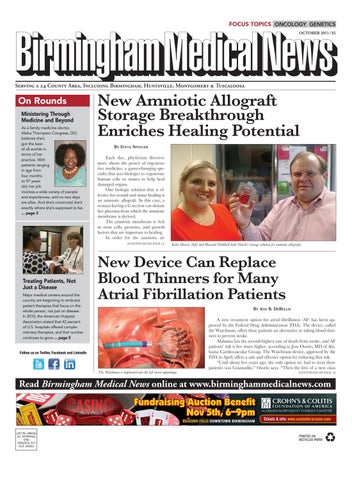
New Amniotic Allograft Storage Breakthrough Enriches Healing Potential By Steve Spencer
Each day, physicians discover more about the power of regenerative medicine, a game-changing specialty that uses biologics to regenerate human cells or tissues to help heal damaged organs. One biologic solution that is effective for wound and tissue healing is an amniotic allograft. In this case, a woman having a C-section can donate her placenta from which the amniotic membrane is derived. The amniotic membrane is rich in stem cells, proteins, and growth factors that are important to healing. In order for the amniotic al(CONTINUED ON PAGE 14)
Treating Patients, Not Just a Disease Major medical centers around the country are beginning to embrace patient therapies that focus on the whole person, not just on disease. In 2010, the American Hospital Association stated that 42 percent of U.S. hospitals offered complementary therapies, and that number continues to grow ... page 5
Katie Mowry (left) and Howard Walthall hold Nutech’s storage solution for amniotic allografts.
New Device Can Replace Blood Thinners for Many Atrial Fibrillation Patients By Ann B. DeBellis
Follow us on Twitter, Facebook and LinkedIn
The Watchman is implanted into the left atrial appendage.
A new treatment option for atrial fibrillation (AF) has been approved by the Federal Drug Administration (FDA). The device, called the Watchman, offers these patients an alternative to taking blood thinners to prevent stroke. Alabama has the second-highest rate of death from stroke, and AF patients’ risk is five times higher, according to Jose Osorio, MD of Alabama Cardiovascular Group. The Watchman device, approved by the FDA in April, offers a safe and effective option for reducing that risk. “Until about five years ago, the only option we had to treat these patients was Coumadin,” Osorio says. “Then the first of a new class (CONTINUED ON PAGE 12)
Read Birmingham Medical News online at www.birminghammedicalnews.com Fundraising Auction Benefit Nov 5th, 6–9pm REGIONS FIELD DOWNTOWN BIRMINGHAM
ALABAMA/NORTHWEST FLORIDA CHAPTER
Tickets & info: www.casinoforacause.com
PRINTED ON RECYCLED PAPER
PRSRT STD U.S. POSTAGE PAID FRANKLIN, TN PERMIT NO.357
EVERY COMPANY FACES CHALLENGES. WORKING WITH YOUR LAW FIRM SHOULDN’T BE CHALLENGING. YOUR LAW FIRM SHOULD BE OUT IN FRONT, REMOVING CHALLENGES. THIS IS WHAT WE DO FOR SOME OF THE MOST RESPECTED COMPANIES IN HIGHLY REGULATED INDUSTRIES— AND WE HAVE TAKEN BOLD STEPS TO ENSURE A CLIENT EXPERIENCE AS FREE FROM CHALLENGES AS POSSIBLE.
PHONE NUMBER
8 0 0 -7 6 2 -2 4 2 6
WEB ADDRESS
www.balch.com
Alabama
Fl o r i d a
Georgia
Mississippi
Wa s h i n g t o n , D C
No representation is made that the quality of legal services to be performed is greater than the quality of legal services performed by other lawyers.
Balch_BhamMedNews_FullPG_Challenges_Text.indd 1
2 • OCTOBER 2015
Birmingham Medical News
2/18/15 6:05 PM
HEALTHCARE SPOTLIGHT
Ministering Through Medicine and Beyond By June
headed back to Birmingham for rotations at Cooper Green Mercy Hospital then to Tuscaloosa for her residency at The University of Alabama Family Medicine Residency. A little over a year ago, she happily settled in “back home” at Medical West. “This part of town is my ministry,” she said. “I live, work and worship here, and I make it a point to attend events in this community. I want to be visible and inclusive. People like to see their doctor out and about.” A believer in community service, Congress makes herself available to participate in health fairs whenever asked, and she works tirelessly for causes involving breast cancer and domestic violence. “Those are two things I’m passionate about,” she said. “I lost an aunt to breast cancer, and I personally am a survivor of domestic violence that occurred when I was 20 years old. So it’s something I feel adamant about, and I want to use my ex-
mAtheWS
As a family medicine doctor, Alisha Thompson Congress, DO, believes she’s got the best of all worlds in terms of her practice. With patients ranging in age from four months to 97 years old, her job involves a wide variety of people and experiences, and no two days are alike. And she’s convinced she’s exactly where she’s supposed to be. “I was created to do this, and that makes every bit of the difference,” Congress said. “I enjoy going to work every day.” And for her, working at UAB Medical West makes the job even better. “I was born in the hospital where I practice,” she said. “My grandmother retired from here, and Medical West has always been part of my life. So coming here to practice medicine was a natural for me. This is my home. This is my community.” Not to mention, pursuing a career in the medical field is what Congress has always wanted to do. “I decided I wanted to be a physician when I was four years old because I liked my pediatrician so much, and I never wanted to be anything else,” she said. “Every career day or event, I headed for the medical professionals.” After graduating from Shades Valley’s Jefferson County International Baccalaureate School, Congress earned a bachelor’s degree at Talladega College. But even though her Alisha Thompson Congress, DO ultimate educational goal was to graduate from medical school, she decided to take a break from her studies. So at that point, she took a teaching job with Birmingham City Schools. “I loved the kids, and I loved teaching, but I loved it almost too much,” she said. “I was working with mostly lower income kids, and I wanted to fix everything for them. But of course I couldn’t.” Congress did, however, have a positive influence on some of the youngsters’ lives and continues to keep in touch with
Birmingham Medical News Become a Fan on Facebook
Alisha Congress, DO with a young patient
perience to minister to others.” Congress spoke at Bessemer’s First Annual Pink and Purple Parade last fall and plans to participate in an upcoming domestic violence seminar this fall. She finds additional opportunities to minister through involvement in her church, First Missionary Baptist Church of Hueytown, where her father pastors and her brother serves as youth director. But it’s her everyday interaction with patients that allows her to regularly make a difference in the lives of others. “It’s an amazing feeling to walk out of a patient’s room and know you’ve done something to touch somebody,” she said. “But I know that I have no power to do any of this on my own. I’m just allowing God to use me. “It can be mind-blowing, and I’m always grateful to be able to do what I do. I don’t take it lightly that people choose me to facilitate their medical care.”
Jefferson County Medical Foundation Trust
Answering Service
some of her first students, who are now in college. But she eventually turned her attention and career path back toward the medical field and entered Lake Erie College of Osteopathic Medicine in Pennsylvania. As soon as possible, however, she intended to return to the South. “I’m such a Southern girl, and I really wanted to do my clinical rotations back home,” she said. “But I had to put in a request for that with someone who always said ‘no’ to things. When he said ‘yes,’ I couldn’t believe it. But I know now it was divine intervention.” So when the time came, Congress
Serving physicians for over 28 years Our goal is to provide excellent service to physicians and their patients • View and change your schedule anytime from computer or smartphone • Operator will follow up with patient to confirm their call was returned • All calls recorded • Messages delivered via pager, text message, phone, fax or email • HIPAA compliant secure messaging
Contact: Mary Whitehead 205-933-8601
SeniorCare Is Welcoming More Into Our Group. Cliff Arceneaux is now accepting new patients at SeniorCare. Caring for seniors takes a special kind of professional. One who knows how to provide warm, personal care and help aging individuals maintain their health and independence. Cliff Arceneaux is one of these unique professionals. Cliff provides outstanding care to seniors in the setting that best meets their needs — our office, retirement communities, and even in their homes through our House Calls program. Help us help others. Give us a call today. 205-916-0105 seniorcareofalabama.com Paul D. Roller, MD MBA MPH Ad Cliff Senior Carev2.indd 1
Emily Baillio, MD
Cliff Arceneaux, PA-C
Birmingham Medical News
9/24/15 1:31 PM
OCTOBER 2015 • 3
ONCOLOGY
We are committed to safer, more targeted treatment options for our patients
Navigating a Path to Quality Care at a Lower Cost
stories of patients who say they couldn’t have made it through their treatments without their The UAB Comprehensive navigator,” she says. “Early reCancer Center is poised to be a sults of another survey show a national model for cost reduchigh level of patient satisfaction tion and quality health care with the navigation program as through the implementation a whole.” of a unique lay patient navigaMyeisha Hutchinson is tion program. After a threeone of the lay navigators who year observational study of has played a role in the success UAB’s Patient Care Connect Todd J. Scarbrough, MD of this program. She and other Program, preliminary results I N A N N I STO N navigators empower patients show a significant reduction to make decisions about their in health care utilization and care by providing information, Medicare costs. identifying resources, and coorThe Patient Care Connect Specializing in: dinating care between multiple Program was created in 2012 SBRT, SRS, IMRT and IGRT providers. “We are part of the with the support of a three-year Stereotactic radiosurgery, health care team and work as $15 million Health Care Innoliaisons and advocates for the radiopharmaceuticals, vation Challenge Grant Award Edward Partridge, MD, and Gabrielle Rocque, MD, discuss results of an patients. We make care more from the Centers for Medicare observational study of the Patient Care Connect Program. such as Zevalin and Xofigo. personal for them,” she says. and Medicaid (CMS) with the RMC Radiation Therapy “Ultimately, we want patients to know They have also participated in programs goal of achieving better health care at a that we are listening and will help them to educate women about the importance lower cost. Second floor NEARMC overcome barriers. We want to make of mammograms in early breast cancer The UAB Comprehensive Cancer 256-235-5089 treatment at a big institution like UAB feel detection. Center has a long history using lay naviDR. SCARBROUGH is board certified by the American like one-on-one care.” “When CMS requested proposals gators in a variety of settings. Lay naviBoard of Radiology. A graduate of East Tennessee College Navigators are proactive in their conthat would provide better health care at gators have participated in cancer health of Medicine in 1998, he completed his radiation therapy residency at Emory University in 2003. tact with patients and quickly identify rea lower cost, we proposed to recruit and disparities research conducted in the Alasources to help them manage their care. train lay navigators to work with Medibama Black Belt and the Mississippi Delta. “I usually get a big thank you for things I care patients and help steer them through think are minimal,” she says. “That’s how the system. We planned to install those I know I am helping the patient.” navigators at UAB and the 11 other instiRocque says these navigators offer tutions that are part of the UAB Cancer several advantages. “These individuals Community Health Network,” says Edare more approachable, and patients are ward Partridge, MD, director of the UAB willing to ask them things they may not Comprehensive Cancer Center. “We want to ask nurses or physicians,” she says. believed that use of lay navigators would “The program also helps us make sure provide better health care at a lower cost, we are focusing on a holistic approach to ONE INDEPENDENCE PLAZA, SUITE 900, BIRMINGHAM, AL 35209 and we estimated that we would reduce medicine and are moving beyond the paemergency room visits, hospitalizations, A C I P C O H E A LT H S E R V I C E S • C H I L D E R S B U R G M E D I C A L S U R G I C A L C E N T E R tient’s symptoms to address social issues intensive care unit (ICU) visits, and imCULLMAN • HOMEWOOD • HOOVER like transportation problems or family prove care at end of life by having more PRINCETON BAPTIST MEDICAL CENTER • PELL CITY • SYLACAUGA difficulties. We want to make sure we are hospice admissions. We submitted that meeting all of their needs.” S T. V I N C E N T ’ S O N E N I N E T E E N grant proposal and we got the funding.” Another key feature of the program is Early data indicates that the Patient the concept of navigating patients across Care Connect Program attained the goals the continuum of care. “Most navigaof that proposal by reducing hospitalizator programs focus on either screening tion rates by almost 20 percent over the and early detection or the early phases three-year grant period. Emergency room of treatment,” Rocque says. “Our provisits decreased almost 10 percent, and gram focuses on patients who are in the ICU admissions saw a dramatic six perearly detection stage as well as those on cent reduction. survivorship or end of life. That allows us In terms of Medicare claims, the the unique opportunity to target our serinitial UAB study indicates there was a vices to those who are most likely to need considerable reduction of overall cost in them.” the navigated patient population from The Patient Care Connect Program $15,091 to $8,269 per patient quarter, has had more than 80,000 contacts with a savings of $6,822 per navigated papatients. “That’s outside of usual health tient. Cost in the last six months of life care delivery, so what the navigators are decreased from $23,735 to $16,764 per really doing is connecting the dots – connavigated patient while the same costs in necting various parts of the health system the non-navigated group increased from so the patient at home does not worsen $13,418 to $15,544. W W W. B G A P C . C O M 205-271-8000 and end up in the emergency room,” ParWhile these financial savings are subtridge says.. stantial, Gabrielle Rocque, MD, medical J. Lynn Cochran, MD | Raymond Tobias, MD | P. David Miller, MD | Mark R. Janich, MD | H. Craig Philpot, MD UAB’s navigator program has been director of the Patient Care Connect ProJ. Cotton Shallcross, Jr., MD | Kenneth M. Sigman, MD | Charles S. Bluhm, MD | Owen R. McLean, MD implemented in the 12 hospitals in its gram, says the most important result may David J. Landy, MD | Christopher P. Shaver, MD | Rajat N. Parikh, MD Cancer Community Health Network albe realized from the perspective of the Rishi K. Agarwal, MD | Charles A. Dasher, Jr., MD (CONTINUED ON PAGE 27) patient experience. “There are countless By Ann B. DeBellis
SERVING PATIENTS THROUGHOUT THE
BIRMINGHAM AREA
4 • OCTOBER 2015
Birmingham Medical News
ONCOLOGY
Treating Patients, Not Just a Disease stress reduction techniques. “We are focusing on a person who just happens to have canMajor medical centers around cer,” she says. “While the onthe country are beginning to emcologist focuses on the disease, brace patient therapies that focus on we can concentrate our attenthe whole person, not just on disease. tion to other important things In 2010, the American Hospital Asthat are happening to the ensociation stated that 42 percent of tire person such as the side U.S. hospitals offered complemeneffects related to cancer treattary therapies, and that number ment. We can address how the continues to grow. UAB Hospital is disease is affecting the patient’s one of those hospitals and its Comlife, family, friendships, and prehensive Cancer Center has esspirituality.” tablished Alabama’s first Integrative Integrated medicine is deMedicine Clinic for Oncology. Referred to as integrated medi- Carolina Salvador, MD, right, talks with Carolyn Maddox about complementary pendent on a partnership between the patient and doctor. cine, this medical approach empha- therapies for cancer patients. That relationship helps the pasizes the care of the whole person tient express his needs and feelings which cially start up next year.” -mind, body and spirit - uses evidence-based then allows the doctor to offer appropriate Salvador, who completed the two-year approaches, and includes all aspects of the and effective complementary treatments. fellowship at the University of Arizona Intepatient’s lifestyle. “Integrated medicine uses Through those treatments, Salvador says grative Medicine Program, emphasizes that non-traditional treatments for a holistic apthey can help control and possibly allevithe integrative treatments will not take the proach to managing symptoms and side ate some side effects, help improve physical place of oncology care, “it is a complement effects that patients experience during and strength and stamina, and lessen anxiety. to the oncology care,” she says. “I am not after cancer treatments,” says UAB hema“Integrated medicine allows us to give trained to be just an oncologist or just an tologist and oncologist Carolina Salvador, patients more time, more attention, and integrative medicine doctor. I want to comMD, leader of the clinic. “As oncologists a broader approach to healing,” she says. bine both roles and use this clinic to take we train and work hard to treat cancer, but “Together we form a partnership to find the care of the patient as a whole person.” sometimes we tend to overlook the whole best treatments and to give a patient better According to Salvador, integrated person. I felt like we needed to take a differquality of life.” medicine typically combines conventional ent approach which was a motivation for Edward Partridge, MD, director of the Western medicine with complementary establishing the clinic. Currently, the clinic UAB Comprehensive Cancer Center, says treatments such as massage, biofeedback, offers physician consultations but will offer Salvador is the impetus behind the estabyoga, herbal medicine, acupuncture, and more integrative treatments when we offiBy Ann B. DeBellis
lishment of the clinic. “She has training in integrative medicine and has done a great job setting up the clinic,” he says. “We know that patients are interested in complementary therapies and sometimes seek them outside of the health system. I personally support having the integrative clinic so that our patients who want those therapies will have access to them in an organized environment. We also hope to conduct research on the use of these therapies to better understand the benefits of complementary approaches.” Those who favor holistic treatment of patients see it as a way to help physicians who may be overwhelmed by the growing demands of our health care system. It also may comfort and encourage patients who often feel they are nothing but a disease. As more hospitals and academic centers embrace integrated medicine therapies, Salvador says she is seeing a real movement toward treating the whole person. “We are all working together toward the same goal of attaining better health care that will provide more holistic care for all patients, not just cancer patients. Any person with a chronic medical illness can benefit from this integrated approach,” she says. “In addition to treatments, I think it will be important in the prevention of disease through better nutrition, good physical exercise, and stress management. That can make a real impact in overall health.”
Birmingham Medical News
OCTOBER 2015 • 5
Princeton Opens Structural Heart and Valve Center Internationally renowned surgeon serves as medical director By Jane Ehrhardt
“Instead of one option, you get 10 options here,” says Mustafa Ahmed, MD, medical director of the new Structural Heart and Valve Center at Princeton Baptist Medical Center. At a normal heart center, someone with stenosis (tight heart Mustafa valve) would get one opAhmed, MD tion — replace the valve through open surgery. “But some older or very young people cannot handle that
procedure,” Ahmed says. “Here we can either replace or repair that valve. And we can use a robot or a mini-incision or someone like me can go through the leg or some other place without cutting someone open.” Ahmed, internationally recognized for his research and impact on structural heart disease, is one of the few specialists in the country with expertise in both minimally invasive procedures and advanced cardiac imaging. He was the first at UAB to complete the American Board of Internal Medicine (ABIM) clinician-scientist pathway in cardiology. “It allowed me to develop expertise in research and cardiol-
Gain peace of mind. We only get paid if you do. Our fee is based on payments received.
With MedCorp, we take care of the billing, so you can focus on your patients. We can partner with your staff or you can leave it all to us. Only looking for software to do your billing? We can help you with that. We represent and work with Medisoft, Lytec, Altapoint, TotalMD & MediTouch. We can also help you set up your entire computer and software system!
www.medcorpalabama.com | (256) 547-4425 ext. 308
SOME SERVICES MEDCORP PROVIDES: 5 Creating new patient accounts from face sheets & insurance cards 5 Entering charges & co-payments from your superbills 5 Sending patient statements 5 Posting payments received 5 Refiling rejected claims with corrections 5 Filing insurance claims 5 Posting insurance payments from ERA/EOB/REMIT 5 Reviewing past-due accounts 5 Editing insurance claims 5 Posting insurance remark notes 5 Following-up on claim rejections
K
ogy, along with key interventional and imaging aspects of structural heart disease,” he says. Ahmed is also internationally known for handling pulmonary embolisms. “Very few of us can go through the leg to clean the clot out of the lung,” he says. He’s the only surgeon performing this procedure in the state. “It’s just another example of using mini techniques to help life-threatening conditions.” Clifton Lewis, MD, a cardiac surgeon, comprises the other half of the surgical team at the new Center. He brings a reputation for robotic surgery. “Most mitral valve surgeons will do six in a year,” Ahmed says. “Here, we’re doing over 150 in a year and that’s just mitral valve operations.” Lewis has also performed the largest number of cases of tricuspid robotic valve surgeries in the country. Rather than stirring Clifton Lewis, MD competition, combining the two preeminent surgeons has resulted in breakthrough structural heart and valve procedures. “There’s a misconception that cardiac surgeons do not want to work together. But Clifton and I are best friends when it comes to work. We enhance what each other can do,” Ahmed says. The partnership has already sparked a completely new range of options.
Kassouf
Compliance Plus
Kassouf & Co introduces Compliance Plus — a comprehensive HIPAA readiness, management, and documentation solution. COMPLIANCE PLUS is much more than just an online HIPAA program. Compliance Plus connects our staff and resources with your staff, creating a collaborative portal to successfully implement a customized and ongoing HIPAA compliance program. COMPLIANCE PLUS is a partnership between your practice and our team of healthcare experts. This is not a do-it-yourself solution. We guide you through the HIPAA compliance process, providing the necessary documentation, analysis and training.
THROUGH COMPLIANCE PLUS YOU RECEIVE: • HIPAA project & task management • On-site IT annual risk assessment • Policy & procedure assessment • Access to the Kassouf Policy Library • Compliance risk management
• Initial on-site HIPAA training • Ongoing web-based HIPAA training • Monthly security updates to staff • Centralized document repository • Ongoing “security officer” support
COMPLIANCE PLUS is our commitment to be there when you need us — supporting you and your practice.
K a s s ou f C E R T I F I E D
P U B L I C
Co A C C O U N T A N T S
2208 University Boulevard | Birmingham, AL 35233 | 205-443-2500 | complianceplus.kassouf.com 6 • OCTOBER 2015
Birmingham Medical News
Recently the team had a patient with both a leaky mitral and tricuspid valve. “Which is much, much riskier than a single valve problem,” Ahmed says. To make it worse, the patient had a bad heart. “No surgeon in their right mind wants to touch that person.” But the two surgeons brought their specialties together for a solution. Ahmed went through the leg and fixed the mitral valve with plugs. Then Lewis fixed the tricuspid using the Da Vinci robot. “We came up with a new approach to treat the patient and that’s the kind of thing we’re doing here. It was the first procedure like that in the world,” Ahmed says. Opened in July, Princeton’s Structural Heart and Valve Center has exceeded in three months the case volume they expected to handle in a year. As a result, they’ve added two more nurses to support their staff of two surgeons and five cardiologists. “We cover every aspect of structural heart and valve care from imaging, assessment, and surgery to care,” Ahmed says. “We do you cutting edge stuff with a completely new range of options.” One patient arrived who had been through multiple heart surgeries and was a Jehovah’s Witness, meaning he would not take blood. “Here we had someone too unstable to have surgery, blood count too low, and we came up with a new way to get in through his leg,” Ahmed says. “It was a first-in-the-world procedure.” That procedure let the patient live, so two months later he could handle regular heart surgery. “Before we came along, there was no option for a patient like him,” Ahmed says. “But we can come up with things here that rival major medical centers.” The Center, says Ahmed, is not just for patients in dire need of structural heart or valve repair. “What will surprise physicians is that I want to see people with moderate heart disease,” he says. “I want to get them in ahead of time, identify them, and follow them.” Before the Structural Heart and Valve Center opened in Birmingham, “you had to shop around to find who could do the different imaging, procedures and assessments,” Ahmed says. But the Center works to get imaging and assessment done in one day, while also allowing patients to see both surgeons and schedule any needed procedures. “We do that several days a week, and we all stretch to be available at any given time, so we’re able to take on cases from really far away.” The equipment and skills available at the Center, he says, put Princeton on a par with world class medical centers, like Mayo Clinic. “This is the only place where we have a team with the expertise to offer you every single option that is available on the planet,” Ahmed says. “Anyone can send their most complicated cases here.”
Medical West Expands Animal-Assisted Therapy Dogs to Become Part of Rehab Program
pets to the facility’s annual hospital week. A few nurses at the inpatient rehab unit brought “It’s wonderful to patients out to the yard to intersee the transformation in act with the dogs. “It created a the patients’ faces when spark,” Clark says. “We saw a the dogs arrive,” says really positive improvement in Pam Autrey, PhD, RN, those patients. They did betand chief nursing officer ter in their therapy. It seemed at Medical West hospito give them a morale boost to tal, an affiliate of UAB. spend time with an animal.” The dramatic change So Medical West contacted occurs in one of the most Hand in Paw (HIP), a local difficult populations to nonprofit that uses the proven manage at a hospital, getechniques of the international riatric psych patients. Pet Partners program to train Twice a month, therapy animals. HIP careKosmo, a terrier mix, fully selects and trains owners and Demi, a golden reand their pets to serve in meditriever, make official cal and educational situations. calls to the 19-bed unit. Medical West Geriatric-Psych unit staff with animal-assisted therapy teams from Hand in Their 175 volunteers currently Trained as therapy dogs, Paw. help children with learning disthe two canines, under abilities, reluctant young readers, and the control of their owners, stroll the halls demeanor changes immediately.” Their patients of all ages who face emotional, for about a half hour, visiting any interoverall comfort level improves, along with physical, and mental conditions, such as ested patient. The only areas off-limits intheir willingness to participate in activities autism, muscular dystrophy, terminal illclude patients in isolation and any rooms and leave their rooms. “It’s amazing what ness and dementia. where food is prepared or being served. this does,” he says. “The HIP teams are very well “The results of the interactions are Clark began working to bring therapy trained,” Autrey says. She was just as iminstant,” says Nathan Clark, director of dogs to Medical West last summer after the pressed by the handlers as the dogs. “You business development. “The patients’ Humane Society of Birmingham brought By Jane Ehrhardt
Located on Hwy 280, east of I-459
have to be a special person to do this in this environment, but they just blended right in and started mingling like they did it every day.” For the teams to qualify for their therapy certification, the dogs must pass basic obedience classes along with the Hand in Paw therapy training. “Those dogs don’t jump up, they don’t lick — which is really good from an infection control perspective — and the day before they come, they have to have their teeth cleaned, a bath, their ears cleaned, and their nails clipped,” Autrey says. That kind of detailed awareness and understanding of infection control helped allay concerns of starting the animal-assisted therapy at the hospital. “The idea of animals in a sterile environment was the biggest challenge we faced with the quality department,” Clark says. The other challenge was creating policies and procedures. “My advice to other facilities wanting to do this, is to depend on a company like HIP that does this professionally,” Clark says. “They’ve crossed all those hurdles for you.” The potentially complicated process was also eased by Clark’s adapting UAB hospital’s (CONTINUED ON PAGE 16)
GrandviewHealth.com
Birmingham Medical News
OCTOBER 2015 • 7
ENT Associates of Alabama, P.C. Welcomes Dr. Angela Blount Dr. Blount is Board Certified and practices general adult and pediatric ENT with special interests in sinus/allergy disease, endoscopic sinus surgery, pediatric ENT, and thyroid surgery.
Morton Goldfarb, M.D., F.A.C.S. John Poynor, M.D., F.A.C.S. Stephen Favrot, M.D., F.A.C.S. Jack Aland, M.D., F.A.C.S. Sheldon Black, M.D., F.A.C.S.
Peyton Colvin, M.D., F.A.C.S. L. Clark Simpson, M.D., F.A.C.S. Howard Goldberg, M.D., F.A.C.S. E. Scott Elledge, M.D., F.A.C.S. Jonathan Levine, M.D., F.A.C.S.
Alice Morgan, M.D., Ph.D., F.A.A.O.A. Bruce Morgan, M.D., Ph.D. David Walters, M.D. Angela Blount, M.D.
At ENT Associates of Alabama, we care for ALL of your ear, nose and throat needs. We specialize in all ages from infants to geriatrics and all of our doctors are board certified and dedicated to providing exemplary care. • surgery of ear, nose & throat • head and neck cancer surgery • facial plastic & reconstructive surgery • upper respiratory infections • flu • allergies • voice restoration
• Botox • fillers • robotic surgery • in-office balloon sinuplasty • hearing aids & much more!
7 LOCATIONS TO SERVE YOU: St. Vincent’s • Trinity • Jasper • Cullman Shelby • Gardendale • The Northside Clinic (Pell City)
Call 1-888-ENT-5020 for your appointment today www.entalabama.com
8 • OCTOBER 2015
Birmingham Medical News
Meaningful Use Audits Proactive Tips for Success By Jackie Trimm
For health care professionals who began accepting Meaningful Use incentive money at the outset of availability under the Medicare option in 2011, the year 2015 is an important year. If the provider has met all core requirements and objectives for the designated reporting periods, he or she has not only successfully converted to an efficient electronic health records system, but has also collected the maximum incentives authorized by CMS to do it - a total of $44,000 for eligible health care professionals (EPs). In today’s health care environment, that is significant money. Not only did starting early earn the EP the full incentive, but he/she avoided the payment reductions starting at one percent and progressing to five percent annually - that began this year for eligible professionals who chose not to participate in the Meaningful Use Incentive Program. Yes, 2015 marks the end of five good years for those professionals who got in early, figured out the process, stayed current on the constant changes, and kept attesting to satisfaction of those meaningful use objectives and measures for the designated reporting period. These providers are well on their way to Stage 3 - no small feat. But when the government disburses $20 billion in incentives, there will be strings attached, and those strings have come in the form of post-payment audits. Approximately five percent of Meaningful Use participants who have received incentive money will be audited via CMS’s contractor, Figliozzi and Company. According to recent statistics released by CMS, since 2011, it has authorized more than 10,000 audits on more than 265,000 attestations by EPs (this does not include audits of eligible hospitals), and more than 25 percent of those audits have resulted in failure. Failure is expensive. A failed audit requires return of all incentive money received for that audit year - in other words, no partial credit for partial compliance. The most common areas of failure involve failing to conduct proper data risk assessments, per Core Measure 15 (meaningful use regulations require these assessments in addition to those assessments performed to comply with HIPAA regulations), and failing to keep adequate documentation that support attestation. Relying on the vendor’s certification and its retained system data alone will not be enough to survive the audit. So what can an EP do to be ready for the audit letter when it comes? The best weapon is anticipation. Upon receiving notification of the impending audit, the EP will generally have two weeks to submit responsive data. Although certified EHR systems have the capability to produce information reasonably fast, and all clinical quality measure data must in fact be reported directly from the EHR system, certified systems do not always provide the complete picture. Supporting documentation can and should be available from other sources. It is important to be able to quickly produce not just the attestation data, but all source data that was relied upon in making the attestation. According to CMS, reports
from all sources should demonstrate at a minimum the numerators and denominators used in all calculations, the timeframe of the reporting, and evidence to support that it was generated for that particular provider. CMS acknowledges that certified EHR systems cannot always limit reporting periods or properly support non-percentage based objectives, and so it is important that other documentation be maintained for the auditor’s review. If the EP has anticipated his/her “burden of proof,” so to speak, the chances of a successful audit are greatly improved. For example, did the EP attest that he/she writes fewer than 100 prescriptions a month to apply a MU exclusion? If so, what documentation proves it? Did he/she attest that more than 60 percent of medication orders were done via computer entry? If so, what source documents will demonstrate the numerator and the denominator values for that calculation? Was there a successful electronic submission of public health information? How can it be proven? Approximations and assumptions won’t be enough to survive the audit. The following tips, when done before the audit letter arrives, gives the EP a fighting chance: • Keep all source documentation for a minimum of six years • Ensure proper paper exists to support the “yes/no” attestations • Work with IT to access and preserve general system data and audit trails. For example, when was the “generate patient lists by condition” function turned on? When was a function toggled from no to yes? • Use screen shots to document pointin-time entries, specific reporting periods, and successful submissions where possible • Perform routine gap analyses and audits internally. Know your weaknesses before CMS does! • Be ready to prove the negatives. Zero patients requested copies of medical records during the reporting period? What documents support that? • Be duplicative where needed and maintain separate compliance files. A system security analysis under HIPAA will not qualify as the system security analysis under Core Measure 15. • Every attestation should have documents to support it. Remember that one failed element equals a failed audit. A failed audit will result in repayment of all incentives received for that audit year. Successful navigation of the Meaningful Use program is about more than just meeting objectives and figuring out the attestation process, which admittedly was challenging enough. At the end of the day, it is about keeping the money that was earned. Anticipating the audit and its pitfalls is a critical component to surviving the regulatory land mine of Meaningful Use. Jackie Trimm practices in Burr & Forman’s tort trial and insurance practice group, with an emphasis on health care litigation.
Introducing Fresh
Healing Potential Realized
Naturally
bioACTIVE Announcing a breakthrough in regenerative medicine: Affinity fresh amniotic allografts.
NuTech’s breakthrough proprietary preservation system, AlloFreshTM, maintains the integrity and viability of fresh amniotic tissue. For the first time, surgeons can take full advantage of this unique tissue’s strength, flexibility, and healing potential. Affinity provides a natural solution for regenerative healing. 1–3
The Affinity Allograft Advantage
Proprietary Storage System
Durable and Flexible
42 Days of Viability
Contact NuTech at 800-824-9194 Learn more about how Affinity fresh allografts are transforming regenerative medicine: info@nutechmedical.com www.nutechmedical.com References: 1. Niknejad H, Peirovi H, Jorjani M, et al. Properties of the Amniotic Membrane For Potential Use in Tissue Engineering. Eur Cell Mater. 2008(15):88–89. 2. Wolbank S, Hildner F, Redl H, van Griensven M, Gabriel C, Hennerbichler S. Impact of human amniotic membrane preparation on release of angiogenic factors. J Tissue Eng Regen Med. 2009;3(8):651–654. 3. Gruss J, Jirsch D. Human amniotic membrane: a versatile wound dressing. Can Med Assoc J. 1978;118(10):1237–1246.
© 2015 NuTech Medical, Inc. NuTech name and logo are registered trademarks, and Affinity is a registered trademark of NuTech Medical, Inc. AlloFresh is a trademark of NuTech Medical, Inc. All Rights Reserved.
Birmingham Medical News
OCTOBER 2015 • 9
GENETICS
The Epigenetics of Experience Genes, Mind and Memory By Laura Freeman
For science fiction writers, staying ahead of science fact is getting harder. One vivid example is how recent advances in genetics are pushing the thresholds of neuroscience forward into areas that sound like plots to futuristic movies. Among the coming attractions now being studied are promising genetic and epigenetic tools for editing traumatic memories, implanting transgenerational memories, modifying the effects of experience on reward behaviors to break the hold of addictions, and precision targeting of pharmaceuticals to counter brain diseases and cognitive decline. Jeremy Day, PhD, is an assistant professor in neurobiology at UAB. His lab focuses on understanding how experience alters the brain, how those changes drive future behaviors, and developing more specific epigenetic tools to repair problems Jeremy Day, MD “When only one gene is involved, a global inhibitor that acts broadly can have serious off-target effects. Our lab is interested in learning to manipulate epigenetic processes in a very specific way,” Day said. “The CRISPR system has
been used to correct mutations and insert genes. We’re using a version of CRISPR that doesn’t cut DNA. Instead, we use it to create anchor points to bring epigenetic modifiers to a specific gene. This requires a few tricks to achieve specificity. We have to engineer guide RNA to target that gene. “For example, if a gene is implicated in Alzheimer’s, we want to target that location by pulling an epigenetic-modifying protein there and have it act only there. That is the goal of our work.” Such precisely targeted tools, which are already showing success in animal studies, together with advances in targeted epigenetic neuropharmacology, would make therapies available to treat some of the most challenging problems affecting the human brain, memory and cognitive processes. Two areas that could greatly benefit are opposite sides of the same coin—how links to positive memories can cue reward behaviors, and how associations with traumatic experiences can trigger stress reactions. “Fear-based memories create epigenetic changes in brain circuits. By targeting the circuits where those changes are located, we should be able to inhibit the maintenance of that memory and associations that trigger it. It has been done in animal models, but we would need new technologies to identify which neurons need to be altered so we can
be sure we aren’t affecting other memories,” Day said. “In addictions, there are very powerful memory links to previous experience and environmental cues that stimulate drugseeking behaviors. Weakening the links to reward-motivated behaviors should make it easier to break free from addictions. However, we would want to accomplish this in a way that wouldn’t inhibit a person’s ability to enjoy everyday life.” Genetic memory has been a topic of speculation for years, but epigenetic memory is showing some real evidence that the effects of what one generation experiences can be passed on to the next. “Studies in mouse models that link a specific odor to a frightening experience— electrical shock—have shown that the next generation of mice will respond with fear to the same odor without the shock. The second generation also shows some increased sensitivity,” Day said. “It will be interesting to determine whether visual, tactile and sound memories have a similar affect. In humans, could this contribute to psychological difficulties, and could those inherited memories be targeted?” Therapies that could counter brain disorder affecting cognitive abilities are another area of research that reads like science fiction. “If we can detect Angelman syndrome
early and upregulate the good copy of the gene, we should be able to prevent some of the retardation associated with the disorder. There has already been proof in principal in animal studies at The University of North Carolina,” Day said. “For patients who are already affected by diseases that cause cognitive decline, eventually epigenetic therapies may be able to enhance their function. There is already an exciting study using HDAC inhibitors to reverse neurodegeneration.” The timeline for this brave new world is the big question. How soon will we be seeing more genetic and epigenetic therapies in real world medicine? “We’ll see some sooner than others. Already, we’re using biomarkers to predict who is at risk, and the degree to which they are at risk. Genomic medicine is coming into practice. Five to ten years down the road, we should be seeing very specific epigenetic therapies that will make a tremendous difference in how we treat neurological disorders.” As genetic, genomic and epigenetic advances contribute remarkable innovations to medical care, it is easy to be reminded of scientist and author Arthur C. Clark’s oftenquoted Third Law—“Any sufficiently advanced technology is indistinguishable from magic.”
The Cardiac EP Services of Princeton Baptist Medical Center
205.786.2276 BaptistHealthAlabama.org 833 Princeton Avenue SW POB III, Suite 200A Fax: 205.786.6227 Email: ibrahim.hanna@bhsala.com
ACCEPTING NEW PATIENTS
Ibrahim Hanna, MD, Medical Director Over 10 years Of experience Arrhythmia Management | Atrial Fibrillation Clinic | Defibrillator & Pacemaker Implants Cardiac Device Explants | Electrophysiologic Studies & Ablations
10 • OCTOBER 2015
Birmingham Medical News
GENETICS
Unmasking Mystery Diseases HudsonAlpha to Open America’s First Genomics Clinic By Laura Freeman
November 1st, the morning after Halloween’s phantoms have shed their masks, HudsonAlpha Institute for Biotechnology in Huntsville begins its quest to unmask even more fearsome and elusive real life villains—unknown genetically-based diseases destroying the lives and health of human patients. Headed by David Bick, MD, it will be the nation’s first clinic devoted to using whole genome sequencing to identify genetic clues that can help put a name to unknown and hard-todiagnose diseases. “Often patients with baffling disorders that have a genetic basis go on a painful, expensive diag- David Bick, MD nostic odyssey from doctor to doctor, trying to find someone who can tell them what is wrong and what can be done to help them,” Bick said. “When conventional labs and diagnostic technologies can’t provide enough clear answers to make a diagnosis, we may be able to solve the riddle by identifying genetic variants.” The first step in vanquishing any monster is knowing what you are fighting, and where its vulnerabilities are. Since the HudsonAlpha Clinic for Genomic Medicine will
be sequencing the whole genome, it will be looking at a broader range of genes that could influence how other genes are coding. “The primary difference in our clinic is that we will be tightly focused on undiagnosed diseases, and we will exclusively sequence the whole genome, rather than just the exome,” Bick said. “Not so long ago, conventional wisdom was that the one percent of genes involved in coding proteins is where everything important happens. As it turns out, the other 99 percent includes genes that influence how the one percent are expressed and control RNA splicing.” The clinic’s initial efforts will be directed primarily toward children who have undiagnosed conditions likely linked to genomic variants, and to adults who have a disorder that remains unidentified despite extensive diagnostic testing. “Our purpose is to bring whole genomics into the practice of medicine so physicians have more effective tools to identify and understand the underlying causes of disorders,” Bick said. “In the future, our clinic and its genomic sequencing capabilities could be resources assisting in the development of pharmaceuticals and other interventions to treat those conditions.” The clinic will be located on the campus of HudsonAlpha, the Huntsville-based research center known nationally and internationally for its work in genetics, genomics
and its high-throughput sequencing capabilities. Bick came to HudsonAlpha from the Medical College of Wisconsin, where he worked extensively in genomics research. He studied human genetics and did previous work in the field at Yale. “Using whole genome sequencing, we’re successfully identifying approximately 25 percent of the disorders behind previously undiagnosed health problems in patients referred to us,” Bick said. “Even when we don’t find an immediate match to variants linked to specific conditions in our data base, the data is expanding so fast, with new input from around the world, that sometimes six months later when we run the genome again, the answer is there.” If there isn’t yet an answer to what a condition is, there may be valuable answers to what it isn’t—sparing patients from the possible side effects of treatments that may be off target. As research continues, genomic sequencing offers great potential for identifying which interventions are most likely to be effective, with the least risk of side effects. Already, a patient’s unique genetic code can be helpful in predicting which blood thinners in which doses are likely to be most effective. “We’ve been working in close collaboration with the genetics team at UAB, and eventually we would like to use telemedicine
to make consultations available to patients in their doctor’s offices across the state,” Bick said. “As a physician, when I evaluate a patient, I look for external physical markers. Sometimes I can spot characteristics associated with a specific disorder. As I review symptoms and history with the physician, I ask whether the patient has been tested for that condition. It may not be something that would immediately come to mind—but if we test for it and the results are positive, we can solve the problem without having to go farther.” Physicians can refer patients to the clinic, or patients can self-refer. “As of now, the challenge is insurance. Some plans cover it. Some don’t. Sometimes I can write a letter explaining why genomic testing makes sense, and the insurer may decide to cover it, especially considering how expensive repeated rounds of conventional testing can be.” Even if patients have to cover the cost themselves, getting an answer for a disorder that can be treated, or for one where early intervention can make a difference in quality of life can be well worth it. “Over time, as more insurance companies see the value, more will be likely to cover it. The technology of genomic sequencing is evolving so rapidly, the cost of using it as part of real world medical practice is becoming more affordable.”
To make an appointment, call our office at 205-352-1175. BrookwoodCareNetwork.Com/graNd-river
SPORTS MEDICINE FOR EVERYDAY ATHLETES, PRIMARY CARE FOR ADOLESCENTS, ADULTS AND SENIORS NEW PATIENTS WELCOME SAME-DAY AND WALK-INS ONLINE BOOKING
CHRISTOPHER S. CARTER, MD Dr. Carter is board-certified in family medicine and fellowship-trained in sports medicine. He treats individuals of all ages, and is committed to educating his patients about how they can take an active role in staying healthy.
NOW OPEN
BROOKWOOD PRIMARY CARE – GRAND RIVER 1115 Payton Way, Leeds, AL 35094 (Conveniently located directly across from the Bass Pro Shops® entrance) Birmingham Medical News
OCTOBER 2015 • 11
New Device Can Replace Blood Thinners for Many, continued from page 1 of drugs that we call novel oral anticoagulants (NOACs) was released. These new blood thinners - Pradaxa, Xarelto, Eliquis and Savaysa – are easier to take because patients don’t have to have frequent blood work done like they do with Coumadin. Those meds have made it much better for patients, and they decrease the risk of stroke significantly.” In AF patients, the high risk Jose Osorio, MD in surgery of stroke comes from the left atrial blood can pool in the LAA causing clots. appendage (LAA), a small pouch in the left A clot can dislodge and go to the brain, atrium of the heart. “When you have AF,
causing a stroke, or to another part of the body,” Osorio says. “So with the knowledge that most clots form in the LAA, scientists developed this device which can occlude the appendage.” The Watchman device looks like a small parachute made of mesh and wires. Once implanted, heart tissue grows over the device, completely occluding the LAA. This growth typically occurs within 45 days during which the patient must continue to take blood thinners. Because of that, patients who can’t tolerate
Quoth the Raven
with a C P A P you will snore...
NEVERMORE, NEVERMORE. Helping You Breathe Easier - Day and Night James Sosnowchik, MD | H. Andrew Wilson, Jr., MD | Christopher W. Roney, MD 205-871-9112 | www.sleepandlungdocs.com Brookwood Medical Center | 2022 Brookwood Medical Ctr Dr, ACC 310
Serving the Birmingham Community for over
35 Years • Long-Term Care • Short-Term Care
• In-patient Physical, Occupational and Speech Therapies • 24/7 Admissions
Our Family Caring for Yours Civic Center Health and Rehabilitation, LLC
*Best Practice Award August 2009 utilizing the Montessori Method for Dementia Management
205-251-5271 - Call us today for a tour!
Presented by the Alabama Nursing Home Administration
1201 N. 22nd St. Birmingham, AL 35234
12 • OCTOBER 2015
Birmingham Medical News
blood thinners are not candidates for this device. “Once the LAA is completely occluded, after about 45 days, we can stop the blood thinner since clots no longer will form inside the appendage,” Osorio says. “Trials have shown that the device is similar to Coumadin in terms of stroke reduction, yet you have a significantly lower risk of bleeding with the Watchman. That’s the advantage. For patients at a higher risk of bleeding, elderly patients for example, this is an important option.” St. Vincent’s Birmingham is the first hospital in the state to offer the Watchman device to these heart patients, and Osorio implanted the device in the first Alabama patient in late June. Since then, he has implanted devices in another 18 patients. The first three of those patients underwent their 45-day evaluation in August which revealed that the appendage was completely closed. They all have been taken off Coumadin. “This is a novel, game-changing device. It’s different from anything else we have used to treat AF,” Osorio says. “During the first device trials done in the U.S., there were some complications, but researchers made some modifications in the way the procedure is performed and now it is much safer. In the hands of experienced physicians, the complication rate is very low.” As with many new medical devices, patients who received the Watchman device after the initial clinical trials were tracked through Continuous Access Programs (CAP), which are registries that follow patients’ results. The device has been used in Europe for years and in the U.S. there have been two randomized trials (PROTECT AF and PREVAIL) and two registries (CAP Registry and CAP 2 Registry). “A recent analysis of all patients enrolled in trials in the U.S. and CAP registries showed that this device is equal to Coumadin in stroke reduction, and patients who had the Watchman device died less often, with a 50-percent reduction in mortality,” Osorio says. “We are collecting data that will also be on another registry soon so we can track the patients thoroughly to make sure everything is going well. Since new physicians will be implanting the device, we want to make sure the procedure remains safe.” Osorio takes referrals from physicians with patients who might benefit from the Watchman device, which he believes will be life-changing for people who don’t want to take blood thinners. “You have to spend time talking to patients to know how much being on a blood thinner affects their lives. Even for patients who can reach a normal rhythm, being on those medicines causes them to worry about cutting themselves or falling,” he says. “Living with the constant fear from being on a blood thinner impacts people significantly, and my patients are thankful that the Watchman device is now an option for them.” Read more about the Watchman device at http://www.theafibclinic.com/ watchman-device.html
Birmingham Medical News
OCTOBER 2015 • 13
New Amniotic Allograft Storage Breakthrough, continued from page 1 lograft to be most effective, it is important to keep as many cells alive as possible between the time the membrane is harvested and stored until it is used with a patient. Unfortunately, this has been a challenge. For example, in the most common storage technique, where the amniotic membrane is dried and dehydrated, once the water is removed, the structure of the tissue collapses. And while the healing proteins are retained, the stem cells, which create the proteins, die. This means that will be no new proteins created. Some providers have tried to freeze the amniotic allograft for storage, but the results are largely the same as with the dehydrated products. However, recently Birminghambased Nutech Medical has made a breakthrough in storage technology that appears to boost the allograft’s healing potential. “Over years of experimentation, we’ve developed a proprietary storage system,” says Howard Walthall, CEO of Nutech. “We store the fresh amniotic membrane in a special solution that maintains the structural integrity and viability for 42 days from the date of processing. This is longer than ever before possible.” In this fresh amniotic allograft, which Nutech has named Affinity, most of the stem cells are still alive. According to Walthall, the definition of a stem cell is subject to interpretation. “The most com-
Wound that had not healed in two years.
The wound is healed after six weeks of Affinity treatment.
mon definition of a stem cell is that it can reproduce itself and differentiate down multiple lineages, meaning that it can be persuaded to become a different cell type. Many cells in the body can only become the type of cell they are. A stem cell can, in theory, become a muscle cell, a bone cell or other types, depending on the environment. If that’s the definition of stem cells, then many of the cells in amniotic membrane are stem cells.” And while stem cells are found everywhere in the body, amniotic based cells have some special traits. “They are much younger so their capacity to reproduce themselves is larger and they can also differentiate into a larger variety of cell types. So they can become almost any cell in the body,” says Katie Mowry, of Research and Development at Nutech. “Specifically for Affinity,” Walthall
says, “these (stem) cells produce proteins in a variety of categories. They produce regenerative proteins, growth factors that play a role in blood vessel formation which is important to bring nutrients to a wound site. They produce anti-inflammatory growth factors and regenerative healing factors. There are many proteins that are produced – probably hundreds. We’ve studied 40 to 50 specifically and we’ve found a large number of growth factors compared to other amniotic products.” “Growth factors are produced by (stem) cells and usually have an effect on either cell growth or migration,” Mowry says. “For example, a cell in our Affinity Allograft may produce a growth factor that causes the fibroblast cell to do something – maybe to proliferate or move (migrate) to fill in a wound void.
“We haven’t tried to quantify the number of growth factors in Affinity because it’s a tissue product. It’s a whole tissue system. So not only are most of the (stem) cells still alive, but the structure of the matrix remains intact.” So far, the Affinity allograft has been used by wound care specialists for hardto-heal wounds as well as by surgeons to close surgical incisions. And orthopedists are using it to heal soft tissue injuries in tendons, ligament, and cartridge. “One of the most rewarding experiences with Affinity so far involved a doctor in Pennsylvania who used it on a wound patient,” Walthall says. “The lady had the wound for two years before she tried Affinity,” Mowry says. “She had been treated before with Debridement, Enzymatic Debridement, and some other graft products. They had also tried using a Wound V.A.C. on it. She was getting close to needing an amputation. She had had osteomyelitis, which is a bone infection, twice because this was such a deep wound. So he started treatment. The physician placed the graft over the wound, and then placed a nonadhesive dressing over the top. He continued this treatment weekly and after six applications, the wound was gone.” Healing cases like this are becoming more prevalent as advances like the Affinity allograft continue in regenerative medicine.
We’ve Got You Covered!
Remind you of anyone? Is HIPAA security at the bottom of your to-do list? REALLY?!
.
ed physicians,
TAKE PRACTICAL STEPS— •
The Risk Assessment – Get help if you don’t have the expertise, so you end up with a prioritized plan for mitigating all of your risks.
•
Mitigate low-cost yet significant risks as quickly as possible. For example, handling passwords. It’s usually well within the grasp of any practice, but it requires a commitment to implement a change.
•
Document your ad hoc policies and procedures, assure that training occurs, and actually implement the security procedures documented.
keysyshealth.com mpretnar@keysyshealth.com 205.277.1506
14 • OCTOBER 2015
Birmingham Medical News
Find rates and application materials at www.masalink.org/insurance or call (800) 239-6272.
Open enrollment for 2016 is October 15 - November 15 PIPA ad_Birmingham Medical News_FINAL.indd 1
9/28/2015 4:59:01 PM
WHO’S TENDING OUR DOCTORS?
Streamlining Prescription Management Synchronizing Patient Prescriptions Could Save Practices an Hour Daily By LYNNE JETER
Editor’s Note: This article is part of a Medical News exclusive series, “Who’s Tending Our Doctors?” to focus on ways the industry can help alleviate physician stress and allow physicians to return to the joy of practicing medicine. Consider a patient on multiple medications who might generate several phone calls throughout the year as each medication comes due for renewal. Multiply it by hundreds of patients with chronic illness seen by a typical primary care physician, and it could quickly add up to thousands of phone calls every year. At two or three minutes per call, demands on the staff to manage prescription renewals could easily add up to an hour daily of unnecessary work. An easy solution: a streamlined approach to prescription management. Instructions on how to effectively manage the practice change are available online
free via www.STEPSforward.org through the American Medical Association (AMA). “Streamlining prescription management allowed me to go home earlier,” said Christine A. Sinsky, MD, FACP, an internist with Medical Associates Clinic, a multispecialty group practice with sites i n Iowa, Wisconsin and Illinois, and the AMA point person for STEPS Forward, its ambitious new initiative offering physicians strategies to revitalize their medical practices and improve patient care. “It’s made a huge difference not only with my personal time, but it’s also meant less inconvenience to patients and more personal time for them to do things other than worry about getting prescriptions refilled.” In a study published in 2012 by Sinsky and Thomas A. Sinsky, MD, “A Streamlined Approach to Prescription Management” in Family Practice Management, the top priority is to eliminate waste. “The work of prescription renewal
has become so ingrained in practice that many physicians no longer recognize it as waste,” said Sinsky. “In fact, physicians commonly renew scripts for an arbitrary number of refills, thus guaranteeing unnecessary work for themselves and their staff a few months later.” Physicians often use prescriptions as a prompt for patients to schedule subsequent appointments, a practice that burdens itself with unnecessary phone calls for prescription renewals and appointment scheduling, while also increasing the chances of patient non-adherence. “A less organized approach to prescription renewal may have worked 20 years ago, when patients had fewer chronic conditions and took fewer medications,” said Sinsky. “Now, more than 40 percent of patients over age 65 are on five or more medications.” Synchronizing preChristine scriptions around the Dr. Sinsky annual visit – providing sufficient refills to last until that time, and insuring the next annual visit is scheduled at the conclusion of the current annual
A rough, conservative calculation suggests that if all practices implemented yearly, synchronized, bundled renewals, more than 46 million hours of primary care physician and staff time could be saved every year in the United States.
visit – will take care of all those problems, said Sinsky. “In our experience, it’s not uncommon for a group of six to eight primary care physicians to hire one full-time nurse whose main responsibility is prescription renewals,” she said. “This nursing time could be wisely deployed for advanced medical home activities, such as direct patient care, self-management support, or population management.” A rough, conservative calculation suggests that if all practices implemented yearly, synchronized, bundled renewals, more than 46 million hours of primary care physician and staff time could be saved every year, noted Sinsky. Most states limit prescription renewals to 12 months. A few states have a longer time period, such as a 15-month (CONTINUED ON PAGE 16)
Physician Office Suites AVAILABLE FOR LEASE
Grandview Physicians Plaza is a state-of-the-art outpatient companion to the nationally ranked Grandview Medical Center. • PREMIER LOCATION with excellent visibility and accessibility on the campus of Grandview Medical Center • CUSTOMIZABLE SUITES specifically designed for the unique requirements of each physician practice or specialty clinic
OPENING OCTOBER 2015 www.grandviewphysiciansplaza.com
• DESIGNED FOR CONVENIENCE featuring eight floors of newly-designed, efficient office suites with convenient parking for physicians, patients and staff.
For leasing information, contact Jim Adams with Daniel Corporation at 205-443-4522 or jadams@danielcorp.com. Birmingham Medical News
OCTOBER 2015 • 15
At Integrated Solutions we put our money where our mouth is.
Medical West Expands Animal-Assisted Therapy, continued from page 7 pet therapy policies to suit Medical West’s facility. “It was easy to turn to them because they’d already done this,” he says. The entire approval process took about four months. “A lot of eyes had to see it,” he says. “But it was not a big deal other than the timing of getting it through the committees, and that was because they only met monthly.” With the success of the teams’ visits at the geriatric psych unit since the beginning of the year, Medical West is expanding the animal-assisted program. Starting this month, the therapy dogs will make rounds in the inpatient rehabilitation unit. “The dogs can be used to motivate patients to do certain exercises, especially in occupational therapy,” Autrey says, in
addition to the emotional benefits. Petting the dogs and tying ribbons on them can improve fine dexterity. Patients also practice using walkers and canes while following the dogs. “It’s certainly been worth it and it hasn’t cost us a dime,” Clark says. “From a business development perspective, if we can offer a service that makes patients happy and not spend any money on it, it’s a win-win. “It’s easy to say no to change,” Clark says. “But our original concerns — behavior and cleanliness – were never an issue.” Even the staff gets uplifted by the dogs’ visits. “It gets people excited when they see a dog in the lobby. It changes everybody’s perspective. Everybody lets their guard down when dogs are around.”
Streamlining, continued from page 15 window, which further streamlines prescription management. Policy makers could facilitate the elimination of waste by modifying state regulations to allow prescription renewals for an interval longer than 365 days. “Several states already provide this important expanded window for renewals: Idaho and Maine (15 months), Iowa (18 months), and Oregon and California (two With Your Best Interest At years),” Sinsky pointed out. “This allows patients and their physicians to balance insurance coverage rules – mammograms
Healthcare IT Can Be Risky Business. Wear a Helmet...
How does FREE sound!
Have Ayou Technology Partner At Integrated SolutionsAnd we are so sure will be impressed by our capabilities to meet your IT needs we will bet money on it. Go to the link below today to schedule a For 19 Years, We Have Been That Partner. free network assessment.* We have taken a leading role in HIPAA/HITECH www.It4theplanet.com/freeassessment/medical awareness and IT security preparedness.
We invite you to learn more about our company.
Alabama: Limits refills for controlled substances.
source anything.
Arkansas: Limits refills for controlled substances and also prohibits refills on a non-controlled substance after one year from the date of issue of the original prescription.
We offer faster,and smarter, and safer information only senior engineers perform scheduled technology solutions maintenance and upgrades. We don’t out-
We support over 100 medical practices
provide data protection solutions, utiliz20 years servingWe the medical community
ing a wide range of products and techHIPAA medicalnologies, security assessments instead of what is simply our branded offering. Knowledgeable in over 20 EMR software products
Excellent customer satisfaction We build disaster plansfeedback and fail-over systems for data, connectivity and
even cooling. Information We test real world Our goal is to be the leading Technology scenarios, so we know they will provider in the Birmingham market. Our successful track work when it counts. record demonstrates our ability to meet or exceed expectations for our medical We are partners with Medical clients. Incorporated to bring state-of-the-
We know you want stablepower IT solutions that art backup systems that runare for well supported so you can focus on patient care. hours (and days) instead of just minutes.objectives. So, when you’re ready Our solutions meet those for an IT review or consultation, we will be there to assist Weyour strive organization… for economy wherever possible you and and integrity above everything, because that
* limited to the firstmost 10 ofoffices that apply matters all.
Let us become your trusted practice partner. a division of:
www.it4theplanet.com 205-314-3444 Your Healthcare Technology Partner
www.ntgrated.com 205-314-3444
it4theplanet.com
16 • OCTOBER 2015
State-by-State Prescription Refill Limits in Medical News Markets
We monitor our clients’ IT systems around the clock
can’t be obtained more than once every 365 days, for example – and patients’ personal schedules with prescription renewal constraints.” In summary, simple prescription renewal workflow changes in primary care practices, accompanied by modification of some state pharmacy regulations, would go a long way toward eliminating a source of significant waste in the U.S. healthcare Heart system, improving the work life of nurses and physicians, and increasing access to primary care services, said Sinsky.
Florida: Limits refills for controlled substances and also prohibits refills on a non-controlled substance after one year from the date of issue of the original prescription. Kentucky: Limits refills for controlled substances and also allows prescriptions marked “prn” or “ad lib” to be refilled up to one year from the date of the original prescription. Also prohibits refilling a prescription after one year from the date of issue of the original prescription. Louisiana: Limits refills for controlled substances and requires all prescriptions for drugs other than controlled dangerous substances to expire one year from the date of issue of the original prescription. Mississippi: Limits refills for controlled substances and also prohibits refilling prescriptions after 12 months from the date of issue of the original prescription. Missouri: Limits refills for controlled substances and also prohibits filling or refilling any prescription after one year from the date of issue of the original prescription without consulting the prescriber. North Carolina: Limits refills for controlled substances and also allows prescriptions marked “prn” to be refilled up to one year from the date of the original prescription. Tennessee: Limits refills for controlled substances and also prohibits prescriptions marked “refill at will” from being refilled after the expiration of time specified or one year from the date of the original prescription, whichever falls first. SOURCE: “A Streamlined Approach to Prescription Management” by Thomas A. Sinsky, MD, and Christine A. Sinsky, MD, FACP.
Birmingham Medical News wear a helmet 2.indd 1
4/25/2013 9:38:20 PM
Physician Leader Movement Gaining Momentum Population Health Driving the Change By LYNNE JETER
Today, barely 5 percent of hospital leaders are physicians. That percentage is expected to soar in the advent of population health management. According to The Advisory Board Company, 60 percent of hospitals plan to hire more physician leaders over the next five years. “Putting physicians in leadership roles is critical to making the shift toward value,” said John Combes, MD, president and COO of the American Hospital Association’s Center for Healthcare Governance, noting that multiple studies have found the best performing hospitals are physician-led, and overall hospital quality scores can be up to 35 percent higher when a physician helms the organization. Administrative decisions made under population health management will directly affect patient care, emphasized Kathy Jordan, president of Jordan Search Consultants. “In theory, a business-savvy clinician would provide myriad competitive advantages,” she said. “After all, physi- Kathy Jordan
cians were trained to put patient care first. If that emphasis can be married with business acumen, everyone wins.” According to a white paper published by the American Association for Physician Leadership (AAPL), “Matured physician leadership will be essential for healthcare to continue moving toward higher quality, consistent safety, streamlined efficiency, and becoming value-based.” The white paper highlighted the link between physician leadership and organizational success: 21 of the 29 pioneer Accountable Care Organizations (ACOs) that earned bonuses from the Centers for Medicare and Medicaid Services (CMS) were physicianled. To better identify the growing number of physician roles, the CanMEDS Physician Competency Framework lists these characteristics: medical expert, communicator, collaborator, manager, health advocate, scholar and professional, noted Regina Levison, vice Regina president of client deLevison velopment for Jordan Search Consultants.
“Universities are responding to this description and the need to train physician leaders,” she said, noting that a September 2014 article in The Atlantic, “The Rise of the MD/MBA Degree,” showed how the number of MD/MBA programs has doubled in the past decade. “Now, more than half of the nation’s 133 accredited medical schools allow students to simultaneously pursue an MBA and an MD. In addition, graduate programs in healthcare administration, public health, healthcare informatics, medical management, and population health have sprouted across the country.” Executive-level titles are popping up in healthcare organizations that require clinical leadership skills to improve population health – chief medical officer, chief of clinical integration, chief integration officer, and chief transformation officer. “Physicians and medical students are bearing witness to this change and know that to be competitive, leadership and business skills must become as routine as taking a patient’s history and physical,” said Jordan. Candidates are taking steps to better prepare for physician leadership positions. For example, more than half of Jordan’s candidates being considering for plum
roles have engaged a career coach to help them improve the business side of their CV. “The competition for a physician leadership role is fierce—and rightly so,” said Levison. “These positions will be responsible for defining healthcare in the next decade and beyond.” In addition to prioritizing candidates with a business, leadership or management degree, Jordan suggests that organizations shortlist physicians with the following qualities: Listener: A physician leader must be able to listen—and really hear—what colleagues are saying to make informed, collaborative decisions. Good listening skills often translate to enhanced conflict management abilities. Connector: Part mediator, part listener, part intelligent communicator, a physician leader must be able to build a sense of connectivity among people and across systems. Learner: A physician leader must demonstrate an insatiable curiosity— about technology, the new value as opposed to volume financials, and cost centers. They must display an interest (CONTINUED ON PAGE 24)
Atrial Fibrillation
Atrial Fibrillation, or AFib, is a very common arrhythmia, or irregular heartbeat. AFib affects more than 2.5 million Americans of all ages and races. It is rarely life threatening, but it can be frightening and may lead to other health problems such as stroke or heart failure. By working with your doctor, you can keep your heart rhythm under control and possibly prevent future health problems.
To find out more about the latest advances in AFib treatment, or to make an appointment with a heart rhythm specialist, please call 205.510.5000 or visit cvapc.com.
cvapc.com
SYMPTOMS OF AFIB MAY INCLUDE: • Palpitations (fluttering, fast heartbeat) • Weakness or tiredness • Shortness of breath
• Chest pain or tightness • Dizziness or lightheadedness • Fainting spells
The Detect-Protect-Correct Approach DETECT AFib can be detected through non-invasive diagnostic tests such as an electrocardiogram (ECG or EKG) PROTECT AFib may be treated or controlled with rate control or antiarrhythmic medications. Anticoagulants may also be used to reduce the risk of AFib-related blood clots, which may lead to stroke. CORRECT If AFib cannot be controlled with medication, your physician may recommend a procedure such as electrical cardioversion, catheter ablation, or a pacemaker.
Birmingham Medical News
OCTOBER 2015 • 17
The Literary Examiner BY TERRI SCHLICHENMEYER
Cook County ICU: 30 Years of Unforgettable Patients and Odd Cases by Cory Franklin, MD; c.2015, Academy Chicago; $16.95 / $19.95 Canada; 223 pages “What’s wrong with me?” That’s a common question when your head hurts, your stomach loop-de-loops, your tongue is disorganized, and you present yourself at the hospital. You need to know what’s wrong so you can feel alright again, and your doctor may have the answer. But as you’ll see in the new book, Cook County ICU by Cory Franklin, MD, it might take some sleuthing. As the son of an attending physician
at Cook County Hospital in Chicago, Cory Franklin grew up with a comfortable familiarity for the facility. It was natural, then, that he would become a physician at that hospital’s ICU, once he became a doctor himself – but first, Franklin worked at and learned at other hospitals around the country, and he collected stories. Every doctor, it seems, gets a share of unusual cases, and since becoming a doctor in the late 1970s, Franklin was no ex-
ception. He was on the ICU team when the first reported case of iodine toxicity from topical absorption was found. He once declared a patient dead, only to learn moments later that the ECG
Is it time? Is it time to get some help? Are tax, accounting,
and poor revenue cycle management headaches hampering your practice from growing to where it should be? Let us handle the numbers. You handle the healthcare. Give us a call today.
Member of the National CPA Healthcare Advisors Association (HCAA) 110 OFFICE PARK DRIVE, SUITE 100, BIRMINGHAM, ALABAMA 35223
205.323.5440 | pearcebevill.com
No one takes better care of Alabama than Gentiva. In Birmingham, Gentiva’s care always feels like home, because it always comes right from the heart. Our services Notherapies, one takes better care and of Alabama than Gentiva. In Birmingham, Gentiva’s care include nursing, disease pain management, and hospice. So when always feels like home, because it always comes right from the heart. Our services you need us, we’ll be ready with leading clinical solutions and compassionate care include therapies, disease andthan painGentiva. management, and hospice. So when No onenursing, takes better care of Alabama In Birmingham, Gentiva’s care – right in the comfort of home. you need us, we’ll be ready with leading clinical solutions and compassionate care
always feels like home, because it always comes right from the heart. Our services – include right in the comfort of home. nursing, therapies, disease and pain management, and hospice. So when For more information, please contact: you need us, we’ll be ready with leading clinical solutions and compassionate care more please – right in information, the comfort of home.contact: Gentiva HomeFor Health 205.941.9981 Gentiva Home Health 205.941.9981 Gentiva Hospice 205.682.9441 Home Health & Hospice Gentiva Hospice 205.870.4340 Gentiva Hospice 205.682.9441 Home Health & Hospice For more information, please contact: Gentiva Home Health 205.941.9981 We accept patients for care regardless of age, race, color, national origin, religion, sex, disability, being a qualified disabled veteran, being a qualified disabled veteran of the Vietnam era, or any other category We accept patients for care regardless of age, race, color, national origin, religion, sex, disability, being a qualified disabled veteran, being a qualified disabled veteran of the Vietnam era, or any other category Gentiva Hospice 205.682.9441 Home Health & Hospice protected by law, or decisions regarding © 2011advance Gentiva Health ©Services, Inc. Health 3550 Services, Inc. 3550 protectedadvance by law, or directives. decisions regarding directives. 2011 Gentiva 18 • OCTOBER 2015
We accept patients for care regardless of age, race, color, national origin, religion, sex, disability, being a qualified disabled veteran, being a qualified disabled veteran of the Vietnam era, or any other category protected by law, or decisions regarding advance directives. © 2011 Gentiva Health Services, Inc. 3550
Birmingham Medical News
machine was broken. He recalls the gang leader he cared for, and how the swaggering twenty-something man was really a little boy, down deep. “Stories of life and death make for a constant source of drama,” Franklin says, and he has those, too: he writes of poisons ingested and suicides thwarted, Munchausen’s Syndrome cases solved, and Kings, Princesses, and Dukes in Cook County. Oh, and Elvis is very definitely dead. Medicine is usually a serious thing to practice, though there’s humor in many situations. Franklin writes of hospital hijinks, pre-internet practical jokes, and things that make ER staff laugh. He once kept a very old secret for an elderly war veteran, and he explains what happens when everyday items are found where they shouldn’t be. And having cared for the famous and not-so-famous, Franklin says that “Some names and their stories still resonate decades later.” He writes about his first AIDS patients, and a toothless laborer he’ll never forget. And he knows how ethics can be tested when a patient is a killer. Why do we feel so not-ourselves when we go to a hospital? Why shouldn’t you schedule elective surgery in mid-November? Author Cory Franklin, MD, knows why – and his explanations are only a tiny bit of what you’ll read inside Cook County ICU. Never stuffy and only just a little squirmy, Franklin takes readers on an interesting case-walk around one Chicago hospital, from the sshhh of the automatic doors to the dimly-lit morgue, focusing on the ER and ICU. On this tour, we get a peek at some of the most notable patients and illnesses that Franklin and his colleagues have tackled, we see medical mystery-solving in action, and we get advice. I loved that. For readers who enjoy true-medicine stories, this is one of those reward-yourself kinds of books filled with anecdotes you’ll eat up. It’s compelling, comic, and constantly addicting so, for you, missing Cook County ICU would be very wrong. Terri Schlichenmeyer. Terri is a professional book reviewer who has been reading since she was 3 years old and she never goes anywhere without a book.
Mandatory Provider Data Reporting Comes to Alabama By Colin Luke
Following the lead of other states, Alabama has begun the process of requiring health care facilities to submit mandatory data on a periodic basis and to make such data generally available to the public. The specific data to be submitted, how often it is going to be required and the electronic mechanism for submission are all being worked out by the recently appointed Health Care Information and Data Advisory Council (“HCIDAC”). The HCIDAC was formed in response to the adoption of HB500, known as the Alabama Health Planning Facilitation Act (the “Act”) which was introduced by Rep. April Weaver. (http://alisondb. legislature.state.al.us/ALISON/ SearchableInstruments/2015RS/ PrintFiles/HB500-enr.pdf). The Act is designed to address the collection of additional health care information necessary for informed statewide health planning and to give the Statewide Health Planning and Development Agency (“SHPDA”) authority to require the reporting of certain information to SHPDA by health care facilities. HCIDAC is charged with advising and participating in the writing of rules necessary to implement the Act and reviewing reports prior to dissemination by SHPDA. Under the Act, HCIDAC membership is appointed by various provider groups and by the current chairs of the Statewide Health Coordinating Council and the CON Review Board. HCIDAC is focused on remedying past reporting issues, including the timeliness of reporting and the accuracy of the data available to SHPDA, so that informed health care planning decisions can be made based upon current and accurate information. An important goal of HCIDAC is to streamline the reporting process through an “easy-to-use” electronic reporting mechanism. In its first few meetings, HCIDAC has indicated that it desires to eliminate the collection of unnecessary information and make sure any information required in connection with the State Health Plan is collected. HCIDAC members have also indicated that facility charity care and demographic information should be collected and reported on a uniform basis with clearly defined terms and methodologies. HCIDAC is also charged with developing penalties for non-compliance with the reporting requirements. Section 8 of the Act states: “SHPDA shall impose an administrative penalty against a covered health care reporter that failed to comply with this act in an amount not to exceed five thousand dollars ($5,000) if the covered health care reporter is a rural health care provider or ten thousand dollars ($10,000) for all covered health care reporters and the covered
health care reporter may not participate in the CON review process either as an applicant for a CON or in opposition to a CON application until the covered health care provider is in compliance with this act…” Because facilities will no longer be able to participate in the CON process unless they are current in their mandatory data reporting, SHPDA is much more likely to have complete and timely data to use in its health planning decisions. Wayne Pate, a long-time member of the Statewide Health Coordinating Council and well known retired Birmingham business executive, has been elected as HCIDAC chairman. Chairman Pate has appointed three subcommittees to develop two types of mandatory reports each. The three sub-committees are as follows: (1) Hospitals and Hospice - (Doug Beverly will chair this group.) (2) Nursing Homes, Assisted Living and Mental Health - (Barbara Estep will chair this group.) (3) Ambulatory Surgery Centers and Home Health Care - (Dr. Michael Gosney will chair this group.) Each subcommittee will meet in accordance with the Alabama Open Meetings Act and will publish notice of its meetings two weeks in advance through the SHPDA staff. It is anticipated that different types of facilities will have different reporting requirements. The Act requires that regulations must be adopted within one year after the effective date of the Act, within which time SHPDA, following advice and guidance from HCIDAC, must adopt rules pursuant to the Act. In order for the CONRB to have adequate time to take up the proposal as a potential new regulation, HCIDAC’s proposal must be submitted to SHPDA no later than February of 2016. Without a doubt, the new mandatory data requirements will streamline the CON process in Alabama and allow for more uniform comparisons of facility performance and actual need. Facilities will also benefit by having the ability to report their data electronically and in a manner which makes sense for their particular type of service.
Diagnosis for Diagnosis Diagnosis for for Healthcare Savings Healthcare Healthcare Savings Savings AtAt ImageSouth, we provide quality At ImageSouth, ImageSouth, we provide we provide quality quality imaging services for lessout-of-pocket out-of-pocket imaging imaging services services for less forout-of-pocket less cost to cost the patients thepatients patients and personalized and cost toto the andpersonalized personalized patient patient care. care. patient care. Non-hospital Non-hospital based independent based independent imagingimaging centers centers Non-hospital based independent centers like ImageSouth like ImageSouth are the lowest are thecost lowest providers costimaging providers of of like ImageSouth are the lowest cost providers of diagnostic diagnostic imagingimaging services.services.
diagnostic imaging services.
Largest Outpatient Largest Outpatient Imaging Imaging NetworkNetwork in the Birmingham in the Birmingham region region Largest Outpatient Imaging Network Less waiting Less time waiting time in the Birmingham region Less paperwork Less paperwork complete to complete Lesstowaiting time Convenient Convenient locationslocations and parking and parking Less paperwork to complete Patient-friendly Patient-friendly environment environment Convenient locations and parking Local Board-Certified Local Board-Certified Radiologists Radiologists
Patient-friendly environment Local Board-Certified Radiologists
Colin Luke is a partner in the health law practice at Waller.
Five Convenient Five Convenient Locations: Locations: | 205.995.4900 | 205.995.4900 ImageSouth ImageSouth GreystoneGreystone ImageSouth ImageSouth Shelby | 205.663.4674 Shelby | 205.663.4674
Keep your finger on the pulse of Birmingham’s healthcare industry...
BIRMINGHAM MEDICAL NEWS.COM
Five Convenient Locations:
ImageSouth ImageSouth Open MRI Open 280 | MRI 205.870.1979 280 | 205.870.1979
| 205.592.4674 ImageSouthImageSouth Montclair Road Montclair Road | 205.592.4674
ImageSouth Greystone | 205.995.4900
| 205.591.4738 ImageSouth ImageSouth PET CenterPET Center | 205.591.4738
ImageSouth Shelby | 205.663.4674
ImageSouth Open MRI 280 | 205.870.1979 www.ImageSouthRadiology.com www.ImageSouthRadiology.com ImageSouth Montclair Road | 205.592.4674 ImageSouth PET Center | 205.591.4738 Birmingham Medical News
OCTOBER 2015 • 19
www.ImageSouthRadiology.com
Relax. Recover. Regain.
Using Deep Brain Stimulation to Treat OCD Patients Neurologists Worldwide Using Neurosurgeon’s Commercial Infrastructure ‘Very Accurately, Precisely, and Safely’ By LYNNE JETER
Let our luxurious surroundings soften your road to recovery. The resort-like amenities at Aspire will create a soothing environment for your rehab stay. Our licensed physical therapists will work with you personally to restore your strength and ability. Our facility boasts the latest in rehabilitation options, including two state-of-the-art gyms with specialized equipment to get you back in action. Our ceiling-mounted Zero Gravity System suspends patients for secure guidance to get you on your feet faster. Our therapists utilize the latest Omni Virtual Reality System to stimulate progressive therapy through walking, jogging, and other movements. We also have recovery services for hip and knee replacements, plus strength and conditioning programs following rheumatologic conditions.
Let Aspire’s resort-like atmosphere be a part of your rehab experience. Contact Anna Rush at 205-721-6200 for more information Conveniently located off Hwy 31 in Hoover 575 Southland Dr | Hoover AL 35226 Medicare, Medicare Advantage Plans and other insurances accepted.
MEET SOME OF OUR STAFF
Dr. Michael Murray
Anna Rush
Nick Beckham
James Tullidge
Medical Director
Community Relations Director
Executive Director
Assistant Executive Director
20 • OCTOBER 2015
Birmingham Medical News
ST. LOUIS–On July 6, world-renowned neurosurgeon Richard Bucholz, MD, led a team at SSM Health Saint Louis University Hospital in St. Louis, Mo., to perform deep brain stimulation (DBS) to treat obsessive compulsive disorder (OCD) for the first time in the Centers for Medicare & Medicaid Services’ (CMS) Region VII. “The outcome of this test case for the region has been extremely gratifying,” said Bucholz, vice chairman in the department of neurosurgery and K. R. Smith Endowed Chair in Neurosurgery at Saint Louis University (SLU), of the middle-age male patient, housebound by the disorder and unresponsive to medication. “This patient is rejoining society, not exhibiting previous compulsions, and seems to be doing extremely well.” In a DBS procedure, mostly known for treating Parkinson’s patients, speciallytrained neurosurgeons implant tiny electrodes through dime-sized incisions into areas of the brain that control movement. In a second procedure, the electrodes are attached to an implanted generator that dispatches signals to the electrodes in the brain. Later, a neurologist programs the generator to determine the optimal setting for normalizing brain activity to alleviate tremors, stiffness, slowness, involuntary movements and gait problems. “A tremor from Parkinson’s is an excess motor activity in the brain,” explained Bucholz. “Similarly, compulsions from OCD are excess thoughts in the brain. Suppressing those thoughts through DBS is very similar to what we’ve done for years in treating movement disorders.” In 2009, the U.S. Food and Drug Administration (FDA) approved DBS for treating OCD. Last year, a group of experts published a clinical guideline in Neurosurgery, recommending DBS for cases of OCD unresponsive to medication. “I wasn’t really surprised the FDA approved DBS for treating OCD because the benefits of intervention in this area have been well known for a long time,” said Bucholz. “Also, results from pilot studies in the few (U.S.) centers that have done this for several years have been quite remarkable. I was a bit surprised that Medtronic, the research sponsor, decided to put this out as a humanitarian device exception, a special way of releasing a product that can only be placed under research protocol and in approved centers,
as opposed to a more general release.” As a result of the special designation, Saint Louis University Hospital remains one of few academic centers in the nation allowed to perform DBS for OCD. “We’ve been enrolled in the study for some time and set up a committee to review potential candidates for this procedure,” he said. “It’s taken us a while to come up with individuals with all the appropriate indications for intervention.” Appropriate candidates are determined by refractoriness and incapacitation, said Bucholz, who at press time had additional cases scheduled by the end of September. Whether the newly FDA-approved procedure will be covered by insurers has been highly debatable, said Bucholz. “There’s never been a test case in the regional group that covers St. Louis to determine reimbursement,” he explained. “That’s proven a challenge. Other Medicare review groups for other geographic areas of the U.S. have demonstrated reimbursement for this intervention, given the suitability based on criteria. We’ll see whether this test case gets reimbursed.” CMS Region VII covers Missouri, Kansas, Iowa and Nebraska. Bucholz became world known for his invention of StealthStation, an imageguided navigational device to improve surgeons’ abilities to access the brain and navigate complex neural and vascular anatomy. Developed in his St. Louis garage in 1990, the platform was FDA-approved in 1996, the same year Medtronic acquired it. StealthStation, now in its seventh revision as the S7 Surgical Navigation System, is commonplace in operating rooms around the globe that routinely house cranial surgery. “StealthStation is the necessary infrastructure to perform DBS very accurately, precisely, and safely,” he said. “This common instrument allows neurosurgeons to intervene in the brain with stimulators, viruses, tissues, implants … you name it.” Among other innovations for Bucholz, a National Academy of Inventors (NAI) Fellow: a special collar that holds the patient’s head throughout the procedure in a way that makes patients who are awake during surgery feel more at ease. The collar replaced the cumbersome frame used by some neurosurgeons. Positive outcomes of DBS cases for OCD have opened the door to treating a variety of conditions in the burgeoning field of neuromodulation. Bucholz is (CONTINUED ON PAGE 25)
Finding Neuronal Needles in the Haystack Technology Opens the Door to More Data, Potentially More Answers By CINDY SANDERS
With 100 billion neurons in the brain, singling one out can be a Herculean task – much like finding a needle in the haystack. However, new technology by Utah-based Blackrock NeuroMed LLC can make that undertaking easier … and potentially help researchers find answers, or at least point to new questions to ask, in the quest to better understand a host of neurologic disorders. “What makes us really unique is we have the capability of recording signals from individual neurons in the brain,” said Andy Gotshalk, CEO of Blackrock NeuroMed, a pioneering EEG monitoring technology company headquartered in Salt Lake City. Where standard EEG technology measures the energy of tens of thousands of neurons at once, Blackstock’s technology also measures and records signals from each tiny neuron, allowing cliAndy Gotshalk nicians and researchers unprecedented precision in identifying underlying causes of disruption in the brain’s natural circuitry. Using a large forest with millions of trees as an analogy for the human brain, Gotshalk said traditional EEG alerts physicians and researchers if there is a fire in a large sector of the forest or if a disease has struck thousands of trees. The current standard of care picks up on those large signals, he explained. “But if there was just one tree on fire or had a disease, traditional EEG would not pick that up … but our equipment can,” he said of being able to drill down to signals from a single neuron. The Cervello® EEG/LTM systems combine research and clinical applications to allow data collection on epileptic patients with surgically implantable electrodes. While the electrodes aren’t anything new, Gotshalk said the way Blackrock’s amplifiers work to pickup extremely small signals and then get those signals from the brain to the computer display monitor without interference is unique. The system incorporates three primary technologies – an electroencephalogram, a high-definition video camera, and a data-recording device that can monitor the brain’s electrical activity. And, Gotshalk continued, “It’s done with precise synchronization – these signals are very quick; they’re on a millisecond scale – making sure a clinician knows when these neurons are firing.” Gotshalk noted there are already a significant number of epileptic patients being monitored across the country with implantable electrodes. The American Association of Neurological Surgeons (AANS) estimates nearly 30 percent of patients with epilepsy are considered medically resistant and are not well controlled by diet and medication. From this pool of
patients, many will be evaluated through noninvasive monitoring, but a portion will go on to have subdural or depth electrodes implanted for more precise monitoring. With the Blackrock technology, hours and hours of brain data collected while waiting for a seizure can now be processed with the hope that the information will offer new insights into how the brain works. Gotshalk said the technology could help clinicians better see when and where seizures are starting and how they are progressing across the brain. However, the goal for the collected images and data is not only to impact the treatment of epilepsy but also other conditions including ALS, Alzheimer’s, depression, and Parkinson’s. “Central to our company’s mission is unraveling the mystery of what causes different neurological disorders,” Gotshalk stated. “It’s technology like ours that is going to give clinicians and researchers better data and a much better understanding of how the diseases are manifesting themselves so we can provide better solutions.” While still in the early stages – the company was spun out from Blackrock Microsystems in 2012 – Gotshalk said there are already major installations throughout the Epilepsy Monitoring Units at Cedars-Sinai, Swedish Medical Center Seattle, Children’s Hospital of Wisconsin, and Children’s of Alabama in Birmingham. In addition, individual pieces of monitoring equipment are being used by a number of researchers, including some at UCLA. Recognizing this is new technology, Gotshalk said the company is moving slowly to ensure clinicians are comfortable with the system’s clinical use, which still allows them to view traditional EEG data while simultaneously giving them the new ability to monitor individual neuron
signaling. However, he reiterated, the hope is absolutely that researchers and physician-scientists will take advantage of this expanded data with an eye toward impacting other neurological conditions.
“The goal is to get a much better understanding of how the brain is functioning … which hopefully will give us better insight when the brain isn’t functioning properly,” he concluded.
Accepting New Patients W. Timothy Denton, M.D. Miles E. Gresham, M.D. John P. Day, M.D. Gregory L. Champion, M.D. Robert D. Marks, M.D. William H. Halama, M.D. Bradley A. Rubery, M.D. Brent N. Barranco, M.D. Robert A. Shaffer, M.D. Robert D. Loudon, M.D. Allison D. Bridges, M.D. Lindsay S. Robison, M.D. Brian A. Brunson, M.D.
5 Convenient Locations To Serve You: Shelby: 663-1023 Brookwood: 870-0256 St. Vincent’s East: 838-3034 Prattville: 870-0256 Gardendale: 838-3034 Call your nearest location for an appointment. www.gastrodocs.info
Urology Centers of Alabama CONGRATUL ATES
Dr. Nicole Massie A Diplomate of the American Board of Urology who is now certified in the subspecialty of Female Pelvic Medicine and Reconstructive Surgery.
24 physicians serving 14 locations 3485 Independence Dr | Homewood AL 35209 1-800-452-1464 | (205) 930-0920 urologycentersalabama.com
Birmingham Medical News
OCTOBER 2015 • 21
Covering the Healthcare Education Spectrum News of Note in Training Innovations By CINDY SANDERS
By mandate and practical necessity, healthcare professionals are lifelong learners. Whether at the starting point of undergraduate or graduate education or further along in careers and looking to hone skills, a wide array of resources exist to help providers be better prepared to deliver effective, efficient care. A number of national organizations are looking ahead to assess the way professional teams will need to interact within the delivery system of the future to dispense the highest quality of care, along with ways to help communities and patients take a more interactive role in managing their health.
AMA Expanding Med Ed Initiative
Less than two years after the American Medical Association (AMA) launched an initiative to reshape medical education in America, the national organization has announced funding for up to 20 additional medical schools to join the AMA’s Accelerating Change in the Medical Education Consortium. The consortium was originally created in 2013 with an $11 million grant initiative to 11 of the country’s top medi-
Dr. Susan Skochelak addresses the need to fundamentally transform the way we train physicians in America. The AMA has recently announced it will extend grant funding as part of the organization’s Accelerating Change in Medical Education initiative.
cal schools. Each of the participants is looking at innovating curriculum redesign to better prepare medical students to deliver care in today’s evolving healthcare landscape. At the Indiana University School of Medicine, leaders have created a virtual healthcare system (vHS) and are using a teaching electronic medic record to en-
sure competencies in system-, team- and population-based healthcare, as well as clinical decision-making. At Vanderbilt University Medical Center, the new curriculum looks to create master adaptive learners who will engage in self-assessment and adapt to change throughout their medical career. The Vanderbilt program is also embedding students in
the healthcare workplace from the earliest phases of undergraduate medical education. A synopsis of all 11 current programs is available at changemeded. org. “In such a short amount of time, our consortium schools have made impressive strides toward creating the medical school of the future. Many of the schools have already implemented new curriculum models that are supporting innovative training for 7,000 medical students who will one day care for more than 12.2 million patients each year,” said AMA President Steven J. Stack, MD. He continued, “It is because of this tremen- Dr. Steven J. Stack dous progress that we’ve decided to collaborate with more medical schools and continue on the path to spreading innovation across the entire medical education system to close the gaps that exist between the way physicians are educated and how healthcare will be delivered in the future.” As part of this second phase of the Accelerating Change in Medical Education initiative, the AMA is calling on (CONTINUED ON PAGE 24)
Who Treats Leg Pain?
We do. Leg pain is one of the most common complaints we see. It can be mechanical, referred, radicular, neuropathic, and or vascular. Leg pain is usually a manifestation of an underlying chronic disease, which if not identified and treated, can result in serious complications. Leg pain can be quite difficult to diagnose and is often a mixed bag of neuropathic and vascular pathology. We specialize in diagnosing complicated leg pain and have excellent treatment options available to return function and quality to patients’ lives.
Alabama’s Comprehensive Pain Specialists
Opiate & non-Opiate Medical Management • Cervical, Thoracic, & Lumbar Epidurals • Selective Nerve Root Blocks • Provocative Discography • Radiofrequency Ablation • Spinal Cord Stimulator Trials & Implants • Peripheral Nerve Blocks • SIJ Injections • Facet Injections & Medial Branch Block • Platelet Rich Plasma
Ty Thomas, MD • Chad Austin, MD • Alex Pisaturo, MD • Brian Thoma, MD • Wade Martin, MD • Audra Eason, MD • Arrtie Pisaturo, MD • Matt Smith, MD • Adam Farris, MD
Referrals... Made Simple. 22 • OCTOBER 2015
Birmingham Medical News
205-332-3160 Bamapain.com
Montclair Campus 860 Montclair Rd, Suite 955 Birmingham, AL 35213
Bessemer Campus 727 Memorial Drive Bessemer, AL 35022
Birmingham Medical News
OCTOBER 2015 • 23
Covering the Healthcare Education Spectrum, continued from page 22 medical schools to build upon and implement the education models created by the 11 founding consortium schools, as well as offer unique projects that can be shared with medical schools nationwide. A national advisory panel is currently reviewing grant proposals, which were due last month. Proposals are being evaluated with an eye toward: • Developing flexible, competencybased pathways, • Teaching and/or assessing new content in healthcare delivery science, • Working with healthcare delivery systems in novel ways, • Making technology work to support learning and assessment, • Envisioning the master adaptive learner, and • Shaping tomorrow’s leaders. “Bringing systemic change to our medical education system as we know it will require many more partners and many more schools,” said AMA Group Vice President for Medical Education Susan E. Skochelak, MD, MPH. “We are excited about the high level of interest that we’re seeing from medical schools for changing and enhancing medical education in our country and look forward to growing the community of innovation that we’ve created with new ideas and fresh perspectives from additional medical schools.”
24 • OCTOBER 2015
AACN Futures Task Force
Last year, the American Association of Colleges of Nursing established the Futures Task Force with a broad charge to develop recommendations to ensure the nursing workforce meets future demands, and that the national organization stays at the forefront of innovation in nursing education. The final report will be presented at the AACN’s fall meeting on Monday, Oct. 26. For information on the findings, visit the organization’s website at aacn. nche.edu.
HCEA
The Health Care Education Association (HCEA) – a multi-disciplinary organization of professional healthcare educators who look to improve outcomes through evidence-based education for patients, families, staff and the community – is prepping for the organization’s 2015 conference Oct. 15-17 in Indianapolis. “Education on the Fast Track: Transforming the Patient Experience” will focus on patient engagement and the ways in which educators and healthcare workers impact the healthcare experience. Among the 21 breakout sessions at the biannual
meeting are discussions on generational diversity and teaching adolescents how to evaluate health information, explaining numbers and risk with patients, working with the LGBT community, and several sessions emphasizing health literacy strategies. A conference roundup will be posted after the event, and past educational conference summaries are available online through the Education Center tab at hcea-info.org. In addition, the website’s Resources tab includes links to publications, educational tools, and the organization’s Learning Center Network.
Physician Leader, continued from page 17 in broad, strategic matters that will add value to the organization and demonstrate a keen understanding of the competitive landscape and the overall healthcare environment. Collaborative communicator: A clinical leader must be able to articulate a value proposition to which people want to contribute. This person must be able to communicate effectively at all levels of an organization and to encourage others to share their views in an open and nonjudgmental environment. Inspirer: With a sense of commitment to a shared purpose, much can be accomplished. That’s why a physician leader must be able to engage, develop, and mo-
Birmingham Medical News
tivate others to build consensus. Facilitator: When evaluating for leadership, look for candidates who have skills and experiences that match the organization’s vision. Individuals who are leaders facilitate the success of others. Identify candidates who seem comfortable in facilitating and navigating change; those will be the nimble leaders that healthcare organizations need. David Nash, MD, MBA, founding dean of the Jefferson College of Population Health at Thomas Jefferson University, said the list will continue to evolve. “We’re taking the right steps right now to be successful in the healthcare environment in the near future,” he said.
“We’ve taken massive strides toward more comprehensively educating physicians who have shown a propensity for leadership, but as the healthcare industry continues to evolve, the David Nash qualities of a competent physician leader should similarly change.” Jordan agrees. “The competent, effectual physician leader appropriately employed by a strategic, visionary organization,” she said, “will create the dynamic needed to successfully navigate this new era of healthcare and improve the health of populations nationwide.”
Deep Brain, continued from page 20
working closely with a group to develop an implantable device to treat rheumatoid arthritis and Crohn’s disease through the use of a stimulator placed on a nerve. But potential DBS treatments of some conditions remain sidelined. “For example, there’s extreme interest in using DBS for patients with debilitating depression, but controversy remains about where to place the electrode for maximum effect,” said Bucholz. “Two centers have proposed two different areas of the brain to stimulate, but for now, studies don’t support either location.” Regardless of ongoing debates in medical circles about which conditions to treat with DBS, Bucholz said it offers milestone relief for OCD sufferers. “We know the target of the brain and it’s working quite well,” he said. “The more we learn about the brain, the more we can think about intervening to reverse debilitating conditions. It’s a rewarding time to see DBS transform the way people can lead their lives.” Bucholz is the SLUCare functional neurosurgeon who leads DBS surgery at SLU Hospital; SLUCare neurosurgeon Pratap Chand, MD, who specializes in movement disorders, collaborated on the landmark surgery. The SLUCare Physician Group team also includes Lauren Schwarz, MD, a neuropsychologist who works with patients considering DBS.
Children’s Opens Child Abuse Pediatrics Division By Michael A. Taylor, MD
Child maltreatment is a significant public health problem in Alabama, as it is in all states. The most recent statistics show there were nearly 20,000 reports of child abuse or neglect during 2013 in Alabama, with about 9,000 children confirmed as victims. And that is just the tip of the iceberg, with cases often going unreported and under-reported. Studies indicate that about one in eight children nationally are victims of serious abuse or neglect by the time they reach their 18th year. Children’s of Alabama is responding to this widespread problem with the creation of a new Child Abuse Pediatrics Division. It will expand the current services provided by the Children’s Hospital Intervention and Prevention Services (CHIPS) Center. Child maltreatment encompasses a wide variety of conditions, including physical abuse, sexual abuse, caregiver fabricated illness (previously referred to as Munchausen syndrome by proxy), neglect and psychological/emotional abuse. Thus, child abuse pediatricians must work within medical, child welfare, law enforcement and judicial systems. We are often called to testify in court. The CHIPS Center has provided forensic medical evaluations, psychosocial assessments, play therapy, counseling, case
management services, prevention education, court support and expert court testimony in cases of suspected child abuse. Drs. Melisa Peters and David Bernard have provided medical care to maltreated children at Children’s for many years through the CHIPS Center and the Emergency Department. However their availability to provide care has been stretched between these two services. The UAB Department of Pediatrics and Children’s created the new Division of Child Abuse Pediatrics along with a fulltime director, a position I am honored to hold. This division will provide oversight for existing child maltreatment services being offered through Children’s and UAB. This includes The CHIPS Center, the pediatric sexual assault nurse examiner (P-SANE) program, which operates out of the ED, and other physical abuse and neglect services. Drs. Bernard and Peters have invaluable experience serving maltreated children and are both board certified in general pediatrics, child abuse pediatrics and pediatric emergency medicine. They will continue to play key roles with Dr. Bernard as the medical director for the SANE program and Dr. Peters as the medical director for The CHIPS Center. These actions are moving Children’s to the advanced tier of services for child maltreatment. Over the next five years, we
will move to develop at Children’s a “Center of Excellence,” the top tier as defined by the Children’s Hospital Association). This expansion will involve an extended regional presence, larger child protection teams, an accredited fellowship, research initiatives and increased family intervention and prevention services. I have a special affection for Children’s, having served my pediatric residency here and serving as a long-time pediatrician at the University Medical Center in Tuscaloosa. And I am passionate about providing medical services to our most vulnerable children. Children’s has a Level 1 Trauma Center, a Burn Center, a large Emergency Department, a nationally known neonatal intensive care unit, pediatric cardiovascular services, the Alabama Center for Childhood Cancer and Blood Disorders and many other top organizations within top organizations. Children’s is now becoming a leader in the recognition, management and prevention of child maltreatment. Michael A. Taylor, MD is director of the newly created Division of Child Abuse Pediatrics at Children’s of Alabama and professor of Pediatrics at UAB. He is board certified in general pediatrics and child abuse pediatrics. He has extensive experience in providing medical services and support to abused and neglected children.
As office manager, his job covers a lot of ground. And the health insurance he chose for his company covers even more. Blue Cross and Blue Shield of Alabama was Cole’s choice for his company. And everyone’s happy with that decision. They have access to the largest network of doctors and hospitals in the state, as well as one of the lowest average family premiums in the nation among employers. And all that helps Cole focus on other things.
AlabamaBlue.com Blue Cross and Blue Shield of Alabama is an independent licensee of the Blue Cross and Blue Shield Association.
40439_BHAM medical magazine_cole.indd 1
Birmingham Medical News
OCTOBER 2015 • AM 25 3/30/15 10:31
10 Tips for HIPAA Compliant Technology By Josh Cantrel
It’s a bull market for black market health records. A single patient health record can earn cybercriminals 10 times the price of a stolen credit card number. The Office of Civil Rights is auditing small and large healthcare providers alike, imposing multi-million dollar fines in some cases. Meanwhile, the same electronic storage, mobile devices, and cloud-based applications that patients, doctors, and healthcare staff want to use often compromise a practice’s ability to keep that patient data safe. In light of this, it is obvious that HIPAA compliant technology practices are more important than ever. Using the ten tips outlined here, you can make sure you are using technology in a way that supports your HIPAA compliance goals and keeps your patients’ health records secure. 1. Analyze and manage risk. Before any other steps can be taken, perform a documented risk analysis to determine where electronic protected health information (ePHI) is being used and stored. Use the findings of this analysis to identify the possible areas where HIPAA violations may occur. Then work to implement measures to reduce risks to an acceptable level. 2. Encrypt ePHI. Robust data en-
cryption is the first line of defense against improper disclosure of electronic protected health information. When ePHI is properly encrypted, it is protected even when physical controls are not properly followed and a piece of hardware is misplaced or stolen. Endpoint encryption is often regarded as one of the cheapest and easiest ways to reduce the risk of most ePHI data breaches. Click here to learn more about endpoint encryption. 3. Store ePHI on secure servers or in a secure cloud environment. In addition to being encrypted, servers on which ePHI is stored should be kept secure, both physically and virtually. Servers and data should not be accessible to staff without authorization, and servers should be protected with passwords or public key authentication. If your ePHI will be stored in a cloud computing environment, carefully evaluate the cloud provider’s approaches to management, security and accountability. 4. Avoid storing ePHI on disks or thumb drives. If a laptop can be misplaced or stolen, a thumb drive, disk, or external hard drive can be, too – and often, more easily. Misplaced thumb drives and storage disks are one of the most common causes of HIPAA violations. This problem can be completely eliminated simply by prohibiting the use of these devices. If you must use a thumb
drive, make sure they it is encrypted, that there is a record of its chain of custody, and that it does not leave the facility. 5. Use clearance levels to limit access to ePHI. Individual access to workstations, transactions, and software should be limited by authorization and clearance levels. Employees should only be granted access to ePHI when it is critical to their ability to perform their job, and they must be properly trained on HIPAA compliance procedures in order to be approved for access. 6. Consistently update IT security measures. IT security can only be robust when it is regularly updated. Security updates are essential to identifying and fixing bugs, and patching vulnerabilities that could lead to improper access of ePHI. Employee authentication credentials (passwords) should also be regularly updated and never shared. 7. Regularly train staff on improper disclosure of ePHI. Improper access, disclosure, or transmission of ePHI by employees is a major cause of HIPAA breaches – and more often than not, it’s accidental. Staff must be educated about protecting health information, and participate in periodic trainings to remind them of its importance. 8. Use and review audit reports. Audit reports are logs that track activity on hardware and software. These allow
Financial planning and wealth management like it should be: strategic, collaborative and acting in your best interest.
3800 Colonnade Parkway, Suite 300 • Birmingham, Alabama 35243 Phone: (205) 208.8700 • bridgeworthllc.com • Bridgeworth, LLC is a Registered Investment Adviser.
26 • OCTOBER 2015
Birmingham Medical News
security officers to easily find the cause or source of any breaches, improper access, or improper disclosure of ePHI. All staff should have a unique, authenticated name and/or number so that audit reports can correctly identify users. 9. Perform periodic evaluations. Periodically review your business practices and changes to the law to determine whether your HIPAA compliance procedures need to be updated. Regularly evaluate systems’ security measures to ensure they are current. 10. Have contingency plans. Make sure that all ePHI is backed up, that backups are accessible, and that procedures are in place to recover any lost data. Establish procedures that will enable critical business procedures to continue operating in the event of an emergency. Technology on its own cannot make a healthcare practice HIPAA compliant. With forethought, regular employee education, and relevant policies, however, any practice can leverage the best that technology has to offer while securing patient data.
Josh Cantrell is a technology writer with IT services company, TekLinks.
Grand Rounds UAB Medicine-Leeds Clinic Opens
UAB Medicine’s new $7 million, 17,000-square-foot UAB Medicine-Leeds clinic, located off Rex Lake Road at Interstate 20’s Exit 140, will open Wednesday, Oct. 21. The internal medicine and pediatric facility also will feature a UAB Hospital outpatient diagnostic center complete with MRI, CT, ultrasound, digital X-ray, bone-density scanning and mammography. Full ambulatory lab services also will be provided on-site. Two nurse practitioners will also help staff in the internal medicine and pediatric clinic upon opening with plans to add an additional nurse practitioner and as many as three new physicians in 2016. The site’s imaging facility features cutting-edge capability including computed tomography and a 1.5 Tesla GE MRI. A suite offering nationally recognized personalized care in OB/GYN and neurology subspecialties also is planned for the
UAB Medicine-Leeds facility. Other subspecialty disciplines from both internal medicine and pediatrics also are being explored.
Kenneth Jaffe, MD and Jordan Case MD Join Lemak
Lemak Health has added two new physicians to their team, Kenneth Jaffe, MD and Jordan Case, MD. Jaffe graduated from the University of Alabama in Tuscaloosa. He is a Board-Certified Orthopedist who focuses his practice on general orthopedics, orthopedic oncology and adult reconstruction. Jaffe received his medical degree from USB where he completed his or-
Kenneth Jaffe, MD
Jordan Case, MD
thopedic surgery residency. He completed fellowships at Harvard University, Mass General Hospital, and Boston Children’s Hospital in orthopedic oncology and adult reconstruction. He returned to Birmingham where he was on staff at the UAB Hospital for12 years prior to going into private practice. Jaffe will be rotating between the Trussville and Birmingham clinics and will also be performing cases at Birmingham Surgery Center and Gardendale Surgery Center. Jordan Case, MD is a board-eligible orthopedic surgeon with a fellowship in sports medicine. He will be rotating between the Gardendale and Trussville clinics and performing surgery cases at the Brookwood and Gardendale Surgery Center. Case received his undergraduate degree from Davidson College, where he was a Varsity Baseball pitcher. He then went
onto pursue his medical degree from the Medical University of South Carolina. He completed his fellowship in Sports Medicine at Santa Monica Sports Medicine and Orthopaedic Group. Prior to this, he completed his internship in General Surgery as well as his residency in Orthopaedic Surgery at Wake Forest Baptist Health.
Birmingham Medical News Become a Fan on Facebook
Navigating a Path, continued from page 4 lowing for evaluation at different types of hospitals. “We have UAB’s top-level cancer center with numerous physicians, a small hospital in Alexander City with one medical oncologist, and everything in between,” Partridge says. “Because of this network, we are able to test this program in multiple sites and it appears to be working well in all of them.” The Comprehensive Cancer Center plans to continue the program and to expand it to other carriers. They also have applied to CMS to be a demonstration program for a new oncology payment model that is scheduled for roll out in the spring of 2016. Right now, the cost of the program is being covered by the grant, Rocque says, but moving forward there are several different ways the program can be sustained. “In the short term, most hospitals are choosing to absorb the cost of the navigators because they recognize the benefits. However, that is a short-term sustainability solution as we move toward a valued-based health system,” she says. “Medicare and other systems highlight the importance of providing high quality care at lower cost. The navigators become an integral part of that if we can demonstrate cost reduction, higher satisfaction, and higher quality. Then it makes sense for everybody to support the navigators within their structure of this new valuebased delivery system.” Rocque says an ultimate goal for the lay patient navigation program is to employ the concept across the entire UAB system. “Patients feel that they have a personal advocate throughout their cancer journey,” she says. “Wouldn’t we love to have that for every disease category? If we can do it for cancer, we believe we can do it in other areas.”
As the southeast’s largest independent, full-service imaging equipment distributor, Capital X-Ray prides itself in providing customers with the latest in digital imaging technology. From complete digital radiography suites and computerized radiography systems to ultrasound and MRI, Capital X-Ray is ready to be your imaging equipment specialist.
Direct digital radiography | Computerized radiography | PACS
The Southeast’s Digital Imaging Specialists
CALL US TO SCHEDULE A CONSULTATION. (800) 239-XRAY (9729) | CAPITALXRAY.COM
Birmingham Medical News
OCTOBER 2015 • 27
Grand Rounds Baptist Health System receives Transforming Clinical Practice Initiative award
Baptist Health System is one of 39 health care collaborative networks selected to participate in the Transforming Clinical Practice Initiative, announced today by Health and Human Services Secretary Sylvia Burwell. Baptist Health System will receive up to $10.8 million to provide technical assistance support to help equip clinicians in central Alabama with tools, information and network support needed to improve quality of care, increase patients’ access to information
and spend health care dollars more wisely. As a Practice Transformation Network, Baptist Health System will support 1,350 clinicians to expand their quality improvement capacity and achieve common goals of improved care, better health and reduced cost. This is part of a comprehensive strategy advanced by the Affordable Care Act that enables new levels of coordination, continuity and integration of care, while transitioning volume-driven systems to value-based, patient-centered, health care services. It builds upon successful models and programs such as the Hospital Value-
Based Purchasing Organization Program, Partnership for Patients with Hospital Engagement Networks and Accountable Care Organizations.
Laura Crandall Brown Foundation Golf Tournament
The Laura Crandall Brown Foundation will host the 2nd Annual “Get Busy Fighting” golf tournament, presented by Viva Health, on November 2nd at Oxmoor Valley Golf Course. The event honors local gynecologic (GYN) cancer survivor and advocate, Ginny Bourland. Ginny was diagnosed
with Stage IV ovarian cancer in the summer of 2011. With no prior medical conditions and leading an otherwise healthy lifestyle, Bourland took notice when her sudden weight gain was unresponsive to increased exercise and diet changes. She persisted in finding an answer despite both her general practitioner and gynecologist attributing the symptoms to decreased metabolism and stress. Since 2011 she has had three recurrences and become an active advocate for gynecologic cancer research and awareness efforts. The tournament will feature a four person scramble format, with prizes for 1st, 2nd and 3rd place teams. Online Registration is available at www.thinkoflaura. org/getbusyfighting. Entry fees are $125 per golfer or $500 per team and include greens fee, cart, drink tickets, and entry to the awards lunch. For more information, contact ma.king@thinkoflaura.org. Proceeds from the golf tournament will benefit the Laura Crandall Brown Foundation’s mission of early detection of ovarian cancer, GYN cancer awareness, and patient support.
New multidisciplinary clinical center for care, diagnosis and state-of-the-art research
Are your patients paying too much for routine lab tests? At ARCpoint Labs we offer affordable lab testing for your patients who are paying out of pocket for their labs due to no insurance, non-covered labs, or high deductibles. Results are ready quickly and may be sent directly to your office prior to your patient’s visit.
WE ALSO OFFER:
• Medication Compliance Monitoring for Patients on Pain Management Therapy • Genetic Testing for Medication Tolerance, Weight Management, Pre-disposition • Food Intolerance Tests, Food and Environmental Allergy Tests and more
Located on Highway 280 in Greystone.
5510 Highway 280 South, Suite 215 • Birmingham, AL 35242 ARCpointLabs.com/bham-greystone
28 • OCTOBER 2015
Birmingham Medical News
Call us for information or appointments.
205.968.1090
The Foundation for Mitochondrial Medicine, UAB and Seahorse Bioscience today announced the creation of the Foundation for Mitochondrial Medicine Program at UAB – a comprehensive clinical program for the diagnosis of neuromuscular mitochondrial diseases using precision medicine models for monitoring therapeutic interventions. The shared academic, philanthropic and medical mission of the clinic is to revolutionize the treatment and diagnosis of mitochondrial diseases by establishing and integrating state-of-the-art techniques in bioenergetics and therapeutics using a precision medicine approach. The clinic plans to realize this vision by developing two parallel components: 1) a monthly multidisciplinary clinic to evaluate and care for adults and pediatric patients with mitochondrial disease and 2) a reference laboratory for metabolic bioenergetics focused on establishing mitochondrial-targeted clinical, noninvasive laboratory measurements and instruments. “By establishing the clinic and sharing this vision, we plan to address the unmet clinical, diagnostic and therapeutic needs of the mitochondrial patient community,” said Laura Stanley, Executive Director of FMM. “Clinical needs of the patient community will be coordinated under one roof, and multiple specialists will join together to serve complex patient populations whose symptoms require the collective knowledge of neurologists, geneticists, gastroenterologists and others. UAB and Seahorse Bioscience have made revolutionary advancements in the field of bioenergetics, and UAB’s established research expertise and longstanding work in neuromuscular diseases make it the ideal location for the program.”
Grand Rounds Dorsey Elected to RHNC Board
Russ Dorsey, information technology manager at Kassouf & Co., has been elected to the Board of Directors for Regional Health Care Network. Dorsey has more than 28 years of experience in information services focusing on healthcare technology, HIPAA, and HITECH. Russ Dorsey He specializes in project management and budgeting, practice start-up, software systems selection and implementation, infrastructure planning, vendor management, cost and resource analysis, security assessment, and disaster recovery planning. “I am honored to be elected to the RHNC Board of Directors,” Dorsey said. “I believe in the mission of this organization and hope that my IT experience will have a positive impact on this board and the community it serves.” Regional Health Care Network is focused on increasing access to healthcare services among populations in the communities it serves. This includes patient access to quality care and wellness programs, telemedicine outreach, allowing practitioners to serve outlying communities, and programs designed to promote rural workforce access to careers in healthcare. Regional Health Care Network has
recently launched an educational initiative, working with two East Alabama community colleges whereby students may complete training for a career in Health Information Technology (HIT). RHCN has developed the curriculum and is also providing financial assistance to students who qualify. The Regional Health Care Network received a $300,000 one-year renewable grant to help fund this initiative.
UAB Creates Joint MD/MBA Degree Offering
UAB is expanding the institution’s business and medical education through the addition of a dual Doctor of Medicine and Master of Business Administration degree. The Collat School of Business has partnered with UAB’s School of Medicine to develop a program aiming to provide MD/MBA graduates the best possible trajectory to expand their career options, and to create future physician-executives. The new dual-degree program will give medical students the training and education to better understand the business side of health care, through providing courses in accounting and finance, economics, marketing, management, health care innovation, operations, and supply chain management with a focus on health care, as well as information technology and business strategy with a focus on health care.
Grandview Medical Center Hosts Ribbon Cutting Ceremony
Grandview Medical Center, the new 372-bed hospital in Birmingham, celebrated its upcoming grand opening on October 2nd with a ribbon-cutting ceremony. Grandview’s president and CEO, Keith Granger, and the Grandview leadership team welcomed local, state and industry officials to the event, including Birmingham Mayor William Bell, Alabama Lt. Governor Kay Ivey, and Wayne Smith, Chairman and CEO of Community Health Systems. The medical center will officially open the weekend of October 10th. “Birmingham is proud to welcome the Grandview team and this beautiful campus to the 280 corridor of our city,” said Mayor Bell. “As the city grows, access to quality healthcare will be a critical component of our success. Grandview is well-positioned here in our highest growth area to contribute to that success.” At the ceremonial cutting, Mr. Granger spoke of the journey leading up to this memorable day. “Today represents the culmination of a decade of the hard work of many people who were determined to bring high quality, convenient and technologically-advanced healthcare to this part of Birmingham,” Granger said. From the advanced technology in the cardiac cath labs and the Hybrid OR, to the digital information boards in the patient rooms throughout the building, the nearly one millionsquare foot facility is one of the most technologically advanced hospitals in the country. The Medical Center consists of 12 floors and 372 beds, along with a Level III Trauma Center, helicopter-landing pad, certified Chest Pain Center, a Hybrid OR and 30 operating rooms. Visitors to the campus will be greeted by a digital system to help them find their way around the campus. The adjacent medical office building consists of 220,000 square feet, and houses Grandview’s Sleep Lab, Wound Care Center and Cardiac Rehab unit, in addition to various physician office spaces. There are more than 600 primary and specialty care physicians on Grandview’s active medical staff.
Birmingham Medical News
OCTOBER 2015 • 29
Grand Rounds Bonatz Speaks at ASSH Annual Meeting
Ekkehard Bonatz, MD was a contributing speaker at the ASSH 2015, the 70th Annual Meeting of the American Society For Surgery Of The Hand held September 10th through the 12th, 2015 in Seattle, Washington. The meeting hosted about 3,000 hand surgeons from the U.S. and other countries. Ekkehard Bonatz and Ashley Bonatz, MD Prichard, PA-C presented “Ancillaries in your Hand Surgery Practice: The Physician Assistant.” With the many economical changes facing the specialty of orthopaedics, the subject demonstrated how Physician Assistants can contribute to patient satisfaction, increased patient volume, streamline patient care, and ultimately increase revenues for a medical practice. Bonatz is a practicing partner at Southlake Orthopaedics Sports Medicine & Spine Center, PC.
Gregory Mayberry, MD Joins Norwood
Gregory F. Mayberry, MD has joined
Norwood Clinic where he will practice in the Department of Family Medicine. Mayberry, who is board certified in Family Medicine, earned his undergraduate degree in 2006 Gregory from Tennessee Techno- Mayberry, MD logical University. He received his medical degree in 2012 from Saba University School of Medicine in the Netherlands and completed his residency at St. Vincent’s East Family Medicine Residency program where he served as Chief Resident. Mayberry is board certified with the American Board of Family Practice and he is a member of the American Academy of Family Physicians.
Kevin C. Staudinger, MD Named Bessemer Doctor of the Year
Kevin C. Staudinger, MD, MPH, with the Brookwood Occupational Health Clinic in McCalla, has been named Doctor of the Year by the City of Bessemer. Staudinger is a graduate of Tufts University School of Medicine. He received his training in Occupational Medicine at
Everyone needs help at home now and then. Turn to Choice. TOP-NOTCH CAREGIVERS MEETING YOUR NEEDS WITH COMPASSION. Sitters / Companions · Personal Care Personal Therapy · Light Housekeeping Meal Preparation · Medication Assistance Errand Service · RN / LPN’s Hospital / Facility Sitters
205-445-0705 | choice-homecare.com
the University of Alabama Medical Center and Orthopedic Surgery at University of Connecticut. Additionally, Staudinger is specialty trained in Occupational Health & PreKevin C. Staudinger, ventative Medicine with MD, MPH expertise in Emergency Medicine and Orthopedics. For the past 18 years he has practiced Occupational Medicine and Preventative Medicine here in Alabama. Staudinger’s practice specializes in preventative care and the care of injured employees.
Gary Roubin, MD Honored at VIVA
VIVA Physicians, a not-for-profit organization dedicated to advancing the field of vascular medicine and intervention, will honor Gary S. Roubin, MD at the VIVA (Vascular Interventional Advances) conference this November in Las Vegas. Roubin, who practices Gary S.MDRoubin, with Cardiovascular Associates in Birmingham, will receive the A Teacher, Leader and Scholar (ATLAS) award which celebrates the career of physicians who have distinguished themselves as scholars and leaders in their respective vascular fields. Beginning with his work at the University of Alabama and continuing with his leadership at Lenox Hill Hospital in New York City, Roubin developed and advanced carotid artery stent deployment with embolic protection as not only a viable option for patients, but as an equivalent therapy for those with extracranial carotid artery disease. Roubin received his medical training in Australia and received his PhD degree in cardiovascular physiology at Sydney University. Due to his early success, he
was awarded a two-year grant by the National Heart Foundation of Australia to work with Andreas Gruentzig, MD at Emory University, where he placed the first balloon expandable coronary artery stent. Roubin has published more than 260 papers, three textbooks, and has recently published his perspective on the journey surrounding development of the first balloon expandable coronary artery stent. He has trained hundreds of interventionists on techniques for endovascular therapy for vascular disease, and has been on the executive committee for both CREST and CREST 2.
EDITOR & PUBLISHER Steve Spencer VICE PRESIDENT OF OPERATIONS Jason Irvin CREATIVE DIRECTOR Susan Graham STAFF PHOTOGRAPHER Jennifer Neal CONTRIBUTING WRITERS Ann DeBellis, Jane Ehrhardt, Laura Freeman, Lynne Jeter, June Mathews, Cindy Sanders OVERSEAS CORRESPONDENT Idi Amin 4 Privet Drive Correspondent Hairold Potter Birmingham Medical News 270 Doug Baker Boulevard, Suite 700-400, 35242 205.215.7110 • FAX 205.437.1193 Ad Sales: 205.978.5127 All editorial submissions should be mailed to: Birmingham Medical News 270 Doug Baker Boulevard, Suite 700-400 Birmingham, AL 35242
EXCEPTIONAL CARE WITH COMPASSION & UNDERSTANDING DR. CAMERON ASKEW Offering a wide variety of bariatric and general surgery services.
or e-mailed to: editor@birminghammedicalnews.com —————————————————— All Subscription requests or address changes should be mailed to: Birmingham Medical News Attn: Subscription Department 270 Doug Baker Boulevard, Suite 700-400 Birmingham, AL 35242
or e-mailed to: steve@birminghammedicalnews.com
Birmingham Medical News is published monthly by Steve Spencer ©2015 Birmingham Medical News, all rights reserved. Reproduction in whole or in part without written permission is prohibited. Birmingham Medial News will assume no reponsibilities for unsolicited materials. All letters sent to Medical News will be considered Medical News property and therefore unconditionally assigned to Medical News for publication and copyright purposes.
513 BROOKWOOD BLVD STE 310 • BIRMINGHAM AL 35209 • (205) 874-9780 • INFO@SURGERYBIRMINGHAM.COM
30 • OCTOBER 2015
Birmingham Medical News
——————————————————
www.birminghammedicalnews.com
Civil & Complex Litigation
Divorce
White Collar & Criminal Defense
Governmental & Regulatory Affairs
Labor & Employment
Insurance Defense Mediation
Probate & Elder Law
Appellate Advocacy
We have a plan for the unplanned.
Attorneys at Law 2025 Third Avenue North, Suite 500, Birmingham, Alabama 35203 205-323-1888 WhiteArnoldDowd.com No representation is made that the quality of legal services to be performed is greater than the quality of legal services performed by other lawyers.
WAD Birmingham Medical News Augusta Ad2.indd 1
Birmingham Medical News
5/18/15 10:20 AM
OCTOBER 2015 • 31
Christopher Designs
Photography: Bartosz Potocki
Crisscut
AVAILABLE AT...
MOUNTAIN BROOK • B I R M I N G H A M Selection, Education, Value & Guidance – Redefined. 2800 Cahaba Village Plaza, Birmingham, AL, 35243 • 205-201-7400 www.Diamonds-Direct.com CHARLOTTE • RALEIGH • BIRMINGHAM • RICHMOND • AUSTIN