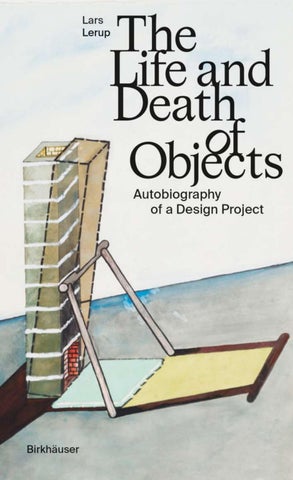
The Life and Death of Objects
Lars Lerup
The Life and Death of Objects Autobiography of a Design Project With a Postscript by Scott Colman
Birkhäuser Basel
Contents
7
I.
1945–1965. Sweden
II.
1966–1970. California
35
III.
1970–1985. University of California, Berkeley
41
IV.
1979–1980. New York City
49
V.
1980–1985. Berkeley
53
VI.
1985–1988. The Last Years in Berkeley
63
VII.
1988–1989. Berlin
75
VIII. 1991–1993. Vico Morcote
95
IX.
1993–2009. Houston
109
X.
March 19–June 6, 1999. room
125
XI.
Five of Nine. Two Decades
141
XII.
2000–2009. Houston (Cont’d)
157
XIII. 2009–2010. Rome
173
XIV. 2011–2017. Houston–Berlin
183
XV.
191
2010–2018. Houston–Madrid
XVI. 2020. Last Things First
203
“The Pantheon of Things” (2021) A Postscript by Scott Colman
219
Acknowledgments Endnotes Imprint
227 231 239
I 1945–1965 Sweden
The Chair and the City This book is the autobiography of a long design project. Often interrupted for extended periods, the project never leaves me. Even when dormant, it rushes by every time I contemplate the typical apartment plan and its domestic objects. And the project does so intrusively: as a thought, or a shadow of another object—always disloyal. Adamantly it claims not to be furniture, although it may look like it. The history of the project is the domain in which objecthood emerges in time. Closely related are a series of notes on thoughts motivating the project. Since they are so closely bound to my life, the designed objects and their stories are mixed. A diachronic story interrupted by objects. Designed and built—often years later—but spawned by life experiences. The book goes synchronically—cloudlike. Just like the project itself, it is erratic but insistent on being an integral part of my life and the other project on the city, or urbanization as I now think of it. The disloyal objects, in contrast to the utility that characterizes furniture, project other agencies. Material rather than disciplinary ones. Agencies that question predetermined stations in domestic space—such as the sofa group’s position in the living room—and roles in the grammar of the 7
plan. The plan as it is “laid out” in media and in the persistent encounters with housie houses, provokes both “tenderness and aggression”—the cute, as it was so elegantly captured by Sianne Ngai.1 Wonderful for the economy, terrible for the environment, bad for the modern family—all rooted in the disastrous way we conceive the things we make. Telling this story is to make a dent in consumerism—the powerful enterprise that drives urbanization. Both by necessity and purpose, I shift the conversation from the global to the local—where it all begins. Here in the book as a story, drawing, image—knowing that everything we make has a butterfly effect. And yes, we are already in the center of a typhoon. To mark the beginning of this project, I use a black-andwhite photograph. Lying on the floor in our living room, I am building an encampment using empty matchstick boxes, wooden blocks, and military figures. It was taken in 1945 by my father, just returned from the Second World War. He never saw action. Standing guard above the artic circle, he spent five years at the Finnish border. I leave it as a mere marker.
Itinerancy Apart from my father’s occasional trips to Denmark, my parents never went abroad. They each moved once, my mother from a coastal city and my father from the southern coast. I moved many times. Why this generational increase in mobility? My own emigration to America is not unique. Småland, the Landskap or province where I was born, has been the 8
Figure 1. The Author (1945)
source of a steady flow of poor, religious, small-time farmers to America, especially at the end of the nineteenth century and the beginning of the twentieth. My version is not just an emigration, but a series of resettlements—still not unique: America is known for its restlessness. Distances seem shorter here, while at the same time uniquely important. As I have suggested elsewhere, American Distance is a unique, possibly contradictory need to overcome and establish distance—simultaneously. When this steady flux is interrupted, the economy follows suit. There are at least two reasons for moving to America: there are those who come to stake a piece of land and those who come to escape. I belong to the latter kind—the modern kind, the traveling salespeople, who move for a reason and always with the fastest transportation. 9
For us, it is not a mathematical problem; our ecological footprints are hideously large. The ease with which each move is made makes me suspicious that the logical purpose is disguised behind an escape secured by an eternal return—the urge to return to the Swedish coast and the regularity with which I find myself there. Despite feeling increasingly removed from Swedish life, I feel closer and closer to its littoral: the zone where the ocean meets the land, where network cities are built. Land’s End, where the dream of India (that finds America instead) is born. Littoral, originally litoralis, is a generous word used in many ways. For me it is the (tidal) zone where liquid meets solid. The unique zone where movement encounters stasis—a state of steady surprise. Cyclical at best. Standing by its side the back and forth—nature’s clock.
Apropos Sleep Sleeping in the kitchen is an early memory. The bed is a wooden box with a lid. It is a traditional fållbänk, a folding bench sat on during the day and slept in at night, although rumor has it that this one housed the pig being fattened for the holidays. Such lore is hard to forget—even more so when you realize that others don’t sleep in the kitchen. The box sits under the wide kitchen window. The 1940s are very cold with snow cover often reaching two meters. The black sheet of night sky, lit by millions of stars, fills the window and is separated from me only by double glass. In my horizontal position the city is cut off. At the base inside the double-glazed window a stretch of cotton (while stopping the draft) imi10
“Hideous, identical concrete contraptions” for Thafvelin and, through the experience of occasionally staying there, to the vagabond-sleeper. My twenty years of “sleeping about” has by now, as the word implies, been embedded.
Murphy’s Bed I’m fine sleeping in bedrooms. But if I wake up, I move. Beds that move, hide in walls, in benches, and in boxes crowd my nocturnal life. Eventually, a strange object has to result. By 2015 it is one of the latest. Beckett is by now a constant voice—stories of entrapment, of death, and comedy appear. Beckett’s Murphy4 naked, bound to a rocking chair, seeks nothingness in 1938. He sits in a soon to be condemned apartment in West Brompton in London. Coincidently, a more efficient “Disappearing Bed” already existed in San Francisco. In 1912, William Lawrence Murphy patents In-aDor wall-bed, called simply Murphy by its aficionados. In my
Diagram 2. Objects That Hide
23
Figure 4. Murphy’s Bed
24
Figure 5. Murphy’s Bed (model)
version, the two Murphys form a union—no longer in a wall but in a closet with a bed. For me, our Murphy’s Bed hints at my mother’s rocking chair; two skids at the very long paws of two kangaroos (assistants of Ture Sventon, a childhood detective) and 1950s ice shanties also decked out with skids for easy maneuvering. And now, still just a model, the pale green wood tower hosts a bed. The movement technology allows the bed to rotate forty-five degrees. Closed, an upstanding box on skis; open, a cantilever dreaming about its sleeper. As one of many freestanding objects in my arsenal, it steps into the everyday. By a simple rotation it tells a “story”—not mine, by the way, but a compressed story of sleep. A nocturnal anecdote. 25
Fridays Every Friday, we walk over to Sturebadet—a public bathhouse. A couple of hours in the sauna (wet and dry) followed by minutes in the ice-cold pool and we disperse. I return to the office. Thafvelin, or Tavve, is just back from the offices of Blandaren—a legendary student magazine. Abroad, Swedes are not known for their humor. Tavve, writing and drawing in Blandaren, is very funny. Already present, Lennart Lindquist, just returned from years in Mexico. Artist, philanderer, raconteur, he holds court, glass in hand. We are waiting for the model. Once he or she arrives, we draw for hours. The years of drawing models have a direct and decisive effect on the objects. Although we get to know the models, once in pose they are embodied objects—erect, horizontal, back, front. Standing lit on a low pedestal, the erect shape joins the spare furniture— often I draw both. The step from human bodies in space to inanimate ones is direct. Since then, objects in space are fused with humans in space.
A Note on Space Space is a contested domain. Gaston Bachelard suggests that we bring “our lairs” with us, making us unresponsive to unfamiliar spaces; the anthropologist Edward Soja seems to agree that space is socially constructed when, in an exploration of urban space, he writes about third space. When Jorge Luis Borges and Michel Serres write, space is obscurely invasive. Borges writes about the “pernicious influences of the 26
VI 1985–1988 The Last Years in Berkeley
Figure 8. New Zero Interior
Strange Objects Rails cut across the floor of the interior. Releasing black smoke, a steam engine sits in the center of the image. A table, transfigured with its surface turned ninety degrees to replace two of the four legs. Fixed to a wall, three lighting fixtures made of rain spouts. Three black chairs, looking like 63
Figure 9. Nofamily House Traps
Mexican equipales. A low, angled side table with stubby red legs. This is the central space of New Zero, a late version of Texas Zero, intended for two women in New Orleans. Texas Zero is included in Planned Assaults, which Phyllis Lambert publishes in 1987. With a foreword by Lambert and a postscript by Peter Eisenman, the book is splendidly edited by Eve Blau and designed by Eleanor Coponigro. The text opens with the Nofamily House, armed with traps set for the family narrative: stairs that lead nowhere, redundant doors, liberated handrails, and a Fresh Window.24 This is followed by a Love House with one half missing 64
and no kitchen. The book closes with Texas Zero, a house (for a divorcée) disguised as a country store. Stocked with a “squad” of objects (in symmetrical formation) rather than canned soup and sides of pork. Arranged around the central axis of an open plan, the squad consists of two leaning fireplaces, a lean-to closet, a last supper table, a which-way chair, a which-way-mirror, and a night-and-day bed. The objects described in the drawing and in New Zero are the first hint at architectonics taking charge of the organization of space. Long in returning from the Classical era, these strange objects burst onto a scene that Bruce Mau suggests needs Massive Change. The culmination of decades of preparation.
Wurster Hall Like all classrooms, Wurster Hall—which house the College of Environmental Design—has an inordinate number of chairs. All are involved in an endless dance. Military squadrons of chairs are turned into circles. Stacked chairs wait. Two facing chairs sitting apart from the educational formations suggest the extracurricular. Students carrying chairs from one room to the next are filling a gap. Yet, while quietly serving their many sitters, the same chairs are largely invisible. Figuratively, this is the chair’s momentary death. In the dance, chairs are the focus. We are the objects. Merce Cunningham and the Thonet chair haunt this scene. Cunningham demonstrates graphically how to interrupt the everyday scene of moving chairs and sitting on them. He selects the legendary Thonet chair—elegant, light, 65
descriptive of its own making. While on the subject of dance-walking, he lifts the chair out of the limited everyday movement patterns. Straps it to his back, as if he is carrying a ghost. And then he dance-walks with a chair as the primary p artner. Enraptured, I find myself spinning, not along a creaking black floor but in some space drawn from my memory bank. Wurster Hall, high on the sloping Berkeley campus, is frequently seen as an architectural offense by non-architects. What they miss in their irritation is the significance of a protruding balcony (strapped to the face of a tower). Just below the top of the grey concrete tower, the cantilevered balcony sticks out. That it does so from the tower of a school centered on the environment is easily missed. Buildings are not radios! But when objects poke at us for no obvious reason, “look at their feet.” Where are they going? In this case the ignored extension pokes into the world we ignore. The world seen from the balcony is at this time, in the late 1980s, still glorious, aside from three days in late September when the daily airflow is stopped and the air is filled with the pollution produced in the valley behind it; today, the valley pollution is thickened by burning forests. The topsoil below us feeds the luxurious landscape of the campus. The subsequent decades of the building boom have forced the removal of tons of topsoil—clearly fatal, since its replenishment takes at least ten thousand years. Since the consensus that a Great Acceleration began after 1945, there has been a lingering feeling among ecologists and geologists that we have entered a new geological era, largely the result of human intervention in and on the earth and its resources, many of them non-renewable. Here, the 66
XI Five of Nine Two Decades
We could generalize, and infer that all forms possess virtue in themselves and not in a conjectural “content.” —Jorge Luis Borges
The nine objects shown in the installation—Racer, T-chair, Tallboy, O’Meldon’s Cube and Root, Lean-To, Flatbed, Watt’s Lift, Maus and Wobbly—are conceived at different times and occasionally in direct connection with my personal experience. Thus, the tension between the diachronic
Diagram 8. Objects That Roll II
141
Figure 28. Ten Objects
142
and synchronic organization in an autobiographical story poses dilemmas. The description below contains only four objects—Racer, Maus, Lean-To, and Watt’s Lift. The missing five, developed at earlier times in connection with particular situations are placed in those chapters. In turn, suggesting that the objects are event bound rather than time dependent.
Racer There is one chair that I am particularly fond of. Originally found in English clubs, closely bound to bourgeois culture, today it has wandered out from the plan and “furniture” to become a prized object, briefly gentrifying the most bohemian lofts—often worn, tired, and full of its magical presence. Known as “the leather club chair,” it is always brown. To my mind, it is a full-fledged object. The Racer is a cultural crash. Designed somewhere between the London pub and the Los Angeles lowrider—nose down, close to the ground, ready to bounce, heave, and warp—the Racer waits for modern robotics. Leaning rakishly forward, outfitted with two back wheels, the Racer is a square brown wooden box. The seat is a shaped aluminum sheet, leaning comfortably backwards inside the box. Hand-grips are cut on each side of the box at its front. A member of Objects That Move and Rotate—unlike its stolid leather referent meant to be forever still—the Racer is always ready to go.
143
Figure 29. Racer
144
XIV 2011–2017 Houston–Berlin
Dessau and Berlin After a decade of sporadic visits, an accidental meeting in Houston with Alfred Jacoby, the director of the Dessau Institute of Architecture (DIA), leads to an additional decade of occasional engagement in Germany. Gunnar Hartmann, a Rice graduate and colleague at DIA, asks me to join his PhD committee, chaired by Wolfgang Schäffner, at Humboldt University in Berlin. During this time, he and Horst Bredekamp develop a research program called Image Knowledge and Gestaltung. Submitting the project to a national university competition, they win a Cluster of Excellence Grant in 2016 and invite me as a visiting researcher to a section of the program known as the Experimental Lab run by Henrike Rabe. Along with several PhD candidates from a variety of disciplines, Friedrich Schmidgall joins me to work on Objects That Meet. I choose chairs again, but now the type of institutional chairs that wander around the lecture halls of university buildings. There are less glamorous places than museums for objects to meet. In the backwaters of conspicuous consumption, a visible second-hand market is found, often along special streets or districts in most large cities. But there is also the 183
Figure 37. Tieranatomisches Theater
more or less hidden transitory world of basements and attics from house to institution. This is where displaced but not yet discarded objects are found. In Berlin we find a stack of twelve chairs in the storage of Humboldt University. Much like a crypt, institutional storage is the waiting area for the dumpster. For the recycler it is a goldmine. Already intimately entangled, the stack shows promise. The chair is probably one of the most transitory objects in any institution—changes in the administration? Change the furniture! Our chairs are made of bent steel tubes and plywood. They step out of the 1950s with the spirit of the Eameses written all over them. Here, I find a home for the “Strange Objects” built at the Lab and demonstrated at Humboldt’s Tieranatomisches Theater. At this time, Gunnar Hartmann; Harun Badakshi, an oncologist at The Charité—Universitätsmedizin Berlin; and I instigate a research project sponsored by DIA and financed 184
Diagram 17. Objects That Disassemble
by Fresenius Medical Care, under the rubric “Health and Design.” In the meantime, Hartmann, trained as sculptor, and I begin an ongoing collaboration around strange objects. With the closure of the Excellence Program, my institutional relations with Berlin end. The refashioned chairs have probably returned to Humboldt’s netherworld.
Disassembler Separated, the stack of chairs is taken apart in the center of the studio. Each chair displays the anatomy of a veritable sitting machine: infrastructure supporting one horizontal surface and one vertical. Elegantly tied into a coherent assemblage, yet explicit about its elements—rubber feet; two legs held together by a horizontal bar that, with two additional cross bars, stabilizes two more identical legs; additional bars 185
serving as the back structure; plywood surfaces making up the seat and backrest. Clearly synthetic yet skeletal, it is discrete and explicit in its makeup. No instructions needed for disassembly. Once taken apart, the same recurring surprise: where did the original chair go? Suddenly, the skeleton is gone and the remaining bones lie unencumbered by their previous functions. The four legs remain legs but the cross bars serve as handles and suddenly the reduced assemblage is a walker. Further disassembly reduces the legs to mere tubular members. The plywood seat and back become just surfaces. The materiality becomes as important as the shape, the shape more important than its name and implied use. The tubes-of-legs are just lengths-of-tube. It is in this boneyard that we begin.
Freud-o-Man On a recent visit to Sigmund Freud’s house at 20 Maresfield Gardens in London, I have seen the famous assemblage of the chaise-longue for the patient and the good doctor’s club chair behind (invisible to the patient.) Needing a twentieth- century upgrade, we stretch and cannibalize a couple of chairs and add wheels and handlebars to produce the Freudo-Man. It sits around in the Experimental Lab for some time. There is no evidence that it is used for anything but naps. Given time, it may be the invitation to office therapy. The attachment of wheels and handlebars is a farfetched reference to one aspect of Plato’s “ship of fools”—not the political argument, but just the idea that motion may have a calming effect on the distressed mind. The other nod is to 186
Lars Lerup
Acquisitions Editor: David Marold, Birkhäuser Verlag, A-Vienna Content & Production Editor: Bettina R. Algieri, Birkhäuser Verlag, A-Vienna Proofreading: Sue Pickett Cover design: Floyd Schulze Layout and typography: Ekke Wolf, A-Vienna Image editing: Pixelstorm, A-Vienna Printing: Holzhausen, die Buchmarke der Gerin Druck GmbH, A-Wolkersdorf Paper: Munken print white 15, 100 g Typeface: Utopia, Futura Now All images, unless stated otherwise: Lars Lerup Library of Congress Control Number: 2021948987 Bibliographic information published by the German National Library The German National Library lists this publication in the Deutsche Nationalbibliografie; detailed bibliographic data are available on the Internet at http://dnb.dnb.de. This work is subject to copyright. All rights are reserved, whether the whole or part of the material is concerned, specifically the rights of translation, reprinting, re-use of illustrations, recitation, broadcasting, reproduction on microfilms or in other ways, and storage in databases. For any kind of use, permission of the copyright owner must be obtained. ISBN 978-3-0356-2510-3 e-ISBN (PDF) 978-3-0356-2511-0 © 2022 Birkhäuser Verlag GmbH, Basel P.O. Box 44, 4009 Basel, Switzerland Part of Walter de Gruyter GmbH, Berlin/Boston 987654321
www.birkhauser.com