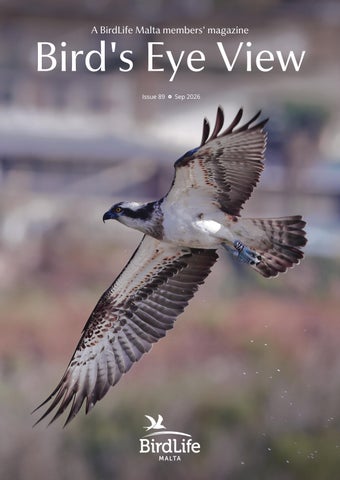
A BirdLife Malta members' magazine
Bird's Eye View Issue 89
Sep 2026
CONTENTS
E Keeping nature on the agenda by Darryl Grima BirdLife Malta President
lections come and go. Governments are elected, political priorities are announced, and promises are made. Yet for Malta’s natural environment, the reality on the ground often remains remarkably unchanged. Since the election, we have unfortunately continued to witness the same pressures on our countryside and wildlife. Illegalities have not disappeared. Birds continue to face persecution, habitats remain under pressure, and decisions affecting our natural heritage too often appear to place nature somewhere towards the bottom of the political agenda. This should concern all of us. Nature cannot speak for itself. A migrating bird cannot lobby a minister. A tree cannot protest its removal. A protected habitat cannot stand up in Parliament and demand that the law be respected. That responsibility therefore falls on organisations like BirdLife Malta – and importantly, on every person who believes that our natural heritage deserves better. Our work has never depended on who occupies the seats of power. We will work with
anyone who genuinely wants to protect nature, while continuing to challenge decisions and actions that threaten it. We must remain consistent, determined and focused. For BirdLife Malta, birds and nature must always remain our priority. This means continuing our conservation work, protecting and restoring habitats, educating future generations, documenting illegalities, advocating for stronger policies and, when necessary, holding those responsible to account. There will be moments when progress feels frustratingly slow. But conservation has always required persistence. Every protected bird, every restored habitat, every child inspired by nature and every person who chooses to stand with us makes that persistence worthwhile. Political terms may last five years. Our responsibility to nature goes far beyond them. And as long as Malta’s birds and natural environment need a voice, BirdLife Malta must be there to provide it.
June
2026
CRIME: Hunter hunting in close season (Żejtun, Apr 2025) PUNISHMENT: €3000 fine + hunting ban for life
Crime and Punishment
CRIME: Two trappers trapping finches in close season (Fomm ir-Riħ, Mar 2025) PUNISHMENT: Trapper 1: €3000 fine + banned from trapping for life Trapper 2: €1800 fine + trapping ban for three years
The culprits in this list were brought to justice after being observed and reported by BirdLife Malta.
CRIME: Trapper using unauthorised trapping gear (mist net) (Żejtun, Nov 2024) PUNISHMENT: €1000 fine + trapping ban for three years
Editorial Board Antonia Micallef (Editor), Victor Falzon (Naturalist & Field Teacher), João Gabriel Candeias (Multimedia Communication Assistant), Angela Scorzoni (Communications Assistant), Alexandra Żubrowicz (Events & Outreach Assistant), Giada Lampitelli (Education Officer) BirdLife Malta Council Darryl Grima (President), Joanna Tabone (Vice-President), Norman Chetcuti (Treasurer), Denise Casolani (Council Secretary), James Aquilina, Eurydike Kovacs, Alessandra Loria, Paul Portelli, Kathleen Psaila Galea, Raphael Soler (members). Senior Management Team Mark Sultana (CEO), Nicholas Barbara (Head of Conservation), Mark Gauci
Contents Comment
2
News
3
Bird Profile
5
Reserves
6
Educate
8
Engage
10
Research
11
Explore
12
Events
14
(Head of Land Management), Antonia Micallef (Public Engagement Executive), Gabriella Seguna Galea (Finance Manager), Manuel Mallia (Salina Park Manager), Manya Russo (LIFE PanPuffinus! Project Manager). Design João Gabriel Candeias Printed at Poultons on sustainably sourced paper Front cover photo Osprey by Denis Cachia Reg. Vol. Org. VO/0052 © 2026 BirdLife Malta. All rights reserved. Contact BirdLife Malta mailing address: 57/28 Abate Rigord Street, Ta’ Xbiex XBX 1120, Malta tel: +356 21347645 • email: info@birdlifemalta.org • website: www.birdlifemalta.org
birdlifemalta
2
birdlife_malta
Bird's Eye View Sep 2026
BirdLifeMT
BirdLife_Malta
birdlifemalta
birdlifemalta
birdlifemalta
BirdLife Malta
NEWS
Abusing the "rabbit season" loophole Protected birds were shot just two weeks apart, before autumn hunting opened and during the lax rabbit hunting season. On 13 August, a hunter killed three Squacco Herons at Żonqor after shooting at a flock. The Environmental Protection Unit (EPU) caught two men as they attempted to retrieve the birds. Two weeks later, an Eleonora’s Falcon was found shot at Dingli. BirdLife Malta
Aron Tanti
Migratory birds in decline More Turtle-dove protection A Sicilian court suspended the region’s pre-season hunting period, giving migrating Turtle-doves safer passage. Meanwhile, new European data shows continued decline along Malta’s migration route. Despite this, Malta approved another spring hunting season. We continue calling for decisions based on scientific evidence and a renewed moratorium.
BirdLife International’s State of the World’s Birds report finds 45% of migratory bird species are declining, with one in nine threatened with extinction. Seabirds and waders are among the most threatened. Launched in Nairobi during the Global Flyways Summit, the report highlights pressures along migration routes. BirdLife Malta CEO Mark Sultana signed the Nairobi Flyways Declaration, committing to protect migratory birds and their habitats.
New Animal Welfare Commissioner
In May-June our Conservation team reported six active illegal trapping sites in Gozo. Five targeted waders, while another appeared designed for Turtle-doves. Police dismantled the sites and caught one trapper in the act. We urge the public to report suspected illegal trapping.
BirdLife welcomes Inspector Elliot Magro’s appointment as Malta’s new Commissioner for Animal Welfare. His previous work tackling wildlife crime and protecting our natural heritage provides valuable experience. We look forward to continued cooperation while calling for stronger resources for the EPU.
Unsplash
Department of Informationż
BirdLife Malta
Illegal trapping sites in Gozo
Europe vs toxic lead EU Member States backed restrictions on lead ammunition, while new rules on lead fishing tackle moved closer to adoption. The measures could reduce lead poisoning among millions of birds and protect people from exposure. We have supported the #BanLeadNow campaign and continue calling for stronger action against lead ammunition.
Bird's Eye View Sep 2026
3
NEWS Kathleen Psaila Galea
BirdLife objected to a proposed solar farm on protected garrigue at Ta’ Kuljat, Gozo. We also criticised plans to remove 800 trees on Kemmuna. Both cases highlight the need to protect ecologically valuable land and Natura 2000 sites from development.
Ġustizzja għal Artna
Gozo - Planning Authority
Nature under pressure
A welcome reform proposal
Kudos, Dinja Waħda!
BirdLife welcomed the proposal to suspend construction while planning appeals are being heard. This could prevent developments from being completed before appeals are decided. As part of Ġustizzja għal Artna, we continue calling for transparent planning reform, stronger enforcement and meaningful access to environmental justice.
BirdLife Malta's Dinja Waħda programme reached the ERA Awards shortlist, while Our Lady Immaculate School in Ħamrun won the Green School Scheme Award. The school’s project will create an outdoor learning space with biodiversity features, rainwater harvesting and composting. We congratulate the school community and everyone involved. PPNEA
Mario V. Gauci
Scopoli’s secrets
Protecting the Adriatic Flyway
New research has revealed previously unknown journeys made by Scopoli’s Shearwaters before breeding in Malta. Tracking data came from two BirdLife Malta-led LIFE projects. The findings demonstrate the value of long-term seabird monitoring and strengthen our understanding of a species facing threats including light pollution and bycatch
BirdLife joined partners in Albania in calling for stronger protection of the Vjosa-Narta Lagoon and Sazan Island. These important sites support migratory birds, Dalmatian Pelicans, Greater Flamingos and Loggerhead Turtles. Protecting these habitats also safeguards the shared natural heritage connecting communities across the Adriatic Flyway.
4
Bird's Eye View Sep 2026
Saving Our Shores BirdLife is supporting the Save Our Shores campaign by Friends of the Earth Malta, which calls for stronger protection of Malta’s coastal environment. Our shores support wildlife, biodiversity and communities, but face increasing pressure from development and human activity. Protecting these ecosystems is essential for a sustainable future for both nature and people.
BirdLife Malta
More than 30 ROOTED Walking Handbooks are now available across nine CareMalta homes. The guides encourage older people and those with limited mobility to enjoy accessible nature walks. The initiative forms part of our Erasmus+ ROOTED project, promoting greater access to nature and the benefits of connecting with the outdoors.
FOE Malta
BirdLife Malta
ROOTED brings nature closer
Bill Oddie BirdLife pays tribute to renowned British naturalist and broadcaster Bill Oddie, who passed away recently. Oddie visited Malta in 2014 and 2015 to support our conservation work and raise awareness about protecting birds. His passion for wildlife inspired generations and leaves a legacy for nature conservation.
James Aquilina
BIRD PROFILE
Maltese name Arpa
Scientific name Pandion haliaetus
Length
52–60 cm
Wingspan 152–167 cm
Call
A short, loud whistle
Behaviour
Specialised in catching fish
Habitat
Mainly associated with water, both freshwater and marine
Osprey
W
ith its striking appearance and remarkable fishing skills, the Osprey is one of the most specialist of birds. Designed for life around water, it has a suite of adaptations that allow it to spot, catch and carry slippery fish with impressive efficiency.
Built for fishing The Osprey can search for fish while hovering high above the water using its excellent eyesight to locate potential prey. Once it identifies its target, it plunges feet first into the water, reaching out with its long, curved talons. Its feet are particularly well adapted for the job. The soles have spiny scales that help it grip slippery fish, while one of its four toes can rotate backwards for a stronger grasp. During a dive, the nostrils close to minimise water entering the nose, and the dense, somewhat oily feathers help cope with repeated plunges. After a dive, an Osprey can rapidly shake off excess water, even while airborne. While flying with its catch, the Osprey often rotates its prey so its head faces forward. This streamlined position reduces wind resistance during flight.
Cosmopolitan raptor Ospreys occur across several continents, making them one of the world’s most widespread birds of prey. Some populations, including those in northern Europe and North America, undertake long migrations between their breeding and wintering grounds. Ospreys usually build large nests close to water, and breeding pairs often return to the same nest year after year. Although Ospreys resemble eagles, they are distinctive enough to belong to their own family, Pandionidae. One of the Osprey's most recognisable features is the dark stripe running through the eye against an otherwise white head. As in many birds of prey, females are generally larger than males.
Aron Tanti
by Aron Tanti BirdLife Malta Nature Photographer
Local status
Scarce but regular migrant. Protected.
Aron Tanti
The fishing specialist
Status
(IUCN Red List) Least concern
Regular visitor With a lifespan of well over 10 years in the wild, an Osprey can undertake many migrations during its lifetime. Yet illegal hunting, habitat loss, disturbance around coastal areas, and the decline of suitable feeding sites remain threats to the species. In Malta, the Osprey is a scarce but regular migrant, particularly during spring and autumn migration. Ensuring that migrating Ospreys can pass safely through Malta, and protecting the habitats and feeding sites they depend on, remains essential.
This Osprey rested recently at Għadira nature reserve
Bird's Eye View Sep 2026
5
Victor Falzon
Nature at our reserves
Foresta 2000 by Victor Falzon Naturalist and field teacher
6
Bird's Eye View Sep 2026
Opening Hours All year round 24 hours everyday free entrance More info at: birdlifemalta.org/nature-reserves/foresta-2000/
RESERVES
Golden Oriole (Tajra Safra)
Oriolus oriolus
Aron Tanti
If you’re out walking or driving in the countryside at this time of year, and this bright yellow, almost pigeon-sized bird streaks across your eyeline, you have just seen a golden oriole, and you are richer for it! Golden orioles are one of the more colourful birds that grace our valleys and green spots for a few days in spring and autumn as they make their way north or south across the Mediterranean. The name could not fit the bird better: if the male’s bold yellow plumage (with black wings and tail for contrast) explains ‘golden', you only need to hear the bird’s fluty yodelling song to understand the ‘oriole’ bit. Many golden orioles sadly end up as glass-eyed trophies in stuffedbird collections. At protected places like Foresta 2000, they stand a better chance of surviving.
Mediterranean Slant-faced Grasshopper
(Ġurat Rasu Twila)
Of the two dozen or so grasshopper species that occur in Malta, the slant-faced grasshopper is easily the weirdest looking. True to its name, its head is propped in a sort of perpetual forward tilt, like someone glued its chin to its neck! Also, its face is rather bulbous and its antennae look like flat thin leaves. But for all the eldritch looks and large size (females can grow to 8cm, making this one of our biggest insects) it’s distinctly hard to spot in its grassland habitat, especially on the clumps of esparto grass at Foresta 2000. Its long thin body and cryptic greengrey-brown colours match perfectly the grasses on which the animal lives and feeds. But once you spot it you will marvel at the trouble this species has taken to vanish while in full view. Take a walk at It-Taflija in Foresta, you might be lucky to spot one of these fantastic creatures.
Victor Falzon
Acrida ungarica
Narrow-leaved Ash (Fraxxnu)
Fraxinus angustifolia
Desirée Falzon
Many trees in Northern Europe are deciduous, losing their leaf cover to avoid the winter savagery. Most of our trees, on the other hand, are evergreen and get to keep their foliage all year round – let’s face it, our winters aren’t particularly nasty: no snow or frost and, aside from the odd freak gale, little damage. But we do get some deciduous species, all the more precious because they are few, and some are very rare too. One of the scarce species is the narrow-leaved ash. There are some magnificent ash specimens down in Buskett valley – they love water, so growing in a valley makes sense. At Foresta 2000 we didn’t forget them either. Way back in the 2000s we planted a few ashes in an area most likely to channel rainwater. They’re still alive – nowhere as tall as the Buskett giants of course, but hey, at 20 years old they’re still babies (as trees go).
Bird's Eye View Sep 2026
7
Finding a place for nature in our school gardens
Entrance to the Dinja Waħda garden at San Anton School
by Desiré e Falzon Dinja Waħda Field teacher and teacher trainer in nature-based learning
The same is true of everything in nature. Animals instinctively know what food to look for and where to look for it, depending as they do on the plants the landscape provides. The spectrum of wildlife in any habitat is a perfect evolutionary adaptation to the variety of mini habitats and layers in that habitat. All this means that gardening for wildlife must start with an understanding of nature, animal likes and dislikes, plant habitat preferences, and – hardest of all – how to keep everyone happy. And this is where BirdLife steps in to reframe our perception of nature.
Nature’s needs The biggest challenge our education team faces with urban nature is not nature. It’s perceptions of shabbiness. Nature’s homes are far removed from the sterility of our homes and formal gardens.
8
Bird's Eye View Sep 2026
Bridging the gulf is what happens in our Dinja Waħda gardens. People like order. People dislike untidiness. A garden with dry vegetation, grey seed heads, uneven ground, random stones and wild plants disturbs our perception of “healthy” and “well-tended”. Our aesthetics are tuned towards seasons where nature looks green and lush. But an ecological garden has tangled vegetation that provides nesting shelter for warblers. It grows wild plants whose leaves feed grubs that birds prey on, and flowers that pollinators drink from. It supports plant life cycles where seeds and dry grass are seasonal essentials in food chains and nest-building. And it has variety that is anything but neat.
A meeting of worlds Less than half our primary schools have green patches. Among those that do, BirdLife has created 14 wildlife gardens under our Dinja Waħda programme. Besides sharing the wonders of nature with children, these gardens are a meeting point between educators and ecology. More than thirty years after creating our first wildlife garden, a few highlights have emerged as key steps to harmonising urban nature and people’s expectations.
A red admiral caterpillar munches nettle leaves
Desirée Falzon
E
veryone knows butterflies. But less known is that butterflies, as their Maltese names imply, have particular tastes in plants. For example, the red admiral – farfett tal-ħurrieq – will only lay eggs on nettle plants (ħurrieq). The caterpillars are adapted to tolerate nettle chemistry, giving them an advantage over other butterfly young.
EDUCATE Lillian Schembri
Desirée Falzon
Variety Features like a pond, bug hotels, bird table, perching poles, bird bath, stone piles and compost bins all attract different animals. Even small urban spaces can be rich in biodiversity, if allowed to grow and add layers of habitat and wildlife opportunities over the years.
The plan Planning a wildlife garden must keep two clients happy: wildlife and education. This means facilitating access to nature while limiting disturbance. The main feature here would be a winding footpath to encourage getting close to habitats without trampling through them. A class-sized gathering area then provides a space for writing, reading, discussing or simply being in nature.
Live feed camera in action at Żurrieq Primary Desirée Falzon
Victor Falzon
Students of Ħal Tarxien Primary watering newly-planted shrubs at their Dinja Waħda Garden
Antonia Micallef
Signage helps visitors understand what's going on
Students of Ħad-Dingli Primary planting a white mulberry at their Dinja Waħda Garden
Keeping it going Dinja Waħda garden maintenance is a fine balance between meeting expectations of the school community and allowing nature to thrive. This is the biggest challenge our education unit faces, as teachers and adults in general tend to judge a school garden by its level of tidiness, looking for “cues to care” in cut vegetation, tilled soil and swept leaves. In reality, these cues impoverish a garden of its food chains and biodiversity. This is where the Dinja Waħda programme has its work cut out. Teacher training, educational materials, wildlife cameras, signs, and above all, time spent on site showing nature and its workings are irreplaceable in transitioning teachers to understanding nature. In a society where children’s connection with nature is limited and shrinking, it is crucial for BirdLife to continue to invest in Dinja Waħda gardens. The race is on to bridge the gap, so that our children can experience nature without inherited perceptions that hinder their understanding of nature in its many forms.
Bird's Eye View Sep 2026
9
ENGAGE
by Giulia Galvani Public Engagement Assistant Photos by Annalisa Merici
F
rom birdwatching and biodiversity to traditional salt harvesting, BirdLife Malta’s summer school visits give children the chance to learn about nature while having fun at Salina Nature Reserve. As summer begins, so does our programme of summer school visits at Salina. These educational days give children a chance to spend time in nature during the holidays and learn about biodiversity and ecosystems through games and activities adapted to their age group and school’s needs. Each visit starts with a short introduction to Salina’s history and ecology, followed by nature-based fun activities. Children can explore topics including pollinators, birds and animal adaptations. One of the most popular activities is birdwatching, where children learn to use binoculars while looking for different bird around the saltpans. Schools can also request a virtual reality experience, offering an immersive bird’s eye view of the reserve.
Discovering the saltpans Schools can also choose a day focused on salt production to learn about Malta’s long tradition of salt harvesting. Through a guided visit to the Salt Museum and activities such as a salt-harvesting game, children discover how this practice shaped parts of Malta’s coastal landscape and economy, as well as the importance of saltpans for biodiversity.
A busy summer at Salina This year, bookings were handled by both the Salina and Education teams. The Salina team booked 17 visits (350 students) while the Education team booked a further nine visits (188 students). In total, 26 summer school visits brought 538 students to Salina this summer.
10
Bird's Eye View Sep 2026
A
new BirdLife Malta study explores how people in Malta perceive and use the country’s nature reserves. Among other things, it reveals strong public support for having more of them. How well do people in Malta know their nature reserves? Do they visit? What do they think about the organisations working to protect the country’s natural environment? These were some of the questions behind Nature and Us, a BirdLife Malta research project providing independent data on the public’s relationship with our protected natural spaces. The research, carried out by Sagalytics, surveyed 640 people aged 16+ from across Malta and Gozo in May 2026.
Antonia Micallef
RESEARCH
Nature and Us What the Maltese really think about our nature reserves by Mark Gauci Head of Land Management at BirdLife Malta
Awareness vs visiting The results reveal an interesting picture. Awareness of some of Malta’s nature reserves is relatively high: 69.1% of respondents had heard of Salina, while 64.4% knew of Għadira. When respondents were asked to name a nature reserve without being given options, Għadira was the most frequently mentioned. Yet knowing that a reserve exists does not necessarily mean visiting it. Among those aware of Salina, only 35.4% ever visited, while just 24.5% of those familiar with Foresta 2000 did. Even among those who visited, many visits were not recent. At Għadira, for example, 82.9% said their last visit was more than a year ago.
Visitors aware of BLM's reserves
Said Yes Said No
69.1%
64.4%
62.8%
61.4%
35.6%
Għadira
38.6%
37.2%
30.9%
Salina
How is BirdLife Malta perceived? The research also provides an interesting snapshot of public awareness of BirdLife Malta. Awareness of the organisation was extremely high, with 96% of respondents saying they had heard of it. Meanwhile, 67.6% believe BirdLife Malta is doing a good job protecting nature. Responses also showed, however, that the organisation remains strongly associated with birds and illegal hunting rather than the full breadth of its conservation work.
More nature reserves please
Simar
Foresta
Information is key One of the clearest messages from the research concerns information. More than 90% of people familiar with one of the nature reserves included in the survey did not know the opening hours or that entrance is free. Visitor experiences were overwhelmingly positive, with 86.3% of visitors to Salina describing their experience positively. When asked what could be improved at several reserves, better site promotion repeatedly emerged among the suggestions.
Perhaps the strongest message for the future is public support for nature itself. When respondents were asked whether Malta needs more nature reserves, 72.4% said yes.
The findings suggest that the challenge is not necessarily convincing people that nature matters. Instead, it is about turning awareness and goodwill into a stronger and more regular connection between people and the natural spaces we protect for them. For BirdLife Malta, the research provides valuable evidence to help understand how people engage with nature reserves and where there is potential to strengthen that connection. Nature and Us was funded through the Voluntary Organisations Project Scheme (VOPS) managed by the Malta Council for the Voluntary Sector (MCVS) and supported by the Ministry for Inclusion and the Voluntary Sector (MIV). This project/publication reflects only the views of the author; the MCVS cannot be held responsible for the content or any use that may be made of the information contained therein.
Overall experience at BirdLife Malta's reserves
Positive Neutral
86.3%
85.8%
Negative
76.3%
72.6%
22.7%
21.9%
13.2%
12.1% 2.1%
Għadira
Salina
5.5%
1%
0.5%
Simar
Foresta
Bird's Eye View Sep 2026
11
TOPIC
Discovering the wildlife of Majjistral Nature and History Park
A walk in the
Wild (north) West Article and photos by Alex Casha Naturalist, Majjistral Nature and History Park
F Victor Falzon
rom garrigue and coastal cliffs to orchids, butterflies and migrating birds, Majjistral Nature and History Park offers a rewarding walk through one of Malta’s most wildlife-rich landscapes.
Varied coastline Established in 2007, Majjistral Nature and History Park stretches along the coast from Ir-Ramla tal-Mixquqa (Golden Bay) to Il-Prajjet (Anchor Bay), l/o Mellieħa. The park can be explored on foot along the Green Route, extended to the Blue Route, covering about 6 km. The route passes through garrigue, where shrubs grow in pockets of terra rossa soil, alongside seasonal plants like orchids, irises, squills and crocuses. Parts of the walk pass close to the vertical cliffs, clay slopes and boulders. Some paths cross over rough ground, so proper walking shoes are recommended. Along the way, take time to look beyond the scenery – Majjistral is home to a remarkable variety of wildlife.
Rich wildlife Wild Rabbits are most likely spotted early or late in the day. Summer brings grasshopper nymphs and several species of butterfly, including the endemic subspecies of Swallowtail. Reptiles include Black Whipsnake, Mediterranean Chameleon and Ocellated Skink. Majjistral Park is one of the best places in the country for birds. The coastline provides a good vantage point, particularly during easterly winds when birds seek shelter beneath the cliffs. Scan the garrigue with your binoculars, but remember to look up too. At least 10 species of birds nest in the park, eight of which – Blue Rock-thrush, Eurasian Collared-dove, Spanish Sparrow, Tree Sparrow, Zitting Cisticola, Sardinian Warbler, Spectacled Warbler and Cetti’s Warbler – are year-round residents. Among these, the Blue Rockthrush is perhaps the most notable and you often hear its fluty song as you walk along the path.
12
Bird's Eye View Sep 2026
EXPLORE
Swallowtail butterfly
Wood Warbler
The other two breeding birds – Short-toed Lark and Yelkouan Shearwater – come to the park in spring to nest and leave after the nesting season. During the nesting season the Short-toed Lark is often heard singing overhead. Spring and autumn are best for migratory birds. Migrants commonly seen on the ground include Northern Wheatear, Whinchat, Tree Pipit, Tawny Pipit and Yellow Wagtail. Common Hoopoes are recorded every year, as are Barn Swallows, Common Swifts, European Bee-eaters, herons, egrets, and birds of prey like Western Marshharrier, European Honey-buzzard and Common Kestrel, mostly seen overhead. Small passerines like Wood Warbler and Willow Warbler are sometimes seen searching for invertebrates among the shrubs. In adverse weather, many seek refuge in the park to rest and refuel before continuing their migration. Winter brings species such as Common Stonechat, European Robin, Meadow Pipit and Common Starling. Stonechats often perch on shrubs or other vantage points, giving their distinctive call, which sounds like two pebbles clicked together! Meadow Pipits forage on the ground, often in groups, and can suddenly take flight as you approach. Starlings are also often encountered in flocks.
Little Egrets
A botanical treasure More than 300 species of native plants occur at Majjistral. Along the footpaths you meet Wolfbane, Lentisk, Mediterranean Thyme, Olive-leaved Bindweed, Mediterranean Heath and the sub-endemic Sicilian Silvery Ragwort. Caper plants, dormant and unnoticed in winter, burst into greenery and flower in the warmer months, while Fig trees grow right out of the cliffs. The park is also home to endemics like Maltese Spurge and Maltese Shrubby Kidney Vetch. Maltese Pyramidal Orchids are common and flower early in the season, while nine other orchid species occur, including the endemic Maltese Spider Orchid. After the first autumn rains Sea Squill, Autumn Narcissus and Mediterranean Meadow Saffron emerge, transforming the landscape.
With its extensive countryside and diverse habitats, Majjistral Nature and History Park is an important refuge for Malta’s wildlife. Visitors can help protect it by staying on designated paths, taking litter home and giving wildlife the space it needs.
Maltese Pyramidal Orchid
Sea Squil
Bird's Eye View Sep 2026
13
Jun — Sep 2026
EVENTS
Hot Bird Summer
20 Jun
06 Jun
At FOE, Floriana
At Għar Dalam
Shearwater Boat Trips
Samuel Bezzina
Angela Scorzoni
World Environment Day
Swifts and Bats
26 Jun
João Candeias
11 Jul
Martin Austad
at Mellieħa Playground
João Candeias
Shearwaters and Stars
13, 18, 19 Jun; 9, 16, 17 July; 6 Aug At Ta' Ċenċ
At Dwejra Tower, Gozo
25-26 Jul
At Salina Nature Reserve
4 Aug
At Ħal Far
14
Bird's Eye View Sep 2026
29 Jul
At Salina Nature Reserve
Slay and Clay
22 Aug
At Salina Nature Reserve
Alexandra Żubrowicz
Sara Bezvodova
House Martins and Stars
Extreme Birdwatching 101
Angela Scorzoni
Vera Tokmakova
Salt Fest
Alex Casha
This year's young Black-winged Stilts At Għadira Nature Reserve
Black-winged stilts began breeding at Għadira nature reserve in 2011, and have been nesting there ever since almost every year. The photo shows three of the four chicks that fledged successfully at Għadira this year.
UPCOMING EVENTS Chameleon Night Date: 24 Sep Location: Simar Nature Reserve As daylight fades, participants will use red-light torches to explore the reserve with our team and learn about the chameleon’s behaviour, camouflage and relationship with its habitat. The activity is suitable for families and offers participants an opportunity to experience the atmosphere and wildlife of Simar Nature Reserve outside normal opening hours.
Science in the City Dates: 25-26 Sep Location: Tritons Square, Valletta Join us for Science in the City for the weekend where we will be celebrating science and culture through the theme of "Research, Resist, Reimagine". Visit our stand to discover the fascinating world of Malta’s urban wildlife, including birds who live among us. Bring the whole family along and take part in fun, science-based activities designed for all ages.
EuroBirdWatch 2026 Dates: 3-4 Oct Location: Simar Nature Reserve Autumn migration is upon us! Many familiar (and maybe new) species will be stopping for a brief period here in Malta, making it the perfect time for us to observe them. Therefore, in honour of Eurobirdweek, we are hosting birdwatching and bird ringing sessions at Għadira and Salina Nature Reserves.
Fermented Vegetables for Beginners Date: 24 Oct Location: Salina Nature Reserve Come experiment, taste, and learn the real science behind fermentation with Dr Lidia Babenko (it's not witchcraft, it's just very patient bacteria) how to prepare vegetables correctly and create the right conditions for a safe, successful ferment no complicated equipment required.
Upcycled Bag Charm Workshop Date: 21 Nov Location: Salina Nature Reserve Turn your junk drawer into your new favourite accessory. Fabric scraps, spare beads, that one earring you lost years ago; all fair game. With the help of local artist, Gail Hooper, leave with a one-of-a-kind charm, and the satisfaction of having made something instead of bought it.
Bird's Eye View Sep 2026
15
Salvu Vella
HANDS OFF KEMMUNA!
We don’t want Kemmuna developed. We want Kemmuna to remain a haven for birds and nature. Kemmuna is a Special Area of Conservation, a Special Protection Area, a Natura 2000 site, an Important Bird Area, and Malta’s largest Bird Sanctuary – all titles governmentdesignated or approved. But apparently when mega development looms its ugly head, all these special statuses evaporate. Kemmuna is threatened with a new hotel, a villa village and 44 swimming pools. These will increase human presence on the island drastically, which will be fatal to Kemmuna’s unique tranquillity and darkness that is so vital for wildlife.