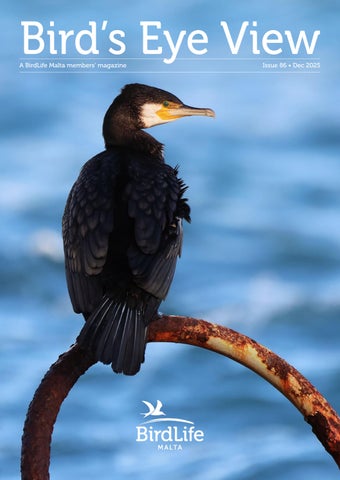
Bird’s Eye View
A BirdLife Malta members’ magazine
Issue 86 • Dec 2025
Contents
Protecting nature is not optional, it’s a duty. Malta is again at a crossroads. The government’s proposed planning law reforms represent one of the most serious threats to nature in recent years. These changes would further weaken safeguards that already fail to protect what little remains of our natural heritage. It is for this reason that BirdLife Malta stands squarely with the Ġustizzja għal Artna campaign, a united front of environmental NGOs demanding that the government place the wellbeing of people and nature before short-term interests. Malta deserves planning laws that defend the environment, not dismantle it. Unfortunately, these reforms are not happening in isolation. The recent weakening of Malta’s birdringing legislation is another worrying sign. By diluting scientific standards to please trappers, the government has again undermined the credibility of ecological research and exposed nature to further harm. Proper bird ringing must be rooted
Darryl Grima BirdLife Malta President
Editorial Board Antonia Micallef (Editor), Victor Falzon (Naturalist & Field Teacher), João Gabriel Candeias (Multimedia Communication Assistant), Nadia Sodano (Communication Assistant), Sofia Meskhidze (Events & Outreach Assistant), Giada Lampitelli (Education Officer)
Contents Comment News
in science, not politics. Anything less is an insult to conservationists who dedicate their lives to understanding and protecting our wildlife. This trend of erosion has now caught (again!) the attention of Europe. The European Commission quickly saw through the government’s childish ploy, declared the infamous “scientific” finch-trapping derogation as recreational trapping in disguise, and launched fresh infringement procedures against Malta. This move confirms what BirdLife Malta has always maintained: that this derogation serves no scientific purpose and blatantly breaches the EU Birds Directive. And so, Malta now faces yet another avoidable clash with EU law, simply because it refuses to prioritise nature. BirdLife Malta will continue standing firm, and our message is clear: nature is not a commodity but our shared responsibility. We will defend it relentlessly.
2
Engage ROOTED
10
Research Shifting Sands
11
3-4
Bird Profile The Great Cormorant
5 6-7
Explore From Buskett to Dingli and back
12-13
Reserves A tale of two sites Educate Winter birds in our towns
8-9
Events
13-14
The African visitor A rare visitor lights up Malta’s birding scene! The Moussier’s Redstart, a small but striking songbird from northwest Africa, dazzles with vivid colours: males in bright orange and black, females softer yet elegant. The photo shows a male, perched among low vegetation and rocks, delighting observers with his tail-flicking display.
BirdLife Malta Council Darryl Grima (President), Joanna Tabone (Vice-President), Norman Chetcuti (Treasurer), Denise Casolani (Council Secretary), James Aquilina, Eurydike Kovacs, Alessandra Loria, Caldon Mercieca, Paul Portelli, Kathleen Psaila Galea, Raphael Soler (members). Senior Management Team Mark Sultana (CEO), Nicholas Barbara (Head of Conservation), Mark Gauci (Head of Land Management), Stefania Papadopol (Head of Public Engagement), Antonia Micallef (Public Engagement Executive), Gabriella Seguna Galea (Finance Manager), Manuel Mallia (Salina Park Manager), Manya Russo (LIFE PanPuffinus! Project Manager), Janet Borg (Office Coordinator). Design João Gabriel Candeias Printed at Poultons on sustainably sourced paper Front cover photo Great Cormorant by Aron Tanti Reg. Vol. Org. VO/0052 © 2025 BirdLife Malta. All rights reserved.
CRIME AND PUNISHMENT The culprits in this list were brought to justice after being observed and reported by BirdLife Malta.
Oct 2025
CRIME: Selling wild finches at Valletta market (October 2023). PUNISHMENT: Wild bird trader fined €1000 + revocation of bird possession licence for three years.
Nov 2025
CRIME: Hunting birds (waders) during close season in Qalet Marku (August 2024). PUNISHMENT: Hunter fined €2000 + revocation of hunting licence for three years + revocation of firearms licence for two years.
Nov 2025
CRIME: Trapping after hours in Bengħajsa (December 2024). PUNISHMENT: Trapper fined €1,000 + disqualification of bird trapping licence for two years. Aron Tanti
Contact BirdLife Malta mailing address: 57/28 Abate Rigord Street, Ta’ Xbiex XBX 1120, Malta tel: +356 21347645 • email: info@birdlifemalta.org • website: www.birdlifemalta.org
2
birdlifemalta
birdlife_malta
BirdLifeMT
BirdLife_Malta
birdlifemalta
birdlifemalta
birdlifemalta
Bird’s Eye View 86 • December 2025
News
Finch in a cage on a trapping site Luca Eberle
Malta reopens illegal trapping The European Commission has opened a new infringement procedure against Malta over finch-trapping. Despite two ECJ rulings confirming violations of the Birds Directive, trapping continues under the guise of “scientific research.” BirdLife Malta calls for immediate suspension and continues to provide evidence to secure full protection for these species.
Minister fails to inform!
At least 50 shot already
On 17 October, Gozo Minister Clint Camilleri announced the new finch-trapping season but deliberately failed to inform European Commissioner Jessika Roswell, whom he had met two days earlier specifically to discuss bird trapping. BirdLife Malta criticised the government for persisting with bird trapping, which is illegal under EU law.
Since the start of this year’s hunting season on the 1st of September, at least 50 protected birds (that we know about) have been shot, including Short-eared Owls, Eurasian Hobby, European Honey-buzzards, several Common Kestrels, a Common Barn-owl (FKNK-bred) and a globally endangered Saker Falcon. BirdLife Malta warns that weak enforcement endangers all birds, especially rare species.
Gozo Minister Clint Camilleri and EU Commissioner Jessika Roswal DOI
Ringing laws undermined BirdLife Malta condemns the government’s plan to weaken scientific bird ringing, no doubt another shoddy attempt to disguise bird trapping as research. All genuine bird ringing in Europe must follow the EURING framework to maintain scientific integrity, transparency and credibility. Yet the government specifically plans to dismantle this crucial requirement.
The Injured Saker Falcon Antoine Monnier Edward Bonavia
Bird’s Eye View 86 • December 2025
3
News
Illegal hunting soars as enforcement collapses During Raptor Camp 2025, held from 12 September to 5 October, 242 illegal hunting incidents were documented in under a month, including use of electronic callers targeting protected species. Please report illegal hunting on 119 and any injured birds found to BirdLife Malta on 79255697. Western Marsh-harrier with evident shotgun damage to the wing at Buskett
Seabird conservation success The LIFE PanPuffinus! project has concluded five years of Yelkouan and Balearic Shearwater conservation, through bycatch mitigation, rat control and community engagement. Following robust evidence of key seabird breeding populations, St Paul’s Islands and the Northern Cliffs have now been designated Special Protection Areas. BirdLife Malta
The fight for Kemmuna continues
ODZ hotel application withdrawn
The Planning Tribunal rejected an appeal against the hotel and villa development on Kemmuna despite habitat impacts. NGOs, including BirdLife Malta, will pursue all legal avenues to protect this bird sanctuary and Natura 2000 site from irreversible damage.
Plans to redevelop the Festaval Hotel ruins in Mellieħa’s Natura 2000 site right in the middle of Foresta 2000 have been withdrawn. The project faced refusal recommendations, missing documentation and opposition from BirdLife Malta and the Mellieħa Local Council. The site should now be restored to nature.
Aerial view of the existing Comino hotel
The Festaval hotel ruins
Nicholas Barbara
67 Dinja Waħda schools On 11 November, BirdLife Malta held its annual Dinja Waħda Awards event. Over the past scholastic year, Dinja Waħda involved 12,560 students and 787 teachers from 67 schools in nature-based activities. The event highlighted nature education initiatives, success stories and the importance of engaging children with nature.
João Candeias
Richard Clarke
Malta Bird Report 2024 out
BirdLife Malta hosts Marine Task Force From 4 to 6 of November, BirdLife Malta hosted the annual Marine Task Force meeting, gathering partners from across Europe to discuss marine restoration, sustainable fisheries, offshore renewables and protected areas. The meeting fosters knowledge-sharing, political updates and strategies to protect seabirds, marine ecosystems and coastal communities.
BirdLife Malta has just published the Malta Bird Report 2024, which brings together ornithological observations in 2024. The report is compiled by the Malta Rarities and Records Committee, and includes an introduction to Malta’s avifauna, year’s summary, systematic list and bird-ringing report. Copies are available from our nature reserves, with previous editions available online.
Front cover of Malta Bird Report 2024
BirdLife Malta on Canale 5 On 14 and 21 September, BirdLife Malta appeared on Canale 5’s L’Arca di Noè, during which we showcased our work to protect birds, restore Salina Nature Reserve, monitor coastal species and tackle illegal hunting and habitat loss.
Stefania Papadopol
New Council At BirdLife Malta’s AGM on 3 October, a new Council was confirmed for 2025–2027. Eleven candidates were approved, with Darryl Grima as President, Joanna Tabone as Vice-President, Norman Chetcuti as Treasurer and Denise Casolani as Secretary. The new Council will guide BirdLife Malta through the coming two years.
4
Antonia Micallef
L’Arca di Noè filming a bird ringing session Bird’s Eye View 86 • December 2025
Bird Profile
The Great
Cormorant The Great Cormorant is a robust, blackish bird with a long, thick neck and a characteristic wedge-shaped head. It has a strong bill and a distinct yellow patch at the base of the throat, giving it a very recognisable profile. In Malta, the Great Cormorant is a regular autumn and winter migrant, mostly seen from mid-September to March, although it does not breed locally. They can be observed feeding in bays and occasionally in nature reserves managed by BirdLife Malta. At times, flocks numbering in the twenties, or even exceeding one hundred individuals, can be seen flying in formation along the coast. The call of the Great Cormorant is not often described in local literature, and the species tends to be relatively quiet compared with other waterbirds. They may produce low croaks or guttural sounds, especially around nesting sites, but their voice is not a prominent feature for casual observers. The Great Cormorant is a powerful diver, using its strong, webbed feet to swim underwater and catch fish. They feed in both shallow and deeper waters, bringing prey to the surface as they resurface. After feeding, they commonly perch on rocks or man-made structures with their wings outstretched to dry, as their feathers are not fully waterproof. At places such as Salina Nature Reserve, they have been seen perching on the Dejma Cross in the middle of the saltpans.
According to the IUCN Red List, the Great Cormorant is classified as Least Concern, reflecting its wide distribution and relatively stable global population.
Maltese Name: Margun Scientific name: Phalacrocorax carbo Length: 77– 94 cm Wingspan: 121–149 cm Conservation status (IUCN Red List): Least Concern Local status: Migrant Call: Generally quiet; produces low croaks or guttural calls Behaviour: Strong diver; often dries wings after feeding; commonly perches on rocks and structures; flies singly or in coordinated flocks. Habitat: Coastal waters, brackish wetlands, estuaries, sheltered inshore areas, rocky shores.
Cormorants favour coastal, brackish and estuarine environments, but are also found on freshwater lakes and rivers. In Malta, they are particularly common along rocky coasts and inshore areas, utilising sheltered bays and nature reserves such as Għadira and Salina as resting and feeding spots. Their diet is broad, ranging from tiny killifish and eels inside reserves to scorpionfish in shallow marine waters. Although they do not breed in Malta, Great Cormorants are an important component of the islands’ winter birdlife. Their presence reflects the health of coastal fish populations and highlights the importance of protecting marine and wetland habitats. They serve as indicators of marine ecosystem integrity, fully aligning with BirdLife Malta’s conservation goals. Manuel Mallia Salina Park Manager
Aron Tanti
Bird’s Eye View 86 • December 2025
5
Antonia Micallef
A tale of
Two Sites Għadira and is-Simar nature reserves are two sites you find on most school calendars. They are annual destinations for thousands of students who visit, armed with fieldwork sheets and enthusiasm. The two sites are nowadays taken for granted and considered part of the landscape, but a few decades ago they didn’t even exist. 6
Bird’s Eye View 86 • December 2025
Reserves
Għadira Għadira was the first nature reserve in Malta, set up in the 1980s. Before then, its history ranged from ancient saltpans to bird-killing grounds. When a road project in the 1960s threatened the site with annihilation, BirdLife Malta (then MOS) pleaded with the authorities for the protection of the site's rare habitat and flora and fauna. Somehow the pleas did not fall on deaf ears, the plans were diverted and the wetland spared. BirdLife began making proposals to the government to turn the place into a proper nature reserve and restore the saltmarsh. In 1978, a wetland expert was brought over from RSPB (BirdLife in the UK) to help with the plans, which the government approved. Shortly after, Għadira was declared a Bird Sanctuary and with funding from various sources, including a grant from BirdLife International (then ICBP), the exciting process of restoration began in summer 1980. The main goal was to dig shallow depressions for seawater to seep back in and revive a permanent coastal lagoon that once dominated the area. The plan also included the formation of various sandy islands to create more shoreline for waders to forage. Following the machinery phase, eager hands joined in as BirdLife members met every weekend to plant vegetation, put up fences and gates, build sand dams and small islands, and establish a nature trail. A visitor centre and a birdwatching hide were built, and a warden employed. The site was officially opened in 1988.
Għadira wetland takes shape
Victor Falzon
Għadira recent view Aron Tanti
Is-Simar The north-east end of Wied il-Pwales was always different from the fertile farmland that characterises the rest of this valley. The area was much too near to Xemxija Bay, the ground was too marshy and the place totally exposed to the wicked salt-laden grigal that wreaks havoc on precious crops. So farmers stopped farming the land there; they dug a canal to drain the marsh and grew a tamarisk plantation to act as wind break. The abandoned area became a rubbish-strewn no-man's land with regular sewage overflow. But BirdLife early on saw the potential of this place: no land is useless if carefully restored. In the early 1990s, a developer made proposals to turn the site into a money-making theme park, complete with plastic dinosaurs, etc. This sounded the alarm bells, so BirdLife stepped up pressure and made its counter proposal, namely to restore the area for nature instead. Luckily, the government welcomed the idea, and in summer 1992 our plan began taking shape. As with Għadira, the plan was to help marshland regenerate. This was achieved by excavating pools, canals and islands, while leaving a good chunk of tamarisk grove intact. The heavy works were followed by tree-planting and setting up of a perimeter fence to secure the site's newly-acquired Bird Sanctuary status. Here too a visitor centre and three hides were built, and a warden engaged. Another success story. Victor Falzon Naturalist and field teacher
Excavating pools at Is-Simar Joe Sultana
Is-Simar recent view Aron Tanti
Despite having saved both sites and helping to restore their natural habitat, BirdLife had to wait several years to obtain some form of control over Għadira and Is-Simar. That came, eventually, in July 2000, when both sites officially passed under BirdLife Malta management. This being the 25th year since that happy occasion, it’s only proper that we remember fondly this landmark in the sites’ – and our organisation’s – history.
Bird’s Eye View 86 • December 2025
7
Winter birds in our towns The birds that share our urban spaces Winter brings colder temperatures that birds feel just as strongly as we do. With only feathers to insulate them, many species rely on migration to survive. As autumn approaches, millions of birds leave continental Europe and move south. Some continue to Africa, while others stop around the Mediterranean, including Malta. Several species have adapted not only to seasonal changes but also to human-made habitats, especially urban areas.
A well-known winter visitor is the European Robin. Arriving in Malta in October and staying until March, thousands spend the season here, each vigorously defending a small territory. Any intruding robin is chased away with sharp calls and, if necessary, pecking. Robins thrive both in natural sites and in built-up areas. Gardens, yards, empty plots, even large roundabouts can host a robin if there is some soil for worms and enough shrubs or trees for cover. Their large eyes help them see at dawn, making them one of the earliest birds active each day. In areas lit throughout the night, robins often sing long after dark. Another similar-sized winter visitor is the Black Redstart. It is named for its rust-red tail, which fans out in flight and often stands out more than the rest of the bird. Both sexes share this tail pattern. Females are dark grey, whereas males are largely black. Although naturally associated with rocky habitats such as garrigue and cliffs, many spend winter in towns. They perch on rooftops and walls, feeding on insects hidden in cracks. Their Italian name, Codirosso Spazzacamino, refers to their habit of roosting in chimneys. In Malta they often sleep on water pipes in internal yards or beneath roof canopies. European Robin, Aron Tanti
8
Bird’s Eye View 86 • December 2025
Educate danger, the flock takes off together in tight, shifting formations that disorient predators. Starlings are also skilled mimics, repeating calls of other birds and even non-natural sounds learned when young. In the evenings, they roost in large Ficus trees in urban areas, with the biggest gathering near the Junior College in Msida. At dawn, large flocks are seen dispersing to feeding areas, especially around Ħamrun. These patterns remind us that our towns and villages support thousands of birds each winter. We can help them by leaving biscuit or cake crumbs on window sills or bird tables and by considering their needs when tree pruning or carrying out similar work. Spreading pruning over several years, or doing it in summer, reduces disturbance. Avoiding loud noise and bright light near known roosting sites also ensures that these winter visitors get a peaceful night’s rest. Nicholas Galea Head of BirdLife Malta Bird ringing scheme. This article is brought to you in collaboration with APS which is funding the project Għasafar Ġirien (Urban Birds).
Photos by Aron Tanti
Black Redstart
Common Starlings, Aron Tanti
Some species spend their days in open countryside and return to towns only to roost, where buildings provide warmth and protection from predators. One of the most distinctive is the White Wagtail, Zakak Abjad in Maltese – a name that reflects both its call and its largely white plumage. The bird gets its English name from its constant tail-bobbing. Wagtails walk rather than hop, searching for insects along fields and footpaths. In the late afternoon, they gather in large numbers to roost in urban trees. The largest roost is in the trees opposite the Law Courts in Valletta. Since 1985, BirdLife Malta volunteers have counted the wagtails from vantage points on the bastions. The highest count was recorded in 2024, when more than 16,000 birds entered the roost. Smaller roosts occur in It-Tokk (Gozo), Mosta Square and Buġibba.
White Wagtail
Spanish Sparrows, although present year-round, also join wagtails and starlings in forming sizeable winter roosts.
The Common Starling shows similar behaviour. Larger and highly social, starlings feed on insects and fruit, often perching on power lines overlooking fields. Those on the wires act as sentinels; if they spot Common Starling, Mario V. Gauci
Spanish Sparrow
Bird’s Eye View 86 • December 2025
9
ENGAGE
ROOTED
Bringing adults closer to nature through learning and inclusion
Vera Tokmakova
ROOTED: Reconnection and Outreach Of Adults: Teaching Environmental Discovery, is BirdLife Malta’s Erasmus+ project, launched in 2025 to strengthen the relationship between adults, particularly older people, and the natural world. Working with partner organisations from Spain, Poland, Greece and Slovakia, the project promotes wellbeing, lifelong learning and social inclusion through accessible, nature-based education.
In November, BirdLife Malta marked a key milestone with its first multiplier event at Salina Nature Reserve. Held in collaboration with CareMalta Group, it welcomed more than 40 residents from various care homes, including many living with dementia. Supported by BirdLife Malta staff, volunteers and young Nature Guardians, the participants enjoyed a morning outdoors, with birdwatching, discovering local species and taking part in a creative workshop where they made nature-themed decorations to take back home. The project’s work extends beyond events. A major focus is the development of practical and accessible educational tools, including a Handbook of Nature Walks with simple, inclusive routes in each partner country, and a Manual for Organisations and Care Homes offering guidance on integrating nature into daily routines and creating greener living spaces. ROOTED has also launched a dedicated website and a podcast series featuring stories, interviews and environmental learning resources that connect generations. Digital inclusion is another central pillar. The project is installing interactive touchscreens and live wildlife webcams in nature reserves and care homes, enabling residents – including those with limited mobility – to observe birds, seasonal changes and habitats in real time. These tools bring nature indoors, ensuring meaningful contact with the natural world remains accessible to all.
Vera Tokmakova
Mark Gauci
Vera Tokmakova Nature Reserves Visitor Experience Officer
ROOTED is based on a clear principle: nature benefits everyone, but access is not equal. Many adults, particularly seniors or those with mobility difficulties, may no longer be able to explore natural spaces as they once did. ROOTED seeks to bridge this gap by creating opportunities that reconnect people with nature while encouraging intergenerational learning. 10
Vera Tokmakova
Bird’s Eye View 86 • December 2025
Restore
Shifting Sands Restoring Malta's dunes
Coastal sand dunes are among the rarest and most fragile habitats in the Maltese Islands. Shaped by wind, sea and time, they now survive in only a few locations. At Għadira Nature Reserve, BirdLife Malta has launched Shifting Sands: Restoring Malta’s Dunes, a project supported through the LEADER Programme’s CAP Strategic Plans 2023–2027. Its aim is to re-establish a small but ecologically important dune community that once formed part of Għadira’s natural landscape.
Mark Gauci
The dune in question is an 800m² strip of land between the east perimeter of the nature reserve and the road. Over the years, the area became severely degraded due to invasive alien species such as Giant Reed and African Boxthorn. These fastgrowing plants outcompeted native flora and altered the sandy substrate essential for dune vegetation. The project’s first phase focused on their careful removal. The cleared area will now be replanted with native dune species, such as Sea Daffodil and Sharp Rush. Adapted to shifting sands, salt spray and extreme summer drought, these species will rebuild the habitat’s natural structure and resilience. An old perimeter fence in disrepair has been replaced.
Public engagement is key to Shifting Sands. New information panels explain dune ecology, the pressures these habitats face, and why their restoration is vital to our increasingly limited coastal landscape.
Fence protecting the sand dune area from trampling Mark Gauci
Digital outreach, including video reels and animations, will further strengthen public understanding. This initiative complements ongoing conservation efforts at Għadira, enhancing biodiversity and reinforcing the reserve’s role as an outdoor classroom for students, families, researchers and nature enthusiasts. By restoring lost habitat, the project not only rehabilitates a damaged ecosystem but also renews the connection between people and place. As the dune slowly recovers, it will again support life and foster a deeper appreciation of our landscapes. Mark Gauci Head of Land Management, BirdLife Malta
Small machinery was used to remove the large invasive Acacia trees
New information panel on site Victor Falzon
Mark Gauci
Bird’s Eye View 86 • December 2025
11
Explore
From Buskett to Dingli and back a short sunset hike
This short but picturesque walk will take you on a circular route starting from Verdala bus stop, through Buskett to Dingli cliffs via the fascinating Għar il-Kbir complex before circling back to the starting point. Along the way you will encounter beautiful landscapes and historical landmarks, delving into the culture and nature of Malta.
Verdala Castle dominates Buskett woodland
Evening view of Filfla Sofia Meskhidze
The walk begins in front of the gate of Verdala Palace. Originally built as a hunting lodge by the Knights of St John, it was expanded into a palace in 1586 and now serves as the summer residence of the President of Malta. Walking downhill through Buskett, you can enjoy this rare woodland, one of the greenest areas in Malta. Situated on a major migratory flyway, Buskett is an Important Bird Area and a Special Area of Conservation within the EU Natura 2000 network, making it ideal for birdwatching. During autumn and spring migration, birds of prey such as Eurasian Honey-buzzards and Western Marsh-harriers are
common visitors, as well as Common Kestrels, which occasionally stay throughout the winter and can be observed in November and December. In winter you are sure to hear the calls of European Robins that winter in Malta, and of resident birds such as Sardinian Warblers and Zitting Cisticolas. Keep an eye out for White Wagtails, named for the characteristic movement of their long tail. Exiting Buskett on its southernmost side, head towards Clapham Junction, the nickname for Misraħ Għar il-Kbir, a prehistoric site with ancient cart ruts and a cave complex that was inhabited until the mid-19th century. If you’re feeling adventurous, you can enter the caves and explore them. Interestingly, the name “Clapham Junction” was coined by archaeologist David H. Trump, who was inspired by the cart ruts, which reminded him of the busy railway station in London. Common Kestrel, Aron Tanti
One of the caves in the Għar il-Kbir Complex
Buskett woodland view Sofia Meskhidze
12
Sofia Meskhidze
Sofia Meskhidze
Bird’s Eye View 86 • December 2025
Sofia Meskhidze
As you walk through the garrigue in this area you will inevitably smell Mediterranean Thyme and see the rounded bushes of Tree Spurge and Maltese Spurge. The violet flowers of Yellow-throated Crocus add a flash of colour to the landscape. Once you leave Buskett behind, trees become less common, but you can still spot Aleppo Pines growing sporadically along the route. If you plan to go on this hike in the evening, make sure you time your arrival at the Dingli Cliffs for sunset, it is not to be missed. The viewpoint offers breathtaking views of the sea, the sunset (weather permitting), and the islet of Filfla, formerly a rock used as target practice by the British and now an Important Bird Area and strict Nature Reserve, home to multiple seabird species, including one of the largest populations of European Storm-petrels in the Mediterranean. On the cliffs you will come across a number of endemic plants, including Maltese Salt-tree and Maltese Rock-centaury. The latter is Malta’s national plant and a protected species facing threats such as non-native plants, dumping and trampling. Looking out to sea, you may notice gulls soaring above the water or hear the song of the Blue Rock-thrush. Continuing north along the cliffs, you will come to a small, unassuming chapel: the Maddalena chapel, built in the 17th century and famously struck by lightning twice. Feel free to linger by the chapel for a final look over the wide expanse of the sea before turning back inland. You can return to the starting point in Buskett by retracing your steps, or continue on a circular route along the narrow countryside roads, eventually reaching Verdala Palace with Buskett on your righthand side. Darkness descends quickly after sunset, so keep in mind that this last segment of the route
Victor Falzon
may need to be done in the dark, bring a torch for convenience, but avoid using white light in order to minimise disturbance to wildlife. If the hike seems short, it is possible to extend it by heading towards IlGirgenti after Buskett and passing through Il-Fawwara and Ġebel Ciantar before reaching the cliffs at Dingli and returning to Buskett from there. This naturally doubles the distance and time required. Sofia Meskhidze Events and Outreach Assistant
The walk is rated as easy and takes between 2 and 2.5 hours to complete. Make sure you wear appropriate footwear, stay hydrated and enjoy nature respectfully, without damaging vegetation or disturbing any wildlife you encounter.
Yellow-throated Crocus Sofia Meskhidze
Maltese Rock-centaury
The Maddalena Chapel,perched on the edge of the cliff Sofia Meskhidze
Sofia Meskhidze
Bird’s Eye View 86 • December 2025
13
Events Events from September to December 2025
13 Sep
18 Sep
Watching Raptors at Buskett
Night Hike with Nature Guardians Alumni
at Buskett Woodland
at Foresta 2000 Vera Tokmakova
Silvia Viviani
19 Sep
19 Sep
Sunset Walk from Buskett to Dingli Cliffs
Clean-up with BOV at Majjistral Park
at Buskett Camilla Bianco
Giada Lampitelli
26—27 Sep
28 Sep
Sand Dunes Day at Għadira Nature Reserve
Science in the City
at Triton Square, Valletta
at Għadira Nature Reserve
Sofia Meskhidze
Lucie Čermáková
4—5 Oct
5 Oct
EuroBirdwatch 2025 at Buskett, Simar Nature Reserve, Għadira Nature Reserve.
Sofia Meskhidze
14
Walk and Picnic with St Benild School
at Selmun Alishia Stone
Bird’s Eye View 86 • December 2025
26 Oct
31 Oct
Spooky Hike with Falko
Nature Walk: Mistra and Selmun at Mistra Bay
at Foresta 2000
Bernardette Chircop
31 Oct
Stefania Papadopol
11 Nov
Żurrieq Halloween in aid of Puttinu Cares
Dinja Waħda Awards Ceremony 2025
at Żurrieq
at AX ODYCY Hotel
Bumin Akar
28 Nov
Antonia Micallef
30 Nov
Chameleon Night
Nature Walk in Mġarr
at Simar Nature Reserve
at Mġarr and Victoria Lines
Nadia Sodano
Nadia Sodano
Upcoming events 12—21 Dec
Christmas in the Park at Salina Park
Find BirdLife Malta stand in Salina Park on all days of the Christmas fair, selling merchandise and Christmas specialities. Come by for some last-minute Christmas souvenirs, engage in fun activities or to just say hello!
19—21 Dec
29 Dec 7pm
Sip, Soak and Savour
at Salina Park
Join us as we close 2025 with a special screening of Orchids - Darwin‘s Conundrum, the award-winning documentary produced and directed by Maltese biologist Thomas Cassar. Thomas will be with us in person, and following the screening he will take questions about the documentary, his scientific work, and the remarkable biology of these extraordinary plants.
MIV Christmas Market at Palazzo Francesco Lija
Embrace the Christmas spirit with us at Palazzo Francesco in Lija, where we will set up a stand with merchandise and fun educational activities for people of all ages.
Bird’s Eye View 86 • December 2025
15
People rise for Malta Thousands took to Valletta’s streets twice in October to oppose planning reforms that threaten Malta’s future. On 4 October and again on 27 October during Malta’s 2025 Budget speech, over 70 organisations, including BirdLife Malta, joined the Ġustizzja għal Artna movement in calling for the withdrawal of Bills 143 and 144, warning they weaken public rights and environmental safeguards. The campaign has now launched Tour Ġustizzja għal Artna, a nationwide outreach effort across Malta and Gozo to explain the dangers posed by the proposed laws and invite communities to engage, ask questions, and stand up for the protection of our towns and natural spaces.