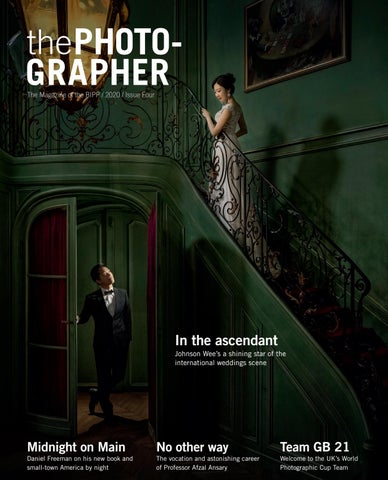
The Magazine of the BIPP / 2020 / Issue Four
In the ascendant Johnson Wee’s a shining star of the international weddings scene
Midnight on Main
Daniel Freeman on his new book and small-town America by night TP-2020-4 OFC.indd 1
No other way
The vocation and astonishing career of Professor Afzal Ansary
Team GB 21
Welcome to the UK’s World Photographic Cup Team 14/12/2020 14:18
USEFUL AND INFORMATIVE RESOURCES
FIND THE BIPP ON INSTAGRAM, TWITTER AND FACEBOOK
TP-2020-4 IFC.indd 2
www.talkingshot.co.uk
www.facebook.com/ groups/2216824425216109/
masteringportraitphotography.com
https://www.facebook.com/ groups/212014723451456/
14/12/2020 14:18
I SSUE FOUR, 2 0 2 0
CEO’s column 2 Martin Baynes reviews progress through 2020 and announces some special awards Board of Directors 4 Regional Chairs 6
Midnight on Main Daniel Freeman 18 Taking his night work over to the US gave Daniel Freeman the shape of a project that would yield a mainstream publisher
BIPP President | Jon Cohen 8 Jon looks at some of the lessons learnt from a tough year
Angles and atmosphere 26 Realising the back story of what elements of composition represent and how they work can completely change our creative approach
Johnson Wee 10 Providing highly polished and detailed work to an adoring client base, Johnson Wee has well and truly arrived on the international weddings scene
Defence School of Photography 32 We talk to Frank Tomlinson about life at the helm of DSOP, training photographers in a military zone, and look back at its long history in the field
the Photographer is published four times a year by the British Institute of Professional Photography, The Artistry House, 16 Winckley Square, Preston, Lancashire PR1 3JJ T: 01772 367968 E: info@bipp.com W: www.bipp.com Company secretary: Michael Lane CEO: Martin Baynes
Directors: Emily Hancock FBIPP (Chair) Tony Freeman Hon FBIPP Karen Massey ABIPP Monir Ali LBIPP Barrie Spence ABIPP Ian Southerin LBIPP Regional Chairs: Barrie Spence ABIPP (Scotland) David Stanbury FBIPP (North West)
Social media column 39 A call to arms Professor Afzal Ansary 40 A look back at the illustrious career of medical and scientific photographer Professor Afzal Ansary and the moment that forged his path Portrait of a Pandemic Karen Massey 48 The story of a qualifications project in lockdown World Photographic Cup 54 Presenting Team GB 2021 Obituary 64 David Campbell Hon FBIPP David Taylor FBIPP (Midlands) Andrew Younger LBIPP (South West) Irene Cooper ABIPP (Yorkshire) Monir Ali LBIPP (South East) Editor: Jonathan Briggs, editor@bipp.com Advertising: Tel 01772 367968 E-mail: admin@bipp.com UK Subscribers £20, EU £40, Rest of the World £50 ISSN: 0031-8698. Printed and bound by Magazine Printing Company, Hoddesdon, Herts
Neither the British Institute of Professional Photography (BIPP) nor any of its employees, members, contractors or agents accepts any responsibility whatsoever for loss of or damage to photographs, illustrations or manuscripts or any other material submitted, howsoever caused. The views expressed in this magazine are the views of individual contributors and do not necessarily represent the views of the BIPP. All advertisements are accepted and all editorial matter published in good faith. The Publisher makes no warranty, express or implied, that any particular product or service is available at the time of publication or at any given price. No part of this publication may be reproduced by any means whatsoever, or stored in a retrieval system, or broadcast, published or exhibited without the prior permission of the publisher. This magazine is the copyright of the BIPP without prejudice to the right of contributors and photographers as defined in the Copyright, Designs and Patents Act 1988. All rights reserved. Registered at Stationers’ Hall, Ref B6546, No. 24577. © BIPP 2020 1
TP-2020-4 Contents 01.indd 1
14/12/2020 14:56
M ARTI N BAYNES
Dear Member, Wishing you a Happy Christmas and prosperous New Year – it surely has to be more prosperous than this year! Well, we have made it through this year together, as an association. There have been casualties, and I thank you all for your patience in supporting the Institute through this difficult year. I am very optimistic about seeing you all being extremely busy in 2021. We have been involved in a number of lobbying groups including involvement with the wedding task force – rapid testing is on its way with a 15-minute wait for a result and even as I type this, the news on TV is of the first vaccines being administered in the UK. Like you, I am very hopeful that by the start of the 2nd quarter of next year, we will be well on our way to normality with a huge amount of pent-up demand for photography in 2021-22. In this issue of the Photographer, as always, we have brought you a wide range of images and stories from our very varied and broad membership. From an interview with the Officer Commanding of the Defence School of Photography (DSOP), a college which trains all military photographers, to introducing you to Team GB 2021 for the Photographic World Cup Challenge. As you are aware, we have successfully completed the Regional Chairs appointments and also that of the Board of Directors. Congratulations to you all and I look forward to working with you over the next three years. I would like to thank the members who applied for positions and who were not successful on this occasion – it was great to see such a high standard of interest, and I hope we can harness your enthusiasm and skills on many projects we have in the pipeline. In 2021 we have some exciting projects that we are eager to start. We have some catching up to do on qualifications. The regional print competition will start in the 2nd quarter of 2021 with the nationals in October, leading to the highlight of 2021, the ‘Photographer of the Year’. This will be announced and presented in November at the AGM. Also, at the AGM we will have our awards with an evening of celebration. We are currently looking to see if we can
have the delayed 2020 INFOT in 2021, so watch this space… We had news of the very sad loss of a very special member David Campbell who was an amazing Regional Chair in Northern Ireland. He really was a legend who has touched many people, and as one of the founder members of Venture he was an incredible businessman. I am delighted to say we were able to honour David in the last few weeks of his life with an Honorary Fellowship – which I know he was over the moon with. In this issue we take a look back at David’s extraordinary life. From 2021 we are introducing the David Campbell regional award supported by Venture Studios. It’s an award for the most active region, and I know David would have approved of this and done his level best to win it. As an Institute, we have been through many challenges – two world wars, a number of depressions, a revolution in technology and the way people purchase photography. The most recent challenge almost brought the Institute to bankruptcy through mis-management. We have moved from posting a deficit of £211,000 in 2019 to a much smaller loss of £28,000 in the most recent accounts. We are hoping to be back in the black by March 2021. This is a monumental achievement – during this dark time in our history, two members stood up to be counted. Over two years, through the correct channels and with sheer force of will and determination they identified the issues and contacted other members to attend the now very infamous AGM. Even after the change in management and over a year of fighting, they stepped up to take their place on the Board whilst the organisation went through a restructure. This included moving the office and saving over 80 per cent of fixed overheads. I have been contacted by many members over the past 16 months asking how these two Fellows of
2 the PHOTOGRAPHER / 2020 / Issue Four
TP-2020-4 02-64.indd 2
14/12/2020 15:00
CEO’S COLUM N
the Institute could be rewarded for all their hard work. Last night on a ZOOM meeting with the Board, we announced to Sean Conboy and Jonathan Beer that they have been awarded with the highest possible honour to become Honorary Fellows. Our huge and well-deserved congratulations go out to them both. The Board of Directors felt that their contribution was so great that they would also like to honour them with an award in their name that will be presented on very special occasions when a member or someone outside the organisation does something that has an increadable impact on the Institute. The Beer-Conboy Award still needs a better title – let me know if you have any suggestions – and let’s keep it clean. Suggestions that made me laugh were the JonBoy and BeerBoy Award… Last year I sent out an annual planner with the magazine but due to the uncertainty of the start of 2021, I will be sharing next year’s calendar of events on the new website. Please be aware with our ever-changing climate, this could be subject to change. Along with this I will communicate all
planned events such as meetings, qualification dates for both ourselves and the FEP and print competition dates to name just a few. I want to take this opportunity to thank Kevin Weatherly, who steps down from the Board as his term comes to an end at the AGM – his help and advice have been invaluable. I also want to thank all our members for your continued support in this difficult year. I truly hope you have a wonderful Christmas in whatever you have planned. It is going to be very different for us all. I look forward catching up with you all and fingers crossed we may even be able to attend a trade event. Merry Christmas and wishing you a prosperous New Year. Martin
Sean Conboy Hon FBIPP
Jonathan Beer Hon FBIPP
Sean has had a passion for images since the age of 11 and started his career in professional photography 30 years ago. Known for his use of space and light, the British architectural photographer is best known for creating majestic images of large scale interiors, as well as drawing the viewer into more intimate spaces with perfectly crafted composition and lighting. Sean shoots architecture and interiors for many national and international clients around the world . A photographer who very much learnt his craft in the era of large-format film and cameras, Sean regularly speaks and gives workshops for companies such as Hasselblad, Linhof and broncolor and is involved in judging for the Hasselblad masters and many photographic organisations.
Jonathan is a still-life and product photographer based in Manchester. Well known for his clinical and meticulous lighting, Jonathan’s attention to detail and patience coupled with a healthy dose of stubbornness help him to create high-end still life work for clients including Hoegaarden, Royal Mail, Nescafe, Jo Malone, M&S and Hasselblad amongst many others. An active member of the BIPP for over ten years, Jonathan is valued as a mentor, assessor and judge. He is regularly called upon to be involved in industry awards and qualifications, as well as speak to and share his experience with both students and fellow photographers.
3
TP-2020-4 02-64.indd 3
14/12/2020 15:00
B IP P BOARD OF DI RECTORS
Emily Hancock FBIPP Emily has been a photographer for 20 years, specialising in equine portraiture and art photography for much of her career. She received a Fellowship for her equine photography from the BIPP in 2012 and has since received numerous accolades for her work. In recent years, she studied Art History at Sotheby’s institute and has embraced her creativity to become an artist, combining equine photography and mixed media to create stunning pieces that are exhibited, displayed and sold globally. Emily juggles creating artwork and private equine commissions, with running an equine photography training academy, and managing a string of successful childcare nurseries in Hampshire. Having been involved with the BIPP for many years, Emily continues to support the organisation and hopes to inspire the creativity of many photographers across the UK. Tony Freeman Hon FBIPP Tony Freeman failed a preliminary photographic examination in 1958 and subsequently went on to become President of the very same Institute that set the examination! By 1961 he was in charge of the photographic section of a provincial evening newspaper and within 12 years had established two studios and three press agencies all whilst working as a freelance TV cameraman. Tony has served the BIPP for 40 years, representing them in Europe, receiving two presidential awards and an honorary Fellowship before becoming President in 2003. With a dedicated group of colleagues, Tony turned around a struggling Western region to become extremely successful however, due to the intervention of the former CEO, not the case today. He is hoping his experience will help put the Institute back on a solid footing before handing over to a younger, enthusiastic member to take the Institute on to greater heights.
Karen Massey ABIPP A photographer of 16 years with a love of people, specialising in wedding and corporate photography. It is a true honour for me to be voted onto the Board of Directors where looking after you the members is paramount. I enjoy getting stuck in and assisting where I am needed. Being a board member also fits perfectly within my role at the Federation of European Photographers (FEP), where I currently sit on the Board and also as the Vice-Chair. I am excited to grow the interest of the membership within the FEP and overseas, opening up new opportunities for our members. When I am not photographing or interacting with members and head office I also run my own organisation RISE, an organisation I set up for Professional Female Photographers, which supports women in the industry, where members can learn, develop and grow their businesses, giving women more of a voice within our industry. When RISE members also start to look for a qualification, they are guided through the Institute path. I am looking forward to getting to know you all. Ian Southerin LBIPP We all know that being a good photographer is not easy. You need to ‘own’ your personal beliefs, you need to have perseverance and you need to have a hunger for success. Once we have all of those attributes in place we then need to learn to hit the shutter button at the right moment with the camera pointing in the right direction, while being confident that the light is right. All of the aforementioned is tricky to get into the correct order and we haven’t even mentioned making money. The BIPP is an organisation ideally positioned to help its members help themselves become great photographers. As a director I want our Institute to build up our networks, to get alongside the normal (often struggling) professional and take an interest in them.
4 the PHOTOGRAPHER / 2020 / Issue Four
TP-2020-4 02-64.indd 4
14/12/2020 15:00
B IPP BOARD OF DI RECTORS & REGI ONAL CHAI RS Our Institute is made up of ‘little people’, who aren’t famous, who don’t attract sponsorship from the trade, are not wealthy, but do believe in the Institute. It is vital that we listen to our members. Regarding our magazine I agree with the words of Robert Mapplethorpe ‘The more pictures you see, the better you are as a photographer’. I want to see our magazine become a premium ‘art’ publication that showcases the best photography in the world. A wonderful ‘Inspiration’ that drops through your letterbox 4 times a year. I’ve been a photographer and a BIPP member for over 20 years. If you ever fancy a photography chat, just give me a call. Monir Ali LBIPP South East Regional Chair Hello, photography has always been a big part of my life, from the time I was given my Uncle’s old Pentax AG it has been a valuable part of my life’s journey both professionally and personally. I joined the organisation mid-career after bouncing around various other trade associations, but when I got to the BIPP I felt I was at home – from the learning, getting my qualification, to the people I have met. For me, the BIPP is an opportunity for us to develop personally as well as raise the bar for our industry regardless of what sector you fall in. Most of us have chosen this way of life for personal reasons, business reasons but the one thing that unifies us is the need to be a part of a world where we get to be creative, tell visual stories and to be part of an elite network. I specialise in two areas of photography: Asian & Cultural wedding photography and food photography – both of which I love and enjoy. I have photographed over 700 Asian weddings in my ten-year career. I love food and traveling, enjoy all sorts of music from Bollywood, Classical to Old School tunes and everything between. Thanks to my daughters I have developed a fondness for unicorns and camping in enchanted forests! Throughout my career I have been fortunate enough to photograph people from English Princes to Bollywood Queens, heroes of the screen, stage, music and sport. I have done the occasional workshop, seminars and am passionate about teaching young
people photography. As one of the newer members of the team, I think the most important aspect of the BIPP is the membership body – you, me and our colleagues. Together we make the changes you want to see. I’d love to hear about your story and what you want from the Institute. I am only a phone call away. Barrie Spence ABIPP Scotland Regional Chair I’m relatively new to the BIPP, only having joined in March 2019. I joined with the aim of growing my network of professional peers and to make friends. Almost all of us work alone and don’t have a lot of support in our business (I’ve built and worked in great teams – I miss the support of friends and colleagues in my own business). That’s why I believe that the network and community is key to our membership – the value is really in the friendship and support we can give and receive. As a newcomer, it’s not easy to make the connections – it’s working for me, but it does take effort and time. I don’t consider anything set in stone and I’ll challenge and work to change anything that’s awkward, sub-optimal or inflexible (otherwise known as being awkward and causing trouble). I also understand that change takes time and expectations need to be set (and met). My written communication is pretty direct and to the point, but I’m always happy to talk (phone calls are rarely short). I don’t take myself overly seriously and try to make what I do enjoyable and rewarding. Photographically, I’m a portrait photographer and primarily studio-based – it’s Scotland, reliably usable weather can be a challenge. My portraiture includes dance and headshots (on the commercial side) and the usual family/dog work on the social side. I’ll actually shoot anything for pay, but only if I can do it well (and if I can’t, I’ll refer it to someone who can). I received my first qualification (QEP) in October 2019 and then my ABIPP in September 2020 – I value my qualifications immensely, but I don’t use them to define me. I want the organisation to grow. I want connection and community. I want friendships. But enough about me. Tell me what you want and let’s try to make it happen. I’m always happy to take the time to listen and talk to BIPP members – call me. 5
TP-2020-4 02-64.indd 5
14/12/2020 15:00
BI PP REGI ONAL CHAI RS
David Taylor FBIPP Midlands Regional Chair My interests in photography first began at around the age of ten – like many photographers, experiencing a B&W film being processed, and B&W prints being made under a red safelight in the bathroom converted into a darkroom… it was magic. My lucky break came in when I applied for a position as a photographic assistant with Lubrizol Corporation, an American Company and a world leading provider of speciality chemicals for the transportation, industrial and consumer markets. I have been very lucky to have made a career out of my passion for photography, using the best equipment in top-class facilities – and got paid for it. There’s little wonder I’ve clocked up over 45 years working for Lubrizol. I attended Derby and District College of Art where the glamorous side of photography seemed to be fashion and advertising photography, but it was the contrasts and diversities of industrial and commercial photography that interested me most, and over the years I have traveled extensively in Europe and the world from northern Scandinavia to southern Spain, to Russia, India, China, Singapore, Japan, Australia, South Africa, the Americas North and South, for an ordinary humble bloke it’s just been amazing, but then photography is amazing!
After taking reluctant retirement from Lubrizol (one of the most difficult decisions I have had to make – but there’s a right time for most things in life and my time had come) I now photograph wildlife, one of my big loves since being a boy. For the last five years I’ve been working on a few projects in wildlife and am hoping to gain a fellowship in the future. Offering images for sale for calendars and publication is an outlet for my new wildlife challenge, alongside working with Carol my wife who is also a photographer of over 40 years in our own small business, Chapel Studio, doing general practice photography. david@chapelstudiophotography.co.uk
David Stanbury FBIPP North West Regional Chair David Stanbury is a multi award winning portrait and wedding photographer based in the North West of England with a career spanning over 25 years and nearly 1,400 weddings. His accolades include over 300 National & Regional awards including UK Wedding Photographer of the Year, UK Portrait Photographer of the Year, UK Wedding Album of the Year and a two times finalist in the prestigious Hasselblad Masters Awards. He has also one of only a handful photographers awarded a triple Fellowship in wedding photography by the BIPP, MPA and SWPP. David is also a photography consultant working with some of the biggest photography companies in the world and an international photography judge. David works exclusively with his wife Jane from their studio covering weddings and seminars worldwide. Their photography style is described as stylish and timeless and is very much in demand by couples who require the very best in wedding photography. stanburyphoto@gmail.com
6 the PHOTOGRAPHER / 2020 / Issue Four
TP-2020-4 02-64.indd 6
14/12/2020 15:00
CAPTURE ONE VERSI ON 21
Andrew Younger LBIPP South West Regional Chair I’m a wedding photographer from Plymouth, Devon. Together we with my wife Agnieszka we run Younger Photography. We have a small family and these days choose to photograph weddings locally with the odd destination wedding thrown in. I started working for a portrait studio in 1989, and I feel very fortunate to have worked in this industry for over 30 years now. I’m as happy shooting film as I am digital. Photography is still a great passion, as is beer and Curly Wurlies. Hope to see you at a regional meet soon my lovers. info@youngerphotography.com
Irene Cooper ABIPP Yorkshire Regional Chair Irene has been a production stills photographer for the entertainment industry for over 30 years, and work has varied from Shakespeare to TV soaps and pantomime. She recently returned to education and achieved an MA in Photography at De Montfort University. Irene joined the Institute as a student in 1986. Twelve years later, she was honoured to be elected as President (1998-99) – only the fourth woman to hold the post in the Institute’s first 100 years and she is now currently Chair of the Yorkshire Region. Having been an active member of the Institute for many years, she continues to support the membership and encourage them to gain inspiration from the wide range of talents our organisation has to offer. irene@irenecooper.com
C
ombining its best-loved elements such as personalised workspaces and the powerful colour editor with new features like Speed Edit and Dehaze, Capture One v21 is focussing on a new type of user experience and is crying out for those who are sticking with what they know to make a step into the C1 world. Undoubtedly a very powerful tool in the right hands, Capture One has often – rightly or wrongly – been considered the RAW processor of choice for high megapixels, low volume workflow. People have also found it a bit difficult to get into, also. Hence with v21, learning your way around is integrated into the workspace itself, with enhanced tooltips and access to tutorials right from within the software. Then there’s faster asset management and an improved importer to make organisation easier – for example you can now import images from different folders all in one command. As Capture One comes of age, naturally there’s a raft of developments to pique your additional interest too. Speed Edit lets you work without touching a slider on the interface – holding down selected hotkeys and scrolling, dragging or using the arrow keys allows rapid edits to be made, with such commands extendible to batch editing. Dehaze eliminates haze and the most undesirable atmospheric weather conditions in a single slider. It uses deep analytic algorithms to assess and automatically adjust contrast, saturation and a matrix of other parameters to remove haze and reveal the image behind. There’s also a new feature very interestingly called ‘ProStandard Profiles’. The concept is that it will help to protect hues and colour transitions when making adjustments to an image, and is aimed at particularly at product photography, for example. To understand the feature, it’s like Capture One providing a RAW processing profile for a particular camera that’s enhanced to protect certain areas of a file, and is better than the manufacturer ‘standard’. ProStandard has to be manually selected from the ICC Profile drop-down under the Base Characteristics panel and is only currently available for the most popular camera models. However this is a list that will grow as Capture One profiles more and more cameras. It’s an interesting development area for the software and one that could certainly – just by itself – have many photographers taking another look at whether Capture One could become their processing software of choice. www.captureone.com 7
TP-2020-4 02-64.indd 7
14/12/2020 15:00
BI PP PRESI DENT
I mage © Tamara Peel
J ON COHEN
I
t’s been the toughest year for professional photography and it goes without saying for humanity in general – I won’t dwell on that – it’s self evident and everybody is primarily focussed on keeping home, family, business and community as safe and healthy as possible. Some spending is still there and I don’t just mean Amazon – furniture orders, building work and the explosion of sales in gardening and interior design are just a few examples of where money, probably holiday money, is being spent this year. In our photography sector there has been some commercial and fine art activity but judging by prolab reports it’s portraiture, while still nowhere near a healthy market, that has not been as badly hit as other areas. More generally the pandemic has shown us that the way businesses interact with clients has to change pretty rapidly. It’s the businesses with quick, slick, good looking websites complemented by strong social media streams that traded relatively well during and after the first lockdown. The pandemic globally has
kicked forward the move to digital remote business and customers now have high expectations from providers. Am I suggesting everything is going to be moving on-line? Well no, in that it’s mostly a physical product that photographers produce, not every image will be sold as a file so finished prints or albums are still at the core of our industry. As well as looking simply beautiful they’re an important way for photographers to show how a professionally printed image can look when compared to the massive outpouring of screen images. I’m not knocking screen images here, you only have to scan Instagram to see some brilliant work by aspiring photographers but for me a high-quality print or album is a finished piece of crafted work – there’s no substitute. I’m biased I know but I think we’re really lucky to have world class pro imaging labs here in the UK, and when photography is hit badly, so are our labs. It was sad to hear that GF Smith had closed their photolab operations, anybody who’d had the pleasure of a tour there would know what a great team they had in Hull, not only producing work for photographers but also taking top quality photo printing to the design world. How has this pandemic year been for me? Strange would be the one word answer but just to expand a little, I parted company in the nicest way with Fujifilm earlier this year, it was the perfect excuse to get out to photographer and prolab friends for a final visit and I was massively grateful to them and to my colleagues for all the events we had. In the early part of the year I was also back over in Japan, a place I love visiting – we managed to get in family visits, a trip up to Hokkaido and an amazing walk on the Kumano Kodo trail before our not so helpful airline abandoned us there. Heathrow was eerily quiet when we finally managed to find a return flight home and since then, like most people, I’ve been picking out the easy bits from my to do lists, improving my Zoom skills, talking to industry friends and spending time in the great outdoors whenever I can. I enjoy in a big way being out in the hills and mountains and judging by the queue for Striding Edge in September they’ve been a place of respite for many others too. The mountains are perfect for a bit
8 the PHOTOGRAPHER / 2020 / Issue Four
TP-2020-4 02-64.indd 8
14/12/2020 15:00
COVI D- 19 RESEAR C H ROLLS- ROYCE
of thinking time and beautifully compensate for my so so photography by doing most of the hard landscaping work themselves, I’m not up to Colin Prior’s inspirational standards but surely it’s only a matter of time… I must admit to missing the buzz of working at Fujifilm, I loved the way that the business is still investing in photo technology, both in capture and print, while forging ahead in important new areas like medical diagnostics and pharmaceuticals. They’ve been lovely people to work with too. Luckily my new boss Mr Baynes has promised to keep me well occupied once I’ve understood the intricacies of making his tea (the drink that is, just to be clear to any Northern compatriots). I’ve been really impressed by the activity that has still gone on in the photography arena this year, awards like the Pink Lady Food Photo Awards and exhibitions like Photo London all had to move to an on-line format but produced great events, placeholders I’m sure for a return to physical events next year. Shutterhub already had a foot firmly in the digital arena but produced some innovative print exhibitions too and a nicely curated Yearbook that gave graduates among many others an opportunity for exposure, really useful with most graduate shows cancelled. I’m a big fan of Carolyn Mendelsohn’s very moving portrait exhibition “Being Inbetween” so it was excellent to see the book of the portraits funded and in production this year, this as well as Carolyn’s work with some scarily good young photographers documenting their lockdown experience on Instagram in “Through our Lens”. Lastly back to the pandemic – one thing that it has brought us (and not in a good way but it brought it nevertheless) is an abundance of thinking time. The upside is that it is an opportunity to tune up the way we interact with clients, go for that associateship or fellowship, everything to really make the best use of what I fervently hope will be a good year for photography in ’21. I know there have been some well meaning but badly thought through retraining campaigns aimed at creative areas that have taken a major hit but rethink, re-skill, reboot I think not! As we adapt to the post pandemic world, that world will need professional photography every bit as much as it always has.
R
olls-Royce has been working on a pioneering study in the UK which aims to make operating theatres safer places during the COVID-19 pandemic and beyond, by using cameras normally used to test jet engines. Led by University Hospitals of Derby and Burton NHS Foundation Trust (UHDB) and in partnership with the University of Lancaster, the study aims to understand the spread of droplets in the air when treating patients. The Rolls-Royce Image Resource normally use high-speed cameras to test jet engines, such as the Trent XWB. During the pandemic, surgeons have had to perform regular tracheostomies on patients, in which an opening is created in the neck to place a tube into the windpipe. The procedure creates droplets of liquid in the air which could contain pathogens, such as COVID-19. It is hoped the research can discover how far particles travel and how long they remain in the air in a bid to improve safety for staff in operating theatres. To do this, Rolls-Royce engineers were called in to monitor how far droplets can travel through the air. When testing engines, the team uses high-speed cameras to capture tests in minute detail. The cameras capture 8,000 frames per second, allowing engineers to study how an engine behaves in a range of conditions. In this study, the same cameras are used to help analysts create a more three-dimensional understanding of how far the droplets travel. Eve George, Imaging Engineer at Rolls-Royce, operates the cameras and says using them in this way has been unique for her and her team: ‘We test our engines and components to the limit, using high-speed cameras to capture incredible levels of detail. Working with patients instead of jet engines was very different to our day job, but it’s great that we’ve been able to apply our technology to help keep NHS staff safer while treating patients.’ Eve George LBIPP, Kat Forey ABIPP and Dave Bull FBIPP were proud to take on this project. The RollsRoyce Image Resource includes nine team members, almost all of whom are BIPP members and support all aspects of imaging for the company during a very difficult period for Rolls-Royce Aerospace. The Image Resource is led by Steve Smith FBIPP.
9
TP-2020-4 02-64.indd 9
14/12/2020 15:00
we d d i n g s
10 the PHOTOGRAPHER / 2020 / Issue Four
TP-2020-4 02-64.indd 10
14/12/2020 15:00
J OH N S ON W E E
Creative consistency International recognition has come quickly in the flourishing career of Johnson Wee – and it’s not without good reason. An astonishing level of thought and creative application courses through his work
I
t would be easy to describe Johnson Wee as a superstar in the making – and it’s probably time for Johnson himself to drop the ‘rising star’ tag. Just saying, but Johnson Wee really has arrived, an international name on the wedding scene, specialising in destination and pre-wedding highly produced and often big-budget shoots. And all in less than ten years in the game. Since Johnson represents young blood in the industry, it’s tempting to take a look at his social media figures as a point of reference. He’s got around 12,500 followers – in wedding photographer terms a very decent showing. Certainly it’s nothing like Lara Jade in the fashion world or Fer Juaristi also on the wedding scene, but they’ve been around a while longer. When the superstar thing is put to Johnson, he recoils. He’s a very well-mannered and modest guy, and explains: ‘In photography I don’t think there’s any such thing as a superstar. Styles and fashions in our industry come and go so quickly – ever more so with social channels and the global nature of media – the
g
11
TP-2020-4 02-64.indd 11
14/12/2020 15:00
we d d i n g s
you have to adapt and change, trends move very rapidly. What I’m doing now is high-end and niche. Although the idea of destination, pre-wedding and engagement shoots has been around for decades, the current trend is allowing me to embrace really high production values and be very creative – which is something I love.’ Of course, it didn’t start off this way. Johnson began his photographic life working as an assistant in what you might call a ‘mass-production’ bridal studio. He was only there because he’d spent a little too much time on the party scene – and way too little time studying – that his parents sent him there, almost family exile style. It was a matter of operating the same shoot, the same locations, the same window, the same lighting… endless repetition, couples crammed in one after the other. Johnson exclaims: ‘It was killing me, I didn’t want to be a machine!’ He was there because of the wide photographic background found in his family – his uncle ran a studio and film lab and great uncle has pictures in the National Portrait Gallery permanent collection. So there is natural creative zeal in his genes and photography became the obvious outlet, once exile was over. Johnson is more than happy to talk about the influences that have helped carve his path in the industry. Particularly referencing wedding photography he talks about Jerry Ghionis and Yervant Zanazanian for their classic, timeless style and good advice but more interestingly Johnson mentions Stuart Weston’s commercial fashion work for Toni & Guy amongst others, Erwin Olaf and Franco Fontana. He explains: 12 the PHOTOGRAPHER / 2020 / Issue Four
TP-2020-4 02-64.indd 12
14/12/2020 15:00
J OH N S ON W E E
g 13
TP-2020-4 02-64.indd 13
14/12/2020 15:00
we d d i n g s
14 the PHOTOGRAPHER / 2020 / Issue Four
TP-2020-4 02-64.indd 14
14/12/2020 15:00
J OH N S ON W E E
‘Stuart’s work interests me because it’s not about the models, the faces – it’s how he manipulates and shapes light to subtly focus in on the most important part, the hair. I have always loved looking at shapes and scale, angles, symmetry and structure in images – how an image goes together and the thought process that is behind it.’ All of this has undoubtedly come together to form the style and creativity that Johnson’s become known for – which clearly makes life a little easier now when it comes to working with the next client. ‘I am really fortunate that most people who come to me are looking in the same direction, we’re already on the same page, so when it comes to some discussion or brainstorming usually we’re close from the get-go. But every now and again you have to work with their own ideas and things that may not be so in tune with your own style. However, I will work with it because what we’re shooting is for them – it’s important to keep that right at the forefront of your mind. We’re not actually shooting a commercial or editorial even though the amount of logistics and production might suggest it – they’re the client and I’m working with them.’ The complexity of a destination shoot can be quite surreal. A couple might book Johnson because they’re obsessed with the Sherlock series for example and they want to come to London and recreate scenes. Then Johnson will go into great detail getting hold of the exact costumes used and working out locations, styling and props. Johnson sees this as a fantastic creative exercise and loves that creativity plays a significant part in his work: ‘Creativity has played a big, big part in my career. Working
g
15
TP-2020-4 02-64.indd 15
14/12/2020 15:00
we d d i n g s
16 the PHOTOGRAPHER / 2020 / Issue Four
TP-2020-4 02-64.indd 16
14/12/2020 15:00
J OH N S ON W E E
up a concept takes up a huge chunk of time but I feel that it’s what makes the difference. Technical skills are not enough; it’s not enough to just stand up against the work of other photographers.’ Clearly, Johnson has developed a post-production style that suits his work. He says: ‘I want it to be clean with no distractions. The idea is to find a balance between environment and subject. You should be able to delve right into the main attraction… the bride and groom. The image itself should get you there and I’m always after an image that is largely created in camera. If I showed the RAW files you’d see they’re always pretty close to the end result.’ And on a practical basis, Johnson points out that it’s not always big-budget: ‘no matter where in the world I am I’ll always get myself a local assistant. That allows me to take advantage of opportunities as they arise, with no language barriers. You’ve got to be ready to grab it in the moment as the scenario develops. At the end of the day I am really surprised about the path I have been able to go on… I didn’t expect to be travelling the world doing work I love and bringing workshops and seminars to people in different countries.’ And what does he think has actually got him here? ‘It’s influences, cultivation of creativity and sheer hard work and persistence,’ he says.
17
TP-2020-4 02-64.indd 17
14/12/2020 15:00
M i d n i g h t on Main
Small town dreams Historian James Truslow Adams coined the phrase ‘American Dream’ in his 1931 book The Epic of America, in which freedom includes the opportunity for prosperity and success, as well as upward social mobility for offspring, achieved solely through hard work. Daniel Freeman found a canvas for his own epic on the streets of US towns embodying the phrase whilst finding his own path from East to West
‘F
ascinated by the way the world appears at night, I am drawn by a compulsion to work in the times when everything is at its quietest,’ says Daniel of his habit of working during the hours of darkness. We’ve been here before of course – some five years back we talked in depth to Daniel about his nocturnal wanderings in ‘Shadow walker’ – a time when he was producing moonlit landscapes and industrial and architectural set pieces, introducing us to the magic of how our perception changes when the sun is gone. That was then and this is now, with the release of Midnight on Main, published by Hatje Cantz and distributed by Thames & Hudson – a 128-page journey through small town US streets, largely shot in the early hours of the morning. Night time has always captivated those who see the world differently and Daniel would fit well into that category. As his nocturnal photography seemed to naturally gravitate towards the US, on one trip stateside in 2016 what would become Midnight on Main found its way to Daniel, offering a refined sense of purpose, a specific theme and topic rather than going about shooting everything and anything. The project and now book is the combined result of four or five trips, depending on what you count. And that gives a bit of a hint about how Daniel quite literally found his own way across the country. You might think that this was about carefully pre-researched locations, that America can’t just be found like this, in some classic road-trip fantasy. But no. When asked about the scale of the US, how he planned and broke it down, Daniel replied: ‘There were no specific locations that were on a list or written up. I started off in Boston and I just knew I had a month to get to Oakland, California – that was the only structure and gave me a rough idea of where I had to be at the end of each week, geographically speaking. Often it was a case of what I fancied… Sometimes I’d drive into a town and it would offer nothing visually, but then sometimes I would end up in these places that fitted my inner image of what this was all about just perfectly.’ 18 the PHOTOGRAPHER / 2020 / Issue Four
TP-2020-4 02-64.indd 18
14/12/2020 15:00
I mage © Daniel Freeman
DANI EL FRE E M A N
g 19
TP-2020-4 02-64.indd 19
14/12/2020 15:00
All i mages © Daniel Freeman
M i d n i g h t on Main
Of course, it’s almost every photographer’s dream to get a book out with a major publisher. But it’s a long old journey in itself to get from creation to book deal, requiring self-belief, persistence and timing. Daniel explains the route he took: ‘Whilst out on the road I thought there could be something in this, but there’s many photographers who have worked around this subject area, and some iconic ones at that. However it was different enough, I felt – both from the type of night work I’d done in the past and the Americana material others had produced. A friend of mine told me they thought it was strong and recommended I pitch it to publishers. They had a BBC contact, and I messaged them – it was just after the last presidential election in early March 2017 and the BBC website ran a picture feature and put it on the homepage. It got 1.5 million hits that week.’ With the BBC coverage people from all over the world were messaging Daniel asking for a book, then asking why isn’t there a book? It was still a personal project and so with this level of interest he became determined to get it published. Suddenly Daniel had a plan: ‘I did a lot of research trawling through publishers information and went through all the books I could get hold of, listing and researching those who I would want to get involved with and what the potential was. I worked out who I could fit with, what they already did and gave each a score, creating a tier system with the very big names at the top, knowing they were probably out of reach. As it turned out I got a hit with the next level – down to all the work I put into pitching properly, what to do and what not to do.’
20 the PHOTOGRAPHER / 2020 / Issue Four
TP-2020-4 02-64.indd 20
14/12/2020 15:00
DANI EL FRE E M A N
g 21
TP-2020-4 02-64.indd 21
14/12/2020 15:00
M i d n i g h t on Main
Daniel has specialised in nocturnal image creation now for over a decade, with travelling being at the forefront of what he does – hence a US ‘epic’ was in many ways the natural expression of his passion. He says of the experience: ‘After exiting monotonous interstates where landscapes can creep up and glide past unnoticed – or having spent hours weaving along back roads – when arriving at small towns, their topographic familiarity is strangely reassuring. Where the outskirts slide into focus, comfort awaits in the predictability of gas stations, motels, and signs proclaiming the town’s name and population. At the epicentre of town, turning every corner can feel like stumbling uninvited onto the carefully crafted set of an American biopic motion picture.’ Daniel would usually begin shooting at a location around 10pm and work through to 1 or 2am. He would arrive in the late afternoon and end up talking to locals and staff in restaurants. That’s how almost subconsciously he’d get a feel for what was happening in a town – the life and vibrancy can be a direct response to the people there. Sometimes people would have a slightly sceptical attitude to his presence, but there was never any hostility. However, this work is almost completely devoid of people and movement – a very conscious decision on Daniel’s part: ‘Once the theme was in place I felt it was important to create images that could stand on their own without characters or action. So I did have a recipe: no people, not a modern vehicle in sight in order to have a sense of timelessness, no franchises, no names that you could recognise. This was about the place and its own personality – I did not want it to be about the fact that a certain place was in a certain state and it was taken at an exact point on my journey.’ Indeed it’s the overall familiarity that is so striking about the body of work, appreciated without so much as a footnote of where and when. He continues: ‘I packed more in terms of pants and socks than anything else. I work relatively quickly and travel light gear wise. I’m minimalist in approach.’ Now he’s reached the point of publication (Midnight on Main was released in November), what does it mean for him as a photographer and his particular niche? Daniel explains: ‘For me it’s my legacy… it’s a massive accolade for a major body of work. I imagined it would feel like closure when it came about but I don’t think that’s true – I think it’s the first in a trilogy. Ironically, I owe a lot of it to lockdown because it gave me concentrated time and I got the hard work done. Once I’d submitted the book, I finally got away from it a bit and started shooting the night locally again but I found I was completely changed as a photographer. I’m asking myself the question of purpose all of the time, which is almost a double-edged sword. In my head is the idea of 22 the PHOTOGRAPHER / 2020 / Issue Four
TP-2020-4 02-64.indd 22
14/12/2020 15:00
I mage © Daniel Freeman
DANI EL FRE E M A N
g 23
TP-2020-4 02-64.indd 23
14/12/2020 15:00
All i mages © Daniel Freeman
M i d n i g h t on Main
covering all 50 states – I did 22 in this work.’ Hence the passion for discovery is not dimmed, and it’s as if the point of the journey is not to arrive: ‘I have always loved driving at night and have always loved travelling – I feel like a bit of a rambler, only ever in one place for long enough to get a feel for it, to realise it, like some kind of a backwards romanticism. The expanse of America makes you feel that way, as if the journey will never come to an end.’ Midnight on Main is published by Hatje Cantz Verlag, ISBN 978-3775748179, available from all major outlets RRP £44. Also available from info@danielfreemanphotography.co.uk or Instagram: @danielfreemanphotography priced £35 including UK p&p. 24 the PHOTOGRAPHER / 2020 / Issue Four
TP-2020-4 02-64.indd 24
14/12/2020 15:00
DANI EL FRE E M A N
25
TP-2020-4 02-64.indd 25
14/12/2020 15:00
W H Y I M AG E S WO R K
Angles and atmosphere What makes a photograph greater than the sum of its parts? What takes us as image makers beyond the run-of-the-mill recording of data, and able to approach the ethereal world of storytelling? Jonathan Briggs investigates
O
nce upon a time, quite some while ago, I had my portrait taken – corporate style – and my lasting memory is that in my mind at the time I thought the guy pressing the shutter was the ultimate ‘jobbing’ photographer… bish, bash, bosh; have I cut his head off ? No? Great, next… For me personally, any image had to be so much more than this. Creativity, structure and narrative had to get in there and do their work. In actual fact it took me back to being a 12-yearold boy with a compact film camera, shooting from the hip without a care or a plan… and getting pretty much exactly what I deserved back from Boots, complete with a few of those passive-aggressive advisory stickers. My dad casually said something like ‘what’s it of ?’ quite a few times before returning to Sunday’s objective that was reading the Observer. The point of these musings is absolutely not that all photographs have to boast lofty ideas to have value and impact – that would be ridiculous – but instead that the addition of visual storytelling, the creation of atmosphere and emotion, can elevate an image from being ‘here is a picture of a(n) [insert]’ to the statement being irrelevant because the viewer is too busy going on their own personal journey with your image. Much of this, I believe, comes down to ‘pace’, ‘perspective’ and ‘pathways’. To elaborate on these three Ps: pace is quite
26 the PHOTOGRAPHER / 2020 / Issue Four
TP-2020-4 02-64.indd 26
14/12/2020 15:00
s t or y t elling and c o m po s it io n
I mage © JBDS
Spot check > Canon EF 24-105mm f4 L IS USM 1/8 sec f8 ISO 800 The dominant ‘p’ in this picture is obviously perspective. Shot from the point of view of the altar rail, pointing up to the heavens, it is centred on devotion and prayer instead of being just about the location itself. The graduation of shadow, maintaining detail all the way to the ceiling, helps reinforce the vertical dimension and balances the strong horizontals in the frame. The image resolves off camera, too, suggestive of the divine.
g 27
TP-2020-4 02-64.indd 27
14/12/2020 15:00
I mage © JBDS
W H Y I M AG E S WO R K
28 the PHOTOGRAPHER / 2020 / Issue Four
TP-2020-4 02-64.indd 28
14/12/2020 15:00
s t or y t elling and c o m po s it io n
literally the speed at which an image progresses. I would say ‘moves’ but that would sound a little bit silly whilst talking about still images – all the same, these concepts certainly work in the realm of moving images, if not more so or more obviously. To have a fast pace does not necessarily mean that there must be action, thrills and spills – it can mean that our understanding of an image happens quickly. In contrast the reverse would be an image such as this woodland shot (left) that encourages a walk through, an exploration stumbling over broken branches with uncertainty. The pace is slow, the steps tangled and the movement wary. The effect is greatly enhanced by the relatively low perspective of the shot and the composition that serves to form levels or barriers working front to back. It’s worth talking through it in some depth: the entry to the image for the viewer is barred by the horizontal elements in the foreground – that’s layer one. The middle ground appears to be a muddy, marshy pool and the best route through is unclear (layer two). Where would you step? Then the diagonals across the frame formed by the trees (layer three) both block and suggest the route through the picture – a way out (layer four) – that curves like an S laying flat on the floor. In this way, the three Ps serve to create a three-dimensional image, whilst actually following quite closely traditional ideas around the rule of thirds. However, positionally thinking, just imagine how different the picture would be if the green muddy pool had been more central? It wouldn’t have worked at all as the pathway would have been effectively blocked and it would have reverted to being a picture of some trees. Also, it’s quite interesting to consider how the subtle nature of the lighting and exposure definitely helps develop the fairytale. There’s nothing in the frame that dates the capture, too. All of that having been said, are we suggesting that our images require a level of planning and thought that would almost wreck the pleasure of working up to a picture in the field? Not at all – but there’s a great deal of difference to be gained by means of taking control of the entire frame and making it work for you as a creative. Sure, there’s likely to be potential for crop adjustments after the event with today’s monster camera sensors – but working with the end in mind will uplift your work considerably even within the framework of being able to change things up back at the desk.
g 29
TP-2020-4 02-64.indd 29
14/12/2020 15:00
W H Y I M AG E S WO R K
The flip side of this particular coin is that our woodland fairytale could easily have been overlooked due to conditions (mid-afternoon on a cloudy autumn day). Which leads us very nicely indeed to the subject of space and a very specific choice of lighting. This moonlit picture (right) has a lot of black or nearly black space which could be considered to be breaking all the technical rules – rule of thirds is all at sea; does the darkness do anything creatively? Not in the traditional sense, perhaps – but I’d argue that there’s a clear pathway through the image around the corner, the unseen resolution of the image is behind the trees that dominate the foreground. There’s a couple of subtle and important additional pointers beyond the road itself – think how tempting it would have been to have moved into the road so as not to have the jagged angles of the wall in the lower right of the picture breaking the highlighted line of the curbstones? But how much more of a traditional shot would it have been, shooting up the road almost straight at the moon? Then again, you’d have been taking your life in your hands too as it was quite tough to find a long enough gap in traffic to gain a clean capture even without setting up in the road. Furthermore, the darkness of the image creates balance by asserting that this is about the road going around the corner out of sight and not about the full moon itself. Did I have all these thoughts on a list before me when setting this shot up? No, and yes. An image predominantly made up of shadow was intended and a full moonlit night was intentional; as was the position of the moon in the sky and the ‘between two layers’ idea. Some of the rest came about naturally in the viewfinder which is something we all love. Storytelling after all is largely about questions. The role of the wall in this frame is to point up the hill and around the corner like a chevron and thereby ask what’s there – even the angles of the telegraph wires and branches above all echo the direction of travel that leads between two distinct layers of composition. That’s the cutting edge of this picture – a pathway that leads between the worlds by the light of the full moon. Marvellous… This is all totally subjective – I grant you that – and it’s intended to be exactly so. You can argue and disagree to your heart’s content. But there you have it, when you elevate the thought that goes into an image there’s a whole lot more to talk about. Whilst we’ve illustrated the concept with an interior and a couple of landscapes, the ideas are applicable to many genres. We are, at the end of the day, simply seeking to make a photograph talk to us and provoke thoughts and feelings beyond the simple subject. 30 the PHOTOGRAPHER / 2020 / Issue Four
TP-2020-4 02-64.indd 30
14/12/2020 15:00
I mage © JBDS
s t or y t elling and c o m po s it io n
31
TP-2020-4 02-64.indd 31
14/12/2020 15:00
De f e n c e S chool of P h otograp hy
Photographic training across the military The Defence School of Photography adopted its present moniker in 2003, allowing it to train employees from across the military spectrum either enlisted or civilian. Its purpose is to ensure excellence in the provision of effective, timely and relevant training across defence, the wider Civil Service and National department agencies. Frank Tomlinson FBIPP is at the helm
T
he Defence School of Photography, or DSOP for short, is responsible for training photographers across all three Armed Services. The aim is to advance operational capability and meet defence needs. The school has a long and interesting history, with its roots pre-dating the formation of the RAF. You can turn to page 36 to enjoy a detailed historical account including Victor ‘Daddy’ Laws. But today, one of the oldest technical training schools in the RAF is a thoroughly modern, flexible and fast-paced operation, responding to the needs of today’s Armed Services. Everything found here exists because of the need to provide specific capability. DSOP has been led since 2018 by its Officer Commanding Frank Tomlinson. He says of his path to his current role: ‘There were three things I considered doing after school… one was photography; another was the Met Office; and the other was to join the Ordnance Survey. The Met Office needed degree upon degree to advance so that was out; Ordnance Survey changed its entry requirements just as I was leaving school; and so it happened that a job came up at a photography studio in Swindon. Then a family friend knew a photographer in the Forces and he told all these stories about travelling the world and having a bit of an adventure. So in 1970, I applied to join the RAF.’ Frank ‘came through the front door’ as an air photographic operator, printing aerial reconnaissance imagery. After a couple of years he followed a specialist route as a Ground Photographer, serving in numerous postings in the UK and overseas until he found his way to RAF Cosford in 1998 as a junior NCO in 32 the PHOTOGRAPHER / 2020 / Issue Four
TP-2020-4 02-64.indd 32
14/12/2020 15:00
Coursework image © Crown copyright
TRA I N I N G
g 33
TP-2020-4 02-64.indd 33
14/12/2020 15:00
Coursework image © Crown copyright
De f e n c e S chool of P h otograp hy
charge of the photographic section. Following promotion to Sergeant he joined the School as a senior NCO instructor. He’s covered all the ground within DSOP from training junior photographers all the way to course design and the business side of the school as Officer Commanding Support and finally Officer Commanding. It’s a fine career spanning a 50-year period that must have seen huge change. But Frank says: ‘I can honestly say that the role that we play now is exactly the same as when I joined up. However, how we go about teaching the full breadth of photographic practice is entirely different than it was in 1970.’ Frank describes their position as the GPs of photography: ‘It’s one of the joys of being a photographer in the military – every day being different. Today we teach the nuts and bolts of photography and then apply that to specific requirements. Thirty years ago it was more like teaching a little of everything and with that approach came a great deal of repetition. Now the basic skills and knowledge of the craft are
applied throughout the genres the military environment demands.’ It’s an important point of difference, that DSOP does not consider itself to be training a military photographer. Frank explains: ‘We are training a photographer in a military zone. The BIPP certificates used to say “Military Photographer”, and now they say “Staff Photographer”.’ For the large proportion of DSOP’s trainees, photography is not their primary duty in the Armed Forces. As a part of fulfilling their assigned role they may be required to attend DSOP on short, high-impact pre-deployment training courses to meet particular needs – the instructors often have to take infantry soldiers from complete photographic novices to being capable – for example – of capturing credible intelligence imagery.
34 the PHOTOGRAPHER / 2020 / Issue Four
TP-2020-4 02-64.indd 34
14/12/2020 15:00
TRA I N I N G
shorter career as a photographer, however they are just as keen to pass their course and put into practice in what must be the best job in the Armed Forces.’ The earlier comment about training a photographer in a military zone is borne out by the level of creativity found on the professional course and at the school. They teach video and short film work and offer advanced courses such as the five-week Defence Professional Techniques that builds on their core photographic skills in a professional application. Many have moved into civvy street and continued to be successful commercial photographers. Completion of the 28-week career course is awarded with the new Level 3 Photographic Assistant apprenticeship and a Licentiate from the BIPP. Many then go on to complete Associate qualifications with the BIPP and it’s a particularly valued – and transferable – milestone in Forces careers that can last decades.
Coursework image © Crown copyright
For recruitment to the professional course, there are differences amongst the forces. The RAF recruits from civvy street through the armed forces careers office and aptitude test. Following this route RAF recruits will join the 28-week career photographers training course after their initial RAF training. By contrast the Army and Navy recruit from within their services where they can volunteer to be a photographer, often after completing one of the operational photographic training courses undertaken during their careers. As a result, those coming from the Army and Navy will often have a much stronger idea of professional photography, whilst RAF recruits may just have thought they liked the sound of it. But whilst the RAF might bring DSOP a green photographer who may also need to learn life skills, there is the potential for that person to give 30 years of service. Frank continues: ‘The Army and Navy trainees may have a
35
TP-2020-4 02-64.indd 35
14/12/2020 15:00
De f e n c e S chool of P h otograp hy
M
ilitary photography and photographic training have a proud and well documented history which extends beyond 1915 and the first School of Photography (SOP), founded during the days of the Royal Flying Corps (RFC) and the Royal Navy Air Service, and continued after the formation of the Royal Air Force (RAF), and therefore is one of the first or oldest technical training school in the RAF. The expansion of the RFC could not have taken place without a huge increase in training and facilities. Photography from the air, and the equally difficult darkroom techniques, were identified as subjects that needed to be taught. Consequently, the SOP was formed at South Farnborough under the command of 2nd Lieutenant Victor ‘Daddy’ Laws (left). He was instrumental in promoting the use of photography for aerial reconnaissance is today rightly renowned as the ‘Father of RAF Photography’. However, photography from the air was not the only use made of photography during the First Word War. In 1915 Earnest Brooks, a freelance press Photographer, enlisted in the Royal Navy Volunteer Reserve and was appointed as the Admiralty official photographer. In 1916 he was transferred to the War Office, given the honorary rank of 2nd Lieutenant and appointed as the Official Photographer on the Western Front – the first official War Photographer. The stagnation in photographic training after WW1 changed into a frenzy of activity after the outbreak of the Second World War to meet an increasing use of aerial reconnaissance. A second RAF SOP was opened in Blackpool and together both Schools trained 6,510 photographers during the war period. From the millions of reconnaissance photographs produced during this period, probably the best known are the post-strike pictures of the Dam Buster Raids and the V1 and V2 rocket sites at Peenemunde. Aerial reconnaissance wasn’t the only use made of photography in WW2, either. The Nazi hierarchy recognised the use of photography as propaganda to influence morale of the
36 the PHOTOGRAPHER / 2020 / Issue Four
TP-2020-4 02-64.indd 36
14/12/2020 15:00
HI STORI CAL BACKGROU N D
All i mages © Crown copyright
Photo recce over the Western Front
g
37
TP-2020-4 02-64.indd 37
14/12/2020 15:00
De f e n c e S chool of P h otograp hy
German people; whereas the British military saw war photographs as having the reverse effect. This was to change, and as a result the British Army Film and Photographic Unit (AFPU) and the RAF Film Production Unit (RAFFPU), based at Pinewood Studios, found themselves in a catch-up situation. After a slow start both grew in strength and produced such films as Desert Victory and The True Glory. Such was their expertise that both films won Hollywood Oscars. After WW2 the RAF SOP moved from Farnborough, eventually settling at Wellesbourne-Mountfield, where it remained until 1963, relocating into the present purposely designed building at RAF Cosford. In 1972 the Royal Navy and Army closed down their joint SOP and moved to RAF Cosford, the RAF SOP became the Joint School of Photography ( JSOP). This continued until 2003, when as a result of the Defence Training Review (DTR), Governance for JSOP transferred from the RAF to the Joint Force Command under the Command and Control of the Defence Intelligence Security Centre,
School of Photography Barracks Farnborough, 1930
Ernest Brooks camera and himself pictured on the Western Front, 1917
subsequently renamed the Joint Intelligence Training Group ( JITG). To recognise the event and a wider training commitment across the MOD, JSOP became the Defence School of Photography (DSOP). 2015 – a centenary of military photographic training Leading up to the centenary, a decision was made to establish a collection of military photography concentrating on the period between 1915 to 2015. The aim of the project was to chart the evolving of photographic equipment used by the military and how military photography related to world events. The collection includes Earnest Brooks camera – he produced several thousand images between 1915 and 1918 (more than a tenth of all British official photographs taken during the war) – and the camera used in the WW2 Great Escape from Stalag Luft III in Poland).
If you would like to view the collection, email JITG-DSOP-iHub@mod.gov.uk with your details to arrange a visit. 38 the PHOTOGRAPHER / 2020 / Issue Four
TP-2020-4 02-64.indd 38
14/12/2020 15:00
SOCI AL M EDI A J OEL HANSEN
The visual history of the BIPP With the Institute boasting over a century of photographic history, we’d like to be showing the world much more of what that means – from past and present, young and old. There’s an opportunity to share the membership’s collective talent
A
fter starting at BIPP, one of my first calls to action was to dig into the collection of images from past and present photographers of the Institute and begin sharing on-line. While it is essential to continue to highlight current members, I think it is also important to mine the past to build the future. And with the legacy of the organisation being visual, the past 119 years should provide me with more than enough images, but unfortunately, that is not the case. As you all know, the current team of staff is still reasonably new, and many of the images from past competition and qualifications are no longer on file, along with membership registers. For me, this has left a large gap in the Institute’s heritage that I am determined to fill, and I need YOUR help to do it. The images I post on social media at the moment are from the BIPP awards website that only goes back to 2019. Alongside this, I pull content from the past decade of this magazine – although this is only a drop in the ocean compared to the BIPP’s history. I have read The Fantastic Images of a Century: The Centenary of the British Institute of Professional Photography 1901-2001 book by John Hannavy, which outlined some of the most significant moments and renowned photographers from the past. Yet, I know there is still so much inbetween to highlight and I can’t help but think of all the iconic moments BIPP photographers must have captured through their lenses.
So can you help me? Maybe you have some old negatives sat up the in the proverbial loft? Or an old hard drive full of photos sat in your draw? Perhaps you know previous members we can highlight and celebrate so they’re not forgotten, along with their photographs? Even any snippets of information, memorable moments, information on the story behind a picture, the equipment you used or a career-defining moment – please share it with me so we can talk about it. And it’s not just older members’ photographs I’m looking for – any current work you’d like to share, send it over. I can then post your images on-line along with your website and tag your social media pages to help bring you exposure via BIPP’s on-line platforms. We should be showing everyone on social media what makes the Institute prestigious, respected and admired as an organisation – the depth talent of its current and past membership. Send images to me at Joel@bipp.com and feel free to add in any context or story behind the photograph, your social media handles, any image titles and the camera, lens or film used if you so wish. You can send over single images with your details in the file name, or send over a folder with your name on it, or add in a separate document with any additional information you’re happy to share. The BIPP’s story is told through your images and work –let’s make sure it’s getting told.
39
TP-2020-4 02-64.indd 39
14/12/2020 15:00
r e t r o s p e ctive
A true vocation Professor Afzal Ansary has worked in medical and scientific imaging for well over half a century. After working at Guy’s Hospital Medical School, London in 1971 he established and as Senior Lecturer headed the Department of Medical Illustration at the University of Zambia for 18 years. He also served as an Honorary Consultant to the National Council for Scientific Research, Zambia, is an Accredited Senior Imaging Scientist (ASIS) and the recipient of numerous awards
O
ur childhoods don’t always draw a clear path to our futures, but for Professor Afzal Ansary, his career in photography had already begun at the age of 11, growing up in Uganda. Photographing school sports activities in his small town of Mbale, he used his earnings to buy a Leica 111f, and a Rolleiflex by age 14. Today, Professor Afzal Ansary has become synonymous within the field of medical and scientific imaging, earning him an Honorary Fellowship of the British Institute of Professional Photography, two Fellowships (Medical and Scientific) from the British Institute of Professional Photography, Fellowship of the Royal Photographic Society, Fellowship of the Biological Photographic Association and Honorary Fellowship of the Master Photographers Association. Also, in 1997, he was awarded DGPh: Deutsche Gessellschaft furPhotographie e V (DGPh) Germany. In July 2005, he was also awarded Emeritus Fellowship of the BioCommunications Association. His images have been published worldwide in books, journals, newspapers, and other media and used by the Discovery Channel, BBC and Channel 4 (Embarrassing Bodies). Afzal has presented several papers at national and international meetings and published several papers. With no formal training early in his career, he explains: ‘My knowledge came by reading the journals, the books, leaflets – whatever I could get hold of. I used to write letters to Linhof and Hasselblad, and they would send me literature and I used to spend time in the library of the British Council. I would go to the local camera shop, and tell them what I wanted and ask if they’d import it for me.’ ‘To start with, I didn’t have a darkroom when I was 11, so I’d use three bowls in the middle of my garden at night. I would tell my younger sister to put a blanket over me, and after 10 or 11 minutes in the developer prod me four times
Above, Afzal Ansary with his tripod
Image (right) © Afzal Ansary. Thick vertical section of human scalp. Crossed polars and Lamda plate. Zeiss Ultraphot 3 microscope
40 the PHOTOGRAPHER / 2020 / Issue Four
TP-2020-4 02-64.indd 40
14/12/2020 15:00
g 41
TP-2020-4 02-64.indd 41
14/12/2020 15:00
r e t r o s p e ctive
Image © Afzal Ansary. Vitamin C crystalised from aqueous solution (1990). Specimen preparation by Spike Walker.
42 the PHOTOGRAPHER / 2020 / Issue Four
TP-2020-4 02-64.indd 42
14/12/2020 15:00
PROFESSOR AFZA L A N S A RY
and tap me on my head. She would often tap me on the head to begin with, but then run off. When I was 14 I used to leave early in the morning to go to school, but instead I would go to a local studio – I used to go and work in the darkroom for two rolls of 120 film.’ After honing his craft and with a keen nose for business, Afzal began to undercut the three local photography studios in town: ‘One day, when I went home I saw these three studio owners sitting in the lounge with my father. I panicked and went in, and my father said, “come in and sit down, the gentlemen are running the studios in town, and they have a complaint against you”. My father reprimanded me, telling me that I should be going to school and not doing this type of work, but when they were leaving my house, my father stopped and asked the three gentlemen: “My son must be very good at it to take your customers?”’ Early in his life, a defining moment would direct Afzal’s future in the field of medical photography on a trip up Mount Nkonkojero near his home town. Afzal explains: ‘I was just 14 years old at the time and as usual I started my “safari” to take landscape photographs. It was a hot day. I sat under a mango tree to have my lunch and a cold drink. The packed lunch consisted of an egg and cheese sandwich, a packet of crisps, biscuits and a can of cold drink. I was about to have my lunch when I noticed an African woman, bare breasted, tilling land with a pickaxe. In Africa to have bare breasts is common as breasts are considered to be no more than the means of feeding a baby and not sex organs – so I was quite used to seeing women with bare breasts. Breastfeeding is often done in public places such as bus stops and local markets. At one stage her lower garment fell down and I saw that she had breasts and male genitals (scrotum and penis) as well. I was shocked, very shocked. I found my
g
43
TP-2020-4 02-64.indd 43
14/12/2020 15:00
r e t r o s p e ctive
Image © Afzal Ansary. An eight-week human foetus rests in an adult’s palm – the complete foetus is visible inside an intact amniotic sac, the membranous, fluid-filled bag that cushions and protects the developing infant. The amniotic sac is bound by two membranes, the inner amnion and outer chorion. On one level this image is rare in medical imagery and on another the conceptual message is clear and powerful – here is a human foetus (a potential child) being held in an adults’ hand. We are reminded that through our life others do hold ‘our life in their hands’ on many levels. Today in the UK, the Human Tissue Act (2004) regulates removal, storage and use of human tissues, defined as material that has come from a human body. This image was made abroad in 1984 (a print is archived in the permanent collections of the National Science and Media Museum, Bradford, UK).
courage and approached her, speaking in Kiswahili (the local language). I asked her if I could photograph her nude. She was, understandably, furious. The response was emphatically “No”. I explained the reasons why I wanted to photograph her nude but after her constant refusal I offered her my lunch pack, which fortunately I had not consumed. I also gave her all the money in my pocket, which, I still remember, was one Schilling and 55 Cents – the remainder of my pocket money for the entire week. At long last she consented and I made a picture. I was very nervous and made at least six exposures at different settings – there was no chance for a retake. I came down the hill as fast as I could and straight into my darkroom to process the film. I had perfectly focussed and exposed negatives and could not wait for the film to dry. As soon as it was dry, it
went into my enlarger and I printed a postcard-size print.’ The next morning, Afzal went to his local doctor’s surgery and showed the doctor the picture, asking ‘what is this?’ The doctor smiled and pulled out a medical textbook and explained about ‘hermaphrodite’. Afzal says: ‘The doctor was impressed with my picture and he knew that I was interested in photography and that I knew how to use my camera. He asked me if I would photograph a couple of his patients with tropical ulcers on their
44 the PHOTOGRAPHER / 2020 / Issue Four
TP-2020-4 02-64.indd 44
14/12/2020 15:00
PROFESSOR AFZA L A N S A RY
Above: very large cauliflower-like keloid scar on the torso of a female, made of a hard and irregular type of scar tissue which continues to grow even after the wound has healed – in this case for some time. They often form where healing injuries, burns or surgical incisions are put under tension and is common in black people. Left: Hermaphrodite All images © Afzal Ansary
lower legs. I, of course, jumped at the opportunity. All my life I wanted to use photography as a tool to get information that would not otherwise be available.’ ‘Three or four months later the doctor came to my house and showed me a medical journal in which he had published his article on tropical ulcers. But what was most interesting was that at the end of his article under acknowledgements it read: “I would like to thank Afzal Ansary, medical photographer, for the photographs.” That was it – I read all I could lay my hands on about medical photography and wrote to various organisations seeking information on medical photography courses. After my schooling, I headed for United Kingdom. The rest, as they say, is history.’ Professor Ansary trained in Medical Photography at St Mary’s Hospital Medical School, London and studied Scientific Photography at the Polytechnic of Central London (now the University of Westminster). He joined the then Institute of British Photo graphy (IBP) in March, 1962 as a student member and has been a member ever since. He has also been
g
45
TP-2020-4 02-64.indd 45
14/12/2020 15:00
r e t r o s p e ctive
appointed Honorary Professor at the University of Nottingham, Medicine and Health Sciences, School of Life Sciences and an Honorary Professor at the Post Graduate Institute of Medical Education & Research, Chandigarh, India. He is still active within academia with two universities and loves to teach. Within the Royal Photographic Society, Professor Ansary is the Chair of the Imaging Scientist Qualifications Board, Chair of the Combined Royal Colleges Medal Awards Committee, member of the RESEARCH Panel – previously known as REAP (Research Education and Applications of Photography), and Chair of the Medical Group. He was also member of the Distinctions Advisory Board (DAB) from January 2016 to December 2017 (two years), and was awarded the Fenton Medal and Honorary Life Membership of the Royal Photographic Society. In 2011, he established and co-ordinated the very first International Images for Science Exhibition. He then co-ordinated the second exhibition in 2013 having acquired financial support from the Scientific and Technical Facilities Council (STFC) – one of the objectives behind these exhibitions was to create public awareness as to the important role imaging plays in modern-day science. In fact, Professor Ansary is an advocate of the power of images to communicate science with the public. Perhaps Afzal’s most recognised achievement in the medical field is his instrumental role as principal author of A Colour Atlas of AIDS in the Tropics – on the epidemiology, diagnosis, symptoms and prevention of HIV infection and AIDS observed among patients in tropical regions. Deemed to be an essential tool for clinicians in all parts of the world, it is one of the most comprehensive publications pictorially documenting the manifestation of AIDS in the human body, and won the RPS Medical Group Lancet Award in 1990. Although all his professional life he has specialised in medical and scientific imaging as a practitioner, an academic, an author, a writer and a co-ordinator of scientific imaging exhibitions, he has been passionate about photography in general – as a hobby he is interested in travel, documentary, environmental portraits, landscape, and nature photography. He says: ‘My professional life was in medical and scientific imaging, but environmental portraits and documentary were my lifelong passions in photography. I am very much a people person – the camera was the very last thing that I brought out. I’d get to know my subject first, I’d talk with them to build a rapport to understand their beliefs, their sentiments, their feelings, their culture and their religion.’
His project and two exhibitions on People of Pakistan is the most notable example of Afzal putting his philosophy into action, where he completely immersed himself in the environment and culture of everyday people. As part of that project, he spent five days with a group of beggars – an experience that challenged his ethical stance as a photographer. One called Gulam Fatma asked: ‘Do you want to photograph me? Is it because I’m poor or because I’m ugly?’ She would cover her face every time he tried to take her picture. Afzal explains: ‘Eventually, she said to me “are you my friend?” I said, “Of course, I’m your friend – I have been spending time with you day in, day out.” She replied: “If you’re my friend, then share lunch with me and don’t insult my hospitality by refusing.”’ Gulam then revealed a small metal bucket filled with food collected from leftovers thrown away by roadside food stalls. Afzal knew the meal could be rancid and make him ill, but he persevered and tucked into the food. The gesture earnt Gulam’s permission. Even though he no longer takes pictures in the medical and scientific fields, Afzal teaches within the sector and still pursues personal photographic projects – demonstrating passion and dedication for his obvious vocation after 70 years.
46 the PHOTOGRAPHER / 2020 / Issue Four
TP-2020-4 02-64.indd 46
14/12/2020 15:00
Image © Afzal Ansary 47
TP-2020-4 02-64.indd 47
14/12/2020 15:00
Portrait of a pandemic
K
aren Massey admits that she has a slight obssession – she has found something in life that she absolutely loves to do and that is to photograph weddings. As everyone knows, that’s not been happening at all since the Spring. Life’s been very tough for all those people whose mode of employment has been halted. Yes, there may be light on the horizon with a coming vaccine but the timelines are still long until weddings of old – at least – are back. She says: ‘I’ve always been fascinated by photography and when my first little girl was born it made me realise just how important it was to capture all those things that light up your life in a moment in time – pictures that are classic, romantic and tell stories for life.’ That’s what Karen does, and hasn’t been able to do for a while now. Despite the circumstances, Karen wanted to submit for her Fellowship this year – not in weddings, but with a subject that reflected where she personally was in the year 2020. She explains: ‘My original idea was to photograph 20 women of 2020 who had been
I mage © Karen Massey
The world pressed pause but some carried on – they pulled together, united, just doing what needed to be done for the good of others and the country. This is COVID-19 and this is also Karen Massey’s Fellowship panel submitted for qualification earlier in the year
48 the PHOTOGRAPHER / 2020 / Issue Four
TP-2020-4 02-64.indd 48
14/12/2020 15:00
KAREN M A S S E Y
g 49
TP-2020-4 02-64.indd 49
14/12/2020 15:00
particularly inspiring and reached the pinnacle of their careers, reflective of where my personal goals are.’ Like everyone around the world this year, Karen’s months of careful planning had to go on hold when March came around. Disappointed, but with not much option, she decided that she still wanted to push herself forward and switch direction: ‘I decided to produce a panel of something that was current, relevant and world changing in 2020 – something that we will hopefully never see again in our lifetimes, I wanted to document social history… a time in our life that will go down in history, never to be forgotten, and that changed the face of our society.’ In this way, Karen’s Portrait of a Pandemic Fellowship panel came about. Very much going out on a limb, each image was taken in a 15-minute window within the ‘normal’ and exceptional working day of everyone involved and with a single camera and lens. Karen used an off-camera flash set up to control ambient light and all of the images were created in just a three-week period. The creation was just one element, though. In the circumstances, how should these pictures be produced and presented? It was a difficult question and one on which Karen, again, took a diversion from the normal routes. She comments: ‘When I was considering how to present my panel, it didn’t feel right to display these images in
I mage © Karen Massey
P o r t r a i t o f a pan d emic
50 the PHOTOGRAPHER / 2020 / Issue Four
TP-2020-4 02-64.indd 50
14/12/2020 15:00
KAREN M A S S E Y
g 51
TP-2020-4 02-64.indd 51
14/12/2020 15:00
All i mages © Karen Massey
P o r t r a i t o f a pan d emic
52 the PHOTOGRAPHER / 2020 / Issue Four
TP-2020-4 02-64.indd 52
14/12/2020 15:00
vibrant colour because of what they show. After some tests I settled on a desaturated look that to me illustrated how the world had gone from full HD to its own less saturated view with people confined to their homes and on furlough – a new word to most and one that we were soon to understand could mean future unemployment.’ Of course, with portraits of people in this time of COVID, the linking factor is face masks – some challenge, limiting the potential impact of a portrait by covering half of the face. It was a challenge that Karen very much overcame, managing to connect very clearly with her subjects even when posing in a group. This set of work will most likely be something that maintains its
All i mages © Karen Massey
KAREN M A S S E Y
own energy – and when looked back on, when some time has passed by and we’re living more normally, will then release its full impact. But ultimately, in this moment, Karen’s submission for Fellowship with this work was not successful – something she has taken very squarely on the chin: ‘I was, naturally, upset about it at the time I received the news, but I can see that I made it something of a personal endeavour to push on no matter what and submit the project. In the light of that, having a mentor might have helped me see it with more objectivity. I can see that my chosen style of presentation is something that is very hard to get just right and in a panel situation its that which enables the work to hang together in the way that a Fellowship panel really needs to.’ Despite everything, the experience hasn’t put Karen off going again with new work. She says: ‘It’s only when you talk to people in depth that you realise there’s many photographers who have gone through the same scenario, who learn from it and come back stronger than ever before. There’s nothing wrong with taking risks – but perhaps I took too many all at once.’ 53
TP-2020-4 02-64.indd 53
14/12/2020 15:00
W P C Award s
World Photographic Cup Team 2021 In a world where new photographic awards seem to pop into our in-boxes more frequently than a Trump family lawsuit, the World Photographic Cup or WPC Awards are a true breath of fresh air
F
ounded as a collaboration between the Federation Of European Photographers (FEP) and the Professional Photographers Of America (PPA) the WPC has grown to become, possibly, the most prestigious photographic awards in the world today. With 38 countries from five different continents competing, the standard of the final entries is simply staggering. Historically, Team GB has been poorly represented and when I first attended the awards as a member of the UK team back in 2019 I was struck by how seriously many other nations were taking these awards. There was a huge delegation from China in particular and USA were also well represented. I am proud to say that I won the Best Of Nation Award that year but the team as a whole did not do that well. I returned from Oslo with a determination to change this and in 2020 Martin and the BIPP committee appointed me as captain of Team GB. I now had the responsibility to choose the team and we set about reviewing some of the best talent form around the UK. In 2020 we came a very credible 9th in the world, scoring gold and silver in the Nature (Landscape / Wildlife) category and placing highly in several of the other five disciplines being Commercial, Illustration / Digital Art, Portrait, Reportage / Photo Journalism and Wedding. This year, the WPC will be held in Rome and COVID allowing it will be a truly spectacular event. Our UK team is, in my opinion, stronger than ever, building on the experience of last year’s achievements. Winning the overall World Photographic Cup is of course the ultimate goal but for now it is more important that UK photographers are given the visibility and creative respect that they undoubtedly
Above: Silver in the Nature category for Team UK 2020. Image © Tracey Lund Left: Gold in the Nature category for Team UK 2020. Image © Chris Chambers
54 the PHOTOGRAPHER / 2020 / Issue Four
TP-2020-4 02-64.indd 54
14/12/2020 15:00
TEAM GB 2 0 2 1
deserve on the international stage. The current cup holders, Brazil, have built their standing over many years and like all competitions it takes time to establish a style and approach to the awards that will hopefully, in time, breed success. My approach under the direction of the BIPP board has been based on gathering an eclectic team of the finest photographic talent we have from all corners of the UK. The rules state that we can enter up to three images in each category with a maximum of one image per photographer in each. This means that each member of the team is entered into at least one category with some representing more than one. Being team captain is sometimes more challenging than you might imagine. I found myself having to exclude some incredible photographers to make way for others who offered a similar style or genre and it is beholden on me to ensure that we promote a variety of styles and approaches that can showcase the diversity that makes British photography, in my opinion, the best in the world. Here is our dream team: Chris Chambers was a gold medal winner last year with his stunning nature photography but he is also one of the UK’s leading wedding photographers. He holds sell-out workshops teaching others to shoot weddings and landscape images from his base in Castleford, North Yorkshire. His classical approach creates beautiful, memorable images. Saraya Cortaville shoots thoughtful, empathetic imagery recording the people she meets and the places she travels
to around the globe. As last year’s president of the BIPP, Saraya is well known as a master of her art and one of very few photographers to hold multiple BIPP Fellowships. A talented Fujicolor ambassador, in her heart Saraya is a portrait photographer who simply loves to travel. Sanjay Jogia is a long-term Canon ambassador shooting primarily Asian weddings. His work is a unique combination of technical brilliance and colourful creativity. Sanjay is very used to the international scene having been asked to speak on several occasions at the annual WPPI event held in Las Vegas. He has also won multiple WPPI awards and is one of the most respected photographic judges in the UK. Gurvir Johal is the second Asian wedding specialist in the team. Based in Birmingham, Gurvir’s work exudes a sense of quality and luxury that is rarely matched. He is primarily an ideas man and his conceptual work is as precise as it is thought provoking. A double Master at WPPI he is a valuable member of Team GB. Many of us like to shoot nature and landscape images in our spare time but few have achieved the heights of nature photography specialist, Tracey Lund. Winner of a coveted Sony World Photography award amongst many other accolades, Tracey is quite simply one of the top wildlife photographers in the world today. She seems to have that magical ability to be in the right place at the right time and her shots always have that precise sense of composition that marks her out as a true talent. I first met Tony Moore at the MPA awards ceremony where, predictably, he was awarded several medals including the highest accolade of the evening. I was instantly drawn to his extraordinary photographs. Tony shoots landscapes and commercial commissions that are unlike anything else, spending countless hours on each and every image. From his home in Northern Ireland, he produces huge, colourful, super detailed, fine art prints that grace the walls of collectors and business premises alike.
55
TP-2020-4 02-64.indd 55
14/12/2020 15:00
W P C Award s
Well known for his iconic Portrait Of A Wrestler project, James Musslewhite has created his own photographic genre with a collection of images devoted to the world of international wrestling. Working on both sides of the Atlantic, James is also the founder and presenter of the popular vlog The Honest Photographer. His images are edgy, hard hitting and truly unforgettable. Peter Rooney is a commercial photographer and a respected fine artist. He is responsible for producing some of the most memorable images of the past decade and has developed a mastery of photography that is matched only by his wizardry as a Photoshop retoucher. In the great tradition of surrealists like Dada and Dali, Peter’s work is sometimes provocative and always layered with drama and meaning. In addition to being one of the country’s top wedding photographers, Mark Seymour is also a highly accomplished travel photographer. As a Nikon ambassador he runs travel photography workshops under his Shoot The Street banner, flying photographers off to mainly Asian countries to capture some of the best street photography around. He is well qualified in this respect having had his own work published in the iconic National Geographic magazine and received a multitude of awards over the years. As the youngest member of our team Gavin Smart is very much an emerging talent. Gavin uses cinematic lighting to tell imaginative stories for his highly stylised images. Working mainly in the field of advertising he is also keen to shoot his own personal projects. His work has the hallmarks of an artist that understands the importance of mastering the craft of photography as well as the idea. His finished pieces demonstrate a youthful freshness that I know will be recognised by the WPC judges.
Image © James Musslewhite | Reportage | WPC 21
It is my hope that by fielding this rich, talented group of photographers we can showcase what British photography is truly all about. With six different categories to cover I feel we have a good chance of scoring highly in every genre. I feel very privileged to be leading a team that includes so many great names in our industry. The World Photographic Cup is recognised as the very pinnacle of photographic awards ceremonies around the globe and we hope one day to raise the cup above our heads as the best in the world. We also hope to host the event in the UK in the not too distant future. If COVID allows we will be there in Rome next year flying the flag for Britain.
56 the PHOTOGRAPHER / 2020 / Issue Four
TP-2020-4 02-64.indd 56
14/12/2020 15:00
TEAM GB 2 0 2 1
Above: Image © Peter Rooney | Commercial | WPC 21
Above: Image © Mark Seymour | Reportage | WPC 21 57
TP-2020-4 02-64.indd 57
14/12/2020 15:00
W P C Award s
Above: Image © Gavin Smart | Digital Art | WPC 21
58 the PHOTOGRAPHER / 2020 / Issue Four
TP-2020-4 02-64.indd 58
14/12/2020 15:00
TEAM GB 2 0 2 1
Right: Image © Gurvir Johal | Portrait | WPC 21
59
TP-2020-4 02-64.indd 59
14/12/2020 15:00
W P C Award s
Above: Image © Chris Chambers | Wildlife | WPC 21
Above: Image © Tony Moore | Wildlife | WPC 21 60 the PHOTOGRAPHER / 2020 / Issue Four
TP-2020-4 02-64.indd 60
14/12/2020 15:00
Image © Tracey Lund | Wildlife | WPC 21
TEAM GB 2 0 2 1
61
TP-2020-4 02-64.indd 61
14/12/2020 15:00
W P C Award s
Above: Image © Saraya Cortaville | Reportage | WPC 21
62 the PHOTOGRAPHER / 2020 / Issue Four
TP-2020-4 02-64.indd 62
14/12/2020 15:00
TEAM GB 2 0 2 1
Above: Image © Richard Bradbury | Commercial | WPC 21
Above: Image © Sanjay Jogia | Wedding | WPC 21 63
TP-2020-4 02-64.indd 63
14/12/2020 15:00
DAVID CAMPBELL HON FBIPP 1955- 2020
A photographer, and a businessman
D
avid Campbell started his working life as a food scientist in the field of microbial toxicology. At the age of 32 he made a huge life change and started his own photography business – D S Campbell Photography and joined the BIPP, successfully sitting his LBIPP at Photography Picture by Ross McKelvey ABIPP at Work in Spring 1988. It would be more than a decade before David returned to qualifications, gaining his ABIPP at head office in 1994. He put most of these early successes in the business of photography down to being an avid learner – and two learning experiences stand out, namely the Kodak Masterclasses and the BIPP Conference Weekends. He attended every single one from joining in 1988 until they stopped running. The first thing he would say to us right now is ‘Please think about at reviving them!’ In December 1991 David became the first photographer in Northern Ireland to be awarded a Kodak European Gold Award. This was seen at the time as the most prestigious professional photography award in Europe and more importantly it allowed him to become a member of Kodak’s Gold Circle – giving unprecedented access to some of the world’s best photographers. In the next year David was invited to train and become a Kodak European Judge, which he did for the next four years. He grew his own business against a backdrop of the Northern Ireland Troubles to be probably the largest portrait business in Northern Ireland. It was then that David grasped an opportunity to attempt to make a change to the whole portrait business in the UK.
David won a Kodak European Gold Award in 1991
It was in 1997 that David became involved with a training company owned by his friend, great photographer himself and genius marketing strategist Brian Glover-Smith. David had the opportunity to try many marketing initiatives in Northern Ireland, out of sight of the main UK marketplace and by 2000 they were ready to launch Venture UK Plc. They floated the idea to Kodak UK who, after approval from Rochester (Kodak USA), came onboard as an equity partner. The remaining majority shareholding was held by GSA Ltd – a company consisting of Brian Glover-Smith, Paul Wilkinson, Howard Lipman and David. By early 2004, having successfully grown the UK portrait market they wished to expand internationally and were given the opportunity to purchase Kodak’s shareholding – which they did. A year on and the UK operation was arguably the largest turnover family portrait business in the world and David and his fellow shareholders received an unexpected offer for the company. They sold in April 2005 and David retired at 50 years of age to live most of the year in Baja Sur, Mexico and pursue one of his other passions, big game angling. His other interests included travel and local nature conservation. He will be greatly missed by all he touched through his work, his role as Northern Ireland Regional Chair and of course his family and friends.
64 the PHOTOGRAPHER / 2020 / Issue Four
TP-2020-4 02-64.indd 64
14/12/2020 15:00
TP-2020-4 IBC.indd 3
14/12/2020 14:20
TP-2020-4 OBC.indd 4
14/12/2020 14:21