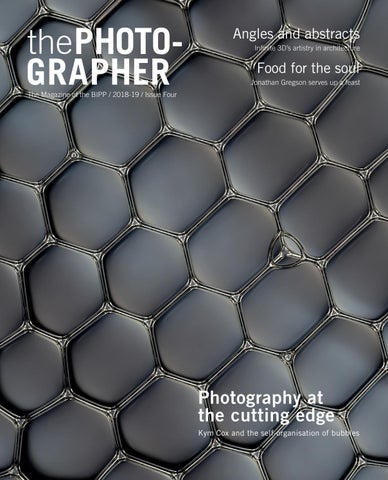
Angles and abstracts Infinite 3D’s artistry in architecture
Food for the soul Jonathan Gregson serves up a feast The Magazine of the BIPP / 2018-19 / Issue Four
Photography at the cutting edge Kym Cox and the self-organisation of bubbles
TP-2018-4 OFC.indd 1
24/02/2019 18:54
TP-2018-4 IFC.indd 2
24/02/2019 18:55
I SSUE FOUR, 2018 - 1 9
Cover image © Kym Cox
BIPP Directors’ / Statement 2 Infinite 3D / Architecture 6 Bringing together all elements of architectural image production under one roof, Infinite 3D provides a one-stop-shop service that has attracted big-name clients
Kym Cox / Art-science 30 With an unerring passion for the research she undertakes, Kym meshes the worlds of science and art and boasts real-world discoveries in a highly complex field
Jonathan Gregson / Food & Travel 18 A journey from assisting on location fashion shoots, through travel photography and eventually taking food work into the studio, Jonathan’s made a name for himself with a host of mouth-watering visuals
Creative thinking / Education 42 Talking to representatives of four well-known educational institutions, perspectives on the modern-day basis of photographic and creative training are revealed
the Photographer is published four times a year by the British Institute of Professional Photography, Ardenham Court, Oxford Road, Aylesbury, Buckinghamshire HP19 8HT. T: 01296 642020 E: info@bipp.com W: www.bipp.com Company secretary: Michael Lane Interim CEO: Emily Hancock FBIPP, Directors: Jonathan Beer FBIPP, Sean Conboy FBIPP, Kevin Weatherly LBIPP, Ioan Said LBIPP
Membership Services Advisory Board Chris Wright ABIPP - National Jonathan Beer FBIPP - National David Campbell ABIPP - Northern Ireland Sean Conboy FBIPP - North West Dan Freeman FBIPP - South East Tony Freeman Hon FBIPP - National Emily Hancock FBIPP - National Alan McEwan Hon FBIPP - Scotland Ioan Said LBIPP - National Denise Swanson FBIPP - National
BIPP pages 58 Company partners, member benefits, regions and events Retrospective / Stuart Clark 62 The view from the Yorkshire region, starting out in 1942 with the hope of becoming a commercial artist
David Taylor FBIPP - Midlands Kevin Weatherly LBIPP - North East David Wheeler FBIPP - South West Katrina Whitehead LBIPP - Yorkshire Editor: Jonathan Briggs, editor@bipp.com Advertising: Tel 01296 642020 Email: jack@bipp.com UK Subscribers £20, EU £40, Rest of the World £50 ISSN: 0031-8698. Printed and bound by Magazine Printing Company, Hoddesdon, Herts
Neither the British Institute of Professional Photography (BIPP) nor any of its employees, members, contractors or agents accepts any responsibility whatsoever for loss of or damage to photographs, illustrations or manuscripts or any other material submitted, howsoever caused. The views expressed in this magazine are the views of individual contributors and do not necessarily represent the views of the BIPP. All advertisements are accepted and all editorial matter published in good faith. The Publisher makes no warranty, express or implied, that any particular product or service is available at the time of publication or at any given price. No part of this publication may be reproduced by any means whatsoever, or stored in a retrieval system, or broadcast, published or exhibited without the prior permission of the publisher. This magazine is the copyright of the BIPP without prejudice to the right of contributors and photographers as defined in the Copyright, Designs and Patents Act 1988. All rights reserved. Registered at Stationers’ Hall, Ref B6546, No. 24577. © BIPP 2019 Issue Four / 2018-19 / the PHOTOGRAPHER 1
TP-2018-4 Contents 01.indd 1
24/02/2019 18:55
BI PP DI RECTORS STATEM ENT
Dear members,
I
n December last year we released a brief statement letting you know about our investigation into the BIPP’s finances and informing you that our then CEO Chris Harper was no longer working for the Institute. We also told you that when the time was right we would provide you with more information. So, get yourself a brew and a comfy seat… here we go… Those of you who have seen the BIPP’s most recent set of accounts will know that they make for pretty grim reading. The Institute lost over £114,000 on normal operations alone between March 2017 and March 2018. These losses, along with the appalling lack of management and oversight that caused them, were obviously the main topic of discussion at the AGM on November 28th. Every two years, at the AGM, a new set of directors is selected from the freshly elected Membership Services Advisory Board, the new board of directors selected was: Jonathan Beer FBIPP Jonathan is a still-life photographer based in Manchester and not particularly fond of talking about himself in the third person. It takes diligence and patience to thrive in a still-life studio, and this stubbornness is why he will still be pursuing a point long after others have given up. Sean Conboy FBIPP There are not many BIPP members who haven’t been left insanely jealous by architectural photographer Sean Conboy’s globe-trotting tales at some point. Now Sean’s shrewd business savvy, ‘get things done’ mentality and extensive network of industry contacts are proving great assets to the board. Emily Hancock FBIPP Emily is a highly skilled equine photographer, not to mention serial entrepreneur. Emily’s businesses currently employ over 60 members of staff, so her HR and management skills have been invaluable during recent months. Ioan Said LBIPP In the rare moments when Ioan is not busy with his commercial and wedding photography businesses, he is networking, building contacts and putting together deals on behalf of the BIPP. Ioan doesn’t use more words than he needs to, but the ones he does use are chosen wisely and worth listening to. Kevin Weatherly LBIPP Before North East based Kevin Weatherly started his studio-based portraiture business he had a career in the Police force (little did we know how useful that would prove to be). Kevin’s calm logic during heated discussions has been a real plus for the board. He has kept our meetings on point and our passions in check during difficult times.
2 the PHOTOGRAPHER / 2018-19 / Issue Four
TP-2018-4 02-64.indd 2
24/02/2019 18:56
BI PP DI RECTORS STATEM ENT
It was clear that our first task as a board must be to get a grip of the BIPP’s finances. Anybody looking at the accounts could see that the Institute had incredibly high and unsustainable administration costs. However, given the lack of granularity in the accounts and unsatisfactory answers provided at the AGM, we instructed John Miskelly FBIPP (who splits his time between his photography and forensic accountancy businesses) to go beyond the publicly available accounts and use his skills to give us in insight into what was causing the losses. The BIPP’s accountancy firm swiftly provided John with the first round of credit card and bank statements, however, within just a couple of hours we could see there was a serious problem. A number of suspicious transactions were quickly identified and listed for further investigation, and on the Monday after the AGM Chris Harper was met at the BIPP’s offices with a view to gaining a greater insight into the transactions in question. In the end it was fairly clear-cut and during questioning Chris admitted to using BIPP bank accounts and credit cards to fund the purchase of items and services for his own personal use. After being made aware just how serious the situation was, Chris immediately offered his resignation which was accepted by the directors. Our work inevitably then became focussed on investigating and dealing with this gross misuse of BIPP funds. With the quality of bookkeeping leaving a lot to be desired it wasn’t always an easy task, however, we uncovered a considerable amount of additional detail by approaching retailers directly to provide us with duplicate invoices and receipts.
To add to the confusion during this time we were battling to move the BIPP’s banking over to new signatories – a task made considerably tougher by the Christmas break. To cut a very long story short, once we had reviewed all the documentation we could lay our hands on, spoken to individual retailers and finally gained access to the BIPP bank accounts we identified over £100,000 of misused funds. There was never any doubt that Chris would be expected to pay this money back to the Institute, and he has co-operated in this regard. We have currently recovered around £38,000 and have a legal agreement in place which sets out the terms by which the balance will be paid. As shocking as these discoveries were to us, and I’m sure are to you all too, they don’t fully explain the BIPP’s financial picture. So in parallel with the above investigation we have been working diligently to streamline, economise, and make sure we’re using your money as effectively as possible. Before Christmas the BIPP was losing over £10,000 every month, so it has been vitally important to review every contract, direct debit and expense statement to identify and reduce waste. We have already made, and continue to make significant savings, and we are pleased to say that we’re aiming to be running at a ‘break even’ position at the start of the next financial year. I and the other directors would like to take this opportunity to thank John Miskelly for his fastidious and dedicated work. Without John’s expertise and assistance we could not have dealt with the discovery of Chris’ actions as decisively as we were able to. It is no exaggeration to say that John’s work has helped save the BIPP from inevitable and imminent collapse. Reducing unnecessary costs and overheads is all very well, but without its members the BIPP is nothing. Ensuring that BIPP membership offers you all a compelling array of benefits is vital to the Institute’s health, and in the last few weeks we have finally been able to turn our attention to these more positive challenges. We are working hard to support the regional committees, and it won’t be long before we have a full programme of events in every region. The knowledge, contacts and friends that many of us have accumulated through our regional meetings cannot be underestimated, so enabling each and every BIPP member to learn from and network with fellow photographers in their area of the country is of the upmost importance to us. The contacts that can be made are not trivial. As I write this, Sean Conboy and g
Issue Four / 2018-19 / the PHOTOGRAPHER 3
TP-2018-4 02-64.indd 3
24/02/2019 18:56
BI PP DI RECTORS STATEM ENT
myself have just returned from a major advertising shoot for Hyundai in Palma, Mallorca. We met through the BIPP, became friends, and we’re now pooling our skills, doing business and earning money together. As well as informing you about your own region’s activities and events, look out for a new monthly newsletter summarising what is going on across all the regions in the subsequent weeks; there might be an event in another part of the country that particularly interests you. It could mean a little more travelling, but for the right event it might be worth it. Any member or guests are of course always welcome at any regional event or meeting. We will also soon be launching the refreshed BIPP Regional Awards. With an initial digital entry stage, homogenised categories, rules and timescales across every region, the awards will be fairer and more inclusive no matter where you are located. The Regional Awards will now feed into the all-new 2020 National Awards. Any images that make it through to the print round of your region’s awards will automatically be included as a finalist in the National Awards, so the investment you make in those prints will be maximised across two competitions. On a more logistical note, we have also been busy creating more robust bookkeeping, expenses and HR procedures – long overdue policies that will increase both our efficiency and transparency. We have made joining the Institute easier and less intimidating for new members, as well as helping lapsed members to rejoin without needing to jump through unnecessary hoops. One sphere we will be much more active within is social media. The BIPP
wants to make a fuss about the great work you are all producing, but to feature your work on our social channels, newsletters and in the magazine we need to hear about it. If you have a project or image you’re particularly proud of, please send the images and the story behind them to media@bipp.com for consideration. Finally, after introducing Emily Hancock as a director just a few paragraphs ago, I am sorry to announce that she has already stepped down! We’re sorry that she is no longer on the board, but actually very pleased because Emily has agreed to join the office team as Interim CEO while we work to appoint a permanent candidate. She has resigned as a director to eliminate any conflict of interest while she is carrying out this role – a replacement director will be selected at the next MSAB meeting. As I mentioned earlier, Emily has incredible experience running large businesses, and is ideally placed to steer us in the right direction during this transitional period. I can assure you that no one will be ‘slid in’ though the backdoor as CEO. The position will be advertised properly and open to any candidate either internal or external. While the appointment is ultimately the responsibility of the directors, the selection process will involve a wider group of members and advisors. We’ll keep you updated as the process develops. If you have made it this far I applaud your dedication – many thanks for your time, I know it’s precious. If any of you have further questions, ideas, concerns or just want to chat, we would love to hear from you, so please do get in touch. The passion and enthusiasm of BIPP members never ceases to amaze me, so I look forward to meeting and speaking with many of you at events, meetings or over the phone in the months to come. Thank you. Jonathan Beer, On behalf of the Directors and MSAB of the BIPP
4 the PHOTOGRAPHER / 2018-19 / Issue Four
TP-2018-4 02-64.indd 4
24/02/2019 18:56
7396
! ٳn ! Á 0( áX Á R
1 6 -1 9 M A R C H 2 01 9, T h e N E C B i r m i n g h a m
Your business in the frame Áȸ ɵ ȒɖɎ ƏȇƳ ƫɖɵ Ɏǝƺ ǼƏɎƺɀɎ ƬƏȅƺȸƏɀ ً ǸǣɎ ƏȇƳ ƏƬƬƺɀɀȒ Ȓ ȸǣƺɀ ƺ ǣȇɀȵǣȸƺƳ ƫɵ ȸƺȇȒɯȇƺƳ ȵǝȒɎȒǕȸƏȵǝƺȸɀ ƏȇƳ ǔ ǣǼȅȅƏǸƺȸɀ 0ȇǝƏȇƬƺ ɵȒɖȸ ƫɖɀǣȇƺɀɀ ȵȸȒǔ ǣɎƏƫǣǼǣɎ ɵ ƏɎ Ɏǝƺ ¨ȸȒ !Ȓȇǔƺ ƺ ȸƺȇƬƺ
¨ȸȒɀ ƏȇƳ ȅƺȅƫƺȸɀ Ȓǔ ȵǝȒɎȒǕȸƏȵǝɵ ɎȸƏƳƺ ƬƏȇ ƏȵȵǼɵ ǔȒȸ Ə I«00 ƺȇɎȸɵ ȵƏɀɀ ȇȒɯ ن 0ɮƺȇɎ ɀɖȵȵȒȸɎƺƳ ƫɵ
THE EVENT FOR EVERYONE PASSIONATE ABOUT PHOTOGRAPHY & MOVING IMAGE k à X ¨ R Á J « ¨ R ç ³ R áِ ! x z z «¨ٳ³ ! z ȳ0 ! (0 X¨¨Á¨³ חI « ۏד אII ³ Á z( «( (ÈnÁ ÁX!k0Á³ ن ن ن³ɖƫǴƺƬɎ ɎȒ ɀȵƺƬǣˡ Ƭ ƬȸǣɎƺȸǣƏ ɯǝǣƬǝ ɯǣǼǼ ƫƺ ɮƺȸǣˡ ƺƳ ƫɵ Ȓɖȸ ƏɖƳǣɎ ɎƺƏȅِ (ƺƏƳǼǣȇƺ ǔȒȸ ƏȵȵǼǣƬƏɎǣȒȇɀ ǣɀ בxƏȸƬǝ ًחאƏǔɎƺȸ ɯǝǣƬǝ ȒȇɀǣɎƺ ɎǣƬǸƺɎ ȵȸǣƬƺɀ ɯǣǼǼ ƏȵȵǼɵ ɎȒ ƏǼǼِ ȇ ƏƳƳǣɎǣȒȇƏǼ ǔƺƺ ƏȵȵǼǣƺɀ ǔȒȸ Ɏǝƺ ¨ȸȒ !ȒȇǔƺȸƺȇƬƺِ ننÁƺȸȅɀ ƏȇƳ ƬȒȇƳǣɎǣȒȇɀ ƏȵȵǼɵِ ƬȒȇƬƺɀɀǣȒȇ ƳɖɀƬȒɖȇɎ ǣɀ ƏɮƏǣǼƏƫǼƺ ɖɀǣȇǕ ƬȒƳƺ X¨¨Á¨³ِ!ח
TP-2018-4 02-64.indd 5 [ 7396 %LSS 7396 %LSS $GYHUWB [ B BY LQGG $G GYH HUW UWB B BY LQGG Y LQGG
24/02/2019 18:56
I NFI NI TE 3D
Image © Infinite 3D
A RCHI TECTURAL I M AGERY
TP-2018-4 02-64.indd 6
24/02/2019 18:56
Finding visual art in architecture
I
nfinite 3D is an architectural services business based in the North West of England that provides high-end architectural photography, 3D visualisations, photo-composites, animation, time lapse and aerial mast imagery to the sector. Conceived by Stewart Jones in the mid-1990s as a purely 3D provider, the current scope of the business as a ‘one-stop-shop’ for architectural image production came about due to a chance meeting in a West Kirby bar. It was 2006 – a business period when many were making yet another cup of coffee, pondering survival in the deepening gloom. However, Stewart was looking to expand. Meanwhile, Charlie Coleman was on an informal placement at Unilever doing packaging design whilst managing a bar alongside the day work. Stewart came in one evening and it turned out that they had some mutual friends – one of whom told Stewart that he really should employ Charlie. Cut to the end and it came to pass. At that point in the tale, there was no definite plan to expand the business offer to top-end architectural photography services – indeed Charlie admits that he didn’t really see a full career in that side of work. However, they began producing 3D photographic composites. The design team behind a project will need to know the impact a building will have on its environment – not just
g
Issue Four / 2018-19 / the PHOTOGRAPHER 7
TP-2018-4 02-64.indd 7
24/02/2019 18:56
I NFI NI TE 3D
Image © Infinite 3D
A RCHI TECTURAL I M AGERY
asking how will it look, but how it will interact with other buildings and effect other lines of sight, and will it impact on protected areas? Then there’s the purpose of producing site hoarding graphics to say that a project is coming, and indeed to sell it. The success of a composite is very much down to the photograph that’s the foundation. The right scene image will often look quite unusual before the 3D model goes in, but that’s the knack – being aware of what’s needed for the composite to work. Charlie explains: ‘You are photographing the plot imagining a 12-storey building in place. It has to be framed as well as it would be with the building in the frame. We have been lucky enough to model and then photograph the finished project – sometimes, if our model was created from the same drawings as the finished building, it can become a real case of “spot the difference”.’ Stewart Jones is an architect by training, having qualified in 1996. Thanks to an inspirational tutor in the early 1990s who trail-blazed the paperless office and software-led design, Stewart began using computer design packages and taught himself 3D. Back then it was StrataVision 3D – featuring primitives-based modelling with texturising, key-frame animation, raytrace and later radiosity rendering (an application of the finite element method to solving the rendering equation for scenes with surfaces that reflect). It is known in the 3D world for being part of the first wave of 3D graphics in
TP-2018-4 02-64.indd 8
g
24/02/2019 18:56
Issue Four / 2018-19 / the PHOTOGRAPHER 9
TP-2018-4 02-64.indd 9
24/02/2019 18:56
I NFI NI TE 3D A R CHI TECTURAL I M AGERY
desktop publishing. One milestone of StrataVision 3D was rendering the environment in the blockbuster game Myst – a graphic adventure puzzle video game that was the best-selling computer game until the Sims came along. The MultiMedia Novel, Sinkha, and the Warner Bros 3D Looney Tunes project were also created initially using this software, so you can appreciate that this was cutting-edge capability. Stewart says: ‘I took to it and realised that it was my future. By late 1996, I’d set up on my own.’ Spin up to the present day and the tool of choice is Cinema 4D with the renderer being Corona. Stewart explains: ‘We can now render whatever pixel size we choose, and so coupled with the big sensor size of Canon’s EOS 5DS R and Capture One’s RAW processing power it means we can create really high-quality billboards.’ Charlie continues the tale: ‘Following on from getting the composites right, we carried on into architectural photography. I started to Images © Infinite 3D. Ibis hotel. Left: 3D rendering. Right: photograph of finished project
TP-2018-4 02-64.indd 10
24/02/2019 18:56
I NFI NI TE 3D A RCHI TECTURAL I M AGERY
put together a proper portfolio and we pitched some of our existing 3D architectural clients. Within 12 months we were seriously offering architectural photography as a fully-fledged service and subsequently developed work across Europe and in the US.’ He continues: ‘The big advantage was of course the network that Stewart had previously built up. That’s where the earlier work certainly originated from. We could turn up with a portfolio to an already favourable client seeking to extend our offer to them rather than starting from scratch – we grew it organically.’ However, surely that will only take you so far. What helped clients believe in their abilities? He responds: ‘I have always pushed myself to think from a client’s point of view and to think very carefully about what the client’s end use is. Clients will often ask for a whole lot and it’s not always going to be the most glamorous work. What’s really tricky is to go into an average building on an average day and still make it an incredible g
Issue Four / 2018-19 / the PHOTOGRAPHER 11
TP-2018-4 02-64.indd 11
24/02/2019 18:56
Image © Infinite 3D
building by means of the package of images you create. I think we’ve got pretty good at that.’ Infinite 3D has recently completed their most significant individual commission to date – IBI’s £1bn Queen Elizabeth University Hospital in Glasgow. Photographing nationally and internationally, they have also worked on residential commissions in California, stadium photography in South Africa, and retail assignments throughout Europe for Nike, Calvin Klein and Ugg, as well as for Skechers in South America. Developing a deep understanding of the unique challenges of sports-venue design, they have visualised and photographed training academies, new stands and complete stadia for a host of international brands including Manchester United, Chelsea, Wolves, Southampton, Everton and Warwickshire Cricket Club (Edgbaston). The fact that Infinite 3D is a multi-disciplinary business is clearly something that stands it out. Charlie admits that they have to think carefully when looking to promote the photographic service naturally – does the name place emphasis on the 3D? Even today it’s perhaps a stretch to say that the business name encompasses all architectural imagery requirements. Charlie comments: ‘Our appeal to the industry is to be able to work in multiple different sectors on multiple different jobs. We’re not specialists in one photographic sector such as stadia. We have clients who don’t use us for photography and those who only use us for our photography.’ Infinite 3D’s client base also extends
TP-2018-4 02-64.indd 12
g
24/02/2019 18:56
I NFI NI TE 3D A RCHI TECTURAL I M AGERY
Issue Four / 2018-19 / the PHOTOGRAPHER 13
TP-2018-4 02-64.indd 13
24/02/2019 18:56
I NFI NI TE 3D
from one-man bands all the way to major multinationals and Charlie feels that the personal relationship has a lot to do with it: ‘When it comes to dealing with different people, the business being one entity has always given us better opportunities – the relationship with the architects is bigger and so are their demands. Everyone expects an incredible service – to stand out in the marketplace you have to work so much harder to achieve that level. Often it’s about making the effort to stage something that may not yet be quite perfect, when a project’s not quite finished – but appreciating what the architect is trying to achieve even though there’s still snags left in the scheme. You have to work on building a relationship with everyone from the public you bump into, the security staff you chat to all the way up to the CEO. You might only be asking someone to move their car, or getting security to make your life just a little bit easier. If you’ve established a good level on which you can communicate, then you’re already winning.’ Charlie sees himself as a natural problem solver: ‘There’s always a problem to be solved with this type of photography and I’d say that’s one of the things I love about it. A site is never all together in the same moment. It’s not just about being good at the core job, but to break down all the elements that allow you to achieve the photography required. From the early days, my view has been that you have to go out and do it – push for what’s creatively correct and possible within the bounds of what people will let you do. It’s a balancing act between being patient and being pushy; having respect
Image © Infinite 3D
A RCHI TECTURAL I M AGERY
g
14 the PHOTOGRAPHER / 2018-19 / Issue Four
TP-2018-4 02-64.indd 14
24/02/2019 18:56
TP-2018-4 02-64.indd 15
24/02/2019 18:56
I NFI NI TE 3D A R CHI TECTURAL I M AGERY
and also imposing yourself – you certainly can’t be too timid – you’d never get what you need. Some of my very early jobs literally came down to knocking on doors and striking up a polite conversation about someone’s building project.’ Infinite 3D’s team is based in West Kirby on the Wirral – their collective global portfolio is clear evidence that in the modern business world there’s little need for a major city-centre office presence. Stewart says: ‘I don’t think our location means we miss anything commercially and it actively makes life more productive and flexible. The process of business is different today than it was ten years ago since sending a couple of gigabytes of data for a client to download is just the norm. A decade back that wasn’t so easy. When we started, we submitted the photography on DVDs in a custom-made box with contact sheets. So practically speaking, the acceptance of moving big chunks of data around the internet
Images © Infinite 3D. Left: original host image Right: 3D model added
TP-2018-4 02-64.indd 16
24/02/2019 18:56
I NFI NI TE 3D A RCHI TECTURAL I M AGERY
makes life a great deal easier. But that’s countered by everything being needed faster and we put such a lot of effort into producing every image to the highest level. I would say the set of images we supply to clients is broad yet produced to a very high level, and that also helps us stand out.’ Charlie concludes by explaining just what makes him tick, day to day: ‘There’s two sides to getting real pleasure from our work. On the one hand you’re always going to get a buzz out of producing great images from the bigger projects which will often provide challenges to match their scale – I have taken pride in working on World Cup stadia for example. However one of my favourite things is working on a reasonably everyday building and there’s the moment when I find one shot that I would personally put up on the wall at home. It’s a personal benchmark that says I have got the job done properly.’ www.infinite3d.co.uk
TP-2018-4 02-64.indd 17
24/02/2019 18:56
J ONATHAN GREGSON FOOD & DRI NK
A feast for the eyes
A
fter graduating in 1998 and moving to London that same summer, Jonathan Gregson found a bit of work covering for a friend who was managing a studio at Perseverance Works – the creative hub in Shoreditch. It was through this ad-hoc stint that Jonathan met some photographers who were in turn in need of assistants and so it turned out that he spent nearly three years assisting a number of different photographers generally in the fashion and editorial worlds. But that’s a far cry from the delicious world of food and drink that he has become widely known for. Jonathan’s work spans food, still life and travel; covering advertising, branding, packaging, books and editorial. His clients include Waitrose, Marks & Spencer, Tesco, Harrods, Lonely Planet and The White Company. The move to London worked out then. Jonathan explains how his step into food came about: ‘Whilst assisting we did a lot of overseas shoots and it was great as a young man travelling around the world doing that. In between sessions I began taking pictures just for myself. It was these pictures that were noticed by an agent who represented one photographer I assisted and it was suggested she could represent me as a travel photographer. Some work came through that channel and it led to rather a light bulb moment for me. I had been trying to emulate the photographers around me but had been noticed for my personal work. In this way, I picked up some travel work for British Airways and also for some of the women’s magazines. Through that work came a link into Waitrose Food Illustrated as it was then called. Suddenly I was off shooting wine regions and city guides, travelling with chefs and so food became half of my travel work.’
g
18 the PHOTOGRAPHER / 2018-19 / Issue Four
TP-2018-4 02-64.indd 18
24/02/2019 18:56
Image © Jonathan Gregson for Waitrose & Partners Health Magazine
TP-2018-4 02-64.indd 19
24/02/2019 18:56
Image © Jonathan Gregson for Marcus Wareing Restaurants – ‘Without’ Agency
It was another few years before Jonathan took his food work into the studio. He says: ‘The first time I shot food in the studio was when I was asked to photograph a new book for a food writer – I thought “ok let’s give it a go”. Following that I picked up a main feature to shoot for Waitrose – and so was collaborating with stylists and art directors in a way I never had before. It felt like I had two sides to my career – the traveller with freedom and the studio photographer with discipline and control. But this double existence really stopped my studio work from ever getting staid and meant that for some editorial projects I have been able to supply all aspects of photography, both travel and still life.’ Jonathan was originally shooting film at the outset of his career and recognises that there was a very different dynamic in the studio at that time: ‘Some would argue that everything is too much on show with digital, to the detriment of the process of building up a shoot. With film
20 the PHOTOGRAPHER / 2018-19 / Issue Four
TP-2018-4 02-64.indd 20
24/02/2019 18:56
there was a mystery around the photography. However, I welcome the open dialogue that digital brings between photographer and client. After all, it is their brief and to be honest the very last thing I’d ever want is for a client to not speak up on the shoot. The last thing you want is for it not to be right. I really enjoy working closely with art directors and clients – the photographer isn’t the only person in the room – different views can themselves lead you to get something special, something far better than a single-minded approach. The collaborative process is now essential in commercial photography and digital means that the photographer remains in touch with what’s going on out there – ideas are formulated way before the job comes to the studio. You can embrace that and get new energy coming into your work.’ Jonathan’s career has almost always featured an agent. He has a long-standing relationship with PearsonLyle
g
Issue Four / 2018-19 / the PHOTOGRAPHER 21
TP-2018-4 02-64.indd 21
24/02/2019 18:56
J ONATHAN GREGSON FOOD & DRI NK
Image © Jonathan Gregson for Waitrose & Partners Food Magazine
whom he joined after representing himself for a year early on as a travel photographer. He explains: ‘A client said that they knew someone who was setting up an agency and that she was fantastic. This made my ears prick up because it was a client telling me.’ The client was referring to Eleanor Harrison who was given the opportunity to set up shop on her own after a thorough grounding in the world of interiors and lifestyle photography and production. The agency was born out of the desire to represent a carefully curated group of outstanding image makers who are also a pleasure to work with – the basis was all about nurturing good relationships. Jonathan adds: ‘I really liked Eleanor – it wasn’t about money, or I will bring you this and that. I wanted a long-standing relationship that would bring me work on a creative level rather than just a monetary level. If you look at the roster you could think that there’s cross-over. Yes, we work in similar areas and so you could potentially see us competing, but actually we all have our own clear styles – stylistically we’re very different.’ Jonathan describes how work changes as a career progresses: ‘When you start out, your client base tends to be editorial. Then your name begins to get you commercial work. I have always wanted to maintain my editorial work as that is where I am given the room to experiment creatively. Commercial work is generally all signed off in advance of the shoot and so offers little room
g
22 the PHOTOGRAPHER / 2018-19 / Issue Four
TP-2018-4 02-64.indd 22
24/02/2019 18:57
J ONATHAN GREGSON FOOD & DRI NK
Image © Jonathan Gregson for Waitrose & Partners ‘Wine Edit’ Campaign
TP-2018-4 02-64.indd 23
24/02/2019 18:57
J ONATHAN GREGSON FOOD & DRI NK
Images above and right © Jonathan Gregson for Lonely Planet Magazine
for on-the-spot decision making. However, whilst a brief will exist in the editorial world, it’s fluid. With my agent I’m constantly taking stock of whether work is taking me down a certain path. Keeping awareness of both places you wish to be in and maintaining that presence if you like requires good management and I rely on my agent to be “me” and how I would be with my clients. I know the relationship is working properly because a client once told me “I know your agent works for you but she makes me feel like she works for me”. That’s a perfect illustration of how it should be. I don’t really want to talk money – I get a buffer between the creative and the financial. Everyone knows that’s what the agent is there for and so there’s no misunderstandings and I can get on with the business of taking photos.’ Jonathan uses Hasselblad medium-format digital in the studio and even used to lug around a Mamiya RZ67 for travel work. He comments: ‘When I started out I had it in my head that food had to be shot on 5x4. But my first client looked at me with some surprise… a young photographer using that? But my clients generally really liked it. I have always wanted to shoot the best quality I can as it future proofs the work. Now with the travel work the big D-SLRs have become the thing and I use a Canon EOS 1DX for wildlife and action and the EOS 5DS for pure capture quality. I have always gravitated to the higher-end equipment. Clients want to feel that you’re giving them the best.’
g
24 the PHOTOGRAPHER / 2018-19 / Issue Four
TP-2018-4 02-64.indd 24
24/02/2019 18:57
TP-2018-4 02-64.indd 25
24/02/2019 18:57
26 the PHOTOGRAPHER / 2018-19 / Issue Four
TP-2018-4 02-64.indd 26
24/02/2019 18:57
Image © Jonathan Gregson for BBH / Tesco ‘Love Stories’ Campaign
Issue Four / 2018-19 / the PHOTOGRAPHER 27
TP-2018-4 02-64.indd 27
24/02/2019 18:57
Image © Jonathan Gregson for Cereal Magazine 28 the PHOTOGRAPHER / 2018-19 / Issue Four
TP-2018-4 02-64.indd 28
24/02/2019 18:57
For a few years, Jonathan operated an off-shoot business directing television commercials. The experience has proved vital as moving image has become a commonplace requirement of studio photography. He says: ‘It was a couple of years ago that I was first asked to do moving image on the back of a stills shoot. I was brutally aware that I had to say yes to both or get nothing.’ The work for Lurpak was to prove a line in the sand: ‘Video is becoming a normal part of commercial work. I enjoy it because I’m still inside it, setting everything up. I feel like I’m creating moving versions of my stills and I love the results. I’m so pleased that I went down the directing route for a while as it gave me a valuable insight. The thing is that I’m hands on with it, even though I will bring someone in to do grading and additional coding. A lot of moving image content is shifting from the big television studios into photographers’ studios.’ Jonathan is unusual in having not one but two studios. Montford Place is a purpose-built studio hire facility that came about when he was looking to invest in a location house but realised quickly (in 2013) that it was going to cost too much – location hire rates had certainly not followed property values. He says: ‘Somehow, Montford Place came up in a property search – part of a Victorian glass works. I had a look and fell a little bit in love thinking it would make an amazing studio. The back-up plan was to move in myself, but the reason for doing it was that a lot of people seemed to be complaining about the standard of some food photography hire studios and I knew I could do it properly. It’s not huge but it works the space very hard and clients love it – food stylists love it – the food-based spec is very high and it gets recommendations with that in mind.’ The irony is, of course, that Jonathan rarely gets use the great facilities there himself… @jonathangregsonphotography www.jonathangregson.co.uk www.montfordplace.com
Images, right © Jonathan Gregson for Waitrose & Partners ‘Gather’ Campaign (top) and Harrods Magazine
TP-2018-4 02-64.indd 29
24/02/2019 18:57
TP-2018-4 02-64.indd 30
24/02/2019 18:57
Seeing is believing
K
ym Cox doesn’t always sleep that well at night. Her issue is not stress or anxiety about work, nor a caffeine-fuelled need to complete a tedious presentation for tomorrow. No, Kym’s problem – should you want to describe it in such a way – is much more like a child’s on Christmas Eve… She exudes excitement about the photographic research that she undertakes – and just like any artist who becomes entirely absorbed, time can pass by with alarming speed. When asked how she manages to keep a lid on it all and get a few hours’ solid rest, she replies with charming positivity: ‘I don’t! I’m always getting up and making notes and there have been times when I’ve been awake for 24 hours straight, powered I suppose by the feeling of discovery. It’s something I find very hard to put aside.’ In truth, Kym tirelessly juxtaposes family life with her research. It was family that previously took her as far afield as Angola and Azerbaijan and she taught digital photography to ex-pats and Nationals in Baku. She says: ‘I wanted to complete a BA so I could teach photography in schools when we returned permanently to the UK.’ On return to England, she first required an A/S Level Photography and the BTEC National Certificate of Photography qualification. It was during the A/S level that Kym began photographing soap bubbles, soap films and foams. The theme continued throughout her BA (Hons) Photography degree at the Arts University Bournemouth because soap bubbles are an important and engaging symbol for representation in art. She was awarded a First Class degree in 2014. Kym’s is, she would surely admit, a rather unexpected journey – both in terms of the connections made between people and the observations made. The key characters involved are Kym and Professor Stefan Hutzler, Leader of the Foams & Complex Systems Group at the School of Physics, Trinity College Dublin. Stefan is concerned with soft condensed matter, granular matter and
g
Issue Four / 2018-19 / the PHOTOGRAPHER 31
TP-2018-4 02-64.indd 31
24/02/2019 18:57
TP-2018-4 02-64.indd 32
24/02/2019 18:57
Image © Kym Cox. When a group of bubbles are created the liquid composition immediately begins to drain, due to gravity and the walls start to crystallise into straight-sided polyhedra. Bubbles want to achieve an equilibrium and will draw air from adjacent ones via their walls. A dividing wall that is straight indicates air pressure on both sides is equal. A concave or convex wall indicates the bubbles are still striving.
econo- and sociophysics. In collaboration with Professor Denis Weaire, he has contributed to a better understanding of liquid foams, which constitute a model system of soft matter, through both experiments and simulations. His research discovered a solitary wave in foam drainage and avalanches of bubble rearrangements in foams under shear and convective bubble motion in foams under forced drainage. As an extension of this work, part of Kym’s collaboration with Stefan centres around how and why equally sized bubbles organise themselves into an ordered structure within the confinement of a glass cylindrical tube. As each new bubble enters the tube from below it pushes those inside upwards. The bubbles shuffle, shift and self-organise themselves into a regular structure, optimising the use of available space. In the tube, the liquid quickly drains and the bubbles begin to crystallise to become straight-sided polyhedra. However, bubbles are intrinsically unpredictable – sometimes the bubbles will form a structure and sometimes they won’t, despite conditions being identical. It only takes one rogue bubble to put a whole structure out of sync for photographing. The process of self-organisation is referred to as ‘packing’. Soap bubbles and soap films are scientifically important to aid understanding of how everything fits together; from nanotechnology and molecular sciences to naturally occurring processes and the physical elements and components found in nature. Soap bubble phenomenon is often reflected in nature. As for scientific research, soap bubbles and soap films are a useful and significant tool because of their phenomenal ability to minimise their surface area using the least amount of energy in a given space. If they can do it, the result and conclusions can then be applied to other materials and processes. Drag the concepts out into the public world where we all can understand it and we are talking about the strength and stability of all building blocks. We’re also talking about application in advanced materials, architectural structures and much, much more besides. One of the main buildings for the 2008 Beijing Olympics was constructed in the form of a framework explicitly based on the Weaire-Phelan structure – The Water Cube. Denis Weaire, another colleague of Kym’s in Dublin, and his student Robert Phelan are famous for their structure because in 1887,
g
Issue Four / 2018-19 / the PHOTOGRAPHER 33
TP-2018-4 02-64.indd 33
24/02/2019 18:57
TP-2018-4 02-64.indd 34
24/02/2019 18:57
Image © Kym Cox. If a bubble bursts the remaining ones will shuffle and shift to quickly fill the space. Bubbles like equilibrium and order.
Lord Kelvin asked how space could be partitioned into cells of equal volume with the least area of surface between them, ie what was the most efficient bubble foam? Kelvin’s structure stood firm for over 100 years until Weaire-Phelan proved otherwise. So, soap bubbles have these amazing abilities. That sounds like the specification for a space-age material if nothing ever has. Yet this phenomena is regularly replicated in nature. It’s also a process that is extremely beautiful and offers up astonishing secrets when captured over time and using varying lighting techniques. Kym would eventually find herself walking along the cutting edge of scientific knowledge when photographing these structures and processes. But let’s rewind a little before we start heading for one of Kym’s big moments. Not everyone can wade into this kind of work – it doesn’t suit one and all or indeed every photographer. Kym accepts that she can go a long time in her studio without seeing anyone, and extends heartfelt thanks to her husband for endlessly supporting her work. But she’s balanced by the knowledge that art, science and research are actually quite social concepts – it is the interconnections in the world that make all of this so exciting. With a gentle nod in this direction Kym rents desk space at Paul Williams Digital in Poole. It makes sense. Kym is also a member of Mensa and an Associate of both the Institute of Physics and the Royal Photographic Society. She was awarded her BIPP Fellowship at the end of last year. Kym’s collaboration with Stefan Hutzler itself began to take shape during the final year of her degree when she was required to ‘engage’ with industry professionals by sending Stefan a comprehensive portfolio of her bubble photographs, knowing that foams were his main research area. Stefan was immediately struck by the quality of the work Kym was producing – his Foams & Complex Systems Group had made many photographs of soap bubble foams in the past to accompany their research publications and he knew exactly how difficult it was to capture the intricate patterns in objects that are intrinsically fragile and of short lifespan. In his reply to Kym, Stefan commented: ‘These are the best photographs of soap bubbles and Plateau borders that I have ever seen, and I have seen many.’ (Plateau borders are the locations where bubbles join together.) He wanted to learn more about Kym’s techniques and offered
g
Issue Four / 2018-19 / the PHOTOGRAPHER 35
TP-2018-4 02-64.indd 35
24/02/2019 18:57
TP-2018-4 02-64.indd 36
24/02/2019 18:57
Image © Kym Cox. Light interference colours and patterns in a draining soap film. As the film drains, due to gravity, thickness varies across the entire film. This is illustrated by every colour change boundary. The swirling patterns are due to changes in atmospheric pressure.
up some of his own group’s experimental techniques that they used in the lab focusing on the creation of ordered cylindrical foams. As a direct result of this early correspondence, Kym’s work was shown at the EUFOAM 2014 conference in Greece, and drew an enthusiastic response from the 100 or so attending scientists. Stefan continues regarding Kym’s work: ‘After I brought her attention to ordered crystalline foams, she produced the most magnificent images highlighting their geometry as well as their colourful evolution due to film drainage.’ Their consultations led to Kym setting up her own foams research lab in her studio which is the point at which you might agree that things really got interesting. But first, circling back some 30 years or more, Kym had a previous existence as a fingerprint expert. Kym spent her formative years in Wokingham, Berkshire. After two unsuccessful applications to study City and Guilds Photography at College, she qualified as a beauty therapist instead and moved to Bristol, whereby a series of curious events led her to become a trainee fingerprint expert. She explains: ‘Many practices and the approach to work photographing scientific phenomena today were instilled during my former career. A methodical approach, collating scenes of crime paperwork, fingerprint lifts, photographs and fingerprint forms for writing accurate statements were essential. An error on my part could lead to serious consequences for the profession. I had to know everything there was to know about an extremely niche subject – this obviously translates well into my work now.’ She continues: ‘I love what I do and I strive for that feeling of excitement when I see something new. I don’t get that buzz by working on something that has been seen and done before photographically. Having said that, copying a composition and lighting style of an inspiring photograph is a highly important part of learning at the first level.’ Kym explains her position walking the line of duty between art and science: ‘It is mutually beneficial,’ she says. ‘Science needs good images to support research and artists need a greater understanding of their subject to create unique works. Together they must produce work that engages with their audience – ultimately this helps secure funding for their next collaborative project.’ Kym’s collaboration with Stefan is entirely self-funded and despite the fact
g
Issue Four / 2018-19 / the PHOTOGRAPHER 37
TP-2018-4 02-64.indd 37
24/02/2019 18:57
All images this page © Kym Cox. Kelvin cells
TP-2018-4 02-64.indd 38
24/02/2019 18:57
Image © Kym Cox
that she has achieved a number of her early aims – such as contributing to the Science Photo Library and the UPROSA consumer goods and image licensing business, she rejects any notion that this kind of work can be made to pay – support itself perhaps, but certainly not turn a living – especially when there’s always a fabulous piece of new, specialist equipment to buy or arranging an upgrade. However, that certainly does not mean that Kym’s suffering for her art and science – it is an extremely happy place and she quips: ‘Try saying “bubbles” in an angry way. You just can’t.’ Now for the ‘what if…’ moment. Kym comments: ‘I question what I see, time and time again and then the “what if?” comes into play. This approach led to my Bubble Chains discovery – bubbles will self-organise into the same structures Stefan created in the glass cylinders. I substituted the cylinder for a length of plastic piping, to see how the bubbles would behave when they were blown into the tube and left to their own devices when they came out the other end. Amazingly, and after a bit of tweaking, they too self-organised into regular structures. I discovered Bubble Chains in February 2016 but kept my powder dry until Stefan’s scheduled visit to my studio that May. He was so very, very excited! My new discovery led to one of Stefan’s PhD students, Jens Winkelmann, to create bubble chain computer simulations using the extremely complex Surface Evolver software (world leading Surface Evolver expert Andy Kraynik flew in from America to teach Jens how to use it!). Our work really took off over the next
g
Issue Four / 2018-19 / the PHOTOGRAPHER 39
TP-2018-4 02-64.indd 39
24/02/2019 18:57
All images this page © Kym Cox. Double staircases and above (middle) bubble chains
TP-2018-4 02-64.indd 40
24/02/2019 18:57
Image © Kym Cox. It was damned annoying to see flippin’ shadows from something in my studio in this composition. I always black everything out. However, on this occasion the underside of a knob on the retort stand was the cause of a ‘nose and mouth’ like shadow. The ‘eyes’ are purely bubble phenomenon. As a result, the bubbles appear to have faces!
two years, culminating with the presentation of an academic poster of our research at EUFOAM 2018, in Lieges, Belgium. Their follow-up academic paper is currently undergoing the final stages and will be submitted for peer review and publication this year.’ Kym is credited to the physics paper as its main author – quite an amazing personal achievement. She says: The breadth of scientific research is an immense source of inspiration. Bubbles perform and react to stimuli in their surrounding environment in many different ways – from a photographer’s point of view the opportunity to see and learn something unique is fantastic. To engage and collaborate with the scientific community provides an opportunity to work closely with practitioners who have an impressive understanding and extensive knowledge so I’m able to interpret the science and photograph bubbles in a new way and I design and build sets and lighting rigs accordingly. I formulate and prepare many kinds of bubble solutions which can, on occasion, takes months to reach a good working consistency. Patience really is a virtue to my practice! I consider myself to be an “ArtScience” practitioner.’ Kym’s bubble photographs have appeared in many exhibitions and she believes soap bubbles are an excellent subject to engage the general population. ‘I try to make myself and my work very approachable to this end. I see my work as something that can bring everyone together.’
www.kymcox.com
Issue Four / 2018-19 / the PHOTOGRAPHER 41
TP-2018-4 02-64.indd 41
24/02/2019 18:57
E DUCATI ON & TRAI NI NG PERSPECTI VES
Creative thinking
M
ore than a decade has gone by since the ‘explosion’ of further and higher education provision aimed squarely at the creative industries and, particularly, photography. Here, we discuss some of the issues that surround the sector with four of the leading institutions: Edinburgh College, Arts University Bournemouth, University of Derby and Blackpool and The Fylde College.
Image © James Frost, Edinburgh College
Jon Lee, Course Leader, BA in Professional Photography, Edinburgh College Do students come to you in a different state of mind now than they did 15 years ago? ‘Yes, it is logical. I went through the education process in the late 1980s. Historically it was taught as a technical process where you had to learn different types of cameras, chemistry, enlargers, printing. In the mid-1990s that was
42 the PHOTOGRAPHER / 2018-19 / Issue Four
TP-2018-4 02-64.indd 42
24/02/2019 18:57
Image © Diana Sosnowska, Edinburgh College
revolutionised and things therefore changed educationally. Cameras can now think for you and the computer drives much of the technical side and so we have had to change how we teach photography. It’s about what the professional offers the world. How do you make a living in the 21st century?’ Is it too bold to ask what is there left to teach? ‘Not at all. Photography has never been more widely consumed but is less relevant in terms of being paid to make photographs. Where we are at today means that a lot of our teaching is understanding photography and its communication with the intended audience. We have to get our students to understand who it’s for and where is it going to be seen and so how best to tell that story. The advertising industry has changed – now less about the product and more to do with a lifestyle, an aspiration, a fantasy.’ So you’re not simply teaching lighting techniques…? ‘Of course not. We do that, but a photographer has to create the story of an image and understand how different parts of the industry function. The major challenge is how do you get people from a school education to understand
creative thinking and problem solving? The standard school curriculum is taught in a formulaic way. There is no right or wrong answer with photography and that is very hard for students to grasp. We can give you a brief but we are not just asking you to answer that but to give a creative solution that is more personal.’ But what if I get it ‘wrong’? ‘We answer that’s ok and we analyse what is happening and help them to let go of previous forms of education. We encourage students to delve into a world that is fantastical, where the are no right and wrong answers. It’s hard.’ The challenges come thick and fast then? ‘Yes, in 16 years it has become ever more challenging to get students to express themselves. Commissioners like to see the style of a photographer and through them discover new ways of doing things. You can’t give a
g
Issue Four / 2018-19 / the PHOTOGRAPHER 43
TP-2018-4 02-64.indd 43
24/02/2019 18:57
Image © Gavin Smart, Edinburgh College
handout to tell someone how to be a creative thinker. But naturally, you must not throw the baby out with the bathwater. Students need to learn the technical aspects in the first years of our programmes, however then it becomes a lot looser. The technical never stops and we need to constantly talk about it, we discuss and teach raw processing, work flow and software technicalities, dynamic range and learning to override the camera. Despite smartphones and social media, incoming students are not advanced digital natives – there’s a lot that they need to learn in terms of industry standards. In the second year we open up into creative thinking and in the third year students choose an area of photography to create a portfolio in. It’s a step-by-step process – there are so often great ideas poorly executed so you can’t miss out the technical – it supports the idea, it’s the foundation. I suppose we’re trying to walk a blurred line between a technical education and a creative one.’ What do you feel makes Edinburgh College stand out? ‘I would say that it’s important to offer a great team. You can’t have one lecturer who thinks they have all the answers. Our team have all been working photographers across various sectors. It is that team pulling together that makes the difference. Sometimes educators get lost in politics – it demands focus and drive, and for everyone to be on the same page. I guess you’d say we all have a certain maturity and have a lot of life-work experience. We can pass on that real world experience of working with clients and we do not sugar-coat how challenging
commercial life is outside of college. At the same time, however it’s important to say we’re not living off the past in any way.’ How would you describe the BA? ‘We’re functioning somewhere between a commercial course and a fine art course. That’s why we call it a BA in professional photography. I don’t mind if a student has an aspiration in one place or another. We will cater to those individual needs – the process is always the same. There are labels out in the world but here we decided not to follow one prescribed path. Some students are very much wanting to go into one side, but when they talk about their work they do so in the same way and I think that’s good to have a group where the ideas are fluid and students do not work in boxes. We actively encourage students to avoid building walls around their work.’ Do your alumni come back to describe life at the coalface? ‘Yes, we have lots of successful working photographers who come back and talk about pitching, estimation, production models, everything that goes into real work. On one occasion a past student asked the class for a quote in 15 minutes…’
g
44 the PHOTOGRAPHER / 2018-19 / Issue Four
TP-2018-4 02-64.indd 44
24/02/2019 18:57
PERSPECTI VES
TP-2018-4 02-64.indd 45
Image © Agata Moreno, Edinburgh College
EDUCATI ON & TRAI NI NG
24/02/2019 18:57
E DUCATI ON & TRAI NI NG PERSPECTI VES
g
Image © Elizabeth Vickers, Arts University Bournemouth
ProfessorPaul Wenham‑Clarke, Course Leader, MA Commercial Photography, Arts University Bournemouth Can you describe the balance in teaching between technical and creative? ‘On our MA we run professional-level workshops on lighting in the studio and on location, plus retouching including Capture One. However, the main emphasis of the course is on developing the individual photographer’s visual voice. The teaching on the course encourages students to undertake research into contemporary issues and debates and to explore them though their own area of practice. We cover all genres of professional practice including documentary, editorial, fashion, portraiture and fine art, and we encourage students to cross genres, such as shooting fashion in a documentary style.’ What trends have you observed in recent years that identify incoming students? What’s different about your intake between now and even just five or so years back? ‘Students on the MA are very focussed on making a living from their photography. Therefore we try to ensure that they develop a sensible career plan. This focus on their career pathway has not changed in five years.
46 the PHOTOGRAPHER / 2018-19 / Issue Four
TP-2018-4 02-64.indd 46
24/02/2019 18:57
Image © Ramon Colsa, Arts University Bournemouth Issue Four / 2018-19 / the PHOTOGRAPHER 47
TP-2018-4 02-64.indd 47
24/02/2019 18:57
E DUCATI ON & TRAI NI NG PERSPECTI VES
g
Image © Elizabeth Vickers, Arts University Bournemouth
In terms of the area of practice, five years ago students were more interested in fashion and now portraiture is very popular.’ How do you help students become creative thinkers? ‘At Bournemouth we encourage a good level of research that looks beyond the obvious answers to questions the student has identified for themselves. It can be hard to be original, but it’s easier if you work on cutting-edge topics. That way you can have greater freedom to find your own way, as less people have explored the same path. AUB is famous for its “maker” culture. We produce very creative people who are very career minded. One of my catch phrases is “you have to make money from your photography, to stay doing photography”. So it’s all about the audience, if there is no audience for the work, you won’t make a living.’
48 the PHOTOGRAPHER / 2018-19 / Issue Four
TP-2018-4 02-64.indd 48
24/02/2019 18:57
Image © Kirsty Wood, Arts University Bournemouth Issue Four / 2018-19 / the PHOTOGRAPHER 49
TP-2018-4 02-64.indd 49
24/02/2019 18:57
E DUCATI ON & TRAI NI NG PERSPECTI VES
g
Image © Ben Allen, University of Derby
Dr Mark Hall, Senior Lecturer in Photography, University of Derby ‘There have always been peaks and troughs in the perceived value of commercial photography. The late 19th century saw a huge rise in commercial practices around the world, followed by a rapid decline when the amateur photographer came about. In the modern day, the devaluation of the professional skillset means everyone thinks they can be “pro” photographers. Educators are by definition complicit in that movement – photographic education, the photographic skillset, is a very saleable commodity. But in the public domain even major photography prizes can be seen to be extolling the virtues of the subject… hardly mentioning the photography and the control that the photographer has exercised over the outcome. We’re facing a time when the photographer is almost being dissolved. Where does that leave us with teaching? I think the key element to teach is the control of image making and then the flux of the current market – flexibility is everything. The
TP-2018-4 02-64.indd 50
24/02/2019 18:57
Image © Ben Allen, University of Derby Issue Four / 2018-19 / the PHOTOGRAPHER 51
TP-2018-4 02-64.indd 51
24/02/2019 18:57
E DUCATI ON & TRAI NI NG PERSPECTI VES
Image © Ben Allen, University of Derby
traditional genre lines have grown tired: landscape, portrait, advertising – the slippage between those demarcations are greater now, therefore business flexibility is a major emphasis. Right from the word go we’ve always been talking about “making money through photography”. You have to be clear that whatever “photography” turns out to be, the course is about making money from it. At Derby, fine art and commercial are still relevant definitions (we have both courses). Where they end up may actually be the same, but where they start from is quite different: art begins with the self; and commercial begins with responses from somewhere else – you add your own self to that. Both can end up at the same point and cross over. Can you teach creativity? We do encourage our students to take risks. They take a risk when they create something original – put that in the financial context that many are working to support their course, and there’s a pressure on them that
52 the PHOTOGRAPHER / 2018 / Issue Four
TP-2018-4 02-64.indd 52
24/02/2019 18:57
g
Image © Ben Allen, University of Derby
doesn’t aid creativity. Then there’s a generational effect to consider: today’s incoming student finds their own history living on a mobile phone or some location that they do not own. This is one cause of the re-emergence of analogue, for example. As time goes by and the world view of a student changes, so how they want to study photography alters in parallel – all of which sounds incredibly contradictory. Us tutors are here because we love it… Engaging intellectually with a subject that has defined my adult life is something that continually excites me, and dealing with the problems and challenges that photography continually throws up is itself a project that I’m willing to accept. Control is the understanding of photography and we seek to bring this philosophical idea into the technical. That way I believe photographers will continue to have something to sell.’
Issue Four / 2018 / the PHOTOGRAPHER 53
TP-2018-4 02-64.indd 53
24/02/2019 18:57
E DUCATI ON & TRAI NI NG PERSPECTI VES
Image © Paul Bradley, Blackpool and The Fylde College
Alan J Kent, Lecturer in Photography, Blackpool and The Fylde College Can you describe the balance in teaching between technical and creative? ‘We have just revalidated our photography degree provision – our degrees are awarded by Lancaster University who are in the top 1% of Universities Worldwide. We have been extremely vigilant in researching and understanding what industry expects from graduates, we strive to have our students industry ready, to start working as professionals from the day they graduate – whether they feel assisting is the best route, or as many do, start up on their own. Our teaching prioritises technical skills initially and gradually introduces creative, conceptual and theoretical image making. Our aim is to ensure our students have a strong technical foundation allied to a creative drive. Initially studio-based sessions are enormously important and we start our first years off creating images using 5x4 cameras and large-format film. This teaches them skills they may not have learnt using only digital, and it certainly
TP-2018-4 02-64.indd 54
24/02/2019 18:57
Image © Vicki Norris, Blackpool and The Fylde College
slows them down and helps them to consider what the camera is doing. Traditional darkroom processing and printing also brings a certain reality to learning about photography. We put great emphasis on lighting skills – practitioners in the industry tell us that knowledge of creative lighting is an area of expertise that really helps to secure work. Other modules throughout the
first year ask students to explore medium format on location, and historical and alternative photographic processes. The focus on traditional skills at this level is aimed at ensuring our students develop a thorough understanding of digital practice by giving them a critical distance to it.
g
Issue Four / 2018-19 / the PHOTOGRAPHER 55
TP-2018-4 02-64.indd 55
24/02/2019 18:57
E DUCATI ON & TRAI NI NG PERSPECTI VES
portfolio will have been informed by feedback from an external industry source.’ What trends have you observed in recent years that identify incoming students? What’s different about your intake between now and even just five years back? ‘At Blackpool we are fortunate to have a level 3 photography provision. The majority of these students choose to continue to study for their degree at the same institution so we have a natural progression of applicants. Our internal candidates are automatically invited to interview provided they meet the desired grades and portfolio requirements. We also invite external
Image © Helen Kay, Blackpool and The Fylde College
Year two modules ask students to develop their practice through a consideration of fundamental aspects of creative practice, such as “risk and creativity”. This allows students to experiment conceptually whilst still maintaining a firm connection with technical skills. Business-facing modules and discussions about enterprise also play an integral part of year two, where we emphasise the importance of building networks within the industry that are capable of sustaining the students’ practice. Year three requires students to develop a personal body of work highlighting their chosen pathway. Here individual students create a portfolio of self-realised ideas. They demonstrate not only their creative and conceptual prowess but also the depth and breadth of their technical understanding built up over three years. It is also expected that their final
TP-2018-4 02-64.indd 56
24/02/2019 18:57
candidates for interview and again we are looking for level 3 qualifications either vocational equivalent or A level grades plus a portfolio. Mature students or those with industry experience are also encouraged to apply as a mix of mature students in the group helps to bring experience and depth to discussions. There is an argument that photography has become too accessible, almost too easy and that you don’t need to do a degree in it, so when a candidate makes the decision that he or she wants to study seriously it demonstrates a certain quality of future thinking, something that we would want to encourage and expand on.’ How do you help students become creative thinkers? ‘Conceptual and creative thinking are incredibly important to any photography student’s development. Finding creative solutions is a necessity throughout the course as it will be later, as a professional photographer. Lectures and critiques encourage a community of practice in the student group, which enables students to identify and refine what and how they want to communicate through the medium. At the same time sessions specifically aimed at the communicative potential of photography help students to analyse, discuss and write about art and photography. It is also important that photography students develop their awareness of visual culture, therefore we positively encourage and insist on research into art movements, photography genre and commercial practice both contemporary and historical.’ Is it hard to get students to genuinely find self-expression? Do some students struggle with emulating what’s gone before too closely? ‘Self-expression and finding ways to develop your own personal style is one of the things that defines the differences between photographers. What a student wants to say through photography, their opinion and their voice comes with experience and practice, lots of practice! In developing a personal style in photography students need to start somewhere. Finding visual connections in other photographers’ work that inspires them is not detrimental to progress, because in attempting to emulate that style requires analysis and deconstruction of the chosen work. One of the best ways of discovering what you like in photography is to know what you don’t like.’ What do you see as the key elements of the Blackpool offer that seeks to set students up for professional life? ‘Blackpool’s raison d’être is that our
undergraduates grow into competent and confident professional practitioners. We know that as qualified Graduates our students leave with a passion for the subject and the right combination of technical and creative skills, skills ready to start earning a living from photography from day one! We also have an incredible network of ex-Blackpool photography students, out there, working in the industry and the great thing about it is that newly graduated students can call on them for advice and support and in some cases even a couch to sleep on until they get paid for there first job. Where do your courses sit between commercial and fine art practice? Do you have a departmental emphasis? ‘Students who apply to Blackpool are most likely to be open to all photographic pathways. In the first year we concentrate on broad skills, many of the initial skills needed are important regardless of genre anyway, and if students do find a specific genre/pathway, it will probably be arrived at towards the end of the second year. Blackpool is the place to study if you want to develop your passion for photography regardless of your personal style preference. Digital photography has created a fine line between creative commercial photography and fine art practice, discerning clients know what is creatively possible and will choose specific photographers for their style, but this might mean a fine art photographer being asked to photograph a pack shot or a commercial photographer being asked to creatively photograph a building at night. Versatility as well as specialisation is fast becoming the important skill in today’s professional photography market. Seek out clients across a broad spectrum of products and services and you will always find work.’ Issue Four / 2018-19 / the PHOTOGRAPHER 57
TP-2018-4 02-64.indd 57
24/02/2019 18:57
C O MPA N Y PA RT N E R S
E
stablished in 1965 in the heart of London, AC Cooper has been providing Photography and Print services for over 50 years. As specialists in the industry we produce the highest quality of work to a diverse range of clientele, Auction houses, Luxury brands, Photographers, Artists, Private Collectors and other like-minded creatives. We provide a personal touch and have an open, dynamic approach to our work. AC Cooper is a reputable name that is recognised and trusted within the sector.
Being an accredited Hahnemuhle certified studio assures our clients of continual excellence, in all we do. Our friendly and professional team are experienced in all aspects of photography and printing, providing unsurpassable quality and expertise. BIPP members receive 25% off Hahnemuhle prints and 15% off all Print services. www.ac-cooper.com
T
• cover against damage caused by computer hackers
he team is headed up by Roy Meiklejon, who many members will already know. Roy has over 30 years’ association with the industry, and the BIPP. AIM has recently launched a new insurance package for the modern professional photographer which combines very competitive, interest-free premiums with leading-edge cover. It has been extended to help deal with some of the risks associated with our digital environment, including: • computer and equipment breakdown • data reinstatement
P
remier Image’s main activities are digital photographic printing, handmade framing and the assembly of contemporary artwork. With over 15 years’ experience of printing and handmade framing, they have helped artists, illustrators and photographers from all over the UK and abroad to reproduce and frame their artwork. We specialise in Epson Digigraphie printing which allows reproductions
As well as providing a significant cost saving, we can certainly recommend their friendly personal service. Don’t delay, contact AIM: info@aimriskservices.com 0333 577 8232 www.aimriskervices.com
of work printed to a high quality specification. And as members of the Fine Art Trade Guild, you know that Premier Image are working to the Guild’s very high standards, giving buyers extra confidence in both the quality of the artwork and the framing. www.premierimage.co.uk
58 the PHOTOGRAPHER / 2018-19 / Issue Four
TP-2018-4 02-64.indd 58
24/02/2019 18:57
M EM BER BENEFI TS
B
ikiniLists helps photographers engage with content buyers at ad agencies, corporations, newspapers, magazines and more in the UK, Europe, USA and Asia. Register to find out more about BIPP members’ discounted packages at www.bikinilists.com/bipp Spend less time researching and more time doing what you love – being creative. BIPP members receive a 10%
D
atacolor – a global leader in colour management solutions, providing software, instruments and services to assure accurate colour of materials, products and images – is offering BIPP members a 20% discount on
L
aw Express is the BIPP legal advice and helpline provider and is a benefit available to all fully qualified BIPP members. If you ever have any concerns regarding legal or business issues Law Express are the people to call. Their services include access to a free 24-hour telephone
T
he Benevolent Society of the BIPP (or BenSoc to give its familiar name) is run by a dedicated team of volunteers and assists people in need due to illness by means of single grants or loans in case of emergency or long-term hardship. BenSoc also provides help, gives encouragement and friendship. Please ‘like’ the BenSoc Facebook page at www.facebook. com/BenSocTheBenevolentSocietyOfTheBipp to keep up to date with activities.
discount on BikiniLists UK Stills package: • Combine Stills and Motion for £695 • Refer a colleague and earn 2,000 e-mail credits when they subscribe (value £100) • Print £575 – discounted @ £517.50 (+vat) • Print / Motion - £955 – discounted @ £695 (+vat)
solutions purchased on-line. Also benefit from the store selling in Euros and, if you’re VAT registered, you can get the VAT removed as the store is in Switzerland! www.datacolor.com
advisory service on legal issues and links to both personal and business-related legal issues. All of these features can be accessed via the Members’ Area of bipp.com, under the ‘Benefits & Discounts’ tab.
The 200 Club BenSoc runs the 200 Club where, for an annual £20 donation, Members can win cash prizes. Every month there is a cash prize of £50, plus an annual prize in December of £250 for the lucky winner. For more information please visit www.bipp.com
Issue Four / 2018-19 / the PHOTOGRAPHER 59
TP-2018-4 02-64.indd 59
24/02/2019 18:57
RE G IO N S & E VE N T S
As you will have seen from the Directors’ Statement, work is underway to bring each BIPP region a dynamic selection of events. We’re pleased to announce that progress has been made in the following regions and their event details can be found over the following pages. If your region isn’t listed, don’t worry! We’ll have even more events up and running by The Photography Show and full details will be available on the stand. COTSWOLDS Tuesday 19th March The Photography Show Cotswolds Regional Social and Qualification tips Come and join us at the BIPP stand on the last day of The Photography Show at the NEC on Tuesday 19th March from 2pm-4.30pm for a Cotswold Region social! You will also have the opportunity to chat through portfolio ideas and see how to create a successful and cohesive image story for your submission. Wednesday 22nd May Stuart Hall FBIPP – Commercial/Advertising Photography SCG Studio, Cheltenham, 5pm-8pm Tuesday 25th June Regional Awards Ceremony Oliver’s, Painswick, Gloucestershire, 2pm-6pm MIDLANDS Wednesday 13th March Fiona Ingvarsson FBIPP – The Power of Photography, Wedding and Portrait Walsall College, 7pm What does Photography mean to you? How do you perceive yourself as a photographer? Are you looking to be inspired? Do you want to stretch yourself both as photographer as well as a person? Then this is the talk for you.
Wednesday 22nd May Chris Frostin – Editorial Photography Walsall College, 7pm A fascinating insight into Chris’ work to date and the challenges facing this genre of photography. Wednesday 26th June Regional Awards Ceremony plus David Taylor FBIPP / Bryn Griffiths FBIPP Practical commercial demonstration Lea Marston Hotel, 7.30pm NORTH WEST Wednesday 13th March Barry Makariou – In Motion Portraits Statham Lodge Hotel, Lymm, Cheshire WA13 9BP Barry and his business partner Dave Nield run a portrait company with a twist… In Motion Portraits. Mixing action-stopping photography with advertising-inspired retouching, they create dynamic portraits of sports people and teams. Finding out what is involved in creating this unique end result will be fascinating. Wednesday 8th May The Foundations of Architectural Photography Statham Lodge Hotel, Lymm, Cheshire WA13 9BP With such a rich architectural heritage and a booming construction industry it’s no wonder so many architectural photographers call the North West home. We’ll be hearing from three of the region’s best architectural photographers, Beccy Lane, Sean Conboy and Bernard O’Sullivan, learning about what makes them tick creatively and technically. Whether working with sunlight or lighting artificially, using precise camera movements or shooting lifestyle at a faster pace, architectural photographers have to be adaptable, and we can all relate to that. Thursday 20th June North West Awards Dinner Dukes 92, Castlefield, Manchester M3 4LZ The big night. Meet up with friends and colleagues, socialise, network, and celebrate the best photography from the best region!
60 the PHOTOGRAPHER / 2018-19 / Issue Four
TP-2018-4 02-64.indd 60
24/02/2019 18:57
REGI ONS & EVEN TS
NORTHERN IRELAND
SOUTH WEST
Monday 11th March Bob Given LBIPP MPAGB EFIAP EPSA ABPE Bob will be showing his MPAGB panel and showing dpis of his Sport photography work
Wednesday 17th April The Hayward Gallery, Group Meet Up The Hayward Gallery, South Bank Centre, 12pm. Details to follow on www.bipp.com
Monday 8th April David Stanbury and Annual Print Competition Presentation David and his wife will be holding a wedding workshop at The Clandeboye Lodge Hotel followed by our annual Print Competition presentation of awards in LaMon Hotel. May – Annual General Meeting Date to be confirmed but will be taking place in Newforge Sunday 9th June Natalie Martin LBIPP – A Modern Approach to Weddings Venue tbc SCOTLAND Wednesday 13th March John Baikie & Jonathan Beer FBIPP – Guest Lecture Edinburgh Sighthill Campus, 9.30am SOUTH EAST Wednesday 10th April Talk by Dan Freeman FBIPP / Fiona Ingvarsson FBIPP ECAD Gallery, The White Building, Unit 6 71, Consort Road, Peckham SE15 3SS. Start: 7pm Wednesday 15th May Studio Visit to AC Cooper and talk by Jason Smith ABIPP – commercial photography AC Cooper, 21 Turle Road, London N4 3LZ
YORKSHIRE Wednesday 17th April David Stanbury FBIPP, Wedding Seminar Bishop’s Manor, Howden, East Riding, Yorkshire This day will cover wedding business, how to create better storytelling, album design, hands-on shooting covers, posing, communicating with clients, composition and lighting. Wednesday 17th April Joanne Gower, Wedding Photographer Guppy’s, York, 8pm Joanne will discuss how to use time management effectively in your wedding business and will discuss her experiences of putting together a portfolio for assessment. Wednesday 24th July Steve Howdle & Stephanie Thornton, Fashion & Portrait Workshop Bishop’s Manor, Howden, East Riding, Yorkshire The day will be held at Bishop’s Manor, Howden, East Riding of Yorkshire. It will be fun, lively and full of lighting techniques and creativity.
Regional contacts Cotswolds Stefanie Calleja-Gera ABIPP stef@scg-photography.com Midlands David Taylor FBIPP david@chapelstudio photography.co.uk North East Kevin Weatherly LBIPP kevinweatherly@mac.com North West Jonathan Beer FBIPP info@jonathanbeer.co.uk Northern Ireland David Campbell ABIPP marlin1@btconnect.com Scotland Jon Lee ABIPP jonleephoto@o2.co.uk South East Chris Harper FBIPP chris@bipp.com South West Bella West FBIPP bellawest@me.com Yorkshire Katrina Whitehead LBIPP katrinabipp@gmail.com
Sunday 25th August Landscape Photography with Anna Bridson ABIPP Yorkshire Sculpture Park, 11am. Bring your camera and picnic basket and join us in a Photo Walk with award winning architectural photographer Anna Bridson, ABIPP who has experience of working with Cultural Heritage Museums.
Issue Four / 2018-19 / the PHOTOGRAPHER 61
TP-2018-4 02-64.indd 61
24/02/2019 18:57
STUART CLARK
When did you become a professional photo grapher? Was there a particular moment when you knew it was going to be your career? My career in photography happened by chance, leaving Leeds College of Art in 1942 with the hope of becoming a commercial – graphic in today’s terms – artist. At that time you were required to be engaged in war work and with advertising at a low ebb I was compelled to take a 16-week course in engineering practise, which was to become useful. By chance, I became employed by a commercial photographic studio as a trainee, on the pretext of using those skills in the main company, Gilchrist bros; who were photo engravers, then engraving dials for aircraft bomb sights and range finder cones for 25lb howitzers. Nevertheless, in the studio we contributed to the war effort photographing scale model aircraft in silhouette to train pilots and air gunners in aircraft recognition, and harmonisation charts for Spitfires to help pilots achieve maximum fire power from their eight converging cannons. What would you say were the clearest differences in professional life at that point compared to now? In 1945 at Pinewood HQ of the Army Film & Photographic Unit I trained as a combat cine cameraman, but the war in Japan ended and I never shot film in action, at demob; returning to the previous firm. After employment with CRH Pickards where I was engaged mainly in industrial photography I became staff photographer at the Leeds depot of the 600 Group. Feeling to be coasting, I set up my own studio business in the village where I reside in what the Institute then described as general practice. In many ways comparing those days with the present has little difference. Formal ‘apprenticeship’ training in studios topped up in night schools whilst working was the norm – now the colleges provide the education. The deskilling of photography has seen the rapid emergence of great talent without the years of formal training and experience – fee-earners are often still undersold by those whose livelihood does not depend solely on photography.
Image © Stuart Clark
BI PP RETROSPECTI VE
Are there any times in your early career that you look back on now and think you could have done things differently? The only way I could look back on my earlier times would be to say I should have made a greater effort to get into the film industry, but this was London based and perhaps I did not travel well. Perhaps becoming established in a more populated community might have led to greater heights, yet I feel I prospered as well as those with whom I associated based in such locations. When and how did you first become involved with the BIPP? I was recruited by the then President of the Yorkshire Region as we met on a City street, perhaps a couple or three years after starting my own business in the early 60s and when meetings were held monthly.
62 the PHOTOGRAPHER / 2018-19 / Issue Four
TP-2018-4 02-64.indd 62
24/02/2019 18:57
STUART CLARK BI PP RETROSPECTI VE
Image © Stuart Clark
of professionalism while seeking technical self-improvement.
What was the purpose / reason (for you) becoming a member? I realised or became aware that seven miles outside the city I was ‘on my own’ without the facility of exchanging values and having an awareness of ‘what was going on around’ isolated from other practitioners. What was the main value to you as a professional photographer of the organisation? Membership brought me into contact with many whose activities were of similar scale to mine and facing similar problems and difficulties, and was valued for their willing sharing of not only the solutions but advice and expertise. I took a one-man printer friend to a meeting once and he could not believe how such information and knowledge was shared between members. Those were the heady days of the Institute when Yorkshire had over 400 members, the annual dinner attracted 140 in a splendid hotel, and there was the National Conference and weekend tutorials. At such events we rubbed shoulders with members from across the country with whom we could exchange confidences. We met photographers with exceptional skills in every discipline – a problem arising shortly afterwards would be quickly resolved with a phone call, and perhaps an invitation to ‘come down and I’ll show you’. Mostly the Institute encouraged me to uphold its standards
Particularly regarding the Yorkshire Region, what roles have you under‑ taken and how did they effect your life as a professional? The Yorkshire Region has been a great part of my life, not only with the professionalism which it stood for but the considerable socialising which became an extension of life that embraced family and led to long-lasting friendships. Volunteering to serve on the committee, an observation led to me running the newsletter for many years, and was the last President before regionalisation dispensed with the office. I became chairman on a few occasions. I was involved with the Great Yorkshire regional conferences – at one such event a live demonstration lasting two hours produced a 20x26 colour print in a swept frame, processed in the onstage darkroom, the portrait first being taken in a studio on the other half of the stage. The following year Roy Doorbar gave the very first live broadcast wedding demonstration. I initiated the Three Regions Conference, embracing Yorkshire; North East; and North West. The following year it became Four Regions when Scotland was added. Spurred on by success, Tony Kirby and I created two Konica Awards events for Scotland and the North but our plans to go national were dashed by Council. In those days the Wars of The Roses were re-fought with much friendly rivalry between the North West and Yorkshire. Was the region’s value different than that of the organisation nationally? Under the umbrella of the National organisation, the regions were close to members, within reasonable geographical distance of many, and so able
g
Issue Four / 2018-19 / the PHOTOGRAPHER 63
TP-2018-4 02-64.indd 63
24/02/2019 18:57
STUART CLARK RETROSPECTI VE
Image © Stuart Clark
meeting. He was chief photographer at the Dental Teaching Hospital in Leeds.
to meet regularly. They formed the link between the two which imparted a feeling of belonging while still conscious of the Institute looking after the general scene and hopefully raising the public’s awareness of the presence and standards of its members. The regions’ value was much more direct and maintained a separate identity. What do you think makes a good regional organisation? And what should it be providing? Is that different now compared to when you first became involved? Expectations are different now – easy access to more than acceptable results in the hands of unskilled users without years of training makes it difficult to define what a region should provide. The demands of family today leaves less time for regular commitments and so content has to be strong and meaningful to warrant travelling a considerable return distance. It has to be seen to be worthwhile. The internet provides a wealth of detailed instruction on absolutely every facet of photographic techniques, posing the question ‘what are the members’ needs and expectations?’ It seems to come down to tuition, entertainment and interest in subjects other than one’s own specialism. In the early days when photography was much more hands on and therefore slower, changes in equipment, materials and techniques required much more guidance and tuition and was often applicable to several disciplines, so few missed a meeting, as the practical thirst for knowledge was there. I know that Treasurer, Len Jepson, never missed a
What advice would you give to members wanting to help develop an active region? A regional committee needs to comprise members who are willing and able to devote time and dedication to the interests and needs of other members, whilst sharing and enjoying the same experience. As with any organisation this is at personal and often monetary cost – the only reward being the satisfaction and benefit of others and knowing that an event went well, in part thanks to your endeavours. Attendance at any event will always vary and ‘star’ attractions do not always guarantee a crowd, but regions need to compile what they believe to be a balanced programme of varying content, ranging from entertainment to serious guidance or tuition – perhaps from other industries and professions that use photography. Of course, worst of all is sitting in a darkened room looking at ego trip pictures without a compelling story. Handson demonstrations tend to be more valuable and naturally guidance on marketing is as essential today as it was back then. It is intrinsically difficult to find out what members really want – surveys rarely produce any helpful response – so the committee has to grasp the nettle and make events as good as they possibly can be. Promoting skills and well-being at regional level is more important than ever and brings everyone closer to both one another and the National organisation. Stuart Clark has received the BIPP President’s Award three times, and was more recently awarded an Honorary Fellowship.
64 the PHOTOGRAPHER / 2018-19 / Issue Four
TP-2018-4 02-64.indd 64
24/02/2019 18:57
TP-2018-4 IBC.indd 3
24/02/2019 18:57
We are proud to present the next generation of photo paper: Fujicolor Crystal Archive Professional Paper - MAXIMA Where excellence meets art. Designed for the fine art market, Maxima paper is the ideal choice for exhibitions and galleries. The most durable silver based photographic paper in the world. Better light stability and the most vivid colours and intense black presenting the finest details even in dark shadows.
www.originalphotopaper.com TP-2018-4 OBC.indd 4
24/02/2019 18:57