the PHOTOGRAPHER
The Magazine of the BIPP / 2016 / Issue One
2016 / Issue One
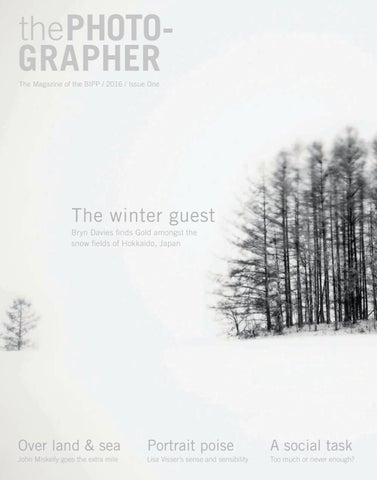
The winter guest Bryn Davies finds Gold amongst the snow fields of Hokkaido, Japan
Over land & sea
Portrait poise
A social task
John Miskelly goes the extra mile
Lisa Visser’s sense and sensibility
Too much or never enough?
TP-2016-1 OFC.indd 1
25/02/2016 14:46
- THE EVENT FOR EVERYONE WHOSE BUSINESS IS PHOTOGRAPHY -
Latest kit and best deals from 200+ exhibitors Crucial business advice at the Pro Conference Exclusive Pro networking opportunities PLUS David Bailey, Chris Packham, Bruce Gilden, Peter Dench, Scott Kelby, Lara Jade and many more. Pro photographers can register for free tickets (subject to verification criteria).
%22. <285 7,&.(76 $7 3+272*5$3+<6+2: &20
TP-2016-1 IFC.indd 58
24/02/2016 19:31
Photography Awards 2016 4 Presented at the end of February, we get some thoughts and perspectives from the Photographer of the Year and a selection of this year’s winning photographers
than just turn up, capture and make it good. Fine art landscape specialist John Miskelly talks about his personal input into image creation and how he constructs a living in Britain’s remote locations
Landscapes / John Miskelly 22 Going the extra mile and taking the extra time is only any good if the intent behind the image is more
Portraiture / Lisa Visser 36 With a competitive streak and a strong will to succeed, Lisa Visser has pushed beyond the doubters and a sticky beginning in photography to forge a winning style that has captured the hearts of her clients
Image © John Miskelly FBIPP
Photography! / Exhibition 46 Promoting professional image making at its best, this BIPP group show is about to move on to Preston where it runs in April and May BIPP / News 51 Company partners, member benefits and BIPP Guides the Photographer is published four times a year by the British Institute of Professional Photography, The Coach House, The Firs, High Street, Whitchurch, Aylesbury HP22 4SJ. T: 01296 642020 E: info@bipp.com W: www.bipp.com President: Eric Jenkins Hon FBIPP Chief Executive: Chris Harper FBIPP Directors: Suzi Allen LBIPP, Russell Baston HonFBIPP, Bryn Griffiths FBIPP, Scott Johnson FBIPP, Bella West FBIPP
Membership Services Advisory Board Suzi Allen LBIPP (National) Russell Baston HonFBIPP (National) Saraya Cortaville FBIPP (National) Tony Freeman HonFBIPP (National) Bryn Griffiths FBIPP (Midlands) Scott Johnson FBIPP (South East) Fyzal Kirk ABIPP (North East) Richard Mayfield FBIPP (Yorkshire) Alan McEwan FBIPP (National) John Miskelly FBIPP (Northern Ireland)
Image © Lisa Visser FBIPP
Issue One, 2016
Are you socially acceptable? 54 Are you scared of the social media challenge? Have you thought carefully enough about what your activity says about you? Help is at hand Capture colour management 60 A look at three simple tools that ensure the data you capture isn’t a shot in the dark James Russell LBIPP (North West) Bella West FBIPP (National) Stuart Wood FBIPP (National) Editor: Jonathan Briggs, editor@bipp.com Advertising: Tel 01296 642020 Email: jack@bipp.com UK Subscribers £20, EU £40, Rest of the World £50 ISSN: 0031-8698 Printed and bound by Magazine Printing Company, Enfield
Neither the British Institute of Professional Photography (BIPP) nor any of its employees, members, contractors or agents accepts any responsibility whatsoever for loss of or damage to photographs, illustrations or manuscripts or any other material submitted, howsoever caused. The views expressed in this magazine are the views of individual contributors and do not necessarily represent the views of the BIPP. All advertisements are accepted and all editorial matter published in good faith. The Publisher makes no warranty, express or implied, that any particular product or service is available at the time of publication or at any given price. No part of this publication may be reproduced by any means whatsoever, or stored in a retrieval system, or broadcast, published or exhibited without the prior permission of the publisher. This magazine is the copyright of the BIPP without prejudice to the right of contributors and photographers as defined in the Copyright, Designs and Patents Act 1988. All rights reserved. Registered at Stationers’ Hall, Ref B6546, No. 24577. © BIPP 2016
Issue One / 2016 / the PHOTOGRAPHER 1
TP-2016-1 Contents 01.indd 1
24/02/2016 19:31
News / Quadra HS
Hi-sync, now highly portable Elinchrom’s new Quadra HS takes creative flash to new locations, being a feather-light unit that could certainly go where full-sized heads might not have wanted to go before
S
o high-sync flash gear continues to be a focus for lighting manufacturers – which makes perfect sense as it represents gear that helps you stand out from the crowd – understanding the wide creative capabilities of high-sync flash certainly opens doors that were previously closed. Elinchrom’s new Quadra flash head for the ELB 400 and Quadra series is dedicated to high-sync photography, being a powerful, full-functioning miniaturised flash head which is compatible with the ELB 400 and all previous generations of Quadra packs. It packs a punch but is built to be as portable as possible, weighing
only 0.28kg (0.62lbs). This head not only packs well but it is mountable in situations that would be impossible for a fullsized flash head. The HS name means the system is optimised for high-sync photography such as high shutter speeds or overpowering the sun. It is ideal for use in conjunction with the EL-Skyport transmitter Plus HS we had a glance at last issue. The Quadra HS head integrates a daylight balanced LED modelling lamp that produces the equivalent of 50w of tungsten light output and there exist many portable accessories dedicated to the Quadra mount with Elinchrom also offering the Quadra reflector adapter for those who want full access to the complete range of Elinchrom accessories, including Rotalux, Litemotiv, etc. The head includes an interchangeable 2.5m head cable, the 13.5cm Quadra reflector with multifunction cap and a Quadra protective cap. The Quadra HS can be purchased either as a single item or in a set with the widely respected ELB 400.
NEED TO KNOW Maximum Watt/seconds F-stop at full power (at 1m, 100 ISO, reflector 48°) Flash duration Port A 100% Port B 33%: User replaceable flashtube Changeable reflector Circuit protection Interchangeable cable Modelling lamp Daylight LED Fan cooled Dimensions
424 90.0 1/550 1/1100 Yes Yes Yes Yes 50w No 8.0 x 7.5cm
Image © Saraya Cortaville
2 the PHOTOGRAPHER / 2016 / Issue One
TP-2016-1 News_TGate Ad 02-03.indd 2
24/02/2016 19:32
TP-2016-1 News_TGate Ad 02-03.indd 3
24/02/2016 19:32
4 the PHOTOGRAPHER / 2016 / Issue One
TP-2016-1 Awards 04-21.indd 4
24/02/2016 19:32
BIPP PHOTOGRAPHY AWARDS 2016
Photographer of the Year 2016 BRYN DAVIES LBIPP \ GOLD \ VISUAL ARTS NEVER one to shirk a difficult subject, Bryn Davies takes the Photographer of the Year mantle and is the epitome of the thinking, planning photographer – his work always has a wider role to play, in his career, his portfolio and you figure the overall world of photo graphy at large. Shot specifically to complete a cycle of work, Bryn’s images sum up the category with ambition and courage. He’s a photographer who knows what he wants and isn’t afraid of what it takes to get there… Bryn explains: ‘In February last year I was attending my exhibition in Seoul. Having already established portfolios from China and Korea, the last frontier remaining in East Asia was Japan. ‘The north island of Hokkaido is a world that oper ates on a much slower pace to the rest of the coutnry, particularly in winter, where much of the landscape is under several feet of snow. The meditative state of lone trees on a white canvas is reflective of the Zen thoughts of time and space. This feeling was not shared at the time of capture however, facing daily walks of more than 20km through blizzards and sub-zero tempera tures in Biei and Kussharo to find the right tree, on the right hill, with the right access. An evening meal and a chance to thaw out in an Onsen were the real Zen moments best reserved for private selfies.’ Comparing the depictions with those of China and Korea, on the one hand Bryn finds a sense of completion: ‘Yes, completion, but also a sense of renewal. The idea of taking my Leica M Monochrom out to do things it wasn’t primarily designed for (land scapes, long exposures and extreme weather) is a great way to challenge conventions, tools and yourself.’
g
Issue One / 2016 / the PHOTOGRAPHER 5
TP-2016-1 Awards 04-21.indd 5
24/02/2016 19:32
BRYN DAVIES LBIPP \ GOLD \ VISUAL ARTS
g 6 the PHOTOGRAPHER / 2016 / Issue One
TP-2016-1 Awards 04-21.indd 6
24/02/2016 19:32
RICHARD MAYFIELD FBIPP \ GOLD \ COMMERCIAL
Issue One / 2016 / the PHOTOGRAPHER 7
TP-2016-1 Awards 04-21.indd 7
24/02/2016 19:32
LEE HOWELL ABIPP \ GOLD \ COMMERCIAL
8 the PHOTOGRAPHER / 2016 / Issue One
TP-2016-1 Awards 04-21.indd 8
24/02/2016 19:33
BIPP PHOTOGRAPHY AWARDS 2016 Commercial Gold Lee Howell ABIPP Technocolour: Red Richard Mayfield FBIPP Colour My World
TIM VERNON FBIPP \ GOLD \ SCIENCE & TECHNOLOGY
Bronze Andrew Neilson ABIPP Bremont 2015 Bryn Griffiths FBIPP Colour Expressions Kinga Kocimska LBIPP Sale Non-Commissioned Merit Richard Bradbury FBIPP Thai Hill Tribe Science & Technology Gold Tim Vernon FBIPP Fertilization Silver Yon Marsh LBIPP Fluid Sculpture Visual Arts Gold Bryn Davies LBIPP Sketches of Japan Saraya Cortaville FBIPP Women of Tanzania Silver John Miskelly FBIPP Paul Coghlin FBIPP
Elemental Chroma
Merit Paul Reiffer FBIPP Piotr Kowalik FBIPP Weddings Silver David Wheeler FBIPP David West ABIPP
Cityscape Adventure
Wedding Couture Emotion
Bronze David Wheeler FBIPP Moments of Reflection Lee Howell ABIPP Fine Art Bridal Portraits Portrait Silver Emma Findley LBIPP Number 3 Richard Mayfield FBIPP Sunrise Performance Bronze Saraya Cortaville FBIPP On the Buses Merit Michael Wharley ABIPP David Calvert FBIPP Piotr Kowalik FBIPP Provisional Of the Year Open Merit Patrick Durston
The Elements Black On White Music Alistair Campbell: The Travelling Circus Allen Thomasson: Timeless Pan Troglodytes: Observed Through Glass
Issue One / 2016 / the PHOTOGRAPHER 9
TP-2016-1 Awards 04-21.indd 9
24/02/2016 19:33
YON MARSH LBIPP \ SILVER \ SCIENCE & TECHNOLOGY Influenced at an early age by work from Stephen Dalton capturing insects and birds in flight, Yon’s interest in photography and natural history pho tography began. Yon explains: ‘Since the invention of this particular area of flash photography by “The Doc” Harold Edgerton with his revolutionising flash technology at MIT, today we are lucky with his heritage in an age of miniaturisation. Having interests and specialisms in both science and art I am intrigued in the beauty that might exist in split moments of time and use photography to capture this. I am intrigued by the way in which fluids can have shape and form giving unexpected beauty, it is just one state of matter – and constantly changing. I believe that science may appeal to the brain whilst art appeals to the heart. Using paint as a starting point these responses have been influenced by Jackson Pollack, however the laws of physics have been controlled as much as they can be, the resulting work also has a sense of natural random ness within – unlike Pollack who visualised his canvas and had some form of control and placing of the dripping paint. Aiming to bring the areas of science and art together, photography experiments are used as a means to bring an ephemeral universe into existence; using forces within science that create a fragility to liquids being pulled by gravity, surface tension, centrifugal forces, temperature and sound. The resulting works represent a lot of experimental endeavours; using home made electrical triggers and drills, combinations of temperature and viscosity unite to bring the laws of physics into a visual explosive moment of colour. A purposemade studio was constructed with multiple flashguns triggered at the same time to generate sufficient light since the exposures used here are peaking at 1/50,000 of a second. The process is an extremely messy one and each result is a unique fluid sculpture. These fluid sculptures may exist for less than a second, yet in their moment of creation demonstrates an essence of purity and almost harmony before they come crushing down into chaos and oblivion.’ TP-2016-1 Awards 04-21.indd 10
24/02/2016 19:33
BRYN GRIFFITHS FBIPP \ BRONZE \ COMMERCIAL Bryn explains how to go about creating an exploding pumpkin: ‘Pumpkins were scooped out from the back then filled with glitter and small glittery shapes, and dynamite for the explosion. To work out the perfect timing for the shot, and as we were shooting some TV footage at the same time on a 2,000 frames per second Phantom 4K camera, we were able to identify to within a thousandth of a second what delay was needed from explosion to when the pumpkins broke up. The studio was blacked out; shutter left open; and a trigger delay was added as soon as the dynamite was fired. Our first attempts exploded quicker than the 1/10,000th we had available and we just captured a white flash. Early attempts also got the whole of Park Royal running to studio 6 where we were shooting as it sounded like a bomb had gone off! Still with our ears ring from the noise of the previous explosions, we put stress lines in the pumpkin and this dissipated the charge just enough for us to get the image I was after. Equipment: Hasselblad/Broncolor Lighting – Scoro Packs set to 1/10,000th. Immediate, right: A high-pressure bazooka gun fired ball-barings at the glass bauble. These had been filled with glitter and small glittery shapes, to emulate the exploding theme. I was behind armoured metal plate as the gun was firing just over the top of my head. The pressure and veloc ity of the gun (variable) were a factor in getting the right look and feel for this campaign. Again, as above, we were able to identify to within a thousandth of a second the delay needed from when the gun was fired to when the bullet hit the glass bauble.
Issue One / 2016 / the PHOTOGRAPHER 11
TP-2016-1 Awards 04-21.indd 11
24/02/2016 19:33
DAVID CALVERT FBIPP \ MERIT \ PORTRAIT David discusses his work: ‘The five images that make up my portfolio are from a panel of 20 images that was submitted to the BIPP, where it was awarded a Fellowship. I’m a massive fan of black and white portraiture – when I first got into photography in my teens, I was hugely influenced by the stark black and white portraiture that photographers such as David Bailey and Patrick Lichfield were creating. The panel (entitled ‘Black on White’) is very much a nod to those influences. ‘Black on White’ celebrates the beauty of black skin, the female form and black and white photography. It took a while to come up with a concept that I was happy with – although I knew I wanted to feature sub jects who were black. To add more impact and contrast to the images, I decided to shoot the subjects against a pure white background. The entire panel took 18 months to produce – much longer than I had originally
intended. The time taken was largely down to finding the right models who in comparison to white art nude models are few and far between. In the end, ten different models were used across 13 shoots ranging in age from 21to 49 and not all of them were professional – some being found by chance or with the help of other photographers who knew of my project. The lighting set-up was relatively simple: two flash heads fitted with barn doors were used to light a white background. The subject was lit with a single flash head on a boom arm fitted with a beauty dish. The height and angle of the key light was adjusted on each pose to get the best overall look.
12 the PHOTOGRAPHER / 2016 / Issue One
TP-2016-1 Awards 04-21.indd 12
24/02/2016 19:33
BIPP PHOTOGRAPHY AWARDS 2016
Occasionally, a silver reflector positioned on the floor was used to enhance the sheen of the model’s skin. Initially, Bowens flash was used, however half way through the project my studio moved over to the excellent Elinchrom ELC Pro HD system. Large 8’ x 4’ polyboards painted black were posi tioned either side of the model to “suck” light out from the edge of the subject to give them a more three-dimensional feel and to enhance the separation of the subject from the background.’ You can see the full panel of work at www.blackonwhite.photo
TP-2016-1 Awards 04-21.indd 13
24/02/2016 19:33
PAUL COGHLIN FBIPP \ SILVER \ VISUAL ARTS Paul’s thoughts on his work: ‘After working for some time on quite sombre black and white photography projects, such as the Petalum series, I felt it was time to turn my approach on its head somewhat and instead produce new lighter, more uplifting colour work. I started on what was to become “Chroma” and “Chroma II” two years ago in bursts of activity whenever the right type of flowers were available, and also when I was able to fit it in around other commercial work. In 2014 I produced 30 images and a further 30 in 2015. One of the biggest challenges I find with the floral series isn’t actually photographic, but that of keeping the flowers alive! It isn’t so much of a problem when you just have a few to photograph, but when you have a couple of buckets of indi vidually selected (before anyone else picks them) and carefully transported flowers, it can be quite disheartening when some of them go over. I’ve also found that some flowers just don’t photograph the way I’d hoped, often due to the way the structure of the petals or their natural colour reacts to the lighting or the way they look once they are photographed. Lighting also has to be varied too, as some flowers respond better to natural light and others to strobes. Unfortunately, one size doesn’t fit all, so I have to experiment and then reset things for each flower, and I can spend many hours just working on one specific type of flower, trying out different set-ups. Although Chroma I and II are in colour and appear quite different from much of my previous black and white work, they still share similar fea tures such the textural aspect; the fairly deep depthof-field; and the balance or symmetry in many of the images – whether through symmetrical flowers or a pleasing balance in the composition. With spring not too far away, I’m already look ing ahead to this year’s continuation of the Chroma project, as well as adding to my Behind The Eyes animal portrait series and Equilibrium series.’
14 the PHOTOGRAPHER / 2016 / Issue 1
TP-2016-1 Awards 04-21.indd 14
24/02/2016 19:33
EMMA FINDLEY LBIPP \ SILVER \ PORTRAIT Issue One / 2016 / the PHOTOGRAPHER 15
TP-2016-1 Awards 04-21.indd 15
24/02/2016 19:33
PAUL REIFFER FBIPP \ MERIT \ VISUAL ARTS 16 the PHOTOGRAPHER / 2016 / Issue One
TP-2016-1 Awards 04-21.indd 16
24/02/2016 19:33
BIPP PHOTOGRAPHY AWARDS 2016
TP-2016-1 Awards 04-21.indd 17
24/02/2016 19:33
MICHAEL WHARLEY ABIPP \ MERIT \ PORTRAIT 18 the PHOTOGRAPHER / 2016 / Issue One
TP-2016-1 Awards 04-21.indd 18
24/02/2016 19:34
Issue One / 2016 / the PHOTOGRAPHER 19
TP-2016-1 Awards 04-21.indd 19
24/02/2016 19:34
SARAYA CORTAVILLE FBIPP \ Peter Grugeon Award for the GOLD \ VISUAL ARTS Best Fellowship 2015
DAVID YEAMAN LBIPP \ Licentiate of the Year 2015
BIPP PHOTOGRAPHY AWARDS 2016
20 the PHOTOGRAPHER / 2016 / Issue One
TP-2016-1 Awards 04-21.indd 20
24/02/2016 19:34
TP-2016-1 Awards 04-21.indd 21
24/02/2016 19:34
DAN FREEMAN ABIPP \
Peter Grugeon Award for the Best Associateship 2015
Time and tide They wait for no man, and insist that we spend a great deal of it waiting for the right combination of both. John Miskelly would certainly agree – but the rewards are there when the vision is strong 22 the PHOTOGRAPHER / 2016 / Issue One
TP-2016-1 JM 22-31.indd 22
24/02/2016 19:33
Image © John Miskelly
D
o you know where this image is shot? Probably not. So let’s set the record straight: we’re in County Donegal looking at the Atlantic Ocean on the north-western tip of Ireland. However, the point is that you don’t need to know. Packed full of dramatic energy, movement and life, John Miskelly’s seascapes take us so much further than the location-specific response. Whilst John’s work somewhat naturally
concentrates on the Celtic lands, he’s successfully breached the invisible barrier between recording and creating – a big jump from ‘that’s what it was like’ all the way to ‘that’s how it felt’. You could claim that this is why photography can be truly art and admired just for itself.
g
Issue One / 2016 / the PHOTOGRAPHER 23
TP-2016-1 JM 22-31.indd 23
24/02/2016 19:33
Image © John Miskelly
g
John doesn’t necessarily go out of his way to make his latest work devoid of identifiers, but is aware that the approach opens doors to more global appreciation. Somehow, a landscape photographer is always limited if they’re heavily connected to one place – say for example Ireland or Scotland. It takes a real effort to throw off the tag and let the images do the work for you.
All of which takes an enormous amount of time. Creating quality work such as this requires a commitment to the cause and a level of self-critique that would be beyond the patience of most. John admits that at the top end of the scale he might only be adding a dozen or so exhibition-quality images a year to his portfolio. Anyone who knows anything about this genre will agree: you need an understanding family and the patience of Job. All the pieces of the jigsaw puzzle that’s in your mind can take an awful long time to become available.
24 the PHOTOGRAPHER / 2016 / Issue One
TP-2016-1 JM 22-31.indd 24
24/02/2016 19:33
Image © John Miskelly
And this is the difference between (a) travelling out (no matter how far) to a wonderful location and capturing it on a top-end camera; and (b) having an idea in your mind that you wish to create in a place. It’s chalk and cheese (or more likely, cheese and chalk). John Miskelly set out on the landscape journey after an early career in social photography and largely thanks to attending a seminar with Joe Cornish. Inspired, he bought some Lee filters; went to Venice with a photo grapher friend; was forced to get up at the crack of
dawn every morning (wasn’t this a holiday?); and finally realised it was doing something in his heart that other worlds of work previously had not. John picks it up: ‘I jumped into it properly five years ago, building up skills and material. Did I have a plan? I’m sure I did but I don’t think I ever wrote it down… but I tend to use mind maps – I plan using mind maps of what I am trying
g
Issue One / 2016 / the PHOTOGRAPHER 25
TP-2016-1 JM 22-31.indd 25
24/02/2016 19:33
g
to achieve and how I am going to do it. I review the business – where it’s going, how it’s getting there and my task list. Planning in that sense, yes I did lots.’ John identifies four clear strands to his business: print sales; commissioned landscape work; running landscape workshops and tuition; and writing for
magazines – though the latter is more likely to be raising awareness than revenue. Despite his niche, John insists that marketing and communication is everything: ‘You have to be seen at the end of the day. That is partly about running good social media – thinking carefully about the message that’s conveyed by the images you use and what you say – and then maintaining and growing the contact database of the business. This is about regular,
26 the PHOTOGRAPHER / 2016 / Issue One
TP-2016-1 JM 22-31.indd 26
24/02/2016 19:33
Image © John Miskelly
substantial e-newsletters that my customers want to read, and a continuous blog.’ John seems to underline the notion that regularity is extremely important: ‘I would say that consistency is everything – in the pictures you create, in what you say about them, in your communications with your customers. I don’t believe that social media is the be-all and end-all of marketing, but it’s one important strand. Just like the images, it takes time to do
and there’s a lot to be said for making that commitment and sticking to it. How many blogs have you started out being interested in only for it to get less regular and eventually dry up? I’d say this happens to the majority.’ As a result, John sees a lot of repeat business across all strands of his work.
g
Issue One / 2016 / the PHOTOGRAPHER 27
TP-2016-1 JM 22-31.indd 27
24/02/2016 19:33
Image © John Miskelly
g
He explains how he thinks about his style: ‘I like to build a body of work. You don’t just go out and produce a top shot every day. I can spend days awaiting the combination of factors I want before setting that ten-minute exposure going. Perhaps people don’t know what they are trying to produce, and of course they almost chance upon some fantastic shots but the vision isn’t
there. Vision should be purposeful – you go out and produce a certain type of picture. That doesn’t mean that you don’t ever do anything on the hop, but there are a lot of variables that I need in seascapes. Planning it means there’s a much greater chance of getting what I have in my mind.’ He also appreciates the global nature of commerce these days: ‘Because I sell a certain amount of work directly through my website, I can of course sell anywhere in the world. The internet and everything that goes with it acts as a global shop front.’
28 the PHOTOGRAPHER / 2016 / Issue One
TP-2016-1 JM 22-31.indd 28
24/02/2016 19:33
Image © John Miskelly
So what is it that stops people getting good landscapes? ‘Partly,’ says John, ‘it’s because they don’t want to keep going back, getting up at 3am, standing out in the rain.’ The shot taken at Elgol (previous spread) is a case in point. Sitting on the shores of Loch Scavaig at the end of the Strathaird peninsula on the Isle of Skye, it requires a 15-mile drive down a rollercoaster single-track road. But the location looks across to the Cullin ridge – probably the British Isles’ most impressive mountain range – and access from this side is either
by boat across to Loch Coruisk, or a very long walk on a route that includes a section known as The Bad Step. In other words, this is the good side: ‘It rained for 24 hours before the light broke,’ says John. It doesn’t really sound like the most efficient kind of business, does it? ‘Individual projects are so hard to cost – it’s not like having a studio! Some shots
g
Issue One / 2016 / the PHOTOGRAPHER 29
TP-2016-1 JM 22-31.indd 29
24/02/2016 19:33
g
have sold again and again. I look at the whole business over time and you should be hard on yourself and be certain it is all making sense. Part and parcel of why I do it is because I enjoy being out in the wilds – that is part of the reward. It may not be just about money and I don’t count the hours, but no-one wants to wake up a few years down the line and realise that you’ve had a lot of fun but have actually been going backwards. I carefully track the cost of travel, accommodation and equipment against what I’ve achieved and effectively the products I have for sale. I well remember Joe Cornish telling me that he went to the Old Man of Stour (a landslip rock formation also on Skye) ten times before he got what he had in mind.’ The reward of this life is also about confidence and control: ‘I’ve worked for large corporations in my life, but I like being in control of my own destiny, and accept that I’m no longer terribly employable at anything else! I would say that an ability to be clearly critical of imagery has been lost to an extent in the profession. My biggest challenge and driver is to stay ahead of the game and produce imagery that the average guy in the street or average photographer – amateur or semi-professional – can’t. Completing the picture is not about this or that technique or the equipment in your bag. I am thankful for that fact, that I can go to a location and create something that will not be seen in the same way again. I don’t tend to worry about how the industry has changed – I’ll always be pushing as long as the passion remains. If you’re ever satisfied and think you’ve achieved everything you should certainly go and do something different. www.johnmiskelly.co.uk
TP-2016-1 JM 22-31.indd 30
24/02/2016 19:50
Image © John Miskelly TP-2016-1 JM 22-31.indd 31
24/02/2016 19:33
Fujifilm / Crystal Archive Paper
ADVERTISEMENT FEATURE
Genesis and Fujifilm Crystal Archive Paper are miles ahead at the Travel Awards
T
he Travel Photographer of the Year Competition (TPOTY) is one of the biggest events on the calendar for professionals in this sector of the business and for enthusiasts who are documenting their journeys to, and experiences in, fresh and interesting parts of the world. The award event was conceived by professional photographer Chris Coe (right) in 2002 and launched the following year, and it was designed to create a showcase for interesting travel-related photography and to broaden the general perception of this area of photography. ‘Travel photography requires photographers to show the breadth of their skills as it embraces so many different genres,’ says Suffolk-based Chris. ‘People, landscape, wildlife, reportage, advertising, architecture, food photography etc – and I don’t think that was generally understood. TPOTY has always sought to promote photographers, and back then there weren’t many photographic competitions around and even fewer focused on travel. Those that did exist were generally run by publishers with the objective of sourcing free images for their publications. TPOTY was designed from the outset for photographers and it’s always taken a strong stance on protecting copyright.’ Fujifilm was one of the founding sponsors for the competition and Genesis – the lab that Chris has personally used for over 20 years – became a supporter because he felt their high-quality service made them the perfect partner. Genesis prints all the TPOTY exhibitions and, in addition to providing prints as prizes the lab also offers a Fujifilm Crystal Archive printing service – at 50% discount – for shortlisted entrants, since TPOTY’s final judging is always done on prints rather than online. ‘We needed a lab that could provide master printing and the attention to detail that’s
expected of a high-profile photography award,’ says Chris. ‘The Crystal Archive prints that Genesis produces offer a tonal range and richness that’s very hard to match with any other type of printing, and the various silver halide papers offer different characteristics in much the same way as film did.’ TPOTY is as much about prestige and exposure as it is about winning prizes, and it’s thrown the spotlight on a number of rising stars over the years, while more experienced photographers have cemented and enhanced their reputations. ‘One young winner’s images were spotted by a London ad agency and TPOTY negotiated a five-figure fee for their use by a major aircraft manufacturer,’ says Chris. ‘The fee paid for a college course and a new camera system and the image use was renewed the following year.’ Meanwhile for the overall winners there’s the benefit of extensive media coverage and the chance to be part of a high-profile UK exhibition. The last one welcomed 51,231 visitors in six weeks – and the show will now start to tour internationally. The winners of the 2015 TPOTY competition have recently been announced and the exhibition of work will be touring shortly. Full details of how to enter for the 14th awards can be found on www.tpoty.com from April 2016. Below left: by Jakub Rybicki. Below right: by Johnny Haglund. Both courtesy of Travel Photographer of the Year (TPOTY) 2014, copyright of the photographers. See: www.tpoty.com
32 the PHOTOGRAPHER / 2016 / Issue One
TP-2016-1 Fuji 32-35.indd 32
24/02/2016 19:33
ADVERTISEMENT FEATURE
Fujifilm / Crystal Archive Paper
Captured – the sporting life
I
t was necessity that first encouraged Australian-born Tarquin Millington-Drake (right) to pick up a camera in earnest. Having spent over 20 years to date working for sporting travel company Frontiers, he’s found himself travelling to some of the remotest places on the planet on a regular basis, and it felt only natural to record the fascinating people he was meeting. ‘I had no training,’ he says, ‘so I benefited from the arrival of the digital era. It gave me the opportunity to teach myself the basics of photography through a process of trial and error. I produce pictures for our brochures and web use, to support my blog, and increasingly I have written for sporting magazines, supplying photographs to support the articles.’ Tarquin was born in Sydney in 1965 and moved to the UK the same year, being raised alongside the River Thames at Shepperton. Along its leafy banks he learned to fish for pike and then taught himself to cast a fly using an old rod he’d found in his parents’ garden shed. ‘Over the years I’ve fished almost all the great rivers of the world,’ he says. ‘Shooting began while I was staying with friends in the country and I quickly developed a love of dogs and dog work. I’ve been fortunate to be able to combine my passions with my career.’ Cotswolds-based Tarquin is now considered one of the top country sports photographers in the UK, and this summer his book A Year on the Moor was published, celebrating life on and around a grouse moor in Northumberland. Many of the pictures inside were gathered together for an exhibition and event, A Celebration of Grouse, which took place in silversmith and fellow grouse enthusiast Patrick Mavros’s gallery in London earlier this year. It was the need to have large-scale prints produced to a high standard for the exhibition that first led Tarquin
to Genesis, and it was Patrick Mavros who recommended the lab to him. He was immediately impressed by the results and he’s been using their services ever since. Fulham-based Genesis has been supplying Lambda C-Type prints for Tarquin, which are output on Fujifilm’s silver halide Crystal Archive Paper and then face-mounted, a process that sees the print mounted between a sheet of perspex and an aluminium or di-bond backing sheet. ‘Face mounting enhances the colour and depth of the print, and gives the photograph a beautiful contemporary finish,’ says Tarquin. ‘It becomes a complete work of art and it’s perfect for clients that are looking to hang pictures in places where a more robust finish is required.’ www.millingtondrake.com
From ‘A Year on the Moor’
Ken Sethi of Genesis shows off a face-mounted acrylic display print on Fujifilm Crystal Archive paper Issue One / 2016 / the PHOTOGRAPHER 33
TP-2016-1 Fuji 32-35.indd 33
24/02/2016 19:33
Fujifilm / Crystal Archive Paper
ADVERTISEMENT FEATURE
From a life of crime (as a barrister) to a life of just kidding round
K
ids just want to have fun. So does photographer Janine Stow. Children are simply world-class when it comes to letting off steam, having temper tantrums and making noise. So it’s interesting that so many professional photographers choose to produce pictures that show them in stiff, formal poses. Anything but relaxed. For London-based Janine Stow the instinct was always to let the children she was photographing do their thing around her, and to win their trust and confidence by effectively becoming a child herself. She joins in their games – hunting for lions and making daisy chains. She stimulates their imagination, wins their trust and then takes her pictures in a relaxed style while the children play happily around her. ‘I work quickly and take whatever the children will offer me,’ she says, ‘and just capture what’s there in the most natural way possible.’ Self-taught and with a natural eye for composition, Janine previously had a busy life as a criminal barrister. Then 11 years ago her husband’s job took her to Singapore for what was meant to be a two-year stay and the opportunity was there to take her photography more seriously. ‘I could see an opportunity for child portraiture since the style in Singapore was very formal and studio based,’ she says. ‘My lifestyle approach particularly appealed to the ex-pat community who favoured a more natural look.’ The two years in Singapore ended up being six, and Janine returned to the UK with two children, two dogs and settled in a new house. Now she needed to find a lab she could trust and so she asked her wedding photographer for a recommendation. ‘She suggested
Genesis,’ she says, ‘and I’ve been with them ever since. The Fujifilm Crystal Archive C-type prints they produce for me not only look amazing, but give me something extra that I can tell my clients. The pictures of their family will go to become an heirloom, and I can tell them that they’re archivally really stable and could last for up to 100 years.’ One of the most pleasing aspects of photographing children is that once Janine has completed her first shoot she will often go on to become the family’s regular photographer. What starts out as a shoot with a new baby turns into shots of the Christening, then pictures of the first birthday party and other significant family events way into the future. ‘It’s such a pleasure to watch these children growing up,’ she says. ‘We get to know each other and that leads to very relaxed and successful sessions. I still have plenty of contacts in Singapore and go back there twice a year to catch up with the clients I still have there. It’s a privilege to be involved in this way and it’s definitely one of the best aspects of the job.’ www.janinestowphotography.com For information on Fujifilm Crystal Archive papers or to request a sample print please call Peter Wigington on 01234 572138, email photoimaging@fuji.co.uk or visit www.fujifilm.eu/uk/products/photofinishing/photographic-paper
¶ $ * I D P R E D W V I \
34 the PHOTOGRAPHER / 2016 / Issue One
TP-2016-1 Fuji 32-35.indd 34
24/02/2016 19:34
JHQHVLV-DQ HQHVLV-DQ
VXSSRUWLQJ FUHDWLYH H[FHOOHQFH VXSSRUWLQJ FUHDWLYH H[FHOOHQFH VXSSRUWLQJ FUHDWLYH H[FHOOHQFH
VXSSRUWLQJ FUHDWLYH H[FHOOHQFH VXSSRUWLQJ FUHDWLYH H[FHOOHQFH VXSSRUWLQJ FUHDWLYH H[FHOOHQFH
1IPUPHSBQI ª +BOJOF 4UPX QSJOUFE PO 'VKJDPMPS $SZTUBM "SDIJWF CZ (FOFTJT *NBHJOH 1IPUPHSBQI ª +BOJOF 4UPX QSJOUFE PO 'VKJDPMPS $SZTUBM "SDIJWF CZ (FOFTJT *NBHJOH 1IPUPHSBQI ª +BOJOF 4UPX QSJOUFE PO 'VKJDPMPS $SZTUBM "SDIJWF CZ (FOFTJT *NBHJOH
'VKJDPMPS $SZTUBM "SDIJWF %JHJUBM 1FBSM JT B QBQFS XJUI m 'VKJDPMPS $SZTUBM "SDIJWF %JHJUBM 1FBSM JT B QBQFS XJUI m 'VKJDPMPS $SZTUBM "SDIJWF %JHJUBM 1FBSM JT B QBQFS XJUI m OF WJTVBM BDVUBODF BOE GVMM TBUVSBUJPO OF WJTVBM BDVUBODF BOE GVMM TBUVSBUJPO OF WJTVBM BDVUBODF BOE GVMM TBUVSBUJPO ¶7KH )XMLÀ ¶7KH )XMLÀ ¶7KH )XMLÀ OP &U\VWDO OP &U\VWDO OP &U\VWDO QSBJTFE CZ QIPUPHSBQIFST GPS XIJUFS UIBO XIJUF IJHIMJHIUT WJCSBOU DPMPVS BOE TVQFSC TIBEPX QSBJTFE CZ QIPUPHSBQIFST GPS XIJUFS UIBO XIJUF IJHIMJHIUT WJCSBOU DPMPVS BOE TVQFSC TIBEPX QSBJTFE CZ QIPUPHSBQIFST GPS XIJUFS UIBO XIJUF IJHIMJHIUT WJCSBOU DPMPVS BOE TVQFSC TIBEPX EFUBJM %FWFMPQFE GPS VTF XJUI BMM NJOJ MBCT BOE NFEJVN UP MBSHF TDBMF QSJOUFS TZTUFNT $SZTUBM EFUBJM %FWFMPQFE GPS VTF XJUI BMM NJOJ MBCT BOE NFEJVN UP MBSHF TDBMF QSJOUFS TZTUFNT $SZTUBM EFUBJM %FWFMPQFE GPS VTF XJUI BMM NJOJ MBCT BOE NFEJVN UP MBSHF TDBMF QSJOUFS TZTUFNT $SZTUBM $UFKLYH & W\SH SULQWV $UFKLYH & W\SH SULQWV $UFKLYH & W\SH SULQWV "SDIJWF %JHJUBM 1FBSM JT B TJMWFS IBMJEF QBQFS DPOUBJOJOH QFBSM NJDB QJHNFOUT BOE NFUBM PYJEFT "SDIJWF %JHJUBM 1FBSM JT B TJMWFS IBMJEF QBQFS DPOUBJOJOH QFBSM NJDB QJHNFOUT BOE NFUBM PYJEFT "SDIJWF %JHJUBM 1FBSM JT B TJMWFS IBMJEF QBQFS DPOUBJOJOH QFBSM NJDB QJHNFOUT BOE NFUBM PYJEFT XIJDI DPNCJOF UP HJWF QVSFS XIJUFT BOE TIBSQFS CFUUFS EFm XIJDI DPNCJOF UP HJWF QVSFS XIJUFT BOE TIBSQFS CFUUFS EFm XIJDI DPNCJOF UP HJWF QVSFS XIJUFT BOE TIBSQFS CFUUFS EFm OFE IJHIMJHIUT 0QUJNJTFE GPS EJHJUBM OFE IJHIMJHIUT 0QUJNJTFE GPS EJHJUBM OFE IJHIMJHIUT 0QUJNJTFE GPS EJHJUBM *HQHVLV SURGXFH *HQHVLV SURGXFH *HQHVLV SURGXFH TZTUFNT UIF QBQFS IBT B UIJDLFS CBTF BOE IJHIFS TUJGGOFTT GPS B IJHI RVBMJUZ MPPL BOE GFFM TZTUFNT UIF QBQFS IBT B UIJDLFS CBTF BOE IJHIFS TUJGGOFTT GPS B IJHI RVBMJUZ MPPL BOE GFFM TZTUFNT UIF QBQFS IBT B UIJDLFS CBTF BOE IJHIFS TUJGGOFTT GPS B IJHI RVBMJUZ MPPL BOE GFFM IRU PH QRW RQO\ ORRN IRU PH QRW RQO\ ORRN IRU PH QRW RQO\ ORRN 8JUI TVQFSC BSDIJWBM QFSNBOFODF JNBHFT QSJOUFE PO $SZTUBM "SDIJWF %JHJUBM 1FBSM XJMM MPPL BT 8JUI TVQFSC BSDIJWBM QFSNBOFODF JNBHFT QSJOUFE PO $SZTUBM "SDIJWF %JHJUBM 1FBSM XJMM MPPL BT 8JUI TVQFSC BSDIJWBM QFSNBOFODF JNBHFT QSJOUFE PO $SZTUBM "SDIJWF %JHJUBM 1FBSM XJMM MPPL BT GSFTI JO UIF GVUVSF BT UIF EBZ UIFZ XFSF UBLFO 1PSUSBJU BOE XFEEJOH QIPUPHSBQIFST XJMM mOE UIF GSFTI JO UIF GVUVSF BT UIF EBZ UIFZ XFSF UBLFO 1PSUSBJU BOE XFEEJOH QIPUPHSBQIFST XJMM mOE UIF GSFTI JO UIF GVUVSF BT UIF EBZ UIFZ XFSF UBLFO 1PSUSBJU BOE XFEEJOH QIPUPHSBQIFST XJMM mOE UIF DPD]LQJ« , FDQ WHOO DPD]LQJ« , FDQ WHOO DPD]LQJ« , FDQ WHOO QBQFS JEFBMMZ TVJUFE GPS BMCVNT BOE EJTQMBZ QSJOUT BOE XJMM NBSWFM BU UIF IJHI MFWFM PG EFUBJM BOE QBQFS JEFBMMZ TVJUFE GPS BMCVNT BOE EJTQMBZ QSJOUT BOE XJMM NBSWFM BU UIF IJHI MFWFM PG EFUBJM BOE QBQFS JEFBMMZ TVJUFE GPS BMCVNT BOE EJTQMBZ QSJOUT BOE XJMM NBSWFM BU UIF IJHI MFWFM PG EFUBJM BOE DPMPVS BDIJFWFE 5IJT JT B QBQFS XIJDI EFmFT UIF BHFJOH QSPDFTT :PVS DMJFOUT XJMM MPWF ZPV GPS DPMPVS BDIJFWFE 5IJT JT B QBQFS XIJDI EFmFT UIF BHFJOH QSPDFTT :PVS DMJFOUT XJMM MPWF ZPV GPS DPMPVS BDIJFWFE 5IJT JT B QBQFS XIJDI EFmFT UIF BHFJOH QSPDFTT :PVS DMJFOUT XJMM MPWF ZPV GPS P\ FOLHQWV WKH SLFWXUHV P\ FOLHQWV WKH SLFWXUHV P\ FOLHQWV WKH SLFWXUHV JU JU JU RI WKHLU IDPLO\ ZLOO JR WR RI WKHLU IDPLO\ ZLOO JR WR RI WKHLU IDPLO\ ZLOO JR WR 2WKHU SDSHUV LQ WKH )XMLÀ 2WKHU SDSHUV LQ WKH )XMLÀ 2WKHU SDSHUV LQ WKH )XMLÀ OP 3URIHVVLRQDO 3DSHU 5DQJH OP 3URIHVVLRQDO 3DSHU 5DQJH OP 3URIHVVLRQDO 3DSHU 5DQJH EHFRPH DQ KHLUORRP EHFRPH DQ KHLUORRP EHFRPH DQ KHLUORRP t 'VKJm MN $SZTUBM "SDIJWF 5ZQF ** t 'VKJm MN $SZTUBM "SDIJWF 5ZQF ** t 'VKJm MN $SZTUBM "SDIJWF 5ZQF ** t 'VKJm MN $SZTUBM "SDIJWF 4613&.& t 'VKJm MN $SZTUBM "SDIJWF 4613&.& t 'VKJm MN $SZTUBM "SDIJWF 4613&.& DQG , FDQ WHOO WKHP WKDW DQG , FDQ WHOO WKHP WKDW DQG , FDQ WHOO WKHP WKDW t 'VKJm MN $SZTUBM "SDIJWF %1** t 'VKJm MN $SZTUBM "SDIJWF %1** t 'VKJm MN $SZTUBM "SDIJWF %1** t 'VKJm MN $SZTUBM "SDIJWF %1 53"/4 t 'VKJm MN $SZTUBM "SDIJWF %1 53"/4 t 'VKJm MN $SZTUBM "SDIJWF %1 53"/4 WKH\·UH DUFKLYDOO\ UHDOO\ WKH\·UH DUFKLYDOO\ UHDOO\ WKH\·UH DUFKLYDOO\ UHDOO\ t 'VKJm MN $SZTUBM "SDIJWF '6+*53"/4 t 'VKJm MN $SZTUBM "SDIJWF '6+*53"/4 t 'VKJm MN $SZTUBM "SDIJWF '6+*53"/4 t 'VKJm MN $SZTUBM "SDIJWF '6+*'-&9 t 'VKJm MN $SZTUBM "SDIJWF '6+*'-&9 t 'VKJm MN $SZTUBM "SDIJWF '6+*'-&9 VWDEOH DQG FRXOG ODVW VWDEOH DQG FRXOG ODVW VWDEOH DQG FRXOG ODVW t 'VKJm MN $SZTUBM "SDIJWF "-#6. 1"1&3 t 'VKJm MN $SZTUBM "SDIJWF "-#6. 1"1&3 t 'VKJm MN $SZTUBM "SDIJWF "-#6. 1"1&3 t 'VKJm MN $SZTUBM "SDIJWF 83*5&"#-& t 'VKJm MN $SZTUBM "SDIJWF 83*5&"#-& t 'VKJm MN $SZTUBM "SDIJWF 83*5&"#-& IRU XS WR D KXQGUHG IRU XS WR D KXQGUHG IRU XS WR D KXQGUHG 'PS NPSF JOGPSNBUJPO PO UIF GVMM SBOHF PS UP SFRVFTU B 'PS NPSF JOGPSNBUJPO PO UIF GVMM SBOHF PS UP SFRVFTU B 'PS NPSF JOGPSNBUJPO PO UIF GVMM SBOHF PS UP SFRVFTU B \HDUV · \HDUV · \HDUV · TBNQMF QSJOU QMFBTF DBMM 1FUFS 8JHJOHUPO PO TBNQMF QSJOU QMFBTF DBMM 1FUFS 8JHJOHUPO PO TBNQMF QSJOU QMFBTF DBMM 1FUFS 8JHJOHUPO PO PS FNBJM SKRWRLPDJLQJ#IXML FR XN PS FNBJM SKRWRLPDJLQJ#IXML FR XN PS FNBJM SKRWRLPDJLQJ#IXML FR XN ² -DQLQH 6WRZ ² -DQLQH 6WRZ ² -DQLQH 6WRZ PS WJTJU ZZZ IXMLÀ PS WJTJU ZZZ IXMLÀ OP HX XN SURGXFWV SKRWRÀ PS WJTJU ZZZ IXMLÀ OP HX XN SURGXFWV SKRWRÀ OP HX XN SURGXFWV SKRWRÀ QLVKLQJ SKRWRJUDSKLF SDSHU QLVKLQJ SKRWRJUDSKLF SDSHU QLVKLQJ SKRWRJUDSKLF SDSHU MASTERMASTER PHOTOGRAPHY PHOTOGRAPHY MASTERSEPTEMBER/OCTOBER PHOTOGRAPHY SEPTEMBER/OCTOBER SEPTEMBER/OCTOBER 2015 • 2015 1 • 1 2015 • 1
JHQHVLV-DQ IXMLDG DGYHUWRULDO LQGG JHQHVLV-DQ IXMLDG DGYH HQHVLV-DQ IXMLDG DGYH JHQHVLV-DQ IXMLDG DGYHUWRULDO LQGG JHQHVLV-DQ IXMLDG DGYH HQHVLV-DQ IXMLDG DGYH JHQHVLV-DQ IXMLDG DGYHUWRULDO LQGG HQHVLV-DQ IXMLDG DGYH HUWRULD UWRULDO LQG UW O LQGG HGUWRULD UWRULDO LQG UW 35 O LQGG G H UWRULD UWRULDO LQG UW O LQGG G TP-2016-1 Fuji JHQHVLV-DQ IXMLDG DGYH 32-35.indd
24/02/2016 19:34
Simple sensibility Creatively speaking, Lisa Visser’s portraiture couldn’t be any further from the ‘photography’ she was thrown into in her first job out of school. It may not have been pretty, but the experience in part helped her become the photographer she is today
L
isa Visser has always specialised in photographing children, but not necessarily in the way she has always wanted, nor in the way she does now. The very beginning of her career pathway in some ways has more in common with how she creates her work today than it does her first training and job. ‘I initially became interested in photography at school when my art teacher suggested I do a GCSE in photography back in 1987. I was really drawn to portraiture and used to practise on my three sisters constantly,’ she says. However, that initial expression of what she saw around her got a little lost when Lisa left school at 17 and decided to get a trainee job as a portrait photographer. ‘I got a job in a big portrait chain that would set up in high-street stores photographing children all day long, all in the same way,’ she explains. ‘I was working to the company formula and had very little time with each client, it was quite soul destroying and really put me off being a portrait photographer. I would often
do 25 sessions a day, but was not allowed to create images in any way I wanted to – there was no development and nothing creative about it at all. There was nothing in this process that represented photography for me.’ Despite everything, and indicative of Lisa’s resolve, it took four years for Lisa to decide to give that one up. There then came a period out of photography until 1999 when Lisa returned to working in a portrait studio, but with an entirely different vibe: ‘I got another job working at a highstreet studio which really gave me space to do what I wanted with the simple proviso that it would sell (not as simple as it sounds…). It was a completely different experience to my first job and g
36 the PHOTOGRAPHER / 2016 / Issue One
TP-2016-1 LV 36-45.indd 36
24/02/2016 19:34
Image © Lisa Visser TP-2016-1 LV 36-45.indd 37
24/02/2016 19:34
Image © Lisa Visser
g
I fell in love with photography all over again.’ This then launched Lisa’s real learning curve. She was encouraged to join the BIPP and to start working towards qualifications. It was probably written in the stars – all the way back when Lisa was forcing portrait practise on her siblings – that she would set up her own business four years ago in 2012. Lisa works from a small but perfectly formed 15m2 purpose-built studio at the end of the garden. As she concurs, it’s just perfect for doing children’s portraits. Lisa explains where she’s at: ‘I have always specialised in photographing children and this is the area I love and
feel I am at my best. For the last ten years or so I have been drawn to creating a more sensitive image – the challenge of depicting emotion, vulnerability and thoughtfulness in a portrait. Perhaps this tendency stems from my own feelings as a child – I put a lot of myself into the way I portray children.’ Where did this approach spring from? Real life, rather than posed life, it seems. Lisa comments: ‘I find my inspiration comes from watching people simply as they are. I catch a moment in the every day and then start imagining an image. There are times when I’ll see something in a film for example, too – but I’m happy to admit that sometimes I don’t have the resource or skill to create exactly what I see in my mind… but I will keep working on that.’ This kind of creative development can only happen over time. ‘When I think back,’ says Lisa, ‘I have always
38 the PHOTOGRAPHER / 2016 / Issue One
TP-2016-1 LV 36-45.indd 38
24/02/2016 19:34
Image © Lisa Visser
liked to push myself. It started off in 1999 on my return to photography and the importance of working towards qualifications was emphasised to me – that it was about being better and expressing yourself as a professional. I’m quite competitive – as it turns out – and I just thought it would be a good way to see where I was in the context of my peer group.’ Beginning with an informal chat on the BIPP’s stand at the then Focus on Imaging (you can do the same at The Photography Show this month), Lisa took a couple of attempts to attain her Associateship with help and encouragement coming from well-known mentor Kevin Wilson. ‘He really instilled confidence in my approach to work – the difference that it makes can’t be understated… getting a clear understanding of where my stronger and weaker elements lay and gaining real intent with my photo graphy.’ All of that is great, but this is a business –
the work has to sell, too. Lisa explains that her development has led to a big shift in the type of clients coming in through the door: ‘I find that when people come in they tend to know what I will want to do, and have already bought in to my style – perhaps showing it in the types of outfit we discuss and them getting excited about the feeling we’re going to look at. They are engaging with my product well ahead of the session and I feel this is only possible if you have developed a strong photographic personality yourself, spending time on it, growing alongside it, and being brave enough to take it on. It has not been a quick process.’
g
Issue One / 2016 / the PHOTOGRAPHER 39
TP-2016-1 LV 36-45.indd 39
24/02/2016 19:34
Image © Lisa Visser 40 the PHOTOGRAPHER / 2016 / Issue One
TP-2016-1 LV 36-45.indd 40
24/02/2016 19:34
g
Lisa continues: ‘I mean it has developed over quite a while. When I was planning my fellowship I realised that working with older children might allow me to find a more sensitive style and I decided it was going to be about showing more emotion. From then on I began gearing shoots around the plan, slowly producing work that could be considered for my panel and in that way my style began to flower. Initially, it was personal work and I had no idea what my clients would think to it – I would do my usual portrait sittings and then if it seemed like a possibility I would talk to the parents about what I was doing and ask if I could add those captures at the end of the session. Eventually these images found their way into my display and clients started showing interest in it being the basis of their shoots.’ However, it wasn’t all plain sailing: ‘Another photographer point-blank told me I would never sell this style of work. I was convinced they were wrong, but it can be hard to see your way through those kind of moments considering all the time, effort and thought that you’ve invested in the work. However, you have to think forwards and be aware of changing perspectives and fashions – I just felt that what I was doing had potential. It is not for everyone, not for every client – I know that and I can adjust as required.’ Lisa’s client base extends all across the UK, including the north of England, Wales, London and the home counties – there’s actually more emphasis on people travelling longer distances than the local area, which Lisa puts down to the power of word of mouth and social media. ‘I have done a little bit of marketing through children’s magazines, but that’s nothing compared to how Facebook activity rewards you with awareness and network.’ Pity the poor publishers you could say. However, Lisa’s not much interested in pushing business growth, looking more towards a decent balance of work and quality. Perhaps that shows in her photo graphy, eminating time and sensitivity. She comments: ‘I don’t think I want to expand in the strong sense of
g
Issue One / 2016 / the PHOTOGRAPHER 41
TP-2016-1 LV 36-45.indd 41
24/02/2016 19:34
Image © Lisa Visser
g
the word, and would rather feel that I’m giving the best of me to every customer in my studio. There’s a big difference between producing a fine art shoot, and say doing an actor’s headshot. I am willing to admit that I have suffered in the past, booking in too many clients and then not having the time to do it right. I’m a strong believer in deciding what I’m doing and seeing it through.’
In just the short time Lisa has been in her current business, a handful of her clients have set up their own photography services and started marketing to the same client base. Lisa comments: ‘It’s so easy to set up a Facebook business page – it doesn’t mean a thing, in terms of what they can do – and perhaps they are just practising on their family still. But when you’re working in this context the message is clear: you can’t be middle of the road, producing pictures that “anyone” could take. The current industry won’t let you. I have to be more active,
g
42 the PHOTOGRAPHER / 2016 / Issue One
TP-2016-1 LV 36-45.indd 42
24/02/2016 19:34
Image © Lisa Visser Issue One / 2016 / the PHOTOGRAPHER 43
TP-2016-1 LV 36-45.indd 43
24/02/2016 19:34
Images © Lisa Visser
g
thinking about new ideas and approaches to make coming to me a stand-out experience. I hope to still be doing this many years into the future – I absolutely love what I do so I’d be really sad if I wasn’t able to continue with it. Perhaps one of my weaknesses is that I’m rather a technophobe – not one of those people who are into this, that or the other new piece of equipment. I realise that awareness on that front is also part of keeping ahead of the chasing pack and new technology can equal new ways of doing things, but the area doesn’t naturally appeal.’ Where might the next development of Lisa’s style come from? Lisa says: ‘I try to set time aside to ponder what I am doing and think about what I want to portray – maybe a trigger will come from something I’ve seen and that could set me off on a new path of exploration. When I first saw Vee Speers “The Birthday Party” [an avidly collected series of theatrical portraits with an edge of fantasy and the surreal] what struck me was
how different the images were and how the responses from the children were so characterful, very much enhanced by the colour palette, too. I think photo graphy should be about being creative and brave. I wouldn’t want my pictures to become workmanlike. There have been times when the children have left such an impression on me that I’ve been smiling about the things they’ve said for days after the photo session, when they epitomise everything that is wonderful about being a child, being full of wonderment and excitement for the world. I genuinely get a lot of pleasure from this work.’ www.lisavisserfineart.co.uk
44 the PHOTOGRAPHER / 2016 / Issue One
TP-2016-1 LV 36-45.indd 44
24/02/2016 19:34
Image © Lisa Visser Issue One / 2016 / the PHOTOGRAPHER 45
TP-2016-1 LV 36-45.indd 45
24/02/2016 19:34
Exhibition / Photography!
PHOTOGRAPHY! The Work of the British Institute of Professional Photography
T
his is a major exhibition series that’s currently showcasing some of the best photographers in the world to the public, whilst offering a chance for people to discover more about the professional side of photo graphy. This selling exhibition includes a supporting programme of talks and workshops and travels across the UK from April. Right now it can be found at the Bucks County Museum, Aylesbury until 5 March before moving to Oxheys Mill Studios, Preston where it runs from
7 April to 21 May. The show includes stunning and exciting contemporary images including portraiture, landscapes, archi tecture, advertising work and fine art. It’s all about inspirational imagery and film, covering a wide range of outstanding work created by members of the BIPP. The purpose of the exhibi tion is to inspire those who visit the gallery, informing them of the work that the BIPP does and providing an insight into the standard that BIPP photographers are assessed to. There is a wide variety of imagery on show, from portfolios of four images or more, to single-image displays and installations. This group exhibition features 40 Photographers from a wide cross-section of specialisms and from across the UK and the world. Photography! is professional image making at its best!
46 the PHOTOGRAPHER / 2016 / Issue One
TP-2016-1 Exhibition 46-50.indd 46
24/02/2016 19:34
Copyright © remains with original photographers
Exhibition / Photography!
Issue One / 2016 / the PHOTOGRAPHER 47
TP-2016-1 Exhibition 46-50.indd 47
24/02/2016 19:34
Copyright © remains with original photographers
Exhibition / Photography!
Photography! features work from Bryn Griffiths FBIPP (above); and Tamsin Green ABIPP (below)
48 the PHOTOGRAPHER / 2016 / Issue One
TP-2016-1 Exhibition 46-50.indd 48
24/02/2016 19:34
Exhibition / Photography!
Plus Saraya Cortaville FBIPP (below, left); and many other top photographers
Issue One / 2016 / the PHOTOGRAPHER 49
TP-2016-1 Exhibition 46-50.indd 49
24/02/2016 19:34
Private view images © Chris Harper FBIPP
Exhibition / Photography!
50 the PHOTOGRAPHER / 2016 / Issue One
TP-2016-1 Exhibition 46-50.indd 50
24/02/2016 19:35
BIPP / News
BIPP guides – Booking Your Wedding Photographer and Image Use As many of you will know, BIPP has been producing a number of free downloadable guides, with the core aims of raising awareness of BIPP Members and bringing useful, non-exhaustive information to people who require it. The BIPP Wedding Guide is aimed at buyers of photography and informs the reader about the importance of booking a fully qualified professional. Alongside this guide there is a wedding card that can be sent out free of charge in small batches of around 30 cards. This points people towards the wedding guide and is ideal has a handout if you’re attending any wedding shows. Please email jack@bipp.com and we’ll get some cards sent out to you! The BIPP Guide to Using Images Towards the latter part of 2015 we released the BIPP Guide to Using Images. This is also available as a free download from bipp.com. This guide focuses on image use and copyright and brings together all you need to know in one easy-to-read guide. Work is also underway on a BIPP Guide to Licensing Images that will be released in the not too distant future, so be sure to look out for that!
Portfolio Reviews and Assessments BIPP runs One-to-One Portfolio Reviews to support members who would like to achieve a professional qualification with the BIPP. Each review lasts approximately 50 minutes and is a great opportunity to go through your images with a BIPP Approved Assessor. Saturday 19 to Monday 21 March 2016 The Photography Show, Birmingham Tuesday 17 May 2016, London Tuesday 5 July 2016, London Tuesday 20 September 2016, London Tuesday 22 November 2016, London
Qualification Assessment Dates Tuesday 14 June 2016 (Submission Deadline: 17 May 2016)
Don’t forget to come and visit us on Stand F152 at The Photography Show!
Wednesday 21 September 2016 (Submission Deadline: 24 August 2016) Wednesday 23 November 2016 (Submission Deadline: 26 October 2016) FULL DETAILS ON REVIEWS AND ASSESSMENTS CAN BE FOUND AT WWW.BIPP.COM Issue One / 2016 / the PHOTOGRAPHER 51
TP-2016-1 BIPP 51-53.indd 51
24/02/2016 19:35
BIPP / Company partners
Bowens Intnational is a world-leading manufacturer of photographic lighting systems. For over 50 years Bowens has maintained its position in the photographic market as a favourite among professional and amateur photographers alike. Today, Bowens continues to design professional photographic and video systems from its head quarters in south-east England. With distribution in over 70 countries Bowens lighting equipment is one of the most widely used flash systems in the world today. www.bowens.co.uk
Founded in 1965, AC Cooper has been providing quality Photography & Print services from our base in London’s prestigious West End (W1) for 50 Years. Print has been a defining part of our heritage, sourcing optimum grade materials available to us. Holding a Hahnemuhle certified studio accreditation providing our clients with added assurance that we have the expertise required to deliver. Offering mounting and framing services, our experienced team will endeavour to assist with your project. www.ac-cooper.com
52 the PHOTOGRAPHER / 2016 / Issue One
TP-2016-1 BIPP 51-53.indd 52
24/02/2016 19:35
BIPP / Company partners
Hasselblad has been synonymous with photography since its earliest days. But it was Victor Hasselblad’s invention of first the 1000 and then the 500 series in the 1950s that turned a camera into an icon. Here in a small, robust, rectangular box was an unrivalled combination of camera reliability and image quality. Such was the lead that it had over its competitors it became the choice for NASA’s space programme. Edwin ‘Buzz’ Aldrin’s shots of Neil Armstrong, the first man on the moon, were taken with a Hasselblad 500EL/70. The same relentless pursuit of excellence motivates Hasselblad in the digital age. Today they are the authors of the world’s most advanced medium-format digital system and the owners of a truly global brand. Photographers who want to excel in their craft can now get their hands on a Hasselblad in 75 countries. www.hasselblad.co.uk
GF Smith Photographic – Looking after the past. Keeping memories special. It’s why we design the products we do. Photographic from GF Smith make beautiful photographic books, frames and mounts. We have been doing so since 1985 from our factory in Hull. For us, every photograph is unique, it’s a wonderful thing, something worth saving and taking care of. It needs to be remembered well, and for a very long time. We make our albums, our frames, folders and mounts with our hands, using only the very best of materials. It’s why we use traditional methods of book binding, the finest leathers and why our struts are handcrafted. A specialised service, we focus on you the photographer. We are not a generic best fit for all kinds of companies. We like to think our online service and range of products offer something special. Our sales executives cover the country and are happy to visit you in your home or studio and let you touch and feel the products first hand. It is a service as unique and bespoke as the products we offer. Ask for a visit, give us a call and speak to a person with real knowledge. www.gfsmithphotographic.com
Issue One / 2016 / the PHOTOGRAPHER 53
TP-2016-1 BIPP 51-53.indd 53
24/02/2016 19:35
Photography / Networking
Social acceptability S
ocial media – a boon for those wanting to publicise their business or the devil’s own work? Many see social media differently and either embrace or avoid it accordingly. However, used correctly it can be the making of a business, but get it wrong the world’s ire will be heaped upon you in the most public of ways. Undoubtedly there is an opportunity here. For most, social media, in the workplace at least, is just a tool to reach their potential target market quickly, efficiently and – hopefully – inexpensively. However, few do this well. Why? Because their activity adopts a scattergun approach where content is created and fired off without any real planning, thought about the business or any real care for followers. Susan Gunelius, CEO of Keysplash Creative, says that to succeed with social media means understanding that you need to listen to what your market is saying and what it wants. Gunelius offers nine other ‘laws’ of social marketing that include Focus, Quality, Patience, Compounding, Influence, Value, Acknowledgement, Accessibility and Reciprocity. They’re all quite obvious if you think about it. Take Value – Gunelius says that it’s a mistake to post reams of comments if they add little of value to the reader; on Quality, she suggests that it’s far better to have 1,000 decent connections than 10,000 who are of poor quality; [let alone paid-for Likes
Just doing anything can be a challenge, whilst getting a strategy right and seeing it through is a real mountain to climb. Here we help you decide what you want to get out of a social media presence and explain some of the pitfalls to steer well clear of that are quite possibly of zero value] and on Compounding Gunelius reckons that just as success breeds success, so goodquality content will be shared many times over. You can read her thoughts at http://www.entrepreneur.com/article/218160; they’re all very pertinent. But there’s a further point to be made here and it’s one put forward by Patrick Cuttica at Sprout Social, a US-based online platform. He says that there’s so much content being created by firms, brands and consumers as well as agencies – in all forms of media – that frankly we don’t have the capacity to absorb everything that is available. So while creativity can only go so far, the winners will be those who are not only the noisiest, but also the most relevant. The networks and their policies Moving on, there’s no need to outline each of the social media platforms – Facebook, Twitter, LinkedIn, Instagram and so on or what they do – most will be aware of their existence. However, what is probably of greater value is to understand that they all have their own peculiarities as to what they allow to be posted. A little knowledge here is useful, especially as it’ll have a direct effect on your usage of the networks. Take Facebook for example, it openly states: it will ‘remove content, disable accounts and work with law enforcement when we believe that there is a genuine risk of physical harm or direct threats to public safety’ and ‘we may remove certain kinds of sensitive content or limit the audience that sees it’. Each of these policies can be drilled down to reveal Facebook’s view on, for example, sexual violence, exploitation and nudity (which g
54 the PHOTOGRAPHER / 2016 / Issue One
TP-2016-1 Social 54-59.indd 54
24/02/2016 19:35
‘While creativity can only go so far, the winners will be those who are not only the noisiest, but also the most relevant.’
TP-2016-1 Social 54-59.indd 55
24/02/2016 19:35
Photography / Networking
g
means it’ll remove anything linked to any sexual content involving minors, but will also remove images depicting nudity, no matter how artistic, because it doesn’t want to upset any of it’s ‘global audience’). These two policies alone may be problematic for photographers for obvious reasons – not because of the intent of the photographer but because of the nature of the work can be controversial. Similarly, its policy on violence and graphic content could cut across any reportage that a photographer may get involved in – Facebook declares: ‘We remove graphic images when they are shared for sadistic pleasure or to celebrate or glorify violence.’ But who (and how) do they decide what is acceptable? It can seem very arbitrary. Turning to Instagram – a natural outlet for photographers – it too has a set of community guidelines (not unsurprising if for no other reason than it’s owned by Facebook). Its policies declare that only images – moving or still – that are owned by the poster can be uploaded; that content of a sexual nature is banned, as are images of nudity including buttocks and nipples (but interestingly, not images of ‘post-mastectomy scarring and women actively breastfeeding’). There is, of course, more to their policies, but you’ve got the gist. The take-home message here is that photographers wanting to use social media need, irrespective of their own views and wishes, to understand the rules that each of the media networks impose. You can ignore the rules for a while, until caught, but contravene them enough times or significantly and your account will be closed down
‘You can ignore the rules for a while, but contravene them enough times and your account will be closed down and the connections lost along with any reputation you’ve cultivated.’
and the connections you’ve made will be lost along with any reputation you’ve cultivated. There’s also the touchy subject of your content being reported by other users. It’s not at all uncommon for competitors to actively seek out work that’s of a certain standard to worry them and working in the same fields or geographical location and immediately report it – no matter whether or not it actually falls foul of the regulations. A great deal of trouble and strife can then ensue. Most platforms will respond by taking content down straight away, and worry whether it was correct to do so [a lot] later. It happens more regularly than you might think! Create and distribute meaningful content So with the principles set out, how should photographers drive traffic to their social media accounts? The first step is to recognise, as if you need telling, that being in a visually dominant industry means, by extension, that you need a strongly branded and highly personalised website and social media pages. You need to post and link to powerful images that represent what you stand for and your
56 the PHOTOGRAPHER / 2016 / Issue One
TP-2016-1 Social 54-59.indd 56
24/02/2016 19:35
Photography / Networking
work. And clearly it won’t hurt having comment from satisfied clients – nothing beats a verifiable recommendation. But think – if you have a company name that’s descriptive already, but want to use social media to promote a new genre, remember that the two might not match up well. It has been seen for example, a company name that includes the words ‘glamour photography’ being used on social media to promote family portraits. It’s not going to work. The raison d’être of social media is the propagation of thought and comment, globally, and so by definition you need to carefully place imagery in the right places that will lead back to you. Think of why National Geographic has its Daily Instagram section online and in its app. It’s incredibly popular and features some stunning images taken by professionals and amateurs alike. Consider how some images are shared millions of times on Facebook. The bottom line is that you need to prove your photography skills to a wide audience and the right image will work wonders for you. Take a tangential look at Pinterest. It is an interesting platform that may not necessarily get you new bookings, at least directly, but it can help you create boards that both you and clients can use to refine what it is that they want from a shoot and what you can offer. One example would be to have a ‘What to Wear’ board offering recommendations for co-ordinating
family outfits prior to a portrait session. And the best part of Pinterest is that you don’t even have to create your own images – you can search for appropriate images that can be pinned to your own board. Again, get it right and you could find that recommendations follow. An alternative is to create and post instructional videos that prove and illustrate your skills on a range of photographic topics. Place them on YouTube and create your own channel and then use your social media accounts to point back to YouTube and your channel. Look at Jessica Kobeissi’s channel – she has a number of uploaded videos that cover, for example, Photoshop and tone usage, tips on using natural light, guidance on posing models and how to edit and colour fashion portraits in Photoshop. It’s not what you think of them that counts – but they’re fun, nicely produced and engaging. Views? 12,000 a month. g
Issue One / 2016 / the PHOTOGRAPHER 57
TP-2016-1 Social 54-59.indd 57
24/02/2016 19:35
Photography / Techniques
g
Yet another option is to create a blog as a platform to publicise something you are passionate about – Eric Kim, a California-based photography tutor, says on his blog: ‘I first started my street photography blog because there weren’t any resources on the internet that gave practical tips, advice, and information on how to shoot street photography.’ For him, the key point is, as he puts it, to ‘think about creating a blog that you are so passionate about that even if you were never paid for it, you would update it everyday for at least ten years’. More of his pearls of wisdom can be read at erickimphotography.com. The massive requirement of course is regularity and longevity of content, coupled with relevance and interest. You simply can’t be repetitive – and never re-use old content from a year prior. The web is both up to the minute and possessed of a very long memory… and muck sticks. Social media involves being on a two-way street where you post and others comment. The corollary is that you need to use those comments as a way of starting a conversation with and between followers. In terms of the pictures you post, do whatever it takes to create and post an eye-catching image. That said, sometimes the simplest of images, with no manual or software intervention can speak volumes. The best example must surely be of the Afghan girl, Sharbat Gula, who was captured on film by National Geographic photographer Steve McCurry in 1984. It’s everywhere and is used by a good number of people on Facebook alone as their profile picture. Search on Twitter and you’ll find the image in a number of
other Tweets too. Kim sums this point up neatly when he says: ‘What incentive would you have to follow a photographer who has crappy photographs?’ Common errors Social networks are unforgiving. What can seem like a good marketing idea at the time can backfire and rapidly inflict serious damage as followers seize on the slightest social media faux-pas. The cause may be an ill-judged message or campaign, or an unthinking employee – either way, the effect can be the same. In the early days of Twitter, furniture retailer Habitat thought it would be a good idea to get more attention to their brand by including unrelated trending hashtags (such as #trueblood – a popular TV show at the time) in promotional tweets. The reaction was immediate and angry from other Twitter users: ‘Naughty, money-grabbing furniture outlet. Bad bad bad. Now I’m glad I can’t afford your overpriced Ikea replicas.’ The problem with the written word is that there is no intonation – no voice to give meaning to the written words. This is why saying something online in BLOCK CAPITALS is like shouting. Similarly, posting the same old thing and time again is going to do you no favours and will lead you to being un-followed. Indeed, overusing something such as a hashtag in a Tweet is not going to help – one hashtag per tweet that links to a searchable event allied to photography will suffice. And then there’s etiquette about reposting. Some suggest that Tweets should only be re-tweeted within an hour. And what of reposting a hoax Facebook posting? In January 2016, Piers Morgan, former newspaper editor and TV personality was caught out reposting the news that artist Tony Hart had just died. While the tribute was fitting, it was seven years too late as Hart died in 2009. The investment of time Consider your time too. Facebook, Twitter, Instagram, Pinterest, LinkedIn and Tumblr are just a few of the social networking sites available. You can join one or join them all, but if you’re to do it well there’s a real risk of spreading yourself too thinly – you’ll either do a poor job or end up sinking more time than you can afford into maintaining your presence. And don’t lose sight of the frequency on which you check posts. Kim makes a very pertinent observation: ‘If I
58 the PHOTOGRAPHER / 2016 / Issue One
TP-2016-1 Social 54-59.indd 58
24/02/2016 19:35
Photography / Networking
check Facebook, Instagram, or Twitter every minute – there is a very low likelihood (let’s say 1%) that a new post will actually be interesting, relevant, and helpful to me. But let’s say I check social media once a day – then you might have a 75% chance of something relevant appearing in your feed.’ So post carefully and check appropriately remembering the adage that a watched pot never boils. The legal niceties So as we’ve seen, the huge growth in popularity of social media has created new opportunities to engage with clients, develop and add value to brands. However, it has also created new legal challenges that need to be managed. It is not difficult to set up a Twitter or Facebook account that impersonates a brand and the negative impact of this on a brand can grow exponentially if false offers, scams, malicious information, spoofs or jokes get shared on social media networks. Nigel Miller, a commerce and technology partner at law firm Fox Williams, says that using a third party’s trade mark could result in trade mark infringement ‘if it creates a likelihood of confusion or association with the third party’s products or, if the third party trade mark is a very well-known mark and the post takes “unfair advantage” of the mark.’ Users should keep their account details secure. Consider that in early January (2016), Labour leader Jeremy Corbyn, had his Twitter account hacked which led to a series of foulmouthed posts published on his feed including one that said: ‘davey cameron is a pie’. ‘You also need to note that Unfair Trading regulations prohibit using the media to promote a product where a trader has paid for a promotion without making that clear,’ says Miller. He adds that the regulations also prohibit traders posting content that falsely creates the impression that the trader is a customer. At the extreme, now that the Advertising Standards Authority’s powers have been extended to cover online advertising, you could, for example, find a social media campaign banned by the ASA. Criminal law Under the Communications Act 2003 it is an offence to send a communication (including social media posts) that is grossly offensive or indecent, obscene or of a menacing character. To illustrate the point Miller points to the case of Liam Stacey who
received a 56-day jail term in March 2012 after sickeningly tweeting ‘LOL’ when footballer Fabrice Muamba collapsed. Even if not criminal, an offensive tweet sent in an unthinking moment of recklessness can become widely known and cause you substantial brand damage. Later on in 2012, Azhar Ahmed posted an offensive Facebook message following the deaths of six British soldiers. He was found guilty of sending a grossly offensive communication. Employee issues While many photographers are sole traders, those that have staff need to remind their employees not to share company confidential information on public social networks. The Daily Mail noted that health secretary Jeremy Hunt seemed to have breached patient confidentiality in July 2015 when he posted a photo of a hospital visit on Twitter where patient names could be read. It’s possible the same could happen to you on a commercial shoot with new launch products. To conclude You need to think carefully about where you want to create an account, its purpose and who the target is. Consider also the imagery used to establish your credentials and also how you intend to interact with followers. But remember, if something goes wrong it should be dealt with promptly, openly, honestly and sensitively. Even think if you need cyber-liability insurance and if it’s available at commercial rates. Social media, if used properly can be a very powerful tool. However, ignoring the risks can be very dangerous to a business and its reputation. Issue One / 2016 / the PHOTOGRAPHER 59
TP-2016-1 Social 54-59.indd 59
24/02/2016 19:35
Photography / Techniques
Capture perfection W
hite is white, yes? One of the oldest problems with photo graphy is getting the lighting conditions in which you capture your images under control. Today standalone light meters are less frequently used to gather your exposure and capture infor mation as digital cameras have evolved to have good metering capabilities in themselves. Whether you choose to use an external meter, which can add extra control and accuracy to the process (but also additional complexity and weight to your camera bag) or want to work ‘in camera’ or maybe just ‘sort it out’ in post-process, two key elements to
Colour in capture is still a big issue, especially with the grab-and-go attitude to photography prevalent in some circles. However, there’s some simple tools from Datacolor to help get it right capture and control at the point of pressing the shutter are the contrast range of your shots and also the white point (ie a known white for the shots that can allow you to remove major casts). Find a way of recording this accurately and you won’t need to guess what the conditions were like in hindsight when you retouch your images – you’ll have a point of reference to compare with. In its simplest form, to achieve this over the years a succes sion of paper or cloth cards have been employed to give you a known target to set your capture parameters with. If you know
60 the PHOTOGRAPHER / 2016 / Issue One
TP-2016-1 Colour 60-64.indd 60
24/02/2016 19:36
Photography / Techniques
the colour value of the piece of white card and photograph it in the relevant photo shoot’s lighting conditions, you then have a reference point which you can use to set your capture parameters. In particular with post-process software like Adobe Photoshop and Adobe Photoshop Lightroom, shooting and setting your white point for one shot can subsequently be applied to all other shots in the same lighting conditions in a ‘batch process’. As a basic starting point then for taking control of the colours in your shoots you need a ‘Grey Card’. With cards that have more than one flat grey face though, there is also the ability to set contrast ranges as well. One problem with pieces of card, though, is that they are pretty bulky and can easily get marked and creased. A solution that came along was the expanding, cloth, fold-out cards but these too, proved highly susceptible to fading and marking over time. One further problem with flat cards however, is the need to angle them correctly. To get accurate readings the recom mendation is to place the card at 45 degrees to the prevailing light. If the direction of lighting is changing or you simply don’t have the time to get this angling correct then a solution needs to be found. To this end, Datacolor created the SpyderCUBE. This little gem, as the name suggests, is cubic in shape and only about 4cm (about an inch) in length per side and allows you to balance contrast for your shot like no other solution on the market. Also easier to drop into a photo shoot compared to a standard grey card, this small device can be hung or tripod or lighting rig mounted via its standard spindle mount at its base. Despite it’s compact nature the SpyderCUBE gives you larger blocks of grey to use as targets than many conventional flat cards, with two of the cube’s faces split between a 96% White and an 18% grey triangle. Provided you can see both of these two-toned sides when the cube is either hung or mounted into your shoots, you have a perfect target to set grey balance irrespective of the direction of any lighting or even if it’s changing. As long as the hole on the black face of the Cube is pointing roughly towards you, one of the grey and white sides should be around 45 degrees to the prevailing light. Once you’ve shot the SpyderCUBE simply choose the lighter one of these two-tone, split sides to use in setting the grey balance. The lighter side will have the light hitting it at about the correct angle, the other side will be
DATACOLOR DISCOUNT CODE: Get a 20% discount when you place an order on the Datacolor web store by using the code ajobri0513. Visit www. datacolor.com/spyder-cp
‘The SpyderCUBE gives you larger blocks of grey to use as targets than many conventional flat cards, with two of the cube’s faces split between a 96% White and an 18% grey triangle.’
g Issue One / 2016 / the PHOTOGRAPHER 61
TP-2016-1 Colour 60-64.indd 61
24/02/2016 19:36
Photography / Techniques
Top tip: As clothing detergents often contain a bleaching agent to lighten your clothes colours, make sure you keep your CUBE in its bag to protect it from fading over time.
g
in shadow. Now use the black face and lighter white triangle to set your shadow and highlight to their known 4% black and 96% white readings respectively. Any out of gamut scintillation (100% white and over) or 100% shadows should only appear on the ball atop the Cube or in the hole at the centre of the black face respectively. The pocketability of the SpyderCUBE means it should always be available to shoot.
Stay focussed! Despite what you might think, many cameras and lens com binations, albeit replete with highly sophisticated auto-focus solutions, are not always in true focus when you release the shutter. A survey of around 1,500 people conducted at the 2012 Photokina showed around 60% of their camera and lens combinations were actually auto-focussing incorrectly. Ironically, whilst this was patently evident in some cases, it was the combinations that were only marginally out of focus that proved the biggest issue. Where people could see that their newly acquired systems were incorrectly focussing they were quick to get them recalibrated. It was those that were shown to be marginally inaccurate that caused a frequent ‘light-bulb’ moment of realisation as to why, ‘those portraits had always been a bit soft’ or ‘those sports shots that you knew you’d got spot on were never quite right’. Fortunately most D-SLRs over the past few years have introduced a micro-adjustment function to their menus that allows you to adjust the auto-focus for specific camera / lens
62 the PHOTOGRAPHER / 2016 / Issue One
TP-2016-1 Colour 60-64.indd 62
24/02/2016 19:36
Photography / Techniques
combinations. All you need is a targeting solution to use to check this and there’s now a few solutions on the market to use to enable this correction. Ranging from Apps for smart phones and tablets to rather ethereal, and flimsy card and paper based devices that seem more fitting as a mobile above a cot than for use by a photographer the SpyderLENSCAL delivers a device that is robust enough to carry around if needed for use with hired lenses or backs, but also easy enough to pop up and very simply allow you to shoot and discover and focus imperfec tions. Simply snap it open and either table or tripod mount and you can swiftly correct your situation. Colour Accuracy Photographers are generally not granted the same latitude that, for example, painters are allowed. When capturing images, whilst artistic licence sometimes is allowed, when shooting places and people as photographers we are fre quently berated if the subjects appear somewhat ‘off colour’. Before colour target
Top tip: In addition for those of us working heavily in portraiture or sports photography, the same solution can also be used to set a false focus point slightly ahead of what would be the true focus. By so doing, focussing on the eyes of your model can mean that the tip of the nose is also in focus as the actual focus point is somewhere between the two as opposed to having the focus accurately set and getting a fuzzy nose captured but ears crisp.
Never more so is this an issue than for weddings, sports and product photog raphy. Being inaccurate with the hue of the bride’s gown, the team’s expensive livery or the specific colours the food or
g
After colour target
Issue One / 2016 / the PHOTOGRAPHER 63
TP-2016-1 Colour 60-64.indd 63
24/02/2016 19:36
Photography / Techniques
g packaging and big trouble may ensue.
More troublesome still is the need to get the same subject looking exactly the same in multiple lighting situations (eg in church, at the reception and in exter nal shots) or, indeed, when using mul tiple cameras. A simple way of working up images taken in differing conditions across multiple camera bodies would be a major advance… With this in mind, and extending the remit of grey cards to cover more than just white point / grey balance and contrast range, we reach the need for a larger range of known colours to capture. This is delivered in the form of a colour card such as the Datacolor SpyderCHECKR. Allowing you to get that dress, skin tone and any other important hues just right, the multicoloured target comes in a highly robust plastic case about the same shape and size as an iPad. Intentionally not pocketable, the foldout design is ideal for shooting from a distance and in particular for group scenes. Tripod mountable or simply held or leant into your location at some point in the shoot, the target comes with plug-in software for most image capture solutions (eg Adobe Photoshop Lightroom, Adobe Photoshop or Has selblad Phocus) and enables you to set up a calibration preset with the touch of a button to linearise all your shots. As the software knows what each colour swatch should read, it can instantly cal culate a calibration across the spectrum to remove casts and bring all colours
DATACOLOR DISCOUNT CODE: Get a 20% discount when you place an order on the Datacolor web store by using the code ajobri0513. Visit www.datacolor.com/spyder-cp
into alignment in virtually any lighting condition. Don’t worry though, you don’t need to ask your brides, grooms or models to hold the target – as long as you shoot it at some point in the same lighting condition that any group of shots is taken in, you can apply the calibration to the whole group later on. Just make sure you do shoot it in each and every lighting set-up and with each camera you’re using. For those wanting the same solution but at an entry-level price (around £39), the new Datacolor SpyderCHECKR 24 effectively gives you one half of the full device in a card sleeve and you can download the relevant software plug-in to allow you to swiftly and easily create a preset within the likes of Lightroom et al to correct colours and tonal range of your shoot with the touch of just a couple of buttons. So it really is just one stop to get your pictures looking perfect. To learn more about the products visit: www.datacolor.com/ spyder-cp
64 the PHOTOGRAPHER / 2016 / Issue One
TP-2016-1 Colour 60-64.indd 64
24/02/2016 19:36
New Elinchrom - HS
© Tristan-Shu
A Whole New World Of Hi-Sync Photography
7ULJJHU WKH OLJKW IDQWDVWLF
6HH XV RQ VWDQG '
7KH 1HZ 6N\SRUW 3OXV +6 7UDQVPLWWHU &RQWURO YLVXDOLVH WKH SRZHU VHWWLQJV RI XS WR (OLQFKURP XQLWV /&' VFUHHQ HQKDQFHG UDQJH RI XS WR P 6KRRW DW VSHHGV RI XS WR V LQ +L 6\QF PRGH $YDLODEOH IRU &DQRQ 1LNRQ RQO\ e 4XDGUD +6 +HDG 2SWLPLVHG IRU +L 6\QF SKRWRJUDSK\ LV LGHDO IRU IUHH]LQJ PRWLRQ VSRUWV SKRWRJUDSK\ DV ZHOO DV RYHUSRZHULQJ WKH VXQ &RPSDWLEOH ZLWK DOO JHQHUDWLRQV RI 4XDGUD (/% RQO\ e :HèYH JLYHQ \RX PRUH FRQWURO QRZ JR KDYH VRPH IXQ The
TFC
Flash Centre
London•Leeds•Birmingham•Online
TP-2016-1 7KH 3KRWRJUDSKHU 7KH 3KRWRJUDSKHU LQGG IBC.indd KHU LQG 3 LQGG G
ZZZ WKHćDVKFHQWUH FRP K ć K -VSSV^ \Z VU [^P[[LY ';OL-SHZO*LU[YL
1VPU \Z VU -HJLIVVR ^^^ MHJLIVVR JVT -SHZO*LU[YL
;OL -SHZO *LU[YL )SVN ^^^ [OLÅHZOJLU[YL JVT ISVN
24/02/2016 19:36
SIGNATURE INKJET MEDIA
An inkjet paper that captures and holds all of the shadow and highlight detail we demand
Stand Number G21
discover the right inkjet paper for our images that captures and holds all of the shadow and highlight detail we demand. Natural Soft Textured Bright White 315 by Fotospeed, is our paper of choice. - Trevor and Faye Yerbury
PIGMENT INKS
CUT SHEETS
ROLLS
100% COTTON
FREE ICC PROFILES
Signature Natural Soft Textured Bright White 315 inkjet media from £24.99 For more information, call us on 01249 714 55 55 55 or drop us an email sales@fotospeed.com m
www.fotospeed.com TP-2016-1 OBC.indd 58
24/02/2016 19:36