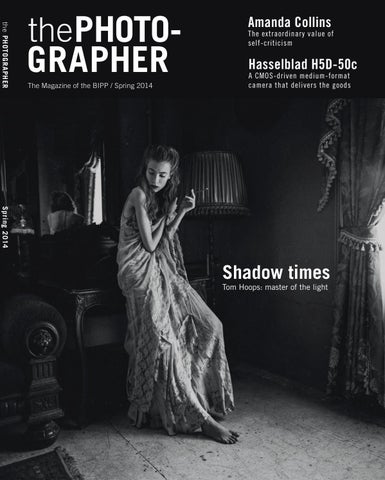
the PHOTOGRAPHER
Amanda Collins
The extraordinary value of self-criticism
Hasselblad H5D-50c The Magazine of the BIPP / Spring 2014
A CMOS-driven medium-format camera that delivers the goods
Spring 2014
Shadow times Tom Hoops: master of the light
TP-2014-SPR OFC.indd 1
04/04/2014 11:23
7KH DOO 1(: (/& 3UR +'
3KLOLSSH (FKDURX[
ZZZ HOLQFKURP FRP
(YHQ IDVWHU UHF\FOLQJ IURP Z V WR Z V (YHQ VKRUWHU ÁDVK GXUDWLRQV (YHQ PRUH DFFXUDWH FRORXU DQG H[SRVXUH (DV\ WR XVH 2/(' GLVSOD\ DQG FRQWUROV 1HZ ÁDVK PRGHV 6HTXHQFHG 'HOD\HG V\QF 6WURERVFRSLFF ([WUDRUGLQDU\ SHUIRUPDQFH ZLWK DOO WKH WUDGLWLRQDO (OLQFKURP ZLGH IHDWXUHV DQG EHQHÀWV IRU 3URIHVVLRQDO 3KRWRJUDSKHUV :RUOGZ
TP-2014-SPR IFC.indd 2 %,33 LQGG %,33 LQGG
04/04/2014 11:23
Spring 2014
The Editor / Comment 2 The Photography Show gets it right at the inaugural event Cover story / Tom Hoops 4 Known for his love of the dark side in lighting terms, we find that there’s much more to one of the most talked about photographers today
Hasselblad H5D-50c 16 CMOS sensors come to the mediumformat party, offering a new world of improved speed and flexibility. Could this be the development that causes you to make the jump? Amanda Collins 26 Over this and the next few issues, we’re following Amanda on her journey of creative and technical development and learning
BIPP / News from the Institute 36 Company partners, benefits, honorary fellowships, events coming up across the UK and major qualifications news New model mayhem 44 What was hot at The Photography Show, from cameras to tripods, from lenses to lighting, all the way to Dropbox on a camera… The Years of La Dolce Vita 54 The original ‘paparazzo’, Marcello Geppetti photographed a unique era of Italian society. We take a peek into his world Business / Expenses 62 Get on top of the ins and outs of business
the Photographer is published four times a year by the British Institute of Professional Photography, The Coach House, The Firs, High Street, Whitchurch, Aylesbury HP22 4SJ. T: 01296 642020 E: info@bipp.com W: www.bipp.com President: Roy Meiklejon FBIPP Chief Executive: Chris Harper FBIPP Directors: Russell Baston Hon FBIPP, Kevin Pengelly FBIPP, Graham Rutherford FBIPP, Frank Tomlinson FBIPP
Membership Services Advisory Board Suzi Allen LBIPP (South West) Russell Baston Hon FBIPP (National seat) Tony Freeman Hon FBIPP (National seat) Richard Mayfield FBIPP (Yorkshire) Alan McEwan Hon FBIPP (Scotland) Ian Pedlow LBIPP (Northern Ireland) Kevin Pengelly FBIPP (South East) James Russell LBIPP (North West) Graham Rutherford FBIPP (National seat) Malcolm Sales ABIPP (Midlands)
Frank Tomlinson FBIPP (National seat) Kevin Weatherly LBIPP (North East) Bella West FBIPP (National seat) Stuart Wood FBIPP (National seat) Editor: Jonathan Briggs, editor@bipp.com Advertising: Tel 01296 642020 Email: media@bipp.com UK Subscribers £20, EU £40, Rest of the World £50 ISSN: 0031-8698 Printed and bound by Magazine Printing Company, Enfield
Neither the British Institute of Professional Photography (BIPP) nor any of its employees, members, contractors or agents accepts any responsibility whatsoever for loss of or damage to photographs, illustrations or manuscripts or any other material submitted, howsoever caused. The views expressed in this magazine are the views of individual contributors and do not necessarily represent the views of the BIPP. All advertisements are accepted and all editorial matter published in good faith. The Publisher makes no warranty, express or implied, that any particular product or service is available at the time of publication or at any given price. No part of this publication may be reproduced by any means whatsoever, or stored in a retrieval system, or broadcast, published or exhibited without the prior permission of the publisher. This magazine is the copyright of the BIPP without prejudice to the right of contributors and photographers as defined in the Copyright, Designs and Patents Act 1988. All rights reserved. Registered at Stationers’ Hall, Ref B6546, No. 24577. © BIPP 2014
Spring 2014 / the PHOTOGRAPHER 1
TP-2014-SPR Contents-p01.indd 1
04/04/2014 11:24
TP-2014-SPR IBC.indd 3
04/04/2014 11:27
The editor / Comment
A big show success F
uture must have – on some level – been wondering whether their gamble on the continuing appetite for a large-scale photography show would pay off. The fact that the only complaints I heard about anything over the four days at the start of March were that the carpet was rubbish and it was hard to get hold of parking passes means there were many happy exhibitors. It was a great success and somehow had a different vibe than its predecessor, but it wasn’t without its curiosities. First off comes the official visitor figures. Future says that 30,134 people made it to the event and that’s a good few thousand short of Focus’ 2013 numbers and yet it not only seemed busier in a broad brush sense, but exhibitors large and small felt it was a very well-attended event. There’s a number of factors at work here: the overall stand floor space was smaller; and Future inserted numerous live stages and theatre areas. However you’d think that the latter would have a negative impact on the feeling in the aisles and on the stands, but no. The live stages, living garden and all, plus pro and student conference days all coexisted with ease. But they must have cost an arm and a leg. It all goes together to form an interesting equation that makes you wonder if Future made any money out of year one. Year two will move to a bigger space and also shifts almost a month later in the calendar, taking place from
The Photography Show at Birmingham’s NEC was a bit of a punt for organiser and exhibitor alike – but the crowds they did come 21-24 March. It’s possible some professional photographers might be told by their accountants to go and spend some money before the tax year-end… but it’s more likely this is just enforced by availability at the NEC. So the format was different and that had two particular implications. On the one hand, with a pro conference and even a pro-only hour early on two mornings, there’s no doubt that there were more higher-end professional photographers visiting. The pro-only hour was a complete waste of time, though, with everyone having to get up an hour earlier to stand around drinking coffee whilst gazing hopefully at the one or two visitors drifting by – I’m sure Future will learn from that and realise incoming ideas need a bit of sifting… On the other hand, it was undoubtedly and simultaneously more of a consumer show than the years that have gone before. It’s neat, of course, that Future has no problems with it being so. The fact of the matter is that the bulk of photography-related sales will be in the consumer marketplace and if anything they can be applauded for hitting a sweet spot – creating an event that offers up reason for proper professionals to rock up whilst not having to claim that it’s a trade show. Now that the photography event in the UK is owned by a multinational Plc it’s free of the shackles and politics that went before – and that can only be a good thing for photographers and it must mean properly ‘special’ show prices on kit in years to come. At the professional end at least, The Photography Show did boast some new equipment being launched at the event. There’s more detail in the full Show round-up later on in this issue but Nikon did at least have the D4s on display, ahead of it going on sale in the UK and coming a week after
2 the PHOTOGRAPHER / Spring 2014
TP-2014-SPR Comment p02-03.indd 2
04/04/2014 11:24
the official launch, and also the retro-styled Df about which Hiro Sebata, Product Manager at Nikon UK, said: ‘The concept for this camera was based on the emotion of photography and will appeal to passionate photographers who enjoy pure photography and cherish their cameras, as well as their images, old and new.’ Put those comments in the context of this being a 16.2mp full-frame camera costing £2,499 with a lens and you realise really quite perfectly what The Photography Show is actually all about, and why it will work in years to come. Its predecessor, Focus on Imaging, had come into being a quarter of a century back as a trade exhibition and survived as such because it managed to fudge the issue of what it actually was, year after year. It just went with the flow. Future, however, can just plump for the reality of the market and what photography truly represents in the UK right now and offer up a show experience to suit. This is nothing new – in the analogue days, volume film sales to capture birthday parties financed development of pro products – and so it is today. In a mature market – a term that can be used to describe
digital photography nowadays – the same holds true. In other words… money talks and changes hands – for example, never have I seen so many people in one place buy higher-end Canon printers. It was stunning. The reason? On the day, at the event, they were cheap and you could just about get the box under your arm. End of story. There’s life in the photography industry, that’s for sure. Don’t expect rapid product development from the big hitters in our world, but do just use the simple opportunity that The Photography Show offers to look at lots of different stuff all at the same time all in the same place. Jonathan Briggs, editor
Spring 2014 / the PHOTOGRAPHER 3
TP-2014-SPR Comment p02-03.indd 3
04/04/2014 11:24
TP-2014-SPR Hoops p04-15.indd 4
04/04/2014 11:24
Another dimension Unconventional subjects and dark moods have given Tom Hoops the epithet ‘unique’ in the fashion world. But he’s no photography diva – the man is modest, straightforward, and insists he’s no miracle worker
T
here are some common themes running through the much-admired work of photographer Tom Hoops. The most obvious is his use of shadow. Less immediate perhaps is the really excellent framing, composition and posing of his subjects; the angles created in the pictures. Altogether he creates a consistency of drama, a kind of hanging sense of anti cipation you can almost taste. It’s not often that we get the chance to really talk about images – simply because it’s unusual to find much depth to discuss, and there’s nothing worse than lofty wafty nonsense. But here, with Tom’s work, it’s a chance to get into the experience of viewing a photograph. Start with the picture, left: there’s the strong shadows which characterise Tom’s work but more than being an ID this approach offers us a fully 3-D route in. Note the oppositions going on: the extension of the fingers downwards and the neck up and away; note the symmetry of the forearms and then the way the finger nails drag our eyes over the shoulder. Don’t go on workshops to learn
Image © Tom Hoops
TP-2014-SPR Hoops p04-15.indd 5
g
Spring 2014 / the PHOTOGRAPHER 5
04/04/2014 11:24
g
6 the PHOTOGRAPHER / Spring 2014
TP-2014-SPR Hoops p04-15.indd 6
composition – look at this instead and work it out for yourself. All of this is no accident or chance result of banging out a hundred frames. It’s thought about and planned, tried and tested. Everything in that image exudes length of form right down to the pleats in the dress. Yes, Tom has a team, but also he’s the centre of it. These days Tom Hoops is based in Bangkok, Thailand, but distance from the West has not stopped him becoming one of the most watched, talked about and followed photographers working today. He ended up in Asia when he took a job out there as a designer and it was only years after that he swapped to photography. He says: ‘I was working in design and then began working for just one client on a regular basis and I was doing quite boring stuff like purchasing and logistics and it wasn’t really for me at all. You know originally I wanted to paint and so I thought I’d quit and do that. I borrowed someone’s camera and it was supposed to be used to take pictures of subjects to then paint – but I still haven’t taken any pictures of anyone to paint…’ Tom’s work was raw street portraiture at the outset – and he considers it some of his strongest – but he was also very aware that it’d be difficult to market: ‘I would get a few portrait jobs and that was alright but where I’m based is not ideal for that kind of style – it’s a bit too strong. The aesthetic in Asia is all bright and commercial and so I became aware early on that if I wanted photography to be my profession I had to make that strong, raw portraiture more commercially viable.’ Have his art and design roots made him a different g All images © Tom Hoops
04/04/2014 11:25
TP-2014-SPR Hoops p04-15.indd 7
04/04/2014 11:25
TP-2014-SPR Hoops p04-15.indd 8
04/04/2014 11:25
g
Image © Tom Hoops
TP-2014-SPR Hoops p04-15.indd 9
kind of photographer? ‘Probably in terms of composition and perhaps it has given me a different eye but I really hesitate to say one way or the another. Maybe I have a lot of patience. We’re bombarded with photography in the modern world and in some ways it’s better to switch yourself off and follow your own creativity – in other words, producing work that you are really happy with and that you feel strongly about. That’s what I hope I have done.’ Tom is entirely self taught and when he decided this was really what he was going to do he bought a cheap Nikon camera with a 50mm lens. He says: ‘I told myself I’d pay off the investment in the second-hand camera before I bought any more gear. So I made do. I committed to not spending a fortune on gear. I might have had a crappy old body and lens but I needed to make that work, thinking about what I was doing rather than what I didn’t have. Artistically it’s very easy to make up excuses for why you can’t do this or that. I shot some strong frames of a ginger model and they got me some recognition. Then you work along – I did a couple of commercial shoots and the path started to open up a bit before me. It would have been nice to be around and working 60 years ago though… You’d have a lot less competition and more opportunities to do interesting things. You’d go off and shoot in Africa and India and it could be the first time people had seen those worlds. It’s a thing isn’t it? Everything’s been done a thousand times and so that first mystery has gone – I would have liked that potential for exploration artistically.’ And in contrast, what does Tom think about the cult of ‘celebrity’ photographers, known for being known it would seem, rather than for doing much work? He comments: ‘I’m not mad on social media for a start. On a working basis in the fashion and editorial genres there’s little leverage from it unless you are super popular, and you’d hope you become super popular thanks to the images you’ve produced rather than the number of followers you have or what you say on Twitter. I want my work to be my marketing and yes I use social media as a channel to engage with people all over the world and the network it creates is fantastic, but a photographer’s work is not the best because they’ve been on TV, right?
g
Spring 2014 / the PHOTOGRAPHER 9
04/04/2014 11:25
g
It’s also worth realising that there’s quite a difference between some of the work that’s popular on-line and what’s being produced and used commercially in fashion and editorial.’ So what comes first in the creative workflow? The designer in you and the use of the picture, or the pure photography? ‘Of course I am thinking about where copy is going and the position of people in the frame – the nuts and bolts of the brief is up there, but primarily I want to get something interesting from the subject. If I have the choice, I want to choose the right subject and not try to get something from them, but if it’s the job to shoot that particular person then it’s about trying to connect with that person and find something interesting. This is why your focus in your head should be the subject, not the lights. You can’t be thinking about the lights and camera and making it look beautiful. Your concentration must be on the person in front of you. Everyone is different, models and actors, the more successful they are the easier it is for you as they will tend to know themselves. If you’re trying out models who have just started working it is going to be more difficult – they don’t have the experience to know what they do best yet. Therefore, as you get better everyone you work with should be better.’ With his ‘dark’ style of work has come an expectation that Tom has that kind of character to match. Is he a real director/dictator on a shoot? ‘No, not at all,’ he says. ‘I am the director but of a team. I need everyone to look towards the same vision as me, and in that sense I am very direct about what I want – I have to communicate it otherwise it’d be hopeless. But with the subject I like to let them do their thing. In fact, I am (hopefully) quite good fun when working. I’m not Marylin Manson with a camera, we make everyone as relaxed as possible. I will meet people before a shoot, spend an evening and have dinner so they know me before they work with me.’ Tom is also very aware that no photographer can take success for granted: ‘I read something when I first started out, it went: “As quick as you get into the industry you get out.” There’s an element of truth in that statement. There are styles that become super popular 10 the PHOTOGRAPHER / Spring 2014
TP-2014-SPR Hoops p04-15.indd 10
g Image © Tom Hoops
04/04/2014 11:25
Spring 2014 / the PHOTOGRAPHER 11
TP-2014-SPR Hoops p04-15.indd 11
04/04/2014 11:25
TP-2014-SPR Hoops p04-15.indd 12
04/04/2014 11:25
g
All images © Tom Hoops
TP-2014-SPR Hoops p04-15.indd 13
super fast but they don’t last. Simplicity, perhaps, will provide you with more time. For example, when people really understand photography they look at HDR images and say “God it’s horrible”. So maybe that’s why I like shooting film, the beauty and simplicity, but I know not everyone will see it. Take Richard Avedon… It looked great then, it looks great now and will look great in 50 years’ time. It’s like a pair of blue jeans.’ Tom happily admits that he’s not particularly into the technical side of photography: ‘With lighting I’ll mix it up and try new equipment and experiment. My favourites are HMI film lights. But most of the time I’m super simple – one light bounced around or one and a fill; maybe occasionally a third might come in. I reckon if there’s amazing natural light then use that. Having said all of this, I do know what I’m doing a little bit. But my point is… if your main focus is the technical,
g
Spring 2014 / the PHOTOGRAPHER 13
04/04/2014 11:25
g
you lose the artistic and it’s nothing. Some people get stuck in a rut and open their wallets to unstick their creative roadblock – it never works. The big reason why they don’t fulfil their potential is fear. I don’t do anything different to anyone else and I’m quite happy to share what I do and talk about the stuff I’ve learnt along the way. My workflow isn’t at all unusual. What I do is experiment a lot.’ Tom normally runs a couple of workshops a year. He comments: ‘I started because people ask me lots of questions and seem to want an avenue. But believe me I am constantly surprised as to where I have got to considering I began only seven years ago. People come to my workshops who have been shooting a lot longer than I have. The fact is I can only give what I have learned myself. I almost want to say “why are you
14 the PHOTOGRAPHER / Spring 2014
TP-2014-SPR Hoops p04-15.indd 14
asking me?” I do tell people they aren’t going to get anything ground breaking. It’s never that it’s a new type of camera or special technique that’s top secret. It’s always something about a particular way of seeing a subject. There are only so many ways to retouch skin but everyone will develop their own look and feel and get a different result. The same goes for photography and styles. It also surprises me that people have certain perceptions of you as a person based on the type of work you produce. You can put your personality into a photo, but me… I’m just normal of course!’ tP www.tomhoops.com
All images © Tom Hoops
04/04/2014 11:25
Summer 2012 / the PHOTOGRAPHER 15
TP-2014-SPR Hoops p04-15.indd 15
04/04/2014 11:25
The best of both worlds? Think that medium-format can’t be for you because you don’t spend all your time shooting in controlled conditions? Hasselblad thinks it has the answer by moving to a CMOS sensor with its H5D-50c to provide a faster and more flexible user experience. We took an early test drive to find out if they’re right
J
ust when you thought you had a handle on technology, along comes Hasselblad and changes everything up. It’s a major technologic shift we’re going to be talking about here, so listen up.
The background Our basic understanding of the 35mm versus mediumformat question was in part resting on the assumption that professional 35mm digital camera bodies use CMOS sensors whist medium-format bodies use CCD sensors. If you think about what’s been going on in the land of professional D-SLR body development in the last few years it’s all been about size and speed. Size is quite easy to get your head around: the bigger the sensor in terms of megapixels, the bigger the physical size of the resulting image relative to resolution. We’ve seen the flagship D800 from Nikon give us more than 36mp. Then turning to speed we have to think about frames per second linked to how many frames can be shot in a continuous burst. In other words how fast the processor can off-load the data to the card is key. Add high ISO
g
16 the PHOTOGRAPHER / Spring 2014
TP-2014-SPR Hasselblad 50c p16-25.indd 16
04/04/2014 11:25
Spring 2014 / the PHOTOGRAPHER 17
TP-2014-SPR Hasselblad 50c p16-25.indd 17
04/04/2014 11:25
2x zoom-in
Blond hair like this is a great example of where the extended dynamic range of medium format digital really shines: highlights, shadows and everything in between all beautifully rendered by the H5D-50c
18 the PHOTOGRAPHER / Spring 2014
TP-2014-SPR Hasselblad 50c p16-25.indd 18
04/04/2014 11:25
g
capability into the game too. Stick all of this together and there are models such as the Nikon D4s that can shoot 11 fps on a CMOS sensor that’s 36mm x 23.9mm and do it basically in the dark. OK. Turning to our original ideas of CCD-based medium-format bodies we could compare this situation with a Hasselblad H4D-50, for example. Its CCD sensor is a massive 40.2mm x 53.7mm but it’s capable of 33 captures a minute… and a maximum ISO of 800. Right, we get the difference yes? Now for some more depth… what, more? What’s there to know? Both CCD and CMOS image sensors begin with the same job to perform: they are there to convert light into electrons. One approach to thinking about the sensor used in a digital camera is to think of it as having a 2-D array of thousands or millions of tiny solar cells, each of which transforms the light from one small portion of the image into electrons. In a CCD (charge-coupled device) sensor, every pixel’s charge is transferred through a very limited number of output nodes to be converted to voltage, buffered, and sent off-chip as an analogue signal. All of the pixel can therefore be devoted to light capture, and the output uniformity is extremely high. In a CMOS (complimentary metal-oxide semiconductor) sensor, each pixel has its own charge-to-voltage conversion going on, and the sensor includes amplifiers, noise-correction and more to make the chip output digital bits. This reduces the area available for light capture – because each pixel on a CMOS sensor has several transistors located next to it, the light sensitivity
of a CMOS chip tends to be lower, with many of the photons hitting the chip on the transistors instead of the photodiode. With each pixel doing its own conversion, uniformity is lower. Described in layman’s terms, a CCD sensor will generally be ‘seeing’ considerably more of the light information coming at it from the lens than a CMOS sensor. Taking all of the above into consideration it’s not difficult to understand why medium-format camera systems cost a great deal of money and in return offer a level of image quality that is still unmatched by even the biggest and best 35mm D-SLRs: the sensor is much bigger and it’s better at seeing what you point the camera at. It’s additionally capable of ‘seeing’ more differences between levels of tone (dynamic range) – commonly expressed in stops, a medium-format digital body will have around 12 f-stops of dynamic range against a D-SLR’s six or seven. When understanding this, think of dynamic range as building blocks forming a curved wall. More blocks means smaller blocks and that equals greater and smoother detail. See ‘zoom-in’, left. The trouble is that CCD-based medium-format systems have issues that often prevent many potential users from making the jump up (beyond price, we might add). One is obviously shooting speed – it might sound silly but in practice our H4D-50 example with a maximum frame rate of 1.1 seconds per capture will feel very slow indeed to most D-SLR users. Then there’s ISO – where that model is limited to 800 at the top end, compared to the latest D-SLRs with hugely expanded ISO ranges. Finally there’s battery life, as CCDs use more power than CMOS sensors. The solution? Hasselblad comes along with a new model – the H5D-50c – a digital medium-format body that’s got a 50mp CMOS sensor inside. A-hah… So what’s this all for? It’s aimed squarely at solving the medium-format ‘problem’ we all understand nice and clearly thanks to reading the above. Hasselblad claims that the new camera solves these issues whilst retaining the stand-out quality the brand is known, for so let’s examine the elements one by one.
g
Spring 2014 / the PHOTOGRAPHER 19
TP-2014-SPR Hasselblad 50c p16-25.indd 19
04/04/2014 11:25
g
Size: it’s a 50mp sensor and that in Photoshop terms equates to 8,272 x 6,200 pixels. Think in the real world of 70cm x 52cm at 300ppi straight off the bat. This kind of file size allows a photographer to service just about any possible imaging demand. There’s a reason that much of the advertising photography world demands medium-format capture… this is it. Quality: interestingly, Hasselblad tells us that the 50c has actually got an even bigger dynamic range than its sister H5D-50 with a CCD sensor, boasting 14 f-stops’ range. This has practical benefit in terms of even more impressive shadow and highlight detail and smoothness of contrast edges, plus quite astonishing capacity for a file to be pulled and pushed about in post-production. We know this for real because this image was shot with a pre-production 50c body, shortly before the full production versions were due to be available – so this is not marketing speak but actual experience. Yes, we loved the results taken simply with a straight forward two-light set-up, a model and a backdrop. In short, despite the switch to a CMOS sensor with all the expected issues that should bring, the medium-format quality difference is there for all to see. There’s just no way you could get close to this with a 35mm D-SLR. The quality effect is a great deal to do with the sensor performance, but the role of Hasselblad’s True Focus system should not be overlooked. It operates as follows: decide on your desired focus point (for example, the eye), press the True Focus button rather than pressing the shutter release half-way down as you would normally do to trigger the AF; the camera locks on; you’re now free to recompose the image whilst maintaining razor-sharp focus. Obviously you or your subject can’t move forwards or backwards,
g
Our ‘first look’ at the H5D-50c was on a pre-production body, but its performance was flawless
20 the PHOTOGRAPHER / Spring 2014
TP-2014-SPR Hasselblad 50c p16-25.indd 20
04/04/2014 11:25
Spring 2014 / the PHOTOGRAPHER 21
TP-2014-SPR Hasselblad 50c p16-25.indd 21
04/04/2014 11:25
2x zoom-in
Dynamic range plays a major part here, determining the number of ‘levels’ of tone the sensor can ‘see’ and hence use to build an edge from shadow to highlight
Another radical ‘zoom-in’ to show the quality and smoothness of the contrast edge, entirely free of anything that shouldn’t be there… 22 the PHOTOGRAPHER / Spring 2014
TP-2014-SPR Hasselblad 50c p16-25.indd 22
04/04/2014 11:25
2x zoom-in
Two ends of the tonal scale in one segment of a frame. Having lots of room to render each is where medium format excels
Spring 2014 / the PHOTOGRAPHER 23
TP-2014-SPR Hasselblad 50c p16-25.indd 23
04/04/2014 11:25
g but the system is extremely good at calculating the change in camera position in terms of its swing up and down or side to side around you or a tripod as a central pivot point. We had a good old go at tricking it, but to no avail! That takes us neatly on to frame rate.
Speed. The H5D-50c offers a much faster FPS number coming in at 1.5 captures per second. In reality, that’s a perfectly good working speed for portraiture or fashion and whilst testing the 50c we ran a long burst of continuous shooting in this way and it was more than up to the job. What’s more, you can lock on the True Focus once and with a good model running through numerous pose changes but not switching position forward / backwards, effectively capture a long burst of frames. So in general, this new model does offer much greater flexibility in practical use from the speed viewpoint. That takes us to the hypothetical question ‘could I use it for a wedding?’ Certainly. As described, the possibilities are in fact endless. Then there’s high ISO capability. The 50c takes big strides and now offers up to 6400 ISO. Its lower noise levels also bring advantages such as being able to support exposures of up to 12 minutes and shutter speeds up to 1/800 sec. Our testing of this side of the 50c’s abilities were limited to some non-studio conditions in Calumet’s Drummond Street store – in fact rather a good ‘really awful light’ workout. The 50c performed extremely well in its brave new world of higher ISOs with a likeable grain structure and none of the ‘chroma’ effect – where the pixels get so smooth the image looks unreal – that
H5D-50C KEY FEATURES AT A GLANCE •
50 Mpixel CMOS sensor with almost twice the physical size of the largest 35mm D-SLR sensor.
•
Excellent high ISO performance: shoot at up to ISO 6400 and still produce crisp clean images with perfect colours both on location or in the studio.
•
High dynamic range (up to 14 f-stops) for improved detail in shadow and highlight areas.
•
Longer shutter speeds (up to 12 minutes).
•
Faster capture rate: 1.5 frames per second.
•
Live Video in Phocus with higher frame rate.
• True Focus auto-focus system with Absolute Position Lock and camera controls. •
Options for working with tilt-shift.
•
GPS recording flexibility.
you commonly find with extreme ISO use on 35mm D-SLRs. At the end of the day All things considered, we were very impressed by the H5D-50c. It’s a new game in medium-format land and it would seem that Hasselblad has taken hold of the CMOS platform’s advantages and kept its disadvantages at bay. In this instance, being pre-production, we were only able to use one of our own test-shot images here in the magazine. A full test day of free shooting is promised in due course and therefore a more expansive hands-on report covering a range of imaging situations will have to feature in a future magazine. But for now, this is a new and very useable standard. tP
24 the PHOTOGRAPHER / Spring 2014
TP-2014-SPR Hasselblad 50c p16-25.indd 24
04/04/2014 11:25
TP-2014-SPR Hasselblad 50c p16-25.indd 25
04/04/2014 11:25
Different strokes Through the process of joining the BIPP and attaining her licentiate qualification, Amanda Collins put in a great deal of hard work and effort – and it was only then that she came to the conclusion that something was still missing. In the first part of a series of articles looking at Amanda’s continuing professional development, we find out what the missing piece turned out to be
W
hy should I join the British Institute of Professional Photography? It’s a question that we’re asked a great deal – sometimes with a cynical accompanying tone. The qualifications system forms the cornerstone of the natural answer and it entirely quantifiable and real. But then, ‘why do I need qualifications’ is the next question in the common conversation and as an organisation we can talk of representing quality and benchmarks and so on, but the more subtle element is about You The Photographer. CPD stands for Continuing Professional Development and it doesn’t sound very sexy or creative, more for doctors or lawyers who need to know stuff, yes? But put another way, in terms of continuing to develop as a professional and the qualification structure from top to bottom offers a route to enrich and enlighten your photography – taking you places you’d never have gone otherwise. This is what Amanda Collins grabbed with both hands, bringing a variety and sensitivity to her photography – and commercial success – that was
g
26 the PHOTOGRAPHER / Spring 2014
TP-2014-SPR Collins p26-35.indd 26
04/04/2014 11:25
Image © Amanda Collins Spring 2014 / the PHOTOGRAPHER 27
TP-2014-SPR Collins p26-35.indd 27
04/04/2014 11:25
far beyond what had gone before. Along the way she discovered what it was that would get her out of bed of a morning and would trigger future creative journeys that themselves are only just beginning. Does this all sound a little fluffy to you? Hang on… because it’s entirely real. With a studio in Billericay, Essex doing social portraiture, business was ticking along but Amanda was quite aware that it was just that – ticking along. She booked to have a portfolio review – as it turned out with Chris Harper – and she says: ‘The feedback was genuine and not entirely positive. But I told myself after a bit of an eye-widening moment “you came here to be critiqued so you better take it on board”. However it was hard. The key part, though, was that Chris got me looking at my work myself. Rather than being told that this or that element could be improved or changed and just leaving me a big long list, I was encouraged to engage with my own photography and literally think back at myself. This was the beginning of a huge change in my self-awareness.’ Amanda spent 18 months working towards her Licentiate: ‘It was a major task for me, getting a handle on everything that was wanted, but looking back at the process I feel it was very rewarding. The level of help and mentoring that is part and parcel of the BIPP qualifications system is actively pushing you forward, and the trick is that you begin forging your own path and wanting more for yourself. You want to be producing a higher level of work and you want to achieve recognition. I think that getting onto this path really got me out of a professional rut.’
Image © Amanda Collins
g
g
28 the PHOTOGRAPHER / Spring 2014
TP-2014-SPR Collins p26-35.indd 28
04/04/2014 11:25
Image © Amanda Collins TP-2014-SPR Collins p26-35.indd 29
04/04/2014 11:25
‘The feedback was genuine and not entirely positive. But I told myself after a bit of an eye-widening moment “you came here to be critiqued so you better take it on board.”’
30 the PHOTOGRAPHER / Spring 2014
TP-2014-SPR Collins p26-35.indd 30
04/04/2014 11:25
Image © Amanda Collins Spring 2014 / the PHOTOGRAPHER 31
TP-2014-SPR Collins p26-35.indd 31
04/04/2014 11:25
Image © Amanda Collins TP-2014-SPR Collins p26-35.indd 32
04/04/2014 11:25
Image © Amanda Collins
g
Ideas of the kind of photographer Amanda wanted to be came to a head once more whilst visiting the SWPP Convention: she was perusing some of the Awards entries on the walls of the hotel lobby and found herself again thinking about photographic styles and the difference in our perceptions of one picture over another. ‘It was then that I had a bit of a moment and many of the subtleties of Chris’ help and advice clicked in to place. It was like I had been limiting myself up until that point, working in certain ways because that’s what I thought the market and the genre demanded. I decided there and then that I could vary my style, expand my work and find ways of expressing what my mind’s eye wanted to see come through in the captured images.’ All this is strongly linked to the fact that Amanda originally studied fine art and her thing was painting
portraits. It was by rediscovering her artist’s eye and natural feel for structure and pose, lighting and form that opened up a world of possibilities. ‘I said to myself “this is what’s been missing – my art”.’ She continues: ‘At the end of the day, no matter your location, portraiture is a really saturated market and you tend to think straight down the line and set out working just like everyone else, going with the flow, white backgrounds and all. So I took a big risk – it felt like that to me – and decided to branch out, following my own sense of what I wanted in pictures, how I might set the tone and atmosphere of a frame.
g
Spring 2014 / the PHOTOGRAPHER 33
TP-2014-SPR Collins p26-35.indd 33
04/04/2014 11:25
Image © Amanda Collins 34 the PHOTOGRAPHER / Spring 2014
TP-2014-SPR Collins p26-35.indd 34
04/04/2014 11:25
g It didn’t happen over night, but I began the process and
simply because I am now willing and able to criticise myself and push on with challenges I set out for myself. It’s a virtuous circle and that’s being recognised by my client base.’ The immediate future looks bright for Amanda. There’s talk of personal projects and she’s actively working towards her Associateship. If there’s any one reason why the sea-change in Amanda’s photography has come about it’s the following: it’s attentive, has depth of feeling; and therefore it means something to the photographer behind the lens. tP www.amandacollinsphotography.co.uk Image © Amanda Collins
personally committed to it.’ And the result? ‘Business has grown considerably. I’ve moved to bigger studio space in Chelmsford and that location gives me a larger local market too. You can’t necessarily tie down the commercial changes to one decision or action but it’s certainly part and parcel of the process I’ve been moving through. I think I’m now producing the kind of work that sits on walls better – and if you think about it that’s going to make a big change commercially. In today’s “digital everything” world you have to be recognisably producing pictures that have a depth of skill and thought within them. Otherwise, anyone can do it and it’s just filler. But I hope I can get across that being part of the BIPP and using the qualifications and mentoring system has given me confidence in myself – quite
Spring 2014 / the PHOTOGRAPHER 35
TP-2014-SPR Collins p26-35.indd 35
04/04/2014 11:25
BIPP / Company partners
Hasselblad has been synonymous with photography since its earliest days. But it was Victor Hasselblad’s invention of first the 1000 and then the 500 series in the 1950s that turned a camera into an icon. Here in a small, robust, rectangular box was an unrivalled combination of camera reliability and image quality. Such was the lead that it had over its competitors it became the choice for NASA’s space programme. Edwin ‘Buzz’ Aldrin’s shots of Neil Armstrong, the first man on the moon, were taken with a Hasselblad 500EL/70. The same relentless pursuit of excellence motivates Hasselblad in the digital age. Today they are the authors of the world’s most advanced medium format digital system and the owners of a truly global brand. Photographers who want to excel in their craft can now get their hands on a Hasselblad in 75 countries. Hasselblad H5D-50c Studio Days • 30 April 2014 – Calumet, Manchester – 10am-4pm • 7 May 2014 – Dale Photographic, Leeds – 10am-4pm • 28 May 2014 – AGMD Photography, Leith, Edinburgh – 10am-4pm An opportunity to get ‘hands on’ with the new H5D-50c CMOS camera, a game changing camera that offers medium-format quality with low-light sensitivity and longer exposures. Drop in at any time during the day, there’ll be a studio and model available for your test shots. Visit www.handsonahasselblad.com and click on ‘Events’ and also see our first test drive article in this issue.
36 the PHOTOGRAPHER / Spring 2014
TP-2014-SPR BIPP p36-43.indd 36
04/04/2014 11:25
BIPP / Partner news
Shoot, Upload, Sell! Beautiful web sites for photographers with online sales, proofing, sales tools and Wordpress blog. theimagefile is the UK’s award-winning image management web solution. Designed by photographers specifically for photographers to display, proof and sell images online. Quite simply they offer you a cost-effective, cashgenerating solution for your business. The solution goes way beyond just getting your images elegantly online for sale or distribution. theimagefile is the complete web strategy for the professional image-maker with a wealth of advanced functionality and services, constantly being updated, to help you save time and help your business grow. BIPP Members receive a £5 discount on ‘theimagefile’ professional subscription fee. www.theimagefile.com
‘Orbit is game-changer. It has great potential for almost all users of D-SLR/mirrorless cameras and small/medium camcorders and is perfect for smaller production companies too.’ – Tim Haskell, Business Development Manager Bowens International is set to launch Comodo Orbit, a groundbreaking camera stabilisation device designed to provide photographers and cinematographers across the world with a radical new ‘single shot’ cinematic option. Orbit, the brainchild of multi-award-winning Dutch film director Leonard Retel Helmrich, enables users to shoot a scene in a single take using just one camera moving ‘fluidly – almost like flying – around the subject’ and has been developed by Bowens to spearhead its Comodo camera rig and grip range. The new device, which incorporates a unique patented twin-grip capability, allows users to move freely with the action, allowing seamless access to places previously considered impossible with other support systems and creating a totally exclusive viewer perspective. Orbit will retail at £999 (inc VAT).
BIPP Qualification Blocks – New stock in! Our acrylic Qualification Award blocks are available for qualified BIPP members to purchase online. Display them in your studio, office, trophy cabinet or on your mantelpiece, take them with you to your next wedding fair or promotional show – wherever they will be seen by potential clients! Promote your achievements, your BIPP qualification and your status as a professional photographer, while
raising the profile of your profession. The awards are available to BIPP Qualified Members ONLY, who must hold the relevant qualification and all online orders will be confirmed before the blocks are posted. There are three options for you to choose from: Licentiateship (7x5) £40; Associateship (8x6) £45; Fellowship (9x7) £50 Prices are subsidised by BIPP and include VAT and UK postage & packing. Visit www.bipp.com/shop Spring 2014 / the PHOTOGRAPHER 37
TP-2014-SPR BIPP p36-43.indd 37
04/04/2014 11:45
BIPP / Benefits
CURRENT BIPP MEMBERSHIP BENEFITS INCLUDE:
HMCA are delighted to offer BIPP members and their families a range of medical health cover and related products. Once members subscribe to any of the plans they will automatically qualify for further discounts from the range of loyalty benefits. These include leisure, hotels and magazine subscriptions. Details will be given upon joining and enclosed in welcome packs. If you are already a member of a health plan HMCA offer a unique transfer facility which does not involve an examination and will cover you for any pre-existing condition from the original date of you joining your existing plan. On average, they have been proven to save up to 50% on similar plans. The transition is seamless with no break in medical cover or moratoriums. You can visit their website for further details – www.hmca.co.uk/bipp.htm or call 01423 866985
STAY IN TOUCH WITH THE BIPP The BIPP website http://www.bipp.com The BIPP Blog www.bipp.com/blog
Amberflare is an Aylesbury-based design company specialising in creative design for a wide range of clients. Whatever your requirements and budget, Amberflare can get your project up and running in no time. With over 20 years’ experience in print, web, exhibition and interior design there is no job too big or too small. Be it a simple business card and branding set-up to a large-scale roll out covering multiple media formats, every project is executed with precision, attention to detail and professionalism. BIPP Members receive a discount of up to 40% off the basic rebranding package. Please call and speak to Lee on 07534 919101 or email lee@amberflare.co.uk Portrait Professional & Smart Photo Editor A time-limited discount is offered for BIPP Members on the first 300 copies of each software package. You will save 57% on any edition of Portrait Pro and if you use the BIPP specific discount code (call BIPP Head Office on 01296 642020), you will receive a further 15% off. Plus you get an extra 25% discount off Smart Photo Editor’s half price offer; a 63% saving! Portrait Professional – www.portraitprofessional.com Smart Photo Editor – www.smartphotoeditor.com Twitter http://twitter.com/thebipp Facebook http://www.facebook.com/thebipp Linked in http://www.linkedin.com
38 the PHOTOGRAPHER / Spring 2014
TP-2014-SPR BIPP p36-43.indd 38
04/04/2014 11:45
BIPP / Awards information
BIPP Awards Schedule BIPP STUDENT AWARDS 2014 Call for Entries: 1 May 2014 Deadline (with NO extension!) 25 July 2014 Prizes will include £500 to the BIPP Student of the Year, coverage in the Photographer magazine and more. Categories • Wedding & Portrait • Commercial • Science & Technology • Visual Arts Open To BIPP Student Members – FREE entry for BIPP Student Members. Non-BIPP Students – If you’re on a photography course of BTEC Level 3 or above and are NOT a BIPP member, you can enter at a cost of £10 inc vat per portfolio. Entries You can enter any category as many times as you like. Each entry should consist of a portfolio of 5 images. So if you wanted to enter twice in the Wedding & Portrait category, you would send in two portfolios of 5 images. The work should be fresh and creative and each set of 5 images must sit together as a portfolio. Entries must be 10x8” or A4 prints, numbered 1-5. A completed entry form must be included with each portfolio. An image can bleed to the edge of the paper or have a thin keyline around, with a white or black border. No other mounting or overlay is required. Any shortlisted photographers will be asked for a high-res digital file after the first round of judging. An image may only be used once within the competition.
Winning Images In each of the categories the judges will search through the portfolios for a shortlist to go forward for two titles: BIPP Student of the Year 2014 Winner, BIPP Student Open 2014 THE BIPP 2014 COLLEGE AWARD Call for Entries 1 May 2014 Deadline (with NO extension!) 25 July 2014 Prize £500 to the winning student BIPP works with several colleges and universities in the UK. If your college is one of them, speak to your Course Leader who has the ability to nominate ONE student from each BIPP Approved or Affiliated Course to go forward for the annual BIPP College Award. With a prize of £500 for the winner, the tutor recommends the student who they feel has excelled during the course and shows the highest standard of work within their portfolio. The tutor sends in the nominee’s printed portfolio to: The BIPP 2014 College Award The Coach House, The Firs, High Street Whitchurch, Buckinghamshire HP22 4SJ The judges will assess each of the portfolios and award ONE prize – the BIPP 2014 College Award. Don’t miss your opportunity to gain valuable recognition for your work and add something very special to your CV – speak to your Course Leader now! PROFESSIONAL PHOTOGRAPHY AWARDS 2014 Call for Entries: 1 July 2014 Deadline (with NO extension!) 30 September 2014 R1 Judging: 8 October; Awards Reception: 3 December Further details will be in the summer issue. Spring 2014 / the PHOTOGRAPHER 39
TP-2014-SPR BIPP p36-43.indd 39
04/04/2014 11:25
BIPP / Regions
Midland Paul Witney ABIPP pwitney@bgs.ac.uk
North East Kevin Weatherly LBIPP kevinweatherly@mac.com
North West James Russell LBIPP james@jamesrussell photography.co.uk
EVENTS & DATES COMING UP
MIDLANDS
NORTHERN IRELAND
Wedding Photography with Kevin Pengelly FBIPP Tuesday 29 April, 7.30pm-10pm Lea Marston Hotel, Sutton Coldfield, B76 0BY
Trevor & Faye Yerbury and Annual Print Competition Monday 14 April, full day New Forge Lane Country Club, Belfast
Kevin is a Fellow in Wedding photography and will be discussing his approach to weddings. Paul Witney ABIPP Tuesday 27 May Lea Marston Hotel, Sutton Coldfield, B76 0BY Following on from the successful Video and D-SLR evening, Paul is returning for an afternoon of practical shooting and an evening demonstrating the principles of editing. This will be a ‘hands on’ day. NORTH EAST/YORKSHIRE Capturing Natural Light in Environmental Fine Art Portraiture with Bella West FBIPP & Chris Harper FBIPP Tuesday 22 July, 10am-4pm Venue details to be confirmed Join two of the most respected photographers in the UK for this day of practical demonstrations and tutorials based around the use of natural light. It’s a day of two halves – Bella will lead on how to achieve beautiful portraits of children and young people and we’ll contrast her style with that of Chris’ visually stimulating fitness photography. Learn the differences between the two styles and discover how similar lighting and backgrounds can be used for two very distinct types of photography. Be less reliant on your kit and the limitations of the camera and use your eye to escape from ordinary images into something much more creative.
This is an amazing opportunity for any member who has never had the privilege to attend one of the Yerbury’s fantastic workshops. The Yerbury studio is one of the UK’s leading studios, and has a recognised reputation for producing classic signature black and white portraits as well as cutting-edge avant garde boudoir photography. SCOTLAND Scottish Region Image Awards Sunday 18 May, Huntingtower Hotel, Perth This competition is open to BIPP Professionals and Students of photography from 4 March until 18 April 2014. Entry details can be found at www. bippscotland.com. Entry costs have been kept the same as last year and we hope for a great level of entries in both quality and quantity. Coming soon! Steve Howdle ABIPP Lighting Workshop Wednesday 22 & Thursday 23 October, Huntingtower Hotel, Perth Steve has agreed to return to Scotland to hold a two-day workshop, with four sessions across the two days. The full programme can be found at www.bippscotland.com
VISIT WWW.BIPP.COM/REGIONS TO BOOK NOW 40 the PHOTOGRAPHER / Spring 2014
TP-2014-SPR BIPP p36-43.indd 40
04/04/2014 11:25
Northern Ireland John Miskelly LBIPP john@johnmiskelly photography.co.uk
Scotland Mike Brookes-Roper FBIPP mike@brookes-roper.co.uk
South East Chris Harper FBIPP chris@bipp.com
South West Suzi Allen LBIPP info@suziallen.com
Yorkshire Stuart Clark Hon FBIPP stuartclarkphotos@ talktalk.net
EVENTS & DATES COMING UP
SOUTH EAST Self Marketing for the Professional Photographer: An Afternoon with Richard Bradbury FBIPP Monday 19 May, 2pm-4pm Wiltshire College, Salisbury The two-hour seminar will cover everything you need to know about ensuring that you control the type and quantity of business coming your way throughout the year. South East Regional Awards Call for Entries Monday 2 June This year’s South East Regional Awards will open for entries on Monday 2 June. The closing date is Friday 25 July. Full details will be available towards the end of May. Capturing Natural Light in Environmental Fine Art Portraiture with Bella West FBIPP & Chris Harper FBIPP Thursday 5 June, 10am-4pm The Bell Inn, Ticehurst, East Sussex Join two of the most respected photographers in the UK for this day of practical demonstrations and tutorials based around the use of natural light. It’s a day of two halves – Bella will lead on how to achieve beautiful portraits of children and young people and we’ll contrast her style with that of Chris’ visually stimulating fitness photography. Learn the differences between the two styles and discover how similar lighting and backgrounds can be used for two very distinct types of photography. Be less reliant on your kit and the limitations of the camera and use your eye to escape from ordinary images into something much more creative.
Photographic Essay in the Open with Denise Swanson FBIPP Tuesday 12 August, 10am-4pm Upton Broad & Marshes, South Walsham, Norfolk Spend a day recording nature at Upton Broad & Marshes, an area of quiet beauty and wildness located in the Bure Valley of Norfolk. It is protected by the Norfolk Wildlife Trust and supports some of Broadland’s rarest wildlife, from swallowtail butterflies and hawker dragonflies to water voles, otters, and a host of wetland plants. Led by an experienced nature photographer, you will spend the day taking images along river banks and footpaths, so please come dressed for the occasion. SOUTH WEST David & Goliath: Creative Wedding Masters at Work! With Kevin Wilson Hon FBIPP & David Wheeler ABIPP Tuesday 17 June, 10am-4pm Ellenborough Park, Cheltenham Spa, Gloucestershire For the very first time, witness the battle of the giants! Kevin Wilson is known globally for his wedding photography and for the support he gives people coming into the profession. David Wheeler is one of those people. Experienced in other fields but only starting to shoot weddings a few years ago, David has become ‘one to watch’.
VISIT WWW.BIPP.COM/REGIONS TO BOOK NOW
Spring 2014 / the PHOTOGRAPHER 41
TP-2014-SPR BIPP p36-43.indd 41
04/04/2014 11:25
BIPP / Training
BIPP Spring & Summer School Training A great way to broaden your horizons as a photographer – with several different areas of photography covered, the BIPP Spring & Summer schools are aimed at photographers of every discipline – whether you want to learn something new or build upon what you already know. On each day you’ll have the opportunity to head out on a practical shoot, take part in theory sessions and listen in on inspiring talks from your tutor. The schools and training days are held at our training facility in Whitchurch, Buckinghamshire, and each day will begin at around 10am, then conclude between 4.30 and 5.00pm.
BOOK ALL 4 DAYS IN SPRING OR SUMMER & ONLY PAY FOR 3! Head over to www.bipp.com/events to book your place now.
SPRING SCHOOL MONDAY 28 APRIL TO THURSDAY 1 MAY
SATURDAY TRAINING, SUMMER-AUTUMN
28/4 The Key to Creative Weddings with Simon John FBIPP
Training for Friends of BIPP & Non-Members Considering qualified status but not quite ready to take the plunge? Held on weekends, the following training days are led by experienced tutors and are ideal if you’re looking to increase your knowledge and expertise in wedding, portraiture, fine art or commercial photography. Equally, if you are already well practised in a particular area of photography, it’s a great opportunity to learn something new! Starting at 10am and concluding at 4.30-5.00pm, your day will comprise of a practical shoot, talks and theory. These days are intense, but highly rewarding. Head over to www.bipp.com/events to book your spot! BIPP Friends £216 inc VAT; Non Members £240 inc VAT
29/4 Photographing Pets with Paul Walker FBIPP 30/4 Portraiture with Saraya Cortaville FBIPP 01/5 Shooting Artistic Documentary Weddings with David Stanbury FBIPP SUMMER SCHOOL MONDAY 7 JULY TO THURSDAY 10 JULY 07/7 The Basics of Portraiture: from People to Horses with Emily Hancock FBIPP 08/7 Pure Wedding Photography with Kevin Pengelly FBIPP 09/7 Environmental Portraiture of Youth with Bella West FBIPP 10/7 Men are from Mars… with Russell Baston Hon FBIPP & Chris Harper FBIPP
Members BIPP Friends Non Members
£540 inc VAT £648 inc VAT £720 inc VAT
Single Day Bookings Members £180 inc VAT BIPP Friends £216 inc VAT Non Members £240 inc VAT
Saturday 14 June An Introduction to Professional Wedding Photography with David Islip FBIPP Saturday 16 August The Fundamentals of Portraiture with Tina Hadley FBIPP Saturday 6 September Using Light in Fine Art Portraiture with Chris Harper FBIPP & Russell Baston Hon FBIPP Saturday 4 October The Basic Principles of Commercial Photography with Bryn Griffiths FBIPP
42 the PHOTOGRAPHER / Spring 2014
TP-2014-SPR BIPP p36-43.indd 42
04/04/2014 11:25
BIPP / Qualifications news
Looking for a European Qualification in Professional Excellence?
Anthropology and Photography, three-day conference BIPP will be exhibiting at the three-day conference at the British Museum, Clore Centre, 29-31 May 2014, so be sure to come and pay us a visit if you’re attending.
BIPP is running One-to-One Portfolio Reviews to support members who would like to achieve a professional qualification in Europe. To qualify with the FEP you must be a current qualified BIPP member. If you have any queries, please call BIPP on 01296 642020. The next review is – Tuesday 3 June 2014 Remember, these reviews are specifically related to FEP qualifications – not BIPP. Discover more about the FEP requirements, the differences between BIPP and FEP qualifications and the steps you’ll need to take to go forwards in Europe. Important Information • Each portfolio review session costs £30 for Members (inc VAT). • Sessions last up to 60 minutes. • Please bring a selection of your work on a laptop or tablet. • Please note portfolio reviews are non-refundable.
Anthropology and Photography’s aim is to stimulate an international discussion on the place, role and future of photography. Visit www.therai. org.uk/conferences for further details.
BIPP Qualification Assessment Dates If you’re looking to qualify or upgrade your current BIPP qualification, the next Assessment dates are: 10 June 2014 BIPP Head Office, Aylesbury, Buckinghamshire (Submission Deadline 13 May 2014) 5 August 2014 BIPP Head Office, Aylesbury, Buckinghamshire (Submission Deadline 8 July 2014) BIPP Portfolio Reviews – If you’d like to receive further advice before submitting for your Qualification Assessment, our next Portfolio Reviews are on: 21st May, Tattershall Castle, London & 16 July, Shaftesbury, Dorset. For further details on Portfolio Reviews & Qual ification Assessments visit – www.bipp.com/qualify Spring 2014 / the PHOTOGRAPHER 43
TP-2014-SPR BIPP p36-43.indd 43
04/04/2014 11:25
The Photography Show
New model mayhem An unavoidable part of photography is the endless quest to be producing the best you can with the best equipment you can afford. The one-and-only place to cover your bases was The Photography Show at Birmingham’s NEC. Here’s a round-up of the main movers and shakers
I
t’s not just about keeping up with the Joneses… Admitedly, such a gear-fest as a photography show on this kind of large scale isn’t everyone’s cup of tea. But for all those out there who had niggled about the crowds in years past, you can do so no more – you had your chance (the Pro hour on Monday and Tuesday morning) and very few made use of it indeed. But as already noted, there were plenty of fully fledged professionals making use of the event, along with many starting out and an array of variants in between and down below. With a good vibe and an active atmosphere there was something refreshing about the first The Photography Show. What the organisers were doubtless praying for was some substantial new models (of camera) to draw the crowds, and generally speaking such prayers were answered. Maybe there weren’t any revolutions on show, but it was enough. So let’s kick straight on and look at some of the highlights that might get you thinking about gear you could make sound use of in the financial year just begun. First out of the blocks and announced just days before The Photography Show was Nikon’s D4S. Going under the monniker ‘I am full throttle’, this is Nikon’s speed king and indeed everything about the D4S focuses on producing images at an exceptional rate. An expanded ISO range and EXPEED 4 image processing take low-light photography even further into the dark whilst advances to AF performance offer improved acquisition and tracking at 11 fps, plus much finer
control over the AF area with the new Group Area AF mode. Nikon’s RAW Size S file format accelerates image transfer onto networks and a Gigabit 100/1000TX Ethernet port enables ultra-fast connection. Hiro Sebata, Professional Product Manager at Nikon UK, said: ‘The Nikon D4S follows the success of the D4 and brings with it a new level of
44 the PHOTOGRAPHER / Spring 2014
TP-2014-SPR TPS p44-53.indd 44
04/04/2014 11:26
Above and below: Official sample images taken on Nikon’s new D4S clearly illustrate its talents
performance designed to meet the needs of the most demanding photographers. Nikon engineers have taken on board valuable feedback from professional users in order to implement a wealth of improvements that will make all the difference to professionals working in the intensely competitive fields of sports, press, and nature photography.’ This talk is backed up by substantial
development too – the frame-persecond rate with autofocus tracking is a full 10% increase, making the D4S the fastest autofocus D-SLR-camera in Nikon’s history. Assuming milliseconds matter, the shutter’s 42 ms lag can can indeed make a critical difference, taking pictures in less than the blink of an eye. Furthermore, a completely new shutter and mirror mechanism reduces mirror bounce, delivering a stable viewfinder image with minimal viewfinder blackout when shooting at high speed. Then the Group Area AF constantly monitors five different AF fields, which can be shifted across the 51-point array as composition demands. Shooting in this mode enables fast-moving subjects to be tracked with phenomenal precision over long distances, and greatly improves acquisition and background isolation when shooting subjects that are comparatively small and close to a highcontrast or distracting background. A totally different field of photography is the target market for another new model, the Nikon Df, a D-SLR dedicated to ‘pure’ photography that boasts looks inspired by Nikon’s iconic 35mm film cameras but technology from the latest professional models. Nikon sees it as sitting proudly in a class of its own, a retro-style camera against the uniformity of modern-day D-SLRs. Equipped with a full-frame FX sensor the same size as the flagship D4S, it offers uncompromised dynamic range and phenomenal light sensitivity – in DxO Mark tests it’s the best. Nikon expects the Df to capture the hearts and minds of photographers who are as passionate about their camera as they are about their art… Thanks to an
g
Spring 2014 / the PHOTOGRAPHER 45
TP-2014-SPR TPS p44-53.indd 45
04/04/2014 11:26
g
optimised balance between the size of the FX-format sensor (36.0×23.9mm) and an effective pixel count of 16.2 million pixels, the Df delivers images with stunning depth and detail, low noise, and wide dynamic range. Its ISO range is 100–12,800, extendable up to 204,800 (equivalent), so the Df retains Nikon’s badge as the leader in low-light shooting. In short the Df is Nikon’s pro hardware in a pretty vintage frock with the previous generation of image processing EXPEED 3. Yes, and no… the knurled mechanical dials for ISO sensitivity, exposure compensation, exposure mode, and release mode offer access to all parameters relevant to still photography without using the camera’s menu. For a full-frame camera it’s light – a compact body that weighs approximately 710g without the battery, yet it is weather-sealed to the same degree as Nikon’s D800 D-SLR for enhanced resistance to moisture and dust. The Df body comes in classic black, or silver with black highlights. The textured grip, mechanical dials, and flat top-panel hark back to Nikon’s iconic silver-halide film SLR cameras such as the F2 and F3, and the GUI boasts an original monotone colour. But the retro approach does not stop there. Taking its dedication to pure photography a step further than any other D-SLR on the market today, the Df boasts a unique collapsible metering coupling lever that enables even vintage non-AI Nikkor lenses to be attached directly to the camera. When shooting with a non-AI lens in A (Aperture Priority) or M (Manual) mode, the Df allows fullaperture metering – equivalent to that of AI lenses. Lens characteristics such
C
M
Y
CM
MY
CY
CMY
K
Nikon’s Df has top-end power but isn’t just a party frock - it can even be used with old non-AI Nikkor lenses
as focal length and the widest aperture setting can be defined via simple camera settings, enabling the camera to recognise the aperture setting and calculate correct exposure. As an FX-format camera, the Df is compatible with Nikon’s extensive range of Nikkor lenses, and the camera comes packaged together with a special edition of Nikon’s popular AF-S 50mm f/1.8G Nikkor lens, boasting a retro look to complement the Df camera.
g
46 the PHOTOGRAPHER / Spring 2014
TP-2014-SPR TPS p44-53.indd 46
04/04/2014 11:26
photolease_fullpagead_Stopwatch-withsocial_BIPP_CMYK300dpi.pdf photolease photolease_fu fullpagead fullpagead_Stopwatch-withsocial_BIPP_CMYK3 Stopwatch-withsocial BIPP CMYK300d K300dpi.pdf pi.pdf 1 18/03/2013 18 8/0 /03/2 2013 11:07:48 11:07:48
C
M
Y
CM
MY
CY
CMY
K
TP-2014-SPR TPS p44-53.indd 47
04/04/2014 11:26
The Photography Show
g
Making a big splash with a large stand was newcomer Samsung with its compact system camera the NX30, with an expanded line of NX lenses now including an ‘S’ Series premium lens. With a 20.3MP APS-C CMOS Sensor, fast 1/8000 sec shutter speed and 9 frames per second continuous shooting function it’s not short on power but it’s the ‘Smart Connectivity, Tag & Go’ side of things that’s the stuff to watch, plus Dropbox – on a camera? Building on the success of Samsung’s market-leading smart camera technology, the NX30’s NFC (Near Field Communications) and WiFi capabilities offer the next-generation of connectivity, making it easier than ever to take advantage of a host of intuitive sharing features. The Tag & Go function lets users tap and share pictures instantly, pairing the NX30 with NFC-enabled smartphones and tablets. The Photo Beam feature allows the transfer of an image or video to a smartphone or tablet by simply touching the two devices together with no other configuration needed. MobileLink lets users select multiple images to send to four different smart devices at one time, without the need to take repetitive shots on each individual device. AutoShare automatically sends every photo taken instantly to smartphone or tablet devices and the Remote Viewfinder Pro function enables control of the NX30 from a smartphone, allowing the user to capture shots remotely yet still have full visibility of the scene. Dropbox, the popular web storage service is preloaded on the NX30 in selected regions – making it the first camera-specific device to offer direct-to-Dropbox uploading. Additionally, users of the NX30, in selected regions, can upload directly to Flickr, the full-resolution photo-sharing site – another first in a camera-specific device. Expect the other camera manufacturers to be following suit. On the studio flash side, The Flash Centre were showing Elinchrom’s new high-end compact flash units. The ELC Pro-HD Compacts 500 and 1000 are the ‘world’s most complete, feature-rich compact studio flash units’. Designed and assembled at Elinchrom’s HQ in Switzerland the ELC benefits from the highest Swiss specification. Elinchrom President Chris Whittle said: ‘We set out to make a unit that
Samsung’s NX30 offers direct uploading of images to Dropbox
Elinchrom’s new Pro-HD Compacts offer three creative shooting modes
would not only change the way a photographer works but also the way that they think. We believe the ELC combines everything a photographer needs with everything a photographer wants, plus the consistency and reliability that you expect from Elinchrom.’ Recycling times are lightning fast (0.6s for the 500 and 1.2s for the 1000) while Swiss precision guarantees consistency of power output and colour temperature. Furthermore the super fast flash durations (up to 1/5000s or 1/5260s) enable you to freeze motion like never before. The ELC features three exciting new shooting modes that
48 the PHOTOGRAPHER / Spring 2014
TP-2014-SPR TPS p44-53.indd 48
04/04/2014 11:26
Elinchrom’s new Pro-HD Compacts showing delayed mode (top) and fast flash duration (bottom)
will literally change the way you create. Sequence Mode allows you to sequentially trigger up to 20 ELCs in bursts or as a continuous cycle, to utilise the high frame rate of your camera. Delayed Mode provides the option of first or second curtain sync and everything in-between, plus predictive syncronisation within a short sequence. Finally Strobo Mode enables you to take a picture with stroboscopic effects within a single frame. ‘We are delighted with the ELC,’ continued Chris. ‘The specifications are impressive, but let the photographers who have used them so far speak for us!’ Frank Doorhof is one photographer who enthused: ‘The new ELCs make shooting motion like shooting with constant light but now with the freezing power of strobes. It’s awesome to shoot at 5fps and still run out of buffer in the camera before the strobes do.’ Now getting out of the studio and into the hills… When Gitzo launched the original Mountaineer in 1994, it
g
Spring 2014 / the PHOTOGRAPHER 49
TP-2014-SPR TPS p44-53.indd 49
04/04/2014 11:26
The Photography Show
g was the world’s first carbon fibre tripod. After 20 years,
Mountaineer is still leading the way, continuing to evolve and define the latest tripod technologies. Mountaineer is Gitzo’s ‘all-purpose’ carbon tripod family, both extremely rigid and light in weight. Understandably, Mountaineers are the most popular tripods in the Gitzo range. Now stiffer and stronger than ever, with newly developed Carbon eXact tubes and a refined top spider design, they are also faster and easier to use with evolutions in the G-lock system, Ground Level Set mechanism, and leg angle selectors. New Mountaineer tripods maintain the lightweight characteristics of preceding Carbon 6X models, but are even stiffer, thanks to the fibre composition of the Carbon eXact tubing and tube dimension optimisations that include larger diameters of lower leg sections. In addition, the top spider and column lock have also been improved, contributing to the tripod’s rigidity. New Mountaineer tripods feature G-lock Ultra, a redesigned version of Gitzo’s signature leg lock system G-lock. G-lock Ultra has even more comfortable operation and reduced risk of debris entering the tubes and locking mechanisms. It is fine-tuned for the smaller differences in tube diameter between leg sections of Carbon eXact tubes, contributing to increased stiffness of the legs. The Ground Level Set mechanism, which lets the photographer remove the centre column to get the camera closer to the ground, has been completely redesigned for faster operation. A single simple unlocking ring under the column’s upper disc frees the column while keeping the upper disc solidly in place on the tripod, with no need to unscrew and re-fit the upper disc and hook as in previous versions. There are ten tripod leg sets and three complete tripod and head kits in the new Mountaineer range, covering Gitzo’s size-related Series 0 (the smallest) up to Series 3. Each series has three and four section models available, while Series 2 and Series 3 also have a special long four-section model for increased height. Over on the Eizo stand were to be found two updated 27” colour management monitors. The Eizo ColorEdge CG277 is targeted at professionals in digital
photography, prepress, video editing, post production, and other fields that require the most predictable colour in their workflow. It features a sensor that
50 the PHOTOGRAPHER / Spring 2014
TP-2014-SPR TPS p44-53.indd 50
04/04/2014 11:26
is housed inside the monitor and swings up onto the screen for self-calibration. The ColorEdge CX271 is ideal for professionals and prosumers in photography and design. It houses an internal correction sensor that maintains the calibration results after the monitor has been calibrated with an external sensor. The ColorEdge CG277 and CX271 include the advanced features of previous 27-inch ColorEdge monitors while offering a new wide-gamut IPS (in-plane switching) panel that reproduces 99% of the Adobe RGB colour space. In addition, dark tones retain their depth, even when the screen is viewed at an angle in a dimly lit photographic or post-production studio. An LED backlight reduces power consumption by 40% and utilises brightness modulation technology to minimise flickering and eye fatigue. During the development of the ColorEdge CG277, photographer Carl De Keyzer of Magnum Photos, tested the monitor and commented: ‘The calibration system is astonishing – for the first time I can calibrate my screen without professional help. The colours are entirely in line with what comes out of my large printers, so no guessing anymore; just true what you see is what you get.’ For brightness and colour uniformity, Eizo uses its own Digital Uniformity Equaliser (DUE) technology. DUE ensures a Delta-E difference of three or less across
the screen. It also counterbalances the influences that a fluctuating ambient temperature may have on colour temperature and brightness. Eizo’s proprietary ColorNavigator calibration software comes bundled with both monitors. ColorNavigator is used for setting the target values for brightness, gamma, and white point, and generating an ICC profile. ColorNavigator has a scheduling function that activates the self-calibration and self-correction functions of the ColorEdge CG277 and CX271 respectively. The software offers several advanced functions such as emulating the colour characteristics of smart phones, tablets, and other devices, and profile validation for verifying calibration results. For video editing and post production, the ColorEdge CG277 has a 3D LUT (look-up table) that adjusts colour individually on an RGB cubic table. With ColorNavigator software’s emulation function, the 3D LUT applies a film look to the image so creators can preview how the image will be seen by their audience. Whilst we’re thinking video, Hague Camera Supports released the new K3 Mini Jib Traveller which has a compact and lightweight design making it easy to take anywhere with you. Measuring just 82cm for transit, and weighing just 2kg, this jib is perfect for people on the go. It’s ideal for both D-SLRs and all handheld camcorders under 3kg, or could be used with action cameras such as the GoPro for an even more lightweight set-up. The Mini Jib is fastened directly to the video head of any sturdy tripod, in the same way you would attach your camera. It can be
g
Spring 2014 / the PHOTOGRAPHER 51
TP-2014-SPR TPS p44-53.indd 51
04/04/2014 11:26
The Photography Show
g
mounted using both 1/4” and 3/8” screws. On the end of the jib is a camera plate mounted on a pulley with a control cable coming down the jib to a second pulley at the side of the video head on the tripod. It is this control cable that keeps the camera level as the jib is raised or lowered. Tilting the tripod’s video head controls the camera pulley on the end of the jib, enabling the camera to be tilted up or down. The radial ball bearings in the pulley ensure a very smooth tilt movement. The jib has a telescopic weight bar which can be adjusted to counterbalance the camera with standard bar weights or a sandbag used for counterbalance. An additional feature of the Mini Jib is the ability to mount the jib horizontally so you can create sideways tracking movement, similar to a slider, or the camera can be positioned to move forward or back. Combine this with using the pan bar on the video head and some very unusual shots can be achieved. The K3 Mini Jib Traveller is available now at www. haguecamerasupports.com On the thrid party lens front, Sigma has been organising its products into a few categories for a little while now. Contemporary, Art and Sports are the headers. Art lenses are designed with a focus on sophisticated optical performance and abundant expressive power, the Art line delivers high-level artistic expression. Making waves in the Art category is a truly revolutionary product, the Sigma 18-35mm 1.8 DC HSM – the first wide-angle to standard zoom lens to achieve a large
aperture of 1.8. Designed specifically for APS-C sized sensors, the Sigma 1835mm 1.8 translates to 27mm-52.5mm on 35mm cameras. To achieve a wide zoom lens with a maximum aperture of f1.8, various technical problems need to be overcome. As the aperture value gets larger, the depth of focus becomes shallower, thus it makes the lens design extremely complicated in order to compensate for various distortions, such as spherical, axial chromatic and astigmatic aberration along with curvature of field. In order to compensate for astigmatic aberration across the entire focal range, Sigma relied on the experience and know-how gained when designing its super wide angle zoom lenses. The incorporation of SLD (Special Low Dispersion) glass has optimised power distribution of the optical elements and compensated for various aberrations as well as curvature of field at the widest angle. So Sigma has finally made the dream of a zoom lens with f1.8 throughout its entire focal range come true. The 18-35mm is ideal for landscapes, portraits, still life, and close-ups plus the Hyper Sonic Motor
52 the PHOTOGRAPHER / Spring 2014
TP-2014-SPR TPS p44-53.indd 52
04/04/2014 11:26
(HSM) ensures smooth, fast and accurate autofocusing. The use of Thermally Composite Material (TSC) reduces size and weight but increases the lens durability. A nine-blade rounded diaphragm also creates beautiful background blur. The Sigma 18-35mm 1.8 DC HSM is a new benchmark in photographic history and a must-have for every camera bag. And now another excellent bit of tripodery… The new Manfrotto 190 is a tripod that brings compactness and transportability together with incredible stiffness. The new Quick Power Lock (QPL) system is definitely one of the most eye-catching and unique features of the new model. It is a strong, ultrafast and ergonomic locking system that allows for complete extension of the legs with one-handed opening. Another innovative aspect of the 190 is its compactness, which makes it more portable. The new patented 90° column is accessible when you need it to be, with quick
‘one finger’ operation. Both the new flat upper disk and the four-section model have more compact closed dimensions, reaching any position and opening new shooting possibilities. Thanks to these features, the 190 is great for every situation: you can carry it everywhere, without worrying about the space in your bag. The 190 allows you to create a portable photographic studio, thanks to the ‘easy link’ plug, which enables instant connection between tripod and accessories, such as LED lights for Macro Photography and VDSLR applications through arms and brackets. The patented Rotating Leveling Bubble is quick to set up and allows to you to position the tripod more precisely. It is easy to read, whatever the shape of the head or however the tripod is set up. While the new Leg Angle Selectors are also easy to set up, as they are made following the most innovative ergonomic standards and prevent fingers and nails being trapped in the upper casting. The new 190 is available in aluminum and carbon fiber versions. And as you’ll have seen at the start of this issue, the BIPP were out in force at The Photography Show. Ahead of the event, BIPP announced a major development within the qualifications structure for working, professional photographers. Any BIPP photographer who successfully achieves a Licentiateship (the entry level qualification with BIPP) now has the option to work towards achieving a BA (Hons) Degree in Photography with just one further year of study. The Open College of the Arts (OCA) offers the BA (Hons) Photography degree via open and distance learning. Working closely with BIPP, they will now consider the Licentiate qualification submission as ‘prior experiential learning’. In practical terms, the candidate’s BIPP submission could equate to two years of a three-year honours degree, leaving the final year to be taken via the OCA. Chris Harper FBIPP, Chief Executive of the BIPP, said: ‘Our team has been working towards this achievement for a long time. We have developed our qualifications structure to a point where it is recognised as a truly challenging method of professional development.’ Next year’s show runs from 21-24 March 2015.
Spring 2014 / the PHOTOGRAPHER 53
TP-2014-SPR TPS p44-53.indd 53
04/04/2014 11:26
Sweet life in monochrome The term ‘paparazzo’ comes from a character in the film La Dolce Vita whose inspiration at least in part came from the Italian photographer Marcello Geppetti. His work captured a unique period during the ’50s and ’60s in and around Rome when life and cinematic art blurred – the basis of today’s celebrity obsession
T
his summer the Estorick Collection in London – a short stroll from Highbury & Islington underground – presents The Years of La Dolce Vita, a photographic exhibition that explores one of the most fertile periods in contemporary Italian cinema and the simultaneous explosion of celebrity culture. The 80 photographs on display from 30 April to 29 June capture literally the ‘sweet life’ enjoyed by Italian movie stars and Hollywood ‘royalty’ working in Rome during the 1960s. The 1950s and ’60s formed a golden era in Italian film when directors such as Michelangelo Antonioni, Pier Paolo Pasolini and Federico Fellini produced some of their most famous movies, including the latter’s iconic La Dolce Vita. Hollywood stars including John Wayne, Charlton Heston, Lauren Bacall and Elizabeth Taylor, to name just a few, frequented the capital as American film makers were lured to Rome by the comparative inexpensiveness of its Cinecittà studios, and it was here that such epic productions as Ben-Hur (1959) and Cleopatra (1963) were shot.
g
54 the PHOTOGRAPHER / Spring 2014
TP-2014-SPR La Dolce Vita p54-61.indd 54
04/04/2014 11:26
Marcello Geppetti (1933-1998), Brigitte Bardot in Spoleto, June 1961. MGMC & Solares Fondazione delle Arti
Spring 2014 / the PHOTOGRAPHER 55
TP-2014-SPR La Dolce Vita p54-61.indd 55
04/04/2014 11:26
Marcello Geppetti (1933-1998) Audrey Hepburn, Rome, 1961. MGMC & Solares Fondazione delle Arti
56 the PHOTOGRAPHER / Spring 2014
TP-2014-SPR La Dolce Vita p54-61.indd 56
04/04/2014 11:26
g
In the evenings, however, the focus of Rome’s movie culture – as well as the lenses of its paparazzi – shifted to the bars and restaurants lining the city’s exclusive Via Veneto and the popular haunts of glamorous celebrities such as Kirk Douglas and Audrey Hepburn, so taking the film sets out onto the streets. The exhibition juxtaposes images of this real-life dolce vita taken by Marcello Geppetti, one of its most skillful chroniclers, with behindthe-scenes shots from the set of the eponymous film taken by its cameraman, Arturo Zavattini. Together, they evoke an era of extraordinary
glamour, creativity and decadence, and remind us that the ‘guilty pleasure’ we take in celebrity portraiture is absolutely nothing new. The term paparazzo is taken from Fellini’s La Dolce Vita, being the name of a character inspired by a number of real-life photojournalists then active in Rome. Marcello Geppetti (1933-1998) undoubtedly served as one-such model, and it is from his astonishing archive of over a million images that most of the works on display are drawn. Early in his career, Geppetti sent his photographs to press agencies, gaining a reputation both for technical quality and his talent for capturing dramatic, eye-catching moments. He was employed by the Meldolesi-Canestrelli-Bozzer agency, then one of the most high-profile of its kind, before going freelance when he become bored with being employed.
g
Marcello Geppetti (1933-1998) Richard Burton and Liz Taylor kissing in Ischia, June 1962. MGMC & Solares Fondazione delle Arti Spring 2014 / the PHOTOGRAPHER 57
TP-2014-SPR La Dolce Vita p54-61.indd 57
04/04/2014 11:26
Marcello Geppetti (1933-1998) Carlo Ponti, Sophia Loren and Vittorio De Sica, Rome, 1961. MGMC & Solares Fondazione delle Arti
g
Geppetti was known for a signature ‘stolen’ aesthetic and was published in Time, Life, and Vogue. In fact his full spectrum of work extended way beyond celebrity culture into politics and photojournalism – he was no one-trick photographer. But certainly as David Schonauer said in American Photo magazine ‘Marcello Geppetti found a startling new style of shooting celebrities that
would change the nature of journalism and the public’s relationship with the rich and famous.’ Geppetti’s photographs naturally feature the biggest stars of the day: from Brigitte Bardot to Clint Eastwood; from Sophia Loren to Rock Hudson. Many capture moments when it is said ‘the ordinary coexisted with the extraordinary’ as this perhaps unique mirroring of fact and fiction was played out in public on the well-heeled streets of Rome. Undoubtedly one of his most famous shots is that of Richard Burton kissing Elizabeth Taylor
58 the PHOTOGRAPHER / Spring 2014
TP-2014-SPR La Dolce Vita p54-61.indd 58
04/04/2014 11:26
Marcello Geppetti (1933-1998) Jack Lemmon, Joan Collins and Robert Wagner at ‘Caffè dell’Epoca’, Rome, October 1961. MGMC & Solares Fondazione delle Arti
while holidaying in Ischia – a photograph that made their affair public and was recently listed among the 30 most famous images in history, alongside works by Andy Warhol and Cecil Beaton. Geppetti was also responsible for the first ‘stolen’ shot of a naked Brigitte Bardot… And maybe it’s the historical context in which we now view his
pictures that tends to separate them from the negative public image of ‘paparazzi’ imagery in the modern era. Geppetti has been described as ‘the most undervalued photographer in history’ once more by American Photo and his photographs have been compared to Cartier-Bresson and Weegee. Some such comparisons might extend beyond the realistic depending on your point of view, but our appreciation now of these celebrity images from half a century ago is difficult to deny.
g
Spring 2014 / the PHOTOGRAPHER 59
TP-2014-SPR La Dolce Vita p54-61.indd 59
04/04/2014 11:26
Marcello Geppetti (1933-1998) Carlo Ponti, Sophia Loren and Vittorio De Sica, Rome, 1961. MGMC & Solares Fondazione delle Arti 60 the PHOTOGRAPHER / Spring 2014
TP-2014-SPR La Dolce Vita p54-61.indd 60
04/04/2014 11:26
g
As is clear from some of the images on view, celebrities considered the behaviour of the paparazzi as intrusive then as they do today. One photograph captures the actor Franco Nero in the act of assaulting Geppetti’s fellow paparazzi, Rino Barillari, at the Trevi Fountain, while another series of images show Anita Ekberg in her stockinged feet confronting another paparazzi with a bow and arrow before attacking him with her fists. Again, nothing we see today is new – though it would be highly questionable whether the pictures littering today’s celebrity magazines will ever been seen in a
Estorick Collection of Modern Italian Art 39a Canonbury Square, London N1 2AN www.estorickcollection.com Wed-Sat 11am to 6pm; Sun 12pm to 5pm Closed Mon & Tue. Admission £5 The exhibition will be accompanied by a programme of talks on Saturday afternoons at 15.00 hours – free with an admission ticket.
similar light as Geppetti’s. Thinking about why that is takes us on an interesting journey all of its own, but for now just enjoy the fantastic detail of life to be found in these shots. tP
Arturo Zavattini (b 1930) set of ‘La Dolce Vita’, Marcello Mastroianni. Solares Fondazione delle Arti Spring 2014 / the PHOTOGRAPHER 61
TP-2014-SPR La Dolce Vita p54-61.indd 61
04/04/2014 11:26
Business / Expenses
The ins and the outs T
ax can be an absolute minefield and ensuring that the correct income is declared is vital. However, the matter of what can be expensed is open to interpretation and misunderstanding. On the one hand you don’t want to miss out on valuable reliefs, yet on the other, you’ll not want to mistakenly claim for something that isn’t allowable and possibly give HMRC an excuse to conduct an investigation into your affairs. So – what can you claim for? As a self-employed professional, you receive the gross income and it is your responsibility to pay the correct taxes and national insurance contributions – there’s no employer to do that for you. In summary, under the self-assessment rules, you are responsible for calculating your trading profit and for paying the correct amount of income tax and national insurance contributions to HMRC. The payments you’ve calculated need to be made on 31 January following the tax year-end. You are also required to make a payment on account towards the current accounting year at the same time. In addition, you will be required to make another instalment on account by the following 31 July. Your accounts The accounts you draw up are a summary of income and expenses, generally for a period of 12 months and are declared
Starting out in self-employment brings a raft of new responsibilities and commitments – one such element is getting on top of basic record keeping and knowing what can and can’t be claimed as business expenses. Here’s a start on the subject to HMRC on your tax return. You are responsible for selecting your accounting date – it doesn’t have to match the same tax year that HMRC works to – but you must fully consider the impact of self-assessment tax rules on the dates you choose. As tax rates and rules alter almost every year preparing your accounts is somewhat a technical area, which requires up-todate knowledge of accounting rules that affect your particular business. What expenses can be claimed? Moving on to what can be claimed, it’s important to note that expenses are costs to a business which are incurred ‘wholly and exclusively’ for the purpose of trade. As a result, these expenses can be deducted from your total income, allowing you to claim tax relief on them. If you trade via a limited company then by definition these expenses to be ‘wholly, exclusively and necessarily’ for the purpose of trade. However, not all expenses are allowed relief against your income. Your allowable expenses are the same as those whilst you are employed, as well as the following: • Equipment (eg camera which is most likely to qualify as ‘equipment’ and thus qualify for annual investment allowance); • Replacement of parts; • Professional indemnity insurance; • Professional subscriptions; • Course fees (in some cases); • Accountancy fees; • Advertising and marketing;
62 the PHOTOGRAPHER / Spring 2014
TP-2014-SPR Business p62-64.indd 62
04/04/2014 11:26
Expenses / Expenses
• Printing; • Stationary and books; • Postage; • Use of home as office; • Mileage and business travel; • Subsistence; • Staff wages (you will be required to operate a PAYE scheme); and • Cleaning and laundry. There are also partial allowable expenses which you can claim, at an appropriate percentage or reduced amount, in certain circumstances to account for private use. These relate to: • Motor running costs; • Telephone; • Hire Purchase (leasing) interest; and • Other loan interest. The relevant allowances will be claimed (by your accountant) when submitting your tax return to HMRC. Of course not all business-related expenses can be claimed against your income, so it’s clearly worth seeking guidance from your accountant, making sure that you advise them of all of your expenses and let them guide you on the tax deductions that are permitted. Your annual self-assessment return The tax year runs from 6 April to the following 5 April. Once you are in the self-assessment system it’s important to remember 31 January as this is the date when you file your tax return for the tax year ending on the previous 5 April. You will also be settling your tax bill relating to the previous year on the same date. As noted earlier, this is when you make your first payment on account for the forthcoming year. If you do not pay your tax bill or file your return by the due dates it will lead to penalties, interests or surcharges. How should the expenses be recorded? An important part of the tax process is the need to keep full and proper records of all business income and expenditure. This means, in simple terms, retaining all receipts and invoices relating to business expenses as HMRC has the power to en-
‘The better the record keeping, the easier it is to draw up accounts and the lower the bill for your accountant’s service.’ quire into your affairs and may ask for evidence to support your claim. By law you are required to keep your records for a minimum of six years – note that penalties may be charged for failure to maintain or retain records. Not everyone uses full-blown accounting software so at the minimum, consider using an Excel spread sheet, with references to the relevant documentation, to keep track of your expenses; your accountant should be able to provide you with a template. The better the record keeping, the easier it is to draw up accounts, and if you are using an accountant, the lower the bill for their service. The advice is that, where relevant, you retain the following: • Income received summaries; • Bank statements, cheque book stubs, paying-in-books; • Bank loan statements; • HP / leasing agreements; • Expense invoices/receipts; and • Records of business and private mileage. You must maintain the sources of all monies into your various accounts including non-business related income. Your records do not need to be g Spring 2014 / the PHOTOGRAPHER 63
TP-2014-SPR Business p62-64.indd 63
04/04/2014 11:37
Business / Expenses
g
sophisticated but you should keep a record of all transactions as they arise. Income is taxed in the period in which it is earned, even though this is not necessarily the period in which the income is received. In contrast, expenses are recorded on earnings basis and are deducted in the period in which they relate to, which may not be in the period they are paid. Since 6 April 2013, self-employed individuals can generally opt to be taxed on a cash basis where they are taxed on total income received, less expenses paid, within the relevant period. There is little distinction between capital costs (fixed assets) and revenue costs (recurring costs) here. Therefore capital costs paid in the period in a given period, on which capital allowances would normally be claimable, are treated as normal business expenses; having been adjusted for private usage. But to qualify for a cash basis of taxation, certain conditions need to be satisfied. The single most important condition is that all receipts recorded for the period must be below the current VAT registration threshold (£79,000 2013/14). If the total of receipts exceeds twice the amount of the VAT registration threshold at the time the year after, the business must leave the cash basis system of taxation. It’s worth noting that businesses do have the option to utilise cash basis taxation for their future tax years, where there has been a change of circumstances. Your accountant should advise you first before joining the scheme – cash basis taxation is not necessarily the best option for everyone. It’s strongly advised that the selfemployed open a separate savings
account for tax provision immediately after the start of self-employment. As a general guide, you should consider saving 25% to 35% of your income towards tax and NIC. Using your own car for business purposes You can claim business mileage at the rate of allowance publicised on HMRC’s website (http://www.hmrc.gov.uk/rates/ travel.htm) for the particular financial year. This allowance can vary depending on the rate agreed by the chancellor in the budget. You can calculate your mileage by recording the mileage at the start and end of your journey. It is advisable to keep a record of the date and purpose of the trip, along with the location and client you are visiting. Retain these records in a safe place as HMRC can ask for this in the future during a tax investigation. You will also need to take this to your accountant at the tax year-end as they can claim the mileage expense against your income. Note that if you are claiming business mileage you are not allowed to claim fuel expenses and motor repairs. HMRC can investigate In extreme circumstances HMRC may disallow expenses you’ve claimed for taxation purposes. Their reasoning for this could be that they believe the expense claimed is not incurred ‘wholly, exclusively and necessarily’ for purpose of trade. A good example of this is where they consider the expense relates to a private trip. If this is the case, HMRC would then seek to impose penalties depending on the behaviour of the tax payer. This could result in higher penalties imposed if they deem this to be fraudulent or negligent conduct; unless it is proven otherwise to be an error that arose innocently. And finally… Most of the principles relating to income and expenses are based on common sense, but if you’re in any doubt, speak to your accountant – it’s what you pay them for. Lastly, do keep all logs and records in a safe place where you will be able to access the information if you are in an unfortunate situation where HMRC undertakes an investigation. Majid Rasheed is a client manager at RA Accountants LLP.
64 the PHOTOGRAPHER / Spring 2014
TP-2014-SPR Business p62-64.indd 64
04/04/2014 11:26
TP-2014-SPR OBC.indd 2
04/04/2014 11:27