the PHOTOGRAPHER
Aga Tarnowska
The pace of a picture
Rebecca Northway
New directions and distance
The Magazine of the BIPP / Winter 2013
Winter 2013
Canon 5D mk III
What’s it like to live with in the longer term?
Emily Hancock
Our very own horse whisperer shares her specialism
Portraiture
Capture One Pro 7
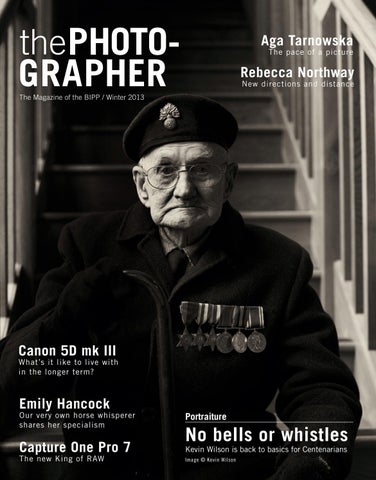
Kevin Wilson is back to basics for Centenarians
The new King of RAW
TP-2013-WIN OFC.indd 1
No bells or whistles Image © Kevin Wilson
20/12/2012 20:32
)D )DPLO\ $G 7KH 3KRWRJ )DPLO\ $G 7KH 3KRWRJUDSKHU SGI DPLO\ $G 7KH 3KRWRJUDSKHU SGI UDSKHU SGI
JYLH[L
&
0
<
&0
0<
&<
&0<
.
3KRWRJUDSKLF $UWZRUN 5DQJH
;OL PTHNPUN PUK\Z[Y` OHZ [Y\Z[LK -\QPMPST MVY ULHYS` `LHYZ [Y\Z[LK \Z [V WYV]PKL [OL ILZ[ WYVK\J[Z [OL ILZ[ ZLY]PJL HUK [OL ILZ[ PUUV]H[PVUZ 5V^ `V\ JHU [Y\Z[ \Z MVY `V\Y 7OV[VNYHWOPJ (Y[^VYR TLKPH -\QPMPST JYLH[LK [OL OLYP[HNL `V\ JYLH[L [OL M\[\YL
+H]PK *VUZ[HU[PUL c ^^^ ZP[[PUNPTHNLZ JVT c ^^^ TV[P]H[PVU VYN \R
-PUL (Y[ ,[JO 7HWLY
NZT
7OV[V 9HN
NZT
4\ZL\T 9V\NO 7HWLY
NZT
4\ZL\T ;VYJOVU 7HWLY
NZT
-PIYL )HY`[L .SVZZ
NZT
*HU]HZ ,A 7VS` JHU]HZ
NZT
(Y[PZ[ JHU]HZ
NZT
,A 5H[\YHS JHU]HZ
NZT
,A >OP[L JHU]HZ
NZT
:H[PU JHU]HZ
NZT
5H[\YHS *V[[VU JHU]HZ
NZT
/+ >OP[L *V[[VU JHU]HZ
NZT
7OV[V )HZL .SVZZ WOV[V WHWLY
NZT
:H[PU WOV[V WHWLY
NZT
3\TPUH_ .SVZZ WOV[V WHWLY
NZT
,A .SVZZ WOV[V WHWLY
NZT
,A :H[PU WOV[V WHWLY
NZT
7YLTP\T 3\Z[YL WOV[V WHWLY
NZT
3-7 .SVZZ WOV[V WHWLY
NZT
3-7 :H[PU WOV[V WHWLY
NZT
:H[PU WOV[V WHWLY
NZT
7LHYS WOV[V WHWLY
NZT
,A 7LHYS WOV[V WHWLY
NZT
7HWLY )HZL 7YLTP\T 4H[[ )VUK WHWLY
NZT
7YLTP\T 4H[[ )VUK WHWLY
NZT
,A 4H[[ )VUK WHWLY
NZT
7YLTP\T 4H[[ )VUK WHWLY
NZT
7YLTP\T 4H[[ )VUK WHWLY
NZT
7OV[V )VHYK 7OV[V .SVZZ )VHYK
TT
7OV[V 4H[[ )VHYK
TT
7OV[V 7LHYS )VHYK
TT
:VM[ ;L_[\YL -PUL (Y[ )VHYK
TT
7OV[V :TVV[O /PNO >OP[L *V[[VU )VHYK
TT
3LHYU TVYL H[ ^^^ M\QP JV \R WHYHUNL
TP-2013-WIN IFC.indd 2
20/12/2012 20:35
Winter 2013
The Editor / Comment 2 Cover story / Kevin Wilson 4 He’s done most things and got most t-shirts but Kevin presented himself with the challenge of a particularly difficult portraiture subject
Long-term view / Canon 5D mk III nine months on 14 When the 5D mk III broke cover many wondered whether the spec was right. Living with it gives the answer the Photographer is published four times a year by the British Institute of Professional Photography, The Coach House, The Firs, High Street, Whitchurch, Aylesbury HP22 4SJ. T: 01296 642020 E: info@bipp.com W: www.bipp.com President: Roy Meiklejon FBIPP Chief Executive: Chris Harper FBIPP Directors: Russell Baston FBIPP, Kevin Pengelly FBIPP, Graham Rutherford FBIPP, Malcolm Sales ABIPP, Frank Tomlinson FBIPP
Profile / Emily Hancock 22 Understanding the ways of her specialism has put Emily at the top of the tree for equestrian portraits. But she still wants more…
BIPP / News from the Institute 32 Information on the new awards programme, election results, company partners, member benefits, and regional events Preview / Ansel Adams 40 ‘Photography from the Mountains to the Sea’ at NMM Greenwich Membership Services Advisory Board Suzi Allen LBIPP (South West) Russell Baston FBIPP (National seat) Tony Freeman Hon FBIPP (National seat) Richard Mayfield FBIPP (Yorkshire) Alan McEwan FBIPP (Scotland) Ian Pedlow LBIPP (Northern Ireland) Kevin Pengelly FBIPP (South East) James Russell LBIPP (North West) Graham Rutherford FBIPP (National seat) Malcolm Sales ABIPP (Midlands)
Interview / Aga Tarnowska 42 The up-and-coming fashion photographer talks to tP
Gallery / Rebecca Northway 50 Rebecca shows how distance can make all the difference Software / Capture One Pro 7 56 Want to radically improve your image quality for just a couple of hundred pounds? Pro 7 is the RAW processor to make all the difference Business / Pricing for profit 62 Frank Tomlinson FBIPP (National seat) Kevin Weatherly LBIPP (North East) Bella West FBIPP (National seat) Stuart Wood FBIPP (National seat) Editor: Jonathan Briggs, editor@bipp.com Advertising: Tel 01296 642020 Email: alexander@bipp.com UK Subscribers £20, EU £40, Rest of the World £50 ISSN: 0031-8698 Printed and bound by Magazine Printing Company, Enfield
Neither the British Institute of Professional Photography (BIPP) nor any of its employees, members, contractors or agents accepts any responsibility whatsoever for loss of or damage to photographs, illustrations or manuscripts or any other material submitted, howsoever caused. The views expressed in this magazine are the views of individual contributors and do not necessarily represent the views of the BIPP. All advertisements are accepted and all editorial matter published in good faith. The Publisher makes no warranty, express or implied, that any particular product or service is available at the time of publication or at any given price. No part of this publication may be reproduced by any means whatsoever, or stored in a retrieval system, or broadcast, published or exhibited without the prior permission of the publisher. This magazine is the copyright of the BIPP without prejudice to the right of contributors and photographers as defined in the Copyright, Designs and Patents Act 1988. All rights reserved. Registered at Stationers’ Hall, Ref B6546, No. 24577. © BIPP 2013
Winter 2013 / the PHOTOGRAPHER 1
TP-2013-WIN Contents p01.indd 1
20/12/2012 20:34
The editor / Comment
Sounding out video I
n recent issues of the Photographer we’ve run a series all about shooting video on a D-SLR. Perhaps we’re getting to a point now where there aren’t many professional photographers who haven’t come up against the ‘video’ issue in one way or another. This is convergence – stills and video – tasks that used to require two separate bits of kit now fundamentally require one, even at broadcast level. Then, at a consumer level, all you need is a smartphone. It was absolutely no surprise to hear in a presentation at the Retail Imaging Show late last year that sales of video cameras have absolutely fallen through the floor. Convergence turned out to be the loose theme of a few hours of lectures at the Show. It was a slightly bemusing scenario – at the advertised opening time of 8:30am nobody had thought to set anything up or lay out the coffee and when the first talk was due 15 minutes later the 30 or so ‘hardcore’ talk attendees were told one speaker had cancelled – it wasn’t looking good. Thankfully, when Richard Gregory, Account Director at leading research company GfK did his stint, everything became much more interesting. He reported a raft of pertinent UK-based statistics, in particular that the overall photo sector contracted 7% in the year 2011-12, whilst the average price of a digital camera actually increased in the four years from 2008-2012. Considering that the consumer electronics market contracted by 14% in 2011-2012, the
Convergence is everywhere, but what exactly is it, what is it not and what are the practical implications for the professional photographer? retailers in the audience couldn’t moan too much. Just over £600 is now the average purchase price of a D-SLR and more than 80% of households own a digital camera, with almost two digital cameras being sold per household in the last five years. More illuminating was the point that whilst the smartphone has killed the satnav market in terms of it being an individual unit, it’s not hurting the D-SLR market which is holding pretty steady – year on year – with peaks and troughs being linked to supply-side problems rather than any lack of demand. Similarly, the highspec compact interchangeable lens systems that have recently been big news have been purchased in addition to rather than instead of a D-SLR. Overall then, the addiction continues… So, to date, you could say that convergence has been in ‘favour’ of the professional D-SLR user. Sad times, however, are here for both the specialist videographer and sound recordist. Tim Constable and Eifion Jones from Rycote provided a knowledgeable discussion of sound – emphasising the fact that, if anything, it remains the missing link: yes, we can have a D-SLR at a drop of a hat that records HD video, but have you got any real idea how to record and work with professional sound? No, was clearly the predominant answer. In the light of all this, it was a neat coincidence when a long-time colleague, film devotee and irregular contributor to this magazine called me up describing a video commission he’d just taken an enquiry for off the back of doing a load of corporate portraits… the point being that the client now saw a photo grapher as automatically being able to supply moving image services. The problems: How long would editing take? How much should he charge? How should he deal with the sound? Jonathan Briggs, editor
2 the PHOTOGRAPHER / Winter 2013
TP-2013-WIN Comment-p02-03.indd 2
20/12/2012 20:36
%
9L 9 1R 1
%,50,1*+$0 1(& 0$5&+ 9LVLWRU UHJLVWUDWLRQ _ 2QOLQH UHJLVWUDWLRQ YLD ZHEVLWH RU )RFXV $SS 9 VL 9L V WR WRU U UH UHJLVWUDWLRQ R _ 2 2Q QOLQH UHJ HJLV LVWWUUDWLR RQ YLD ZH HE EV VLWWH HR RUU )RF R XV $SS S 1RQ WUDGH \RX·UH ZHOFRPH 2QO\ RQ VLWH LI 1RQ WUDG GH \R \RX· X UH ZHOFR RPH PH 2Q PH 2QO\ \ RQ VLWH LI SUH SDLG RQ OLQH
SUH H SDLG RQ OL OOLLQ QH H
7HO )D[ (PDLO LQIR#IRFXV RQ LPDJLQJ FR XN 7H 7HO )D[ (PDLO LQIR# #IRFXV RQ LPDJLQJ FR XN ,PDJH +RXVH &RRPEH $YHQXH &UR\GRQ &5 6' 8.
6+$5( 7+( 3$66,21
ZZZ IRFXV RQ LPDJLQJ FR XN Z Z IRFXV RQ LPDJLQJ FR XN ZZ
TP-2013-WIN Comment-p02-03.indd 3
20/12/2012 20:36
Like the old days It’s a risky business deciding to embark on a personal project that has a simple focus on subjects who are neither commonly photogenic or comfortable before the lens. Kevin Wilson’s ‘Centenarian’ work confirms that his quality and creativity remains even when the pretty brides and posh locations are nowhere to be seen
Y
ou can imagine numerous photographers before him, weighing up the pros and cons of putting personal time and effort into photographing people who have got to the age milestone of 100; who have received that coveted letter from the Queen. The pros are that the project sounds good, has a very specific hook and has the potential to show that your work isn’t just about models, brides who’ve had professional make-up, or the biggest and best locations. The cons… well, where do you start? Photographing the oldest generation is fraught with problems: lack of mobility; lack of mental capacity; short attention span… we could go on. Note that this is in no way disrespectful – just plain old fact. Any photographer setting out on this one runs the terrible risk of ending up with a load of similar pictures of old
TP-2013-WIN Wilson-p04-13.indd 4
g
20/12/2012 20:37
Image © kevin Wilson Winter 2013 / the PHOTOGRAPHER 5
TP-2013-WIN Wilson-p04-13.indd 5
20/12/2012 20:37
Image © kevin Wilson 6 the PHOTOGRAPHER / Winter 2013
TP-2013-WIN Wilson-p04-13.indd 6
20/12/2012 20:37
Kevin Wilson / Centenarian
people sitting in chairs. The End. Add to that already considerable risk the fact that Kevin has a considerable reputation to protect. As with anyone who has climbed to the top – it’s a hell of a long, quick way down. He says: ‘It was quite difficult a lot of the time and the picture itself was just the end of the process – so much time was spent arranging access, finding people at the outset and then the shot itself was often just a five-minute session. It was totally different than any normal portrait because I was not in control of the situation in any way. I couldn’t choose the location; I couldn’t direct them to do this or that. All I could do was to turn up, find what was there and work with it.’ Therefore, it was pretty much the ultimate exercise in ‘find the picture’: that notion that in every scene, no matter how hum-drum or opposed to what you’d like, there’s a great picture and a great story if you only have the ability to look properly. Kevin describes the formula: ‘I kept it very simple, although that was really forced on me. Much of the time the shots were hand-held as their home would be worried about someone tripping over a tripod. There were no lights – the only control I had was to turn off the domestic lights in the room. Hence the images were shot wide open at a high ISO so giving the short depth of field.’ The technical requirements of getting a shot in this environment makes the issues we talked about earlier even more severe: there was no room for error and very little between photographer and subject to create the shot. All of which leads us to the crux of the project, which could be viewed as
a back-to-basics challenge to do the pure photographer’s job: find or create the picture no matter what the circumstance. Anyone who has tried will concurr that it’s easier said than done. Kevin explains further: ‘It’s not the camera that takes the picture and it’s not your lighting or tecniques to create one efftect or another. The picture is created by your subject’s personality and character coming up against your own. With a number of my subjects on Centenarian I wasn’t able to say much if, for example, they were suffering from dementia. But nonetheless in those few words we interacted and responded to each other in a way that was unique, that was different than anyone else because it was them and me. That’s how the
g Image © kevin Wilson
g
Winter 2013 / the PHOTOGRAPHER 7
TP-2013-WIN Wilson-p04-13.indd 7
20/12/2012 20:37
Kevin Wilson / Centenarian
pictures were made here: one light, one window, one camera, plus two personalities.’ Why did Kevin decide to go ahead and tackle this work? ‘I’m an older photographer myself and I’m also a judge and a mentor and so I must be doing work and tackling new ideas and showing that I can do it, still come up with the goods when it’s not all sweetness and light. Even though I’ve been successful I’m not going to sit on my backside – I have to be abreast of what’s going on and show that I can do different types of work. I wouldn’t want anyone to say that I’m only producing great pictures because I have this or that and a great camera.’
Image © kevin Wilson
g
The Centenarian project came about as a result of a chance meeting when a characterful 96-year-old came into Kevin’s Dorset studio: ‘I’m always looking for new projects and this character came into the studio and said he needed a passport photograph. That was a little unusual in itself, let alone the fact that he was off to watch the European Grand Prix just a few years off his century. I asked if I could photograph him properly – on a pink background as it turned out… and the picture was a winner in the Kodak Awards. But the experience got me thinking about older people – unfortunately he never made it to 100. I wondered how I could go about assembling these people for portraits. It’s been a very rewarding project and working with just one light and one lens is a lovely pure approach.’ The 20 resulting portraits came out of numerous visits to care homes. Kevin describes the scene: ‘I did the project in around three months. Imagine if you will going into a home, you’re confined – some were like palaces but the vast majority were council-run and the only light I had was from a window – I never had a room to myself to work in. It can be soul-destroying going into the day-room with a large number of people sitting there. I did consider the problem of people looking sad, but the fundamental idea was to characterise and portray what I found. No matter how the situation makes you feel, you must still look for the picture. You think to yourself that you’ll never want to be in there – that feeling doesn’t go away, and it was hard to be attempting communication with people who had lost a certain amount of mental capacity.’ g
8 the PHOTOGRAPHER / Winter 2013
TP-2013-WIN Wilson-p04-13.indd 8
20/12/2012 20:37
Image © kevin Wilson Winter 2013 / the PHOTOGRAPHER 9
TP-2013-WIN Wilson-p04-13.indd 9
20/12/2012 20:37
Kevin Wilson / Centenarian
g
Our cover photograph this issue depicts Sid. He’s 100 years old and he continues to go out on the street selling poppies each year. He served in battles where he was one of the few survivors. He was a bodyguard for Winston Churchill and he still lives on his own. He goes up and down the steps behind him every single day. Kevin’s only difficulties with Sid were that he’s stone deaf and can’t do Wednesdays since he has a bath on that day… The role of these images, therefore, is partly to help us be aware of the people around us whom we’d otherwise not notice. Their biographical details are secondary to the image, but it’s an interesting exercise to separate the two and then consider whether Kevin’s image successfully gets past the usual barriers. The images here show that he does. Kevin comments: ‘One of the most difficult parts of the project was getting agreement from the relatives. I decided that I would photograph each person in several ways. There would be happy, smiling images and then the ones I wanted that would hold the meaning. I gave them all the files and also a framed portrait free of charge. It was a really good way for families to capture memories. Three have already passed away, so it was an important moment for the families.’ Kevin had a strong idea of how to present these images in terms of final styling. He says: ‘I knew that these images would not work in colour. The black and white brings you back to the ravages of time and life – I wanted to see that and for it to be the most important element of the picture. I wanted them to be stark but real – not created.’
g
10 the PHOTOGRAPHER / Winter 2013
TP-2013-WIN Wilson-p04-13.indd 10
20/12/2012 20:37
3KRWR%DVH
70
Business Management Software for Wedding Photographers
Exclusive 30% BIPP Member Discount Available off the full price of the full PhotoBase Admin Software S f Package. P k Contact us via the website for a discount code.
t Built, tried & tested by fulltime pro wedding photographers t Manage client contacts, bookings, enquiries, diary & tasks t Create quotes, invoices, receipts, sales orders & more with PDF export t Track workflow and job progress from consultation to album delivery t Publish events to iCal / Google Calendar to view on mobile devices t Built-in email client and SMS text messaging for quick client notification t Accounting features with date range filtering & export to csv, excel etc t Go mobile - Run permanently from a USB Flash Drive (optional)
Download your free 30 day trial today, for Mac or PC Join us on the 29th January for an ‘Introduction to PhotoBase’ BIPP event at Lea Marston Hotel, Sutton Coalfield, where we’ll be performing common complex admin tasks with ease, using PhotoBase. Download free trial at: S
O
REDCAT F
T
W
A
R
E
www.redcatsoftware.co.uk
TP-2013-WIN Wilson-p04-13.indd 11
I’d recommend Photobase to any wedding photographer, the benefits are just endless Karl Bratby FBIPP, ilifephotography, Nottingham
20/12/2012 20:37
Image © kevin Wilson 12 the PHOTOGRAPHER / Winter 2013
TP-2013-WIN Wilson-p04-13.indd 12
20/12/2012 20:37
g He continues: ‘Where possible I wanted to have conversations with my sitters, to find out a little bit about them as that way I could get a bit closer and get a better picture – but sometimes the barriers went up – when that happened I was never going to get the picture I wanted until I’d managed to connect with them somehow. One lady said to me: “Nothing’s happened to me in my life – I just worked for Marks and Spencer.” That was it, and even asking about the war drew a blank. But I asked whether she’d had children and it transpired that her son had died in a playground accident. She started to well up and told me that it was the first thought that came into her head every single day when she woke up. It’s because of instances such as this that I say it’s not the camera that takes the picture – unless you can get behind the barriers people put up you will just get flat unfeeling pictures that are devoid of depth and of character. But if you can get into people, no matter what the location or the circumstance you have the potential to get a great picture.’ Kevin took 40 to 50 pictures of each subject but sometimes it was that run of shots that yielded the results. Kevin says: ‘I still had to work through each portrait as you would normally – often it wasn’t until the end that the right picture revealed itself. You always know when you’ve taken the exact frame that suits the subject down to the ground and no matter how little time you have, you’ve got to work to get that frame. If you’ve connected with your subject, they’ll reveal who they are.’ tP
1(: %5;
$GGLQJ SURIHVVLRQDO IHDWXUHV VXFK DV VXSHU VKRUW ÁDVK GXUDWLRQV DQG KLJKHU SRZHU WKH %5; LV DQ HYROXWLRQ RI DOO WKH WUDGLWLRQDOO\ UREXVW (OLQFKURP TXDOLWLHV SRZHU VSHHG YHUVDWLOLW\ DQG FRQWURO 7KH (OLQFKURP 6\SRUW 5; UHPRWH FRQWURO V\VWHP QRZ DGGV XQLTXHO\ FUHDWLYH IHDWXUHV VXFK DV PXOWLÁDVK WLPH ODSVH DQG VHFRQG FXUWDLQ V\QF WR WKH ZKROH (OLQFKURP UDQJH 7KH QHZ %5; LV EXLOW WR HPSRZHU D JHQHUDWLRQ RI SKRWRJUDSKHUV IURP ZKRP JUHDWHU FRQWURO YLD L3KRQH L3DG 3& DQG 0DF ZLOO JHQHUDWH H[WUDRUGLQDU\ FUHDWLYLW\ UHDWLYLW\
ZZZ WKHÁDVKFHQWUH FR XN XN N
Email: kevin@kevinwilson.co.uk Web: www.kevinwilson.co.uk
Winter 2013 / the PHOTOGRAPHER 13 %,33 LQGG %,33 LQGG GG TP-2013-WIN Wilson-p04-13.indd 13
20/12/2012 20:37
Long-term view / 5D mk III
More of the same I
t was, quite possibly, the most eagerly anticipated camera launch of the last 12 months. In 2009, the Canon EOS 5D Mark II had ushered in a new era of photography and videography, bringing high-quality stills and full HD video to the world in one compact and familiar body. Three years on, the EOS 5D Mark III was all set to replace it. The hype and rumours surrounding the new camera were massive. It had been expected, if you believe the rumour mill, from around the middle of 2011, so when it finally arrived, the expectation levels had risen exponentially. True, the EOS 5D Mark II had its faults – the AF system was the same as that found in the original EOS 5D and was therefore slow in tracking, the frame rate was not especially fast and the Mode Dial featured no lock meaning the camera always seemed to end up set to Bulb mode. From a video point of view, the low-res output from the HDMI port and lack of headphone jack for monitoring audio, not to mention the approximate 12-minute clip limit, were potential deal-breakers if only the quality of the results was not so good. However, these aside, it’s been a wellloved camera that has found a home in many a photographer’s bag, both as the main workhorse or a trusty back-up body. This success of the EOS 5D Mark II gave the EOS 5D Mark III both a good platform to build from, but also a lot of expectation to live up to.
One of the most eagerly awaited cameras of the last year, Canon’s EOS 5D mk III also marked the point at which Canon and Nikon took different development directions. David Newton has spent plenty of quality time working with the mk III and gives a practical perspective on what’s worked out great and what could be better On launch, the initial reactions to the camera were very good. From a specification point of view, the EOS 5D Mark III ticked all the boxes. The resolution, at 22.3 megapixels, seemed an ideal compromise – not so high that it affects high ISO performance, but high enough to offer as much detail as most people realistically need. The ISO range had been increased compared to the EOS 5D Mark II and was almost on par with the flagship EOS-1D X and most interestingly, it had an AF system that on paper is remarkably similar, again, to the EOS-1D X. The frame rate too is a big improvement.
14 the PHOTOGRAPHER / Winter 2013
TP-2013-WIN 5Dmk3-p14-21.indd 14
20/12/2012 20:55
Long-term view / 5D mk III
Who needs more resolution than this? If you want to shoot a billboard you might require medium-format digital, but if you like 35mm, then 22.3 megapixels is more than enough for almost any usage
3.5fps on the EOS 5D Mark II felt slow at times, but 6fps on the EOS 5D Mark III makes the camera usable not just for social documentary and landscapes, but also for sports and wildlife. For the movie makers, there were some key improvements. The first of which was the removal of the 12-minute clip length limit; it’s been pushed out to 29 mins 59 secs. While this is still not the same as a video camera, it is more than long enough for 95% of the uses for which the EOS 5D Mark III is intended. Beyond the clip limits, Canon introduced the world of photographervideographers to intraframe codecs – essentially an uncompressed movie stream for easier editing and better quality. All of this pales in comparison though, to the inclusion of a headphone jack for audio monitoring, combined with the silent control touchpad and live audio level meters on screen. It’s fair to say those interested in HD movie shooting got a little excited by that. The biggest disappointment on launch was actually concerned with the AF – ironically also one of the strongest points of the camera. It’s the same criticism as the EOS-1D X faced – the loss of f/8 focusing meaning a 2x Extender and f/4 lens wouldn’t focus. If you know your Canon history, it wasn’t much of a surprise – historically only the EOS-1 Series have been able to focus with a maximum aperture of f/8 – but still photographers wanted to complain. Well, we wouldn’t be photographers if we didn’t have something to complain about, would we? So let’s take a deeper look at the camera and see just where it stands after lots of long-term hard use. g Winter 2013 / the PHOTOGRAPHER 15
TP-2013-WIN 5Dmk3-p14-21.indd 15
20/12/2012 20:55
Long-term view / 5D mk III
If you want to test an AF system, find a fast dog and get them to chase a ball. If it can cope with that, it’ll cope with most things – and this was with the rather ‘slow’ EF100-400mm lens
g
What’s great? Let’s start with the positives. First up, Canon took a brave step with the EOS 5D Mark III. By not really increasing the resolution compared to the previous model, they effectively laid down a marker in the megapixel race. I’m not
Having a maximum sync speed of 1/200 sec means you’re always into high-speed sync if you want to balance with the daylight – or you need to accept that on bright sunny days the ambient may well be overexposed
sure we won’t see higher resolution sensors from Canon in the future, but for the moment they appear to have listened to the many of us that said enough was enough. We don’t want or need more resolution, what we’d really like is increased dynamic range and better high ISO performance. And that’s what they’ve given us. This camera is about two-stops better in high ISO terms than the EOS 5D Mark II. It may not be the
16 the PHOTOGRAPHER / Winter 2013
TP-2013-WIN 5Dmk3-p14-21.indd 16
20/12/2012 20:55
Long-term view / 5D mk III
HOW ABOUT THE EOS-1D X? For those considering the EOS 5 D Mark III, there is often an internal discussion about whether the EOS-1D X is a better choice or not. This is especially true for anyone shooting wildlife. The fact is, these two cameras are so similar in so many ways, you need to have deep pockets or the requirement for 12fps shooting and colour tracking AF to make the extra cost worthwhile. For movie shooters, the EOS 5D Mark III is the better option, for sports it’s the EOS-1D X. Everything in between, well you’ll be happy with either, so let your budget decide!
king in Canon-land (that crown is held by the EOS-1D X) but it’s close and crucially a good step on from what was already a good camera. The addition of a Mode Dial lock and the change to EOS 7D-style button layouts is, in the long term, likely to prove beneficial. Coming from previous EOS models, the button layout is familiar enough to be easily usable, with just a few new quirks thrown in – we’ll talk about some of those in a minute. In use, the camera is a good size in the hand, the grip feels more positive and the viewfinder is bright and clear. Essentially it feels a lot like an EOS-1 Series camera without the grip attached. Almost, in fact, like the mythical ‘EOS 3D’ that many have been pining for. As for image quality, both for stills and video, the Mark III picks up where the Mark II left off. The results direct from the camera are very good. Colours seem neutral, there is plenty of detail and tones are smooth and even. There’s a trend in D-SLRs to include lots of incamera processing, ostensibly to make life easier, but in many cases to improve the output of the camera. However, with the Mark III, even switching Picture Styles to Neutral and using Auto White Balance with none of the lens correction functions turned on, the results are still excellent. The new AF system takes a little getting used to and setting up. There is an ‘out-of-the-box’ setting for AI Servo, but if you want to get the best from it, you’d best read the manual, practice, or get some training to help. Personally I don’t mind – I’d rather have the options than not but I know from the questions I’ve had, some find them a bit overwhelming. g Winter 2013 / the PHOTOGRAPHER 17
TP-2013-WIN 5Dmk3-p14-21.indd 17
20/12/2012 20:55
Long-term view / 5D mk III
g
From a movie point of view, the new ALL-I codec is very good. File sizes are much larger, but there is no compression and if you look very carefully when editing, you’ll find the quality remains high throughout due to not having to cut in a compressed section. The addition of the headphone socket is another major plus and like the EOS-1D X, the live audio levels on screen and silent control touch pad to adjust audio levels (and shutter speed, aperture and ISO if you want) while filming makes it much more of a complete tool. What could be better? Now we know what’s good about the camera, let’s take a look at what could be better. First up – and this is something I’ve already touched on – the AF system has one annoying ‘glitch’, namely the AF points are not illuminated, they are simply black. In bright conditions, this is not such an issue, but when it gets dark, or when you place the AF point on something dark, it can make it really hard to see where the AF point is. It is something Canon are aware of and there are rumours they are looking in to it, but at the same time some people are suggesting it may not be possible to implement the same firmware fix as the EOS-1D X (which suffered from the same issue) due to the slight differences in the pentaprism and metering design. Next up, the flash sync speed. Currently it is 1/200sec. While this has been the same for the three EOS 5D models, I would like to see this increasing. Certainly for the two sunny days we get each year, it would be nice to have a higher sync speed so you don’t have to drop into
THE MAIN CONTENDERS If you’re in the market for a new full-frame camera, then the other main contenders to look at are the Nikon D800 and the Sony SLT-A99. The reality is, there is far too much emphasis put onto cameras these days. Back in the days of film, everyone knew cameras were a box and really made little difference to the results of your image, so you invested in lenses and kept cameras for a long time. Through the early years of digital, this reversed and more weight was given to the camera than lenses. However, as technology has matured it has become quite difficult to buy a truly ‘bad’ camera, especially at this end of the price bracket. The real choice between these cameras is not between which is ‘better’ but which system will grow with you and which camera or system you feel most comfortable using. Try to look ahead rather than react to what you’re doing right now.
Button layout is little changed, with a few quirks making it different from its predecessor. Additions include silent adjustment of audio levels for movie capture
g
18 the PHOTOGRAPHER / Winter 2013
TP-2013-WIN 5Dmk3-p14-21.indd 18
20/12/2012 20:55
Long-term view / 5D mk III
ISO1600 and a fast lens opens up so many shooting possibilities. And the results even up to ISO6400 are more than usable
Winter 2013 / the PHOTOGRAPHER 19
TP-2013-WIN 5Dmk3-p14-21.indd 19
20/12/2012 20:55
Long-term view / 5D mk III
EOS 5D MARK III – THE ESSENTIALS 22.3Megapixel Full-frame CMOS 61-point AF (up to 41-X type) 6 frames per second shooting speed ISO 100-25,600 as standard ALL-I and IPB video codecs Headphone jack Mode Dial lock
g
high-speed sync quite so soon. Of course the sync speed is determined by the size of the sensor and the size of the magnets used to drive the shutter curtains, they in turn being determined by the size of the body overall and the space available inside, but it would be good to see this increase even to 1/250 or 1/320sec for a little extra help. I have also had a bit of an issue with the WiFi transmitter. I know whichever way Canon decide to go on this they will face flak, but the reality is that their decision to make a universal WiFi transmitter that will work on other EOS models means it must be attached by USB cable. Longer term this makes it less secure than a moulded in and screwed on grip. Equally, it puts more pressure on the USB port attachment point – another point I find slightly niggling. With the increase in tethered photography for many people, I would like to have seen the USB connection beefed up a little more. As with the EOS 5D Mark II, it still feels a little less than robust and hence doesn’t fill you with confidence. The final issue in terms of using the camera is actually one of both muscle memory and also usability for movie shooting. The redesigned button layout has created a magnification button on
the left of the screen. Coming from previous models, it takes a little bit of time to remember not to push the AF point selection button to zoom in, but this is not a major issue. More problematic is when filming you need to either remove a hand from the camera to push the zoom button to check focus, or you need to use your left hand. Neither of these is ergonomically comfortable nor effective helping you control all aspects of filming with your right hand as was possible before. If you don’t shoot movies, it will mean nothing to you, but for those that do, it’s a frustration and feels like a step back rather than forwards. Next year’s firmware A little while ago, Canon took the unusual approach of announcing a firmware update they were working on for the EOS 5D Mark III. This firmware promises to fix two ‘issues’ with the EOS 5D Mark III and for many, can’t come soon enough. The first ‘fix’ is the f/8 focusing. Like its bigger brother, the EOS-1D X which had an update recently, this new update for the EOS 5D Mark III will bring f/8 focusing (for example an EF500mm f/4L IS II USM lens and Extender
The universal WiFi transmitter is a great idea in theory – you can buy it once and it’ll work with several EOS models. Unfortunately in practice the requirement for a cable into the camera somewhat goes against the ethos of a wireless connection…
20 the PHOTOGRAPHER / Winter 2013
TP-2013-WIN 5Dmk3-p14-21.indd 20
20/12/2012 20:55
Long-term view / 5D mk III
WHY 29 MINS 59 SECONDS? One question that is often asked about shooting movies on the EOS models, is why is there a limit of 29 mins 59 seconds for a single clip? Now the EOS 5D Mark III allows you to record more than 12 mins in a single clip by sticking files together when each file size goes beyond 4GB, it seems odd that the maximum recording length is not determined by the size of the memory card. The answer is simple though… tax. At 29mins 59secs, the recording time falls below what would otherwise class the camera as a video camera. Video cameras attract a higher rate of tax in some territories and therefore by limiting the recording length, the price is kept a little lower!
EF2xIII combination) to cameras other than the EOS-1 Series for the first time. The second ‘fix’ concerns movie shooting. One thing moviemakers coming from larger cameras want is the ability to record not just to internal media like memory cards, but to external SSD drives too. Unfortunately, no EOS model offers a ‘clean’ HDMI output – in other words the HDMI output is either not full HD resolution, or it has the red recording dot on it. The new
firmware will solve this allowing you to record your movies directly out of the HDMI output in glorious uncompressed HD to a device like an Atmos Ninja. This will simplify workflow and help continue the rise of the EOS 5D line in both independent and high-end video circles. Hit or miss? Overall, the EOS 5D Mark III is a big hit. It picks up where the EOS 5D Mark II left off and adds some crucial extra features that make it an ideal choice for almost all types of photographer. If you’re in the Canon camp, you should be very happy. If you’re a Nikon or Sony shooter, then the presence of cameras like the EOS 5D Mark III in truth pushes long-term development rather than you into a system swap. tP
The new AF system is worth investigating beyond the out-of-the-box set-up for best results
Winter 2013 / the PHOTOGRAPHER 21
TP-2013-WIN 5Dmk3-p14-21.indd 21
20/12/2012 20:55
Horse sense Emily Hancock is fast becoming the ‘Horse Whisperer’ of equine photography, demonstrating that the old adage ‘know your subject’ rings oh so true. She has a talent for engaging with the horses and riders she captures – and it seems that really is everything…
I
f you’re going to get it wrong, do it early on. Emily Hancock left home at 18 to study human biology at Oxford Brookes University. She says: ‘I always knew I wanted to go to university – but the reason I chose human biology was purely because it was the second best thing I was good at, after photography.’ But she quickly realised that second best was not going to be good enough: ‘In my first term people kept asking me what I wanted to be when I graduated and I never knew. My mum has always said “you can be whatever you want to be” and you always listen with scepticism. Then one evening I was driving back to university and I asked myself, “what do I love doing?”. Photography was the only answer.’ Of course, it’s easy to say, and not so easy to achieve. Emily knew she needed to build up a portfolio in order to pursue her aim. The obvious context g
22 the PHOTOGRAPHER / Winter 2013
TP-2013-WIN Hancock-p22-31.indd 22
20/12/2012 21:00
Image © Emily Hancock
Winter 2013 / the PHOTOGRAPHER 23
TP-2013-WIN Hancock-p22-31.indd 23
20/12/2012 21:00
Emily Hancock / Equine
was the equestrian world in which she was already involved. ‘At the time I was playing polo at Tidworth. I asked the owner who the event photographer was. I did the cold call and asked to shadow, desperate to learn. I didn’t know until I arrived that he was photographing the Royals. I took pictures on the day and sent them over and he offered me a job immediately.’ Emily then worked as an equestrian event photographer at the weekends and freely admits to facing a huge learning curve: ‘With horses you have to be so quick. I had a single day’s training at a racecourse and then it was up to me to get a shot that would sell. This was about operating the camera quickly – I knew in my head what I wanted to capture, and what was the kind of image that I would want to buy, but getting it was a different matter. There was a team of maybe six to eight photographers working on an event. Each had their area or fence to photograph and you’d sit there for hours and hours photographing 300 or more competitors going over that same
fence. It was really scary doing it the first time. The only thing that got me through was that I knew what the right kind of image was.’ If this sounds like Emily was a woman on a mission, with a hard-nosed approach to getting what she wanted you couldn’t be further from the truth: ‘Personality-wise I’m a very shy person, and there’s no room for that in business. I have had to face up to it and do the cold calling, and build on contacts I’ve had in the Pony Club. I have a list that I still work through every year.’ Emily is also entirely open about the difficulties of setting up as a photographer in her own right: ‘There were g
Image © Emily Hancock
g
24 the PHOTOGRAPHER / Winter 2013
TP-2013-WIN Hancock-p22-31.indd 24
20/12/2012 21:00
Improve your photography The Original
The smartt wayy to trigger your camera using sound, lightt intensityy increase, IR beam breaking and motion.
Ringflash Adaptor for hot-shoe flash units The RAYFLASH Ringflash Adapter is unique! ONLY A truly portable ringflash solution for +VAT Fashion, Beauty, Portrait, Wedding and Macro photography. It fits to the front of your existing hotshoe mounted flash, is easy to hold and leaves both your hands free to operate camera and lens. Light loss is only 1-stop! Available for Nikon, Canon and various other flash units.
£129
A great variety of stills and video cameras can be used, digital as well as film based cameras. Wildlife and other images, normally very difficult to achieve,, can be easily captured.
ONLY
TriggerSmart Kit
£199+VAT
Contains Controller, IR/LIS Receiver, IR Transmitter & Sound Sensor, two o Mini Tripods and cables.
Simply the best camera brackets Another unique and innovative product! The Rotator allows 360o positioning of the flash around the lens axis, avoiding horrible side shadows in any camera position. See full details on our website.
ONLY
£99+VAT
Real Battery power
Custom Brackets make a large range of high quality camera brackets, rotating camera mounts, quick change adaptors, flash mounting hardware and Gimbal heads. Prices from £26.45+VAT
Quantum is the leader when it comes to powering portable flash units! These are the latest hi-tech models: TURBO 3 1050 full power flashes at one second recycling.* The Turbo rbo 3 can al also lso power m many any Cano Canon on & Nikon DSLRs! 5-hour continuouss video reco ording! TURBO O SC 400 full power flashes att 11.44 second d recyclin ling.** TURBO O Blade e 4000 full power flashes at 1.4 second recyclin ng.*
Folding-T
Mini-RC
Digital PRO-M Kit
HONLPHOTO Discover the HONL range of brilliantly useful photo lighting accessories, acceessories, which w modify and adapt the light from fr portable flash units. Simple in design, simple to use and highly portable.
*with 6v flflash h unit, i ffor example l Canon 580EX and Nikon SB800/900.
Contact the importer for full technical details, prices and a list of dealers: info@flaghead.co.uk or tel: 01202 733123
TP-2013-WIN Hancock-p22-31.indd 25
Gimbal-LS
For DSLR’s, 35mm, medium format cameras and all types of flash units.
Prices from £7.30+VAT. Starter kit: £126.50+VAT.
www.flaghead.co.uk 20/12/2012 21:00
Emily Hancock / Equine
times in the first two years when I only averaged one shoot a month and I did find that tough. You begin to doubt and start asking yourself “do I really want to be a photographer, why not do a nine-to-five job and have work colleagues and a social life?”. I’d say it took three years before I was working at anything like full capacity. Looking back, three years is the classic test point and I got through.’ Emily enrolled on the bespoke course with Annabel Williams – which is a big investment but Emily clearly identified her reasoning: ‘I needed something serious – a real commitment – and I needed more guidance especially on the business side. It was a billion times better than I expected and I’d say it was the best year of my life. I still apply a great deal of what I learnt on that course to my business every single day and I have a great deal to thank them for in terms of who I want to be and who I want my clients to be. They made me
understand what marketing and selfpromotion was in real terms and it’s a regular part of what I do in my business practice right now.’ However, looking back to those early days on the polo circuit, she realises what a huge break it was: ‘It was there that I learnt how to become an efficient, precise photographer. My boss was strict with me, and I had one attempt to get that one shot that had to sell. Since I was a little girl, I’ve been passionate about horses. There is nothing like the bond between a horse and its owner. When I get behind my camera, I feel privileged to capture
Image © Emily Hancock
g
26 the PHOTOGRAPHER / Winter 2013
TP-2013-WIN Hancock-p22-31.indd 26
20/12/2012 21:00
Image © Emily Hancock
Emily Hancock / Equine
ESSENTIAL KIT Nikon D3; D300; 70-200mm; 35-70mm; 50mm lens Adobe Photoshop; Lightroom; Small box with grit in to shake…
that intimacy and beauty.’ Emily’s horse portraits have been described as works of art – contemporary, natural and beautiful. She succeeds in capturing the intimate and magical moments which exemplify the unique relationship between horse and owner. Shot against landscapes, the family home or the stable, her eye produces unique equine portraits. Emily has already produced commissions for horse lovers across the UK and has worked with many stars of the equestrian world, including Nikki and Richard Barrett, Charlotte Jourdain, Claire Gallimore and renowned British Olympic equestrian sportswoman, Mary King. Her work has been exhibited at major shows and equestrian events around the UK and she held an acclaimed exhibition at Somerley House in Hampshire, which was a huge success raising thousands of pounds for the Lewis Manning Hospice in Poole. Her portraits have been published in numerous magazines including British Dressage, Horse and Rider and Your Horse. She says: ‘I was so chuffed so see one of my photographs in a magazine for the first time, I rushed out to
Great quality plug & play inkjet pigment inks in 30ml to 1 litre bottles. SIX TIMES CHEAPER than Epson desktop and THREE TIMES CHEAPER than Epson wide format. AT LEAST £2 LESS than similar third party 125ml bottle inks.
g
Superb range of the nine most popular inkjet papers from top German mills. Always £1 CHEAPER per A4 box than similar brands. A4, A3, A3+ and A2 (plus custom sizes cut at no extra charge) and rolls up to 60”- always in stock.
Own Brand Professional Photographic
Inks & Paper
FREE A4 test print & FREE sample inkjet paper pack: email digital@marrutt.com
SAVE MORE: Use 10% Discount Code “TPR” at www.marrutt.com Send to press blank document.indd 1
TP-2013-WIN Hancock-p22-31.indd 27
Valid to 29.3.2013
07/10/2012 07/ 7/10/ 0/2 /2012 13:50 13:5 :50 0 Winter 2013 / the PHOTOGRAPHER 27
20/12/2012 21:00
Image © Emily Hancock 28 the PHOTOGRAPHER / Winter 2013
TP-2013-WIN Hancock-p22-31.indd 28
20/12/2012 21:00
Image © Emily Hancock
g
buy lots of copies and to this day I still have the copy of that magazine in my studio.’ But her ambitions lie further afield: ‘Within the next ten years I am determined to be known as one of the finest equine photographers in the world, flying internationally for private commissions to shoot for the Olympic team or maybe the Royal Family.’ The
importance of such drive cannot be under-estimated: ‘I want to be the photographic equivalent of world-renowned horse whisperer, Monty Roberts.’ Emily continues: ‘I have big plans for my 30s… I’m looking to travel internationally a bit more with my work, and am hoping to get overseas commissions. I’m looking at how I can sell fine art pieces and put on exhibitions.’ And these are not mere hopes. She reveals: ‘I have teamed up with a commercial fine art consultant to help me progress my business in this direction. It’s going to be about
g
Winter 2013 / the PHOTOGRAPHER 29
TP-2013-WIN Hancock-p22-31.indd 29
20/12/2012 21:00
Image © Emily Hancock 30 the PHOTOGRAPHER / Winter 2013
TP-2013-WIN Hancock-p22-31.indd 30
20/12/2012 21:00
Emily Hancock / Equine
Tim Flach as a major point of inspiration. Emily comments: ‘He’s an amazing person and it’s not that I want to emulate his work… I’m inspired by where he is career-wise. Inspiration does not change where I’m going but widens the scope of what I’m trying to achieve.’ To date, Emily has hit upon a very secure and successful formula for work: ‘I generally go to clients’ homes or where they keep their horses. I spend a day with them and then they come and view their images and decide what they want. I charge a fee for going and doing the day. Because I’m “horsey” myself I know the kind of shot they want – that’s what has the biggest impact 99% of the time. I have been in business for 12 years, and have grown every single year so far. However there’s a ceiling on what you can do under that formula – Emily Hancock Photography would not be a saleable business because it’s just me and clients obviously don’t want someone else turning up to do the work. My target now is to slightly change my client base, bringing in new strands. The fact of life is there’s only so many jobs you can do in a year, depending on your circumstances. One avenue I’m looking at is the celebrity market. For instance I would love to photograph Madonna with her horses. I’ve just photographed Olympic gold winner Charlotte Dujardin and you have to take the view that one thing lead can very well lead to another.’ tP
Email: info@emilyhancock.co.uk Web: http://emilyhancock.co.uk
g
putting together work off my own back rather than it always being commissioned, and that means my style is still developing. I still think I’m young as a photographer – I can’t imagine what my work will be like in ten years. Private commissions mean I am shooting what I know will sell and that says there is an element of formula. I want to release my creative self and it’s bigger and bolder than I could have imagined so I’m only scratching the surface so far. I am a very business-orientated person and that mindset has got me to where I am now. But sometimes you have to just create work, engage other influences, and put to one side ideas of whether you can assign costs and income directly to the time and results.’ As you would expect from a highly driven equine photographer, Emily sites
GICLÉE PRINTTS DISPLAY YOUR PRINTS AT COMPETITION QUALITY
PRICE FROM S ONLY
£2.38*
• &KRLFH RI 3UR )LQH $UW 3DSHUV • GSL WR GSL 2XWSXW 5HVROXWLRQ • &RORXU 8OWUFKURPH . ,QNV • 3ULFHV IURP RQO\ IRU [ SULQWV
FOR A 7x5 PRINT
15% OFF
USE C ODE BIPP15 *:
PART OF THE SIM GROUP:
+44 (0) 1707 27 37 47 | INFO@SIMLAB.CO.UK | SIMLAB.CO.UK * PRICES EX VAT AND DELIVERY & INCLUDES 15% OFFER. OFFER ENDS 31/03/13 GICLÉE PRINTS ONLY
Winter 2013 / the PHOTOGRAPHER 31
TP-2013-WIN Hancock-p22-31.indd 31
20/12/2012 21:00
BIPP / Awards 2013
New Awards structure with competitions across the year Celebrating imaging throughout 2013, the BIPP Awards will recognise the talent of photographers across the full range of our disciplines. Competitions will run throughout the year, to ensure no-one misses their opportunity to submit and share their work. Specialisms have been divided, so only expert judges will select the very best images. Our sponsors, Towergate Camerasure, have enabled us to offer cash prizes to the overall winners of each competition, and these photographers will be shortlisted for the Photographer of the Year title in December 2013. Each competition will have categories for non-commissioned work, qualifying/provisional members and Friends of the BIPP, alongside the categories for qualified members.
field, and a presentation for the category winners will take place shortly after the judging. The overall winner from each of the competitions will be considered for the Photographer of the Year title and cash prizes are available for those shortlisted.
Three new areas are: • The BIPP International Fellowship Award open to photographers who still want to challenge themselves, having achieved Fellowship of BIPP, or other respected organisations around the World; • The BIPP Moving Image Awards which recognise the huge increase in interest and use of this medium; • The BIPP Open Awards will also be created for non-member, professional photographers. These innovations have been introduced to take into account the ever-increasing quality of the entries and to allow for a greater appreciation of the different aspects of the profession. Each competition will have a specific team of judges, chaired by an expert in the particular
The judges will be searching for technical ability but, more importantly, they’d like to see creativity and freshness (the ‘WOW’ factor!). Full details of each competition will be on the websites (bipp.com or professionalphotographyawards.com), as soon as they become available. THE AWARD COMPETITIONS ARE: The BIPP Wedding & Portraiture Awards (7 January – 28 March) The BIPP Student Awards (7 January - 28 March) The BIPP Art of Science & Technology Awards (2 April - 28 June) The BIPP Moving Image Awards (2 April - 28 June) The BIPP Commercial Awards (1 July – 30 September) The BIPP Visual Arts Awards (1 July - 30 September) The BIPP International Fellowship Awards (2 April - 30 September) The BIPP Open (2 April – 30 September)
32 the PHOTOGRAPHER / Winter 2013
TP-2013-WIN BIPP p32-39.indd 32
20/12/2012 21:02
THE BIPP WEDDING & PORTRAIT AWARDS
Closing date: 28 March 2013
Judging: 23 April 2013 Presentations: 12 June 2013 The Judges Include: Bella West FBIPP (Chair) Saraya Cortaville FBIPP Tom Hoops Steve MacLeod Your entry: Image size 10x8in / A4 prints plus a digital file. Cost: £5 + VAT per image.
• Qualifying/ Provisional members and Friends submit into their ONE relevant category. • Prints should be approximately 10x8in (A4 is acceptable), minimum size 8” longest side. • Each print should be accompanied by a high-res digital file on a disc (multiple images on one disc are fine). • Each print should have a completed entry form on the reverse (downloadable from bipp.com). • At least one of these entry forms should include payment details to cover all of your images.
• There is no limit to the number of images submitted but an image may only be used once i.e. cannot appear in any other category.
For full details on how to enter, rules of entry, judging procedures and a downloadable entry form please visit www.bipp.com. Image: Bella West FBIPP, Bronze, Weddings 2012
Image: Jacqui Matthews FBIPP, Silver, Weddings 2012
How to enter:
Winter 2013 / the PHOTOGRAPHER 33
TP-2013-WIN BIPP p32-39.indd 33
20/12/2012 21:02
THE BIPP STUDENT AWARDS
The Judges: Paul Dyer FBIPP (Chair) Jonathan Briggs Chris Harper FBIPP Alan McEwan FBIPP Lisa Visser FBIPP There are three categories in this year’s Awards, each with a financial reward: 1 Best Single Image – open to all BIPP Students 2 Student Open – for non-BIPP students studying a photographic course of BTEC Level 3 or higher, in any college/university in the UK Your entry and cost: Image size 10x8in / A4 prints plus a digital file. £5 + VAT per image. How to enter: • Prints should be approximately 10x8 in size including mount (A4 is acceptable).
For full details on how to enter, rules of entry, judging procedures and a downloadable entry form please visit www.bipp.com. 3 Best Student Portfolio BIPP works with a number of Colleges and Universities, which offer a BIPP-Accredited course. If you’re a student on one of these courses, speak to your tutor about having your portfolio nominated by your college. Each Approved College can only nominate one portfolio, as the best in the year. The work is then judged independently and, if you’re successful, you could win £500. The Best Student Portfolio is free to enter – just speak to your Course Leader! Image: Martin Zalesny, Student Photographer of the Year 2012
Judging: Late Spring, 2013 Presentations: Summer 2013
Closing date: 28 March 2013
• Images should be of existing work from your Final Year portfolio. • Each print should be accompanied by a high-res digital file on a disc (multiple images on one disc are fine). • Each print should have a completed entry form on the reverse (downloadable from bipp.com). 34 the PHOTOGRAPHER / Winter 2013
TP-2013-WIN BIPP p32-39.indd 34
20/12/2012 21:02
BIPP / Election results
New Board of Directors, MSAB and CPD Advisory Board Our Annual General Meeting was held on 4 December 2012. Thanks very much to everyone for attending. During the meeting the new Membership Services Advisory Board was announced. These are the members who will sit on the MSAB for the next two years. They are here to represent you – so if you have any queries or suggestions, please get in touch with them. They can be contacted by emailing msab@bipp.com.
This group then met to elect three new Directors as Mike Pounder ABIPP, Denise Swanson FBIPP and Mike Brookes Roper FBIPP have all served for the maximum four-year period. Thanks go to them for their tremendous contribution as Directors of BIPP. Our new Board of Directors is: Russell Baston FBIPP Kevin Pengelly FBIPP
Suzi Allen LBIPP (South West)
Graham Rutherford FBIPP
Russell Baston FBIPP (National seat)
Malcolm Sales ABIPP
Tony Freeman Hon FBIPP (National seat)
Frank Tomlinson FBIPP
Richard Mayfield FBIPP (Yorkshire) Alan McEwan FBIPP (Scotland) Ian Pedlow LBIPP (Northern Ireland)
The Board elected members to the Continuing Professional Development Advisory Board:
Kevin Pengelly FBIPP (South East)
Russell Baston FBIPP
James Russell LBIPP (North West)
Eric Jenkins Hon FBIPP
Graham Rutherford FBIPP (National seat)
Alan McEwan FBIPP
Malcolm Sales ABIPP (Midlands)
Denise Swanson FBIPP
Frank Tomlinson FBIPP (National seat)
Frank Tomlinson FBIPP
Kevin Weatherly LBIPP (North East)
Kevin Wilson Hon FBIPP
Bella West FBIPP (National seat) Stuart Wood FBIPP (National seat)
Malcolm Sales ABIPP (BIPP’s representative to FEP) and Pippa Walkley (Creative Skillset) will also act as Advisors to CPD. We’re also delighted that Roy Meiklejon FBIPP has agreed to a second term as President of the Institute.
Winter 2013 / the PHOTOGRAPHER 35
TP-2013-WIN BIPP p32-39.indd 35
20/12/2012 21:02
BIPP / Company Partners
Epson is a global imaging and innovation leader whose product lineup ranges from inkjet printers and LCD projectors to sensors and other microdevices. Dedicated to exceeding the vision of its customers worldwide, Epson delivers customer value based on compact, energy saving and high-precision technologies in markets spanning enterprise and the home to commerce and industry. Epson’s strategy is to provide the professional photographic, commercial, signage and textile digital print sectors with large-format inkjet products and specialist ink sets engineered to deliver choice, quality, performance and low Total Cost of Ownership. Featuring Epson’s Micro Piezo printheads that deliver superb results, the comprehensive range of Epson Stylus Pro and SureColor SC printers gives the industry the widest a choice of formats from 17in to 64in and in a range of productivities and multi-colour inksets to enable companies to choose the best model for their specific needs. www.epson.co.uk Fujifilm is a global leader in imaging technology, products and services including digital cameras, photofinishing, digital storage and recording media, consumer and professional film, motion picture film, professional video, printing systems, medical imaging, office technology, flat panel displays and graphic arts. The company employs more than 73,000 people worldwide, with 178 subsidiaries stretching across four continents. It has a global turnover in excess of £13 billion. In the UK, Fujifilm has been supplying the imaging, printing and graphics industries, as well as consumers, professional and enthusiast photographers, with high-quality, innovative products and services for over 25 years. Fujifilm UK currently employs more than 400 people and has become one of the country’s most popular photographic and imaging brands. www.fujifilm.co.uk
36 the PHOTOGRAPHER / Winter 2013
TP-2013-WIN BIPP p32-39.indd 36
20/12/2012 21:02
BIPP / Benefits
CURRENT BIPP MEMBERSHIP BENEFITS INCLUDE:
Lawcare by firstassist is a genuine 24 hour advisory service on all legal and related problems. As a BIPP member, you’re able to receive confidential expert advice and guidance on the steps you should take to protect your rights whenever you need it. In most cases, the advice is immediate and is geared to providing you with easily understood practical help. Comprehensive advice is available, including employment disputes, problems with customers and suppliers, defence of prosecutions, domestic legal problems such as personal injury, property or matrimonial problems and so on.
Quote your BIPP membership number to obtain up to 40% off your insurance with Towergate Camerasure. Call +44(0)870 4115511 or visit www.towergatecamerasure.co.uk. Towergate Camerasure are leading providers of insurance to the photographic, video and multi media industries. With over 25 years’ experience, they offer bespoke insurance solutions to suit all. Towergate Camerasure support BIPP members by offering discounts on all policies. They also highlight some of the best Fine Art photography in Europe by sponsoring the BIPP’s Towergate Fine Art Competition. www.towergatecamerasure.co.uk
All BIPP members are eligible for this free service, so call BIPP Head Office on 01296 642020 to receive Lawcare’s direct number, along with your BIPP ‘code’. The code is also in the members’ area at bipp.com. STAY IN TOUCH WITH THE BIPP The BIPP website http://www.bipp.com The BIPP Blog http://thebipp.blogspot.co.uk/
Twitter http://twitter.com/thebipp Facebook http://www.facebook.com/groups/46615645089/ Linked in http://www.linkedin.com
Winter 2013 / the PHOTOGRAPHER 37
TP-2013-WIN BIPP p32-39.indd 37
20/12/2012 21:02
BIPP / Regions
Midland David Taylor FBIPP david@chapelstudio photography.co.uk www.bipp-midlands.org.uk
North East Kevin Weatherly LBIPP kevinweatherly@mac.com www.bippne.com
North West Bernard O’Sullivan ABIPP info@insideoutphoto.co.uk www.bippnw.com
EVENTS & DATES COMING UP
MIDLANDS
SCOTLAND
Portfolio Review & Qualification Assessment Day Tuesday, 29 January 2013 10am-4pm Sutton Coldfield
Kevin Wilson Hon FBIPP Regional Masterclass, Qualifications & Portfolio Assessments Monday 18 – Tuesday 19 March 2013 Perth
Not quite ready for qualification? Our one-hour portfolio reviews are ideal for anyone interested in discussing their work with an Approved BIPP Assessor, who will give constructive advice and discuss the criteria for qualification submission. Email rachel@bipp.com or visit www.bipp.com/ portfolioreviews. These appointments must be pre-booked! Later, in the evening (7pm-10pm), come along to meet Steven Bradshaw LBIPP. Steve has developed a Database/Management System exclusively for professional photographers – Photobase. Photobase can be run from a usb stick with 98% of functionality on a laptop on location. Client sms notification, Google mapping of venues, and email functionality is all the internet connection is required for. For those of us struggling to keep up with our clients this promises to be an interesting and informative evening. See Steve’s web site at www.redcatsoftware.co.uk Also in the Midlands – 26 February is the Annual Print Competition – visit Facebook or bipp.com for more details.
Join us for two days at the Huntingtower Hotel, Perth for qualifications, reviews and the opportunity to see and discuss the work of one of Europe’s leading social photographers. Kevin Wilson continues to challenge himself – gaining three Fellowships with the BIPP alongside his Honorary Fellowship, gained in 2012. See what makes his work so special… Kevin will lead you through his Centenary Project (see the cover feature in this issue), touching on the experiences and stories of his subjects. He’ll also talk you through how he uses natural light and there will be the opportunity to work with a model and put his ideas and suggestions into practice. Image © Kevin Wilson Hon FBIPP
Ready for a challenge? Looking to go for your first, or next, BIPP qualification? If you feel you are ready to submit for qualification and would like to book in for assessment, please visit www.bipp.com/qualifications or email jane@bipp.com for more information and details of how to book an assessment time.
Numbers are limited to provide an intensive masterclass environment, so are on a first come, first served basis. Members £45+Vat; Friends £54+Vat; Non-Members £60+Vat. Qualification assessments and portfolio reviews must be prebooked! Please contact rachel@bipp.com or call 01296 642020 if you are interested in attending.
38 the PHOTOGRAPHER / Winter 2013
TP-2013-WIN BIPP p32-39.indd 38
20/12/2012 21:02
Northern Ireland Denis Brady ABIPP info@denisbrady.com www.bippni.com
Scotland Mike Brookes-Roper FBIPP mike@brookesroper.co.uk www.bippscotland.com
South East Chris Harper FBIPP chris@bipp.com www.bipp.com
South West Suzi Allen LBIPP info@suziallen.com www.bippsouthwest.com
Yorkshire Stuart Clark ABIPP stuartclarkphotos@ talktalk.net www.yrbipp.co.uk
EVENTS & DATES COMING UP
NORTH WEST Annual Awards & Photography Conference Sunday 24 March 2013 Full Day, Worsley Park Marriott, Manchester
Delegates will be able to hear the speakers in turn and get the full benefit of each seminar during the day. BIPP Assessors will be on hand to speak to people about their work and there will be opportunities to submit for your qualifications (these timed appointments should be booked separately).
A full day of practical workshops, trade show, portfolio reviews and qualification assessments. All alongside the region’s Annual Awards!
There will also be a full trade show supported by many sponsors including Fuji, Johnsons Photopia, Permajet, The Flash Centre and Fotospeed.
Non-members are welcome, so bring along your friends and colleagues.
The fun continues into the evening with a threecourse ‘fine dining’ dinner and the presentation of the North West awards and the prestigious North West Photographer of the Year trophy. The night continues with a disco, dancing and entertainment.
The day features three first-class speakers who will each be running practical workshops: • Stuart Wood, FBIPP – Celebrity, people and lifestyle photographer
All members are urged to get their competition entries ready for the digital hand in on 16 January 2013 at a cost of £5 per entry. This year also, there will be an ‘Open Award’ for out-of-area members and non-members. This will be a print only competition, hand in date 20 February 2013. First competition entry is free for members who book their event ticket on or before 16 January 2013.
• Dave Stanbury ABIPP – Multi award-winning wedding photographer
Image © Stuart Wood FBIPP
• Sean Conboy ABIPP – Highly acclaimed architectural and industrial photographer
Please check website http://bippnw.wordpress.com for competition rules. Cost: £60 per person (includes workshops, gala dinner, and extensive trade show). The Hotel has excellent bar and restaurant facilities for refreshments during the day and lunch. Conference & Awards Booking: Please ring 0845 094 0539. To book a portfolio review or qualification assessment, email rachel@bipp.com for details. Keep an eye on your regional website or Facebook group for details of 2013 events in your area.
Winter 2013 / the PHOTOGRAPHER 39
TP-2013-WIN BIPP p32-39.indd 39
20/12/2012 21:02
Exhibition / Ansel Adams
Photography from the Mountains to the Sea Ansel Adams at the National Maritime Museum, Greenwich until 28 April 2013
A
The Tetons and the Snake River, Grand Teton National Park, Wyoming, 1942. Photograph by Ansel Adams. nsel Adams (1902-1984) Courtesy Center for Creative Photography © 2012 The Ansel Adams Publishing Rights Trust was a photographic pioneer who brought the American wilderness into the homes of millions with his spectacular images of rugged and romantic landscapes. Despite being the most popular and arguably the most influential photographer in American history, Ansel Adams: Photography from the Mountains to the Sea at the National Maritime Museum is a rare opportunity to see his work exhibited on a large scale in the UK. Many of the more than 100 original prints featured have never before been on display in the UK. The exhibition comes to the National Maritime Museum from the Peabody Essex Museum, Salem, Massachusetts. Best known for his monumental photographs of mountains and parklands Ansel Adams: Photography from the Mountains to the Sea is the first exhibition to focus on Adams’ lifelong fascination accomplished image makers of modern with water in all its forms. This new display brings together the finest times. The exhibition explores Adams’ examples of Adams’ images of this elemental subject, combining some interest in water as he progressed from an of the most famous photographs of the 20th century with stunning, earlier ‘Pictorialist’ style, towards a dislesser-known examples, and providing a new context for enjoying this tinctly Modernist approach, demonstratimportant artist and his legacy. ed through his use of techniques such as Ansel Adams: Photography from the Mountains to the Sea includes sharp focus, seriality, and sequence. images of crashing waterfalls, dramatic rapids and geysers, placid ponds, raging rivers, and beautiful icescapes. Visitors will have the chance to appreciate the extraordinary detail of the tiniest prints, and to see National Maritime Museum, Adams’ largest known works – a series of three murals produced for Greenwich until 28 April 2013 the American Trust bank. Fluid, ephemeral, and unpredictable, Adams every day, 10am to 5pm. returned to water throughout his career, and the exhibition traces his Admission £7 / £6. development from a young boy taking holiday snaps to one of the most
40 the PHOTOGRAPHER / Winter 2013
TP-2013-WIN Adams-40-41.indd 40
20/12/2012 21:04
Clearing Winter Storm, Yosemite National Park, California. Photograph by Ansel Adams. Courtesy Center for Creative Photography © 2012 The Ansel Adams Publishing Rights Trust
Exhibition highlights include the very first photograph Adams ever made, at the age of 14, featuring a watery pool at the Panama Pacific Exhibition of the 1915 World’s Fair; the three American Trust murals, produced in the 1950s on an unprecedented scale and testament to Adams’ technical innovation; Adams’ favourite work, Golden Gate before the Bridge which hung above his desk; and some of Adams’ most iconic images including Clearing Winter Storm, Yosemite and Stream, Sea, Clouds, Rodeo Lagoon, Marin County, California. Ansel Adams: Photography from the Mountains to the Sea features photographs drawn predominantly from the
Ansel Adams Archive and supplemented with important works from other prominent private and institutional public collections in the USA. Support for the exhibition was provided by David H Arrington and the Center for Creative Photography, University of Arizona. Ansel Adams is one of the 20th century’s most celebrated and influential photographers. Best known for his images of the American wilderness, Adams was an active member of the Sierra Club, the largest grass roots environmental organisation in the United States of America. Adams and fellow photo grapher Fred Archer created the Zone System – a technique for determining optimal film exposure and development. He was also one of the founding members of the Group f/64 who shared and promoted the new Modernist style of photography.
Winter 2013 / the PHOTOGRAPHER 41
TP-2013-WIN Adams-40-41.indd 41
20/12/2012 21:04
New talent / Aga Tarnowska
Pace, poise, possession It’s fantastic – and increasingly unusual in these days of the wider world’s misunderstanding of what makes good photography – to get involved with a set of pictures. Time is everything: by that we mean the pace of an image; how it demands a certain length of attention span from the viewer. Take these pictures by up-and-coming young photographer Aga Tarnowska. They are unrelated, but are somehow joined by a feeling; a tension; a ‘need to know’. It’s not going too far if we suggest that you could allow them to possess you – just for a few moments in time in your busy day. Consider how the curve of the hair is everything in the picture opposite. Considering the obvious depth to the work of a photo grapher just setting out, we decided to ask a few questions and find out where this talent is headed. Do you have a pre-determined style in mind that you are working towards? These images really make you want to stop and stare… Not necessarily. But my overall aim is to create my very own unique and – importantly – genuine style. I want my work to stand out and be remarkable. It is a long road, and it requires a lot of practice and patience. g
42 the PHOTOGRAPHER / Winter 2013
TP-2013-WIN Aga-42-49.indd 42
20/12/2012 21:07
Image © Aga Tarnowska Winter 2013 / the PHOTOGRAPHER 43
TP-2013-WIN Aga-42-49.indd 43
20/12/2012 21:07
Image © Aga Tarnowska 44 the PHOTOGRAPHER / Winter 2013
TP-2013-WIN Aga-42-49.indd 44
20/12/2012 21:07
How did you come to be producing this kind of ‘fashion inspired’ imagery? As a newly graduated photographer I won the BIPP Scottish Region Overall Student Category as well as getting a 1st and 3rd award in the Advertising and Fashion Student Categories. I also had some of my work published in a magazines and worked with a few jewellery designers. Now I’ve got to be concentrating on expanding my portfolio, networking, building a contacts base and, of course, clients. What channels do you use to market yourself ? I use various media to market myself. I think that these days online marketing is one of the easiest and best ways to do it. However, it’s not the be-all and end-all of the matter. Not everything happens online – I think that networking at various kinds of events is very important too. The personal connections you make can produce surprising results further down the line. In an ideal world, what would you like to be doing in five years’ time? I’d like to be an established photographer with my own collaborative studio, working for Haute-Couture fashion designers. I will have to work on my business skills though – I don’t think I am a very good sales person and g
Winter 2013 / the PHOTOGRAPHER 45
TP-2013-WIN Aga-42-49.indd 45
20/12/2012 21:07
despite being confident in my product, my photography, I admit to finding it difficult to sell that product to others. Has it turned out as expected to date? Many different and sometimes rather bizarre situations have come about. Working with animals instead of real model was an experience I won’t forget. I was looking to photograph jewellery in different, informal way, so the Pug dog was my solution. Unfortunately he was untrained and it was almost impossible to make him stay still. It took a huge amount of time and effort to achieve the shot. My assistant and I were laughing ourselves to death – doing absolutely anything and everything to make this dog to stay still and get his attention at the same time. There’s a lot of problem-solving in photography! And any problems you haven’t been able to solve? My nightmare in photography was an ‘unlucky’ shoot during which I broke my ankle in several places. I did not manage to complete it and was rushed to hospital in an ambulance. I spent a nearly a week in hospital and the screws in my ankle certainly make it another very memorable experience. This accident stopped me in my tracks completely for three months just after graduation. Fortunately I’m getting back on track and slowly back into business. g
46 the PHOTOGRAPHER / Winter 2013
TP-2013-WIN Aga-42-49.indd 46
20/12/2012 21:07
Image © Aga Tarnowska Winter 2013 / the PHOTOGRAPHER 47
TP-2013-WIN Aga-42-49.indd 47
20/12/2012 21:07
Image © Aga Tarnowska 48 the PHOTOGRAPHER / Winter 2013
TP-2013-WIN Aga-42-49.indd 48
20/12/2012 21:07
What do you think is the most difficult part of the job? It has to be being a confident sales person. All your business is dependent on this. If you’re a great photographer who can’t sell your services you don’t make any money and it won’t take you anywhere. And yet very often we see it is other way round – very poor services being sold for a lot of money because of effective selling skills. The environment is not for everybody; to be a successful photographer you need many different skills, many of which don’t necessarily have much to do with photography itself… If you could do something to make a real difference to your progression as a photographer right now, what would it be? It would be to work for other an established fashion photographer, to get to know the fashion industry better and learn more from another’s working practices. Then, of course, it would be great to work with some of my favourites models such as Kate Moss or Anja Rubik and photographers such as Tim Walker and Paolo Roversi. I think it is very important to remain inspired, positive, work hard and push your own boundaries. Advice is often there if you ask for it. www.atarnowska.com info@atarnowska.com
5d mark ii; 50d; speedlite 580ex ii 24-105mm f4, 50mm f1.4; 70-200mm f2.8 Lenses quantuum heads; beauty dish, various soft boxes, reflectors; canon
manfrotto tripods
Winter 2013 / the PHOTOGRAPHER 49
TP-2013-WIN Aga-42-49.indd 49
20/12/2012 21:07
New talent / Rebecca Northway
‘A portrait should portray, that is its function’
W
hen we are placed in certain situations, we suddenly stop being ourselves and take on a persona or undertake actions that we think are correct or expected in that moment. This is the great challenge when it comes to photographing children and families – as soon as the camera comes into play the moment changes and the subject no longer reveals much about themselves. The most common approach to tackling this issue is distraction, often through comedy, but that’s not always suitable if you’re going for feeling rather than reaction. Portraiture can get very repetitive if every shot is a smile or a laugh. Rebecca Northway has instead worked with distance as a technique to allow the true personality of her subjects to come through. She says: ‘On location, I like to try to show a deeper side of the child and I prefer to be as far away as I safely can be. This way they become more able to explore the surroundings we have chosen (usually with their imagination rather than physically), even if that environment is simply a chair or a step. My favourite images are always the ones where the child looks one hundred per cent in a world of their own. First they have to be comfortable in the space I have put them in, and then equally used to my presence in the background. The resulting images are therefore more natural, more observational and give the story a chance to form. I have been using a 70-200mm f2.8 lens to allow that distance, but it also creates a more ‘compressed’
image, and allows me to work in lower light. I use available light at all times, sometimes aided by a reflector and a diffuser.’ The net effect is an image where the subject, the personality and individual nuances all have room to breathe. Hence story and context can develop and there’s proper interaction between the environment and the subject. Rebecca has previously worked successfully in traditional studio-based family portraiture and indeed in roles where the photography was formalised and tightly controlled. But a couple of years ago she decided to go back to basics and reinvent her style, feeling that there were elements of the modern profession that were passing her by. Through training and mentoring Rebecca has found a new method of capturing unique moments for her clients and has recently opened a gallery and studio in Chalford, Gloucestershire. See more at www.rebeccanorthway.com g
50 the PHOTOGRAPHER / Winter 2013
TP-2013-WIN Northway-p50-55.indd 50
20/12/2012 21:09
Image © Rebecca Northway
Winter 2013 / the PHOTOGRAPHER 51
TP-2013-WIN Northway-p50-55.indd 51
20/12/2012 21:09
Image © Rebecca Northway 52 the PHOTOGRAPHER / Winter 2013
TP-2013-WIN Northway-p50-55.indd 52
20/12/2012 21:09
Image © Rebecca Northway
Winter 2013 / the PHOTOGRAPHER 53
TP-2013-WIN Northway-p50-55.indd 53
20/12/2012 21:09
Image © Rebecca Northway 54 the PHOTOGRAPHER / Winter 2013
TP-2013-WIN Northway-p50-55.indd 54
20/12/2012 21:09
Image © Rebecca Northway
Winter 2013 / the PHOTOGRAPHER 55
TP-2013-WIN Northway-p50-55.indd 55
20/12/2012 21:09
RAW processing / Capture 1
Spot the difference Pictures are all about the details and yet it’s quite possible that you are not getting anything like the full detail from your current camera. Is that a good enough New Year bombshell for you? When we think about getting ‘better’ pictures we tend to focus on upgrading cameras, lenses, tripods and so on well before we look at the software offerings that are out there. Since PhaseOne has just come out with its very latest version of Capture One, this seemed like a very good moment to so some back-backback testing: the results might just make you shudder a little bit. Capture One Pro 7 boasts a great deal in the promotional material that there’s been a huge amount of development in the basic rendering of a RAW file with a whole new processing engine and that its engineers have designed an advanced Bayer Interpolation algorithm for incredible out-of-the-box detail and colour rendition. An advanced noise reduction method has been added and individual optimisation of best compromise between minimum noise and maximum details has been designed for each camera that Capture One Pro 7 supports. Then there’s the greatly enhanced HDR tool that squeezes dynamic range out of each image. Sounds remarkable. So we gave it a try. You could be excused for thinking all this would require a new -model camera, so we went back to a file from the original Canon 5D mk I and
We spend an awful lot of time obsessing about which camera we use, what lens we have (and rightly so) and often how many we’ve got (not so cool). But do we think enough about the software we use to process RAW files? No. It can be easy to think that they all do much the same job, but you’d be horribly wrong… pushed it through Aperture 3.4.3 on the one hand (left-hand side of all the examples that follow) and then Capture One Pro 7 (right-hand image). The results are startling… CAPTURE 1 PRO 7, THE LOW-DOWN Microsoft® Windows® minimum requirements • Intel Core 2™ or better • 4 GB of RAM • 10 GB of free hard disk space • Calibrated color monitor with 1280x800, 24-bit resolution at 96dpi screen ruling • Windows Vista® SP2 64bit, Windows 7® SP1 64bit, Windows 8® 64bit • Microsoft® .NET Framework version 4.0 (will be installed if not present) Apple® Macintosh® minimum requirements • Intel Core 2™ or better • 4 GB of RAM • 10 GB of free hard disk space • Calibrated color monitor with 1280x800, 24bit resolution at 96dpi screen ruling • Mac OS X 10.8, 10.7.4, 10.6.8 or later Recommended system requirements • Use processors with multiple cores, eg Intel Core i7™ or better • 8 GB of RAM or more • Leave plenty of hard disk space free for your images • Use a fast hard disk eg a Solid State Disk (SSD) • An Internet connection is needed when activating Capture One.
56 the PHOTOGRAPHER / Winter 2013
TP-2013-WIN C1P7-p56-61.indd 56
20/12/2012 21:11
RAW processing / Capture 1
Default rendering in Aperture 3.4.3
Default rendering in Capture 1 Pro 7
Default rendering in Aperture 3.4.3, section at 100 per cent
Default rendering in Capture 1 Pro 7, section at 100 per cent
g Winter 2013 / the PHOTOGRAPHER 57
TP-2013-WIN C1P7-p56-61.indd 57
20/12/2012 21:11
RAW processing / Capture 1
Default rendering in Aperture 3.4.3, wider 100 per cent view
g
The default renderings mean this is how each piece of software interprets the file from your camera without you making any further adjustments. What is clear from the outset is that has a finer understanding of the RAW code than Aperture – which means the whole range of tones is wider, hence giving an impression that it’s reading a file with greater dynamic range – of course it is not. Perhaps this is most crushingly noticeable in the shadows where Aperture’s reading looks positively filled
Default rendering in Capture 1 Pro 7, wider 100 per cent view
in by comparison (above) and all jolly fuzzy and flat to boot. Be careful to realise that Capture One has not compressed the highlights and shadows like a jpeg in a camera would, but that it seems to be able to differentiate between different tones or zones significantly better than Aperture. Then when we turn to the working up of the file – and by that we mean getting the most out of it and moving the colours and contrast and so on until you get the picture that was actually before your very eyes, Capture One takes its original lead and stretches away to the sunset. Somehow there is both more detail, more structure and yet better smoothness than could be attained in Aperture (and note that this was done by a seasoned Aperture user). But it’s in the sky that we really sat
g
58 the PHOTOGRAPHER / Autumn 2012
TP-2013-WIN C1P7-p56-61.indd 58
20/12/2012 21:11
RAW processing / Capture 1
Worked version in Aperture 3.4.3, full frame
Worked version in Capture 1 Pro 7, full frame
Worked version in Aperture 3.4.3, section at 100 per cent
Worked version in Capture 1 Pro 7, section at 100 per cent
Autumn 2012 / the PHOTOGRAPHER 59
TP-2013-WIN C1P7-p56-61.indd 59
20/12/2012 21:11
RAW processing / Capture 1
HDR controls in Aperture 3.4.3, 100 per cent view
HDR controls in Capture 1 Pro 7, 100 per cent view
HDR controls in Aperture 3.4.3 after 4x enlargement, 100 per cent view
HDR controls in Capture 1 Pro 7 after 4x enlargement, 100 per cent view
60 the PHOTOGRAPHER / Autumn 2012
TP-2013-WIN C1P7-p56-61.indd 60
20/12/2012 21:11
RAW processing / Capture 1
Shadows in Aperture 3.4.3 after 4x enlargement, 100 per cent view
g
up and took note. Both the Aperture and Capture One work-ups included use of HDR controls (which are often labelled ‘highlights and shadows’). Essentially, these tools are designed to drag out detail in the picture that you would otherwise not actually know was there. It’s the kind of job that’d also done extremely well by Nik Software’s plug-ins but you can see from the comparison top-left that Capture one’s engineers certainly kept their eyes on the prize. The Capture One version actually reveals cloud forms that can’t be seen at all in the Aperture version and where Aperture pushed certain pixels to white, Capture One is rendering them naturally and indeed perfecting the pillow-like cloud forms that are so attractive in final prints.
Shadows in Capture 1 Pro 7, 100 per cent view
Moving on, these work-ups were exported as 8-bit Tifs and then each enlarged in Photoshop CS5 by four times. The results at 100 per cent view are bottom left and above. This is a really good test for the integrity of a RAW file. Since Photoshop’s enlargement basically look around pixels and mimics them to get an increased physical size of file, the more there is in the document coming out of the RAW processor, the better the result is going to be, by far. Below left you can see that detail, form and structure is maintained in the file from Capture One. Then above in the shadows there’s more detail and less outlining in the version from Capture One. In fact, pretty much everything about the right-hand file is better. This may seem like we’ve just written a massive advert for Capture One Pro 7, but when a company makes mighty claims they deserve accolades when it turns out to be true. If you’re thinking about ways to increase your image quality this New Year, don’t break the bank – have a look at this for £228. As was said on the respected www.luminous-landscape.com ‘This is the largest improvement in one software generation I’ve ever seen.’ tP Winter 2013 / the PHOTOGRAPHER 61
TP-2013-WIN C1P7-p56-61.indd 61
20/12/2012 21:11
Business / Organisation
What do you charge? P
ricing is a professional discipline. Setting the correct price for your work is not at all a straightforward matter. Believe it or not, a perfect pricing policy is not one that results in a full diary or the highest possible proportion of your quotes that lead to a shoot. The best pricing policy is the one that earns you the highest possible level of profit from your existing capacity. The difference is crucial, since many businesses still price to get a job rather than to make it financially worthwhile. Being better than ‘good value’ can make earning a decent living almost impossible. Larger firms have a dedicated marketing department. One of its functions is market research, which not only tries to determine which products and services the market needs but also what the customer is prepared to pay. Small firms – your studio – may not be able to afford a marketing department but they can still go about pricing in a scientific way. Setting prices – the starting point Most approach pricing from the wrong end of the process. Typically, they take the production cost, add a reasonable profit margin and then adjust the price according to the current workload and quotes obtained by the customer from elsewhere. This is a relatively simple process but it is not the best way.
It’s really the biggest question in photography. To answer it – and make a decent living – you need to know how to recognise the ‘liability’ clients that will keep you struggling forever more. Time to listen up The first principle of pricing is that there is no link at all between the cost of providing the product or service and the final selling price, except, of course, that your price should be higher than the cost. Your price may be determined by many considerations – present demand, forward bookings and competition from other photographers – but the cost of the job should be the least important. To illustrate the point, consider a business that has built up a database of customers. This information can be sold or ‘rented’ to non-competing organisations whose typical client profile is similar. An entire industry has developed around these ‘list rentals’. In this case, the cost of providing the information is negligible – the cost of a few thousand labels and a printout – so if this service was priced on a ‘cost-plus’ basis then the selling price would be very low indeed. However, the providers of these services realise that the value to the customer lies in the access to the information itself rather than merely the physical goods supplied. The result is proper pricing and a gross profit margin of 90 per cent or more. So before you price to shoot a calendar or attend a wedding, begin your pricing process with the customer. What is the value of you to them? Price elasticity of demand ‘Price elasticity of demand’ is a standard term in economics. It describes the relationship between the level of demand for something and its price. In general, a higher price means fewer sales. The extent to which sales are influenced by changes in price is called price elasticity of demand. If a
62 the PHOTOGRAPHER / Winter 2013
TP-2013-WIN Business-p62-64.indd 62
20/12/2012 21:12
Business / Organisation
Price, speed, quality – choose any two To set prices in an effective way you need to understand how demand for your services varies with price. It goes without saying that this is an imprecise science! In any marketplace there several types of customer – the one who wants the lowest price, the one who demands perfection at any price, the one who wants it yesterday and the customer who expects a low price, high-quality yesterday. How do your customers fit in to this picture? Does the answer match your own perceptions of where your business is positioned in the marketplace? Customers who expect excellent quality and service at a cut-throat price are a liability. There is an absolute contradiction in their expectations. If you attempt to satisfy them you cannot make a decent profit. Let them go elsewhere – or make them see sense. One of your tasks, therefore, is to persuade all customers that there is always a trade-off between price and quality and that anyone who says otherwise has got it wrong. To most people this is self-evident and will be readily accepted. For those that don’t, consider giving them a hint as to the cost of the equipment, the model and the studio for example. The golden rule is to be honest with your customers. If you have positioned your business at the volume end of your market – say mass photography of schoolchildren – don’t be afraid to explain this to your customers so that they do not
Sales volume
Elastic demand
Unit price
Inelastic demand
Sales volume
small price change has a big impact on sales volume, then demand is said to be very ‘elastic’. Conversely, a product that does not react much to a change in price is said to have ‘inelastic’ demand. Consider this: demand for staple goods – food and so on – tends to be highly elastic, especially for non-essentials such as alcohol. Luxury items – diamonds or a Nikon D800 body – are highly inelastic in their response to price fluctuations, particularly if they’re needed for business. In between is a continuous range of elasticity. There are, of course, extreme cases, where products have negative price elasticity of demand – a higher price actually produces an increase in sales. Up-market cosmetics are one example that springs to mind, where a premium price is an integral part of the customer’s expectations; another could be the cost of a top model – Kate Moss isn’t sitting on £48m for nothing.
Unit price
have unrealistic expectations of you or your service. The best customers are always those who will pay a premium for an excellent job. A demanding customer who sets high standards and is willing to pay the price will enable you to earn more profit, to invest in the best
g
Winter 2013 / the PHOTOGRAPHER 63
TP-2013-WIN Business-p62-64.indd 63
20/12/2012 21:12
Business / Organisation
g
equipment, to pay well for high-calibre staff and to build a reputation as a reliable photographer and so attract more customers with similar attitudes. It’s a virtuous spiral leading to an evergreater competitive advantage. So what if your own operation falls somewhere in between? You’re neither the best at what you do, nor the worst. Neither the cheapest nor the most expensive. For some requirements you’re more competitive than for others. How do you approach pricing if this is the case? Positioning your business The answer is that you change things. When you started you probably had a clear idea of what type of photographer you wanted to be and where you would be positioned on the ‘quality ladder’. That original vision tends to become blurred with time – we are all overtaken by our day-to-day work. You take on those troublesome or unprofitable shoots against your better judgement. Before long your workload is cluttered with dozens of customers that you really didn’t want. As a result you don’t have the capacity to take on the more lucrative work. However, your equipment and expertise will be best suited to a particular group of clients with complimentary requirements. You may be capable of producing very high-quality images or delivering a top-notch service, but only to a limited extent. Or maybe you have a very specialised skill for which a premium may be charged – say aerial photography. Whatever your strengths, set your stall out appropriately, price your work to suit and stick to what you do best.
The pricing trap – how to avoid it The pricing trap is as easy to understand as it is to be caught out by. It involves pricing your work just a little on the low side and promising just a little too much on quality or delivery. The result is that your profit margin is squeezed from two directions. The under-pricing obviously reduces profit. Equally, your commitment on quality and/or delivery could mean overtime working, more wastage, high processing costs and so on. At the end of the day what looked like a nice deal hasn’t made you a bean. As soon as you encounter price pressure you should start to ‘sell’ trade-offs to your customer. Let them know that if you concede on price they must give up something else in return. Perhaps the shoot can be put off until a sudden gap appears in your schedule – that is it’s at your convenience. Or perhaps at that price they have to pay up front. Whatever the trade-off, make sure there is one and that your customer knows about it. Gradually, your clients will stop asking for the impossible. How to deal with poachers Many industries are plagued by cut-throat operators who poach custom by undercutting the fair price quoted by others. We’ve all come across them. We know that the job just can’t be done for the price quoted, but we still stand to lose an existing client or a new account because of a suicidal competitor. The answer is to stand firm and sow the seeds of doubt in the client’s mind. If it’s an existing customer, point out that they had no complaints until this ‘Johnny come lately’ appeared. Remind them that they have been happy with your service and the prices you have charged. Establish firmly in their mind that they are taking a big risk by transferring the business to an unproven supplier. Emphasise the link between quality and price. In the case of a new customer your task is more difficult but the principle is the same. If the client is convinced of your integrity and reliability they will place a premium on your services. At the end of the day, you will lose some custom. But it will be the unprofitable business – the jobs which you know aren’t worth doing, for customers who you know will cause more headaches than all the rest put together! Alan Bowes
64 the PHOTOGRAPHER / Winter 2013
TP-2013-WIN Business-p62-64.indd 64
20/12/2012 21:12
)RU VDOHV DQG VXSSRUW
“ Theimagefile’s service wa as su supe perb b in itts concep pt and delivery.” Adva Ad vanc nced ed Photo togr grap aphe her. r.
internet solutions s for the serious photographer :KDW WKH SURIHVVLRQDOV VD\...
.H\ EHQH¿WV... 1R VWDUW XS IHHV RU XS IURQW FRVWV
³7KH,PDJH¿OH LV ZRUNLQJ EULOOLDQWO\ IRU PH , YLVLWHG D VPDOO ORFDO VKRZ RQ 6XQGD\ DIWHUQRRQ DQG SKRWRJUDSKHG D IHZ RI WKH FXWH GRJV :LWKLQ DQ KRXU RI WKH LPDJHV EHLQJ XS DQG UHDG\ WR YLHZ , KDG P\ ¿UVW RUGHU IRU RYHU RI HQODUJPHQWV 0DQ\ WKDQNV ´ *HRII 3DUWQHU
1R FRQWUDFW WHUP MXVW VLPSOH PRQWKO\ SD\PHQWV
³, MXVW XVW ZDQ ZDQWHG WR ZULWH DQG VD\ D ELJ ZD WKDQN \RX WR WKHLPDJH¿OH IRU EULQJLQJ P\ EXVLQHVV LQWR WKH VW FHQWXU\ <RX JX\V UHDOO\ KDYH GHOLYHUHG DOO \RX VDLG \RX ZRXOG , VKRXOG KDYH WULHG LW VRRQHU 0\ FXVWRPHUV ORYH LW DQG WKH VDOHV DUH EXLOGLQJ LQWR UHDOO\ XVHIXO LQFRPH ´
(DV\ WR XVH ZLWK PDVVLYH IXQFWLRQDOLW\
$QG\ *ULI¿Q
)ULHQGO\ NQRZOHGJHDEOH WHOHSKRQH VXSSRUW DQG DGYLFH *UHDW SULFHV SDFNDJHV IURP MXVW SHU PRQWK (\H FDWFKLQJ ZHEVLWHV ZLWK UHDO ZRZ IDFWRU
%XLOW LQ 6DOHV DQG 0DUNHWLQJ IXQFWLRQV WR KHOS \RX EXLOG \RXU EXVLQHVV 'LUHFW GHOLYHU\ WR \RXU FOLHQW IURP \RXU FKRLFH RI ODE
...
theimagefile
www theimagefile com www.theimagefile.com TP-2013-WIN IBC.indd 3
20/12/2012 21:13
TP-2013-WIN OBC.indd 2
20/12/2012 21:13