ON THE LEVEL


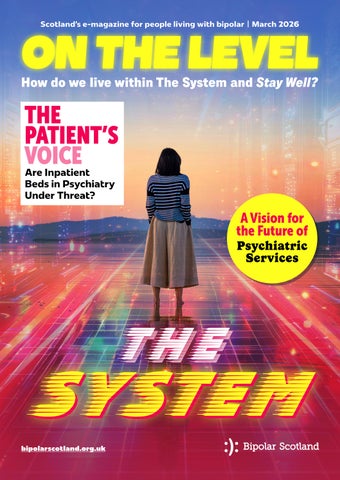
Hello everyone! This edition our theme is (dun dun duuuun) The System. This could be any system - the NHS, the police, the benefits process - and how we interact with it. Perhaps unsurprisingly, most of our focus will be on the NHS as we examine how we deal with it and how it deals with us.
There is a great article on P5 by our new Chair of the Board of Bipolar Scotland Dr. Victoria Reid on proposed changes to mental health provision - namely the number of psychiatric hospital beds in Scotland - and how that might impact those with severe mental health conditions like bipolar.
We have our usual suspects David Carr on P12 and Graham Morgan on P18 sharing their experiences of being caught up in a large bureaucracy like the NHS and how it can help - and hinder - your recovery. And, giving a hopeful view of how The System could work on P8, is renowned psychiatrist and friend of Bipolar Scotland Dr. Daniel Smith, Head of Psychiatry at Edinburgh University.
We also have a special treat - a cultural view on systems from our guest columnist Lidia Dodsworth on P17. Inspired by recent events at the BAFTAs surrounding the film Image: Vecteezy.com
I Swear, Lidia gives a thoughtful take on bipolar representation in the artsor lack thereof!
I hope you enjoy the magazine!
See you next time, Pete Stanton

The System will see you now… Or will it? Chair of Bipolar Scotland Dr. Victoria Reid looks into rumours that the Greater Glasgow NHS Health board might be looking for ways top reduce the number of psychiatric beds in the country’s largest health authority.
Literary Corner
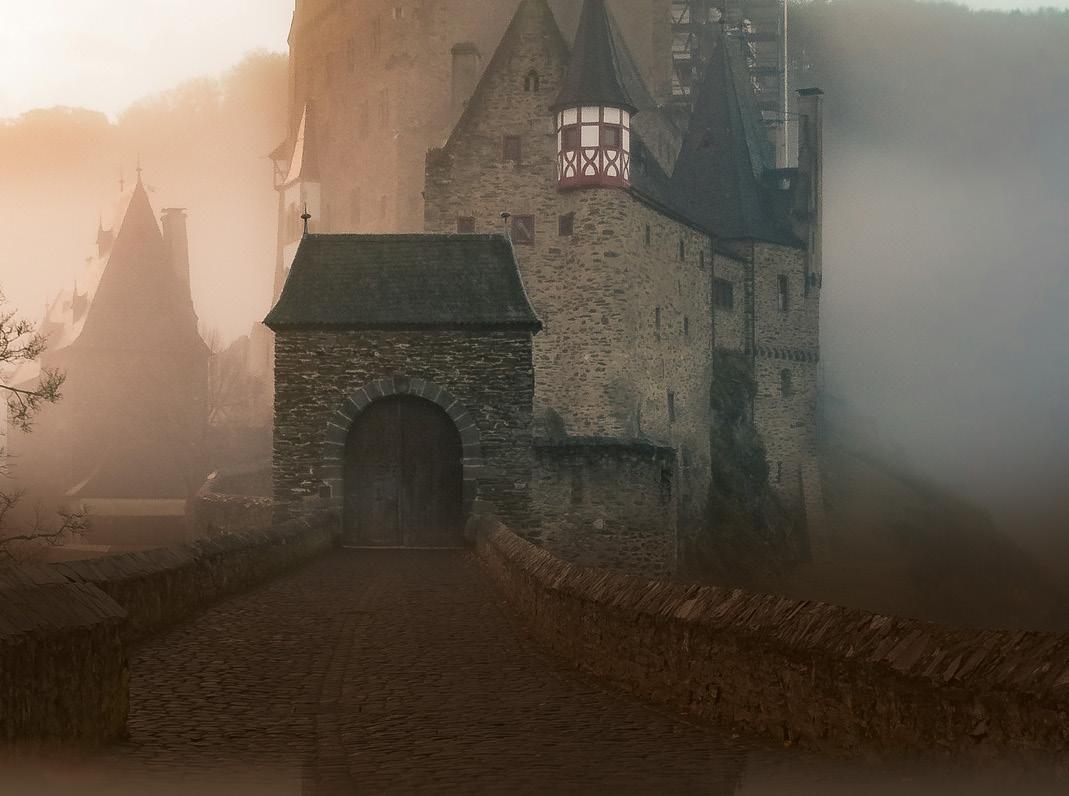
Well, not quite. But our regular columnist David Carr does invoke images of Kafka when describing his experiences of navigating The System.

Edited by Jamie Stewart and Pete Stanton
Please note that the views and opinions expressed in On The Level are not necessarily those of Bipolar Scotland.
Submissions: If you would like to submit a piece of writing, a photo or an idea to be considered for future issues of On The Level, please get in touch with: petes@bipolarscotland.org.uk
We would also love your feedback about On The Level. Send us an email or reach out to us on social media. You can find us on Instagram (@bipolar_scotland) and Facebook (@bipolarscotland)
©Bipolar Scotland 2025 Scottish Charity No. SC021705 Company No. 163305
T: 0141 560 2050 E: info@bipolarscotland.org.uk bipolarscotland.org.uk
Academic and Head of Psychiatry at Edinburgh University Dr. Daniel Smith outlines his vision for a functioning and effective mental health care system that would help people with bipolar.

Jamie’s Diary in this issue Jamie talks about working in and about the system.
Disclaimer: On The Level works in good faith with a range of subject-matter experts and official bodies to produce accurate and well-researched content. While every effort is made to ensure the reliability and accuracy of the information presented, errors may occasionally occur. Where necessary, we will issue corrections or clarifications.

Your space to share your creative writing. If you’d like to submit a poem, story or piece of writing, please email us on info@bipolarscotland.org.uk with the subject line ‘On The Level Submission’.
By Colette MacFadyen
We rely on The System but is it on our side
Do they really know what we go through
To be at the mercy of your moods, high and low
Can they really empathise, do they really know?
Do they label us all the same way
Do they get to know us, do they know our name
Are we just another person who has lost control
We rely on their kindness, do they want to know?
Sometimes they tower over us and judge us too
Can they really put themselves in our shoes
And imagine what we are going through
We are vulnerable and scared, do they care?
But sometimes there is a glimmer of hope
When The System can be kind and open its heart
A doctor or nurse sees you for who you are
Recognises your struggles and how you have come far
It is these glimmers of hope we cling to
That is The System we fight for each day
One that does not label or number us
But treats us with the dignity we deserve
A System of hope, empathy and respect
A System that is for us, not against us!
Chair of Bipolar Scotland Dr. Victoria Reid investigates concerns that psychiatric bed numbers may be shrinking in Glasgow
At the Bipolar Scotland Conference, ‘Time for Transformation’, in October 2025, I got chatting to a delegate with 30 years’ experience in disability rights, mental health law and engagement work. What he had to tell me came as a huge shock: was I aware that over the next three to five years, inpatient bed numbers for psychiatry in Greater Glasgow & Clyde could be reduced drastically? He signposted me to the document A Refresh of the Strategy for Mental Health Services Greater Glasgow & Clyde: 2023-28 (MH Refresh Document), which recommends a major shift of emphasis from inpatient beds to community services.
NHS Greater Glasgow & Clyde (NHSGGC) is the biggest Health Board in the UK, covering six Local Authority areas: East Dunbartonshire; East Renfrewshire; Glasgow City; Inverclyde; Renfrewshire; and West Dunbartonshire. It serves a population of between 1.2—1.3 million residents, and up to 2.2 million for regional/specialist services. This last decade has already seen a 20% reduction in psychiatric beds in the Health Board: in 2014, NHSGGC had 1,105 mental health and learning disability inpatient beds. By 2025, that number had gone down to 875 (data from Scottish Government Inpatient Census). And that is before we are faced with the effects of the current ‘service reprioritisation’…
Adults with bipolar are only one of many categories potentially requiring psychiatric inpatient care. Psychiatric beds serve a range of ages and stages (child, adolescent, perinatal, adult, older people) and a range of conditions. These include, for example, eating disorders, dementia, forensic mental illness, learning disabilities, drug and alcohol addiction. There are likely to be in Greater Glasgow & Clyde fewer beds available than the present 875 for all of us in our greatest need.


Bipolar Specificity:
Bipolar is a severe and enduring mental illness. That makes it distinct from most mental illnesses, such as anxiety or depression. Bipolar requires lifelong secondary care, which means a GP is not enough, but rather a Community Mental Health Team or outpatient hospital care is needed, for the long haul. Acute episodes and recovery can require inpatient hospital care.
Many Bipolar Scotland members, myself included, have inpatient experience on a psychiatric ward: it was during a sevenweek stay in Hairmyres Hospital, South Lanarkshire, that, after years of suffering, my bipolar was finally diagnosed and appropriate medication made available to me. Inpatient care contained me safely during a sustained manic episode. It took inpatient care and the observation of nurses to be believed as someone experiencing mania. Hitherto the series of different locum psychiatrists I saw as an outpatient discounted my accounts of hypomanic and manic behaviour since at my 3-monthly 20-minute appointments I invariably presented as depressed. For diagnosis inpatient care was a necessity for me.

The System:
I am still trying to fathom more fully the structures that decide priorities in psychiatry. The following is what I have gleaned so far (and I stand to be corrected). The bodies responsible for decision-making are the Health Board; and the Health and Social Care Partnership (HSCP). HSCPs merge the planning and delivery of services previously managed separately by NHS Boards and Local Authorities. HSCPs are overseen by an Integration Joint Board (IJB). Glasgow City HSCP, overseen by Glasgow City IJB, is the umbrella HSCP for three others (Glasgow NW, NE and South). However, the Health Boards still operate separately from the HSCPs in some domains. This leads to a confusing and difficult to penetrate structure and as such, it’s hard to ascertain where specific responsibility and therefore accountability should lie.
the organisation through a period of change and centre as the experts of bipolar lived experience in all parts of Scotland.
Our dedicated team has worked incredibly hard to increase the number of support groups, recruit and train more volunteers, increase the number of peer support hours offered, deliver more self-management training, and develop and promote a brand new suite of specialist training, supporting employers to make workplaces more bipolar friendly.
Health and Social Care is legally obliged to involve people and communities in the decision-making that affects them, as laid out in the Scottish Government’s Planning With People Document. Public engagement and consultation is conducted for the Health Board (in Glasgow certainly) via the Patient Experience and Public Involvement (PEPI) Team, whereas it is conducted for the HSCP via the Local Engagement Forum (LEF).
Remarkably, we’ve achieved all of this against a backdrop of cost savings. In the last few years we’ve ceased unnecessary spending, including the closure of our office hub in Paisley and negotiated new contracts with suppliers to further reduce expenditure. We’ve restructured the team, appointing the right people to the right roles on the right salaries. Coupled with our recent fundraising success, these achievements enable Bipolar Scotland to step forward with confidence into the new year and beyond.
Money is a major issue. I don’t yet know how the budgets of the HSCP, Health Board and Local Authority interface nor which public body is directly responsible for the funding of inpatient psychiatric services. What I do know is that Glasgow City HSCP has a major funding gap to address: around £140 million over the next five years must be saved. That is approximately 10% of its entire budget across all 400+ services, including homelessness, children, social care, and health. A team has begun gauging the ‘public value’ of the services currently provided, with a view to seeing which should be continued, augmented, reduced, or ceased. Services affecting inpatient psychiatry will be amongst those being evaluated. For psychiatry, a shift of emphasis from inpatient care to community care can be a cost-saving strategy
The time is therefore right for me to step down and hand the reins to my very capable successor, Maja Mitchell-Grigorjeva. Maja is excited to be working with members, staff, volunteers and Trustees to develop the new Strategy ahead of the Scottish election in May and I know you’ll continue to give her your support. Thank you for your kindness, patience and insight throughout my tenure. It’s been lovely getting to know you.
Greater community based support to offset bed reductions?
That said, in the view of Gordon McInnes of
the Mental Health Network Greater Glasgow & Clyde, a move towards increased community services can also be done meaningfully, maintaining or improving health outcomes. It could take several forms, such as ‘“Recovery Colleges”, peer support models, trauma informed services and home treatment’. Such changes would require detailed consideration as regards costings, availability of services to people, tracking of outcomes. McInnes comments: ‘This is a major change to the model of care across Greater Glasgow & Clyde and there should be extensive engagement to gauge the feedback from people who receive such services.’
Discuss the issue with our loved ones, families, friends, and other potential bipolar allies. They too may know the importance of psychiatric inpatient beds.
Share information across Scotland. Are inpatient bed numbers under threat elsewhere in the country? Should you have any information about this topic or similar happening in other parts of the country, please email info@bipolarscotland.org.uk
Bipolar Scotland is keen to collate evidence.
Consider. Why might we, or might we not, wish to defend inpatient psychiatric beds against cuts? For example, what does inpatient care provide us with that community care cannot? How many of us were diagnosed in hospital? Did we feel we were kept in hospital too long or discharged too early? What more must community care offer to help us day-to-day and when we are in crisis? What is currently lacking in community care? What works well? Have confidence in our voices. Few of those deciding which services to reduce will know
the importance of the psychiatric ward for those of us living with bipolar. Those of us who know the psychiatric ward as a patient have important lived experience. We know the risks of not gaining timely access to hospital care, and those of being discharged prematurely. We know the role of inpatient care in bipolar diagnosis.
Hope. In 2024 Glasgow City Council looked to save money by removing 450 teaching posts. A successful campaign led by the teaching union, the EIS, and parent-teacher groups led the Council to renege on this. Campaigning can work.
Realism. That said, it is more difficult to
campaign against bed cuts in psychiatry than cuts in teacher numbers. Those of us who recognise the vital importance of these beds are not collectively organised. We are dealing with stigma, and sometimes quite traumatic experiences on the ward. It is not easy to hold up a placard in defence of a place you go when you are at your lowest and sometimes least yourself, a place many of us would prefer to forget, despite it all.
We have a healthy membership at Bipolar Scotland and hope to be an effective vehicle for the bipolar patient’s voice in all this. We wish to make sure that consultation and public engagement exercises about cuts to inpatient beds in psychiatry involve our voices.
Pete the Editor here. I had a chat with Edinburgh University Head of Psychiatry, and friend of Bipolar Scotland, Professor Daniel Smith to try to make sense of that most epic of all systems - the NHS…
What is the general state of psychiatric provision in Scotland at the moment?
In general, I think there’s not enough provision currently for prevention of relapse. In people with bipolar, and I hear stories about as soon as someone looks relatively stable, they will sometimes, if not often, be referred back to their GP and given the contact numbers for the crisis out of hours teams if anything happens.
And I don’t think that’s fair for many people because we know works in psychiatry is a long-term therapeutic relationship with a specialist. Obviously s long-term therapeutic relationship with GPs are also very important, but it seems the GPs have enough to do and I don’t think people with bipolar disorder should have all of their monitoring and relapse prevention work done in primary care. It needs specialist ongoing input by a multidisciplinary team. So, by a CPN (Community Psychiatric Nurse), by an OT (Occupational Therapist), by a psychiatrist, by a psychologist. So I feel like many people with bipolar don’t get as much input in NHS Scotland now as they deserve. And I think that’s a false economy because only offering secondary care input when people become unwell is kind of not good, doesn’t make good sense for anyone really.
We should try and keep people well, and we should try and keep people well by doing really detailed relapse prevention work with them, rather than just bouncing them back to primary care when they appear to be stable.
I mean, obviously patient choice is important as well. So if people don’t want to see a psychiatrist or a multidisciplinary team on a regular basis and they’re doing okay, then that should be respected. But, you know, as things stand, I get a sense that unlike other diagnoses like schizophrenia, people with bipolar disorder do miss out on a lot of secondary care monitoring and relapse prevention.
Well, services are stretched, for sure, and underfunded and I think elements of risk in looking after patients are probably often not as serious in people with bipolar disorder. People worry about people with schizophrenia and psychosis a lot more in terms of risk to themselves and possibly risk to others. So that’s not as prominent a thing in bipolar disorder probably and therefore that dictates where the resources are spent.
So it’s still a sort of triage mentality?
I think so. You know, to be fair to my NHS consultant colleagues in psychiatry, the services are overwhelmed by people who are severely unwell and this is what happens when services are underfunded. There are some areas of psychiatry that miss out.
If you had, say, all the resources in the world to treat people with bipolar specifically, then what would that look like from diagnosis through to inpatient, outpatient care and longer term care?

“I get a sense that unlike other diagnoses like schizophrenia, people with bipolar disorder do miss out on a lot of secondary care monitoring and relapse prevention.”
Well, I think it would be important to tailor the level of care to the individual. So some system that has the ability to give more light touch support to people who don’t need as much. So it’s not a sort of one size fits all. It’s targeted on multi-level support according to people’s needs and preferences as well. But I think ultimately Scotland would benefit from a specialist service for bipolar disorder run by specialists that maybe gave opinions on people for whom standard care hasn’t been helpful.
That’s really important because I think there is a proportion of people with bipolar who do need very specialist input. That’s both psychopharmacology as well as psychiatry, as well as psychology, social inputs, etc. So I think that some sort of specialist service that could help with people who most need it, but also help train practitioners as well. I think the level of expertise in primary care is very low, unfortunately. The level of knowledge and confidence and help in dealing with bipolar disorder diagnosis and treatment is quite low in GPs. And then it could be better in psychiatry in many community mental health teams.
I think it could be better. I mean, a good example of that is just the fact that year on year, fewer and fewer people are being treated with lithium. And yet, the NICE (National Institute for Healthcare and Excellence) guidance for bipolar disorder says that everyone has to be told that the first line gold standard treatment is lithium. But yet every year, fewer and fewer people are being treated with lithium, even though it should be more and more people.
So there are simple, evidence-based things that for whatever reason are not happening. So that would be one sort of low hanging fruit - can we offer lithium to all the people who could potentially benefit from lithium and can we properly supervise that trial of lithium treatment, rather than just thinking ‘lithium is quite hard to talk about or to monitor, so therefore we won’t bother offering it to patients’. I think that’s a mistake, for example. But in answer to your question, it’s a big question, but there’s lots of different aspects to the answer. So my response would be better training and knowledge in primary care, upskilling in secondary care, especially around psychopharmacology and psychoeducation, and then a specialist level service to help coordinate care across Scotland as well.
I had no idea that the usage or the prescription of lithium was dropping. Is that a combination of factors or things that’s leading to that situation?
It’s complicated and people are trying to work it out, but I think there’s a danger that there’s a generation of trainee psychiatrists coming through who don’t feel confident starting with lithium, which is a real shame. We have data that documents the fact that lithium is being under-prescribed year on year. And I’ve got more anecdotal feedback from trainees who say that the consultants that they work with often don’t use it as often as it could be used. It’s partly because it needs monitoring, and it’s partly because of a misperception that it’s a highly toxic drug.
And I think that misperception has been propagated by pharmaceutical companies who want people to be prescribed anticonvulsants instead. So I think, you know, psychiatry needs to be more assertive and begin training people on how to prescribe lithium properly and offering it to all patients who might benefit from it.


Very interesting, because from my own personal experience I wasn’t offered it until very, very, very late into the game.
Right, so why is that? That says to me, if you had cancer, or if you had diabetes, or if you had, epilepsy, you would expect that very early in the course of your illness, a psychiatrist, a specialist, would offer you the gold standard treatment according to the guidance in the National Institute of Clinical Excellence, NICE. So, to wait, you know, five, six, seven years before someone even mentions lithium to you is not very helpful.
What do you think we need to be communicating right now to help us get to a place where we can make these things happen?
I think people need to know about the health economics of this, namely every time someone with bipolar disorder or mania relapses into depression or mania and requires hospitalization, that’s an incredibly expensive event for the health service. So even preventing a small proportion of those episodes by investing properly in specialist knowledge and care and training and prevention is economically helpful to the person. So it’s just about convincing health care policy makers that prevention pays dividends in the medium to long term. But unfortunately, we currently have services that are very reactive rather than focused on long term outcomes.

The definitive text on how bureaucratic systems work is Franz Kafka’s The Castle. A man known only as K arrives in a snow-covered village governed by a distant and mysterious castle. An official arrives and tells K that he needs a permit to stay in the village. K tries repeatedly to gain access to the castle’s authorities, but every attempt leads him through messengers, assistants and minor functionaries who provide partial information, contradictory explanations, and endless delays.
I don’t want to overwork the analogy. Dealing with our mental health system is not usually quite such a Kafkaesque nightmare. But the theme of the novel that rings true for me is that the castle’s bureaucracy has its own internal logic. K is an outsider who experiences the system not as something malign or capricious, but rather as something opaque, impersonal, at a distance.
I found out by accident that I had been allocated a new psychiatrist. I was seated in the waiting area at my health centre and when my regular psychiatrist approached, I stood up to greet her. ‘Oh no,’ she said, ‘You’re seeing someone else.’ I had known her some fifteen years and we had a good working relationship. Without warning I had entered the twilight world of locum psychiatry.
How gaps in our mental health system depersonalise our care.
Like the castle’s bureaucracy, NHS systems have their own rationale. Decisions about my care have been made in the background, weighing staffing and budget against my needs. My bipolar disorder is well managed, so it makes sense for my experienced consultant psychiatrist to concentrate on patients in crisis. I can be left to the ever-changing, identikit, resident doctors with their omnipresent, systematised checklists. But nobody has explained that rationale to me. I recently learned that my psychiatrist has since retired. Nobody told me that either.
In an economy of permanent austerity and a consequent growth in need for mental health services, continuity of care is now frequently absent. I used to have a named CPN involved in my care. I no longer do. Now there is nobody in the system who knows me as an individual. This is not only alienating. More crucially, there is nobody who is familiar with how my moods present over time - surely essential to bipolar care?
The relationship between me and my mental health team has shifted from one of familiarity and trust to strangers I talk to every six months. I only ever speak to them about medication. My care has become faceless. Letters which inform me of my next locum
appointment emerge like missives from the castle.
This facelessness manifests in other ways. Talking therapies are rare in the NHS, but when they happen, they give the patient an opportunity to speak openly about their problems. The most common talking therapy to be offered is Cognitive Behavioural Therapy - although this has contested efficacy for bipolar disorder. Even this has become remote. The staffing crisis - 1 in 4 posts in Scotland are unfilled - has necessitated that it be delivered in a more efficient, systematised way. It has gone from being a face-to-face therapy to impersonal apps.
I am currently well. Most of my personal issues with the system are just irritations. I shouldn’t have to explain myself at each fresh interaction with a new duty CPN. I shouldn’t have to convince them that I am not drug
seeking every time I call to request diazepam. If I were ill and already reluctant to call, having to explain myself to someone I have never met would be one more barrier. ‘Just call duty’ we are told. It’s never that easy to open up to a stranger.
As our care is pared back, the patientcarer relationship has become an afterthought. Is psychiatry meant to be this way? In a system shaped by shortage, we have become conditioned to accept the bare minimum it has to offer.
I’m sure my mental health team - If I can still be said to have one - would be affronted to hear that their care is impersonal. But the system is creaking as it grinds away in the background, remote from the patients at its margins. The castle stands distant. I remain on the outside.

The chrono/metabolic psychiatry lab at University of Edinburgh is becoming a pioneer in Scotland conducting cutting edge research focussing on different aspects of bipolar. Our mission as a group of researchers is to understand a holistic perspective of bipolar, keeping lived experience in the centre.
In this article, we’re excited to share updates from three studies currently running in our lab- each exploring a different piece of the bipolar puzzle. From the light that regulates your mood, to the sleep that shapes your days, to the way bipolar interacts with your body’s metabolism, our research spans the full picture of what it means to live with bipolar.
Together, the three studies reflect our commitment to understanding bipolar not as a single condition with a single answer, but as something deeply personal, biological, and multifaceted. Read about whichever study speaks to you most — or read all three:
• HELIOS-BD — light, lithium and mood
• AMBIENT-BD — sleep, body clock and mood
• MetPsy — bipolar and metabolic health
The HELIOS-BD study aims to understand whether people with bipolar disorder have altered sensitivity to light, and whether
lithium can correct this altered sensitivity. We do this by measuring participants’ response to light at night, and completing a variety of tests looking at the structure and function of the retina.
Participants are required to attend two overnight sleep studies at the Royal Infirmary Edinburgh, and 4 additional appointments for retinal testing. We reimburse £15/hour and all travel and childcare expenses. For our full participant information sheet, please visit www.heliosbd.com. We are aiming to recruit 60 people with bipolar taking lithium and 60 people with bipolar disorder not taking lithium. We have recruited 58 participants to the non-lithium group, and have just two spaces left. We are particularly looking for people taking lithium, as we have only reached 40 of our target of 60 participants. We are recruiting until July 2026. We do our best to make the study accessible to people across Scotland and aim to be flexible with appointments. If you would like to
discuss the study further with a member of the research team, please contact us by telephone on 07788512143 or by email at: heliosbd@ed.ac.uk. We are progressing well with completion of each part of the study, and should have some initial results from the retinal imaging in early 2027 – please keep an eye out for updates on our website www.heliosbd.com !
AMBIENT BD STUDYING THE RELATIONSHIP BETWEEN SLEEP AND CIRCADIAN RHYTHMS (BODY CLOCK) IN BIPOLAR
Sleep, body clock and mood are the three things deeply intertwined in bipolar disorder and the AMBIENT-BD study is here to explore that and the mechanisms behind it. The AMBIENT-BD study is investigating the relationship between sleep, circadian rhythms (your internal body clock) and mood in people living with a diagnosis of bipolar. A salient feature of this study is that it has been designed with the involvement of people from the bipolar community. People with lived experience have been at the heart of every major decision of this studyfrom how it is structured to how data is collected. Your voices have definitely helped shape our research!
To make participation easy, AMBIENT-BD uses ‘low intensity’ technology that aims to collect data in ambient and passive way.
• Somnofy — a bedside sleep sensor
• Axivity — an actigraph wristwatch
• TUM Momentum — a bespoke app built by our research team
What’s in it for you?
• £15 per appointment with our researchers
• Travel and overnight accommodation reimbursed up to £300
• A personalised sleep report summarising your own data at the end of participation
We’ve recruited 62 out of 180 participants and we’re recruiting throughout the year. The response from the bipolar community has been overwhelmingly positive — and we want to keep that momentum going. If you have a bipolar diagnosis and want to contribute to research that could genuinely change how we understand and support bipolar disorder. You can register your interest on our website- https://www.ambientbd. com/register-your-interest or email us on ambient-bd@ed.ac.uk. You can also call us on 07353103399 or 07353103395.
We would absolutely love to hear from you!
STUDYING THE EFFECTS OF BIPOLAR ON METABOLIC HEALTH
The METPSY study aims to better understand whether metabolic issues are linked to changes in mental health outcomes among young people with severe mental health conditions, including bipolar. with a diagnosis of bipolar are invited to take part in the study are asked to attend 3 in-person visits at the Royal Infirmary of Edinburgh
(travel expenses covered) over 12 months, and also provide data on their mental health, sleep, and glucose levels remotely between study visits. Interested? Get in touch at metpsy@ ed.ac.uk or visit our website: https:// www.metabolicpsychiatryhub.com/ takepart
Through the three studies, HELIOS-BD, AMBIENT-BD and METPSY, we aim to connect different aspects of bipolar with the understanding that bipolar affects every part of a person. These studies aim to complement each other, adding an important piece to a bigger puzzle.

We would also like to acknowledge and thank the support of the bipolar community! Your contribution doesn’t just help with research, it has the potential to shape how bipolar is understood and supported for people in the future. If any of these studies has sparked your interest, we’d love to hear from you. Whether you’re ready to sign up, want to find out more, or simply know someone who might benefit from getting involved — please reach out or

By Lidia Dodsworth
I watched I Swear recently and it genuinely stayed with me. What I loved most was how gently it handled something that’s so often misunderstood. It didn’t over-dramatise. It humanised. And you could really feel how storytelling has helped people better understand Tourette’s Syndrome over time.
It made me think about bipolar. Because where is that same softness for us?
So often it’s shown at its most extreme, the “Jekyll and Hyde” stereotype, the unstable character, the unpredictable partner. It’s loud, dramatic and a little frightening. But rarely do we see someone just… living with it.
There was a period in my life where bipolar completely overtook me. It was crippling. I truly didn’t believe I would see my 30th birthday. That’s how convincing your own mind can become when it turns dark.
But I did.
Now I’m in my 30s. I’m raising my children. I’m working. I’m creating. I’m building a life. And alongside all of that, I’m constantly checking in with myself. Regulating. Learning my patterns. Taking responsibility for my emotional depth.
That part isn’t dramatic enough for film.
Even things like work can feel harder than people realise. I’ve had my fair share of full- and part-time jobs in the past, and I’ve found it especially difficult to maintain a healthy work/life balance without support in place. During more severe episodes, like many others, I’ve had to step away from
employment altogether. It adds pressure — especially when misunderstanding still exists in workplaces.
Bipolar isn’t a horror story. It isn’t split personalities. It isn’t being kind one day and someone else the next. It’s intensity. It’s shifts in energy. It’s knowing yourself deeply enough to steady your own waves. It isn’t a condition anyone glamourises, it’s hard as hell to cope with.
I don’t think people avoid understanding it intentionally. Often, they just haven’t been shown the full picture. And when the only portrayals are the frightening ones, that becomes the narrative.
So I want to congratulate the actors and director behind I Swear for creating something that opens conversation with care. Films like this matter. They invite empathy instead of fear. It’s no surprise they deserved every BAFTA awarded to them on 22 February.
I just hope one day we see a story about bipolar told with that same balance. The quiet strength. The resilience. The individual doing the inner work no one else sees.
Because that story exists too. And maybe it’s time we told it a little more honestly.
Lidia writes and shares reflections on motherhood, mental health and personal growth through her platform Mixing it with Lidia.
When I went for my last depot I was in a good mood. The nurse who called me from the waiting room smiled when she saw me, as did the other nurse who was at her computer. Even though it was only a few days after my CTO had been renewed we all seemed pleased with life. The jag hurt, it stung, which is not normal. My nurse noticed, was mortified and apologised and I said there was no need to; that usually I hardly felt it.
The other nurse started asking her usual questions and when she got to the one about whether my voices were bothering me, I said they were fine. She always forgets I don’t hear voices and this day I couldn’t be bothered to correct her and just smiled inside. They told me I would be taking oral medication when I am in Poland in a couple of weeks and I agreed that I would pick up the prescription but I am not sure if I will.
As the questions carried on, I got bored and started staring at the blinking light on the ceiling which prompted one of the nurses to ask what I was looking at. I found it funny and told her off for being paranoid for believing that I was hallucinating and they laughed. I left in a really good mood. They were smiling too.
Often, I am not so happy when I go to the clinic; it feels sparse and cold and routine. It reminds me that I am a person who can get lost in the system or just plain old processed as if I have no feelings. I know we need a system; there are thousands of us that need our jags and our appointments and our therapies and
By Graham Morgan
medication and without a system we would fall into chaos. Many more people like me would be living on the streets in poverty in the way we used to before the mental health system started. But despite that, systems need organised and organisation can dehumanise and process and make us other and inferior. It can make us feel defective. It can make us angry and alien and uncooperative.
I hear that by far the best indicator or the efficacy of talking therapies is the relationship we have with our therapists and while I am not sure what I mean by healing I worry that systems can create an absence of the healing some of us crave. To me healing is the presence of something very human in our care.
It may come with medication but it may also come with connection and warmth and the love our therapists have for people like us. While boundaries may be needed in systems they can also serve to alienate when hugs are sackable offences and individuality becomes a threat to policy and process. I do not know if ever I have experienced healing and maybe healing is a sort of fey alternative therapies concept that I should doubt but I have been in the presence of staff who give something indefinable which has made a huge difference in my life.
I just spent about 9 months getting CBT for psychosis. If I am honest it was painful and exhausting and already I can’t remember more than one of the exercises I was taught. All that remains is the pebble I now keep in my pocket to sooth me

and the memory of the presence of the psychologist on the screen who, to my great surprise, seemed to hold me and understand me. Someone who, despite just being an image on my computer; seemed like a healing presence.
I have found that with some nurses in my life; they stand out in my memory: calm present, warm, positive. They were unfazed and didn’t judge. I knew they wanted the best for me. That helped profoundly. There was once a physiotherapy assistant in a hospital who I thought did more good that nearly all the other staff. She breathed positivity while understanding and knowing first hand all about the depths that can envelop us. Her presence was
healing, despite a system that did not easily accommodate her.
How many of us are part of the mental health system in Scotland? Hundreds of thousands? We need organisation, process, policy to keep us coping, to keep us alive but we need a system that allows the chaos and joy of being human to shine through; that allows us all to laugh at the awfulness of it and yet helps us connect. It reminds me of my, maybe naïve belief, that love is key to any mental health service but how can you safely and wonderfully make love integral to a system?
I really don’t know but sometimes it has to shine through.
I chose to title this article in the most pretentious way possible! This issue is about ‘The System’ - we are all a part of it whether we like it or not; work, bills, travel, social media requests, birthdays, appointments, you keep on top of things and you play the game. If you are also Bipolar, this is an extra pressure.
We can all manage to keep on top of things or just about keep on top of things. But playing the game isn’t the same as winning, if you are so caught up in the gears of life that you can’t enjoy anything - you need to step back a little while.
I feel I am speaking to myself (I should take my own advice sometimes!)

Life is for living, not just obeying a system, we were born to be free, getting out for a walk (as I have said many times) is a way I free my mind. Getting out in nature is so important, it reminds me that life is bigger than me and what is going on in my head.
But I do understand the weight of it all, I keep myself so busy, and it can sometimes be unhealthy. In the pursuit of achieving goals, I have lost friends, I have been able to gain new ones too. I miss when people used to live right next door to me in a small town, people are so spread out now it is hard to keep up but I think everybody feels the same. I am so lucky that I have so many great people around that when I do see them I am able to connect in a really awesome way.
It is those moments of freedom with friends or family that I feel I am winning, but I also have a job that can
bring me so much joy - I allow myself those great moments, I am up for life, there are moments of joy and freedom within and outside of any system.
Do I wish I had more time? Of course who doesn’t? I would also like to live in a lighthouse and be taller! I saw a podcast recently that had this cool Buddhist monk talking, he said “if someone asks you if you want to do something socially, even a small thing and your response is pressured and anxious, you are probably burned out”
He suggests you step back, look at all
your responsibilities, look at any area you may need help with, do all you can to not just exist but to live again.
Look at the things you can do in your social time that bring you joy, paint, read that old comic book, anything that connects you to you again.
We all have to play the game, but some of the rules are yours to set.
I wish you all the best Love to you, Jamie x


We run online and in-person peer support groups across Scotland – friendly, safe spaces for anyone living with or affected by bipolar. Here’s a full list of all our groups running during April and May. Why not talk to people who get it?
To access an online support group, please visit https://bipolarscotland.org.uk/gethelp/support-groups/ to sign up.

SCOTLAND-WIDE (ALL ONLINE) BIPOLAR BLETHER: For anyone living with or affected by bipolar in Scotland. Sunday 5 April and Sunday 3 May, 3-4pm.
18-30: For anyone aged 18-30 affected by bipolar in Scotland. Wednesday 1, 15 & 29 April, Wednesday 13 May, 7-8pm.
FRIENDS & FAMILY: For carers and loved ones. Monday 20 April & Monday 18 May, 7-8pm.

AYRSHIRE & DUNDEE
• Tuesday 7 April & Tuesday 5 May, 7-8pm.
• Dundee in-person (Dundee Volunteer and Voluntary Action, 10 Constitution Rd, Dundee, SS1 1LL): Thursday 2 April and Thursday 7 May, 7-9pm.
BORDERS
• Borders online group: Wednesday 1 & 15 April and Wednesday 3 & 17 May, 7-8pm.
DUMFRIES & GALLOWAY
• Dumfries & Galloway online group: Tuesday 21 April & Tuesday 19 May, 7-8pm.
FIFE & FORTH VALLEY
• Fife & Forth Valley online group: Tuesday 14 & 28 April and Tuesday 12 & 26 May, 7-8pm.
GLASGOW
• Glasgow City online group: Sunday 26 April and Sunday 24 May, 7-8pm.
• Glasgow City in-person (Premier Inn, Glasgow City, 187 George St, Glasgow, G1 1YU): Wednesday 8 April & Wednesday 13 May, 7-9pm.
• Glasgow West online group: Sunday 12 April & Sunday 10 May, 7-8pm.
• Glasgow West in-person (Partick Trinity Church, 20 Lawrence St, Partick, Glasgow, G11 5HG): Wednesday 22 April and Wednesday 27 May, 7-9pm.
HIGHLANDS & ISLANDS
Highlands & Islands online group: Thursday 16 April & Thursday 21 May, 7-8pm.
• Highlands & Islands in-person (Café 1668, 86 Church St, Inverness, IV1 1EP): Thursday 2 April & Thursday 7 May, 7-9pm.
NORTH LANARKSHIRE
North Lanarkshire in-person (Coatbridge Community Centre, 9 Old Monkland Rd, Coatbridge, ML5 5EA): Monday 13 April & Monday 11 May, 7-9pm.
PAISLEY
• Paisley online group: Monday 13 April & Monday 11 May, 6-7pm.
• Paisley in-person (Methodist Central Hall, 2 Gauze St, Paisley, PA1 1EP): Monday 27 April & Monday 25 May, 6-7.30pm.
WEST DUNBARTONSHIRE
• West Dunbartonshire online group: Wednesday 8 April & Wednesday 13 May, 7-8pm.
• West Dunbartonshire in-person (Concord Community Centre, Dumbarton, St Mary’s Way, G82 1LJ): Wednesday 22 April & Wednesday 27 May, 7-9pm.
WEST LOTHIAN
• West Lothian in-person (Bathgate Community Centre, Lindsay House, South Bridge St, Bathgate, West Lothian, EH48 1TS): Thursday 9 April & Thursday 14 May, 7-9pm.
EAST LOTHIAN
• East Lothian online group: Thursday 23 April & Thursday 28 May, 7-8pm.

Want to get in touch with us?
Bipolar Scotland is based at:
Studio 10
Anchor One 7 Thread Street Paisley PA1 1JR
You can contact us by phone between 9.30am – 3:30 pm, Monday to Thursday, on: 0141 560 2050, or by email on info@bipolarscotland.org.uk
We’re also on Instagram: (@bipolar_scotland), and Facebook: (bipolarscotland1)
Charity Number: SC021705 Company Number: 163306 bipolarscotland.org.uk