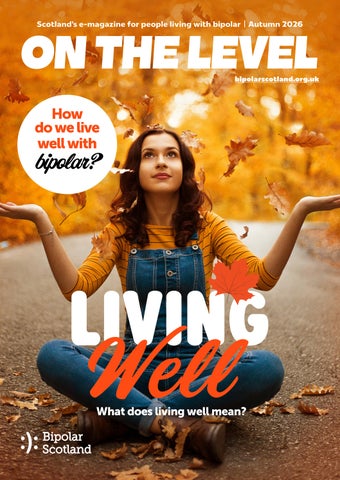
Scotland’s e-magazine for people living with bipolar Autumn 2026
ON THE LEVEL
bipolarscotland.org.uk
How do we live well with
bipolar?
Living Well What does living well mean?
EDITORIAL - OTL Autumn Foreword - Summer Welcome to the September issue of On the Level! As we continue to live in an increasingly stressful world, we thought we would try to produce a more upbeat issue this month to provide some small counterweight to it all. Therefore, the theme of this issue is ‘Living Well’. This can mean anything really, from staying on top of your meds, to having a hobby, to seeing friends or practicing guru-like levels of self-care. The point is it doesn’t have to be a hugely impressive routine, sometimes the little things are just as, or even more, important. With that in mind, our regular retinue of contributors share what living well means to them. On P6 David Carr explores how the language we use impacts our wellbeing (I sense the beginnings of a manifesto with this one!), on P8 Graham Morgan takes a more metaphysical view, balanced nicely by some sciencey stuff with Research Corner on P14, in which our friends at Edinburgh University hit us with some Image: Vecteezy.com
studies regarding the impact of diet on bipolar. I hope you enjoy it! Pete Stanton, Editor, On the Level.
CONTENTS 6
16
The Power of Words
David Carr argues the case for re-claiming some of the words used against people with mental illnesses. There is strong historical precedent…
14 Research Corner
This month’s guest author is Dr Morven Baker from the University of Edinburgh. In her article, Dr. Baker takes us through the study she and her colleagues are conducting to investigate what impact diet has on bipolar depression.
ON THE LEVEL Edited by Jamie Stewart and Pete Stanton. Please note that the views and opinions expressed in On The Level are not necessarily those of Bipolar Scotland. Submissions: If you would like to submit a piece of writing, a photo or an idea to be considered for future issues of On The Level, please get in touch with: petes@bipolarscotland.org.uk We would also love your feedback about On The Level. Send us an email or reach out to us on social media. You can find us on Instagram (@bipolar_scotland) and Facebook (@bipolarscotland) ©Bipolar Scotland 2025 T: 0141 560 2050 Scottish Charity No. SC021705 E: info@bipolarscotland.org.uk Company No. 163305 bipolarscotland.org.uk
Fundraising
We draw attention to three of our dedicated fundraisers in a section that will become a regular feature in On the Level. Get your wallets out!
Disclaimer: On The Level works in good faith with a range of subject-matter experts and official bodies to produce accurate and well-researched content. While every effort is made to ensure the reliability and accuracy of the information presented, errors may occasionally occur. Where necessary, we will issue corrections or clarifications.
Image: Vecteezy.com
BIPOLAR SCOTLAND 03
Jamie’s Diary Living well with Bipolar I find living right with bipolar disorder challenging. I have a craving for sugar all the time, that and a mix of thirst caused by medication. This has been the case as long as I can remember, even as a small child I was on meds that made me crave all things sweet. I remember vividly my mum buying a Ghostbusters chocolate bar for me and my two brothers, she put them in her handbag and I got a craving so bad that when nobody was looking, I took it out her handbag and greedily wolfed it down without being seen, this happened last year so I have learned from it! (Jokes) Of course, I was caught and my parents told me they would get the police involved, thank god that wasn’t true! Image: Vecteezy.com
I am telling you this as I know it is difficult to avoid temptation, but it is possible. It was during Covid where I noticed how unfit I had become, between not leaving the house and changing medication it was when I did go for a gentle walk my body felt like glass and I couldn’t go far. But we are formidable creatures, the more we put our mind to something the better we get. Going out and getting fresh air and starting to walk soon became a healthy addiction, even now I walk miles in the week – it really helps clear my head. I am not the best with eating, I am guilty of eating things that are easy to make, in saying that; I am disciplined and try to have treats in moderation. Health for me is about allowing
that space to recover, my job / life is hectic, and I enjoy that but talking care of myself is key. My diet as stated isn’t perfect, but I take all my multivitamins and vitamin D (a must for this time of year) So can people with Bipolar feel healthy? Yes absolutely, it can just be another challenge to stay on top of. There is a little part of my spirit that likes to punish myself a little, to walk that extra mile, to push myself a
little further but I am absolutely not suggesting anyone do this. I am also always trying new supplements, my new one is Ashwagandha - It seems to bring a little calm. But staying hydrated and eating better are definitely the winners for me. It is not about perfection, it is just about trying to be better than I have been to myself in previous years. Keep going forward, do what works for you - Love Jum x
BIPOLAR SCOTLAND 05
David Carr
It Is Better to Be Mad On Your Feet… I teach English to speakers of other languages. The other week, my lesson featured medical vocabulary, and I included words relating to mental ill health. I am a stickler for terminology. My learners have to get it right. Depression was easy enough to describe - I used mime - but when it came to bipolar disorder, I struggled. My class, a superdiverse set of learners from different cultural backgrounds, was fully on board with mental illness as a medical issue. Their attitudes towards it were on a par with those in their host culture. But the word they understood for the more challenging side of bipolar disorder was ‘crazy.’ I taught that this is not considered a polite way to describe mental ill health. But what are the alternatives? Native speakers of English also struggle with what to call us. Mental? Bonkers? Nutter? People may understand ‘She is depressed’ or ‘He has anxiety.’ But beyond that, our vocabulary often fails us. Terminology remains a live issue in the LGBTQIA+ community. The catch all term ‘queer’ has been reclaimed to describe the glorious tapestry of sexuality and gender diversity. This is not without controversy. Some remember times when it was hurled as a slur, often a precursor to violence. Can the slurs which stigmatise mental ill health similarly be recaptured?
George III was considered to be mad. This was a standard word in his day and it was understood that the king was suffering from a temporary health condition. But it also carries stigma. Am I mad to suggest that the word might be reclaimed by us? Some with serious and enduring mental health conditions have done just that. Mad Pride is a grassroots movement, with its origins in the 1970s but gaining traction, starting in Toronto in the 1990s with Mad Pride parades. London has held occasional Mad Pride events since the early 2000s. The origins of Mad Pride are in those who consider themselves survivors of a hostile psychiatric system. One of their aims is to destigmatise madness. But this is a minimum goal. Activists go beyond this, with stark critiques of psychiatry, and of the way that madness is treated in wider society. Some Mad Pride activists argue that certain forms of madness are a form of human variation rather than pure pathology, echoing arguments made in autism and neurodiversity advocacy. Mad Pride is not necessarily anti-treatment. Mental health conditions such as bipolar disorder are organic in origin and many people - myself included - benefit greatly from medication. But madness is also socially constructed. The way that we experience our illness is fundamentally defined by the way we are treated, by individuals - stigma - and by wider society. Mad people struggle to find practical support, including access to
disability benefits. We find it difficult to the medical services that keep us well. When we do access them, they often come with a coercive element, from detainment to the requirement that we ‘comply’ with our sometimes excessive - medication. The Mad Pride movement challenges the idea that madness is something that is automatically incapacitating and something to hide. As well as addressing the way that madness is framed - by individuals, by media - it seeks to give mad people agency and autonomy. Partly this is achieved by advocating for greater attention to lived experience in the shaping of psychiatry and for stronger communities of peer support. However, the problem with Mad Pride is that we can lack the strength to advocate on our own behalf. It is hard to stand up for yourself when you cannot get out of bed, when your life is a car crash, when all the apparatus of the mental health system is focused on crisis and containment, rather than on recovery and allowing patients to lead meaningful lives.
Who else is there to speak for us? I am currently well. I am open to a fault about my illness. I am a seasoned political activist. But I can well see that others may not feel up for the fight. However - try we must and just possibly the adoption of an unashamed mad identity signals, perhaps counter-intuitively, that we are to be taken seriously. The Spanish civil war veteran, Dolores ‘La Pasionara’ Ibárruri, who is commemorated by a statue beside the River Clyde, once said ‘It is better to die on your feet than to live forever on your knees.’ The self-identifying label of mad perhaps feels too much like sticking our heads above the parapet. I would like to reclaim it as a starting point for an identity that returns to us agency when we can manage it. We will need to do this collectively, as a community, sharing the load. Madness is perhaps a useful and suitably militant umbrella term beneath which we can unite and organise. To call ourselves mad can be a useful first step in living well and authentically. I am ready to embrace it.
Image: Vecteezy.com
BIPOLAR SCOTLAND 07
T ha n e r o M
l l I n e n ss A By Graham Morgan
However, for some years now, despite my cynicism; I have begun to believe that I am loved by my family and my friends. I have celebrated their hugs and laughter and my partners kisses and even if I find it hard to join in and truly see the colour of life; I have found a faith that they want me in their lives permanently.
For most of my adult life I have lived within the confines of the implications of my diagnosis of schizophrenia. A harsh acceptance that my perceptions may be faulty; that I might remain blurred and barred from a world where people can laugh and feel emotion and joy as naturally and inevitably as the day breaks, but I don’t. In a way my atheism, despite my belief that I am a devil and evil, was a comfort in this. On those days when such thoughts are too strong, if I am very lucky indeed, I can pretend that they are just manifestations of my illness and that evil or goodness is just some construct to help us operate in our society as best we can. It can be easiest to think that I am ill and that I live in a mechanistic, meaningless place, where morality is a debatable concept.
Even when I struggle to brighten in the morning, I have found great pleasure walking Dash the dog; seeing the flowers around me and the trees. Hearing the call of seabirds and smelling the rich smell of the mud of the seashore. I like to fall asleep listening to the sound of the crows settling across the road, knowing Dash will bound up and leap onto the bed soon and that Wendy will creep up to the room as I am almost drifting off, only to wake me with her chatter and make me smile sleepily with her company. I work. I work far too hard and for some years I have doubted my ability, but recently I have realised I am good at what I do and that I do often bring value to those I work with. This is a huge relief. I still tell myself each day that I should be dead, and I can still think I might, one day try to escape this existence again, but at the same time, I am delighted with my life and desperate not to fall back into the horror of whatever all this illness is. I have been content with this. Content that my entire life can be explained by the science of illness, hoping but not really believing that my worst thoughts are aberrations of a disabled mind or an
unquiet mind or a mind damaged by some mixture of the past and who I am now. However, lately I have started to question this. The time before last; when I was sick but not in hospital; I emailed our local church asking for sanctuary but also telling them I was evil so they may need to protect their church if they let me in. I cannot remember their reply but know I was not made welcome in what I hoped would be refuge. Sometimes, I do stray into religious places and in the still cool gloom feel a sense of the sacred and a sense of peace. I wonder if I could find something in such places even though I have often tended to see faith as misguided and only fit to comfort those needing its false balm. However, I am now reading novels by people like Elif Shafak and learning about Rumi and Sufism. I have had glimpses into paganism and a kindly writer led me to books of poetry that combine a love of science and nature with spirituality. It has challenged me. It has made me think that maybe there is something greater than one plus one equals two. It has reminded me that for years I have said that we need to bring love into mental health services; something that most workers still shy away from in horror.
T More han
An Illness By Graham Morgan
It has also made me wonder what love is and though I have not come to any conclusion; increasingly I find comfort in love; not just as a tentative way of creating connection or babies but as a force we may never understand. Maybe a force that underlies all our attempts to find meaning and purpose. I am not sure I will ever return to organised religion, but I can see that for me ‘living well’ may transcend the bare mechanics of function and the dry meanings of science and its current explanation of who and why someone like me is. I have hopes that I can bring doubt into my life and in doing so acknowledge there are many things we will never understand and maybe love, something that so many of us know we feel; is one of those things and can be how I learn to structure my life. Our romantic love, our love of the scent of orange blossom, our love of a skylark or our community or our friends or our children or the Universe. This offers me hope, offers me a glimpse of joy. I am not sure I will ever truly feel in the way I once remembered doing and I am not sure I will ever glory in life and I fear my inner vision of myself terribly, but I think for me to start to live well is to open my life to wonder and yes; love!
Living well By Colette MacFadyen
Life is a balancing act of trying to live well Taking daily medication and pacing yourself Trying new therapies all aimed to help you From exercise classes – Pilates and yoga too CBT, anxiety classes and mindfulness Therapies that will free your mind from undue stress Life really is a challenge There are struggles you will face Look to those around you To hug you and embrace Professionals and caregivers Will help you when they can All these people will support you And help you make a plan So use all of your strategies Take all the help that you can get Life is worth it if you do And you will have no regrets Life is a balancing act So take time to find a way To stop and take a breath And enjoy each brand-new day
Image: Vecteezy.com
BIPOLAR SCOTLAND 11
Staying Self Aware Through Reflective Writing By Struan Logan
It’s tough to get therapeutic help when you have Bipolar. Whether it is people who don’t understand your condition (“Is it ADHD?”) or when you make the same mistake as me and get a cheap counsellor who consistently calls you Greg. Sadly, my best therapies have been temporary, including Bipolar Edinburgh’s Peer Support where I had twelve sessions over roughly six months. However what has stayed consistent has been my ability to reflectively write since the Spring of 2022. Reflective writing is where you write to analyse an event, explore what it means, what you’ve learned and how it’ll influence your future actions. I keep these pretty loose and mine are done with the regularity of a relaxed diary so it doesn’t make me feel restricted. Instead, I feel growth and development as these diaries build up (I am approaching a total word count of over 300,000 from a roughly four year period). I started reflective writing when I had just had my first episode of psychosis at the age of 31, but the doctors did not diagnose it as Bipolar at that point. However, when I was psychotic
I somehow knew I needed to write to get my energy out, so writing was a lot of what I did for the next six months when I was recovering. I didn’t write about anything in particular, I just wrote reflectively on what I was up to, what had been going on and what I planned to do about it. The main goal was that the piece had to be 1000 words long. Whilst not every single session is going to make the 1000 mark before I give up, the vast majority did and I even have a bunch of 2000-3000 word pieces from the early days. However, those I would hardly call essays, they’re more streams of consciousness that are incredibly unfocused and rambly. The best part of these for me are generally sitting in my favourite cafes in Leith on a Sunday afternoon, writing for 1 to 4 hours depending on the length, drinking some excellent black coffee and meditatively taking a look back on my recent life and where to go next. At first these writings were streams of consciousness into the void as I still had symptoms of psychosis, like racing thoughts and active delusions that were present but which I did not truly believe. But these first runs were likely a mess which I don’t have much interest in looking at.
was a metaphorical slap in the face and a list of reasons to be incredibly grateful rather than wallowing in my own self pity any longer. It felt fantastic. I’ve always felt having a positive attitude helps me keep bad depressions at bay - I am the bipolar type far more worried about emulating Kanye West than Kurt Cobain. However, I can certainly say that reflective writing has compounded that positivity even if it does confuse quite a few of my friends. General opinion holds that regular writing of your gratitudes is one of the most effective ways of staying mentally happy, and whilst I’m not currently looking for a therapist when I next do I will be slightly worried about him calling me Keith. Anything that compliments what I’ve currently got in my mental health arsenal is worth using, and for me reflective writing is absolutely the top one. Because fundamentally, what other form of mental health exercise can you do whilst enjoying a fantastic dram? Which is what I do when I really want to treat myself.
Thankfully these did become more honed and refined as my life became more structured. I essentially used it as a long form gratitudes list where I put a positive spin on what was going on in my life, and if I felt it needed a remedy I tried to create one. I remember once doing a session where I planned to winge about what was going on in my life and instead my fingers typed what Image: Vecteezy.com
BIPOLAR SCOTLAND 13
RESEARCH CORNER
Food and Mood: the ENERGISE-BD Trial by Dr Morven Baker and Dr Victoria Linsley Image: Vecteezy.com
What is ENERGISE-BD? ENERGISE-BD is a research study investigating how different diets affect feelings of low mood (depression) in people living with bipolar. Some research suggests that changes in diet might help these depressive symptoms, so we are doing a trial to further investigate this theory.
ENERGISE-BD will compare the effect of two different diets on symptoms of bipolar depression. These two diets are nutritional ketosis (achieved by following a modified ketogenic diet, which is high in fat and very low in carbohydrates, so the body switches to burning fat for energy) and the NHS EatWell guide (which advises eating a variety of different food groups to achieve a healthy balanced diet). We will also investigate whether these diets affect other aspects of mental and physical health, if they are easy for people to follow, and if they are costeffective options for people with bipolar which might be used within the NHS. Why are we doing this study? Current treatments for depression in people with bipolar (such as antidepressants) might not always be effective and may have unwanted side effects, including negative effects on physical health and an increased risk of abnormally high mood. So, we need to
develop and test new treatments for bipolar depression. Dietary changes have been used as an effective treatment for patients with other conditions such as epilepsy and using different diets may be helpful for patients with mental health conditions such as bipolar too. The development and delivery of the ENERGISE-BD study is shaped by people with personal experience of bipolar, through our Lived Experience Advisory Panel. Their involvement ensures that our research focuses on the priorities of people living with bipolar. What will the study involve? We aim to start recruiting participants for the study in October 2026 and will get in touch with community members to provide more information closer to the time. The study will be carried out in two places, Edinburgh and Birmingham. We aim to recruit a total of 206 adults with bipolar depression. Each participant will be randomly assigned to follow one of the two diets for 12 weeks, meaning that they have an equal chance of being assigned to either the nutritional ketosis or the NHS EatWell diets. Participants will be informed about which dietary intervention they have been assigned to. Participants will continue their usual treatment for bipolar at the same time, including continuing to take any
prescribed medication and attending appointments with their usual clinical teams. We will assess participants’ mental health before and after the diet. We will also monitor participants’ physical health through blood tests, weight and blood pressure measurements, to see if the dietary changes have any impacts on physical health too. Participants will receive regular support from specialist research dietitians throughout this period, to help them with the dietary changes. Participants who are based near the Edinburgh study site will undergo three Magnetic Resonance Spectroscopy scans of the brain. These scans use magnet and radio waves to measure the levels of certain chemicals in the brain, so we can look for any changes in the way the brain meets its energy demands as a result of the dietary changes.
Potential benefits for participants include learning more about how their mood relates to changes in diet and receiving education and advice on dietary interventions from a qualified dietitian. On a wider scale, the results of this trial may then help us to improve treatments for people with bipolar depression in the future, depending on how each diet is found to impact people’s mental and physical health. Author’s bio: Dr Morven Baker is a psychiatrist working as clinical research fellow and Dr Victoria Linsley is a postdoctoral research associate. Both work at the University of Edinburgh on the ENERGISE-BD trial, examining the impact of two dietary interventions on people with bipolar depression.
We are also carrying out a process evaluation study as part of the ENERGISE-BD trial. The aim of this is to understand how the trial is delivered, the experience participants have of taking part, and whether any improvements can be made for the future. This process includes interviews with the participants and different staff members. What might the impact of the ENERGISE-BD study be? Image: Vecteezy.com
BIPOLAR SCOTLAND 15
Bipolar Scotland Fundraising Keeping the running theme going, another of our members Rachel Jackson has just run the Baxters River Ness 5K! Well done Rachel and thanks for your support! If you’d like to contribute towards Rachel’s £1000 target, please head to her Just Giving Page here: justgiving.com/page/rjacz
I’m very happy and grateful to report that we’ve been the lucky beneficiaries of some of our member’s hard work and determination this month! The intrepid Mary Twaddle is currently in training for The Great Scottish Run in October. The run itself is a half marathon, so it’s not for the faint of heart! Mary has already raised over £700 of her £1000 total for Bipolar Scotland, which is amazing! If you’d like to donate just click this link or check out our socials for more info. ajbellgreatscottishrun2026. enthuse.com/pf/ mary-twaddle?utm_ source=share&utm_ medium=whatsapp
And finally a massive thank you to the incredible Jenni, who walked this year’s Edinburgh Kiltwalk in memory of her dad, John. Jenni’s dedication has raised over £1,200 for Bipolar Scotland—an amazing achievement that will help provide vital support and hope to individuals and families living with bipolar across the country. If you’d like to add to Jenni’s impressive total, then click this link to be taken to her Just Giving page: https://www.justgiving.com/page/ jenni-connolly-2 Thanks Mary, Rachel and Jenni!
Image: Vecteezy.com
BIPOLAR SCOTLAND 17
BIPOLAR SUPPORT GROUPS ACROSS SCOTLAND We run online and in-person peer support groups across Scotland – friendly, safe spaces for anyone living with or affected by bipolar. Here’s a full list of all our groups running during October and November. Why not talk to people who get it? To access an online support group, please visit https://bipolarscotland.org.uk/gethelp/support-groups/ to sign up.
SCOTLAND-WIDE (ALL ONLINE) BIPOLAR BLETHER: For anyone living with or affected by bipolar in Scotland. Sunday 4 October and Sunday 1 November, 3-4pm. 18-30: For anyone aged 18-30 affected by bipolar in Scotland. Wednesday 30 September, Wednesday 14 & 28 October, Wednesday 11 November 7-8pm. FRIENDS & FAMILY: For carers and loved ones. Monday 19 October & Monday 16 November, 7-8pm.
REGIONAL Ayrshire & Dundee online group: • Tuesday 6 October & Tuesday 3 November, 7-8pm.
• Highlands & Islands in-person (Café 1668, 86 Church St, Inverness, IV1 1EP): Thursday 1 October & Thursday 5 November, 7-9pm.
• Dundee in-person (Dundee Volunteer and Voluntary Action, 10 Constitution Rd, Dundee, SS1 1LL): Thursday 1 October and Thursday 5 November, 7-9pm.
NORTH LANARKSHIRE North Lanarkshire in-person (Coatbridge Community Centre, 9 Old Monkland Rd, Coatbridge, ML5 5EA): Monday 12 October & Monday 9 November, 7-9pm.
Borders online group: • Wednesday 21 October and Wednesday 18 November, 7-8pm. DUMFRIES & GALLOWAY • Dumfries & Galloway online group: Tuesday 20 October & Tuesday 17 November, 7-8pm. FIFE & FORTH VALLEY • Fife & Forth Valley online group: Tuesday 13 October and Tuesday 10 November, 7-8pm. GLASGOW • Glasgow online group: Sunday 11 October and Sunday 8 November, 7-8pm. • Glasgow City in-person (Premier Inn, Glasgow City, 187 George St, Glasgow, G1 1YU): Wednesday 14 October & Wednesday 11 November, 7-9pm. • Glasgow West in-person (Partick Trinity Church, 20 Lawrence St, Partick, Glasgow, G11 5HG): Wednesday 28 October and Wednesday 25 November, 7-9pm. HIGHLANDS & ISLANDS Highlands & Islands online group: Thursday 15 October & Thursday 19 November, 7-8pm.
PAISLEY • Paisley online group: Monday 12 October & Monday 9 November, 6-7pm. • Paisley in-person (Methodist Central Hall, 2 Gauze St, Paisley, PA1 1EP): Monday 26 October & Monday 23 November, 6-7.30pm. WEST DUNBARTONSHIRE • West Dunbartonshire online group: Wednesday 14 October & Wednesday 1 November, 7-8pm. • West Dunbartonshire in-person (Concord Community Centre, Dumbarton, St Mary’s Way, G82 1LJ): Wednesday 28 October & Wednesday 25 November, 7-9pm. WEST LOTHIAN • West Lothian in-person (Bathgate Community Centre, Lindsay House, South Bridge St, Bathgate, West Lothian, EH48 1TS): TEMPORARILY PAUSED LOTHIAN ONLINE GROUP • Thursday 22 October & Thursday 26 November, 7-8pm.
Image: Vecteezy.com
BIPOLAR SCOTLAND 19
Want to get in touch with us? Bipolar Scotland is based at: Studio 10 Anchor One 7 Thread Street Paisley PA1 1JR You can contact us by phone between 9.30am – 3:30 pm, Monday to Thursday, on: 0141 560 2050, or by email on info@bipolarscotland.org.uk
We’re also on Instagram: (@bipolar_scotland), and Facebook: (bipolarscotland1) Charity Number: SC021705 Company Number: 163306 bipolarscotland.org.uk