ISSN 2364-2351 | A 60711 |
Interview
Life Sciences and Industry Magazine
Karen Massey, CEO of argenx, on what’s next for Europe’s autoimmune champion
Autumn Edition 2026 | Volume 25 | 20 € w w w.europ ean - biote chnolog y.com
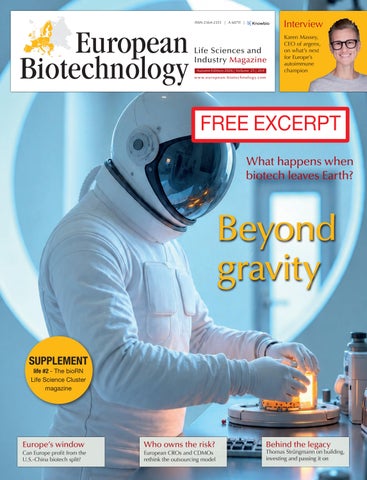
FREE EXCERPT What happens when biotech leaves Earth?
Beyond gravity SUPPLEMENT life #2 - The bioRN Life Science Cluster magazine
Europe’s window
Who owns the risk?
Can Europe profit from the U.S.-China biotech split?
European CROs and CDMOs rethink the outsourcing model
Behind the legacy
Thomas Strüngmann on building, investing and passing it on
MS i M aging easy c A re dual po L arity benchtop D esign easy operat I on
Easy to clean, simple to run With the MALDI-8030 EasyCare you can do routine maintenance yourself. The compact instrument is easy to clean and quickly back in use again. Adding its outstanding performance parameters, it’s the ideal solution for high sample throughput, especially in a clinical environment.
A true multi-talent Enables a wide range of applications, e.g. protein and polymer analysis or quality control for (bio)-pharmaceuticals Available as linear positive MALDI-8020 EasyCare
Self-service maintenance Less maintenance costs, increased uptime Compact benchtop design Allows installation almost anywhere in the lab Outstanding performance Offers comparable performance parameters to larger and more expensive MALDI-TOF instruments
www.shimadzu.eu/easy-care
Learn more!
INTRO
European Biotechnology | Autumn Edition | Vol. 25 | 2026
FREE EXCERPT
Picture: © Fresenius
Europe has the investors. It needs the capital. The medicines and devices that will shape European healthcare over the next decade are mostly invented by companies that are still small, or that do not yet exist. Between 2015 and 2021, 65% of new drugs approved for the world’s twenty largest pharmaceutical companies were brought in through licensing or acquisition. The same holds true in medtech, diagnostics and care provision. A strong R&D function is no longer enough. Companies must also be connected to the innovation they do not own. Europe is not short of innovation. It is short of the means to hold on to it. The region’s share of global pharmaceutical R&D investment has fallen from 41% at the start of the century to around 31%. In 2025, U.S. stock exchanges took an estimated 98% of the world’s biotech IPO capital, and mid-sized European drugmakers spent the year acquiring American biotechs rather than being acquired. The sciTHOMAS THESTRUP is Managing ence is still here. The value it creates is increasingly drifting west. Director of Fresenius Ventures, the This is not a capability problem. Large European pharma alnewly established venture arm of ready knows how to be an investor: Novartis, Roche, Sanofi, Fresenius, a >€200 million fund inBoehringer Ingelheim and Novo have run venture arms for decvesting in growth fields adjacent to ades, and two of the three most active corporate investors be(Bio)Pharma, MedTech and Care hind the roughly 70% of biopharma companies that went pubProvision. Before joining Fresenius, lic since 2022 are European. Even the number of active corhe co-founded two companies, porate venture capital units in Europe is not far behind North held business development roles at America’s: an estimated 820 against roughly 1,030. What EuLundbeck and UCB Pharma, and rope lacks is not capability, but capital deployment. U.S. veninvested in life sciences through ture funds manage close to six times the capital of their EuroSunstone Capital and Angelini Venpean counterparts and invest around six times as much every tures. He holds a PhD in neurosciyear. Yet many mid-sized pharmaceutical, medtech and diagence and protein engineering. nostics companies remain on the sidelines. And care providers across the continent still have only little to no venture capabilities. A minority stake taken early is the cheapest, most informed way to understand a technology years before any acquisition, and beats meeting that company in a banker-run auction later. It is a two-way exchange: an industrial parent can offer medical, regulatory and operational expertise as well as access to clinical, scientific and academic networks that help a young company scale – creating value beyond capital alone. Corporate investors can play a growing role in Europe’s innovation ecosystem: patient investors that can engage early, are not constrained by traditional fund cycles, and can provide meaningful strategic support. This is the opportunity Fresenius Ventures was created to pursue. Europe has spent years debating how to stay competitive in healthcare and life sciences. While policymakers continue to refine the framework for innovation, corporate investors do not need to wait. By backing the next generation of healthcare companies today, wherever they emerge, European corporates can strengthen their own competitiveness and ensure that more of tomorrow’s healthcare value creation ■ remains connected to Europe. Thomas Thestrup
3
CONTENTS
European Biotechnology | Autumn Edition | Vol. 25 | 2026
FREE EXCERPT
DEEP DIVE
TOPICS AND HIGHLIGHTS
18
A wall around China’s labs, and a window for Europe?
26
Interview with Karen Massey, argenx’s new CEO
29
Europe’s test: Turn science into global companies - now!
36
The Strüngmann legacy, passed on
38
Fundraising: Relationships matter more than ever
40
Biopeople
74
AI biotech is no longer a useful category for investors
TECHNOLOGY
76
AI drug discovery’s new bottleneck is the lab
Space: Biotech’s new laboratory
78
Associations news & events
82
Company list, preview next issue
When genetics enters the inner ear
06 WATCHLIST
14
Six Spanish biotech startups to watch
70
SUPPLEMENT: bioRN Life Science Cluster magazine No. 2 | 2026
IMPRINT European Biotechnology (ISSN 2364-2351) is published quarterly by: Knowbio GmbH, Lessingstr. 12, 16552 Mühlenbecker Land, Germany, Tel.: +49-30-264921-0, Fax: +49-30264921-11, Email: service@european-biotechnology.com, Internet: www.european-biotechnology.com; Publisher: Joachim Eeckhout; Editorial Team: Dr. Georg Kääb, Uta Mommert, Maren Kühr, Advertising: Oliver Schnell, +49-30-264921-45, Christian Böhm, +49-30-264921-49, Andreas Macht, +49-30-264921-54; Distribution: Michael Kuhrt +49-30-264921-43; Graphic Design: Martina Willnow/Michaela Reblin; Production: Martina Willnow; Printed at: Möller Pro Media® GmbH, European Biotechnology Life Sciences & Industry Magazine is only regularly available through subscription with a Knowbio bundle subscription: €80 for private individuals (students €40) incl. VAT, €120 plus VAT for corporates. Prices include postage & packaging. Ordered subscriptions can be cancelled within two weeks directly at Knowbio GmbH. The subscription is initially valid for one calendar year and is automatically renewed every year after. The subscription can be cancelled at any time and is valid until the end of that calendar month. Failures of delivery, which Knowbio GmbH is not responsible for, do not entitle the subscriber to delivery or reimbursement of prepaid fees. Seat of court is Berlin, Germany. As regards contents: individually named articles are published within the sole responsibility of their respective authors. All material published is protected by copyright. No article or part thereof may be reproduced in any way or processed, copied, and proliferated by electronic means without the prior written consent of the publisher. Cover Photo: © Knowbio GmbH · AI-generated image; © Knowbio GmbH
Pictures: © Freepik - Magnific.com; Flowo - Magnific.com; alex-shuper-yaLbuNZQy-0-unsplash
4
CONTENTS
European Biotechnology | Autumn Edition | Vol. 25 | 2026
FREE EXCERPT
SPECIAL
EDITORIAL
Autoimmunity & inflammation
What makes a biotech European?
Autoimmune and inflammatory diseases remain one of Europe’s most active areas of biotech innovation. From inflammatory bowel disease, psoriasis and atopic dermatitis to lupus, vasculitis, multiple sclerosis and rare immune-mediated disorders, European companies are helping reshape how chronic inflammation is understood and treated. The field is now moving beyond broad immunosuppression towards more precise approaches.
21
Europe takes cancer science into immunology
23
Interview with Erik Lundgren, Immunic’s CEO
SPECIAL
Pictures: © www.magnific.com; metamorworks - stock.adobe.com; Knowbio GmbH
CRO & CDMO CROs and CDMOs are under growing pressure to expand their services while navigating global shifts and political uncertainty. Alongside established modalities, they must adapt to a wave of newer technologies, including ADCs, RNA therapeutics, cell and gene therapies and in vivo CRISPR treatments, while keeping pace with increasingly complex and innovative clinical trial designs.
43
Europe rethinks the CRO-CDMO model
53
WuXi AppTec bets on expansion in Europe
56
The handover: Making technology transfer work
60
European CDMOs follow pharma west
63
ADC boom drives European CDMO investment
69
Europe’s complex trials fuel CRO demand
Its headquarters? Its founders? Where it raises money? Those things matter, but perhaps not as much as the influence it has on the ecosystem around it. In this issue, we speak with the new CEO of argenx, a company that has grown into one of Europe’s rare “big biotechs” on the back of Vyvgart. Its importance goes beyond one blockbuster drug. Companies like argenx create experienced teams, attract capital and show that a European biotech can scale without disappearing into a larger company. We a l s o s p e a k w i t h Th o m a s Strüngmann, co-founder of Hexal and one of Germany’s most influential biotech investors. His story illustrates the other side of the same equation: entrepreneurs who turn one success into capital for the next generation. BioNTech is his most obvious example, but the broader effect is what matters: experience and money being recycled back into the ecosystem. That, to me, is what European biotech is ultimately about. A company founded here but acquired, relocated and gradually detached from the region leaves little behind. A company that stays, grows and supports the next generation does the opposite. The real measure of a biotech ecosystem is not simply how many companies it creates, but whether each success makes the next one more likely.
Joachim Eeckhout CEO
5
FREE EXCERPT
When genetic medicine enters the inner ear Gene therapies began as proof-of-concept treatments for a handful of rare genetic disorders and now, with emerging tools, may expand into broader territories with new targeted organs. This year, one gene therapy achieved what once seemed improbable: enabling children born profoundly deaf to hear. With the first therapy for genetic deafness now approved, the inner ear is emerging as a promising target for the next generation of genetic medicines.
GENETICS
DEEP DIVE
European Biotechnology | Autumn Edition | Vol. 25 | 2026
Pictures: © beststudio - Magnific.com; Freepik - Magnific.com; kjpargeter - Magnific.com
FREE EXCERPT
In April this year, the U.S. Food and Drug Administration (FDA) approved Regeneron’s Otarmeni (lunsotogene parvec), the first treatment ever for a genetic cause of deafness. While Europe awaits a European Medicines Agency (EMA) decision after accepting the filing in May, many other therapeutics and genetic tools are being investigated, riding the wave of the emerging field of inner-ear genetic medicines. OTOF-related deafness, also known as autosomal recessive deafness type 9 or DFNB9, is a congenital, severe-to-profound bilateral hearing loss. The OTOF gene encodes otoferlin, a protein essential for transmitting sound signals from cochlear inner hair cells to the auditory nerve. When pathogenic variants disrupt otoferlin production, the sensory cells may remain structurally intact but cannot efficiently pass auditory signals to the brain. Until recently, this form of deafness was considered permanent and managed
with hearing aids or cochlear implants – devices that can improve access to sound but do not restore the full spectrum of sounds. Otarmeni gene therapy was designed to address the underlying genetic defect by delivering a functional copy of OTOF directly into the inner ear. Administered through a cochlear injection, the therapy targets inner hair cells, aiming to restore otoferlin production and, with it, the cellular machinery needed to transmit sound to the auditory nerve. Besides Regeneron, other companies are developing gene therapies to target the OTOF mutations. In China, Refreshgene Therapeutics developed AAV1hOTOF (also known as RRG-003), which was tested in six children in an early clinical trial published in The Lancet in 2024. Five of the six treated children showed measurable hearing recovery, with improvements in auditory brainstem response and speech perception. After that initial data, no other news has been
shared. Eli Lilly, after its Akouos Inc. acquisition in 2022, announced that its gene therapy, dubbed AK-OTOF, restored the hearing of a child with profound hearing loss within 30 days of treatment. This was part of a Phase 1/2 trial expected to be finalized in October 2028. On the European front, French Sensorion was testing its own OTOF-targeting gene therapy, known as SENS-501. Initial results from the Audiogene Phase 1/2 trial showed the treatment was well tolerated, with no serious adverse events reported, and two of three children in the higher-dose cohort showed early improvements in hearing. However, the Montpellier-based company recently decided to change gears, redirecting its focus to SENS-601, a therapy targeting mutations in the GJB2 gene, a major cause of hereditary deafness. Despite the shift in its pipeline, the company expressed in the announcement that “Sensorion remains fully committed to ensuring the
THE BRIGDE TO YOUR SUCCESS! Customized Enzymes and Reagents from NEB Largest selection of enzymes for genomic research
Research-grade and GMP-grade production
Large to small scale lyophilization capabilities
ISO 9001 and ISO 13485 certified
Formulations without components such as BSA, detergents or glycerol Enzymes at user defined concentrations Custom aliquoting, kitting, packaging & private label (OEM)
Further information on Customized ›› Read the full story in the printed issue. Products and Solutions from NEB
7
TECHNOLOGY
European Biotechnology | Autumn Edition | Vol. 25 | 2026
FREE EXCERPT
Space: Biotech’s new laboratory What if gravity is holding biotechnology back? Remove that force, and proteins that make antibody therapeutics can crystallize more uniformly, organoids that mimic human organs can assemble more easily into 3D structures, and aging and oncologic models develop faster than they do under normal Earth gravity. The solution to this? Studying and developing drugs in space.
R&D INNOVATION
Microgravity is becoming a new experimental environment. As launch costs fall, autonomous miniature laboratories emerge, and return capsules are developed, biotechnology is beginning to move beyond Earth – not primarily to keep astronauts healthy, but to discover and manufacture better medicines for patients on the ground. One of the first R&D examples of this approach involved MSD’s development of a subcutaneous formulation of Keytruda (pembrolizumab). In collaboration with the U.S. National Aeronautics and Space Administration (NASA), MSD scientists studied how the drug’s antibody crystallized on the International Space Station (ISS) in microgravity conditions.
The experiments showed that without gravity, protein crystals formed more uniformly and suspensions had lower viscosity, making the formulation ideal for syringe delivery or, in other words, more suitable for subcutaneous injection. The space experiments were not themselves the final manufacturing process: once the optimal conditions were identified in orbit, the company reproduced the relevant characteristics on Earth using specialized mixing and thermal-control techniques. The U.S. Food and Drug Administration (FDA) approved Keytruda Qlex, the Keytruda subcutaneous formulation, in September 2025. “Microgravity studies of pembrolizumab are an example of how the orbital environment can be used to understand crystallization behavior and formulation properties,” said Cora Thiel, Vice Director of the Institute of Aerospace Medicine at the University of Zurich and Director for International Relations at the Center for Space and Aviation Switzerland and Liechtenstein. “Space research can contribute to medical products on Earth when microgravity offers a material or biological advantage that cannot easily be reproduced terrestrially,” she added.
A genomic code of gravity But the potential applications extend beyond pharmaceutical formulations. Thiel’s research, for example, focuses on a more fundamental question: how does
a cell know that gravity has changed? Thiel and her colleague Oliver Ullrich studied how altered gravity affects gene regulation and the organization of DNA inside the cell nucleus. The results suggest that the response can happen remarkably quickly. “In our experiments, altered gravity changed gene expression within approximately 20 seconds, while many of the early transcriptional changes moved back toward baseline within minutes,” Thiel said. “By combining parabolic, suborbital and orbital experiments, we have found that the cellular response to gravity appears to be linked to the spatial organization of the genome itself,” Thiel noted. She explained that active and inactive genomic regions can change their position within the nucleus when gravity changes, accompanied by rapid changes in gene regulation. Her group describes this emerging concept as a possible “genomic code of gravity,” or the idea that part of the cellular response to gravity may be encoded in the spatial organization of the genome. “What remains unclear is the identity of the primary gravity sensing mechanism,” remarked Thiel. The significance of this research may ultimately depend less on understanding how cells respond to gravity than on what scientists and biotechs can do with that knowledge. If changing the physical environment can alter cellular behavior so rapidly, microgravity could also be used deliberately to steer how
Picture: © alex-shuper-yaLbuNZQy-0-unsplash
70
European Biotechnology | Autumn Edition | Vol. 25 | 2026
TECHNOLOGY FREE EXCERPT
cells develop and interact. One area where researchers are already testing this possibility is the production of three-dimensional human tissues.
Biology done without gravity For drug developers, the attraction is straightforward: the closer a laboratory model is to human biology, the more useful it could be for predicting what will happen in a patient. Yet reproducing the complexity of human tissues outside the body remains difficult, particularly when scientists want cells to form structures that resemble real organs. “On Earth, researchers generally rely on matrices, scaffolds or other support systems to encourage cells to grow in three dimensions,” explained Thiel. “The biological processes involving these structures are technically demanding, while the structures themselves can influence the developing tissue. Microgravity provides a fundamentally different physical environment in which cells can interact and organize more freely in three dimensions.” Thiel pointed to a joint University of Zurich-Airbus project as an example. They developed a scalable process using adult human stem cells, first carrying out extensive development work on Earth before conducting two production missions to the ISS aboard SpaceX’s CRS-20 and CRS-23 missions. The experiments generated differentiated organ-like structures, including liver, bone and cartilage tissue. “We validated functional tissue markers, achieved a 100% production yield in the flight experiments, and successfully continued cultivation for more than 30 days after return to Earth without an observed loss of quality,” said Thiel. Although the immediate application for microgravity-grown tissue may not be transplantation, it could easily be accelerating drug discovery. Many drug candidates fail because of toxicity. “Threedimensional human liver tissue could allow compounds to be tested earlier and under conditions that better reproduce human tissue biology than conventional two-dimensional cell cultures,” commented Thiel.
In the future, the approach could also support precision medicine. Patient-derived tissues could potentially be used to test different drugs or combinations against biological material from a particular individual, allowing researchers to observe how that person’s tissue responds before a treatment is given. “Human organ-like tissues may additionally reduce the need for some animal experiments by providing a directly human test environment for selected toxicological and pharmacological questions,” added Thiel. In her opinion, “regenerative medicine is a longer-term prospect.” She believes that patient-derived tissues produced in microgravity could potentially become biological building blocks that are matured further after return, assembled through bioprinting or other tissueengineering approaches, or eventually used directly for tissue repair. However, Thiel cautions that transplantation applications will require rigorous evidence of safety, reproducibility, long-term function, manufacturing quality and cost-effectiveness before their application on Earth.
For astronauts and terrestrials “In the current era, we aim to go further and explore new planets and celestial bodies. To do so, we will need to travel for months, with no possibility of a rapid return to Earth,” said Nieves Cubo Mateo, an industrial engineer who works as a clinical engineer at Hospital General Universitario Gregorio Marañón in Madrid, where she coordinates the Advanced Planning and 3D Manufacturing Unit (UPAM3D). She is also a professor at Nebrija University, where she leads the Applied Research Group in Engineering and Computer Science (ARIES). Cubo Mateo and her team recently completed a European Space Agency (ESA)-funded project focused on using machine learning to computationally design bioinspired structures for additive manufacturing (the engineering term for a range of 3D-printing technologies). The project explored structures capable of preventing crack propagation, be›› manufactured Read the full story in thesupport printedstrucissue. ing without
tures, and maintaining their mechanical performance in both the human body and the space environment. At UPAM3D, the team is currently working on a project funded by ESA, with the company CiTD, to translate technologies originally developed for space applications into clinical practice, with the aim of improving the safety and reliability of patient-specific prostheses manufactured as custom medical devices. “New technologies are now under study to find a way to help the crew if some medical scenarios arise (such as accidents, cancer provoked by changes in the environment that may affect the physiology of the human body, cosmic radiation, etc.),” said Cubo Mateo. “In this regard, cancer seems to be a very probable case scenario and must be looked at in detail. Additive manufacturing technologies will allow scientists to perform more complex and real constructs [to better study oncologic therapeutics].” The ESA is also funding a broader portfolio of research aimed at understanding how the human body adapts to the stresses of spaceflight and developing countermeasures for long-duration missions. Projects are examining changes in bone, muscle, cardiovascular function and the immune system, as well as the effects of isolation and space radiation. The work has applications beyond astronaut health: the same physiological changes can offer insights into conditions on Earth, including osteoporosis, muscle loss and cardiovascular disease. ESA is also testing potential countermeasures, such as neuromuscular electrical stimulation to help preserve muscle strength and mass during spaceflight, while using data from astronauts and ground-based studies to improve medical monitoring and personalized interventions. In this regard, Thiel commented that “space research also provides a powerful model for mechanisms that are highly relevant to medicine on Earth.” She said that mechanical unloading accelerates loss of bone and muscle and therefore offers an experimental window into processes related to immobilization, osteo-
71
82
INDEX / PREVIEW
European Biotechnology | Autumn Edition | Vol. 25 | 2026
FREE EXCERPT
3P Biopharmaceuticals S.L. (ES) . . . . . . . . 33 AATec Medical (GER) . . . . . . . . . . . . . . . . 28 Abbvie Inc. (US) . . . . . . . . . . . . . . . . . . . . 22 abc biopply ag (CH) . . . . . . . . . . . . . . . . . 63 Adaptam Therapeutics (ES) . . . . . . . . . . . . 17 AGC Biologics (GER) . . . . . . . . . . . . 10 LIFE Akouos Inc. (US). . . . . . . . . . . . . . . . . . . . . 7 Alchemab Therapeutics Ltd. (UK) . . . . . . . 40 Araris Biotech AG (CH) . . . . . . . . . . . . . . . 37 argenx (NL/B) . . . . . . . . . . . . . . . . . . . 26, 27 AstraZeneca AB (SE/UK) . . . . . . . . . . . . . . 30 Atara Biotherapeutics Inc. (US) . . . . . . . . . 43 Athos KG (GER) . . . . . . . . . . . . . . . . . . . . 36 Austria Wirtschaftsservice GmbH/Austrian Business Agency GmbH . . . . . . . . . . . 34,35 Autolus Ltd. (UK) . . . . . . . . . . . . . . . . . . . 21 Azafaros B.V. (NL). . . . . . . . . . . . . . . . . . . 37 BenevolentAI (LU) . . . . . . . . . . . . . . . . . . 76 Berlin Partner (GER) . . . . . . . . . . . . . . . . . 11 BIO Deutschland e.V. (GER) . . . . . . . . . . . . 9 BIO-Europe (Informa, US) . . . . . . . . . . . . . 15 BioBrokers (F) . . . . . . . . . . . . . . . . . . . . . . 38 BioNTech SE (GER) . . . . . . . . . . . . 36, 37, 40 BioOrbit (UK) . . . . . . . . . . . . . . . . . . . . . . 72 BioRN Cluster Management (GER) 6, 16 LIFE Boehmert & Boehmert (GER) . . . . . . . . . . 20 Bristol Myers Squibb (US) . . . . . . . . . . . . . 30 CELONIC AG (GER) . . . . 41, 50, 51, 11 LIFE CONCEPT HD (GER) . . . . . . 81, CP3, 8 LIFE Coriolis Pharma Research (GER) . . . . . . . . 46 CriteriaCaixa (ES) . . . . . . . . . . . . . . . . . . . 31 Cube Biotech GmbH (GER) . . . . . . . . . . . 77 CZ Vaccines, S.A.U. (ES) . . . . . . . . . . . . .CP4 Eli Lilly (US) . . . . . . . . . . . . . . . . . . . . . 7, 10 Eon Labs (US) . . . . . . . . . . . . . . . . . . . . . . 36 Evidenze Health Srl (IT) . . . . . . . . . . . 52, 54
Evonik Industries AG (GER) . . . . . . . . . . . . 60 FGK Clinical Research (GER) . . . . 31, 44, 46 Fördergesellschaft IZB mbH (GER) . . . . . . 39 Fortrea Holdings Inc. (US). . . . . . . . . . . . . 44 Foventa Ltd. (UK) . . . . . . . . . . . . . . . . . . . 40 Frontier Space (UK) . . . . . . . . . . . . . . . . . 73 g-SPACE (US) . . . . . . . . . . . . . . . . . . . . . . 73 GALSER SA (CH) . . . . . . . . . . . . . . . . . . . 57 Genentech Inc. (US) . . . . . . . . . . . . . . . . . 76 GlaxoSmithKline (UK) . . . . . . . . . . . . . . . 76 H&B Real Estate AG (CH) . . . . . . . . . . 13, 42 HAS Healthcare Advanced Sythesis (CH) . 63 HAYA Therapeutics (CH) . . . . . . . . . . . . . . 37 Health+ Life Science Alliance (GER) . . 7 LIFE Hexal AG (GER) . . . . . . . . . . . . . . . . . 36, 37 Idorsia Pharmaceuticals (CH) . . . . . . . . . . 40 IDT Biologika GmbH (GER) . . . . . . . . 49, 55 Immunic AG (GER) . . . . . . . . . . . . 23, 24, 25 Integra Therapeutics (ES) . . . . . . . . . . . . . . 16 Invitris (GER) . . . . . . . . . . . . . . . . . . . . . . 39 IQVIA Inc. (US) . . . . . . . . . . . . . . . . . . . . 30 Iteria Biopharma (ES) . . . . . . . . . . . . . . . . 17 Jacobian (GER) . . . . . . . . . . . . . . . . . . . . . 37 Jiangsu Hengrui (CN) . . . . . . . . . . . . . . . . 30 JJP Biologics (PL). . . . . . . . . . . . . . . . . . . . 22 KCAS Bio – Lyon (F) . . . . . . . . . . . . . . . . . 61 Lonza (CH) . . . . . . . . . . . . . . . 41, 44, 60, 63 Lucera (GER) . . . . . . . . . . . . . . . . . . . 9 LIFE LUMIS International GmbH (GER) . . . . . . 58 Melodia Therapeutics (CH) . . . . . . . . . . . . 37 MIG Fonds (GER) . . . . . . . . . . . . . . . . . . . 37 Mosanna Therapeutics AF (CH) . . . . . . . . . 37 MSD (US) . . . . . . . . . . . . . . . . . . . . . . . . . 70 Nanoligent (ES) . . . . . . . . . . . . . . . . . . . . . 16 NerPharMa (IT) . . . . . . . . . . . . . . . . . . . . . 43 New England Biolabs GmbH (GER) . . . . . . 7
Novartis AG (CH) . . . . . . . . . . . . . . . . . . . 36 Novo Holdings A/S (DK) . . . . . . . . . . . . . . 31 NRG Therapeutics (UK) . . . . . . . . . . . . . . 41 Orikine Bio (ES) . . . . . . . . . . . . . . . . . . . . 16 Piramal Pharma Solutions (UK) . . . . . . . . . 63 Polpharma Biologics/Rezon Bio (PL) . 44, 47, 62 Polysciences Europe GmbH (GER) . . 15 LIFE Qiagen NV (NL) . . . . . . . . . . . . . . . . . . . . 40 Recursion Pharmaceuticals (US) . . . . . . . . 76 Refreshgene Therapeutics (CN) . . . . . . . . . . 7 Regeneron (US) . . . . . . . . . . . . . . . . . . 7, 10 Relation Therapeutics (UK) . . . . . . . . . . . . 76 Rentschler Biopharma (GER) . 44, 45, 48, 56, 57 Richter BioLogics GmbH (GER) . . . . . . . . 59 Roche (CH). . . . . . . . . . . . . . . . . . . . . . . . 76 SCTbio (CZ) . . . . . . . . . . . . . . . . . . . . . . . 44 Sensorion (F). . . . . . . . . . . . . . . . . . . 7, 8, 12 SERVA Electrophoresis GmbH (GER) 13 LIFE Shimadzu Europa GmbH (GER) . . . . . . .CP2 Siegfried Holding AG (CH) . . . . . . . . . . . . 60 Simris Biologics AB (SE) . . . . . . . . . . . . . . 41 Eppendorf Process Center (GE) . . . . . . 64,65 Sitryx (UK) . . . . . . . . . . . . . . . . . . . . . . . . 21 SLAS (US) . . . . . . . . . . . . . . . . . . . . . . . . . 78 Sofinnova Partners (F/UK/IT) . . . . . . . . . . . 41 SpacePharma (CH/IL/US) . . . . . . . . . . . . . 73 SPT LABTECH LTD (UK) . . . . . . . . . . 14 LIFE Telum Therapeutics (ES) . . . . . . . . . . . . . . 14 UAB Biotechpharma/Northway group (LT) 69 VarmX B.V. (NL) . . . . . . . . . . . . . . . . . . . . 48 Vetter Pharma-Fertigung GmbH (GER) 17, 60 Wacker Chemie AG (GER) . . . . . . . . . 66, 67 WuXi AppTec (CN) . . . . . . . . . . . . 48, 53,54 WuXi Biologics Germany GmbH . . . 12 LIFE Xspray Pharma AB (SE) . . . . . . . . . . . . . . . 43 YUMAB GmbH (GER) . . . . . . . . . . . . . . . 68
Coming up in the Winter edition
infrastructure needed to bring these medicines to patients. › Gene editing, looking at how the field is moving from ex vivo approaches toward in vivo therapies, as well as the technologies, companies and clinical programmes shaping its next phase.
cialised European biotech audience. To discuss advertising, editorial visibility or partnership opportunities in our print and online publication, please get in touch. The advertising booking deadline for the Winter edition is September 10, 2026.
The Winter edition offers companies, research organisations, service providers, investors and other industry stakeholders an opportunity to contribute to the conversation around where European biotech is heading next and to share their perspectives with our readership.
Contact us:
Q4 2026 PREVIEW The Winter edition of European Biotechnology Magazine will be published on 26 November 2026, bringing together stories and analysis from across Europe’s biotech sector.
This issue will focus on two areas attracting growing scientific, clinical and commercial attention:
› Radiopharmaceuticals, from new therapeutic approaches and targets to manufacturing, isotope supply and the
Alongside the print magazine, our coverage continues throughout the year on european-biotechnology.com, with news, analysis, interviews and background features reaching a highly spe-
Oliver Schnell +49-(0)30-264921-45 oliver.schnell@knowb.io Andreas Macht +49-(0)30-264921-54 andreas.macht@knowb.io Christian Böhm +49-(0)30-264921-49 christian.boehm@knowb.io
th
14
Congress
Developments in Modern Pharmaceutical and Biopharmaceutical Laboratories
any m r e dt, G rt) a t o s p r i m r Da rt A u f k n 026 a 2 r F r e r emb (nea v o N 5 23 – 2 Topics  NEW: Data Quality Management of Aberrant Results  Mycoplasma Detection  Quality Control for mRNA/LNP Products  Analytical Procedure Lifecycle Management (APLM)  Artificial Intelligence in Laboratories  GMP Compliance Trends in Analytical Laboratories  Laboratory Optimisation, Automation and Digitalisation/Outsourcing  Endotoxin and Pyrogen Testing  Alternative and Rapid Microbiological Methods  Cell and Gene Therapies/ATMPs - Quality and Safety  Bioassays/Potency Assays  Bioanalytical Control of Biological Drug Substances and Products
Premium Sponsors 2026
Supported by
All information can be found at: www.pharmalab-congress.com/congress-2026
Biopharmaceutical CDMO
SEED BANK
UPSTREAM & DOWNSTREAM
FILL & FINISH
LYOPHILIZATION
ONE PARTNER. EVERY STAGE From Clinical phases I to III, to Commercial Vaccines & Biologics Manufacturing under One Partner
www.zendal.com
PACKAGING & RELEASE